I am all for it with respect to the high school situation. Read more at the NY Times Magazine.
But, .... that means that my freshman class will be a whole bunch of 17-year olds? At least when they are 18, I can tell them (and I do) that they are adults and I won't babysit them .... if they are 17 and living in the dorm .... wait, I was 17 when I headed to the engineering college. Hmmmm .....
So, these minor issues aside, I do not agree with high school ending at 11 if the argument is being advanced strictly on economic efficiencies that are nothing but budgetary considerations. Because, I could then propose, a sort of reductio ad absurdum, that we may as well transform K-12 into K-9. (Yes, pun intended! arf arf!!!)
Sriram Khé, blogging since 2001 ........... ............ And back again since June 2008
Saturday, February 27, 2010
You cannot sleep at night? Iran and Israel will keep you even more awake!
Here is how the NY Times words it:
[The] fuel now sits out in the open, where an air attack, or even a carefully staged accident or fire, could destroy it.
American and European officials will say little on the record because the guessing game touches on three of the most delicate subjects in the dispute: Whether Israel will strike the facilities and risk igniting a broader Middle East war; whether there is still time to stop the Iranian program through sanctions and diplomacy; and who is really in control of Iran and its nuclear program. ...
Of course, Israel unveiled its latest weapon to warn Iran and others in the 'hood:
The strangest of the speculations — but the one that is being talked about most — is that Iran’s Islamic Revolutionary Guards Corps is inviting an attack to unify the country after eight months of street demonstrations that have pitted millions of Iranians against their government. As one senior European diplomat noted Thursday, an Israeli military strike might be the “best thing” for Iran’s leadership, because it would bring Iranians together against a national enemy.
It would offer an excuse some Iranians might sorely want to throw out the nuclear inspectors and renounce the Nuclear Nonproliferation Treaty. That would leave Iran in the position that North Korea is in: free to manufacture fuel or bombs without inspectors to blow the whistle.
Israel’s Air Force on Sunday introduced a fleet of huge pilotless planes that can remain in the air for a full day and fly as far as the Persian Gulf, putting Iran within their range.
Earthquake in Chile, and Pat Robertson says ...
A deadly 8.8 magnitude earthquake.
The Haiti quake was a 7.0. The differential, we ought to remember, is measured on a logarithmic scale. A differential of 1 means that
These are all reminders that we live on a relatively young planet, where there is a whole lot going on underneath the surface. I will wait for experts to weigh in; but, my thought on reading this MSNBC news item "Is nature out of control?," is that it is pretty darn stupid to think that nature was ever orderly and well behaved!
Pat Robertson? Well, a blogger has "divined" Robertson's mind and has issued a statement on the holy man's behalf :):
The Haiti quake was a 7.0. The differential, we ought to remember, is measured on a logarithmic scale. A differential of 1 means that
each whole number increase in magnitude represents a tenfold increase in measured amplitude; as an estimate of energy, each whole number step in the magnitude scale corresponds to the release of about 31 times more energy than the amount associated with the preceding whole number value.In other words, this Chilean earthquake was way, way, bigger than the Haiti quake. But, the poverty in Haiti versus the relatively rich conditions in Chile correspondingly mean that a smaller shake in a poor country kills more people than a larger quake in a richer country.
These are all reminders that we live on a relatively young planet, where there is a whole lot going on underneath the surface. I will wait for experts to weigh in; but, my thought on reading this MSNBC news item "Is nature out of control?," is that it is pretty darn stupid to think that nature was ever orderly and well behaved!
Pat Robertson? Well, a blogger has "divined" Robertson's mind and has issued a statement on the holy man's behalf :):
True story, in 1973 Chile elected a Communist to lead their government. The earthquake was punishment for that. God hates Communism. Also he is punishing Chile for electing a woman president, for not making their citizens speak English, and for having a country named after a food. And the queers too. The queers in Chile brought this on their country. Every time a hot young full breasted woman kissed another hot young full breasted woman right on the lips while their tongues snaked around each other and their heaving bosoms heaved while their soft hands caressed each other...hang on...what was I saying? Hmmmmm. Oh yes, this was all brought on by men having butt sex with other men.
Ug99 Fungus: big ag problems ahead?
A neat follow-up to my eggplant post, with respect to how important the agricultural battles are going to be:
The enemy is Ug99, a fungus that causes stem rust, a calamitous disease of wheat. Its spores alight on a wheat leaf, then work their way into the flesh of the plant and hijack its metabolism, siphoning off nutrients that would otherwise fatten the grains. The pathogen makes its presence known to humans through crimson pustules on the plant’s stems and leaves. When those pustules burst, millions of spores flare out in search of fresh hosts. The ravaged plant then withers and dies, its grains shriveled into useless pebbles.On the one hand, the rising population and their affluence will trigger higher demand for food of various types. On the other hand, the possibility of pests causing large-scale problems. The report at Wired.com continues:
While languishing in the Ugandan highlands, a small population of P. graminis evolved the means to overcome mankind’s most ingenious genetic defenses. This distinct new race of P. graminis, dubbed Ug99 after its country of origin (Uganda) and year of christening (1999), is storming east, working its way through Africa and the Middle East and threatening India and China. More than a billion lives are at stake. “It’s an absolute game-changer,” says Brian Steffenson, a cereal-disease expert at the University of Minnesota who travels to Njoro regularly to observe the enemy in the wild. “The pathogen takes out pretty much everything we have.”These are the kind of reports that make me dismiss the extraordinary events that Hollywood movies, for instance, portray as our huge dangers. In contrast, it is such "small" and "old" problems that I worry will cause large-scale havoc on this planet. It turns out that Yemen is at the nerve center of this problem too:
The fungus is also an efficient traveler: A single hectare of infected wheat releases upwards of 10 billion spores, any one of which can cause the epidemic to spread. The circumstances have to be just right, though — the prevailing winds must blow toward an area of wheat cultivation, and the P. graminis spores must survive the airborne journey.
That is precisely what happened in the case of Ug99. Two years after its initial discovery at Kalengyere, the pathogen drifted into the fields of central Kenya, where it caused major losses and wreaked havoc on thousands of subsistence farms. The pathogen’s next stop was Ethiopia, sub-Saharan Africa’s biggest wheat producer, followed by eastern Sudan. (So far, those two countries have escaped major damage thanks largely to dry weather, which tends to hinder.) By 2006, the pathogen had hopped over the Red Sea into Yemen, a disturbing migratory milestone. “I look at Yemen as the gateway into the Middle East, into Asia,” says David Hodson, former chief of Cimmyt’s Geographic Information Systems unit and now with the Food and Agriculture Organization in Rome, where he tracks global wheat rusts.
Friday, February 26, 2010
Jon and Jon invent a form of democracy :)
Will the authors of the Federalist Papers be excited, or depressed, with this?
| The Daily Show With Jon Stewart | Mon - Thurs 11p / 10c | |||
| Bipartisan Health Care Reform Summit 2010 - Government Unity | ||||
| www.thedailyshow.com | ||||
| ||||
The eggplant war in India
An eggplant war is going on in India, with immense implications for agriculture.
Familiarity with “eggplant parmigiana” might tempt us to think that the crop originated in Italy. However, it is India that is the geographic home for this vegetable, where it has been cultivated for hundreds of years.
However, it is not referred to as eggplant in its native habitat—the name there is “brinjal” in the English language. In the Tamil language that I grew up speaking at home, this vegetable is called “kaththarikai.”
When we were young, my siblings never cared for the brinjal dishes, which meant that I could eat that much more of my mother’s tasty preparations. However, mom rarely cooks this anymore because dad has suddenly become allergic to this vegetable after almost 80 years of enjoying it in various forms! A small helping of brinjal immediately translates to rashes that then take at least a fortnight to go away.
It is a bizarre coincidence that dad’s eggplant allergy started about the same time that India started debating whether or not to allow the cultivation of genetically modified (GM) brinjal. Of course, this correlation has no causation at all. But, I suspect that it is all the more the reason for dad to write off brinjal for the rest of his life.
The goals of genetic modification to this native vegetable are straightforward. Bt-Brinjal, as the GM variety is known, is a trans-genic brinjal that was developed by the global leader in this field, Monsanto, through its subsidiary. The idea is that introducing the soil bacterium Bacillus Thuringiensis (Bt) into the genetic structure will make the plant more pest-resistant because the insects that attack the plant will, in turn, fall victim to the Bt toxin. This approach will, theoretically, increase yields and reduce the need for synthetic pesticides.
The opposition to this Bt-brinjal is along the same lines of concerns over any GM crop. Do we know enough about how it might affect human health? Will the GM crop drive out the native strains?
For now, the federal government has imposed a moratorium, and the statement issued by the Environment Minister, Jairam Ramesh, reflects the concerns of those who oppose Bt-brinjal. The minister, whose graduate studies in science and public policy were at MIT and Carnegie Mellon University, declared that the moratorium will be in place “till such time independent scientific studies establish, to the satisfaction of both the public and professionals, the safety of the product from the point of view of its long-term impact on human health and environment, including the rich genetic wealth existing in brinjal in our country.”
However, this Bt-brinjal war represents a much larger issue. Demand for fruits and vegetables will increase in this largely vegetarian country of more than a billion people not merely because of the large population but because of the growing affluence.
In meat-eating lower-income countries undergoing economic growth and development, studies show that increasing affluence triggers growth in the demand for meat. In China, for instance, thanks to the rapid economic growth, per capita meat consumption more than doubled in a short period between 1985 and 2000, according the estimates from the Food and Agriculture Organization.
In the case of India, the affordability of the growing middle class will quickly translate into greater demand for vegetables and fruits, even more than the growth in meat consumption. But, conventional agricultural practices will not be able to satisfy this affluence-driven consumption. At the same time, there is a limit to which fertilizers and other modern agricultural practices can increase yields. Further, people in India—and in the rest of world, including here in the US—are also a tad worried about dependence on chemicals in the food chain.
So, to a large extent, this war over Bt-brinjal is more than about the brinjal productivity itself. This is also setting the stage for decisions that will have to be made regarding a whole range of crops that are viable candidates for genetic modification as a route for increasing productivity.
Well, I know at least one person who is relieved to be on the sidelines of this Bt-brinjal war—my father, who has stopped eating kaththarikai!
Suicide bombing in Kabul: Headlines differ!
So, we have news media reporting on the same incident in Kabul--the Taliban carried out coordinated attacks on two hotels.
It is awful, such violence and deaths. I don't think it is a coincidence either that this attack happened, particularly targeted at hotels preferred by Indians, just as the Indian and Pakistani governments are exploring another round of talks.
From The Hindu (India): Nine Indians killed in Taliban attack on hotelsYes, the perspective changes depending on where we report from, and for whom we report ....
AP: Kabul Taliban attack shows insurgents not crippled
Daily Times (Pakistan): 17 killed as terrorists target foreigners in Kabul
Miami Herald (US): Taliban says Kabul bombs meant to drive Americans out
It is awful, such violence and deaths. I don't think it is a coincidence either that this attack happened, particularly targeted at hotels preferred by Indians, just as the Indian and Pakistani governments are exploring another round of talks.
Poverty, education, and developing countries
In response to some of my photographs from my Tanzania trip last December, a cousin (in India) noted:
So, it is no surprise to me that even desperately poor people in India might save a few rupees in order to send their kids to private school where they have to pay fees. To them it is worth that trouble. Why? Aha, glad you asked. Let us turn to this review of Peter Tooley's book, The Beautiful Tree, for some insights:
By the way, I thought the rural Tanzania classrooms potentially had much more infrastructure than those in India. Chairs and tables are a good start - compared to sitting on the floor. Also, have heard that faculty vacancy/ absenteeism is a big issue here - wonder how it is there.Yes, it is true ... government school teachers not even showing up to work is not unusual at all in India, and more so in the villages there. And, yes, it is not that much a different story in Tanzania's schools either, apparently.
So, it is no surprise to me that even desperately poor people in India might save a few rupees in order to send their kids to private school where they have to pay fees. To them it is worth that trouble. Why? Aha, glad you asked. Let us turn to this review of Peter Tooley's book, The Beautiful Tree, for some insights:
what Tooley found, in four years of site visits and a five-country study described in his book The Beautiful Tree, throws a wrench in this familiar-sounding reasoning. Between two-thirds and three-fourths of students in the impoverished areas he studied were in fact attending these allegedly nonexistent schools, even when public options were available. ...Interesting, eh. And then this paragraph with a lot of punch:
Most reasons that the parents gave for their choice had to do with what the World Bank calls the “short route” to accountability (as opposed to the “long route” which works through the political process). Because school owners’ profits and reputations in the community depend directly on whether parents are happy with their children’s schooling, they paid attention to parents’ complaints. Because teachers in private schools can be fired, they were less likely to be late, idle or absent. ...
The most surprising thing to those of us who harbor prejudices (hidden even to ourselves?) that illiterate, unschooled parents can’t possibly know more than education experts, is that these parents were making smart, informed decisions. Not that the private schools were perfect—far from it: many of the schools Tooley visited were tucked away in poorly lit, dilapidated, smelly buildings without toilets, and teachers there did lack government training certificates, and were paid less than in the public system. But Tooley found that in low-cost private schools, across the board, classroom sizes were smaller, and teachers were much more likely to be found teaching during an unannounced visit. They are also achieving better results: the students in private schools outperformed their public school peers in nearly every subject they were tested in.
Internet and creativity
I am not sold on the idea that somehow the growth of the internet impedes creativity. Often I think it is the other way around .... and here is an example of how creative people can get and, more importantly, how easily that product can be shared with the entire world:
Thursday, February 25, 2010
Size matters: small is beautiful?
To paraphrase Dick Cheney, Hummer is in its last throes :) I suppose this is better than how Government General Motors told Saturn another of Cheney's statements--*&%$ yourself!
In the context of Hummer's inevitable death, Tunku Varadarajan writes:
Anyway, Varadarajan has a neat observation:
I am, therefore, all the more reminded of Schumacher's Small is Beautiful. Yes, it takes me back to my first year of grad school, which was when I read that book. It had enormous appeal, but not only was it a tad touchy-feely, it was pretty much a retelling of Buddhist philosophy in political economic language. But, I have always had a soft spot for the small is beautiful approach to life--again, in a way I wrote about this at Planetizen.
In the context of Hummer's inevitable death, Tunku Varadarajan writes:
Americans aren’t shy or subtle, and bigness gets the point of one’s prosperity across to one’s neighbors without artifice or nuance. Big McMansions and cars telegraph “I’m rich and successful” to those not schooled in the snobberies and subtleties of class, to those who lack hypocrisy. Big American breasts are a perfect (if occasionally gaudy) metaphor for the country’s bounty.I wish he had clarified whether those breasts were of women or men :)
Anyway, Varadarajan has a neat observation:
the demise of the Hummer looks like more than the end of an automotive brand. It looks like the start of an age when we need to measure ourselves afresh—and maybe start to resize America.I am not sure whether a downsizing will really appeal to mainstream America. I wrote about this at Planetizen--though, it was before this Great Recession.
I am, therefore, all the more reminded of Schumacher's Small is Beautiful. Yes, it takes me back to my first year of grad school, which was when I read that book. It had enormous appeal, but not only was it a tad touchy-feely, it was pretty much a retelling of Buddhist philosophy in political economic language. But, I have always had a soft spot for the small is beautiful approach to life--again, in a way I wrote about this at Planetizen.
Wednesday, February 24, 2010
The "real" Asian Tiger ...
Consider this excerpt:
South Korea.
An economy that in the 1960s had a per capita income on a par with sub-Saharan Africa is now snapping at the heels of Britain and France.Forty-plus years, and a poor country is now, for all purposes, a rich one. And that country is ....
South Korea.
Its economy is practically as big as India’s even with a population less than one-twentieth the size. It exports more goods than the UK, a statistic admittedly more surprising to those who are aware that Britain still makes things. Samsung, not long ago considered a poor-man’s Sony, overhauled Hewlett-Packard last year to become the world’s biggest technology company by sales.I had a whole bunch of classmates from South Korea when I was in grad school. My dissertation guide, Harry, refers to them as the Korean mafia--no, they are not into illegal activities. All those guys are doing really well as academics and policy wonks, and remain well networked. Good for them, I say. One guy took me to a Korean BBQ restaurant, which was quite an experience. With another guy I remember going to the Chart House--this one was by Malibu. One guy went to Vegas one weekend and came back about 3,000 dollars richer!!! All those guys seemed to have quite some loose change in their pockets, while I was always scrambling for money :)
Hey, a road monster ahead .... watch out :)
Ok, it is not a monster.
It is oxygen pipes at a tunnel construction project in India--this NY Times piece talks about how India is raising money to finance development projects like this one:
BTW, notice that the Indian government debt is at 80 percent of the GDP? Guess what the US government's debt is as a percentage of the GDP? You think it is higher or lower?
Ready for the answer?
It is oxygen pipes at a tunnel construction project in India--this NY Times piece talks about how India is raising money to finance development projects like this one:
In the last 10 months, India has raised $3.5 billion selling off pieces of state-run companies, more than such sales brought in during the previous four years. Overburdened with debt, New Delhi desperately needs the cash, in part to finance development projects like roads, schools and hospitals that may help sustain the country’s impressive growth.The NY Times adds this:
So far, policy makers are just scratching the surface. The government owns 473 companies worth about $500 billion, or 45 percent of the country’s gross domestic product.I grew up at one of the better government-owned project/towns--Neyveli. It is one of the few profitable enterprises that are state-owned.
Economists say New Delhi could raise several billion dollars simply by reducing its stake to 90 percent in listed companies. And the government has said it plans to list an additional 60 profitable state-owned operations on the country’s stock exchanges.
“It’s a no-brainer,” said Prithvi Haldea, chairman of Prime Database, a research firm based in New Delhi. “It’s a simplistic way of raising capital for the government.”
But Mr. Haldea, like many analysts, is skeptical that New Delhi will go far enough or move fast enough.
Economists’ arguments have taken on added weight because India’s efforts to bolster growth and reduce endemic poverty are running up against daunting fiscal realities. With government debt already at 80 percent of G.D.P., policy makers cannot easily borrow more money without significantly driving up interest rates and making it more difficult for the private sector to borrow.
BTW, notice that the Indian government debt is at 80 percent of the GDP? Guess what the US government's debt is as a percentage of the GDP? You think it is higher or lower?
Ready for the answer?
federal marketable debt held by the public, which we estimate will be 60.7% of GDP at the end of F2010, will jump to 87% of GDP in the next decade - a level not seen since the post-WW II period (1947).
Tuesday, February 23, 2010
The news can't drive you insane ...
But the guy who says that can and will :)
| The Daily Show With Jon Stewart | Mon - Thurs 11p / 10c | |||
| Moment of Zen - News Can't Drive You Insane | ||||
| www.thedailyshow.com | ||||
| ||||
Being late to class ....
A hilarious exchange on this topic between a student and a professor at NYU's business school. Note that the student is not freshman undergrad, but is in the MBA program! (ht)
*************
*************
Sent: Tuesday, February 9, 2010 7:15:11 PM GMT -08:00 US/Canada Pacific
Subject: Brand Strategy Feedback
Prof. Galloway,
I would like to discuss a matter with you that bothered me. Yesterday evening I entered your 6pm Brand Strategy class approximately 1 hour late. As I entered the room, you quickly dismissed me, saying that I would need to leave and come back to the next class. After speaking with several students who are taking your class, they explained that you have a policy stating that students who arrive more than 15 minutes late will not be admitted to class.
As of yesterday evening, I was interested in three different Monday night classes that all occurred simultaneously. In order to decide which class to select, my plan for the evening was to sample all three and see which one I like most. Since I had never taken your class, I was unaware of your class policy. I was disappointed that you dismissed me from class considering (1) there is no way I could have been aware of your policy and (2) considering that it was the first day of evening classes and I arrived 1 hour late (not a few minutes), it was more probable that my tardiness was due to my desire to sample different classes rather than sheer complacency.
I have already registered for another class but I just wanted to be open and provide my opinion on the matter.
Regards,
xxxx
—
xxxx
MBA 2010 Candidate
NYU Stern School of Business
xxxx.nyu.edu
xxx-xxx-xxxx
The Reply:
—— Forwarded Message ——-
From: scott@stern.nyu.edu
To: "xxxx"
Sent: Tuesday, February 9, 2010 9:34:02 PM GMT -08:00 US/Canada Pacific
Subject: Re: Brand Strategy Feedback
xxxx:
Thanks for the feedback. I, too, would like to offer some feedback.
Just so I've got this straight...you started in one class, left 15-20 minutes into it (stood up, walked out mid-lecture), went to another class (walked in 20 minutes late), left that class (again, presumably, in the middle of the lecture), and then came to my class. At that point (walking in an hour late) I asked you to come to the next class which "bothered" you.
Correct?
You state that, having not taken my class, it would be impossible to know our policy of not allowing people to walk in an hour late. Most risk analysis offers that in the face of substantial uncertainty, you opt for the more conservative path or hedge your bet (e.g., do not show up an hour late until you know the professor has an explicit policy for tolerating disrespectful behavior, check with the TA before class, etc.). I hope the lottery winner that is your recently crowned Monday evening Professor is teaching Judgement and Decision Making or Critical Thinking.
In addition, your logic effectively means you cannot be held accountable for any code of conduct before taking a class. For the record, we also have no stated policy against bursting into show tunes in the middle of class, urinating on desks or taking that revolutionary hair removal system for a spin. However, xxxx, there is a baseline level of decorum (i.e., manners) that we expect of grown men and women who the admissions department have deemed tomorrow's business leaders.
xxxx, let me be more serious for a moment. I do not know you, will not know you and have no real affinity or animosity for you. You are an anonymous student who is now regretting the send button on his laptop. It's with this context I hope you register pause...REAL pause xxxx and take to heart what I am about to tell you:
xxxx, get your shit together.
Getting a good job, working long hours, keeping your skills relevant, navigating the politics of an organization, finding a live/work balance...these are all really hard, xxxx. In contrast, respecting institutions, having manners, demonstrating a level of humility...these are all (relatively) easy. Get the easy stuff right xxxx. In and of themselves they will not make you successful. However, not possessing them will hold you back and you will not achieve your potential which, by virtue of you being admitted to Stern, you must have in spades. It's not too late xxxx...
Again, thanks for the feedback.
Professor Galloway
Planet War, er, Earth
Foreign Policy has a neat photo-narrative on the various ongoing conflicts on this planet. The photo here? Pakistan:
While Iraq and Afghanistan have captured much of the public's attention of late, Pakistan may well be the country whose security, stability, and partnership is most important to American success in the war on terrorism. Under increased pressure from the United States, Islamabad has recently begun to intensify its efforts at fighting the Taliban within its borders. While Pakistani forces have enjoyed some success in their counter-insurgency operations against the Taliban, such success has come at the cost of alienating civilian populations and destabilizing Pakistani society. Above is a photograph from June 21, 2009 of Pakistani refugees who fled from the fighting in northwest Pakistan and are now living in the Shah Mansoor relief camp in Swabi, Pakistan.
Paul Krugman will be at the AAG annual meeting
A neat essay in the New Yorker on how Paul Krugman the economist found politics as well ...
I am all the more looking forward to his talk at the upcoming annual meeting of the AAG, on April 16th. I would assume that it will be an overcrowded hall for this event :)
Given that I deal mostly with economic geography, I was waiting for that dimension of Krugman's to unfold in the essay, and it is pretty neat:
At the AAG meetings last year, they devoted a session to Krugman receiving the Nobel Prize and what this meant for economic geography. But, they made quite a mess of it.
Of course, as one who still enjoys a little bit of freedom of expression, despite the best (worst?) efforts of some of my faculty colleagues to silence me, I did share my feelings with the session's organizer :) Even though this posting is already too long, here is that email I sent in March 2009:
I am all the more looking forward to his talk at the upcoming annual meeting of the AAG, on April 16th. I would assume that it will be an overcrowded hall for this event :)
Given that I deal mostly with economic geography, I was waiting for that dimension of Krugman's to unfold in the essay, and it is pretty neat:
Later on, Krugman became interested in economic geography, in the related question of why there were regional specialties—why, in the United States, for instance, were cars produced in Detroit, carpets in Dalton, Georgia, jewelry in Providence, and chips in Silicon Valley? Again, the answer turned out to be history and accident. Once an industry started up in one place, for whatever reason (the carpet industry in Dalton appears to have its origin in a local teen-ager who in 1895 made a tufted bedspread as a wedding present), local workers became trained in its methods, skilled workers from elsewhere moved there, and related businesses sprang up close by. Then, as more skilled labor became available, the industry could grow and benefit from economies of scale. Soon, as long as it didn’t cost too much to transport the industry’s products, the advantages of the place would be such that it would be impractical for someone to open up a similar business anywhere else. Many economists found the idea that economic geography could be so arbitrary “deeply disturbing and troubling,” Krugman wrote, but he found it exciting.
Again, as in his trade theory, it was not so much his idea that was significant as the translation of the idea into mathematical language. “I explained this basic idea”—of economic geography—“to a non-economist friend,” Krugman wrote, “who replied in some dismay, ‘Isn’t that pretty obvious?’ And of course it is.” Yet, because it had not been well modelled, the idea had been disregarded by economists for years. Krugman began to realize that in the previous few decades economic knowledge that had not been translated into models had been effectively lost, because economists didn’t know what to do with it.
At the AAG meetings last year, they devoted a session to Krugman receiving the Nobel Prize and what this meant for economic geography. But, they made quite a mess of it.
Of course, as one who still enjoys a little bit of freedom of expression, despite the best (worst?) efforts of some of my faculty colleagues to silence me, I did share my feelings with the session's organizer :) Even though this posting is already too long, here is that email I sent in March 2009:
I was delighted when I noticed in the program a session devoted to Paul Krugman's Nobel Prize for his work in economic geography.
As a member of the geography department in a teaching university, one of the reasons I look forward to the AAG is for the continuing education benefits from attending sessions. Particularly when the demands of teaching require me to spread my intellectual interests across a range of courses. However, for the most part, the session on Paul Krugman did not advance the discussion more than how the Economist summarized it in 1999--almost exactly to the day of the session, ten years ago.
After my comments, I have copied/pasted the article from the Economist, and the word "geographers" is highlighted throughout because of the keyword search I had employed. I remembered that piece because (a) it came at a time that Krugman was rapidly transitioning into a public role, and (b) I have used that many times over the ten years, including in a book review in Professional Geographer.
I found it equally puzzling that the geographer mentioned in that article, Professor Ron Martin, was not one of the panelists. Well, there could have been any number of logistical reasons behind it. But, puzzling nonetheless. Anyway, my thanks to Professor Martin for his observations towards the end of the session when it was opened up to comments from the floor.
Well, even if I did not find the session at a level I initially expected, my thanks to you for organizing this session. I hope that this session will be the beginning of a series of conversations on forging a truly new economic geography that marries the best ideas and methods of economists and geographers.
************
"Knowing your place"
Economist; 03/13/99, Vol. 350 Issue 8110, p92-92, 1p
Economists say they have rediscovered geography. Geographers are interested to hear it. They didn't know they had been awayTHE leading light of the "new economic geography" is Paul Krugman, professor of economics at MIT. These days he is widely known for his popular books and magazine columns, where his speciality is to explain economics in straightforward terms while pouring scorn on rival experts such as Lester Thurow and Robert Reich. Mr Krugman is a brilliant writer of economics for non-specialists. Annoyingly, he is at least as good at the real thing. The "new economic geography" has lately been a chief interest, developing as it does from his earlier research in "new trade theory".It is too soon to say whether this new area of work, like its predecessor, will become a major field of research in its own right. But it is not too early for geographers to be very annoyed that economists are roaming blithely across their land.In a new paper, Ron Martin, from the geography department at the University of Cambridge, surveys the "new economic geography" with the critical eye of an actual geographer-and makes some interesting points. As will become clear, much of what he has to say applies not just to new economic geography but also to much else of what economic theorists spend their time on these days.Mr Martin explains that the two main branches of new economic geography-one of them concerned with clusters of activity, the other with regional growth disparities-raise questions that are entirely familiar to geographers.On clusters, economists start with the idea that centripetal and centrifugal forces are in opposition when firms choose where to locate. The agglomerating forces are "externalities" such as the ability to tap into an established local market for appropriate labour and intermediate goods. The dispersing forces are the costs of congestion, and the bidding-up of prices for land and labour. In models of clustering, transport costs and labour mobility usually have a central role: if transport is cheap and labour is mobile, agglomeration will tend to outweigh dispersal (and the converse).According to Mr Martin, these and other models "generate a dull sense of deja vu . . . Geographers were busy analysing industrial location in these terms back in the 1960s and 1970s."Much the same goes for the other sort of models-the kind concerned with convergence (or lack of it) in regional incomes. Again, according to Mr Martin, the economists arrived late for the meeting. Their starting point was the comparatively recent finding that incomes among regions converge more slowly than the standard neoclassical model of growth would predict. (This model embodies diminishing returns, meaning that as you invest more, you get a smaller return-so poor regions should catch up.) New economic geographers are examining the reasons for this slow convergence. Again, Mr Martin observes that their work "merely revives" ideas proposed more than 30 years ago in proper geography.He goes further. The geographers have not only been there and done that, they have given it up as a fruitless enterprise and moved on. The real problem with new economic geography, they believe, is its obsession with mathematical modelling. The economists sometimes argue that geography came to a halt way back because the mathematical tools of the day were not up to the job. Imperfect competiton features prominently, for instance, and clever maths is needed to deal with it. Now those tools are available-their use in economics pioneered by specialists in industrial organisation and trade-so economists can breathe new vigour back into the lifeless body of geography.No, not quite, says Mr Martin. It wasn't mathematical backwardness that led geographers away from this approach but the conviction that to rely too heavily on maths was a dead end. Geographers realised that "formal mathematical models impose severe limits on our understanding. Geographers became more interested in real economic landscapes, with all their complex histories and local contexts and particularities . . ."A specific complaint is that an economist may be happy to use the same model to explain clusters at completely different scales-at the international level, at the scale of core versus periphery within a single economy, among urban concentrations and even within city neighbourhoods. (Yes, that is just like an economist.) Geographers insist that profoundly different processes are at work at different scales. So modern geography is interested in a more "discursive" approach, piling on detail and colour, in "close explication of locally specific and contingent factors", in building models from the bottom up, not from the top down.Mr Krugman's response is robust. The geographers are often simply anti-model, anti-quantitative, anti-clarity, he has written. The geographical literature uses terms likes post-Fordism-even Derrida gets a look in-and Mr Krugman finds that very off-putting. (So does this column, it must be said.) Mr Krugman's general defence of maths in economics, and his strictures on using it properly, seem right: economic statements are based on models, he has argued, whether you acknowledge their existence or not. Better to know the model you are using, if only to understand its limitations, than to kid yourself you have moved to a deeper, model-free plane. Quite so.Yet who can deny, as the geographers complain, that at the frontier of research, abstract economic modelling and the real world have moved dispiritingly far apart? A meeting of minds ought to be possible: a middle ground between bottom-up and top-down. One day, maybe, but tempers will have to cool first.The article by Mr Martin is "The New `Geographical' Turn in Economics", Cambridge Journal of Economics, January 1999. Among Mr Krugman's many writings on the subject are "Development, Geography and Economic Theory" (MIT Press, 1995).
Jail time for teaching geography? More on the law is a ass!
A couple of days ago I wrote about the case that was waiting for the Supremes--the retired pacifist 80-year old judge whom the government has tagged as a terrorist!
Earlier this morning, there I was having my morning fresh brew and listening to NPR when I almost choked with the coffee going down the wrong way--all because I heard Nina Totenberg say that according to the Patriot Act teaching political geography is a crime. I was sure it was my sleepiness that made he hear things that did not happen ....
So, I checked the transcript over at NPR, and it is true:
Earlier this morning, there I was having my morning fresh brew and listening to NPR when I almost choked with the coffee going down the wrong way--all because I heard Nina Totenberg say that according to the Patriot Act teaching political geography is a crime. I was sure it was my sleepiness that made he hear things that did not happen ....
So, I checked the transcript over at NPR, and it is true:
the way the U.S. government interprets this law is itself so complicated that the courts have said, so far, that an average person would have a hard time knowing for sure what is a crime. For example, the government says teaching geography is not giving expert advice, but teaching political geography is.I will quote Dickens yet again: the law is a ass--a idiot!!! The Patriot Act is a large herd (is that the word?) of asses, perhaps the largest collection in our legal system. Oh wait, there is one that is even worse: the claim that waterboarding is not torture!
Greece: the crisis musical :)
A pictorial statement, worth more than a thousand words, on the Greece/EU/Euro issues :)
"Statistically significant" global warming
Have you ever wondered what "statistical significance" means? Particularly in the context of climate change? The video here provides a fantastic explanation of the concept and its application in global warming.
Monday, February 22, 2010
All about music
Arts and Letters Daily has vastly contributed to my intellectual life (before you sneer, yes, there is more to it than mere mashed potatoes!) ... for years I have been a faithful daily visitor there. Today's experience there is all about music.
I would not have known otherwise that "Monday, Feb. 22, is Frédéric Chopin's 200th birthday. That is, it's Fryderyk Chopin's birthday; the Polish-born, Paris-dwelling composer's name is more commonly spelled these days with Ys. And that's his birth date according to a baptismal certificate"
The music-challenged person that I am, the technical terms like "rubato" makes me wonder all the more whether I know anything at all. It feels great to walk like an ignoramus. But, I could understand this much: "Although Chopin himself was said to shrink away from too-loud playing, there's plenty in it that thunders and plenty that's assertive. It's also strikingly original. Chopin, unlike many composers of his day, wasn't under the sway of Beethoven. He abhorred, for instance, the start of the last movement of the Fifth Symphony; his primary influences were earlier, particularly Johann Sebastian Bach." Really? Chopin abhorred the Fifth Symphony?
So, why music in the first place? Why do we value it so much? Apparently science cannot quite explain this!
I would not have known otherwise that "Monday, Feb. 22, is Frédéric Chopin's 200th birthday. That is, it's Fryderyk Chopin's birthday; the Polish-born, Paris-dwelling composer's name is more commonly spelled these days with Ys. And that's his birth date according to a baptismal certificate"
The music-challenged person that I am, the technical terms like "rubato" makes me wonder all the more whether I know anything at all. It feels great to walk like an ignoramus. But, I could understand this much: "Although Chopin himself was said to shrink away from too-loud playing, there's plenty in it that thunders and plenty that's assertive. It's also strikingly original. Chopin, unlike many composers of his day, wasn't under the sway of Beethoven. He abhorred, for instance, the start of the last movement of the Fifth Symphony; his primary influences were earlier, particularly Johann Sebastian Bach." Really? Chopin abhorred the Fifth Symphony?
So, why music in the first place? Why do we value it so much? Apparently science cannot quite explain this!
We do not love music because it exercises our brains or makes us more attractive to members of the opposite sex, but because we have lived with it since we came into being: it is entwined in our common and individual consciousness to the extent that, simply put, we would not be ourselves without it. In contemplating the mysteries of music we are also thereby contemplating the mystery of ourselves.
Sunday, February 21, 2010
"At least you can't blame this on a woman"
There are times, not a whole lot though, when I disagree with Katha Pollitt. But, even when I disagree with her arguments, there is no denying that she is a wonderful writer with a clear stand. The following paragraph? Not only well written, but also one that I agree with:
If Hillary had won the election, every single day would be a festival of misogyny. We would hear constantly about her voice, her laugh, her wrinkles, her marriage and what a heartless, evil bitch she is for doing something--whatever!--men have done since the Stone Age. Each week would bring its quotient of pieces by fancy women writers explaining why they were right not to have liked her in the first place. Liberal pundits would blame her for discouraging the armies of hope and change, for bringing back the same-old same-old cronies and advisers, for letting healthcare reform get bogged down in inside deals, for failing to get out of Iraq and Afghanistan--which would be attributed to her being a woman and needing to show toughness--for cozying up to Wall Street, deferring to the Republicans and ignoring the cries of the people. In other words, for doing pretty much what Obama is doing. This way I get to think, Whew, at least you can't blame this on a woman.
Introducing Ada and Grace: virtual humans from USC
We are apparently getting closer and closer to the possibility that was envisioned in the movie, Simone. Recall that movie? It had a great concept, but was not well executed.
The revolutionary 1960s: "Pity we missed the revolution"
Tony Judt, a frequent contributor to the NY Review of Books, is a bold thinker who does not shy away from controversies, and is now battling ALS--Lou Gehrig's disease. Even as the disease slows him down (read this moving piece by him on his daily life), Judt has been writing, and he recaps his (and his generation's) active involvement in the protests of the 1960s. Judt writes:
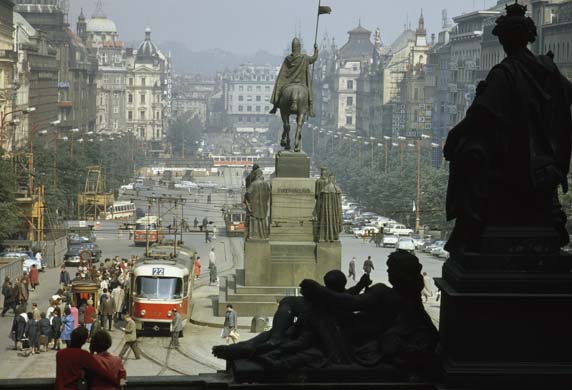
Warsaw Pact tanks invade Prague. People are depicted going about their daily business as the tanks sit just a short distance from them
Looking back, I can’t help feeling we missed the boat. Marxists? Then why weren’t we in Warsaw debating the last shards of Communist revisionism with the great Leszek Kolakowski and his students? Rebels? In what cause? At what price? Even those few brave souls of my acquaintance who were unfortunate enough to spend a night in jail were usually home in time for lunch. What did we know of the courage it took to withstand weeks of interrogation in Warsaw prisons, followed by jail sentences of one, two, or three years for students who had dared to demand the things we took for granted?
For all our grandstanding theories of history, then, we failed to notice one of its seminal turning points. It was in Prague and Warsaw, in those summer months of 1968, that Marxism ran itself into the ground. It was the student rebels of Central Europe who went on to undermine, discredit, and overthrow not just a couple of dilapidated Communist regimes but the very Communist idea itself. Had we cared a little more about the fate of ideas we tossed around so glibly, we might have paid greater attention to the actions and opinions of those who had been brought up in their shadow.
No one should feel guilty for being born in the right place at the right time. We in the West were a lucky generation. We did not change the world; rather, the world changed obligingly for us. Everything seemed possible: unlike young people today we never doubted that there would be an interesting job for us, and thus felt no need to fritter away our time on anything as degrading as “business school.” Most of us went on to useful employment in education or public service. We devoted energy to discussing what was wrong with the world and how to change it. We protested the things we didn’t like, and we were right to do so. In our own eyes at least, we were a revolutionary generation. Pity we missed the revolution.Prague in 1968 (photo and text here from The Guardian):
Warsaw Pact tanks invade Prague. People are depicted going about their daily business as the tanks sit just a short distance from them
The physical book in a digital world .... melts away ....
Jason Epstein reviews, in the NY Review of Books, the inevitability of digitization, and concludes:
It is not the digitization that worries me at all--after all, without the binary digits, this blogging itself won't be possible!
It is Bradbury's bottom-line in the shockingly accurate prediction of how anti-intellectual we will become, surrounded by television screens and disconnected from society ..... that is worrisome. Every time a huge gazillion inch high definition television set is purchased, it further pushes us into a hedonistic life. A hedonistic life where nothing else matters.
Now, in an existential framework within which I mostly approach life, well, I am absolutely ok with whatever people want to make of their lives--I suppose my worry stems from the high probability that the hedonism is not a result of informed decision-making. And it is not based on being well-informed because, hey, that HD TV means no reading or thinking. After all, as Bradbury notes in Fahrenheit 451, thinking makes people depressed :)
My rooms are piled from floor to ceiling with books so that I have to think twice about where to put another one. If by some unimaginable accident all these books were to melt into air leaving my shelves bare with only a memorial list of digital files left behind I would want to melt as well for books are my life. I mention this so that you will know the prejudice with which I celebrate the inevitability of digitization as an unimaginably powerful, but infinitely fragile, enhancement of the worldwide literacy on which we all—readers and nonreaders—depend.Epstein's description of books melting away triggers in my mind images of the firemen from Ray Bradbury's Fahrenheit 451, and the machine/dog that is used to sniff out and track down the protagonist, Guy Montag.
It is not the digitization that worries me at all--after all, without the binary digits, this blogging itself won't be possible!
It is Bradbury's bottom-line in the shockingly accurate prediction of how anti-intellectual we will become, surrounded by television screens and disconnected from society ..... that is worrisome. Every time a huge gazillion inch high definition television set is purchased, it further pushes us into a hedonistic life. A hedonistic life where nothing else matters.
Now, in an existential framework within which I mostly approach life, well, I am absolutely ok with whatever people want to make of their lives--I suppose my worry stems from the high probability that the hedonism is not a result of informed decision-making. And it is not based on being well-informed because, hey, that HD TV means no reading or thinking. After all, as Bradbury notes in Fahrenheit 451, thinking makes people depressed :)
Subscribe to:
Posts (Atom)