Showing posts with label nobel prize. Show all posts

Sunday, January 10, 2016

Peace is War. Slavery is Freedom. Strength is Ignorance.

The Nobel Peace Prize has never been without controversies.  Take the case of Mohandas "Mahatma" Gandhi, for instance:
Gandhi was nominated in 1937, 1938, 1939, 1947 and, finally, a few days before he was murdered in January 1948.
Gandhi was not recognized for the phenomenally peaceful methods he preached and practiced.
Up to 1960, the Nobel Peace Prize was awarded almost exclusively to Europeans and Americans. In retrospect, the horizon of the Norwegian Nobel Committee may seem too narrow.
"In retrospect" the Committee ought to feel awful about handing the prize to Barack Obama too, as I have often blogged about!


A few months ago, I blogged about another Nobel Peace Prize recipient behaving in ways that were anything but about peace.  "What a shame!" I commented about Aung San Suu Kyi's silence over the systematic campaign against the country's Rohingya.  She intentionally even shut off the strong advice from two other Peace Prize honorees: the Dalai Lama and Desmond Tutu.

In his column, Nicholas Kristof writes about the wily politician that Aung San Suu Kyi is:
She is now a politician, and oppressing a minority like the Rohingya is popular with mostly Buddhist voters.
Oh, wow, what a surprise!  How awful a politician is she?
Aung San Suu Kyi avoids even saying “Rohingya.”
Kristof writes:
Aung San Suu Kyi is also inheriting the worst ethnic cleansing you’ve never heard of, Myanmar’s destruction of a Muslim minority called the Rohingya.
A recent Yale study suggested that the abuse of the more than one million Rohingya may amount to genocide; at the least, a confidential United Nations report to the Security Council says it may constitute “crimes against humanity under international criminal law.”
Yet Aung San Suu Kyi seems to plan to continue this Myanmar version of apartheid.
Of course, I agree with Kristof when he concludes:
Defenders of Myanmar and of Aung San Suu Kyi note that the country has many problems; they see the Rohingya as one misfortune in a nation with a vast swath of misfortunes. The priorities, as they see them, are economic development, democracy and an end to the country’s many local conflicts, and they protest that it’s myopic to focus on the problems of one ethnic group in a nation so full of challenges.
Yet to me, there is something particularly horrifying about a government deliberately targeting an ethnic group for destruction, locking its members in concentration camps and denying them livelihood, education and health care. When kids are dying in concentration camps, after being confined there because of their ethnicity, that’s not just one more problem of global poverty. It’s a crime against humanity, and addressing it is the responsibility of all humanity.
Strip her of the Nobel, I say.

Friday, October 08, 2010

"I do not feel guilty for following my constitutional right to freedom of expression"

The Nobel Peace Prize recipient:
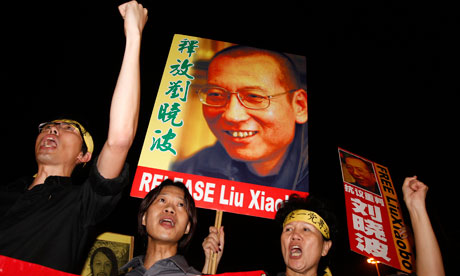
The award of the 2010 Nobel Peace Prize to Chinese dissident Liu Xiaobo follows an occasional precedent of recognizing human rights campaigners who are either imprisoned or subjected to state restrictions or harassment.
In announcing the prestigious award, Norwegian Nobel Committee President Thorbjoern Jagland cited Liu for his "his long and non-violent struggle for fundamental human rights in China." Liu is currently serving an 11-year jail sentence in China for inciting subversion of state power.
China is pissed :
The Beijing government summoned the Norwegian ambassador in protest. It called Mr Liu a "criminal", said the award violated Nobel principles and could damage relations with Norway. ...
Foreign ministry spokesman Ma Zhaoxu said: "Liu Xiaobo is a criminal who violated Chinese law. It's a complete violation of the principles of the prize and an insult to the peace prize itself for the Nobel committee to award the prize to such a person."
Here is an excerpt from Liu's statement from December 2009: (ht)
Ask me what has been my most fortunate experience of the past two decades, and I’d say it was gaining the selfless love of my wife, Liu Xia. She cannot be present in the courtroom today, but I still want to tell you, my sweetheart, that I'm confident that your love for me will be as always. Over the years, in my non-free life, our love has contained bitterness imposed by the external environment, but is boundless in afterthought. I am sentenced to a visible prison while you are waiting in an invisible one. Your love is sunlight that transcends prison walls and bars, stroking every inch of my skin, warming my every cell, letting me maintain my inner calm, magnanimous and bright, so that every minute in prison is full of meaning. But my love for you is full of guilt and regret, sometimes heavy enough hobble my steps. I am a hard stone in the wilderness, putting up with the pummeling of raging storms, and too cold for anyone to dare touch. But my love is hard, sharp, and can penetrate any obstacles. Even if I am crushed into powder, I will embrace you with the ashes.
Given your love, my sweetheart, I would face my forthcoming trial calmly, with no regrets about my choice and looking forward to tomorrow optimistically. I look forward to my country being a land of free expression, where all citizens’ speeches are treated the same; where, different values, ideas, beliefs, political views... both compete with each other and coexist peacefully; where, majority and minority opinions will be given equal guarantees, in particular, political views different from those in power will be fully respected and protected; where, all political views will be spread in the sunlight for the people to choose; all citizens will be able to express their political views without fear, and will never be politically persecuted for voicing dissent; I hope to be the last victim of China’s endless literary inquisition, and that after this no one else will ever be jailed for their speech.
Freedom of expression is the basis of human rights, the source of humanity and the mother of truth. To block freedom of speech is to trample on human rights, to strangle humanity and to suppress the truth.
I do not feel guilty for following my constitutional right to freedom of expression, for fulfilling my social responsibility as a Chinese citizen. Even if accused of it, I would have no complaints. Thank you!
Powerful statement.

Thursday, October 07, 2010

I learnt from Mario Vargas Llosa's letters ...

On Sunday, eagerly anticipating the news about the Nobel Prize announcements, I wrote that in literature I am rooting for Mario Vargas Llosa .... need I say I am excited this morning :)
Peruvian Mario Vargas Llosa won the Nobel Prize in literature on Thursday, the Swedish Academy announced.
Vargas Llosa was chosen "for his cartography of structures of power and his trenchant images of the individuals resistance, revolt, and defeat," the academy said.
One year, I used one of his books for a class.  Yes, I did.  But, it wasn't a fiction work of Llosa's ... it was his Letters to a young novelist ... now, I wasn't teaching any fiction-writing class; it was one of the ways in which I attempted to convey to students how to do research, how to write, how to think through ... That was the only time I used this book by Llosa because it was quickly clear to me--much to my disappointment--that not one student cared about it ...

Wednesday, June 23, 2010

Can there be a good Commie?

In an op-ed in the Boston Globe, Jeff Jacoby writes that there is no "good" Communist.  He writes it in the context of the death of Portuguese writer--Nobel laureate--Jose Saramago, and the stream of obituaries that noted his Communist affiliation:
not just a nominal communist, as his obituaries pointed out, but an “unabashed’’(Washington Post), “unflinching’’ (AP),“unfaltering’’ (New York Times) true believer. A member since 1969 of Portugal’s hardline Communist Party, Saramago called himself a “hormonal communist’’ who in all the years since had “found nothing better.’’ Yet far from rendering him a pariah, Saramago’s communist loyalties have been treated as little more than a roguish idiosyncrasy. Without a hint of irony, AP’s obituary quoted a comment Saramago made in 1998: “People used to say about me, ‘He’s good but he’s a communist.’ Now they say, ‘He’s a communist but he’s good.’ ’’
But the idea that good people can be devoted communists is grotesque. The two categories are mutually exclusive. There was a time, perhaps, when dedication to communism could be absolved as misplaced idealism or naiveté, but that day is long past. After Auschwitz and Babi Yar, only a moral cripple could be a committed Nazi. By the same token, there are no good and decent communists — not after the Gulag Archipelago and the Cambodian killing fields and Mao’s“Great Leap Forward.’’ Not after the testimonies of Alexander Solzhenitsyn andArmando Valladares and Dith Pran.
In the decades since 1917, communism has led to more slaughter and suffering than any other cause in human history. Communist regimes on four continents sent an estimated 100 million men, women, and children to their deaths — not out of misplaced zeal in pursuit of a fundamentally beautiful theory, but out of utopian fanaticism and an unquenchable lust for power.
Reason, which was the link to this op-ed, has quite a collection here
Jacoby notes:
Communism is not, as its champions like to claim, an appealing doctrine that has been perverted by monstrous regimes. It is a monstrous doctrine that hides behind appealing rhetoric. It is mass crime embodied in government. Nothing devised by human beings has caused more misery or proven more brutal.

Friday, April 09, 2010

"Hard" sciences, indeed ...

Reading the autobiographical essay by the recent Nobel Laureate in Chemistry, V. Ramakrishnan, was educational, informative, and humbling in so many ways. 
His sheer dedication and perseverance is simply awesome .... To be awarded a Nobel in the sciences at a "young" age of 57 means that he has packed in those years experiences that would take me more than a couple of lifetimes!!!
For starters, here is one paragraph:
After my marriage at the age of 23, I was suddenly no longer alone but had a wife and a five-year-old stepdaughter, Tanya Kapka. This sudden change in my responsibilities made me realize that I had to get on with my career. I produced a passable thesis in the next year and obtained a Ph.D. in physics in 1976 just a month before our son Raman was born. But by that time I had already decided I was going to switch to biology.
Let me see ... he has a PhD in physics by the age of 24, is married with two children and decides to switch to biology and then goes to grad school on that .... and does that, and more ...
Ramakrishnan ends the essay with:
On my return to Cambridge in early January, things slowly began returning to normal after the euphoria of the autumn. I began to realize that the Nobel Prize could be seen not just as an affirmation of my past work but also as an encouragement to continue to work on interesting problems. Certainly, it seems to have fired up people in my laboratory, and I look forward to the struggles ahead as we try to answer some of the hard questions in our field and beyond. Looking back on my life so far, I feel a deep sense of gratitude for having been able to lead such a rich life both intellectually and personally.
Read the entire essay here

Tuesday, February 23, 2010

Paul Krugman will be at the AAG annual meeting

A neat essay in the New Yorker on how Paul Krugman the economist found politics as well ...
I am all the more looking forward to his talk at the upcoming annual meeting of the AAG, on April 16th.  I would assume that it will be an overcrowded hall for this event :)

Given that I deal mostly with economic geography, I was waiting for that dimension of Krugman's to unfold in the essay, and it is pretty neat:

Later on, Krugman became interested in economic geography, in the related question of why there were regional specialties—why, in the United States, for instance, were cars produced in Detroit, carpets in Dalton, Georgia, jewelry in Providence, and chips in Silicon Valley? Again, the answer turned out to be history and accident. Once an industry started up in one place, for whatever reason (the carpet industry in Dalton appears to have its origin in a local teen-ager who in 1895 made a tufted bedspread as a wedding present), local workers became trained in its methods, skilled workers from elsewhere moved there, and related businesses sprang up close by. Then, as more skilled labor became available, the industry could grow and benefit from economies of scale. Soon, as long as it didn’t cost too much to transport the industry’s products, the advantages of the place would be such that it would be impractical for someone to open up a similar business anywhere else. Many economists found the idea that economic geography could be so arbitrary “deeply disturbing and troubling,” Krugman wrote, but he found it exciting.
Again, as in his trade theory, it was not so much his idea that was significant as the translation of the idea into mathematical language. “I explained this basic idea”—of economic geography—“to a non-economist friend,” Krugman wrote, “who replied in some dismay, ‘Isn’t that pretty obvious?’ And of course it is.” Yet, because it had not been well modelled, the idea had been disregarded by economists for years. Krugman began to realize that in the previous few decades economic knowledge that had not been translated into models had been effectively lost, because economists didn’t know what to do with it.

At the AAG meetings last year, they devoted a session to Krugman receiving the Nobel Prize and what this meant for economic geography.  But, they made quite a mess of it. 

Of course, as one who still enjoys a little bit of freedom of expression, despite the best (worst?) efforts of some of my faculty colleagues to silence me, I did share my feelings with the session's organizer :)  Even though this posting is already too long, here is that email I sent in March 2009:
I was delighted when I noticed in the program a session devoted to Paul Krugman's Nobel Prize for his work in economic geography. 

As a member of the geography department in a teaching university, one of the reasons I look forward to the AAG is for the continuing education benefits from attending sessions.  Particularly when the demands of teaching require me to spread my intellectual interests across a range of courses.  However, for the most part, the session on Paul Krugman did not advance the discussion more than how the Economist summarized it in 1999--almost exactly to the day of the session, ten years ago. 

After my comments, I have copied/pasted the article from the Economist, and the word "geographers" is highlighted throughout because of the keyword search I had employed.  I remembered that piece because (a) it came at a time that Krugman was rapidly transitioning into a public role, and (b) I have used that many times over the ten years, including in a book review in Professional Geographer.

I found it equally puzzling that the geographer mentioned in that article, Professor Ron Martin, was not one of the panelists.  Well, there could have been any number of logistical reasons behind it.  But, puzzling nonetheless.  Anyway, my thanks to Professor Martin for his observations towards the end of the session when it was opened up to comments from the floor.

Well, even if I did not find the session at a level I initially expected, my thanks to you for organizing this session.  I hope that this session will be the beginning of a series of conversations on forging a truly new economic geography that marries the best ideas and methods of economists and geographers.

************
"Knowing your place"
Economist; 03/13/99, Vol. 350 Issue 8110, p92-92, 1p
Economists say they have rediscovered geography. Geographers are interested to hear it. They didn't know they had been away
THE leading light of the "new economic geography" is Paul Krugman, professor of economics at MIT. These days he is widely known for his popular books and magazine columns, where his speciality is to explain economics in straightforward terms while pouring scorn on rival experts such as Lester Thurow and Robert Reich. Mr Krugman is a brilliant writer of economics for non-specialists. Annoyingly, he is at least as good at the real thing. The "new economic geography" has lately been a chief interest, developing as it does from his earlier research in "new trade theory".
It is too soon to say whether this new area of work, like its predecessor, will become a major field of research in its own right. But it is not too early for geographers to be very annoyed that economists are roaming blithely across their land.
In a new paper, Ron Martin, from the geography department at the University of Cambridge, surveys the "new economic geography" with the critical eye of an actual geographer-and makes some interesting points. As will become clear, much of what he has to say applies not just to new economic geography but also to much else of what economic theorists spend their time on these days.
Mr Martin explains that the two main branches of new economic geography-one of them concerned with clusters of activity, the other with regional growth disparities-raise questions that are entirely familiar to geographers.
On clusters, economists start with the idea that centripetal and centrifugal forces are in opposition when firms choose where to locate. The agglomerating forces are "externalities" such as the ability to tap into an established local market for appropriate labour and intermediate goods. The dispersing forces are the costs of congestion, and the bidding-up of prices for land and labour. In models of clustering, transport costs and labour mobility usually have a central role: if transport is cheap and labour is mobile, agglomeration will tend to outweigh dispersal (and the converse).
According to Mr Martin, these and other models "generate a dull sense of deja vu . . . Geographers were busy analysing industrial location in these terms back in the 1960s and 1970s."
Much the same goes for the other sort of models-the kind concerned with convergence (or lack of it) in regional incomes. Again, according to Mr Martin, the economists arrived late for the meeting. Their starting point was the comparatively recent finding that incomes among regions converge more slowly than the standard neoclassical model of growth would predict. (This model embodies diminishing returns, meaning that as you invest more, you get a smaller return-so poor regions should catch up.) New economic geographers are examining the reasons for this slow convergence. Again, Mr Martin observes that their work "merely revives" ideas proposed more than 30 years ago in proper geography.
He goes further. The geographers have not only been there and done that, they have given it up as a fruitless enterprise and moved on. The real problem with new economic geography, they believe, is its obsession with mathematical modelling. The economists sometimes argue that geography came to a halt way back because the mathematical tools of the day were not up to the job. Imperfect competiton features prominently, for instance, and clever maths is needed to deal with it. Now those tools are available-their use in economics pioneered by specialists in industrial organisation and trade-so economists can breathe new vigour back into the lifeless body of geography.
No, not quite, says Mr Martin. It wasn't mathematical backwardness that led geographers away from this approach but the conviction that to rely too heavily on maths was a dead end. Geographers realised that "formal mathematical models impose severe limits on our understanding. Geographers became more interested in real economic landscapes, with all their complex histories and local contexts and particularities . . ."
A specific complaint is that an economist may be happy to use the same model to explain clusters at completely different scales-at the international level, at the scale of core versus periphery within a single economy, among urban concentrations and even within city neighbourhoods. (Yes, that is just like an economist.) Geographers insist that profoundly different processes are at work at different scales. So modern geography is interested in a more "discursive" approach, piling on detail and colour, in "close explication of locally specific and contingent factors", in building models from the bottom up, not from the top down.
Mr Krugman's response is robust. The geographers are often simply anti-model, anti-quantitative, anti-clarity, he has written. The geographical literature uses terms likes post-Fordism-even Derrida gets a look in-and Mr Krugman finds that very off-putting. (So does this column, it must be said.) Mr Krugman's general defence of maths in economics, and his strictures on using it properly, seem right: economic statements are based on models, he has argued, whether you acknowledge their existence or not. Better to know the model you are using, if only to understand its limitations, than to kid yourself you have moved to a deeper, model-free plane. Quite so.
Yet who can deny, as the geographers complain, that at the frontier of research, abstract economic modelling and the real world have moved dispiritingly far apart? A meeting of minds ought to be possible: a middle ground between bottom-up and top-down. One day, maybe, but tempers will have to cool first.
The article by Mr Martin is "The New `Geographical' Turn in Economics", Cambridge Journal of Economics, January 1999. Among Mr Krugman's many writings on the subject are "Development, Geography and Economic Theory" (MIT Press, 1995).

Monday, October 12, 2009

More on the Nobel Prize for Peace

The nominations were due way back in February:
February – Deadline for submission. The Committee bases its assessment on nominations that must be postmarked no later than 1 February each year. Nominations postmarked and received after this date are included in the following year's discussions. In recent years, the Committee has received close to 200 different nominations for the Nobel Peace Prize. The number of nominating letters is much higher, as many are for the same candidates.

Sunday, October 11, 2009

The 3am phone call Obama didn't get :)

Remember that campaign commercial about the White House getting a phone call at 3:00 am?  It was neat how SNL wove that into Obama being awarded the Nobel Peace Prize.

Comedians worried that they might not be able to have fun with Obama as the president as they had when W and Clinton were in the White House.  Turns out not to be the case, fortunately for democracy.  Of course, Obama himself has been quite in the clear and no jokes about his individual self.  But, there is a theme emerging--while the jokes are about the events surrounding him, Obama is in the center of those jokes.

Friday, October 09, 2009

Nobel Peace Prize: the most glaring omission ever


From FP:

Mohandas K.  Gandhi was the spiritual and political leader of the Indian independence movement and an advocate of nonviolent resistance as a means to effect social change. Gandhi assumed a leading role in the Indian National Congress in 1921 and transformed the party into a mass movement dedicated to ending social and economic discrimination against Indians and achieving India's complete independence. He was also a vocal advocate for the emancipation of the Hindu "untouchable" class, as well as unity between the Hindu and Muslim communities. Following India's declaration of independence, he opposed the partition of India and Pakistan. Gandhi was shot and killed by a radical Hindu nationalist on Jan. 30, 1948.
More here

Here is Obama on his accomplishments thus far

HT

Friday, March 27, 2009

Paul Krugman's Nobel Prize, and Economic Geography

Though it seems like eons ago, it was just a couple of months ago that Krugman was awarded the Nobel. The day of the announcement (October 13, 2008), I wrote the following to my department colleagues:
hey, this is exciting.
am all the more excited because most of the courses i teach are either directly or indirectly about economic geography .... and krugman was one of the first neoclassical economists to systematically talk about a "new economic geography"
in his book Geography and Trade, krugman writes, "About a year ago I more or less suddenly realized that I have spent my whole professional life as an international economist thinking and writing about economic geography, without being aware of it"
it will be neat if neoclassical economics alters its course thanks to the 1-2-3 punch from Amartya Sen, Joseph Stiglitz, and Paul Krugman. but, maybe that is asking for too much, eh!
Thus, I was looking forward to the special session on Krugman and economic geography that I noticed in the program for the annual meeting of the premier professional organization for geographers--the Association of American Geographers.
But, the session did not live up to its billing. So, after thinking about it for a day or so, I emailed the following to the session organizer, with a copy to Professor Ron Martin:
Dear Professor Maskell:

I was delighted when I noticed in the program a session devoted to Paul Krugman's Nobel Prize for his work in economic geography.

As a member of the geography department in a teaching university, one of the reasons I look forward to the AAG is for the continuing education benefits from attending sessions. Particularly when the demands of teaching require me to spread my intellectual interests across a range of courses. However, for the most part, the session on Paul Krugman did not advance the discussion more than how the Economist summarized it in 1999--almost exactly to the day of the session, ten years ago.

After my comments, I have copied/pasted the article from the Economist, and the word "geographers" is highlighted throughout because of the keyword search I had employed. I remembered that piece because (a) it came at a time that Krugman was rapidly transitioning into a public role, and (b) I have used that many times over the ten years, including in a book review in Professional Geographer.

I found it equally puzzling that the geographer mentioned in that article, Professor Ron Martin, was not one of the panelists. Well, there could have been any number of logistical reasons behind it. But, puzzling nonetheless. Anyway, my thanks to Professor Martin for his observations towards the end of the session when it was opened up to comments from the floor.

Well, even if I did not find the session at a level I initially expected, my thanks to you for organizing this session. I hope that this session will be the beginning of a series of conversations on forging a truly new economic geography that marries the best ideas and methods of economists and geographers.

************
"Knowing your place"
Economist; 03/13/99, Vol. 350 Issue 8110, p92-92, 1p

Economists say they have rediscovered geography. Geographers are interested to hear it. They didn't know they had been away

THE leading light of the "new economic geography" is Paul Krugman, professor of economics at MIT. These days he is widely known for his popular books and magazine columns, where his speciality is to explain economics in straightforward terms while pouring scorn on rival experts such as Lester Thurow and Robert Reich. Mr Krugman is a brilliant writer of economics for non-specialists. Annoyingly, he is at least as good at the real thing. The "new economic geography" has lately been a chief interest, developing as it does from his earlier research in "new trade theory".

It is too soon to say whether this new area of work, like its predecessor, will become a major field of research in its own right. But it is not too early for geographers to be very annoyed that economists are roaming blithely across their land.

In a new paper, Ron Martin, from the geography department at the University of Cambridge, surveys the "new economic geography" with the critical eye of an actual geographer-and makes some interesting points. As will become clear, much of what he has to say applies not just to new economic geography but also to much else of what economic theorists spend their time on these days.

Mr Martin explains that the two main branches of new economic geography-one of them concerned with clusters of activity, the other with regional growth disparities-raise questions that are entirely familiar to geographers.

On clusters, economists start with the idea that centripetal and centrifugal forces are in opposition when firms choose where to locate. The agglomerating forces are "externalities" such as the ability to tap into an established local market for appropriate labour and intermediate goods. The dispersing forces are the costs of congestion, and the bidding-up of prices for land and labour. In models of clustering, transport costs and labour mobility usually have a central role: if transport is cheap and labour is mobile, agglomeration will tend to outweigh dispersal (and the converse).

According to Mr Martin, these and other models "generate a dull sense of deja vu . . . Geographers were busy analysing industrial location in these terms back in the 1960s and 1970s."

Much the same goes for the other sort of models-the kind concerned with convergence (or lack of it) in regional incomes. Again, according to Mr Martin, the economists arrived late for the meeting. Their starting point was the comparatively recent finding that incomes among regions converge more slowly than the standard neoclassical model of growth would predict. (This model embodies diminishing returns, meaning that as you invest more, you get a smaller return-so poor regions should catch up.) New economic geographers are examining the reasons for this slow convergence. Again, Mr Martin observes that their work "merely revives" ideas proposed more than 30 years ago in proper geography.

He goes further. The geographers have not only been there and done that, they have given it up as a fruitless enterprise and moved on. The real problem with new economic geography, they believe, is its obsession with mathematical modelling. The economists sometimes argue that geography came to a halt way back because the mathematical tools of the day were not up to the job. Imperfect competiton features prominently, for instance, and clever maths is needed to deal with it. Now those tools are available-their use in economics pioneered by specialists in industrial organisation and trade-so economists can breathe new vigour back into the lifeless body of geography.

No, not quite, says Mr Martin. It wasn't mathematical backwardness that led geographers away from this approach but the conviction that to rely too heavily on maths was a dead end. Geographers realised that "formal mathematical models impose severe limits on our understanding. Geographers became more interested in real economic landscapes, with all their complex histories and local contexts and particularities . . ."

A specific complaint is that an economist may be happy to use the same model to explain clusters at completely different scales-at the international level, at the scale of core versus periphery within a single economy, among urban concentrations and even within city neighbourhoods. (Yes, that is just like an economist.) Geographers insist that profoundly different processes are at work at different scales. So modern geography is interested in a more "discursive" approach, piling on detail and colour, in "close explication of locally specific and contingent factors", in building models from the bottom up, not from the top down.

Mr Krugman's response is robust. The geographers are often simply anti-model, anti-quantitative, anti-clarity, he has written. The geographical literature uses terms likes post-Fordism-even Derrida gets a look in-and Mr Krugman finds that very off-putting. (So does this column, it must be said.) Mr Krugman's general defence of maths in economics, and his strictures on using it properly, seem right: economic statements are based on models, he has argued, whether you acknowledge their existence or not. Better to know the model you are using, if only to understand its limitations, than to kid yourself you have moved to a deeper, model-free plane. Quite so.

Yet who can deny, as the geographers complain, that at the frontier of research, abstract economic modelling and the real world have moved dispiritingly far apart? A meeting of minds ought to be possible: a middle ground between bottom-up and top-down. One day, maybe, but tempers will have to cool first.

The article by Mr Martin is "The New `Geographical' Turn in Economics", Cambridge Journal of Economics, January 1999. Among Mr Krugman's many writings on the subject are "Development, Geography and Economic Theory" (MIT Press, 1995).
Monday, February 16, 2009

Economics is a ponzi scheme :-)

As an academic discipline, economics is at its lowest point now.  It is simply hilarious to see "Nobel" prize winning economists disagree with each other in blogs and opeds.  Simply soap-opera style to see words like "hysterical" and "freshman" and "econ101" being used to make fun of the other's arguments ..... aaah, I am so glad that economics is in such a disarray.  May I have a moment of schadenfreude?  
Yes, I read the Economist, WSJ, and mouth off economic jargon.  But, I have never believed that economics is a science, which is what "mainstream" economists wanted us to believe.  And they always were uber-confident with their mathematical models--always built on assumptions--and the results of those models.  With all those, it is simply ridiculous that they can't quite figure out how we got into this mess, and whether a stimulus will do any good, and how much good could it ever do--says a lot about the true state of the discipline.  Maybe the field of economics now itself has been built up as one big ponzi scheme :-)

Gregory Clark describes it thus:
The debate about the bank bailout, and the stimulus package, has all revolved around issues that are entirely at the level of Econ 1.  What is the multiplier from government spending?  Does government spending crowd out private spending?  How quickly can you increase government spending? If you got a A in college in Econ 1 you are an expert in this debate: fully an equal of Summers and Geithner.     

The bailout debate has also been conducted in terms that would be quite familiar to economists in the 1920s and 1930s.  There has essentially been no advance in our knowledge in 80 years.

It has seen people like Brad De Long accuse distinguished macro-economists like Eugene Fama and John Cochrane of the University of Chicago of at least one "elementary, freshman mistake."

It has seen Treasury Secretary Timothy Geithner, guided by Larry Summers, one of the most respected economists of our time, produce a bailout plan for the US financial system stunning in its faltering vagueness.

Bizarrely, suddenly everyone is interested in economics, but most academic economists are ill-equipped to address these issues. 

Recently a group of economists affiliated with the Cato Institute ran an ad in the New York Times opposing the Obama's stimulus plan.  As chair of my department I tried to arrange a public debate between one of the signatories and a proponent of fiscal stimulus -- thinking that would be a timely and lively session.  But the signatory, a fully accredited university macroeconomist, declined the opportunity for public defense of his position on the grounds that "all I know on this issue I got from Greg Mankiw's blog -- I really am not equipped to debate this with anyone."

Monday, October 13, 2008

The end of the Reagan/Thatcher revolution?

Thanks to the economic crisis, I hope we won't have to worry about the Reagan/Thatcher philosophy of political economy that resulted in the likes of Grover Nyquist and Tom DeLay. What a national nightmare that DeLay caused! Everything from closing access to Democratic representatives in the House, to personally overseeing mid-Census redistricting in Texas. Simply awful. Whatever intellectual merits the conservatives (not Republicans!) might have had, all we need is a poster of Nyquist and DeLay to make anybody run the other way.

Krugman's Nobel might well be the proverbial final nail. Reading some of the commentaries from the market-fundamentalist economists, including Mankiw himself, it appears that they are hopping mad that Krugman received the prize. My own suspicion is that they know that it will be years before they can regain the influence to shape intellectual fashions in economics. Or in social science, for that matter.

No, I have no false notions that this will lead to some big time leftist political policies. No Hugo Chavez, thank you very much. But, we might make some much needed corrections to the ultra-right approaches that preferred subsidies for the rich and cried against subsidies for the poor.

BTW, a reminder again that this is not a prize that is one of the original Nobel Prizes. In economics, it is an award in Nobel's memory, and the money for it comes not from Nobel's TNT wealth. The official name for the award is: The Sveriges Riksbank Prize in Economic Sciences in Memory of Alfred Nobel

Paul Krugman's Nobel Prize

This is exciting--particularly because he barely registered a blip in the pool that Greg Mankiw blogged about.
Am excited even more because most of the courses I teach are either directly or indirectly about economic geography .... and Krugman was one of the first neoclassical economists to systematically talk about a "new economic geography"
In his book Geography and Trade, which is a collection of his lectures, Krugman writes,

About a year ago I more or less suddenly realized that I have spent my whole professional life as an international economist thinking and writing about economic geography, without being aware of it
It will be neat if neoclassical economics alters its course thanks to Amartya Sen, Joseph Stiglitz, and Paul Krugman. but, maybe that is asking for too much, eh!
BTW, both Sen and Krugman were solo winners .... I think that these were also political statements by the committee--Sen's came after the collapse of LTCM, for which the previous year winner provided the brains! It was the committee's way of apologizing .... Krugman's selection reflects the need to change course from the maniacal approach to freer trade and less regulations.

Hey, this is my blog, and I am entitled to my opinions!
The video here is thanks to Google--it makes available on YouTube the talk and Q/A with authors who are invited to its SF headquarters