Showing posts with label congo. Show all posts

Saturday, October 01, 2016

la fleur du cobalt

Right from when I was a kid, I have always worried about how guilty I should feel.  As I wrote in this essay, one of my earliest lessons on this was when I realized that I was eating candies when across from me were kids my age who were begging.  I have been leading a life since then of trying to convince myself that I don't have to feel awful about everything around me.

But then that realization is also why I do what I do.  In my role as a university instructor, as an op-ed writer, as a blogger, I am able to get at least a few other people to think about the terrible stuff that is all around us and hope that as our collective awareness grows we can also address the human suffering.  

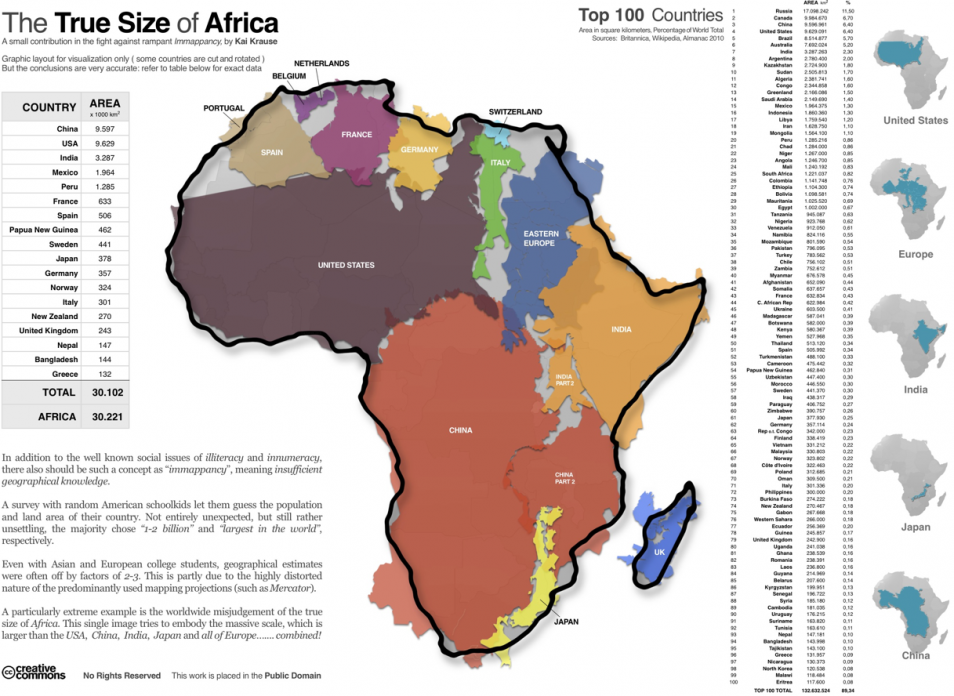
Yesterday's post was Syria.  Today, it is about Congo.  The huge country in the middle of a huge continent.  How huge is the Democratic Republic of Congo?  Think about Western Europe.  About two-thirds of Western Europe can fit into Congo.  

It is a country that is a sorry mess now.  Has been messed up for a long, long time.  And whether or not we care about the country, we are all intricately connected to it.  Here is one more way we are: Cobalt.  "60 percent of the world’s cobalt originates in Congo."

Cobalt. Who cares, right?
[It is a] mineral essential to the rechargeable lithium-ion batteries that power smartphones, laptops and electric vehicles made by companies such as Apple, Samsung and major automakers.
Without cobalt, you and I won't be in communication here--we would not have our laptops and smartphones.  Smartphones have five to ten grams of cobalt in them, while a laptop has about an ounce, the report says. "Cobalt is the most expensive raw material inside a lithium-ion battery."

Of course, this is not the first time that I am blogging about Congo.  Remember this post from a few months ago, on King Leopold's Ghost?
Under the reign of terror instituted by King Leopold II of Belgium (who ran the Congo Free State as his personal fief from 1885 to 1908), the population of the Congo was reduced by half -- as many as 8 million Africans (perhaps even 10 million, in Hochschild's opinion) lost their lives.
Some were beaten or whipped to death for failing to meet the rigid production quotas for ivory and rubber harvests, imposed by Leopold's agents. Some were worked to death, forced to labor in slavelike conditions as porters, rubber gatherers or miners for little or no pay.
Some died of the diseases introduced to (and spread throughout) the Congo by Europeans. And still others died from the increasingly frequent famines that swept the Congo basin as Leopold's army rampaged through the countryside, appropriating food and crops for its own use while destroying villages and fields.
A country that is rich in all kinds of resources, which is why the rest of the world has been messing around there for a long time.  Cobalt is merely the latest :(
Concern about how cobalt is mined “comes to the fore every now and again,” said Guy Darby, a veteran cobalt analyst with Darton Commodities in London. “And it’s met with much muttering and shaking of the head and tuttering — and goes away again.”
In the past year, a Dutch advocacy group called the Center for Research on Multinational Corporations, known as SOMO, and Amnesty International have put out reports alleging improprieties including forced relocations of villages and water pollution. Amnesty’s report, which accused Congo DongFang of buying materials mined by children, prompted a fresh wave of companies to promise that their cobalt connections were being vetted.
But the problems remained starkly evident when Post journalists visited mining operations in Congo this summer.
We mutter. We shake heads. We move on.  How awful!

So, why la fleur du cobalt in the title?  In the report, you will read about the tragic irony.  I urge you to read the entire piece, which is a phenomenal piece of investigative journalism.  And watch the videos there. And spread the awareness.  You and I could do at least that much.

Tuesday, March 29, 2016

King Leopold’s Ghost

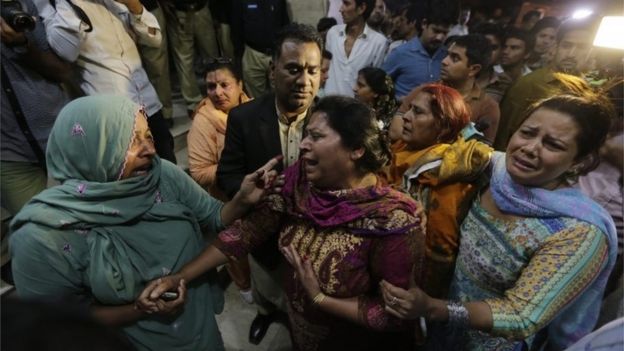
Terrorism strikes. 35 people killed and more than 300 injured.
Terrorism strikes again five days later.  On Holy Easter Sunday.  At least 72 killed, many of them children.

One received extensive front page news coverage for a couple of days, and the other was barely mentioned in the front page on the day after.

From the BBC

It is the same old story all over again.  When terrorists strike in Western Europe or North America, it is serious news.  When terrorists strike and kill way more people in the brown-skinned world, the attitude is pretty much along the lines of "who cares!"  As Rafia Zakaria notes in this op-ed:
 Two days after Sunday’s attack, Lahore has disappeared from the top headlines. Pakistan’s pain has already been extinguished from the global news cycle, its catastrophe a news item and not — as in Paris or Brussels — a news event. 
A hundred, two hundred years ago, it was the white skinned who terrorized the brown skins.  Take the case of Belgium, which was the recent site of terrorism in Western Europe, and Leopold,who was its king towards the end of the 19th century.  Even a simple Google search attempt results in this autofill:


Why is it referred to as a genocide in the Belgian Congo?  I have excerpted the following from an old (1998) New York Times article that I tracked down; it is a review of the book that I have also used as the title for this post:
 Under the reign of terror instituted by King Leopold II of Belgium (who ran the Congo Free State as his personal fief from 1885 to 1908), the population of the Congo was reduced by half -- as many as 8 million Africans (perhaps even 10 million, in Hochschild's opinion) lost their lives.
Some were beaten or whipped to death for failing to meet the rigid production quotas for ivory and rubber harvests, imposed by Leopold's agents. Some were worked to death, forced to labor in slavelike conditions as porters, rubber gatherers or miners for little or no pay.
Some died of the diseases introduced to (and spread throughout) the Congo by Europeans. And still others died from the increasingly frequent famines that swept the Congo basin as Leopold's army rampaged through the countryside, appropriating food and crops for its own use while destroying villages and fields. 
Perhaps based on all the data, somebody has already done calculations somewhere on how many brown skins equals one white skin.

I am, yet again, reminded of the narrow-minded empathy that we often tend to display:
It favors vulnerable children and animals, and discriminates against unattractive people. You’re more likely to sympathize with someone in your social group rather than an outsider, especially one who looks different.
The typical European looks more like the majority American and, thus, they are all in the same "social group" that triggers the tsunami of empathy?

At some point, the earlier the better, we need to truly, genuinely, understand that a human life somewhere in the world is as much a human life in any other part of the world.  The more we fail to even acknowledge this, and the more we continue to behave as if some humans are infinitely more valuable than others, I worry that we will face decades of bloodshed ahead.


Sunday, July 27, 2014

We are missing the story on a country called Africa

A plane goes down in Ukraine. We seem to kind of sort of know where that country is.  A plane goes down somewhere in that area bordering Mali, Algeria, Burkina Faso and, as the friend alerted me, even the Los Angeles Times then produces map about the country of Africa!
Of course, this is not the first time it has ever happened--if I had been paid a dollar for every time I corrected a student who incorrectly referred to Africa as a country, I would be a very rich man by now.

Whether it is students or reporters or the general public, the continent is nothing more than a big blob to most of us. A messed-up "country" out there somewhere.  Clueless we almost always are!  We do too little for the place we should all call home, right?


Plenty has been said and written about this atrocious marginalization of the vast geography and its people.  Anjan Sundaram adds to that commentary and he understates it when he notes:
Our stories about others tell us more about ourselves.
Yes! :(

A few weeks ago, NPR reviewed Sundaram's book, which was my first ever introduction to his work.  In his op-ed, Sundaram writes about his background, which I recall from that NPR report and this interview with Jon Stewart.
As a student in America, where I was considering a Ph.D. in mathematics and a job in finance, I would read 200-word stories buried in the back pages of newspapers. With so few words, speaking of events so large, there was a powerful sense of dissonance. I traveled to Congo, at age 22, on a one-way ticket, without a job or any promise of publication, with only a little money in my pocket and a conviction that what I would witness should be news.
I am always way impressed with people like Sundaram, who choose to walk away from the safety and comforts of the well-traveled roads--especially in his case after an undergraduate degree from the IIT at Madras, a graduate degree from Yale, and a job offer from Goldman Sachs.  Next to people like Sundaram, I am nothing but a facade, if at all. Always lacking his kind of a drive, determination, and dedication, it is no surprise that I am forever wondering whether I coulda been a contender!

As Sundaram writes about the news organizations and his life as a stringer for the AP:
Reporters move like herds of sheep, flocking to the same places at the same times to tell us, more or less, the same stories. Foreign bureaus are closing. We are moving farther away.
News organizations tell us that immersive reporting is prohibitively expensive. But the money is there; it’s just often misallocated on expensive trips for correspondents. Even as I was struggling to justify costs for a new round of reporting in Congo, I watched teams of correspondents stay in $300-per-night hotels, spending in one night what I would in two months. And they missed the story.
Parachuting in with little context, and with a dozen other countries to cover, they stayed for the vote but left before the results were announced. A battle broke out in Kinshasa after they left, and I found myself hiding in an old margarine factory, relaying news to the world, including reports to this newspaper.
And after he left?
For years after I left Congo, my position with The A.P. remained — as it is now — vacant. The news from Congo suffers as a result, as does our understanding of that country, and ultimately ourselves. Stories from there, and from places like the killing fields of the Central African Republic, are still distant, and they are growing smaller.
The vast "country" of Africa is getting more and more distant and smaller even as we talk about how the world is shrinking thanks to all the interconnectedness.  "Our stories about others tell us more about ourselves." Indeed!

Wednesday, June 30, 2010

Congo's Independence Day

While still groggy from the vicodin that I am on now (yes, the doctor's orders!) I heard on NPR that it is 50 years since Congo became independent.
Despite the wonderful effects of the chemical, I remembered the stingingly satirical piece from The Onion:

Sunday, June 27, 2010

Conflict minerals

We may be able to undercut some of the world’s most brutal militias simply by making it clear to electronics manufacturers that we don’t want our beloved gadgets to enrich sadistic gunmen. No phone or tablet computer can be considered “cool” if it may be helping perpetuate one of the most brutal wars on the planet.
More from Nicholas Kristof here ... and the YouTube video he refers to:

Saturday, April 24, 2010

The geography of slavery

Henry Louis Gates has a neat op-ed in the NY Times on the complexities of identifying the parties responsible for the horrible trans-Atlantic slave trade.

Gates refers to this database, where you find a treasure of maps on this subject, including the following map:

The topic of slavery is always like the topic of the Holocaust: every time I read something about these topics, I simply cannot understand how humans allowed these to happen. History is full of such atrocities, I suppose ... and, yet, even the President is so cautious about using the "genocide" word when he referred to the manner in which the Ottoman Turks practically wiped out a good chunk of the Armenians ...

Tuesday, February 23, 2010

Planet War, er, Earth

Foreign Policy has a neat photo-narrative on the various ongoing conflicts on this planet.  The photo here? Pakistan:
While Iraq and Afghanistan have captured much of the public's attention of late, Pakistan may well be the country whose security, stability, and partnership is most important to American success in the war on terrorism. Under increased pressure from the United States, Islamabad has recently begun to intensify its efforts at fighting the Taliban within its borders. While Pakistani forces have enjoyed some success in their counter-insurgency operations against the Taliban, such success has come at the cost of alienating civilian populations and destabilizing Pakistani society. Above is a photograph from June 21, 2009 of Pakistani refugees who fled from the fighting in northwest Pakistan and are now living in the Shah Mansoor relief camp in Swabi, Pakistan.

Thursday, January 07, 2010

Congo's stimulus plan: An AK-47 for everyone!

The folks are the Onion are simply way too well informed, wise, brilliant, and hysterically funny, to come up with stuff like this all the time.
It is a tragedy that the war and killings go on in the Congo, while we seem to be far more interested in Star Wars and Avatars .... oh well, I suppose we will continue to ignore Africa a lot more ...


Congo Approves Economic Stimulus Package Of AK-47 For Every Citizen