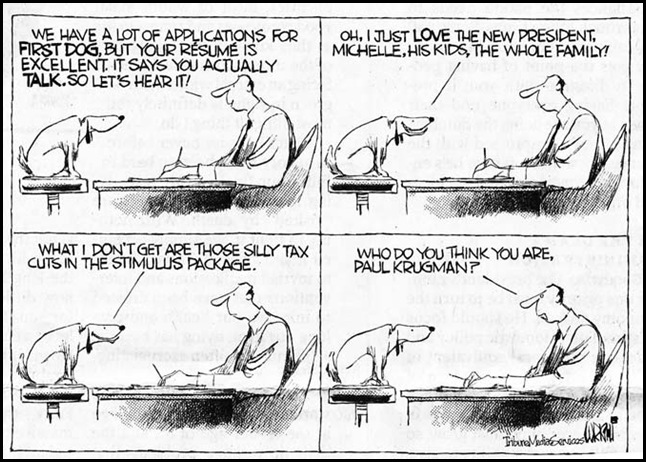
Showing posts with label deficit. Show all posts

Friday, November 09, 2012

Elections over. Back to the fiscal cliff now!

You, the reader, have two choices:
A: This video from the Wall Street Journal
Or,
B: This Daily Show video from a year ago, which I had blogged about on November 17, 2011
With Option A, you can watch and cry.

With Option B, you can watch and laugh.  And then realize that the joke is on us, and cry.

Aren't we happy with the status quo!

Saturday, June 04, 2011

Unemployment levels beyond compare. Why no discussion on this?

Nouriel "Dr. Doom" Roubini has a tweet that puts it quite well:
US economy now close to stall speed. From anemic recovery to tipping point to stall speed and growth recession. Is a double dip next?
Yet another reason I am simply relieved, even more than happy, that I have a job. A job that is secure. With indefinite tenure.

But, often across from me is the reality--students who are going to find it extremely difficult to find any job at all.

Yesterday, it was another lesson on the painful reality of unemployment.

I was merrily walking along the bikepath by the river, enjoying the fantastic spring day here.  Low 70s and nothing bu the sun.

And then all of a sudden I see a woman sprawled out on the grass by the path, with her cycle down, and a guy helping her out.

"Is there anything I can do to help?" I asked them.  She asked me to hand her the water bottle that was on her bike.

The guy was wiping the blood of her knee and shin.  Without lifting his head, he asked me "what is the shortest way from here to the main road for her friend to pick her up in a car?"  I had no idea.  I mean, I knew that there was one route, but that was at least half a mile to the road.

I offered to wait with her if he wanted to bike up to the nearby homes to figure things out.  He thought that might work.

While he was gone, I asked her how she was.  She was in a great deal of pain--couldn't move her left leg.  An older woman on her bike stopped by.  She took out her first aid kit--yes, she had one in a carrier in her bike--and before beginning to wipe the blood asked her "are there any pathogens in your blood I should be worried about?"

What an important question to ask in a very respectful way, I thought to myself.

Meanwhile, a couple more people stopped by.  All of us at some point asked the same question: should we call the emergency folks?

This is where the reality of unemployment kicks in.  She didn't want to call for the ambulance because "I have no insurance and am unemployed.  I can't afford to pay for it."

It is awfully shocking to come head-to-head with that kind of a reality.  A reality that exists only as a theoretical and intellectual possibility for me, but is everyday life for many.

She lucked out in a way--a fire engine and emergency crew happened to be on the bike path for some other reason, and they gave her emergency care that she needed.  And bundled up her leg.  They advised her to head to ER, but she preferred to go home with her friend.  The fire chief drove to get the get friend's vehicle over to the bike path and load her into the car.

A half-hour had gone by as I resumed my walk.  All the sight of blood and sound of pain had made me queasy. I was afraid I was going to either throw up or pass out.  Am glad I know my own limits and tolerances when it comes to such situations.  I couldn't wait to get home and drink a whole lot of water and settle my stomach and my mind.

Thus, after a good night sleep, here I am blogging about unemployment.  I can't but help wonder and worry that there is very little public discussion about the high levels of unemployment.  And, an unemployment where the jobless are being so for weeks on.


We are in historic territory when it comes to such long-term unemployment:
The average unemployed person in America has been looking for work for 39.7 weeks, or more than nine months. That is the longest average unemployment spell since the Labor Department started keeping track in 1948
Robert Reich writes:
The overall jobless rate rose to 9.1 percent.
Together with plummeting housing prices, falling wages for non-supervisory workers, a paltry 1.8 percent growth in the first quarter, and a precipitous drop in consumer confidence, the picture should be clear to anyone able to see clearly.
The recovery has stalled.
We’re not in a double dip yet, but the odds are increasing.
The question is whether all this will wake up Washington, and stop the monumental distraction of the games being played over the debt ceiling and long-term budget deficit. The Republican lie that the nation’s long-term budget deficit is responsible for high unemployment would be laughable if it weren’t so tragically irrelevant to the current situation.

Wednesday, May 18, 2011

The forgotten many: America's unemployed

Newspapers in Oregon have been trumpeting that unemployment in the state is now down to 9.6%
But, other than to spin any such positive story, the media has gone dead:
Major U.S. newspapers have increasingly shifted their attention away from coverage of unemployment in recent months while greatly intensifying their focus on the deficit, a National Journal analysis shows.
The analysis -- based on a measure of how often the words "unemployment" and "deficit" appear in major publications -- portrays a dramatically shifting landscape of coverage over the past two years, as the debate over how to fix the federal deficit has risen to prominence and the question of how to handle still-high unemployment has faded from the media's consciousness. ...
Mentions of unemployment have been dwindling since they spiked to 154 in the month ending August 15, 2010; over the month ending Sunday, there were 63. ...
That major newspapers and other media outlets have covered the deficit with greater intensity in recent months should come as no surprise given the focus of the politicians and policymakers they cover. The declining mentions of unemployment are perhaps more surprising, as the issue remains salient for millions of Americans.

The 9.6 percent in Oregon or the nationwide 9% is an under-count in many ways.  When looking at the entire labor force, unemployment is at 16.5 percent.

Of course, there is an entirely separate discussion to be had on what happens to the labor-age population that has been incarcerated?  "The overall unemployment rate among men would be about 8 percent higher if those in prison were out and experiencing the same labor market as others of their race and age. By expanding our prison population, we have reduced the unemployment numbers."

It is not only the journalistic media that has forgotten the unemployed--the literary and entertainment media, too, has apparently shut itself off:
Hollywood and the publishing industry have learned just one historical lesson from the Depression: people want entertainment in tough times.
The Grapes of Wrath, the films of King Vidor, even socially conscious gangster films from Warner Brothers were only a fraction of Hollywood's output then. The Depression was also the era of Fred and Ginger, Nick and Nora, screwball comedy and Busby Berkeley.
That hasn't changed. Writers, film-makers, game designers all want to eat - and that's the market they have to create for.
A line of poetry by T S Eliot composed at the same time Steinbeck was writing Grapes of Wrath, and Agee and Walker were having their report spiked, says it best. "Humankind / cannot bear too much reality."
But humankind has to live in the real world with other human beings. And if writers and artists won't put a human face on the jobless numbers, who will?

Monday, May 09, 2011

Quote of the day: Krugman on the Ryan plan for Medicare

Here’s an analogy: think of Medicare as a footbridge that is deteriorating and will eventually become unsafe. You could propose structural repairs to fix its faults; Ryan doesn’t do that. Instead, he proposes knocking the bridge down and replacing it with trampolines, in the hope that pedestrians can bounce across the stream. And the Post declares that he deserves credit for pointing out that the bridge is falling down, and proposing a solution. Um, we knew that the bridge was in bad shape — and his solution is a fraud.
Ah, the imagery of 80-year olds jumping on trampolines is priceless; can I use Ryan coupons to pay for that imagery?

Krugman's bottom line?
Republicans are proposing to destroy Medicare; saying that clearly isn’t scare tactics, it’s simply pointing out the truth.

Monday, March 28, 2011

I like Stiglitz's arguments on the deficit and debt. But, politics sucks!

Do I worry a lot about the growing trillions of dollars of debt?  Of course, yes.  Do I worry even more about the unemployment levels?  Yes, dammit.

Is there a way to address both?

Joseph Stiglitz says, ahem, yes, we can!  I like the points he makes, in explaining why he refused to sign off on the bipolar bipartisan group of former chairmen and chairwomen of the Council of Economic Advisers' letter "that stresses the importance of deficit reduction and urges the use of the Bowles Simpson Deficit Commission’s recommendations as the basis for compromise":
In my report, I outline the low-hanging fruit that could easily exceed the $4 trillion dollar target set by the Bowles-Simpson Commission. For example: (a) The Cold War ended more than two decades ago, but we continue to spend tens of billions on weapons that don’t work against enemies that don’t exist. Fruitless wars have not increased our security and our military’s credibility. Rather, they have undermined both.

We could have more security with less spending. The commission recognized this — but didn’t go far enough. Congress and the Obama administration have not gone far enough either.

(b) The health care reform bill did little to eliminate the trillion-dollar giveaway to the drug companies, resulting from restrictions on the ability of government (the largest buyer of drugs) to negotiate prices. In contrast to every other government in the world. While much more can, and should, be done to control health care costs, this little change would make a big difference.

Eliminating corporate welfare, both that hidden in our tax systems and in the hidden give-aways of our country’s natural resources to oil and gas and mining companies; eliminating the unjustifiable and harmful tax breaks for speculators and companies that keep their money out of the country, and taxing activities that generate large negative externalities—whether the environmental pollution that threatens our health and our children’s future, or the financial transactions that brought out country and the world to the brink of ruin—could all easily generate trillions of dollars in revenues. At the same time, they could also create a fairer society, a cleaner environment, and a more stable economy.

Deficit reduction is important. But it is a means to an end — not an end in itself. We need to think about what kind of economy, and what kind of society, we want to create; and how tax and expenditure programs can help achieve those goals.
Greg Mankiw, who was Bush's CEA Chair, differs. 

I am not sure whether one even needs to get into the content of their disagreement, or whether we can merely use the proxy qualifiers: Stiglitz headed the CEA during Clinton's presidency, and Mankiw had the job when "W" was the president.  I suppose it would be news if those two had advocated contrary positions.  Which makes me wonder then where the science of economic calculations is, and where the politics begin!

BTW, did you catch this news item about GE--the country's largest corporation--having paid no income taxes, thanks to all the gazillion tax loopholes that its army of accountants and lawyers exploit, after those loopholes were created thanks to the gazillion lobbyists? 
At a tax symposium in 2007, a G.E. tax official said the department’s “mission statement” consisted of 19 rules and urged employees to divide their time evenly between ensuring compliance with the law and “looking to exploit opportunities to reduce tax.”
Transforming the most creative strategies of the tax team into law is another extensive operation. G.E. spends heavily on lobbying: more than $200 million over the last decade, according to the Center for Responsive Politics. Records filed with election officials show a significant portion of that money was devoted to tax legislation.
 Ah, good ol' US of A.

Wednesday, March 09, 2011

The alarm bells over entitlements, deficits, and debt

And it is not even Halloween yet!

Along with the chart below, the Economist has this quick take:
The chart shows the proportion of GDP spent on entitlements and interest, compared with the proportion of GDP that the government is expected to raise in the form of revenues. ... As can be seen, entitlements and interest will absorb all government spending by 2025. ... In short, the fiscal position is deteriorating rapidly. Where then is the appetite for cutting entitlements or increasing taxes sharply?

Friday, February 25, 2011

Quote of the day, on California's higher education system

A phenomenon without a doubt, and without a peer:
California is arguably the heaviest-hitting state in any league of higher education. To find something comparable, you would have to aggregate the combined performance of the entire Northeastern United States. Massachusetts, Connecticut, Pennsylvania, New Jersey and New York together have produced precisely as many Shanghai top 50 institutions as California. And they have done so with the head start of an extra century or more of development, with the resources of a combined population base close to twice California's and, of course, with vast amounts of private-pocket financing.

The combined endowments of the 10 top-50 institutions on the East Coast top $80 billion. The West Coast's 10 top-ranked universities have a combined endowment of just over $21 billion, or about one-fourth of what their East Coast counterparts have amassed. Moreover, Stanford alone accounts for more than half of the endowment money held by the West Coast's top universities.

In other words, in terms of bang for the buck, the efficiency of California's university performance is staggering. Only a few state institutions in the Northeastern United States make it into the Shanghai top 50. All the others are plushly upholstered private institutions.
So, whatever happened to California, which finds itself in such a mess today?  

Tuesday, February 15, 2011

"Spend, spend, spend" say the Democans

Call them not Democrats or Republicans at Congress. Instead, refer to them as Democans.
When they talk about the budget without talking about the real big expenditures, I say that is a wonderful example of bipartisanship.
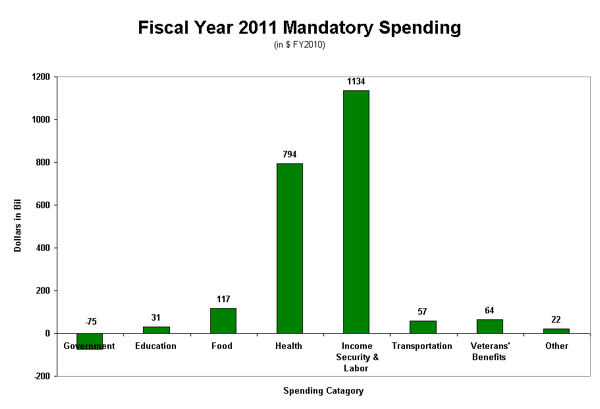
Neither one wants to talk about the mandatory spending, but that is where the real money is! (source for the graph, via)
So, what is in this mandatory spending that takes up nearly 60 percent of the budget?
If only the joke weren't on us voters!
And, of course, even within the Discretionary Spending, way too much agreement on the need to spend a gazillion billion on defense :(

I like how Ezra Klein sums up the situation:
Well, the business of the American government is insurance. Literally. If you look at how the federal government spends our money, it’s an insurance conglomerate protected by a large, standing army.

Monday, February 14, 2011

Thanks to Egypt for eclipsing Reagan's 100th birthday :)

So, Ronald Reagan's 100th birthday was hailed, for all practical purposes, only the the likes of Sarah Palin.  Most of the rest of America was engrossed in Jersey Shore the developments in Egypt and, of course, the Super Bowl mania.

It is awful that Reagan is being elevated to such levels of political saintliness.  Michael Kinsley's column from a few years back is a must read on the myths about Reagan.  But, for those who prefer not to read more than a few words, and like the Reagan story in a cartoon, well, here it is:

Monday, February 07, 2011

Chart of the day: America's defense spending

Just the facts, ma'am (ht):
How does this relate to the debt and deficit that we often worry about?  Let us check in with Alan Simpson, the co-chair of President Obama's National Commission on Fiscal Responsiblity and Reform (ht):

“We’re going to get rid of all earmarks, all waste, fraud and abuse, all foreign aid, Air Force One, all congressional pensions,” said Simpson on Sunday in an interview on CNN’s “State of the Union.” “That’s just sparrow belch in the midst of the typhoon. That’s about six, eight, ten percent of where we are. So, I’m waiting for the politician to get up and say, there’s only one way to do this: you dig into the big four, Medicare, Medicaid, Social Security, and defense. And anybody giving you anything different than that, you want to walk out the door, stick your finger down your throat, and give them the green weenie.”...
While many Republicans are still resisting cutting the defense budget, Simpson said that military spending needed to be addressed in order to seriously reduce the deficit. He said that the commission asked Sens. Dick Durbin (D-Ill.) and Kent Conrad (D-N.D.) about what they hear from the Defense Department about cutting contractors. “They don’t know how many contractors they have,” he said in amazement of the Pentagon. “It’s something between 250,000 and a million. So, our proposal is to cut 250,000 contractors out of the game.”
The Pentagon doesn't even know how many defense contractors it has?  Do they at least know how many billions we spend?

Monday, November 29, 2010

Stat/quote of the day: America's military spending

The U.S. defense budget is now about the same as military spending in all other countries combined.
That is Gregg Easterbrook (ht) writing about the out of control defense budget, which grows even despite mounting concerns over the deficit and debt.  Even under Barack "Change" Obama's presidency:
This year, the United States will spend at least $700 billion on defense and security. Adjusting for inflation, that’s more than America has spent on defense in any year since World War II—more than during the Korean war, the Vietnam war, or the Reagan military buildup. Much of that enormous sum results from spending increases under presidents George W. Bush and Barack Obama. Since 2001, military and security expenditures have soared by 119 percent.
And then Easterbrook has this nugget way towards the end of his essay, which has plenty of specifics:
The mindset of top-heavy spending has also infiltrated the realm of counterterrorism and intelligence. For security advice, the president now has a secretary of defense, a secretary of state, a director of national intelligence, a national security adviser, a Central Intelligence Agency, a National Security Council, a President’s Intelligence Advisory Board, a National Security Agency, a Defense Intelligence Agency, separate Air Force, Navy, Marine, Army, and even Coast Guard intelligence commands, a National Counterterrorism Center, an FBI Directorate of Intelligence, a State Department Bureau of Intelligence and Research, a National Reconnaissance Office, and a National Geospatial-Intelligence Agency. Even the Treasury Department has an Office of Terrorism and Financial Intelligence.
The specter of terrorism obviously required an improvement in intelligence. But spending for the sake of spending doesn’t make the nation any safer, while multiple overlapping bureaucracies may only slow reaction time. The new security hierarchies are sagging under the weight of senior-grade officials who spend much of their time in turf battles. Recently, the director of national intelligence, Dennis Blair, resigned after just 16 months on the job, after a sandbox squabble with the CIA over whose name comes first on memos. If that’s how people at the top of the security hierarchy are behaving, imagine how those in the middle are wasting the public’s time.

Friday, November 12, 2010

Party like there is no deficit!

The topic is pensions as one hell of a liability issue is not new to this blog.  So, the following serves as an addition to the collection:

Today there is an almost $500 billion shortfall for funding teacher pensions, and that gap is growing. Why should you care? Because ultimately taxpayers are on the hook for that money. But the problem doesn't just end there.
One would think that these and the other kind of future obligations will force us to worry, and do something, about the growing deficit and debt issues.  The preliminary thoughts from the "bipartisan" commission has already been declared dead on arrival.  It is kind of an irony in that the opposition is absolutely bipartisan--commentators of every stripe seem to be opposed to it.


Monday, October 25, 2010

Will someone please shut Krugman up

Leave it to the British (and Slate, here in the US) for bold and punny headlines.  In this case, a bold headline at the Daily Telegraph that says it all!  Really, I have borrowed the title for this post from there ...

Even before I get to the content, I could not understand why there is no question mark at the end of the headline :)

About the content itself, it is a squabble over the Lib-Con government's recent decision in favor of massive budget reductions.  Cameron is doubling down on a gamble that such reductions during this feeble recovery will actually do Britain good.  Krugman blasts that in his column and, hence, the response from Daily Telegraph, which is typically right of the political/economic center.

I suppose we will know in five years whose policy decisions turn out to be the correct ones.

As far as I am concerned, I yet again wonder if Krugman is diluting his value by pontificating a tad too much.  Even if Krugman is always correct, it might become like the nerdy guy in the class who always puts his hand up and provides the correct answer while the rest of the class begin to hate him for being so smart :) 

So, from a PR perspective, if not for the sake of content, perhaps Professor Krugman ought to chill for a while?

Friday, September 17, 2010

America's #1 problem "isn’t Islamo-fascism". It is debt.

Michael Kinsley puts it so well, as he always does:
The biggest peril Americans now face isn’t Islamo-fascism. It’s our own inability to live within our means. It would be nice to give our country the wisdom and self-discipline to stop running up the credit card. And we should try. But it’s unlikely that we can remake the national character (including our own) in 19 years. What we can do is offer a lecture and a fresh start. We should pass on to the next generation an America that’s free from debt. Instead of ignoring it, or arguing endlessly about whose fault it is and who should pay for it, Boomers as an age cohort should just grab the check and say, “This one’s on us.”
The "we" in this excerpt? The boomers.

Kinsley then threads the needle:
We may legitimately disagree about the timing of any Great Fiscal Clean-Up: do we need a second or third jolt of stimulus first to nail shut the coffin of the Great Recession, adding a trillion or more in IOUs to the pile before turning to the task of reducing the pile? Maybe so. But money well spent is still money spent. The Great Recession may have been a legitimate reason for putting off the day of reckoning—just as a cold may be a good reason to put off a necessary heart operation—but the cold doesn’t cure your heart problem or eliminate the need for the operation.
Not convinced?  Here are some hard data that Kinsley then provides:
pick a document at random from the pile. Here’s one: the latest annual “Long-Term Budget Outlook” of the Congressional Budget Office, published in June. The future is especially hard to predict at this moment, because current law includes several things that are unlikely to happen, such as the expiration of the George W. Bush tax cuts, and major unspecified cuts in defense and other spending programs. But making reasonable assumptions about these matters, the CBO projects that the national debt—nearly 62 percent of GDP—will rise to 87 percent of GDP by 2020 (a decade away), 109 percent (its previous peak, during World War II) by 2025, and 185 percent by 2035. “After that, the growing imbalance between revenues and noninterest spending, combined with spiraling interest payments, would swiftly push debt to unsustainable levels.”
Of course, I am with Kinsley all the way here. My blogging track-record also shows that I have forever been worrying about the rapidly growing debt.  It is simply bizarre that everybody talks about it, but nobody wants to do anything.  Nothing is done because reducing debt will require honest discussions about where government expenditures ought to be chopped off, and for every expenditure there is an equally strong lobby to retain that particular expenditure and cut somewhere else.

As the Economist notes:

To get spending down to the level we're taxed at, we'd have to cut back to persistent levels of federal spending we haven't seen in 50 years. Average federal spending in the 1960s was 18.6% of GDP. In the 1970s it was 20.1% of GDP. In the 1980s it was 22.2% of GDP. In the 1990s it was 20.7% of GDP. In the 2000s it was 20.0% of GDP. In the 1950s, federal spending was 17.6% of GDP, but in the 1950s, there was no Medicare or Medicaid.
And this is all the data can tell us. The data can't tell us whether we want to go back to the levels of federal spending we had in the 1950s. That's a question of value that voters have to decide.
The scarier aspect is that this is not the only story. Again, as I have blogged referring to a number of commentators, there is another issue as well--the budgetary crises at local and state governments. The only good news here is that these entities cannot print money as the federal government can!

Maybe the Onion was on the right track after all, in terms of how to solve this problem :)

U.S. Government Wipes Out National Debt

Sunday, July 25, 2010

A depressing read on economics and politics

Tell me if these two paragraphs don't make you bloody depressed even on a wonderful summer night with the full moon aglow:
My reading of contemporary Republican thinking is that there is no chance of any attempt to arrest adverse long-term fiscal trends should they return to power. Moreover, since the Republicans have no interest in doing anything sensible, the Democrats will gain nothing from trying to do much either. That is the lesson Democrats have to draw from the Clinton era’s successful frugality, which merely gave George W. Bush the opportunity to make massive (irresponsible and unsustainable) tax cuts. In practice, then, nothing will be done.
Indeed, nothing may be done even if a genuine fiscal crisis were to emerge. According to my friend, Bruce Bartlett, a highly informed, if jaundiced, observer, some “conservatives” (in truth, extreme radicals) think a federal default would be an effective way to bring public spending they detest under control. It should be noted, in passing, that a federal default would surely create the biggest financial crisis in world economic history.
That is from Martin Wolf's lengthy examination of the political aspects of supply-side economics. (ht)
If that does not depress you enough, here is how Wolf concludes his post:
The danger does not arise from the fiscal deficits of today, but the attitudes to fiscal policy, over the long run, of one of the two main parties. Those radical conservatives (a small minority, I hope) who want to destroy the credit of the US federal government may succeed. If so, that would be the end of the US era of global dominance. The destruction of fiscal credibility could be the outcome of the policies of the party that considers itself the most patriotic.
In sum, a great deal of trouble lies ahead, for the US and the world.
There is only one word to describe the situation ... fucked!


The Tory/LibDem alliance seems all the more attractive now.

Friday, July 23, 2010

The coming state government layoffs

Oregon's government, like many other states in the union, is looking at huge budget deficits, and reminders of this painful reality of the financial hole are aplenty.  It slowly begins to filter down to everyday life, such as the one described in the NY Times:
Since the start of the recession, at least 25 states and the District of Columbia have curtailed programs that include meal deliveries, housekeeping aid and assistance for family caregivers, according to the Center on Budget and Policy Priorities, a research organization. That threatens to reverse a long-term trend of enabling people to stay in their homes longer.
 My guess is that elected officials will have no choice but to either layoff government employees, or to force cuts in pay and benefits, or both.  And appointed officials will have no choice but to implement that decision.  As all these people do that, I hope they will exercise careful thought, and have empathy, as best demonstrated in this episode of Benson.