Showing posts with label EU. Show all posts

Monday, May 27, 2019

Caveat Emptor

I had some quick learning to do when I transitioned from electrical engineering to graduate studies in topics about which I was fascinated but were all brand new.  Every day I was encountering new phrases that might have been elementary to some but were the metaphorical Greek and Latin to me.  And sometimes they were literally in the Latin.

This was also in the prehistoric days before Google. Before the internet as we understand it today.  Which meant that any time I ran into new phrases, it was darn difficult to figure out what the hell it meant. Sometimes, despite my ultra-self-consciousness and introvertedness, I managed to get myself to faculty's offices and ask them to clarify.

One of the phrases that initially stumped me was caveat emptor.  I chanced upon a faculty searching for a book in the library.  Lowdon Wingo.  I had never come across such a name ever.  He was ancient even back then.  (He will one supercentenarian if he were alive now)  I gathered up all my courage and asked him what caveat emptor meant.

Buyer beware!

That, by itself, gave me a lot to think about the market system.

If the buyer is not carefully looking through the product details, then?  So long, sucker!  Uncle Sam doesn't really care about the human buyer, but is always far more keen on the most important person ever--the corporation!

Economic life in the US has not changed all that much over these years.
Across a span of cosmetics, including makeup, toothpaste and shampoo, to items ranging from household cleaners to fruit juice to cheese, hundreds of potentially harmful ingredients banned in the EU are legally allowed in the US. ...
“Generally, the EU has got it right. In the US we have a strong favouritism towards companies and manufacturers, to the extent that public health and the environment is being harmed. The pendulum has swung in an extreme way and it’s really going to take a general awakening by the public.”
Caveat emptor!

Want an example? "In cosmetics alone, the EU has banned or restricted more than 1,300 chemicals while the US has outlawed or curbed just 11."

Why is it so here in the US?
The clout of powerful industry interests, combined with a regulatory system that demands a high level of proof of harm before any action is taken, has led to the American public being routinely exposed to chemicals that have been rubbed out of the lives of people in countries such as the UK, Germany and France.
I don't  understand such a behavior.  Don't American industry leaders and lobbyists have children and grandchildren that they worry about?  Why would they not want to make sure their little ones will have an awesome future?  Why would they want to condemn those innocent kids to caveat emptor?

I know; that was a rhetorical question.  That was answered well in Thank you for smoking, remember?

Oh well ... so, is there any hope?
“I’m hoping for dramatic changes in our politics but there’s little chance of that,” said Bergstein. “The federal government is barely functioning, so consumers have to realize they have the power to become more vocal and demand change. The awareness is still not there, though.”
Caveat voter!

Saturday, June 04, 2016

Hit the road, (Union) Jack

For all the angry anti-colonialist that I am, even I can't believe that I am cheering Britain.  Cheering for Britain to exit the European Union.  Brexit, Brexit, Brexit!

This New York Times report sets up the context:
underlying all the dire predictions of doom — that staying or going will cause Britain to fall apart in various apocalyptic ways — is a deeper emotional issue that speaks to the country’s sense of self. Who does it think it is, and where does it think it belongs? Has it ever felt like it’s part of Europe?
It is a "deeper emotional issue" about whatever it is that provides value to people.  In the brief time that we get to live on this beautiful planet, we handle our existential crisis in so many different ways.  We try to answer the question of "who am I?" through many affiliations and ideas,  When people search for meaning, there are different institutions that provide them with comfort.  Even though I seem to be getting more convinced about my evidence-based atheistic framework, I do not go about criticizing what people believe in their respective faiths because I understand--and appreciate--how their religious beliefs help them with making meaning of their existence.  And especially about that great certainty that awaits all of us, irrespective of the beliefs.

The political identity also plays an important role. While I personally and intellectually recognize that the political identity is a freakish accident--being born in a country--it is very much like the accident of being born in a family that practices a particular religion, speaks a particular language, eats particular foods, listens to particular music, ... All these accidents together help with understanding our own place in the cosmos.

We err when we conclude that those institutions that give us various identities are irrelevant.  It is a huge mistake to force people into behaving as one.  It was along these lines that I blogged two years ago about Scotland's (failed) effort to break free; I wrote then:
We are so much wrapped up with the idea of globalization that we forget we are humans and we like, we love, identities.  Identities especially when there is a long and rich history of the peoples.  Economics--being materially well off--does matter to us, yes.  But, we seem to overlook that we do not live on bread alone.  There is a lot more than mere material satisfaction that makes us human.  Identity--religious, ethnic, linguistic, ... and often these are also intertwined.
The challenge, as I see it, is to figure out how to understand each other and engage in constructive cross-cultural relationships even while holding on to the identities and without making those identities as a metric for hierarchical comparisons.  The solution is not to erase the identities but to understand that we can create a much better future even as we tightly embrace whatever identity that we want to hold on to.


Friday, August 20, 2010

In trouble in France ... after all the way from India

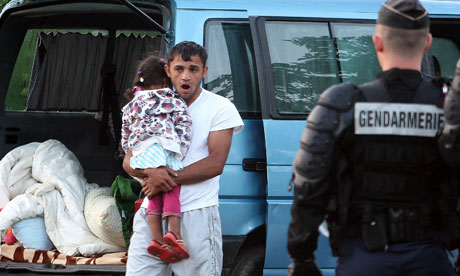
France, which loves to advice the rest of the world on anything and everything is deporting quite a few Roma:

"That's France for you," said one middle-aged woman, sitting dejectedly in pink flip-flops at the rue de Lyon squat. She, like all other Roma to whom the Guardian spoke, was unwilling to be identified. Intense media interest since the start of Nicolas Sarkozy's crackdown on crime and illegal immigration last month has made them uneasy in front of the cameras.
So, what happened?
In July, dozens of French Roma armed with hatchets and iron bars attacked a police station, hacked down trees and burned cars in the small Loire Valley town of Saint Aignan.
The riot erupted after a gendarme shot and killed a French Roma, 22-year-old Luigi Duquenet, who officials said had driven through a police checkpoint, knocking over a policeman. Media reports suggested he had been involved in a burglary earlier that day.
Duquenet's family dispute the police version of events, saying he was scared of being stopped because he did not have a valid driver's licence.
French President Nicolas Sarkozy called an emergency ministerial meeting, at which it was decided that some 300 illegal camps and squats would be dismantled within the coming three months.

Sakozy, who showed how brutally dogmatic he can be when it comes to dealing with minorities--remember how he dealt with the Algerian youth?--jumps into this harsh decision of deportation.  Romania, not that it has treated the Roma well within its own borders, cries xenophobia:
"We understand the position of the French government. At the same time, we support unconditionally the right of every Romanian citizen to travel without restrictions within the E.U.," Romanian President Traian Basescu said.
The rest of Europe is watching this closely:
The Council of Europe has expressed grave concerns at France's controversial deportation of Roma migrants.
“Recent developments in several European countries, most recently evictions of Roma camps in France and expulsions of Roma from France and Germany, are certainly not the right measures to improve the situation of this vulnerable minority. On the contrary, they are likely to lead to an increase in racist and xenophobic feelings in Europe,” Mevlüt Çavuşoğlu, President of the Parliamentary Assembly of the Council of Europe (PACE), declared on Friday.
Finally, why do the Roma wander anyway, right?
The Roma originated in India but left the subcontinent in the 11th century, perhaps following Muslim invasions. From there, they crossed into the Byzantine Empire, and then up to southeastern Europe by about 1300. Generally speaking, xenophobia made it difficult for them to stop in any one place for very long, let alone establish permanent settlements. (Since it's thought that the Roma adhered to strict purity codes, they may also have been reluctant to mix with outsiders, making assimilation unwanted on both sides.) When the Roma arrived in Western Europe in the 15th century, local populations worried they were part of an Ottoman invasion (because of their dark skin color) and the German Reichstag of Freiberg declared them outlaws. Barred from purchasing land or joining guilds, the Roma had no choice but to move about.
Another take on the Indian connection here.

But, the Roma have experienced worse things than Sarkozy.  Which is why I cheer when I read this:
many of the Romany families deported by France for outstaying their welcome were planning to head straight back.
“Of course we are thinking about going back,” 26-year-old Ionut Balasz told journalists as he arrived at the airport. “Life is better there than in Romania, even when you are illegal.”
Good luck to the Roma!

Tuesday, February 23, 2010

Saturday, March 07, 2009

Recession, trade limits don’t mix

I am not surprised at all that the stimulus package has “buy American” provisions in it. I suppose congressional leaders were reflecting the prevailing mood among the U.S. public, and even among most students in my introductory geography course.

My students’ “buy American” discussion was in the context of an assignment they had completed. I had asked them to pick 20 items at random in their apartments and note the countries where they were manufactured. They then had to identify any patterns they observed in the data.

As one would guess, about 50 percent to 60 percent of the goods they owned were manufactured in China. Barely a fifth of their “stuff” was made in the good ol’ USA. Some students were surprised to note that they owned things made in countries they did not even know existed.

The more we discussed the data, the more they seemed to be concerned about goods flooding this country from somewhere else. It didn’t take long before some of these students in an introductory geography class began wondering if we need to protect and encourage “our” businesses and not rely so much on China or other foreign countries.

The “buy American” provisions in the stimulus package reflect these same concerns. The package requires that only U.S.-made goods, particularly iron and steel, be used in public works and building projects that will be paid for by the stimulus dollars. Financial firms that are on government life support will not be able to hire foreign labor, either.

My typical response to students is to rely upon local examples. I ask them whether other countries might feel that importing planes manufactured by Boeing precludes the growth of an aircraft industry within their borders. I ask whether the import of Hollywood films is wiping out other countries’ native movie industry. I ask whether my students would be OK with those countries not buying our movies and planes.

It becomes clear that trade is a way of life, and imports and exports are basic characteristics of modern and successful economies — even during recessions. On the other hand, if countries implement a variation of autarky — the notion that a country should be self-sufficient and not engage in international trade — then the results are unfavorable.

India, during my formative years, practiced a version of “buy Indian” through an elaborate and regulated system of import-substituting industrialization. In this system, it was nearly impossible to get access to goods manufactured in another country. It didn’t matter whether it was chocolate or cement or cars, importing meant extensive governmental red tape and even bribes.

Had India continued down that path, it would not have undergone the economic and technological revolution that it has. The much joked-about call centers would not have been sited in India. Neither would Thomas Friedman have coined the phrase “the world is flat.”

As I have noted in earlier columns, absolute poverty in India has not been eliminated, and many other problems persist. But I am confident that the situation would be worse had India not switched its economic gears from autarky to policies that actively encouraged greater participation in the global economy.

So much to my students’ disappointment, I am not keen on closing our economy, even if only partially, with “buy American” provisions.

Also, the current economic crisis is not merely American but global. We are at a stage where China’s imports have dropped almost by half, and the economic contraction in Japan makes our recession look tame. So I am equally worried that other countries might start imitating America with their own versions of “buy domestically.” It is no wonder then that other key global players, including China and the European Union, already have warned us that they will keep a close watch on American protectionism.

To a large extent, the way out of this recessionary hole is by adopting a global slogan of “just buy, baby,” similar to Al Davis’ old tagline of “just win, baby” in the Oakland Raiders’ heyday. It’s simply unwise to chant, “just buy American, baby.”

Appeared in print: Sunday, Mar 8, 2009, page G3

Thursday, January 29, 2009

carbon emissions, and how to bypass them :-(

So, the Economist made me think about something that should have been pretty obvious to me, given that one of the topics I teach is the economic geography of resources. All these years I have been explaining to students how there is lots of oil under the North Sea, and how Norway is a huge oil exporter. And an exporter of natural gas too.
In other contexts, I have also talked about how Scandinavians value and cherish clean air, water, ....

Yet, I had completely failed to note the contradiction in Norway's image of cleanliness with its tremendously profitable exports--oil and natural gas--which are one hell of a polluter! What a moron, eh? Writes the Economist:
Yet for all its environmental piety, Norway is also a prodigious polluter. Its greenhouse-gas emissions have grown 15% since it adopted the carbon tax. They are still rising, and are likely to continue to do so until 2012, according to Mr Stoltenberg. As it is, Norway spews out more emissions per head than many other countries in Europe. And, in the eyes of many environmentalists, these statistics understate the damage Norway is doing to the atmosphere. It is the world’s third-biggest exporter of gas and fourth-biggest exporter of oil. The process of extracting these fuels from below the North Sea releases some greenhouse gases within Norway itself. But when the oil and gas Norway exports are burned abroad, they generate far more emissions.
Maybe Norway's situation is more a philosophical challenge than an economic one. It does remind me of accusations that Mother Teresa was accepting large donations from people who were renowned crooks. Her argument was that she didn't care who dropped what in the donation box!

But seriously, is it ethical to advocate for caring for the environment when the country exports a gazillion barrels of oil every year?

Well, that was a couple of days ago. And that was from a publication that is center-right. Another British publication, the Guardian, which never leans to the right, has an interesting news report--that
Britain's biggest polluting companies are abusing a European emissions trading scheme (ETS) designed to tackle global warming by cashing in their carbon credits in order to bolster ailing balance sheets.
The sell-off has helped trigger a collapse in the price of carbon, making it cheaper to burn high-carbon fossil fuels and leading to a fall in the number of clean energy projects.
The report adds:

The EU's emissions trading scheme was set up as a market solution to cut greenhouse gas pollution from industry. Polluters were issued with permits that can be traded between companies and countries as a way of encouraging an overall reduction in carbon output. However, companies are now cashing them in for their own financial benefit.

Up to €1bn-worth of carbon emissions permits are said to have been sold off in recent months as industrial companies see an opportunity to bring in funds at a time when their carbon output is expected to fall due to lower production.

Nothing makes sense anymore :-(