Showing posts with label euro. Show all posts

Thursday, August 13, 2015

No refund for you even if you don't understand what I am saying!

We live in magical times.  When we want something, all we need to do is go to a store and hand them colorful paper and walk away with that product.  Or, we slide a plastic and that product is all ours.  Better yet, we look at a magical screen while sitting comfortably on our beds, choose what we want, type in something, and a few hours to few days later, that arrives on our front steps from god-knows-where, .  It is one crazy world, if you were to stop and think about it.

What a contrast to the world that I have experienced in my own life, back when I was a child, which seems like it was only yesterday.  I can still picture in my mind visiting with the grandmother.  Early in the morning the "thayir" (yogurt) woman comes knocking.  I offer to help out.  Grandmother doesn't give me money to pay for it, but gives me rice to hand over to the thayir-woman.

Of course, we now refer to that as a barter system.  But, I can't help thinking that the thayir-woman didn't see any reason to receive in exchange a piece of paper--currency.  She preferred something that was tangible, something that was going to be immediately useful.

We have come a long way since those thayir-woman days.

Currency is all over the news now.  Over in Europe, the Greece-Euro dra(ch)ma continues.  Keep going east, and there is all that news and commentary over China's devaluation of its currency.

Paul Krugman had linked to this analysis, which I thought might make my life better.  I read the following:
There is, however, a more fundamental reason for the devaluation. China has been violating the impossible trinity. This notion says a country can only do on a sustained basis two of three potentially desired objectives: maintain a fixed exchange rate, exercise discretionary monetary policy, and allow free capital flows. If a country tries all three objectives then economic imbalances will build and eventually give way to some kind of painful adjustment.
It made me think it might be time for me to get that lobotomy that I have been putting off!

I was reminded of a play that we read back in high school.  It was called "The Refund."  The setup in this farce is a chance encounter that two old high schoolmates have decades after graduation.  The protagonist, Wasserkopf, says:
Here I was walking along the street, fired from my last job, and wondering how I could get hold of some cash, because I was quite broke. I met Leaderer. I said, ‘How goes it, Leaderer?’ ‘Fine!’ he says. ‘I’ve got to hurry to the broker’s to collect the money I made speculating in foreign exchange.’ ‘What’s foreign exchange?’ I said. He says ‘I haven’t got the time to tell you now, but, according to the paper, Hungarian money is down seventy points, and I’ve made the difference. Don’t you understand?’ Well, I didn’t understand. I said, ‘How do you make money if money goes down?’ and he says, ‘Wasserkopf, if you don’t know that, you don’t know a damn thing. Go to the school and get your tuition fees back.’ Then he hurried away and left me standing there, and I said to myself, ‘Why shouldn’t I do that?’ He’s right, now that I’ve thought it over. 
Of course, the principal and teachers make sure he does not get a refund, by explaining that his bizarre answers are all correct.  Reading all that news and commentary, I too feel like I want a refund of all my school fees.  I can't seem to understand any damn thing anymore.  It is not only with the currency, for that matter.  The fact that nobody can explain why The Donald is setting the terms of political debate means that we all deserve a free prefrontal lobotomy! ;)

I suppose everyday life will only get more and complicated as we move into the future.  The days of the thayir-woman and the easy to understand barter, are over.  Maybe we rush around because we don't want to stop and think about all these.  If we paused, we might sign up for a lobotomy!  Oh well, I have some grocery shopping to do and maybe I will buy yogurt too. ;)


Thursday, January 15, 2015

On the Swiss Franc and Euro. I demand a refund of my school fees. Wanna join me?

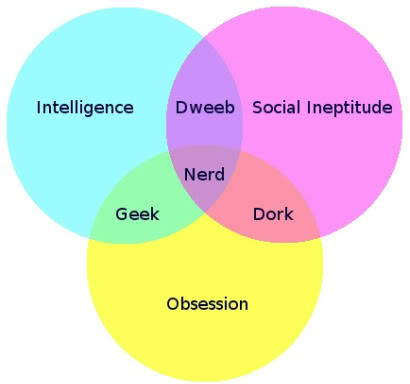
Yes, I have been a nerd all my life.  Now, keep in mind that there is a huge difference between a nerd and a geek.  Or a nerd and a dork. Definitely no dweeb, as this playful Venn diagram explains:

Source

The nerd in me remembers a whole lot of ideas and concepts, while maintaining a selective amnesia about people and events.  Thus, I remember about a play called Refund that was a part of the curriculum years ago in high school. Or, was it The Refund, I wonder.

A wonderful farce the play is, for which the setup is a chance encounter that two old high schoolmates have two decades after graduation.  A Google search provides me with the full text of the play; how about that!  Anyway, the setup is this--the protagonist, Wasserkopf, says:
Here I was walking along the street, fired from my last job, and wondering how I could get hold of some cash, because I was quite broke. I met Leaderer. I said, ‘How goes it, Leaderer?’ ‘Fine!’ he says. ‘I’ve got to hurry to the broker’s to collect the money I made speculating in foreign exchange.’ ‘What’s foreign exchange?’ I said. He says ‘I haven’t got the time to tell you now, but, according to the paper, Hungarian money is down seventy points, and I’ve made the difference. Don’t you understand?’ Well, I didn’t understand. I said, ‘How do you make money if money goes down?’ and he says, ‘Wasserkopf, if you don’t know that, you don’t know a damn thing. Go to the school and get your tuition fees back.’ Then he hurried away and left me standing there, and I said to myself, ‘Why shouldn’t I do that?’ He’s right, now that I’ve thought it over. 
Of course, the principal and teachers make sure he does not get a refund, by explaining that his bizarre answers are all correct.

I, too, want to get to get a refund because I, too, cannot fathom what the hell is going on with the Swiss Franc-Euro foreign exchange thing that has been in the news all day long.  Somebody made money and that wasn't me!  To add insult to the injury, when I read this in the Economist, it seemed to me that understanding theoretical physics will be immensely easier.  The WSJ tries to be helpful by dumbing things down, but that puts me only closer to asking for a refund of my fees.  Forbes makes it worse.

To this guy, whose favorite dreams are about money and taxes, well, I am sure he needs no refund, especially given his immense wealth.  I suppose I can console myself that my school fees at least paid for his understanding of all this money-mumbo-jumbo! ;)

Oh, wait ... does this mean that I was never a nerd but only a dork? ;)

Monday, March 18, 2013

Cyprus, Euro, and the Welfare State. A re-telling of Ant and the Grasshopper

A few weeks ago, while on my walk by the river, I had company that I had not planned on, when I slowed down to my neighbor's speed for most of the walk.  And we chatted.  While discussing our respective hobbies--I have none--he talked about this music interests.  "There must be a way for society to help out struggling musicians" he said.

I was not sure how seriously I needed to follow-up on that.  This was, after all, at a walk by the river.  But, I couldn't let that slide either.  I went for it.

"That is the kind of issues we are now struggling with.  Different kinds of work have varying levels of incomes associated with them.  So, if one chooses to follow a certain path that doesn't have the returns one expects, then should we really require those who opted for a different path to subsidize the former?  Or, should society worry only about those who, for physical or mental reasons, are unable to fend for themselves?"

I effectively killed that topic.  We continued on with other less controversial topics.

Before the birth of the modern welfare state, we might not even have had any need to engage in such discussions.  It was an unfair world where opportunities were highly unequal, based on the social class into which one was born--something beyond anybody's control.  Liberal democracies, especially in the post-WWII era, have been experimenting with policies that attempt to equalize those opportunities.  Some try to equalize the outcomes, which is what my neighbor seemed to want our society to do in the case of musicians.

The welfare state, with its heavy focus on equalizing outcomes, is a big factor in the ongoing Eurozone crisis. High levels of taxation on those with higher earnings helped pay for those who, like my neighbor's musician friend, either were in occupations that didn't pay much, or, even worse, opted to retire at 55 and spend the rest of their lives on pension from the state.

It really doesn't require that metaphorical PhD in rocket science to figure out that such a system is unsustainable.

Cyprus happens to be a collateral damage in this unsustainable setup, even though it was in a much better state than even its immediate neighbor, Greece.  In fact, it is that very neighbor that has messed up Cyprus:
Greece happened. Cypriot banks were heavily exposed to the Greek debt crisis, by virtue of having large bonds holdings of Greek debt, both public and private. The value of that debt took a nosedive, destroying the balance sheets of Cypriot banks. 
Here in the US, thanks to the myth of anybody making it, we are more interested in the equality of opportunities than in the equality of outcomes.  But, of course, we can't really make it an even playing field.  There is a limit to which government can intervene and make opportunities less unequal.  Truly equal it can/will never be.  Born into President Bush's family will result in opportunities that will be in plenty compared to being born to John and Jane Doe in Anytown, USA.

Where do we then draw the line on equalizing opportunities, or outcomes, or both?

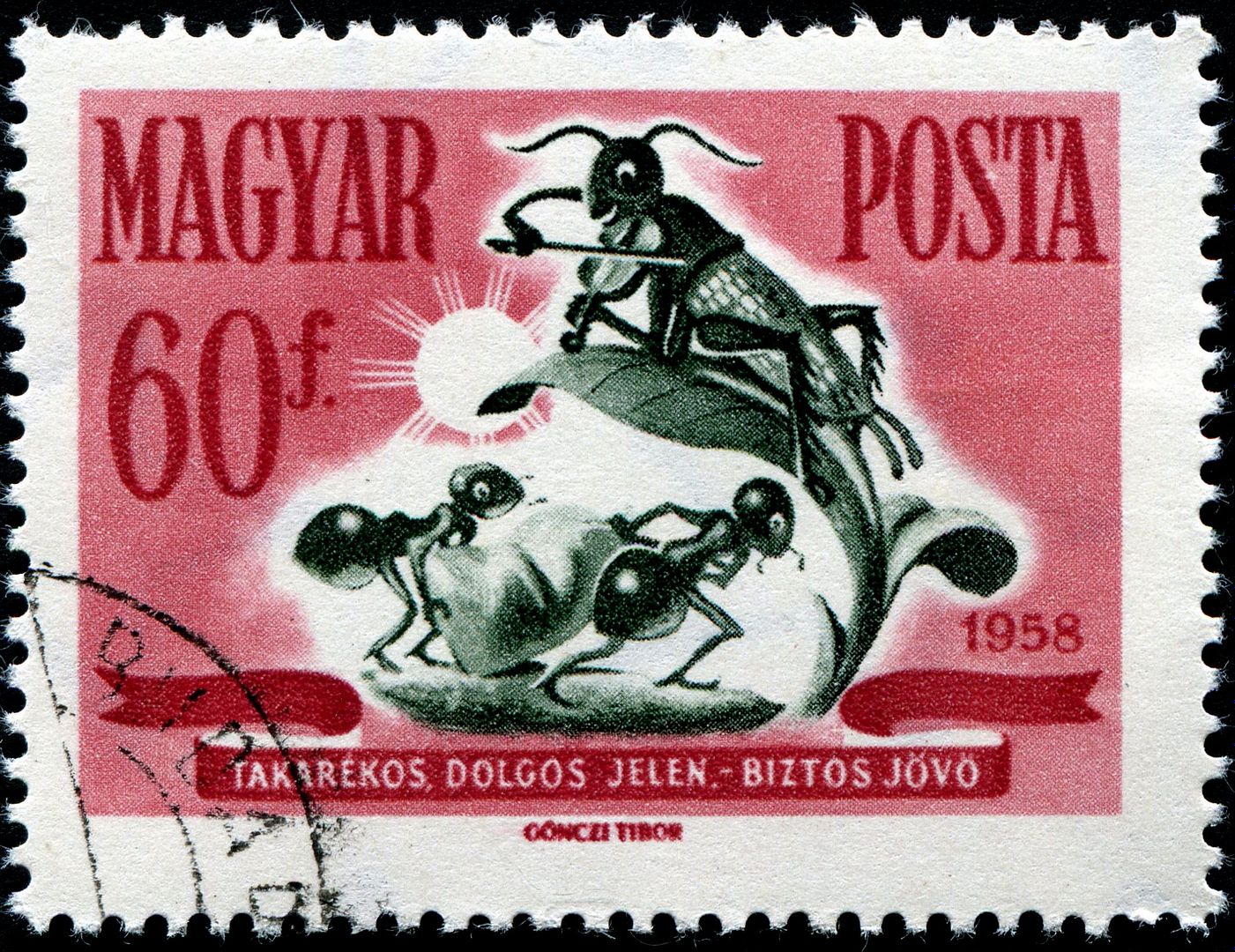
Aesop dealt with something similar in the tale of the Ant and the Grasshopper.  The grasshopper has a good time feeding on the abundant food in the summer, singing and dancing away, while the ant toils away to save for the rainy days that were bound to follow the long summer days.  One can easily imagine what happens to the grasshopper when the rains and cold weather settle in over the winter.

Somerset Maugham authored a wonderful twist to this story, which is what perhaps the Greeks and everybody else hoped would happen to them also.

But, even Maugham couldn't have written the irony that is unfolding in the Euro area: the ants are being penalized and asked to pay for the grasshoppers who sang and danced away.

The longer I live, the more I realize that life is a fascinating series of retelling, and new interpretations, of old stories.  Fascinating only as long as I am not the grasshopper shivering and starving on a rainy, cold, winter night, of which we have in plenty here in Oregon.
Source

Tuesday, June 19, 2012

Obama's re-election hinges on unemployment and the Euro crisis?

What is the connection?
for all the attention on Syria, Egypt and other areas of conflict, the most important crisis for Mr. Obama remains the European economy because of its impact at home. “Europe’s weakness is likely to blow back on Obama’s efforts this fall — just at the wrong time,” she said. “He’ll have to run harder because of it.” 
Spending time and energy on the Euro crisis and the rest of the world's problems mean that Obama will have that much lesser to devote to his own re-election campaign. 

Kind of crazy, therefore, that Obama's re-election might heavily depend on the strict European mom, Angela Merkel:
The clouds in Europe are casting a shadow over the American economy, which, in turn, is casting a shadow over the president’s re-election effort. And Obama administration aides admit there is little they can do except cajole European leaders not to let a big Spanish bank go under or to let austerity measures drag the continent’s economy down even. German Chancellor Angela Merkel, who has her hand on the German finance spigot, has more far more control over this piece of the president’s re-election puzzle than does the president himself.
Meanwhile, the tension over the Euro crisis is building up, which then makes the political theatre that much more unscripted;
[European Commission President José Manuel] Barroso, asked by a Canadian reporter why North Americans should help pay for Europe's crisis, broke from his conciliatory tone and effectively blamed U.S. practices for causing the European troubles.
"This crisis was not originated in Europe," Mr. Barroso said. "This crisis was originated in North America. Many in our financial sector were contaminated by unorthodox practices from some sectors of the financial market."
Nice try, Mr. Barroso, to blame the US for the crisis across the Atlantic.  His cause would be better served if he had instead said that we are all in it together.

All these get way too complicated for Obama because not everything is well on the domestic front.  For one, it is only a matter of days before the Supreme Court rules on Obamacare. 

And then there is that huge problem that remains awfully stubborn: unemployment
The year-over-year increase in part-timers not working at their capacity is troubling in light of the decline in unemployment. The unemployment decline may paint a rosier jobs picture than is warranted and would mask the persistent fact that 18% of U.S. workers are having difficulty finding the level of employment they would like. Anyone who works at least an hour per week for pay is considered "employed," by both the BLS and Gallup.
For example, if a worker spends two hours a week mowing lawns and gets paid, that person is counted as employed, even if he or she wants to work full time. So while fewer people are unemployed, many are still not working at their desired capacity, as measured by Gallup's underemployment rate.
The following cartoon from the Economist captures well how unemployment influences Obama's re-election:

Tuesday, July 26, 2011

Scary chart of the day: Youth unemployment

Outsourced to the Economist:


Notice how much closer the US is to the Eurozone average, and how much below that average Germany is?

BTW, I wonder how much the Germans are kicking themselves for having been so enthusiastic about a common currency:
the truth is dawning in Germany that although hard-pressed taxpayers will not have to pick up the whole price of the new €159 billion refinancing package, they face instead a future of indefinite help to the single currency's weaker and more profligate economies - the cost of a more integrated core of Europe.
While the report says that Germans are split on this issue, I like this anecdotal point:
Ronny Nickel, 61, a construction worker, shook his head in disapproval. "To help them once is OK. But not again and again. We pour money into their system but no one knows where it is going.
"In Greece you can retire young, but we work until we are 67. It's not right. And it's dominoes – they are all falling."
His son Jeremy, 20, an apprentice metal worker, nodded. "What upsets me is that they call us Nazis," he said, showing a newspaper report of how the German consulate in the Greek city of Thessaloniki had been painted with swastikas by protesters.
"That was way before I was born. We've only just stopped paying for the First World War, and it's not right that my generation should be labelled with this too. I used to be very pro Europe, but not any more."

Tuesday, July 05, 2011

The Greek (debt) Tragedy: A Euro Sirtaki


And here is Nouriel "Dr. Doom" Roubini's take on the Greek events and the global economy:

If what is happening now turns out to be something worse than a temporary soft patch, the market correction will continue further, thus weakening growth as the negative wealth effects of falling equity markets reduce private spending. And, unlike in 2007-2010, when every negative shock and market downturn was countered by more policy action by governments, this time around policymakers are running out of ammunition, and thus may be unable to trigger more asset reflation and jump-start the real economy.
This lack of policy bullets is reflected in most advanced economies’ embrace of some form of austerity, in order to avoid a fiscal train wreck down the line. Public debt is already high, and many sovereigns are near distress, so governments’ ability to backstop their banks via more bailouts, guarantees, and ring-fencing of questionable assets is severely constrained. Another round of so-called “quantitative easing” by monetary authorities may not occur as inflation is rising – albeit slowly – in most advanced economies.
If the latest global economic data reflect something more serious than a hiccup, and markets and economies continue to slow, policymakers could well find themselves empty-handed. If that happens, the risk of stall speed or an outright double-dip recession would rise sharply in many advanced economies.
Opa!


Sunday, July 18, 2010

A symbol makes a currency? Nah!

This is the symbol for the Indian Rupee--has been adopted by the Indian government, and will now work its way through various international bodies for acceptance and implementation worldwide.

The more important question is whether the Indian rupee will be accepted at, say, Tokyo's Narita Airport.  It is one thing to design a new symbol, it is another for the currency to be accepted outside India.  That will take a long time.

One commentator notes:
Looks a little like Harry Potter's lightning scar, doesn't it? Either that or the logo for a new import sports car. Or maybe even a windblown pine tree in a Tom Thomson painting.
Over at the WSJ is this observation:
The new symbol contains the Devanagari ‘Ra’ and the Roman capital ‘R’ without its upright leg. It’s hard to describe. It also looks like backward “c” suspended on a backslash with some railway tracks running through it. That help?
So, what does the Gray Lady has to add to this?
It was designed by D. Udaya Kumar, a student at the Indian Institute of Technology, who studied typography, scripts and ancient printing methods.
Where do some of the other currency symbols that we use often come from anyway? The American $?
When the United States adopted its own currency in 1785, it used Spanish money as its model—a deliberate "screw you" to the British. Scholars have since theorized that the $ sign evolved out of an abbreviation for peso: The plural for pesos was "ps," which eventually became "ps," and then simply an "S" with a single stroke denoting the "p." One early instance of the $ symbol crops up in a letter written by the merchant Oliver Pollock in 1778. Pollock also uses the "ps" abbreviation, making the letter a bridge between the two. The double-line through the S variation is less easily explained. Some believe they represent the twin pillars of Gibraltar depicted on the Spanish coat of arms. Others say it's shorthand for the letter "U" superimposed over the letter "S"—for U.S.
Now you know!

Tuesday, June 22, 2010

The nation's--world's--worst job ...

A couple of days ago, Fred Thompson (erstwhile senator and Republican presidential contender, and actor!) was on the Daily Show.  One of the questions Jon Stewart asked him was whether Thompson is relieved that he is not in the White House having to deal with all the issues.
Of course, The Onion beat everybody to the post when it declared soon after Obama won:
Black man given nation's worst job
It has gotten only worse for the president; the latest?
Yes, it is now Day 64 since the BP rig exploded, and continues to gush out oil at rates that only seem to increase every day--now at, or having exceeded, 100,000 barrels a day!
General McChrystal decides it is time to be a MacArthur, and is now looking at being removed from the job, which means a new chief for the country's longest war ever
Israel has gone complete bonkers with Gaza and occupied territories, and now even Ehud Barak is worried
The Euro is quite close to imploding, and the French-German relations are showing the stress
Unemployment continues to be high, and is a mere fractional points away from the psychological two-digit rate
WTF, eh!
And then internal issues:

The budget director, Orzsag, is leaving; A blogger at the SF Chronicle's notes the sex-issue:
Any dude who can snag ABC newscaster Bianna Golodryga while banging wealthy shipping heiress Claire Milonas, and running the country's budget is a man.
A man, yes, but not a thoughtful man.
One long summer ahead.  And then?  Midterm elections.  Odds seem to be in favor of the Republicans getting back the control of the House?

Friday, June 04, 2010

The US economy in a mess, but dollar surges ...

A long time ago, our high school English included a play called "The Refund" ... at least, I think that is what the title was (I am simply excited I can remember this much given that 30 years have passed since I exited the best high school I could have had.)  In that play, a character runs into his schoolmate who says he made a lot of money trading in currencies, and this oaf has no idea what is going on.  The successful guy then tells him that if he does not know even that, then he ought to go back to high school and get his tuition and fees refunded!  (Hey, anybody reading this, any chance that I might locate this play on the Web?)

I sympathize with that dolt in the play who could not understand how people can make money from currencies.  I mean, look at this: the American economy has been awful for quite some time now.  The stock-market wants to sink down to where the BP well is spewing like an undersea volcano.  Unemployment continues to be way too high.  The wars in Iraq and Afghanistan suck money, life, and any sense of hope. 

And, guess what?  The dollar is appreciating.  Money is rushing into America.  Bernanke, et al, have no pressure to raise interest rates.  It is almost like we have entered a bizarro world!

It just so happens that the US might suck, but the rest of the world seem to be suckier.  I tell you, am ready for my refund :)

Sunday, May 30, 2010

Economic recovery depends on "gas now, brake later"?

The first time I came across the phrase was in this piece in the Economist:
Mr Obama’s fiscal policy has been described as “gas now, brake later”: wider deficits in the near term to keep the economy out of depression (which would risk even bigger deficits), followed by a switch to deficit reduction to cap the rise in the national debt. The switch, however, remains a future abstraction.
So, who actually coined that phrase anyway?  (I'll admit that it is too darn "cute" a metaphor.  So, it can't be Thomas Friedman ... muahahaha)
A Google search for "gas now, brake later" points only to the Economist as a source for it.  So, ahem, the Economist making things up but does not want to claim ownership and wants to pretend that it is something like a well-accepted descriptor of the current administration's economic policies?  Hey, whatsup?

Anyway, where will this sticky gas pedal metaphor take the US?
Fortunately, America has time. Its favourable demographic trends mean its fiscal day of reckoning is further off than Europe’s and the dollar’s reserve-currency status provides manoeuvring room. Yet this may not be the blessing it seems. Getting politicians to take the deficit seriously may well be impossible unless the bond market forces them. For now Europe’s crisis has done exactly the opposite: as investors flee the euro, the dollar has soared and Treasury yields have plunged. There is not much incentive to take the foot off the gas-pedal and apply the brakes just yet.
Great!

Friday, May 28, 2010

The Euro crisis, and what Congress plans to do ...

First, the Eurozone crisis .... try your best not to laugh; after all, this is one serious crisis:

(ht) So, if that amused you, welcome to my world.  Perhaps you will then like the following one on what Congress is planning to do:


Congressmen Submit Emergency 3 AM Bill Demanding IHOP Stay Open All Night

Tuesday, May 04, 2010

The Greek Tragedy, or if PIIGS could fly!

The Eurozone crisis is essentially:
I owe you
You owe me
We owe each other
this image is worth more than a few thousand words (ht):

Tuesday, April 27, 2010

Headline of the day about Greece

'Nothing Justifies Kicking Greece out of the Euro Zone'
I am not making this up; that is the very headline at Der Spiegel!
Merkel has rejected a debate about ejecting Greece from the euro zone. "It is about a quick reaction in favor of the euro's stability as a whole. Everything else is a distraction."
In Monday's newspapers, German commentators are divided over whether the country's taxpayers should be forking out for the debts of other European nations and whether it may be time to contemplate kicking Greece out of the euro zone. 

First Iceland. Then Greece. Next Portugal? And Euro dies?

That listing of countries might be a wonderful vacation schedule.  But, that seems to be the path of the European contagion ...
First, this news update: Greece's bond rating now means that one can expect only 30 cents on the dollar.  I bet there are quite a few Greeks who are now lamenting the gazillions spent on hosting the Olympics in 2004.  How much did they spend?  Ahem:
the overall cost (state and private funding) was estimated to reach 8.954 billion euro, not including the cost of projects that were completed or the construction of which were accelerated due to the Games, but which had been planned for construction regardless of the Games. Those projects included the Attiki Road highway, Athens' new Eleftherios Venizelos international airport, the tram, and the suburban railway. Of that 8.954 billion euro total, an estimated 7.202 billion was footed by the State, with the remaining 1.752 billion euro coming from the Athens 2004 Organizing Committee (ATHOC) and financed by the committee's revenues from ticket sales, television broadcast rights, Olympic-logo product sales, and sponsorships.
If we count all those investments "regardless" of the Games, well, let us round it up to 10 billion euros.  That was six years ago.  So, factor in inflation as well.  All it means is this: if Greece hadn't wasted away that precious euros, it would not be facing this disastrous scenario of not enough cash to pay the piper, eh! 
Of course, Greece's debts are way more than 10 billion euros.  But, my point is that having debt is one thing, but not being able to make payments is another.

It is not the Olympics aspect that Krugman writes about though.  He has far more profound things to say:
Greece seems to be spiraling over the edge into default; I just don’t know how it steps back from that edge now. Might it also leave the euro? That would be a total mess, inviting the mother of all bank runs
These developments could even make the Goldman Sachs folks respectable and responsible :)  Talk about timing!

Anyway, Hitchens' bottom line is pretty much simple: I told you so!  Apparently he did write that the Euro was not bound to last:
In the summer of 2005, Foreign Policy magazine asked its contributors to name one taken-for-granted thing that they thought was overrated or would not last. After a brief interval of reflection, I chose the euro.
A better prediction that Fukuyama's "the end of history" ...
Anyway, Hitchens writes:
How tragic it is that the euro system has already, in effect, become a two-tier one and that the bottom tier is occupied by the very countries—Greece, Portugal, Spain, and Ireland—that benefited most from their accession to the European Union. The shady way in which Greece behaved in concealing its debts, and the drunken-sailor manner in which other smaller states managed their budgets, has, of course, offended the Germans. It is openly said in Germany now that it would be better to bring back the deutsche mark than to be bailing out quasi-indigent and thriftless banana republics.
Well, this is the same stuff that Krugman refers to the "cohesion crisis"
So, will Greece exit the Euro?  Not so fast, cautions this report:
The most drastic solution - abandoning the euro as a prelude to devaluation - would not change the requirement to cut the twin deficits since short-term export competitiveness is not the key issue and opportunities to boost exports (including tourism) are quite limited, especially as the European economy remains weak.  Those who see euro exit as attractive should also recall the instability generated by historic episodes of devaluation.
Hmmm .... we will be in this for a long time ... hold on to your wallet, home, kids, ....

Monday, March 08, 2010

Questions I would rather not see as headlines ...

... but, here they are at Slate.com:
Can California Declare Bankruptcy? What about Greece?
Isn't that exciting!  How the heck did we reach such a juncture?
California passed a gas tax last week to help make up for its nearly $20 billion budget gap, the latest in a series of measures to right the state's teetering economy. The country of Greece is in even worse shape, with accumulated debt higher than 110 percent of GDP, set to reach 125 percent this year. Can a state declare bankruptcy? Can a country?
You are thinking, hey, declare bankruptcy and start all over!  Gold Rush, Part II.  Of course, California cannot declare bankruptcy. 
Greece is in a slightly different situation. There's no international bankruptcy court for countries that can't pay their debts. Instead, other EU countries that depend on Greece's solvency, such as Germany or France, would have to agree to bail it out. (When the economy of one member of the Eurozone sinks, it drags the euro down across the continent.)
Anne Applebaum writes that Germany is sick and tired of bailing out ailing Euro economies.  Further more, the deficit countries seem to be partying away, while Germany is working hard to save:
Frankfurter Allgemeine Zeitung, Germany's deeply serious paper of record, has pointed out that while the Greeks are out protesting the raising of the pension age from 61 to 63, Germany recently raised its pension age from 65 to 67: "Does that mean that the Germans should in future extend the working age from 67 to 69, so that Greeks can enjoy their retirement?'
But, there is more to this Greek Tragedy than that meets the eye, according to Applebaum:
Germany is now run by a generation with no personal memories of the war. Germany's historical debate is now focused on the fate of Germans who suffered from wartime bombing and postwar deportation, not with the fate of Germany's victims—in Greece or anywhere else. Sooner or later, the Germans will collectively decide that enough sacrifices have been made and that the debt to Europe has been paid. Thanks to the ungrateful Greeks with their island villas and large pensions, that day may arrive more quickly that we thought it would.
Oh well ... dance away, Zorba :)

Tuesday, February 23, 2010

Sunday, February 07, 2010

Bad news for Euro ... good news for the dollar?

If only the state of a "permanent revolution" here in the US would calm down just a tad .... because, there is a global opportunity that we can tap into: the Euro is heading into a big fall and, yet again, the dollar and the US will be viewed as one hell of a safe investment amidst the chaos of the world.  First, from the WSJ:
The euro is likely to face further declines this week as concern over sovereign debt in Europe prompts investors to seek refuge in the perceived safety of the dollar and the yen.
Pressure on the common currency escalated last week, as worries about the soundness of debt issued by Greece spread to other fiscally stressed euro-zone nations, including Portugal and Spain.
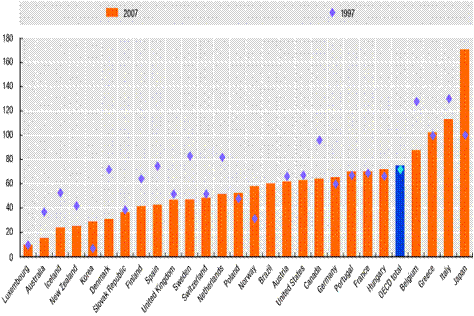
Second, a little more on the sovereign debt, from The Economist:
As you can clearly see at right, Europe's deficit troubles began well before the global economic collapse.Now, there was an interesting discussion in the Washington office this week over whether it was possible for there to be a simultaneous crisis for all sovereign debt. While perhaps technically possible, it does seem unlikely, and so one might argue that countries with a relatively sound fiscal position, like America, have a lot of room to borrow for now, because debt worries elsewhere are causing investors to look for relatively safe havens. 
Ok, back to the WSJ:
The euro's losses were about 1.5% against the dollar last week, bringing its year-to-date slide to 4.6%. Against the yen, the common currency dropped Friday to a near 12-month low.
"Until we see signs of acceptance by those [nations] that austerity measures need to be put in place to resolve the fiscal imbalances, the euro will continue to deteriorate," said Thanos Papasavvas, head of currency management at Investec Asset Management in London, which oversees about $60 billion.
Ballooning budget deficits in euro-zone countries threaten to hurt an economic recovery, forcing the ECB to keep interest rates low longer than anticipated, in contrast to expectations of quicker increases from the U.S. Federal Reserve.
So, can the G7 do anything?  What says you, Professor Simon Johnson?
Ex-IMF chief economist Simon Johnson, also described the G7 group of leading economies as "fundamentally useless".
Johnson does not hold anything back:
Greece is an an extreme example - there I think you can see that it's going to get very messy very quickly - but unfortunately the budget situation in these other countries is also weak.
"And I have to add the UK to this list. Unless you can persuade the markets that you're really going to bring the budget under control within the foreseeable future and you're going to have some credible actions - and you're going to have to do some persuading - you're going to have big trouble."
But, Paul Krugman has a different take and, get this, it has an abbreviation that "sounds" great when you say it aloud as a word: PIIGS :) .... Krugman writes:
As Europe is roiled by sovereign debt fears, it’s important to realize that the crisis in the largest of the PIIGS (Portugal, Ireland, Italy, Greece, Spain) has nothing to do with fiscal irresponsibility. ....
The point is that this has nothing to do with a spendthrift government; what’s happening to Spain reflects the inherent problems with the euro, which now more than ever looks like a monetary union too far.
 Krugman then has this update:
Update: Whoops. Yes, Italy is bigger than Spain — and it has been fiscally irresponsible. But in a way that makes the point; Spain, which has been a good actor, is in much more trouble than Italy, which hasn’t
All the economists of the world will duke this out.  As far as I am concerned, once again the US dollar becomes a safe haven--despite the humongous mess that we are in.  How bizarre, eh!

Monday, February 01, 2010

What a depressing news headline :(

Huge Deficits May Alter U.S. Politics and Global Power

That is the headline over at the NY Times.

My question is this: why the use of "may" and not "will", eh?
American deficits will not return to what are widely considered sustainable levels over the next 10 years. In fact, in 2019 and 2020 — years after Mr. Obama has left the political scene, even if he serves two terms — they start rising again sharply, to more than 5 percent of gross domestic product. His budget draws a picture of a nation that like many American homeowners simply cannot get above water.
For Mr. Obama and his successors, the effect of those projections is clear: Unless miraculous growth, or miraculous political compromises, creates some unforeseen change over the next decade, there is virtually no room for new domestic initiatives for Mr. Obama or his successors. Beyond that lies the possibility that the United States could begin to suffer the same disease that has afflicted Japan over the past decade. As debt grew more rapidly than income, that country’s influence around the world eroded.
Again, where from does the NY Times get an optimism to use "may" instead of "will", you ask?  Well, it is at the tail end:
“Much may depend on whether we put in place the financial reforms that can rebuild a functional financial system,” Mr. Galbraith said, to finance growth in the private sector — the kind of growth that ultimately saved Mr. Clinton from his own deficit projections.
His greatest hope, Mr. Galbraith said, was Stein’s law, named for Herbert Stein, chairman of the Council of Economic Advisers under Presidents Richard M. Nixon and Gerald R. Ford.
Stein’s law has been recited in many different versions. But all have a common theme: If a trend cannot continue, it will stop.

I suppose we can expect the dollar to continue to slide down.  Meanwhile, the demographic dynamics of the Euro zone and Japan mean that those economies will slowly lose their influence and so will their currencies.  The Russian demographics are no different.  So, it will all come down to a showdown between China and the US.

And, it does not appear that the Chinese politburo is as stupid as the Soviets were.  Which means chances are pretty good that China will stare us down?  Hmmmm.....

Perhaps I should return to using the line I discontinued, when talking with students: "you are screwed!"