Showing posts with label women. Show all posts

Tuesday, August 10, 2021

Be a man ... by being human

Remember that old Pepsi ad featuring MC Hammer?  I still remember that commercial not because of any fondness of Pepsi over Coke, but because of "feelings" that the macho rapper starts to croon.  The ad did young boys a huge disservice by suggesting it was not hip to sing about, to talk about, feelings.

I was raised with phrases like "don't cry like a girl"--like almost all kids were back in those days in the old country.  Anger I could display. Fight I could.  Because boys will be boys.  But, crying was unmanly. I see that attitude even now, even in the adopted country.

We seem to forget that feelings bring people together.  Women cultivate their sisterhood through talking about their feelings, whether it is about their husbands or mothers or colleagues or kids or ... it is a long list of people about whom we have feelings and women seem to unreservedly talk about them.  Men, on the other hand, talk about sports and politics and the weather and everything else that is not about one's own feelings. 

All these despite plenty of men singing about feelings.  Like even that "feelings" song that MC Hammer sings because he drank the "wrong" soda.
Feelings, nothing more than feelings,
Trying to forget my feelings of love.
Teardrops rolling down on my face,
Trying to forget my feelings of love.
It is also the case that men who sang about feelings were immensely popular with women, from Frank Sinatra to Marvin Gaye to ... recall Rebecca's weak spot in Cheers?

Yet, we continue to brainwash boys and men that it is feminine to get in touch with their emotions!

In the narratives they consume, as well as the broader cultural landscape in which they operate, girls get a huge head start on relational skills, in the day-to-day thorniness and complexity of emotional life. Story by story, girls are getting the message that other people’s feelings are their concern and their responsibility. Boys are learning that these things have nothing to do with them.
We have barely even registered this lack of an emotional and relational education as a worrying loss for boys. We tend to dismiss and trivialize teenage girls’ preoccupation with the intricacies of relationships as “girl-drama.” But as Niobe Way, a professor of psychology at New York University and the author of “Deep Secrets, Boys’ Friendships and the Crisis of Connection,” says, “When we devalue things associated with femininity — such as emotions and relationships — boys miss out.”

It is strange, bizarre, and tragic that this is talked about even in 2021!  Am not at all surprised that of the students who come to my office, only female students ever are honest with their emotions and seek my assistance.  With a couple of male students, I have even mildly attempted to convey to them to sort out their issues, ... but, hey, I don't have too much time remaining at the university.

Some day, we will get past these false gender norms and become healthy.


Wednesday, March 24, 2021

Throw like a girl?

As kids, my brother and I played cricket in the wide open space between the gate and home.  Three stumps with bails, a cricket bat, and a cricket ball--all kid size, of course.  One bowled while the other batted.  More time was spent searching for the ball and considerably less was the playing time itself.

Often, my sister's friends came visiting.  Sometimes, they wanted to play with us.  Looking back, I am not sure if they played cricket with us for a few minutes because they wanted to humor us or because they really were keen on playing the game.

Back then, in the school or in the public grounds, girls did not play cricket.  (Nor did they play football either.)  I recall my sister playing games like throwball (or was it volleyball?) and whatever the ring tossing game was called.  And, maybe badminton.

It was one hell of a sexist world.

And then one day I read in the newspaper that there was an all-women Indian cricket team.  All women?  I was impressed.  (Thankfully, Wikipedia gives me the particulars.)

It took me a while to shed my sexist skin.  After all, giving up the privileges of being a male isn't easy ;)

I moved to the US, which was only slightly better than India was when it came to gender issues.  I was shocked that "Trojans" referred by default only to the male sports players.  Otherwise, they were the "Women of Troy."

In Bakersfield, when I started writing commentaries, I sent the editor a piece about such gendered usage.  I remember arguing in that essay that "Americans" doesn't mean men by default.  It was one of the many commentaries that never made it past the editor.

Life in Eugene meant that I was bombarded all the time by the athletic activities at the local university. I wrote another commentary, again, on this topic and emailed that to the editor.  He too decided against publishing that.

In the summer of 2019, I blogged about the separate and unequal character of female sports.  Even when a female team is successful, as was the case with women's soccer, it gained neither respect nor the dollars that the losing men's team did.

I don't care for sports.  But, I do care for equal treatment.

The "March Madness" underway has brought the unequal treatment to the foreground, again. "Men’s sports, athletes, coaches and events have always been the association’s priority."

When college women basketball players began to post photos and videos of how they got less food, less accurate COVID-19 testing and less exercise equipment in the NCAA March Madness Tournament bubbles than their male counterparts, a sense of collective outrage ensued.

It is not new, but I am glad it made it to the news.  Let's see if this new outrage produces a different and better outcome.


Friday, March 12, 2021

It was once a Third World Country posterchild

A few years ago, I met with an activist environmental lawyer from Bangladesh.  Syeda Rizwana Hasan was the first one from Bangladesh that I met since my graduate school days.

Always excited to meet with accomplished people from my old part of the world, I talked with her about her work.  And then I asked her a lot about Sheikh Mujibur Rahman.

In 1970, when Bangladesh was still East Pakistan, "Sheikh Mujibur Rahman, won a landslide victory in national elections. The Pakistani leadership was reluctant to accept the results because it did not want an East Pakistani political party heading the federal government."

West Pakistan, now Pakistan, was the center of all the economic, commercial, and military power. The West Pakistan government and its people couldn't care about the Bengali-speaking fellow-citizens who were thousands of miles away, separated by India.  The last thing they wanted to grant was autonomy to the Bengali-speaking Pakistanis.

As the demand for Bengali autonomy grew, the Pakistani government launched Operation Searchlight,“ a military operation to crush the emerging movement. According to journalist Robert Payne, it killed at least 7,000 Bengali civilians – both Hindus and Muslims – in a single night.

On March 26, Bangladesh was declared independent and the liberation war began.

The US, mad with its supremacy and in a Cold War against the USSR, sided with West Pakistan's leaders and military.  As we review history, I wonder how many times we ever sided with the good guys!

When refugees started spilling over to India in the millions, India's prime minister, Indira Gandhi, decided to employ the military against the West Pakistani forces in East Pakistan.  In less than two weeks, the West Pakistani forces surrendered.  India's military chief, S.H.F.J. Manekshaw, became a household name.  We kids thought he was the greatest ever!

In no time at all, the Nixonian realpolitik Secretary of State, Henry Kissinger, labeled Bangladesh as a "basket case."

Nick Kristof writes about how much Bangladesh has developed over the 50 years, and how we in the US can learn from it.

Life expectancy in Bangladesh is 72 years. That’s longer than in quite a few places in the United States, including in 10 counties in Mississippi. Bangladesh may have once epitomized hopelessness, but it now has much to teach the world about how to engineer progress.

Kristof continues:

Bangladesh invested in its most underutilized assets — its poor, with a focus on the most marginalized and least productive, because that’s where the highest returns would be. And the same could be true in America. We’re not going to squeeze much more productivity out of our billionaires, but we as a country will benefit hugely if we can help the one in seven American children who don’t even graduate from high school.

That’s what Biden’s attack on child poverty may be able to do, and why its central element, a refundable child tax credit, should be made permanent. Bangladesh reminds us that investing in marginalized children isn’t just about compassion, but about helping a nation soar.

I wonder what Kissinger has to say about Bangladesh now.  But then, who cares for Kissinger, right?

With women like Syeda Rizwana Hasan, Bangladesh is now well on its way to even surge past India.

Well, it has.

A few months ago, the IMF reported that Bangladesh had moved ahead of India in terms of per capita income.  Boy did that cause quite some issues for the Modi-toadies who believe in the superiority of Hindus!

We all can learn a lot from the 50-year old Bangladesh success story.

Saturday, March 06, 2021

Say his name

When we were young, mother took us to grandma's village for the annual summer holidays--we were too young to travel on our own.

Those were the days before cellphones and emails. There was no landline at most homes, and one went to the nearest post office in order to place "trunk calls"--long distance calls.

So, the day that we arrived at grandma's, mother would promptly write a letter to my father informing him that we had arrived safely.

When we were of a certain age, we realized that our mother, who never addressed father by his name, would have trouble writing a letter to him.  In the old tradition, the wife was so subservient to the husband that she dare not treat him as an equal and call him by his name.

So, how did my mother address my father in those letters?

We would badger her; but mother always shooed us away.  I don't think she even showed us the letters.  To this date, I have no idea how that letter-writing was done!

Even when talking to father, mother could not use the disrespectful "you" (நீ) but had to use (நீங்க.)

It was all par for the course.

But then things changed in a hurry.

My siblings' marriages were arranged along the traditional, orthodox lines.  My sister addressed her husband by his name, and my brother's wife called him by his name.  And the  நீங்க was tossed away for good.

Changes have happened.  But, these have been mostly in the southern part of India where families and governments have invested in female literacy and empowerment.  In the Hindi heartland, in particular, the lives of women continue to be highly dependent on the whims and fancies of men.  Even the Chief Justice of India's Supreme Court!

Justice Sharad Arvind Bobde, the head of India’s Supreme Court, asked a 23-year-old man accused of raping a minor whether he would marry his victim, who is now an adult. 
The victim, who under Indian law can’t be identified, has accused the man, a distant relative and a civil servant with the Maharashtra State government, of repeatedly stalking and raping her starting when she was 16. 
The judge’s comments provoked new demands that people in power, and particularly men, do more to improve how women and girls are treated in India.

There is more from the same judge:

In a separate case, according to the letter and media reports, Justice Bobde appeared to condone rape in the context of a consensual relationship. 
“When two people are living as husband and wife, however brutal the husband is, can the act of sexual intercourse between them be called rape?” Justice Bobde asked while hearing a petition filed by a man accused of rape by a woman who had been his live-in partner.

In the old country, the more things change, the more they seem to say the same, which is a tragedy and disservice to women :(

Monday, November 09, 2020

Ill-behaved men and the abused women

Audrey Truschke, whose lecture on Aurangzeb I attended in Chennai in January 2019 during my sabbatical and was condemned by the Hindutva and its sympathizers as whitesplaining, writes this about the Mahabharata:

The epic itself foretells:

आचख्युः कवयः केचित्संप्रत्याचक्षते परे
आख्यास्यन्ति तथैवान्ये इतिहासमिमं भुवि
Some poets told this epic before.
Others are telling it now.
Different narrators will tell it in the future.

One of the latest narrators is Karthika Nair, whose interpretation of the Mahabharata is absolutely innovative.  It compels the reader to rethink the old epic, however familiar one might be with the tales and the characters.

Nair gives voice to the Queen of Panchala--Draupadi's mother--who is a "woman without a name" in the epic.  Through this queen, Nair condemns how men--kings in particular--defined life that was hell for mothers because of wars and bloodshed:


As Truschke also reminds us, the Mahabharata "condemns many of the appalling things it depicts, but one area where its response is more tepid concerns the treatment meted out to women."

The world of the Mahabharata is stacked against women. Our world today looks distinct in its details, but some basic principles are not much different. For example, more than one person has compared Draupadi’s plight with that of ‘Nirbhaya’, the name given to the young woman mortally gang-raped in Delhi in 2012. Nirbhaya (meaning ‘fearless’) resisted her attackers, and one of the rapists later said that this resistance prompted him and his fellow assaulters to be more brutal than they would have been otherwise. Two millennia later, the corrupt ‘moral’ remains: she should not have objected to unjust treatment.

The Mahabharata is not as straightforward a story about good and bad as one might expect from an epic that features practically all the Vedic gods.  

The Mahabharata claims to show dharma or righteous conduct – a guiding ideal of human life in Hindu thought – within the morass of the characters’ immoral behaviours. But the line between virtue and vice, dharma and adharma, is often muddled. The bad guys sometimes act more ethically than the good guys, who are themselves deeply flawed. In the epic’s polychromatic morality, the constraints of society and politics shackle all.

This is also why Nair prefers this epic over the Ramayana.  She writes that in the Mahabharata, "right and wrong and not so easy to spot anymore."  Tragic!

Monday, October 19, 2020

War and Peace

Back in January 2019, I wrote this about David Shulman:

I am stumped at everything that Shulman offers.  A guy who was born in Waterloo, Iowa, who immigrated to Israel, seems to know more about Tamil than all but a handful of the 80 million Tamil-speakers put together!

A polyglot Shulman is.  In addition to English and Hebrew, "he has mastered Sanskrit, Hindi, Tamil and Telugu, and reads Greek, Russian, French, German, Persian, Arabic and Malayalam."

Which is why Shulman comfortably writes that one of the most powerful interpretations of the Mahabharata was written in Malayalam: "By far the most powerful such interpretation that I have read, Wandering the Mahabharata, was written in the South Indian language Malayalam by a maverick scholar, Kuttikrishna Marar"

We are all better off thanks to scholars like Shulman who interpret history and old texts for the vast multitude of us who are barely literate in one language.

Shulman's essay is about a recent book on the Mahabharata.  The first paragraph alone blows my mind on how fluent he is with various aspects of life in the Subcontinent, in addition to his mastery of the epic itself:

The Mahabharata, the great Sanskrit epic, is a fiery, dangerous book. One is not supposed to keep a copy in the house, lest it burn down. And it is dangerous, perhaps fatal, to read it from beginning to end, in linear sequence. Similarly, translating it from Sanskrit into another language, beginning at the beginning, is not recommended. The classical Telugu version from South India has three authors; two died during its composition.

More than a year ago, when I helped my parents move, and when my parents were donating and getting rid of many of their possessions, my father complained that nobody will want his copy of a scholar's interpretation of the Mahabharata--for the very reason that Shulman notes.

Shulman weaves his phenomenal understanding of the Subcontinent when reviewing Until the Lions: Echoes from the Mahabharata.  After listing works that interpreted the epic in innovative and powerful ways--I have no clue about any of those!--he writes:

But surely the most lyrical of all such attempts to see the Mahabharata through the eyes of its characters is the remarkable dramatic poem Until the Lions by the Kerala-born, Paris-based poet, dance producer, and librettist Karthika Naïr.

She has given her book an appropriate subtitle: “Echoes from the Mahabharata.” The thirty haunting, heartrending chapters, in a wide range of forms and styles, resonate powerfully with one another; together they offer a text clearly meant for live performance, in oral recitation—or rather incantation—and in dance. ...

The poems of Until the Lions are graphically typeset on the page so that they seem to be dancing, a celebration of visible sound. Karthika plays with metrical modes—canzone, rima dissoluta, the Panjabi Sufi acrostic form known as Si Harfi, and the Tamil andadi, in which each new verse begins with the final syllables of the previous one.

Read the entire essay.  If you are like me, after reading it, you too will immediately place an order for the book from your favored retailer.

I will end with this nugget from Shulman on the continued relevance of the Mahabharata:

[This] two-thousand-year-old book is, in a way, a template for Indian civilization; it remains as vital and relevant today as it ever was, and not only for South Asia. The apocalypse it describes is something all too human, driven by greed, egotism, spite, and the usual phoney fixation on the glories of dying in war. 

Wednesday, October 07, 2020

Rewriting the code of life

 One of my many, many, many drawbacks is this: I waste my time even on stuff that I don't understand.  Topics for which I am way underprepared.  Yet, I continue with this habit.

There is a reason for this madness.

Actually two.

First, I am genuinely interested in a bunch of things.  Of course, I know where my strengths and weaknesses are and I could simply focus on my strong areas alone.  But, that ain't me.  How could I not know about stuff about which I don't know anything?  No, do not jump to conclude that it is some kind of a FOMO.  Nope.  FOMO doesn't belong in this context.  FOMO is about fleeting, momentary excitement.  I am referring to something more than the now.

Second, even though I am a college professor, I don't consider myself a "teacher."  I am a life-long student who teaches.  If the university fires me from my job next year, I will continue to be a student even though I will no longer be a professor.  Being a student is absolutely a part of who I am.

So, I waste time reading about stuff that can often be way above my head.

CRISPR is one of those.

My earliest post--yes, there is more than one--on this was in March 2015.  In that post, I expressed my concerns about CRISPR.  I ended that post with this quote:

Rewriting human heredity has always been a theoretical possibility. Suddenly it’s a real one. But wasn’t the point always to understand and control our own biology—to become masters over the processes that created us? 

Doudna says she is also thinking about these issues. “It cuts to the core of who we are as people, and it makes you ask if humans should be exercising that kind of power. There are moral and ethical issues, but one of the profound questions is just the appreciation that if germ line editing is conducted in humans, that is changing human evolution,” Doudna told me. One reason she feels the research should stop is to give scientists a chance to spend more time explaining what their next steps could be. “Most of the public,” she says, “does not appreciate what is coming.”

See the name Doudna in that quote?

In October 2015, I blogged about CRISPR, Jennifer Doudna, and Emmanuelle Charpentier.  It was about how they were not awarded the Nobel, despite being considered the top bet.

They didn't get the October morning phone call until 2020!

The Nobel Prize in Chemistry was jointly awarded on Wednesday to Emmanuelle Charpentier and Jennifer A. Doudna for their 2012 work on Crispr-Cas9, a method to edit DNA. The announcement marks the first time the award has gone to two women.

“This year’s prize is about rewriting the code of life,” Goran K. Hansson, the secretary-general of the Royal Swedish Academy of Sciences, said as he announced the names of the laureates.

Not merely understanding life, but rewriting the code of life.

As Jennifer Doudna said, most of the public does not appreciate what is coming.

For now, I am delighted that two women were the recipients of the Nobel Prize in chemistry.

But, I remain worried about the longer-term implications. 

If only I didn't waste time reading stuff that I don't truly understand!

Wednesday, August 05, 2020

What's love got to do with it

Remember this line?
It is a truth universally acknowledged, that a single man in possession of a good fortune, must be in want of a wife.
No, don't worry; this post is not about Jane Austen.

It is about marriage though.

The "arranged marriage."

A Netflix show has kicked up a great deal of controversy about arranged marriages in India.

From a young age, I have had nothing but complaints about the arranged marriage.  The criteria to select the bride were just godawful,  She cannot be too short or too tall.  God forbid if she were "dark."  No blemish anywhere.  And, oh, while her paycheck is desirable, she should also function as a traditional housewife.  The man will donate the sperm and soon after grow a huge pot belly from all the eating and doing nothing.  (Slowly women are gaining some say in the process, but men and their families control most of the arrangement process.)

There was nothing in this that appealed to the teenage me.  The older I got, the more I have awful things to say about this system.  Which is also why I have not watched the Netflix show, nor do I have any plan to watch it.

What are the problems with the arranged marriage that the show makes people talk and write about? Let's start with the godawful caste system:
Contrary to what some viewers might think, the caste system is an active form of discrimination that persists in India and within the Indian American diaspora. One of the primary functions of arranged marriage is maintaining this status quo. This can be confirmed by a cursory glance at matrimonial columns in Indian newspapers, which are full of “Caste Wanted” headlines, or at the ubiquitous matchmaking websites that promise to help users find an upper-caste “Brahmin bride” or “Rajput boy,” while filtering profiles from people in lower castes. Marrying into the same caste of one’s birth is not, as Indian Matchmaking might suggest, a benign choice akin to finding someone who “matches your background” or has “similar values.” It’s a practice that helps dominant-caste folks preserve their power. That's just the start. 
The caste is pretty much the point of departure in this process.

The average non-Indian viewer might not imagine an India beyond the Hindu upper-caste that the show is about:
Though the show is called Indian Matchmaking, it portrays no couples who identify as Muslim, Christian, or Dalit—communities that represent close to 40 percent of India’s 1 billion–plus population.
A while ago, I reviewed a book about the Indian diaspora in the Caribbean.  The author wrote about how the new professional Indians on work visas look down on the "native" Indian community, who are the descendants of people who left India to work as laborers in faraway unknown lands.  This also apparently features in the Netflix show:
[The] story of event planner Nadia Jagessar, who tells the camera she’s struggled to find a match in the past because she’s Guyanese Indian. This is code for a number of conditions: Nadia’s family, originally Indian, immigrated to Guyana in the 1800s, along with a vast influx of indentured Indian labor shipped around the world after the British outlawed slavery. Many consider them low-caste, or not “really” Indian; there is a suspicion of their heritage being mixed, carrying with it the stigma of being tainted. Yet the show merely explains that for many Indian men, bright, bubbly, beautiful Nadia is not a suitable match.
After all, high caste affluent Indians did not jump on those ships!

What is the view from India about the show?  "it has shown how casteism and sexism merge with money, high-status, and modernity in the urban milieus of Mumbai, Delhi, New York, and Chicago."
Given that my doctoral research was on the matchmaking practices of urban Indians, I can say that this show is not far from reality. We are perhaps uncomfortable and angry because this show has said it as it is, and has done so on a global platform, leaving little scope for pretence.
The messier the system, the better the entertainment and the money that it brings to the producers.  Netflix has the last laugh in this, similar to how the current President owes it all to the entertainment of the lowest kind.

What a depressing and sad state of the world!

Monday, July 27, 2020

Do corporations give birth and breastfeed?

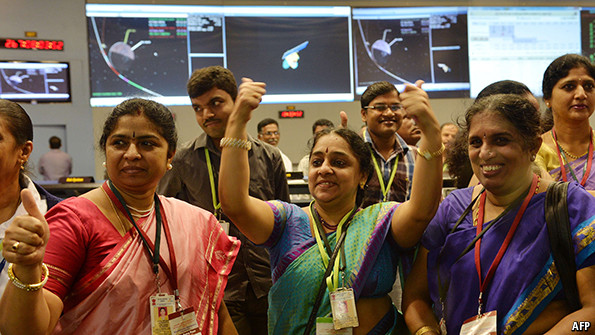
Six years ago, in this post, I wrote about the number of women scientists who were involved in India's success with the Mars orbiter, and included the following image too:


Women rocket scientists.  How awesome, right?

I don't know their back stories.  But, chances are good that if those scientists are also mothers, then child care was never a big worry for them--because, grandparents, almost always grandmothers, took care of the young ones while the parents were off at work.  Nuclear families in which the parents, especially mothers, exclusively take care of their kids is more the exception than the rule in the old country.

Of course, that is not the case here in the United States.

And now the coronavirus has completely upended every aspect of our lives, including schooling and day care centers, which then requires parents to take care of their children 24x7.  In most cases, this huge task falls on mothers, which is a huge challenge when they are also working from home.  It is even more of a challenge if they suddenly became unemployed.
According to research from Syracuse University released last month, more than 80% of adults in the country not working in order to care for children who would be in school or daycare if not for COVID-19 are women. A recent paper published in the academic journal Gender, Work & Organization found that mothers of young children reduced their working hours four to five times more than fathers.
It.Is.A.Nightmare.

Though the following metaphor that Betsey Stevenson uses is not the best one for the context, it conveys the point:
Although young men today are much more likely to profess their belief in gender equality than those of previous generations, they are not significantly more likely to divide most household tasks equitably, from child care to grocery shopping. And COVID-19 does not seem to be changing this dynamic, Stevenson says.
“If the guy is driving toward the cliff of not feeding the children, and the woman is driving toward the cliff of not feeding the children, she pulls off first and she feeds the children,” Stevenson said. “And the problem is that if he knows that she’s going to pull off first, then he wins the game of chicken.”
If that is the situation now, what might be the long-term effects?
Child care is one of those issues where we still really think it’s a personal problem: ‘You made the choice to have those little rugrats. You deal with them.’ Compare that with elder care. We recognized it was a social issue. We built a series of nursing homes and institutional care, and we have societal grants to cover some of that through Medicaid. But with child care, we’ve said this isn’t a social issue. And I think the pandemic has revealed that it is a social issue.
Child care is not a personal issue, it’s not a women’s issue; it’s actually an economic issue. It’s an economic issue because we need to invest in children.
Again, compare with India, where not only child care is a part of an extended family issue, elder care too is part of an extended family issue.

Meanwhile, here in the US, we are leaving parents and their children behind even as we spend gazillions on supporting persons corporations like the airlines.
Come September, I don’t think that the pandemic is enough behind us that every job would be back anyhow. Can we get every job back without child care? Absolutely not. The question is, how much is a lack of child care holding us back, versus how much are people still staying at home because they don’t want to get Covid?
Even if child care is not holding us back in September or October, we are letting the whole child care system erode in such a way that it’s not going to be there for us when we are fully ready to go back.
How so?
Where I really see the child care crisis holding us back is once we are ready to have all the jobs come back and we’re really ready to recover, even though we’ll have opened the schools, opened the child care centers, the workers aren’t going to be there, the slots aren’t going to be there. At the state level, we saw this in the 2008 recession
Very depressing!

Does Professor Betsey Stevenson have a solution?
 The solution has got to be government spending on child care. It’s going to have to be government encouraging and rewarding businesses that provide employees with the flexibility they need in order to balance work and child care. The policymakers debating legislation right now need to realize that caregiving is an essential part of our economy. And it’s an investment that when they make that, they are going to see benefits in terms of economic growth.
The same folks who are happy to cut corporate taxes because they think that’s going to unleash a wave of growth, I want them to realize that if they want to unleash a wave of growth, they need to invest in the next generation so that the current generation can do their work and the next generation is prepared to do it even better.
I am on board with this.

I was/am never a fan of government-subsidies for adults to have children.  But, I have also always believed that subsidies for human issues are far more important than subsidies for corporations to screw our lives.  However, as long as we have a party that is committed to protecting the life of abstract "persons" that corporations are, and with their party faithful committed to defending the "life" of a fetus in a petri dish while not caring about investing in life that is already here alive and suffering, we are doomed.

So ...

Vote accordingly.

Wednesday, July 22, 2020

Will procreation be the COVID-19 recreation?

After the virus crossed over from China, in countries around the world, people have been sheltering in place since March.  People have also been unemployed in huge numbers.  Adding to all these, the lock down has sharply decreased entertainment options.

So, like Khushwant Singh famously joked decades ago about India, will acts of procreation be major recreation in the age of the coronavirus?  Are we looking at a big baby boom towards the end of 2020 and in early 2021?

Nope.

Even back in April, experts said that a baby boom won't happen.
In the short term, as the pandemic wrecks swaths of the economy, the coronavirus will probably give couples even more cause not to have children, experts said.
“I really don’t think they’re saying, ‘Oh, let’s have a baby in the midst of the greatest epidemic that the country has faced in 100 years,’” said Kenneth Johnson, a demographer at the University of New Hampshire.
There may be recreation in the bedroom, but no procreation.

The anxiety over one's economic future in this context itself is a mood dampener, to say the least.  Further, responsible adults might also have intense worries about the future of babies brought into existence when things are chaotic all over.
In contrast, the original baby boom, between 1946 and 1964, took place in an era of postwar euphoria and financial stability for many Americans. Couples married young, could afford homes and had children quickly. And it was not until 1960 that the federal government approved the first birth control pill.
That was in April.  Did the experts change their opinion over time?

Nope.  They doubled down.

Three months into the lock down, experts said that "the COVID-19 episode will likely lead to a large, lasting baby bust."  As a result of the pandemic and the economic recession, "we could see a drop of perhaps 300,000 to 500,000 births in the U.S."

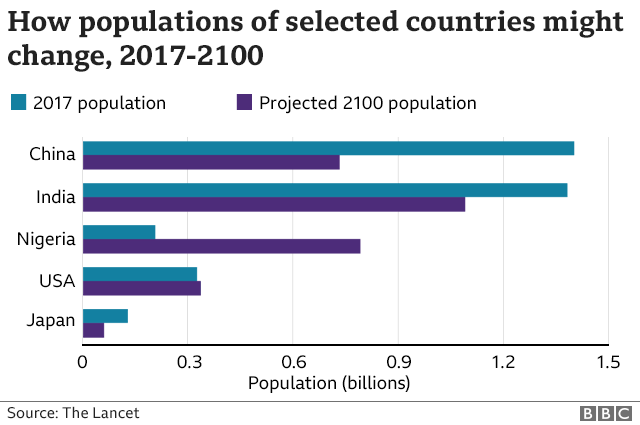
The baby bust will further complicate the demographic crisis that has been slowly unfolding.  Even prior to the corona-recession, the fertility rate - the average number of children a woman gives birth to - had been falling.  As a result, it is only a matter of time before population in many countries started shrinking instead of growing:


Is there a solution?

Yes. But that won't appeal to the uber-nationalistic blood-and-soil tRumpians.  Migration is the answer.  And that too from "shitholes."
Prof Ibrahim Abubakar, University College London (UCL), said: "If these predictions are even half accurate, migration will become a necessity for all nations and not an option. "
To be successful we need a fundamental rethink of global politics.
"The distribution of working-age populations will be crucial to whether humanity prospers or withers."
Of course, the tRumpians can dismiss all these and work with alternative facts that will show that young white women will have lots of babies.

Tuesday, December 10, 2019

Going stag

Emma Watson created some brouhaha by declaring herself to be self-partnered.  The rest of us refer to that existence as being single.  Maybe she was serious about that usage, or perhaps she was joking.  But, a brouhaha resulted.  And a few commentaries on her statement, like this one, in whcih the author writes:
The problem with declaring yourself self-partnered is that you’re ceding the argument, agreeing with the precept that some kind of monogamous partnership is a necessary component to a fulfilling life. Self-partnered also makes the same mistake that most depictions of romantic partnership do—assuming that one person can be all things for another. Even a person in a perfect romantic relationship still needs intimate platonic relationships. Self-partnering turns us even more into islands, suggesting that with the right mindset we can all be self-sufficient. A woman’s singleness is not a situation to be corrected, transcended, or rebranded. Be single, Emma, and be proud.
The language issues aside, it is high time that we the people reconsidered privileging the married people through the laws that we have created and the monetary benefits that we bestow on them.  "single people still don’t have access to the legal benefits and protections the government grants to those who get married."  Like what, you ask?
In the US, there are more than 1,100 laws benefiting married couples, and that’s just at the federal level; many states offer perks and protections as well.
Spouses in the US can pass on Medicare, as well as Social Security, disability, veterans and military benefits. They can get health insurance through a spouse’s employer; receive discounted rates for homeowners’, auto and other types of insurance; make medical decisions for each other as well as funeral arrangements; and take family leave to care for an ill spouse, or bereavement leave if a spouse dies.
Now, those are not bad things.  In fact, they are fantastic.  But, why privilege the spouse?  After all, it is not as if single people are mere isolated beings who dropped on earth from outer space, right?  If you prick them, do they not bleed like us?
After all, singles are rarely all alone. They have parents, siblings and other relatives, they have close friends and, often, lovers. Why should they be denied the right to pass on their Social Security benefits to them when they die, instead of having their money absorbed back into the system? Why should they be denied paid time off work to care for them?
Aha, you say now, eh!

I have never understood why a government should subsidize family and marriage.  Especially when we are no longer a "traditional" world in which the man works and the woman stays home barefoot and pregnant.
The law professor Martha Albertson Fineman argues in her book The Autonomy Myth (2004) that the government should stop privileging married couples, and offer the same perks and protections to anyone in a caregiving role. The law professor Vivian E Hamilton makes a similar argument in her paper ‘Mistaking Marriage for Social Policy’ (2004).
Notice that both those authors who are quoted are women?  It is not any accident.  After all, the current framework benefits the man as the primary income earner in a traditional family and they aren't going to be complaining.

Some day, we will wake up to the new reality that has been around us for a while.  But, I know better than to hold my breath for this to happen.

Monday, November 18, 2019

When men come to god's defense

We live in such godawful times of a President tweeting and uttering incoherent rants that we have forgotten how much we used to adore, revere, and quote presidential observations and rhetoric.

Oh, don't worry; this post is not to vent about the horrible human being in the Oval Office nor about his 63 million bootlickers.  Nope. It is about the maniacal goings-on in the old country.

We used to quote Presidents.  Like Abraham Lincoln, who said,  "My concern is not whether God is on our side; my greatest concern is to be on God's side, for God is always right."  If I were a believer, then that would be my position too--a true believer knows that god doesn't need us mortals to defend her honor.  Instead, it is us mortals who need god to protect us. This simple logic is apparently lost on most fanatical faithful!

And thus the Hindu fanatics--almost always men, across all the religions--continue to fight to keep menstruating girls and women away from a temple where the god is believed to be a bachelor.  I blogged about this issue back in February 2016, when tRump was looming as a threat, and when even those who hated him but later turned around and voted for him used to comment at this blog.

I wrote there that in India, the government oversees the functioning of temples.  As a result, of course, the judicial arm of the government has a say in whether menstruating women should be barred from entering temples.  Such is the theatre of the absurd!

That was in 2016 as the lawsuit was filed.  Two years later came the verdict: "In 2018, while lifting the ban on women's entry into the shrine, the Supreme Court had said that everyone had the right to practice religion and that the ban was a form of "untouchability"."

Last December in India, protests and counter-protests I saw and read about.  Intellectuals and leaders wrote commentaries.  Women were turned away from the temple.  The fight continues:
India's Supreme Court said Thursday it will set law on women’s entry into temples and mosques after being asked to review its decision lifting a ban on some women entering the Sabarimala temple in Kerala state.
Back to square one:
A temple official welcomed the ruling and appealed to women to stay away.
Women trying to enter the temple after the verdict last year were attacked by mobs blocking the way.
Many checked vehicles heading towards the temple to see if any women of a "menstruating age" - deemed to be those aged between 10 and 50 years - were trying to enter.
It is a disgrace that quite a few men are so obsessed with the reproductive system of women.  And these men so firmly believe that they are doing god's work?

Tuesday, July 23, 2019

It was 30 years ago today ... almost

One of the strangest aspects about When Harry Met Sally is this--I have no idea when and where I first watched the movie!

Wikipedia states that the movie was released in July 21, 1989.  I was in India that summer.  It was my first visit home after coming to the US in 1987.

In the summer of 1988, I went to Venezuela, which profoundly changed me--for the better.  To be in an alien country, where people spoke a language that I could not understand, and yet everything seemingly familiar ... I wanted more of those experiences, which, thankfully, I have been able to have over the years.

By the time I went home in 1989, I had changed a lot.  I wonder if it was after that trip to India, when I started the PhD program, that I decided to grow a beard.

Struggle as I do, I simple cannot recall the first time I watched When Harry Met Sally.  All I know is that I have watched it a gazillion times.  Every single time, the movie is charming, clever, funny, and absolutely human.  Every single time.

I like movies like that, which help me understand what makes us think and do the way we do.  They rarely make those kinds of movies anymore.  It is almost as if most people do not want to understand others.

When Harry Met Sally was all about conversations.  The guys talking, even when doing the wave at the ballgame. The gals talking over food. Harry and Sally talking.  Harry and Sally and Jess and Marie talking.  It is a lot of talking, and every word there is a gem!

Whether it is biological or cultural, or a combination of both, men and women are different.  When Harry Met Sally doesn't merely tap into the differences for cheap laughs.  Instead, Nora Ephron and Rob Reiner plumb those differences for a brilliantly funny and insightful commentary on who we are.  I wish they had also included in the movie the line that Rob Reiner says in his conversation with Nora Ephron, as they recall how they made the movie: "women fake orgasms; men fake listening" ;)

Over the years, I have come to not only acknowledge the differences between men and women, but also appreciate the differences.  Differences makes life interesting, exciting.  It will be a dull and boring world otherwise.

I wonder what a contemporary equivalent might be of When Harry Met Sally. 


Wednesday, June 12, 2019

Separate and unequal

As I grew older, I stopped being a sports spectator. Investing time, money, and emotions on people playing does not appeal to me anymore.  Yet, I follow the news about major sporting events because, well, it is news after all.

When I read in the news that a losing semi-finalist at the French Open cried, I couldn't but laugh.  Crying over losing in a sport?  A sport?  At least the Tom Hanks character was dealing with a player crying in a bygone era; but in 2019 a professional cries about losing in a sport?

There is also the soccer World Cup going on.  It is not much talked about though, even by soccer fans, because, well, it is the women competing.  A sport really matters only when men play. That's why the women playing in team America get paid only 38 cents on the dollar compared to the men's team.  Does it matter that the men's team has never won the championship but the women have?  Three times the World Cup champions American women soccer teams have been.

But, nobody cares, and they get 38 cents on every dollar the loser men get!

During the last World Cup, the men's team did not even qualify for the tournament!

And, oh, the women's team has practically ruled at the Olympics ever since it became an official sport there.

You can see why the news interests me.  What women do and accomplish matters very little:
this summer marks the 20th anniversary of the legendary 1999 World Cup final in which the U.S. women’s national team defeated China on penalty kicks before 90,000 fans at the Rose Bowl in Pasadena, California. The '99ers remain American sports icons, but they also epitomize U.S. Soccer’s neglect. The team returned victorious from that World Cup as national heroes poised for huge commercial success. An outline of Brandi Chastain on her knees in exultation after her winning goal could have become a logo as ageless and commercially valuable as Michael Jordan’s Jumpman.
Such is the state of the world!  The high ranking for the team does not translate into prestige and money:
Serena Williams, asked by reporters to comment on the women’s soccer team’s lawsuit after a second-round victory at the BNP Paribas Open in Indian Wells, Calif., called the pay discrepancy “ludicrous,” adding, “I think at some point, in every sport, you have to have those pioneers, and maybe it’s the time for soccer.”
A rational person would think so!  But, the soccer-loving men simply don't want the women's tournament to be shoved down their throats!

Oh well ... What do I know anyway! ;)


Thursday, June 06, 2019

What about the seven ages of women?

When driving to work in the morning, I spotted a mother and child walking to the neighborhood school.  The tot who looked like a first-grader had a pink backpack on her, and was holding on to her mother's hand.

I wondered though if she was indeed holding her mother's hand, or if the mother was dragging her to school.

I was then reminded of Shakespeare's "All the world's a stage" soliloquy, in which the bard describes the whining schoolboy and his satchel.

But that got me thinking that the entire soliloquy is only about the boy/man.  Even though Shakespeare sets up the world as a stage where "all the men and women" are merely players.  After that set up, all he describes is the seven ages of man. Not of a woman.

When this revelation hit me, I could not understand how I had missed it all these years of talking and blogging about the world being a stage with all of us having our entrances and exits.  I wondered then whether girls and women have always sniggered at this soliloquy as nothing but a male's perspective.  And, even more, I wondered what the female equivalent might be.

I am confident that there exists in this world at least one such feminist take on this, with a soliloquy that describes the world as a stage in which a girl grows up into womanhood and then on to old age "Sans teeth, sans eyes, sans taste, sans everything."

Here is Shakespeare describing the seven ages of "man":

All the world's a stage,
And all the men and women merely players;
They have their exits and their entrances,
And one man in his time plays many parts,
His acts being seven ages. At first, the infant,
Mewling and puking in the nurse's arms.
Then the whining schoolboy, with his satchel
And shining morning face, creeping like snail
Unwillingly to school. And then the lover,
Sighing like furnace, with a woeful ballad
Made to his mistress' eyebrow. Then a soldier,
Full of strange oaths and bearded like the pard,
Jealous in honour, sudden and quick in quarrel,
Seeking the bubble reputation
Even in the cannon's mouth. And then the justice,
In fair round belly with good capon lined,
With eyes severe and beard of formal cut,
Full of wise saws and modern instances;
And so he plays his part. The sixth age shifts
Into the lean and slippered pantaloon,
With spectacles on nose and pouch on side;
His youthful hose, well saved, a world too wide
For his shrunk shank, and his big manly voice,
Turning again toward childish treble, pipes
And whistles in his sound. Last scene of all,
That ends this strange eventful history,
Is second childishness and mere oblivion,
Sans teeth, sans eyes, sans taste, sans everything

Wednesday, May 22, 2019

Le Deuxième Sexe en Amérique

I grew up in an India that had a woman as a Prime Minister.  I grew up with an elder sister. In my classes, girls were smart, and attractive.

Even though I was fully aware of the restrictions on women of all ages, while men of all ages had a lot more freedom, I never thought twice about the ability of women to be engineers, doctors, or political leaders.

Here in the adopted land, I am shocked day in and day out on how much women are not taken seriously, especially in politics. 

Heck, even in college administration.  In the history of my university, which has gone through many transformations from its founding in 1856, guess how many female presidents we have had?  Let me make the math simple: How many female presidents of my university over the past 163 years?

One.

Yep. Only one. From 1995 to 2002.

But, hey, the consolation is that our story is more the rule than an exception. At least we had one female president.  The flagship university in the state hasn't had even that many. I don't think they have even had a female provost!

I have threaded together a few tweets about how the Democratic Party has a number of qualified female candidates in the contest and yet it is the (white) men who are being considered as electable. Even in 2019, women are considered not electable. 

In a potential toss up between the pussy-grabber and a qualified woman, the pussy-grabber winning because his opponent is a woman says a lot of awful things about my adopted home!

Seriously, the pussy-grabber?

Meanwhile, in the old country, a man who ditched his wife in order to freely go about his divine mandate of Hindu-fying India and restoring traditions is all set to win another election.

Something is rotten.

Tuesday, May 21, 2019

The naked truth

I have always been impressed with people who seem free and liberated enough that they color their hair in purple and blue and whatever else; or wear outrageously colorful clothing; or couldn't care about how they look when they are clothed or not.  Nudity in the public terrifies me, and I bet am not alone.

I am, therefore, all the more impressed that an academic at Cambridge, with graduate degrees from Oxford, sometimes presents self in the nude in order to convey the point.  In the nude in the public.  Or, in the nude in videos that the entire world can watch whenever.  And, oh, this a female academic.

I won't embed any unclothed image of Victoria Bateman's in this blog, even though it is not at all difficult to track them down.  Bateman herself provides plenty even at her Twitter stream.

Why the public nudity sometimes?  For one, she is pissed off that women are "invisible" to economists and economic historians.  And, she is one hell of a strong feminist.
I think “my body, my choice” should be at the heart of feminism. It shouldn’t just apply to birth-control rights.
Bateman's forceful and well thought out arguments remind me of Camille Paglia.  But, I don't want to digress.

Bateman has come out with her latest book, which is about how women made the West rich.
The Industrial Revolution was a new technological wave. Women were crucial for sowing the seeds of that wave. They created the incentives for technological change, the savings, the skills base, and the entrepreneurship. But when that feeds through to the economy, women don’t get paid back in return.
And so we see quite a sizable decline in women’s participation in the labor force throughout the Industrial Revolution. By the late 19th century, we have the roots of the idea of the male breadwinner model. That then becomes the middle-class ideal, and we then get the cult of domesticity.
Which leads us situations like this today:
There was an International Labour Organization (ILO) report out last year that showed that globally 75% of unpaid care is provided by women. They estimated it’s the equivalent of 2 billion women working full time, for nothing. The ILO says the way in which unpaid care is seen as women’s responsibility is one of the big impediments to women entering the workplace and being able to achieve equality within the workplace.
Now, don't for a second be tempted into thinking that Bateman comes from a privileged background and, hence, the OxBridge and feminism and nudity and all that.  Nope.  Bateman's parents didn't complete high school.
[Her dad,] inspired by Thatcherite entrepreneurialism, went into business for himself, again in ductwork, and her mom helped out with the administrative side while working other odd jobs and raising Bateman and her two younger sisters. Customers often couldn’t pay Bateman’s father, and the business soon went under. When Bateman was 11 and home sick, she’d go with her mom to clients’ homes begging for them to pay what they owed, sometimes blocking their driveways to help persuade them. At home, however, the family was on the flip side of that ugly equation, several men armed with bats demanding that her parents pay what they owed.
When Bateman was 14, her parents split, and her mom raised the girls as a single mother.
A tough life.  A blue-collar background just like Paglia's.

A woman who has accomplished a lot. "Bateman is embraced and appreciated by colleagues and students alike for her approachability, her down-to-earth sensibility, and her sense of humor."
Her dad, now in his 70s, still works in duct fitting, traveling about in his van. Her mom was in a bad car accident 10 years ago and is on disability. One of her sisters went to night school and has pulled together a career for herself, but the other still struggles mightily.
But, even this uber-confident feminist academic sometimes feels the bad moments ... what does she do? "I play the Ella Fitzgerald song “They all laughed.”

Whether we are clothed or in the nude, men or women, academics or duct workers, we all find comfort in Ella Fitzgerald ... and Louis Armstrong.  

Sunday, May 19, 2019

"She" sells ... by the sea shore!

Take a look at the image below:

Source

A woman in a two-piece swimsuit, staring at the ocean with a drink in her hand.  Right?

Now, imagine a man in his swim trunks staring at the ocean with a drink in his hand.

Unless the image of the woman is needed because it is a part of a story in which women are the focus, the story can be told with an image of a man, yes?

If the story is not really about women, or a woman, then why the graphic of a woman in a two-piece swimsuit with a drink on her hand?

It is the old saw of objectification of women. Sex sells!

BTW, the writer is a guy.  All the more then why a graphic of a guy in his swim trunks is more appropriate, I would think.

The story for which that graphic is a lead-in has the byline "one of the best ways to reduce stress while traveling is to just plan less and let spontaneity take over."  Tell me again why you need for this a graphic of a woman in a two-piece swim suit with a drink in her hand!

And, this is in the NY Times!

Oh well ...

As for the content?  I largely agree with the point that he makes: "I strongly recommend considering planning less, even if that’s leaving just a few days open."

Surely there are other graphics that will work to get this point across, don't you think?

Tuesday, April 30, 2019

On Lords and Ladies

In the NY Times, I read this:
The Baylor University Lady Bears, who took home their third national title with an 82-81 victory over Notre Dame in this year’s N.C.A.A. final, were welcomed to the Oval Office by Mr. Trump.
Once again, I am pissed off.  No, not about #tRump, but about the usage "Lady."

Why?

Think about why there is a reference to "Lady Bears."  Are there Lord Bears?  Nope.  There are Bears, and then there are Lady Bears.

What's happening?  The nickname for the Baylor University is Bears.  By default, that nickname refers only to the men's teams.  Women's teams are therefore referenced with respect to the male Bears; hence, Lady Bears!

In my early op-ed writing years, I wrote about this too.  I thought--and I continue to think--that it was bizarre that a common nickname does not refer to males and females.  In that essay, I wrote about how the reports were then equating the name only to men, and therefore specially calling women out.  Of course, that essay was not published.

Imagine if "Americans" referred only to men, and we then said "female-Americans."

Well, we kind of sort of do that.

During my early years in the US, I was always surprised that only the non-white groups were referred to by their prefixes, as if the word "American" meant only white.  In my commentary-writing days in California, I once submitted an essay in which I argued that white criminals should be referred to as being white, just as reports call out the racial ID when the perps are "others."  Of course, the commentary was not published.

Maybe those essays were not published because they were crappy writing.  Or, maybe because I was calling out the obvious, and people are usually uncomfortable with dealing with such truths.

The "other" is based on such definitions of default conditions.  Whether it is about gender or race, or even food habits.

Recall my observations on the Indian usage "non-vegetarian" that is often referred to as "non-veg"?  What?  No?  How could you forget?

Ok, lemme quickly recap for you.

Meat eating is the default food habit in England.  The ones who do not eat meat, have to identify themselves as vegetarians or vegans or whatever else.  When the Subcontinent absorbed the English language, a new usage was created for the food habits there: non-veg.  As in not-vegetarian.

Such a special coinage to refer to the meat-eaters makes the rest of the world also think that Indians are vegetarians.  The reality is far from that.  It is a minority of Indians who are vegetarians.

Estimates of vegetarians in India are as low as 20 percent of the population to about 30 percent of the Indians.  Even if one takes the average, only about a quarter of India's population restricts itself to vegetarian food.  An overwhelming three-quarters of the population is non-veg.  This is not new.  It has always been that way. Consumers of animal protein have always exceeded the population of vegetarians.

Then, one would think that in India, too, there will not be any need for the "non-veg" usage, right?

I suspect that, as in many instances, this is a result of identifications being shaped by the rich and the powerful.  I think that given the high profile role of brahmins in the British Raj, well, both the British and the Brahmins made vegetarian as the default word to describe Indians in the new language.  And, therefore, a new word for the others.

Language is about power.  The dominance of "vegetarian" is a reflection of the power that a minority had over an overwhelming majority of "others."  The phrase "non-veg" is not any accidental creation.

"Lady Bears" says a lot about the power, privilege, and primacy of the "Lord" Bears.  It is not a phrase that was accidentally created.

Sunday, April 28, 2019

Female empowerment and social progress

In the immediate outskirts of Kanchipuram, we saw three girls in school uniforms pedaling away on their brand new bicycles.  How did we know they were new?  The frames had the thin, filmy, plastic wraps.

My immediate thought was that it was perhaps a government project to give free bicycles in order to make sure that the kids don't drop out of school.  The success has been well documented.

We went to the temple.  As we were ready to leave, the same girls appeared.

I asked them about the bicycles.  Yes, they were new. And provided by the government. The leader of the pack was excited, animated, and eager to share with us how liberating it was for them to now freely go around.  Like this detour that they had taken on the way back home from school--she said that the distance between home and school was about ten kilometers (six miles.)

Girls on bicycles. Girls and women on scooters (Vespas.)  Young women in groups at beaches.  The part of India--way down south in the Subcontinent--has progressed a lot since my childhood days in the old country.

India's south is also where the dynamism is.  People live longer. They have fewer children, so much so that total fertility rates are lower than replacement levels.  Tamil Nadu's rates are on par with many European countries!  As a result, there is a lot of migration from the poorer and populous northern and northeastern parts of the country.

All these further convinced me that the Tamils would have been much better off had the state seceded from the union!

This Brookings Institution briefing notes that India's "economic geography is changing in favor of the southern states."  No surprise there, really, for any India watcher.  "The south has done better in providing basic services, building infrastructure, rejuvenating industry, empowering women, and educating girls."  Female empowerment is the key element here.

The briefing adds:
For a long time, political power, population, poverty, and production were concentrated in the north. As production moves southward, political power will inevitably follow. And as the economic center of gravity moves away from traditional centers of power, it could exacerbate regional tensions. India will have to figure out ways to manage them.
Like I said, Tamil Nadu ought to have been a country of its own, instead of being a part of "India."