Showing posts with label agriculture. Show all posts

Tuesday, May 29, 2018

High time I blogged about this!

The coffee shop had an interesting sign--CBD can be added for an additional charge.

CBD at a coffee shop?  Without any special licence?  At a place that minors are allowed?  What's going on?

There is a rapidly evolving market demand "for a hemp-derived extract called cannabidiol, or CBD"
CBD is popping up in everything from cosmetics to chocolate bars to bottled water to pet treats. One Los Angeles bar sells drinks containing the oil, massage therapists use creams containing CBD and juice bars offer the stuff in smoothies. Dozens of online sites sell endless iterations of CBD oils, tinctures, capsules, transdermal patches, infused chocolates and creams with no oversight.
CBD in coffee is a part of this trend.  And there is more CBD entering the market because of marijuana prices plummeting in states like Oregon that have legalized it.
A glut of legal marijuana is driving Oregon pot prices to rock-bottom levels, prompting some nervous growers to start pivoting to another type of cannabis to make ends meet — one that doesn’t come with a high.
Applications for state licenses to grow hemp — marijuana’s non-intoxicating cousin — have increased more than twentyfold since 2015, making Oregon No. 2 behind Colorado among the 19 states with active hemp cultivation.
And support for growing hemp is coming from strange corners:
Senator Mitch McConnell (R-KY) has introduced The Hemp Farming Act of 2018, which would remove hemp-derived CBD from the Controlled Substances Act, freeing hemp farmers from many of the current federal regulations. For now, much of the hemp-derived CBD consumed in the United States is manufactured in Europe and Israel and imported into the country.
The turtle is on board with this!  But, as long as trump and sessions are in their offices in DC, we will be in a legal grey area. That does not dampen the market though.
Despite confusion around the legislation and some quality concerns, the legions of CBD devotees are growing every day. "It has become a trend since [CBD] is something new and exciting to the majority of the public," says Henry. "It's something that alleviates pain and discomfort, without the negative side effects of pharmaceutical drugs."
One of the reasons that the turtle also supports hemp production--helps struggling farmers.  Not because these farmers are users, but growing hemp can be profitable in an otherwise low-margin activity.
Hemp can be grown to harvest on about half as much water as corn can, for example. Hemp also tolerates a wide variety of soils and temperatures, requires no pesticides, and grows extremely fast, soaring to as much as 20 feet in 100 days.
Thus, if hemp eventually replaces other crops across large acreages, it could free up precious water supplies in the arid West for other uses. This could become especially important with climate change expected to shrink Western mountain snowpacks.
I tell students that this world is way too fascinating, and this entire hemp thing is merely the latest evidence for me.
Some U.S. farms are reporting revenue of $90,000 per acre from CBD oil alone. That compares to around $600 per acre for alfalfa. This makes hemp an enticing choice for any farmer.
And that doesn't count potential profit from the fiber in hemp stalks.
If there is money to be made, jeff sessions and his crazies will be powerless to stop the forces. But, they can take some CBD to ease their pain, or smoke some weed if they want to really chill out ;)

Tuesday, August 22, 2017

Rice is god, but lentils are my life

I often refer to an "original sin" that humans committed, which is the cause of daily complaints that we have about work.  You know, "the worst mistake ever," as Jared Diamond phrased it.   The invention of settled agriculture, and the life away from hunting and gathering, has condemned us to working, even if they are only bullshit jobs.

Diamond wrote:
For instance, the average time devoted each week to obtaining food is only 12 to 19 hours for one group of Bushmen, 14 hours or less for the Hadza nomads of Tanzania. One Bushman, when asked why he hadn't emulated neighboring tribes by adopting agriculture, replied, "Why should we, when there are so many mongongo nuts in the world?"
When hunting and gathering, humans worked just about enough to get their food.  Even if they wanted to get more, well, there was no storing that dead animal or the berries, right?  Further, they had way more variety in their diets than we do.  Oh well, we traded that life for the dependable supply of a more limited variety of food that could be saved for the literal and metaphorical rainy day.  And, 12,000 years later, here we are with our fancy computers and planning to send humans to Mars!

In this story of life after the Neolithic Revolution:
The crucial role of wheat, goats and sheep is always emphasized.  Legumes, not just lentils but chickpeas, vetches and later peas, somehow get short shrift. But it is likely that they play as great or even greater a role than meat and dairy in supplying protein to the growing population.  This is a matter of simple efficiency. Per acre, lentil provides more calories than grazing cattle.
Give beans the Aretha Franklin treatment--give them R.E.S.P.E.C.T. ;)

It is not only efficiency, but also the insurance against possible famines.  Why?  "Beans are practically indestructible if thoroughly dried and well stored."  Add to this the roots of the legumes drawing nitrogen from the air and fixing it in the soil, thereby making land more productive.  No wonder that Umberto Eco, from the land of pasta e fagioli, declared that beans saved European civilization:
But what I really want to talk about is beans, and not just beans but also peas and lentils. All these fruits of the earth are rich in vegetable proteins, as anyone who goes on a low-meat diet knows, for the nutritionist will be sure to insist that a nice dish of lentils or split peas has the nutritional value of a thick, juicy steak. Now the poor, in those remote Middle Ages, did not eat meat, unless they managed to raise a few chickens or engaged in poaching (the game of the forest was the property of the lords). And as I mentioned earlier, this poor diet begat a population that was ill nourished, thin, sickly, short and incapable of tending the fields. So when, in the 10th century, the cultivation of legumes began to spread, it had a profound effect on Europe. Working people were able to eat more protein; as a result, they became more robust, lived longer, created more children and repopulated a continent.
We believe that the inventions and the discoveries that have changed our lives depend on complex machines. But the fact is, we are still here -- I mean we Europeans, but also those descendants of the Pilgrim Fathers and the Spanish conquistadors -- because of beans. Without beans, the European population would not have doubled within a few centuries, today we would not number in the hundreds of millions and some of us, including even readers of this article, would not exist.
 All these do add up a hill of beans! ;)


ps: Yep, am continuing with the book on beans ;)

Friday, January 06, 2017

Even the "invisible hand" does not want to pick beans!

Over the summer, when visiting with a student at a fruit farm, I got to taste cherries that were heavenly.  Trees with pears that were a few weeks away from ripening and harvesting made even me, who does not care much for pears, drool.

The student explained how harvesting pears is not an easy job.  Now, do not think that he is puny like I am.  Nope. He is one hell of a well-built fellow.  But, apparently harvesting pears tires him out more than any other farm work.  Of course, his work at the farm is not to pick fruits.  The harvesting is done by a crew of migrant farm labor.  And, yes, the migrant labor is mostly Mexican.

A few months after that summer, the country elected to the White House a demagogue who has vowed to build a "big beautiful wall"; to deport eleven million undocumented immigrants; and to even block remittances to Mexico.

As Newton made us understand, every action has its reactions.  Like this:
[California's farming industry is] calling on congressional representatives to educate the incoming president on the workforce it takes to feed the country, and they’re assuring workers they’ll protect them.
Good luck with educating the demagogue!
Trump’s remarks were felt sharply in California, which produces nearly half the country’s fruits, vegetables and nuts valued at $47 billion annually. Experts say his words resonate nationwide.
Texas, Florida and Georgia are examples of states with large migrant communities dominating home construction, health care, food service industries, said David Zonderman, a labor historian at North Carolina State University.
“California might be ground zero,” he said of immigrant families living in the shadows. “But it’s not a unique California issue.” 
And why is this important?
Roughly 325,000 workers in California do the back-breaking jobs that farmers say nobody else will do, according to the U.S. Bureau of Labor Statistics. Manuel Cunha Jr., president of the Nisei Farmers League farming association, estimates 85 percent of California farmworkers live in the United States illegally.
Farmers for years have scrambled under a shrinking labor pool.
Mexico’s improving economy has slowed the flow of migrant workers.
Meanwhile, the demagogue's promise that Mexico will pay for that big beautiful wall is having another kind of a reaction.
A campaign memo released in April 2016 says the Trump administration will force Mexico to stump up by threatening to block money transfers from undocumented Mexicans living in the United States. This would be “an easy decision for Mexico” according to the memo. Indeed, Mexico received nearly $25bn in remittances in 2015 according to its central bank, equivalent to 2.3% of the country’s GDP. Over 98% of these remittance payments came from the United States.
So, if you are one of those remitters and you don't want to take any chances with a demagogue, then what would do?  You will send as much as you can right away. Yes?
 In November remittances to Mexico totalled nearly $2.4bn, a 25% jump over the previous year. Total remittances for 2016 are expected to reach $27bn, $2bn more than in 2015. And America’s southern neighbours may be pre-empting the Mr Trump administration in other ways. 
Oh well; if we cannot eat fruits and nuts and vegetables anymore, then we can always feast on beef and pork. Oh, wait, that too has immigrant labor--from Somalia.  Didn't the demagogue claim that all Somalis are terrorists?


Thursday, March 17, 2016

Paying for the ancestors' worst mistake ever!

I have often wondered, in this blog too, why we humans tend to work so hard.  Sometimes, if the context ever comes up, I even bug students in my classes about this.  I tell them that biologically we are animals, and that for the longest time we even lived like that--the hunting/gathering ancestors of ours worked enough to get food for the day and then they called it quits. I tell them that the settled agriculture ruined it for us because ever since then we have been working hard from dawn to dusk and now we work round the clock thanks to artificial lighting and heating!

Of course, when I criticize the permanent agriculture, I am merely channeling Jared Diamond, who called that the worst mistake ever!
How do you show that the lives of people 10,000 years ago got better when they abandoned hunting and gathering for farming?
From the perspective of hard work and very little down time, the "progress" is questionable:
 Scattered throughout the world, several dozen groups of so-called primitive people, like the Kalahari bushmen, continue to support themselves that way. It turns out that these people have plenty of leisure time, sleep a good deal, and work less hard than their farming neighbors. For instance, the average time devoted each week to obtaining food is only 12 to 19 hours for one group of Bushmen, 14 hours or less for the Hadza nomads of Tanzania. One Bushman, when asked why he hadn't emulated neighboring tribes by adopting agriculture, replied, "Why should we, when there are so many mongongo nuts in the world?"
Imagine a 14-hour work week.  Oh, wait, that's the faculty life! ;)

In the contemporary world, in a life that the hunter-gatherers would not remotely relate to, we are proud of working hard.  We are even suspicious of those who seemingly do not want to work as hard as some do.  Ryan Avent has a lengthy essay pretty much defending himself while explaining why he--and many others like him--love to work hard and long hours.

BTW, perhaps you recognize the name Avent from having been a subscriber to the Economist.  What I didn't know until I came across that essay by Avent is that the Economist has launched another periodical, called 1843.
The Economist’s bi-monthly magazine of ideas, culture and lifestyle. Aimed at the globally curious, every issue includes in-depth features, as well as culture, design, technology, travel, style, food and drink, and body and mind.
You can guess what the significance of 1843 might be to that publication, right?

Anyway, back to Avent's defense of his long work days:
You might have thought that whereas, before, a male professional worked 50 hours a week while his wife stayed at home with the children, a couple of married professionals might instead each opt to work 35 hours a week, sharing more of the housework, and ending up with both more money and more leisure. That didn’t happen. Rather, both are now more likely to work 60 hours a week and pay several people to care for the house and children.
Why?
And that is exactly what Avent attempts to answer.   Read that engaging piece.

I am not sold on the long, long work days.  I remain convinced that it is pretty darn stupid to spend a good chunk of one's life merely working away.  But, hey, if ever you are frustrated by all that hours of work and no leisure, then curse our ancestors whose brilliant idea it was to settle down and start farming and domesticating cattle more than 10,000 years ago!


Monday, August 26, 2013

Can GM food feed the planet? Yes, it can. Will it? Depends!

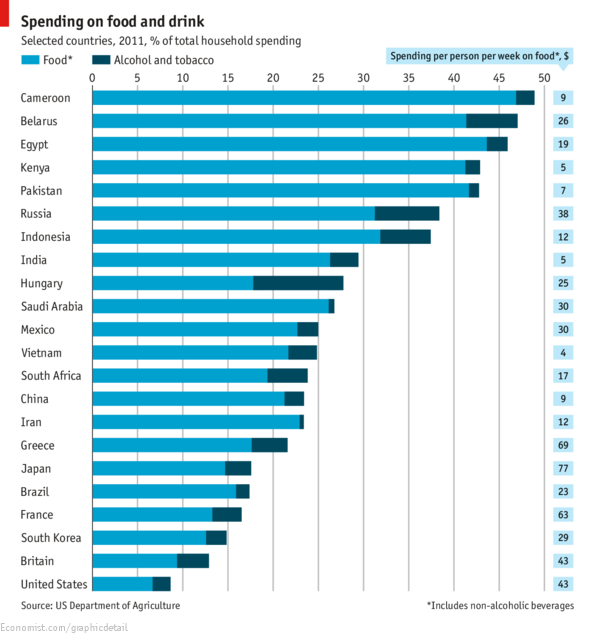
In response to a question at a recent guest-lecture, I commented that rising affluence is the cause of what we often refer to as "problems."  With affluence, we humans tend to increase consumption of different types, including food.  Affluence means that we are no longer limited to surviving on cassava and bananas.  We begin to want more nutrition and variety. Vegetarians want to increase protein and fat and sugar intake. Carnivores with money are tempted to eat more animal food..

Of course, the world is not full of affluent population--we cannot afford to be misled by the exceptional affluence here in the US that has made food so inexpensive:

Image source

Against such a background, we are also certain that the global population will increase by at least another two billion people, if not even more.  The higher numbers, along with the projected increase in affluence, means one undeniable aspect of life--we will need to produce more food.

Producing more food begins with increasing agricultural yields.  Not merely because of the growth of the vegetarian population--that will be a much slower growth compared to the demand for animal protein. All those animals have to be fed.

Hence my worries over the sustained opposition to GM food.  The Scientific American has a "food issue" in which there is this lengthy piece on GM crops:
[Despite] overwhelming evidence that GM crops are safe to eat, the debate over their use continues to rage, and in some parts of the world, it is growing ever louder. Skeptics would argue that this contentiousness is a good thing—that we cannot be too cautious when tinkering with the genetic basis of the world's food supply. To researchers such as Goldberg, however, the persistence of fears about GM foods is nothing short of exasperating. “In spite of hundreds of millions of genetic experiments involving every type of organism on earth,” he says, “and people eating billions of meals without a problem, we've gone back to being ignorant.”
So who is right: advocates of GM or critics? When we look carefully at the evidence for both sides and weigh the risks and benefits, we find a surprisingly clear path out of this dilemma.
This is a battle that has been going on for decades now.  We might even find a peaceful solution to the Israel-Palestine issue before we sort out the GM crop disagreements.  So, where do we go from here?
There is a middle ground in this debate. Many moderate voices call for continuing the distribution of GM foods while maintaining or even stepping up safety testing on new GM crops. They advocate keeping a close eye on the health and environmental impact of existing ones. But they do not single out GM crops for special scrutiny, the Center for Science in the Public Interest's Jaffe notes: all crops could use more testing. “We should be doing a better job with food oversight altogether,” he says.
I doubt we will reach any middle ground on this, given the deep trenches that have been dug.

Meanwhile, the race is on to label foods, which this Scientific American editorial notes is "a bad idea":
We have been tinkering with our food's DNA since the dawn of agriculture. By selectively breeding plants and animals with the most desirable traits, our predecessors transformed organisms' genomes, turning a scraggly grass into plump-kerneled corn, for example. For the past 20 years Americans have been eating plants in which scientists have used modern tools to insert a gene here or tweak a gene there, helping the crops tolerate drought and resist herbicides. Around 70 percent of processed foods in the U.S. contain genetically modified ingredients.
Instead of providing people with useful information, mandatory GMO labels would only intensify the misconception that so-called Frankenfoods endanger people's health [see “The Truth about Genetically Modified Food”].
But, isn't sticking a label on the food better for consumer choice?  Consumers can then buy whatever they want to buy?  Not really:
 Many people argue for GMO labels in the name of increased consumer choice. On the contrary, such labels have limited people's options. In 1997, a time of growing opposition to GMOs in Europe, the E.U. began to require them. By 1999, to avoid labels that might drive customers away, most major European retailers had removed genetically modified ingredients from products bearing their brand. Major food producers such as Nestlé followed suit. Today it is virtually impossible to find GMOs in European supermarkets.
Americans who oppose genetically modified foods would celebrate a similar exclusion. Everyone else would pay a price. Because conventional crops often require more water and pesticides than GMOs do, the former are usually more expensive. Consequently, we would all have to pay a premium on non-GMO foods—and for a questionable return.
So, to recap: where will all the additional food crop production come from to feed the growing population that will also be more affluent?

Monday, July 29, 2013

Air, water, and land. All three polluted in China. Is manufacturing worth it?

In the years before Rupert Murdoch bought out the Wall Street Journal, and changed the tone of the paper, I was a regular reader of that paper. Even a subscriber at one point.  (I am sure that will gladden the hearts of my socialist colleagues!)

The WSJ was unique in one way--it was almost as if the editorial page was a newspaper of its own and ideologically driven with Robert Bartley in the driver seat, separate from the rest of the paper that was not that far from a middle-of the-road routine journalism.  The paper even had Alexander Cockburn as a regular columnist giving his interpretations from the far left side of the political spectrum.  

Typically, every issue had an interesting rather off-beat story that began in the front page and worked its way into the inside pages.  I can even faintly recall the image of Daniel Pearl's portrait on the front in that characteristic WSJ-style.

Even now, every once in a while, the WSJ breaks free of its ideological framework (I guess it is possible now with Murdoch being distracted with many professional and personal issues!) and presents lengthy pieces, like this one on China's pollution in the rural areas, affecting the agricultural lands too.

Pollution in China is not anything new in this blog.  For instance, this past January alone, I had three entries (here, here, and here)on the topic, with the bottom-line question of all is all that cheap manufacturing for the rest of the world really worth all the pollution?

In its latest piece on China's rural pollution, the WSJ notes:
For years, public attention has focused on the choking air and contaminated water that plague China's ever-expanding cities. But a series of recent cases have highlighted the spread of pollution outside of urban areas, now encompassing vast swaths of countryside, including the agricultural heartland.
Estimates from state-affiliated researchers say that anywhere between 8% and 20% of China's arable land, some 25 to 60 million acres, may now be contaminated with heavy metals. A loss of even 5% could be disastrous, taking China below the "red line" of 296 million acres of arable land that are currently needed, according to the government, to feed the country's 1.35 billion people.
To begin with, though it is vast in land area, most of the land is not suited for agriculture.  And then to have between 8% and 20% of the arable land messed up?

Caption at the WSJ story:
In Dapu, a chemical factory sits next to a farm. 'Nothing comes from these plants,' says a local farmer.
I suppose the air pollution is visible in Shanghai or Beijing--which is why, finally, after years of dodging the issue, China is committing $277 billion to clean up the air pollution over the next five years. Water pollution is also equally visible--when dead pigs float down the river, or rivers run in some psychedelic colors.  Compared to air and water pollution, contamination of soil is pretty much out of sight, and happens far away from the big cities.
[Factories] are moving to the countryside to take advantage of cheaper land, often made available with the help of local officials who want to boost growth, environmental researchers say. In other cases, urban leaders want factories to move out of crowded cities. The ensuing problems of rural pollution are exacerbated by the fact that many small-town governments have less capacity to properly regulate complex industrial activities than their counterparts in big cities, experts say.
Even in a dysfunctional politics like the one in India, such happenings get reported by the media, and activists head to the courts--like Rahul Choudhary, about whom I had written in the Register Guard.  But, it is a different story in China, where negative reports rarely see daylight.
China's Ministry of Environmental Protection refused to release the results of a multiyear nationwide soil-pollution survey, calling the data a "state secret."
It gets complex:
Removing heavy metals from farmland is a complicated process that can take years—time lost for farming. That is a chilling prospect for a government tasked with supporting 20% of the world's population on less than 10% of the world's arable land. Any major reduction in food security would hurt the Communist Party, which has staked its reputation in part on its ability to keep the country's granaries full with minimal imports.
The government's refusal to release its soil survey, meanwhile, has only added to fears that officials know more than they are willing to say. Launched to great fanfare in the state media in 2006, the survey was originally scheduled to be completed in 2010. In June last year, an environment ministry official told the Xinhua news service that more than 20% of soil samples in a trial program for monitoring pollution, involving 364 rural villages, had failed to meet national standards and that the results of the survey would be published "at the proper time."
We consumers have a responsibility, too.  As I often remind students, "the invisible hand" watches out for whether we are willing to put our money where our mouth is.  If we are willing to pay up, then the market responds.  But, as long as we do not care about the pollution in China, or labor dying in accidents in Bangladesh, and all we care about is getting the most inexpensive product, even if it means that we toss it away after a few months, well, we will have to witness the pollution too.


China’s Andy Rooney Has Some Funny Opinions About How Great The Chinese Government Is

Monday, September 13, 2010

In Praise of Fast Food ... well, not "fast food" itself ...

I like cooking. I do not have an extensive repertoire, but I do all right. The more I cook, the less I find foods at restaurants tasty anymore--particularly for the price they charge for the quality they offer. 

But, and despite this, I don't diss the extensive practice of eating food that somebody else has prepared: fast food in many variations. Because, as I tell my students when we discuss geographic patterns in agriculture and food, the "old ways" were also the times when women had pretty much no choice but to be cooks, or most men had no choice but to be farmers.

The story of economic progress has been one of walking away from such limited choices into exercising freedom in terms of what we want to do.

It is quite possible that my grandmother hand-made a lot more dishes and snacks than my mother did--and she made some wonderful sweets that I always, always, looked forward to.  And, yes, my sister makes way fewer eats than what my mother did.

But, the differences in terms of what my sister has done/does versus the previous generations of women, include everything from, say, my sister having a masters degree in the sciences ...

The productivity difference is also enormous. For instance, the electric rice grinder that mom bought about thirty years ago, which she still uses, gained her the two hours that she would have otherwise had to spend at the "aattukkal". (The large version of the mortar/pestle in the photo here.)  Now, both mom and sister have yet another choice--they can directly purchase from the grocery store the machine-mass-produced ready to cook ground mix!  It is their choice now, if they want to do anything the "old way" ... to be able to exercise that choice is freedom.

Freedom in our daily lives matter a lot.  These are not freedoms that a constitution can guarantee, but can only come from economic progress.  Thus, when I feel like having vadas while visiting India, mom does not have to slave in the hot kitchen and fry those delicious vadas and come out of the kitchen drenched in sweat--a two minute walk takes me to the restaurant where I can pick up any number of vadas I want.

So, why such thoughts?
It is not only because I think of food a lot :)

I have started thinking about the kind of topics that I would like to discuss with students, or at least keep them in my mental back-pocket, which I can then appropriately use in discussions. And I ran into this article (ht), which is a wonderful essay.  Even though to excerpt from that is a crime--it really needs to be read from the start to the end--well, here are the concluding observations:
If we do not understand that most people had no choice but to devote their lives to growing and cooking food, we are incapable of comprehending that modern food allows us unparalleled choices not just of diet but of what to do with our lives. If we urge the Mexican to stay at her metate, the farmer to stay at his olive press, the housewife to stay at her stove, all so that we may eat handmade tortillas, traditionally pressed olive oil, and home-cooked meals, we are assuming the mantle of the aristocrats of old.
If we fail to understand how scant and monotonous most traditional diets were, we can misunderstand the “ethnic foods” we encounter in cookbooks, at restaurants, or on our travels. We can represent the peoples of the Mediterranean, Southeast Asia, India, or Mexico as pawns at the mercy of multi­national corporations bent on selling trashy modern products—failing to appreciate that, like us, they enjoy a choice of goods in the market. A Mexican friend, suffering from one too many foreign visitors who chided her because she offered Italian food, complained, “Why can’t we eat spaghetti, too?”
If we assume that good food maps neatly onto old or slow or homemade food, we miss the fact that lots of industrial foods are better. Certainly no one with a grindstone will ever produce chocolate as suave as that produced by conching in a machine for 72 hours. And let us not forget that the current popularity of Italian food owes much to two convenience foods that even purists love, factory pasta and canned tomatoes. Far from fleeing them, we should be clamoring for more high-quality industrial foods.
If we romanticize the past, we may miss the fact that it is the modern, global, industrial economy (not the local resources of the wintry country around New York, Boston, or Chicago) that allows us to savor traditional, fresh, and natural foods. Fresh and natural loom so large because we can take for granted the processed staples—salt, flour, sugar, chocolate, oils, coffee, tea—produced by food corporations.
Culinary Luddites are right, though, about two important things: We need to know how to prepare good food, and we need a culinary ethos. As far as good food goes, they’ve done us all a service by teaching us how to use the bounty delivered to us by (ironically) the global economy. Their ethos, though, is another matter. Were we able to turn back the clock, as they urge, most of us would be toiling all day in the fields or the kitchen; many of us would be starving.
Nostalgia is not what we need. What we need is an ethos that comes to terms with contemporary, industrialized food, not one that dismisses it; an ethos that opens choices for everyone, not one that closes them for many so that a few may enjoy their labor; and an ethos that does not prejudge, but decides case by case when natural is preferable to processed, fresh to preserved, old to new, slow to fast, artisanal to industrial. Such an ethos, and not a timorous Luddism, is what will impel us to create the matchless modern cuisines appropriate to our time.
Yes!
I am already pumped up for my classes; I wonder if my students are ready as well :)

Friday, August 20, 2010

This, too, is India ... no outsourcing!

The caption at the source:
ALL FOR PEANUTS: A farmer ploughs his field as a farm woman spreads groundnut seeds in a field in Mappillainayakampatti, near Thanjavur District. Photo: M. Srinath

Wednesday, March 10, 2010

Why a salad costs more than a Big Mac

provides billions of dollars in subsidies, much of which goes to huge agribusinesses producing feed crops, such as corn and soy, which are then fed to animals. By funding these crops, the government supports the production of meat and dairy products—the same products that contribute to our growing rates of obesity and chronic disease. Fruit and vegetable farmers, on the other hand, receive less than 1 percent of government subsidies.
The government also purchases surplus foods like cheese, milk, pork, and beef for distribution to food assistance programs—including school lunches. The government is not required to purchase nutritious foods. 
 Source, and ht
A note on the source, which is the Physicians Committee for Responsible Medicine:
Founded in 1985, PCRM is a nonprofit organization supported by physicians and laypersons who receive Good Medicine each quarter. PCRM programs combine the efforts of medical experts and grassroots individuals.
Leadership
PCRM Board of Directors: Neal D. Barnard, M.D., President; Mark Sklar, M.D., Director; Russell Bunai, M.D., Treasurer and Secretary.

Sunday, February 28, 2010

The spread of GM crops

Hey, the Economist is also on to the GM crop issue--I suppose there are lots of people who understand that there is more to the world than being preoccupied with the US, Western Europe, AfPak, and Iraq
Anyway, the Economist makes points that provide a larger context than my comments on the Bt-brinjal controversy in India.
The magazine notes:
in Europe, opposition to GM food appears as strong as ever, despite increasingly strident scientific dissent. The European arm of Greenpeace, a green pressure group, still denounces the technology and gloats about a decline of over a tenth in cultivation of GM crops in Europe last year. Sir David King, a former scientific adviser to the British government, argues that the unjustified vilification of GM is leading to needless deaths. He thinks the delay in the introduction of flood-resistant GM rice, for example, has condemned many in the poor world to starvation.
I tell you, we need to seriously start thinking about feeding 9 billion people

Sunday, July 19, 2009

California's Detroit: farmlands in the Central Valley

The real question is what emerges after the almonds, tomatoes and cantaloupes disappear. What happens as ever more Central Valley farmland is retired, as is inevitable? What does the future look like for the northwest corner of Fresno County? Will the usual solution -- building a new prison -- be all that's conceived? Or can the sun-baked San Joaquin Valley become a hub of solar power and alternative energy, as some have suggested? If so, who will prepare workers for this new field?

... "We are part of a multibillion-dollar agricultural juggernaut that feeds the nation," Riofrio said. "But we've gotten chewed up and spit out."
Rick Wartzman in the LA Times

Monday, July 06, 2009

Will we be able to feed 9.5 billion people?

The Aspen Ideas Festival is over. You nor I went to that one means that apparently we did not have ideas that anybody wanted to listen to, or we did not have the money to listen to those with ideas! Oh well ....

James Fallows was one of those that the attendees wanted to listen to, and has blogged about a session he moderated; it was on "Feeding the World's Billions." Fallows writes:
Sample alarming fact: if the world population eventually tops out at 9.5 billion, 50% more than now, total food production will probably have to grow by 200%, as people eat higher up the food chain and demand more and more meat. The challenge, as several panelists put it, was to produce three times as much food on no more than the current amount of agricultural land. (About why it won't just work to cut down all remaining forests to grow food, see here.)

Sample specific solution-possibilities, or at least interesting facts: Average yields in U.S. farms are roughly three times as high as the overall average for Mexico, India, and Brazil. If those countries got to even two-thirds of the US level, it would make a huge difference in closing the "grain gap." Also: a huge share of the world's food output is wasted -- in the developing world because it rots and spoils before it can get to market, and in the US to a significant degree because of restaurant waste. Thus easy opportunities for gain.
I am sure the neo-Malthusians will be all over this one in no time at all ....

Tuesday, November 04, 2008

Eating locally to save the planet? Think again.

A follow-up to an earlier post about food-miles. Ron Bailey cites a study by economic geographer Pierre Desrochers and economic consultant Hiroko Shimizu, who challenge the notion that food miles are a good sustainability indicator. And, importantly:
the debate over food miles is a distraction from the real issues that confront global food production. For instance, rich country subsidies amounting to more than $300
billion
per year are severely distorting global agricultural production and trade. If the subsidies were removed, far more agricultural goods would be produced in and imported from developing countries, helping lift millions of people out of poverty. They warn that the food miles campaign is "providing a new set of rhetorical tools to bolster protectionist interests that are fundamentally detrimental to most of humankind." Ultimately, Desrochers and Shimizu's analysis shows that "the concept of food miles is...a profoundly flawed sustainability indicator."

Tuesday, July 01, 2008

Organic farming bad for the poor

From the Economist:
FROM farmers' markets to happy chickens, sales of organic food have rocketed in recent years. And to meet this demand, the share of farmland used for organic production has also increased in many rich countries. Switzerland has upped its share from under 2% in the mid-1990s to over 10% today, the highest in the OECD. But as global food prices soar, hurting the poor in particular, environmentalists may find organic farming trickier to promote. Organic farming produces far less than conventional intensive methods, and so more land must be farmed for the same yield.