Showing posts with label germany. Show all posts

Tuesday, November 10, 2020

Immigrants and Project Lightspeed

The tRump regime--"administration" doesn't really describe it--loudly and openly beat up on immigrants and Muslims.  Remember how one of the first things he tried to do was a blatant Muslim ban?  He then had to scale it down and pretend it was not really a Muslim ban when it was.

During those dark days, social media--from the anti-tRump side--pointed out how Apple might not have happened if a certain Syrian immigrant had not come to the US.  Steve Jobs' biological father, Abdulfattah Jandali, was an Arab Muslim from Syria, who came to the US to pursue a PhD.

Now, it is another Muslim immigrant to the rescue.  Make that two immigrants.  Not here in the US, but in Germany.  But, it is also an American story.

Scientists have greeted with cautious optimism a press release declaring positive interim results from a coronavirus vaccine phase III trial — the first to report on the final round of human testing.

New York City-based drug company Pfizer made the announcement on 9 November. It offers the first compelling evidence that a vaccine can prevent COVID-19 — and bodes well for other COVID-19 vaccines in development.

Pfizer being a US-based company.  But, the immigrants who provided the scientific breakthrough are not here.  They are in Germany, born to Turkish immigrants.

Dr. [Ugur] Sahin, 55, was born in Iskenderun, Turkey. When he was 4, his family moved to Cologne, Germany, where his parents worked at a Ford factory. He grew up wanting to be a doctor, and became a physician at the University of Cologne. In 1993, he earned a doctorate from the university for his work on immunotherapy in tumor cells.

Early in his career, he met Dr. [Özlem] Türeci. She had early hopes to become a nun and ultimately wound up studying medicine. Dr. Türeci, now 53 and the chief medical officer of BioNTech, was born in Germany, the daughter of a Turkish physician who immigrated from Istanbul.

BioNTech is the firm that the couple founded.

BioNTech began work on the vaccine in January, after Dr. Sahin read an article in the medical journal The Lancet that left him convinced that the coronavirus, at the time spreading quickly in parts of China, would explode into a full-blown pandemic. Scientists at the company, based in Mainz, Germany, canceled vacations and set to work on what they called Project Lightspeed.

They partnered with Pfizer, whose CEO is Greek!

Albert Bourla was born and raised in Thessaloniki, Greece.[2] Born into a Jewish family, he earned his doctorate in the biotechnology of reproduction at Aristotle University of Thessaloniki's Veterinary School.[3] He left Greece with his wife when he was 34 and since then he has lived in seven different cities, in four different countries.

The tRump regime eagerly broadcast the Pfizer success as one that was made possible through its Operation Warp Speed.  Controversies are in plenty on how much Warp Speed really made it possible.  Whatever that might be, did the regime say anything about how it was immigrants who created this success?  Did the regime say anything about the Turkish Muslim backgrounds of the two scientists in Germany?

I am glad that the fucking tRump regime is on its way out, though they will torch everything they possibly can during the exit.  I can only hope that we Americans have inoculated ourselves against that kind of a political virus.

Meanwhile, I hope that the Pfizer vaccine and the others under development will deliver us from the global pandemic in a matter of mere months from now.

Friday, December 06, 2019

Truth, Reconciliation, and Unbearable Burdens

I have written quite a few posts here on the caste and race issues of the old and adopted countries of mine.  The unbearable burdens of the past, as I often note them to be.

In the posts before tRump's election and mOdi's re-election that served as a Rorschach test of sorts, when regular readers had yet to reveal their true colors, the comments say a lot, like:
I understand, but do not subscribe to, the concept that any generation must apologise for the behaviour of previous generations. These symbolic apologies, in my humble view, are mere tokens and are not synonymous with real change, which is what is really important.
Am I to apologize for the actions of unrelated people centuries ago? Hollow apology. We should acknowledge our past and move forward. I am no more responsible for slavery than someone my age in Oregon is a victim of slavery.
Of course, the freedom of expression in a true democracy means that those views and worse are allowed in the public space.  But, if only they would think differently and better!

I wrote in one of my final commentaries for the local newspapers (or, was that the final one?) "We as a country have never truly come to terms with this history and the racial dimensions of contemporary America."  One of the emails that I got was from a reader (a stranger to me) who wrote:
I am so frustrated that Germany, a country which confronted its past head on, cannot be a lesson for America. Even the smallest acknowledgement of the horrors of slavery and the following disastrous treatment of black people cannot be found in the broader culture.
I am amazed that some of our finer movies which made powerfully and emotionally clear the evil and injustice of this treatment can't have a wider and deeper influence on the politics and everyday behavior in the U. S.
For me, some form of reparations seem correct, moral and necessary, but how can such a thing happen without acknowledgement of the crimes? I see your writing as a clear statement for the need of justice deserved.
Germany does provide us with an example that we can learn from.  Even now, in 2019, more than seven decades after the end of WW II, German leaders offer public apologies for the past.  There is no dismissive "acknowledge our past and move forward" nor are they "symbolic apologies."  It is sincere, heart-felt, and constructively moves into actions towards the future.

Angela Merkel did that again during her first visit as German chancellor to the Auschwitz-Birkenau Holocaust memorial:
Dressed in black, Merkel said the crimes committed at the site in southern Poland where the Nazis ran their largest death camp would always be part of German history.
“This site obliges us to keep the memory alive. We must remember the crimes that were committed here and name them clearly,” Merkel said during a ceremony attended by the Polish prime minister, Mateusz Morawiecki.
“I feel deep shame given the barbaric crimes that were committed here by Germans,” she added. 
What a profound statement by a leader who personally had nothing to do with the barbaric crimes that were committed in the past!

As Harvard's president noted in acknowledging the university's past:
The past never dies or disappears. It continues to shape us in ways we should not try to erase or ignore.

Saturday, November 16, 2019

The fear of the "other"

Consider Germany and the US.  If I were asked which country is the land of immigrants, well, the answer is a no-brainer.  That's what I would think.

As with many things in life, what I think might not be correct!

Take a look at the chart below:

Source

Really?  Germany's foreign-born population slightly exceeds (percentage-wise) that of the US?

Sure, a significant component of the foreign-born in Germany are from other EU countries.  But, still, that high a percentage?

We live in a remarkable time when it is so easy to physically move to a new place that could be far from where we are born.  A plane ticket and a few hours later one could be on the other side of the planet.  It is practically magic.

But, the magic does not happen more only because countries--we, the people--prevent the movement.  And collectively we are losing:
If everyone who wanted to migrate were able to do so, global GDP would double, estimates Michael Clemens of the Centre for Global Development, author of a forthcoming book, “The Walls of Nations”. No other policy change comes close to generating such colossal rewards. If there is $90 trillion a year up for grabs, you might think that policymakers would be feverishly devising ways to get a piece of it. They are not.
How bizarre our behavior is!
It has become physically much easier to move, but bureaucratically much harder. Only 2% of those who arrived at Ellis Island a century ago were turned away.
Ahem, a century ago, those arriving at Ellis Island were not brown-skinned people!  But, ok, point taken.
Now it is extremely difficult to migrate legally from a poor country to a rich one, unless you are highly skilled or a close relative of a legal resident. America’s green-card lottery last year attracted 294 applicants for each of its 50,000 slots. Partly because of Mr Trump’s efforts to make life hard for them, the net inflow of all migrants fell by 74% in 2018, to 200,000 people. Globally, many more people would like to move than can. A Gallup poll suggests that 750m people—15% of the world’s adults—want to settle permanently abroad. That includes 33% of sub-Saharan Africans and 27% of those in Latin America and the Caribbean.
We can do better. But, when even an American citizen of Iranian descent is suspect, when the President's adviser on immigration wants to peddle racist tropes, ... I will conclude by quoting Branko Milanovic again:
[As] economic migration faces increasing obstacles in rich countries (and, it has to be added, not solely because of xenophobia but for economic reasons as well), the ideal of a world “without injustice of birth” recedes.

Friday, August 16, 2019

Fantasy Soda

I would think that I am not the only one from India who loved Fanta when I was young.  It was a special treat to get to drink Fanta.

And then, just like that, it was gone. 

We had no Coca-Cola products in India thanks to the government kicking the company out of India.

In its place came some godawful soft drinks--one was even called the "Double Seven", the "77" was a reference to 1977, which was the year that Indira Gandhi lost the elections and the urine-drinking Morarji Desai became the prime minister.  At least he didn't sell that bottled pee as cola, eh!  But, that is a different story by itself.

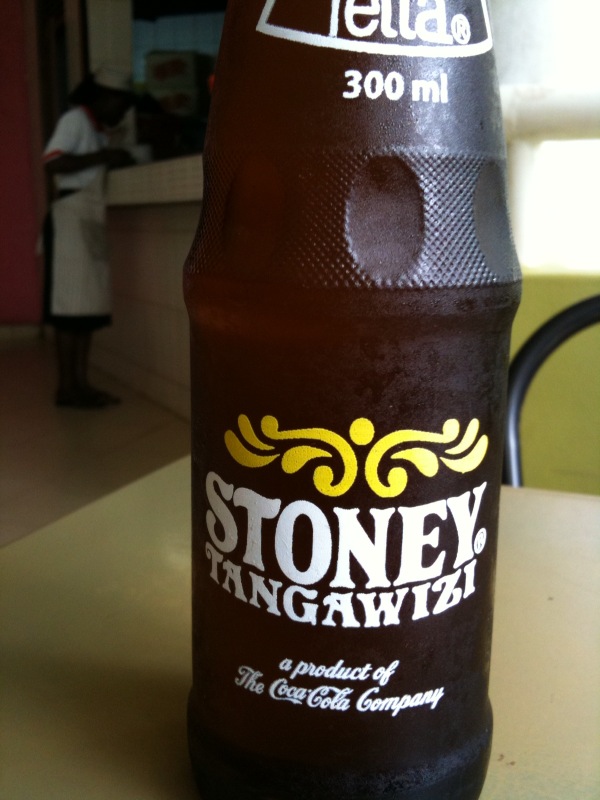
I suppose Fanta also was appealing because I was a kid.  I tried one much later, well into adulthood, and it was not the same.  And then, a decade ago, I had Fanta when I was in Tanzania--but only when the absolutely wonderful ginger beer, "Stoney Tangawizi," which is also a Coca-Cola product, was not available.


Oh, I could go on and on about the Stoney.  It was even better than what had until then been my best ginger beer--Bundaberg. I wish they would sell Stoney here in the US.

Even though a product from the Coca-Cola company, Fanta was originally created because of a very bizarre situation in wartime Germany:
The soft drink Fanta was invented by Coca-Cola, an American company, inside of Nazi Germany during World War II. Developed at the height of the Third Reich, the new soda ensured the brand’s continued popularity. Fanta became a point of nationalistic pride and was consumed by the German public, from the Fraus cooking at home to the highest officials of the Nazi party.
Something like India coming up with "Double Seven" cola!

And what went into the making of Fanta?
The drink was technically fruit-flavored, but limited wartime resources made that descriptor not wholly accurate. Its ingredients were less than appetizing: leftover apple fibers, mash from cider presses, and whey, a cheese by-product. “[Fanta] was made from the leftovers of the leftovers,” says Mark Pendergrast, who, as the author of For God, Country, and Coca-Cola, revealed this hidden past.
If you are like, you begin to wonder why Coca-Cola was doing business in Nazi Germany. It has always been that way--profit-making rarely ever stops to pause to think about morals!

And then Pearl Harbor happened.
The U.S.’s entrance into World War II meant that American companies had to immediately stop all business activities with the enemy. In addition, the German government was threatening to seize “enemy-owned” businesses. General Motors pulled out of Germany (though, Opel, a fully owned subsidiary of GM, still operated there). IBM’s operations were seized by the Third Reich, though controversy exists on how much they contributed to the German war effort. Coca-Cola HQ in Atlanta also cut off communications with Keith in Germany and halted the export of Coca-Cola’s 7X flavoring (the long-mythicized, top secret formula for Coca-Cola syrup).
The name Fanta? "Joe Knipp, a salesman, pitched “Fanta,” shorthand for the German word for “fantasy.” It stuck."

So, if Fanta was invented in Nazi Germany, then Coca-Cola could have easily discontinued that name, right?  Wrong. Have you already forgotten that profit-making rarely ever stops to pause to think about morals?
In April 1955, Coca-Cola reintroduced Fanta with a new recipe, this time as an orange-flavored drink. It debuted in Italy, before making its way to the United States in 1958. According to Pendergrast, they revived the name largely because it was convenient. After all, Coca-Cola already had the copyright. “I don’t think anyone [at Coca-Cola] cared that [Fanta] had roots inside of Nazi Germany,” says Pendergrast, “I think they thought no one would pay attention.”
Such is life in these modern times!

Friday, June 24, 2016

Three men in a van ... and a woman too!

The whiteness of where I live is such a contrast to the multi-tonal mosaic of Southern California.  Heck, some of the whites are so tanned that they look even darker than me!

A view of downtown Los Angeles
from the daughter's apartment
The shuttle van driver was on time.  As he started driving, of course, I began my small talk with him.  It is so wonderful to understand life from the perspective of one whose daily life is very different from mine.  The small talk quickly revealed that he, too, had an accent that indicated he was from somewhere else.

"Hey, is that a little bit of an Iranian accent in you?" I asked him.

He smiled.  "No, Armenian."

"I was close. Neighboring country." I ought to know, given that I am tenured in the geography department ;)

He came here when he was a child, when the family immigrated just before the USSR came tumbling down.  I didn't ask him if they would have stayed back in a free and independent Armenia.

"I hear there are white supremacy groups in Oregon.  How do they treat you when you are a person of color?" he asked.  He was so articulate that I was sure there is a backstory to why he was being an airport shuttle van driver.  I didn't ask him that either.

We reached the hotel where he was picking up more passengers.  Two visiting Germans.  This kind of a spontaneous and serendipitous mixing of people from diverse parts of the world is one I miss in my life in Oregon.  The foreigners that the friend introduces me to, when they arrive here for short work visits, are welcome additions.

Other than the Germans occasionally struggling to think about the correct English word, we four had a great conversation the rest of the drive.  The driver talked to them about German soccer clubs.  "We are not into sports" the German male politely replied.  Vintners, from the Mosel region, who were here to market their wines.  He gave me his business card and asked me to check out their wines if our stores carried them.  Though I don't drink, I wonder if I should buy a bottle and then email him about it.

"My family still has vineyards in Armenia and they make their own wines too" the Armenian-American said.

"Ja, ja, Armenia is one of the oldest wine regions of the world" the vintner said.

I had no idea about Armenia's wines and history.  I had to later read up in Wikipedia in order to get an idea of what the German and the Armenian were talking about.  I tell ya, if only people realized how little I know about this world!

"I went to Varanasi.  I have never seen a place like it" she said.

I am from India and was born in a faith that cherishes going to Varanasi, yet I have never been there.  And, with personal connections to the city.

"The traffic in India is crazy" she said.  "There are no rules but everything works like magic" he jumped in.  "It is synchronized driving, like synchronized swimming" he added with a smile.  I like that characterization of India and its traffic conditions.

Like how the Passover Seder ends with a prayer of "next year in Jerusalem," I wish for a Varanasi visit some day soon.  For now, I will continue to observe life from here in Whitelandia!

Tuesday, June 07, 2016

I want you to celebrate this presidential election

No, not the one here in the US.  Our elections stink so bad that we will be better off if I didn't write anything about it.

The presidential election in Peru is the one that I am referring to.

Why Peru?  Not because of the potato.  You ready?

Think about Peru, and its location.  In South America, and Spanish as the language, right?  Think about the last names from that part of the world.  Next door in Bolivia, the fearless leader is Evo Morales.  On the other side is Ecuador's Rafael Correa.  You all set?

Ok, you are a sharp thinker, who is well informed.  So, you know where this is going.  I will get to it then.

The last names of the two presidential candidates in the Peruvian election: Fujimori and Kuczynski.  Read that again.  Would you ever expect the last names of the presidential candidates in a Spanish speaking South American country to be a Japanese name and a Polish name?  Sit, take a deep breath, and calm yourself down.

Yes, the 41-year old Keiko Fujimori is the daughter of the former president, Alberto Fujimori, who disgraced himself after a decade in office and is now behind bars.  The senior Fujimori's parents immigrated to Peru from Japan.  Over the years of following the Shining Path and how Alberto Fujimori put an end to that violent group, I was familiar with the story of his parents' immigration and, therefore, his fleeing to Japan when the scandals caught up with him.

Pedro Pablo Kuczynski's story is new to me.  He is the same age as Alberto Fujimori--77 years.  Kuczynski's parents, too, came to Peru at about the same time that Fujimori's parents immigrated from Japan.  In Kuczynski's case?
His Jewish father, a doctor, fled Berlin after Adolf Hitler came to power; his Swiss mother taught literature
Wikipedia offers more about the presidential candidate's family;
Pedro Pablo Kuczynski Godard has been married twice, first to Jane Dudley Casey (daughter of Joseph E. Casey, member of the U.S. House for the 3rd district of Massachusetts), their offspring being corporate executive and technology entrepreneur, Carolina Madeleine Kuczynski, the journalist Alex Kuczynski,[9] and John-Michael Kuczynski. His current wife is Nancy Lange, with whom he has had a daughter. Kuczynski's younger brother Miguel Jorge is a fellow of Pembroke College, Cambridge; and their first cousin is Jean-Luc Godard, the renowned French-Swiss film director. Kuczynski's brother-in-law Harold Varmus received the Nobel Prize for cancer research in 1989.
Fujimori v. Kuczynski, in a Spanish speaking South American country, is one awesome example of the wonderfully globalized cultures that characterize our contemporary existence.  Here's to wishing for a lot more of such mixing of ideas and cultures, but because people want to move and not because they are forced to move.

Tuesday, September 16, 2014

Energiewende is the zeitgeist word. No schadenfreude, please

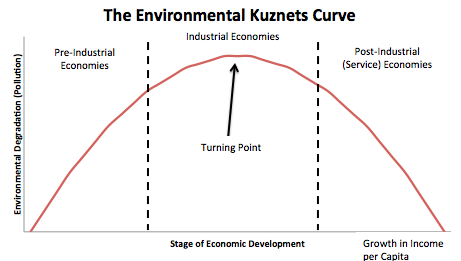
What if globally we are at, or at least close to, that worst point along the environmental Kuznets Curve, and things could only get better from now on?


Of course, I could be--and for all I know--completely wrong.  But then, keep this in mind: Nobody. Knows. Anything.

We try to make order of the chaos that the world is by connecting the dots.  It is, however, to some extent like how we connect the celestial dots--the stars--and give them "shapes."  But, we could connect the stars differently and come up with completely different shapes, right?  Of course, I am using the stars analogy only for illustrative purposes--here on earth, we can confirm with the passing of time whether or not the shape that I create is wrong and whether somebody else's is correct.

I suppose I am connecting a few dots out of my optimism.  A wish that we might be on to a path of screwing up the natural environment a tad less, and make it better.

It all begins with the world's factory--China--where "environmental anxiety is spreading."
This growing anxiety is reflected in the rising frequency of environmental protests. In the past year, people have taken to the streets in cities throughout the country to protest the building of coal-fired power plants, chemical plants, oil refineries, waste incinerators, and the like. According to Chen Jiping, a former leading member of the Communist Party’s political and legislative affairs committee, pollution is now the leading cause of social unrest in China.
Why this budding environmental consciousness now? The answer is simple: 2013 was, by any accounting, one horrific year for the environment. ...
China’s environment is a disaster. But by casting a bright light on the country’s severe pollution problems, the crises of the past year have stirred a greater environmental consciousness in the people. At the same time, they have spurred the country’s leaders to take more aggressive environmental action.
There is hope.

Meanwhile, the big European industrial power, Germany, continues to wage its seemingly lone war against climate change:
Germans will soon be getting 30 percent of their power from renewable energy sources. Many smaller countries are beating that, but Germany is by far the largest industrial power to reach that level in the modern era. It is more than twice the percentage in the United States.
Hence:
The word the Germans use for their plan is starting to make its way into conversations elsewhere: energiewende, the energy transition.
Germany's efforts involve China too:
Germany’s relentless push into renewable energy has implications far beyond its shores. By creating huge demand for wind turbines and especially for solar panels, it has helped lure big Chinese manufacturers into the market, and that combination is driving down costs faster than almost anyone thought possible just a few years ago.
But, it does not mean that all is well.  There is a catch:
Much concern is focused on Germany's reliance on brown coal, which harms the environment more than other types of coal, for a secure and affordable power supply. Last year lignite was the single biggest source of German power, generating 25.8 percent, and it has risen every year since 2010.
Greenpeace says no other country in the world extracts and converts as much brown coal into electricity as Germany.
"Germany is making itself a laughing stock because it hasn't set limits on brown coal," said Greenpeace's Karsten Smid, who wants the government to say when it will phase it out.
These lignite-based power plants (which is why Germans were technical advisers for the industry in the town where I grew up) are needed because, more than anything else, the renewables are intermittent.

I am confident a majority on this planet are in a situation where we can echo this:
“Indeed, the German people are paying significant money,” said Markus Steigenberger, an analyst at Agora, the think tank. “But in Germany, we can afford this — we are a rich country. It’s a gift to the world.”
Germany is not the only rich country, right?  We can all afford to begin to afford to experiment with Energiewende (pronounced in-ur-GEE-vend-uh) and make it a century of carbon in other ways than merely burning it up:


Friday, February 08, 2013

Holy carbon! US exports coal and Europe imports it!!!

A chart that I would never have imagined would be the case:
Wow!
In the United States, natural gas is now frequently less expensive than coal for power, so demand for the hard, black fuel has plummeted. Ships are steaming the coal around the world instead. U.S. coal exports to Europe were up 26 percent in the first nine months of 2012 over the same period in 2011. Exports to China have increased, too.
But, ... but, ... aren't Europeans supposed to be, ahem, greener than thou?  
Green-friendly Europe has a dirty secret: It is burning a lot more coal.  Europe’s use of the fossil fuel spiked last year after a long decline, powered by a surge of cheap U.S. coal on global markets and by the unintended consequences of ambitious climate policies that capped emissions and reduced reliance on nuclear energy.
So, Germany shuttered its nuclear program after the Fukushima incident, and now burns more coal instead.  The truth is always dizzying!

How much have things changed in Germany?  Like so, in a community not far from the Polish border:
Last year, the power plant consumed 88,000 tons of lignite a day and generated more electricity than it had since 1981, according to Vattenfall, the Swedish company that runs it. That record is even more impressive given that in 1981, Communist East German officials didn’t have to contend with labor laws or environmental regulations and could run the mines almost every day of the year.   
The expansion of lignite mining has stunned some people who live in its path. One community under threat is the tiny hamlet of Atter­wasch, a cluster of 250 people on the edge of a proposed expansion of the Jaenschwalde mine. They might have to leave their homes, as well as their church, whose chapel was built in 1294.   
“This church survived the Thirty Years’ War [in the 1600s], two world wars and socialism,” said Mathias Berndt, the senior pastor at the church, which is festooned with anti-coal-mining protest banners. “Now a free country is coming and saying, ‘Good for you, but now you have to move.’ ”
Germans are in love with coal now.  And that too one of the dirtier varieties--lignite.  It was their expertise with lignite that led the West Germany of those old times to provide technical assistance in the town in India where I grew up.

The burning of coal is understandable when poor countries do it--they simply cannot afford to use way more expensive resources, especially when they have to import it.  "Moving away from fossil fuels could be devastating for some of the world's poorest countries."  But, Germany? The Netherlands?

Why is Germany so much anti-nuclear energy, even to the extent of burning more coal?  For that matter, it is a shame that an anti-nuclear energy stance has come to be typical of the liberal left. Why so?  Ashutosh Jogalekar discusses the following five reasons in detail over at the Scientific American:
  1. Ignorance: This simple reason remains remarkably pervasive. I am not trying to sound preachy or elitist here but reading two or three books would greatly benefit people who have a gut reaction against nuclear energy.
  2. Bad psychological connections: There are two bad connections in the minds of many liberals, both of which are rather unjustified and contribute to their dislike of nuclear power. One is the connection between nuclear power and nuclear weapons.  ... Another flawed connection is between environmentalism and the boycott of nuclear power. Unfortunately die-hard environmentalists are mainly responsible for reinforcing this connection. Their decades-long opposition to nuclear energy started with some reasonable premises, but then mainly descended into irrational, uninformed and exaggerated polemic.
  3. Waste: ... Many people think that this is the single greatest threat from nuclear power, that we will all be inhabiting vast atomic wastelands if we allow nuclear power to flourish. ... It’s not a trivial issue, but many of the problems have to do with inefficiency and increased proliferation threats from burying valuable plutonium-containing nuclear waste.
  4. Damn them Republicans: There is actually a third connection- that between nuclear weapons and belligerent right wing political leaders that drives liberals’ disdain for all things nuclear. If the erroneous connection between power and weapons takes hold in your mind, then it is not too difficult to perceive a connection between nuclear energy and right wing excesses.
  5. Fear of the unknown: This is again related to the first point. Fear of the unknown has unfortunately driven negative liberal reactions to many other promising technologies, including vaccines and GMOs. 
An argument in favor of rationally approaching the global energy issue, and the energy needs of the developing countries in particular, is not new to this blog.  Especially when Europe is importing coal like there is no tomorrow!

BTW, the US is flush with coal because fracking has made natural gas available in plenty, and at low prices.  And Europe is grabbing that coal.  Why doesn't Europe also use natural gas then?
One big part of the problem, experts and officials say, is Europe’s cap-and-trade system, which aims to reduce European Union-wide industrial greenhouse gas emissions by 20 percent by 2020. The system is the centerpiece of Europe’s green policies. But the program, which charges industries for permits to emit greenhouse gases, no longer serves as a major disincentive to pollute. Industrial production fell dramatically during the economic crisis, so overall greenhouse gas emissions remain well underneath the cap, and they are still falling. The price per ton of carbon emissions is barely more than a tenth of its 2008 peak. Energy companies, who must plan decades in advance, have shied away from investing in gas-fired power plants because they are not profitable in comparison to coal.
Yep, carbon is way too cheap now!  Burn, baby, burn!

Tuesday, July 26, 2011

Scary chart of the day: Youth unemployment

Outsourced to the Economist:


Notice how much closer the US is to the Eurozone average, and how much below that average Germany is?

BTW, I wonder how much the Germans are kicking themselves for having been so enthusiastic about a common currency:
the truth is dawning in Germany that although hard-pressed taxpayers will not have to pick up the whole price of the new €159 billion refinancing package, they face instead a future of indefinite help to the single currency's weaker and more profligate economies - the cost of a more integrated core of Europe.
While the report says that Germans are split on this issue, I like this anecdotal point:
Ronny Nickel, 61, a construction worker, shook his head in disapproval. "To help them once is OK. But not again and again. We pour money into their system but no one knows where it is going.
"In Greece you can retire young, but we work until we are 67. It's not right. And it's dominoes – they are all falling."
His son Jeremy, 20, an apprentice metal worker, nodded. "What upsets me is that they call us Nazis," he said, showing a newspaper report of how the German consulate in the Greek city of Thessaloniki had been painted with swastikas by protesters.
"That was way before I was born. We've only just stopped paying for the First World War, and it's not right that my generation should be labelled with this too. I used to be very pro Europe, but not any more."

Thursday, June 23, 2011

Difficult to let go of the baggage!

Claudia, the office manager for Hotel Real Audencia, told me when I came back from exploring Quito that both the day trips were confirmed--one to Otavalo, and then to Cotopaxi the day after.  "Be ready by 8:00.  They will pick you up from here."

It was close to 6:30 when I woke up the following morning.  Only after 7:00 would the free breakfast be available.  "Free" as in it was a part of the room charges.  So, I spent some time organizing my backpack, and straightening out the bed.

The dining area was on the top floor of the hotel, with a fantastic view of Plaza Santo Domingo and the Virgin on the hill.  I walked up the stairs a few minutes after 7:00, and two, in their early twenties--graduate students, perhaps--were already half-way into their breakfast.

I had made a habit of sitting at a different table every morning, in order to get a new perspective each time.  I walked up to get myself a cup of tea (as the guide-book had warned, regular coffee was no good.  The book's explanation was that all the good coffee was for export.)  By then, another woman, in her early thirties, had come in as well, and she was getting hot water and milk for tea. 

While I am typically eager to chat with strangers, particularly in foreign lands, I suppose I am a tad hesitant these days because of my self-consciousness over my status as a single guy.  In the past, in the company of  wife or daughter, or both, I was always confident that my intentions would not be mistaken.  But, now, there is always the possibility that I could be viewed as a cliché.

Finally, it didn't matter.  "Where are you from?" I asked her.

"Germany. How about you?"

This simple question dogged me throughout my trip.  Whether it was the taxi driver or a fellow tourist, when they asked me where I was from, I was always tempted to stop with "the US."  But then, I knew that they knew that I am from somewhere other than the US.  So, at a little after seven in the morning, when a young and attractive German woman asks where I was from, well, I am sure it is not difficult for anyone to imagine me trying to figure this question out.

"From the US. Have lived there for a long time after I moved from India."  I was happy with this answer and decided to use the same anytime people asked me this question during the rest of the trip.

As we walked back to our respective tables, I sensed some kind of an anxiety in her.  I sat across after asking for her permission to join at her table.  She could easily be from the US, I thought to myself.  And, like most Western Europeans, she spoke English very well, and her accent had very little of a German sound in it, unlike mine that is heavily loaded with an Indian tone.

"Where in the US are you from?"

"From Oregon. It is north of California."

Turned out that she was a dentist from a small town near Munich, and she was on her way to Cuenca for a five-week dental camp for the not-so-well-off.

"But, how did you figure out from Germany some place in Ecuador for this camp?"

"I am with Dentists without Limits."

"Oh, like Doctors without Borders?"

"Ja"

As we talked, I found out the reason for her anxiety. Her flight from Germany was via Venezuela, and her bag didn't make it to Quito after Caracas.  And her flight to Cuenca was only hours away. 

"I am so sorry.  I am sure it is terrible" I said.

"All the donations for the dental camp are in that bag.  And, I have no clothes other than what I am wearing now."


The tip of her nose was getting red, like how my daughter's used to when she was a teenager.  It was always a sign that my daughter was ready to explode into tears.  I looked at the clock-tower at the Plaza--it was already past 7:30.

In a way, it is awful that we have very little time to sit with and console a fellow human.  I decided to skip my shower and instead chat with this woman and encourage her as much as I could.

"Well, let us hope that your bag will come through.  The best I can offer is you are my clean t-shirts.  I have lots of chocolate that I can give you though."

"Thanks  That's ok.  I put all the food items from my fridge into my carry-on bag, and so have chocolate and cheese and cookies for now.  What do you say in English, "keep your hands together""

"Yes, keep the fingers crossed"

"Ja. Fingers crossed" she said.

"Look at it this way" I told her, "you will have some interesting stories to tell your friends after you return."

"I don't think I will tell them.  Because they will immediately say "I told you not to go anywhere in South America" ... all these countries have too much crime and violence and my friends didn't want me to come here."

"True. Anywhere in South America is awfully unsafe these days" I replied. 

It was almost 7:45. I told her I had to get going, because of the tour starting at 8:00.

"Where are you going today?

"To Otavalo, and stops along the way."  ... "I am sure your bag will come through."

"I hope so. It is not the money value, you know. There are items there--not costly--but items from my trips to Bali and other places.  Those cannot be replaced. And, of course, the dental donations."

"But, you have to go, right?  Enjoy your trip to Otavalo."

As I stood up to leave, I felt terrible that I could not spare any more time to help her out. There was nothing I could do--I don't know the language, for starters.  But, if only to chat with her.

"Hey,  good luck. Nice chatting with you. Bye."

I rushed to my room. Was glad that I had already organized my backpack. Brushed my teeth and got out of my pajamas. Deodorant, in place of a hot shower. Jeans and a t-shirt. Socks. Shoes.

The phone rang as I was getting my backpack. "Your tour guide is here."

"I will be down in a minute. Thanks."

Two flights of stairs later, I was at the desk and Ivan introduced himself as the guide.

We started walking to the van that was parked by the Plaza Santa Domingo.  Only now, as I type this, do I realize that it didn't occur to me to look at the window above and wave out to the lonely German woman who was visibly discombobulated over her lost luggage!

Monday, February 07, 2011

The Anglo-German verdict on multiculturalism: it is dead!

For those fanatical Republicans who mindlessly, and out of sheer reflex, chant "American Exceptionalism" without ever pausing to think about what it means, America is certainly exceptional when it comes to its ability to throw together people of various colors, languages, religions, ... (editor: how about that Alabama governor and his ideas? Well, I didn't say we don't have nutcases!)

Over at Europe, things are not going well.  A couple of months ago, Germany's chancellor was brutal in her analysis:
Chancellor Angela Merkel has declared the death of multiculturalism in Germany, saying that it had "failed utterly" , in what has been interpreted as a startling shift from her previous views. The German leader said it had been an illusion to think that Germans and foreign workers could "live happily side by side".
An illusion!  Not here in America, Chancellor Merkel. 
(editor: but, I thought your faculty and administrative colleagues don't like you by their side?  Awshutup!)

Now, it is the British prime minister's turn; David Cameron said:
we have allowed the weakening of our collective identity.  Under the doctrine of state multiculturalism, we have encouraged different cultures to live separate lives, apart from each other and apart from the mainstream.  We’ve failed to provide a vision of society to which they feel they want to belong.  We’ve even tolerated these segregated communities behaving in ways that run completely counter to our values
So, how do we read these?  The Week offers three takes on Cameron's statement:
Cameron is saying what we're all thinking: David Cameron should be applauded for being the first Western leader to mount a "reasonably coherent defense" of our values, says Gregory Buls at American Thinker. The only way peaceful Muslims will live in harmony with the West is if they understand "what makes Western societies such ideal places to live and raise families." That's a "matter of philosophy," not simply politics.

Cameron misunderstands what multiculturalism is all about: The Prime Minister's speech was driven by "nostalgia for a strong national collective identity," says Madeleine Bunting at The Guardian. But the beauty of multiculturalism is that it has reinvented our notion of "what it is to be British." That's a debate still being "subtly negotiated" in our streets, schools and hospitals. Cameron's rhetoric deprives that argument of hope, and "makes it instead something to fear."

Liberal Britain is afraid of being patriotic: Cameron wants, understandably, to promote a "unified British culture," says John Hinderaker at Powerline. But it's far from clear that "post-Christian" Britain has the "self-confidence to promote its own values." It's troubling that Cameron is pushing the "weak tea of contemporary liberalism." Will that really be enough to "counteract the attraction of radical Islam?" Don't count on it.
I was all set to point out one major flaw in Cameron's argument, but found that it has already been articulated by Frank Furedi:
when Cameron complains that, as a result of multicultural policies, mainstream British society has ceased to criticise and condemn the retrograde views and practices of minority communities, he should not point the finger of blame at tolerance – passive or otherwise.
Multiculturalism has nothing to do with true tolerance. Multiculturalism demands not tolerance but indulgent indifference. It relentlessly promotes the idea of ‘acceptance’ and discourages the questioning of other people’s beliefs and lifestyles. Its dominant value is non-judgmentalism. Yet judging, criticising and evaluating are all key attributes of any open-minded, democratic society worth its name. It is crucially important to rescue the concept of tolerance from its confused association with multiculturalism.
And, here is Furedi making an important point:
The reinterpretation of tolerance as non-judgmentalism or indifference is often seen as a positive thing; apparently, open-minded people are non-judgmental. In truth, the gesture of affirmation and acceptance can be seen as a way of avoiding making difficult moral choices, and a way of disengaging from the challenge of explaining which values are worth upholding. It is far easier to dispense with moral judgment entirely than to explain why a certain way of life is preferable to another way of life that should be tolerated, yes, but not embraced. That is probably why the indulgent indifference of multiculturalism has gained so much traction in recent decades: in Britain and many other European societies, multiculturalism has spared governments the hassle of having to spell out the principles underpinning their way of life.
It is this stupid approach to multiculturalism that has promoted a free for all approach when it comes to voicing any insane idea as equally legitimate.  Here in the US, this "non-judgmental" yardstick is the reason why creationism and intelligent design have so much of a status in the public sphere.  On the other hand, we ought to tolerate them while pointing out that their view are primitive. 

Sunday, August 29, 2010

Quote of the day: on Obama's presidency

If Obama’s politics leads to a Republican takeover of one or both houses of Congress, and even to a Republican president in 2012, then much of what Obama has accomplished could be undone. It’s unlikely that a new Republican president and Congress would actually repeal the health care or the financial reform bill. But the former could be starved of public funds and deprived of regulatory oversight; and the latter could be neutered by a hostile treasury secretary and by weak or hostile presidential appointees to the Securities and Exchange Commission or the new Consumer Financial Protection Agency. Reform legislation needs administrations and congresses committed to reform. That is where politics has to come in; and that’s where the Obama administration, with its aversion to populism, has fallen short.
John B. Judis writing about Obama's (and the Democrats') "Unnecessary Fall"

A similar take on the President, all the way from Germany where Candidate Obama had a phenomenal summer (how do you say "Obamania" in Deutsch?) ... just two years ago:
Even a year ago, I don't think I would have imagined the 2010 midterm elections to become this important ... and setting up one hell of a 2012 election season ... crazy!

There is still one thing, if happens, which will be the mother of all game-changers: the capture or death of Osama bin Laden.

Tuesday, August 17, 2010

Chart of the day: beer

A former colleague used to joke that his body was a temporary storage facility for beer :)

Sunday, June 27, 2010

Chart of the day: worldwide debt

Leave it to the Economist for the appropriate pun in the caption for the graphic :)

But, yes, "oh dear" is the best way to describe one's reactions to this graph.

The only surprise for me was Germany--its debt levels are not that dissimilar from the US'.

It is interesting, eh, to compare the debt levels of the "old" successful economies that are now in horrible conditions with the debt levels of BRIC--Brazil, Russia, India, China.

So, why debt?
 Why do people, companies and countries borrow? One obvious answer is that it is the only way they can maintain their desired level of spending. Another reason is optimism; they believe the return on the borrowed money will be greater than the cost of servicing the debt. Crucially, creditors must believe that debtors’ incomes will rise; otherwise how would they be able to pay the interest and repay the capital?
But in parts of the rich world such optimism may now be misplaced. With ageing populations and shrinking workforces, their economies may grow more slowly than they have done in the past. They may have borrowed from the future, using debt to enjoy a standard of living that is unsustainable. Greece provides a stark example. Standard & Poor’s, a rating agency, estimates that its GDP will not regain its 2008 level until 2017.
Rising government debt is a Ponzi scheme that requires an ever-growing population to assume the burden—unless some deus ex machina, such as a technological breakthrough, can boost growth.

Tuesday, June 22, 2010

The nation's--world's--worst job ...

A couple of days ago, Fred Thompson (erstwhile senator and Republican presidential contender, and actor!) was on the Daily Show.  One of the questions Jon Stewart asked him was whether Thompson is relieved that he is not in the White House having to deal with all the issues.
Of course, The Onion beat everybody to the post when it declared soon after Obama won:
Black man given nation's worst job
It has gotten only worse for the president; the latest?
Yes, it is now Day 64 since the BP rig exploded, and continues to gush out oil at rates that only seem to increase every day--now at, or having exceeded, 100,000 barrels a day!
General McChrystal decides it is time to be a MacArthur, and is now looking at being removed from the job, which means a new chief for the country's longest war ever
Israel has gone complete bonkers with Gaza and occupied territories, and now even Ehud Barak is worried
The Euro is quite close to imploding, and the French-German relations are showing the stress
Unemployment continues to be high, and is a mere fractional points away from the psychological two-digit rate
WTF, eh!
And then internal issues:

The budget director, Orzsag, is leaving; A blogger at the SF Chronicle's notes the sex-issue:
Any dude who can snag ABC newscaster Bianna Golodryga while banging wealthy shipping heiress Claire Milonas, and running the country's budget is a man.
A man, yes, but not a thoughtful man.
One long summer ahead.  And then?  Midterm elections.  Odds seem to be in favor of the Republicans getting back the control of the House?

Tuesday, June 01, 2010

Soccer mania: 1982, Brazil, and Socrates

All I remember from that World Cup was one name: Socrates.  It was a simply awesome tournament ... TV was just about being introduced then in the part of India where I lived, and it was the good ol' newspaper and radio that we had to work with.  I wonder if that made it all the more exciting, come to think of it ...
Here is a clip of one of those classic Socrates' goals from that tournament

Guess what happened to Socrates?
Sócrates is a doctor of medicine, a rare achievement for a professional footballer (he is a graduate of the Faculdade de Medicina de Ribeirão Preto). Even rarer is the fact that he earned the degree while concurrently playing professional football. There are persistent rumours that Sócrates turned out for the University College Dublin. However, the player himself has denied this saying that he has never even been to Dublin[citation needed].
He is also noted for being an intellectual (he holds a doctorate degree in philosophy), a heavy drinker and smoker, and for his height (193 cm, 6 ft 4 in).
Well, thinking about soccer, and Socrates reminded me of this Monty Python gem: Germany v. Greece :)

Tuesday, May 04, 2010

The Greek Tragedy, or if PIIGS could fly!

The Eurozone crisis is essentially:
I owe you
You owe me
We owe each other
this image is worth more than a few thousand words (ht):

Tuesday, April 27, 2010

Headline of the day about Greece

'Nothing Justifies Kicking Greece out of the Euro Zone'
I am not making this up; that is the very headline at Der Spiegel!
Merkel has rejected a debate about ejecting Greece from the euro zone. "It is about a quick reaction in favor of the euro's stability as a whole. Everything else is a distraction."
In Monday's newspapers, German commentators are divided over whether the country's taxpayers should be forking out for the debts of other European nations and whether it may be time to contemplate kicking Greece out of the euro zone. 

First Iceland. Then Greece. Next Portugal? And Euro dies?

That listing of countries might be a wonderful vacation schedule.  But, that seems to be the path of the European contagion ...
First, this news update: Greece's bond rating now means that one can expect only 30 cents on the dollar.  I bet there are quite a few Greeks who are now lamenting the gazillions spent on hosting the Olympics in 2004.  How much did they spend?  Ahem:
the overall cost (state and private funding) was estimated to reach 8.954 billion euro, not including the cost of projects that were completed or the construction of which were accelerated due to the Games, but which had been planned for construction regardless of the Games. Those projects included the Attiki Road highway, Athens' new Eleftherios Venizelos international airport, the tram, and the suburban railway. Of that 8.954 billion euro total, an estimated 7.202 billion was footed by the State, with the remaining 1.752 billion euro coming from the Athens 2004 Organizing Committee (ATHOC) and financed by the committee's revenues from ticket sales, television broadcast rights, Olympic-logo product sales, and sponsorships.
If we count all those investments "regardless" of the Games, well, let us round it up to 10 billion euros.  That was six years ago.  So, factor in inflation as well.  All it means is this: if Greece hadn't wasted away that precious euros, it would not be facing this disastrous scenario of not enough cash to pay the piper, eh! 
Of course, Greece's debts are way more than 10 billion euros.  But, my point is that having debt is one thing, but not being able to make payments is another.

It is not the Olympics aspect that Krugman writes about though.  He has far more profound things to say:
Greece seems to be spiraling over the edge into default; I just don’t know how it steps back from that edge now. Might it also leave the euro? That would be a total mess, inviting the mother of all bank runs
These developments could even make the Goldman Sachs folks respectable and responsible :)  Talk about timing!

Anyway, Hitchens' bottom line is pretty much simple: I told you so!  Apparently he did write that the Euro was not bound to last:
In the summer of 2005, Foreign Policy magazine asked its contributors to name one taken-for-granted thing that they thought was overrated or would not last. After a brief interval of reflection, I chose the euro.
A better prediction that Fukuyama's "the end of history" ...
Anyway, Hitchens writes:
How tragic it is that the euro system has already, in effect, become a two-tier one and that the bottom tier is occupied by the very countries—Greece, Portugal, Spain, and Ireland—that benefited most from their accession to the European Union. The shady way in which Greece behaved in concealing its debts, and the drunken-sailor manner in which other smaller states managed their budgets, has, of course, offended the Germans. It is openly said in Germany now that it would be better to bring back the deutsche mark than to be bailing out quasi-indigent and thriftless banana republics.
Well, this is the same stuff that Krugman refers to the "cohesion crisis"
So, will Greece exit the Euro?  Not so fast, cautions this report:
The most drastic solution - abandoning the euro as a prelude to devaluation - would not change the requirement to cut the twin deficits since short-term export competitiveness is not the key issue and opportunities to boost exports (including tourism) are quite limited, especially as the European economy remains weak.  Those who see euro exit as attractive should also recall the instability generated by historic episodes of devaluation.
Hmmm .... we will be in this for a long time ... hold on to your wallet, home, kids, ....

Monday, March 08, 2010

Questions I would rather not see as headlines ...

... but, here they are at Slate.com:
Can California Declare Bankruptcy? What about Greece?
Isn't that exciting!  How the heck did we reach such a juncture?
California passed a gas tax last week to help make up for its nearly $20 billion budget gap, the latest in a series of measures to right the state's teetering economy. The country of Greece is in even worse shape, with accumulated debt higher than 110 percent of GDP, set to reach 125 percent this year. Can a state declare bankruptcy? Can a country?
You are thinking, hey, declare bankruptcy and start all over!  Gold Rush, Part II.  Of course, California cannot declare bankruptcy. 
Greece is in a slightly different situation. There's no international bankruptcy court for countries that can't pay their debts. Instead, other EU countries that depend on Greece's solvency, such as Germany or France, would have to agree to bail it out. (When the economy of one member of the Eurozone sinks, it drags the euro down across the continent.)
Anne Applebaum writes that Germany is sick and tired of bailing out ailing Euro economies.  Further more, the deficit countries seem to be partying away, while Germany is working hard to save:
Frankfurter Allgemeine Zeitung, Germany's deeply serious paper of record, has pointed out that while the Greeks are out protesting the raising of the pension age from 61 to 63, Germany recently raised its pension age from 65 to 67: "Does that mean that the Germans should in future extend the working age from 67 to 69, so that Greeks can enjoy their retirement?'
But, there is more to this Greek Tragedy than that meets the eye, according to Applebaum:
Germany is now run by a generation with no personal memories of the war. Germany's historical debate is now focused on the fate of Germans who suffered from wartime bombing and postwar deportation, not with the fate of Germany's victims—in Greece or anywhere else. Sooner or later, the Germans will collectively decide that enough sacrifices have been made and that the debt to Europe has been paid. Thanks to the ungrateful Greeks with their island villas and large pensions, that day may arrive more quickly that we thought it would.
Oh well ... dance away, Zorba :)