Showing posts with label deflation. Show all posts

Monday, July 26, 2010

The deflation worry ...

If I were not a half-baked economist, I suppose I would not worry this much about the deflation threat. 
But, wait, even real economists are worrying about deflation. A lot! 
Paul Krugman has often written and blogged about this; in his latest post, Krugman notes:

Picture America in, oh, 2014: unemployment is still around 9 percent, prices are falling about 1 percent a year. Many economists might look at that situation and say, well, deflation is stable, not accelerating, so we must be at the natural rate of unemployment — move along, folks, nothing to see here.
So it’s time to start focusing on downward rigidity and what it implies. After all, all indications are that we’re going to be dealing with a depressed economy for a long time to come.
Why all the worry?  What is the situation on the ground, so to speak?
The latest U.S. data are sobering: Consumer prices overall have declined in each of the last three months, putting the inflation index in June just 1.1% above a year earlier. The core inflation rate — a better gauge of where prices are going because it excludes volatile energy and food items — has dropped to a 44-year low of 0.9%.

That's well below the 1.5%-to-2% year-over-year inflation that the Federal Reserve likes to see, and some Fed policymakers have raised concerns about the rising risk of a broad decline in prices.
The WSJ--yes, that darn pro-business publication:
The good news is that the Fed might not need to fear a Depression-style deflationary spiral. The bad news is that if the U.S. does fall into deflation, it could be stuck there for many years like Japan, and suffer the subpar growth that has gone with it. And because deflation is so poorly understood, policy makers could discover they have no good solutions.
How does this begin to show up? An example:
Safeway executives said the strength of that push on pricing caught them by surprise.
"Deflation continues in price per item and is not expected to significantly improve until the fourth quarter," said Chief Executive Steve Burd, who oversees supermarkets including Safeway, Vons and Dominick's.
Burd acknowledged that retail deflation was much greater than expected in the second quarter and drove a decline in identical-store sales.

Saturday, July 17, 2010

Be responsible and ... go spend money?

So, given the economic conditions over the last two years, should we praise those saving money, or praise those who are fearlessly spending like there is no tomorrow?  (BTW, this might be a good time to read Somerset Maugham's take on the Ant and the Grasshopper ... I can't seem to find a free version online though!)

Roger Lowenstein writes that being an ant is ok, but sometime soon we better become grasshoppers:
Credit and inflation are really two sides of the same coin. When credit expands, people have more money to pay for goods, and prices go up. The Federal Reserve Board has kept short-term interest rates at nearly zero, effectively jamming the credit-creation pedal through the floor. But it hasn’t persuaded people to take out their wallets or their credit cards, stoking fears of a Japan-like deflation. Core inflation (which measures price increases of everything but energy and food) has fallen to its lowest level in 44 years. As people pay back loans rather than take out new ones, they exert a drag on business.
 Keep in mind that this a deflation threat along with high unemployment levels.  Anyway, when would Americans get back to being Americans and spend, spend, and spend, while taking on more debt in the process?
The Conference Board, which asks consumers every month whether they anticipate buying a home, a car or an appliance within the next six months, reported plummeting numbers in June. Consumers used to get their kicks from new Sub-Zero refrigerators; now they chip away at their balances. The turn is yet to come.
So, ok, that is Lowenstein.  Economics being economics, there has to be more than one interpretation, right?  Of course, yes.  Here is the libertarian Reason being sarcastic (so what's new, you ask?)
With inflation hawks questioning his every move and disloyal Fed underlings urging an interest rate hike, Bernanke finds himself unable to do the one thing he's spent his career preparing to do: save the world by throwing money at it.
Like many supergeniuses, Bernanke is in trouble because his plan is too brilliant. It really is possible to create inflation if you have the will. Just print another trillion or two, stop paying banks to keep that money in their vaults, and the country will be flooded with dollars. The problem is that the Fed keeps trying to micromanage the inflation, explode the monetary base without anybody noticing. But at some point you have to commit to devaluation of your currency. The moment to strike is now: Personal savings rates have been increasing for the last three months [all pdfs] measured. There are still millions of jobs to save or create. It's time to send a clear message: We're going to keep printing money until you stop saving it.

So, what do you say, Professor Krugman?
Like others, I’ve been warning that policy makers in the United States are defining normalcy down — accepting high unemployment and below-target inflation as just the way things are. It’s not just an obsession with inflation risks; it’s an abdication of responsibility for the economy, even if prices are falling rather than rising.
The passivity of the Bank of Japan offers an object lesson. The BOJ is now under political pressure? Why? Because it still sees no reason to act after fifteen years of deflation.
Is this a glimpse of the Fed’s future? That’s what I’m afraid of.

Sunday, July 04, 2010

Stagflation cometh? Already here?

The next reading of the CPI comes out in mid-July. A negative number will mark the third straight decline and will surely inflate the volume of talk about deflation. (As the historical data show, we haven't seen four straight monthly declines in the CPI since the 1930s.) But when considering the risks of deflation, we shouldn't look at the CPI in isolation. The phenomenon of prices falling modestly at a time when the economy as a whole is growing at a 3 percent click, as it is today, isn't much to worry about. "The combination of slow growth or stagnation and deflation is the thing that's scary," says Michael Bordo. In other words, look out for stagflation.
That is enough to get me worried all the more about a disastrous combination of employment stagnation and deflation, about which I have blogged enough ... Here is a post from back in October 2008 where I quoted extensively from Dr. Doom himself!

Speaking of him, here is Roubini's comical response to Financial Times' quick survey of summer vacation plans:
Where are you going on holiday this year?Recently I have lived like the George Clooney character in Up in the Air (a film I watched on a plane). If I get a vacation this summer it would possibly be a tour of crisis-hit countries – if I am still allowed in them: Spain, Ireland, Iceland, Latvia, Greece and, maybe, the oil spill-ridden US Gulf Coast.

Sunday, June 27, 2010

Worry about this quote on the economy :(

the United States and Europe are well on their way toward Japan-style deflationary traps.
That is Paul Krugman's line, from his NY Times column.  As I have noted many times over in this blog, this potential combination of deflation and high unemployment is a nightmare scenario that, for whatever reasons, most policymakers are not that much worried about--despite the loud cautionary notes from the likes of Krugman. Like this blog entry from two years ago quoting Roubini--though, that was in the context of oil prices!
So, who will get hurt the most?
The answer is, tens of millions of unemployed workers, many of whom will go jobless for years, and some of whom will never work again.

Friday, May 14, 2010

The coming deflation?

While hyperinflation is to be worried about, a little bit of inflation does not worry most of us--in fact, most central banks work towards maintaining that healthy rate of inflation
Deflation, on the other hand, is a serious monster.  Krugman adds more to why we need to worry ...
Ever since the economic crisis began there have been two schools of thought about inflation prospects. One school basically has a Phillips curve, aggregate demand view: because major economies are operating far below full employment, we should expect disinflation, and possibly deflation. The other is basically monetarist with a touch of Austrianism: look at all the money central banks are printing and governments are borrowing, it says, inflation — maybe even hyperinflation — is just around the corner.
Guess who’s been right so far?
“Spain joins therefore Slovenia, Portugal and Ireland in the number of countries where core prices are falling compared to the previous year,” said Luigi Speranza, an economist at BNP Paribas.
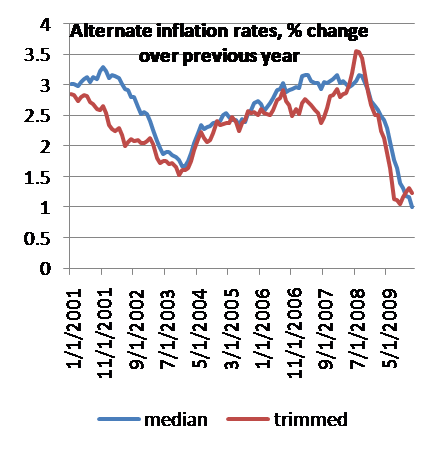
What about the US? Well, various measures of core inflation — like the Dallas Fed trimmed-mean deflator, the Cleveland Fed median CPI, and indexes excluding food and energy have all fallen from 2.5-3 percent inflation at the start of the crisis to around 1 or lower. If the trend continues — which it will unless the recovery is stronger than I fear — deflation is in our future, maybe next year.
 Table? crawl under it. stay there. until 2020?

Friday, February 19, 2010

Deflation just round the corner?

Krugman wants us to worry about it and even sarcastically adds a "san", a la Japanese, to Bernanke.

Thursday, October 15, 2009

Unions, wages, inflation, and deflation

According to the Bureau of Labor Statistics:

The Consumer Price Index for Urban Wage Earners and Clerical Workers
 (CPI-W) decreased 1.7 percent over the last 12 months 
So, here is a question: if a big reason for unions to negotiate a wage increase is to keep up with the uptick in the Consumer Price Index, will unions now negotiate for a wage decrease?
Just asking :-)