Showing posts with label wars. Show all posts

Wednesday, May 31, 2017

The 'never again' bullshit

We humans are a bizarre bunch.  We are aware of acute food shortages and malnutrition, yet we keep going with our own lives.  We live the "let them eat cakes" lives of affluence.

We are even willing to bomb the shit out of people trapped between prick-waving maniacs, which then leads to more than mere food shortages.  We use the "f" word: Famine, which the United Nations defines as:
A famine can be declared only when certain measures of mortality, malnutrition and hunger are met. They are: at least 20 per cent of households in an area face extreme food shortages with a limited ability to cope; acute malnutrition rates exceed 30 per cent; and the death rate exceeds two persons per day per 10,000 persons.
How depressingly clinical, right?

Yemen has reached that famine stage:
More than two years of civil war in the country has triggered a humanitarian crisis, with almost seven million people on the brink of famine.
A resurgence of a cholera outbreak has also resulted in 60,000 suspected cases since April and 500 associated deaths.
Let them eat cakes!
the suffering of Yemenis was not a coincidence, or the "result of forces beyond our control" - but rather the fault of those involved and inaction by world powers.
Let them eat cakes!

As Amartya Sen noted, famines are often the result of human (mis)management.  In the case of Yemen, too:
“If there was no conflict in Yemen, there would be no descent into famine, misery, disease and death — a famine would certainly be avoidable and averted,” Mr. O’Brien told the United Nations Security Council.
He depicted the crisis as man-made, implicitly placing part of the blame on the Saudi Arabia-led military coalition that has been bombing Yemen’s Houthi rebels and their allies for over two years.
He also blamed the Houthis.
“The people of Yemen are being subjected to deprivation, disease and death as the world watches,” he said.
Mr. O’Brien also implored the Saudis to avoid an attack on Hodeidah, the only port in Yemen that can still handle shiploads of food and medicine. Virtually all of the basic needs in Yemen, the Arab world’s poorest country, must be imported.
It is not as if we were caught unaware.  This is not like a 9.0 earthquake that suddenly happens.  We have systematically created this famine, and are making sure the misery will get worse:
Donald Trump ran for president as the world’s greatest dealmaker. His first international destination as president, Saudi Arabia, is where he reportedly registered eight companies during his campaign. Yet by announcing one of the largest arms-sales deals in U.S. history during this visit, Trump is revealing to the world a dark side to his boasts of creating jobs: He may be helping to create a famine as well.
Let them eat cakes!
If our dealmaker in chief ever had leverage in a negotiation, it would be this one. With a hundred billion dollars’ worth of U.S. planes, ships and precision-guided munitions on the line, Trump could simply demand that the Saudis end the blockade, refrain from bombing Yemen’s major port and enter into a U.N.-brokered political settlement in exchange for the U.S.-made weapons. But he doesn’t have to listen to a progressive Democrat like me — these are precisely the policies that Sen. Todd Young (R-Ind.) has been calling for. Even Trump’s own appointee to the World Food Program, former South Carolina governor David Beasley (R), argued that in light of the president’s visit, “it’s very, very timely that the United States apply all the pressure it can with regard to all parties involved, including Saudi Arabia.”
Let them eat cakes, while we sell more arms to kill them all!

Caption at the source:
A woman with cholera was treated at a hospital in Sana, Yemen, on Sunday.

Monday, March 04, 2013

$85 billion sequester cuts? Meh! We spent a trillion-plus on wars!

So, it appears that we have given up $85 billion for Lent!
The sequester kicked in on Friday night, meaning $85 billion in spending cuts will hit federal agencies and employees during the remainder of the fiscal year — slowly at first but with greater force over time.
Congress this week will begin to focus its attention on a March 27 deadline for adopting a new spending bill that would replace the last short-term funding measure, which expires on that date. Absent a deal, the government shuts down.
It will be an interesting month of theatrics all over again.

If the fight is this intense over how much 85 billion of government spending will, or will not, have any Kenyesian multiplier effect in the economy, how come Congress pretty much came together in a wonderful sense of bipartisanship in order to spend more than a trillion dollars in Iraq and Afghanistan?  BTW, a reminder that we are talking about 1,000 billion dollars in wars, which is actually a very low estimate.  Joseph Stiglitz says it is past the two trillion dollar figure.  Three trillion, if you include the various indirect costs as well.

If the Republicans think that those trillion dollars didn't mess up our economy, then why are they fighting over some measly amounts here?  At least, we are spending the money within the country, right?  On the other hand, if the Democrats are convinced that this 85 billion will be the end of the world as we know it, then how come they merrily kept voting for the war spending in multiples of 85 billions all these years?

I am comparing the 85 billion to the gazillions we have spent on wars because, as I mentioned in a previous post, we are rapidly nearing the tenth anniversary of the invasion of Iraq.  Many commentators are offering their own reflections on the wars.  If Christopher Hitchens were alive today, I wonder if he will apologize for having enthusiastically supported the wars.  Many, like Andrew Sullivan, are tendering their apologies.  But, how does a "I was wrong" matter anymore?

Thinking about the Iraq War, one cannot ignore the much longer war that the US has been fighting in Afghanistan--the one that candidate Senator Obama referred to as the good war.  And, as President, he has proven to be a worthy successor to Bush, in terms of doing everything to screw things up.  Reading this lengthy essay by Vali Nasr was more than a tad depressing.  He concludes there:
 It was to court public opinion that Obama first embraced the war in Afghanistan. And when public opinion changed, he was quick to declare victory and call the troops back home. His actions from start to finish were guided by politics, and they played well at home. Abroad, however, the stories the United States tells to justify its on-again, off-again approach do not ring true to friend or foe. They know the truth: America is leaving Afghanistan to its own fate. America is leaving even as the demons of regional chaos that first beckoned it there are once again rising to threaten its security.
America has not won this war on the battlefield, nor has the country ended it at the negotiating table. America is just washing its hands of this war. We may hope that the Afghan army the United States is building will hold out longer than the one that the Soviet Union built, but even that may not come to pass. Very likely, the Taliban will win Afghanistan again, and this long, costly war will have been for naught. 
We will exit Afghanistan like all the other great powers did in history.  When we leave, the country will have enough trained warriors and  weapons for them to engage in attacks on "others," defined by ethnicity and religion, just like how the well trained militia are a big part of the problem in Mali. This will spill over to both Pakistan and Iran, which will make the second half of this decade even more challenging.

We will perhaps still be arguing about budgetary nickels and dimes.  I suppose we do get the republic we deserve, especially when we are the people we have been waiting for!

Tuesday, June 07, 2011

The "invisible army" of foreign workers on US military bases

A student, "T," joked the other day in class that he was planning to write a letter to the major newspapers in Oregon, suggesting that they not publish any of my opinion essays because of their depressing themes and analyses. 

I suppose it is a professional hazard.

The reality is that I am way too much an optimist compared to many of the essays I read.  Maybe that is why another student, "W," wrote in her email:
Thanks for teaching this class; I really enjoyed it and was challenged to learn surprisingly more than I do in most other classes. And it's true, I still have no idea where you stand on all of these issues.
"W" and most other students are always left wondering where I stand on most pressing issues of the day because for the most part all I end up doing in class is to ask as many probing questions as I can, perhaps even as the metaphorical devil's advocate.  And I tell them not to worry about what my own bottom-line is.

However, here in my blog, it is another story--it is here, not even in the opinion pieces--that I write what I feel about ... for instance, about the US military expeditions and the use of contracted foreign labor, which is what this post is about.

It is way past time we wrapped up our military adventures in Iraq, Afghanistan, Libya and, for that matter, in NATO too.

In this grand scheme of things lies Sarah Stilman's truly depressing piece in the New Yorker on how we use and abuse foreign workers on our bases in Iraq and Afghanistan.  If "T" were to read it, he would be surprised at how much an optimist I am!

For business reasons, the New Yorker has Stilman's essay behind its paywall.  Which does great disservice--people need to read these kind of essays in order to get an idea of how our wars end up screwing up lives of people as far away as in Fiji and India.

Stilamn's essay begins with the story of three Fijian beauticians leaving their island with dreams of earning lots and lots of money in Dubai, only to find that the recruiting company had duped them about the job, which wouldn't pay all that much and was going to be in the notorious Green Zone in Baghdad.  They are merely three of the thousands of foreign labor used in camps, thanks to all the defense outsourcing. 
The vast majority—more than sixty per cent of the total in Iraq—aren’t hired guns but hired hands. These workers, primarily from South Asia and Africa, often live in barbed-wire compounds on U.S. bases. A large number are employed by fly-by-night subcontractors who are financed by the American taxpayer but who often operate outside the law. The wars’ foreign workers are known, in military parlance, as “third-country nationals,” or T.C.N.s. Many of them recount having been robbed of wages, injured without compensation, subjected to sexual assault, and held in conditions resembling indentured servitude by their subcontractor bosses.

These foreign labor are treated practically as slaves.  How bad is the situation? Sometimes they are not even fed!:
... thousands of third-country nationals have tried to make their grievances known, sometimes spectacularly.  Previously unreported worker riots have erupted on U.S. bases over issues such as lack of food and unpaid wages. On May 1, 2010, in a labor camp run by Prime Projects International (PPI) on the largest military base in Baghdad, more than a thousand subcontractors--primarily Indians and Nepalis--rampaged, using as weapons fists, stones, wooden bats, and, as one US military policeman put it, "anything they could find." ...
At one point, as many as fourteen hundred men were smashing windows, hurling stones, destroying computers raiding company files, and battering the entrance to the camp where a large blue-and-white sign reads "Treat others how you want to be treated ... No damaging PPI property that has been built for your comfort." ...
And, to top all these off:
Three military policemen under sergeant Trvett's supervision that night later received Army Achievement Medals for their role in quelling the rampage.
We do all these and more in the name of fighting a war! 

With war-mongering presidents, which include Obama, and a jingoistic Congress that is afraid to challenge the executive despite what the Constitution says, I suppose we have no time to worry about the enormous destruction to life, property, and ideals.

But, apparently we have all the resources and energy to waste on Weinergate!

Tuesday, March 29, 2011

Bush said "Mission Accomplished." What did Obama say?

And, with respect to the, ahem, Constitution:

Bloody warmongering country we have become :( 

Sunday, March 27, 2011

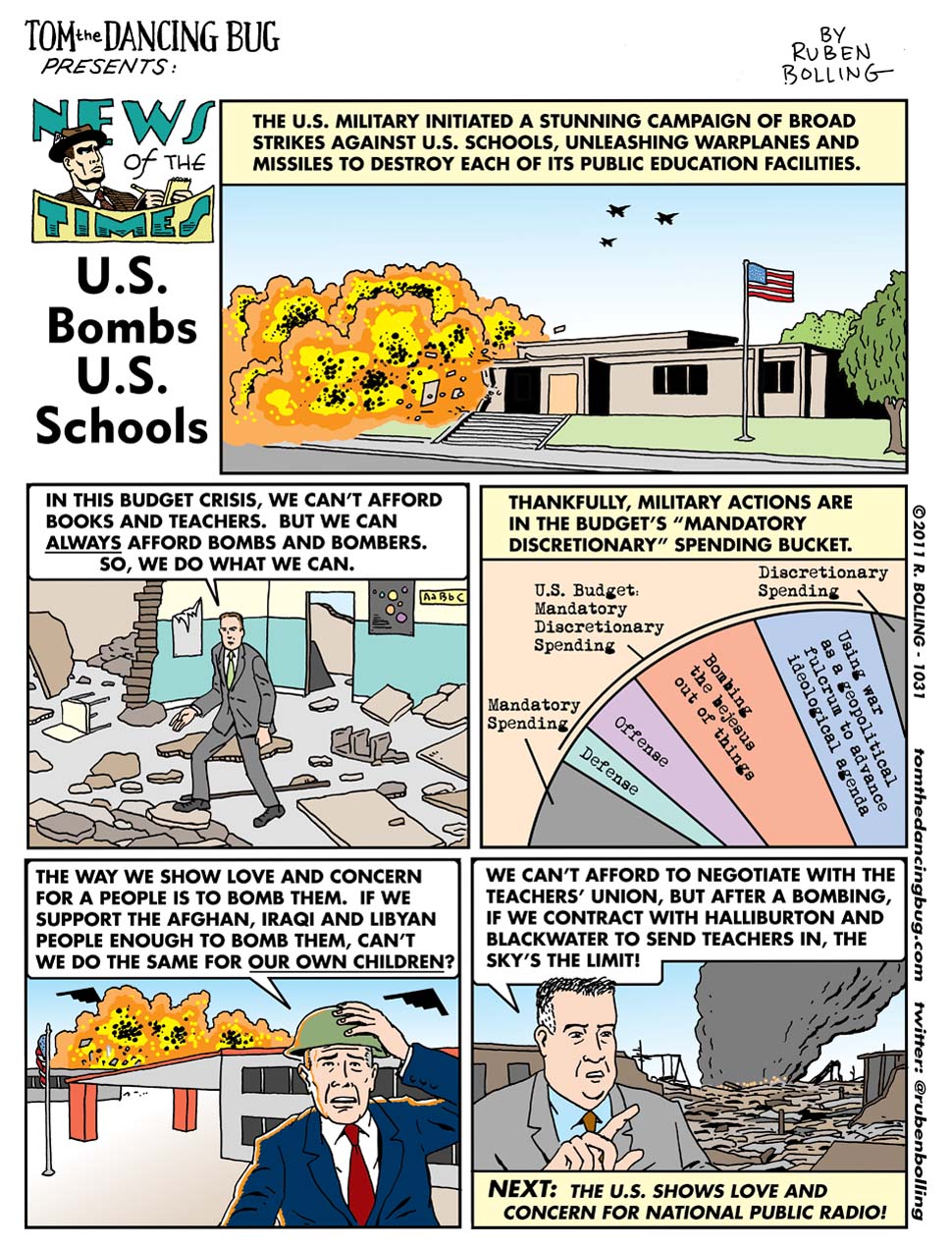
Why not eradicate malaria, instead of bombing the shit out of people?

In my introductory classes, I almost always show them this TED talk that Bjorn Lomborg gave a couple of years ago.  Lomborg, who is probably a banned word in the academic hallway where my office is given that I am surrounded by self-proclaimed Socialists and Marxists, makes a neat and simple point:
If we had say, 50 billion dollars over the next four years to spend to do good in this world, where should we spend it?
Apparently America's answer is that we would rather spend it on bombing a country.  I mean, think about the cost of the recent wars and what they actually deliver in terms of returns.  Joseph Stiglitz, who initially estimated the cost of Iraq War at $3 trillion--yes, 3,000 billion dollars--had to revise it upwards:
two years on, it has become clear to us that our estimate did not capture what may have been the conflict's most sobering expenses: those in the category of "might have beens," or what economists call opportunity costs. For instance, many have wondered aloud whether, absent the Iraq invasion, we would still be stuck in Afghanistan. And this is not the only "what if" worth contemplating. We might also ask: If not for the war in Iraq, would oil prices have risen so rapidly? Would the federal debt be so high? Would the economic crisis have been so severe?
The answer to all four of these questions is probably no. The central lesson of economics is that resources -- including both money and attention -- are scarce. What was devoted to one theater, Iraq, was not available elsewhere.
And now, we are on to yet another war of choice--in Libya.  It is not cheap.  Mark Thoma summarized it in one single sentence; a sentence heard around the blogosphere:
We have enough money to pay for military action in Libya, but not for job creation?
The Economist's correspondents are engaged in a debate on this very issue of guns and butter.  Exhibit one:
If our foreign policy aims to prevent suffering and death with finite resources, it makes sense to ask whether this war makes sense on those grounds. I grasp the tiresome point that the choice on the table was not a choice between taking out Libya's air defences and buying bed nets. The choice was between taking out Libya's air defences or not. But the question nagging some of us is why this was the choice on the table. Why did this come up as a matter requiring urgent attention and immediate decision? Why is it that the choice to express our humanitarian benevolence through the use of missiles and jets gets on the table—to the top of the agenda, even—again and again, but the choice to express it less truculently so rarely does? If our humanitarian values really set the agenda, how likely is it that the prospect of urgent military intervention would come up so often?
It's important that we take the logic of humanitarian justification seriously, but it's true that talk of bed nets tries to do this in a somewhat confused and confusing way. What we really need is intelligent insight into the death and suffering intervention in Libya can be expected to prevent relative to other feasible options. That no one seems even to try to do this in a serious or systematic way—that it seems almost surprising when someone notes the existence of options "between sitting on our hands and launching something close to all-out war"—suggests that objective humanitarian success isn't actually the guiding light of Operation Odyssey Dawn.
Exhibit two is an argument with this colleague, explaining why we Americans and our government prefers the bombing approach than the malaria tent approach:
it simply isn't true that we aren't faced with calls for peaceful humanitarian interventions as often as we are faced with calls for military ones. We are faced with calls for peaceful humanitarian interventions all the time. People are asking for more money for USAID. People are asking for more money for UN peacekeepers. People are asking for more money for the United States Institute for Peace. They're asking for more money for the Global Fund to Fight AIDS, Tuberculosis and Malaria. If you want America, collectively, to be doing more of this sort of thing and less of the bombing sort of thing, then what you need to do is to argue that those sorts of activities are central missions of the United States government, because the most powerful political forces in America over the past couple of decades have been arguing that they aren't, and that's why we're not doing more of them.
In other words, yet again the argument is that we the people are to be blamed--we haven't emphasized enough to our warmongering politicians that we would prefer our tax dollars to spent otherwise. 

Well, as we go about bombing the shit out of countries, we need to keep this in mind:
If the experience of the last ten years has taught us anything, it should be this: We can bomb our enemies into the Stone Age, but we cannot bomb them into the 21st century

Friday, February 19, 2010

What's in a name? Iraq War ...

If a rose by any other name smells just as sweet, well, a war by any other name stinks the same!

The Washington Post reports that:

The Obama administration has decided to give the war in Iraq a new name -- "Operation New Dawn" -- to reflect the reduced role U.S. troops will play in securing the country this year as troop levels fall, according to a memo from Defense Secretary Robert M. Gates.
Since U.S. forces charged across the Kuwaiti border toward Baghdad in 2003, the war has been known as Operation Iraqi Freedom. The new name is scheduled to take effect in September, when U.S. troop levels are supposed to drop to about 50,000.
Oh, wait a minute, I get it now.  The Iraq War is over.  Alright then.  Party on!

Wednesday, January 13, 2010

We are at war :(

Fewer than two in 10 soldiers on their first or second combat deployment showed signs of mental illness or reported marital problems, according to battlefield research in Afghanistan completed last year. The rate increased to three in 10 soldiers for those on a third or fourth deployment.
... Suicides are at record levels. The divorce rate among enlisted soldiers has steadily increased during the war years. Rates of mental health and prescription drug abuse are on the rise.
With a growing number of injured or wounded soldiers, painkillers are now the most abused drug in the Army. One in four GIs admit to illicitly using narcotic medication during a 12-month period, according to a 2008 Pentagon health survey.
That is from a USA Today story on repeated deployments of US troops.  Just awful conditions.

The Army's aim is to allow two years of recovery for every year in combat. Given the current pace of war, however, it will be a "couple of more years" before that goal is met, says Adm. Michael Mullen, chairman of the Joint Chiefs of Staff. For those in the infantry, who do so much of the fighting, a return to combat often comes within a year.
Meanwhile, soldiers must return to war again and again because the size of the nation's all-volunteer force is limited, Army leaders say. In the past, the government could grow the Army quickly through conscription, allowing the burden of war to be shared by more people.

Tuesday, October 06, 2009

Seven years ago .... voting to wage the Iraq war :-(

Now the talk is about whether or not the war in Afghanistan should be escalated.  Seven years ago, we were practically "done" with Afghanistan and Congress was all set to rubber stamp its approval of Bush's decision to go to Iraq.  Here is an excerpt from Bush's remarks on October 7, 2002:
America believes that all people are entitled to hope and human rights, to the non-negotiable demands of human dignity. People everywhere prefer freedom to slavery; prosperity to squalor; self-government to the rule of terror and torture. America is a friend to the people of Iraq. Our demands are directed only at the regime that enslaves them and threatens us. When these demands are met, the first and greatest benefit will come to Iraqi men, women and children. The oppression of Kurds, Assyrians, Turkomans, Shi'a, Sunnis and others will be lifted. The long captivity of Iraq will end, and an era of new hope will begin.
Iraq is a land rich in culture, resources, and talent. Freed from the weight of oppression, Iraq's people will be able to share in the progress and prosperity of our time. If military action is necessary, the United States and our allies will help the Iraqi people rebuild their economy, and create the institutions of liberty in a unified Iraq at peace with its neighbors.
Later this week, the United States Congress will vote on this matter. I have asked Congress to authorize the use of America's military, if it proves necessary, to enforce U.N. Security Council demands. Approving this resolution does not mean that military action is imminent or unavoidable. The resolution will tell the United Nations, and all nations, that America speaks with one voice and is determined to make the demands of the civilized world mean something. Congress will also be sending a message to the dictator in Iraq: that his only chance -- his only choice is full compliance, and the time remaining for that choice is limited.
Members of Congress are nearing an historic vote. I'm confident they will fully consider the facts, and their duties.
All I can do is try to cynically laugh at our wars by recalling George Carlin:

Tuesday, July 14, 2009

We come in peace. Really!

In my intro classes, when I discuss demographic transition, I point out that as much as we like to think that humans are large-scale killers, well, the more time progresses, it seems like wars and the like kill fewer percentage of humans than in earlier centuries. Life is, by and large, quite peaceful for most humans on the planet.

Steve Pinker begins his essay on that very note. He writes:
Far from causing us to become more violent, something in modernity and its cultural institutions has made us nobler. In fact, our ancestors were far more violent than we are today. Indeed, violence has been in decline over long stretches of history, and today we are probably living in the most peaceful moment of our species' time on earth.
So, what is the reason for this decline in violence, while we walk around thinking that life is getting worse? Hmmm ..... can you do some work and read his essay? Pinker concludes:
We enjoy the peace we find today because people in past generations were appalled by the violence in their time and worked to end it, and so we should work to end the appalling violence in our time. Nor is it necessarily grounds for optimism about the immediate future, since the world has never before had national leaders who combine pre-modern sensibilities with modern weapons.

But the phenomenon does force us to rethink our understanding of violence. Man's inhumanity to man has long been a subject for moralization. With the knowledge that something has driven it dramatically down, we can also treat it as a matter of cause and effect. Instead of asking, "Why is there war?" we might ask, "Why is there peace?" If our behavior has improved so much since the days of the Bible, we must be doing something right. And it would be nice to know what, exactly, it is.

Thanks to A&L Daily for the link.