Showing posts with label NYRB. Show all posts

Sunday, May 16, 2010

The politics of the libertarian mob

Democrats were day-trading, Republicans were divorcing. We were all individualists now.
A wonderful line from Mark Lilla's essay in the NYRB, which has a neat title: "The Tea Party Jacobins."  Lilla is a professor at Columbia, after quite some time at Chicago.  More than anything else, Lilla is a faculty who is comfortable in both academic and journalistic domains--a trait I admire and look up to.
What is Lilla writing about there?
A new strain of populism is metastasizing before our eyes, nourished by the same libertarian impulses that have unsettled American society for half a century now. Anarchistic like the Sixties, selfish like the Eighties, contradicting neither, it is estranged, aimless, and as juvenile as our new century. It appeals to petulant individuals convinced that they can do everything themselves if they are only left alone, and that others are conspiring to keep them from doing just that. This is the one threat that will bring Americans into the streets.
Welcome to the politics of the libertarian mob.
Instead of the old Jacobins, who were leftist radicals, Lilla says we have the new Jacobins.  How different are these from the old?
When the new Jacobins turn on their televisions they do not tune in to the PBS News Hour or C-Span to hear economists and congressmen debate the effectiveness of financial regulations or health care reform. They look for shows that laud their common sense, then recite to them the libertarian credo that Fox emblazons on its home page nearly every day: YOU DECIDE.
Lilla has a point when he notes that the new Jacobins prefer:
the company of anti-intellectuals who know how to exploit nonintellectuals, as Sarah Palin does so masterfully.16 The dumbing-down they have long lamented in our schools they are now bringing to our politics, and they will drag everyone and everything along with them. As David Frum, one of the remaining lucid conservatives, has written to his wayward comrades, “When you argue stupid, you campaign stupid. When you campaign stupid, you win stupid. And when you win stupid, you govern stupid.”
So, where is this heading towards?  Lilla thinks that the Tea Party itself might dissolve soon, as much as a float is taken down after the Homecoming party!  But:
Now an angry group of Americans wants to be freer still—free from government agencies that protect their health, wealth, and well-being; free from problems and policies too difficult to understand; free from parties and coalitions; free from experts who think they know better than they do; free from politicians who don’t talk or look like they do (and Barack Obama certainly doesn’t). They want to say what they have to say without fear of contradiction, and then hear someone on television tell them they’re right. They don’t want the rule of the people, though that’s what they say. They want to be people without rules—and, who knows, they may succeed. This is America, where wishes come true. And where no one remembers the adage “Beware what you wish for.”

I wish Lilla had phrased something else in place of "libertarian mob" because true libertarians like the intelligent folks at Cato or Reason are not quite thrilled with the Tea Party folks' anti-intellectual ranting.  And, to a Libertarian Democrat like me, well, this nutcase mob is not anything like our idea of why we like the libertarian streak in our politics .... But, that is my only quibble :)

Sunday, February 21, 2010

The revolutionary 1960s: "Pity we missed the revolution"

Tony Judt, a frequent contributor to the NY Review of Books, is a bold thinker who does not shy away from controversies, and is now battling ALS--Lou Gehrig's disease.  Even as the disease slows him down (read this moving piece by him on his daily life), Judt has been writing, and he recaps his (and his generation's) active involvement in the protests of the 1960s.  Judt writes:  
Looking back, I can’t help feeling we missed the boat. Marxists? Then why weren’t we in Warsaw debating the last shards of Communist revisionism with the great Leszek Kolakowski and his students? Rebels? In what cause? At what price? Even those few brave souls of my acquaintance who were unfortunate enough to spend a night in jail were usually home in time for lunch. What did we know of the courage it took to withstand weeks of interrogation in Warsaw prisons, followed by jail sentences of one, two, or three years for students who had dared to demand the things we took for granted?
For all our grandstanding theories of history, then, we failed to notice one of its seminal turning points. It was in Prague and Warsaw, in those summer months of 1968, that Marxism ran itself into the ground. It was the student rebels of Central Europe who went on to undermine, discredit, and overthrow not just a couple of dilapidated Communist regimes but the very Communist idea itself. Had we cared a little more about the fate of ideas we tossed around so glibly, we might have paid greater attention to the actions and opinions of those who had been brought up in their shadow.
No one should feel guilty for being born in the right place at the right time. We in the West were a lucky generation. We did not change the world; rather, the world changed obligingly for us. Everything seemed possible: unlike young people today we never doubted that there would be an interesting job for us, and thus felt no need to fritter away our time on anything as degrading as “business school.” Most of us went on to useful employment in education or public service. We devoted energy to discussing what was wrong with the world and how to change it. We protested the things we didn’t like, and we were right to do so. In our own eyes at least, we were a revolutionary generation. Pity we missed the revolution.
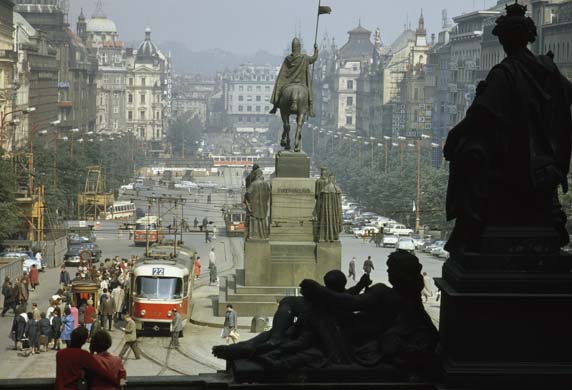
Prague in 1968 (photo and text here from The Guardian):
Warsaw Pact tanks invade Prague. People are depicted going about their daily business as the tanks sit just a short distance from them

Sunday, September 20, 2009

One doesn't fight in the hope of winning

That is the quote that Gary Wills, professor emeritus at Northwestern, uses to conclude his essay in the NY Review of Books.
It is a depressing thought, no?, to think that most of the time we fight the good fight not in the hope of winning it? So, what is the context in which Professor Wills writes this? At how much the change in the White House has not translated to significant directional changes that would indicate a move towards restoring the ideals of the constitution. The entire essay, which is not at all lengthy, is a great read. Excerpt:
A president is greatly pressured to keep all the empire's secrets. He feels he must avoid embarrassing the hordes of agents, military personnel, and diplomatic instruments whose loyalty he must command. Keeping up morale in this vast, shady enterprise is something impressed on him by all manner of commitments. He becomes the prisoner of his own power. .... He is a self-entangling giant.

.... in the nuclear era, the Constitution has become quaint and obsolete. Few people even consider anymore Madison's lapidary pronouncement, "In republican government the legislative authority necessarily predominates." Instead, we are all, as citizens, asked to salute our commander in chief. Any president, wanting leverage to accomplish his goals, must find it hard to give up the aura of war chief, the mystery and majesty that have accrued to him with control of the Bomb, the awesome proximity to the Football, to the Button.

But, we fight, not in the hope of winning because, as Professor Wills puts it:
Nonetheless, some of us entertain a fondness for the quaint old Constitution.
Yes. We do.

Wednesday, April 29, 2009

Das war schön!

This entire month I have been following the NYRB's poem of the day, in celebration of the National Poetry Month--in April, which is ironical when viewed against TS Eliot's "April is the cruelest month" :-)

I liked the poem that NYRB has for today:

K. 453

By Karl Kirchwey

On May 27, 1784,
as he followed Vienna's back streets home,
Mozart paused, startled, by a pet shop door
and listened to the allegretto theme

from his own piano concerto in G-Major
repeated by a starling in a cage.
He'd written it only five weeks before—
had God given them both the same message?

He counted out thirty-four copper Kreutzer.
Pleasure was like the iridescent sheen
in the dark plumage: an imagination livelier,
perhaps, more fecund and ready than his own!

He entered this in his new quarto accounts ledger,
but where the price should go, he wrote the tune
instead—transcribed it a second time, rather—
and then, in his small hand, wrote Das war schön.

Thursday, January 15, 2009

Eyeless in Gaza

Roger Cohen's short piece in the NY Review of Books has a title that is a play on the old idea that an eye for an eye will end up leaving everybody blind.  Actually, Cohen has an even better metaphor to describe the tragic and atrocious Israeli military campaign in Gaza: "As Avi Shlaim, a professor of international relations and former soldier in the Israeli army, has observed, the Gaza offensive "seems to follow the logic of an eye for an eyelash."

Cohen writes that: 
Only in the Middle East do the dead rule. As Yehuda Amichai, the Israeli poet, once observed, the dead vote in Jerusalem. Their demand for blood is, it seems, inexhaustible. Their graves will not be quieted. Since 1948 and Israel's creation, retribution has reigned between the Jewish and Palestinian national movements. 

Tuesday, September 23, 2008

Life, death, humor, and god

The more we reflect on the pleasures of life, the more we miss the greatest consolation that used to be provided by religious belief: the promise that our lives will continue after death, and that in the afterlife we will meet the people we have loved. As religious belief weakens, more and more of us know that after death there is nothing. This is the thing that makes cowards of us all. ...
Living without God isn't easy. But its very difficulty offers one other consolation—that there is a certain honor, or perhaps just a grim satisfaction, in facing up to our condition without despair and without wishful thinking—with good humor, but without God.
That was the physicist and Nobel Laureate, Steven Weinberg, in the NY Review of Books. Would it be incongruent if I were to say "amen" to this? :-)

Saturday, August 02, 2008

Understanding China

As a graduate student, I interacted with quite a few Chinese students. But, I could never breakthrough a wall that I felt existed around them. Interestingly, Taiwanese and Korean students were very easy to talk to, have coffee with, and go to restaurants. I recall very well how one of those students, "RL", tensed up when I brought up the topic of Mao. I never talked about Chinese politics with him after that. My curiosity about China continues on. One of my favorite things to do if we fly Singapore Airlines to India is to watch Chinese movies. All I know is that I simply am not able to peek beyond the wall.

This essay in the New Yorker further complicates the image I have of China and its youth. And the review essay in the NYRB has many interesting insights. Excerpt from the NYRB piece:
After a century and a half of famine, war, weakness, foreign occupation, and revolutionary extremism, a growing number of Chinese—overseas as well as inside China—had come to look to the Olympic Games as the long-heralded symbolic moment when their country might at last escape old stereotypes of being the hapless "poor man of Asia"; a preyed-upon "defenseless giant"; victim of a misguided Cultural Revolution; the benighted land where in 1989 the People's Liberation Army fired on "the people." In one grand, symbolic stroke, the Olympic aura promised to help cleanse China's messy historical slate, overthrow its legacy of victimization and humiliation, and allow the country to spring forth on the world stage reborn —"rebranded" in contemporary parlance—as the great nation it once had been, and has yearned for so long to once more become.