Saturday, February 20, 2010

Obama meets with the Dalai Lama .... finally!

Back in September 2009, I wrote about the White House canceling the scheduled meeting with the Dalai Lama.  Well, better late than never--Obama finally did meet with the Tibetan spiritual leader.

Syeda Rizwana Hasan

There is a good possibility that I will get to meet with Syeda Rizwana Hasan, and I have been doing my homework to get ready--in case I do get to say hi to her.  Yep, being a student is a lot of fun :)

It is always humbling to read about people like Hasan.  The YouTube clip I have embedded here says a lot about Hasan's work.  In 2009, she was a recipient of one of the most prestigious awards in environmental leadership--the Goldman Environmental Prize:
The Goldman Environmental Prize is the world's largest award for grassroots environmentalists. Awarded annually since 1990, the Prize is given to environmental heroes from the six continental regions of Africa, Asia, Islands & Island Nations, Europe, North America and South & Central America.

The Prize is announced in April every year, to coincide with the international celebration of Earth Day. It includes a trip to San Francisco to accept the cash award of $150,000 per winner.

Photo of the day: cellphone at a paddy field

Slowly, as I blogged earlier too, governments are waking up to making use of cellphones in their development strategies; this excerpt and the photo are from The Hindu:
The Union government is trying to evolve a framework for using the mobile platform to improve the access of a large section of the population, especially the poor, to basic financial and banking services. This coincides with the growing realisation, globally, of the need for developing countries to put mobile technology to optimum use to serve the underprivileged.

The top 10 of the worst meals!

Time lists the top ten from fast food and restaurant chains.  The worst of 'em all?

2,140 Calories
Yes, it's meant to be shared, but this Outback Steakhouse appetizer has more calories than you should eat all day. Health advocates are hoping restaurant chains will be forced to post calorie counts on their menus through a provision the Senate approved this month.
The entire list is pretty fascinating--I haven't ever had any of the ten items listed there.  I am all the more thankful for the sheltered life I lead :)

And, I am thankful that two of my favorites are not in the list:
Krispy Kreme's original glazed doughnut, and .... drum roll please ...
In-n-Out's cheesburger with fries :)

A Colombian export and Plato's cave

A follow-up to an earlier post on flowers and economics.

Last week a student, "J.", excitedly shared with the class that the bouquet of flowers she had bought from the store turned out to be from Colombia and not from any local nursery.  She then gave me the barcode tag from that bouquet, which is what I have inserted here on the left after scanning it.

Of course, it is wonderful when students are able to experience for themselves the academic discussions we have in the classroom.  My first ever experience with students giving me such feedback was back when I was in California.  One student, whose name I still remember--Andrea--, was in my economic geography class where I had talked about table grapes as an example of an economic product that in modern times are able to transport over thousands of miles, with the result that grapes are available throughout the year in the grocery stores.  Andrea's email, a couple of terms after the class ended, was a result of her excitement when it suddenly struck her in the grocery store that she was holding in her hands grapes that had been imported from Chile.

Once we understand a small part of the world, it is amazing how it never looks the same again.  We then want to share that with others.  In our own ways, and our own respective paths, we are all like those in Plato's cave. Will someone unchain me please, and confirm whether the shadows I see are really mashed potatoes? :)

Friday, February 19, 2010

What's in a name? Iraq War ...

If a rose by any other name smells just as sweet, well, a war by any other name stinks the same!

The Washington Post reports that:

The Obama administration has decided to give the war in Iraq a new name -- "Operation New Dawn" -- to reflect the reduced role U.S. troops will play in securing the country this year as troop levels fall, according to a memo from Defense Secretary Robert M. Gates.
Since U.S. forces charged across the Kuwaiti border toward Baghdad in 2003, the war has been known as Operation Iraqi Freedom. The new name is scheduled to take effect in September, when U.S. troop levels are supposed to drop to about 50,000.
Oh, wait a minute, I get it now.  The Iraq War is over.  Alright then.  Party on!

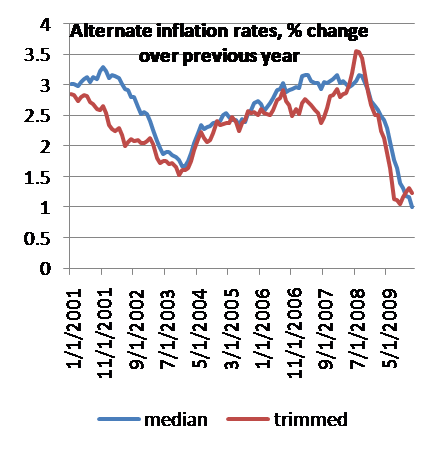
Deflation just round the corner?

Krugman wants us to worry about it and even sarcastically adds a "san", a la Japanese, to Bernanke.

(Flow)Chart of the day: Tiger Woods

ht

The latest on torture by the CIA

Following the launch of a Justice Department criminal probe into the CIA's alleged abuse of detainees, the intelligence agency was forced last week to complete months of previously scheduled torture over the course of one frenzied weekend. "We were already way behind on false executions as it was," said CIA director Leon Panetta, who was overseeing the consolidation of several human pyramids into one large one so that relentless tauntings and other dehumanizing practices could be accomplished more efficiently. "Only three of the car batteries have any juice left, and these poor dogs are almost too tired to strike. If we weren't keeping these guys awake 24-7, there's no way we'd be able to wrap this up by Sunday." Panetta said that if the CIA didn't finish in time, he will order a covert operative to assassinate Russian president Dmitry Medvedev to take some of the pressure off.
Source? The Onion. Which means, well, you know what it means :)

In praise of boredom ... yes, "praise"

Colin Bisset writes in Philosophy Now (ht):
my idea of boredom has little to do with wealthy surroundings. It’s about a certain mindset. Perfect boredom is the enjoyment of the moment of stasis that comes between slowing down and speeding up – like sitting at a traffic light for a particularly long time. It’s at the cusp of action, because however enjoyable it may be, boredom is really not a long-term aspiration. It’s for an afternoon before a sociable evening. It marks that point in a holiday when you’ve shrugged off all the concerns of work and home, explored the hotel and got used to the swimming pool, and everything has become totally familiar. ‘I’m bored’ just pops into your mind one morning as you’re laying your towel over the sunlounger before breakfast, and then you think ‘How lovely.’ It’s about the stillness and familiarity of that precise moment before the inevitable anxiety about packing up and heading back to God-knows-what.
But, it is quite difficult to be bored as we get older.  Like Bisset mentions, I too felt bored when I was a kid.  Now, boredom is a luxury that not only can I not afford, but I feel guilty if I feel bored.  The guilt coming from a nagging feeling that I ought to be doing something ...
But then this might also be the reason why we feel time flies by as we get older .... because, we do not allow boredom into our lives.

NPR  had a segment on why life seems to speed up as we age .... As the NPR page says, read it before it is too late :)
If you don't want to read/listen to that, you can always watch this clip of As Time Goes By .... from one of my all-time favorite movies, Casablanca, with one of my all-time favorite actors, Ingrid Bergman :)

Thursday, February 18, 2010

The best journalist in America ...

Well, Tunku Varadarajan didn't actually say that Jon Stewart is the best journalist .... According to Varadarajan, Stewart is the best journalist of the Left--even better than Krugman.

I don't think Stewart is as one-sided to the left .... Nonetheless, I do agree with Varadarajan's description:
Why is Jon Stewart No. 1? Because no one can match his reach, and his daily impact on the 25-40 demographic (which put its man in the White House). Because he invariably asks tougher questions than much of the “mainstream” media. Because we don’t see Paul Krugman going on Fox to do battle, head-to-head, with Bill O’Reilly. Because he will make fun of Obama when Obama needs to be made fun of. And because he has, with his humor and intelligence, captured better than anyone the hypocrisy and absurdity of our media and politics.

What, me worry? Naaaah :(

Richard Posner summarizes the state of the economy:
The United States has a deeply wounded economy. At this writing, transfer payments by the government to individuals and families (Social Security, unemployment benefits, tax credits, etc.) exceed the taxes being collected from the household sector. At the same time, private investment net of depreciation is negative. This means that private savings are being borrowed by the government, combined with the government's foreign borrowing, and then transferred to households to enable them to maintain their accustomed level of consumption. People are saving more, but government borrowing overwhelms their saving, with the result that aggregate saving -- public plus private -- is negative. So: negative savings, negative private investment, an incredible ratio of household debt to disposable income (1.25 to 1, though down from 1.39 to 1 in 2007), massive government borrowing to finance private consumption -- not a nice combination.
I so wish that I had no intellectual or personal interest in these topics.  The ignorance would have made my life so much better!

Anyway, Posner continues with his assessment, and it is more of stuff that should keep us awake night after night:
it is small consolation that fiscal imprudence is bipartisan. The parties play leapfrog when it comes to spending. From the standpoint of economic policy, the United States has only one party, and it is the party of profligacy.
Anne Applebaum says that she has seen America's future and it is damn "Greecy":
Fortunately for American politicians, we do not have to submit our financial statistics to a European Commission, and thus we do not have to lie about them outright. But aside from our very large budget deficit—at the moment, 9.9 percent of GDP and climbing—we also have liabilities that are rarely acknowledged. The costs of Medicare and Medicaid are going up, as is the cost of veterans care. Markets assume that the vast debts of Fannie Mae and Freddie Mac are underwritten by the government, and someday the government might be called upon to pay them. No one is lying about these things, but no one is talking about them very much, either.
The good news is that the American government's bankruptcy is not on the front pages, and it won't be for many years: Our sheer size, our entrepreneurship, and our relatively open business culture will keep us going for a long time. But the Greek crisis shows that the combination of debt and political deadlock can be deadly. The catharsis we feel as we watch it unfold—that Aristotelian combination of pity and fear—should shock us far more than it has so far.

"The law is a ass—a idiot"

So said Mr. Bumble in Charles Dickens' Oliver Twist.

That is what I could think of when I read a LA Times news story about this man and a Supreme Court case:
He went to the South as a "freedom rider" in 1961, joining other civil rights activists on behalf of African Americans seeking the right to travel freely on interstate buses. He was arrested, then badly beaten by white cellmates. "When I went to jail in Alabama for violating the Jim Crow laws, they charged me with disturbing the peace," he said.
Guess what? According to the government, this man is a terrorist!

Who is he and why is he a terrorist?

He is Ralph Fertig, a retired judge and USC professor.  The guy turns 80 next week (Happy birthday, Mr. Fertig.)

What did he do?  Hide explosives in his underwear while on a plane?  Nope.
Fertig says he wants no part of terrorism or violence, but rather the freedom to advocate for the rights of the Kurdish minority in Turkey. He is troubled that Kurds can be punished for speaking their own language or displaying their national colors. And he believes the 1st Amendment protects his right to counsel Kurdish leaders to steer away from violence and to take their cause to the United Nations.

"I am opposed to violence. It seems crazy to me that I could go to jail for trying to persuade people to engage in nonviolence," said Fertig, a retired judge and a USC professor of social work.

The State Department has named the Kurdistan Workers Party, or the PKK, as a terrorist organization. The PKK, which seeks an independent state for the Kurds, has been accused of violent attacks on Turkish targets, including civilians.
See, the law is a ass.

BTW, apparently even writing columns in newspapers can warrant a terrorist label:
Government lawyers say [the anti-terrorism law] even forbids filing a legal brief or writing an op-ed essay on behalf of a designated terrorist group.
Great! Now my colleagues will be happy to report to the feds my opinions as terrorist activity in their attempts to oust me:)

Wednesday, February 17, 2010

The Trillion Dollar Pension Gap

Slowly there is an increasing awareness and, hence, a discussion of the huge crisis that has been kind of ignored for a while--the gazillion dollar deficit in public sector pension funds.  I have blogged about this before (the first one was in July 2008!) and I getting back to it because of this news item in the NY Times:
States may be forced to reduce benefits, raise taxes or slash government services to address a $1 trillion funding shortfall in public sector retirement benefits, according to a new study that warns of even more debilitating costs if immediate action isn't taken.
A billion here, a billion there, and soon you are talking real money, eh!  a trillion dollar shortfall. But, guess what?  That does not account for all the public sector pensions.  Did that make you sit up?
The study did not include many city, county and municipal pension plans, which are thought to have similar underfunding.
Cue that Twilight Zone score :(

Here in Oregon?  Here is the Register Guard on that very topic:
As employer contribution rates rise, school boards, city councils and legislators will feel the pinch. Even if state and local revenues rise as a result of an economic recovery, much or all of the increase will be claimed by rising PERS obligations. Oregonians will notice that even as budgets get bigger, they’ll be pedaling harder to stay in the same place — their classrooms will be no less crowded, their police forces no better manned and their social services no more comprehensive. And if public agencies’ budgets stagnate or decline, the erosion of public services will accelerate.
The projected increases in public employers’ PERS contributions should be a prominent issue in this year’s election campaigns. Oregonians will need to resist demagoguery and public-employee bashing — but at the same time, they should demand candid appraisals of the problem and leadership in addressing it.

Chart of the day: It is the economy, stupid!

ht

What the Chairman Told Tom

From "Why Live Without Writing" in the latest issue of Poetry

 Basil Bunting, angry English member of the circle of the equally angry Ezra Pound, offers a portrait of the skeptic in his poem-monologue, “What the Chairman Told Tom”:
Poetry? It’s a hobby.
I run model trains.
Mr Shaw there breeds pigeons.

It’s not work. You dont sweat.
Nobody pays for it.
You could advertise soap.

Art, that’s opera; or repertory—
The Desert Song.
Nancy was in the chorus.

But to ask for twelve pounds a week—
married, aren’t you?—
you’ve got a nerve.

How could I look a bus conductor
in the face
if I paid you twelve pounds?

Who says it’s poetry, anyhow?
My ten year old 
can do it and rhyme.

I get three thousand and expenses,
a car, vouchers,
but I’m an accountant.

They do what I tell them,
my company.
What do you do?

Nasty little words, nasty long words,
it’s unhealthy.
I want to wash when I meet a poet.

They’re Reds, addicts,
all delinquents.
What you write is rot.

Mr Hines says so, and he’s a schoolteacher,
he ought to know.
Go and find work.

For a wonderful cup of hot chocolate ....

If you like rich but light, delicate, and not too sweet, go for Kshocolat. Rich and full bodied, and if you can afford a few extra calories every day, LA Burdick is your drink. And if you just have to have hot chocolate in the office and cannot boil the milk, Angelina is certainly better than Swiss Miss.
Want details on all these?  Click here.

But, if you are not that much into hot chocolate, and want a real coffee and travel experience, I do have a suggestion: coffee drinking in Argentina.  Click on the cup of coffee on the left on enjoying a cortado.

It is not "global warming." It is "global weirding"

After a long time, Thomas Friedman has a column that is quite good.  I wonder why he can't stay focused and produce quality ones like this ....
In particular, I liked this observation:
Avoid the term “global warming.” I prefer the term “global weirding,” because that is what actually happens as global temperatures rise and the climate changes. The weather gets weird. The hots are expected to get hotter, the wets wetter, the dries drier and the most violent storms more numerous.
The fact that it has snowed like crazy in Washington — while it has rained at the Winter Olympics in Canada, while Australia is having a record 13-year drought — is right in line with what every major study on climate change predicts: The weather will get weird; some areas will get more precipitation than ever; others will become drier than ever.
But, the final paragraph is total blah.  Maybe he needed to fill in the space, eh!

Tuesday, February 16, 2010

The updated version of the Statue of Liberty :)

The Faustian Bargain and the Great Recession

Over to Buttonwood, who says "now the devil is claiming his price":
We have set up economies where we have demanded "middle class welfare" (the tax deductibility of mortgage interest is an American example, cheap university tuition is a British one) along with rising house and share prices. To get the latter, governments liberalised the financial markets. This allowed us to borrow money to buy houses and allowed banks to expand from plain vanilla lending into the securities markets. We had welfare states without the pain; we ran trade deficits without suffering the kind of constraints we would have faced with a gold standard. 

The President's cabinet, and my dissertation team

Back when I was a doctoral student, I faced one of the most challenging decisions that I had to make: to figure out a dissertation committee.  I got the ok from the faculty who I wanted to be my principal dissertation research adviser.  But the other two?

My first thought was to work with my diverse interests--after all, shouldn't the dissertation team reflect who I was/am as a student by having faculty members who would look at the issues I wanted to study from the multiple perspectives that I am always interested in?  But then better sense prevailed and, hey, trust me, I do have a PhD diploma.

One of the triggers for this better sense was a rather indirect comment that my adviser made when at one of our regular meetings he told me something like, "Sriram, it is time you graduated."  That comment changed my focus on the process--reading and discussing and being an involved student .... to the product--the dissertation.

Sometimes I do think that President Obama's White House is in a situation that is not different from this doctoral student past of mine.  The White House seems to be a lot into being good policymakers, by doing a lot of background work into the issues, writing papers and making presentations, .... but falling short of being focused on the product.  I think this is the story of the healthcare bill, the jobs bill, the climate change bill, .... you see what I mean?

I suppose the Afghanistan approach is the one that kind of sort of is a good mix of the process and the product.  Even though I am not a big fan of the escalation (I will change my mind if bin Laden and Zawahiri are apprehended at the end of it all) it does show that studious preparation and discussion plus the execution of the decision can work.  But then, is it working only because it is about "war" on which there always seems to be bipartisan support?

Monday, February 15, 2010

A creative and funny advertisement

Will have you guessing about the punchline until the end :)

Pakistan or Unstablistan?

It was not too long ago that Pervez Musharraf was the president of Pakistan and he interfered with the judiciary.
Mr. Musharraf had imposed a state of emergency and sacked 60 judges on November 3, 2007 when the Supreme Court appeared poised to declare him ineligible to contest a presidential election while in military uniform.
That catalyzed large scale protests, which slowly and steadily forced Musharraf from power, and into a self-imposed exile.

Then, Zardari, whose claim is being the widower after Benazir Bhutto's horrific death, became the chief executive.  Not particularly well liked to begin with--after all, his nickname was "Mr. Ten Percent" for the tithe that he had to paid as bribes--Zardari was on shaky grounds .....

So, what is the story now?
Opposing groups of lawyers, supporting the chief justice and the president, gathered in courts chanting slogans.
The controversy is over the president's attempt to appoint two new judges.
The Supreme Court blocked the attempt saying the president had violated the constitution by not consulting the court about the selections beforehand.
The rift has led to fears that Pakistan could be set for further political instability, correspondents say.
Hmmm..... beginning to sound familiar to you by now?
So, what does Musharraf have to say?

Former Pakistan president Pervez Musharraf, settled here on self-exile, has hinted at a return to Pakistan politics if the voters of his country decided.
Stating that he loved his country, the former President said “I would do anything to Pakistan.”

Of course he would. Compared to Zardari, well, Musharraf will come across as Abe Lincoln.
Mr. Lincoln, am sorry to use your name in this context on Presidents Day :)

Cartoon of the day: unemployment

Presidents Day, and the Federalist Papers

Aware that I would be without internet access during my stay in the southern highlands of Tanzania, I took with me the book that I have always wanted to read but kept postponing—The Federalist Papers.

The Federalist Papers is a collection of essays that analyze, defend and, in a way, sell, the American Constitution.  The essays were intended to be along those lines because the principal author, Alexander Hamilton, was deeply worried that the Constitution might not get the backing of enough votes, which would have then brought the revolutionary democratic experiment to a premature end. 

So, in fall1787, soon after the conclusion of the Constitutional Convention in Philadelphia, Hamilton, with considerable contributions from James Madison and John Jay, authored a series of essays advocating the ratification of the Constitution.  Looking at it from 2010, when we continue to operate with that original constitution and with only 27 amendments to it over the more than 200 years since, it does sound strange that Hamilton was so concerned.  But, I suppose this is yet another evidence of the thorough job the founders did and left no stone unturned.

Perhaps it was meant to be that I delayed reading this classic treatise all these years until I was in Tanzania.  For one, it meant reading it under conditions that were not far removed from Hamilton’s times.  After sunset, electricity was available at the Tanzanian village only through a local generator, and that too for a restricted three hours between 7 until 10.  Therefore, most of the reading that I did was while sitting up inside a mosquito net and with a LED headlamp on—instead of candles or oil lamps that Hamilton might have used after sundown.

From a political perspective, of course, Tanzania has been one of the fortunate countries in Africa with a relatively high degree of stability.  In contrast, half the sub-Saharan African countries are authoritarian regimes, according to The Economist magazine’s report on democracy, which classifies countries into full democracies, flawed democracies, hybrid regimes, and authoritarian regimes.  Thus, reading this classic while in Africa, in a continent where democratic governance cannot be taken for granted even in the year 2010, was quite a reminder of how much the 18th century thinking of the framers of the Constitution continues to be way ahead of a great part of the contemporary world. 

Yet, as much as they were blazing a new political trail, the authors of the Federalist Papers were no dreamy idealists.  For instance, Madison notes that “if men were angels, no government would be necessary.” He then masterfully reminds us that government is a reflection of human nature, which then logically underscores the need and structure for checks and balances. Unchecked governments, which seem to be in plenty around the world, certainly do prove that they are no angels.

Lest anybody mistakenly conclude that the Constitution is the perfect model without blemishes and where no ideal was compromised, Hamilton observes in the final—85th—Federalist paper, “I never expect to see a perfect work from imperfect man.”  Yes, we need this reminder in the 21st century America, too, as we continue to renegotiate the social contracts at the federal and state levels in order to correct the old imperfections and to mitigate the new ones we introduce.

The fact that the cogent arguments that are offered in the Federalist Papers are as applicable now as they were back in the 18th century is more than a testament to the clear vision of the founders and their belief in the virtues of democracy.  I now have that much more of an appreciation of my good fortune in having spent all my life in democratic societies, one-half in America and the other, earlier, half in India. 

Finally, reading the Federalist Papers was highly encouraging for a personal reason—these were published as a series of essays in the newspapers in New York.  In other words, discussing policy issues with fellow citizens through the pages of the newspapers is an American tradition that pre-dates even Washington’s presidency.

Which is why I now have a simple explanation for writing opinion columns—it is an absolutely American thing to do!  Thank you, Alexander Hamilton.

Sunday, February 14, 2010

Sometimes a cigar is not a cigar?

With all the escalation surge in Afghanistan, commentators are beginning to offer competing narratives for what is really going on.  Consider the following excerpt from an opinion essay in The Hindu:
The international community has been led to believe that the India-Pakistan fault line is the pivotal concern in the U.S.’s diplomatic strategy in Afghanistan. However, it is more a subplot. The U.S.’s principal protagonist is China, while India and Pakistan — and increasingly Russia — are more like jesters in forming the confusion and the humour in an Elizabethan drama. The main plot is about the expansion of NATO in Central Asia.
So, it is not really about Afghanistan or AfPak, according to the author, a former Indian diplomat, but is to strategically position the US and NATO in Central Asia in order to counter China.
I think this is a little exaggerated.  However, there is an element of truth here: like in Africa, here in Central Asia too China is beginning to flex its soft power in a big way.  For two reasons: one, the resources (oil and natural gas, in particular) and second, the Islamic population that China believes is more sympathetic to the Uighurs in China's Xinjiang Province.  Wait, this is all sounding way too familiar; is it because I have blogged about it before?  Of course, yes!!! :)

Indian music,and Scottish as well?

Well, I might as well go for a hat-trick, with a third consecutive post related to India :)
So, Sara's comment in response to the post on Susheela Raman reminded me of another Indian/British female singer, Sheila Chandra.
First, here is Chandra's wonderfully Indianized version of a Scottish tune:

And then, Loreena McKennit's "Mummers' Dance"

Photo of the day

From a wonderful collection of Valentine's Day themed photos, here is one with the following caption:
ALLEPPEY, India—The Kerala waters, 1987

Nina Simone plus animation: awesome :)