I am rapidly nearing a historic marker in my life: 25 years since I came to the US in 1987.
There are a few--I readily admit, it is barely a few!--who seem to be happy that I chose to come to these United States. It makes my day when they let me know, like how a newspaper reader (an endangered species?) did in an email ten days ago:
I met you several years ago at an orientation for prospective Western
Oregon University students. We chatted briefly and I told you that I
appreciated your opinion pieces in the Register-Guard. My son decided to
attend the University of Oregon but I still remember our brief but
enjoyable conversation. Yesterday I was reminded of that time after
reading your piece on the Americans with Disabilities Act.
You hit the nail on the head in reminding readers how our government used
to operate and why we need political parties that work together
constructively. I cannot begin to tell you how the present dysfunctional Congress and the insulting level of political discourse trouble me. I
am concerned for the future of my children and our country. Despite
those frustrations I want to convey how much I appreciate your cogent writing and world view. I’m glad you chose to become an American
citizen. We need more people like you.
There is a good chance that this reader does not know the phenomenal value his email added to my life. Thanks!
I am glad, indeed, that I am here in the US.
Though, my decision to come to the US surprised quite a few who knew me well when I was young. A few years ago, my father wrote in a letter to me:
You were a bit rebellious in your outlooks and attitudes! ...You earlier had a liking for communist literature and Russian novels. ... But surprisingly you landed in USA for higher studies
So, yes, it was a surprise to them.
But, not to me.
I continue to be rebellious in my outlooks and attitudes, and march to my own drum beat, though, outwardly, I look "mainstream," which perhaps all the more is the reason why the self-proclaimed rebels get pissed-off at me? I continue to like Russian literature--there is something unique about their interpretation of life. Communist leanings? I suppose my father didn't know that it purged out of my system even halfway through my undergraduate studies. It was a teenage infatuation. Am glad that the evil red was not a love in my adulthood!
After all the various twists and turns, in a fortnight, I will complete 25 years in the US--a long journey from Tanzania.
That is the "Punk Prayer" that Pussy Riot sang, which pissed off Vlad the Impaler Putin and the Orthodox establishment.
Blogging about this here will not make any difference to the women who are being tried as if they are al-Qaeda terrorists who killed a couple of thousand civilians. And, yet, as much as none of my other posts have made no difference at all, here I am carrying on in a Quixotic tradition.
Here is to hoping that even Putin will find the entire trial to be a farce, and will come up with some kind of a face-saving deal for himself, at least in response to the growing worldwide support for the protesters:
Pussy Riot's supports include fellow-dissidents in Russia, as
well as Amnesty International, and Western musicians including
Sting and the Red Hot Chili Peppers. Two of the women have young
children.
Virgin Mary, Mother of God, put Putin away
Рut Putin away, put Putin away
(end chorus)
...
Black robe, golden epaulettes
All parishioners crawl to bow
The phantom of liberty is in heaven
Gay-pride sent to Siberia in chains
The head of the KGB, their chief saint,
Leads protesters to prison under escort
In order not to offend His Holiness
Women must give birth and love
Shit, shit, the Lord's shit!
Shit, shit, the Lord's shit!
(Chorus)
Virgin Mary, Mother of God, become a feminist
Become a feminist, become a feminist
(end chorus)
The Church’s praise of rotten dictators
The cross-bearer procession of black limousines
A teacher-preacher will meet you at school
Go to class - bring him money!
Patriarch Gundyaev believes in Putin
Bitch, better believe in God instead
The belt of the Virgin can’t replace mass-meetings
Mary, Mother of God, is with us in protest!
(Chorus)
Virgin Mary, Mother of God, put Putin away
Рut Putin away, put Putin away
Nearly three years ago, I authored this column
in the paper here, in which I described how the visit to Tanzania was a
homecoming for me:.
Tanzania offers a compelling argument for why it is home to humans —
going back to hominids, who were human-like precursors to our kind. The
evidence, in this case, includes the well-preserved footprints of
hominids in northern Tanzania, estimated to be 3.75 million years old.
There was still something missing even after that trip, which I understood much later--to go beyond the theoretical argument, and get evidence of how I
came to be from that African origins.
A few weeks ago,
when I was reading an essay, I came across a reference to the
Genographic Project, and I decided to participate in that as a kind of
a belated birthday gift to myself (yes, I paid for my own gift, thank you very much.) Because
there was that payment to be made, I asked only for the "male" side of the
history--after all, only males can get the male side of the story,
given the Y chromosome. Some time later, I would gift myself
with the female side of the past as well.
Today, I got the results of the DNA analysis, which tell a story of my origins from Africa. The genetic map shows how I got to India, all the way from Africa:
Compared to the tens of thousands of years that it took for the geographic movement out of Africa to India to happen, I came over to Los Angeles in 1987 after a mere day of air travel. Perhaps those early ancestors would not have even dreamed about such a possibility?
Anyway, the report notes:
The
man who gave rise to the first genetic marker in your lineage probably
lived in northeast Africa in the region of the Rift Valley, perhaps in
present-day Ethiopia, Kenya, or Tanzania, some 31,000 to 79,000 years
ago. Scientists put the most likely date for when he lived at around
50,000 years ago. His descendants became the only lineage to survive
outside of Africa, making him the common ancestor of every non-African
man living today.
The place I visited in Tanzania was really, really, close
enough to be the real, old, ancestral home--the home before Pattamadai, Sengottai, and Neyveli that I have often blogged about.
Anyway, from Tanzania (as I imagine the home!):
Your ancestors, having migrated north out of Africa into the Middle
East, then traveled both east and west along this Central Asian
superhighway. A smaller group continued moving north from the Middle
East to Anatolia and the Balkans, trading familiar grasslands for
forests and high country.
And then from there,
Your next ancestor, a
man born around 40,000 years ago in Iran or southern Central Asia, gave
rise to a genetic marker known as M9, which marked a new lineage
diverging from the M89 Middle Eastern Clan. His descendants, of which
you are one, spent the next 30,000 years populating much of the planet.
Getting close to India ...
The man who gave rise to
marker M20 was born in India or the Middle East. Your ancestors arrived
in India around 30,000 years ago and represent the earliest significant
settlement of India. For this reason, haplogroup L (M61) is known as the
Indian Clan.
Although more than 50 percent of southern Indians carry marker M20 and
are members of haplogroup L (M61), your ancestors were not the first
people to reach India; descendants of an early wave of migration out of
Africa that took place some 50,000 to 60,000 years ago had already
settled in small groups along the southern coastline of the
sub-continent.
So, there! Everything else was easy, it seems like.
About that Y chromosome itself? It is alive--through my nephews, now it is in Australia!
I was excited when I saw these elephants at Mikumi National Park, Tanzania.
Officials have retrieved at least 30 charred bodies from the S-11 coach
of the Chennai-bound 12622 Tamil Nadu Express, which caught fire at A
view of Tamil Nadu Express' charred S-11 coach at the Nellore station
I feel terrible for the dead, the injured, and the friends and families of these people. Awful!
My first (and only?) travel experience on the Tamil Nadu Express was a wonderfully delightful experience for the 17-year old that I was then. But, life took a different turn after I reached the destination :( As far as I know, it seems to be one cursed train!
When you hold a hammer, well, everything in the world looks like it has be pounded, er, nailed, er ... damn!, it is so hard to get away from sex during these Olympics :)
I don't know how I missed this at Slate, when I blogged about the increasing sexualization of/at the Olympics:
[The] International Volleyball Federation announced back in March that it would no longer require women’s beach volleyball players to compete in bikinis. For the first time ever in Olympic competition—beach volleyball joined the program in 1996—female players will be allowed to wear shorts and sleeved, midriff-concealing tops.
The new regulations are meant to placate countries with conservative
religious and cultural standards for women’s dress. They also threaten
to deprive millions of male viewers of one of the sport’s main draws:
buff, scantily clad female bodies glistening in the sun (or the London
drizzle, as the case may be). But God bless the USA—the women on the
American beach volleyball team have no intention of abandoning their
skimpy swimsuits.
Why don't they want to ditch the skimpy bikinis? Come on, don't be lazy; read the Slate piece :)
A dance team in bathing suits skimpier for the women than the men
jiggled for the sold—out crowd during timeouts, while rock music nearly
drowned out the pealing of Big Ben. And, much to the relief of the
British tabloids, the athletes wore their traditional bikinis despite
the chill in the air that left the sand at 19 Celsius (67F) when the day
started.
Don't worry--the skimpy bikinis did not affect the crowd's staying power :)
Talk of cold weather had created panic in the British press that the
female players would go for long—sleeves instead of the standard bikinis
a longtime but little used rule in international volleyball. But the
Russians and Chinese were in the two—piece swimsuits for the opening
match, and the Germans and Czechs did the same when they played an hour
later.
But the beach party atmosphere was augmented by the dancers, who filled
the downtime with kicklines and even one tango that ended up with the
dance partners flopping suggestively in the sand.
No wonder most in the crowd of 15,000 the biggest—ever Olympic beach volleyball venue had trouble tearing themselves away.
Hey, with all this talk about sex at the Olympics, I wonder then whether the Olympics logo did indeed reveal that inner Freudian itch! Well, don't let your imaginations get a headahead of you :)
I hope blogging on this theme doesn't become my habit until the ecstatic finish at the closing ceremony :)
Over the last couple of days, I noticed that many of the twitter and webzine and blog sources that I regularly check had something to say about how the Olympics is, well, increasingly sexy. Like this tweet from Salon, for instance:
Sexiest Olympics ever? Our lust for athletes goes back to “wealthy Roman girls running off with gladiators”
I don't know about the "our" lust--I don't remember the last time that I sat down to watch anything. No opening ceremony. No closing. Nothing in between. I merely read up the news later on. But, the news has always reported enough for me to, including photos of attractive men and women Olympians.
Andrew Sullivan cites a study in which the authors report that
[N]early three-quarters of the women’s coverage was devoted to
gymnastics, swimming, diving and beach volleyball. Notice anything they
have in common? The researchers did. "It is now customary for the
participants in all of these events … to wear the equivalent of a
bathing suit," they note in their analysis, which appears in the journal
Electronic News.
Track and field, where the clothing is almost as minimal, made up another 13 percent of the women’s prime-time coverage.
What percentage of the men and women watching the eye candy events might have a comment comparable to the old one about buying Playboy for the articles? :)
The video that Sullivan has embedded there is funny, too:
ALL of a sudden, the Olympics have got sexy. Really sexy.
The pin-up babes of the US Olympic football team arrived for their first training session in Glasgow yesterday.
I preferred the straightforward approach here, in the usage of "pin-up babes." No euphemisms.
the mayor of the Olympic Village is presiding over Sodom and its neighboring suburb of Gomorrah.
Hey, what happens in the Village, stays in the Village!
Of course, all these aren't new by any means. All the way from high school through life, athletic people seemed to have always lived up the sexual reputations. I mean, when was the last time you ever heard of the chess team being all sexy? Bobby Fischer was no pin-up babe! :)
Meanwhile, Slate wonders
what's up with a lesbian kissing scene that was apparently shown in the
opening ceremony ("apparently" because, remember, I rarely ever watch
these events, whether or not the people are sexy!)
[The] question that
dominated my Twitter feed was whether NBC had censored the transmission
of Britain’s first lesbian kiss. This came in the odd pre-parade
section, “Frankie and June Say … Thanks, Tim,” a celebration of digital
Britain. As young Londoners Frankie and June enjoyed their first kiss,
the big screen showed famous film and TV smackeroos, involving Hugh
Grant, Shrek, Lady and the Tramp, and various other megastars.
Immediately after the canine-spaghetti-eating make-out scene, two young
women were shown locking lips.
This scene lasted just half a second, but according to a few
overheated news reports, since the ceremonies were aired around the
world, this was the first same-sex kiss shown in some Middle Eastern
nations.
Oh well, another day in the dull, boring, and uneventful life of Sriram's :)
The Hinduinterviews Waheeda Rehman. The songs and movies she refers to are all my favorites, with "Piya Tose Naina Lage Re" the best of 'em all--not the first time I write about in this blog :)
Rehman refers to the influence Guru Dutt had on her, and about the movie Pyaasa. One of my favorite songs from that movie is this one:
I wonder why Rehman didn't say anything about Kaagaz Ke Phool ...perhaps because of the tales from the past?
Rarely anymore are serious intellectual debates allowed on college campuses, it seems like I have blogged plenty about this. Like when I was told to shut up. What is college for, if not to critique and, thereby, improve our understanding, right?
"$1.25" the young woman at the box office said, as she lifted her head from the book that she was reading when I asked for one ticket to Rock of Ages.
I thought I misheard her. It can't be $1.25! "Say that again"
"$1.25" she said in a rather bored and tired voice while her jaws worked the chewing gum.
Hey, the greenback is still worth something, after all!
It was more than twenty minutes to movie time when I entered the theater. There was nobody else. I mean, nobody. I consciously chose a seat from where I had a good view of the door--so that I could run for my life in case any nutcase walked in. And, of course, the cellphone was ready in my hands.
Ten minutes later, two older women walked in. I eased into my seat and relaxed. The cellphone went into my pocket.
One of the women looked like she was in her late sixties, or even early seventies. And she was here for a movie about music from the 1980s?
A few more people came in, and soon it was show time.
Watching the movie was like watching MTV back in the 1980s--it was pretty much a collection of music videos, but I had no complaints. Though, I would have preferred a little bit more of a story line than what was there--at least to the extent that Mamma Mia attempted, while channeling Abba.
As much as I like "Don't stop believin'," which is a central piece to the movie, even better is the optimistic one from Fleetwood Mac, which is not in the film--after all, the Fleetwood Mac song is not from the 1980s.
This particular version is especially awesome because of the Trojan marching band playing with the group, but then I could be biased :)
The two "don't stop" songs are reminder of music without autotune and the industrial and robotic music manufactured these days. Whenever there is a "live performance" on TV, most of the contemporary pop artists fall so flat in their abilities to sing, without all that autotuning. One of the few things that I hate with the technological advancements, I suppose.
I have often expressed in this blog my disapproval of the "communist" party rule in China. When I evaluate the different systems all around the world, I often think about whether I would want to live there. The bottom-line regarding China is an easy one for me: a definite no.
However, it is up the citizens of China to develop whatever social contract they want, as long as they don't force me to live under their norms. To some extent, this is also what many other countries tell the US, right--that we should stop forcing everybody on the planet to use the US Constitution?
In my graduate school days, every once in a while I engaged my fellow-students from China on their social contract. They were all not unhappy about it. Some of them recognized the flaws, and yet seemed to prefer that over the structure here in the US, for instance, or what India has. In a postmodernist world in which I intellectually understand that paradigms do not easily lend themselves to comparisons, I simply had to think in my mind that I couldn't live there, even if hundreds of millions are ok with that system.
Ramesh, who is no stranger to this blog, lived in China for three-plus years. An ardent fan of capitalism, as even the title of his blog suggests, he writes, with perhaps a few more to come, that China and its politics are way more complex than the simplistic ways in which most of the rest of the world thinks about them:
Mention the words Chinese Communist Party (CCP) and the popular impression is that of an evil organisation, suppressing its people with an iron hand and bent on tyranny. The Party, like every other organisation in the world, has the good, the bad and the ugly. The bad and the ugly gets a lot of coverage and is well known. There is lot that is awful, even bordering on evil—like when it comes to Tibet and Xinjiang— and these have been well documented by the media all around the world . But, there is also the good that is seldom known.
The CCP is for large parts, a meritocracy resembling a corporate culture, more than a political party. It recruits the best talent, does careful career planning, imparts a lot of training—including at foreign universities—promotes the best talent, rotates them across different responsibilities and lets the best rise. It probably has the largest HR department in the world. Sure there is dirty politics of lobbying and incompetence, as with any corporate outfit. There are clear goals, objectives, targets and their performance appraisal system would shame even a well run company. By and large merit works. How many political parties can say that (ask Sonia Gandhi!)
In the CCP in its current format, another dictator like Mao is unlikely to arise. Senior leaders have a retirement age (India, US, are you listening?) There is no hereditary politics—Mao’s children and Deng’s children are political nobodies. In fact there is a generational change in leadership coming this autumn. Peaceful handover of power, which was hitherto the preserve of mature democracies, is now a fact in China.
The Party actually listens to the people. It may not be well known, but there are about 500 protests that happen in China every day. Not every protestor is jailed and beaten (although some are.) While there is brutal censorship of news, public opinion triggers action. The milk scandal, discontent over rising prices, house prices bubble, etc., have all seen responses that would actually make a democracy proud. As in most other countries, there is cover up (easier because there is no free press), but when the issue comes out, action is usually swift. The way the CCP listens to people and reacts is very different from democracies, but there is no denying that strong public opinion elicits a response.
There are no inter‐state disputes (again, are you listening, India?) Polarisation, which we increasingly see in democracies, is not a factor in China.
The ultimate test of any political party is this: can it win public support in an election. In this, the CCP comes out with flying colours. If there was a completely free and fair election in China today, the CCP will probably win a 90% majority. Almost nobody who knows China will dispute that.
As with all things in life, things are not black and white. There are only shades of grey—well, shades of red, in China!
The Wall Street Journal provides an interesting commentary on how the persistently high unemployment and underemployment among the youth compares with the stagflation the baby-boomers experienced. In 1982, unemployment rate for the youth was a high 17%. But,
the situation quickly improved. By the end of 1983, the unemployment
rate for 18-24 year-olds had dropped below 14%, and it didn’t get back
above that mark until the latest recession. This time around,
joblessness among young people remains over 15% three years after the
recovery began. ...
Many of today’s 20-somethings, therefore, are stuck on the sidelines for
what should be — and what was for their parents — their most important
years for wage growth and career development. The effects are likely to
be long-lasting. A study
by Yale economist Lisa Kahn found that “the labor market consequences
of graduating from college in a bad economy are large, negative and
persistent.”
From my reading of the situation, it is not getting better, and does not seem like it will get better any time soon. It is awful!
On top of everything else, most of these youth are also graduating with debts from their years at colleges and universities, which then seems more and more the case that we are looking at a horrible prospect of, what Matt Yglesias referred to as, the indentured servant generation :(
Social Security and Medicare were created in a very different
America as a response to very different circumstances. The old-age
entitlements were designed to alleviate problems related to an
economy still in transition from rural agriculture to urban
manufacturing and post-industrial services. Private pensions and
retirement savings were relative rarities, and the communitarian
dream of multiple generations living under the same roof—invoked as
an ideal by some of the very people, such as Joe Biden and Hillary
Clinton, who champion old-age entitlements as a means of
“independence” for seniors—was a routine necessity.
That’s no longer the case in a country where most retirees are
wealthier than the younger people paying for their benefits.
According to 2010 data (the latest available) from the Bureau of
Labor Statistic’s Consumer Expenditure Data, the typical American
65 or older had a pretax income of about $41,000 and annual
expenses of about $37,000, including $4,800 for all medical care
costs they bear under the current regime (insurance, prescription
drugs, doctor’s visits, etc.). Those who can pay for their needs
out of their own pockets should do so
A couple of years ago, in a blog post that became an an op-ed on the bailout for American auto manufacturers, I noted my reservations against bailouts. In that, I asked what we might do if China gets serious about its aircraft building business; well, hey, good to know that I wasn't off-base! But, wait, is my being correct good news or bad news? :)
So, how is China really doing? I wish I had learned more about China, and traveled to that country--well, at least one of those two things! But, hey, maybe this guy might have more to say about China, its economy, and its peoples, eh! After all, he lived and worked there for three years, and might even know how to correctly pronounce Guangzhou :)
BTW, I can relate to Fallows commenting to Colbert about the Chinese passengers rushing to the aircraft doors even before the plane reaches the gate--same story in India, too :(
The sudden populism over outsourcing reminds me of a Chinese saying that
I recently came across: "If we don't change the direction in which we
are headed, we will end up where we are going."
Twelve years ago, when I taught at California State University,
Bakersfield, I assigned a class of about thirty‐five students the task
of figuring out, through rough calculations, whether Bakersfield could
compete against Bangalore, in India, when it came to call‐centers that
the local leaders were pursuing as a growth strategy. At that time,
outsourcing hadn’t entered the everyday political and cultural
vocabulary, and Bangalore was unknown to most in the United States—after
all, Thomas Friedman had yet to publicize these through his bestseller,
“The World is Flat.”
Working in teams, the students independently arrived at the same
conclusion—Bangalore will beat Bakersfield any day! My hope was that
most of the class would have understood through this exercise how their
economic futures could become increasingly dependent on developments in
other parts of the world.
Well, we have now almost ended up where we were going—economic
activities that might have generated many middle‐income jobs in the past
have migrated to other countries that are equally, or more, interested
in their development. Therefore, unemployment rates in the United States
do not seem to be coming down despite all our attempts. And, yes,
“outsourcing” is now a part of our lexicon and for which politicians
have suddenly developed a fondness.
Yet, we seem to be talking about outsourcing not in any constructive
manner. Outsourcing is being used to portray China or India as some
kind of bad actors, when, in reality, they are far from any real
competition to us. The average Indian earns barely five percent of the
per capita income here in the US. The average Chinese is in a much
better position than the average Indian, but the per capita income there
is only a tenth of the American per capita income. India and China are
not our competitors, but are much poorer countries where people are
eager to improve their economic conditions.
Outsourcing economic activities to India or China or any number of
countries has made possible goods and services at remarkably low prices.
From t‐shirts to smart phones to customer support, we would have to pay
a lot more than we currently do if there were no outsourcing at all.
It is not China’s or India’s problem that we failed to change our own
direction over the years when we enjoyed the abundance of goods and
services at affordable prices. Obsessed by the internet bubble, the
events of 9/11 and then the wars, and then the housing bubble, we
continued to keep going without even attempting to alter our course,
seemingly oblivious to how the economic structures all around the world
were rapidly changing. Should we then be surprised that it has become
extremely difficult to generate gainful employment that will keep alive
the American Dream for the middle class?
Outsourcing blips only when it conveniently fits into political
calculations. Senators John Kerry and John Edwards angled for votes by
referring to outsourcing and offshoring when they were on the Democratic
ticket for the White House in 2004. Now, both Barack Obama and Mitt
Romney are talking about it, but for all the wrong reasons that don’t
seem to reflect in any way the much valued Harvard credentials they both
have. Obama beats up on outsourcing in order to imply that the Chinese
and Indians are taking away “our” jobs, which is a highly screwed up
interpretation. And Romney doesn’t seem to recognize that outsourcing
and the globalization of the economy have not translated to real
economic betterment for the middle class.
If at all, since the Great Recession, I have increased the intensity
with which I try to make students understand that any job that can be
sent to a different country will be sent, and that any job that can be
automated will be automated. Unfortunately, a captive audience does not
always mean an attentive audience.
I suppose we seem to be hell bent on making sure we will end up where we are going.
Remember that memorable scene in Good Will Hunting, when Jason Bourne Matt Damon goes all preachy at the shrink's and tells him to read Howard Zinn's A People's History of the United States?
I suppose Damon would be happy that it is not the least credible book after all--it was edged out by another book, by nine votes!
However, the most intense discussion -- on HNN's boards, at least -- centered on the runner-up, Zinn's A People's History,
with some commenters on one end condemning the book as "cheap
propaganda" and "the historians equivalent of medical malpractice";
others took a more moderate line, criticizing the book as partly
"caricature" and an "exercise in tortured reasoning," but praising the
book for "[reminding] us of some facts about our history that make for
discomfort."
David Kaiser, a professor of military history at the Naval War College, charged “A People’s History” — which has sold more than two million copies
since its initial publication in 1980 — with damaging the country, “By
convincing several generations of Americans that leadership does not
matter and that all beneficial change comes from the bottom,” he wrote,
“it has played a significant role in the destruction of American
liberalism.”
More than two million copies! We have proved Barnum two million times?
I wonder how many of the two million owners were like me: many years ago, I purchased a copy of Zinn's book. But, lost interest in it after a mere few pages. It has been on my shelf forever. Initially at home, and then in my office at campus. In my initial years, I thought displaying that would give me some cred if and when the comrades peeped in! Now, it is there because, well, there are no takers; it is practically never opened, so let me know :)
“What Zinn did was bring history writing out of the academy, and he
undid much of the frankly biased and prejudiced views that came before
it,” said Sean Wilentz, a professor of history at Princeton University.
“But he’s a popularizer, and his view of history is topsy-turvy,
turning old villains into heroes, and after a while the glow gets
unreal.”
That criticism barely raised a hair on Mr. Zinn’s neck.
“It’s not an unbiased account; so what?” he said in the Times interview.
“If you look at history from the perspective of the slaughtered and
mutilated, it’s a different story.”
"So what?" becomes critical because, unlike Colbert's "truthiness," academics are expected to be as unbiased as they can.
Oh, but there is a wonderful scene from Good Will Hunting that makes me smile every time I watch it:
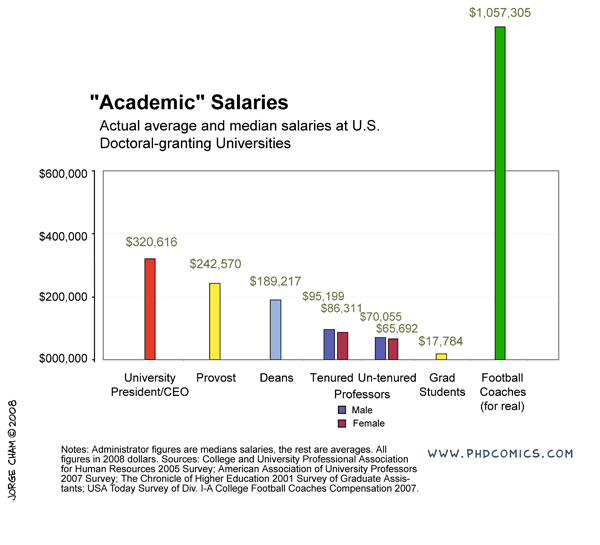
Remember this post from some time ago, which included this graphic?
I wonder how academic salaries with compare with the compensation for football coaches at the University of Oregon, given the following report in the newspaper, today, about the assistants:
The UO football team’s nine assistant coaches each received a $40,000
raise as of July 1, bringing their guaranteed salaries for 2012 to a
combined $2,759,500. That’s a 15 percent raise over what the assistants
were slated to make this year, before signing amended contracts in June.
Aren't we glad that we have the welfare of football coaches way up in the priorities!
So, how much do they get? Am so glad you asked:
Yes, please go ahead and sympathize with them for the ridiculously low compensation! Because, this is nothing compared to how much the head coach earns :)
Meanwhile, apparently there aren't enough fabulous facilities for football at the university. Which is why it is important that you keep buying Nike shoes--so that its founder, Phil Knight, can continue to "play" ball the way he likes:
Massive concrete pillars to hold together
the $68 million operations center that Nike’s Phil Knight is building
for the University of Oregon football program are shooting up next to
Autzen Stadium.
The new center will feature two
skybridge-linked buildings — on the north and east sides of the Casanova
Center — that will rise six stories on top of underground parking. ...
Football coaches will have a private hot
tub and steam room, each with a waterproofed video center, next to their
locker room, so they can watch games while taking a soak.
Yes, it is extremely urgent that the millionaire coaches are able to watch games while soaking in the hot tub. We wouldn't want it any other way. No, sir!
What, you disgusted with this? Come on!
On the top floor will be a
2,285-square-foot players lounge and deck, the blueprints show. On a
lower floor will be an industrial-sized kitchen, 150-seat dining hall
and a 50-seat private dining room.
“The cafeteria is for all student
athletes,” said Craig Pintens, a UO athletics spokesman. “We’re
extremely excited about that. It’s going to help our entire Athletic
Department.”
The football players will have 124 climate
controlled lockers, each equipped with an iPod dock and charging
station. The showers will feature custom shampoo holders painted UO
green.
So, now do you feel nauseated enough? Look away from the screen before you barf.
Do you ever wonder what a horrible life awaits the coaches after they retire? Poor chaps, right? I mean, think, for instance, about the plight of former UO football coach, Mike Bellotti--the guy is walking the streets begging for money, as I blogged a while ago.
Can anybody do anything at all about this? Nah! Nothing ever. Definitely do not look for the radical lefty faculty to raise any tough questions--they are some of the most ardent fans of college football and basketball :(
No, I am not an ideological lefty. Radical, yes, much to the displeasure of those left-leaning faculty too :)
Data diggers hope to improve an education system in which professors
often fly blind. That's a particular problem in introductory-level
courses, says Carol A. Twigg, president of the National Center for
Academic Transformation. "The typical class, the professor rattles on in
front of the class," she says. "They give a midterm exam. Half the kids
fail. Half the kids drop out. And they have no idea what's going on
with their students."
If this is the best from the president of an "organization that provides leadership in using information technology to
redesign learning environments to produce better learning outcomes for
students at a reduced cost to the institution," then there doesn't seem to be any difference between this outfit and Faux News in the use of hyperbole!
At a simple level, if half the kids fail, and half drop out, then it means there is zero pass, correct? Surely, that is not what Twigg is suggesting, is she?
At the next level, we are not talking about "kids." Except the rare ultra-smart student, those entering college are adults. Yes, adults, not kids.
At the content level, it is remarkably stupid to use a blanket characterization that professors do nothing but rattling in a typical class. Yes, there are those professors. But, come on, colleges and universities are a lot more than those professors. Students in my classes often complain that I don't rattle enough, because I make them do a lot of work!
To shoot off that professors "have no idea what's going on
with their students" is yet another hyperbole. Not in my classes, where students know all too well how they can not easily escape my attention--through my eyes and ears, and then through emails and webpages! Even most of our four-person department meetings are about discussing how our students are progressing (or not.)
I suppose the problem is this: most commentators think only about the large research universities when they talk about transforming higher education. They often want to zoom into the mega-sized likes of Arizona State or Ohio State. They conveniently forget that the total number of students at community colleges and teaching universities vastly outnumber those at the super-sized U.
In fact, it could very well be the case that the super-sizing of universities is one of the biggest problems that could have generated many other issues in higher education. The super-sizing led to auditorium-lectures with a couple of hundred students in attendance, where the professor merely "rattles" on. This then becomes a convenient arrangement for those students who prefer to engage in anything other than studying while at college. Any surprise then that Arizona State has always had a reputation of being one of the best party schools?
Now, it doesn't mean that all is well at regular (small) sized institutions like the one where I teach. There is a great deal that is screwed up, and I have often blogged about them. But, hyperbole is not the way to address re-thinking.
Speaking of my own workplace, I am reminded of a faculty colleague, who, perhaps does a great deal of rattling in the hallways and at meetings! In complaining about the use of technology in the classrooms, he wrote in an email a few years ago:
It is not that I want to sound like Scrooge with a Bah! Humbug! remark,
but everytime one more classroom becomes "smart" those of us who prefer
to teach our classes without the rhetorical crutch of PowerPoint are
restricted to an ever decreasing number of marginal classrooms. I am
sick and tired of being treated like a second class citizen with this
practice. How about leaving some classrooms for people who like to use
eye contact with students instead of with overhead screens?
So, yes, there is a great deal of work ahead. But, can we approach it without hyperbole, please?
The United States’ current
dysfunctional politics reminds me of the contrast with a serious piece
of history-making legislation: the Americans with Disabilities Act,
which was signed into law in July 1990.
I was in graduate school in Los Angeles
and in the early phase of getting to know the new country when the ADA
was introduced in Congress. The idea of the act appealed to me as noble:
that people with disabilities ought to be accommodated so that they,
too, can rise to their potential and freely engage in the pursuit of
happiness.
Having grown up in India, I had witnessed
at close quarters many different ways in which friends and relatives
were restricted, sometimes literally to within their homes, because of
disabilities. A distant uncle, for instance, who lost his eyesight as a
young adult became practically unwanted in his own family because he had
become a “burden.” India’s public spaces are daily reminders of the
extreme challenges in everyday life for those who lack full physical
abilities.
If a great society is identifiable by how
it takes care of those with limitations of any kind, then the unfolding
of the ADA — from the introduction of the bill to its implementation,
which continues — has been a story about which we truly can be proud.
The ADA was not without its opponents.
While it was an academic exercise for me to learn in coursework about
how cost-benefit analysis is employed in public policymaking, it sounded
quite awful when critics argued that the ADA would increase costs.
Claims that the law would become a mandate conveniently overlooked the
reality that those with disabilities were being treated as less than
equals. When religious institutions were concerned that they would be
forced to accommodate disabled people by spending money on structural
changes to their buildings, I was struck by how much they seemed to be
going against their own fundamental teachings on how human beings should
be treated.
The bill eventually passed and became the
law of the land, despite a divided government then — the U.S. Senate and
the House were in the control of the Democratic Party, and a Republican
president, George H.W. Bush, was in the White House. The final passage
of the bill was, for all purposes, completely and totally bipartisan — a
world away from the contemporary bickering over all things trivial!
The implementation phase of the ADA
coincided with my first few years of gainful employment. In the small
public agency that I worked for, we now had an additional responsibility
of conforming to the ADA.
It became even more fascinating as the
Internet gave us all an entirely new way to deal with information, which
required us to think about accommodating those who were challenged
visually. Later, when I returned to the academic world, I was impressed
with how the ADA translated to accommodating students constrained by
their hearing disabilities.
The ADA-led accommodations have become so
much a part of my existence here in the United States that I forget how
different conditions are elsewhere — until I cross our borders, that is.
My recent experiences in different parts of the world were reminders of
the phenomenal advances in the United States on this front.
Accommodating the disabled has required us
to spend on everything from sidewalk improvements to sign language
interpreters. These are additional expenses, yes, when compared to how
we conducted our affairs before 1990. But I bet there are very few
people in this country anymore who would ever question these kinds of
“expenses,” because we fully understand the value these deliver — a
value that cannot be captured through any bean counting or cost-benefit
analysis.
The ADA is also a wonderful example of why
we need government, and how political parties can work constructively
toward the betterment of the people — a concept that has become
old-fashioned and is drowned out increasingly by the loud and harsh
yelling that accompanies the trivial pursuits played by politicians and
commentators.
I read the news today, oh boy, that Rajesh Khanna is no more.
There are very few movies of his that I have ever watched. Growing up in India, I was never a big fan of the formulaic masala plots that were rehashed over and over in all the movies, across the languages. On top of that, Hindi was unfamiliar to me. And Khanna or Sharmila Tagore didn't resonate with me either (Hema Malini was a different story, though.)
But, I do recall watching Aradhana.
I was way young a kid when the movie came out, and the songs were a big hit. There is a fair chance that the Aradhana songs were the first ever Hindi film songs that I knew. Over the years, I have come to appreciate the music even more--the quality of the melodies being awesome should be no surprise at all, given that they were SD Burman's creations.
I particularly like the playfulness in the lyrics and the melody in the following one:
The following one, however, is the song that I like the best from the movie. Yes, way more than "Kora kagaz" or "Roop thera mastana"
The drive back seemed especially long on a warm summer afternoon, and my mind and body asked for one too many stops along the way. It was at the first stop that I realized how physically and mentally exhausted I felt, and how much I wished that home was right there.
As is often warranted in life, there is no choice but to keep going. And, keep going I did.
Soon came another stop, at a McDonald's, where I lingered on for more minutes than I would have in "normal" circumstances.
A guy in his mid-thirties walked in with his daughter, who was perhaps four or five years old. She looked angelic from where I was situated--physically and mentally. Her smiling face on a skinny frame and with long, straight, golden hair was way too comforting to look at. If she had walked up to me and said "hi," I suspect that tears would have automatically flowed down from my eyes.
Driving in silence was therapeutic. Daylight started to fade as the sun slowly descended. Up here in the latitudes, the setting sun lingers on for quite a while compared to how how the sun instantaneously sets in the near-equatorial India where I grew up. It is almost as if the sun listens to kids pleading for it to stay around so that they can continue playing and not go to bed.
As I got into the valley where home is, the vast openness provided a perfect backdrop for the final phase of the day. The brilliant hues on the western sky. Shades of red and pink and orange splashed about the clouds. I welcomed the forced slowing down in response to road work, because it gave me enough and more opportunities to safely turn my head to the right and admire the kaleidoscopic western sky.
It slowly sank in that I was not too far from home. That alone was enough to boost my sagging spirits. The feeling was immensely more than how I often feel when returning from visits abroad.
A home is not a man's castle but a safe haven. A security blanket. Terra firma.
The final couple of miles were into the west. The thought of home only minutes away along with the delight from watching the final moments of the beautiful red sky almost erased all the stresses.
Almost.
Because, very little has changed other than me being home.
To know and not to know, to be conscious of complete truthfulness while
telling carefully constructed lies, to hold simultaneously two opinions
which cancelled out, knowing them to be contradictory and believing in
both of them, to use logic against logic, to repudiate morality while
laying claim to it, to believe that democracy was impossible and that
the Party was the guardian of democracy, to forget, whatever it was
necessary to forget, then to draw it back into memory again at the
moment when it was needed, and then promptly to forget it again
No surprise that reactions in India have been swift and pissed.
Mr. Obama’s advice on the need for opening the economy has to be seen in
the context of his own statements against outsourcing of jobs to India
which is also protectionism. If it is right for the U.S. to stop its
corporations from outsourcing jobs to India, which incidentally only
increases their efficiencies, it is also right for India to stop a
Walmart at the door to protect its own small retailers who will be wiped
out if the multinational chain sets up shop.
Of course, Indian consumers and suppliers who might have benefited from
the efficient supply chain of organised retail will be the ultimate
losers. But that is the futility of protectionism, the price that an
economy pays for it. There is enough economic literature available for
those interested to read on how protectionist measures adopted by
various countries prolonged the Great Depression in the 1930s. So where
do these protectionist tit-for-tats stop?
Globalisation, which is all about free movement of products, funds,
people and also jobs, is the answer. But for it to be successful, every
country has to play the game fairly.
Corporate Minister Veerappa Moily said Mr Obama was "not properly
informed" and blamed "international lobbies" for spreading negative
information....
MPs from several opposition parties also criticised Mr Obama for his remarks.
"If Mr Obama wants FDI [foreign direct investment] in retail
and India does not want, then it won't come just because he is demanding
it," Bharatiya Janata Party leader Yashwant Sinha said.
Another minister reminds Obama that these are sovereign decisions:
“Our foreign direct investment (FDI) policy is investor-friendly and,
anyway, these are a country’s sovereign right to decide,” was Commerce
and Industry Minister Anand Sharma’s response to US President Barack
Obama's urging on India's investment climate.
In addition to the hypocrisy, Obama has done another serious disservice--he has provided the best possible distraction away from India's screwed up and dysfunctional government.
I doubt if there was ever a column by Michael Kinsley that I did not like. My all time favorite is, of course, his wonderful piece on the brain surgery that he went through for treating the awful Parkinson's disease. If only he didn't have that early onset of Parkinson's.
In his latest, Kinsley asks what is so wrong about outsourcing. After noting the benefits of trade, which results in outsourcing, he writes about Obama's approach in going after Romney:
He accuses Romney of outsourcing both as governor of Massachusetts
(letting a state contractor move its calling center operation to India)
and before that as a businessman (as part of Romney's "buy, fillet and
throw away the guts" method of corporate acquisition at Bain Capital).
Romney replies that nothing he did was illegal (true, as far as we
know) and that the Obama campaign misrepresents some of the facts (also
true).
Obama apparently intends to skewer Romney as a businessman.
His campaign carefully conflates being a businessman with being a
crooked businessman, and many other variations on the theme: being a
ruthless businessman, a businessman who engages in outsourcing, a
businessman who doesn't pay enough taxes and so on.
While it makes political sense for Obama to virulently go after such a representation of Romney, the anti-business harsh rhetoric that Obama employs makes no logic. It is even more bizarre when one thinks about how Obama spent gazillions bailing out GM and Chrysler, and gazillions to banks that were essentially gambling away somebody else's money. These were done without the rhetoric of how businesses and corporations were evil, when the reality of highly irresponsible corporate decisions was obvious even to the regular Joe, whom Obama is targeting with his anti-outsourcing attacks. Where was this anti-business Obama when, for instance, banks were given gazillions with no strings attached?
Kinsley writes:
One of Obama's flaws is that he seems to feel he can't criticize any
current arrangement without vilifying the people involved, whether they
are responsible for it or not.
Indeed!
Of course, it is not the first time that I have been ticked off by Obama's anti-outsourcing crusade, which I have then blogged about, like in this post, for example.
Over the years, I have noticed that the more limousine liberals, Obama included, use such stupidly insane arguments supposedly defending the poor, the less I find myself sympathetic to their arguments! As I wrote some time ago on the pathetic American hysteria over outsourcing:
If Republicans can be stupid on some issues, then Democrats ensure that
they can be equally moronic, and up the ante! I wish we could outsource
the politicians' jobs!!!
At his blog, Ramesh has an ongoing series in which he discusses India's bizarre and byzantine bureaucratic bumblings. Like in this one, for instance. This post might add to Ramesh's frustrations!
Writing about the bureaucracy, Shikha Dalmia, argues that India is a long, long way from kicking America's economic butt, thanks to its babus:
India, I am quite confident, ain’t going to perch its tricolored flag
atop the globe anytime soon. Not until it does something about its
soul-sapping bureaucracy. The world’s largest democracy doesn’t have
rule of law — it has the rule of babus, the local term for petty
bureaucrats. And so long as they keep challenging India’s entrepreneurs,
there isn’t much chance that India will challenge the West.
... India’s horrendous bureaucracy systematically thwarts its
citizens, killing productivity, often for no apparent reason but to
exercise its powers over them.
Dalmia goes on to describe the ordeal she and her family faced with bean-counting babus. I bet every Indian has more than a few horror stories to tell, and they might even think her story is nothing to write about!
Dalmia makes an important point:
[A] routine matter that shouldn’t have taken more than 10 minutes
swallowed 30 hours of our lives. Yet, by Indian standards, ours was a
happy ending. Episodes even more Kafkaesque than ours are replayed daily
across the country. We had time, resources and the savvy to devote to a
matter that, ultimately, didn’t have existential stakes for us. But
what about, say, a poor rickshaw driver who needs a license to earn his
meager income? Or a farmer who needs the title to his land (something
that can take 240 to 400 days in some parts of the country)?
Yes, yes, and yes.
It is the gross inefficiency at these everyday levels that make life so cumbersome in India. Even opening a bank account is a ten-minute affair in the US, in contrast to the day(s)-consuming operation it can be in India, as my niece recently found out. A bank account where we go to entrust the bank with our money!
In Poor Economics, Abhijit Banerjee and Esther Duflo often point out how the everyday small things, about which we don't even think twice, are awfully time and energy sucking activities for the poor. In India's case, the babus make it worse, when their job is to, ironically, make things easier for the public they serve. So, yes, a rickshaw driver or a farmer is screwed, many times over, by the bureaucracy.
James Surowiecki neatly summarizes Romney's issues related to Bain:
What Romney’s career shows, after all, is that once you’re at the top,
you can keep being called C.E.O. even if you’re not even working at the
company. You can get paid a hundred grand a year—chump change for
Romney, to be sure, but twice the U.S. median income—while doing, by
your own account, nothing at all for the company. You can build up an
I.R.A. worth tens of millions of dollars when the maximum annual
contribution is four thousand dollars. (Henry Blodget suggests here
that Romney’s ownership of Bain Capital shares may explain how that
I.R.A. could have legally gotten so big.) And, above all, if you manage a
private-equity firm, you can reap the benefit of the carried-interest
tax loophole and pay a much lower tax rate on your income than the vast
majority of Americans, and you can continue to reap the benefit of that
loophole even after you stop working for the firm. None of these things
is illegal, but none of them are things that ordinary Americans can
benefit from, and that’s the real scandal of Romney’s career at Bain.
It is different world that Romney comes from.
Not that Obama's world is all to familiar either. The two candidates are both elitists in their own ways. Their shared Ivy League elitism, for one; no wonder even the crooked Richard Nixon wanted to kick them in the nuts--he knew what that (lack of) elitist cred means.
[While] you might think one or the other group more preferable or more
offensive for reasons of politics, culture, or taste, you certainly
cannot argue that either one of them is in close touch with "average" or
"ordinary" or even "middle-class" people, however those terms might be
defined. And although both they and their supporters may shout about
"radical left-wing professors” on the one hand or "Gordon Gekko"
on the other, neither Obama nor Romney can plausibly claim to be
leading a populist revolution against the "elites" who are allegedly
destroying America.
A long time ago, in early high school years, I watched a KB movie--it was a black/white Tamil movie, whose title and plot completely escapes me. I kind of recall a scene in which an important letter lies on the ground, like in the veranda of the home or something, and the inked lettering gets washed out by the falling raindrops.
For whatever reason, the lead female character in that movie--a young woman--often hummed a Hindi song, which is how I came to know about the song here:
To this day, I have no clue whatsoever as to the meaning of the song's lyrics--it just sounds awesome, and that is all I care about!
BTW, "remembrance" is a long-running series here. Click here for the entire collection
The Onion's quality seems to be slipping ... this ain't one of the funniest from America's Finest News Source, but will do for now, especially when The Daily Show is on vacation :)
A few years ago, soon after I moved to Oregon, I got an appreciatory email from a student. But, I simply could not broadcast that email because the student had erroneously written there how much he "had taken for granite" the things I did and said.
Such errors are no mere slip, like how me might end up with the word "pubic" when we meant "public." These errors are way more than mere laugh lines and are indicative of something seriously wrong. A selective listing of errors in this essay might make you smile and chuckle, but should simultaneously worry you.
To their credit, students are often frank when it comes to admitting
their shortcomings and attitude problems. Like the guy who owned up to
doing "halfhazard work." Or the one who admitted that he wasn't smart
enough to go to an "Ivory League school." Another lamented not being
astute enough to follow the lecture on "Taco Bell's Canon" in
music-appreciation class.
Given the ivory tower of higher education, well, Ivory League School sounds right to me :)
All the more important then Allan Bloom's work becomes. Sean Collins writes that Allan Bloom and his seminal work cannot be simply pigeonholed; the debate has become that way only because the left and the right are both being selective in how they (ab)use The Closing of the American Mind. Bloom, he writes, wants to:
uphold liberal education, and yet our modern notion of such
an education was the product of the Enlightenment, of which he is highly
suspicious.
That, in a nutshell, has been my complex relationship with higher education.
Collins further notes:
Bloom writes that openness is an essential feature of the academy: ‘The
university is the place where inquiry and philosophic openness come into
their own. It is intended to encourage the non-instrumental use of
reason for its own sake, to provide the atmosphere where the moral and
physical superiority of the dominant will not intimidate philosophic
doubt.’ However, over time openness was transformed into a mindless
relativism: ‘Openness used to be the virtue that permitted us to seek
the good by using reason. It now means accepting everything and denying
reason’s power.’ If the university preaches that all truths are
relative, what’s the point of searching for truth? Openness, ironically,
leads to the ‘closing’ of the American mind.
The closing of the mind gets reflected even in the casual attitudes we adopt when students do not display the levels of thinking and writing. Perhaps we are taking higher education "for granite" :(
Sometimes, no, make that often, I wonder and worry that academics often ignore understanding and debating the potential ethical and legal issues even as they relentlessly and zealously pursue intellectual inquiry. The analytical and reasoning brain, to an extent, is a curse for our species. Of course, I would never, ever, argue for censoring intellectual pursuit. But, can we at least pay a little bit of attention to issues larger than the intellectual puzzle itself, even as we keep moving forward?
At a couple of meetings of the Association of American Geographers, I was curious about the sessions devoted to the geography of crime. This is pretty much what I do when I go these meetings--I attend more sessions outside my areas of familiarity compared to the sessions related to the topics I usually read, write, and teach about. To me, such sessions are wonderful opportunities to know something about topics that I otherwise would have no clue. Further, the geography of crime struck me as something a tad creepy, but I couldn't quite identify why it felt so.
Having been a "student" at those sessions, it turns out, came in handy when the university where I teach decided to launch an academic program in "crime analysis." After initially contributing my two-cents worth, I rapidly pulled back. On top of my typical unwillingness to participate in moneymaking ponzi schemes that increasingly universities develop, it was that lingering creepy feeling that pulled me back even more. By then, I knew what was beginning to worry me: focusing on developing technical approaches to crime analysis and prevention without paying enough attention to the numerous philosophical and legal issues.
I decided not to engage my fellow faculty and administrators on this troubling notion because, over the years, I have come to understand that raising such questions mean that they are ignored or brushed off or, worse, become the reasons for me to end up in even more trouble. There was at least one conversation with one faculty member, "B," where I shared some of my concerns. But then "B," like me, is an outlaw most of the times, and I knew that we were not going to achieve anything, other than elevating our blood pressure!
Ronald Bailey articulates well that creepy feeling I continue to have:
[We] should always keep in mind
that any new technology that helps the police to better protect
citizens can also be used to better oppress them.
The worry about police oppression might be strange, given my personal life that is nothing but worse than plain vanilla. But, hey, this is not about me :)
Bailey writes that researchers claim:
to have developed computer
programs that can predict not who will commit a crime, but at what
locations they are likely to occur. Welcome to the brave new world
of predictive policing.
Yes, Virginia, we are quickly, and unthinkingly, morphing into the futuristic times of Minority Report!
How might predictive policing interfere with the Constitution’s
Fourth
Amendment guarantee that Americans are to be free unreasonable
searches and seizures? Andrew Guthrie Ferguson, a law professor at
the University of the District of Columbia notes in an article,
"Predictive
Policing: The Future of Reasonable Suspicion," forthcoming in
the Emory Law Journal, that police must have either
“probable cause” to search or “reasonable suspicion” to seize an
individual. Such determinations are actually predictions by law
enforcement officials about the likelihood they will find evidence
of a crime when they search a premise or detain a suspect. Can
computer programs improve these predictions and thus help police
identify would-be perpetrators while excluding the innocent?
Ah, yes, the Constitution. The Bill of Rights.
These are the kind of issues that further highlight the importance of liberal education. Not the liberal education where we offer bizarre courses on Lady Gaga or about Rock Music. But, a rigorous liberal education where we actively and seriously engage with students on weighty content.
Instead, academe is increasingly focused on how to make the content more sexy for students. And, sometimes, the focus is on the "sex" of the word sexy. More than once, I have joked with students that I should include the word "sex" in all my course titles and that will draw more students in. A dull boring course title of "Urban Geography" will then be "Sex and Urban Geography." Then, a simple bait and switch and students are trapped in a class from which they cannot withdraw :)
Oh well. I keep thinking and blogging along these lines while the Criminal Justice department itself is perhaps the fastest growing departments on campus, with all its various majors, minors, and certificate programs, including "crime analysis." But then, I have always argued with vigor that I am the global village idiot!