Showing posts with label migration. Show all posts

Sunday, December 13, 2020

The stories that genes tell

Almost a decade ago, I gave myself a gift. I paid to have my Y chromosome analyzed as a part of a global study: "The Genographic Project was launched in 2005 as a research project in collaboration with scientists and universities around the world with a goal of revealing patterns of human migration."

It was about the old story of migration out of Africa, and not about uncovering any mysteries in my heritage.  There isn't any mystery about my people.  I was glad to help researchers figure out the migratory paths our ancestors took while moving out of Africa into the different corners of the planet that we now inhabit.  And, incidentally, find out the geography of my own genes.

Only a man, who has the XY chromosomes can pass the Y chromosome on to a new generation.  I opted to get this Y chromosome mapped.  Back then, the technology was expensive and I didn't want to spend a lot of money on this in order to map the X chromosome too.

The result did not surprise me.  My people have lived in the Subcontinent for a long time.

The man who gave rise to the first genetic marker in your lineage probably lived in northeast Africa in the region of the Rift Valley, perhaps in present-day Ethiopia, Kenya, or Tanzania, some 31,000 to 79,000 years ago. Scientists put the most likely date for when he lived at around 50,000 years ago. His descendants became the only lineage to survive outside of Africa, making him the common ancestor of every non-African man living today. ...

Your ancestors, having migrated north out of Africa into the Middle East, then traveled both east and west along this Central Asian superhighway. A smaller group continued moving north from the Middle East to Anatolia and the Balkans, trading familiar grasslands for forests and high country.

The man who gave rise to marker M20 was born in India or the Middle East. Your ancestors arrived in India around 30,000 years ago and represent the earliest significant settlement of India. For this reason, haplogroup L (M61) is known as the Indian Clan.

But--and this is important--my ancestral father who came to India about 30,000 years ago was not among the first people to come to the Subcontinent.

Although more than 50 percent of southern Indians carry marker M20 and are members of haplogroup L (M61), your ancestors were not the first people to reach India; descendants of an early wave of migration out of Africa that took place some 50,000 to 60,000 years ago had already settled in small groups along the southern coastline of the sub-continent.

By the time he arrived in India, he was an immigrant in a land that was already populated, and this was about 30,000 years ago!


When we take such a long view of where we come from, we will lead humbled lives.  We won't care to think about whether we are different from others, and whether there are some who are inferior or superior to us.  We will recognize our shared past and work together as one.

In this big story, there are millions and millions of subplots.  One of those is told in this fascinating essay in The New Yorker.  It is about skeletons in a high altitude Himalayan lake, Roopkund, that is frozen for most of the year.  Who were those people?

In the process of describing how genetics is helping uncover the mystery, the essay discusses how science helped piece together a story of Europeans by looking at the Y chromosome evidence of the Yamnaya.  The "power of ancient DNA to reveal cultural events":

In the Iberian study, the predominant Y chromosome seems to have originated with a group called the Yamnaya, who arose about five thousand years ago, in the steppes north of the Black Sea and the Caspian Sea. By adopting the wheel and the horse, they became powerful and fearsome nomads, expanding westward into Europe as well as east- and southward into India. They spoke proto-Indo-European languages, from which most of the languages of Europe and many South Asian languages now spring. Archeologists have long known about the spread of the Yamnaya, but almost nothing in the archeological record showed the brutality of their takeover.

I was born into a family of Brahmins whose Vedic beliefs was orally transmitted and later written down in Sanskrit, which was derived from the language spoken by the Yamnaya.  How did this happen, and when did this happen?  What happened to my ancestral people who arrived in the Subcontinent more than 20,000 years before the Indo-Europeans arrived from the Caucasus?  How do all these stories square with the civilized human being that I am?

Some day, we will understand many such mysteries of how we came about. 

Wednesday, July 22, 2020

Will procreation be the COVID-19 recreation?

After the virus crossed over from China, in countries around the world, people have been sheltering in place since March.  People have also been unemployed in huge numbers.  Adding to all these, the lock down has sharply decreased entertainment options.

So, like Khushwant Singh famously joked decades ago about India, will acts of procreation be major recreation in the age of the coronavirus?  Are we looking at a big baby boom towards the end of 2020 and in early 2021?

Nope.

Even back in April, experts said that a baby boom won't happen.
In the short term, as the pandemic wrecks swaths of the economy, the coronavirus will probably give couples even more cause not to have children, experts said.
“I really don’t think they’re saying, ‘Oh, let’s have a baby in the midst of the greatest epidemic that the country has faced in 100 years,’” said Kenneth Johnson, a demographer at the University of New Hampshire.
There may be recreation in the bedroom, but no procreation.

The anxiety over one's economic future in this context itself is a mood dampener, to say the least.  Further, responsible adults might also have intense worries about the future of babies brought into existence when things are chaotic all over.
In contrast, the original baby boom, between 1946 and 1964, took place in an era of postwar euphoria and financial stability for many Americans. Couples married young, could afford homes and had children quickly. And it was not until 1960 that the federal government approved the first birth control pill.
That was in April.  Did the experts change their opinion over time?

Nope.  They doubled down.

Three months into the lock down, experts said that "the COVID-19 episode will likely lead to a large, lasting baby bust."  As a result of the pandemic and the economic recession, "we could see a drop of perhaps 300,000 to 500,000 births in the U.S."

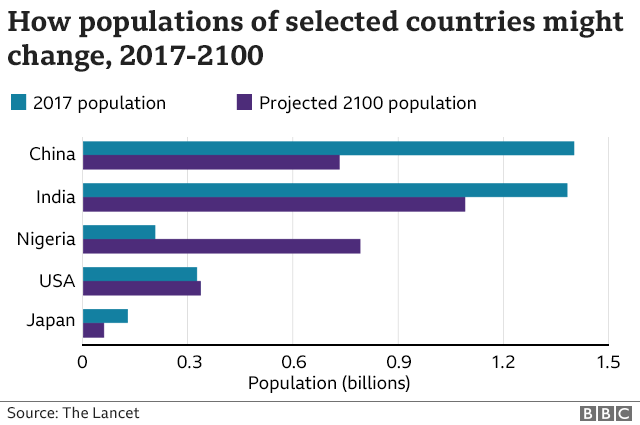
The baby bust will further complicate the demographic crisis that has been slowly unfolding.  Even prior to the corona-recession, the fertility rate - the average number of children a woman gives birth to - had been falling.  As a result, it is only a matter of time before population in many countries started shrinking instead of growing:


Is there a solution?

Yes. But that won't appeal to the uber-nationalistic blood-and-soil tRumpians.  Migration is the answer.  And that too from "shitholes."
Prof Ibrahim Abubakar, University College London (UCL), said: "If these predictions are even half accurate, migration will become a necessity for all nations and not an option. "
To be successful we need a fundamental rethink of global politics.
"The distribution of working-age populations will be crucial to whether humanity prospers or withers."
Of course, the tRumpians can dismiss all these and work with alternative facts that will show that young white women will have lots of babies.

Saturday, November 16, 2019

The fear of the "other"

Consider Germany and the US.  If I were asked which country is the land of immigrants, well, the answer is a no-brainer.  That's what I would think.

As with many things in life, what I think might not be correct!

Take a look at the chart below:

Source

Really?  Germany's foreign-born population slightly exceeds (percentage-wise) that of the US?

Sure, a significant component of the foreign-born in Germany are from other EU countries.  But, still, that high a percentage?

We live in a remarkable time when it is so easy to physically move to a new place that could be far from where we are born.  A plane ticket and a few hours later one could be on the other side of the planet.  It is practically magic.

But, the magic does not happen more only because countries--we, the people--prevent the movement.  And collectively we are losing:
If everyone who wanted to migrate were able to do so, global GDP would double, estimates Michael Clemens of the Centre for Global Development, author of a forthcoming book, “The Walls of Nations”. No other policy change comes close to generating such colossal rewards. If there is $90 trillion a year up for grabs, you might think that policymakers would be feverishly devising ways to get a piece of it. They are not.
How bizarre our behavior is!
It has become physically much easier to move, but bureaucratically much harder. Only 2% of those who arrived at Ellis Island a century ago were turned away.
Ahem, a century ago, those arriving at Ellis Island were not brown-skinned people!  But, ok, point taken.
Now it is extremely difficult to migrate legally from a poor country to a rich one, unless you are highly skilled or a close relative of a legal resident. America’s green-card lottery last year attracted 294 applicants for each of its 50,000 slots. Partly because of Mr Trump’s efforts to make life hard for them, the net inflow of all migrants fell by 74% in 2018, to 200,000 people. Globally, many more people would like to move than can. A Gallup poll suggests that 750m people—15% of the world’s adults—want to settle permanently abroad. That includes 33% of sub-Saharan Africans and 27% of those in Latin America and the Caribbean.
We can do better. But, when even an American citizen of Iranian descent is suspect, when the President's adviser on immigration wants to peddle racist tropes, ... I will conclude by quoting Branko Milanovic again:
[As] economic migration faces increasing obstacles in rich countries (and, it has to be added, not solely because of xenophobia but for economic reasons as well), the ideal of a world “without injustice of birth” recedes.

Wednesday, August 07, 2019

Immigrants gave England their favorite foods. Yet, Brexit?

Way back, a long time ago, when Tony Blair was Britain's Prime Minister, his foreign secretary, Robin Cook, made a comment that was heard around the world.  Cook noted that the chicken tikka masala had become Britain's favorite food that qualified it as the national dish.  He added that it epitomized Britain's involvement with the world and how it adapts to global influences.

The colonial origins of the chicken tikka masala aside, it indeed is remarkable that Britain has been bowled over by curry.  It is a global story to which even the insular Japan is no exception.

The chicken tikka masala displaced fish-and-chips as the national dish.  Was fish and chips truly a "national" dish?

Chips are from potatoes.  Ahem, potatoes did not get to the island, which is becoming increasingly irrelevant, until very recently, well after the white man's not-so-friendly first visits to South America.

So, the chicken tikka masala is recent.  Chips are only a tad older in the English cuisine (yes, an oxymoron!)  How about the fried fish itself?

It turns out that even the fried fish is not particularly English!

Whaaaaat?  Don't tell me that the Pope is not Catholic! ;)

Apparently this fried fish concoction is from the Sephardic cuisine that Jews brought with them after they were expelled from the Iberian peninsula.
As religious violence worsened, many fled Portugal and resettled in England, bringing with them culinary treasures founded in Sephardic cuisine—including fish.
Peshkado frito (in Andalusian dialect, pescaĆ­to frito) was one of them. The dish of white fish, typically cod or haddock, fried in a thin coat of flour, was a favorite particularly among Sephardic Jews, who fried it on Friday nights to prepare for the Sabbath, as the Mosaic laws prohibited cooking. Allegedly, the batter preserved the fish so it could be eaten cold, and without sacrificing too much flavor, the following day.
What a fascinating and complex story about a relatively simple food!

Once it was introduced, well, the rest was history.
It was a hit. Fish prepared “in the Jewish manner” was sold on the streets of London on any given day. And at the end of the week, eating fish on Friday was a part of religious observance for Jews and Catholics alike—as “fish fasting” to avoid consuming warm-blooded animals has been a part of the Catholic tradition for centuries.* Though both groups were religious minorities at the time, fried fish became a popular secular dish, too.
Here's another interesting twist to this globalization story: The writer who provides us the fish-and-chips story is Simon Majumdar.  That last name is a dead give away about the Bengali origin.  Wikipedia offers the details:
Majumdar was brought up in Rotherham near Sheffield, South Yorkshire, England[3] by his Welsh mother and Indian father, a middle child out of four children.[4] His father Pratip "Pat" Majumdar was born in Kolkata
Even the guy who explains the globalization story of fish-and-chips literally owes his life to globalization!  Oh, he is now an American citizen!

If only the narrow-minded, racist, xenophobic people around the world paused to think and appreciate it all!


Friday, June 07, 2019

Making Topophiles out of Navigational Idiots

I was a FOB graduate student when I heard people all jazzed about something called a "monarch butterfly."  I simply could not understand the hullabaloo.

This was back in the dark ages before Google and Wikipedia and the rest.  One had to talk to people or search for information in the library in order to get questions answered.  I chose the easier route and asked a few people what the deal was with the monarch butterfly.

When they explained it to me, well, I too was jazzed, and I too started talking about it.  And, during my one and only camping experience ever, I even got to see a few of those butterflies.

What is so special about them?  This butterfly migrates. Over thousands of miles.  A tiny butterfly!
We knew little about this remarkable feat until relatively recently, when the Canadian entomologist Frederick Urquhart made his discoveries. After searching for hiding places where his country’s monarchs might be hibernating, and not finding any, he got the brilliant idea of tagging 300,000 butterflies with a number and a request (obviously in minuscule writing) to let him know where the animal had been found. He eventually learned that Canadian monarchs travel all the way to Texas and Mexico. They get there by orienting to the sun’s position in the sky, or if it is cloudy, with the help of polarized light. In 1976, Urquhart made front-page news with his announcement of an overwintering site in the Mexican mountains. Since then more such sites have been discovered, always at high altitude, each one packed with millions of butterflies.
NPR's Ari Shapiro asks David Barrie, who has authored a book on Supernavigators whether humans have  "innate abilities to navigate the way that other animals do."  To which Barrie says:
Well, I believe we do, but we have to cultivate them. The trouble is that we've been civilized now for a little while, and we've become more and more dependent on technology. You know, 800 or 900 years ago, the magnetic compass came into use, and then we had, you know, the sextant and the chronometer and so on. Now we've got GPS.
GPS is a marvel. I mean, it is an astonishing technological achieve, but our increasing and exclusive reliance on it is turning us into kind of navigational idiots. We're losing the ability to exercise our natural skills. And from my perspective, almost more sadly, we're being more and more cut off from the natural world as a result. We no longer look up from our little glowing screens and observe the world around us. And I think we may discover that this has quite profound implications both for our physical health but also for our spiritual health, too.
There is more and more evidence that ditching GPS is good for our brains:
In a study published in Nature Communications in 2017, researchers asked subjects to navigate a virtual simulation of London’s Soho neighborhood and monitored their brain activity, specifically the hippocampus, which is integral to spatial navigation. Those who were guided by directions showed less activity in this part of the brain than participants who navigated without the device. “The hippocampus makes an internal map of the environment and this map becomes active only when you are engaged in navigating and not using GPS,” Amir-Homayoun Javadi, one of the study’s authors, told me.
Given that such brain research is new, and a smartphone GPS is even newer, there is much yet to be understood:
What isn’t known is the effect of GPS use on hippocampal function when employed daily over long periods of time. Javadi said the conclusions he draws from recent studies is that “when people use tools such as GPS, they tend to engage less with navigation. Therefore, brain area responsible for navigation is less used, and consequently their brain areas involved in navigation tend to shrink.”
There are plenty of other benefits, big and small, tangible and intangible:
Finding our way on our own — using perception, empirical observation and problem-solving skills — forces us to attune ourselves to the world. And by turning our attention to the physical landscape that sustains and connects us, we can nourish “topophilia,” a sense of attachment and love for place.
Aha, I can now call myself a topophile too!

Wednesday, November 07, 2018

On the road again ...

The Grand Old Party is becoming whiter, older, and racist by the day, and that demographic delivered a strong Senate for trump and the party.

They will soon start talking about the most important national security issue.

No, not North Korea.  Not Russia.

You know that other one.  The huge army that has been blitzkrieging its way to the southern border.

Yes, the "caravan."
On Tuesday, Vox’s Dara Lind reported that “[a]s soon as this week, the Trump administration is expected to issue a new asylum policy — ostensibly in response to the migrant ‘caravan’ — that could have the effect of barring people who enter the US between ports of entry from asylum.”
Because, hey, the manufactured brown-people crisis is the only thing that works for these 63 million racists.

It is not as if the migrants are having a jolly good hike through the territory:
The journey is gruelling and poses a number of challenges for those who decide to join the caravan. The hot weather means sunburn and dehydration are a constant risk.
The migrants have mainly been sleeping on the streets or in makeshift camps and there is a lack of clean water and sanitation. At times, food has been in short supply.
As the caravan has progressed, the towns they pass through have become more organised about providing shelter and food.
The racists have conveniently forgotten that this country was founded by people risking it all and fleeing their homelands in search of a better life and liberty. 

All they see is that the brown people are coming.  From shitholes.

The old, white, racists will ring the alarm bells soon.


Tuesday, April 24, 2018

Brain Drain?

The internet was in its infancy, back when I joined graduate school.  Major research universities were connected, of course, and there were plenty of groups that were focused on specific topics.  One of those groups was soc.culture.indian, which was about all things India--from cricket and politics to movies and cooking.

One of the more frequently passed around and commented posts there was about the "n+1" syndrome that apparently affected plenty of students from India.  Those ill with this syndrome will typically tell themselves, and their friends and family, that they would return to India in "n" years.  And, with every passing year, with various life changes, that "n" continued to remain the same number, however.  The "n+1" was about the mind that was conflicted between staying in the US versus returning to India.

I had no such conflict.  And if anyone asked me about my plans, I added my own funny line.  "It is a country with hundreds of millions of people.  They are not going to miss me."  Ha ha.

Intellectually, there was the interest in brain drain.  If the talented leave, then what about the development of the country?  And, what about the investment the country had made in those who leave?  Should there be a tax on the incomes of these expats?

It has been more than three decades since.  The Indian diaspora is the largest in the world:
India has the largest number of persons born in the country who are now living outside its borders. The number of Indian-born persons residing abroad numbered 17 million in 2017.
That is to be expected from a country whose population exceeds that of the population of the entire African continent by a 100 million people.  Let that sink in: India's population is greater than the population of the entire African continent.

I am an Indian-born person, though an American citizen for a long time.  Most Indian-born persons living and working outside India carry only Indian passports.  Their connections to India means that there is one heck of a money flow from the expats to the home country.  How much do the Indian expats send home?
India retained the top position as recipient of remittances with its diaspora sending about USD 69 billion back home last year
69 billion dollars.

I tell ya, they don't miss me one bit!  My exit was no brain drain; as the old joke goes, with my move from India to the US, maybe I even simultaneously increased the IQ levels in both countries ;)

Saturday, August 27, 2016

Good news for a change. Nah, I am kidding!

One of my favorite ideas that I try to convey to students in the introductory class is this: Everything economic that we can think of is a mere 200 year story, which means that we humans are not mentally ready for the kinds of changes that keep coming our way.  We are not biologically wired for such a pace.

I suppose it might be difficult for a 20-year old to really, really appreciate what I tell them.  If I were a 20-year old, I might not even taken classes that I offer ;)

Consider the simple aspect of having children.  Even a hundred years ago, people did not give much thought to having children.  People had kids, was a simple fact.  If they didn't, it was either because they were biologically incapable--and cultures had lots of awful words to ridicule them--or they had opted for a life without sex.  But, life has changed, and changed rapidly.  Now people choose to have no kids, or only one child, or maybe two.  

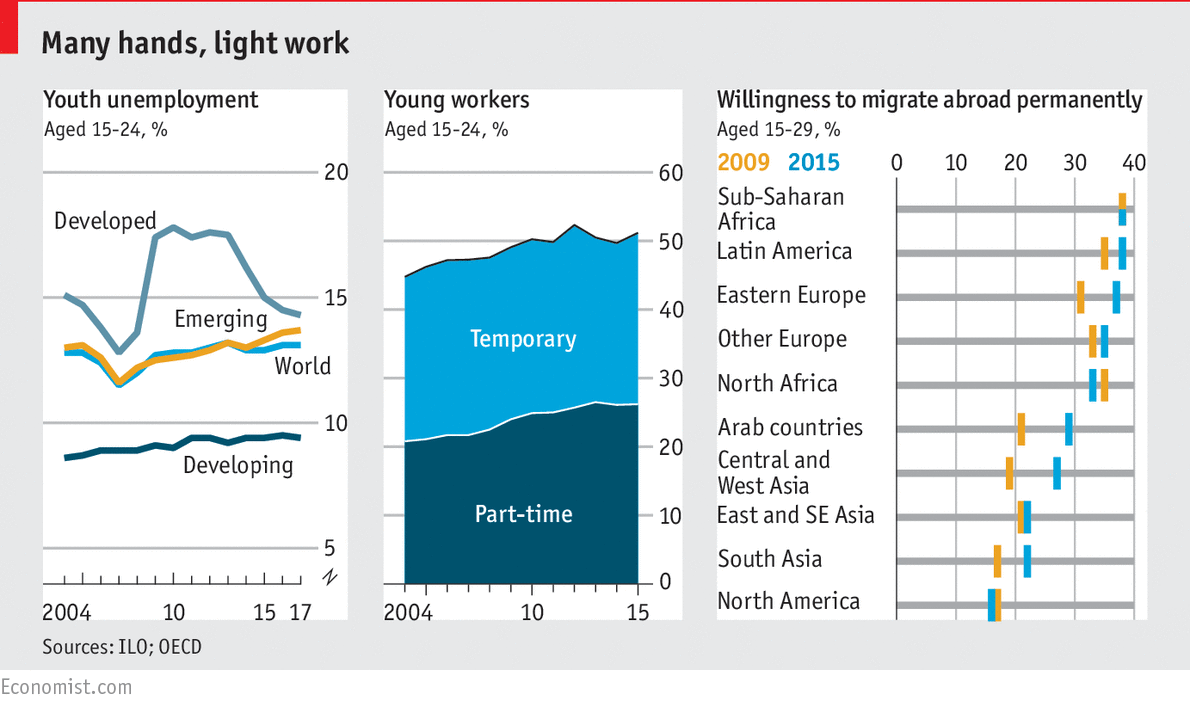
The pace of such dramatic changes leads us to being completely unprepared as "the largest youth population in human history is coming of age in a steady, unstoppable wave."
societies across the Middle East, Africa, and South Asia are experiencing youth booms of staggering proportions: More than half of Egypt’s labor force is younger than age 30. Half of Nigeria’s population of 167 million is between the ages of 15 and 34. In Afghanistan, Angola, Chad, East Timor, Niger, Somalia, and Uganda, more than two-thirds of the population is under the age of 25.
How well these young people transition to adulthood — and how well their governments integrate them economically, politically, and socially — will influence whether their countries thrive or implode. Surging populations of young people will have the power to drive political and social norms, influence what modes of governance will be adopted and the role women will play in society, and embrace or discredit extremist idesituatiologies.
Idle young men, in particular, filled with testosterone, can easily slip into various kinds of anti-social and destructive activities--more so if they do not have war or sex as outlets for the testosterone.  
As we ponder our path forward, we should consider that the developing world’s youth boom coincides with four interrelated global trends: an information revolution, the largest movement of refugees and displaced people in recorded history, growing urbanization that will concentrate youth in cities, and a rise in terrorism and extremist ideologies. Together these trends will spread not just people but, more importantly, their ideas at an unprecedented rate. They will raise and dash expectations pushing and pulling young people toward and away from their hometowns and homelands, toward and away from their desired futures. They will make young people around the globe aware of how others are living, the divisions within their societies, and how those they identify with are treated by governments, security forces, and other groups. This knowledge can inspire or anger. It can commit people to elevating their families and communities — or make them lash out against them.
I tell ya, Major Buzzkill General Malaise is always ready to brighten your day ;)

This situation sets up the probability for more migration:
As poor countries prosper and their young become more educated, they are more likely to migrate. It explains in part why India has the largest diaspora in the world: In 2015, 16 million Indians were living outside India, double the number in 2000.
The youth will be highly motivated to move if employment prospects are dim in their home countries:


"Given the bleak future faced by many, it is little surprise that 40% of 15-29-year-olds in Africa, eastern Europe and Latin America would countenance a permanent move abroad."
I hope the political leaders are paying attention.  Oh, wait, of course they don't pay attention.  Which means, I get yet another opportunity to utter a favorite phrase of mine: we are screwed! ;)

Monday, August 08, 2016

There is migration ... and then there is diaspora

Early on, I  realized that I had a limited vocabulary.  One classmate knew words that I could not even find in the primitive dictionary that we had at home.  As I have noted many times here, my best friend from high school often stumped me with words.  One high school student included a word in her personal statement that was well outside my word list: Sesquipedalian.  It is no surprise to me that she is now wrapping up her doctoral dissertation at Yale!

Maybe that is all the more why Hemingway's works (like here) have always appealed to me, with his short sentences and words that are rarely outside my comfort zone.  William Faulkner may have insulted Hemingway with "He has never been known to use a word that might send a reader to the dictionary" but I don't care; hey, I have never read Faulkner ;)  Seriously, I had planned on reading a Faulkner work five summers ago, but gave up after only a few pages.

In graduate school, I was encountering new words and ideas every single day.  One of those is a word that I now use as if I had known it even from my days at the kindergarten with Mrs. Higgins!

Diaspora.

In our daily lives, we don't think much about "diaspora."  But, if we paused to think about it, then in no time we are mighty impressed with the importance of that word and its meaning in the contemporary world.  One can immediately understand why we would want to understand various aspects related to "diaspora."

This essay reminds us that we will be hearing a lot more about "diaspora" given the large-scale movement of people in the recent past couple of years.  However, "while human migration is always part of a diaspora, not all migrations equal a diaspora."  But, of  course, we--including me--use the word "diaspora" a lot more loosely than it ought to be.

There are two weighty ones in human history: the Jewish and African diaspora.  Even a mere mentioning of the Jewish or African diaspora conveys to us that mere movement of people does not make a diaspora.  Right?
Perhaps contemporary Western societies’ misuse of the term “diaspora” to describe any national groups’ geographic migration is changing the meaning of the word. Or, maybe we haven’t done a good job of educating our citizens about distinctions of important universal concepts. Or, maybe we need a new term for many of today’s populations forced to migrate from their homelands. This will be exceptionally true if, unlike groups in the African diaspora, new groups of migrants are socially included in their new locations.
Here is to hoping that we will see more natural assimilation as people move, and not the creation of more tragic diaspora stories.

Saturday, May 21, 2016

On the road again. Heck, at least once!

Every once in a while, when discussing the economic future, I ask students who are pretending to listen to me whether they would consider moving far away from Oregon.  "What if you have much better employment opportunities in North Dakota?" is my favorite way to get them to think.  I like beating up on North Dakota because back when I was a graduate student, I used to tell people, "hey, if the teaching job is in North Dakota, then that's where I will go."

Moving far away from home because of productive, gainful, and meaningful employment is not an alien concept to me.  As a young man, my father headed all the way to a remote part of India, from his roots way down in the country's peninsula, and that was back when transport was slow, and there were no phones.  From door to door--from his place to grandma's--was a five day travel.  Ten days out of a month's vacation were merely for the travel.  My grandfather would have taken up a job in Ceylon if it had not been for the elders in the family who blocked his plans.

I intentionally asked for a posting in Calcutta at the campus recruitment.  And then I came here to the other side of the planet as a 23-year old, before the Web was invented and when international calls severely dented my graduate student budget.

Even now, old high school friends are in different parts of India and around the world.  Geographic mobility has been very much a part of my life. I have even written op-eds exploring these (like this one.)    Which is why the students' responses always surprise me--most of them do not want to move far away!

I then remind them about how people immigrated from European countries, fully knowing that they might never ever be able to visit their homelands, and might never be able to even talk with any of the ones they were leaving behind.  After all, the large scale European immigration to the US was before telephones and air travel.  Yet, they moved.  And they even moved to godawful North Dakota!

In some classes, I have even joked that they--and the American youth--have become wusses compared to their grandparents and great-grandparents.

I am not the only one who thinks about all these.  For instance, here is Arthur Brooks in his column in the New York Times:
Through census data, we know that Americans are less geographically mobile today than at any point since 1948. Other scholarship suggests that the decline stretches back further. This might help explain why our country is having such a hard time getting out of its national funk.
Mobility is more than just a metaphor for getting ahead. In America, it has been a solution to economic and social barriers. If you descended from immigrants, I’m betting your ancestors didn’t come to this country for the fine cuisine. More likely they came in search of the opportunity to work hard and get ahead.
Even for those already here, migration has long been seen as a key to self-improvement.
It is not merely the economic opportunity issues.  I worry that the young increasingly shy away from taking chances. 
The mobility decline since the Great Recession has actually been the most pronounced among millennials. As the first rungs of the economic ladder became more slippery, young adults began to delay major steps into adulthood and became less likely to relocate for college or careers.
Yep!  

I can think of a number of reasons. Like the over-protective parenting of today where free-range kids are not possible.  The umbilical cord that continues via the constant texting and phones with the parents. The education system that has made kids into subservient and unthinking adults.  Whatever the reasons are, we need to get the young to get moving again.  


Friday, March 27, 2015

This "conservative" loves his hometown(s) ... and wishes others loved their's

It will not be an exaggeration by any means when I assert that I am emotionally invested in, tied to, very, very specific places.
My grandmas' villages.
The town where I grew up.
The city where I earned my doctorate, and then the city where I worked and lived.
And, for thirteen years now, this wonderful place by the Willamette in a gloriously green state.

Growing up in Neyveli, there was a distinct sense of home being there, while grandmas' villages were the "native places"--the places from where our people were from.  In contrast, the city where I went to for my undergraduate degree was not "home."  I always knew it was only a transit stop.

I write and talk with fondness for very few places in the old country and those places were home to me.  In my adopted land, I love Los Angeles even when I know I don't ever want to go there again to live--the fondness from it being my first home away from home.

All these are more than mere fondness for the place though.  It is good to have such a geographic rootedness, I would argue.  A belonging to a place.  A place that is home.   Maybe this wannabe philosopher thinks like this because, as a quote that I recently came across said, “philosophy is really nostalgia, the desire to be at home.”

It is not without reason we have idioms that even refer to the geography.  Like, "down to earth" or "well grounded" or "both feet on the ground."

I love staying put, knowing that I belong to a place.
Staying put—fully inhabiting, loving, and stewarding the place in which you live—is a conservative idea in many respects. It’s interwoven with the idea of civic care and involvement, the importance of commitment to the political, economic, and cultural wellbeing of a community.
It is that sense of commitment to the community that drives me to write op-eds.  Not op-eds for newspapers in the Timbuktus of the world, but for papers in the community where my life is.  Thus, after moving out of California, I never cared to send an op-ed there, as much as back then I did not submit an op-ed to the three Oregon papers where I have been published, more regularly in one compared to the other two.  In fact, in one op-ed, I noted that writing is my civic responsibility.  Such a civic sense would not be there if I didn't have any geographic rootedness in the first place.

However, we live in a world where people move from rural to urban areas, from city to city, from state to state, and even from country to country.  I have always wondered if that meant that some of these moves are always in transition.  I am sure this guy knows plenty about these feelings from his own experience.  In those transitions, is there ever a commitment to a place and its wellbeing?  Or will it be a mere shrug about a senior center that might need help, or a school that might be shutting down, or the whatever it is ...?

These days, with the (un)employment crisis here in America,
Many people have realized that mobility takes a long-term toll on their family and community life. Not only that, moving to a place for recreational or consumeristic purposes is a sapping and exorbitant lifestyle choice, in a time when employment opportunities are still tenuous, especially for younger Americans. Staying “close to home” is more attractive when you know that there will be a safety net, a support group, and a community in that place—to help you even through times of financial difficulty.
A mighty toll.  Understandable--there is no free lunch in life, and there are costs associated with this mobility.

May you always be at home wherever you are!


Saturday, December 27, 2014

The Indianizing Indians

Slowly things are changing in this part of India.  It is Indianizing.

A few days ago,
before the mysterious fever with aches and pains like I have never had in my life--which miraculously disappeared in 24 hours--and before
the horrible experience of traveler's diarrhea--my first in all these years of traveling in the US and different countries, including India,
I walked around the uber-congested shopping areas of the infamous Ranganathan Street.  In the heart of traditional Chennai.

Source

I was shocked to hear languages and dialects that I am sure were not from the Dravidian south, nor were there any Hindi words.  I couldn't pick up any Bengali sing-song either.  In the heart of traditional Chennai!

Even more shocking was to see people who were clearly not from the Dravidian south, nor from the Hindi Belt.  From the northeastern parts.  Walking around casually in the heart of traditional Chennai!

Another day, my brother and I were in an autorickshaw when the driver pulled into a fuelling station--an LPG fuelling station.  As the driver pushed his vehicle along in the long line, another auto driver attempted to cut in. The station attendant came charging and let out yells--in Hindi!  The guy obviously was from another part of India, and was working here in the traditional Chennai, and hadn't learnt the local language to yell in Tamil!  Hilarious it was.  And one more evidence of the India that is slowly changing and mixing.  I call it Indianizing.

People from other parts of India moving to Chennai is easy to understand.  It is a combination of demographics and economics: economic growth rates are not enough in areas with high fertility rates, whereas Chennai and the Dravidian south are experiencing economic growth while the fertility rates have fallen well below replacement levels.


My ground-level observations match up with this report:
Internal migrants in India are expected to touch 400 million in the 2011 census, over half the global figure of 740 million and almost twice as many as China's estimated 221 million.
A third of the country's population are internal migrants.  What a phenomenal change from even two generations ago!
According to the report, internal migrants faced discrimination as 'outsiders', which excluded them from access to legal rights, public services and social protection programmes accorded to residents. This is despite the migrants providing cheap labour and typically doing the most dirty, dangerous and degrading jobs that locals do not want to do. Far from being a burden on society, migrants' cheap labour provides a subsidy and contributes to the national GDP, stated the report. Moreover, remittances from migrants lead to increased expenditure on health and education helping human capital formation.
To be viewed, discriminated, as "outsiders" is not an unusual experience for migrants--internal or international.  Change from the old is not easy for us humans to handle.  But, as this migrant will attest, we migrants are a hardy bunch.  I am sure even the Hindi-yelling LPG gas station attendant will survive and prosper--even in the heart of traditional Chennai!


Tuesday, August 26, 2014

On the worry that the least-skilled will fall further behind

Charles C. Mann notes in his insightful essay on the rhetoric and (in)action regarding climate change:
In the 3,600 years between 1800 B.C. and 1800 A.D., the economic historian Gregory Clark has calculated, there was “no sign of any improvement in material conditions” in Europe and Asia. Then came the Industrial Revolution.
The Industrial Revolution was one hell of a game-changer.  China and India, which at that point accounted for more than a half of the world's GDP, had no idea what lay ahead; no surprise that they are both terribly wounded civilizations that are even now trying to figure out what happened and why they are not the admired and prosperous lands, though China is in a hurry to reclaim its status.

In his book, his talks, his interviews, well, anywhere, Andrew McAfee stresses the importance of the Information Revolution by reminding us about the Industrial Revolution:
As historian Ian Morris writes in his fascinating book Why The West Rules — For Now, “the industrial revolution… made mockery of all that had gone before.”
If that changed the world in a hurry, then, as McAfee likes to point out, we ain't seen nothin' yet with respect to how much the next revolution (that is underway?) will completely overhaul everything.

That is not a new topic in this blog.  I keep coming back to it because of a deep concern that the vast middle class was perhaps a freakish accident in history, and that we will revert to conditions that prevailed throughout almost all of recorded history--the patricians and the plebeians.

The concern over the plebs is nothing but another way of saying that inequality is a troubling issue to me.  Not merely within the US, but across the world.  Now, I have quoted Branko Milanovic and others who have correctly noted that global inequality has narrowed, as this chart from an old post shows:


But, within countries, the gap is widening.

And even the Economist pitches in with "why globalisation is not reducing inequality within developing countries"
Economists are puzzled: the data contradict the predictions of David Ricardo, one of the founding fathers of their discipline. Countries, said Ricardo, export what they are relatively efficient at producing. Take America and Bangladesh now. In America the ratio of highly skilled to low-skilled workers is high. In Bangladesh it is low. So America focuses on products requiring highly skilled labour, such as financial services and software. Bangladesh focuses on downmarket products such as garments.
Comparative advantage predicts that when a poor country starts to trade globally, demand for low-skilled workers will rise disproportionately. That, in turn, should boost their wages relative to those of higher-skilled locals, and so push down income inequality within that country. The theory neatly explains the impact of the first wave of globalisation. In the 18th century, Europe had a high ratio of low-skilled workers relative to America. When Euro-American trade took off, European inequality duly tumbled
Any time the Economist or the Wall Street Journal runs such pieces, then I joke that it means it is time to say "holy shit!"

Anyway, what might be the story here?
[Eric Maskin's theory] relies on what he calls worker “matching”. Unskilled workers can be more productive when matched with skilled ones—that is, when they work together. Assigning a manager to a group of workers can do more for total output than just adding another worker. He places workers into four classes: skilled workers in rich countries (A); low-skilled workers in rich countries (B); high-skilled workers in poor countries (C); and low-skilled workers in poor countries (D). Crucially, he thinks low-skilled workers in rich countries (the Bs) are likely to be more productive than high-skilled workers in poor ones (the Cs).
Before the current wave of globalisation started in the 1980s, skilled and unskilled workers in developing countries—the Cs and Ds—worked together.
So, yes, globalization.  What happened?
The latest bout of globalisation has jumbled the pairings: high-skilled workers in poor countries can now work more easily with low-skilled workers in rich ones, leaving their poor neighbours in the lurch. ...
The Cs work with Bs and end up being more productive. The Ds are left by the wayside.
The Ds number in the hundreds of millions.   Which is why the Economist concludes with this thought:
 if he is right, he poses a challenge to globalisation’s advocates: figuring out how to reap its rewards without leaving the least-skilled in poor countries behind.
Well, hey, it might be a realization that is a tad too late.  But, better late than never, right?

There is one easy solution to this; can you guess what that is?  Hint: it cannot happen again, now that we are already here ;)


Thursday, May 01, 2014

Can't breathe. Is it the smog or the marriage?

Through all the years that I can recall in my early life in the old country, father sneezing was a daily event.  Loud enough not to miss it.  That was the case in the life that we had in the industrial town and later in the bustling city.

Quite some years ago, during my California life, my parents came for a visit.  My mother appreciated the cleaner air and water.  No sneezing sounds from father.

And that was in one of the dirtiest places in California!  Even now it is!

Years later, they visited Australia after my brother immigrated to the land down under.  My parents could feel the difference via what their bodies were telling them.

The sneezing and everything else returned every time they got back to their own settings.

And where they live is not even the dirtiest city in India.

News reports suggest that China's cities easily out-pollute India's cities.  I shudder to think what a visit for a couple of days will do to my system, especially when I go there from the clean and green Oregon where I live.

Commenting about China's pollution, and whether it is all worth it, is not new here.  (like here or here.)  Yet, I am always blown away by the stories of China's pollution and how people deal with it.

No surprise, therefore, to read this in the Economist:
Chinese emigrants are leaving good jobs, cashing out their high-priced homes (or investment properties) and leaving China’s rat race behind. They are unlikely to find better jobs anywhere else, but the air and water are less polluted where they are going, the social safety-net less frayed and the food safer to eat. And there is no one-child policy.
If they can, people will vote with their feet!
Others are keeping one foot, or one half of their marriage, back in China, unsure they want the slower-paced life abroad. Windson Song, a 35-year-old marketing manager in Beijing, and his wife and baby boy, are close to getting approval for permanent residence in the Canadian province of Quebec, where they meet the requirements for skilled-worker emigration (his wife’s ability to speak French helped). She and the child will go first, and will perhaps fulfil the requirement of living in Canada for three out of four years. Mr Song prefers to stay behind in Beijing, where career opportunities in marketing are much better. He often thinks, though, about his first day in Australia as a student a decade ago. It was a “fairytale world”, he says, with “green trees, colourful flowers”, few people and almost no cars. He wants the option of escaping Beijing’s grim cityscape. But his Ć©migrĆ© friends remind him that although (or perhaps because) it is safer, cleaner and less corrupt, life is “really boring” abroad.
Indeed, to the immigrant who cannot adapt to the way of life in these "cleaner" locales, life can be excruciatingly boring. Painful. Depressing. Even in the most scenic settings.  After all, happiness comes from within.

It is not quite easy, it seems, to develop a Solomon's split the kid approach to having one half of the marriage in polluted China and another part in a cleaner paradise.  The split could become real:
A Beijing man is seeking to divorce his wife after she took their son to a tropical island province to escape the capital's notorious smog, saying the long-distance relationship had destroyed their marriage
Now, it is not as if the wife left Beijing and emigrated to Australia:
[Their]son developed serious health problems because of Beijing's air pollution and his wife took the son to the southern resort island of Hainan to escape the haze.
However, Wang's wife did not like Hainan and nor did she like living apart from him, and whenever the two of them met they fought, the report said.
Fed up with this, Wang has filed for divorce in a Beijing court, the newspaper said.
"Smog 'buried' my son's health, and it has 'buried' my marriage," he was quoted as saying.
Who woulda thunk that smog might kill marriages too!

Back in India, father sneezes, and mother coughs.  And they are not bored.

Tuesday, March 26, 2013

Pakistan is a worse "money order economy" than Kerala

A while ago, I noted here about Kerala being a "money order economy"--if not for the remittances from abroad, especially from the Middle East, the state will be in a worse economic condition than it already is.

At least, Kerala's social indicators are healthy--from literacy to life expectancy to women's rights, etc.  Imagine a society without such high social indicators and worse economic conditions in which foreign remittances play even more a significant role.  Ok, you don't need to imagine it when we have the real case of Pakistan:
“This is our savior for keeping Pakistan out of the oxygen tent,” Farooq Sattar, former Minister for Overseas Pakistanis said in an interview in Karachi last month before his party quit the government alliance. “It has kept us from a complete economic collapse.”
Almost 10 million Pakistanis work overseas and the sum they’ve sent home has doubled in the four years through June, to a record $13 billion.
Remittances are about six percent of Pakistan's GDP.  How awful will conditions in Pakistan be if the billion-plus dollars don't keep coming in every month?  Pretty much bankruptcy!
 In 2008, Pakistan averted a balance of payments problem by securing an $11 billion IMF loan package, but the IMF suspended the programme in 2011 after economic and reform targets including widening the country's miniscule tax base were missed.
Some analysts have since warned about the prospect of a new balance of payments crisis.
Asked if Pakistan could avoid going back to the IMF, Liepach said: "I don't see that happening. It's a question of time. They need to do this before the end of this calendar year."
"It needs to be $6 billion to $9 billion."
Even the money that comes in is an underestimate because there are significant amounts that are transferred via off-the-books channels:
Pakistan was among the world’s top 10 recipients of recorded remittances in 2012, according to the World Bank. Sattar estimates billions of rupees from abroad are unreported, transferred with the help of illegal money operators known as hawala or hundi. Pakistan’s recorded remittances would double if the illegal channels were closed, he said.
Sometimes, looking at these issues from the outside, I do wonder why people simply cannot get their act together.  In Pakistan, a country where power shortages are so acute that they even had a floating power plant on loan, people would rather spend money to bomb the shit out of civilians because they happen to be of a different ethnicity or Islamic sect or whatever?  Maniacs would rather attempt to kill a young teenage girl than fixing up the mess the country is in?  It is a mad, mad, mad, mad world!

BTW, how are things in Kerala?  It is complicated. Kerala's labor force understands that almost always they can earn more if they moved out of state or the country.  Meanwhile, the state's below-replacement-level fertility rates mean that the state is rapidly aging, which then draws in labor from other states in India that have even worse economic conditions.  One heck of a migratory world in which we live.  
a study conducted by Gulati Institute of Finance and Taxation (GIFT) points out that these young migrant workers are breathing life into the state’s gasping farm sector, propelling its burgeoning construction industry, toiling at small industrial units, hotels and similar places. In short, they do all the menial works in the state. Without them the wheel of Kerala economy would not move.

The last count shows that about 25 lakh migrant labourers are working in Kerala having a population of 3.33 crore. And their numbers are growing at an incredible pace of 10 per cent annually.

In contrast, nearly 22.8 lakh Keralites are working abroad and nearly 10 lakh are in other states, says the study quoting a State Planning Board’s statistical reports for 2011. It shows that Kerala labour market needs at least 5 lakh workers more to maintain the balance between demand and supply.

This will further skew the native-migrant ratio in favour of the latter. Naturally, the state pays a heavy price for maintaining such a huge workforce from outside.  They drain out Rs 17,000 crore annually from the state by way of wages alone which incidentally is equivalent to the plan size of the state for the next fiscal. 
No state or country can't live off money orders alone.  At least, Kerala is a part of the Indian union.  Pakistan has to fend for itself.  Let us see how the elections mess up Pakistan even more!
Kerala, 2006

Monday, July 30, 2012

My genetic journey, from Tanzania to Eugene, via India

Nearly three years ago, I authored this column in the paper here, in which I described how the visit to Tanzania was a homecoming for me:. 
Tanzania offers a compelling argument for why it is home to humans — going back to hominids, who were human-like precursors to our kind. The evidence, in this case, includes the well-preserved footprints of hominids in northern Tanzania, estimated to be 3.75 million years old.
There was still something missing even after that trip, which I understood much later--to go beyond the theoretical argument, and get evidence of how I came to be from that African origins.

A few weeks ago, when I was reading an essay, I came across a reference to the Genographic Project, and I decided to participate in that as a kind of a belated birthday gift to myself (yes, I paid for my own gift, thank you very much.)  Because there was that payment to be made, I asked only for the "male" side of the history--after all, only males can get the male side of the story, given the Y chromosome.  Some time later, I would gift myself with the female side of the past as well.

Today, I got the results of the DNA analysis, which tell a story of my origins from Africa.  The genetic map shows how I got to India, all the way from Africa:


Compared to the tens of thousands of years that it took for the geographic movement out of Africa to India to happen, I came over to Los Angeles in 1987 after a mere day of air travel.  Perhaps those early ancestors would not have even dreamed about such a possibility?

Anyway, the report notes:
The man who gave rise to the first genetic marker in your lineage probably lived in northeast Africa in the region of the Rift Valley, perhaps in present-day Ethiopia, Kenya, or Tanzania, some 31,000 to 79,000 years ago. Scientists put the most likely date for when he lived at around 50,000 years ago. His descendants became the only lineage to survive outside of Africa, making him the common ancestor of every non-African man living today.
The place I visited in Tanzania was really, really, close enough to be the real, old, ancestral home--the home before Pattamadai, Sengottai, and Neyveli that I have often blogged about.

Anyway, from Tanzania (as I imagine the home!):
Your ancestors, having migrated north out of Africa into the Middle East, then traveled both east and west along this Central Asian superhighway. A smaller group continued moving north from the Middle East to Anatolia and the Balkans, trading familiar grasslands for forests and high country.
And then from there,
Your next ancestor, a man born around 40,000 years ago in Iran or southern Central Asia, gave rise to a genetic marker known as M9, which marked a new lineage diverging from the M89 Middle Eastern Clan. His descendants, of which you are one, spent the next 30,000 years populating much of the planet.
Getting close to India ...
The man who gave rise to marker M20 was born in India or the Middle East. Your ancestors arrived in India around 30,000 years ago and represent the earliest significant settlement of India. For this reason, haplogroup L (M61) is known as the Indian Clan.
Although more than 50 percent of southern Indians carry marker M20 and are members of haplogroup L (M61), your ancestors were not the first people to reach India; descendants of an early wave of migration out of Africa that took place some 50,000 to 60,000 years ago had already settled in small groups along the southern coastline of the sub-continent.
So, there!  Everything else was easy, it seems like.

About that Y chromosome itself?  It is alive--through my nephews, now it is in Australia!


I was excited when I saw these elephants at Mikumi National Park, Tanzania. 

Thursday, November 17, 2011

Map of the day: the wanderers

The Economist notes:
MORE Chinese people live outside mainland China than French people live in France, with some to be found in almost every country. Some 22m ethnic Indians are scattered across every continent.


As a wanderer myself, I am all the more excited with this discussion.  Plus, it is not the first time I have blogged about the wandering humans--like this one, for instance.

Tuesday, August 16, 2011

Geography and the global income inequality divide

A few months ago, I noted here from Catherine Rampbell's review of Branko Milanovic's The Haves and Have Nots

an astounding 60 percent of a person’s income is determined merely by where she was born (and an additional 20 percent is dictated by how rich her parents were)

As much as geographers hate any variation of the idea of geographic determinism, various factors, including border controls, do make it an irrefutable fact that income and wealth for most of us are determined by where we are born.

Joshua Keating offers another chart from Milanovic's book, looking at the gini coefficients (a reminder: smaller numbers mean less unequal distributions)


And this advice:

because "inequality is now determined more by where you live than the class you belong to." The best way to change your lot in life, it seems, is to move.

If only people had as much freedom to move as capital has, right! 

Of course, the other side of the argument is whether we need to focus on the growing inequality, or whether the growing prosperity deserves greater attention.  That calls for a serious debate, right?

For now, the lack of a freedom to move means that:

The typical person in the top 5 percent of the Indian population, for example, makes the same as or less than the typical person in the bottom 5 percent of the American population. That’s right: America’s poorest are, on average, richer than India’s richest — extravagant Mumbai mansions notwithstanding.

The ones who want tight controls over migration unnecessarily worry, out of heights of self-interest, a Camp of the Saints scenario, as if that dystopia is all that is possible when people are allowed the freedom to move.

Wednesday, July 09, 2008

Out of Africa: tracking human migration

From the Scientific American:
The route humans took from Africa to the Americas over the course of tens of thousands of years can now be tracked on the map as if the travelers were moving, albeit extremely slowly, on a series of interconnected superhighways. Alphanumeric route signs, such as I-95, can be recast as alphanumeric genetic markers. In the case of the Y chromosome, for instance, cross the Bab el Mandeb on highway (genetic marker) M168, which becomes M89 when heading north through the Arabian Peninsula. Make a right at M9 and set out toward Mesopotamia and beyond. Once reaching an area north of the Hindu Kush, turn left onto M45. In Siberia, go right and follow M242 until it eventually traverses the land bridge to Alaska. Pick up M3 and proceed to South America.

Mitochondrial DNA and the Y chromosome remain powerful analytical instruments. The National Geographic Society, IBM and the Waitt Family Foundation have joined in a privately funded $40-million collaboration through 2010, research that is primarily devoted to using these tools. With the help of 10 regional academic institutions, the so-called Genographic Project is gathering DNA from up to 100,000 indigenous people worldwide. “What we’re focusing on is the details of how people made the journeys,” says Spencer Wells, who heads the project. In a recent report its researchers found that the Khoisan people of southern Africa remained genetically separate from other Africans for 100,000 years. In another study, they demonstrated that some of the gene pool of Lebanese men can be traced to Christian Crusaders and Muslims from the Arabian Peninsula