Showing posts with label faculty. Show all posts

Tuesday, April 23, 2019

Blogging, public intellectuals, and faculty

Of course I am talking about myself; this is my blog!

A few years ago a student exclaimed in class that he was reading my blog and realized that he need not ever come to my classes; instead he could get everything that I might have to say in the class right from the blog itself.

Whenever students discover this, I tell them that my blog serves multiple purposes for me, of which one is that this blog serves as my own notes that I can refer to if/when needed.  And, of course, it also serves the curiosities of anybody who is interested in the content here.

Over the years, I have wondered why faculty do not operate in such modes, within and outside the classroom.  And why faculty do not go to classes and treat students as members of the public with whom they have to intellectually interact

Tyler Cowen, who is one heck of a prolific, accomplished, polymath of a professor across the continent, and whom I have cited many times here, says:
What’s a university and what is not? Those distinctions are crumbling. If we’re not a university, maybe no one else will be either. There’s a lot of content on the web. A lot of it’s free. That will be increasingly important. I think it’s already the case on a given day. More people read economics blogs than are taking "Principles of Economics" classes in the United States, so why aren’t the blogs already a kind of university? They’ve sort of won that competitive battle in some way.
The people who read the blogs want to read them. A lot of people in "Principles" class, they’re not paying attention, they don’t want to learn, they feel they have to, so blogs are in some ways doing a better job of educating.
While Cowen uses the example of economics, the same can be said about any subject.  People want to know about any number of topics but somehow we have convinced ourselves that the old buildings with ivies crawling on them is the only way to meet that desire to know.  In fact, it increasingly works the other way around--those who come to the universities are some of those who are least interested in learning and are in college only to pick up a diploma.

Cowen has moved beyond blogging itself--to a "university" that offers a whole bunch of videos.  The interviewer signs off with this:
Maybe the biggest impact of upstarts like Marginal Revolution University will be that traditional colleges will feel more like, well, like blogging. Maybe the line between the formality of college education and the informal materials found online throughout one’s life will blur, and maybe those distinctions will just matter less and less. Authority may sound less like a lecture from a podium and more like a Facebook post.
But, are the faculty, who are busily writing books that nobody ever reads, thinking about such important questions as "What’s a university and what is not?"

Source

You read until here?  Check this out.

Friday, October 19, 2018

The Best Way Out Is Always Through

The following is a copy/paste from my essay at Inside Higher Ed.
*********************************************************

I wish I had learned a number of things that I didn’t in graduate school, including what it means to be a faculty member advising students. If only I had been told what I know now: faculty advising and office hours are not really about the classes, per se!
I started teaching economic geography at California State University, Bakersfield. When students came to my office, it was not to talk about agglomeration economies, central place theory or international development (my favorite). Instead, they often talked about their own lives. Earl, a United States Army veteran, talked about his experiences as a homeless person sleeping under bridges. I still recall Frank getting teary as he spoke about his homeland, Sierra Leone, which he had to flee. (I have replaced real names of students in this piece to protect their identities.) And there were more, whose names and faces are fading away in my memory.
It did not take long for me to understand that advising would involve dealing with the anxieties, vulnerabilities and emotions that students struggle with. I was unprepared. I had to quickly learn and improvise. And I did.
I became a listener.
All through my life as a student, and until I became a member of the teaching profession, I had never had such experiences. In my undergraduate years in India, I found no equivalent of “office hours.” Other than during classes, when I tried my best not to fall asleep through the lectures, I rarely saw my professors, let alone talked with them. It is not that I did not walk around with emotional baggage of my own; at times, the weight of my baggage seemed unbearable. But I had no one to talk to about my anxieties that included an acute fear of public speaking, worry about my family’s financial stress due to my father being unemployed and -- the biggest one of them all -- my intense feelings of unhappiness and depression about my electrical engineering program.
Perhaps my formative years would have been less anxious if India had continued with a variation of the old tradition of gurukula. In the gurukula system, the student (shishya) almost always lived in the home of the teacher (guru) and his family. The guru and his wife were, for all practical purposes, a second set of parents, and provided a home -- a remarkable alma mater -- that made possible the shishya’s intellectual andemotional development. In complete contrast to the gurukula, my college professors and I were total strangers in India’s modern higher education system.
Though not operating a gurukula in Oregon, which is where I have been living and teaching for the past 16 years, I am convinced that faculty members can -- and should -- play an important role in students’ emotional as well as intellectual development. News reports empirically validate the struggles of the students whom I come across in my teaching. The Higher Education Research Institute at the University of California, Los Angeles, which has been surveying first-year students across the country since 1966, notes a significant decline in the emotional health of college students. Life has apparently become even more complicated than it was when I was a teenager worrying about my future.
At the surface, it might seem like the three-legged academic stool -- teaching, scholarship and service -- does not include dealing with students’ feelings. But teaching does have a place for it. After all, we are not dealing with automatons but human beings with emotions. The life of the mind, which serves as an unofficial motto for higher education, includes anxiety and sadness.
I fully recognize that I am not a counselor. I suggest to students to meet with the counseling professionals on the campus if they are not able to work out their problems. One student, Valerie, who does work with counselors, wrote to me recently: “I don't plan on being broken for the rest of my life though. Well, it is not like I am planning it now, but things will be better soon.”
It seems like students want faculty members like me simply to hear them out and not necessarily solve their problems. Listening to students in my office, when they engage me about their life concerns, compels me to walk a fine line -- fully engaged and relating to the person yet detached enough from the emotions and the person so that I don’t get entangled in their lives. Depending on what students tell me, I sometimes share with them some of the anxieties that I experienced as a college student. Always, they are surprised to learn that I, too, was once a walking bundle of nerves.
A few days ago, I met with a student, Gina. As we discussed her classes and the need to look for summer internships, I sensed that something was troubling her. Thanks to the years of working with students, I knew that I should not force the issue, and that if a student really wanted to share their troubles with me, they would. The more we talked about her academic plans, the more I could see her gaining confidence that she could trust me.
She paused and looked away. And then Gina slowly talked about her problems dealing with anxiety and depression.
I listened. We talked about her worries and her interests. I latched on to her mentioning poetry. I told her about a line from Robert Frost that is comforting and encouraging when we struggle with problems: The best way out is always through. “I love Frost. I will look it up,” she replied with a smile.
But then, all of a sudden, her facial expressions changed. With her fingers covering her mouth, and looking deeply apologetic, she asked, “Is it OK to talk with you about these? These are my personal problems, right?”
“Of course, it’s OK,” I replied. She relaxed more when I added that advising and office hours are not merely about classes but -- and more important -- about such issues. And that’s a profound truth that I had not known as a graduate student when I was excitedly looking forward to a life as an academic.

Friday, October 05, 2018

The Conceptual Penis in Breastaurants

So, yet another gotcha! moment in the academic world of "research."

In case you missed it, because you were preoccupied with the teetotaler pussygrabber defending a beer-drinker by claiming that Jews were ruining the country, well, you are correct in ignoring the latest tempest in the academic teapot.

But, we shall address that here.


Yawn!

To me, this is merely yet another dog bites man story.

Note that in the opening sentence I wrote "yet another" ... because the one that really should have alerted academia was the original--by Alan Sokal.  That was more than two decades ago.

However, academe couldn't be bothered.

Academe didn't change because of the entrenched publish-or-perish culture.  Publishing intellectual masturbation as "scholarship" is a requirement for promotion.  These days, it is a requirement to even get the first job in higher education--in contrast to the old days when intellectual masturbation began after getting hired!

Does it bother you that I repeatedly refer to intellectual masturbation?  It should.  I am being intentional here.  As I wrote in an essay in the Chronicle Review, 17 years ago, almost to the very date, most of the academic "research" is pretentious work that will not sell even for penny, or for a kopek according to Anton Chekov's "Uncle Vanya" that I quoted in that essay.

I had always hoped that the financial urgency will force higher education to review its bizarre facade of scholarship, before the public figured it out as much as Uncle Vanya figured it out.  But, academic "scholars" could not be bothered with all that.  The intellectual masturbation continues with cries of orgasmic pleasures within the walls of the ivory towers!

In this essay in The Chronicle Review, the authors note:
We need policy makers and grant makers to focus not on money for current levels of publication, but rather on finding ways to increase high-quality work and curtail publication of low-quality work. If only some forward-looking university administrators initiated changes in hiring and promotion criteria and ordered their libraries to stop paying for low-cited journals, they would perform a national service. We need to get rid of administrators who reward faculty members on printed pages and downloads alone, deans and provosts "who can't read but can count," as the saying goes. Most of all, we need to understand that there is such a thing as overpublication, and that pushing thousands of researchers to issue mediocre, forgettable arguments and findings is a terrible misuse of human, as well as fiscal, capital.
The authors list a few suggestions for reform.  What is their bottom line?
Best of all, our suggested changes would allow academe to revert to its proper focus on quality research and rededicate itself to the sober pursuit of knowledge. And it would end the dispiriting paper chase that turns fledgling inquirers into careerists and established figures into overburdened grouches.
Here is the ultimate kicker: the authors are, implicitly, referring to the research universities.  If this is their set of observations on the happenings at research universities, then one can easily imagine the state of "research" at the vast number of universities that are not research universities but teaching universities, like the one where I teach.

In another essay, Arthur Levine noted that rapidly widening gap between "Digital students, Industrial-era universities" :
[It] is important to ask how much colleges and universities need to change. In 1828, facing industrialization and a Connecticut legislature that disapproved of Yale’s classical curriculum, the Yale faculty responded with a report which asked, in part, whether the college needed to change a lot or a little. This, Yale’s faculty said, was the wrong question. The question to be asked, they argued, was: What is the purpose of a college? This remains the right question today.
What is the purpose of college, and what is the role of "research" that faculty do?

Tuesday, August 28, 2018

United States of the Traumatized!

In November of 2006--yes, twelve years ago--a faculty "colleague" emailed me, in which he wrote:
I did lack a bit of courtesy; however, if you are going to exist in an administrative/director position at any level at any university I suggest you quickly develop a thicker skin...faculty are frequently, mostly without intention, discourteous and disrespectful.
In another context more than a decade ago, a philosophy professor had some choice words for me in his lengthy email: "please shut up."

It is an endless list of faculty freely dishing out.  The irony is that many of these are the same ones who "fight" to protect students from words and ideas!

Of course, way back in graduate school, I had been educated enough on how unprofessional faculty can be.  I was mentally prepared for what academia will be.  But, every unprofessional response was a shock that continued to shatter into a million pieces the noble ideal, if ever it existed, of a Socratic exchange of ideas.

It is not only in academia.  Everywhere, all the way from the current Oval Office, people seem to simultaneously exhibit two attitudes: One in which they seem to want to always hit below the belt, and another in which they constantly whine that their feelings are being upset.  Bizarre!

So, what can be done?
[If] we are going to beat back the regressive populism, mendacity and hyperpolarization in which we are currently mired, we are going to need an educated citizenry fluent in a wise and universal liberalism. This liberalism will neither play down nor fetishize identity grievances, but look instead for a common and generous language to build on who we are more broadly, and to conceive more boldly what we might be able to accomplish in concert. Yet as the tenuousness of even our most noble and seemingly durable civil rights gains grows more apparent by the news cycle, we must also reckon with the possibility that a full healing may forever lie on the horizon. And so we will need citizens who are able to find ways to move on despite this, without letting their discomfort traumatize or consume them. If the American university is not the space to cultivate this strong and supple liberalism, then we are in deep and lasting trouble.  
Nope, the university has long ceased to be place for the professional and courteous battle of ideas.

Source

Friday, May 18, 2018

Caring is expressed in listening

Lee Shulman, whom I heard speak at one conference many years ago, was one heck of a guru in the world of understanding teaching and learning.  He talked and wrote in plenty about pedagogy, by observing the teaching and leaning in various fields.  Shulman made me think a lot about the pedagogy in medical schools, which I also understood vicariously through my daughter's experiences.

There is a lot we can--and should--learn from how knowledge is conveyed in professional fields different from ours.  A constant reflection on what we do and what others do is a requirement for teachers.

Abraham Verghese writes about the rapid infusion of big data into the medical profession, and the essay gives me a lot to think about.  Verghese, who I referred to in this post seven years ago, I came to know of through a book of his ... that was more than 20 years ago.  He is one of the Indian-American physician authors who seemingly have time for everything!  And now the guy has even wandered into writing fiction.  An ultimate Renaissance man indeed!

Anyway, in this recent essay, Verghese writes about the practice of medicine:
True clinical judgment is more than addressing the avalanche of blood work, imaging and lab tests; it is about using human skills to understand where the patient is in the trajectory of a life and the disease, what the nature of the patient’s family and social circumstances is and how much they want done.
... that patient’s greatest need is both scientific state-of-the-art knowledge and genuine caring from another human being. Caring is expressed in listening, in the time-honored ritual of the skilled bedside exam — reading the body — in touching and looking at where it hurts and ultimately in localizing the disease for patients not on a screen, not on an image, not on a biopsy report, but on their bodies.
In our profession, too, we deal with data about students like the graduation requirements and GPA.  But, working with students is not merely about looking up that kind of data and "solving" their problems.  Well, that too. But, often, it is above and beyond those mechanics.  It is about listening to students.   And to "genuinely care."

Earlier this week, as we wrapped up a nearly 30 minute chat about her academic plans, the student said "thanks for your advice every time." I was slightly taken aback.  She continued with "you always listen to me, and think about what will be good for me."

I thanked her.  I wished her a good summer.

Yesterday, it was deja vu all over again with another student.  At the end of our meeting, she put her stuff in her backpack, picked it up, and then said, "thanks for listening to me and always putting myself in my place and thinking about what will be good for me."

I thanked her.  And told her that it was pleasantly strange that she was saying something identical to what another student.  Her response was even more interesting for me: "Most other faculty I have taked to seem to be single-track and they only talk about their own stuff."

I agree with Abraham Verghese: Caring is expressed in listening

Wednesday, August 23, 2017

Master teacher

A few years ago, when reading up about Boris Pasternak, I was delighted with the way he had phrased the statement declining the Nobel Prize (under pressure from the bastard Soviet overlords.)  Pasternak's statement, in a telegram to Swedish Academy, was this:
Considering the meaning this award has been given in the society to which I belong, I must reject this undeserved prize which has been presented to me. Please do not receive my voluntary rejection with displeasure.
I found that statement to be so awesomely phrased.  It was even better than Groucho Marx's line on why he did not like being a member of clubs: “I wouldn't want to belong to a club that would have me as a member.”

I liked Pasternak's statement so much that I decided that if ever I was even remotely considered for a teaching award at my university, well, all I would do in my reply was to quote the Russian ;)

The "best teacher" awards at most places are variations of a popularity contest.  Increasingly so in the students-are-our-customers atmosphere that now envelops higher education.  There's no "business" like higher education.  I, on the other hand, do not care for popularity, whether it is with students or colleagues, or with blog commenters or neighbors, or whoever.  Which is why, sadly enough, I will never get an opportunity to use Pasternak's lines! ;)

Identifying the teacher of the year, or other such awards, is "bunk" (paywalled):
How does any professor, let alone a panel of judges, really know what goes on in another professor’s class? Longstanding academic convention dictates that we rarely cross the threshold of a colleague’s classroom. We are seldom invited to one another’s lectures and seminars. It goes without saying that an unannounced "pop in" is strictly out of the question.
The door to a lecture hall could just as well be a police sawhorse — if that sawhorse stood behind a moat and was outfitted with a gun turret. Herein lies an unrecognized truth about American higher education: The inner workings of college teaching spaces are more or less unknown.
I have no idea what goes on in any other professor's class.  Literally, not metaphorically.  Neither in California nor here have I engaged in serious discussions on how we teach what we teach, and more.  It is like there is an unwritten rule that we can talk about everything else, but not about our classroom teaching!

On my campus, I am almost always shocked at most of the people receiving such honors.  From my interactions, I would never have picked most of them as even halfway decent teachers, and yet they represent the university as model teachers.
I once had a colleague who taught a 200-level class. She loathed the fellow who taught the 100-level that was a prerequisite for her own. The latter was a campus legend. He was a flamboyant character who gyrated and twerked as he lectured. By the time his students cycled into her class, they knew exceedingly little about the subject matter. Her 200 regressed into a 100, because the guy in the 100 was teaching — well, she had no idea what he was teaching. He did win many Faculty of the Year awards, though.
I know plenty of faculty like that!  "flamboyant character who gyrated and twerked," indeed :(
Good college teachers, then, don’t necessarily do what is in their own professional interest. They do what’s in the interest of their students.
Exactly.

I know I am not a good teacher.  But, my approach to teaching is not about me nor about my professional advancement.  It is about students.  In developing the syllabi for the upcoming year, I am actually tightening up the structure for my classes because I worry that I am not being rigorous enough--even though, tightening up the structure is not the route to popularity.  I don't care.  I am used to being ignored, neglected, and dissed.  After all, in my life, I have never been popular even when I am all by myself ;)


Monday, October 10, 2016

The bald fact

"What's your story?  When did you get to the US?"

At the end of a day of listening to presentations by budding and mature scholars, we were at dinner.  At my table, I was one of the three---at that table of six--who has made a home in America. Of course, I was only one who looked like I might have come from somewhere else--the other two are Scotland and Israel.

"Interesting you should ask me that," I said.  "I often review my life and look at the photographs.  What shocks me the most is how young I look in those photos when I was fresh off the boat."

And then I laid out my worst problem in life.  "I had lots of hair back then.  And black."

We laughed.

I am now a bald professor with a grey beard.  I have now become the cliché.  I suppose I can make a complete caricature of myself if I wore a tweed jacket with elbow-patches and smoked a pipe as well ;)

Of course, it is all because of the male pattern baldness.  It is not my fault; shit happens!

Here is W.B. Yeats beginning a poem with "bald heads" as if I need any reminder!

The Scholars
By W.B. Yeats

BALD heads forgetful of their sins,
Old, learned, respectable bald heads
Edit and annotate the lines
That young men, tossing on their beds,
Rhymed out in love’s despair
To flatter beauty’s ignorant ear.

They’ll cough in the ink to the world’s end;
Wear out the carpet with their shoes
Earning respect; have no strange friend;
If they have sinned nobody knows.
Lord, what would they say
Did their Catullus walk that way?

In a few minutes, this bald head will find out what the young women and men bring to the class.  And later I will edit their lines.  Maybe a bald head is an asset that makes me seem more learned than I really am. ;)

Monday, May 16, 2016

If only Faculty were Public Intellectuals

I remarked to the few students who were pretending to listen to me that engaging with the public requires a thick skin.  (It is not because of a thin skin that I do not engage with most faculty; I choose not to even wish the unprofessional professionals!)  It is relatively easy for faculty to say whatever bombastic stuff they want to expound on--when they are in class with a captive audience, or when they are at one of their committee meetings.  (As a friend joked, a committee is where they take minutes for the hours wasted!)  

It is strange, rather ironic, that tenured faculty confine themselves to such safe territories and do not dare to venture out.  Why don't they proclaim their bombastic ideas with the public?  If they truly believe, for instance, that the humanities and the social sciences have never been more important, then why don't they make the case to the world outside their safe spaces?

Rachel Toor--a tenured member of the faculty at a university here in the Pacific Northwest--writes:
We live in interesting times. Scholars in the humanities can’t afford to stop making the case that what we do matters — that art helps us to live. We need to be able to convey that to our students, especially those in STEM fields who may not have gained as much exposure to music, literature, art, or theater.
But, why to "our students"?  They are not the ones who need that message.  After all, what students think and do result from various social policies and structures that the public has established. Further, the courses that students take resulted from the curriculum that faculty designed.  Which means it is the faculty who need to be convinced about the humanities?
The timidity we find in much academic work is a product of a system that — while professing to cherish academic freedom — doesn’t foster academic bravery.
She got that part right!

Another faculty, who is on the tenure-track, writes about "dipping our toes into the role of the public intellectual."
So tell me, reader. How are you dealing with this seemingly inevitable slide toward becoming a public intellectual? What are the benefits and what are the risks of engaging with people about our work online? Share your stories below in the comments or Tweet @MeganCondis. Let’s talk about it.
Oh, please!  I have been doing this for years.  I suppose I should have written essays about my experiences at the places where these faculty have published theirs and boosted my CV!

I have been doing what I have been doing for two decades now, from even before the birthing of "www."  Harsh and negative criticism is something that I view as evidence that I am doing something alright.  As I joked with students, how many can claim to have received hate mail! ;)

I will end this post with excerpts from two recent responses from strangers, which will show that I have enough of a thick skin to engage with the public ;)

First:
I read your article in the R-G about Elihu Yale and I have to say you’ve really gone off your nut this time. Have you had your blood sugar checked lately?
Mild, right?  Keep in mind that was merely the opener!

How about a couple of sentences from another one?


The students' jaws dropped when I read that to them.  I told them about my all-time favorite hate mail that I received; check it out yourself ;)

I, for one, am not holding my breath waiting for the tenured faculty to be brave outside the ivory tower.  As they say in the old country, வீட்டிலே புலி வெளியிலே எலி  (a tiger at home, but a mouse outside.)

Thursday, May 12, 2016

The demagogues and faculty who shit on outsourcing to India!

The title of the post conveys my sentiments, right?  I am ticked off!
I will stop right here before I display my fluency with colorful vocabulary!!!

I will add this much: There were two triggers for this post.  One, I heard a faculty colleague ask another, "do you really want the corporations to outsource everything?"  And then, this meme that was shared on Facebook by a friend:


The following is my op-ed that was published four years ago in The Register-Guard, August 13, 2012, during the previous presidential election cycle:

The sudden populism over outsourcing reminds me of a Chinese saying that I recently came across: “If we don’t change the direction in which we are headed, we will end up where we are going.”

Twelve years ago, when I taught at California State University, Bakersfield, I assigned a class of about 35 students the task of figuring out, through rough calculations, whether Bakersfield could compete against Bangalore, India, when it came to call centers that the local leaders were pursuing as a growth strategy.

At that time, outsourcing hadn’t entered the everyday political and cultural vocabulary, and Bangalore was unknown to most in the United States — after all, Thomas Friedman had yet to publicize these through his best-seller, “The World is Flat.”

Working in teams, the students independently arrived at the same conclusion: Bangalore will beat Bakersfield any day! My hope was that most of the class would have understood through this exercise how their economic futures could become increasingly dependent on developments in other parts of the world.

Well, we have now almost ended up where we were going — economic activities that might have generated many middle income jobs in the past have migrated to other countries that are equally, or more, interested in their development. Therefore, unemployment rates in the United States do not seem to be coming down despite all our attempts. And, yes, “outsourcing” is now a part of our lexicon and for which politicians have suddenly developed a fondness.

Yet we are not talking about outsourcing in a constructive manner. Outsourcing is being used to portray China or India as bad actors, when, in reality, they are far from any real competition to us. The average Indian earns barely 5 percent of the per capita income here in the United States. The average Chinese is in a much better position than the average Indian, but the per capita income there is only a tenth of that in the United States.

India and China are not our competitors, but they are much poorer countries where people are eager to improve their economic conditions.

Outsourcing economic activities to India or China, or any number of other countries, has made possible goods and services at remarkably low prices. From T-shirts to smart phones to customer support, we would have to pay a lot more than we currently do if there were no outsourcing at all.

It is not China’s or India’s problem that we failed to change our own direction over the years when we enjoyed the abundance of goods and services at affordable prices. Obsessed by the Internet bubble, the events of Sept. 11, 2001, and the wars that followed, and then the housing bubble, we continued to keep going without even attempting to alter our course, seemingly oblivious to how the economic structures all around the world were rapidly changing.

Should we then be surprised that it has become extremely difficult to generate gainful employment that will keep alive the American Dream for the middle class?

Outsourcing enters our public discourse only when it conveniently fits into political calculations. Sens. John Kerry and John Edwards angled for votes by referring to outsourcing and offshoring when they were on the Democratic ticket for the White House in 2004. Now, both President Obama and Mitt Romney are talking about it, but for all the wrong reasons that don’t seem to reflect in any way the Harvard credentials they both have.

Obama beats up on outsourcing in order to imply that the Chinese and Indians are taking away “our” jobs, which is a highly screwed-up interpretation. And Romney doesn’t seem to recognize that outsourcing and the globalization of the economy have not translated to real economic betterment for the middle class.

Since the Great Recession, I have increased the intensity with which I try to make students understand that any job that can be sent to a different country will be sent, and that any job that can be automated will be automated. Unfortunately, a captive audience does not always mean an attentive audience.

I suppose we seem to be bent on making sure we will end up where we are going.

Sunday, May 08, 2016

The endangered conservative professors on American campuses

To the campus faculty, at least in the hallway in the building where my office is, there is only one presidential candidate who matters, and who can change the country--and, thereby the world--for the better: Bernie Sanders.

So much that the prevailing sentiment seems to be, well, let me put it this way: if you don't feel the Bern, then you are an idiot.  I don't feel the Bern, which means ... ;)

The other day, one of the Bernies told me that if Sanders doesn't win the nomination then he would even skip voting for a presidential candidate.  "Even if that means Trump wins?" I asked the colleague.  Such is the Bernie fever on campus.

Even a casual reader of this blog, leave alone this guy who has racked up quite a few frequent-commenter bonus points, knows from my posts that my campus, like most higher education institutions, is loaded with way-left-of-center faculty.  So ideological is the tilt, so out there to the left, that an independent thinking person that I am have been forced off the conversations and told to shut up.  Apparently my "input and perspectives" are met with "disdain."  And I am not even a right-wing conservative!

Given such an ethos, I am even surprised anymore when commentators bother to write about the lack of diversity of thought in higher education.  It is, after all, old, old, old, stale news.  But, they write and I, too, blog about it!

In that liberal rag, the New York Times, the liberal columnist, Nicholas Kristof--an Oregon native--complains about the lack of diversity:
Conservatives can be spotted in the sciences and in economics, but they are virtually an endangered species in fields like anthropology, sociology, history and literature. One study found that only 2 percent of English professors are Republicans (although a large share are independents).
In contrast, some 18 percent of social scientists say they are Marxist. So it’s easier to find a Marxist in some disciplines than a Republican.
Of course it is far too easy to find Marxists and Socialists among faculty.  Heck, we have two who even contested in elections as socialists!  A Republican social scientist is an endangered species.  For that matter, even the likes of the late Daniel Patrick Moynihan might be persona non grata at campuses like mine because they won't be liberal enough!

It is not only the politics, but also the closely related religious beliefs:
The discrimination becomes worse if the applicant is an evangelical Christian. According to Yancey’s study, 59 percent of anthropologists and 53 percent of English professors would be less likely to hire someone they found out was an evangelical.
“Of course there are biases against evangelicals on campuses,” notes Jonathan L. Walton, the Plummer Professor of Christian Morals at Harvard. Walton, a black evangelical, adds that the condescension toward evangelicals echoes the patronizing attitude toward racial minorities: “The same arguments I hear people make about evangelicals sound so familiar to the ways people often describe folk of color, i.e. politically unsophisticated, lacking education, angry, bitter, emotional, poor.”
Over the years, I have had plenty of conservative and religious students work closely with me, confide their angsts with me, even though they know well that I am an atheist and who is largely left-of-center on many issues.  Because, I do not treat them as "politically unsophisticated, lacking education, angry, bitter, emotional, poor" and instead give them the same professional treatment that I give anybody else.  

Kristof concludes with:
Universities should be a hubbub of the full range of political perspectives from A to Z, not just from V to Z. So maybe we progressives could take a brief break from attacking the other side and more broadly incorporate values that we supposedly cherish — like diversity — in our own dominions.
Dream on!  This will never, ever happen. 

Wednesday, March 16, 2016

An honest day's work

By now, it should be clear to regular readers that I don't waffle and use euphemisms.  Right?  Mine is a Socratic approach.  In fact, the older I get, the less I am able to argue for anything that is way off the truth--I cannot even imagine how lawyers and accountants do that lying day in and day out!

So, in that Socratic spirit, let me share with you something that has baffled me throughout my career as an academic.

I find it bizarre when faculty talk about preparing students for the workforce, and when they give career advice to students.

It is bizarre because most of them--not all, but an overwhelming majority of them--have never been gainfully employed outside the walls of the ivory tower.  I do not mean working summer jobs as students.  I am referring to real jobs with real responsibilities.  Yet, they give career advice to the youth?  And students listen to them?

Most of the faculty were good students who went to college right after graduating from high school.  And almost always, even as they were wrapping up the undergraduate programs, they applied to graduate school, earned their doctorates, and then started working as faculty.  If not for the odd summer jobs, they might not have had any exposure to the real world at all.

My neighbor/friend jokes often that I am like any professor who has never done an honest day of work, by which he means the real world working experience.  But, of course, he knows he is exaggerating.  I worked as an engineer in India.  A real job.  Well, make it three real jobs with three different employers in India.  And then here in the US, I worked as a transportation planner, for almost six years.  The six longest years ever.  A grand total of seven years of work in the world that was far away from higher education.

The more I observe the faculty in higher education, the more I am convinced that most of them should simply admit to students that they have no idea about jobs and careers.  Even worse are the deans and provosts.  All of them should do a full disclosure like "to be honest, the only thing I know is how to prepare for a career in higher education."  As Ken Robinson remarked in this awesome talk that is also hysterically funny, the entire point of education, right from kindergarten, seems to be about preparing clones of teachers.
 If you were to visit education, as an alien, and say "What's it for, public education?" I think you'd have to conclude, if you look at the output, who really succeeds by this, who does everything that they should, who gets all the brownie points, who are the winners -- I think you'd have to conclude the whole purpose of public education throughout the world is to produce university professors. Isn't it? They're the people who come out the top. And I used to be one, so there. 
Which is all the more why I felt awesome on reading a student's email of thanks in which he writes:
The advice you gave was based on your understanding of who I am as a person and what I value, not on some intellectual or scholar you are trying to forge into your own image.
It is unfortunate that most of higher education today is neither about the intellectual aspects of understanding the world nor about workforce preparation.  It has become a self-serving business.  How awful!

Sunday, March 06, 2016

Explaining wage increase when productivity slowdown is for real

The faculty union at the university where I work delivered to its members, and the rare non-members like me, significant salary raises.

Despite the large increase, some aren't happy, apparently.  The other day I heard a full-professor complain to another full-professor about the salary compression at the top of the scale.  I wanted to ask them: if we all do the same work then shouldn't we receive the same pay?  As "comrades" shouldn't they, therefore, complain about the unequal pay?  But, I did not.

Meanwhile, Oregon's legislature has decided to increase minimum wages in the state.

The student newspaper on campus had a front page story on whether student jobs were now at risk.  I took a copy of the paper with me to class and asked students whether any of them had read the student newspaper.  None had.  I held up the paper, and then read out the following from the report:
Western Oregon University may be affected by this bill, especially those student workers who are employed on-campus.
“Based on my early calculations, I believe it [Senate Bill 1532] could add up to 3-5% on student employee costs next fiscal year in my area,” stated Patrick Moser, the Director for Student Leadership and Activities.
“How that affects student employment in my department is highly dependent on how the Incidental Fee Committee chooses to address the budget issues of minimum wage increases,” Moser continued.
I reminded them that every business will have to engage in such calculations.  And also pointed out the uniqueness of the university--fees can be increased in order to account for the higher wages and that the fees will come from students.  Businesses with a profit bottom-line cannot simply increase prices, which means a different kind of decision-making.

The campus economics seems to be in alternate universe that is disconnected from the real world in which the vast majority complain--legitimately--about not having had any real increase in earnings.  While the super-rich have certainly added to their Richie Rich lives, the rest of the folks have to deal with stagnation or worse.  Tyler Cowen, who is by no means any friend of the left, writes:
American middle class wages haven’t been rising as rapidly as they once were, and a slowdown in productivity growth is probably an important cause.
Cowen cites recent research and points out that the tech sector hasn't delivered on productivity.
Information technology is still one of the most dynamic sectors of the American economy, and it probably will remain so, and grow yet more influential, even if its absolute impact is not as large as the optimistic revisionists suggest.
That still leaves us with a big productivity problem. We need to acknowledge that while many Internet entrepreneurs are economic heroes, statisticians are also pretty good at what they do, and we may simply need to accept some of the lessons embedded in their numbers. America’s productivity crisis is real and it is continuing. 
I wonder what my faculty colleagues and students think about that essay by Tyler Cowen.  Students can be excused if they don't read it; but, what excuse do faculty have if they don't read such essays and think about it, especially when it is not from the manically pro-business Wall Street Journal but from the publication that is dear to liberals?

Sunday, February 28, 2016

You say publications, I say intellectual onanism

I am beginning to doubt Herb Stein's law that "if something cannot go on forever, it will stop,"  After all, the "publications" by higher education faculty shows no sign of stopping any time!

Well-meaning faculty have attempted to show to the world that publications, especially in the vast humanities and the social sciences, is a case of the emperor with no clothes.  But, apparently it is such a well-known fact that nobody raises an eyebrow and faculty continue to publish crap.  Peter Dreier, who "teaches politics and chairs the Urban & Environmental Policy Department at Occidental College" writes that most publications are academic drivel.  Of course; what's new!  Dreier writes about his own experiment with generating garbage with highfalutin phrases, in a manner that resembles Alan Sokal awesome work exposing the bizarro world of academic publications.  Dreier notes:
I am more than willing to admit that just because I don’t understand something doesn’t mean it isn’t well reasoned or accurate. But the proportion of things published in academic journals has become less and less accessible to anyone who isn’t a specialist in that field. We live in an era of increasing academic specialization. As academia becomes more and more fragmented and balkanized into more narrow niches, an increasing proportion of what academics produce is unnecessarily obscure and obtuse, and, not surprisingly, poorly written. Graduate students read this drivel written by their academic elders, and then seek to emulate it, perpetuating the rule of pompous prose.
In the 39 years since I finished graduate school, specialization has become more and more narrow, so that even people in different subfields of the same discipline—say, Japanese history and colonial American history, or Renaissance literature and Southern poetry—aren’t expected to understand, or at least judge the quality of, others’ work.
Exactly.

But then he and I are fellow-travelers:
I am a professor with a Ph.D. in sociology who now teaches in a political science department and chairs a department of urban and environmental policy. In other words, I do not have strong disciplinary loyalties and think that the boundaries between many academic fields are pretty blurry. I believe that most social scientists—sociologists, historians, economists, anthropologists, geographers, and political scientists—should be able to read and understand most of what their fellow social scientists write, if only they would write in relatively clear prose. Although I’m not formally trained in English literature, or art history, or other humanities subjects, I can grasp the basic points, if not the nuances, of most articles published by scholars in these fields, if they are written to be understood rather than to impress and intimidate.
I did my graduate work in urban planning, then taught in the department of economics, and then in the geography department.  As much as I love being in the all-embracing geography, my identity is not tied to, nor dependent on, geography.

The other day, I was grading papers in my office with the door open. I heard a student ask a colleague across the hallway, "can you tell me about the sociology classes so that I can plan for the next term?"  A sensible question, right?  The response was so telling of the bizarre fragmentation of higher education and the related turf issues.  "I am a historian" was the reply before showing the student the office of a "sociologist."  Why the reflexive need to defend oneself with "I am a historian" is something I can never, ever, understand.

More from Dreier:
The problem of academic jargon is not confined to a single political or ideological wing, but it certainly dominates much of the writing by leftists in the social sciences and humanities. I consider myself a person of the left, and my research and writing—focusing on American politics, urban policy, social movements, and labor studies— generally explores issues of social justice and democracy. But I have little patience for much of what passes for left-wing academic writing in the social sciences and humanities, which emphasizes criticism (often called “deconstructing” or “problematizing” by academics) of conservative and liberal ideas and social institutions, but makes little or no attempt to figure out what to do to make things better.
I also have little patience for the kind of embarrassingly obtuse writing style preferred by many postmodern and allegedly leftist academics that obscures more than it enlightens and is often a clever mask for being intellectually lightweight. 
In case you, dear reader, are an outsider and have no idea how to "desconstruct" and "problematize", well, check with the youth in college and they will have plenty of stories to tell you while you will have to remind yourself to close your wide open mouth! ;)

What is even more depressing is this: there are plenty of real world problems and issues that need to be understood and solved.  From lead in Flint's water to the mayhem in South Sudan to the Hindutva tilt in India to ... and the real world with really curious and interested people will read what the "expert" faculty have to say--if only those who protect themselves "with feathers and robes, emblems and degrees" will look beyond their orgasmic intellectual onanism!

(Full disclosure: A few years ago, I was denied promotion to full professor because I refuse to engage in academic drivel and, therefore, will be stuck at the "Associate" level until it is time.)

Monday, February 01, 2016

"Hey! How'm I doing?"

The older I get, and the more years that I teach, the faster I seem to want to get evidence from students that I passed the Ed Koch test.  You know, the answer to "How'm I doing?"

Back in the old days, I was content to wait for weeks, even the end of a term. Not anymore.  By the third week, or at least the fourth, I am looking for signs that I am making a difference.

Why this feedback fever?  It is simple.  In the early years of teaching, I thought teaching was about me.  Students were an afterthought.

Now that I am older and wiser, I couldn't care a shit if my lecture was great (which never is the case anyway!), or if I was flawless in the classroom, or ... My job is about the students.  Hence, I need to know from a student's perspective if I am doing ok.  Which is why the feedback fever that seems to set in earlier and earlier.

But, unlike Ed Koch, I can't walk around and ask students, "Hey, how'm I doing?"

Even though I cannot walk around asking that question, like with most things in life, we find something only because we are actively searching for it.  Seeking it.  Serendipity is rare.  Perhaps even serendipity is only because we were on that path; else, that awesome whatever would not have appeared by itself.  If I am not thinking about "how'm I doing?" from a student's perspective, then chances are that I will be doing worse than I would like to.

It has been four weeks into the term.  Perhaps the feedback will come later. Or maybe not.  It might turn out that this term I made no difference to any student.  Que sera sera!

I cleaned up the desk.  I put away the papers.  I turned around.  I looked at the four shelves of cards from students.


"I'm doing alright" I reassured myself.

Now, if only a student would tell me that! ;)

Friday, January 29, 2016

A minority of one

"What is your hobby?" asked a student.

For all the autoethnography that I engage in here in this blog, in my newspaper op-eds, and even in conference talks, when students ask me questions about me or my views, I don't open up.

"I like cooking" I told the student who asked about my hobby.  Thankfully, she didn't ask me about my views on cooking and eating animals ;)

In another class too it happened. I had barely walked in to the room when a student shot a question at me: "How come unlike other professors you are not wearing a union tshirt, Dr. Khé?"

I typically do not respond to such questions in the classroom.  It is not because I do not talk about my what I do when not "working" or what I think about the faculty union.  There are plenty of blog-posts on all those and more.  Yet, I try my best to deflect those questions away for one simple reason--we get together in a classroom for a specific reason, which is to learn about the scheduled topic.  To talk about the union or my hobby is nothing but an abuse of the power and privilege that I have in that classroom just because I am the instructor.

"I don't want to take up class time on that" I replied.  "I am old-fashioned that way" I added.

"No, you are not old-fashioned" came a quick retort.  "Other professors have been talking about it in class" jumped in another.

It looked like I had to satisfy the mob ;)  The clock said it was not class time yet--two minutes before the official start time.  I dragged myself to responding to why I wasn't wearing a union tshirt.  But, that opened up more questions.  "Are you against unions?" "Are you the only professor not a union member?" "Do you benefit from not being in the union?" "Are you worried about groupthink?" Important questions that students and taxpayers need to think about, and juicy topics for me.  But, I am old-fashioned!  Perhaps my responses were all way briefer than what they wanted to hear.  But, as the clock indicated it was class time, I began the process of putting them to sleep via my lecturing ;)

I worry that I will become one of the many who do not think twice about using and abusing their power and position.  Right from when I was young, I have found it difficult to work with people with power and authority because almost always they abuse it.  Whether it is the police or the politicians or the World Bank or the union or the religions or  even a lowly Ramamritham, rare is the person who does not abuse the power and the privilege that come with that position.

Over the years, and especially from my own personal experiences, I have also come to understand that it takes a lot of effort to resist the urge.  If a union leader can abuse the position's power and privilege, and if a lowly Ramamritham can, then should we be surprised when a Bill Clinton takes advantage of an intern, or ...?

Thus, I continue to tilt at real and imaginary windmills.  As George Orwell put it so well in 1984:
He wondered, as he had many times wondered before, whether he himself was a lunatic. Perhaps a lunatic was simply a minority of one.
It looks like within my small professional world I will forever be a lunatic, and in a minority of one.  That's ok too.

Friday, January 22, 2016

Stop the presses. Faculty are political!

Students have no idea how they make me feel great via their comments in class or in their papers.  One noted in her paper that she did not care for the ideas when they were expressed by "an extremely conservative" professor but is apparently receptive to those same ideas when she hears them from me.  Another found that in my blog I criticize Obama and Faux News.

These two comments are not anything new.  Years ago, one student wrote in a long letter of appreciation that she really didn't know about my politics even after having known me throughout her undergraduate years.  Which is exactly how it ought to be; my political philosophy ought to be irrelevant and immaterial to students.  Right?

It is one thing when biologists have political preferences; after all, mitochondria are not influenced by political views.  But, in the humanities, the social sciences, business, and a gazillion other things that universities offer, well, it is pretty much all politics.  Rare will be a business faculty with uber-left leanings, and perhaps rarer will be a sociologist with ultra-right political views. Yet, we pretend that our "research" is all objective.  Ha!
In October Russell Roberts, a research fellow at Stanford University’s Hoover Institution, tweeted that if told an economist’s view on one issue, he could confidently predict his or her position on any number of other questions.
The people rose in protest with tweets, blog-posts, and position papers!
As Mr Roberts suggested, economists tend to fall into rival camps defined by distinct beliefs. Anthony Randazzo of the Reason Foundation, a libertarian think-tank, and Jonathan Haidt of New York University recently asked a group of academic economists both moral questions (is it fairer to divide resources equally, or according to effort?) and questions about economics. They found a high correlation between the economists’ views on ethics and on economics. The correlation was not limited to matters of debate—how much governments should intervene to reduce inequality, say—but also encompassed more empirical questions, such as how fiscal austerity affects economies on the ropes. Another study found that, in supposedly empirical research, right-leaning economists discerned more economically damaging effects from increases in taxes than left-leaning ones.
That is worrying.
Seriously?  They needed to do research on this?  It shows what pretentious lives economists lead believing that their thinking is not political and is only--and nothing but--scientific!
 even if economics is not uniquely ideological, its biases are often more salient than those within chemistry. Economists advise politicians on all manner of important decisions. A reputation for impartiality could improve both perceptions of the field and the quality of economic policy.
For Brutus is an honourable man;
So are they all, all honourable men

Tuesday, January 12, 2016

Neither higher nor education

The more years I teach, the more I wonder and worry about the fragmentation of knowledge at the undergraduate level.  To an overwhelming majority of college students, the undergraduate degree will mark the completion of formal schooling.  Very few will go on to graduate school, and even fewer will go on to do research in that fragment.

Yet, the system practically forces students to identify themselves with a fragment.  "I am a basketweaving major."  It then becomes hard for me to resist the urge to knock some sense into that young person; I want to tell them that the world does not need more basketweaving majors, but needs more educated people. I feel compelled to explain to them that focusing on basketweaving is not the same as getting educated and that it is a hindrance to education.

But ... I don't even attempt to make students think differently about this identification with their majors because it is not really their fault.  It is the damn faculty who created this fine mess and are actively cultivating it.

Philosophers have a great deal of experience with this mess, after going down the horrible path of creating their own "discipline":
“Real” or “serious” philosophers had to be identified, trained and credentialed. Disciplinary philosophy became the reigning standard for what would count as proper philosophy.
This was the act of purification that gave birth to the concept of philosophy most of us know today. As a result, and to a degree rarely acknowledged, the institutional imperative of the university has come to drive the theoretical agenda. If philosophy was going to have a secure place in the academy, it needed its own discrete domain, its own arcane language, its own standards of success and its own specialized concerns.
Faculty then needed students who would identify themselves as "philosophy majors."  It was, and is, the same story with every field of inquiry.  At the university where I teach, my esteemed colleagues have introduced so many new academic majors and minors that one would erroneously conclude that there is a great deal of knowledge being produced here--ha!

The irony is that we faculty love to talk about the Socratic approach, and about Socrates himself!
Before its migration to the university, philosophy had never had a central home. Philosophers could be found anywhere — serving as diplomats, living off pensions, grinding lenses, as well as within a university. Afterward, if they were “serious” thinkers, the expectation was that philosophers would inhabit the research university. Against the inclinations of Socrates, philosophers became experts like other disciplinary specialists. This occurred even as they taught their students the virtues of Socratic wisdom, which highlights the role of the philosopher as the non-expert, the questioner, the gadfly.
Well, I know what happens to "the non-expert, the questioner, the gadfly" ;)

So, where are we then at the end of it all?
Having become specialists, we have lost sight of the whole. The point of philosophy now is to be smart, not good. It has been the heart of our undoing.
While the essay was about philosophy, that bottom-line is equally applicable to everything that we do at the undergraduate level--we have lost sight of the whole.  If only students understood this, sooner than later!

Friday, January 01, 2016

I don't teach. I want students to learn.

When I meet young people, I feel an urge to flood them with what I have learnt in life so that they can avoid the mistakes that I made and take the shortcuts that I have found.

But, I know better.  No young person wants any advice from a balding, greying, middle-aged guy who talks funny in any part of the world.  So, STFU is the reminder I always give myself.  It has worked quite well so far.  I have an impressive record of only rarely ever volunteering any advice!

Thus, even with the young relative, I merely engaged in a conversation without becoming the older uncle who tells her how to lead her life.  During the chat, I described how I work with students, when my father chimed in with "in India, students are taught, whereas in America students have to learn."

If only a majority, in India and America alike, understood the importance of students owning the responsibility to learn.

There is a role for "teaching," no doubt.  But, for the most part, it is the learning that students need to focus on, which they seem to forget.  As I often remind students, I could be the worst teacher ever, but because it is their life, they need to pay attention to their own learning despite the terrible person standing across from them.

But, they don't listen to me; need I remind you that no young person wants any advice from a balding, greying, middle-aged guy who talks funny in any part of the world!  And they end up writing positive comments and sending me thank-you notes and gifts ;)

I wonder if I was merely lucky that I kept after learning even without anybody ever telling me that education is about learning.  As far as I can recall, right from my early school days.  Like in that physics example, too, in high school; ahem, it is not as if I went to school only for that one girl!  What if high school and college students do not know that education is about learning?  What if nobody has even bothered to clue them in?

I have joked with students--because advice is not well received--that at the end of every term, they should ask themselves, "what have I learnt from the classes that I took?"  If they are not able to easily draw up a list, they should  approach the university president for a refund of the tuition is my joke.  Hahaha!  Humor can deliver truth easily and well--if one gets the joke.

Very few seem to care about learning.  Even in daily life, outside of the classroom environment, there seems to be very little interest in learning.  After all, we need to learn about personal health, finance, ...  Learning is hard work though, which most of us prefer avoiding.

Perhaps it was always this way.  Maybe that's why Socrates had to walk around Athens reminding people about the importance of an examined life, for which learning is a fundamental requirement.  Oh well, I too will "learn" when I am handed a cup of delicious hemlock infused coffee--I hope that will be at my 75th birthday celebrations ;)

Monday, September 21, 2015

Trigger warning: I always prefer more speech, not enforced silence

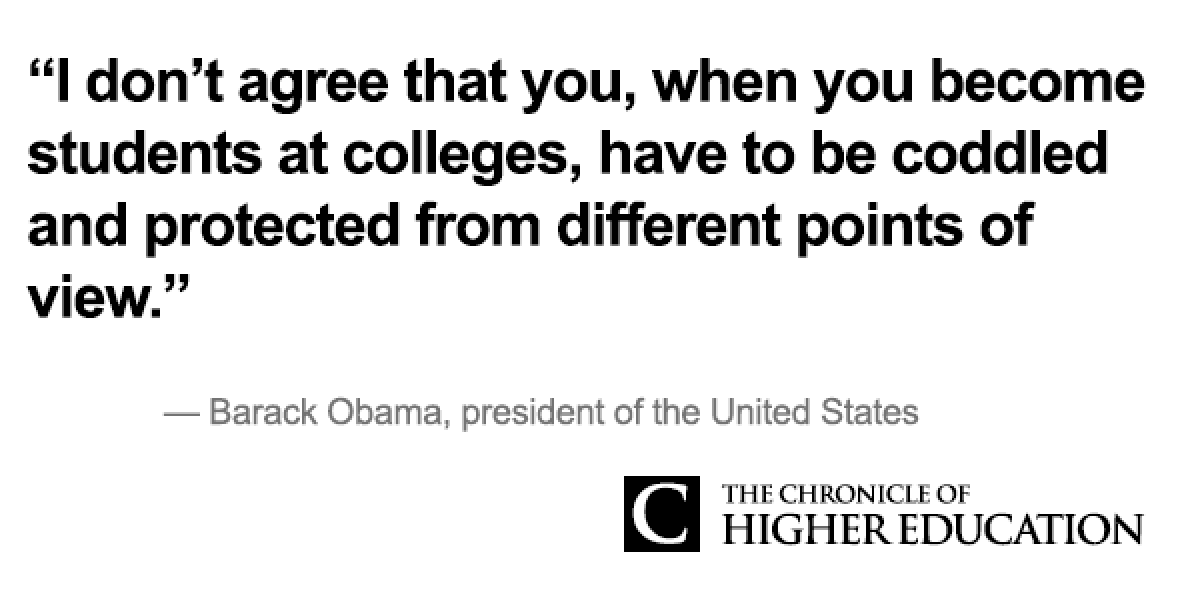
A few days ago, a tweet from the Chronicle of Higher Education included a quote:
Source
Obama's comments included issues like this one that I have blogged about.  He added:
Anybody who comes to speak to you and you disagree with, you should have an argument with them. But you shouldn’t silence them by saying you can’t come because I’m too sensitive to hear what you have to say. That’s not the way we learn, either.
Of course, it generated constructive comments and also brought out the trolls.  Thanks to one of those comments, I looked up the paragraph in an opinion by Justice Brandeis, who was the first Jewish member of the US Supreme Court:
 To courageous, self-reliant men, with confidence in the power of free and fearless reasoning applied through the processes of popular government, no danger flowing from speech can be deemed clear and present unless the incidence of the evil apprehended is so imminent that it may befall before there is opportunity for full discussion. If there be time to expose through discussion the falsehood and fallacies, to avert the evil by the processes of education, the remedy to be applied is more speech, not enforced silence.
That Supreme Court opinion was in 1927!  Almost 90 years ago!!!

Rest assured that this not yet another post on the maniacs who have messed up what could have been an even more enjoyable career in higher education.  This post is about how the higher education "establishment"--especially the student life bureaucracy--is leading students down the path of enforced silence, which is what Obama's comment is about.

Glenn Reynolds has more to say in the context of Obama's comments:
College isn’t supposed to be about having our prejudices reinforced. It’s supposed to be about learning how to think about ideas, and even to change one’s mind in the face of new arguments and evidence.
It’s also about learning to address ideas one doesn’t agree with. As Aristotle said, “It is the mark of an educated mind to be able to entertain a thought without accepting it.” You can’t do that if you’re not willing even to hear unacceptable thoughts.
I suppose such a perspective to engage in discussion of ideas is not always welcomed.  Yet, I continue to seek that kind of an engagement, even in professional matters.  A recent email that I sent to the provost of the university, included the following lines:
 I don't see any evidence out there to convince me otherwise.  To borrow from John Maynard Keynes, I will change my opinion if the facts change.
I am not holding my breath; I know all too well that the provost will not reply.

I am really, really, tempted to include the following in the syllabi for my courses:
Trigger Warning: This course will force you to think!
Oh well!

Monday, September 07, 2015

Burn, baby, burn. Burn a few books!

In a hallway in the building where my office is located, the esteemed ladies and gentlemen who protect themselves with feathers and robes, emblems and degrees have display shelves that are, as I blogged earlier, a monument to faculty, by faculty, for faculty.  What are displayed there, you ask?  Grab a chair; this will take a while! ;)

You, dear reader, like reading.  You have a thirst for understanding.  You perhaps even checked out books from your local library.  But, there is a good chance that you never knew about a genre of books that go straight from the publisher to university libraries where they remain forever without ever being moved even once.  The complimentary copies that the authors receive sometimes end up in display shelves like the one in my office hallway.

Increasingly, academics write books that nobody ever reads.  They are weightier than the journal articles that academics write which nobody ever reads.  Most academic "research," especially outside of the "hard sciences" is not read by anybody it seems.  It was this revelation, even when I was in graduate school decades ago, that further convinced me that I didn't want to waste my time writing stuff that will be nothing but intellectual onanism.

I did write an essay about this, which was read by a few.  It was not a traditional journal article, however.  In that essay, which was published back in October 2001, I wrote about the "aha moment" when I read Chekov's Uncle Vanya (yes, those Russians have been constant companions in my life!):
Would people be disillusioned if they knew that only a few of professors' publications are ever read by more than a handful of other scholars? Would people be disappointed in higher education if they realized that most academics' publications would not sell even for a penny? Would people agree with Uncle Vanya that professors who write but are rarely read and cited are swindlers? Could it be that people already grasp the truth, and that their knowledge is one cause of the decline in the prestige our society accords to faculty members?
It is a racket. A scam.  A huge ripoff.  In The Guardian, an anonymous academic (no, not me--I love to say these in the open!) writes about his personal experience in this book-publishing scam:
A few months ago, an editor from an academic publisher got in touch to ask if I was interested in writing a book for them.
I’ve ignored these requests in the past. I know of too many colleagues who have responded to such invitations, only to see their books disappear on to a university library shelf in a distant corner of the world.
If someone tried to buy said book – I mean, like a real human being – they would have to pay the equivalent of a return ticket to a sunny destination or a month’s child benefit. These books start at around £60, but they can cost double that, or even more.
This time, however, I decided to play along.
 The entire essay (and the comments too) is worth reading, especially if you didn't know about such "scholarly" tomes that end up in the masturbatory display shelves or in the remote corners of university libraries.  The anonymous academic writes there:
These may sound like stories of concern to academics alone. But the problem is this: much of the time that goes into writing these books is made possible through taxpayers’ money. And who buys these books? Well, university libraries – and they, too, are paid for by taxpayers.
 No different a point about taxpayers from what I had written in 2001, right?

You might then wonder, as the rational thinking person that you are, why this ripoff continues even when academics know that most books are never ever read by anybody.  I will remind you about the name for this blog: Every profession is a conspiracy against the laity.