Showing posts with label college football. Show all posts

Thursday, July 09, 2020

A possible lesson from Covid: Sports is sports, and education is education

Two months ago, in May 2020, which seems like two decades in the age of the coronavirus, I wrote in this post:
In response to COVID-19, if higher education is forced to stay focused on its mission and reduce its extravagant expenses on athletics, then it will be one of the few benefits to come out of this global catastrophe.
Ahem.  It could happen.

First was an announcement from the Ivy League, which became the first Division I conference to suspend football for the fall:
The presidents said in a statement that sports could not be played under campus-wide policies that include restrictions on student and staff travel, social distancing requirements and limits on group gatherings.
“With the information available to us today regarding the continued spread of the virus, we simply do not believe we can create and maintain an environment for intercollegiate athletic competition that meets our requirements for safety and acceptable levels of risk,” the statement read.
Of course, Harvard and Yale are not the champs who win the ultimate prize.

And then the Ivy on the west coast, Stanford, had more news:
Stanford will discontinue 11 of our varsity sports programs at the conclusion of the 2020-21 academic year: men’s and women’s fencing, field hockey, lightweight rowing, men’s rowing, co-ed and women’s sailing, squash, synchronized swimming, men’s volleyball and wrestling.
Yes, synchronized swimming.  You read that correctly.

And you know well where you have watched synchronized swimming.  In Hail, Caesar ;)


Ok, you perhaps have not watched that movie.  But, surely in the summer Olympics. Yes?

In the US, universities are the prep schools for wannabe Olympians!  And, Stanford is a leader in that:
USC topped the list at every Summer Games from 1928 through 1964 (tied with Cal in 1948). UCLA’s run went from 1968 through 2004. Stanford had the most in 2008, 2012 and 2016.
Now, it does not mean that Stanford coaches only US athletes for the Olympics.  Nope.   Athletes come from all over the world to "study" at American universities so that they can get access to all kinds of personnel and infrastructure support.  Remember the scene in Bend It Like Beckham where the young women celebrate getting the soccer scholarship to an American university?

This bizarre aspect of American higher education investing gazillions on athletics is truly an awful American Exceptionalism!  I will quote this again:
In no other country’s university system, after all, does sports play anything like the central role it does in American academic life. Men do not go to Oxford to play cricket; the Sorbonne does not field a nationally celebrated soccer team. Even in the most sports-mad countries, sports is sports and education is education. That’s a better system.
Will the novel coronavirus eventually lead American universities to a better system?  I am not holding my breath on that!


Friday, May 01, 2020

Gimme Football, or Gimme Death

There is so much to write about higher education in the context of COVID-19.  A post like this one from two days ago is simply not enough!

Consider this tweet:
How is it possible for a coach of a ball team at a public university to earn 93 million over a decade?  Do people not see the insanity here?

Of course, those are rhetorical questions.  People simple did not care, and do not care.  It is almost as if Americans took up arms in 1775 and yelled, Gimme Football, or Gimme Death!  Football and basketball became the core of the American religion!
For years, top-level programs have bathed in cash. They’ve erected lavish facilities, signed coaches to multimillion-dollar contracts and massively increased athletic staff sizes. ...But the gravy train has hit a snag.
As I wrote in this blog-post on this very date in 2016, "how do we get the American public to understand what education is about?"

Well, judgment day maybe just about round the corner:
In the end it [sic], it probably won’t matter what people believe or want. The cold, hard numbers will have final say. At some point, it might not be economically feasible for most Division I college athletic programs to continue to operate as they have.
That point might be now.
In response to COVID-19, if higher education is forced to stay focused on its mission and reduce its extravagant expenses on athletics, then it will be one of the few benefits to come out of this global catastrophe.

The following is an unedited post from May 1, 2016:
********************************************************


The Sunday edition of the local newspaper had plenty of pages dedicated not to the Syrian crisis, nor to climate change, and not even to the latest antics of the Donald.  The pages, with color photographs galore, were about football at the local university!  Thankfully, I did not throw up all over the paper ;)

It is simply bizarre that everybody, from the president--who was his usual masterful self at the comedy improv last night--down to the high school student complains about the cost of higher education and, yet, there are only a few of us who have been railing against the wasteful allocation of precious dollars towards college football (and basketball too.)  About five years ago, in this post, I quoted Katha Politt who phrased it well:
In no other country’s university system, after all, does sports play anything like the central role it does in American academic life. Men do not go to Oxford to play cricket; the Sorbonne does not field a nationally celebrated soccer team. Even in the most sports-mad countries, sports is sports and education is education. That’s a better system.
Which is why it was refreshing to read about a public university in a neighboring state deciding that it did not want to participate in the athletic arms race.  The president of the University of Idaho, which is the state’s land-grant university, writes that some of the alumni and supporters do not agree with his decision because of the impact on the "institution’s “prestige” and “relevance.”  The university president responds to them:
Success on the football field should complement the prestige and relevance of our academic institution. But football affiliation or performance should not define prestige and relevance. The impact of our institution should define us, as measured by the entire experience for our student body, including our athletes; by academic excellence across the university; by sustained research, scholarly activity and creative success; and by deep engagement with communities and partnerships with industry.
Oh my!  Finally, a university president develops a spine to stand up against the brainwashed who believe that colleges and universities exist in order to entertain them!
Why should my university's decision about what conference to play in matter to anybody outside our institution? Because I think our situation has potential implications for dozens of universities that play big-time college football and says a lot about the state of college athletics.
Exactly!  This is 'yuge', as the guy with short fingers and a huge ego says.
We can and will create an outstanding student-athlete and communitywide experience around our program, a vibrant football culture that is a great front porch for Idaho’s leading, national research university, a draw for future students and a continued source of pride for current students. And we can do it in a way that does not constrain the university and does not distract from our core mission.
"Core mission."  What a quaint idea for a university president to make a decision based on the mission's and higher education's mission!  How do we get other universities and their presidents to understand this simple concept?  More importantly, how do we get the American public to understand what education is about?

Source

Thursday, February 12, 2015

Baptists and Bootleggers rallied at the capitol, which means that you and I are screwed!

A talk by a faculty, originally scheduled for today, was cancelled.  I wonder how many students showed up for a panel discussion on liberal education that was also scheduled for the same time.

All because of a rally at the capitol to seek additional funding for higher education.  The one that I was alerted about a few days ago; remember?
Your salary, your benefits, your retirement, your class size, and your teaching load are all at stake.
I wonder if the comrades waved banners about their salaries, benefits, and retirement.  My guess is that they would not have; what says you? ;)  It makes for bad PR to speak the truth, right?  Am guessing that the rally was all for students.  Because, their hearts bleed for students.  If you believe that, well, I have so many things I can sell you!

But, the comrades are better.  Than one guy here:
UO interim President Scott Coltrane and Portland State University President Wim Wiewel — and many students — wore big green buttons declaring “755.” The figures 755 and 550 were the numbers of the day. Oregon’s seven universities want the Legislature to spend $755 million on them over the next two budget years, up from the $685 million that legislative leadership have proposed and the $594 million in the governor’s budget.
Which one you ask?  The UO interim president, of course.  He is the same guy who just inked the 17.5 million dollar salary, plus fringe benefits, for "the best professor" at his campus.
Universities have only so many sources to look for money — state spending, tuition and donations. State spending and tuition are the bread and butter of college operations, Coltrane said.
If he can pay that kind of salary to a damn football coach, I don't want a nickel of my taxes going to that university.  (Of course, they will engage in accounting gimmicks of how tax dollars are not used to pay the coach.  But, those are gimmicks. Well, that is plain and simple bullshit!)
Coltrane said that, in terms of normal operation, “we really do look to the state and look to tuition. (Donors) are not big on that.”
Oh, my!  The president of the flagship university of the state openly says that donors are not big on normal operations of the university?  And, neither the press nor the politicians care to grill him on that?

So, the comrades and the administrators, who are usually at each others' throats, come together for more money from the state, which reminds me of the Bootleggers and Baptists analogy.  Of course, the comrades are also big time sports enthusiasts and, therefore, they don't care about the 17.5 million dollar waste.

Nothing makes sense anymore.

I am wasting my time and energy thinking and writing about all these.  I wish I were smarter and had gotten aboard the gravy train to retirement :(

I will never learn.  And one of these days I will be kicked out of my job too.  Even then I might not learn the lessons.  Oh well; stupid is as stupid does!

Wednesday, February 11, 2015

The older I get, the more I hate college football

In the market economy, we certainly know how to put a price on anything and everything, irrespective of how much we value that item or the work that a person does.

Take for instance the snow that has been piling up in Boston.  Imagine if the workers whose job it is to clear the roads and streets did not show up for work. Or threatened to go on a strike.  We immediately see the value of the work they do, right?  These are real services they provide, without which quite of bit of life in Boston will come to a standstill.  One would think that they will be highly paid.

source

Or, take elementary school teachers as an example.  We trust them with what pretty much every parent would consider to be the most precious in life--their children.  Teachers who have immense opportunities to shape or ruin their children's futures.   One would think that they will be highly paid.

Instead, you and I and the other billions of humans collectively prefer to pay people for services that we could easily do without.

Take, for instance, the latest news about a college football coach. At the university in the town where I live.
The University of Oregon will pay at least $17.5 million to keep winning football coach Mark Helfrich on his home turf for another five years.
$17.5 million!  Other than this guy who is now spending some of his fortunes on a road trip, I doubt whether any reader of this blog really knows what $17.5 million mean.  I have no freaking clue how to understand that kind of a money.

$17.5 million for coaching a football team.

The market, my friend, knows how to put a price but has no fucking understanding of value!  This is the system that we are stuck with.  Especially when the people can't get enough entertainment in their lives.  To heck with the children in the second grade, but goddammit we shall have entertainment 24x7!

You want more references to understand the distorted and screwed up emphasis on entertainment?
Helfrich’s annual salary is now about six times the UO president’s compensation.
Let me recap.
The coach is for a football team, whose existence is made possible by the university whom the players represent.
Without the university, there will not be students.
Without students, no football team.
The university is there to educate students.
One would think that, therefore, the educator-in-chief, the university president, would be the highest paid officer, right?
But, the coach earns six times what the president is paid!
According to the USA Today coaches salaries database, Helfrich — whose previous annual salary of $2 million ranked 52nd nationally and 10th in the Pac-12 — is now fourth among his Pac-12 counterparts and tied for 22nd nationally with an immediate base-pay raise to $3.15 million.
That, my friend, is how "the market" works!  But, we are stuck with it because the great alternative was infinitely worse.

Keep this in mind the next time you try to convince me, or somebody else, or even yourself, on the glories of the market!

BTW, because a $17.5 million can barely cover the caviar bill:
Some of the fringe benefits in Helfrich’s contract include:
Two courtesy cars.
Membership to the Eugene Country Club and the Downtown Athletic Club.
Use of a skybox suite and 12 tickets to home football games; four tickets to home games of Oregon’s other varsity sports.
Travel for his spouse to regular-season road games and for his spouse and children to postseason games.
Meanwhile, the road cleaning crew in Boston gets ready for another dump on Thursday.  The elementary school teachers spend their own money for supplies.  We pay bullshit jobs quite a bit, and make sure we would attack the real value adders if they asked for an Oliver Twist-more!
in our society, there seems a general rule that, the more obviously one’s work benefits other people, the less one is likely to be paid for it.  Again, an objective measure is hard to find, but one easy way to get a sense is to ask: what would happen were this entire class of people to simply disappear? Say what you like about nurses, garbage collectors, or mechanics, it’s obvious that were they to vanish in a puff of smoke, the results would be immediate and catastrophic. A world without teachers or dock-workers would soon be in trouble, and even one without science fiction writers or ska musicians would clearly be a lesser place. It’s not entirely clear how humanity would suffer were all private equity CEOs, lobbyists, PR researchers, actuaries, telemarketers, bailiffs or legal consultants to similarly vanish.
We are fucked up!

ps: I am sure there will be some who will claim that these are not representative of a free market.  But, hey, that claim is no different from die hard Marxists' claim that the USSR was not practicing true Communism.  So, no point talking about some Utopian version of anything that does not exist on this planet.

Friday, July 20, 2012

The most underpaid in America: college football coaches!

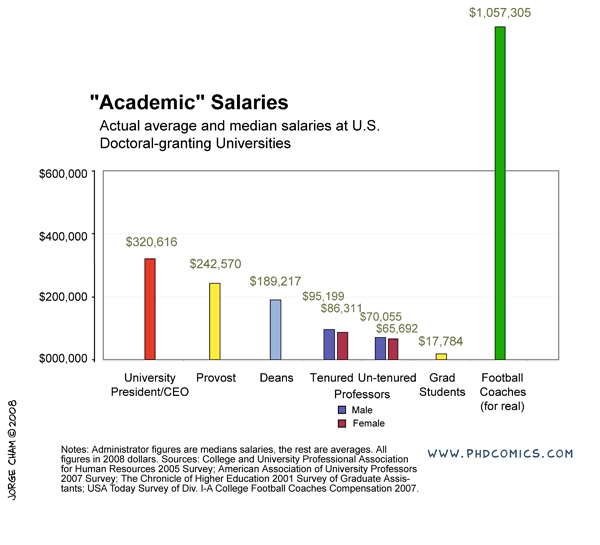
Remember this post from some time ago, which included this graphic?


I wonder how academic salaries with compare with the compensation for football coaches at the University of Oregon, given the following report in the newspaper, today, about the assistants:
 The UO football team’s nine assistant coaches each received a $40,000 raise as of July 1, bringing their guaranteed salaries for 2012 to a combined $2,759,500. That’s a 15 percent raise over what the assistants were slated to make this year, before signing amended contracts in June.
Aren't we glad that we have the welfare of football coaches way up in the priorities!

So, how much do they get?  Am so glad you asked:


Yes, please go ahead and sympathize with them for the ridiculously low compensation!  Because, this is nothing compared to how much the head coach earns :)

Meanwhile, apparently there aren't enough fabulous facilities for football at the university.  Which is why it is important that you keep buying Nike shoes--so that its founder, Phil Knight, can continue to "play" ball the way he likes:
Massive concrete pillars to hold together the $68 million operations center that Nike’s Phil Knight is building for the University of Oregon football program are shooting up next to Autzen Stadium.
The new center will feature two skybridge-linked buildings — on the north and east sides of the Casanova Center — that will rise six stories on top of underground parking. ...
Football coaches will have a private hot tub and steam room, each with a waterproofed video center, next to their locker room, so they can watch games while taking a soak.
Yes, it is extremely urgent that the millionaire coaches are able to watch games while soaking in the hot tub.  We wouldn't want it any other way.  No, sir!

What, you disgusted with this?  Come on!
On the top floor will be a 2,285-square-foot players lounge and deck, the blueprints show. On a lower floor will be an industrial-sized kitchen, 150-seat dining hall and a 50-seat private dining room.
“The cafeteria is for all student athletes,” said Craig Pintens, a UO athletics spokesman. “We’re extremely excited about that. It’s going to help our entire Athletic Department.”
The football players will have 124 climate controlled lockers, each equipped with an iPod dock and charging station. The showers will feature custom shampoo holders painted UO green.
So, now do you feel nauseated enough?  Look away from the screen before you barf.

Do you ever wonder what a horrible life awaits the coaches after they retire?  Poor chaps, right?  I mean, think, for instance, about the plight of former UO football coach, Mike Bellotti--the guy is walking the streets begging for money, as I blogged a while ago. 

Only in America can we ever have a situation where a football team is affiliated with a university!

Can anybody do anything at all about this?  Nah!  Nothing ever.  Definitely do not look for the radical lefty faculty to raise any tough questions--they are some of the most ardent fans of college football and basketball :(

No, I am not an ideological lefty.  Radical, yes, much to the displeasure of those left-leaning faculty too :)


Saturday, May 05, 2012

Ban football. Yes, college and NFL

I can't help but wonder how a student at the University of Oregon will cope when in-state tuition has recently gone up by 9% and the state legislature passed an 11% decrease in funding to the Oregon system overall for 2011 and 2012. Yet thanks to the largess of Nike founder Phil Knight, an academic center costing $41.7 million, twice as expensive in square footage as the toniest condos in Portland, has been built for the University of Oregon football team.
Always important to feed those Ducks.
 Quite a few interesting aspects to the above excerpt from this piece:
  • It is from the Wall Street Journal
  • A friend, "R," in India--yes, India--sent me the link, along with a note "you'll love to read this"
    • The last I might have seen/met this friend in real life? About 35 years ago!
Anyway, we can't seem to write enough analytical and editorial essays about why football ought to be "punted" away from colleges and universities. And then when we think about the atrocious damages it causes, especially to the brain, it becomes all the more urgent to ban the bloody sport.  It needs to fade away the same way that boxing has lost the kind of attraction it once had.

All the more that I am looking forward to the upcoming Intelligence Squared debate on football. 

Strictly from an academic perspective, there is nothing for me to add to what the author writes:
Call me the Grinch. But I would much prefer students going to college to learn and be prepared for the rigors of the new economic order, rather than dumping fees on them to subsidize football programs that, far from enhancing the academic mission instead make a mockery of it.
We ought to keep in mind that this sport-centered academic culture is an uniquely American irrationality.
In no other country’s university system, after all, does sports play anything like the central role it does in American academic life. Men do not go to Oxford to play cricket; the Sorbonne does not field a nationally celebrated soccer team. Even in the most sports-mad countries, sports is sports and education is education. That’s a better system.
But then, ahem, who cares for what I blog/think/write/say, right? :)


Wednesday, November 30, 2011

Even students are getting a tad queasy about college football money :)

It is too bad that the term is coming to an end--just when students are brimming with so much opinions that they want to include me in the conversations.  Three of those conversations were all about college sports--football, to be specific.

A couple of days ago, "D" came to my office to talk about this paper. "BTW, Dr. Khé, you went to USC, right?"

"Yes" I replied.

"So, did you watch the USC-Ducks game?"

He was taken aback when I said I did not.

His reaction made me think that he was expecting me to gloat about USC killing UO's national championship aspirations with that upset victory.  I felt compelled to explain, which I did.

"As a graduate student, I used to follow football.  And later too.  But then the more I seriously started thinking about academics and students, all I could see in the football games was coaches earning millions of dollars.  So, I don't watch anymore."

It seemed like it took "D" by surprise.  When he asked me more on this topic, I asked him if he had seen the latest news about Bellotti and his retirement income.  He hadn't.  So, I pulled up my blog post on it, and it was neat to see the jaw-dropped expression on the Duck fan.

"He gets $41,000 a month in retirement?  But he also works for ESPN!"

I wonder if he will think about this when he watches the Ducks play UCLA for the Pac-12 title.  I hope he does.

Earlier today, I got an email from "S":
In case you did not see this (though I suspect you probably did), here is a news story that I had to read a second time to make sure the numbers were, in fact, monthly salaries.
Yes, she was also referring to the same Bellotti dollar figure news.

To cap it all, as I was walking towards the library, a voice yelling "Dr. Khé" forced me out of my thoughts.  It was "T," who is a football player too.  He, also, engaged me in a short conversation about the money in college sports.

I told "T" that I am all for students playing sports.  "It is the money that bugs me " I told him.  He agreed with me--at least, that is what he said :)

I wish I could bug all those three with this latest update:
At a time when college football programs are coming under fire for lionizing their coaches, Ohio State University hired Urban Meyer and agreed to pay him $4 million a year. That makes Meyer one of the highest paid college football coaches in the country.
Meyer will earn three times more than Ohio State President E. Gordan Gee, the nation’s highest paid university president. On most campuses, coaches top the payroll. And despite the economy, budget cuts and increasing tuition, coach salaries continue to climb.
So, the joke is on whom? Students? Faculty? Taxpayers? All of the above?

Oh, btw, this is the same OSU's president Gee who in a brutally frank manner hoped that the football coach would not fire him; remember that?

As my neighbor often comments, there are only two religions in America now: college football and NFL!

Tuesday, November 22, 2011

We need to spend more on college football ... for retirement options!

$40,000 per month in retirement. WTF, eh!

I wonder if students ever think about how this misplaced priority is screwing them!

The consolation here: at least he wasn't a Paterno! 

Oh, BTW, Click here to get astounded by the gazillions that college coaches earn. 
An analysis by USA TODAY found that in 2006 the average pay for major-college coaches was $950,000. ...
The average compensation in 2011 is $1.47 million, a jump of nearly 55% in six seasons.
In the six conferences with automatic Bowl Championship Series bids, the average salary rose from $1.4 million in 2006 to $2.125 million in 2011. That's a jump of about 52% — meaning salaries at schools in the other five major conferences are going up at roughly the same rate as they are at higher-profile schools.
"The hell with gold," higher education lawyer Sheldon Steinbach says. "I want to buy futures in coaches' contracts."
Critics find it troubling that this rapid rise for coaches comes at a time when instructional spending at many schools has slowed or declined amid economic struggles and shrinking state education budgets.
Ha!  I am willing to sell you a Taj Mahal for about 20 mil :)

Friday, November 18, 2011

Abolish NCAA sports. It has no "business" at universities ...ctd

How about the following point as a follow-up to this previous post?
In no other country’s university system, after all, does sports play anything like the central role it does in American academic life. Men do not go to Oxford to play cricket; the Sorbonne does not field a nationally celebrated soccer team. Even in the most sports-mad countries, sports is sports and education is education. That’s a better system.
Makes perfect sense to me.  Katha Pollitt has a simple bottom-line in that essay:
Cancel the season. Fire everybody. Get real about rape. Grow up.
Yep. 

Sunday, November 13, 2011

College Football: A tale of two universities

It was such a pleasure to read this op-ed by Barry Glassner, who is the president of Lewis and Clark College here in Oregon. He writes about being smitten with Division III sports, and notes:
Division III schools emphasize the experience of the athletes, not the sports-consuming public. The NCAA specifically calls on us to "place special importance on the impact of athletics on the participants rather than on the spectators ... and the general public and its entertainment needs."
...
On D-III playing fields, student-athletes really are student-athletes. At this level, no one gets athletic scholarships. Students compete not for fame and big crowds, not for a shot at a pro career, but purely for the fun, excitement and educational benefits they derive.
This is what most of us imagined colleges and universities to be--environments where there is enough opportunity to engage the body along with the engaging life of the mind.

In contrast, the former president of the university where I teach justified the gazillion dollar expenditures on athletics-related items:
Since moving from NAIA to NCAA Division II in 2000, Western Oregon University has been adjusting to the economic realities of competing at a higher level.More money was needed for scholarships, travel and increased investment in facilities, such as the new Health and Wellness Center opening this year, that will relocate the football team from the Old PE Building on campus.
Perhaps Division III was no good for us?  Even though it is immensely more than good enough for Lewis and Clark?

Friday, October 14, 2011

Stop (taxpayer) funding of college sports

Perhaps the editor has decided against publishing an opinion piece I had emailed him two weeks ago (that and more is in this piece) in which I wrote:

As much as various college sports provide entertainment throughout the academic year, they do not generate employment and incomes with the kind of economic multipliers that, for instance, an Intel has had, and will continue to have, in the Portland metropolitan area and throughout Oregon as well.

So, that was two weeks ago.

Three days ago, the Oregonian's editorial noted "Intel's thundering footfall"

A report this week shows more than 5 percent of all economic activity in Oregon derives from Intel's work here.

The company in 2009 employed more than 15,150 people at average gross salaries of more than $117,000 each, dwarfing the average Washington County private-sector salary of $52,200 and Oregon salary of about $40,000. That $1.8 billion payroll then filtered into retail consumption and home-buying – and yet even it was dwarfed by $5.4 billion the company spent in the same year on utilities and goods and services furnished in good measure by Oregon businesses. The ripple effect runs deep as well as statewide.

Yet, it is not the creation of the next Intel or a new industry leader that our universities focus on. 

Instead, universities, including the one where I work, have come to believe, it would seem so, that it is in their best interests to collect monies from students and taxpayers in order to keep students and taxpayers entertained.

As we begin to experience tighter and tighter budget situations, one would think that we would then begin to cut the college-athletic-entertainment-industry's expenses.  Not so!

Using the problems in Virginia as the point of departure, this column in Reason argues:

perhaps now is the point at which Virginia leaders should give college athletics a long, hard look. Why? Two reasons: (1) They cost a gawdawful lot of money, and (2) they have nothing to do with the purpose of a university.

Well, hey, I wrote in my opinion piece that has not made it to print:

Successful sports teams could certainly help us forget, at least for a few hours, our individual and collective economic insecurities, but they are not going to help us build a secure and prosperous future in a rapidly changing world.

Thursday, October 06, 2011

I care about salaries of college coaches, not of presidents

I am quite happy about the NBA lockout.  Ten guys dripping with sweat and chasing a ball, all to figure out who can slide one through a hoop, for which they get paid a gazillion dollars!  A colossal waste of time and money.

Will the NBA lockout affect local economies?

"There is no way the NBA lockout will have any significant economic consequences," says the University of Alberta’s Brad Humphreys, an economist who has studied the effects of sports work stoppages.

Even worse is all the commercial aspect of college sports.

I am glad that salary raises for administrators at the University of Oregon made the news.  Thanks to all the brouhaha, we were reminded, early on in the football season, that there is a real university campus with buildings and students, associated with a local team called the Ducks.

While college sports grew out of a laudable and valid conviction that a sound mind needs a sound body too, we need to keep in perspective that football and most other college sports have veered far away from that original notion, and have morphed into yet another branch of a sprawling entertainment industry.

The question, especially during these trying times of high unemployment and stalled economic growth, is whether such entertainment delivers long term economic benefits.

This is where I begin to worry about our misplaced loud protests over a few thousand additional dollars spent on academic salaries versus the millions that we so enthusiastically invest in the college sports industry.

To begin with, all entertainment activities are not created equal.  When Hollywood produces movies and television shows, those are products consumed all over the world and not merely in California or the US.  In 2010, for example, films alone earned slightly more than $10.5 billion in the US, but earned almost 32 billion dollars at the global box offices.

These billions are significant exports, and help us tap into the niche in the global marketplace.  The niche that is often bombastically referred to in the academic jargon of “comparative advantage.” 

The corresponding employment generation that results from such a multi-billion dollar export industry is also why it feels like every other waiter in Los Angeles is a Hollywood wannabe. 

However, sports and sporting events are not in this category.  Most economic analysis routinely conclude that the stadiums, arenas and sporting events do not have consistent and long-term economic benefits and multipliers, and could even have unfavorable benefit-cost ratios. Even their local economic significance is in suspect.

College sports, in particular, serve a highly geographically restricted market even within the United States.  Professional sports are slightly better in their global appeal.  For instance, even my mostly sedentary brother is one of those many who follow this sport, even though he lives far away in Australia and has barely visited the US for a week.

Thus, as much as various college sports provide entertainment throughout the academic year, they do not generate employment and incomes with the kind of economic multipliers that, for instance, an Intel has had, and will continue to have, in the Portland metropolitan area and throughout Oregon as well.

The economic success of businesses like Intel, and entertainment activities like movie-making, are highly dependent on the other reason why college sports teams exist in the first place--the academic aspect of the universities.

Research universities push the edges of scientific and technological understanding, and it is no surprise then that a cluster of such institutions in the San Francisco area gave birth to, and continues to nurture, the huge information industry there.  It is, similarly, a symbiotic relationship between Hollywood and the universities in Southern California.  Further, we need to keep in mind that movies are not merely about lights, camera, and action anymore.  One only needs to recall the high tech wizardry of "Avatar" or any of the Pixar releases to be reminded of how technologically advanced and sophisticated this entertainment industry is.

Against such a background, I care not about the half a million dollar compensation for a university president, nor about the million dollar salary of an Intel executive, nor about the ten million dollar payday for a Hollywood actor—though, I would prefer a shuffling of that listing.  However, I am highly concerned about the phenomenal investment in college sports, including the multi-year and multiple-million dollar contracts that have become all too common for coaches in major college sports.

Successful sports teams could certainly help us forget, at least for a few hours, our individual and collective economic insecurities, but they are not going to help us build a secure and prosperous future in a rapidly changing world.

Thursday, September 22, 2011

Quote(s) of the day: on the shameful business of college sports

“I’m not hiding,” Sonny Vaccaro told a closed hearing at the Willard Hotel in Washington, D.C., in 2001. “We want to put our materials on the bodies of your athletes, and the best way to do that is buy your school. Or buy your coach.” ...
“Why,” asked Bryce Jordan, the president emeritus of Penn State, “should a university be an advertising medium for your industry?”
Vaccaro did not blink. “They shouldn’t, sir,” he replied. “You sold your souls, and you’re going to continue selling them. You can be very moral and righteous in asking me that question, sir,” Vaccaro added with irrepressible good cheer, “but there’s not one of you in this room that’s going to turn down any of our money. You’re going to take it. I can only offer it.” 

Simply awful.  Faustian bargains!

This is merely the beginning of a lengthy essay by Taylor Branch on "The Shame of College Sports" (ht.) Read it, pass it around, and talk about the essay even when you are watching the ball game on TV.

Branch writes:

Today, much of the NCAA’s moral authority—indeed much of the justification for its existence—is vested in its claim to protect what it calls the “student-athlete.” The term is meant to conjure the nobility of amateurism, and the precedence of scholarship over athletic endeavor. But the origins of the “student-athlete” lie not in a disinterested ideal but in a sophistic formulation designed, as the sports economist Andrew Zimbalist has written, to help the NCAA in its “fight against workmen’s compensation insurance claims for injured football players.”...
Dale Brown, the retired longtime basketball coach at LSU. “Look at the money we make off predominantly poor black kids,” Brown once reflected. “We’re the whoremasters.”  

A long time ago, at least it feels that way, I used to follow college football, primarily because of the school I attended.  Through the years, I have slowly drifted out of it.  To the level that when a few days ago, on game day, when I ran into two neighbors and one of them asked me whether I was stepping out because it was half-time, the other answered for me, "he doesn't follow football."  I added "That is true. I couldn't care."  A long-running joke about the business of college sports that another neighbor has is this: "Hey, until recently I didn't know that there is a university and a whole lot of buildings associated with the Oregon Ducks."

But, I do care--about the horrible business it has become, and which has led higher education far, far, away from its educational mission. Away from the pursuit of knowledge to the pursuit of dollars on the backs of unpaid labor. So much so that even a small school like the one where I teach wants to emphasize athletics more than it wants to do anything about education and the long-term success of its students.

Branch concludes the essay with these comments:

“Scholarship athletes are already paid,” declared the Knight Commission members, “in the most meaningful way possible: with a free education.” This evasion by prominent educators severed my last reluctant, emotional tie with imposed amateurism. I found it worse than self-serving. It echoes masters who once claimed that heavenly salvation would outweigh earthly injustice to slaves. In the era when our college sports first arose, colonial powers were turning the whole world upside down to define their own interests as all-inclusive and benevolent. Just so, the NCAA calls it heinous exploitation to pay college athletes a fair portion of what they earn.

All the more the reasons for me to stay away from college football.  Oh, and when I made a comment about how even my faculty colleagues, who normally spew socialist language, are college-sports crazy and even organize betting pools during March Madness, well, they went ballistic.  These "leftist" rabid fans of college sports who defend the big business of college sports are the most hypocritical of them all.  They are so ready to criticize, for instance, Wal-Mart, yet are so religiously faithful to college sports.  Compared to the mercenary tyrannies in NCAA sports, Wal-Mart is a gazillion times better as an employer and as a provider of goods and services.

Saturday, March 05, 2011

Problems with football--both college and NFL

It simply baffles me that we are unable to do anything about the ultra-wasteful NCAA football, despite any number of reports and analyses that detail how much it screws up higher education and, more importantly, the life of the typical students who are increasingly finding it difficult to stay financially afloat.

Last night, PBS' "Need to Know" had a pretty good segment on NCAA football, by focusing its lens on Ohio University. 
In New York, the governor is proposing a 10 percent reduction in funding to higher education. In Michigan, it’s 15 percent. And in California, almost 16 percent. Last month, the president of the University of Nevada Las Vegas announced that the school may end up in the academic equivalent of bankruptcy. Tenured faculty could lose jobs, and entire departments may be closed.
But on many campuses, spending on intercollegiate athletics is growing, even though most sports programs run up millions of dollars a year in annual deficits. That means that while public universities are cutting in classrooms, your tuition dollars — and maybe even your tax dollars — are subsidizing big-time college sports.
It is depressing that we can have any number of such reports, but NCAA sports, especially football, apparently has even better a teflon coating that Reagan had during his presidency.  Simply depressing.

It is atrocious that faculty in higher education overtly, and covertly, encourage and support, and quite maniacally, college sports.  I fault even more the liberal faculty who waste not a second in complaining about fat cats in the corporate world and even in college administration and rally up students in these causes.  Quite a contrast it is when it comes to NCAA football and sports--not only do they rarely critique them, they are big time fans to boot (pun intended!)  And then their misguided defense of sports as an avenue to providing access to higher education for the poor and minority students.  Gimme a break!

As I have blogged before, even the small little university where I work is not exempt from wasteful spending on football. Of course, the "radical" faculty and their union has not bothered even to whimper about this.

One of the many reasons why higher education is academically adrift!

As if this sucking of blood money from students and taxpayers is not enough, the NFL goes even further.  Let us leave it to Reason to explain how the NFL owners, players, and the feds are all taking us for a very expensive ride:


I feel terrible for the youth in this country who don't realize how much they are being screwed :(

Wednesday, February 23, 2011

Multimillion dollar boondoggles in higher education. Even at my campus :(

The ponzi scheme of higher education is so awfully evident everywhere.

Consider for example the brand new structure that is almost ready for use: The Health and Wellness Center.
The recreation center is a 45,000 square feet addition to the Old P.E. building, comprising of a two-court gymnasium with an elevated track, two racquetball courts, three multipurpose rooms, a 2,400 square foot strength and weight training area, a 3,600 square feet cardiovascular area, a 40 foot high by 40 feet wide rock climbing wall, new locker rooms for the recreation facility and the existing pool and gymnasium, an equipment check-out area, and office space for campus recreation.
Yes, including the uber-fad: rock climbing wall!  Cool, we have arrived!  The mission of the university is accomplished.  I am sure the authors who listed my university as one of the best returns on investment will be really happy.

I refer to this building as our Taj Mahal!

Over the summer, the university president offered reasons for why such an investment is needed:
Since moving from NAIA to NCAA Division II in 2000, Western Oregon University has been adjusting to the economic realities of competing at a higher level.More money was needed for scholarships, travel and increased investment in facilities, such as the new Health and Wellness Center opening this year, that will relocate the football team from the Old PE Building on campus.
Well, wouldn't it have made economic sense then to have stayed in NAIA and, therefore, not have incurred all these additional expenses?  Taxpayer and tuition monies could have been put to better use if we had stayed back in NAIA, right?

But, of course, the mark of a real university is a football team, and a good chunk of real estate in this new multimillion dollar "Taj Mahal" will be for that reason:
The football program will have approximately 8,000 square feet of new space. The new space will provide the program the ability to house all of the coaches centrally, a more comprehensive training room, improved locker room, laundry and equipment storage space.
Awesome.  I could not have imagined a better scenario.

Now, here is the awful thing--we are not alone.  It is pretty much the same story, a tragic one, in higher education.  Here is an excerpt from an article in the Chronicle of Higher Education:
Last fall, Winona State University opened a 90,000-square-foot Integrated Wellness Complex on the east side of the campus, just across the street from the university's performing-arts center. The complex houses classroom and administrative space along with aerobics facilities, weight rooms, a glass atrium, and a 200-meter indoor track. Massage therapy is available on Tuesdays, Wednesdays, and Thursdays. It cost $19.5-million to build.
The eerie similarity is not simply with the construction of a wellness center.  There is more:
The institution was founded in 1858 as a "normal school," the 19th-century term for colleges that trained public-school teachers. In 1921 it began offering bachelor's degrees and was renamed Winona State Teachers College. As the population of college-going students exploded after World War II, Minnesota converted Winona into a bigger, broader institution, dubbing it Winona State College in 1957. The final upgrade came in 1975, in a trade of "College" for "University."
There are more than 150 former normal schools like Winona, educating hundreds of thousands of students nationwide. Nearly all followed an identical progression: They became teachers colleges, then dropped the "teachers," then dropped the "college."
Yes, pretty much the same story here too.

The author has a note of warning:
a higher-education system in which teachers colleges are building $20-million gymnasiums is a system that is dangerously vulnerable to forces gathering outside the city walls.
Yes, they will come for us with torch and pitchforks.

Friday, January 14, 2011

College sports and the lack of critical thinking

So, finally, the BCS national championship hoopla is over.  But, we have very little time to get some badly needed rest--the March Madness will soon be upon us!  Of course, I have already landed in hot water for comments about that one :)

The following letter to the editor shows how messed up our thinking has become when it comes to sports:
Shame on Oregonians who rooted for Auburn
I didn't attend OSU or U of O and neither did my kids. My husband was a professor at Western.
Monday night I was in front of the TV rooting for the Ducks not because I'm fond of green and yellow or I like Eugene better than Corvallis, but because that team was representing Oregon where, except for a trip to the Rose Bowl (which is no small feat), nothing amazing has happened sports-wise since the Blazers won the championship in the '70s.
For those who were spitefully cheering for Auburn, shame on you. This was about more than a game. This was the Whos from Whoville shouting, "We are here! We are here!"
We were people rallying together for a team who was representing our beautiful state. Yeah, it would have been great if they had won, but they played with great sportsmanship, class and heart right down to the last second.
They showed the country that we Oregonians are about more than just spotted owls and rust. I'm a proud webfooted hillbilly.
Says a lot about critical thinking, which is supposedly the reason why universities exist in the first place.  Increasingly though, it appears that universities are merely the convenient physical framework to offer non-stop sports and keep people entertained.

One commenter in the newspaper's site has this to offer:
Out of 120 kids on their roster about 25 come from Oregon High Schools.

Almost 50 come from California.

Another 45 come from other states.

Tell me again why I should be ashamed of myself for not rooting for them?
:)

Friday, November 12, 2010

The football-academic complex called "universities"

A few years ago, there were all kinds of speculations that USC's star player, Reggie Bush, was being paid in violation of NCAA rules.  It was a collective shrug of sorts as a response to such news.
Now, yet another star player and payments--this time at Auburn. 
The fact that an amateur athlete allegedly soliciting a six-figure payment to secure his services barely raises the eyebrows of college football lifers only serves to highlight how insulated the college athletics echo chamber has become. 
A lot lies beneath these high profile news items.  A lot more mundane stuff that goes unreported. Like courses with diluted standards to keep players within the passing grades ...

Oh well. A few decades ago, the president of the University of California system summarized what it means to keep a university going: parking for faculty, sex for students, and football wins for alumni.  So, no point challenging the football-academic complex, which will find ways around any number of Congressional investigations.

Monday, October 04, 2010

Good and bad news for USC Trojans :)

Good news:
A 13-year trademark battle ends as the high court lets stand a ruling that the 'SC' logo belongs to the University of Southern California, not the University of South Carolina.
Bad news:
32-31 defeat that knocked the Trojans out of the AP top 25, the first time since 2001 that they've been unranked during the regular season.
Best news:
USC football sucks.  
Why is this good news?  As I noted earlier, the last time Trojan football tanked, the academic reputation went up, and kept going up.  I am all for USC to keep climbing up the academic ladder :)

Monday, July 19, 2010

More on athletics v. academics

Outsourced:
Recent renovations have reaffirmed the Big House as the Biggest House: Michigan Stadium's official capacity this fall will be a whopping 109,901, moving it ahead of Penn State as the largest sporting edifice in America. (It even says so on Wikipedia.) That's $226 million well-spent.
For some context, 109,901 people will make the stadium the seventh-largest city in Michigan on game days (passing up Ann Arbor, ironically), and is significantly larger than the largest city in Delaware, Maine, Montana, New Hampshire or North Dakota. The combined populations of the largest cities in West Virginia (Charleston, 53,421) and Wyoming (Cheyenne, 55,362) couldn't quite fill it. (And yes, 109,901 is nearly the exact population of the U.S. Virgin Islands at last estimate.)

Tuesday, September 29, 2009

College athletics: A modest proposal

leaders in the Obama administration and in Congress have expressed a strong interest in education reform and claim to appreciate the crucial role of education in maintaining the United States' leading role in the world. They have also demonstrated sensitivity to outrageous executive compensation.
I bet you the reader agree with this factual statement in an op-ed by Benjamin Rosenberg in the Christian Science Monitor (HT.) 
So, what does Rosenberg want?  Take it away:

The academic fate of our universities is more important than who is crowned national college football champion, so perhaps Congress can spare some time for academics.
Here's how: Most colleges and universities receive federal research grants or subsidies that help them to advance academic and intellectual interests, and to achieve socially beneficial goals. But if the institutions themselves do not value those goals, they should not receive taxpayers' money to advance the goals.
And thus Congress should prevent federal research grants or subsidies from being awarded to any educational institution that pays greater compensation on average to its football or basketball coaches than it does on average to its tenured faculty members.
Any school that pays more to those who coach big time sports than to those who teach students academic subjects shows its true colors. No taxpayer should pay money to such a school.