Showing posts with label unemployment. Show all posts

Sunday, January 03, 2021

We fiddle ... while Rome burns :(

Consider this:

If a corporate executive gets a $100,000 bonus for steering a company through a difficult year, while four $25,000-per-year restaurant workers lose their jobs entirely, the net effect on total compensation is zero — even though in human terms a great deal of pain has been incurred.

This is a perfect illustration of why quantitative literacy is important in this modern world.  I wonder what percentage of a literate population, heck even college graduates, will be able to make sense of that simple arithmetic.  I have done my part to educate a few and will perhaps have one final opportunity in the fall term that could even be in the real world, after all the virtual interactions.

It is also a perfect illustration of why we need an economic restructuring, and create a new political economy that will address the human suffering when four workers lose their jobs.

So ... "Even as millions of individuals faced great financial hardship this year, Americans in the aggregate were building savings at a startling rate."

One of the most counter-intuitive outcomes ever, right, when we might have expected differently in what has been awful loss of jobs?

The trend became clear six months into the pandemic.  Professionals and high-income earners didn't seem to lose jobs.  Low-wage workers bore the brunt of the recession.

Back in September, as the university's president and his aides were developing the plans for firing quite a few tenured and adjunct faculty and staff because of the Covid-induced budgetary crisis, I wrote to the president: "It certainly is surprising that Oregon’s current budget won't be significantly affected by COVID-19, and that projections into the future might not be that dark after all."  Always evidence-based in my arguments, I attached the report from the Oregon Office of Economic Analysis.

It has been more than three months since I sent that email; I am yet to hear from the president or his aides.  I suppose I will soon hear from them!

Will there be protection for low-wage workers not only through this pandemic but--and more importantly--even after conditions return to "normal"?

I worry it won't.

Why this pessimism?

For the same reason that I have offered many times.  Like here:

I will once again say the same thing: We work out the solutions politically.  Unlike a challenge of how to get humans to the moon and back, or how to vaccinate people, these are not technical issues.  In a democracy, we are, therefore, at the mercy of voters and politicians.

At the mercy of politicians.  Picture in your mind the likes of mItch mcConnell, tEd cRuz, mArco rUbio, kEvin mcCarthy, ... who will do everything that they can to stop doing anything good for the less-privileged, even as they kiss rich white asses!

Wednesday, July 15, 2020

The thread of life

Unlike in most other countries, American universities are big time landlords, who earn a lot of income from their developed real estate.

Country clubs Dorms, conference rooms, auditoriums, climbing walls, etc.  Some also own huge basketball and football venues for educational purposes entertainment.

All those expensive real estate developments have been idle since last March.  And there is very little chance that significant usage of those facilities will begin even in early 2021.

The landlords universities are in distress, and the Republican Uncle Sam couldn't care less.

My own university also has to reckon with the tightening dollars and cents.  As a result, some of us faculty, too, are bound to lose our jobs before the next academic year ends.

Should that day arrive way earlier than I had planned, I will be thankful that I was/am one of the lucky few on this planet who was able to pursue for quite a length of time what truly interested me.  Thanks to some dumb luck!

In my agitated and angst-filled younger years, I was convinced that somewhere out there were the answers to the big questions.  Somewhere.

Even in the first couple of years of graduate school, I was confident that I was on the way to the answers.

I did find the answer.  It was a non-answer of sorts.  Life is full of wonderful ambiguity.  That's it.  We have to live through it all.

Every once in a while I succumb to the temptation of the answer, but almost always I just want to breathe and drink and eat this ambiguity.  I love those damn wicked problems!

No wonder then that even with the courses I teach, I seem to always force students to think about the possible multiple interpretations. I even tell them sometimes not to expect a definitive answer from me.  I suppose my pedagogical goal, if I were to think about it that way, is that if I can help students understand that life itself is all about dealing with ambiguity, then they will know how to deal with specific instances whatever they might be.

A concern and worry that I have is that despite the high levels of literacy that humanity has achieved, there appears to be a decreasing interest in exploring and understanding and discussing the ambiguity that life is.  Perhaps that is also a reason why 63 million responded with a favorable vote when a demagogue yelled and screamed that he alone had all the answers,

The following poem by Oregon's own William Stafford is how I want to end this note on the delightful pursuit of ambiguity:
The Way It Is
There’s a thread you follow. It goes among
things that change. But it doesn’t change.
People wonder about what you are pursuing.
You have to explain about the thread.
But it is hard for others to see.
While you hold it you can’t get lost.
Tragedies happen; people get hurt
or die; and you suffer and get old.
Nothing you do can stop time’s unfolding.
You don’t ever let go of the thread.

Saturday, August 12, 2017

The new normal is ... a new slavery?

In graduate school, a professor casually commented that unemployment is a privilege of the rich.  The poor simply cannot afford to be unemployed, he argued.

I had a question right then but did not ask.  I was way too self-conscious about my accent and I worried that I might have to repeat the question in order to be understood.  I stayed quiet.  The question was this: What if people are working but the returns are next to nothing.  You know, like slaves.  Like hamsters running forever but not really going anywhere.

That question continues to bug me.  I have forever worried that the automation means that owners of those digital abstractions will get to hoard way more money than ever before.  This, in a political environment that discourages redistribution of income, will lead to workers working away but ...

The NY Times adds more to my worries, via this chart:

Soure

So ...
The message is straightforward. Only a few decades ago, the middle class and the poor weren’t just receiving healthy raises. Their take-home pay was rising even more rapidly, in percentage terms, than the pay of the rich.
...
In recent decades, by contrast, only very affluent families — those in roughly the top 1/40th of the income distribution — have received such large raises. Yes, the upper-middle class has done better than the middle class or the poor, but the huge gaps are between the super-rich and everyone else.
Megan McArdle, who is by no means left of the political-economic center, writes about the slow wage growth even though unemployment rate is at a low, low 4.3 percent:
So this slow wage growth may simply be what the labor market now looks like. Earlier eras of tight labor markets produced big increases in wages, but those increases were matched by rising worker productivity. Today, employers striving for productivity may replace the worker altogether, either by outsourcing to a lower-wage country or by giving that job to a machine.
So the biggest mystery is not why U.S. wage growth seems stuck even as unemployment falls. The biggest mystery is how we’re going to adjust our economy, our culture and our politics to the new normal.
It is no mystery to me--I have forever blogged about the need for a new social contract.  If only this president and his minions, and the likes of Paul Ryan and Mitch McConnell who manically advocate tax-cuts for the wealthy, will honestly respond to these real trends, instead of inventing their own alternative facts!

Saturday, August 27, 2016

Good news for a change. Nah, I am kidding!

One of my favorite ideas that I try to convey to students in the introductory class is this: Everything economic that we can think of is a mere 200 year story, which means that we humans are not mentally ready for the kinds of changes that keep coming our way.  We are not biologically wired for such a pace.

I suppose it might be difficult for a 20-year old to really, really appreciate what I tell them.  If I were a 20-year old, I might not even taken classes that I offer ;)

Consider the simple aspect of having children.  Even a hundred years ago, people did not give much thought to having children.  People had kids, was a simple fact.  If they didn't, it was either because they were biologically incapable--and cultures had lots of awful words to ridicule them--or they had opted for a life without sex.  But, life has changed, and changed rapidly.  Now people choose to have no kids, or only one child, or maybe two.  

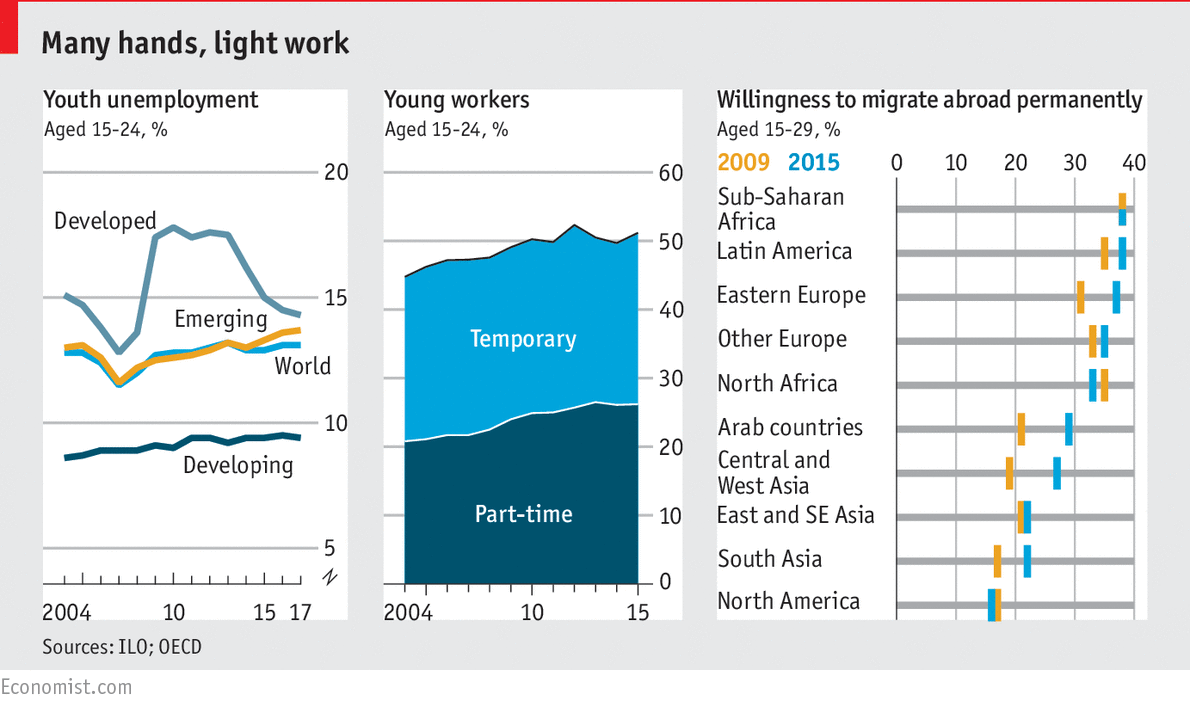
The pace of such dramatic changes leads us to being completely unprepared as "the largest youth population in human history is coming of age in a steady, unstoppable wave."
societies across the Middle East, Africa, and South Asia are experiencing youth booms of staggering proportions: More than half of Egypt’s labor force is younger than age 30. Half of Nigeria’s population of 167 million is between the ages of 15 and 34. In Afghanistan, Angola, Chad, East Timor, Niger, Somalia, and Uganda, more than two-thirds of the population is under the age of 25.
How well these young people transition to adulthood — and how well their governments integrate them economically, politically, and socially — will influence whether their countries thrive or implode. Surging populations of young people will have the power to drive political and social norms, influence what modes of governance will be adopted and the role women will play in society, and embrace or discredit extremist idesituatiologies.
Idle young men, in particular, filled with testosterone, can easily slip into various kinds of anti-social and destructive activities--more so if they do not have war or sex as outlets for the testosterone.  
As we ponder our path forward, we should consider that the developing world’s youth boom coincides with four interrelated global trends: an information revolution, the largest movement of refugees and displaced people in recorded history, growing urbanization that will concentrate youth in cities, and a rise in terrorism and extremist ideologies. Together these trends will spread not just people but, more importantly, their ideas at an unprecedented rate. They will raise and dash expectations pushing and pulling young people toward and away from their hometowns and homelands, toward and away from their desired futures. They will make young people around the globe aware of how others are living, the divisions within their societies, and how those they identify with are treated by governments, security forces, and other groups. This knowledge can inspire or anger. It can commit people to elevating their families and communities — or make them lash out against them.
I tell ya, Major Buzzkill General Malaise is always ready to brighten your day ;)

This situation sets up the probability for more migration:
As poor countries prosper and their young become more educated, they are more likely to migrate. It explains in part why India has the largest diaspora in the world: In 2015, 16 million Indians were living outside India, double the number in 2000.
The youth will be highly motivated to move if employment prospects are dim in their home countries:


"Given the bleak future faced by many, it is little surprise that 40% of 15-29-year-olds in Africa, eastern Europe and Latin America would countenance a permanent move abroad."
I hope the political leaders are paying attention.  Oh, wait, of course they don't pay attention.  Which means, I get yet another opportunity to utter a favorite phrase of mine: we are screwed! ;)

Sunday, January 11, 2015

I have a job for you ... but, don't ask about the pay!

Faculty working their ways from kindergarten through their doctorates and then continuing on with teaching, without having had meaningful employment in the real world, is not unusual at all.  Sure, they might have held summer jobs somewhere, but that's it.  

Such a model works well for research universities.  But, those are not the places where the majority of the youth go for higher education--it is teaching universities like mine that serve the vast numbers.  And most students at the teaching universities have questions about jobs after graduation.  Ok, not all but the responsible ones do.  It is an increasingly difficult challenge for me to give them rosy, optimistic answers, given my understanding of the situation now and what I understand will be the immediate future.

Though the argumentative Indian who lives in India disagrees with me, I don't buy into his optimism for the future and how labor is overpriced in the US, especially when I read pieces like this on employment and wages:
the labor force's 273,000 person decline was part of the reason the unemployment rate fell from 5.8 to 5.6 percent. The participation rate, which shows how many people have a job or are looking for one, ticked down to 62.7 percent, tying a 38-year low. That's not so good.
You know what else isn't good? Wages.
Yes, of course, I am continuing from where I left off yesterday.  Well, this thread is not anything new in this blog anyway!
it's a little surprising that wages have stayed stagnant despite declining unemployment. That's not supposed to happen, not when joblessness is under 6 percent. Indeed, unemployment is already near the semi-mythical "natural rate" of, the Fed guesses, 5.2 to 5.5 percent, where inflation is supposed to start accelerating. The idea is that workers have more bargaining power when there aren't as many people out of work—so they can demand higher wages, which turns into higher prices.
That this hasn't happened tells us that there's still a decent amount of slack in the labor market. And that's clear enough if you look at how, even now, millions of people can only find part-time jobs when they want full-time ones, or have been looking for work for six months or longer.
So, yes, there is employment.  But, employment that is not full-time work. And even that full-time being vast under-employment with low wages.

Generating jobs even as the economy shows robust growth is getting to be difficult:
The problem is that most industries formed since 2000—electronic auctions, Internet news publishers, social-networking sites, and video- and audio-streaming services, all of which appeared in official industry classifications for the first time in 2010—employ far fewer people than earlier computer-based industries. Whereas in 2013 IBM and Dell employed 431,212 and 108,800 workers, respectively, Facebook employed only 8,348 as of last September.
The bottom-line is:
the digitization of the economy may have far-reaching implications for the future of growth and employment.
So, what can be done?
there is much that governments can do to prevent stagnation. They can redistribute income to those with a higher propensity to spend. They can also support investment into industries that might foster more new jobs than digital technologies—jobs for solar photovoltaic installers, wind energy engineers, biofuels production managers and transportation planners.
Finally, while digital technologies may create fewer jobs than previous innovations, they also substantially reduce the amount of money it takes to start a new digital business—and that will make it possible for more people to become entrepreneurs. Indeed, self-employment might become the new normal. The challenge for economic policy is to create an environment that rewards and encourages more entrepreneurial risk taking. A basic guaranteed income, for instance, would help by capping the downside to entrepreneurial failure while boosting spending and combating inequality.
Wait, wait, wait--that laundry list requires a great deal of responsible discussions in the political space, especially at the federal level, in the House, in the Senate, and at the White House.  Which means ... yep, the youth are screwed!

So ... as a faculty at a teaching university, if I present such a view to students, then I will be turning students away from my classes.  Perhaps I should simply tell them that my job is to only teach a few courses and that their jobs is not my concern.  Nope, that ain't me.  Which means ... yep, I am screwed!

Tuesday, April 08, 2014

Ah to be young. But, jobless? Ouch!

For years I have been expressing concern about an issue on which I have always hoped that I am dead wrong.  But, I am yet to come across substantive evidence that will convince me that I am worried for no reason at all.

It is about (un)employment, especially among the youth.  

I am returning to the topic only after a few days because, well, I have come across way too many commentaries related to this and none is encouraging.

First, the numbers:
While the overall unemployment rate stayed at 6.7 percent, the unemployment rate for 20-24 year-olds increased from 11.9 percent to in February to 12.2 percent in March. For workers ages 16 to 24, the unemployment rate rose marginally to from 14.4 percent in February 14.5 percent.
That is bad. Very, very bad.

Of course, even two years ago, I blogged about the jobless youth:


The only consolation is, well, at least we are not Greece!

No work.  Not many are hiring.

One of the commentators I often read, Tyler Cowen, lays out the bottom-line early in his opinion piece:
technologically related unemployment — or, even worse, the phenomenon of people falling out of the labor force altogether because of technology — may prove a tougher problem this time around.
Hey, this is exactly what I have been worried about for some time now. This digital, information, revolution is not like the Industrial Revolution that unleashed plenty of new jobs that never existed before in order to manufacture products that never existed before.  This time it is different. Mighty different.

Cowen adds:
A new paper by Alan B. Krueger, Judd Cramer and David Cho of Princeton has documented that the nation now appears to have a permanent class of long-term unemployed, who probably can’t be helped much by monetary and fiscal policy. It’s not right to describe these people as “thrown out of work by machines,” because the causes involve complex interactions of technology, education and market demand. Still, many people are finding this new world of work harder to navigate.
Sometimes, the problem in labor markets takes the form of underemployment rather than outright joblessness. Many people, especially the young, end up with part-time and temporary service jobs — or perhaps a combination of them.
It is an employment world that is unlike, well, as Cowen puts it: 
what we’re facing isn’t your grandfather’s unemployment problem. It does have something to do with modern technology, and it will be with us for some time.
The technological revolution underway, along with the rapid globalization, will make it harder and harder to generate meaningful jobs that pay the middle class wages we have come to expect in America. 

I worry that the youth are not being told all these.  Instead, they are presented with nothing but rosy scenarios.  Follow your passion, they are advised.  A wonderful advice, yes, but only if the youth are also warned that the route they choose might lead them to an economic dead-end.

When I engage students about the possible economic misfortunes that lie ahead, they readily dismiss my concerns because, after all, they do not hear anything like my warning sirens from others.  Maybe I should start talking with them about the pots of gold where the rainbows end, about unicorns, and, perhaps, about Santa Claus too!

Eat More
by Joe Corrie

’Eat more fruit!’ the slogans say,
’ More fish, more beef, more bread!’
But I’m on Unemployment pay
My third year now, and wed.

And so I wonder when I’ll see
The slogan when I pass,
The only one that would suit me, -
’ Eat More Bloody Grass!’

Sunday, November 17, 2013

Give a man free fish ... soon he will be bored and will choose to pay for them!

With the exception of people like my super-wealthy gazillionaire friend (haha!) or people like me who, according to my neighbor, never works for a living, most dread the weekdays and look forward to weekends and holidays.

We are a strange species.  We bring all the trouble of work on ourselves and then dream about not having to work.  We chain ourselves, put a lock on it and throw the key away, and then dream of being free at least every two days of the week.

Some of the most free people that I have met in my life were in the villages like Pattamadai and Sengottai.  Seemingly in sync with the hot temperature conditions, where even a brisk walk can tire a person, there was a whole lot of doing nothing.  We folks from urban and industrial areas, having been used to working in order to earn the privilege of sitting around twice a week, found that kind of a rustic life to be dull and boring and even labeled them as lazy for not doing anything.

The older I get, the less clear I am on who is really free.

We dream of a future, made possible by science and technology, when we won't have to work at all.  Robots that clean the homes. Ready-to-consume nutritious food in full and plenty (even if it will be in unrecognizable forms to us in the present.)  A future in which even firefighters won't have any work because nothing synthetic will ever crash or burn thanks to advancements in science and technology.   In that future, we will have all the free time in the world.  Or, at least, more weekends than weekdays.

When students complain about income inequality and unemployment--about which I have been worried for a long time, evidenced by the number of blog posts on those issues--sometimes I have thrown at them a different scenario to think about.  What if those profiting from automation and outsourcing agreed to guarantee every American an income that will be at higher-than-poverty level, and they can work and earn more if they chose to?  The possibility of a permanent vacation. Every day will be a weekend. A Sengottai/Pattamadai life of minimal work.

Almost always, students do not like that idea.  Sitting around, or even standing around in a museum, doing nothing can become a bore.  Fishing is fun when you do it once in a while, but not day in day out.  Or, given the Puritanical streak, some see the virtue in working as a means of not merely earning a livelihood but about feeling good about oneself and the path to god and heaven.

Of course, that guaranteed minimum income is only a thought experiment.  But, I am not the only one who has been thinking like that--I am merely an insignificant person to think about it ;)
A simple idea for eliminating poverty is garnering greater attention in recent weeks: automatically have the government give every adult a basic income.
The Atlantic's Matt Bruenig and Elizabeth Stoker brought up the idea a few weeks ago when they contemplated cutting poverty in half, and Annie Lowrey revisited it in today's issue of the New York Times Magazine.
See, there are quite a few of us loons out there!

Why are we even constructing such thought experiments?  Because it makes things simpler at one level:
a minimum income would also allow us to eliminate every government benefit as well. Get rid of SNAP, TANF, housing vouchers, the Earned Income tax credit and many others. Get rid of them all. A 2012 Congressional Research Service report found that the federal government spends approximately $750 billion each year on benefits for low-income Americans and that rises to a clean trillion when you factor in state programs. Eliminate all of those and the net figure comes out to $1.2 trillion needed to pay for a universal basic income, still a hefty sum.
Interesting, right?  I tell ya, this thinking business is a whole lot of entertainment that no amount of sports and movies can equal ;)

Of course, with a Congress that can't even figure out what color toilet paper to use, such radical approaches will forever remain only as thought experiments.  It does not mean that there are no attempts--they are not here in the US though!
Switzerland’s citizens will soon vote on a referendum to give each working-age adult in Switzerland a basic income of $2,800 (2,500 francs) per month.
We are living in some interesting times.

A couple of miles outside Sengottai

Thursday, September 05, 2013

Give me your tired, your poor, your huddled masses: Youth unemployment!

The contractual work year in the academic world in which I live begins in ten days.  As I put together the syllabi for the courses that I am scheduled to teach, I, yet again, struggle with how to make the subject appeal to the students who, for the most part, treat any of the courses as merely a hurdle to get past on the way to the "real world" in which they will attempt to realize that fabled American Dream.

I am tempted to contact a few students from the past years and inquire about their economic status, and whether their faith in the college degree as the passport to economic success has worked out.  But, I am afraid the responses will be along the lines of unemployment and underemployment, with very few excitedly reporting about their jobs.  There is a good chance that some of them tried to escape the bleak employment scenario by going to graduate school, which I would have warned them not to if I had any say at all.

It is one tough world out there for the young and the restless.
Consider the bleak prospects of young people entering the workforce today: the portion of people aged twenty to twenty-four who have jobs has fallen from 72.2 percent in 2000 to just 61.5 percent. Meanwhile, if we adjust for inflation, the median earnings of men between the ages of sixteen and twenty-four working full-time has fallen by nearly 30 percent since 1973. For women, the median has fallen by 17 percent. As Andy Sum, an economist at Northeastern University who has studied youth unemployment for many years, has shown, if you are out of work or underemployed during those initial years of adulthood, chances are far higher you will be unemployed, poor, or dependent on welfare later on.
  If that is the American story, how are the youth in the rest of the world?


At least we are not Spain will not be a consolation to that eager-beaver 22-year old feeling discouraged about the job market.  It could get worse for them in the long haul:
people who begin their careers without work are likely to have lower wages and greater odds of future joblessness than those who don’t. A wage penalty of up to 20%, lasting for around 20 years, is common. The scarring seems to worsen fast with the length of joblessness and is handed down to the next generation, too.
The overall ageing of the population might blunt this effect by increasing demand for labour. But Japan’s youth joblessness, which surged after its financial crisis in the early 1990s, has stayed high despite a fast fall in the overall workforce. A large class of hikikomori live with their parents, rarely leaving home and withdrawn from the workforce.
So, at least we are not Japan. Yet.

There is something happening here. What it is ain't exactly clear.

Thus, I will try, in some twisted Groundhog Day ways, to attempt to convey to students that higher education and college degree were never meant to be any kind of a professional guild and that the whole system is not necessarily geared towards maximizing the students' welfare.

I will warn them not to listen to faculty, in particular.  I will then follow it up with how the advice from a faculty not to listen to faculty is a neat paradox.  If they listened to that advice, then they will not listen to anything I say the rest of the term.  On the other hand, if they did not pay attention to that advice, then they have lost out on that observation.

The good thing is that most will not be interested even in that humorous take because higher education has done a fantastic job of making sure that the mission is not about critical thinking anymore.

No, I am not being cranky!

Wednesday, June 05, 2013

Unemployment and the moral(e) issue

As it gets closer to the time that I will have to start grading, a different kind of a reflex reaction kicks in--I seek compensation in terms of reading and blogging, perhaps to replenish the dead grey cells.

Plus, there are incredibly serious problems all around--way more than the "poor me" problems.  Isn't that right, friend? ;)

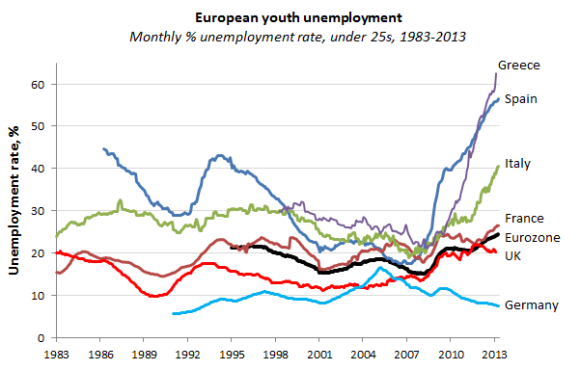
Consider, for instance, this scary, scary chart:


I am flummoxed trying to imagine a 50% unemployment.  And more!  What the what?

We are not talking about some uneducated, illiterate youth simply idling away.  It is an educated population that is jobless.  I have lucked out in life--no firsthand experience of unemployment.  Even the teetotaler me would have picked up the bottle if I had been a young man looking at a decimated job market.

All I have to do is look at the graduating students in order to get a sense of how the dim prospects of jobs begins to affect their morale.  Robert Shiller writes about this morale dimension of high unemployment rates:
The high unemployment that we have today in Europe, the United States, and elsewhere is a tragedy, not just because of the aggregate output loss that it entails, but also because of the personal and emotional cost to the unemployed of not being a part of working society.
I recall that in the movie, Up in the Air, the number one issue that the unemployed workers said they faced was this: waking up in the morning and wondering what they were going to do that day.  Being jobless, when it is not by design or choice, is one morale crusher, I would imagine.
Unemployment is a product of capitalism: People who are no longer needed are simply made redundant. On the traditional family farm, there was no unemployment.
Indeed.  But then, of course, we do not want to return to all of us working on our respective forty acres either.  So, ... ?
For morale, we need a social compact that finds a purpose for everyone, a way to show oneself to be part of society by being a worker of some sort.
And for that we need fiscal stimulus—ideally, the debt-friendly stimulus that raises taxes and expenditures equally. The increased tax burden for all who are employed is analogous to the reduced hours in work-sharing.
But, if tax increases are not politically expedient, policymakers should proceed with old-fashioned deficit spending. The important thing is to achieve any fiscal stimulus that boosts job creation and puts the unemployed back to work.
Hmmm ... that's where we will get stuck in an endless debate, won't we?

Here in the US, though the unemployment rate is in the single-digit now, unlike the horror stories in the Euro countries, but the aggregate number doesn't tell the whole story of discouraged and underemployed workers.  One thing I am convinced about: there is no way we can escape from re-writing the social contract that ties together the government, taxpayers, businesses, and consumers.  Finally, even Germany is waking up to this reality.  Let's see what they come up with.

I don't care how the contract is re-written because, like with anything else, not everybody will be happy with a new contract anyway.  But, what pisses me off is how atrociously Congress has been ignoring all these issues.  It is pathetic.

It is the Congress members who ought to be forced into unemployment, not the young, bright-eyed and bushy-tailed educated youth.

(From the old country ...)

Monday, May 27, 2013

Facebook is not a panacea for the world's problems. It is causing more!

I am no Luddite.  But, there is not a day that goes by without me wondering and worrying that this latest version of the Industrial Revolution might really be the job killer that Luddites have always feared.

Reading George Packer's essay in the New Yorker and this piece on Jaron Lanier in Salon add to my worries.  Here is what Packer writes in his blog, in a follow-up to his original piece:
life inside Silicon Valley can be a paradise (for its winners) of opportunity and reward. Meanwhile, life outside falls further and further behind. All those highly paid engineers, with their generous stock options and unheard-of buying power, aren’t making the Valley more equal—they’re making it less so. 
As one who grew up in the Valley, and as one who attended high school there, Packer is an insider as much as he is an outsider now.  He writes in his essay about the economic reality of the Silicon Valley, which is home to more than fifty billionaires and thousands of millionaires:
There are also record numbers of poor people, and the past two years have seen a twenty-per-cent rise in homelessness, largely because of the soaring cost of housing.  After decades in which the country has become less and less equal, Silicon Valley is one of the most unequal places in America.
This new and improved Digitial Economy, version 2.0, as opposed to the internet boom of the 1990s, is changing the economic and geographic landscape that doesn't seem to be getting the attention it deserves.  

Lanier arrives at this with an example:
“Here’s a current example of the challenge we face,” he writes in the book’s prelude: “At the height of its power, the photography company Kodak employed more than 140,000 people and was worth $28 billion. They even invented the first digital camera. But today Kodak is bankrupt, and the new face of digital photography has become Instagram. When Instagram was sold to Facebook for a billion dollars in 2012, it employed only 13 people. Where did all those jobs disappear? And what happened to the wealth that all those middle-class jobs created?”
Of course, this is not the first time I am blogging about such worries.  In a recent one, I referred to Twitter, which, Packer writes, threatened to move its headquarters away from San Francisco, and I wrote then:
At $10 billion, the company might still be quite a bargain.  For that kind of a valuation, Twitter employs only about 1,600 people.  And even that draws a remark as to whether that many are really needed!
@bill_gross What are 800 developers doing all day at a product that hardly changes? 800? That's like 80 Instagram-like Start-Ups. #wondering— Michael Hirschbrich (@MicHirschbrich) March 8, 2013
Jobs aren't being created directly, nor as multipliers, as they were in the past revolutions.  The result shows up geographically, as Packer notes:
San Francisco is becoming a city without a middle class.  Pockets of intense poverty, in districts like the Fillmore and the Tenderloin, are increasingly isolated within the general rise of exorbitantly priced housing.  
Lanier adds:
We kind of made a bargain, a social contract, in the 20th century that even if jobs were pleasant people could still get paid for them. Because otherwise we would have had a massive unemployment. And so to my mind, the right question to ask is, why are we abandoning that bargain that worked so well?
At Ramesh's post on Apple's tax avoidance, even when disagreeing, we both agreed on the need to rewrite the social contract.  A contract with the people on so many different levels.

Packer asks:
Why has a revolution that is supposed to be as historically important as the industrial revolution coincided with a period of broader economic decline?  I posed the question in one form or another to every one I talked to in the Bay Area. ... Few of them had given the topic much consideration.
Evgeny Morozov wants us to rethink technology:
a) What problems are worth tackling, and what problems look like problems only because we have technologies for solving them? 
b) Which of the “real” problems should be solved by governments and which ones by technology companies—given that it's technology companies that run much of this new infrastructure? What do we lose or gain once it's private technology companies that are tackling problems like climate change or obesity? 
c) If we do decide that, at least for some problems, technological fixes are OK and that private companies can be allowed to help with solving them, what should be the principles and values guiding problem-solving? Tech companies, like all companies, have a bias toward efficiency, but efficiency may not be the value to optimize in attempts to solve important public problems.
Yes, it is not merely about efficiency.  There is a lot more to humanity and life than efficiency alone.  How do we rethink technology in terms of the problems of the day and those we can anticipate in the future?  Why aren't we doing technology along those lines?  Packer's response is this:
It suddenly occurred to me that the hottest start-ups are solving all the problems of being twenty years old, with cash on hand, because that's who thinks them up.
That might be a tad too harsh, and exaggerated, yes.  But, there is also a great deal of truth in it.  Packer quotes a young entrepreneur on his colleagues:
"They actually think that Facebook is going to be the panacea for many of the world's problems.  It isn't cynicism--it's arrogance and ignorance."
If there is any student or one younger than me reading all these: you have been warned.
(Full disclosure: I use Facebook and Twitter, and use them a lot.)

Monday, April 08, 2013

Shed no tears over the demise of America's manufacturing. It ain't dead!

I should know by now, after all these years, that political leaders rarely say anything really meaningful in public.  Thus, I should ignore all their chest-thumping on bringing manufacturing back to America, and how we should be worried over manufacturing's decline.

But, I am human and I err--I point my ears towards them and then have an urge to puke!

What decline in manufacturing?

Robert Samuelson tackles this issue of "manufacturing isn't dead":
The transition from factory to office has raised living standards, curbed pollution and reduced the number of grueling, often-monotonous jobs. Yet this largely beneficial transformation suffers in the popular imagination. The vast “service sector,” which now dominates the economy, is seen as inferior, low-paying and even frivolous because it produces nothing tangible.
Exactly!

I bet the same people who talk with fondness for the manufacturing that is "dead" would have been the kinds of people lamenting about the "death of agriculture" a hundred years ago, without understanding that these are positive changes as a result of higher and higher productivity.

Of course, I have traveled this path before.  For instance, in May 2009, I quoted Robert Reich, who was President Clinton's Labor Secretary:
Any job that's even slightly routine is disappearing from the U.S. But this doesn't mean we are left with fewer jobs. It means only that we have fewer routine jobs, including traditional manufacturing. When the U.S. economy gets back on track, many routine jobs won't be returning--but new jobs will take their place. A quarter of all Americans now work in jobs that weren't listed in the Census Bureau's occupation codes in 1967. Technophobes, neo-Luddites and anti-globalists be warned: You're on the wrong side of history. You see only the loss of old jobs. You're overlooking all the new ones.
Yet, this logical explanation always loses to a faith that manufacturing is the key to boost up an otherwise anemic economic recovery?  Samuelson again:
Almost everyone seems to yearn for a manufacturing renaissance. This would, the reasoning goes, solve many problems. It would kick-start the sluggish recovery. By providing well-paying jobs, especially for semi-skilled men, it would strengthen the middle class. By restoring a heritage of “making things,” it would reduce U.S. trade deficits and re-establish our global economic pre-eminence. No doubt, millions of Americans endorse this appealing vision. It’s make-believe.
The mirage appeals to politicians and the regular folk alike, it seems.  And these people make it seem that we don't manufacture any damn thing anymore; again, I blogged about this in 2011:
America still makes a ton of stuff, and we make more of it now than ever before in history.’’ In fact, Americans manufactured more goods in 2009 than the Japanese, Germans, British, and Italians — combined. American manufacturing output hits a new high almost every year. US industries are powerhouses of production: Measured in constant dollars, America’s manufacturing output today is more than double what it was in the early 1970s.
Samuelson also reminds readers about the same thing:
[In 2010] U.S. manufacturing production of nearly $1.8 trillion was the largest in the world; it was slightly ahead of China’s, about two-thirds higher than Japan’s and nearly triple Germany’s. China may now be No. 1, but the U.S. remains a manufacturing powerhouse. In 2011, near-record output was 72 percent more than in 1990 and six times greater than in 1950. Recall some American-made products: commercial jets, earth-moving equipment, gas turbines.
Logic and evidence don't capture people's attention and imagination as make-believe scenarios do.  No wonder religions continue to flourish!  But, I digress :)

As I noted in a post two years ago, The Onion, which is awesome at satirizing any issue, took on this notion of American manufacturing is dead.  And, of course, there is that other problem of defining what manufacturing is!

Anyway, as Samuelson concludes:
It’s a mistake to romanticize manufacturing and disparage services, portraying them as separate economic realms in competition with each other.
Finally, as Reason noted a while ago, to focus on Made in America is pretty darn stupid!


Saturday, April 06, 2013

The economy avoids graduating students as if they are Kafka's bugs!


Students seem to avoid coming to my office in the spring term much more than how they dodge me in fall and winter, because now is when I am even more interested in their answers to my second favorite question, “so, what is your plan for the summer?” My favorite question being “so, what do you plan to do after graduating?”

If experience has taught me anything, then I should have quit asking these questions a long time ago—most students would rather that I don’t trouble them about these issues. Yet, I do.

Almost always, it seems like what students want is to simply get the heck out of the university. Thus, every single instance that I engage in this back‐and‐forth with them, I am reminded of Franz Kafka’s short story, The Departure. It is a short one‐paragraph story that I often share with students:

I ordered my horse to be brought from the stables. The servant did not understand my orders. So I went to the stables myself, saddled my horse, and mounted. In the distance I heard the sound of a trumpet, and I asked the servant what it meant. He knew nothing and had heard nothing. At the gate he stopped me and asked: "Where is the master going?" "I don't know," I said, "just out of here, just out of here. Out of here, nothing else, it's the only way I can reach my goal." "So you know your goal?" he asked. "Yes," I replied, "I've just told you. Out of here‐‐that's my goal."

If at all, I feel a greater urgency to share that Kafka story with students because of the brutal economic conditions that await them even as they express their goal to get “just out of here.” The Great Recession might have ended with an anemic recovery, but is not by any means a healthy economy that awaits the twenty‐somethings. Even internship opportunities, which were in the past guaranteed pathways to careers, seem to have dried up.

Over the past couple of years, in my visits to the stores and during the travels, I have met fresh out of college youth working at the checkout counters of grocery stores, washing cars at rental places, and waiting tables. None of these require a college degree, of course. But, they work at these places because it beats not working at all. One—a recent psychology grad—expressed her worry when she said, “I don’t want to become a lifer here.”

Most students, once past their bubbly freshman years, are well aware of this reality, which is also why they wish that I would not ask them about their plans. The non‐traditional students who are back in school because of the atrocious employment conditions outside always seem to walk around with worried expressions.  One can easily sympathize with students, therefore, for their immediate goal to simply get away from me!

Worry is what we should all do. According to a recent report from the Center for College Affordability and Productivity, about 48 percent of the employed college graduates are in jobs that do not require a four‐year degree. More than a third of those occupations did not even need anything more than a high school diploma. Such a high level of underemployment after a significant amount of time and money invested in a college degree should worry us all.

Just when I thought I had seen everything regarding underemployment of college graduates, I felt horrified to read about a McDonald's in Winchendon, Massachusetts, advertising for a full time cashier position that was restricted to college graduates. Even worse, it required one to two years of prior experience!

My comforting words to students are nearly Polyannaish—“at least you are not in Spain where the youth unemployment is more than fifty percent.” I tell them that even Ivy League graduates are having a tough time, hoping that misery loves privileged company.

The real tragedy is that despite all these trends over the years, we seem to be continuing with college degree as a cure for all, with more determination than ever. Within this collegiate education, it disappoints and depresses me that it is possible for students to have never read anything by Kafka when, ironically, the economy treats new graduates as if they have become the monstrous bugs that Kafka wrote about inThe Metamorphosis.

John Maynard Keynes famously said “When the facts change, I change my mind. What do you do, sir?”  Have we not accumulated enough facts for us to change our minds regarding this expensive approach to getting every kid to college?


A tired, but a much younger me,
by my office door in 2002

Sunday, March 10, 2013

We create robots. Will robots create jobs for us?

One of the real hassles that I face in my profession is this: to be able to always convey to the youth a sense of  optimism.  "The world is your oyster" is what I tell them, yes, but only after warning them about the dangers that lie ahead.  That Shakespearean phrase follows weeks of a bottom-line of a different kind, not always explicitly stated though: "you are screwed!"

I have been giving them such a message, perhaps in contrast to the overly optimistic hype from most of the rest of my university colleagues, because over the past few years I have been seriously worried that we might be able to generate fewer productive jobs that will promise a prosperous middle class life.  I have been guided by an intuitive understanding that this brave new world of computers is very, very different from the two centuries of industrial revolution.  MIT economist Erik Brynjolfsson phrases it well for me:
[There's] no economic law that says everyone has to benefit equally from increased productivity. It’s entirely possible that some people benefit a lot more than others or that some people are made worse off.
Exactly!

Brynjolfsson explains how computerization is that kind of a game-changer, as opposed to other machines of the past:
It’s called superstar-biased technical change, or talent-biased technical change. If somebody has talent or luck in creating something that people want, that thing can be replicated with digital technology much more easily than in the past. Think of someone who writes software. You can take that talent or luck and replicate it a million times. And while the person who created it does very, very well, the people who previously did that job are less important or maybe not even necessary. The example that I gave in my TED talk was TurboTax. You’ve got a human tax preparer being replaced by a $39 piece of software. It makes the pie bigger in the sense that you create more value with less effort, but most of that value goes to a very small group of people.
Or, my favorite example: Twitter.  At $10 billion, the company might still be quite a bargain.  For that kind of a valuation, Twitter employs only about 1,600 people.  And even that draws a remark as to whether that many are really needed!
Back to Brynjolfsson:
And technological change is affecting more industries simultaneously. Threshing changed agriculture, but digital technology is affecting pretty much every industry. Finally, these technologies are just qualitatively different. The ability to digitize makes it more valuable to be a creator and less valuable to be someone who carries out instructions or replicates stuff. You don’t need to pay people to handcraft each copy of TurboTax. That’s different than, say, an automobile—at least for the time being.
In a way, we were just kind of lucky during the 19th and 20th centuries that technology evolved in a way that helped people at the middle of the income distribution. There’s no economic law that says technology has to work that way.
If any student were to read his book, or listen to him, it will be very difficult not to walk away with a feeling, "damn, I am screwed!"

I am not sure what kind of new industries we will come up with so that people displaced by automation will have more productive things to do.  And whether these new industries will generate enough employment, or whether it will be a case of newer industries generating fewer and fewer jobs.  These are very uncertain times, that much I know for sure.

This Bloomberg editorial echoes my sentiments:
Robots are evoking some deep economic anxiety these days. They’re routinely mastering human tasks -- driving cars, trading securities, diagnosing diseases - - that not long ago appeared permanently beyond their capabilities. And as automated technology advances at an exponential rate, more and more jobs, in more and more fields, will be done by intelligent machines in the very near future.
This transition will involve some scary trade-offs. Growth and productivity will probably accelerate, and low-cost, high- quality goods will probably proliferate. But many workers will find their skills obsolete and their ability to compete diminished. Unemployment could be exacerbated. Wage stagnation for the middle class could persist or worsen. And inequality seems likely to widen.
For all that, we remain optimistic. Throughout history, technology -- from the steam engine to electricity to the computer -- has upended old ways of doing business and created useful and edifying new fields of human endeavor. This long cycle of creative destruction suggests, however, that the robot revolution will be a time of significant turmoil. And that the more we prepare for it now, the better off we’ll be. 
Yes, the more we prepare for it now, the better off we will be.  But, what kind of a preparation might be the best way?

Sometimes I wish I could simply go to the classroom, yap, and come home feeling secure that my paycheck will be automatically deposited in my account, at least for now until robots replace me.  If only I didn't worry about students and their futures!
Statue of Liberty, summer 2000

Wednesday, July 25, 2012

The economy hits youth worst as they lose the generational war

The Wall Street Journal provides an interesting commentary on how the persistently high unemployment and underemployment among the youth compares with the stagflation the baby-boomers experienced.  In 1982, unemployment rate for the youth was a high 17%.  But,
the situation quickly improved. By the end of 1983, the unemployment rate for 18-24 year-olds had dropped below 14%, and it didn’t get back above that mark until the latest recession. This time around, joblessness among young people remains over 15% three years after the recovery began. ...
Many of today’s 20-somethings, therefore, are stuck on the sidelines for what should be — and what was for their parents — their most important years for wage growth and career development. The effects are likely to be long-lasting. A study by Yale economist Lisa Kahn found that “the labor market consequences of graduating from college in a bad economy are large, negative and persistent.”
From my reading of the situation, it is not getting better, and does not seem like it will get better any time soon.  It is awful!

On top of everything else, most of these youth are also graduating with debts from their years at colleges and universities, which then seems more and more the case that we are looking at a horrible prospect of, what Matt Yglesias referred to as, the indentured servant generation :(

Yet, we refuse to talk about one of the significant ways in which the youth are losing because the game is rigged against them: the enormous diversion of precious resources to the much older generations.
Social Security and Medicare were created in a very different America as a response to very different circumstances. The old-age entitlements were designed to alleviate problems related to an economy still in transition from rural agriculture to urban manufacturing and post-industrial services. Private pensions and retirement savings were relative rarities, and the communitarian dream of multiple generations living under the same roof—invoked as an ideal by some of the very people, such as Joe Biden and Hillary Clinton, who champion old-age entitlements as a means of “independence” for seniors—was a routine necessity.
That’s no longer the case in a country where most retirees are wealthier than the younger people paying for their benefits. According to 2010 data (the latest available) from the Bureau of Labor Statistic’s Consumer Expenditure Data, the typical American 65 or older had a pretax income of about $41,000 and annual expenses of about $37,000, including $4,800 for all medical care costs they bear under the current regime (insurance, prescription drugs, doctor’s visits, etc.). Those who can pay for their needs out of their own pockets should do so
Perhaps only James Bond can help; can he?


Tuesday, June 19, 2012

Obama's re-election hinges on unemployment and the Euro crisis?

What is the connection?
for all the attention on Syria, Egypt and other areas of conflict, the most important crisis for Mr. Obama remains the European economy because of its impact at home. “Europe’s weakness is likely to blow back on Obama’s efforts this fall — just at the wrong time,” she said. “He’ll have to run harder because of it.” 
Spending time and energy on the Euro crisis and the rest of the world's problems mean that Obama will have that much lesser to devote to his own re-election campaign. 

Kind of crazy, therefore, that Obama's re-election might heavily depend on the strict European mom, Angela Merkel:
The clouds in Europe are casting a shadow over the American economy, which, in turn, is casting a shadow over the president’s re-election effort. And Obama administration aides admit there is little they can do except cajole European leaders not to let a big Spanish bank go under or to let austerity measures drag the continent’s economy down even. German Chancellor Angela Merkel, who has her hand on the German finance spigot, has more far more control over this piece of the president’s re-election puzzle than does the president himself.
Meanwhile, the tension over the Euro crisis is building up, which then makes the political theatre that much more unscripted;
[European Commission President José Manuel] Barroso, asked by a Canadian reporter why North Americans should help pay for Europe's crisis, broke from his conciliatory tone and effectively blamed U.S. practices for causing the European troubles.
"This crisis was not originated in Europe," Mr. Barroso said. "This crisis was originated in North America. Many in our financial sector were contaminated by unorthodox practices from some sectors of the financial market."
Nice try, Mr. Barroso, to blame the US for the crisis across the Atlantic.  His cause would be better served if he had instead said that we are all in it together.

All these get way too complicated for Obama because not everything is well on the domestic front.  For one, it is only a matter of days before the Supreme Court rules on Obamacare. 

And then there is that huge problem that remains awfully stubborn: unemployment
The year-over-year increase in part-timers not working at their capacity is troubling in light of the decline in unemployment. The unemployment decline may paint a rosier jobs picture than is warranted and would mask the persistent fact that 18% of U.S. workers are having difficulty finding the level of employment they would like. Anyone who works at least an hour per week for pay is considered "employed," by both the BLS and Gallup.
For example, if a worker spends two hours a week mowing lawns and gets paid, that person is counted as employed, even if he or she wants to work full time. So while fewer people are unemployed, many are still not working at their desired capacity, as measured by Gallup's underemployment rate.
The following cartoon from the Economist captures well how unemployment influences Obama's re-election:

Tuesday, June 05, 2012

If only the jobs news was enjoyable as news about Facebook shares!

If only the news was always as good as this one: Facebook shares are trading at $25.79 as I type this!  Couldn't make my schadenfreude better :)  I am enjoying this because, well, why the heck not!  Even if commentaries like this point out that the schadenfreude is bizarre!

In contrast to the fun with news about FB, I am not thrilled with the latest jobs report that has shocked the markets into a tumble as investors worried about the economic outlook.  Oil is down to $82, which was hard to imagine three months ago.  

This is not good news for any incumbent President.  On the other hand, it appears that the incumbent chief executive of the state of Wisconsin might survive the recall effort, which will add to the President's political woes as the summer campaign begins to heat up.  

Take it away, Jon Stewart, and let us watch that wonderful game-show called "Polish that turd" :)

Saturday, May 26, 2012

Go to college when there is nothing else to do?

The old joke about teaching was a simple one liner: if you can't, teach.  Increasingly, the reality seems to be that if you can't, go to college--for students, too!

Enrollment at the university where I teach has been on the rise for a few years, as the following chart shows.


Given that most students way prefer not to be in classes, and given that we have not experienced any remarkable demographic surges that could drive this growth, the most obvious cause that we can hypothesize is, well, the Great Recession and the high levels of unemployment, right?

The following chart shows the unemployment rates in Oregon and the US over the same time period:


A remarkable level of similarity in how the lines in both the charts seem to go and up and down at the same time, eh!

It might also seem that even though unemployment rates have started dipping downwards, enrollment numbers seem to be climbing to new highs. But, notice that the growth rate itself has slowed--the changing slope of the enrollment line.  Further, we can hypothesize that there will be a lag between economic conditions improving and enrollment correspondingly changing.

But, there could be a "hidden" reason that is even more possible as the agent for continued enrollment growth: the unemployment rate we look at is the "U-3" number and not the U-6 number.  This distinction is important because U-6 counts:
Total unemployed, plus all persons marginally attached to the labor force, plus total employed part time for economic reasons, as a percent of the civilian labor force plus all persons marginally attached to the labor force
U-6 is, after all, a much higher rate than is U-3.  In April 2012, for instance, while the official unemployment rate was 8.1%, U-6 was a whopping 14.5%

The chart below compares U-3 and U-6 numbers for Oregon:

 Huge differences, right?

At a 16.9% U-6 rate:
“It will take more than normal job growth to get folks back to work,” said Nick Beleiciks, a state employment economist, at Tuesday’s release of the latest unemployment numbers.
 Thus, enrollment continues to grow?  But, will students be really interested in learning for the sole purpose of knowing?

The graduate student enrollment has already turned into a negative growth, which could reinforce the notion that graduate school was nothing but a place to kill time until one found productive employment?

Of course, with enrollment reflecting horrible economic conditions, the student debt situation, too, is kind of a natural corollary, isn't it?  When we begin to look at the entire higher education industry along these lines, the worthlessness of a graduate degree and, to some extent, the wasted time and effort in getting an undergraduate degree, become all the more troubling. 

All these mean one more aspect: if and when the employment and economic conditions really take off for the better, then it could bring back enrollment down to what I would consider as more realistic levels. Universities like mine seem to operate as if this growth will happen forever, and they might be in for a rude awakening?

Sunday, May 13, 2012

What don't qualify as gifts on Mother's Day?

I woke up recalling, for whatever reasons that only a shrink can uncover, the phenomenally funny Calvin and Hobbes strip about Calvin getting his mother a card.  Breakfast, coffee, and newspaper, and everything else later, I tracked down that strip with a simple Google search:


Calvin, of course, gave his mother quite some hell; I tracked down one of those too:


 Ah, Calvin!

As freaked out Calvin's mother was, well, contemporary mothers are getting used to the freaking reality conveyed in the cartoon below:


Monday, April 23, 2012

One in two college graduates jobless or underemployed

If only people would listen to me, is what I end up thinking whenever I read reports like this one.

It is awful to read about real life examples like "Kelman Edwards Jr., 24, of Murfreesboro, Tenn., who is waiting to see the returns on his college education":
After earning a biology degree last May, the only job he could find was as a construction worker for five months before he quit to focus on finding a job in his academic field. He applied for positions in laboratories but was told they were looking for people with specialized certifications.

"I thought that me having a biology degree was a gold ticket for me getting into places, but every other job wants you to have previous history in the field," he said. Edwards, who has about $5,500 in student debt, recently met with a career counselor at Middle Tennessee State University. The counselor's main advice: Pursue further education.

"Everyone is always telling you, 'Go to college,'" Edwards said. "But when you graduate, it's kind of an empty cliff."
 What can be worse?  Well, ...
Edwards, who has about $5,500 in student debt, recently met with a career counselor at Middle Tennessee State University. The counselor's main advice: Pursue further education.
 But, of course!  Yes, more education.  I shall refrain from using my favorite metaphor here to describe how the education industry is run :(

Meanwhile, the presumed GOP presidential candidate has his own answer to why college grads are in this awful mess.  What is this guy smoking?  I bet his solution is more tax cuts!

Sunday, April 01, 2012

Consumer spending fuels growth. Really? Think again!

So, ... buried in the news report about a rise in consumer spending is this:
Most consumers spent more of what they earned and saved less. The saving rate dropped to 3.7% of after-tax income in February. That was the lowest level since August 2009. It had averaged 4.7% for all of last year.
Americans are also taking on more debt. Consumer borrowing increased from November through January by the most in a decade for a three-month stretch. Yet the increases were driven almost entirely by auto and student loans. Credit card debt decreased in January and remains well below pre-recession levels.
Dales cautioned that at some point, consumers won't be able to draw further on their savings. Further job gains are needed to boost consumers' income.
Hmmm ... job growth has stagnated, and consumers are taking on more debt.  Isn't this a cause for worry, rather than for the stock market to go up?  What the heck am I missing in this picture?

There is at least the old reliable Robert Reich who makes sure that I am not coming across as an idiot:
Fed Chief Ben Bernanke – who doesn’t have to face voters on Election Day – says the U.S. economy needs to grow faster if it’s to produce enough jobs to bring down unemployment. But he leaves out the critical point.
We can’t possibly grow faster if the vast majority of Americans, who are still losing ground, don’t have the money to buy more of the things American workers produce. There’s no way spending by the richest 10 percent – the only ones gaining ground – will be enough to get the economy out of first gear.
Even more worrisome is this: the increase in student loan debt.  Students are borrowing more and more hoping that a college degree will transform into well-paying jobs.  But, that, too, is a mirage on many fronts for most students!  The trillion-dollar debt means:
as more people go to college and assume bigger loans for education, they may take longer than previous generations to hit key milestones such as buying a house or getting married, U.S. officials and economists say. It could take longer for heavily indebted graduates to save money for a down payment on a home, or it could be harder for them to qualify for mortgages.
Rohit Chopra, student-loan ombudsman for the Consumer Financial Protection Bureau, said student debt could ultimately slow the recovery of the housing market. "First-time home-buyers are a substantial part of the housing market," Mr. Chopra said in a speech at the banking conference in Austin. "Instead of saving for a down payment, these borrowers are sending big payments every month."
Student debt is a burden not just for recent college graduates in their 20s but also parents, who often co-sign their children's student loans, as well as midcareer professionals who opted to go back to school during the sluggish recovery.
 Meanwhile, we are well on our way to think of debt as from the cradle to the grave:
new research shows a trend that’s even more troubling than Americans going into hock to pay for a college degree: Apparently, some parents are taking out five-figure loans to finance private school tuition for K-12 kids. Yes, student loans even to pay for kindergarten.