Showing posts with label income inequality. Show all posts

Wednesday, August 19, 2020

Income inequality and the artist

The old belief was that college was the ticket to the fabled middle class American Dream. In this belief system, a four-year college diploma was worth more than a diploma from a two-year college.

The belief did deliver for a while. A great number attended state schools in their regions, graduated, and went on to own homes in the suburbs.

Over the recent years, however, this belief system has stopped delivering.

Students are now graduating with debts that are beyond most of our imaginations, and graduates often end up in jobs for which it seems like college degrees are not required and the pay isn't great either. The dream of owning a home and having kids gets postponed. Sometimes the dreams are simply that.

It is not that the "value" of college education itself has changed. The political economy in the world outside the college campus has changed--radically. Average wages have not kept up with the times. There is plenty of money being made by a few, while the vast middle struggles. Increasingly, the money is made by a very few in the rapidly shape-shifting technology world, while the rest are left behind in the silicon dust.

In this structure, it has become a nightmare for those who majored in order to become writers, musicians, dancers, painters, playwrights, and anything else in such a grouping. In The Death of the Artist, William Deresiewicz writes in detail about how conditions have changed in this group that interprets the human condition through their creative talents. And it is one hell of a depressing portrayal of how much things have changed for the worse.

Based on an intuitive understanding derived from reading about the changing trends, I have cautioned many students, like "R" who was passionate about a career in dancing, about the kinds of red flags that Deresiewicz writes about. I have always warned them about the myth of the "starving artist" who does "not sell out." Of course, money is not everything, but the lack of money is one awful existence. Should more students like "R" approach me, I now have a better approach: I will tell them to first read The Death of the Artist.


As Deresiewicz writes, it is not that there is no money in the arts "industry." Consider, for instance, that "Salvator Mundi," a 600-year-old painting by Leonardo da Vinci, sold for almost half-a-billion dollars. There are people who are THAT wealthy in order to afford to buy paintings valued at multiple millions. The fact that there are such ultra-wealthy is the real problem. Deresiewicz writes:
The devastation of the arts economy, like the degradation of the college experience, is rooted in the great besetting sin of contemporary American society: extreme and growing inequality.
Why does this matter?

The growing inequality leaves very little in the bank accounts of the middle class. This then means that the middle class is less able to spend on non-essentials. They then do not spend money on the local community theatre; the local indie band; the local writers' books; etc. Meanwhile, the tech world continues its brainwashing that you, too, can become a music millionaire right from your basement. You fall for it, and the tech giants add a few more billion dollars in market capitalization.

So, what can be done?

You as a consumer have a choice. For example, you could stop patronizing the algorithm-driven services like Pandora and Spotify. Instead, spend that money on art and the artists in your own community.

You as a citizen have a choice. You could vote for candidates and parties that promise to address the growing income and wealth inequality, and who truly want to make the American Dream possible for many more.

You don't have to take my word for it--read William Deresiewicz's The Death of the Artist.

Friday, June 10, 2016

The birth of inequality

One of the advantages in blogging my understanding of the world is this: I can easily check for myself whether I might have "flip-flopped" on issues.  Of course, because I am not a politician, I go with logic and evidence, which means that I even if I change my position it is not because I am trying to please somebody but because the evidence compels me to.

Through this post, I want to merely say "I told you so!" ;)

For ever, it seems, I have been blogging that the hype about the world being one's oyster overlooks the reality, which is that on an average eighty percent of one's economic success in life is determined by two simple facts--the geography of where one was born and raised, and the parents.  I have explored this in many posts, like in this one on "choose your parents well."

More evidence along those lines:
What is the most striking consequence of deepening income inequality? Could it be the rise of social immobility?
A report recently released by the Russell Sage Foundation — “Opportunity, Mobility, and Increased Inequality” — concludes
that 60 percent of those born into a bottom-quintile family will themselves be in the bottom two quintiles of the income distribution at age forty, and that 56 percent of those born into a top-quintile family will be in the top two quintiles of the distribution at age forty.
I told you so!
Not only do “children of affluent parents graduate from college at substantially higher rates than children of low-income parents,” according to Bradbury and Triest, “the gap persists even when controlling for ability in the form of test scores.”
They cite data showing that
a child’s earnings in adulthood reflect parental investments in his/her human capital (education) as well as his/her endowment of earnings capacity and market luck. That endowment, in turn, is determined by the reputation and “connections” of their families, the contribution to the ability, race, and other characteristics of children from the genetic constitutions of their families, and the learning, skills, goals, and other “family commodities” acquired through belonging to a particular family culture.
I told you so!

Now, keep in mind that I have also been worrying for a long time about the rapidly evolving technological changes are making the economic issues worse.  Which is why I am going to tell you "I told you so" even before I bring to your attention the excerpt:
Are there economic forces at work that are inexorably worsening equality of opportunity regardless of government intervention?
Bradbury and Triest implicitly raise this issue when they point out that
Nations or eras with greater disparities in pay levels according to educational attainment will, other things equal, have higher intergenerational earnings elasticities, hence, lower mobility, because any level of intergenerational correlation in education translates into greater differences in earnings and, hence, higher correlation of parent and child earnings.
This is precisely what has happened in the United States. From 1979 to 2012, the earnings gap in inflation-adjusted annual pay between high school and college graduates has grown from $17,411 to $34,969 for men and from $12,887 to $23,280 for women, according to data compiled by David Autor, an economist at M.I.T.
In other words, the economy, by increasing the wage premium for high skill jobs requiring college degrees or more, is working to exacerbate the problems documented in the Russell Sage report.
If only we would understand such issues and systematically work towards developing a new social contract, about which I have been blogging about for ever--even as recently as three months ago!

But, very serious people do not want to engage in discussions on developing a new social contract for these times.  There is only one alternative then: Choose your parents well!


Sunday, October 04, 2015

The mirror says I am selfish, nasty, brutish, and short. Mirrors lie, of course!

In Two days, one night, Marion Cotillard's character--and we, the audience--are presented with a tough challenge.  She is laid off, and the only way she can get her job back is if her co-workers will give up their bonuses.  Will the workers watch out for their own selfish interests, or will they push her out?

A few years ago, the faculty union at the university where I work voted to strike if their salary demands were not met.  (Full disclosure: I have never been a member of any union.)  Those were the recessionary years after the tech bubble burst and after the fateful events of 9/11.  In the tight budget context, the university did what it had to do in order to balance the books and pacify the faculty--it laid off a few staff, while scrounging around for money.  I wrote to the then president of the union (he is the boss even now) "are we trying to square the circle here?"

While I am no commie who believes in a "from each according to his abilities, to each according to his needs" ideology, I always find it bizarre that even the pink and red unions operate in ways that clearly pitch workers against workers.

Whether or not there are unions at a place of work, when budgets are tight leading to threats to workers' compensation, it is strange that workers would rather see some of their colleagues laid off than to take a a cut in their pay.  I suppose if the richest who have in plenty will not engage in any sense of sacrifice, then why should we expect the middle- and low-income workers to be any different, right?

Whole Foods, for instance, which for years has prided itself on the wages and benefits that the employees receive is now laying  off a few workers because, well:
Whole Foods announced it was eliminating 1,500 jobs—about 1.6 percent of its American workforce—"as part of its ongoing commitment to lower prices for its customers and invest in technology upgrades while improving its cost structure." The focus on cost-cutting isn't surprising—Whole Foods stock has lost 40 percent of its value since February, thanks to lower-than-expected earnings and an overcharging scandal in its New York City stores.
(Another full disclosure: I have always hated the hype about Whole Foods and, thus, I am perhaps enjoying the trouble the company is in!  I don't care much for its founder either.)
It's not unusual for a publicly traded company to respond to a market swoon by pushing down wages and sending workers packing. But Whole Foods presents itself as a different kind of company. As part of its "core values," Whole Foods claims to "support team member [employee] happiness and excellence." Yet at a time when the company's share price is floundering and its largest institutional shareholder is Wall Street behemoth Goldman Sachs—which owns nearly 6 percent of its stock—that value may be harder to uphold.
Easier to uphold when everything is going great, but one heck of a challenge when the trends are unfavorable.
One way it can truly win is by continuing to do what it does especially well: Providing solid-paying work and above-average benefits to its employees. Even if that ultimately means laying some off, presenting relatively generous severance packages is a good thing, too.
Is it?

Nothing makes economic sense anymore, especially when I think about how the low-wage workers are forced to compete against each other, even as the overall income distribution gets increasingly skewed:


I guess deep down we--the richest and the union worker alike--are all intensely selfish creatures who could not care a damn about the others?  How depressing!


Sunday, March 29, 2015

I am increasingly worried about the on-demand economy

Back in the elevator in the 37-story tower, the messengers do talk, one tells me. They end up asking each other which apps they work for: Postmates. Seamless. EAT24. GrubHub. Safeway.com.
Welcome to the on-demand, app, world.  If this is the future, then I don't want any part of it.  Because, as the writer notes:
And that’s when I realized: the on-demand world isn’t about sharing at all. It’s about being served. This is an economy of shut-ins.
Shut-ins.  

There is something strange happening.  Back when I started teaching in California, which seems like eons ago, the business school faculty were getting all excited to offer courses with "e-commerce" somewhere in the title.  It seemed all novel at that time, when Netscape was the dominant web browser!  We were all toying with phrases like "click and order" will wipe out "brick and mortar."  Alan Greenspan thought it was all irrational exuberance; remember that?

All that was before the iPhone revolution. Before Android. Before "apps" that work on smartphones.  Now, there seems to be a new app every day that people are gushing about.  I read the other day that messages via WhatsApp and other apps, plus the good old SMS, means that the phone, apparently, is not for calling people anymore!
In total, Americans spend about 26 minutes a day texting. That compares to spending about six minutes a day on voice calls.
 What the heck are we texting about?  It could be even for things like this:
A woman hauling two Whole Foods sacks reads the concierge an apartment number off her smartphone, along with the resident’s directions: “Please deliver to my door.”
That woman is a worker bee in this on-demand economy.  Yes, this is not the first time I blogged my concerns about this trend.  
Last year the venture capital firm SherpaVentures — whose offices are just down the street from that apartment building full of Ubers and Squares and Twitters— released a sunny study on the future of our on-demand world. They have a stake in making it go big , of course: they’re seed investors in Shyp and Munchery and have $154 million to invest in on-demand businesses. As the desire for more instant, app-based services expands up the economic chain, the report argued, entrepreneurial freelancers — everyone from grocery deliverers to cleaners to accountants to lawyers — will have flexibility to monetize their time when they want to and pursue their passions. Brick-and-mortar stores die out, and so do their low-wage retail jobs, which it suggested would personalize the world, away from the sterile anonymity of big-box stores to a “21st-century village economy,” in which we’re “united” by cellphones.
So who are we uniting with in this scenario? 
Meanwhile, in the crowded less developed economies:
grocery delivery has taken off massively in hyper-dense developing countries, where huge income disparities allow upper-middle-class citizens to turn the rest of the workforce into their personal delivery network.
The WSJ has a story about India on that point:
One morning, Ashok Kumar hoisted a huge, 110-pound pack jammed with books, cellphones, bluejeans and other items onto his back and cinched the shoulder straps.
Then he donned a helmet, climbed onto a motorcycle and, balancing precariously, headed out into the traffic-clogged streets of the Indian capital for his daily rounds.
Mr. Kumar and thousands of men like him fan out across the crowded cities of the world’s second-most-populous nation every day—foot soldiers on the front lines of India’s e-commerce revolution.
This low-tech army of urban sherpas hauls bags of online purchases down narrow alleys and up flights of stairs, lugging everything from laser printers and kitchen appliances to cans of Coca-Cola for their country’s burgeoning consumer class.
So, what exactly is my worry here?
In the new world of on-demand everything, you’re either pampered, isolated royalty — or you’re a 21st century servant.
We aren't thinking this through.  It certainly has the feel of "share-the-scraps economy."

Friday, February 06, 2015

Does grammar matter at work? Depends!

"They don't told us where it's at" she said.

Grammar depends on the context.

If a teacher had said that, well, you know you never ever want to be in that educational setting.  The ungrammatical sentence didn't come from a teacher.  In fact, not from a student either.  If it had been a student, I would have suffered that obsessive compulsion to correct that person.

It was at a retail establishment.  A place that is not for the white-gloved.

I am happy that there are such places where people have jobs.  Not all of us have the capabilities or the interest to be investment bankers or teachers or politicians.  To quote from Caddyshack, the world needs ditch-diggers too.

But, even those jobs are evaporating.

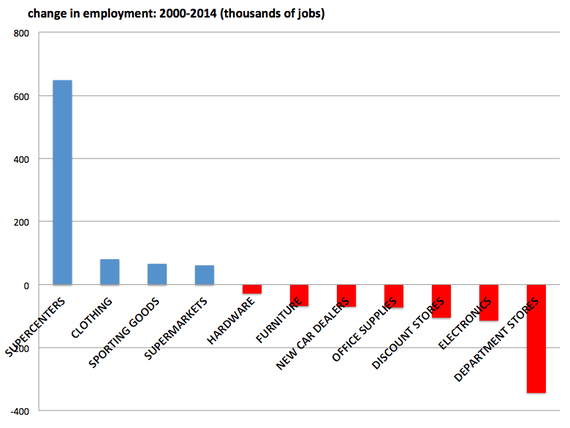
source

There's something happening here.
You don't need a long explication to see what's going on here. Walmart brought ruthless efficiency to the business of selling stuff in stores, and Amazon brought more ruthless efficiency to the business of selling stuff anywhere, so that today, to be a retail salesperson or cashier—still the two most common jobs in America—is to compete with the convenience of a laptop and a couch (or, even worse, a smartphone search filling a spare moment of boredom). As Radio Shack's story shows, when companies go to war against price and convenience, they tend to lose—first go the jobs, then goes the company. ... There is little reason to think that the most important employment engine of the 20th century will continue to pump through the 21st. The future will be cheap, and it will be convenient, but much of it will lose the personal touch of, well, people.
Even as those jobs are evaporating, the chances are that the ones that remain don't pay well.
Though unemployment has finally dipped below six per cent, real wages for most have barely budged since 2007. Indeed, the whole century so far has been tough: wages haven’t grown much since 2000.
Sometimes, I wonder how people make the proverbial ends meet.  And every time I have such encounters, I can't but think it is crazy for the well-heeled like me to ask for raises and for more benefits.

But, of course, those in my earnings bracket aren't comparing themselves to that ungrammatical retail person but to the investment bankers and CEOs.
corporate America, if not the rest of the economy, has done just fine over the past five years. It’s that all the rewards went into profits and executive salaries, rather than wages.
I don't care about my raise.  But, I am pretty darn certain that executives can easily forego a few dollars in order to ensure that the ungrammatical retail person gets to go home with a few more dollars.  Is it possible?  Yes, at least in one company, apparently:
Aetna’s C.E.O., Mark Bertolini, announced that the company’s lowest-paid workers would get a substantial raise—from twelve to sixteen dollars an hour, in some cases—as well as improved medical coverage. Bertolini didn’t stop there. He said that it was not “fair” for employees of a Fortune 50 company to be struggling to make ends meet. He explicitly linked the decision to the broader debate about inequality, mentioning that he had given copies of Thomas Piketty’s “Capital in the Twenty-first Century” to all his top executives. “Companies are not just money-making machines,” he told me last week. “For the good of the social order, these are the kinds of investments we should be willing to make.”
The lowest paid get raises and executives got copies of Piketty's book.  How fascinating!

Sometimes, an extra effort is needed to make sure that a rising tide will lift not only the yachts but also the rafts and the catamarans--wherever they are floating "at."

Source

Saturday, January 10, 2015

Where have all the wages gone?

Thus, after a week of reflecting on the life as it evolved on the way to and from India, and when in India, I return to my regular programming--how much I missed it! ;)

I went to fill gas (petrol, for you readers outside the US! haha) in the car and thought I had traveled back in time when I saw that a gallon was $2.27.  (and 9/10 after the 27, of course)

So, low gas prices are good, right?  Ahem, "it could prove a headache for Federal Reserve Board Chairwoman Janet Yellen."
The Fed is thus facing a bizarre economic dilemma: It has runaway growth and collapsing prices at the same time. The weapons available to Yellen to fight deflation are flimsy. Normally, the Fed would want to lower interest rates. But they are already at zero—there is nowhere left to go. And, of course, house-on-fire economic growth usually calls for higher interest rates, which would only exacerbate the deflation side of the problem.
Economists do not like inflation, yes.  But, deflation is way more worrisome--panic provoking--than inflation is.  And the Fed will not tinker with interest rates for a while:
This would imply that labor-market indicators would become critical to the FOMC’s analysis of when to raise rates—and in particular wage growth. As Yellen put it in August last year, “since wage movements have historically been sensitive to tightness in the labor market, the recent behavior of both nominal and real wages point to weaker labor market conditions than would be indicated by the current unemployment rate.”
That is, rate hikes may be put on hold until people start seeing the benefits of growth in their take-home pay.
Growth in the take-home pay?  Oh, yeah, haven't I been blogging for a long time that middle-class jobs are incomes might never come back?  What does Paul Krugman have to say?
wages are still going nowhere, up only 1.7 percent over the past year.
That's it?  Maybe he will have more on this over the next few days.

This blogger is convinced that the wage stagnation is here for the long haul.  And is even more convinced when he reads pieces like this:
A declining labor share of income also makes it possible for labor productivity to rise without average wages rising in turn. That is, it means that workers can get more productive without seeing the fruits of their labor. That's a big deal, both for workers and for economics as a discipline. For decades, most economists have treated the existence of a stable labor share of income as something like a law of nature. It was one of six "stylized facts" the famous economist Nicholas Kaldor proposed in 1957. Those facts serve as foundations for a staggering number of influential macroeconomic models, including the ones that the Federal Reserve and federal budget officials rely upon. If the labor share is falling, things that most economists would have treated as impossible ten years ago start to look very troubling.
For those of us who have jobs with a decent enough pay, well, this ain't a bad time, with low interest rates, low inflation, low gas prices.  But, if you are like me who believes that it is the responsibility of middle-aged folks to watch out for the long-term welfare of the young, then you, too, will be worried.  Even if you live in India and not in the US--especially because many of the economic dynamics are similar!

Of course, you can forget all these, and utter your own version of "let them eat cake" and watch the "college" football national championship game, then "the superb owl," and then the "March Madness," and go international with sports all over the world.  The youth be damned!


Sunday, October 12, 2014

What does SAT expand to? Student Affluence Test!

One of the best lines ever from the political theatre that I have had the pleasure of watching after moving to the country was the one delivered by Ann Richards, when I was just about getting acquainted with the actors and their affiliations, by which I mean politicians and their parties:
Poor George, ... he can't help it ... he was born with a silver foot in his mouth.
It was the best of the show business in America and I was hooked.  I remain a political junkie to this day, sadly! ;)

Bush, of course, went on to win the elections.  A few years after that, Ann Richards lost the governorship to Bush's son, "W."  And then she lived long enough to see "W" also get elected as president, and then get re-elected as well.

Being born even with a silver foot in the mouth helps. It helps a lot.  To make it is relatively easy when born into the "correct" contexts.

We discount the head start that the silver spoon kids get because of the other narrative that we want to believe--the Horatio Alger myth of rags to riches, from nowhere to the White House.  We are so desperate to believe in the myth that will go to any length to be in denial of the reality, which I have blogged often here, sometimes as choose your parents well.

Today's evidence is from SAT scores.  It will be a rare older American adult who does not remember his/her SAT scores from the high school days.  The number leaves a permanent imprint in one's mind.  Because of the repercussions that the score has for college, scholarship, and the rest of one's life.

It is increasingly clear that the SAT score is highly correlated with the silver spoon effect:
On average, students in 2014 in every income bracket outscored students in a lower bracket on every section of the test, according to calculations from the National Center for Fair & Open Testing (also known as FairTest), using data provided by the College Board, which administers the test.

Students from the wealthiest families outscored those from the poorest by just shy of 400 points. Given the widespread use of the SAT in college admissions, the implications are obvious: Not only are the wealthiest families best equipped to pay for college, their kids on average are more likely to post the sort of scores that make admissions easy.
Now, before you condemn that finding as something from a loony left publication, well, it is from the capitalist-friendly Wall Street Journal.  As I noted in a different context, if even the WSJ or the Economist is reporting about something that I have often worried about, it then means that the shit has hit the fan. Game over, folks. The end. Finito. The fat lady has sung.
Family wealth allows parents to locate in neighborhoods with better schools (or spring for private schools). Parents who are themselves college educated tend to make more money, and since today’s high school seniors were born in the mid-1990s, many of the wealthiest and best-educated parents themselves came of age when the tests were of crucial importance. When the SAT is crucial to college, college is crucial to income, and income is crucial to SAT scores, a mutually reinforcing cycle develops.
Yep, when you choose your parents well, a mutually reinforcing cycle begins.

The problem is glaringly obvious--you can't choose your parents.

So, what happens then if your parents happen to be, say, high school educated blacks who live a blue-collar life in the low-income neighborhood that has awful schools?  Tough luck, kid!  It is your fault that you didn't choose your parents well!

Now, think about the WSJ's report from just a few months ago:
Proving the adage that all of life is like high school, plenty of employers still care about a job candidate's SAT score. Consulting firms such as Bain & Co. and McKinsey & Co. and banks like Goldman Sachs Group Inc. ask new college recruits for their scores, while other companies request them even for senior sales and management hires, eliciting scores from job candidates in their 40s and 50s.
Yep, choosing the parents well is an awesome strategy--don't worry about the silver foot in your mouth because it will all work out in your favor, and you can even proudly beat up on others who can't make it despite all the "equal opportunity" that the land of the free provides!


Monday, September 29, 2014

If this is how academe approaches income inequality ... game over!

An email to faculty, from a "comrade," opened with:
Colleagues: Please help raise the critical consciousness of students and others by recommending two outstanding books: 1) Donald Barlett, James Steele, The Betrayal of the American Dream; 2) Naomi Klein, This Changes Everything: Capitalism vs. the Climate.  
Every once in a while the brain works and I recalled reading reviews of that first book, especially in the NY Times.  (Even normally I care very little for Naomi Klein, who is way too shrill an ideologue for my preferences, even when she addresses issues that worry me too.)

So, of course, the nerd then did a quick google search and located the NY Times piece, and more.

Catherine Rampell, whom I have quoted many times in this blog--and, btw, I am unhappy that she ditched the Times in favor of a columnist gig at WaPo--leads her review with these sentences:
There are two major flaws in “The Betrayal of the American Dream,” a new book about the dismantling of the middle class. The first is its diagnosis of what’s causing the country’s economic troubles. The second is its prescriptions.
Other than that, Mrs. Lincoln, how was the play? ;)

Rampell's follow-up sentence is a classic:
At least it got the symptoms right.
Hehehehe!

If a relatively centrist Rampell takes that tone, I wondered how the WSJ reacted to it.  Thanks to Google, no problems tracking that down either.  This review, too, makes clear right with the opening sentences:
Beware of investigative reporters offering economic analysis. There will usually be a conspiracy theory lurking somewhere. A serious study of economics—macroeconomics especially—doesn't mate well with conspiracy theories.
This surely will not lead to any huge applause for the book, right?
Don't look for any answers to that problem in this book, because they aren't there. But, yes, it probably will sell well.
Above and beyond these reviews and the book itself, a couple of points stand out.  One, isn't it interesting that academics are getting excited that a book by investigative reporters at Vanity Fair will raise critical consciousness?  If academe is about critical thinking, and the great scholarship that ensues will lead to a lot more nuanced understanding, then shouldn't the route be via academic books authored by professors?  Could it be that those books rarely do any damn thing outside of graduate seminars because, well, academic writing stinks?

As many of my posts suggest, and much to Ramesh's annoyance, I am deeply concerned by the widening income and wealth inequalities, and the increasingly bleak outlook for those who didn't choose their parents well.  When academics want to discuss these issues, then shouldn't the book to raise that consciousness be via reading and discussing the much acclaimed work of Thomas Piketty, who has earned the respect even of those who disagree with his interpretations?  Especially when Piketty is zeitgeist and the recommended books are from a couple of years ago!  Or even  the Nobel laureate Joseph Stiglitz in conversation with John Stewart!

I worry that this is merely the latest in the long running degradation of academic discourse, which has slipped into an ideological trash-talk mode that, unfortunately, the impressionable undergrads will believe to be the truth because of their uncritical faith in their favorite and popular professors.

Friday, July 11, 2014

California's PINOT

No, this teetotaler is not blogging about pinot the wine.  I concocted PINOT to refer to Progressives in Name Only Techies!  And, of course, the PINOT people go with pinot too ;)

Listening to the techie crowd, one might easily be convinced that they are one of the most progressives of the liberals in this country.   Which is how I answer a core question that is raised in this New Yorker essay on why so many San Francisco Bay area residents hate the tech industry and its people:
What’s going on in San Francisco has been called a “culture war,” and yet the values each side espouses can sound strikingly similar. Protesters like those outside Davies Hall have fought for open and eclectic urban life. They want broader social-support systems; they’re angry about the Man’s systemic abuses. These are, at least in theory, values on which tech’s pursuits rest. Techies tend to have strong feelings about immigration barriers (they’re against them), universal health care (for that), and environmentalism (a big deal). In their minds, there’s no industry more closely aligned with the quirky culture of San Francisco—so why now, after decades in the region, are they being attacked as interlopers from the wrong side of the ideological divide?
A "culture war" that is different from that other nation-wide culture war that the Republicans are maniacal about.  A war that represents the zeitgeist since the great recession began: the income and wealth inequality.
 [The tech] industry, which derives its competitive edge from efficiency, appears to be better at capital accumulation than at job creation. This is one reason, some economists think, that unemployment has remained more or less flat since 2000, even as productivity has continued to increase. An old-line company like Citigroup has some two hundred and fifty thousand employees; Facebook, which is worth more, employs about six thousand, and most tech startups are far smaller. (When WhatsApp was acquired by Facebook, for nineteen billion dollars, it had fewer than a hundred employees.) Tech has brought good jobs to San Francisco, but almost any other industry, charged with similar growth, would have brought many more.
The result: people protesting in front of those special buses that transport the tech folks back and forth, and the intense opposition to the gentrification in a city that was always known for its diversity.

The protests matter to the affluent--the affluent tech community and their financers--not in ways that make them re-think their ways and engage in more productive partnerships with the hoi polloi but to cry that they are being harassed, writes James Surowiecki in his column in the same issue!
Although the Obama years have been boom times for America’s super-rich—recent work by the economists Emmanuel Saez and Thomas Piketty showed that ninety-five per cent of income gains in the first three years of the recovery went to the top one per cent—a lot of them believe that they’re a persecuted minority. 
The old social contract that held together the rich and the rest of us has been shredded.
The well-being of the American middle class just doesn’t matter as much to companies’ bottom lines.
Which is why even though the pinot-sipping crowd might fund the Democratic Party and its candidates, well, it is not because of any old-time populist sentiments.

Even the market-friendly Democrat, Larry Summers, is worried about the tech revolution's inability to create jobs even as we experience economic growth:
If current trends continue, it could well be that a generation from now a quarter of middle-aged men will be out of work at any given moment. In such a world, more than half of men would have an out-of-work spell of more than a year at some point during their prime years. We do not yet fully know what the capacity to come back to work after such an experience will be, but the experience of men out of work for a long time because of the Great Recession is surely troubling.
So the challenge for economic policy will increasingly be generating enough work for all who need work for income, purchasing power and dignity. What will this require? The role of government was transformed to meet the needs of an industrial age by Gladstone, Bismarck and the two Roosevelts. We will need their equivalent if we are to meet the needs of the information age.
Meanwhile, the information revolution continues to gather momentum with the passing of every nanosecond.
The robots are coming. But they won't all be shiny, Apple-designed C-3PO look-alikes with middle-aged Siri brains. I believe the robot invasion will be a hodgepodge affair, with legs, propellers and wheels; robots that run the gamut from embodied android forms to robotic technologies hidden in the woodwork of our homes. ...
Will our robot future deliver massive inequality or revolutionary empowerment? Either way, 2035 will be a disruptive year.
More disruptive than now?  Shucks!  

Maybe I should start drinking; a pinot noir, please.

Tuesday, May 13, 2014

Has income inequality increased or decreased? Yes!

When eminent economists at the world's elitist of elite universities disagree, then it all comes down to a simple question: who you gonna believe?

Income inequality is one heck of a hot topic now and even normally the dismal scientists would have had plenty to say about it.  And then came a French dude, with a name that I didn't really know how to pronounce and was going about butchering his last name as I butcher any word that I come across.  At least, thanks to the New Yorker, I know that even Nobel Laureates had some trouble with this:
The economist Paul Krugman burst into an office at the CUNY Graduate Center one recent evening with a pronunciation question. “Is it Pik-etty?” he asked, so that the name rhymed with “rickety.” “Or is it Pikit-tay? And are we going with Tho-mah, or Thom-as?” Three academics stood nearby, clutching wineglasses. They had assembled as part of a welcoming party, but no one knew how to pronounce the name of the guest of honor, the French economist Thomas Piketty. “How about Dr. P.?” Chase Robinson, the interim president of the Graduate Center, suggested.
So, really, how is it to be pronounced?  Tell us, Dr. P.:
“Peek-et-tee,” he said.
That is the only easy thing about the storm that “Peek-et-tee,” has kicked up!

It turns out that there are long lines of reputed economists on either side of the issue.  I have no idea how to make sense of it all.  I am inclined to believe the pro-Piketty crowd, only because my emotions tend to sympathize with that.  After all, there is still that remnant of the commie spirits that flooded my teenage brain.

But, my rational mind wonders why there is that other line, also with economists of the highest calibre.  Take Kenneth Rogoff, for instance. A Harvard economics professor and a former chief economist with the IMF.  Enough cred for you?  Rogoff writes:
Reading Thomas Piketty’s influential new book Capital in the Twenty-First Century, one might conclude that the world has not been this unequal since the days of robber barons and kings. That is odd, because one might conclude from reading another excellent new book, Angus Deaton’s The Great Escape (which I recently reviewed), that the world is more equal than ever
Which view is right?
I say the answer is via another question: who you gonna believe?

If you believe Rogoff, well:
The answer depends on whether one looks only at countries individually or at the world as a whole
Why does that make any difference?
The same machine that has increased inequality in rich countries has leveled the playing field globally for billions. Looking from afar, and giving, say, an Indian the same weight as an American or a Frenchman, the last 30 years have been among the greatest in human history for improving the lot of the poor
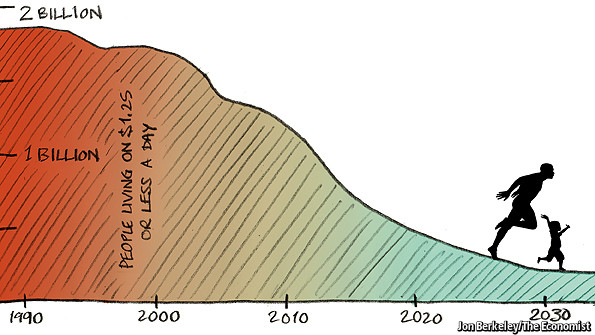
Indeed, over the last thirty years we have seen tremendous improvement in extreme poverty.
In 1990, 43% of the population of developing countries lived in extreme poverty (then defined as subsisting on $1 a day); the absolute number was 1.9 billion people. By 2000 the proportion was down to a third. By 2010 it was 21% (or 1.2 billion; the poverty line was then $1.25, the average of the 15 poorest countries’ own poverty lines in 2005 prices, adjusted for differences in purchasing power). The global poverty rate had been cut in half in 20 years.
The story of India and China now having a significant middle class also happened over the thirty years.  Which is why Rogoff says the answer depends, and concludes with this:
In accepting Piketty’s premise that inequality matters more than growth, one needs to remember that many developing-country citizens rely on rich-country growth to help them escape poverty. The first problem of the twenty-first century remains to help the dire poor in Africa and elsewhere. By all means, the elite 0.1% should pay much more in taxes, but let us not forget that when it comes to reducing global inequality, the capitalist system has had an impressive three decades.
So, who you gonna believe?

I turned to my favorite when it comes to income distribution issues: Branko Milanovic.  He writes:
When we look at the global population rather than at countries, however, there is a positive side. The unprecedented growth of China and, from the early 1990s, of India, as well as much of the rest of Asia has lifted millions out of poverty. For the first time since the industrial revolution, income inequality among world citizens has fallen.
See, again, from a global perspective, things have never been this good.

Milanovic concludes thus:
What is the role of national inequalities? On a purely arithmetic level, if real growth is given, greater inequality slows poverty reduction and probably the expansion of the middle class. But those who believe in trickle-down economics argue that without greater inequality there would not be strong growth. While this might have been true for China in the past 20 years, it is doubtful that further growth in inequality there will be so benign. China’s Gini – a measure of inequality – at about 44 is already greater than America’s. Can it rise further, deepening regional and urban-rural divides, without slowing the expansion of the middle? India’s inequality, long thought to be in the mid-30s Gini range, may if assessed in terms of income rather than consumption already be as high as 50, practically at the Latin American level.It is therefore growth with redistribution (a familiar development formula from the 1970s) that should be our objective in the years to come, if we want both global poverty and global inequality to continue their downward trend. 
So, who you gonna believe?

Thursday, January 23, 2014

The best thing you can do: choose your parents well

President Harry Truman apparently asked for a one-handed economist because he was tired of the "on one hand" and "on the other hand."  Economists, even the Nobel laureates, rarely seem to agree on the issues of the day, which makes the rest of us--practically the entire population--wonder if there is any science at all behind the conclusions that economists reach.

Here in the US, we are now getting into discussions and debates and yelling matches on whether we ought to increase the minimum wage.  And, often, related to this is the larger context of rising income and wealth inequality.  Economists being economists, well, you can pick and choose any one leading scholar who might support your own gut feelings on this, which might also make you wonder whether you can always then pick the correct answer to questions in economics simply based on your own gut feelings and later have it legitimized by quoting a leading economist!

The Economist--not the person but the magazine that calls itself a newspaper--offers, or attempts to offer, an explanation for why some economists oppose minimum wages.  Read the entire piece and decide for yourself whether you get it or whether you need to move to Colorado or Washington in order to inject some dope into your system and then read it!  The comments are the most interesting there, and say a lot about personal feelings leading to conclusions no different from what a real economist might have. This comment by a A. Andros summarizes it:
I am not a trained economist but can, like Beatrice, see a church by daylight.
So, ok, academic economists do not have their personal money at stake, right?  What if you had to think about it as a real investor, entrepreneur, business owner?  Here is Bill Gates (who is, of course, not a trained economist):
You have to be a bit careful that if you raise the minimum wage, you’re encouraging labor substitution, that you’re going to go buy machines and automate things or cause jobs to appear outside of that jurisdiction.
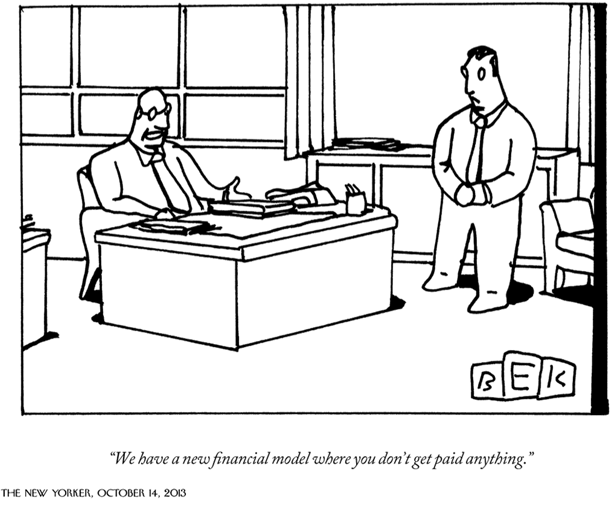
Which is true. The labor substitution via automation happens all the time. At the most basic levels too.  Think about this small piece--we now have plenty of grocery and box stores that have self-checkout lanes. That means a couple of checkout clerk positions, which might have paid minimum or near-minimum wages, have disappeared. And, of course, outsourcing is nothing but jobs appearing outside of the jurisdiction.

Now, one thing is for real--the growing inequality. I followed up on Greg Mankiw's post and tried to read this paper.  But, it had way too much technical discussions for my preference. I liked this there:
income inequality increased over time in our sample, consistent with prior work. Hence, the consequences of the “birth lottery” – the parents to whom a child is born – are larger today than in the past. A useful visual analogy is to envision the income distribution as a ladder, with each percentile representing a different rung. The rungs of the ladder have grown further apart (inequality has increased), but children’s chances of climbing from lower to higher rungs have not changed (rank-based mobility has remained stable).
Yep, make sure you choose your parents well!

This finding is not a real surprise to me because Branko Milanovic wonderfully articulated the importance of the parents' background as a predictor for economic success.

The New Yorker's John Cassidy summarizes the study, and writes:
the new study doesn’t mean that the effects of inequality aren’t more serious than they used to be. With inequality rising, particularly at the top, the rewards for clambering up the income distribution are greater, and so are the costs of getting stuck at the bottom. “The consequences of the ‘birth lottery’—the parents to whom a child is born—are larger today than in the past,” the paper notes. Or, as Saez said to the Times, “The level of opportunity is alarming, even though it’s stable over time.”
So, will increasing the minimum wage do anything to this inequality?  Will that help with evening out the uneven levels of opportunity?  You know what will happen when you ask two economists, right?  So, yes, do not ask them--unless it is a one-handed economist!

Thursday, December 05, 2013

I am a rich man. A super rich man. Is that my problem?

"It has been a long time since I came to your counter" I told her with a smile.  "With you being all possessive, I didn't want you to get upset with me" I added.

She laughed and tapped on my hand.  "Yes, I get jealous sometimes" she chuckled.

The previous customer, a woman who had more than a decade on me, was collecting her bags.  She paused and said "I know I cannot go by any other counter if I come here with my grandkids."

"So, how are things?" I asked her while she scanned the groceries.

"They have me down to four days a week" she replied.

Now that I am older and wiser, I know enough not to assume that anything that people say is good or bad, and that it is better to ask for clarification.  I suppose I have been reading one too many old parables!

"Is that a good thing or a bad thing?"

"Oh, very bad thing."  She paused.  "I can't live on 300 dollars a week."

I had no idea how to respond to that.  Fortunately for me, she continued.  And, as always, she used humor as a cover.

"I guess I will have to stand at street corners and ask for money" and she laughed.

That was a couple of hours ago.  I am trying to make my peace with her situation.

With her situation alone, and then about the many, many others who are in her state.

In the US, what I earn will place me in the upper middle class income.  If I compare myself to the world, I know I am one of the top one percent of the world.  When she tells me about living on 300 dollars a week, I am easily sent on the guilt trip that I have been traveling right from my young age.

I have no idea how others make their own peace on these kinds of issues.  For me, it has been one heck of a struggle.

Yes, there are all those intellectual battles that I can engage in.  Even the Pope and the President have recently weighed in on these income issues, and I have been so tempted to blog about those.  But, there is a wide gulf between the intellect and the emotion.

As I noted in that essay from almost a decade ago, "perhaps academic life means a continuous attempt to redraw the line that separates what I teach from how I live."

Sunday, August 11, 2013

Have skills, will travel. If I have no skills ...?

There are not only two Americas, but two worlds.  One world of residents for whom geography is not a restriction, and the rest whose lives are highly restricted by geography. 


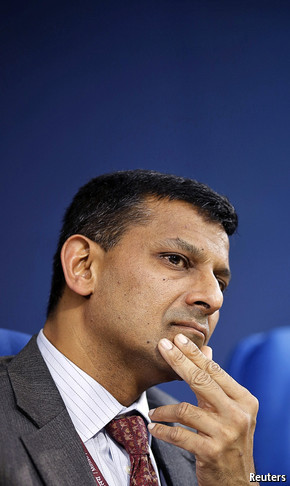
Consider the recent appointment of Raghuram Rajan as the head of India's central bank.  Rajan, who was born in India and educated at one of its best universities, came to the United States for higher studies.  His accomplishments after the formal education include having been the chief economist at the International Monetary Fund, an endowed chair professorship at the University of Chicago, and for having correctly predicted the Great Recession even as the world was partying away like there was nothing to worry about.  In a couple of weeks, the fifty-year old Rajan will take over as India's banker-in-chief.

Rajan's ease at transcending geography might be an exception only with respect to his varied accomplishments at the highest levels.  But, otherwise, it neatly fits into the increasing trend of "have skills, will travel" where those who can are no longer restricted by the geography of their birth.  Think about the numbers of actors and directors in Hollywood productions, or players in Major League Baseball, and you get even more examples of "have skills, will travel."

On a much, much reduced size, I too, of course, fit into that same category--born in India and coming to the United States by banking on my skills.  At the thirtieth reunion of our high school class, which was in 2011, I was amazed at how much of the globe we classmates had covered with our respective domiciles, leave alone the travels.  One classmate who also came to the US for higher studies is now an American expat heading a division of General Motors in China!

However, it is only one small part of humanity that has been liberated from the tight embrace of geography.  The lives of most of the rest depend not only on the countries in which they are born, but even the regions and states within those countries in which they live.

Last term, in my economic geography class, a sharp student often applied the lessons to the case of Coos Bay, where he was born and raised.  The more we got into the concepts, the more he worried that the world of economic opportunities seemed to be shrinking for those without any special talent, and for communities like Coos Bay that flourished on what was once an asset--natural resources.

In the often told story of the "American Dream," one did not necessarily have to have any exceptional skill in order to lead a successful middle-class life.  To paraphrase Woody Allen's comment in a different context, 80 percent of success in achieving that American Dream was merely showing up.  The unskilled and the semi-skilled, too, showed up, did whatever work they had signed up for, and could return to their homes with white picket fences and children and dogs.  It was possible because of the opportunity that the geography--the country in which they were born--provided.

We now live in a world that is very different.  Tasks that require unskilled or semi-skilled labor are rapidly being automated or being sent away to other geographic areas where the cost of getting those tasks done will be much lower.  And, unlike with a highly skilled Rajan who can pack up and leave to wherever the next enticing offer comes from, the less specialized have considerably fewer economic opportunities.  Sometimes the prospect is of no economic opportunity at all--which is what Coos Bay residents, for instance, worry about.

Over the last few years, public policy discussions at DC and at Salem have not reflected these phenomenally rapid changes in global economic geography and how it affects the typical American who has been raised with the hope and guarantee of the “American Dream.”  Unemployment and underemployment, stagnant wages, the widening gap in terms of income and wealth that is simplistically reduced to the phrase “99 percent”, are all reflective of the geographic shifts in the global economy.

It is a harsh reality that a geographic accident of “born in the USA” is no longer the guaranteed pathway to the American Dream.  It is also a wonderful reality that another geographic accident of born in India or anywhere else is no longer a limitation.  The less our elected officials talk about these, the more I become the messenger with a message that depresses students in the classroom.

Shakespeare wrote centuries before this level of globalization that the world is our oyster.  Despite his immense imaginations, even he might be surprised at how much that observation is true now, and how awful life can become for those trapped in the sands.  

Tuesday, July 02, 2013

We care about fellow-Americans and not about Indians or Ethiopians because ...?

One of the serious essays that I read after the Costa Rica trip was this essay by Greg Mankiw, in which he lays out his defense of the one-percent.  I am surprised not with his wanting to defend the one-percent--after all, he has always been in the Bush and Romney camps--but with the approach that he took.  Mankiw seemed to offering a kind of unsophisticated moral and political philosophy interpretation that might be expected only from half-baked pseudo-intellectuals like this blogger!

I wouldn't be as harsh as Jonathan Chait, but I am on his side when he writes:
Mankiw — perhaps admirably, or at least bravely — ventures completely outside his area of expertise, economics, into moral philosophy. The result is — well, there’s no other way to put it. It’s an embarrassing piece of ignorant tripe.
Yet, I admire Mankiw for admitting, for acknowledging, that debates and discussions on income distribution in society cannot be simply resolved via econometrics:
fundamentally normative conclusions cannot rest on positive economics alone. 
If only economists would make this clear to the public every single time they convey their research findings.  If only they would stop claiming that economics is a science that can help in public policy decisionmaking! If only Mankiw himself would recite it every time.

And, yes to Mankiw when he makes clear up front:
At the outset, it is worth noting that addressing the issue of rising inequality necessarily involves not just economics but also a healthy dose of political philosophy. We economists  must recognize not only the limits of what we know about inequality’s causes, but also the limits  on the ability of our discipline to prescribe policy responses. Economists who discuss policy  responses to increasing inequality are often playing the role of amateur political philosopher (and, 3 admittedly, I will do so in this essay). Given the topic, that is perhaps inevitable. But it is useful to keep in mind when we are writing as economists and when we are venturing beyond the boundaries of our professional expertise. 
Give the man his due, I say, for stating that loudly and clearly.  We can then at least agree that income distribution discussions come down to how much we are able to persuade the audience.  Can we convince them that our way of thinking about it is correct?  Econometrics is only as good or as bad a tool as simple rhetoric can be.  Yes, I am channeling D. McKloskey here.

Anyway, in that essay, Mankiw writes:
Some of the largest income disparities are observed between nations. If a national system of taxes and transfers is designed to move resources from Palm Beach, Florida, to Detroit, Michigan, shouldn’t a similar  international system move resources from the United States and Western Europe to sub-Saharan  Africa? Many economists do support increased foreign aid, but as far as I know, no one has  proposed marginal tax rates on rich nations as high as the marginal tax rates imposed on rich  individuals. Our reluctance to apply utilitarianism at the global level should give us pause when  applying it at the national level.
Exactly. We are ok with California and New York sending in more dollars to DC in taxes than they get back from Congress.  Alabama or Mississippi are examples at the other end--they get more from DC than they remit as taxes.  Such national-level redistribution is considered acceptable, but not if we extend the courtesy to Ethiopia.  Even though Ethiopians are immensely poorer than the poorest in Alabama.

The tribal behaviors of the past, when humans helped out only their group are understandable.  But, we now live in a world in which people effortlessly seem to take on new identities.  I am an American citizen who came from elsewhere.  This entire country is full of such narratives; if not first-hand, then one only needs to go back a few generations to find out where the people came from--with the exception of the Native Americans, who are now a minority in their original lands.  Yet, we so easily defend not caring about the rest of the world even when we are ok with massive internal income distribution, to individuals and geographic areas alike.

It is so arbitrary a line that we draw, a political boundary. We then defend it with words and with guns. We then even claim that Indians and Chinese are taking away "our" jobs, as if "we" are the only ones entitled to those jobs and incomes.  But, really, do "they" not bleed when pricked? If tickled, do they not laugh?  If poisoned, do they not die?

So, yes, income inequality and redistributing incomes and wealth really does come down to our own versions of moral philosophy and how we justify them.

We use our own yardsticks to continue to define and re-define the tribes to which we belong and we want to make clear the us-versus-them distinctions.  Income inequality is merely one such example in which we demonstrate this tribalism.

We humans are a very strange life form on this planet.

Friday, August 17, 2012

The rich are different from you and me

The title of this post is, of course, from The Great Gatsby.  That is a phenomenally succinct way to sum it up.  Life is not the same as scaling with respect to incomes.  The rich lead lives that are simply way different from yours and mine.

I have no hassles at all that there are rich people.  We need more of them.  But, it does make for interesting conversations and humor and, sometimes, schadenfreude too, like in this Zuckerberg wealth-o-meter from the Wall Street Journal :)


Forbes has always had a running list of big losers and winners--"real time billionaires"  I have often wondered when a typical billionaire loses sleep: is it when they lose 300 million versus losing only 10 million?  Do they simply ignore the daily fluctuations in their wealth?  Or, win or lose, like Scrooge McDuck, do they go into the vault and roll around in their gold coins? :)

But, of course, all rich are not created equal.  Some are more rich than others, and the difference is as significant (or even more, perhaps?) than the difference between the rich and me.

With two wonderfully informative charts, this Atlantic post notes
Forget gold. If Scrooge McDuck were around today, he'd be diving into a big pile of capital gains. Okay, and maybe some dividends too.
They don't seem to work for salaries, as much as how money works for them!

Thursday, June 14, 2012

Philosophical hassles with income inequality. Can Rawls or Bain help you out?

Before graduate school, I found it extremely easy to figure out answers to pressing public policy issues.  Graduate school messed me up--it was challenging to sort out the competing interpretations on any given issue.  It was like I ate the forbidden fruit from the tree of knowledge and I was, therefore, condemned to a life of constant weighing of the multiple narratives.

In one of the courses, two readings were paired together--an essay by John Rawls (one of the earlier essays prior to the publication of his magnum opus) and Robert Nozick's counterargument.  Years of doing math and science hadn't prepared me for this.  Math and science seemed way easier compared to figuring out my own public policy prescriptions post-Rawls and post-Nozick.  And then there was another essay--by Isiah Berlin on thinking about liberty in two ways. 

Over the years, I have found that the ideas from these three, more than anything else, complicate my personal take on any of the pressing public policy issues of the day. 

Income inequality is one of the most contemporary urgent issues.  In the old days, before wandering around in graduate school, I would have flatly stated that income inequality is awful.  Now, I have to wear Rawls' "veil of ignorance" and think about Berlin's "postive and negative freedom" while dealing with Nozick's libertarianism.  The result: nothing is ever easy anymore.  Nor am I stupid enough to echo the words and sentiments of a former president who proudly claimed that he did not do nuance!

Even while sorting these out through those philosophical filters, there is Warren Buffett with his "ovarian lottery," which is what Michael Lewis also seems to point out:
Don't be deceived by life's outcomes. Life's outcomes, while not entirely random, have a huge amount of luck baked into them. Above all, recognize that you have had success, you have also had luck. And with luck comes obligation. You owe a debt, and not just to your gods. You owe a debt to the unlucky.
Keep all those in mind as you watch Jon Stewart talk with Edward Conard, a former managing director of Bain Capital before he retired when he was about fifty years old.


Thursday, April 19, 2012

Is there a politics of income inequality? Why are the 90 percent so docile?

We have reached a point in discussions on income inequality in the US where there is practically an unanimous agreement that inequality has widened.  The disagreement is in the "so what?"

One tempting question then is always this: in a democracy where every voter has the same number of votes--one--irrespective of the millions they own or the thousands they owe, then how come the ballot is not used effectively to trigger a greater redistribution?

Once again, Nicholas Lemann provides an insightful book-review essay, in which he concludes:
[That] ninety-nine per cent of Americans are being left behind economically isn’t of much use politically. The ninety-nine per cent is too big a category to be an effective political force. For all that, inequality already is a political cause, though in strange and unexpected ways. ... But if we are to go further—and get the political system to try seriously to reverse the trends of the past thirty years—somebody will have to figure out how to stitch together a coalition of distinct, smaller interest groups that, in their different ways, care deeply about inequality, and, together, can pressure Washington in favor of specific policies. It’s an unlovely business, but if you believe that government is the best instrument with which to address the problem it’s also a morally urgent one.
In other words, it is all a restatement of that classic argument offered by Mancur Olson in The Logic of Collective Action.  I wish Lemann had highlighted Olson's arguments in this context.

Friday, April 13, 2012

We are the global elite who could have done things differently

Doesn't the following chart tell one heck of a story:
[The] take of the very rich peaking in the late nineteen-twenties, at close to twenty per cent of total income, then falling sharply for forty years, only to turn back up in the late nineteen-seventies, and peak again in 2007.
Cassidy links to this paper, where the authors provide a similar looking chart for changes in the top income decile:


The question is always the same, right: why bother about income distribution?  Among other reasons, we want to understand how much of the national income goes to the top one and ten percent because of:
their impact on overall growth and resources, their impact on overall inequality, and their global significance.
At the same time, keep in mind that:
In the grand scheme of things, even the poorest 5% of Americans are better off financially than two thirds of the entire world
So, at the end of it all, could we have done things differently since the late 1970s, which is when we notice the sharp uptick in the graphs?
Yes, without thirty years of rising inequality, and with the same overall national income, income of the middle class would have been greater. People with middling incomes have many more priority needs to satisfy before they become preoccupied with the best investment opportunities for their excess money. Thus, the structure of consumption would have been different: probably more money would have been spent on home-cooked meals than on restaurants, on near-home vacations than on exotic destinations, on kids’ clothes than on designer apparel. More equitable development would have removed the need for the politicians to look around in order to find palliatives with which to assuage the anger of the middle-class constituents. In other words, there would have been more equitable and stable development which would have spared the United States, and increasingly the world, an unnecessary crisis.