Showing posts with label academe. Show all posts

Tuesday, July 31, 2018

Know yourself ... and your audience too

My neighbor flattered me yesterday with a question.  "Why don't you write for the New York Times?"

I never let these questions get to my head.  Because, I have a good idea of my mediocrity.  I am not at the level at which those big boys and girls play ball.  But, it is always a treat when somebody says such wonderful things.

The other thing that sometimes I am told is this: "You should write a book."

A long time ago, I read a rather sarcastic essay, which said that there is a book within every one of us, and it is best if that book stayed inside us ;)

Is there a point in writing a book that nobody would ever read?

Of course, academics do that all the time.  They proudly display their tomes in order to impress the gullible students and the universities faculty committees.  But, rare is an academic book ever read by anybody, even within academia!

In an essay that was published in the Chronicle of Higher Education, back in 2001, I quoted from Chekov's play, Uncle Vanya, in which the uncle finally lets loose at a retired professor:
"All our thoughts and feelings pertained to you alone. Our days were spent talking of you and your work, we were proud of you, we uttered your name with reverence, our nights were wasted reading books and magazines for which I now have the deepest contempt! ... But now my eyes have been opened! I see everything! You write about art, but you understand nothing of art! All your works, which I used to love, are not worth a copper kopeck. You've swindled us!"
I then added:
Would people be disillusioned if they knew that only a few of professors' publications are ever read by more than a handful of other scholars? Would people be disappointed in higher education if they realized that most academics' publications would not sell even for a penny? Would people agree with Uncle Vanya that professors who write but are rarely read and cited are swindlers? Could it be that people already grasp the truth, and that their knowledge is one cause of the decline in the prestige our society accords to faculty members? If I did not teach at a university, would I agree with Uncle Vanya?
I don't care much for book-writing, academic or otherwise.

How about building on many of the ideas that I blog about here and writing books?  I don't think so.
You can tell a story to anyone who’s willing to listen. But writing a book that people will pay money for or take a trip to the library to read, requires an awareness few storytellers have. It is not performance, not a one-person show. It’s a relationship with the reader, who’s often got one foot out the door.
Which is why even in this blog I keep the posts short--I am fully aware that the reader is ready to move on, especially in this FOMO world.
If you want to write a book, do it. It’s wonderful and horrible and fulfilling and soul-crushing all at the same time. But do it because you want to, not because someone suggested it one time. Be mindful of what it fully entails before you start, so you have reasonable expectations and set reasonable goals. You don’t have to write with the aim to get published, and you don’t have to publish with a traditional publisher.
In the past, I have collected posts from this blog, re-formatted them as vignettes, and printed them. All for one reader: My father.  He keeps them in his safe, and refers to them by "volume numbers."  That's priceless!

Saturday, June 23, 2018

Develop your passion

When we were kids, my sister was a picky eater who said no a number of vegetables.  The elders almost always had the same advice: By refusing to even taste those dishes, she had no idea what she was missing.

Decades later, she talks about some of those tasty dishes that she has now discovered.  "Remember that amma used to make it?" I have asked her more than once.

We do not know what we are missing out on. It is one thing to reject tasty veggie dishes, but another to make decisions on choices that will have implications for the rest of our lives.

I have forever complained about forcing 17 and 18 year olds to commit to studying fill-in-the-blank in college.  What the hell do we know at that age, and what the hell are we missing out on when we make those decisions?

Except for a tiny percentage, the overwhelming majority of kids in their late-teens have no idea what they want to do.  They don't know what their "passion" in life is.  Well, ok, for most boys there is only one passion ;)  Kidding aside, how do we know what we are passionate about when we have not even tasted the dishes that the academic and the professional worlds offer?

From a Stanford study:
Mantras like “find your passion” carry hidden implications, the researchers say. They imply that once an interest resonates, pursuing it will be easy. But, the research found that when people encounter inevitable challenges, that mindset makes it more likely people will surrender their newfound interest.
And the idea that passions are found fully formed implies that the number of interests a person has is limited. That can cause people to narrow their focus and neglect other areas.
Exactly!
Being narrowly focused on one area could prevent individuals from developing knowledge in other areas that could be important to their field at a later time
Seriously, don't people ever find out anything contrary to what I have been ranting about for years?
[After] reading a challenging scientific article on the same topic, students’ excitement dissipated within minutes. The researchers found that the drop was greatest for students with a fixed mindset about interests.
I have seen this over and over with many students.  They think they know about a field of study, which they think they are passionate about, and when they start getting into it, they begin to quickly lose interest in that field.

So, what is a better route?  The title of this post says it all.

How does a 18-year old develop their passions?  A two-word phrase that will be familiar to even a casual reader of this blog: Liberal Education.  Students get to taste the awesome dishes and then they figure out what their interests are, and how they can be productive members of society.

Wednesday, February 11, 2015

The older I get, the more I hate college football

In the market economy, we certainly know how to put a price on anything and everything, irrespective of how much we value that item or the work that a person does.

Take for instance the snow that has been piling up in Boston.  Imagine if the workers whose job it is to clear the roads and streets did not show up for work. Or threatened to go on a strike.  We immediately see the value of the work they do, right?  These are real services they provide, without which quite of bit of life in Boston will come to a standstill.  One would think that they will be highly paid.

source

Or, take elementary school teachers as an example.  We trust them with what pretty much every parent would consider to be the most precious in life--their children.  Teachers who have immense opportunities to shape or ruin their children's futures.   One would think that they will be highly paid.

Instead, you and I and the other billions of humans collectively prefer to pay people for services that we could easily do without.

Take, for instance, the latest news about a college football coach. At the university in the town where I live.
The University of Oregon will pay at least $17.5 million to keep winning football coach Mark Helfrich on his home turf for another five years.
$17.5 million!  Other than this guy who is now spending some of his fortunes on a road trip, I doubt whether any reader of this blog really knows what $17.5 million mean.  I have no freaking clue how to understand that kind of a money.

$17.5 million for coaching a football team.

The market, my friend, knows how to put a price but has no fucking understanding of value!  This is the system that we are stuck with.  Especially when the people can't get enough entertainment in their lives.  To heck with the children in the second grade, but goddammit we shall have entertainment 24x7!

You want more references to understand the distorted and screwed up emphasis on entertainment?
Helfrich’s annual salary is now about six times the UO president’s compensation.
Let me recap.
The coach is for a football team, whose existence is made possible by the university whom the players represent.
Without the university, there will not be students.
Without students, no football team.
The university is there to educate students.
One would think that, therefore, the educator-in-chief, the university president, would be the highest paid officer, right?
But, the coach earns six times what the president is paid!
According to the USA Today coaches salaries database, Helfrich — whose previous annual salary of $2 million ranked 52nd nationally and 10th in the Pac-12 — is now fourth among his Pac-12 counterparts and tied for 22nd nationally with an immediate base-pay raise to $3.15 million.
That, my friend, is how "the market" works!  But, we are stuck with it because the great alternative was infinitely worse.

Keep this in mind the next time you try to convince me, or somebody else, or even yourself, on the glories of the market!

BTW, because a $17.5 million can barely cover the caviar bill:
Some of the fringe benefits in Helfrich’s contract include:
Two courtesy cars.
Membership to the Eugene Country Club and the Downtown Athletic Club.
Use of a skybox suite and 12 tickets to home football games; four tickets to home games of Oregon’s other varsity sports.
Travel for his spouse to regular-season road games and for his spouse and children to postseason games.
Meanwhile, the road cleaning crew in Boston gets ready for another dump on Thursday.  The elementary school teachers spend their own money for supplies.  We pay bullshit jobs quite a bit, and make sure we would attack the real value adders if they asked for an Oliver Twist-more!
in our society, there seems a general rule that, the more obviously one’s work benefits other people, the less one is likely to be paid for it.  Again, an objective measure is hard to find, but one easy way to get a sense is to ask: what would happen were this entire class of people to simply disappear? Say what you like about nurses, garbage collectors, or mechanics, it’s obvious that were they to vanish in a puff of smoke, the results would be immediate and catastrophic. A world without teachers or dock-workers would soon be in trouble, and even one without science fiction writers or ska musicians would clearly be a lesser place. It’s not entirely clear how humanity would suffer were all private equity CEOs, lobbyists, PR researchers, actuaries, telemarketers, bailiffs or legal consultants to similarly vanish.
We are fucked up!

ps: I am sure there will be some who will claim that these are not representative of a free market.  But, hey, that claim is no different from die hard Marxists' claim that the USSR was not practicing true Communism.  So, no point talking about some Utopian version of anything that does not exist on this planet.

Monday, September 29, 2014

If this is how academe approaches income inequality ... game over!

An email to faculty, from a "comrade," opened with:
Colleagues: Please help raise the critical consciousness of students and others by recommending two outstanding books: 1) Donald Barlett, James Steele, The Betrayal of the American Dream; 2) Naomi Klein, This Changes Everything: Capitalism vs. the Climate.  
Every once in a while the brain works and I recalled reading reviews of that first book, especially in the NY Times.  (Even normally I care very little for Naomi Klein, who is way too shrill an ideologue for my preferences, even when she addresses issues that worry me too.)

So, of course, the nerd then did a quick google search and located the NY Times piece, and more.

Catherine Rampell, whom I have quoted many times in this blog--and, btw, I am unhappy that she ditched the Times in favor of a columnist gig at WaPo--leads her review with these sentences:
There are two major flaws in “The Betrayal of the American Dream,” a new book about the dismantling of the middle class. The first is its diagnosis of what’s causing the country’s economic troubles. The second is its prescriptions.
Other than that, Mrs. Lincoln, how was the play? ;)

Rampell's follow-up sentence is a classic:
At least it got the symptoms right.
Hehehehe!

If a relatively centrist Rampell takes that tone, I wondered how the WSJ reacted to it.  Thanks to Google, no problems tracking that down either.  This review, too, makes clear right with the opening sentences:
Beware of investigative reporters offering economic analysis. There will usually be a conspiracy theory lurking somewhere. A serious study of economics—macroeconomics especially—doesn't mate well with conspiracy theories.
This surely will not lead to any huge applause for the book, right?
Don't look for any answers to that problem in this book, because they aren't there. But, yes, it probably will sell well.
Above and beyond these reviews and the book itself, a couple of points stand out.  One, isn't it interesting that academics are getting excited that a book by investigative reporters at Vanity Fair will raise critical consciousness?  If academe is about critical thinking, and the great scholarship that ensues will lead to a lot more nuanced understanding, then shouldn't the route be via academic books authored by professors?  Could it be that those books rarely do any damn thing outside of graduate seminars because, well, academic writing stinks?

As many of my posts suggest, and much to Ramesh's annoyance, I am deeply concerned by the widening income and wealth inequalities, and the increasingly bleak outlook for those who didn't choose their parents well.  When academics want to discuss these issues, then shouldn't the book to raise that consciousness be via reading and discussing the much acclaimed work of Thomas Piketty, who has earned the respect even of those who disagree with his interpretations?  Especially when Piketty is zeitgeist and the recommended books are from a couple of years ago!  Or even  the Nobel laureate Joseph Stiglitz in conversation with John Stewart!

I worry that this is merely the latest in the long running degradation of academic discourse, which has slipped into an ideological trash-talk mode that, unfortunately, the impressionable undergrads will believe to be the truth because of their uncritical faith in their favorite and popular professors.

Sunday, September 28, 2014

That awful stink? Academic writing!

I am addicted to reading and thinking.  Which is why even as I was getting ready for a full day of meetings and talks, I had to create a "me time" early in the morning, before the activities began, when I could read.

One of the essays I read was Steven Pinker's "Why academics stink at writing."

And then tweeted about it ;)

Of course I liked that essay, for the question that was being tackled there and because of the author too.  After all, it was only slightly more than a month ago that I had even included a video of a talk by Pinker, and the talk was on the godawful academic writing that I was complaining about.  Well, something that I have been complaining about ever since I realized in the early years of graduate school that I had no clue how to write.

Pinker notes there:
The most popular answer inside the academy is the self-serving one: Difficult writing is unavoidable because of the abstractness and complexity of our subject matter. Every human pastime—music, cooking, sports, art—develops an argot to spare its enthusiasts from having to use a long-winded description every time they refer to a familiar concept in one another’s company. It would be tedious for a biologist to spell out the meaning of the term transcription factor every time she used it, and so we should not expect the tête-à-tête among professionals to be easily understood by amateurs.
But then consider the following example I had presented in that post:
The move from a structuralist account in which capital is understood to structure social relations in relatively homologous ways to a view of hegemony in which power relations are subject to repetition, convergence, and rearticulation brought the question of temporality into the thinking of structure, and marked a shift from a form of Althusserian theory that takes structural totalities as theoretical objects to one in which the insights into the contingent possibility of structure inaugurate a renewed conception of hegemony as bound up with the contingent sites and strategies of the rearticulation of power.
How can anybody possibly defend that writing, right?

I agree with Pinker that it is easy to be an awful writer, and that it takes a great deal of effort--for most of us--to be even remotely decent writers:
Fog comes easily to writers; it’s the clarity that requires practice.
Here is the craziest thing of all--most academics are not clueless that academic writing stinks.  Yet, they continue with this awful practice because, well, there is no penalty!  Where is the incentive for them to write well?  Thus, they are being "rational":
professionals may not bother with this costly self-­improvement if their profession doesn’t reward it. And by and large, academe does not. Few graduate programs teach writing. Few academic journals stipulate clarity among their criteria for acceptance, and few reviewers and editors enforce it. While no academic would confess to shoddy methodology or slapdash reading, many are blasé about their incompetence at writing.
I read.
I tweeted.
Attended committee meetings.
And then popped into a session where researchers were presenting their papers.

A student asked me how I ended up writing op-eds.  I referred him to the Steven Pinker essay.  "Google for 'academic writing stinks'" I told him.

I try.

Tuesday, August 19, 2014

My life as an exile. Am enjoying it though ;)

A few years ago, a senior faculty came to my office to talk with me. Not as a friend, not even as a colleague, but in his official capacity.  He  said that every institution has its own culture, and that there was a significant hallway culture where I was, and not working with that culture was how I ended up not socializing with my colleagues--including him, of course.

I certainly did not make him happy when I told him that slavery too was once a part of our culture, but that does not make slavery valid.  A few more exchanges, in which I was my calm discussing (not argumentative) self, and he left my office seemingly worse off in his moods than when he came to talk with me.

He wanted me to be a part of the community.  But, apparently he could not understand why I should differ from the groupthink.

A few months later, after reading an op-ed of mine, he emailed me:
Just as once you enjoyed exchanging ideas with your peers, couldn't this occur again? You have friends in the Division.  You can build from there.  In your conversation and writing, often your sense of humor triumphs over differences.  Your editorials likewise bridge ideologies.  Couldn't this happen in the Division as well?
What he failed to understand, perhaps because he did not want to accept it, is this: I had already been excommunicated and by his failure to speak against it, he was very much a part of the excommunication process.

It is a strange experience to be exiled even while being within.  Of course, things could be otherwise--with a welcoming atmosphere to discuss ideas, even when there is complete and total disagreement.  Or, I could have at least pretended to be a part of the community--but, I did not because, heck, I am too much an old-fashioned guy who loves Socrates as a role model.
Socrates turned himself into an outsider in his own city, but didn’t move to another. He became “átopos,” which meant “out of place,” but also “disturbing” and “perplexing.” Being átopos is crucial if you are to be a straight-talking philosopher, as Socrates was. There is in every community something that has to remain unsaid, unnamed, unuttered; and you signal your belonging to that community precisely by participating in the general silence. Revealing everything, “telling all,” is a foreigner’s job. Either because foreigners do not know the local cultural codes or because they are not bound to respect them, they can afford to be outspoken. To the extent, then, that philosophy is exposure of “everything,” especially of things no one wants to hear about, foreignness is highly necessary for its practice. The philosopher, at least the straight-talking kind, is bound to remain a metaphysical gypsy.
I could not, and cannot, be bothered with respecting the institutional culture when I did not agree with it.  An exile, thus, goes with the territory!
Socrates’ case is telling. Like few others he saw the philosopher’s need to uproot himself from his own community. Yet he refused to go into an actual exile himself, preferring instead a symbolic one. He lived in Athens as if he were a foreigner. This means that he practiced philosophy as a rather dangerous pursuit. Such a tightrope walking can never take you too far, especially when you, performing it with no safety net, make incessant fun of your audience.
Literally making fun of the audience, so to speak, is not one that I do all the time.  But, I do--only once in a while, though.  Like in this tweet from a few days ago:
All together, is it any wonder, then, that I have not gone far!  But, I could not tradeoff expressing my views on issues, even though I know well that there is a price to pay.

Truth-seeking and truth-telling are dangerous practices, especially with no safety net.  At least I have one net that has been holding me up.  I hope that net won't tear anytime soon ;)

Tuesday, March 18, 2014

Were those injured in the Charge of the Light Brigade cared for by the Lady with the Lamp?

Back in our school days, the texts we read for the English classes often had essays by, or about, people who had made some serious mark on history.  Thus, we read about Florence Nightingale--the Lady with the Lamp--and her untiring contributions to treat the sick and the wounded and how she became the patron saint of nursing.

When growing up, and pretty much throughout my life, every so often my father, or his uncle, quoted from memory something from Shakespeare or Tennyson.

What connects the first paragraph on Florence Nightingale with the second on Tennyson?

Making those connections has always been what the life of an academic has been all about.  Years ago, I watched a few episodes of James Burke's Connections and loved the way he tied the stories together.  The world is one amazing set of interconnections. The tangled webs we weave, indeed. Living now as we do with the world wide web, we ought to easily understand that compared to when we were kids, right?

In my classes, too, I try my best to convey to students that understanding even a tiny, tiny bit of this world is not accomplished by merely studying a bunch of courses in any one single formal academic discipline.  Instead, we need to take courses in different disciplines and, more importantly, think through the connections.  And the way I teach, well, it is all about integrative learning where I am constantly highlighting to them the connections to poetry or science or anything else.  To me, there is simply no other way of learning

But, of course, all these are considered to be old-fashioned ideas--even the integrated curriculum that was in the place in the Honors Program was slowly and systematically dismantled because faculty and students saw no value in such an integrated learning.  But, I continue to march along to my own drum beat!

Anyway, real life events are no different with connections in plenty.  Events do not happen in isolation. Case in point: how the Lady with the Lamp and Tennyson come together.  In Crimea.

One of Tennyson's poems, which we did not read back in the school days, but I have heard it recited more than once, was The charge of the light brigade.  One often recited verse from that is this one:
Cannon to right of them,
Cannon to left of them,
Cannon behind them
   Volleyed and thundered;
Stormed at with shot and shell,
While horse and hero fell.
They that had fought so well
Came through the jaws of Death,
Back from the mouth of hell,
All that was left of them,
   Left of six hundred.
To understand a poem like this means we have to dig deeper into the context that triggered Tennyson to write about it.  The tangled world wide web and Wikipedia make it so simple: "about the Charge of the Light Brigade at the Battle of Balaclava during the Crimean War."

The Crimean War.

Aha, you say, because Crimea is so much in the news these days.

It was also during this Crimean War that Florence Nightingale became that famous Lady with the Lamp:
Florence Nightingale's most famous contribution came during the Crimean War, which became her central focus when reports got back to Britain about the horrific conditions for the wounded. On 21 October 1854, she and the staff of 38 women volunteer nurses that she trained, including her aunt Mai Smith,[9] and fifteen Catholic nuns (mobilised by Henry Edward Manning)[10] were sent (under the authorisation of Sidney Herbert) to the Ottoman Empire. They were deployed about 295 nautical miles (546 km; 339 mi) across the Black Sea from Balaklava in the Crimea, where the main British camp was based.
It is that same Crimea that is now the scene of intense geopolitics.

Of course, there is also that other famous Crimean connection: The Yalta Conference.


The question remains, however, on what we learnt, if anything at all, from such previous entanglements in the web that the world is.  I suspect we did not, and we humans rarely do.  Which is why ought not to be surprised when history repeats itself.

Saturday, March 08, 2014

I am not a contrarian. Irreverent is the word!

During graduate school, I was a student intern at a public agency.  Right from the first day there I knew I would not survive in such environments. But, of course, life is one cruel joke after another, and I ended up working for another public agency for more than five years before I returned to academia.

Even on that first day, I was reminded of a comment a graduate school professor made about how he became a libertarian.  It was all because of the summer internship he did at the Los Angeles County government when he was an undergrad.  After one day, I could certainly relate to him, though, even now, I am not a libertarian, but a Democrat who leans that way.

Anyway, a couple of weeks into my internship, during a discussion with my supervisor, I presented a view that was not what she apparently wanted to hear.  "I noticed you are a contrarian" she remarked.

The lowly intern that I was, I did not want to correct her that I was not taking such a stance because I wanted to argue but because what she claimed was wrong.

The irreverence--towards people and false ideas alike--is also why I think I naturally gravitated towards the likes of Christopher Hitchens.  Though, I had always wondered why he chose the title of "contrarian" for his Letters to a young contrarian. His questioning of accepted wisdom was not as a merely debating strategy but because to him there was no sacred cow.  It was sheer irreverence. Who else would have gone after Mother Teresa like how he did!

As Hitchens notes towards the end of the interview,which is when Charlie Rose gets to the book itself, living that irreverent (or contrarian) life is living a life, as opposed to having a career or a job.  It is truly who we are that we live.  And, yes, Hitchens, too talks about leaning towards libertarianism.

I would think that when in pursuit of truth, we naturally become irreverent. The progress of science has nothing but been one instance of irreverence after another.  In the old days, when irreverence was religious blasphemy, heresy, well, a philosopher like Giordano Bruno was burned at the stake.  While irreverent explorations in science are no longer questioned, irreverence in the pursuit of understanding social aspects is far from tolerated, as the recent controversy related to Wendy Doniger's The Hindus demonstrates.

The academic world is no different from the rest of society.  As long as one holds hands with the rest and sings the preferred version of Kumbaya, then all is well.  There is no place for the irreverent, which is a complete contrast to the idealized version of academe that I had in mind.

But, hey, I never set out to win the popularity contest anyway!  So, today's question: whom should I piss off? ;)

Thursday, February 27, 2014

This old prof worries that he is merely a brick in the wall!

"I don't get no respect" I laughingly tell students. This punchline that I have freely borrowed from Rodney Dangerfield is to mask my nagging feelings of whether or not what I do is worth a nickel.

As it gets to the final phase of the term, every term, this inner feeling gets larger and larger because of the reality that I might never see most of the students again in any of my classes.  And rarely ever even on campus.  Would they have been better off had they not taken my classes?  Did the classes I teach add any value at all?  If the same class were taught by somebody else and not by me, would it have made any difference to the value (not) added?

Misery loves company--perhaps that is, also, why we write!  We hope to be a part of a support group where we can let it out. Yesterday, this essay was therapeutic:
For a few months, we are front and center in our students’ lives—or so we hope. They are the focus of our courses, our assignments, our examinations, our office hours, our meditations in the car ride home. We encourage them. We try to fill the gaps in their education. In some cases, we try to resolve the unique challenges that they pose to us (as well as to themselves), psychologically as well as academically. We modify our lesson plans and rework our syllabi. ...
And then it all comes to an end. Students leave, move on, transfer, graduate, and, quite often, we never see or hear from them again. And we are OK with that.
For us, the process starts over, and we soon find ourselves caught up in new stories, while the previous ones remain largely unresolved. ... We fill in the blanks about them based upon what we know (or think we know), and tell ourselves that their stories ended the way that we hoped.
This starting and stopping every term is often taxing--I never can figure out how much I want to be emotionally invested in the students.  What if I get carried away, and begin to even worry about their welfare, when they couldn't care?  What if I erred the other way around by not recognizing the behavior of students who want to cultivate a collaborative relationship with me?  It is exhausting to spend the energy and to then never know how the stories unfolded, and meanwhile having to start all over again with another group of students.
 I want to believe that what I do in the classroom matters on some level, that it has helped to shape their sense of the world and is responsible, in some small way, for their sense of self and belonging. 
Thus, with faith that it all somehow matters, we do what we do.  And learn to deal with the disappointments. And get excited when that rare student provides an affirming answer to whether it was worth a nickel.

No point talking about all these to friends who are dealing with way bigger problems in life. The age that I am in means that friends have their own problems and they are all much weightier than this for me to bug them!  Thus, I was more keen on listening to those far more pressing problems over dinner that a friend had cooked. And along with dinner I got a gift as well--a book of poems by Oregon's own William Stafford. I paused at a page; it seemed like the cosmos too, wanted to address my Dangerfield Complex:
Old Prof
By William Stafford
He wants to go north. His life has become
observations about what others
 have said, and he wants to go north. Up there
far enough you might hear the world, not
what people say. Maybe a road will discover
those reasons that the real travelers had.
Sometimes he looks at the map above
Moose Jaw and thinks about silence up there.
Late at night he opens an atlas
and follows the last road, then hovers
at a ghost town, letting the snow have whatever
it wants. Silence extends farther
and farther, till dawn finds the same page
 and nothing has moved all night, except
that his head has bowed and rested on his arms.
Rousing to get started, he has his coffee.
He sets forth toward class. Instead of the north,
he lets an aspirin whisper through his veins.
I don't feel the ton of bricks anymore. Maybe only a few!

Monday, November 11, 2013

A professor's hairy questions on life!

It has been a few months since I last met with my cousin.  No surprise, therefore, that the first words out of her mouth, after she said hi, were "your hair is fully gray now."

If she has inherited the genes from our grandmother, as I did via my mother, then it is only a matter of time before the black on her head transforms into grey.  Haha, the joke's on her ;)

The first gray hair on my head appeared even before I had experienced the agony over the first pimple!  But, the grey hair's appearance did not bother me at all.  I had grown up with quite a few gray-haired adults around me and I thought it was normal for some to have grey hair.

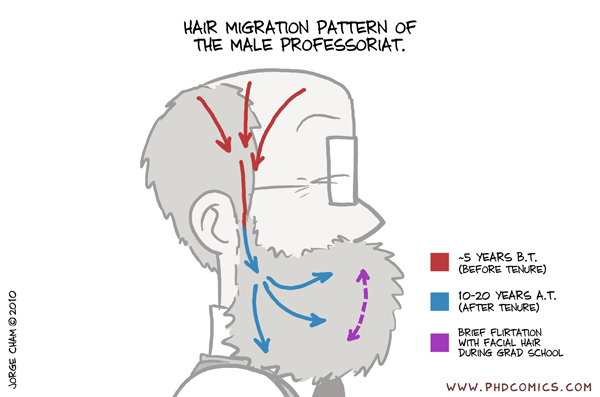
The process to fully grey, of course, was one that took decades.   When I started growing a beard, I was a graduate student, and the hair on top and on the face was mostly black, with occasional gray.


Now, the little bit of hair I have seems to be all grey, and so is the beard.

The beard though wants to grow uncontrollably fast compared to the hair on top, and if it were not for the beard trimmer that I use every few days, I will pretty much be a real-world example of the caricature in the following cartoon :)


As you can see, I don't look that different from the cartoon image .... muahahaha


Why does the hair turn gray anyway?
Gray hair, then, is simply hair with less melanin, and white hair has no melanin at all. Genes control this lack of deposition of melanin, too. In some families, many members' hair turns white in their 20s.
Btw, is is white hair or grey hair?  More importantly, is it grey or gray?
Gray and grey are different spellings of the same word, and both are used throughout the English-speaking world. But gray is more common in American English, while grey is more common in all the other main varieties of English. In the U.K., for instance, grey appears about twenty times for every instance of gray. In the U.S. the ratio is reversed.
So, given that we are part of the ape family, one has to wonder: do male chimps go bald?  do orangutans go grey?

Don't be a bag of lazybones and expect me to answer everything--find out for youself before you grey and more ;)

Sunday, September 29, 2013

It was twenty years ago

As a high school student, and especially as an electrical engineering undergraduate, the urge within me was to understand the human condition and the economic deprivation that was all around me.

Naive that I was, I thought the answers could be explored through formal graduate schooling.  It turned out that much had been investigated and written about even those couple of decades ago.  The more I spent time in the libraries and the classes, the more I was convinced that there was very little--if any--for me to explore and contribute.  Unlike in electrical engineering, where revolutionary insights took us from the diode to the transistor to the integrated chip and Moore's Law, and the world of unknown that was ahead, for all purposes everything had already been explored about the human condition and the relative economic deprivation around the world.

Thus, it was not the pedantic understanding that was needed, I decided, but a way to connect the understanding gained with the people outside academe.  Sometime during my final year as a graduate student, in a conversation with a faculty, I outlined to him my interests in being an academic who does not engage in formal academic research but in scholarship that would be for a non-academic audience.  Like writing newspaper opinions.  .

He thought it was much needed.  But he warned me that academia would not care about any intellectual approach that did not conform to established protocols.  He said something along the lines of "they will get jealous of your public exposure, and you will not get any support."

A month after graduating, my first ever newspaper opinion piece was published.  That was twenty years ago, in July 1993.  Against the background of the Fourth of July fireworks, I argued that the American society ought to worry not about restricting fireworks but about restricting guns.  Twenty years ago, and I shudder to think about the number of people who have died from maniacal violence since.

Over the twenty years, the number of published newspaper opinions stands at 158, which averages to about eight per year.  I suspect that the rate would diminish as I go forward, particularly because of the rapidly decreasing newspaper readership.

So, as I get more into the twilight of a mediocre career, I wonder if this route that I consciously chose was any more constructive than the options that I discarded.  It is not easy to figure out counter-factuals.  It is what it is, of course.  However, I like to believe that it has all been worth it, and that I did not stray away from that goal of understanding the human condition and economic deprivation and doing my tiny little bit to address it.

Saturday, March 02, 2013

Anti-war. Yet, I didn't sign the peace petition pre-Iraq War

Ten years ago, we in the US, and people elsewhere, were following the preparations that were going on to invade Iraq.

When the US and NATO forces got ready to strike against al Qaeda and the Taliban forces in Afghanistan, I half-heartedly supported it.  There was no doubt that the Taliban and al Qaeda were evil, especially for the people living in Afghanistan.  Though, it seemed to me like the war was in haste and that we might be better with a little more planning, I supported it even as the specter of the Soviets, the British, the Greeks all loomed large in the background.

As President Bush, Cheney, and Rumsfeld started beating pretty loudly the war drums to invade Iraq, I was completely opposed to it.  I recall watching on television Colin Powell's presentation at the United Nations and feeling sick in my stomach.  It was difficult to watch even a minute of arrogant war talk from Bush, Cheney, Rumsfeld and their likes, who made the proverbial snake oil salesmen look saintly.

I was no longer a Californian, having made myself home in Oregon.  My colleagues at my new place of work, which is where I continue even now, decided that they would collect money to publish a peace petition in the student newspaper.

But, despite my intense anti-invasion pacifist sentiments, I did not sign the peace petition and nor did I contribute for the advertisement expenses.  I hadn't yet been tenured and, yet, was firm about not signing on with the rest.

A couple of years ago, I found the petition on the bulletin board and made a copy for myself.  It was interesting to note that somebody had scribbled there about 9/11--perhaps a student who supported the war, and I continue to have a strong urge to convince that scribbler about a lack of connection between 9/11 and Iraq.
There was only one other colleague in the division at that time who didn't sign on that page, and he dissented because of his affiliation with, and support for, the GOP.  In my case, political party affiliation has never been a factor, nor was I in favor of the war.  But, no singing kumbaya with the group.

I was not a signatory for a very good reason.  Not because of the phrasing, which is indeed a poorly constructed argument, especially considering the number of PhDs involved in the effort.

Unlike my faculty colleagues who apparently thought their duty ended after such a rhetorical display, which would have impressed only a few gullible students, I thought I ought to work on helping a few more students and members of the public understand about Iraq, the Middle East, and Islam.  As an academic, I have never been convinced that signing peace petitions or organizing marches is the best way I, or most academics, can contribute to society.  To join the academy is to think and inquire, which then means that by sharing the products of inquiry with students and the public we can contribute--a lot more than by signing petitions.

I write op-eds, which is one heck of a political activity, like the old-style pamphleteers.  But, even more a political activity, which Azar Nafisi noted as "subversive:
SOME ASSUME that the only way academics can engage the politics of the day is by coming out of their ivory tower and protesting in front of the White House. But in conveying knowledge, the academy has a far more important and subversive way of dealing with political issues. Knowledge provides us with a way to perceive the world. Imaginative  knowledge provides us with a way to see ourselves in the world, to relate to the world, and thereby, to act in the world. The way we perceive ourselves is reflected in the way we interact, the way we take our positions, and the way we interpret politics.
Curiosity, the desire to know what one does not know, is essential to genuine knowledge. Especially in terms of literature, it is a sensual longing to know through experiencing others—not only the others in the world, but also the others within oneself. That is why, in almost every talk I give, I repeat what Vladimir Nabokov used to tell his students: curiosity is insubordination in its purest form. If we manage to teach our students to be curious—not to take up our political positions, but just to be curious—we will have managed to do a great deal.
It is not that I am political in the classroom; far from that.  I ask questions, present facts, and make them think.  I make them at least a tad more curious to know.  I tell them that they never have to worry about what my personal opinion is because my job is only to help them learn to learn.  But, to make students think about Iraq, the Middle East, and Islam meant that I had to read up a lot more before I could offer any class on those issues.  I took some time, and then offered a class.

The Iraq War dragged on. An even longer engagement in Afghanistan. The Presidency is a lot more powerful, and secretive about its powers, than it seems to have been.  Guantanamo's prisoners are in one tragic suspended state. Drones shower bombs on terrorists, innocents, and even American citizens from Afghanistan to Yemen.

I will continue to write and teach, fully aware that it won't amount to any hill of beans.

Friday, July 27, 2012

If you disagree, shut up! Academe today :(

Rarely anymore are serious intellectual debates allowed on college campuses, it seems like  I have blogged plenty about this.  Like when I was told to shut up.  What is college for, if not to critique and, thereby, improve our understanding, right?


Tuesday, July 03, 2012

How do we figure out intelligent life out there?

Stephen Wolfram responds to this question (ht): How do we figure out whether there’s intelligent life in the universe that doesn’t share our terrestrial history?
[In] the past we assumed that complicated signals from the cosmos must have been produced by civilizations that were about as advanced as we are. What the principle of computational equivalence tells us is that this isn’t true. You can get complicated sequences and patterns from simple rules that don’t require billions of years of evolution. A famous example is when Marconi and Tesla detected weird radio emissions from space and said, “the Martians must be signaling us!” The radio had just been invented, so they assumed that we had reached a technological threshold and were suddenly able to communicate with extraterrestrial life forms. It turns out that the signals came from the magneto-hydrodynamics of the outer atmosphere. When pulsars were discovered much later, scientists were also really excited because the signal was so periodic and seemed too intentional. In both cases, there was a confusion about the underlying cause. For me, the realization that we cannot really talk about abstract intelligence had an important personal consequence: I realized that artificial intelligence doesn’t require us to build a brain-like thing that we can later program, but that we can start with simple computation.
Now, if only I can detect intelligent life on college campuses.  Oh, wait, Wolfram has a comment on that, too:
I was an academic for a while, but I really like energetically doing projects. What I tried to do is build a very efficient mechanism to turn ideas into things. Right now, entrepreneurial companies seem to be the best way to do that. I look at my friends in academia and think: “Wow, things moved so slowly there in the last 25 years!” When we hire academics to work on WolframAlpha or Mathematica, the biggest shock for them is always how quick everything moves. We sit down, and an hour later we have decided what we are going to do and moved on. We can do crazy projects! If you want an immediate impact on the world, that’s what you need.
Granted that his life as an academic was quite a few leagues above my pay-grade.   But, whatever the level, things move too damn slowly in academia!  That, surely, is not a sign of intelligent life :)

Tuesday, June 12, 2012

How are college campuses like the USSR?

No, it is not any cheap shot at faculty who walk around calling each other "comrade." 
(Wait a sec, that was a cheap shot, right?  But, it is true--they proudly and loudly use the words "comrade" and "solidarity" ...)

Tim Groseclose, a political economist at UCLA, writes in the context of the faculty there rejecting a general education requirement:
While few people will say it, nearly everyone on college campuses understands that the “studies” classes are not very rigorous; nor do they have high intellectual standards.
If, however, you say something like that on a university campus, within seconds you’ll usually hear a reply such as, “No, no academic discipline is any more rigorous than any other.  It’s just that different disciplines require different talents.”
Notwithstanding how often you hear such statements, no one in the history of mankind has ever said, “Darn, I made a D in Chicano studies.  I guess now I’ll have to major in chemistry.”  In contrast, lots of people have said the opposite.  Academic conservatives—even those who are leftwing politically—understand that fact.
My liberal friend made another claim:  The same academic conservatives, although they do not think very highly of the “studies” departments, do not want to admit that fact publicly.  They understand the mob-like responses they will have to face, including being called a racist, if they do that.  ...
Thus, the current situation on college campuses is similar to the last several years of the Soviet Union.  Nearly everyone can see that the system is faulty.  But no one will dare to say that publicly.
Groseclose brings up a number of issues that those outside the academic walls, and many even inside, do not understand.  The first is that left-of-center faculty (which, by and large, includes me too, which is all the more why the "comrades" get pissed off at me, I think) can also be academic conservatives.  Conservatives in the sense of holding on to ideas and ideals that have are often considered old-fashioned anymore: such as, we are about education and knowledge and not about credentialing or inflating grades; we expect students to be self-driven and engaged; faculty will have the highest sense of integrity and will welcome differing opinions; .... you see what I mean?

The various "studies" are often--not always--much lighter intellectual endeavors.  While they are always presented as serious activities, in practice, many of the "studies" are what most students would recognize as easy A.  Further, they tend to be ideological in nature.

One disagreement with Groseclose: he writes that no one will dare to say publicly how faulty the system is.  Ahem, not me; I have been saying and writing about this for years!  Which is also why the "comrades" excommunicated me :)

Monday, April 09, 2012

Axe murderers explain the significance of philosophical novels

[The] puzzles and paradoxes of philosophical reflection are not best aired in the narrow, arid corridors of philosophical tracts; and that Plato was wrong to think that literature had nothing to offer philosophy. It is one thing to study John Stuart Mill’s defence of utilitarianism in ethics; quite another to read the passage in Dostoevsky’s Crime and Punishment (1866), where Raskolnikov tests utilitarianism to its limits by taking an axe and cleaving an old lady’s head in two. Illustrations of this sort might even persuade us that moral philosophy needs the novel for the fullest possible expression of its aims.
 That was the best part of this essay, which is on  the rapidly disappearing field of philosophical novels.

Even with that wonderfully rich treasure trove of philosophical novels, it appears that academia routinely misuses and abuses them.  If ever a Russian literature (in translation) course, for instance, is offered at most colleges and universities that are not the big-time research universities, it seems like that the focus is on the stories and rarely ever on the philosophical issues.  
I spent three years in college and wrote three and a half stories but I read everything I could get my hands on. White Teeth is really the product of that time; it's like the regurgitation of the kind of beautiful, antiquated, left-side-of-the-brain liberal arts education which is dying a death even as I write this. Generally, an English Lit degree trains you to be a useless member of the modern world
When increasingly students are not led towards reading and understanding some of those masterful and insightful works, well, it becomes difficult for them to appreciate many other things in life, including this awesome satire from The Onion:


Prague's Franz Kafka International Named World's Most Alienating Airport

Tuesday, January 24, 2012

How smart is your elementary school teacher?

One taboo subject on campus, perhaps on any university campus: anything to do with comparing intellectual abilities of students across majors.  We are expected to pretend that all students are equally capable.  (Plus, of course, pretentious faculty, even at teaching universities like mine, walking around as if they are geniuses!) 

And then comes the GPA issue.  We are suddenly faced with a situation where we find plenty of students with perfect or near-perfect GPAs in some majors, and far-from-perfect GPAs in others.  But, of course, academia being nothing but politics anymore where honest discussions are not allowed, we never openly engage in discussions.

So, we whisper in hallways, and might complain to colleagues we trust.  In my case, not having a colleague to trust makes it all the easier to blog about all these :)

In my second year as a graduate student, when I was a teaching assistant, one undergraduate student, who was in my discussion section, referred to the very course that I was TAing for as a "mickey mouse" course and that she had no problems earning high grades in many similar university courses.  I was amazed at such an honest and open admission from a student. (BTW, she was a contender, that year, to be in the "Royal Court" at the Rose Parade.)

What a terrible contrast it has been since I became a faculty, only to discover that most faculty, unlike that student, do not want to engage in honest and open discussions.

Worse, they are ready to throw out idiots like me who cling on to seemingly antiquated notions that education and university are about honest pursuits of truths!

It will be awesome if, for instance, a faculty meeting were devoted to the following graph (ht):


Fat chance!

Friday, November 18, 2011

Abolish NCAA sports. It has no "business" at universities.

[It's] time for Division I sports programs to be severed from higher education. Our mission as employees of universities is to teach students and to do research. Supporting felons and keeping long-term pedophiles on the college payroll is not part of my job description.
 Yep.

Tuesday, November 15, 2011

How faculty (intentionally) avoid critical conversations about academe

The university's computing services are after the few people like me who are yet to migrate to Google mail that the rest of the campus has transitioned to ... which is when I thought it might be worth spending time looking at the importance of deleting old emails once and for all. I read one email in a folder titled "Senate" and it became obvious that I will have a tough time deleting them all, and will end up migrating all those old emails to Gmail.

The excerpt below is from an email I had sent in June 2003--more than eight years ago--to the incoming president of the faculty senate.  As I re-read it, the feeling is of crushing disappointment that all these are the issues that academe is dealing with even now and we never bothered to tackle them, when all these were so obvious even to a moron like me!

A few days after I sent the email, a big time faculty-leader pulled me aside in the corridor and told me point-blank that the issues I was raising for discussions were within the purview of the faculty union, and that I needed to understand that the only role for the senate was to discuss curriculum.  What a shame!
i suppose that over the next couple of weeks you and the exec. team will put together a work plan for the next year.  may i request consideration of the following?

in my understanding, the higher ed system is rapidly changing.  in addition to the directly influencing acts such as drastic reductions in public spending on hr.ed., larger discussions such as liberal arts v. professional ed., traditional models v. the univ. of phoenix model, etc., are having, and will continue to have, significant impacts on hr. ed as we know it.

it seems like there is a rapidly evolving "new reality" that we faculty need to understand.  perhaps librarians are at the forefront in terms of experiencing the "new reality" that technology, in addition to other factors, is shaping for the profession.  yet, most of these discussions are happening outside the university, and very little is being deliberated by faculty bodies such as the academic senate.  but, faculty bodies, such as our senate, rarely take the lead to figure out what these may mean for their respective campuses; what these may mean not for the next year but for years down the road.

it will be neat if we can discuss at the senate these dynamic events that are happening outside.  in other words, to have the academic senate explore what the future may hold for WOU and how faculty may have to start thinking about that future.  while this will be separate from how the administration and the OUS perceive of the future, i am sure the senate's deliberations will be well received by them. 

examples: will we have to prepare for a future that could sharply change the lecture/discussion/assessment model of today?  all these may lead us to a different paradigm of teaching and learning.  if so, then how do we deliver the content in a new teaching/learning model?  what could be those changes and how can WOU's faculty prepare for those changes?  what do these changes mean for an incoming assistant professor who is joining us for a thirty-year period? 

perhaps this is too broad a discussion.  but, that is precisely my point--that faculty, as individuals and as a body, are perhaps not addressing these issues that form the context within which we conduct classes.  addressing these larger issues will help us in many ways.

thanks.

Monday, October 24, 2011

On why scholars need to be independent of the government

Good thing that most of us faculty are not scholars and are, at best, pretentious and wannabes eh! :)

The following "Subhashitani" articulates so succinctly the idea of independent thinking:


शिलं किमनलं भवेदनलमौदरं बाधितुं
     पयः प्रसृतिपूरकं किमुन धारकं सारसं ।
अयत्न मलवल्लिकं पथिपटच्चरं कच्चरं
     भजन्ति विबुधा मुधा ह्यहह कुक्षितः कुक्षितः ॥
- वेदान्तदेशिक
Are the grains collected not enough to douse the fire of hunger in the stomach?
Can the water in the lakes not quench the thirst?
Are the rags found on the streets not enough to make clothes to cover us?
Even when all the life necessities are taken care of by nature, why do these scholars serve the King?
- Vedantadeshika

Though, in all fairness, I should note here that the Subhashitani is couched in the contexts of allegiance to the divine, and that message does not appeal to this atheist.  But, the idea of independence in intellectual inquiry is valid though.  And vital.