Showing posts sorted by relevance for query grammar. Sort by date Show all posts

Saturday, January 05, 2019

Those cunning linguists!

In my early years of teaching, which was back in California, it did not take me much time to understand that students in my classes needed to learn how to write at the college level.  But, I could not spend all my class time teaching them about writing, nor did I have the ability to explain to the class how to write well.

I, therefore, did the smartest thing ever: I sought help from the English Department. As I have noted here, Kim loaned me one of her teaching assistants for 30 minutes each week for about six weeks.  One of those was Rebecca.  Once, over lunch, we talked about books, and to this day I am pleasantly flummoxed by her response to the my question on the book that she was reading.  It was about grammar!  Yes, it was about grammar. No kidding!

David Shulman gives me an idea of why those linguistics folks love to explore grammar.  He writes about the grammar in Tamil, which makes it interesting even for blokes like me.  Shulman then proceeds to write about the beauty of the language by using the example of the word undayirukka (உண்டாயிருக்கா) which means "to be or become pregnant."


I had no idea about any of these until now!

Of course, Shulman's book is not merely about grammar.  It is a biography of Tamil.

So, about this old language with a rich past and apparently a beautiful grammar too, well, where did it come from?

Shulman writes that "speakers of Dravidian languages were in place in south India, and perhaps also farther north, in the first millennium B.C."  But, it is all a mystery.  "We do not know when Dravidian language first penetrated the subcontinent; there may be a link to the Iron Age cultures of the southern megaliths, or even to the far more ancient world of Neolithic pastoralists."

But, so much is clear: Tamil's grammar paved the way for its poetry.

One of the many examples that Shulman uses in order to convey the richness and beauty of the language is one from the Sangam period.  The anthologies from this period "are broadly sorted into two thematic categories: akam or “the interior,” consisting of love poems, and puram or “the exterior,” a more diverse group, including martial eulogy, public praise, and worldly wisdom."  Here is one (translation by A.K. Ramanujan):


Of course, the akam and puram duality "can only be artificially kept apart."
A seemingly outer being like the beloved, or the god, is so deeply twined into the poet's own in-ness that we soon give up on identifying any out-ness at all.  The Tamil cosmos has no external boundary.
That is profound.

Wednesday, May 04, 2022

The bike-path grammarian

"There's one more behind us."

It was a loud warning that came from behind.  By now, we are used to all kinds of alerts from bicyclists, old and young.  Some ring a warning bell.  Some just zoom on by catching us by surprise.  A few days ago, an old woman's voice yelled out something like, "please step off the path because there is another bike coming towards me and I have no space."

We literally stepped off the path onto the wet gravelly ground.

She then slowly went past us on a cruiser bike.  Maybe there was no stopping or slowing once she got herself going!

This time, the voice warned us about multiple bikes.  A masked woman passed us, followed by another woman.

I looked behind and there was nobody else.  Why did she yell out "there's one more behind us"?

She should have instead yelled out "one more behind me."  Maybe she also "buys local."  Whom cares, right! ;)


In my early years as a pontificating professor (another alliteration that is also tautological!) in California, it did not take me much time to understand that students in my classes needed to learn how to write at the college level.

I, therefore, did the smartest thing ever: I sought help from the English Department.

I went this route because as much as I emphasized the importance of writing, I was almost always at a loss when it came to explaining to students why something didn't quite feel correct.  There was one particular occasion when a student raised her hand in class and asked for the difference between "affect" and "effect" because I had crossed out her usage of "affect" and written there that she should have used "effect" instead.

I had no clue how to answer that question.  I was stumped.  I told the class that I merely had a feel for it after all the years of working with the language, and that they had to take it up with the writing folks.

From the English Department, Kim loaned me one of her teaching assistants for 30 minutes each week for about six weeks.  One of those was Rebecca.  Once, over lunch when planning for the week's discussion on writing, we talked about books.  To this day, I am pleasantly flummoxed by her response to my question on what book she was reading for fun.  I expected her to respond with an interesting work of fiction.  I certainly did not imagine that the book that she was reading for fun was all about grammar.  Yes, it was about grammar.

I suppose I can confidently state that the biker who yelled about "one more behind us" was not that Rebecca!

Of course, there is more to life than grammar, which is the point of departure for a sacred Hindu prayer.  The first verse is literally about life that is wasted on grammar:

Bhajagovindam bhajagovindam
Govindam bhaja muudhamate
Sampraapte sannihite kaale
Nahi nahi rakshati dukrijnkarane. 
         
Translation:
Worship Govinda, Worship Govinda,
Worship Govinda. Oh fool!
Rules of Grammar will not save you
At the time of your death.

Rules of grammar will not save me from death.  But, they provide order in the chaos that is called life.

Saturday, May 14, 2011

WTF is a semicolon, eh! "Death to high school English"

No, it is not about my high school English teacher, who on two occasions slapped the life out of me for no reason at all.  Nor is it about how he knocked up the attendant in the chemistry lab and, as a result, married her.  Oh, it is definitely not about his embezzlement later on, for which he and his wife were fired.  (editor: anything else you have to publicly trash him? Awshutupalready!  editor: why all the fretting and fuming; what is this post about then? will you shut up so that I can get to it?)

My students know all too well that I want them to focus on the mechanics of writing, even though I am not a language instructor teaching them how to write.  I typically refer them to George Orwell's fantastic essay on how related writing and thinking are.

While I am not one of those grammarian colleagues I had in California, who said her favorite bedtime readings were books about the art and craft of writing, I am always fascinated by discussions on this topic.  And sometimes I actually do understand them!  A few years ago, when Lynne Truss' book came out, I quickly purchased for myself a copy and was so close to making it a required reading for one of my courses until a colleague pointed out that students might not easily relate to the British examples and language that Truss discusses.  I was, like, er, WTF :)

Which is why it has been a good Saturday morning--I read two commentaries that deal with different aspects of the English language and grammar.

In this essay in Salon, from where I have borrowed the quote in the title of this post, the author notes:
after seven years of teaching college composition, have I started to consider the possibility that talking about classics might be a profound waste of time for the average high school student, the student who is college-bound but not particularly gifted in letters or inspired by the literary arts. I've begun to wonder if this typical high school English class, dividing its curriculum between standardized test preparation and the reading of canonical texts, might occupy a central place in the creation of a generation of college students who, simply put, cannot write.
For years now, teaching composition at state universities and liberal arts colleges and community colleges as well, I've puzzled over these high-school graduates and their shocking deficits. I've sat at my desk, a stack of their two-to-three-page papers before me, and felt overwhelmed to the point of physical paralysis by all the things they don't know how to do when it comes to written communication in the English language, all the basic skills that surely they will need to master if they are to have a chance at succeeding in any post-secondary course of study.
One more reason to wonder if college is for everybody, and if college, then what exactly do we want students to get from that experience.  Oh well ... a discussion for another day, I suppose.

Anyway, the author finds out from the English teacher at a large school district on what exactly is going on in high schools these days:
"It's very hard to get a lot of teachers to teach those things, especially grammar. We have such a need to engage students. There's such an emphasis on keeping student enthusiasm going and getting them to want to actively participate. When you start talking about grammar, it's like asking them to eat their vegetables, and no one wants to ask them to do that. They prefer class discussion, which is great but to a certain degree, goes off into the wind."
So, then even this foreign-born geography faculty ends up teaching grammar?  Why do we emphasize writing, and why don't students want to learn it?
When I ask her why she thinks there's such resistance to prioritizing and teaching writing, given its numerous applications, given its overlap with critical thinking skills, analytical skills, basic communication skills, she hesitates for a moment, then answers in three words: "It's not fun."
True, but then, teaching (and for that matter, learning) isn't always fun. Changing my kid's dirty diapers isn't fun. Dragging my fat ass onto a treadmill isn't fun. Helping my grandmother "fix" her computer isn't fun. Sometimes we do things not because they're fun but because they're important.
Oh well ...

And even when do get students who are careful about grammar, grammarians make it difficult for us and we have to worry about where to put that damned question mark in the quote--inside the quotation marks or outside?  And today I find out there is something called "logical punctuation" that sounds more of an oxymoron than anything else :) 
the British way simply makes more sense. Indeed, since at least the 1960s a common designation for that style has been "logical punctuation."
British and logical? You got to be kidding!  And in a language in which, as Bernard Shaw pointed out, "ghoti" can be pronounced as "fish"?  Hey, notice that I placed the question mark after the quotes? Haha!


Saturday, June 01, 2013

Life is not about the grammar issues

Before you get any incorrect ideas and leap to conclusions, let me make it clear: spellings matter; watch out for the comma, which can kill a person; and, yes, make the writing look sophisticated by using semicolons!

However, let us not get carried away.  There is more to life than grammar. A lot more.  Way more.

When I was a kid, one relative who never failed to impress me was my father's uncle.  In conversations we always referred to him as RM.  Like all of us, he was also a mixed bag of the good, the bad, and the ugly.  RM was sharp. Quick witted. And well read.  He didn't keep up with the modern science and literature, yes.  But, he knew what he had studied during his younger days.

A rather argumentative and cantankerous man he was.  (Now you know there might be a biological reason, too, for my fascination for The Argumentative Indian!)  Mostly irreligious, and definitely irreverent too.  The religious rarely dared to pick an argument with him not merely because he was good at arguing but, and more importantly, because he would recite from memory verses from any number of religious texts and proceed on to interpreting them.

One that made an early impression on me was the way he presented to the young me how Bhjaja Govindam came about.  Now, thanks to the information technology, I am able to simply link to that Wikipedia entry.  The Wikipedia note says the same that RM told me a long time ago.  That devotional, philosophical, and poetic work, the story goes, was Sankara's reaction when he came across a Sanskrit professor teaching the finer points of grammar to his students.  Sankara observed:
Bhajagovindam bhajagovindam
Govindam bhaja muudhamate
Sampraapte sannihite kaale
Nahi nahi rakshati dukrijnkarane. 
         Translation:
Worship Govinda, Worship Govinda,
Worship Govinda. Oh fool!
Rules of Grammar will not save you
At the time of your death.
RM was often annoyed that those reciting this didn't even pause to understand what it meant and, thus, I have often heard him talk about dukrijnkarane. The audience would get nervous, while I sat there enjoying the show.

We draw our own lessons from what we experience in life.  In my case, I fell in love with the idea that there is a lot more to life than the small stuff that we are so fascinated with.  That there are much larger issues that we needed to understand.  I didn't care for the religious "Govindam" bottom line that Sankara preached, but I appreciated that dukrijnkarane as a metaphor for the ultimately trivial stuff that don't matter at all.

Graduate school and the research activities that professors and students engaged in often reminded me of this dukrijnkarane approach.  Instead of grammar, it was about some minutiae.  I didn't refer to such research as dukrijnkarane; after all, I was an in alien culture.  So, I made fun of research in the field of economic development as nothing but a fixation on "the productivity of left-handed female labor in the cotton textile mills of who-cares-where."

I felt convinced that modern day academic research was nothing but a variation of that Sanskrit professor being monomaniacal about dukrijnkarane.

Whether in intellectual pursuits, or in life, I understand that there is a lot more to it than the fine details we worry about.  Yes, those details matter, like how the comma does.  But, it is not about the comma, right?  And that we forget.

It was always easy to get RM going on such issues.  He loved them.  He seemed to draw energy from making life miserable for others by bringing up such topics.

He was also the first one I really knew who grew a beard.  Well, sometimes he grew one, and at other times he was clean-shaven.  Once, in his bearded phase, while assisting somebody else at a food charity event of sorts, he was asked to be in-charge when the other person left.  RM being RM, he decided to play a practical joke; he sat there like a holy man--he had the beard, the looks, and the erudition after all.  When people came, he made the appropriate comments and soon had collected donations from the passers by by offering his profound words of wisdom!

Now, I am at an age that probably RM was when I began to interact with him as a kid.  My beard, unlike his, is always well-trimmed.  I suspect that my beard is why people pay attention to me even the little bit they do.  Ask yourself: if you were a student in my classes, or a newspaper reader scanning through my op-ed, would you think I had any gravitas if I looked like this?:

yes, me, in summer 2012.
http://sriramkhe.blogspot.com/2012/07/so-why-havent-bald-men-gone-extinct.html
With all the pontification that I do, I can easily imagine that I, too, can sit at a place, make appropriate comments and, in the process, earn more money than I currently do now.  I am not that far away from the place where something like that actually happened, after all.

There is a demand for a false prophet like RM, even if only for those few minutes, or a lot more such RMs because innately we humans are always driven to understanding the mystery that life is.  We intuitively feel that there is a lot more to life than whatever dukrijnkarane we pursue.  We want to make sense of that larger issues.  We then seek people who, we think and believe, might have the answer.  Or, at least, show us the path towards that.

But, the search for that master is futile.  Nobody knows.  It is up to us individually to understand that life is not about the fine points of grammar.  In a way, that is what I tell students, without going into all this philosophy talk.  When I tell them that a course they take with me is not really about the course alone, and that education is not merely about the letter-grade and diploma alone, I know that I am implicitly hoping that they would engage in a self-driven inquiry into what they understand the big picture to be.

Perhaps it was six years ago that I went to Sengottai to say hi to RM.  It was our last interaction.  He was anything but that person he was when younger when he made a serious impression on me. RM spoke so softly that I had to strain to catch his words.  In my Americanized way, I tried telling RM how much I appreciated him.  I held his bony arms with the skin that was dry and wrinkled.  I am not sure whether my expressions crossed across the cultures.

I like to imagine that as RM neared his last few breaths, he knew really, really well that life is not about dukrijnkarane.

A few months ago, when my mother saw a recent photo of mine, she couldn't stop commenting on how much I look like RM.  Am not sure whether it is a case of we see what we want to see, or whether there is more of a resemblance.  The beard helps, for sure :)

Monday, December 03, 2012

Did the budget "affect" or "effect" you? Should you care?

Forget the fiscal cliff.  We need to worry about the grammar gorge!

Yesterday, as is a part of my typical routine, I scanned the Statesman Journal when I came across the headline that caught my attention only because of the grammar issue, and I grabbed a screen shot:
Curiosity being my middle name, I wondered whether the editors might have realized that they, too, had "affect" and "effect" messed up.  Surprise, surprise, ... a corrected headline in place!
For some reason, the screen shot this time is warped; bad grammar = good shot?

Of course, I, too, am no good with the grammar.  But, hey, that doesn't stop me from pointing fingers :)

Monday, October 29, 2012

The mystery that is called English grammar

A few years ago, back in California, I requested the English department folks to loan me a graduate student for 30 minutes every week.  The idea was that this student would remind students in my class about the basics of writing, and then as the term progressed, I would pass along to the graduate student problem-patterns in writing-related issues in the assignments, who would then use those real examples in the 30-minute session.

I went this route because as much as I emphasized the importance of writing, I was almost always at a loss when it came to explaining to students why something didn't quite feel correct.  There was one particular occasion when a student raised her hand in class and asked for the difference between "affect" and "effect" because I had crossed out her usage of "affect" and written there that she should have used "effect" instead.

I had no clue how to answer that question.  I was stumped.  I told the class that I merely had a feel for it after all the years of working with the language, and that they had to take it up with the writing folks.

Which is how I ended up asking my colleague, Kim, for a loan, so to speak.  Through her, I worked with quite a few grad students over the two years or so.  They helped me out with the in-class discussions every term.  One of them, Rebecca, said she loved the language so much that her favorite night time readings were typically books on English grammar!

I am sure students who are experiencing me as an instructor for the first time soon find out that I will bug them, bug the crap out of them, about learning to write.  I remind them that there is a long way to go, for me too.

Grammar issues like this, for instance, when punctuation kills :)


Another common error that we often run into:


That same site has this humorous explanation about "affect" and "effect"


It is not that I am a grammar-Nazi, but, ... :)


Thursday, August 28, 2008

Do correct spellings matter at all? not? nought?

A few items as follow-up to my earlier blog on the English language:

In Arizona, "Two self-anointed "grammar vigilantes" who toured the nation removing typos from public signs have been banned from national parks after vandalizing a historic marker at the Grand Canyon." These guys ought to have known better; after all, the British are still wondering why our spelling of "honor" is acceptable :-)

Speaking of the British, maybe the grammar vigilantes ought to have listened to the British academic who says that we should welcome these typos as variations in spellings. According to this report in the Times, "Instead of complaining about the state of education as he corrects the same spelling mistakes in undergraduate essays year after year, Ken Smith, a criminologist at Bucks New University, has a much simpler solution. “Either we go on beating ourselves and our students up over this problem, or we simply give everyone a break and accept these variant spellings as such.”
My first thought was, "why is a criminologist advising us about grammar?" But, the Arizona "grammar vigilantes" make it clear that obsessing with spellings can make criminals out of us. So, maybe this British criminologist was on to something :-)
Anyway, this grammarian/criminologist managed to create quite a stir throughout the world. Apparently it became a serious debate in India, as this pro and counter arguments show. And one writer opines that Indian students are better in English than the English are.
All because of spelling?

Wednesday, May 28, 2014

I am in good company!

When I was a kid, the elders often appreciatively commented about the quality of writing in the newspaper that we subscribed to--The Hindu.  After coming to the US, however, I have always been shocked at the atrocious grammar there and wonder whether it was the case even back then, or whether the quality has really deteriorated over the years.

Here in the US, I have often commented to students about the wonderful writing styles in the New Yorker and The Economist.  But, recently, I have been noticing grammar issues in The Economist.  A few weeks ago, I even wrote a sarcastic letter to the editor:
Dear Editor:
I reckon the distinguished newspaper loves the word reckon so much that it reckoned it would make for an interesting reading by using four reckons in the Saudi America piece--two of those reckons in consecutive sentences in the same paragraph.
Who woulda reckoned that!
Sincerely
Of course, the magazine newspaper did not publish that letter.  If they had, you, dear reader, would have known about it by now!

Why write about some old story today?  Glad you asked.

I picked up the mail and the latest issue was in.  On the cover was the image of India's most powerful bachelor (ok, married but living separately.)  Over dinner, I read that lead article, and then glanced through the pages and ended up reading this piece on digital disruption on the farm.  Not really a new story, but a neat commentary that ties a few pieces together.  Which is when my brain caught a spelling mistake.  Do you see what I saw?


Yes, I checked the online version.  Thankfully, that error does not show up there.

Wait, are you still searching for the error?  Tsk, tsk! And I  thought the readers of this blog were incredibly smart people! ;)  Oh well, there is more to life than grammar, right?


BTW, don't even attempt to poin out the writhing problems that you find alot in this blog.  Their not paying me fur this ;)

Tuesday, January 08, 2019

Traditions, when the times they are a-changin'

Consider the following sentence:
Tradition means living while adhering to usage as befits the refined culture of particular people in a particular time and place.
What an awesome definition of tradition, right?

But, there is way more to that sentence.

What happens to the glorious Tamil literature that followed the rules of the sophisticated grammar that involved the mythical Agastya and the real life Nakkirar?  Do the old canons get thrown out?  Will a new grammar have to be created?  What about the tradition?

It is in this context, writes David Shulman, that Peraciriyar (the great teacher) took on the challenge of "defining, defending, and explicating the classical Tamil past."  Centuries have passed since the Sangam literature, and the times they are a-changin' in the 13th century.  Poets are experimenting, and Peraciriyar thinks and writes about marapu:
Tradition means making poetry while adhering to usage (valakku) as befits the refined culture (nakarikam) of particular people in a particular time and place.
Even as I read that sentence, I was struck by how contemporary the issue is.  Shulman adds:
Let's say that actual speech changes over time [...]; does this mean we need a new grammar in each new period?
That question is relevant even today.

Languages and cultures do not stay stagnant.  If they do, perhaps they will perish.  The Tamil of today is vastly different from the Sangam Tamil, from Nammalvar's Tamil, from Peraciriyar's Tamil ... even from Kannadasan's poetry.  What happens to tradition when the times they are a-changin'?
Tradition means living while adhering to usage as befits the refined culture of particular people in a particular time and place.
A verse from Pukalenti's Nalavenpa and Shulman's commentary appeal to me a lot--even though my traditions are far removed from Peraciriyar's:


I, too, think that everyone should see the world as it is.

Tuesday, June 06, 2017

The answer is blowing in ... liberal education

It was nearing bed time, but I decided to check my news-feed anyway.  I am glad I did.

I spotted one that referred to Bob Dylan's Nobel lecture.

I pulled up the text that kept my attention focused as I listened to him with the jazzy piano in the background.  It was a delight, as he talked about things that were familiar to me, and to many that were alien to me.  Many that I had no idea about; like this:
John Donne as well, the poet-priest who lived in the time of Shakespeare, wrote these words, "The Sestos and Abydos of her breasts. Not of two lovers, but two loves, the nests."
Sestos? Abydos?

I suppose Dylan knew that there would be blokes like me listening.  Which is why adds there:
I don't know what it means, either. But it sounds good. And you want your songs to sound good.
Dylan then talked about Moby Dick, All Quiet on the Western Front and The Odyssey.
I had principals and sensibilities and an informed view of the world. And I had had that for a while. Learned it all in grammar school. Don Quixote, Ivanhoe, Robinson Crusoe, Gulliver's Travels, Tale of Two Cities, all the rest – typical grammar school reading that gave you a way of looking at life, an understanding of human nature, and a standard to measure things by. I took all that with me when I started composing lyrics. And the themes from those books worked their way into many of my songs, either knowingly or unintentionally.
In grammar school? We don't do those books, or their equivalents, even in college level these days.  If the learning material is more than two screens of scrolling, well, forget it!

I love how Dylan talks about those classics.  Not merely his interpretations, which are wonderful by themselves.  But, more importantly, about how those classics provided him with "an understanding of human nature, and a standard to measure things by."  Which is also what I often I blog about--how short-stories and full-length fiction help me understand the human condition, and how they give me a frame of reference.  And, yes, "either knowingly or unintentionally" those awesome works find their way into my own teaching and writing.

Instead of grounding ourselves on such a broad understanding, which is what liberal education is all about, we increasingly focus on the tricks of the trade.  We train programmers.  We train statisticians, lab technicians, graphic designers, ... We do not educate anymore, it seems.


Sunday, May 20, 2012

Hot chicks! Moms also looking great!!

It doesn't surprise us in Eugene that clouds have started rolling in as if to make fun of our plans and desires to watch the ring of fire.  But, clouds or no clouds, it was too good a spring day not to walk by the river and take in the sights.

And, what sights they were!

I had barely walked five minutes on the path by the river when I spotted a huge gathering of geese and goslings.  The last time this happened, I was so mesmerized by the sight that it didn't occur to me to take photos until it was way too late.

"Not making the same mistake today," I told myself as I immediately reached out for my camera.


I stood there watching the birds for a while.  Two large women on bicycles stopped by to check out the chicks.  I couldn't but wonder how they managed to get their rather large behinds on the tiny bicycle seats, and yet they did as they pedaled away!

I continued walking.  And more chicks.  The mother goose (technically, a goose can only be a mother, when the male is a gander, right?) looked up at me as if waiting for food to drop down. 

Perhaps the birds have come to treat humans as food providers because quite a few continue to feed the birds despite signs advising people not to do that.  If only humans would learn--story of our lives!


When the birds realized that I wasn't going to give them anything to eat, perhaps they were disappointed like how some students get when they realize that I never cancel classes :)

So, they took off and almost right away fell into a straight line formation.


No more chicks to drool over, and I resumed walking. 

The grass seed pollen levels were certainly getting to the unhealthy side--my eyes were beginning to water, and my nose and throat were getting itchy.  But then I kept going--allergy be damned!

Which is when I noticed new graffiti all over the signs.  The chicks didn't do that.  Stupid humans did.  Whatever compels these psychopaths to engage in such destructive behavior?  Why can't they simply enjoy watching the geese and the ducks and the turtles and the herons?  I suppose a stupid is as a stupid does!


And even worse, their grammar sucks!


Oh well; the awful grammar is the least of the worries!

Friday, February 06, 2015

Does grammar matter at work? Depends!

"They don't told us where it's at" she said.

Grammar depends on the context.

If a teacher had said that, well, you know you never ever want to be in that educational setting.  The ungrammatical sentence didn't come from a teacher.  In fact, not from a student either.  If it had been a student, I would have suffered that obsessive compulsion to correct that person.

It was at a retail establishment.  A place that is not for the white-gloved.

I am happy that there are such places where people have jobs.  Not all of us have the capabilities or the interest to be investment bankers or teachers or politicians.  To quote from Caddyshack, the world needs ditch-diggers too.

But, even those jobs are evaporating.

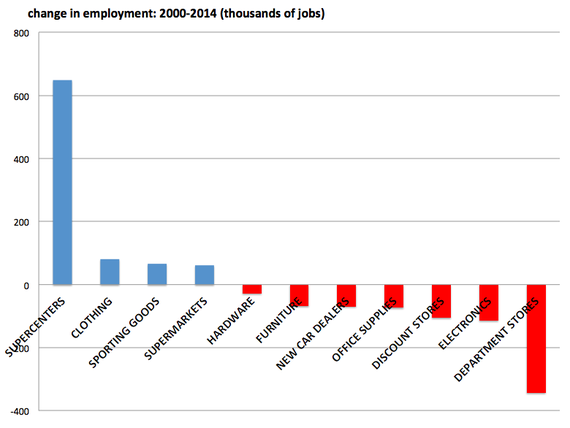
source

There's something happening here.
You don't need a long explication to see what's going on here. Walmart brought ruthless efficiency to the business of selling stuff in stores, and Amazon brought more ruthless efficiency to the business of selling stuff anywhere, so that today, to be a retail salesperson or cashier—still the two most common jobs in America—is to compete with the convenience of a laptop and a couch (or, even worse, a smartphone search filling a spare moment of boredom). As Radio Shack's story shows, when companies go to war against price and convenience, they tend to lose—first go the jobs, then goes the company. ... There is little reason to think that the most important employment engine of the 20th century will continue to pump through the 21st. The future will be cheap, and it will be convenient, but much of it will lose the personal touch of, well, people.
Even as those jobs are evaporating, the chances are that the ones that remain don't pay well.
Though unemployment has finally dipped below six per cent, real wages for most have barely budged since 2007. Indeed, the whole century so far has been tough: wages haven’t grown much since 2000.
Sometimes, I wonder how people make the proverbial ends meet.  And every time I have such encounters, I can't but think it is crazy for the well-heeled like me to ask for raises and for more benefits.

But, of course, those in my earnings bracket aren't comparing themselves to that ungrammatical retail person but to the investment bankers and CEOs.
corporate America, if not the rest of the economy, has done just fine over the past five years. It’s that all the rewards went into profits and executive salaries, rather than wages.
I don't care about my raise.  But, I am pretty darn certain that executives can easily forego a few dollars in order to ensure that the ungrammatical retail person gets to go home with a few more dollars.  Is it possible?  Yes, at least in one company, apparently:
Aetna’s C.E.O., Mark Bertolini, announced that the company’s lowest-paid workers would get a substantial raise—from twelve to sixteen dollars an hour, in some cases—as well as improved medical coverage. Bertolini didn’t stop there. He said that it was not “fair” for employees of a Fortune 50 company to be struggling to make ends meet. He explicitly linked the decision to the broader debate about inequality, mentioning that he had given copies of Thomas Piketty’s “Capital in the Twenty-first Century” to all his top executives. “Companies are not just money-making machines,” he told me last week. “For the good of the social order, these are the kinds of investments we should be willing to make.”
The lowest paid get raises and executives got copies of Piketty's book.  How fascinating!

Sometimes, an extra effort is needed to make sure that a rising tide will lift not only the yachts but also the rafts and the catamarans--wherever they are floating "at."

Source

Wednesday, July 09, 2014

Grammar is not as sweet as chocolate is? Whom cares!

Get ready to spend more, if you love chocolate, appears to be the advice from the Wall Street Journal:


Doesn't surprise me one bit; people in the old country have always had one heck of a sweet tooth, and with better transport and refrigeration chocolate becomes way easier to sell to a rapidly growing middle class.
"Emerging-market demand is the principle reason behind the steady and consistent rise that we've seen in the cocoa market," said Sterling Smith, a futures specialist at Citigroup in Chicago.
Read that quote again.

Did you?

Notice something that troubled you, like it was some stale nut in a chocolate bar?  (BTW, if you ever gift me chocolate, make sure it is plain and simple chocolate, without nuts or fruits!)

Did you spot that it was "principle" when it should have been "principal"?
Principal derives by way of French from the Latin term principalis, meaning “first in importance.” In English, it initially referred to a ruler, but the word also came to be associated with an amount of money on which interest is paid, because that sum is first in terms of priority and the interest (one hopes) is a relative small amount.
...
Principle, by contrast, though it was originally merely a spelling variant, came to mean “proposition or truth,” and later “law of nature” and “rule of conduct.” And, unlike principal, it does not serve as an adjective except in the form of principled.
Assuming that I am indeed on the correct side of the grammar accounting ledger, if we have problems with a language that is the lingua franca of the future, too, then, well, whom who cares, eh!
What, then, can we predict English will lose if the process goes on? An easy choice seems to be “whom”. English was once heavily inflected; all nouns carried a suffix showing whether they were subjects, direct objects, indirect objects or played some other role in a sentence. Today, only the pronouns are inflected. And while any competent speaker can use I, me, my and mine correctly, even the most fluent can find whom (the object form of who) slippery. So whom might disappear completely, or perhaps only survive as a stylistic option in formal writing.
It's not only whom that might disappear but perhaps the apostrophe too?
A battle is being waged over the apostrophe, and the names of two of the online factions—the Apostrophe Protection Society and Kill the Apostrophe—suggest an extremism usually reserved for blood, rather than ink or pixels. The former, founded by a retired British copy editor, provides a gentle guide to deploying the apostrophe. “It is indeed a threatened species!” the site warns, a little preciously. The Web site Kill the Apostrophe, meanwhile, argues that the mark “serves only to annoy those who know how it is supposed to be used and to confuse those who dont.”
So, in the very near future, chocolate-devouring English speakers of the world wont (hehe) be able to understand that awesome joke about "eats shoots and leaves" I guess.

What?  You dont (hehe) know the joke?
[A panda] goes into a bar, asks for a ham sandwich, eats it and then takes out a revolver and fires it into the air. When the publican asks him what on earth he is doing, he throws a book on to the bar and growls: 'This is a badly punctuated wildlife manual. Look me up.' The barman flicks through the book and, under the relevant entry, reads: 'PANDA. Large, black-and-white, bear-like mammal native to China. Eats, shoots and leaves.'


Saturday, January 08, 2011

Fast food, "buy local", and insanity

Every once in a rare while, a student, like "M", walks over to my office, slowly sits on the chair and says something like "I am surprised you had that article for us to read."  The explanation they have is that their expectation and understanding that I walk around with a certain political ideology does not match the readings I have for the class.

I suppose it is because of two streaks in me--the "libertarian" within the left-of-center framework, and the preference for clarity and truth irrespective of ideology!  I think these are the same reasons why I have always been drawn to George Orwell, and in contemporary times, to Christopher Hitchens.  Orwell's sympathies for the left-of-center did not prevent him from writing the powerfully influential 1984 and Animal Farm, which were/are both highly critical of socialism and the Soviet Union, when it was not at all fashionable for intellectuals to be anti-socialism.  There was then only only one breed of intellectuals--leftists.  All others were deemed not only as not being intellectual, but as anti-intellectuals.  (Such a world still exists at my place of work which has quite a few self-professed socialist colleagues!)

I am sure that Orwell would not like to be associated with fans like me, though :)

One of the "contrarian" readings that throws off students is anything that critiques the fashionable "buy local" movement.  In the first place, it irritates me that they could not even employ proper grammar--it ought to be "buy locally" and not "buy local"--if the latter, then "local" is a product that we can purchase as much as we can say "buy tomatoes."  It ought to be "buy locally" because, well, brush up on the verb/adverb aspects of English grammar!

"Locavore" which gained enough popularity to even sneak into the dictionary, makes us focus on the geography--local--as opposed to the larger issues of health and well being.  Locavore does not make any economic sense:
Local food is generally more expensive than non-local food of the same quality. If that were not so, there would be no need to exhort people to "buy local." However, we are told that spending a dollar for a locally produced tomato keeps the dollar circulating locally, stimulating the local economy. But, if local and non-local foods are of the same quality, but local goods are more expensive, then buying local food is like burning dollar bills—dollar bills that could have been put to more productive use. The community does not benefit when we pay more for a local tomato instead of an identical non-local tomato because the savings realized from buying non-local tomatoes could have been used to purchase other things. 
 The "rootedness" of the locavore movement is remarkably stupid when you compare it against the history of humans on this planet:
Our agrarian ancestors may well have been more connected to the land, but they died younger, spent little time in education due to the need for human labour and rarely travelled far from their place of birth. They also made appallingly inefficient use of the land and natural resources.
But, how about locavores as an environmental movement?
After an extensive literature review, other researchers have concluded that "it is currently impossible to state categorically whether or not local food systems emit fewer [greenhouse gasses] than non-local food systems."8 Minimizing the use of natural resources entails producing food in the least-cost location, which will not typically be local.
And other effects of closing off:
The idea that localism will bring resilience is also seriously mistaken. An insular community which does not trade regionally or internationally is at risk from the most basic threats, such as crop failure due to local extremes of weather. The evidence for this is all too apparent in the developing world. In a global community, local crop failure is not a life-or-death issue since food can be temporarily imported in exchange for other goods or services. During times of plenty, excess food can be exported and the long-term surplus and deficit balanced out. The community is buffered against extremes of weather through international trade. While an isolated village has to depend on its own grain store to smooth out times of feast and famine, a trading nation has the entire world as its grain store.
I suppose locavores will be great fans of North Korea then :)

In urban planning, we often reminded ourselves that the road to hell is paved with good intentions.  I am a fellow traveler when it comes to the feel good intentions of localism.  When I travel, I try--as much as possible--to eat local foods.  I do enjoy the fresh-off-the-garden tomato, whenever a neighbor gives me a few.  But, that is it.

How much such insanity exists is best illustrated in this following Daily Show clip.  While it is not about localism, it is about the idiocy that results from wanting to do the right thing but in the most illogical ways
The Daily Show With Jon StewartMon - Thurs 11p / 10c
San Francisco's Happy Meal Ban
www.thedailyshow.com
Daily Show Full EpisodesPolitical Humor & Satire Blog</a>The Daily Show on Facebook

Tuesday, June 11, 2013

American English kicks French butts. Kicks British butts too. Amurica rulz!

I have to remember to keep the grammar Nazi inside me well under control as I begin to grade the final papers.  After all, rmmbr, we r in txtn wrld. prblms w grmmr n sntnces n englsh can luk like polish! lynne truss goin crzy.

At least, we don't do this at our university at graduation; wait, do we?


I don't understand it either!

English rules now, and one awesome aspect of the language is that if enough people mess up the grammar then the mess becomes the norm.  I love it and hate it at the same time ;)

The phenomenal adaptability the language, in addition to this reason (!), means that it now reigns supreme as the language of commerce and science.  Even the French have no option but to use it.  Ha!  And that too American English (ht), not the stiffer British one.  Ha, ha!
Everyone in the world - except Dutch and Scandinavian footballers - learns American English because it is today’s lingua franca. It’s the principal means for disseminating ideas and getting work, as Latin used to be. As Luc Ferry of Le Figaro, writing approvingly of the new French legislation, noted last week: ‘Si Descartes n’avait pas écrit en latin, come le feront encore après lui Leibniz ou Spinoza, il n’aurait jamais été lu dans le monde entier.’ People stopped using French when that country went into decline and lost influence in the nineteenth century, and it was the same story for British English in the twentieth. But neither language has disappeared, and neither is ‘threatened’ by American English. It’s also worth remembering that as America declines, so will its influence and the importance of its language. No empire lasts for ever.
The American empire ain't declining no time soon, buddy! Yo, Amurica rulz! ;)


Thursday, October 11, 2018

Temporary inanity

Apparently USA Today published an op-ed bylined by trump (some bootlicking sycophant of his wrote that piece.)  Surprise, surprise that it was full of lies and misleading statements!

While real journalists (not like the faux news and wsj folks) were all up in arms, the President merrily carried on with his loud lying. Say some shit loudly and boldly, and while the sane ones are trying to sort that out, move on to other stuff where you shit loudly and boldly.  That seems to be his MO.

What a contrast to the old-fashioned idea that the loud ones are not necessary the correct ones and, therefore, to be quiet and humble!  We have various expressions from the past, like "empty vessels make noise."

But, this loudly and boldly is not really a new approach.  The explanation comes from centuries before modern communication technologies were even invented!
उच्चैरुच्चरितव्यं यत्किंचिदजानतापि पुरुषेण ।
मूर्खा बहु मन्यन्ते विदुषामपि संशयो भवति ॥
- सुभाषितसुधानिधि
One must talk loudly even when talking about whatever little you know.
Fools will think you are right and the wise may also be put in doubt.
- Subhashitasudhanidhi

I like how the couplet notes that "the wise may also be put in doubt."

While I am far from being one of the wise, I can certainly relate to being put in doubt.

A few years ago, The Atlantic had a regular column about words and grammar.  The editor/columnist, Barbara Walraff  featured an interesting question from a reader who was at a loss for words that could best describe the situation that the reader was in.  All the words in the dictionary didn't work and a word had to be invented.

I was terribly excited when they ran my question (thanks to "googling" myself, I found out that mine even made it to the book--it is there in the collection that Barbara Walraff has put together):
“I wonder if there is a word for what happens when teachers, like me, grade papers at the end of terms: the incorrect information in students’ papers makes me begin to question my own knowledge. For instance, after grading quite a few papers I begin to ask myself if it is effect or affect; does Switzerland really border a sea? Is there a word to describe this acute sense of ‘unlearning’?”
—Sriram Khe, Eugene, Ore.
It really doesn't take much to get me all excited about life!

As if my question featuring there wasn't enough excitement for me, they also mailed me four books autographed by the respective authors!  Hey, I might not have accomplished much in my career, but there has been enough and more excitement to make it more than a pedestrian existence ;)

The structure was that readers sent in their creative solutions to the grammar/word question, and the editor then published the best:
Temporary inanity is what college English teacher Laura Zlogar, of River Falls, Wis., calls the malady. Deborah Carter, of Walkersville, Md., wrote, “I’m a teacher too, and I’ve always thought of this phenomenon as wisdumb.”
Various people suggested factigue, examnesia, and misleducation— also amissgivings (Anutosh Moitra, of Sammamish, Wash.), bogmindling (Eunice Van Loon, of Biloxi, Miss.), contaminotion (Jim Lemon, of Gladesville, of New South Wales, Australia), errattled (Lisa Bergtraum, of New York City), nonsensery overload (C. Bernard Bar-foot, of Alexandria, Va.), numbleminded (Doug and Kay Overbey, of Maryville, Tenn.), and righter’s block (Carol DeMoranville, of Steward, Ill.).
Tom Dorman, of Sedro-Woolley, Wash., had yet another idea, and he knows whereof he speaks. He wrote: “As a high school teacher, I can sympathize. My ninth-graders have recently convinced me that the Norman Conquest took place in 1951, that Samson and Goliath had a torrid affair (don’t tell the school board), and that car pedium means ‘seize your movement.’ Correct tests like this late into the night to meet your grade deadline and you, too, will feel doubt-witted by your students.”
Be confident. Be bold. Say it like you believe you know it well. Let the others sink in their doubt.

Not!

Never!

Monday, September 30, 2013

Grammar is the spinach between the front teeth!

At the lunch break while on a field trip during the conference, we got to our respective packets that we had picked up beforehand.  Mine was, of course, a vegetarian lunch.  As tasty as that wrap was, it also had quite a bit of greens and sprouts.

Houston, we have a problem!

When I am in the public, I prefer to avoid greens and sprouts for a simple reason--they tend to get stuck between the teeth. Especially the front teeth.  I sometimes jokingly advice students that they ought to avoid spinach at any working lunch because if they talked with a spinach growth on their teeth, then the audience will only be fixated on that ugly green thing and ignore the message.  There is also a distinct possibility that their entire presentation will be discredited.

All because of a green!

So, there I was, hungry as one can be, and devouring the vegetarian wrap, and wondering whether I was running into potential trouble.  As the field trip resumed, I remarked to the only other vegetarian-lunch participant that the only hassle with the tasty wrap was about the greens.

"Oh, show me your teeth and I will check" she volunteered.  And she certified me ok.

Perhaps people stay married only for the reason that a spousal obligation is to point out the spinach. Perhaps in a coded way such that when the wife smiles at her husband and taps on her tooth, the husband knows exactly where he needs to clean up.

Anyway, I didn't have to worry anymore.  Well, except that an incisor, which suffered a trauma after a high school punching incident, is turning yellower by the day and now I was left to wonder what she made of that yellowing tooth.  It is a no-win situation! ;)

Over the couple of days, I attended plenty of presentations.  Grammar errors in the presentation slides stood out like spinach in the front teeth.   Simple mistakes like "here" for "hear" and "censes" where it ought to have been "census."  Maybe I am cursed in that my eyes directly zoom into those errors and stay put.  As much as I consciously drag my eyes away from the annoying spinach, soon they pick up a broccoli somewhere else!

Of course, I give plenty for other eyes and ears.  As I joke with students, I am even capable of messing up pronouncing my own name.  Little do they know that I am not joking!  I can only wonder about the metaphorical spinach and broccoli in me when I was up front.  I am sure I offered a lot--after all, I am a vegetarian, mostly! ;)

Monday, October 10, 2011

Protesters using an incorrect label of "99 percent"

As much as I appreciate the catchy slogan that is, I am annoyed by the usage "99 percent" to describe the population seriously affected by the ongoing economic crisis.  This is more serious than my irritation with the phrase "buy local" when it ought to be "buy locally."  At least that is a grammar issue, unlike this one which is completely messed up.

We might want to think that it is 99 percent, but if only we stopped to find out where the 99 percent line is. 

American households right at the 99th percentile (that is, the cut-off for the top 1 percent) will earn about $506,553 in cash income this year, according to a Tax Policy Center analysis. 

That is right; by chanting "99 percent" the mob is including in the same category those corporate lawyers and Wall Street investment bankers too, when these are, along with a few others, the very people the "99 percent" chanters oppose and detest.

If the definition is based not on incomes but on wealth, then the story is no easier:


The cutoff for the 99th percentile in net worth was $19,167,600 as of 2007, based on this research.
That means, of course, that the bottom 99 percent of Americans includes an awful lot of millionaires.

Surely the protesters are not fighting for more cakes and wine for the millionaires, are they? 

All this because we fail to grasp what income distribution means, and how steep that distribution is at the higher end:


And because we don't get a handle on this--emotionally and rationally--we then walk around with mistaken notions of where we are along this economic continuum:

Poor people consistently overestimated their rank, and rich people consistently underestimated their rank:
DESCRIPTION 
The authors suggest that this misperception may be related to the types of people respondents interact with, and therefore use as a reference point. If you’re mostly exposed to people earning about as much as you, you’re likely to think your earnings are average.

Now, this is within the United States.  What about our individual standing in the world?

The Global Rich List can help you out: at this site, you can type in your annual income and it will tell you where you rank in the world.  For all the awfully low salary I earn as a college professor at Podunk U., it turns out that I am in the richest 0.9 percent of the world!

Meanwhile, there is this poster going around to describe this global 99 percent perspective:


Even more crappy is this poster--as if Africa is nothing but a continent of starving toddlers.

So, what is my point?  Drop the damn slogans and discuss the problems.  The biggest problem of all, here in the US, is the nasty level of unemployment, with seemingly no end in sight.

Sunday, May 03, 2015

Newsflash: buying handmade won't change the economy nor save the world

Sometimes, I worry that maybe the right-wing nutcases (no, not me!) have a point that the education system brainwashes kids in the k-12 system into "one" way of thinking and that this continues in the colleges and universities too.

Today's exhibit: the "feel good" approaches to making the world a better place.  The touchy-feely ways that students (and most faculty, it seems) believe will transform the world into rainbows, unicorns, and pots of gold.

Those are also the issues addressed in this piece on why "that handmade scarf won't save the world."
While buying homemade gifts is a lovely thing to do, thinking of it as a social good is problematic. Like locavorism and “eco consumerism,” it’s part of a troubling trend for neoliberal “all change begins with your personal choices” ideology. This ideology is attractive: Buy something nice, do something good. But it doesn’t work, at least not very well.
Ah, yes.  I have been fighting for a long time the locavorism as the way to the garden of Eden.  While students might not be familiar with the word "locavore" because it is a rather new addition to the dictionary, they are all too familiar with that awfully constructed slogan "buy local,"  I first clarify to them that it is a huge grammar mistake, and that it has to be "buy locally." ;)

So, back to that essay.  The author is like me--ticked off at the misguided approaches to fix the world.  And, on top of that, the uppity-nose looking down on us who think otherwise!  It is not that the author or I want to make the world a worse place; it is just that we want to rationally, critically, think through the touchy-feely approaches.  I want to make sure we don't become "green phonies."

Further, the author points out something that I have argued for long, which the touchy-feely approaches tend to overlook by oversimplifying:
When “buy handmade” is couched as a solution to exploitative labor conditions, it’s easy to forget structural change-making.
It ticks us even more when corporations find a way to make money out of those very touchy-feely things, even more annoying when people fall for those!
Once a mark of poverty, handmade is hot these days. Nothing seems to shout “upper-middle-class values” like hand-carved wooden children’s toys, handmade lavender soap from the farmers’ market, artisan country bread and chunky hand-knit scarves. Etsy, the online marketplace for handmade goods, brought this homespun mania to national attention last month when it went public with a bang, ending its first day of trading at $30, up 87 percent from its I.P.O. of $16. It’s now joined by dozens of other handmade-goods sites, and hundreds of artisan markets across America.
Yep, Etsy is yet another variation of the old PT Barnum quote that there is a sucker born every minute ;)

If only it were simply about the "handmade" nonsense.  Nope, there is more:
“Buying handmade (especially really locally) can greatly reduce your carbon footprint on the world,” reads a post on the popular website Handmadeology.
I had no idea that there is website called Handmadeology.  The internet certainly democratizes idiocy!
There are plenty of good reasons to buy handmade. You’re probably not going to find a squid-shaped dining chair or a crocheted sloth at a big box store, for one. It’s important to support artisans who retain knowledge of traditional art forms. Many handmade items are also higher quality than their mass-produced counterparts. But will buying handmade change the economy or save the world? Not likely.
Exactly.  This is no different from the bottom-line I give students: as consumers, we certainly have the freedom to express our preferences and pay for those options.  But, if we want to make the world a better place via our wallet, then we have a go well beyond a gut-instinct.  It requires a lot of critical thinking to get to the pots of gold.

Plenty of rainbows here in Oregon.
Am continuing to search for the pots of gold, and the unicorn too ;)

Friday, November 16, 2018

The is the point of this post

It wasn't until I came to the US for graduate school did I know that I was not using "the" when I had to, and was overusing it when I didn't need to.  It ain't easy to learn English as a second language!

It goes back to the Tamil language that was, as we used to say in the old country, my mother tongue.

Even with that usage--"mother tongue"--I recall this hilarious incident from my elementary school days.  Our math teacher--the maths master, as we said then--was a quirky, funny, old man.  Well, he seemed old to us when we were kids and, for all I know, perhaps he was the age I am now!  "PK Master" was how we referred to him.

PK Master would suddenly ask a student something interesting while seemingly looking at another.  And, at the same time tap yet another on the head with a long ruler that he always seemed to have in his hand.  We knew that we always had to be on the alert in his class.  Every once in a while, he would intentionally make a mistake in the problem he would have worked out on the blackboard in order to check whether we were merely copying things down or if we were thinking for ourselves.

One of our old classroom buildings

Where was I?  Yes, the mother tongue. So, one rainy day PK Master was walking around while we were trying to solve the problems he had assigned when he asked one of the girls, Madhulika, what her mother tongue was.

I bet she was petrified as much as any of us were whenever PK Master asked us anything; she blurted out, "it is pink."

It is funny as hell now.  But, if you had been in PK Master's class, you would have blurted out even worse things, I tell ya!

Anyway, English is a funny language to learn, with its rules that make no sense.  One of the rules that apparently I hadn't mastered was about "the."  When to use it and how to use it.

For instance, if one were to think in Tamil a statement "நான் லைப்ரரிக்கு போறேன் " and then translate that into English, the translation would be "I am going to library."  Note that the translation does not include "the."

We have to systematically learn to add "the" and say in English "I am going to the library."  Once we pick up such bad habits, well, it takes a lot of effort to unlearn the incorrect ways and learn the correct ones.  I wonder why the English teachers back in my school never pointed this out to me; can't blame them when there were forty kids in the class, eh!

As I started re-learning the English language as a graduate student, I spotted this craziness in all kinds of casual contexts too, not merely in grad school work.  One of the instances in which the "the" issue came up was about the Philippines.

My apartment-mate's father was working in the Philippines at that time--with the Asian Development Bank.  He was also a Tamil.  I noticed that the country was "the Philippines" when a bunch of us Tamil folks spoke in English. But, it was "Philippines" if we spoke in Tamil--there was no "the" there.

So, what is "the" deal with the Philippines?  Here is Wikipedia to "the" rescue:
The official name of the Philippines has changed several times in the course of its history. During the Philippine Revolution, the Malolos Congress proclaimed the establishment of the República Filipina or the Philippine Republic. From the period of the Spanish–American War (1898) and the Philippine–American War (1899–1902) until the Commonwealth period (1935–1946), American colonial authorities referred to the country as the Philippine Islands, a translation of the Spanish name.[25] Since the end of World War II, the official name of the country has been the Republic of the Philippines. Philippines has steadily gained currency as the common name since being the name used in Article VI of the 1898 Treaty of Paris, with or without the definite article.[35]
It is not because of the bizarre grammar rules in English, but all because of Spanish?  Oh the crap! ;)