In a talk a few years ago, Alan Lightman underscored an important commonality between science and literature: Both the scientist and the artist are seeking truth.
The tests of the scientist's invention are more definitive; no matter how beautiful a scientific theory is, it has a terrible vulnerability - it can be proven false. A writer's characters or story cannot be proven definitively wrong, but they can ring false and thus lose their power with the reader, and in this way, the novelist is constantly testing his fiction against the accumulated life experiences of his readers.
Today's exhibit that relates to Lightman's point? Alzheimer's. Well, kind of about Lightman's point, as in the scientific and literary approaches to the disease that I have dreaded about ever since my thirties when I read Sherwin Nuland's How We Die.
The Food and Drug Administration on Monday approved the first new medication for Alzheimer’s disease in nearly two decades, a contentious decision,
made despite opposition from the agency’s independent advisory
committee and some Alzheimer’s experts who said there was not enough
evidence that the drug can help patients.
The
drug, aducanumab, which will go by the brand name Aduhelm, is a monthly
intravenous infusion intended to slow cognitive decline in people with
mild memory and thinking problems. It is the first approved treatment to
attack the disease process of Alzheimer’s instead of just addressing
dementia symptoms.
But, there is a reason why this is considered a contentious decision: "the amyloid hypothesis, which pinpoints
clumps of the toxic protein as the root cause of cognitive impairment,
has yet to be proven." It reinforces Lightman's point that "no matter how beautiful a scientific theory is, it has a terrible vulnerability - it can be proven false."
Meanwhile, last night I read this fantastic short story that is set in an old age home. It is a social commentary on aging and dementia that is presented as fiction. The truth in the novel is consistent with how I understand life. It is true. As Lightman said, we believe in the ending in good fiction:
[We] know that it's true even in fiction because it accords with our life experiences, with our understanding of human nature, and it causes us anguish. ... A writer's characters or story cannot be proven definitively wrong, but they can ring false and thus lose their power with the reader, and in this way, the novelist is constantly testing his fiction against the accumulated life experiences of his readers.
We will find out, sooner or later, whether the amyloid hypothesis and the treatment are proven false. But, the fact remains that if we are lucky enough, we will become old, and some of us will slip into the netherworld of dementia. Novelist force us to think about that, even as scientists work hard to develop drugs to treat the problem.
We need the novelist and the scientist to help us out.
There is something about poetry that appeals to me, even though I have a tough time understanding poems because they are never straightforward. There is plenty of subtext that interpreters have to explain to me. Even worse the situation is when the poems are from the old days. Centuries old. In those cases, I need translators before I can seek the help of interpreters.
Tamil literature has poems in plenty from the Sangam era. But, that classical Tamil is not the Tamil that we speak now and, therefore, is well beyond my intellectual abilities. It is a tragedy that decades under European colonial powers interrupted the transmission of knowledge down the generations through a simple act of imposing a new language as the official language. That interruption meant that Shakespeare became well known to many young students for whom the local masters of the past were practically non-existent.
Reading David Shulman's biography of Tamil a couple of years ago was, thus, a pleasure because, for one, he presented in English the history of the language along with samples of great works of literature. It was a feast unlike any.
Many of the classical works are religious as well, which is how I am at least familiar with the names of a few poets and their works. Nammālvār's Tiruvāymoli is one of those. Who hasn't heard of the name Nammālvār. But, how many of us have read more than a couple of lines of his Tiruvāymoli?
Archana Venkatesan has done us a huge favor by translating into English Nammālvār's Tiruvāymoli. The 528-page book includes a foreword by, yes, David Shulman. A review essay in The New York Review of Books was how I came to know about this translation.
Venkatesan has a Pattamadai connection too! A couple of months ago, in the depths of the pandemic that precluded my annual travel to the old country, one night I googled for "Pattamadai." One of the links led me to this blog post, which was about the blogger--Archana Venkatesan--visiting her ancestral village--Pattamadai--for the first time. She writes there:
This is the village, deep in beautiful ten-Pandya Nadu, where my maternal grandfather was born and raised. This was where he studied, gaining life-skills that pulled him and his family out of difficult circumstances to forge a better life for all of them. This is where my paternal grandmother studied, where my paternal great-great-grandfather helped run a school. Where my uncles and aunts studied.
I emailed her that night. I wrote:
I understand from your post that your grandparents and elders lived in "mela theru." My grandmother's home was in "keezha theru"--almost at the very end and near the Shivan Koil. I have spent many summers in Pattamadai during my childhood years; the last time I was there was 10 to 15 years ago. I have been to mela theru only once: When I was a kid, my father took me there to visit with his friend, Sankaran, who was also visiting from Bombay.
In her reply, Venkatesan noted that until the pandemic hit she had been going to Tirunelveli every year for 15 years for her professional work. An academic, a Tamil scholar, based in the US, who unearths for us the lost works and also translates for our understanding the old classical literature. How fantastic!
After reading the NYRB essay, I immediately wrote to her. In her reply, Venkatesan included a link to her latest project, which is "to produce a complete, scholarly, fully annotated literary English translation of the Tamil Rāmāyaṇa of Kampaṉ."
A rocket powered by kerosene and liquid oxygen and carrying a scientific observatory blasted off into space at 10:49 p.m., March 6, 2009 (by local calendars and clocks). The launch came from the third planet out from a G-type star, 25,000 light-years from the center of a galaxy called the Milky Way, itself located on the outskirts of the Virgo Cluster of galaxies. On the night of the launch, the sky was clear, with no precipitation or wind, and the temperature was 292 degrees by the absolute temperature scale. Local intelligent life forms cheered the launch. Shortly before the blastoff, the government agency responsible for spacecraft, named the National Aeronautics and Space Administration, wrote in the global network of computers: “We are looking at a gorgeous night to launch the Kepler observatory on the first-ever mission dedicated to finding planets like ours outside the solar system.”
Usually, a scientist doesn't write like that. But, Alan Lightman is no ordinary scientist. He is one of the few alive who is a master in science and literature. An established physicist, he has also authored six novels among other writings. Like in the essay that I refer to in this blog post from more than 5 years ago, Lightman weaves science and the humanities so well that even those of us who barely know any science or literature can easily follow along.
When people glibly tell kids that they can be whatever they want to be, I can't but help wonder if any kid can become an expert in both science and literature. Can any kid be whatever they want to be? Seriously?
But, I digress.
In that paragraph, which is how this essay begins, Lightman imagines that the "account might have been written by an intelligent life form located on exactly the kind of distant planet that Kepler would soon begin to search for."
Is there life outside our own planet? We do not have proof. But, the probability is high that we are not the only life forms, and not the only intelligent ones either. "With 100 billion stars just in our galaxy alone, and so many other galaxies out there, it is highly probable that there are many, many other solar systems with life" if something like 10% of stars have a habitable planet in orbit."
So, on one hand, it might seem like life in the universe is not rare. But, Lightman makes us think in another manner, which I find fascinating:
I have estimated that the fraction of all matter in the universe in living form is roughly one-billionth of one-billionth. Here’s a way to visualize such a tiny fraction. If the Gobi Desert represents all of the matter flung across the cosmos, living matter is a single grain of sand on that desert. How should we think about this extreme rarity of life?
How should we think about this extreme rarity?
[If] we can manage to get outside of our usual thinking, if we can rise to a truly mind-bending view of the cosmos, there’s another way to think of existence. In our extraordinarily entitled position of being not only living matter but conscious matter, we are the cosmic “observers.” We are uniquely aware of ourselves and the cosmos around us. We can watch and record. We are the only mechanism by which the universe can comment on itself. All the rest, all those other grains of sand on the desert, are dumb, lifeless matter.
I wish I could require students to read this essay and comment on it as a requirement for successfully completing liberal education. I wish!
As much as I believe that I am more American than most Americans are, there are times that I am pretty darn confident that I am way more "Indian" than are most people who claim to be immensely proud to be Indian.
These false claimants are mostly ignoramuses who are barely familiar with the immensely rich cultures of the past. I, at least, admit to my ignorance and keep learning!
Literature is one that always, always bothers me with the fake Indians, who are far more interested in the contemporary obscenities of cricket and movies, leave alone the puke-worthy politics. Tamil, of which I know at least a little bit about, has a long and rich history that was wonderfully narrated as a biography by David Shulman.
It is only in these contexts of old Tamil literature and history that I truly miss the otherwise awful Karunanidhi. When young, I was lucky enough to have heard him talk about the epics and the characters in his unique and commanding voice.
Literature is not merely about stories. It offers us plenty about the human condition and makes us think about who we are and where we want to go.
Consider the character Kannagi, for instance. Yes, that Kannagi from Silapathikaram. The poetry describes life then, no doubt. Kannagi, especially for that time period--about 2,000 years ago--was one heck of a feminist, who took the king to task for the gross injustice that he rendered to her beloved husband, Kovalan.
The old literature has a number of strong women, if only we took the time to read the old works, read the interpretations, and translate those into today's contexts. But, why bother with history and literature, which are only for those who cannot make it in the world of science, technology, and business!
And then, of course, there is Manimekalai, which continues the story from Silapathikaram. It tells the story of the daughter, Manimekalai, who was born from the relationship that Kovalan had with Madhavi.
Years ago, I wrote a commentary piece that no newspaper wanted to publish. Maybe in my CV I should have listed the essays that were rejected along with the listing of the published pieces. I bet that the rejections easily outnumber those that were found fit to be printed!
Anyway, this particular commentary was in the context of the Oscars--the Academy Awards. The argument that I offered there was this: The Oscars are perhaps the easiest way that we can all understand "market failure."
If the forces of the marketplace were to prevail, then the best picture is the one that earned the most at the box office. As simple as that. As this NY Times piece put it more recently, you can rarely have both box office hits and best picture winners at the Oscars. Rarely ever. The market, where consumers exercise their preferences, rarely ever picks the best picture. The market does not always know the best.
I learnt this young--well before I knew anything about the basics of microeconomics--back in the old country. I loved the movies made by Adoor Gopalakrishnan and Shyam Benegal and ... I didn't watch any of these awesome films in the movie halls because, well, they were never screened there. The market was saturated with formulaic movies, of which I saw a few too. These awesome movies that lost out in the marketplace I watched thanks to the government's television channel. The market, as I later understood in graduate school, knows the price of everything, but never the value of anything.
We need arbiters of quality. Of value. People who know serious shit who can make aesthetic judgments. Once upon a time, academics were integral to this process. Not anymore.
In the early 20th century, the critic I.A. Richards already
perceived the tension between equality and judgment. “The expert in
matters of taste is in an awkward position when he differs from the
majority,” he wrote. “He is forced to say in effect, ‘I am better than
you. My taste is more refined, my nature more cultured, you will do well
to become more like me than you are.’” By the waning years of the 20th
century, professors concluded they needed to reframe their expertise in
order to align it with egalitarianism. Therefore, they bend over
backward to disguise their syllabi as value-neutral, as simply a means
for students to gain cultural or political or historical knowledge.
We have become wimps. Wusses. Especially in the postmodernist discourse, we academics have actively pursued the opposite of making aesthetic judgement--we seem to grant every view, every preference, an equal status! A Marvel comic-book on superheroes is as valuable to humanity as is the Ramayana or Crime and Punishment.
Many professors believe they are trying to contest that intrusion of
markets into every sphere of life that goes by the name “neoliberalism.”
In my experience, the professors most strident about refusing value
judgments are also most committed to resisting neoliberalism. But they
can’t have it both ways.
Indeed. I am not a huge fan of neoliberalism, nor am I a fierce critic of it either. Which is also why many of my colleagues view me with suspicion that I am an enemy in disguise.
There’s a basic problem with the capitulation of cultural
education to consumer preference. Dogmatic equality tells us: There’s
nothing wrong with your taste. If you prefer a steady diet of young
adult novels or reality TV shows, so what? No one has the authority to
make you feel bad about your desires, to make you think you should want
something else.
Such statements sound unobjectionable, even
admirable. But if the academy assimilates this view — as it largely has
over the past three decades — then a possibility central to humanistic
education has been lost. The prospect that you might be transformed,
that you might discover new modes of thought, perception, and desire,
has been foreclosed.
I am always shocked with the number of students who have ever read any serious piece of literature--in high school literature classes and then in the humanities courses in college. And then we wonder why the mind has not been opened yet. Imagine if we had a parallel curriculum in the sciences, where we ... oh well, you get the point, I am sure.
Our work as educators is to show students forms of life and thought that
they may not value, and then to help them become the kind of person who
does value them.
In a recent conversation with a guy about my age, I asked him how he became who he is after having grown up in a highly fundamentalist Christian family. "I came to Eugene and met a whole bunch of people who thought differently," he said. And then he read Greek and Latin classics in college. Since then, he has charted out for himself who he wanted to be.
David Hume wrote: “Many men, when left to themselves, have but a faint
and dubious perception of beauty, who yet are capable of relishing any
fine stroke which is pointed out to them.”
I have enormous trust in the arbiters of aesthetics. I skip movies that Anthony Lane disses, for instance. I am yet to watch any of the box office champs this past decade. Yes, dammit, I know better!
The local newspaper, which had been ailing for a while and now seems to be in a critical condition, reported that a middle-aged man of some local standing now faces charges of allegedly molesting a teenage girl who was known to him.
Meanwhile, there are people--especially undergraduate students--who think that it is inappropriate to teach Lolita. As if there is nothing that we can possibly learn and understand about humans by reading and discussing Lolita.
It is not an easy text to read. I know. I have attempted that twice. The last time was three summers ago. As I noted then, "my spirit is too weak to continue on with Lolita." That book, and the real world too, is not for wusses like me.
A literature professor writes about teaching Lolita even though her students complained about it, even though she has been teaching it since 2008.
I was not surprised by the vehemence of your response to the book,
but by the suggestion that we should perhaps not read it at all. That by
assigning Lolita I am perpetuating trauma and may even be
perpetuating rape culture. This last suggestion runs so counter to my
own beliefs about what literature does that I found it hard to parry
your challenges.
It is almost as if students want literature professors to only teach Aesop's Fables!
Professors need to assign, and students need to read, difficult
books. The challenges we face are not new. Our students are not
“coddled” (a discourse which I abhor). But we need to read and discuss
and come to our own conclusions. Even if that conclusion is that Nabokov
contributed to a “Lolita myth” that has at times had horrific resonance
in our culture.
Indeed!
Nabokov wrote about the difficulty in getting his book published.
Their refusal to buy the book was based not on my treatment of the theme but on the theme itself, for there are at least three themes which are utterly taboo as far as most American publishers are concerned. The two others are: a Negro-White marriage which is a complete and glorious success resulting in lots of children and grandchildren; and the total atheist who lives a happy and useful life, and dies in his sleep at the age of 106.
As I noted then:
It was only in 1967 that the US Supreme Court invalidated laws that prohibited interracial marriage. As far as atheists, Nabokov was not exaggerating by any means; this country might even be ready to elect as president a bisexual Black woman who is a Muslim before the electorate ever warms up to an atheist!
I don't understand the demand that higher education not include such challenging and difficult topics. If we don't, then all that remains is preparing automatons for the work place, with a curriculum that is based on graphic novels. Oh wait, we already do that!
Over the years, I have read plenty of trashy, potboiler, fiction. I have also read a number of serious works of literature. The past few summers even included syllabi that I carefully constructed (FYI: The 2016, and 2015 lists)
Over the years, the potboiler fiction and cheap movies have pretty much disappeared from my radar. As I have often remarked in this blog, reading great works of literature, and watching movies that are about the human condition, help me with trying to understand the "other," which is pretty much everybody other than me. In the process, I begin to understand myself too.
I have also blogged often that my intuitive, personal-observation-based, view is that despite the fact that we are more educated than ever before, we are reading less of literature. I routinely poll students in my classes about a few classics that I expect to appeal to young readers in particular (like Fahrenheit 451) and the response is always discouraging. For that matter, even my faculty colleagues seem to be unfamiliar and uninterested in some of the great works. Yet, these very faculty can be all high and mighty defending the value of the humanities. WTF, right?
Many humanists have difficulty in presenting their case because they
are used to speaking one way among themselves and another way to
outsiders. To the public at large, they still make statements about the
value of great books, of the noblest things said by the most brilliant
minds and of the need to know the Western heritage. Among themselves,
such talk is, at best, hopelessly dated. Perhaps one reason literary
scholars make an unconvincing case to outsiders is that they do not
believe it themselves.
Students often come to college without having any grasp of what
reading great works entails. Their AP and other exams test knowledge of
facts about literature, not actually understanding it. Classes teach
them to hunt for symbols, to judge writers according to current values,
or to treat masterpieces as mere documents of their times. The first
method makes reading into a form of puzzle solving, the second allows us
to compliment ourselves on our advanced views, and the third misses the
point that great literature speaks outside the context of its origin.
Tolstoy is not great because he tells us about czarist Russia or the
Napoleonic wars.
How unfortunate!
Here’s an alternative approach: Why not approach great literature as a
source of wisdom that cannot be obtained, or obtained so well,
elsewhere?
Exactly! This is exactly what I have been talking about, and practicing, for years now.
And great writers present ethical questions with a richness and depth that make other treatments look schematic and simplistic.Moreover, great literature, experienced and taught the right way, involves practice in empathy. When we read a great novel, we identify with
the heroine. We put ourselves in her place, feel her difficulties from
within, regret her bad choices. Momentarily, they become our bad
choices. Even when we do not like her, we may wince, suffer, put the
book down for a while. The process of identification, feeling and
examination of feeling may happen not just once but, in the course of a
long novel, thousands of times. No set of doctrines is as important for
ethical behavior as this constant practice in ethical thought or that
direct sensation, felt over and over again, of being in the other
person’s place.
The most important lesson novels teach is not a fact or a message but
the skill of empathy and of seeing the world from other points of view.
Practiced often enough, that skill can become a habit.
Seriously, isn't it tragic that these are not self-evident, and that the president of Northwestern University and his faculty colleague there have to write a commentary to remind higher education professionals about these?
Empathy does not come easily to us. We need to learn about it, and experience it over and over. We learn and experience empathy through the profound works of literature. I still remember feeling devastated after reading A farewell to arms. As I noted in a post:
Felt so empty inside when it ended that I had to wait out a couple of days before blogging this.
Hemingway simply sucked everything out of me with the anti-war story where the American protagonist signs up to serve in the medical corps of the Italian army in order to fight the good war, ends up deserting that only to have the military come after him because of his AWOL status as an officer, flees to neutral Switzerland with his British "wife" who is pregnant ... and then Hemingway lets the wife die after a difficult birth of a stillborn child. That is simply too cruel!
Empathy, dear reader, for this fictional character leads to empathy for the real ones in the real world.
What could be more important, for ethical and social understanding,
than the ability to grasp what it is like to be someone from a different
culture, period, social class, gender, religion or personality type?
And one learns why even those broad categories won’t do, because one
senses what it is like to be a particular other person. And that, too, is an important lesson: no one experiences the world in quite the same way as anyone else.
If we could more easily put ourselves in the position of others and
put on a set of glasses to see the world in their way, we might very
well, when those glasses are off, still not share their beliefs. But we
will at least understand people better, negotiate with them more
effectively, or guess what measures are likely to work. Just as
important, we will have enlarged our sense of what it is to be human. No
longer imprisoned in our own culture and moment, or mistaking our local
and current values for only possible ones, we will recognize our
beliefs as one of many possibilities -- not as something inevitable, but
as a choice.
It was nearing bed time, but I decided to check my news-feed anyway. I am glad I did.
I spotted one that referred to Bob Dylan's Nobel lecture.
I pulled up the text that kept my attention focused as I listened to him with the jazzy piano in the background. It was a delight, as he talked about things that were familiar to me, and to many that were alien to me. Many that I had no idea about; like this:
John Donne as
well, the poet-priest who lived in the time of Shakespeare, wrote these
words, "The Sestos and Abydos of her breasts. Not of two lovers, but two
loves, the nests."
Sestos? Abydos? I suppose Dylan knew that there would be blokes like me listening. Which is why adds there:
I don't know what it means, either. But it sounds good. And you want your songs to sound good.
Dylan then talked about Moby Dick, All Quiet on the Western Front and The Odyssey.
I had principals
and sensibilities and an informed view of the world. And I had had that
for a while. Learned it all in grammar school. Don Quixote, Ivanhoe, Robinson Crusoe, Gulliver's Travels, Tale of Two Cities,
all the rest – typical grammar school reading that gave you a way of
looking at life, an understanding of human nature, and a standard to
measure things by. I took all that with me when I started composing
lyrics. And the themes from those books worked their way into many of my
songs, either knowingly or unintentionally.
In grammar school? We don't do those books, or their equivalents, even in college level these days. If the learning material is more than two screens of scrolling, well, forget it! I love how Dylan talks about those classics. Not merely his interpretations, which are wonderful by themselves. But, more importantly, about how those classics provided him with "an understanding of human nature, and a standard to measure things by." Which is also what I often I blog about--how short-stories and full-length fiction help me understand the human condition, and how they give me a frame of reference. And, yes, "either knowingly or unintentionally" those awesome works find their way into my own teaching and writing.
Instead of grounding ourselves on such a broad understanding, which is what liberal education is all about, we increasingly focus on the tricks of the trade. We train programmers. We train statisticians, lab technicians, graphic designers, ... We do not educate anymore, it seems.
I have often written here, and talked about, how much literature helps me understand humanity. While in my younger years I read fiction to entertain myself, the older I got the less I sought after "entertaining" fiction. Whether it was in Tamil or English, it was only when I was utterly bored did I look for an entertaining fiction.
The world of fiction--especially the short story genre--helps me imagine what other people might go through in their lives. An insight that I would never have otherwise. And, of course, great writers wonderfully weave into the stories philosophical observations about life.
In the latest short story in my favorite magazine--the New Yorker, which is now the only one that I pay for--Yiyun Li offers this gem:
Perhaps that’s what separates a lucky
person from a luckless one. The lucky, like Mr. Wu, had to give up
something essential in order to advance in the world, because a person
of good luck could become a person of bad luck overnight. The luckless,
like Bella or the deaf-mute, had no choice but to follow the path
assigned to them. That their lives had turned out differently was a mere
accident.
As one who has blogged a lot about luck and a life in a probabilistic world, I now had plenty more to think about those aspects of life.
Of course, this is not the first time that I have read Yiyun Li's story--I have read every work of hers that has been published in the New Yorker. Her life experiences influence her storytelling, which she wrote about in a personal history piece in the magazine:
In the summer and autumn of 2012, I was hospitalized in California and
in New York for suicide attempts, the first time for a few days, and the
second time for three weeks.
Curiously enough, one cannot read a book: one can only reread it. A good reader, a major reader, an active and creative reader is a rereader. And I shall tell you why. When we read a book for the first time the very process of laboriously moving our eyes from left to right, line after line, page after page, this complicated physical work upon the book, the very process of learning in terms of space and time what the book is about, this stands between us and artistic appreciation. When we look at a painting we do not have to move our eyes in a special way even if, as in a book, the picture contains elements of depth and development. The element of time does not really enter in a first contact with a painting. In reading a book, we must have time to acquaint ourselves with it. We have no physical organ (as we have the eye in regard to a painting) that takes in the whole picture and then can enjoy its details. But at a second, or third, or fourth reading we do, in a sense, behave towards a book as we do towards a painting. However, let us not confuse the physical eye, that monstrous masterpiece of evolution, with the mind, an even more monstrous achievement. A book, no matter what it is—a work of fiction or a work of science (the boundary line between the two is not as clear as is generally believed)—a book of fiction appeals first of all to the mind. The mind, the brain, the top of the tingling spine, is, or should be, the only instrument used upon a book.
If only we put in more effort to understand "the others" through reading and re-reading, and developed a better understanding of what it means to be human!
I parted ways with Lolita.
Call me a wimp.
But I don't care.
Death I can handle, and I engage in a whole lot of reading and thinking about it. Because death happens. It is only a matter of time. We are mortals who can't figure out our expiration dates.
The complex and tragic story of H.H. and Lolita, on the other hand ...
Of course, those are characters that Nabokov imagined. But, keep in mind that great literature is nothing but a mirror of who we are. As I was reading Lolita, I read the following the other day in the "Dear Prudence" column in Slate, which I have been regularly reading for years:
Dear Prudence,
I live in a close-knit community, and my husband and I are, or were,
close friends with a couple who live in our apartment building. We are
all in our late 50s. In our community there is a single mother with an
11-year-old daughter, and many of us are friends with the mother. The
husband of the couple who lives in our building offered to be a father
figure for the 11-year-old because her father is not in the girl’s life.
He tutored the girl in school subjects with which she was having
trouble. One day the girl came to me and told me that while she was
being tutored in “Mark’s” apartment, his wife had to go out. He then
offered to read a book to her. He chose a book about teenagers’ changing
bodies. He told her to sit on his lap, which she did, and they leafed
through the book until they came to the parts about boys’ changing
bodies, and there were drawings of boys’ erect penises and “Mark” asked
her if she had ever seen an erect penis. After she told me this, I
arranged for her to talk with an experienced social worker. The social
worker is convinced that Mark did not molest her, and while what he did
was clearly inappropriate, it is not reportable or prosecutable. I can’t
get this scenario out of my head.
Even if you have not read Lolita, you know enough about it to immediately see the parallel here with Nabokov's imaginary H.H. scheming to get his nymphet. When literature portrays a Raskolnikov or a H.H., the characters and the situations that the authors create are not different from the real world people and happenings. As we often find out to be the case, the real world is stranger than fiction.
A Thurston High School English teacher is
under investigation for allegedly sending nude photographs of herself to
a male student.
Sgt. Rich Charboneau confirmed that police
are investigating an alleged incident involving a Thurston High School
teacher but would not confirm her name.
However, Springfield School District spokeswoman Deb Jolda confirmed
that the high school teacher under investigation is Stephanie
Rodakowski, and said that Rodakowski is no longer employed by the school
district.
The real world has more male and female H.H. than we would ever find out. I suspect that only a few of the real H.H. ever get reported and prosecuted.
When Nabokov writes in his marvelous ways words and sentences about H.H. and Lolita, it is almost as if things are happening right in the next room in the hotel with flimsy walls, and I want to yell at H.H. and punch him in his face. Like how the Bradley Cooper character in Silver Linings Playbook threw out of the window his copy of Hemingway's A Farewell to Arms, I too want to toss the damn book away. The difference is that Cooper's character finished the book before he did. I too read A Farewell to Arms all the way to the end and felt what he felt, which is all the more why I enjoyed watching that scene in the movie. But, my spirit is too weak to continue on with Lolita. Especially when I know fully well that it gets worse after where I have stopped, with the end of Part I.
I need a break after all these heavy stuff. I deserve a break. From blogging itself. Maybe I will spend some time with the friend to marvel at the cloud shapes while having a few Fudgsicles ;)
Soon I shall return, and start with the third and final book of this summer's deep-reads, which I hope will be infinitely lighter than what Tolstoy and Nabokov gave me; as Boney M, a favorite during my high school years, wrapped up in one of their hits, "oh, those Russians ...!" ;)
This has already become an unforgettable summer: two consecutive days of 100-plus temperature even before the Fourth of July, which is when normally the warming trend begins in this paradise. The head aches, the body is tired, and the prospect of more heat is not thrilling.
The cooling down to the low 90s next week, which will still be way higher than normal, is not the only reason that I am looking forward to the days ahead. It is also because the books that I have ordered for my summer time deep reading will arive.
A few years ago, I decided to read some of the great literature pieces, including some that I have already read. As I recall, the list has now included Fathers and Sons, To Kill a Mocking Bird, Invisible Man, The Sun Also Rises, Catch-22, A Farewell to Arms, Sartre's plays, The Time Machine, Kafka's short stories, 1984, ... I am lazy to look up my blog-posts and list them all ;) The re-reads were as exciting and humbling as were the new ones.
I am mentally salivating when thinking about the list this time around:
I read Lolita when I was way young. I am sure I missed out on a great deal of understanding about the world when I read it before I experienced the world. Further, re-reading is good, as Nabokov himself said:
Curiously enough, one cannot read a book: one can only reread it. A good reader, a major reader, an active and creative reader is a rereader. And I shall tell you why. When we read a book for the first time the very process of laboriously moving our eyes from left to right, line after line, page after page, this complicated physical work upon the book, the very process of learning in terms of space and time what the book is about, this stands between us and artistic appreciation. When we look at a painting we do not have to move our eyes in a special way even if, as in a book, the picture contains elements of depth and development. The element of time does not really enter in a first contact with a painting. In reading a book, we must have time to acquaint ourselves with it. We have no physical organ (as we have the eye in regard to a painting) that takes in the whole picture and then can enjoy its details. But at a second, or third, or fourth reading we do, in a sense, behave towards a book as we do towards a painting. However, let us not confuse the physical eye, that monstrous masterpiece of evolution, with the mind, an even more monstrous achievement. A book, no matter what it is—a work of fiction or a work of science (the boundary line between the two is not as clear as is generally believed)—a book of fiction appeals first of all to the mind. The mind, the brain, the top of the tingling spine, is, or should be, the only instrument used upon a book.
Why do I read these classics that have stood the test of time? Simple: they help me arrive at my own understanding of what it means to be human, and how I fit into this universe. How does that happen via great literature?
It is really quite remarkable what happens when reading a great novel: By identifying with a character, you learn from within what it feels like to be someone else. The great realist novelists, from Jane Austen on, developed a technique for letting readers eavesdrop on the very process
of a character’s thoughts and feelings as they are experienced. Readers
watch heroes and heroines in the never-ending process of justifying
themselves, deceiving themselves, arguing with themselves. That is
something you cannot watch in real life, where we see others only from
the outside and have to infer inner states from their behavior. But we
live with Anna Karenina from within for hundreds of pages, and so we get
the feel of what it is to be her. And we also learn what it is
like to be each of the people with whom she interacts. In a quarrel, we
experience from within what each person is perceiving and thinking. How
misunderstandings or unintentional insults happen becomes clear. This
is a form of novelistic wisdom taught by nothing else quite so well.
It is an awesome experience because "Empathy is not all of morality, but it is where it begins." I still remember how devastated I felt as A Farewell to Arms came to an end.
Many disciplines can teach that we ought to empathize with others. But these disciplines do not involve actual practice in empathy. Great literature does,
I begin to understand that we humans are complex beings. Cultures and histories and genders and everything else matter.
We all live in a prison house of self. We naturally see the world from
our own perspective and see our own point of view as obvious and, if we
are not careful, as the only possible one. I have never heard anyone
say: “Yes, you only see things from my point of view. Why don’t
you consider your own for a change?” ... We grow wiser, and
we understand ourselves better, if we can put ourselves in the position
of those who think differently.
You can see why I am looking forward to the deep reads for this summer. I am sure I will blog about them, too.
The trigger for this post was simply an ending line in an essay that I read. It was in the Economist. One of the few magazines that I love to read, for the content and for the writing style as well. (I even put my money where my mouth is, in this case--I am a subscriber!) Those wonderful writers, who always have that Economist way of writing. In a magazine that is staunchly pro-individual rights and capitalism, the writers remain anonymous:
Why is it anonymous? Many hands write The Economist, but it
speaks with a collective voice. Leaders are discussed, often disputed,
each week in meetings that are open to all members of the editorial
staff. Journalists often co-operate on articles. And some articles are
heavily edited. The main reason for anonymity, however, is a belief that
what is written is more important than who writes it. As Geoffrey
Crowther, editor from 1938 to 1956, put it, anonymity keeps the editor
"not the master but the servant of something far greater than himself.
You can call that ancestor-worship if you wish, but it gives to the
paper an astonishing momentum of thought and principle."
Kind of ironic, right, that the emphasis is on the whole, the product, with no spotlight on the individual writer? Almost like one of those leftist collectives ;)
Anyway, the ending sentence that impressed me was in a report on China building a new "silk road" via Kazakhstan.
There are many ways a train can derail.
How awesome! You need to read the entire essay in order to understand why it is such a wonderful line.
We might remember many opening sentences, like Tolstoy's "all happy families are alike, every unhappy family is unhappy in its own way" in Anna Karenina. Or, Melville's "call me Ishmael" in Moby Dick. Or, of course, Dickens' "it was the best of times it was the worst of times" in A Tale of Two Cities. But, the final lines don't always get that applause.
My favorite last line is from a movie. From an old movie. No, not from Casablanca, though that is phenomenal as well. The one I love, love, as an ending is from Some Like It Hot. A marvelous final line! ;)
All it takes is a casual comment by a friend for me to turn nerdy. Houston, I have a problem!
At dinner table conversations (well, other than when I dine alone, that is!) I often find myself consciously staying away from a nerdy seriousness. After all, social conversations are not classroom seminars, though, ironically, often academic seminars feel like they are dinner table conversations!
So, anyway, a friend commented about the poetry in Indian movie songs, "i like the old ones... Only tamil poetry a lot more" I wanted to launch, yet again, into that frustration of mine that I can rarely ever find anything like a book-reading or poetry evening in Chennai anymore, when I visit India. It is a shame that a culture with a rich literature past has practically abandoned prose and poetry in everyday life that has been transformed into a never-ending pursuit of material comforts and entertainment.
My schooling didn't prepare me to appreciate poems. Thankfully, that has not prevented me from exploring at least a little bit of poetry. One poet, whose mastery always amazed me when young--and more so now-- was Kannadasan.
While famous as a lyricist for movies, Kannadasan, to me, was a poet in the old traditions--highly creative in being able to distill the emotions and mysteries of our existence into verses. Great poets are able to get to those emotions inside, even if we didn't know we had them in us.
Thus, a few minutes after the friend made those comments, given my interest in autoethnography, the nerd in me wondered whether researchers have tried to psychoanalyze Kannadasan via his writings. After all, even from my own writings, a friend concluded that I am charming, attractive, witty, seeking millionaire beauties, ... nah! Anyway, Kannadasan seems to be a prime candidate for such analysis given the quantity of his work and with his sharp deviations from the norm of the day. Stories were in plenty about his fondness for alcohol, drugs, women, and whatever else, while always producing nothing but brilliant literature, sometimes produced within minutes.
The web is phenomenal. It is truly the oracle that the old societies wished they had--you ask questions and the web answers. And to think that I accessed this essay via the US' National Institute of Health! I have to be careful when I describe this as "mind blowing" in case any of those psychiatrists then come after me :)
The essay, published two years ago, is exactly what I was after:
It is proposed to study the extraordinary creativity of poet Kannadasan, who lived from 1927 to 1981, with regard to the psychiatric factors. He was an outstanding poet, lyricist, novelist, journalist and devout writer of Hindu philosophy. He was the "Kavi Arasu" (poet laureate) of Tamil Nadu and recipient of the first National Film Award for the best lyrics of Tamil in 1969 and Gnanpith Award of the Sahitya Akademi for his historic novel about the Chera kingdom (the present Kerala state) in 1980.
Kannadasan was a prolific writer of varied interests; he has 3000 lyrics and the scripts of more than a dozen films to his credit. His religious writings include “Meaningful Hinduism” with an introduction by Jagadguru Sankaracharya Chandrashekarar Swamigal, whose orations Kannadasan compiled as a book “God's Voice,” an exposition of the Bhagvad Gita, some translations of short works of Adi Sankara, the epic of Jesus and more than 40 books of poems, dramas and plays. Kannadasan's autobiography deals extensively with his political activities and there is also a biography written by his close associate, relative and friend, Thiru Muthiah.
The creative genius of Kannadasan is assessed by analyzing his life and works.
How did the oracle know that I would look for this?
On analyzing Kannadasan's biographic and autobiographic details, we can reach the indisputable diagnosis of cyclothymic temperamental disorder.
So, was Kannadasan's genius a result of this disorder? Without the disorder, would Kannadasan have been as prosaic as I am? If he hadn't suffered from this temperamental disorder, would Kannadasan have been even more prolific than he was? The essay does not address those questions. The author does note the creative process in Kannadasan's own words:
Kannadasan introspects:
“Whenever I sit to write I don′t feel I am writing. An unknown energy, force possesses me. A new sensation arises from head to foot when new words, new similes fall in. There is gooseflesh without my knowledge. Telling becomes bliss.”
It certainly was bliss for lesser mortals like me to listen to his lyrics that were masterfully rendered by musicians.
Wonderful lyrics by the poet Kannadasan, this includes the following lines:
வாழ்க்கை என்றால் ஆயிரம் இருக்கும் வாசல்தோறும் வேதனை இருக்கும் வந்த துன்பம் எது என்றலும் வாடி நின்றால் ஓய்வதில்லை உனக்கும் கிழே உள்ளவர் கோடி நினைத்து பார்த்து நிம்மதி தேடு
Easier said than done!
Here are a couple more from my many favorites by Kannadasan:
[The] puzzles and paradoxes of philosophical reflection are not best aired in the narrow, arid corridors of philosophical tracts; and that Plato was wrong to think that literature had nothing to offer philosophy. It is one thing to study John Stuart Mill’s defence of utilitarianism in ethics; quite another to read the passage in Dostoevsky’s Crime and Punishment (1866), where Raskolnikov tests utilitarianism to its limits by taking an axe and cleaving an old lady’s head in two. Illustrations of this sort might even persuade us that moral philosophy needs the novel for the fullest possible expression of its aims.
That was the best part of this essay, which is on the rapidly disappearing field of philosophical novels.
Even with that wonderfully rich treasure trove of philosophical novels, it appears that academia routinely misuses and abuses them. If ever a Russian literature (in translation) course, for instance, is offered at most colleges and universities that are not the big-time research universities, it seems like that the focus is on the stories and rarely ever on the philosophical issues.
I spent three years in college and wrote three and a half stories but I read everything I could get my hands on. White Teeth is really the product of that time; it's like the regurgitation of the kind of beautiful, antiquated, left-side-of-the-brain liberal arts education which is dying a death even as I write this. Generally, an English Lit degree trains you to be a useless member of the modern world
When increasingly students are not led towards reading and understanding some of those masterful and insightful works, well, it becomes difficult for them to appreciate many other things in life, including this awesome satire from The Onion:
As I have noted often in this blog, the inevitability of death and the emotions that event draws from those who are alive is a topic that I have been drawn to ever since I was young. And over the years, an indifferent stoicism, which was primary my defense against the tragedy of it all, has slowly yielded to an embrace of all the emotions that come with it--from before the event to long after as well.
Joyce Carol Oates writes about her husband's death in an essay that brought me to tears more than once while reading it. Oates is a phenomenal writer, and every sentence there made me feel that I was the going through those same emotions.
While reading that essay (subscription required) I was struck with these thoughts:
They drove a Honda Accord. Until reading that line in the essay, I hadn't given any thought to what kind of cars famous writers drove. But that got me thinking--I would expect Oates and her husband to have earned and owned enough to have been in the top five percentile of households, or somewhere there. Yet, it was an Accord they drove. If I recall correctly, it was a 2007 model. Why does this matter? This small piece of data lends enormous credibility to the emotions and descriptions of their lives that Oates writes about.
Death is lonesome. Oates writes that when her husband died in the hospital, in the middle of the night, she was home.
Given their influence, I would have expected the couple to have had an army of friends with them in such situations. But, Oates writes about driving by herself in the middle of the night, by herself in the ER, .... I wonder if that was how they lived--things personal were strictly personal ...
On Sunday, eagerly anticipating the news about the Nobel Prize announcements, I wrote that in literature I am rooting for Mario Vargas Llosa .... need I say I am excited this morning :)
Peruvian Mario Vargas Llosa won the Nobel Prize in literature on Thursday, the Swedish Academy announced.
Vargas Llosa was chosen "for his cartography of structures of power and his trenchant images of the individuals resistance, revolt, and defeat," the academy said.
One year, I used one of his books for a class. Yes, I did. But, it wasn't a fiction work of Llosa's ... it was his Letters to a young novelist ... now, I wasn't teaching any fiction-writing class; it was one of the ways in which I attempted to convey to students how to do research, how to write, how to think through ... That was the only time I used this book by Llosa because it was quickly clear to me--much to my disappointment--that not one student cared about it ...
The bitingly sarcastic essay on How to write about Africa is a regular listing in the readings I have for students. The same publication, Granta, has a an issue focused on Pakistan. It is not fully online, and my university library doesn't subscribe to Granta. Why? I have no idea about how universities function. (editor: isn't a university your employer? So?)
1. Must have mangoes.
2. Must have maids who serve mangoes.
3. Maids must have affairs with man servants who should occasionally steal mangoes.
4. Masters must lecture on history of mangoes and forgive the thieving servant.
5. Calls to prayer must be rendered to capture the mood of a nation disappointed by the failing crop of mangoes.
6. The mango flavour must linger for a few paragraphs.
7. And turn into a flashback to Partition.
8. Characters originating in rural areas must fight to prove that their mango is bigger than yours.
9. Fundamentalist mangoes must have more texture; secular mangoes should have artificial flavouring.
10. Mangoes that ripen in creative writing workshops must be rushed to the market before they go bad.
It is way too good. I liked this one-liner:
bear in mind that Pakistan is a market-leader. The Most Dangerous Place in the WorldTM.
I would think that a Somali writer would not concede that point though, and argue otherwise :)
No, this is not a blog to cheer myself up about the soon-to-disappear Sun here in the western part of Oregon :) And, yes, it is about Ernest Hemingway's novel.
It was simply wonderful. It was so refreshing a writing style to encounter after getting flooded by the emotion-laden long paragraphs in Invisible Man. The short sentences, particularly to describe the intensity of emotions felt by the characters, must have been quite revolutionary in literature for the time period that this was written. But then, I am biased--I have always preferred short stories to novels, and short sentences over the multi-line sentences in Charles Dickens' works!
However, one issue bothered me. Hemingway seemed to have been intent on making sure that the reader knew fully well that the character Robert Cohn is Jewish. Well, Hemingway doesn't use "Jewish" but always writes "Jew." After a while, and particularly when something negative was said about Cohn, I wasn't sure why it had to pointed out so many times. Was this something consistent with the way Jewish characters were written about in that time period? But, even if so, given that Hemingway was writing in his "Heminway" style, he could have avoided that repeated characterization. Similarly, there is something about the way he refers to a "nigger" boxer that didn't seem quite right. The "Jew" and then the "nigger" together ... as much as I loved the novel, I am curious now about Hemingway's feelings about the world other than White Christians ...
I did like the protagonist--Jake Barnes. There is a sense of idealism underneath his very realistic approach, and that gives life and color to the character. An enormous sense of optimism comes through in that character, which is not to be seen in the others--definitely not in Robert Cohn, nor in the main female character, Lady Brett Ashley. To quite an extent, Barnes personifies the idea of America itself, particularly given the contexts of the story of American and British expats in France and Spain. There is America the ideal--freedom and happiness and all that, and the America that is so pragmatic that is all about taking care of your own yard and to heck with everything and everybody else. Barnes has this in him.
It was neat, therefore, to end the summer readings with a piece of American literature that conveys a sense of pragmatic idealism, how much ever of an oxymoron that is. Am glad I didn't end with Invisible Man, which left me down and depressed, and angry and furious too.
BTW, a few years ago, Wired ran an interesting contest for short stories--along the lines of the shortest story that Hemingway wrote:
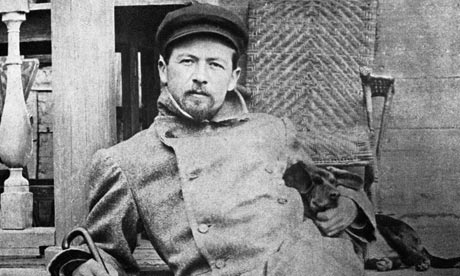
One of the few books I own is a collection of few of Chekov's plays. His plays are not merely theatre, but are profound discussions of humanity and everyday life.
In an essay in the Chronicle Review, almost ten years ago, in which I discussed the wastefulness and pretentiousness of most of the academic "research," I quoted from Anton Chekov's "Uncle Vanya." In that play, Vanya goes after the professor:
"All our thoughts and feelings pertained to you alone. Our days were spent talking of you and your work, we were proud of you, we uttered your name with reverence, our nights were wasted reading books and magazines for which I now have the deepest contempt! ... But now my eyes have been opened! I see everything! You write about art, but you understand nothing of art! All your works, which I used to love, are not worth a copper kopeck. You've swindled us!"
Chekov always has a simple way of saying things that are profound. I then wrote:
The passage from Uncle Vanya reminded me of the public, whose taxes make it possible for universities like mine to exist. Would people be disillusioned if they knew that only a few of professors' publications are ever read by more than a handful of other scholars? Would people be disappointed in higher education if they realized that most academics' publications would not sell even for a penny? Would people agree with Uncle Vanya that professors who write but are rarely read and cited are swindlers? Could it be that people already grasp the truth, and that their knowledge is one cause of the decline in the prestige our society accords to faculty members? If I did not teach at a university, would I agree with Uncle Vanya?
Life has never been the same ever since Chekov's Uncle Vanya helped crystallize the thoughts that had been fuzzy up until that point. (Though, this approach to research and higher education, and a generally disgusted feeling towards the pretentious faculty colleagues, doesn't help me in the real world!)
The Guardian features an essay about Chekov and his plays, on the occasion of his 150th anniversary of his birth. (ht)
his stories are full of people who espouse views very similar to the above – enlightened misfits, philanthropic gentry, civilised professionals (often doctors like himself) holding a candle for reason, justice and all the rest.
The author then notes:
There had been sceptics, agnostics, doubters, questioners of every kind before Chekhov, but perhaps no writer in whom the utter mysteriousness of existence was felt so deeply, or counterpoised by such inexhaustible interest in the teeming variety of forms – human and otherwise – in which it manifests itself. To have found a way of expressing both, with such profligate inventiveness and such apparent ease, was, above all else, the mark of Chekhov's genius; his unsurpassed greatness as a teller of stories.
One surprise: none of the authors' names suggest a South Asian origin, which is a rare occurrence these days in fiction in the English language that qualifies for this prize :) "The judges will now reread the longlist, name a shortlist of six on 7 September and reveal the winner on 12 October."
The Booker longlist in full (click the title to read a review): Parrot and Olivier in America by Peter Carey (Faber and Faber)
Room by Emma Donoghue (Pan MacMillan - Picador) The Betrayal by Helen Dunmore (Penguin - Fig Tree) In a Strange Room by Damon Galgut (Grove Atlantic - Atlantic Books)
The Finkler Question by Howard Jacobson (Bloomsbury) The Long Song by Andrea Levy (Headline Publishing Group – Headline Review)
C by Tom McCarthy (Random House - Jonathan Cape) The Thousand Autumns of Jacob de Zoet by David Mitchell (Hodder & Stoughton - Sceptre) February by Lisa Moore (Random House - Chatto & Windus) Skippy Dies by Paul Murray (Penguin - Hamish Hamilton) Trespass by Rose Tremain (Random House - Chatto & Windus) The Slap by Christos Tsiolkas (Grove Atlantic - Tuskar Rock) The Stars in the Bright Sky by Alan Warner (Random House - Jonathan Cape)


 ... now, I wasn't teaching any fiction-writing class; it was one of the ways in which I attempted to convey to students how to do research, how to write, how to think through ... That was the only time I used this book by Llosa because it was quickly clear to me--much to my disappointment--that not one student cared about it ...
 .
. . The short sentences, particularly to describe the intensity of emotions felt by the characters, must have been quite revolutionary in literature for the time period that this was written. But then, I am biased--I have always preferred short stories to novels, and short sentences over the multi-line sentences in Charles Dickens' works!