Showing posts with label retail. Show all posts

Monday, May 22, 2017

What's the price of retail jobs?

The pussygrabber ranted on and on about jobs in the coal mines, as if he knew anything about the industry or the people who work.  But, 63 million suckers voted for him anyway!

If only his voters had paid attention to the real world, they would have been worried about an entirely different industry: "The retailing industry employs 15.9m people, accounting for one in nine American jobs."

The retail industry is shedding jobs, and closing stores, are frightening speeds:
 Since January the industry has shed 50,000 jobs, with more lay-offs sure to come. Mr Mathrani reckons that, for shopping centres to match demand, 30% of space should close permanently. In one particularly gloomy scenario, all retail property would shrink by as much. If staff dropped by the same proportion, 4.8m would be at risk of the sack—around half the number of American jobs lost during the financial crisis. Eventually, even more may be laid off, as remaining stores cut costs through automation.
Did you notice that "a" word?  Automation!
The result is that America’s rich landscape of shops now looks like a dangerous glut. Since the start of 2016 Macy’s has announced that it is closing 140 shops. J.C. Penney said in March that it would shut 138. More closures are sure to come. Department stores’ floor space has contracted by 11.5% since 2006, but sales have shrunk more than twice as fast, according to Green Street Advisors, a real-estate research firm (see chart 2). To reach the inflation-adjusted sales productivity of 2006, at least another 800 department stores would need to close, reckons D.J. Busch at Green Street.
In the world of politics, it is coal that translates to diamond when it comes to votes:
This slow melt has so far attracted little attention from politicians, despite jobs in retailing outnumbering those in coal mining, which has caught the political eye, by a factor of 300.
Meanwhile, automation in retailing is taking on another fundamental aspect of the transaction: price.
The right price—the one that will extract the most profit from consumers’ wallets—has become the fixation of a large and growing number of quantitative types, many of them economists who have left academia for Silicon Valley.
Yep, "the right price can change by the day or even by the hour" thanks to automation, which is killing the real world stores:

Guru Hariharan uncapped a dry-erase marker in a conference room at Boomerang’s headquarters in Mountain View, California. He was talking about what had led retailers to this desperate place where it’s necessary to change prices multiple times a day. On a whiteboard, he drew a series of lines representing the rising share of online sales for various kinds of products (books, DVDs, electronics) over time, then marked the years that major brick-and-mortar players (Borders, Blockbuster, Circuit City and RadioShack) went bankrupt. At first the years looked random. But the bankruptcies all clustered within a band where online sales hit between 20 and 25 percent. “In this range, there’s a crushing point,” Hariharan said, clapping his hands together for emphasis. “There’s a bloodbath happening.”
Beyond this crushing point, traditional retailers with both a brick-and-mortar and an online presence feel compelled to compete purely on price. Hariharan talked wistfully of the days when he’d walk into RadioShack and have a salesperson direct him to the exact connector cable he needed. But once retailers enter the crushing zone, expenses like staff, training, and customer support typically are slashed. Profit margins keep falling nonetheless—why go to the store at all if no one there can help you?—and a death spiral ensues. (RadioShack traced just this path before filing for bankruptcy in 2015.)

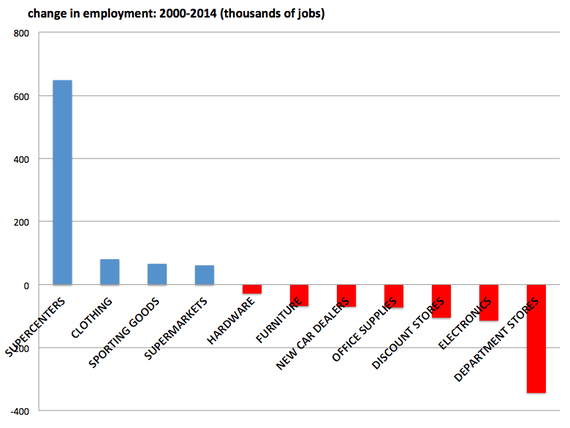
Yet, the pussygrabber always talks about those few thousand coal mining jobs?

Saturday, April 08, 2017

Let them eat cakes!

Most students work part-time, unlike my story when I was an undergraduate student.  In contrast to these students, I was an idle, good for nothing, bum.  I wasted away my time bullshitting with other students.  My parents paid for my tuition and living expenses.  Hey, at least I didn't waste money on alcohol and movies and cigarettes!

With my students, I am always worried that they are doing too many things with the hope that a real and well-paying awaits once they graduate.  In one-to-one conversations, I don't bluntly burst that bubble that is the well-paying job--I do that in the group therapy sessions called classes.  

Last term, a student walked in about five minutes late for a meeting with me.  I gave her time to settle down.  I slowly asked her, "you looked frazzled today."

"I just need more time to sleep," she replied.  "After I graduate, with no school anymore, at least I will be able to sleep more," she added.

At least she has a part-time job for now, in contrast to another student who told me that she was finding it difficult to land any part-time retail job.  "I have always been an excellent student, and I am reasonably good with communications, and yet nothing."  She was frustrated.  I told her about yet another student who was working at a retail store and how I told her to hang on to it because the retail industry is being decimated at a rapid rate.

Forever, I have been talking and writing about the destruction of the retail business here in the US.  It was clear to us ever since we started using the word e-commerce back when the web was still in its infancy.  Brick and mortar would be killed by click and order.  Bookstores were pretty much the first to be caught in this, and then every kind of retail business.  The latest news is more along these lines:
The battered American retail industry took a few more lumps this week, with stores at both ends of the price spectrum preparing to close their doors.
At the bottom, the seemingly ubiquitous Payless Inc. shoe chain filed for bankruptcy and announced plans to shutter hundreds of locations. Ralph Lauren Corp., meanwhile, said it will close its flagship Fifth Avenue Polo store -- a symbol of old-fashioned luxury that no longer resonates with today’s shoppers.
And the teen-apparel retailer Rue21 Inc. could be the next casualty. The chain, which has about 1,000 stores, is preparing to file for bankruptcy as soon as this month, according to people familiar with the situation. Just a few years ago, it was sold to private equity firm Apax Partners for about a billion dollars.
People click their orders on Amazon.com (and a gazillion other sites) and the retail brick and mortar stores go bankrupt.  When businesses go bankrupt, jobs evaporate.
The rapid descent of so many retailers has left shopping malls with hundreds of slots to fill, and the pain could be just beginning. More than 10 percent of U.S. retail space, or nearly 1 billion square feet, may need to be closed, converted to other uses or renegotiated for lower rent in coming years, according to data provided to Bloomberg by CoStar Group.
The blight also is taking a toll on jobs. According to Labor Department figures released on Friday, retailers cut around 30,000 positions in March. That was about the same total as in February and marked the worst two-month showing since 2009.
Those laid off workers now join the competition to find at least part-time work, which makes it next to impossible for students to find the kind of part-time work that was once typically done by students.
Payless is closing 400 stores as part of a bankruptcy plan announced on Tuesday. The mammoth chain had roughly 4,000 locations and 22,000 employees -- more than it needs to handle sluggish demand.
HHGregg Inc., Gordmans Stores Inc. and Gander Mountain Co. all entered bankruptcy this year. RadioShack, meanwhile, filed for Chapter 11 for the second time in two years.
Other companies are plowing ahead with store closures outside of bankruptcy court. Sears Holdings Corp., Macy’s Inc. and J.C. Penney Co. are shutting hundreds of locations combined, reeling from an especially punishing slump in the department-store industry.
It is a tough world out there.

Meanwhile, the bullshitting Republicans continue to tell people that they should pull themselves up by their bootstraps.  Very rarely do students have bootstraps like the ones my parents gave me for them to pull themselves up!  

Friday, February 06, 2015

Does grammar matter at work? Depends!

"They don't told us where it's at" she said.

Grammar depends on the context.

If a teacher had said that, well, you know you never ever want to be in that educational setting.  The ungrammatical sentence didn't come from a teacher.  In fact, not from a student either.  If it had been a student, I would have suffered that obsessive compulsion to correct that person.

It was at a retail establishment.  A place that is not for the white-gloved.

I am happy that there are such places where people have jobs.  Not all of us have the capabilities or the interest to be investment bankers or teachers or politicians.  To quote from Caddyshack, the world needs ditch-diggers too.

But, even those jobs are evaporating.

source

There's something happening here.
You don't need a long explication to see what's going on here. Walmart brought ruthless efficiency to the business of selling stuff in stores, and Amazon brought more ruthless efficiency to the business of selling stuff anywhere, so that today, to be a retail salesperson or cashier—still the two most common jobs in America—is to compete with the convenience of a laptop and a couch (or, even worse, a smartphone search filling a spare moment of boredom). As Radio Shack's story shows, when companies go to war against price and convenience, they tend to lose—first go the jobs, then goes the company. ... There is little reason to think that the most important employment engine of the 20th century will continue to pump through the 21st. The future will be cheap, and it will be convenient, but much of it will lose the personal touch of, well, people.
Even as those jobs are evaporating, the chances are that the ones that remain don't pay well.
Though unemployment has finally dipped below six per cent, real wages for most have barely budged since 2007. Indeed, the whole century so far has been tough: wages haven’t grown much since 2000.
Sometimes, I wonder how people make the proverbial ends meet.  And every time I have such encounters, I can't but think it is crazy for the well-heeled like me to ask for raises and for more benefits.

But, of course, those in my earnings bracket aren't comparing themselves to that ungrammatical retail person but to the investment bankers and CEOs.
corporate America, if not the rest of the economy, has done just fine over the past five years. It’s that all the rewards went into profits and executive salaries, rather than wages.
I don't care about my raise.  But, I am pretty darn certain that executives can easily forego a few dollars in order to ensure that the ungrammatical retail person gets to go home with a few more dollars.  Is it possible?  Yes, at least in one company, apparently:
Aetna’s C.E.O., Mark Bertolini, announced that the company’s lowest-paid workers would get a substantial raise—from twelve to sixteen dollars an hour, in some cases—as well as improved medical coverage. Bertolini didn’t stop there. He said that it was not “fair” for employees of a Fortune 50 company to be struggling to make ends meet. He explicitly linked the decision to the broader debate about inequality, mentioning that he had given copies of Thomas Piketty’s “Capital in the Twenty-first Century” to all his top executives. “Companies are not just money-making machines,” he told me last week. “For the good of the social order, these are the kinds of investments we should be willing to make.”
The lowest paid get raises and executives got copies of Piketty's book.  How fascinating!

Sometimes, an extra effort is needed to make sure that a rising tide will lift not only the yachts but also the rafts and the catamarans--wherever they are floating "at."

Source

Thursday, November 13, 2008

The mall is dead. Really? Wow!

Newsweek:
[The] American mall—that most quintessential of American institutions—is in its dying throes, if not already dead. Moribund malls have not gone unnoticed amongst industry analysts and Web sites like Deadmalls.com that feature photos of hundreds of now-abandoned sites. But what were once just worrying signs appear to have finally flat-lined. Last year was the first in half a century that a new indoor mall didn't open somewhere in the country—a precipitous decline since the mid-1990s when they rose at a rate of 140 a year, according to Georgia Tech professor Ellen Dunham-Jones, coauthor of the forthcoming book "Retrofitting Suburbia," which focuses on the decline of malls and other commercial strips. Today, nearly a fifth of the country's largest 2,000 regional malls are failing, she says, and according to the International Council of Shopping Centers, and a record 150,000 retail outlets, including such mall mainstays as the Gap and Foot Locker, will close this year.