Showing posts with label thinking. Show all posts

Sunday, March 24, 2019

Learn to embrace uncertainty

In graduate school, it seemed like the faculty expected me to go the quantitative route, because of my background in electrical engineering. Statistical modeling and, more importantly, GIS, which was in its infancy back then.

I couldn't care about those data-based inquiries.

Because, I was convinced that the human condition that I was interested in learning and thinking about was beyond mere data.  Further, I even made fun of how the data were used in the publish-or-perish academic culture: Faculty and students were more often than not playing with data and seeing if anything would come out of it, instead of thinking through the issues and then using the data.

As with everything else, I chose the losing route.

Graduate students who specialized in data-based research techniques and GIS moved on to good jobs in academia and outside.  I struggled to find a job!

I did continue to criticize the publish-or-perish culture that encouraged fooling around with data and statistical software, which was getting to be more and more sophisticated.  All these were before "big data."

I now feel vindicated.  Phew!

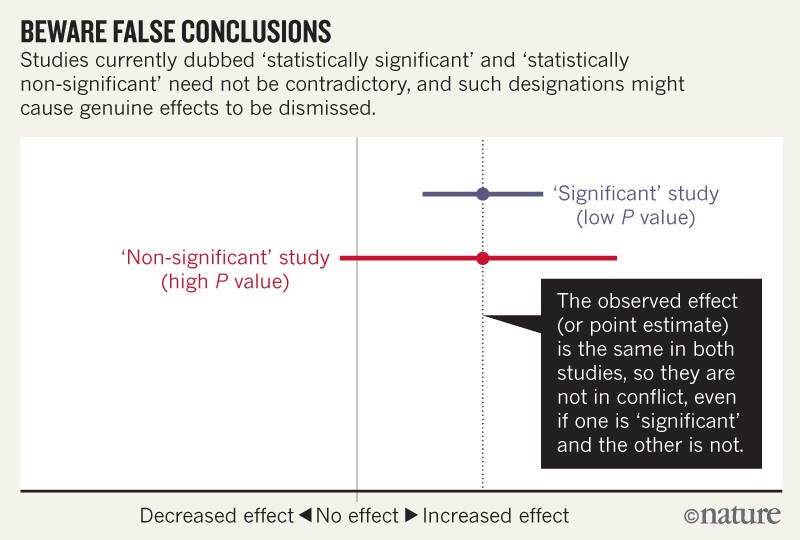
Pissed off scientists have risen up in their opposition to the abuse of statistical significance:
Source

The authors--"more than 800 signatories"--want researchers to quit categorizing:
The trouble is human and cognitive more than it is statistical: bucketing results into ‘statistically significant’ and ‘statistically non-significant’ makes people think that the items assigned in that way are categorically different ...
On top of this, the rigid focus on statistical significance encourages researchers to choose data and methods that yield statistical significance for some desired (or simply publishable) result, or that yield statistical non-significance for an undesired result, such as potential side effects of drugs — thereby invalidating conclusions.
Note how they phrased it? "encourages researchers to choose data and methods that yield statistical significance for some desired (or simply publishable) result" is exactly what I did not find appealing back in graduate school!

More from the authors:
The objection we hear most against retiring statistical significance is that it is needed to make yes-or-no decisions. But for the choices often required in regulatory, policy and business environments, decisions based on the costs, benefits and likelihoods of all potential consequences always beat those made based solely on statistical significance.
Exactly!

And even more important is this point from the authors on what will happen if we got rid of our focus on statistical significance:
Decisions to interpret or to publish results will not be based on statistical thresholds. People will spend less time with statistical software, and more time thinking.
More time thinking.  What a concept!

Tuesday, February 12, 2019

Why read!

Whether it is a department meeting, or a session at an academic conference, there is always something to process, for which I need to be engaged.  For this, I take with me a notebook and a pen.  I occasionally jot things down--not merely those on which I need to follow up on later, but whatever comes across as new to me.  I don't transcribe the proceedings; what I note down are the ones that I want to make sure I commit to my understanding.

Blogging, and serious reading, are along the same lines.  Even if I were not an academic--oh, thank heavens I am one!--I suppose this would have been my MO. 

It was, therefore, exciting that my approach found at least one audience, who commented: "I have decided to read like you - making notes and keeping them for reference in a blog or a Word file - like signposts."  Yes, like signposts.

A few years ago, I blogged about the pleasure of slow reading and thinking, and I had included there this wonderful graphic:

Source

Treat reading like an exercise, even when it is for pleasure.  And, yes, choose a printed book.  A few years ago, my daughter thought she would help me out by gifting me a Kindle.  I gave it a try, but could barely read through even a few pages.  I abandoned it.

That post was six years ago, when distractions were fewer, compared to now.  Since then, I have abandoned Facebook, and made sure to never ever sign up for WhatsApp and all other apps.  Time extends before me, like how it used to in the past.  Reading is wonderfully possible even in this age of constant and annoying distractions, which are also designed to be addictive.
We know perfectly well—we remember, even if dimly, the inward state that satisfies more than our itching, clicking fingers—and we know it isn’t here. Here, on the internet, is a nowhere space, a shallow time. It is a flat and impenetrable surface. But with a book, we dive in; we are sucked in; we are immersed, body and soul.
When you do sit down to read, do not read them all at once.  If you do, then the chances are that you won't remember any damn thing later; all you will have done is kill time! 

Sunday, October 08, 2017

"The art of remembering is the art of thinking."

A few days ago, I was taking a quick walk on campus, after my lunch and prior to my class.  I heard a student yell out my name from the car that was passing by.  I looked at the car.  The driver stopped the vehicle and rolled down the window.

"I didn't expect to see you here, Jessica,"

We talked for a few minutes.  She was one of the more self-motivated and smart students I have met in this university.  It has been six years since she graduated.  I inquired about her sister and her nephew and her husband. "You have a steel-trap mind," she said.

Fortunately, yes.  I pay attention to important things in life, and they register in my memory.  (I know I am setting myself up for the flip side of this: I am bound to insult somebody when I do not remember the details that are important to them, right?)

Apparently remembering is becoming even more challenging for people because of one particular development: Smartphones.  They are hijacking our minds!
Now that our phones have made it so easy to gather information online, our brains are likely offloading even more of the work of remembering to technology. If the only thing at stake were memories of trivial facts, that might not matter. But, as the pioneering psychologist and philosopher William James said in an 1892 lecture, "the art of remembering is the art of thinking." Only by encoding information in our biological memory can we weave the rich intellectual associations that form the essence of personal knowledge and give rise to critical and conceptual thinking. No matter how much information swirls around us, the less well-stocked our memory, the less we have to think with.
But, of course.  Duh!  This is exactly what I have been telling students (and anybody who asks me about this) for a few years now.  In my intuitive understanding, we need to keep working the brain and its memory functions.  However, this is not about memorizing per se.  Just as fluency with the English language is not about memorizing words in the dictionary.  All these help us think, and think clearly.

It gets even worse:
It turns out that we aren't very good at distinguishing the knowledge we keep in our heads from the information we find on our phones or computers. As Dr. Wegner and Dr. Ward explained in a 2013 Scientific American article, when people call up information through their devices, they often end up suffering from delusions of intelligence. They feel as though "their own mental capacities" had generated the information, not their devices. "The advent of the 'information age' seems to have created a generation of people who feel they know more than ever before," the scholars concluded, even though "they may know ever less about the world around them."
You can see how we were ripe for the Russian fake news campaign that gave us the fascist, who turns around and calls all the real news as "fake news."

So, what can you do?  You can read that entire WSJ essay by Nicholas Carr, whom I have cited many times before.  Or, you can do what I have been suggesting for years: Keep that smartphone away from you as much as you can.
When we constrict our capacity for reasoning and recall or transfer those skills to a gadget, we sacrifice our ability to turn information into knowledge. We get the data but lose the meaning. Upgrading our gadgets won't solve the problem. We need to give our minds more room to think. And that means putting some distance between ourselves and our phones.
Not only will that help you think clearly, it will also reduce quite a bit of angst that the smartphones give the users.  Because, our brains are wired to be hijacked, and it is our responsibility to protect our brains that can then serve us well:
Scientists have long known that the brain is a monitoring system as well as a thinking system. ...
But even in the history of captivating media, the smartphone stands out. It is an attention magnet unlike any our minds have had to grapple with before. Because the phone is packed with so many forms of information and so many useful and entertaining functions, it acts as what Dr. Ward calls a "supernormal stimulus," one that can "hijack" attention whenever it is part of our surroundings -- which it always is. Imagine combining a mailbox, a newspaper, a TV, a radio, a photo album, a public library and a boisterous party attended by everyone you know, and then compressing them all into a single, small, radiant object. That is what a smartphone represents to us. No wonder we can't take our minds off it.
Seriously, have I not been saying and writing these through all these years that you have been listening to me and reading my blog?  You don't remember? ;)

Wednesday, June 14, 2017

I mean, think about this!

One of my big problems is this: I can't figure out how to shut the thinking off.  Even worse, because I think about things a lot, I am always shocked that most people don't think.  So much so that I cannot even imagine what not-thinking means!

I recall that when I was in high school, I read somewhere that if a person spent even ten minutes a day thinking, well, the world decided that the person was a philosopher.  That was back then.  Before the web, before Instagram, before trump.  Now, it has gotten worse;  "we live in a culture of thoughtlessness":
The American Time Use Survey found that although 95 per cent of respondents said that they did at least one leisure activity during the previous 24 hours, 84 per cent had spent no time at all relaxing or thinking.
If people are so thoughtless, I suppose we can retire the old saying, "a penny for your thoughts" ;)

So, what if we forced people to think?
A recent study by psychologists at the University of Virginia asked subjects to simply sit in a room and ‘just think’ for 6 to 15 minutes.
Sounds like a great idea to me.  Of course, students are forced to sit in my classrooms for much more than that.  I wonder now how the test subjects reacted.
In the room was a button allowing subjects to electrocute themselves if they wanted.
You can already see where this is going, right?   Will they prefer to sit quietly and think, or will they instead prefer to shock themselves?
The researchers found that the majority of subjects would rather electrocute themselves than just sit quietly and think. One person electrocuted himself 190 times during this short period.
Ouch!

These days, you rarely see humans pondering about something when they are in the public.  It is almost as if we have become afraid of being left to our own selves.
The vast army of electronic devices surrounding us has proven an able ally to our fear of thinking. Only a decade or two ago, everyday life held many small parcels of time in which we would be marooned with our thoughts: queuing, sitting on public transport, idling in a traffic jam, or even just waiting for a friend. Today, the first thing people do when faced with a moment of downtime is to reach for their smartphone. A study by the market research agency Harris Interactive in 2013 found that we use our smartphones when walking down the street, watching films, or while in places of religious worship; 12 per cent admitted to using their phone while taking a shower; 9 per cent had checked their smartphone during sex.
What are they checking their smartphones for when having sex?  Maybe checking the work email when having sex is a turn on for them, eh!

When stopped at traffic intersections, I rarely see drivers these days who are looking up and ahead.  Instead, it is all about the smartphone, as if in that 45 seconds some earth-shattering decision will have to be made by these drivers!

I, on the other hand, need to get out of my head, and live a little! ;)


Tuesday, January 17, 2017

Nero to succeed Marcus Aurelius!

I know I have been harsh on Barack Obama the President.  As President, Obama always came across to me as a souped up combination of Jimmy Carter and George H.W. Bush.  He seemed to lack the inner drive to go out there and strike deals.  Sometimes,  I even think that this personality trait of his has also contributed to Democrats getting cleaned out not only from the White House and Congress, but--and more importantly--at the state level in the legislatures and governors offices all over the country.

As a person, Obama has been a model human being at the White House.  Like how Carter was, and continues to be after his presidency.  Kids all over the world can--and should--look up to the likes of Obama and Carter and tell themselves, "I want to grow up to be like them."

I am equally proud of the remarkable level of intelligence that Obama has always demonstrated.  An intelligence that is not abrasive nor audacious, but humble.  Kids all over the world can--and should--look up to him and tell themselves, "I want to grow up to be smart like him."

A reader, as much as he is a writer and an orator:
During his eight years in the White House — in a noisy era of information overload, extreme partisanship and knee-jerk reactions — books were a sustaining source of ideas and inspiration, and gave him a renewed appreciation for the complexities and ambiguities of the human condition.
Yes, the complexities and ambiguities of the human condition.

What a contrast to the incoming president who has not for a nanosecond demonstrated anything about "the complexities and ambiguities"; in fact, he has taken to a whole new level the previous Republican president who made it clear that he did not do nuances and that he viewed the world as us-versus-them.

For Obama:
reading gave him the ability to occasionally “slow down and get perspective” and “the ability to get in somebody else’s shoes.”
To get into somebody else's shoes is what empathy is all about.

Not even the incoming president's fanatical bootlickers will think of their Dear Leader as capable of empathy!

Obama reads widely, including fiction:
He points out, for instance, that the fiction of Junot Díaz and Jhumpa Lahiri speaks “to a very particular contemporary immigration experience,” but at the same time tell stories about “longing for this better place but also feeling displaced” — a theme central to much of American literature, and not unlike books by Philip Roth and Saul Bellow that are “steeped with this sense of being an outsider, longing to get in, not sure what you’re giving up.”
In contrast, can you imagine the demagogue having anything substantive to say about Diaz or Lahiri?!  As one reader phrased it in his comments to the NY Times piece:
Like Blunder Woman Sarah Palin, Trumpty Drumpty always struggles to name a single book he's ever read.
Oh, I owe to another commenter at the NY Times the title for this post.

Tuesday, August 23, 2016

Meet General Malaise

The days away from the computer, the internet, Twitter, news, and even the New York Times, turned out to be a wonderful digital detox for Major Buzzkill.  However, rest and recreation does not mean that "thinking" is sidelined.

When "thinking" continues, well, Major Buzzkill always shows up for duty in full gear.

I am so much used to "thinking" that the reality that vast numbers do not engage in thinking amazes me.  I vaguely recall GBS (?) noting that thinking is so much absent in society that if one thinks for even five minutes every day then he is considered to be a philosopher.

Perhaps the fact that we humans have to learn to think is understandable.  After all, we are animals--whatever be the fantastic stories of creation that religions might offer, with stories contradicting each other; try reconciling the Vedic commentary on creation with the narrative from the Old Testament, for instance, and you, too, will begin to transition towards atheism! ;)

As animals, we are more used to reflex and doing what others in our species do, than to act after thinking for ourselves.   Imprinting is how we learn to survive:
Imprinting is a crucial stage of development in many young mammals and birds. Among avians, the process is particularly important for species that are precocial, a.k.a mobile and self-feeding soon after hatching, says Sunny Bettley, wildlife rehabilitation and outreach specialist at Sharon Audubon. Through observation, ducklings must learn to forage and swim in order to survive, Bettley explains. They need to know whom to follow, both in terms of imitating behavior and, more literally, to avoid getting lost. For this reason, wildlife rescuers must be careful about how they approach newborn ducks, she says. “Imprinted wildlife can’t be released into the wild as they won’t know how to properly or effectively find food, be aware of natural predators, or communicate with others of their species. They will not being able to reproduce.” 
Thinking requires us to go above and beyond the animal instincts.  In one of the essays that we were assigned in high school, Isaac Asimov reminded me that thinking and reasoning are new for us humans.  Maybe thirty years after reading that essay I am expecting way too much when I want my fellow humans to be thinking beings?

Over light-hearted discussions on some serious issues during the "time off," I did a full disclosure as a preface to my views: "My alter ego's name is Major Buzzkill, who brings to discussions a clear bottom-line of 'you are screwed.'"

Without even pausing, he chimed in a response.  "You have been promoted.  You are now General Malaise."

I imagine going to a meeting of Thinking Anonymous.  When it is my turn, I stand up.  "Hello, my name is General Malaise."  The others flee from the meeting ;)

BTW, given that thinking is my chosen profession, my work, if I think even when vacationing, does it mean that the past few days were a working vacation? ;)

Monday, September 21, 2015

Trigger warning: I always prefer more speech, not enforced silence

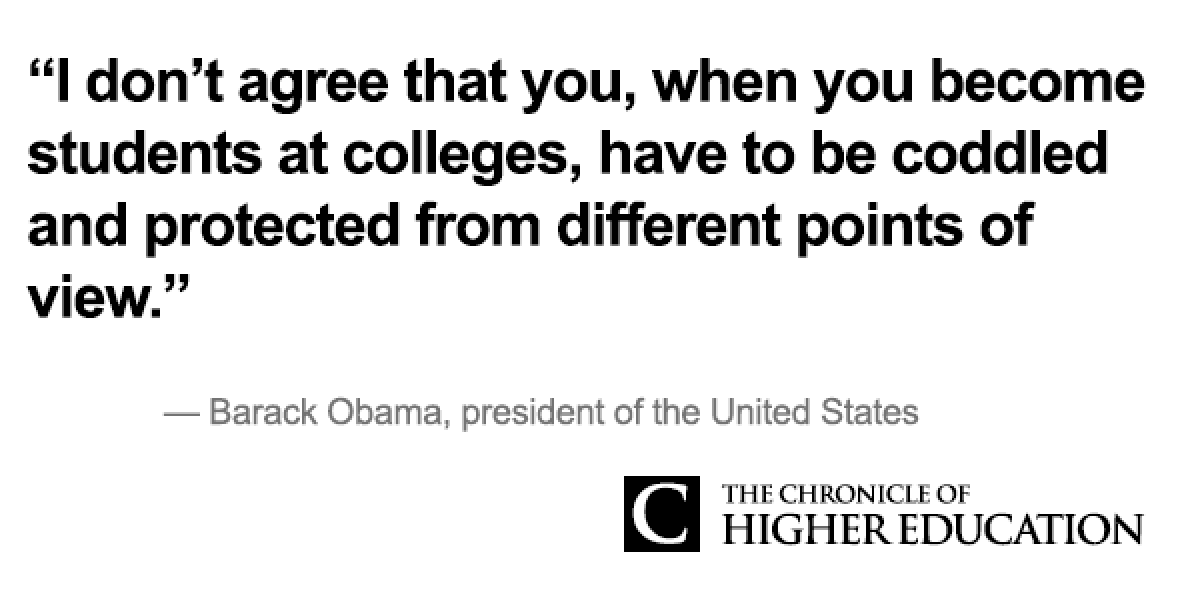
A few days ago, a tweet from the Chronicle of Higher Education included a quote:
Source
Obama's comments included issues like this one that I have blogged about.  He added:
Anybody who comes to speak to you and you disagree with, you should have an argument with them. But you shouldn’t silence them by saying you can’t come because I’m too sensitive to hear what you have to say. That’s not the way we learn, either.
Of course, it generated constructive comments and also brought out the trolls.  Thanks to one of those comments, I looked up the paragraph in an opinion by Justice Brandeis, who was the first Jewish member of the US Supreme Court:
 To courageous, self-reliant men, with confidence in the power of free and fearless reasoning applied through the processes of popular government, no danger flowing from speech can be deemed clear and present unless the incidence of the evil apprehended is so imminent that it may befall before there is opportunity for full discussion. If there be time to expose through discussion the falsehood and fallacies, to avert the evil by the processes of education, the remedy to be applied is more speech, not enforced silence.
That Supreme Court opinion was in 1927!  Almost 90 years ago!!!

Rest assured that this not yet another post on the maniacs who have messed up what could have been an even more enjoyable career in higher education.  This post is about how the higher education "establishment"--especially the student life bureaucracy--is leading students down the path of enforced silence, which is what Obama's comment is about.

Glenn Reynolds has more to say in the context of Obama's comments:
College isn’t supposed to be about having our prejudices reinforced. It’s supposed to be about learning how to think about ideas, and even to change one’s mind in the face of new arguments and evidence.
It’s also about learning to address ideas one doesn’t agree with. As Aristotle said, “It is the mark of an educated mind to be able to entertain a thought without accepting it.” You can’t do that if you’re not willing even to hear unacceptable thoughts.
I suppose such a perspective to engage in discussion of ideas is not always welcomed.  Yet, I continue to seek that kind of an engagement, even in professional matters.  A recent email that I sent to the provost of the university, included the following lines:
 I don't see any evidence out there to convince me otherwise.  To borrow from John Maynard Keynes, I will change my opinion if the facts change.
I am not holding my breath; I know all too well that the provost will not reply.

I am really, really, tempted to include the following in the syllabi for my courses:
Trigger Warning: This course will force you to think!
Oh well!

Thursday, January 22, 2015

What I have lived for ... is to stay away from savants?

I know for sure that this guy will agree with the following quote:
I've made an odd discovery. Every time I talk to a savant I feel quite sure that happiness is no longer a possibility. Yet when I talk with my gardener, I'm convinced of the opposite.
That put down of the savant was by one of the greatest thinkers in modern times: Bertrand Russell.  This pretentious thinker agrees with Russell.  Which is why, for instance, I avoid faculty meetings ;)

In  the prologue to his autobiography, Russell wrote:
Three passions, simple but overwhelmingly strong, have governed my life: the longing for love, the search for knowledge, and unbearable pity for the suffering of mankind. These passions, like great winds, have blown me hither and thither, in a wayward course, over a great ocean of anguish, reaching to the very verge of despair.
I have sought love, first, because it brings ecstasy - ecstasy so great that I would often have sacrificed all the rest of life for a few hours of this joy. I have sought it, next, because it relieves loneliness--that terrible loneliness in which one shivering consciousness looks over the rim of the world into the cold unfathomable lifeless abyss. I have sought it finally, because in the union of love I have seen, in a mystic miniature, the prefiguring vision of the heaven that saints and poets have imagined. This is what I sought, and though it might seem too good for human life, this is what--at last--I have found.
With equal passion I have sought knowledge. I have wished to understand the hearts of men. I have wished to know why the stars shine. And I have tried to apprehend the Pythagorean power by which number holds sway above the flux. A little of this, but not much, I have achieved.
Love and knowledge, so far as they were possible, led upward toward the heavens. But always pity brought me back to earth. Echoes of cries of pain reverberate in my heart. Children in famine, victims tortured by oppressors, helpless old people a burden to their sons, and the whole world of loneliness, poverty, and pain make a mockery of what human life should be. I long to alleviate this evil, but I cannot, and I too suffer.
This has been my life. I have found it worth living, and would gladly live it again if the chance were offered me.
It will be extremely hard to discount the importance of those three that were Russell's passions.

Source

It is a wonderful reminder that giants like Russell have paved the very path that I travel.  How foolish of me to even think that I am traveling a road that is not taken!

As I ease into the final third of my life, looking back at the years that have gone by, I, too, would gladly live it again and take those same paths.  Of course, there have been disappointments and frustrations along the way.  But what is life without them!


Tuesday, January 20, 2015

The big question of the year is on ... the machines that think

No, not my question.  Though, I have obsessed enough over it, even right here in this blog.

It is Edge's annual event--the big question for the year.  For 2015, it is: What do you think about machines that think?

As always, it is an impressive lineup of thinkers who respond to that question.  The ideas there are way more than my limited understanding capacity can handle.  So, I picked my way through that intellectual smorgasbord.

I decided that I would read contributions from non-white males.  Why?  This is a field that has been the domain of white males.  Slowly females and other males are cracking through it all and, thus, I figured it might be interesting to read their perspectives.

Even that was one too many people.  I figured I would develop another filter based on the names that I read: there were two Marias and one Mary.  So, hey, responses by three Marys.  There was one Indian name; so, of course, yes to that.  And then one of my all-time favorite polymaths ever: Freeman Dyson.

I had a game plan.  I went in.

First up, the Indian, Satyajit Das, a "former banker."
I read his piece, re-read it, and wondered why he was in the lineup.  A rambling, broad, blah response.

Will Mary save me?
Nope. More blah!

I bet that this Maria will have something profound; after all, I have often read her blog-posts and they have always been insightful.
Thinking is not mere computation—it is also cognition and contemplation, which inevitably lead to imagination. Imagination is how we elevate the real toward the ideal, and this requires a moral framework of what is ideal. Morality is predicated on consciousness and on having a self-conscious inner life rich enough to contemplate the question of what is ideal.
The famous aphorism often attributed to Einstein—"imagination is more important than knowledge"—is thus only interesting because it exposes the real question worth contemplating: not that of artificial intelligence but that of artificial imagination.
Of course, imagination is always "artificial" in the sense of being concerned with the un-real or trans-real—of transcending reality to envision alternatives to it—and this requires a capacity for holding uncertainty. But the algorithms that drive machine computation thrive on goal-oriented executions, in which there is no room for uncertainty—"if this, then that" is the antithesis of the imagination, which lives in the unanswered and often, vitally, unanswerable realm of "what if?" As Hannah Arendt once wrote, to lose our capacity for asking such unanswerable questions would be to "lose not only the ability to produce those thought-things that we call works of art but also the capacity to ask all the answerable questions upon which every civilization is founded." 

Score!

Off to the other Maria then.  What does the Caltech professor has to say?
I for one, am more concerned about humans who drop thinking or are brainwashed, than smart thinking machines taking over.
I, too, worry about humans who are ready and willing to be brainwashed and do not care to think for themselves.  Go on, professor.
 I foresee the emergence of hybrid human-machine chimeras: human-born beings augmented with new machine abilities that enhance all or most of their human capacities, pleasures and psychological needs. To the point that thinking might be rendered irrelevant and strictly speaking unnecessary. That might provide the ordinary thinking humans a better set of servants they have been looking for in machines. 
Oh, no!  This is the kind of a scenario that worries me.

Finally, Freeman Dyson.  I can always count on him to be clear and direct.  No blah. No unnecessary qualifiers.  No hedging.  A wonderful thinker.  Will he let me down?  I hope not.

Turns out that Dyson had the shortest response of all, which I provide you in its entirety:
I do not believe that machines that think exist, or that they are likely to exist in the foreseeable future. If I am wrong, as I often am, any thoughts I might have about the question are irrelevant.
If I am right, then the whole question is irrelevant.
Awesome!  I knew that they guy would be direct.  Maybe two generations from now, we will find out Dyson was way wrong.  I don't care.  I love the way he clearly articulates his thoughts based on a remarkable knowledge-base.

Here's to hoping that "nature cannot be fooled."

By now, you know where this is from, right?

Thursday, August 28, 2014

Peripatetic Pedant Professes: These feet are made for walking

The day warmed up in a big hurry.

I wimped out of walking when the iPhone reported it was 81 outside.  "Maybe I will walk in the evening" I told myself as I tried to work on the syllabi for the new academic year that will begin soon.

Evening came.

It was a freaking 91 degrees even at  half-past-six.

I was left with only one option: walking canceled.

The day felt incomplete.

So, of course, a pretentious post on walking is the result!

This New Yorker essay, which notes that "people are made for walking, but we are not very good at it" includes extensive commentary on Frédéric Gros' A philosophy of walking:
The purpose of walking, he tells us, is not to find friends but to share solitude, “for solitude too can be shared, like bread and daylight”; the philosopher Kant’s life “was as exactly ruled as music manuscript paper”; when walking, the body “stops being in the landscape: it becomes the landscape.”
I like that interpretation.  To share solitude, with the river and the birds and the trees, and smiling--and the rare unsmiling--humans.  Well, even with those damn bugs.
Contemplative walking is Gros’s favored kind: the walking of medieval pilgrims, of Jean-Jacques Rousseau and Henry David Thoreau, of Kant’s daily life. It is the Western equivalent of what Asians accomplish by sitting. Walking is the Western form of meditation: “You’re doing nothing when you walk, nothing but walking. But having nothing to do but walk makes it possible to recover the pure sensation of being, to rediscover the simple joy of existing, the joy that permeates the whole of childhood.”
I do wonder whether this view of life is a male perspective.  The stereotypical male is more comfortable with the solitude in many, ahem, walks of life than the typical females who are social even when it is about going to the restroom.  In any case, it works for me as a male.

I checked the weather app.


All clear to share solitude with the river--today, and for quite a few days more too.

Friday, August 22, 2014

We are all responsible for the drought in California?

Cogito, ergo sum is one that has been a wonderful guiding philosophy for me ever since I came across that.  (No, it was not in a Latin class, my friend!)  I often remark to students that education is all about thinking.  Thinking almost always challenges out gut instincts, which will not only make us a tad uncomfortable but force us to view the world in completely different ways.

But then thinking is hard work.  When students parrot statements condemning GMO food, or WalMart, or even the virtues of locavore as helping the local economy, it worries me very little.  They are, after all, in the process of figuring out how to think through.  I then prompt them with questions.  It is like the typical response we all received from our mothers throughout most of our childhood: "what were you thinking?" but without the judgmental tone.  Hmmm..., and then I wonder why enrollment in my classes has been on a decline! ;)

When I came across a Facebook comment, made perhaps in a lighter vein, that the ice-bucket-challenge was a waste of water, I was tempted to point out that the ice-bucket-challenge was a mere, ahem, drop in the ocean of wastage.  But, I did not, because Facebook is not really about serious discussions.  I have my blog for that! ;)

Vox.com provides a logical way to think through how we use water, and compares it with the gallon used in the ice-bucket-challenge:

source

The Slate piece that the chart is based on is not about the ice-bucket itself but a related water story--on how so much bottled water is exported out of California, which has been experiencing a terrible drought.
On Monday, Mother Jones produced this set of viral maps showing that most of the country’s bottled water comes from California, which just so happens to be in the midst of an epic, soul-crushing drought.
Barring a tropical storm or other variety of apocalypse, there is really no reason to ever buy bottled water. Bottled water is expensive, and it’s wasteful. But truthfully, exporting bottled water across state lines contributes an incredibly tiny amount to California’s annual water loss. You should never buy bottled water, but it’s because of the plastic, not because it’s making California’s drought worse.
Our gut instincts might tell us that exporting water from a state that has a serious water shortage is the worst thing Californians can do.  Which is where our gut instincts are wrong.  Not because exporting bottled water is wrong--it is wrong because of the plastic, as the article notes, and not because of the water itself.  What is the reality that challenges our gut instincts?
According to the bottled water industry, Americans consume about 30 gallons of bottled water per capita, each year. That may sound like a lot, but you’d do more to stem California’s drought by forgoing a single glass of Napa Valley wine or a single slice of Central Valley cheese. Skipping a single car wash would save more water than two people buy in bottles each year. But here’s the kicker: A single steak dinner uses as much water as almost a lifetime (61½ years’ worth, to be exact) of drinking bottled water. Animal products use so much water mostly because of the inherent inefficiencies of growing hay or grain first, and then feeding it to the animals. Animals raised industrially (not on pasture) are even worse: It takes a lot of water to wash away all the poop that would otherwise just recharge the soil.
Imagine a scene in California: a lovely middle-aged couple having a steak dinner with two glasses of wine and a tomato salad.  And their table also has bottled water.  A typical environmentalist will point only to that bottled water as a crime against nature, when the reality is far from that.

As long as you are checking your "gut" regarding thinking, you might also want to check your real gut:
Since California’s agriculture uses 80 percent of the state’s water anyway, small changes in your diet can go a long way. And since a good chunk of the entire country’s food comes from California, that means you don’t have to be a local to make a difference.
Even if you are a vegetarian--good for your health and for the global environment--and are eating almonds and cheese from California, you have contributed to worsening the state's drought way more than a schmuck does drinking water that was bottled in the Golden State ;)


Wednesday, August 20, 2014

You’ll be safest in the middle

I could not resist the urge.
It was a golden opportunity.
I went for it.

This was the result:
I tell ya, it really doesn't take much to amuse me!

Of course, it is not always about groaners and fart jokes.  And, of course, I don't follow the Scientific American on Twitter for the fun of it, particularly jokes of that kind.  I go there for the real McCoy, like this one on statistics, which notes that "most of us are regularly fooled by the survivor bias."

That is in the monthly column, the title of which will easily explain why I am always drawn to it and its author, Michael Shermer: Skeptic.  It is a no-brainer that I should be a fan of that column, given that I am always questioning anything that my thinking skills allow me to.  (Yes, that skeptical approach lands me in trouble too!)

Back during my California years, a friend, who was openly atheistic in a highly politically and socially conservative setting, gave me as a gift one of Michael Shermer's books: How We Believe: The Search for God in an Age of Science.  Another friend in that same group, who even attended the annual meeting of the Skeptics Society, had a couple of wonderful jokes about religion, like this one:
What is the difference between a religion and a cult?
One hundred years!
Ah, I digress, as I always do.

If only we had more skeptics around, and if only education--especially higher education--helped students think on their own and live productive and fun-filled lives as skeptics!

Perhaps we are a less thinking species than we "think" we are, and have more in common with the sheep, whose behavior we often point to as an example of lack of independent thought.  Or, perhaps, as this critic of William Deresiewicz’s Excellent Sheep notes in recalling his father's comment, our thought is that:
in medio tutissimus ibis

Sunday, May 04, 2014

We need to admit that the required-course college essay is a failure

Every once in a while, I give students in my classes an option to skip out of the required final paper for the class.  No, it is not that they get a freebie.  Instead of the final paper, the option they get to earn the grade is that good old viva voce--oral exam.  A ten to fifteen minutes with me quizzing them in my office.  That's all.

If you ever wanted a demonstration of "faster than a speeding bullet," well, that is how rapidly students negate that offer.  Not even one student is tempted by that offer, it seems.  Ten to fifteen minutes versus a few hours of work and they turn down that offer before I even fully describe it!

Over the years, I have become convinced that the college term paper is an abject failure. Perhaps it works at the Ivies, but I--and the overwhelming majority of us--ain't at one of 'em.  But, of course, the system would easily chuck me out, and there are plenty of colleagues waiting in line to witness that happening, if I were to abandon the requirement of papers when I make abundantly clear that the alternative is even worse, if that is even possible!

I require a lot of writing in the classes that I teach.  No wonder, therefore, that a student has posted this comment at RateMyProfessors.com:
How this class is not a writing intensive class is beyond me. Expect to write 2 pages a week all term with a midterm and final totaling about 7 pages a piece. I received As in every writing class/ Writing intensive class but some how managed only a C+
Thus, there is nothing for me to disagree with the author, Rebecca Schuman, of this essay--from where I borrowed the line for the subject for this post.  Why the preference for the viva voce?
You cannot bullshit a line-ID. Nor can you get away with only having read one page of the book when your professor is staring you down with a serious question. And best of all, oral exams barely need grading: If you don’t know what you’re talking about, it is immediately and readily manifest (not to mention, it’s profoundly schadenfroh when a student has to look me in the face and admit he’s done no work).
At the viva voce, we stare at the reality.  The reality that either one knows or does not.

While Schuman notes that in the context of the required college writing course, the argument is equally applicable to most courses in which we require papers at the end:
We don’t have to assign papers, and we should stop. We need to admit that the required-course college essay is a failure. The baccalaureate is the new high-school diploma: abjectly necessary for any decent job in the cosmos. As such, students (and their parents) view college as professional training, an unpleasant necessity en route to that all-important “piece of paper.” Today’s vocationally minded students view World Lit 101 as forced labor, an utter waste of their time that deserves neither engagement nor effort. So you know what else is a waste of time? Grading these students’ effing papers. It’s time to declare unconditional defeat.
The entire paper-writing is an effing waste of time and effort.  Especially when faculty do not seem to care about giving feedback.

Meanwhile, there is the lure of automatons reading and grading essays.  Fortunately, for people like me, there are a few experts like "Les Perelman, a former director of undergraduate writing at the Massachusetts Institute of Technology," who rage against the machine:
Mr. Perelman’s fundamental problem with essay-grading automatons, he explains, is that they "are not measuring any of the real constructs that have to do with writing." They cannot read meaning, and they cannot check facts. More to the point, they cannot tell gibberish from lucid writing.
With every passing day, the higher education system seems to be more of a failure than it was the previous day.  Yet, all we do is continue to spin the same wheels.  Uninterested students, self-serving faculty and staff, apathetic public who only care about dollars and cents, together make for a horrible combination.  Perhaps it was always like this and I lived in my own bubble.

"Everybody does not get excited with whatever excites you, Dr. Khé" remarked a student in class.  That truthful vocal comment gets a full score in the viva voce!

Wednesday, April 25, 2012

What for is a college education if not to critique?

Glenn Greenwald writes in the context of an UCLA professor running into "trouble" for his views on Israel:
what kind of person goes to an academic institution and then demands to be shielded from political ideas that they find objectionable? Of all places, academia is supposed to permit and encourage the challenging of one’s assumptions and beliefs. At least in theory, that’s the prime value of studying at a university: learning how to think critically, which requires subjecting one’s views to rigorous dispute. 
Yep, one more reason to worry that there is something seriously wrong with how we approach higher education!

Saturday, December 03, 2011

My hunch is that I suffer from "the illusion of validity" because "thinking is hard work"

As a kid, I was quite a serious student of math and the sciences, because of which I wanted to understand the world in a systematic manner.  The saffron-robe clothed people offering their judgments on the world was incompatible with what I was looking for. 

Now, in my professional life, when I ask for students' take on the readings, often my follow-up comment/question would be along the lines of "you say that because ..."  I want them to step beyond relying on their instinct--the "System One" in Daniel Kahneman's formulation, which Freeman Dyson reviews in the NYRB:
System One is amazingly fast, allowing us to recognize faces and understand speech in a fraction of a second. It must have evolved from the ancient little brains that allowed our agile mammalian ancestors to survive in a world of big reptilian predators. Survival in the jungle requires a brain that makes quick decisions based on limited information. Intuition is the name we give to judgments based on the quick action of System One. It makes judgments and takes action without waiting for our conscious awareness to catch up with it. The most remarkable fact about System One is that it has immediate access to a vast store of memories that it uses as a basis for judgment. The memories that are most accessible are those associated with strong emotions, with fear and pain and hatred. The resulting judgments are often wrong, but in the world of the jungle it is safer to be wrong and quick than to be right and slow.
It is not merely students, of course, who go with their instincts.  This one I blogged about is a classic example of how even faculty trained to think otherwise fall victims to "the illusion of validity."  Kahneman talked about this:
what you can get are people jumping to conclusions. I call this a "machine for jumping to conclusions".  And the jumping to conclusions is immediate, and very small samples, and furthermore from unreliable information. You can give details and say this information is probably not reliable, and unless it is rejected as a lie, people will draw full inferences from it. What you see is all there is. Now, that will very often create a flaw. It will create overconfidence. The confidence that people have in their beliefs is not a measure of the quality of evidence, it is not a judgment of the quality of the evidence but it is a judgment of the coherence of the story that the mind has managed to construct. Quite often you can construct very good stories out of very little evidence, when there is little evidence, no conflict, and the story is going to end up good. People tend to have great belief, great faith in stories that are based on very little evidence
Many students in my classes ought to be familiar, by now, that a comment that I often have when I review their essays is, "where is the supporting argument/evidence for this?"  I point that out with the hope that they would not start believing in stories that, sometimes, like with some of my division colleagues' lectures, are devoid of evidence. 

If we started thinking along these lines, an obvious question then is why we don't then ditch that System One, and rely on System Two instead?
Why do we not abandon the error-prone System One and let the more reliable System Two rule our lives? Kahneman gives a simple answer to this question: System Two is lazy. To activate System Two requires mental effort. Mental effort is costly in time and also in calories. Precise measurements of blood chemistry show that consumption of glucose increases when System Two is active. Thinking is hard work, and our daily lives are organized so as to economize on thinking.
I so much love that phrase there: "thinking is hard work."  It seems like we do everything possible to avoid thinking.  So much so that even a "thinking" idiot like me comes across to students as a philosopher!  If only students knew the real story that I am a fake :)