Showing posts with label research. Show all posts

Sunday, March 24, 2019

Learn to embrace uncertainty

In graduate school, it seemed like the faculty expected me to go the quantitative route, because of my background in electrical engineering. Statistical modeling and, more importantly, GIS, which was in its infancy back then.

I couldn't care about those data-based inquiries.

Because, I was convinced that the human condition that I was interested in learning and thinking about was beyond mere data.  Further, I even made fun of how the data were used in the publish-or-perish academic culture: Faculty and students were more often than not playing with data and seeing if anything would come out of it, instead of thinking through the issues and then using the data.

As with everything else, I chose the losing route.

Graduate students who specialized in data-based research techniques and GIS moved on to good jobs in academia and outside.  I struggled to find a job!

I did continue to criticize the publish-or-perish culture that encouraged fooling around with data and statistical software, which was getting to be more and more sophisticated.  All these were before "big data."

I now feel vindicated.  Phew!

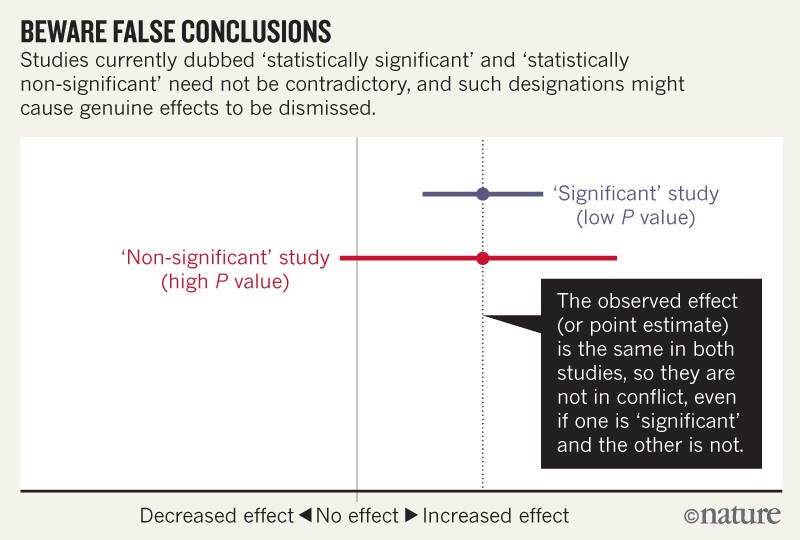
Pissed off scientists have risen up in their opposition to the abuse of statistical significance:
Source

The authors--"more than 800 signatories"--want researchers to quit categorizing:
The trouble is human and cognitive more than it is statistical: bucketing results into ‘statistically significant’ and ‘statistically non-significant’ makes people think that the items assigned in that way are categorically different ...
On top of this, the rigid focus on statistical significance encourages researchers to choose data and methods that yield statistical significance for some desired (or simply publishable) result, or that yield statistical non-significance for an undesired result, such as potential side effects of drugs — thereby invalidating conclusions.
Note how they phrased it? "encourages researchers to choose data and methods that yield statistical significance for some desired (or simply publishable) result" is exactly what I did not find appealing back in graduate school!

More from the authors:
The objection we hear most against retiring statistical significance is that it is needed to make yes-or-no decisions. But for the choices often required in regulatory, policy and business environments, decisions based on the costs, benefits and likelihoods of all potential consequences always beat those made based solely on statistical significance.
Exactly!

And even more important is this point from the authors on what will happen if we got rid of our focus on statistical significance:
Decisions to interpret or to publish results will not be based on statistical thresholds. People will spend less time with statistical software, and more time thinking.
More time thinking.  What a concept!

Thursday, March 21, 2019

If only the world had listened to me!

Many moons ago, when about this time of the year I had started planning for the migration northward to Oregon, I was scanning the local, downtown, community newsletter of sorts--I think it was called the Village News, perhaps modeled after the Village Voice.

In that, and unexpectedly, I received one of the best compliments that I have ever received.  The editor had noted my departure from the university and the town with a comment that the area was losing a public intellectual. I was pleasantly shocked.

It was all the more wonderful because it came from a person whom I had never met. This meant that she had based her comment strictly on my op-eds in the local newspaper, the Bakersfield Californian.

I knew even back in my teenage years that my life would be in the intellectual arena.  Further, I knew that I wanted my intellectual activities to be in the public, and not in some obscure office, not because of a need to be in the spotlight but because of an obsession of sorts to understand social issues and to discuss and debate with others my understanding.

But, of course, I had no idea then of a phrase "public intellectual."  It was one of the many new ideas that came to understand over the course of six graduate school years.

A couple of years ago, a student told me that he wanted to engage in the kind of public discussion of ideas like how I do, and asked me for suggestions on how he could go about it.  That stumped me.  I had no idea what the formula is.  I agree with the author here:
The phrase has come to mean an academic who occasionally addresses a general audience, as if all academics were intellectuals, and some of them were also public ones. In fact, academics and intellectuals are antithetical types. An intellectual is not an expert, and a public intellectual is not an expert who condescends to speak to a wider audience about her area of expertise. An intellectual is a generalist, an autodidact, a thinker who wanders and speculates. As Jack Miles puts it in a stellar essay on the question, “It takes years of disciplined preparation to become an academic. It takes years of undisciplined preparation to become an intellectual.”
I love that description of "years of undisciplined preparation."  I might never have come up with that phrasing, but that has exactly been my life until now.  Undisciplined preparation. 
The intellectual’s job is to think past the culture: to question the myths, metaphors, and assumptions that limit our collective imagination. The founder of the breed was Socrates. As Kazin also said, an intellectual is someone for whom ideas are “instruments of salvation.” Becoming one requires a little more than setting up a blog.
Indeed.

Engaging the public has been far more productive in terms of creating and sharing knowledge, than my formal scholarship can ever be.

Back in graduate school, I was cautioned against gong this route by one of my graduate school professors.  Jim Moore applauded my passion for this approach, but warned me that academia would care only about the formal academic inquiries via the publish-or-perish peer-review process, though they would certainly get jealous about any notoriety that I gained from my approach.  Jim was, and is, correct.  But, it would not be me, and not my life, if I did anything other than what I wanted to do.  I carried on with my Quixotic tilting at windmills.

Every time I visit India, my father asks why I don't write for the Indian newspapers.  I have found it difficult to explain to him that the op-eds in the newspapers there are not the kind of the public intellectual discussions that I favor.  Often they are filled with jargon, written by experts and not by intellectuals.  The writings often seem to have an undertone of the specialist having decided that the ignorant public needs to be educated with his/her expert opinion.  As if the public policy issue would be solved, and solved easily, if and only if the public listened to that expert.  That does not strike me as the role of the public intellectual. 

There is so much to talk about ... never has there been a better time.  It will also be nice though if people listened to me! ;)

Friday, October 05, 2018

The Conceptual Penis in Breastaurants

So, yet another gotcha! moment in the academic world of "research."

In case you missed it, because you were preoccupied with the teetotaler pussygrabber defending a beer-drinker by claiming that Jews were ruining the country, well, you are correct in ignoring the latest tempest in the academic teapot.

But, we shall address that here.


Yawn!

To me, this is merely yet another dog bites man story.

Note that in the opening sentence I wrote "yet another" ... because the one that really should have alerted academia was the original--by Alan Sokal.  That was more than two decades ago.

However, academe couldn't be bothered.

Academe didn't change because of the entrenched publish-or-perish culture.  Publishing intellectual masturbation as "scholarship" is a requirement for promotion.  These days, it is a requirement to even get the first job in higher education--in contrast to the old days when intellectual masturbation began after getting hired!

Does it bother you that I repeatedly refer to intellectual masturbation?  It should.  I am being intentional here.  As I wrote in an essay in the Chronicle Review, 17 years ago, almost to the very date, most of the academic "research" is pretentious work that will not sell even for penny, or for a kopek according to Anton Chekov's "Uncle Vanya" that I quoted in that essay.

I had always hoped that the financial urgency will force higher education to review its bizarre facade of scholarship, before the public figured it out as much as Uncle Vanya figured it out.  But, academic "scholars" could not be bothered with all that.  The intellectual masturbation continues with cries of orgasmic pleasures within the walls of the ivory towers!

In this essay in The Chronicle Review, the authors note:
We need policy makers and grant makers to focus not on money for current levels of publication, but rather on finding ways to increase high-quality work and curtail publication of low-quality work. If only some forward-looking university administrators initiated changes in hiring and promotion criteria and ordered their libraries to stop paying for low-cited journals, they would perform a national service. We need to get rid of administrators who reward faculty members on printed pages and downloads alone, deans and provosts "who can't read but can count," as the saying goes. Most of all, we need to understand that there is such a thing as overpublication, and that pushing thousands of researchers to issue mediocre, forgettable arguments and findings is a terrible misuse of human, as well as fiscal, capital.
The authors list a few suggestions for reform.  What is their bottom line?
Best of all, our suggested changes would allow academe to revert to its proper focus on quality research and rededicate itself to the sober pursuit of knowledge. And it would end the dispiriting paper chase that turns fledgling inquirers into careerists and established figures into overburdened grouches.
Here is the ultimate kicker: the authors are, implicitly, referring to the research universities.  If this is their set of observations on the happenings at research universities, then one can easily imagine the state of "research" at the vast number of universities that are not research universities but teaching universities, like the one where I teach.

In another essay, Arthur Levine noted that rapidly widening gap between "Digital students, Industrial-era universities" :
[It] is important to ask how much colleges and universities need to change. In 1828, facing industrialization and a Connecticut legislature that disapproved of Yale’s classical curriculum, the Yale faculty responded with a report which asked, in part, whether the college needed to change a lot or a little. This, Yale’s faculty said, was the wrong question. The question to be asked, they argued, was: What is the purpose of a college? This remains the right question today.
What is the purpose of college, and what is the role of "research" that faculty do?

Friday, October 13, 2017

And the winner is ... the fruit fly?

In high school biology, I came across Drosophila in the textbook.  There was a dead fly between the pages ;)

No, seriously, it was in high school that I knew about how it was not the frog that we dissected but the Drosophila that was the favorite of the researchers.  For a very important reason--drosophila have a life cycle of two weeks.  A fortnight later, you have a new generation.  A month later, it is the grand kids buzzing around!

Which is why over the years Nobel Prizes have been awarded to science originating from fruit fly research, including the award this year.
Jeffrey Hall, Michael Rosbash and Michael Young – all based in the US – were awarded the Nobel prize in physiology or medicine for their work on the molecular mechanisms that control circadian rhythms – in other words, the 24-hour body clock that controls lives throughout the animal kingdom. Crucially, this work was done largely by experimenting on fruit flies.
Nor was this a first for drosophila research. At least five other groups have received Nobels for their work using fruit flies to unpick the secrets of human physiology and biology in general.
How fascinating, right?  Every day it is such awesomeness.
Today, scientists believe that about 75% of known human disease genes have a recognisable match in fruit flies. These include Down’s, Alzheimer’s, autism, diabetes and cancers of all types. “It’s almost as if they were designed to help scientists,” says geneticist Steve Jones.
Re-read that line:  “It’s almost as if they were designed to help scientists.”  More than anything else, you will need that at the end of this post, and to puke when you watch the embedded video of a know-it-all!

But, we now have a president who is smarter than the smartest.  He knows more than the scientists. More than the generals. The smartest human that ever lived.  So, ...
This year, President Trump proposed budget cuts of 22 percent for the National Institutes of Health and 11 percent for the National Science Foundation. These two institutes fund most basic biological research in the United States.
Exactly.  
The importance of government support for basic research goes well beyond understanding nature. Basic research leads to advances that can transform industry and technology. In biology, current revolutionary approaches to genome editing and cancer immunotherapy owe their existence to basic research.
To paraphrase Monty Python, other than all that, what has science ever done anything for us, right?

Fucking Republican anti-science idiots!


Tuesday, February 02, 2016

Good times, bad times

Even as I was reading this piece at the Scientific American, my thoughts were along the lines of "I knew this already" and "I have been saying this for years."  But then when has the world ever listened to me! ;)

And what was that Scientific American piece about?  Happiness and meaning in life.  Themes that I often explore here.

Unlike me, the writer there has credentials. I mean, Ivy creds:
Scott Barry Kaufman is scientific director of the Imagination Institute in the Positive Psychology Center at the University of Pennsylvania.
So, if you didn't care for what I say, you will pay attention to Kaufman, right?  Story of my life! ;)

With hyperlinks all over the place, Kaufman writes about meaning and happiness, which are are two of our central motivations.  He writes that  "there can be substantial trade-offs between seeking happiness and seeking meaning in life."
Consider, for instance, the “parenthood paradox”: parents often report that they are very happy they had children, but parents who are living with children usually score very low on measures of happiness. It seems that raising children can decrease happiness but increase meaning. Or consider revolutionaries, who often suffer through years of violence and discord for a larger purpose that can ultimately bring great satisfaction and meaning to their lives and the lives of others.
Any parent knows that parenting is not unicorns and rainbows.  In between the fleeting moments of ecstasy of being a parent is a great deal of pain, anguish, hurt, and more that make parents stressed and unhappy.  But, parenthood also gives meaning.  Now you are beginning to think that it was unwise not to listen to me, eh! ;)
It seems that happiness has more to do with having your needs satisfied, getting what you want, and feeling good, whereas meaning is more related to uniquely human activities such as developing a personal identity, expressing the self, and consciously integrating one’s past, present, and future experiences. 
No kidding!  Have I not been blogging about these, like, forever? ;)

Unfortunately, especially these days, every where one turns the message is about happiness that is instantaneous.  The excellent sheep that most are, people bah-bah their vacuous and meaningless existence until it hits them hard one fine day when they begin to wonder what their lives were about--but, by then it is always too late.

There is a lot more to pursue than happiness.  One of the impressive ideas in Pixar's Inside Out was not about happiness but about sadness.  Sadness and the full range of human emotions help us put together meaning.
While happiness may make us feel good in the moment, the avoidance of negative thoughts and feelings may stunt personal development over time. After all, personal development often requires experiencing the full range of emotions
I will leave you with yet another message that I have been talking/blogging about forever:
The more people felt their activities were consistent with core themes and values of their self, the greater meaning they reported in their activities.
That requires people to understand for themselves who they truly are for which they have to find their own answers to "who am I?"

There is only one place where I differ with the Ivy researcher, and that is a significant difference as well: there does not have to be any tradeoff between happiness and meaning--it all depends on how we interpret happiness and meaning.  But, this is merely an intuitive understanding for which I, without any Ivy credentials, cannot provide any "scientific" evidence.  Take it or leave it, as it pleases you ;)


Monday, September 07, 2015

Burn, baby, burn. Burn a few books!

In a hallway in the building where my office is located, the esteemed ladies and gentlemen who protect themselves with feathers and robes, emblems and degrees have display shelves that are, as I blogged earlier, a monument to faculty, by faculty, for faculty.  What are displayed there, you ask?  Grab a chair; this will take a while! ;)

You, dear reader, like reading.  You have a thirst for understanding.  You perhaps even checked out books from your local library.  But, there is a good chance that you never knew about a genre of books that go straight from the publisher to university libraries where they remain forever without ever being moved even once.  The complimentary copies that the authors receive sometimes end up in display shelves like the one in my office hallway.

Increasingly, academics write books that nobody ever reads.  They are weightier than the journal articles that academics write which nobody ever reads.  Most academic "research," especially outside of the "hard sciences" is not read by anybody it seems.  It was this revelation, even when I was in graduate school decades ago, that further convinced me that I didn't want to waste my time writing stuff that will be nothing but intellectual onanism.

I did write an essay about this, which was read by a few.  It was not a traditional journal article, however.  In that essay, which was published back in October 2001, I wrote about the "aha moment" when I read Chekov's Uncle Vanya (yes, those Russians have been constant companions in my life!):
Would people be disillusioned if they knew that only a few of professors' publications are ever read by more than a handful of other scholars? Would people be disappointed in higher education if they realized that most academics' publications would not sell even for a penny? Would people agree with Uncle Vanya that professors who write but are rarely read and cited are swindlers? Could it be that people already grasp the truth, and that their knowledge is one cause of the decline in the prestige our society accords to faculty members?
It is a racket. A scam.  A huge ripoff.  In The Guardian, an anonymous academic (no, not me--I love to say these in the open!) writes about his personal experience in this book-publishing scam:
A few months ago, an editor from an academic publisher got in touch to ask if I was interested in writing a book for them.
I’ve ignored these requests in the past. I know of too many colleagues who have responded to such invitations, only to see their books disappear on to a university library shelf in a distant corner of the world.
If someone tried to buy said book – I mean, like a real human being – they would have to pay the equivalent of a return ticket to a sunny destination or a month’s child benefit. These books start at around £60, but they can cost double that, or even more.
This time, however, I decided to play along.
 The entire essay (and the comments too) is worth reading, especially if you didn't know about such "scholarly" tomes that end up in the masturbatory display shelves or in the remote corners of university libraries.  The anonymous academic writes there:
These may sound like stories of concern to academics alone. But the problem is this: much of the time that goes into writing these books is made possible through taxpayers’ money. And who buys these books? Well, university libraries – and they, too, are paid for by taxpayers.
 No different a point about taxpayers from what I had written in 2001, right?

You might then wonder, as the rational thinking person that you are, why this ripoff continues even when academics know that most books are never ever read by anybody.  I will remind you about the name for this blog: Every profession is a conspiracy against the laity.

Saturday, November 15, 2014

It’s the Teaching, Stupid! Retire already!

Hey, I didn't have to compose that kind of harsh sounding phrases for the title of this post--they happen to be how two commentaries were titled or promoted; though, of course, I second those without any hesitation at all ;)

It seems like it has been forever that I have been complaining about the intellectual onanism that passes off as "research" at institutions like mine where teaching is the very reason why we exist in the first place.  I often feel like shaking people by their shoulders and slapping them on their cheeks (though, I worry that will only add to the orgasmic effect ... hehehe) in order to help them realize that we ain't no Harvard.  As I noted in this post from, gasp, three years ago:
an Ole Miss or my own university wasn't set up to become an alternative to Harvard!  These other institutions have missions that are distinct from those of a Harvard or Stanford.  But, even these universities think and work as if they are nothing but a Harvard-lite.  The focus on "research" at third-rung universities is a classic example--most of the research publications that faculty from third-tier universities are in third and fourth rate journals, which seem to have brought into existence only to serve as an outlet for the great pretenders.
It is the mission creep that is awful, and this occurs mostly at public institutions, whether they are community colleges or state universities. 
But, who cares about mission creep when it is students who pay the high price!

How does this get institutionalized?  Simple. Even teaching universities have forgotten that "it's the teaching, stupid!":
Research and publication are important, of course, but teaching forms the core duties of the vast majority of college professing jobs.
But, what do Kafka's esteemed gentlemen of the Academy do instead when they set out to hire faculty?
Most job advertisements in the humanities and social sciences make the bad mistake of positioning tenure-track search committees to learn much more about applicants’ research than their teaching. In order to make the hiring process better-reflect their needs, many departments should consider taking a teaching-centered approach to their next job search.
I understand why elite private and Research I institutions might pursue research-centered profiles of their candidates. Professors there can expect to receive significant and frequent paid leave time and research grants. It makes sense for these schools to find out as much as possible about their applicants’ research agendas.
Professors at most colleges and universities, however, don’t get such opportunities, and in fact they focus most of their time and energy on teaching. It puzzles me why search committees time and again, especially on the tenure-track level, take so little action to measure candidates on what they will ultimately spend most of their time doing as professors.
It is awful.  I doubt there are many other industries where there is such screwed up approach to hiring highly qualified personnel on the basis of something that has nothing to do with the prime mission.

As they get older, the faculty do not leave either, however awful or great their teaching skills might be.  Now, it is not that I am a great teacher.  But, I know for certain that even the worst of the teaching has to keep pace with the changes in the world.  I know I recognize awful teaching when I see, for instance, PowerPoint slides that have not been updated.

Almost always, it seems like only the good teachers retire!
By any measure—course enrollments, teacher evaluations, testimony from students and colleagues, peer observations and evaluations, and even RateMyProfessor.com—I’m a fine teacher, even an exceptional one, though hardly perfect: One student called me, in writing, an "über bitch." Although I don’t have the energy I had when I was 40, or even 50, compared with most professors in their 60s, I’m an Amazon. I’m also far smarter and cagier about how to teach than when I was a young whippersnapper never more than a couple of steps ahead of my students.
She "signed an "irrevocable agreement" with Hofstra University that paid me a bonus to retire "early."  No, even in her case, the early was not really early: "In my case, that meant at the age of 66."

So, we have a double-whammy at the teaching universities all over the country: a great number of faculty whose interests are in "research" and not in teaching and who don't retire even when it feels like they are way past their expiration dates.  The tyranny of the senior-citizen faculty, which I have blogged about before too (like here, here).

I agree with the author when she writes:
What’s far more likely is a version of what I observed in my own department—an art-history professor in his late 70s who prowled the halls up until a few years ago. He didn’t appear to be able to use email, and we all knew he was a terribly easy grader. Even so, he faithfully met his classes and always attended department meetings, where he hardly ever said a word.
In other industries, this would lead to dismissal because of professional incompetence.  But, not in higher education!
The inconvenient truth is that faculty who delay retirement harm students, who in most cases would benefit from being taught by someone younger than 70, even younger than 65. The salient point is not that younger professors are better pedagogues (sometimes they are, sometimes they aren’t), but that they are more likely to be current in their fields and to bring that currency into their teaching.
Septuagenarian faculty members also cost colleges more than younger faculty—in the form of higher salaries, higher health-care costs, and higher employer-matched retirement contributions. Even if these costs pale in comparison to paying for bloated administrations, it’s wrong to pretend they don’t matter.
Worst of all, their presence stifles change. I’m not talking about mindless change for change’s sake, but the kind of change necessary to keep an institution thriving.
Ah, yes, reminds me of how one senior-citizen faculty had the arrogance to tell me that I wasn't respecting the hallway culture--a culture that badly needs changing!

The author notes:
I want to face retirement the way Prospero, directly addressing the audience at the end of The Tempest, voluntarily surrendered his magical powers:
Now my charms are all o’erthrown,
And what strength I have’s mine own,
Which is most faint: ...
            Now I want
Spirits to enforce, art to enchant.
Yes, I too would like to voluntarily surrender my powers, whatever little that I have.  Though, that time is a long, long time into the future, despite what others think, and it should work well with the other master-plan that I have ;)


Friday, October 10, 2014

Is it possible to pull academia's head out of the clouds?

In a hallway, in the building where my office is, are two shiny display shelves with books authored by faculty.  This takes intellectual onanism and narcissism to new heights (lows?).  After all, it is not even at a place that has high visitor traffic to impress them with "research"--heck, it doesn't even have high student traffic--which means that the displays are essentially for us faculty to feel important in this cosmos.

A monument to faculty, by faculty. and for faculty!

I suppose those display shelves by themselves are an awesome statement on what higher education has come to mean for faculty--it is all about themselves.  Who cares about students and their learning, and society and the public good!

Why such books in the first place?  Because, that is how faculty prove their mental capabilities to their peers.
The first four chapters prove the scholar’s done the work, and the next two chapters – the ones “people might actually read” – present the argument. Elsewhere and in between are the reworking of the author’s dissertation and implicit tenure pitch.
That’s how Timothy Burke, professor and chair of history at Swarthmore College, described the scholarly monograph here Thursday during a forum on its future sponsored by the Association of Research Libraries. Half-jokingly, Burke said of how authors view their books: “I prize this because only five people in the world understand it … We all know it.”
Haha. Funny. What a joke, right?  Those books on display in the hallway are like most books by academics--even if the publishers gave people money to read them, there won't be any takers.

When insiders joke about something important, I wonder why they cannot instead, you know, do something about it.

Anyway, back to the books. If these are not books that you find at the local bookstore, and if even the peers won't really read them, who buys these books?  Two major customers: students, who will buy the required texts (and not even open those books!) and university libraries that stock them on stacks that practically nobody ever goes to anymore.
So what to do about it? Burke and other speakers pointed to the digital monograph as a remedy to higher education’s stubborn grip on an increasingly obsolete form.
OMG, alert the press; the glacier is moving!  Higher education has figured out there is something called "digital."  And, even more, about an important advantage:
“In digital work, expert-based work becomes less important, and problems become more important,” Tanaka said. “That changes the authority structure on which our careers and expertise are based.”
Somewhat counterintuitively, however, he added, the historian in this context becomes more important, not less. With the wealth of data now available to the general public, historians don’t just transmit information; they must think critically about how it is best shared with which audiences, and how it intersects with research and teaching.
Seriously?  It took them these many years to understand that "problems become more important" and that the "expert-based work becomes less important" and that faculty need to "think critically about how it is best shared with which audiences, and how it intersects with research and teaching"???

Even more of a show-stopper is this:
The humanities also need to be a bigger part of online scholarly conversations, he said. Still, Shore said he wondered if the proposal -- especially in light of the day's conversations -- "goes far enough." He told the librarians in the room that they were the "intellectuals of this new ecosystem," and encouraged them to share feedback and -- along with faculty members -- "take risks" in exploring the future of the monograph.
OMG, "a bigger part of online scholarly conversations" could mean, ahem, engaging with the masses that exist outside the ivory towers, and many of them could be as smart as, or even smarter than, the faculty. Isn't it much better to remain cloistered instead and build self-satisfying monuments?

Meanwhile, the friend alerts me to this development:
Enter the Carnegie Corporation of New York, one of the few top foundations that's headed up by a bona fide public intellectual, Vartan Gregorian. This week, Carnegie dropped $5 million on five universities to help bridge the worlds of academia and policy in the area of global affairs.
What's cool here is that Carnegie is targeting two of the top problems keeping scholars sidelined.
First, the foundation wants to see universities change their rules on tenure and promotion to take into account policy-relevant work. As well, its grant funds will support younger scholars who want to freeze that ticking tenure clock while they go out into the policy world and make themselves useful.
Second, Carnegie money will support efforts to pull scholars into debates where their expertise is relevant, through both new research and by engaging with policymakers and the media.
How awesome that a foundation is putting up money as incentives for academics to crawl outside the gilded towers!  Will it work?
the insularity of academia is a hard problem to solve one institution at a time—especially when there's no evidence that the system as a whole is interested in change. For decades, now, universities have been pummeled for becoming less relevant, yet things have only gotten worse. And that's not surprising: Universities aren't really accountable to anyone who favors more real-world engagement, so where's the institutional incentive to change anything?
Add "policy relevant" to the criteria used by U.S. News in its college ranking and we'll see some action. But probably not before.
So while Carnegie's effort is laudable, one wonders if this is money well spent.
Fine, you want the bottom-line?  Here it is:
even if Carnegie is doing God's Work here, it's not clear that any foundation has enough money to pull academia's head out of the clouds.
Yep. I can expect to see and hear within the university how awesome the research work done by faculty is, while the rest of the world outside continues to worry that students are simply academically adrift.

Hey, you think the Carnegie Foundation will give me at least a couple of dollars for the public engagement that I have committed myself to?  Yeah, right!

Saturday, March 30, 2013

Academic research. Irrelevant. But, end not near!

When I was in graduate school, there were, at least, three tenured faculty who didn't have doctorates.  Yep, professors without PhDs.  As one professor put it, it was a different world when he first applied to become a university lecturer.

Nearly three decades later, I, too, am ready to echo those words that the world was very different then from what it is now, and it seems like it is changing even more rapidly.  But, not only has a PhD become firmly institutionalized as a requirement to become an academic, it has become a ponzi scheme as much as many other aspects of higher education are.
[There] seem to be genuine problems with the system that produces research doctorates (the practical “professional doctorates” in fields such as law, business and medicine have a more obvious value). There is an oversupply of PhDs. Although a doctorate is designed as training for a job in academia, the number of PhD positions is unrelated to the number of job openings. Meanwhile, business leaders complain about shortages of high-level skills, suggesting PhDs are not teaching the right things. The fiercest critics compare research doctorates to Ponzi or pyramid schemes.
Though I am not convinced as Ronald Bailey is about Singularity University as model for the future, I do agree with this:
The production of new knowledge is accelerating exponentially, Nail notes, which means that graduate students dawdling along for years on a Ph.D. will become “fatally irrelevant.” 
In this ponzi scheme, we also require from academics more pointless research than ever before.  This, too, like many aspects of higher education, cannot go on forever.  In a fortnight, I will be at the annual meeting of the professional body in my field, and will attend many sessions.  Many sessions of talks and discussions that will simply be inane and it will be a struggle to even stay awake.

But, research and inquiry does not have to be that way, especially in the humanities and in the social sciences.  With the rapid scientific and technological progress, there is more need now than in the past to understand what it is to be human and how humanity fits into the larger scheme of things.  The larger population outside the academic walls is also keen on insights into such questions.  Yet, research, and PhD theses seem to be about making sure there will be no new insight whatsoever!

A couple of years ago, Joseph Nye, who is a Harvard professor, and former dean of the Kennedy School there, expressed similar sentiments when writing about the academic field of international relations::
Scholars are paying less attention to questions about how their work relates to the policy world, and in many departments a focus on policy can hurt one's career. Advancement comes faster for those who develop mathematical models, new methodologies or theories expressed in jargon that is unintelligible to policymakers.
It is not only policymakers who are eager for scholarly interpretations, the public also is. Instead, we academics continue on with an approach that a graduate school friend of mine always ridiculed as "intellectual masturbation."

Nye adds:
The solutions must come via a reappraisal within the academy itself. Departments should give greater weight to real-world relevance and impact in hiring and promoting young scholars. Journals could place greater weight on relevance in evaluating submissions. Studies of specific regions deserve more attention. Universities could facilitate interest in the world by giving junior faculty members greater incentives to participate in it. That should include greater toleration of unpopular policy positions. One could multiply such useful suggestions, but young people should not hold their breath waiting for them to be implemented. If anything, the trends in academic life seem to be headed in the opposite direction.
Unfortunately, even in the nearly three decades that I have been associated with academia, I have not seen anything that even remotely suggests that changes might be coming.  Instead, academia digs even deeper trenches and, as much as those young soldiers in World War I found themselves trapped in the foxholes for weeks not knowing what was going on, young students are used as the metaphorical cannon fodder.  How unfortunate!

Yes, I have strong opinions on academic research. It is a minority opinion, no doubt, and that does not serve me well. Despite the negative feedback from my peers, I am convinced that I am on the correct path, however Quixotic the tilting at the academic windmills might be.

A much younger me, at one of the academic conferences that I attended as a grad student


Tuesday, November 29, 2011

On the firing of Larivere. Let their people go!

The firing of Richard Larivere from his job as the president of the University of Oregon will be discussed for a long time.  As we engage in debates, there is one fundamental issue that we Oregonians have to resolve well before hiring a successor—should UO, and perhaps Portland State and Oregon State too, be spun off the Oregon University System (OUS,) with a separate governance system?

From the day I was hired to teach at Western Oregon University (WOU) back in 2002, I have wondered at the logic, or lack thereof, in having an OUS that governs both UO and WOU.  After all, WOU is what one would refer to as a “teaching university” while UO is a “research university” and the missions of these two institutions are very different. 

It is not that UO faculty do not engage in teaching—they do.  But, at research universities, the expectation is that faculty will devote significant effort into systematically creating new ways in which we understand the world.  The metaphorical earth-shattering scholarship in the sciences and the arts happen at research universities, and that is the yardstick with which we would then measure the “worth” of a research university like UO.  Thus, it is no surprise that faculty who gain membership into prestigious bodies like the National Academy of Sciences are from research universities—and not from teaching universities.

In the American higher education system, the typical expectation is that teaching universities like WOU have a markedly different role.  Pretty much all of our work is about teaching at the undergraduate level.  Nobel Prize winners are, therefore, not to be found in teaching universities, even when they are phenomenal teachers, as many of them are.

When there is such a wide gulf between what is expected at UO versus WOU, I am always surprised that both these institutions are governed by the same board. 

When I joined WOU, the OUS had a new chancellor in Richard Jarvis.  Jarvis was a geographer, and taught an introductory physical geography class for us--for free, as I recall.  But, even before his second year anniversary on the job, Jarvis was fired rather abruptly because the then governor, Ted Kulongoski, wanted to set a new direction for higher education. 

Unfortunately, all I have witnessed in these ten years is more hirings and firings, and the creation of more and more committees, without any directional clarity whatsoever.  This decade-long experience makes me conclude that the current crisis is not anything new that Larivere created, but is the cumulative effect of dilly-dallying.

I can only hope that the termination of Larivere’s contract will compel the governor and the legislature to settle the issues once and for all.  In working out a plan, they ought to recognize that WOU and its sister regional universities, EOU and SOU, are alike in their missions, while UO, PSU and OSU have very different institutional missions.  Forcing these institutions to coexist within the same OUS structure will merely prolong the agony, and is the worst possible deal for taxpayers and students.

Thursday, March 24, 2011

Too Many Doctoral Programs. Well, of course. Duh!

The Association of American Universities has a new leader, Hunter R. Rawlings.  His opening shot?
Mr. Rawlings did, however, make clear that he's concerned some universities, seeking the prestige of a top ranking, may be operating too many doctoral programs, producing students without good job prospects.
Way to go,  Dr. Rawlings.
(BTW, why does the Chronicle use a dull "Mr." ... is that their editorial policy?)
"It's thrilling to have a genuine humanist be the head of an organization like that," said Stanley N. Katz, a legal historian and higher-education policy expert at Princeton University. "He's one of the most deeply thoughtful people I'm acquainted with in higher education."
At the same time, Mr. Katz questioned the plausibility of Mr. Berdahl's suggestion that the country trim its number of research universities, and predicted that Mr. Rawlings will be no more successful in cutting down on doctoral programs.
... "It's not whether we will have fewer research universities—I think inertia will keep them going—but whether they'd be willing to police themselves," Mr. Katz said. "And the answer there is just clearly, flatly no. There's absolutely nothing in the history of research universities to suggest that they're capable of the kind of self-evaluation that he's talking about."
Every time I go to the annual meeting of scholars in my current discipline, and watch the many, many, eager beaver doctoral candidates, I can't but think about Marx's phrasing of the "army of unemployed."


The story is similar in most disciplines, and even more horrific in a few.  Yet, universities continue to churn out PhDs. 

Thursday, January 13, 2011

"It is a ponzi scheme"--universities, that is

I have been blogging about this for such a long time that I might as well yawn away at such reports:
The United States' educational and research pre-eminence is being undermined, and some of the chief underminers are universities themselves, according to articles this week in Science and Nature magazines.
Universities are aggressively seeking federal dollars to build bigger and fancier laboratory facilities, and are not paying an equal amount of attention to teaching and nurturing the students who would fill them, scientists say in the articles.
"It's a Ponzi scheme," said Kenneth G. Mann, a professor of biochemistry at the University of Vermont, whose concerns were described by Nature. "Eventually you'll have a situation where you're not even producing the feedstock into the system."
If only people listened to me; but, not only do they not listen to me, they believe I am incompetent.  The university president says I am not fit even to be an Assistant Professor, and the faculty union presidents ruled that I don't have a right to opinions.  Wait a minute, the fact that these otherwise opposing camps are united means that, aha, I am right :)
The health of universities, and the overall U.S. economy, depends on finding that right balance, he said. "There's a real risk at the present time to have a system that's not stable."
Yep :(

Wednesday, October 13, 2010

Taking a sabbath from academe ...

I have never taken a sabbatical before ... but, will soon apply for one.  Over the years I have read many essays in the Chronicle, among others, that addressed many aspects of sabbaticals.  The latest one, in the AAUP's Academe, is a beaut.  The author, Max Page, is professor of architecture and history at the University of Massachusetts Amherst.  Page questions who took the sabbath out of sabbatical; a wonderful title, right?  His argument is made clear in the subtitle: "Worshipping real academic productivity means giving it a rest now and then."  He writes:
What “sabbatical” meant was that the land—your productive capacity, your brain, your heart—should not be used or exercised in exactly the same way it had been for the previous six years. It needs to be refertilized. It will be more productive and life giving (and refereed journal article producing) if it is allowed a rest from its usual activities. I found it particularly remarkable, and disturbing, that in the sabbatical seminar I attended no one spoke about improving the quality of the work of their sabbatical, only that they produce more, and faster.
Yep. to produce that 30,000th essay on left handed textile industry workers in Timbuktu :)
My plea to my striving colleagues is to be true to the origins of the word. Don’t do nothing—but don’t focus on your usual activities either. Do not till the same soil; dare to do things differently for a year. You will be doing exactly what you are supposed to be doing— honoring your profession and the confidence placed in you— when you explore new areas, pursue projects that might fail, expand your mind with art or music or great literature, and generally upset your routine.
You will be doing what you were hired to do, renewing your capacity for thinking, teaching, researching, serving the public good. You will be doing yourself, and the very idea of the university, a favor.
 I shall try.  Thanks for the reminder.

Thursday, October 07, 2010

I learnt from Mario Vargas Llosa's letters ...

On Sunday, eagerly anticipating the news about the Nobel Prize announcements, I wrote that in literature I am rooting for Mario Vargas Llosa .... need I say I am excited this morning :)
Peruvian Mario Vargas Llosa won the Nobel Prize in literature on Thursday, the Swedish Academy announced.
Vargas Llosa was chosen "for his cartography of structures of power and his trenchant images of the individuals resistance, revolt, and defeat," the academy said.
One year, I used one of his books for a class.  Yes, I did.  But, it wasn't a fiction work of Llosa's ... it was his Letters to a young novelist ... now, I wasn't teaching any fiction-writing class; it was one of the ways in which I attempted to convey to students how to do research, how to write, how to think through ... That was the only time I used this book by Llosa because it was quickly clear to me--much to my disappointment--that not one student cared about it ...

Friday, September 03, 2010

Quote of the day: on American higher education

America’s universities lost their way badly in the era of easy money. If they do not find it again, they may go the way of GM.
Yep.
I have been writing and blogging about this for years, much to the displeasure of my colleagues :)

Anyway, that quote is from The Economist's Schumpeter column, where it is further noted that:
Two right-wing think-tanks, the American Enterprise Institute (AEI) and the Goldwater Institute, have both produced damning reports about America’s university system. Two left-wing academics, Andrew Hacker and Claudia Dreifus, have published an even more damning book: “Higher Education? How Colleges are Wasting Our Money and Failing Our Kids and What We Can Do About It”. And US News & World Report, a centrist magazine, says in its annual survey of American colleges that: “If colleges were businesses, they would be ripe for hostile takeovers, complete with serious cost-cutting and painful reorganisations.”
The contemporary state of American higher education is under severe criticism from the right, left, and center; anybody feeling left out, please take a number and await your turn :)
So, ...
This luxury model is unlikely to survive what is turning into a prolonged economic downturn. Parents are much less willing to take on debt than they were and much more willing to look abroad for better deals. The internet also poses a growing threat to what Bill Gates calls “place-based colleges”. Online, you can listen to the world’s best lecturers for next to nothing.
Again, as far as I am concerned, Schumpeter is late to this party. I have consistently blogged about how such a system cannot continue anymore, and have repeatedly pointed to the online mode too.  But then, nobody listens to me, and if they do it is only to tell me that I have no free speech rights :)

I really, really, hope that the reforms will come from within. Because, those imposed from the outside will completely screw up the liberal education that I so cherish.

BTW, I had a delightful conversation with Claudia Dreifus.  First I got an email from her; apparently she had read something really interesting in my blog.  In my reply, I gave her my cell number, and a couple of hours it was Claudia Dreifus at the phone.  Her email and phone call made my day :)

Thursday, August 05, 2010

If you have not been peer-reviewed, screw you :)

There isn't a single route to intellectual inquiry, particularly when it comes to social issues and social policies.  But, academics have managed to develop a format that is increasingly used only to devalue the intellectual merits of discussions that do not conform to their preferred method.  And what is that one route to revelation according to the pointy-heads?

Why, "peer review," of course!

As I have noted, even in this blog, while the pubic might be led to believe that "peer review" ensures that earth-shattering research is carefully evaluated by peers, and accepted by them, the reality is far from that.  In addition to all those earlier points, consider what Brendan O'Neill writes:
Being peer-reviewed no longer simply means that you wrote an academic report that was considered by other academics to be serious enough for publication – it means you possess the truth, Pure Knowledge, elevated insights that are not available to mere mortals who have not been PR’d. So in the debate about climate change in particular, those whose work has been peer-reviewed are now held up as oracles of wisdom in contrast to their critics, who are increasingly written off and sent to the intellectual equivalent of Connaught with three simple words: ‘Not peer reviewed.’ To be peer-reviewed is to have the right to speak publicly on important matters – to be non-peer-reviewed makes you immediately untrustworthy, a bit of an intellectual charlatan, possibly even suspect in your motives.
There is a censorious dynamic at play here, as a divide is erected between those who are PR’d and those who are not, between those who we should listen to and engage with and those we should look down our noses at - in effect between those who say mainstream, acceptable things and those who spout off-the-wall, experimental stuff. It is ironic that Pickett and Wilkinson, so very keen on the idea of equality, don’t like the idea of an equal right to speak and critique. In this area of life, their attitude is: ‘If you’ve been peer-reviewed, let’s talk. If not? Screw you.’
Of all the "peer-reviewed" colleagues of mine, I doubt whether even ten percent of them will be able to have a meaningful conversation on their subject matters with the world of intellectuals outside that "peer review" circle.  One of the wonderful aspects of the internet is how much it has liberated intellectual conversations from the narrow confines of the incestuous ivory towers.

It might come as a surprise to many of the cloistered academics that there are plenty of intellectuals in the world outside the classrooms and labs.  And most of them couldn't care less about academics and peer-review.  Megan McArdle, who has no shortage of credentials, noted that:
This is not to say that the peer review system is worthless.  But it's limited.  Peer review doesn't prove that a paper is right; it doesn't even prove that the paper is any good (and it may serve as a gatekeeper that shuts out good, correct papers that don't sit well with the field's current establishment for one reason or another).  All it proves is that the paper has passed the most basic hurdles required to get published--that it be potentially interesting, and not obviously false.
Yep, that is all there is to peer-review.  In most cases, particularly when one moves away from the first tier journals with high impact factors, a peer-reviewed publication is nothing more than work done by a hardworking student who faithfully does all the required work, and on time.  The authors of such work are, unlike what they think of themselves, no "oracles of wisdom" as O'Neill puts it.

Let me quote Frank Furedi from a previous blog-post:
Increasingly, peer review has been turned into a quasi-holy institution, which apparently signifies that a certain claim is legitimate or sacred. And from this perspective, voices which lack the authority of peer review are, by definition, illegitimate. Peer review provides a warrant to be heard – those who speak without this warrant deserve only our scorn.

Thursday, July 29, 2010

Higher Education? Muahahaha :(

So, a little more than a week ago, I blogged about the hysterical humor from my campus, all because of an opinion piece in the Chronicle of Higher Education.  Well, the authors of that piece, which was based on their book, Higher Education? How colleges are wasting our money and failing our kids and what we can do about it, have more to say in this interview:
 We argue that you can get a better education at second or third tier colleges. Have you ever heard of Linfield College? It's in a little town called McMinnville, Oregon. We were very impressed with the campus. The professors care. They spend time with the students. The same is true in a place called Hendrix College in Arkansas, orEarlham College in Indiana. They provide a good education because they don't expect professors to do research. 
Hey, our campus is only a few miles south of Linfield College.  But, guess what?  We expect our professors to do a whole lot of pretentious research that nobody ever hears about!  And, despite that, when they do list my university as one of the best buys for the money, ahem, faculty protested ... :)
Why do I say "pretentious research?"  Again, back to Professor Hacker:
The problem is that there are just too many publications and too many people publishing. This is true even in the hard sciences. If there's a research project on genetics in a lab, they will take certain findings and break them into eight different articles just so each researcher can get more stuff on his or her resume.   
And many of the publications are too long. A book on Virginia Woolf could be a 30-page article. Somebody did a count of how many publications had been written on Virginia Woolf in the past 15 years. The answer is several thousand. Really? Who needs this? But it's awfully difficult to say, "Here's knowledge we don't need!" It sounds like book burning, doesn't it? What we'd say is that on the scale of priorities, we find undergraduate teaching to be more important than all the research being done. 
Yep.

Particularly at taxpayer institutions like mine, that millionth "research" publication on Woolf is nothing but a huge attempt to fool taxpayers into believing that there is some earth-shaking research going on.

Oh, yeah, I have blogged about the reality that these contribute to the avalanche of low quality research.

So, Professor Hacker, if all these are supposedly the factors that will determine tenure and promotion, anything to say about tenure? :)
tenure is, in fact, the enemy of spontaneity, the enemy of intellectual freedom. We've seen this again and again. And even people who get tenure really don't change. They keep on following the disciplinary mode they've been trained to follow.  
What bothers us, too, is that over 300,000 professors have it. That's a tremendous number. What that means is these people never leave. There's hardly any turnover in the senior ranks—not just at Harvard, Yale, and Stanford but at small colleges in Kentucky, everywhere. You go to a campus and over two thirds of the faculty have been there at least 25 years. They begin to stagnate. In many ways, they become infantilized, embroiled in ideological issues like faculty parking.
Finally, here is the interview question and Hacker's response:
Some academics have been famous for their ability to speak to the general public—people like Carl Sagan and Margaret Mead. Do you think it would be better for campus culture if more professors were encouraged to connect with the outside world? 
Definitely, yes. Those people were teachers, in the true sense of the word. They were just as knowledgeable about their fields as anyone, but they had playful, imaginative minds. They could go on TV—Carl Sagan could talk about science, John Kenneth Galbraith could talk about economics. They weren't dumbing down their subjects. In fact, they were actually using their brains. 
Now, I suppose I have to wait for the new academic year for more campus humor on this subject.  Can't wait :)

Monday, July 26, 2010

This is research at MIT? :)

Can the Euro LHC top this scientific achievement reported by America's finest news source?

Wednesday, June 16, 2010

Stop the Avalanche of Low-Quality Research

A couple of months ago, the dean of the college, where I teach reviewed my work over the past few years and declared that it essentially amounted to me being on the "mashed potato circuit" ... I asked him whether writing in a third- or fourth-rate journal that nobody ever reads was really worth it.  His response was even more classic--that "bean counting" was his responsibility.  (Yes, the phrases in quotes are the dean's very words!)

As I wrote in an essay in the Chronicle Review, almost ten years ago, most of the academic "research" is pretentious work that will not sell even for penny, or for a kopek according to Anton Chekov's "Uncle Vanya" that I quoted in that essay.  I am hoping that the financial urgency will force higher education to review its bizarre facade of scholarship, before the public figures it out as much as Uncle Vanya figured it out ...

In this essay in the recent Chronicle Review, the authors note:
We need policy makers and grant makers to focus not on money for current levels of publication, but rather on finding ways to increase high-quality work and curtail publication of low-quality work. If only some forward-looking university administrators initiated changes in hiring and promotion criteria and ordered their libraries to stop paying for low-cited journals, they would perform a national service. We need to get rid of administrators who reward faculty members on printed pages and downloads alone, deans and provosts "who can't read but can count," as the saying goes. Most of all, we need to understand that there is such a thing as overpublication, and that pushing thousands of researchers to issue mediocre, forgettable arguments and findings is a terrible misuse of human, as well as fiscal, capital.
The authors list a few suggestions for reform.  What is their bottom line?
Best of all, our suggested changes would allow academe to revert to its proper focus on quality research and rededicate itself to the sober pursuit of knowledge. And it would end the dispiriting paper chase that turns fledgling inquirers into careerists and established figures into overburdened grouches.
Here is the ultimate kicker: the authors are, implicitly, referring to the research universities.  If this is their set of observations on the happenings at research universities, then one can easily imagine the state of "research" at the vast number of universities that are not research universities but teaching universities ....

In another essay, elsewhere at InsideHigherEd, Arthur Levine notes that rapidly widening gap between "Digital students, Industrial-era universities" :
[It] is important to ask how much colleges and universities need to change. In 1828, facing industrialization and a Connecticut legislature that disapproved of Yale’s classical curriculum, the Yale faculty responded with a report which asked, in part, whether the college needed to change a lot or a little. This, Yale’s faculty said, was the wrong question. The question to be asked, they argued, was: What is the purpose of a college? This remains the right question today.
Ahem, 20 years ago, the late Ernest Boyer wrote about this issue of the need to (re)establish the priorities of the professoriate!

Sunday, March 14, 2010

Crazy (Indian) faculty, we are :)

Over to the Chronicle:

Madhukar Vable, a professor of mechanical engineering at Michigan Technological U., has denounced what he says is his university's neglect of the classroom experience for undergraduates. To protest, he has taken down and returned his teaching awards.
...
Last October, Madhukar Vable said farewell to two teaching prizes that he had won a decade earlier. He packed the plaques in envelopes and shipped them back to the university and state offices that had awarded them.
Does Professor Vable know that his awards will go well with mashed potatoes? :)