Showing posts with label tech. Show all posts

Monday, April 26, 2021

Planned obsolescence and unplanned responsibility

In this NYT commentary, the author wants us to ask three questions before we buy the shiny new electronic gadget introduced in the marketplace:

“How long will this last?,” “How will I get it fixed when it breaks?” and “How will I recycle this when I need a new device?”

When I read that, I had two immediate thoughts. 

First, how many NYT readers will care enough to think about those questions and act on them, and how does this number compare to the billions of humans who don't read the NYT?

Second, I have routinely posed these questions in my classes; consider the following paragraph from my blog post in June 2015:

I routinely force students to think about where their old smartphones end up when they upgrade to the latest gadget.  I have assigned essays, like this one, which then provide the context for them to pause for a few minutes and think about the resource consumption.  I practice--at least try to--what I teach.  Thus, I have a difficult time getting rid of my old smartphone even when it serves all my purposes. Last December, when I was taking photographs of the high school classmates who had come to the niece's wedding, one friend laughingly said "ever since the first time I reconnected with Sriram, he has been using the same camera."  Yes, it has been the same camera too for a few years now.  Just because it is old I should dump it?  I don't operate that way.

Maybe if I had been asking other kinds of questions, and teaching sexy subjects, I would not have been laid off, eh!

The NYT commentary notes:

This year, the French government began requiring tech manufacturers to list an “indice de réparabilité,” a repairability score, on product pages for items like the iPhone and MacBook. If a device can be repaired, then its life can be extended, saving consumers money and the planet the burden of so many trashed gadgets.

As much as I like the idea, I think the reality is that this is not going to make much of a difference when gadgets are sold by the billions every year.  Sure, a few customers might tinker with their smartphones, or a few businesses might spring up in countries like India.  But, for most people, the cost of fixing the cranky smartphone might outweigh the benefits of a shiny new one.

I wish the writer had at least mentioned one important phrase: Extended Producer Responsibility (EPR.)  Hold producers and other entities involved in the product chain,  responsibile for end-of-life product management instead of trying to work the the general public  I checked my own blog to see when I first mentioned EPR in my writing.  It was in February 2012.

Some day, sooner than later, we will hold producers like Apple responsible.  Soon, I hope.

Wednesday, February 24, 2021

Do you read me, HAL?

When we scroll through the movies and shows that Netflix lists on our home page, we rarely see anything that interests us.  It is awful.

But, we do watch quite a few movies in Netflix.

It is just that we don't care for what Netflix's AI offers.  We do our own homework, like reading Anthony Lane's reviews, and decide on what we want to watch.  More importantly, we never rate any of the movies that we watch.

Netflix's AI can't figure our our tastes, and I am happy about it ;)

I suppose we employ a version of lateral reading.  We gather information about movies from different sources, evaluate the ratings, and then search for those movies in Netflix.  Of course, not always do we find them in Netflix, but there are plenty of good ones that we have been able to watch.

No, this is is not merely about Netflix.  It is about something much bigger.  It is about my worry that artificial intelligence (AI) is beginning to run/ruin our lives by telling us what to watch, what to cook, where to go, how to go, ...  It is almost as if AI is beginning to kill whatever free will I have.

We are merely at the beginning stages of AI, and it is getting smarter by the second.  Two researchers from the U. of Mass. (Boston) write:

Algorithms could soon – if they don’t already – have a better idea about which show you’d like to watch next and which job candidate you should hire than you do. One day, humans may even find a way machines can make these decisions without some of the biases that humans typically display.

But to the extent that unpredictability is part of how people understand themselves and part of what people like about themselves, humanity is in the process of losing something significant. As they become more and more predictable, the creatures inhabiting the increasingly AI-mediated world will become less and less like us.

Think about what AI is doing, and will do, to distort what it means to be human.  Don't just take my word though--do some lateral reading and conclude for yourself.

BTW, have you watched Burning or Tune in for love? ;)


Monday, February 01, 2021

Don't touch that tech

I grew up in a culture in which there was no hugging.  No touching.  As kids, we couldn't even brush against grandma until she was all done with lunch.

Many decades ago, when I was in middle or high school, a short story in the Tamil weekly, Ananda Vikatan, was about a father visiting with his son in the city and then the son accompanying the father to the railway station.  

The father boards the train that will take him back to his village and sits by the window while the son stands on the platform by that same window.  During the conversation, which itself was not a freely-flowing one and rather awkward, the son places his arm on the window and it accidentally grazes the father's hand. The son feels goosebumps all over and he realizes that it has been years since his childhood days when he even touched his father.

No hugs and touches, but people spent time with their relatives (mostly) and friends.  A lot of time.  The inability to be in the presence of their favorites during this pandemic has caused quite some stress in the old country.  After ten months, my aunt couldn't take it anymore and she visited with my parents.  As always, there was no hugging or touching and they sat at a distance from each other.

Video chats didn't do them any good.  I can relate to that.

But, I fear that those of us who place a premium on visiting with our friends and relatives are in the minority.  The world seems to have fully embraced (no pun intended) video chats of different kinds.

Those in the hugging culture--like here--miss hugging their siblings and parents and grandkids.  Will technology develop a hug app?  Would you like to have such an app?  Be careful what you wish for:

There are real consequences to letting technology intervene with social touch. Do you fear the day when you attempt to console your child only to have her turn to a device that can comfort her in a way you couldn’t even conceive of? Perhaps you should. With the rise of touch-replacement technology, socially distanced lives could become permanent, and we might end up with even greater levels of isolation than today.

The more we adopt such technologies, the more we risk getting isolated and feeling lonely.

In contexts like this, I am always reminded of the science fiction from a century ago, about which I have blogged before: E.M. Forster's The Machine Stops.

We live in a world that Forster wrote about back in 1909.  Imagine that--in 1909!  Screen time of all kinds just as Forster had feared.  We have replaced real human interactions with virtual ones.  So "satisfied" we are with the virtual interactions, and thinking that the virtual even eliminates the need for real interactions, we seem to believe that visiting with parents, children, friends, is not needed anymore.

Forster channels his warnings through the son telling his mother in that fictional work:

"You talk as if a god had made the Machine," cried the other.  "I believe that you pray to it when you are unhappy. Men made it, do not forget that. Great men, but men. The Machine is much, but it is not everything. I see something like you in this plate, but I do not see you. I hear something like you through this telephone, but I do not hear you. That is why I want you to come. Pay me a visit, so that we can meet face to face, and talk about the hopes that are in my mind."

After the pandemic ends, or at least eases, I will pay a visit to the old country, and meet face to face with my relatives and friends.  The older folk won't hug.  We will sit apart, and inquire about each others lives.  It will be a touching visit.

Thursday, December 10, 2020

A nugget of life

In the summer of 2013, I blogged about meat that is grown in labs and bioreactors, which are essentially the prototypes of the factories of the future.  I wrote then: "It is only a matter of time before we perfect such techniques and produce beef or other animal foods without the animals."

It is not that I am a cave-dwelling carnivore.  Far from that.  As with any other development, this too fascinated me.  It interested me so much that I wove this news item into appropriate contexts in my introductory classes.  Student response was typically and overwhelmingly one-sided--meat that doesn't come from killed animals but is produced in factories is unnatural.

I would then nod along, and ask them if they eat pasta.  Of course they did.  "Isn't pasta produced in factories?  Have any of you tried making pasta?"

Once--and only once--a young woman's hand went up.  "Sometimes I make pasta with my grandmother," she said.  And then added that it was a lot of work.

My point was this: If students eat "factory-produced" pasta and hot dogs and whatever else, why should they view the lab-grown meat any differently.

I love this Socratic tradition, which I might not get to practice for too long though.

Seven years after that blog post, the world is now getting closer to making cultured-meat a reality in the marketplace.

The first lab-grown, or cultured, meat product has been given the green light to be sold for human consumption. In the landmark approval, regulators in Singapore granted Just, a San Francisco–based startup, the right to sell cultured chicken—in the form of chicken nuggets—to the public.

Just had been working with the regulators for the past two years and was formally granted approval on November 26.

You need a reminder on how this meat is produced?

Most cultured meat is made in a similar way. Cells are taken from an animal, often via a biopsy or from an established animal cell line. These cells are then fed a nutrient broth and placed in a bioreactor, where they multiply until there are enough to harvest for use in meatballs or nuggets.

There is no killing involved. "The cells for Eat Just’s product are grown in a 1,200-litre bioreactor and then combined with plant-based ingredients."   The fact that there is no killing involved makes all the difference to many millions. 

Of course, the killing is not the only issue, which is why there are many firms in the race:

Dozens of firms are developing cultivated chicken, beef and pork, with a view to slashing the impact of industrial livestock production on the climate and nature crises, as well as providing cleaner, drug-free and cruelty-free meat. Currently, about 130 million chickens are slaughtered every day for meat, and 4 million pigs. By weight, 60% of the mammals on earth are livestock, 36% are humans and only 4% are wild.

For now, as with any innovation, the costs are high, and the process is energy-intensive.  But, again as with most technologies, scaling will rapidly decrease costs and the demand for energy.

At some point, the US-based research/entrepreneur will go global--that's the plan: 

"We didn't work two years to get the approval just to sit on this," says Tetrick. "After Singapore we'll move to the US and Western Europe." But US availability won't be that simple: A regulatory process for cultured meat doesn't yet exist between the USDA and FDA

I imagine that tRump, who famously eats steak with ketchup, would have freaked out with this news story!

There are interesting parallels between the cultured meat and electric car sectors: Both are introducing a technology that can inspire initial resistance from consumers and existential alarm from conventional producers, both involve a major shift in infrastructure, and both need some degree of regulatory air cover to succeed.

It has been a long, long way from the African Savanna, and there is no going back.

Tuesday, May 07, 2019

Playing god?

The anti-vaccination minority seems to be getting louder and more powerful with every passing day.  These are some strange times when it is people in rich countries who are opposed to vaccines, when it used to be the case even a decade ago that people in poor countries were the ones who needed to be convinced about vaccination!

Vaccinations have helped us defeat diseases, and even wipe out the nasty pathogens.  The small pox virus now lives only in highly secure test-tubes.  It is difficult to imagine that it was once one of the most feared monster diseases ever.  Even now my father has tales about the small pox wave that killed and maimed and disfigured children.

Defeating one disease after another, and coming up with ways in which we have effectively postponed death--which is what the remarkably high life expectancy means--is a tad like we are playing god, and very unnatural:
We play god when we vaccinate. We play god when we give women pain relief during labor. ... Our whole life is entirely unnatural. The correction of infertility is interfering in nature. Contraception is interfering in the most fundamental aspect of nature.
Where does "natural" end and the artificial begin?  We wrinkle as we age, for which there is now Botox and cosmetic surgery.  We grow bald: Hair transplant surgery has made Joe Biden look young again. Or, in tRump's case, he has become an orange monster!

An Oxford philosopher, Julian Savulescu, argues that we should go full speed into playing god:
The fact that we’ve done it or nature has done it is irrelevant to individuals and is largely irrelevant to society. What difference would it make if a couple of identical twins come not through a natural splitting of an embryo, but because some IVF doctor had divided the embryo at the third day after conception? Should we suddenly treat them differently? The fact that they arose through choice and not chance is morally irrelevant.
Is it morally irrelevant?

Consider blood transfusions.  Unnatural. We humans do it routinely these days.  Left to nature, we would die from blood loss. But, we play god by taking blood from people and infusing it into others who need that vital juice.  So unnatural and playing god this is that Jehovah’s Witnesses believe that blood transfusions are disrespectful of life itself.

Is morality irrelevant when we play god?

"People will vote with their feet once those technologies offer significant benefits," says Savulescu.

People will choose the unnatural alternatives. We have plenty of problems coming our way, like this:
The interesting question is how long we should live. At the moment we’ve pretty much maxed out what we can do with treating cardiovascular disease or cancer. But if we could attack aging, which is the real disease that causes adult onset cancer and cardiovascular disease, stroke and diabetes, people could live healthily for 200 years or longer. Then we’ll face the deep question, how long should we live? How many people should there be? How we will pay for people living to 150? How will younger people carve out a place in society? Will life become boring? These are really deep and difficult questions. Is this something that people should be able to choose, or should we place termination criteria on how long people can live? It may be that our death starts to become not just our choice, but society’s choice. Is it better to have a society with 500 million people living to 80, or 250 million people living to 160? Those are difficult questions that we may well have to decide. This idea that we’ll just leave it to the market to resolve is not going to wash.
So, what is his greatest worry?
I think we are the biggest threat to ourselves. The elephant in the room is the human being. For the first time in human history we really are the masters of our destiny. We’ve got enormous potential to have unprecedentedly good lives.
Or unprecedentedly godawful lives.  The choice is ours. The moment is now.

Friday, April 19, 2019

Do not lean on me. Lean on the robot?

I try my best not to use the turn-by-turn navigation instructions from the smartphone.  In fact, preparations for a road trip include going to the local AAA office and picking up the relevant maps. Yes, the old-fashioned printed maps.

Will this practice of consulting with maps and figuring out directions go away as we humans begin to rely more and more on smartphones that direct us?

Technology is rapidly removing the "need" for many aspects of our lives.  Where will it all end?

There is something new in us not "needing" the old ways of knowing things.  Of course, even in the olden days, not all of us knew how to grow crops or fix the broken doors.  We got these done through cooperation:
We are constantly engaged in ‘memory transactions’ with a community of ‘memory partners’, through activities such as conversation, reading and writing. As members of these networks, most people no longer need to remember most things. This is not because that knowledge has been entirely forgotten or lost, but because someone or something else retains it. We just need to know whom to talk to, or where to go to look it up. The inherited talent for such cooperative behaviour is a gift from evolution, and it expands our effective memory capacity enormously.
We relied on fellow humans.

This time it is different.  We cooperate with "smart machines."

How then ought we to approach education?  Leave alone higher education for a second.  What should we teach kids in elementary schools?  How much should they be allowed to cooperate with smart machines? Without the smart machines helping them, will kids be way less smart than they seem?  Will that matter?
But in an educational setting, unlike collaborative chess or medical diagnostics, the student is not yet a content expert. The AI as know-it-all memory partner can easily become a crutch, while producing students who think they can walk on their own.
The changes are happening incredibly fast for us to collectively think through such issues.  Before we have thought about them and made a decision one way or another, a lot more changes happen.  We are forever behind when it comes to acting on these important issues that will profoundly affect the future.

My selfish answer is that it is not my problem anymore, given my age.  But, I worry. A lot.

Tuesday, March 26, 2019

The virtual is for the poor?

It was in 2011 that I first came across a reference to EM Forster's The Machine Stops, and since then I have quoted from that masterpiece many times.  I will quote from that story again in order to get you warmed up for what this post will deal with:
"You talk as if a god had made the Machine," cried the other.  "I believe that you pray to it when you are unhappy. Men made it, do not forget that. Great men, but men. The Machine is much, but it is not everything. I see something like you in this plate, but I do not see you. I hear something like you through this telephone, but I do not hear you. That is why I want you to come. Pay me a visit, so that we can meet face to face, and talk about the hopes that are in my mind." 
She replied that she could scarcely spare the time for a visit.
A century ago thinkers like Forster were worried about the potential for human-human face-to-face interaction to be replaced by human-machine interactions. We are now living that science-fiction!
Life for anyone but the very rich — the physical experience of learning, living and dying — is increasingly mediated by screens.
"For anyone but the very rich."

Consider online classes, for instance.  I have taught online classes from the bad old days when we used dial-up modems.  Even though I teach online classes, I have always argued that students are being shortchanged.  And here's how I often make that argument: Students do not go to Harvard to take online classes there.  So, if Harvard's students, who are, on an average, way more talented and able to learn with very little guidance, go to college for a learning environment that is guided by real humans and in the company of real humans, then how is it that we market online classes only to the less privileged?

Online classes are an example of contemporary life that is "increasingly mediated by screens" for those who are not rich enough. This contrast between the rich and the rest begins from a young age:
In Silicon Valley, time on screens is increasingly seen as unhealthy. Here, the popular elementary school is the local Waldorf School, which promises a back-to-nature, nearly screen-free education.
So as wealthy kids are growing up with less screen time, poor kids are growing up with more.
As it turns out, the wealthy even resort to fraud in order to get their children to colleges where real humans with real intellectual prowess will engage with students.  There is a reason they don't commit fraud in order to get their kids to my online classes!

I particularly like this point that the author makes: "Human contact is becoming a luxury good."

Sad!

Sunday, February 24, 2019

Why eat?

Back when I was a high school kid, a classmate, who managed to get a hold of catchy statements from somewhere during those dark days before the internet was invented, said "eat to live, but do not live to eat."

Sounded good to me.  But at home we seemed to have struck a wonderful mix of both--we lived to eat well to live ;)

Even in this eating well, we often remarked that we tended to eat a lot more than normal if we had company, especially if our favorite relatives were visiting.  Everything seemed tastier too.

Life in these modern times is very different.  It feels like four hundred years have gone by, yet it has barely been four decades.  Our eating habits are dramatically different from the past.

One of the major changes has been that we seem to have less and less shared dining experiences and tastes.  We live in an age of ever increasing personalized food, as much as we have personalized movie-watching.  Every where we turn, the "we" and "our" are rapidly yielding to "I" and "mine."

If that is the way we prefer, then the market delivers:
Nick Popovici is one of the entrepreneurs seeking to take advantage of these firm expressions of preferences. He founded Vita Mojo, a small London chain offering ultra-personalised healthy meals to busy workers in the City of London in 2016. Popovici argues that we will soon reach the point where special diets are the norm, and the food businesses will succeed by accommodating them.
Ultra-personalized meals, as if mere personalized ain't enough!
When Vita Mojo first opened, Popovici and his colleagues didn’t know to what extent customers would embrace the personalised meal. The café also offers pre-assembled dishes and Popovici, who was inspired to set up the business after suffering from debilitating food intolerances, imagined that around 10% of customers might go for a fully personalised meal. He was staggered to find that, from the start, more than 90% of customers chose that option. He reckons that the desire for personalised meals was there all along, “It’s just that no one asked people whether they wanted it before.”
Sure, it appeals to our unique tastes.  But, eating all things including what we don't like much is pretty much a lesson about life itself.  In life, we have to deal with all kinds of unpleasantness, right?  We cannot really ultra-personalize our life!
Popovici told me that he recently got in a big argument with René Redzepi, a Danish chef, who felt that personalised nutrition contradicted food’s true purpose, which, as Redzepi sees it, is to bring people together in a kind of communion.
We are fed by more than food when we sit down and break bread. When we eat the same food at the same time, we are brought a little closer together. A human alchemy occurs. Maybe you wish the sauce contained a fraction more garlic and I would like it more with an extra pinch of chilli, but to pay too much attention to these tiny selfish differences would be to miss the bigger transformation, which is the unifying of flavours, of conversation and of company.
Indeed!

Thursday, November 22, 2018

All alone in this vast universe that I cannot comprehend

My grandfather left his village (which my mother claims has always been a small town and never a village!) deep in the southern part of India to go study in Varanasi.

This was back in the early 1930s, in an India where most people hadn't even seen a light bulb and where outdoor dry toilets and manual scavenging were the norm.

After days of train journey, grandfather would reach his student quarters.  If he didn't send a telegram informing his parents about reaching Varanasi, he wrote a letter that would take days to reach his parents.  This was the practice through all the years of his undergraduate studies in metallurgy.

Two decades later, my father, an engineering graduate in a newly independent India,  decided that exciting industrial projects were beginning in places far, far away from his village (which was and is a village, he agrees) and went to join the dam construction projects, modeled after the US' TVA.

Typically, it was four to five days of travel time from the village till father reached his bachelor quarters.  Upon reaching, he penned a letter that typically took a week to reach grandma.

My father and grandfather did not even pause to think that these were nightmarish conditions.  After all, had they thought that way, they would not have ventured out at all to places far, far away from their homes.  Often alone by themselves, and in places where the language, foods, and almost every aspect of culture was different from what they were used to.

Yet, they did.

Now, we live in a world that is hyperconnected.  We Facebook where we are, what we eat, what we do, where we travel. We tweet where we are, what we eat, what we do, and where we travel. We Instagram where we are, what ... well, you get my point.

Loneliness is no longer a part of life anymore, it seems.  

Loneliness makes us think about life and our own place in this universe.  In the old country, those bent on this inquiry went into the forests so that they could be alone to contemplate about existence.  Of course, such meditation was in the contexts of god and prayers, but there was a conviction that loneliness helps.

If we are hyper-connected, then when do we have the time to think about our own existence?  After all, even when we are "alone", we are no longer alone, it seems.

There is something seriously wrong, don't you think, when all these decades of "progress" has only led us to how we are afraid to be alone because, if alone we might have to think about important questions like who we are and why we exist?

My grandfather and father used their alone time to reflect on life.  They read, listened to music, and communed with their gods.  This atheist believes that was a far better existence than the current way of being afraid of inquiring about the human condition itself.

Whether or not one believes in any god, surely there is more to life than posting a Facebook status update, right?!

Source: seriously, you can't recognize this as from the New Yorker? ;)

Thursday, August 23, 2018

We screwed up, bit by byte!

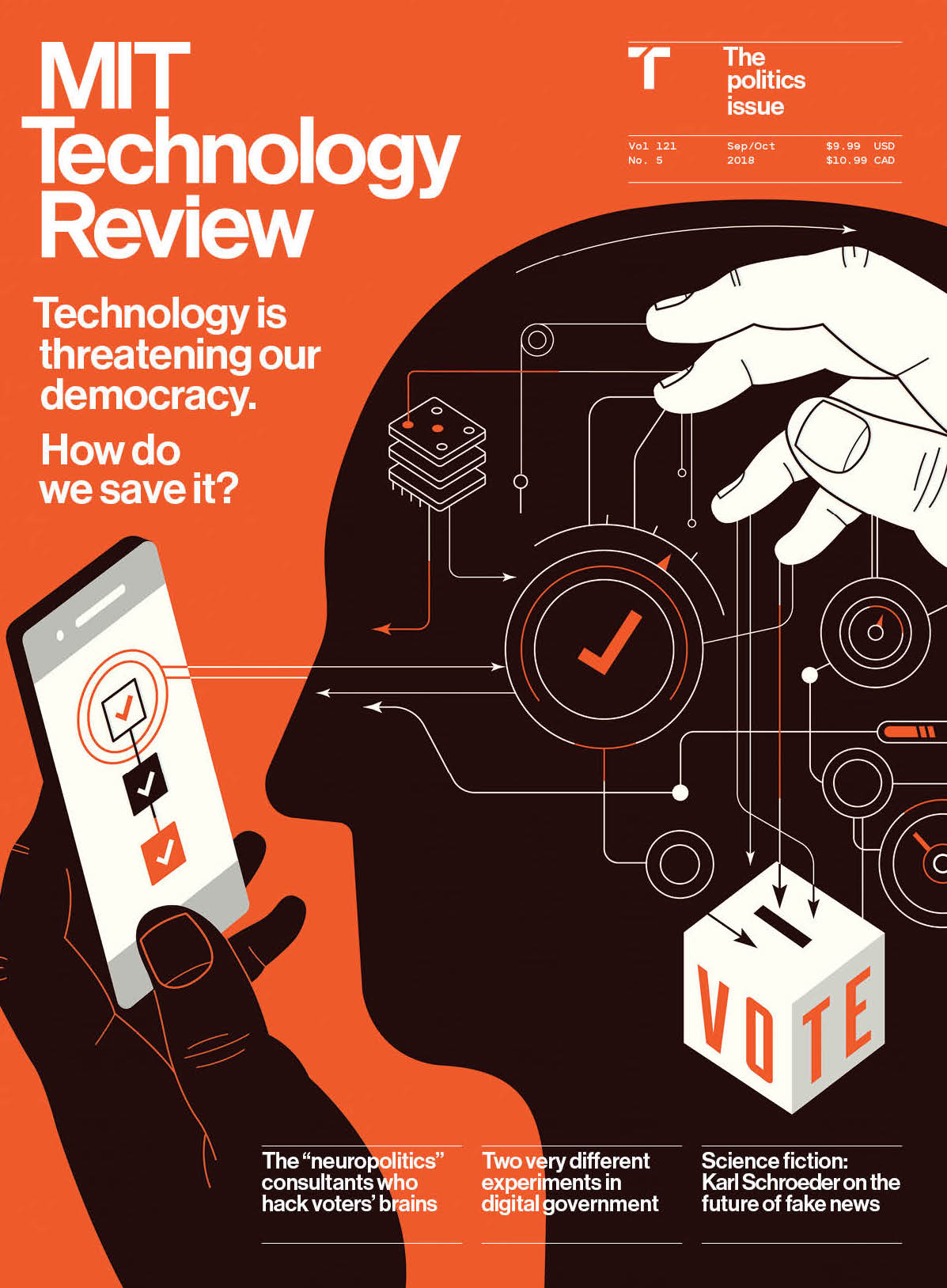
First, I present to you two cover images--of two authoritative publications:


I might as well leave it there for you to fill in the blanks and have nightmares for the rest of your lives!

The editors of MIT Tech Review write:
Silicon Valley was full of hope and hubris about its power to democratize the world.
Today, with Cambridge Analytica, fake news, election hacking, and the shrill cacophony that dominates social media, technology feels as likely to destroy politics as to save it. The tech firms and their boosters either didn’t imagine that “democratizing” technologies would be used by anti-­democrats too, or else believed that truth and freedom would inevitably defeat misinformation and repression.
Have you drawn the line from these to trump yet?

Haven't you been wondering, and worrying, over the past couple of years just what the hell happened?
How did all this happen? How did digital technologies go from empowering citizens and toppling dictators to being used as tools of oppression and discord?
Yes, in stating such views, I am assuming that you reader are not a trump toadie.  If you are, hey, enjoy the moment before your dear fuhrer and his minions are thrown out and thrown behind bars!

We need to be reminded over and over again that "we didn’t get where we are simply because of digital technologies."
The Russian government may have used online platforms to remotely meddle in US elections, but Russia did not create the conditions of social distrust, weak institutions, and detached elites that made the US vulnerable to that kind of meddling. ...
Russia did not create the 2008 financial collapse: that happened through corrupt practices that greatly enriched financial institutions, after which all the culpable parties walked away unscathed, often even richer, while millions of Americans lost their jobs and were unable to replace them with equally good ones.
Russia did not instigate the moves that have reduced Americans’ trust in health authorities, environmental agencies, and other regulators. Russia did not create the revolving door between Congress and the lobbying firms that employ ex-politicians at handsome salaries. Russia did not defund higher education in the United States. Russia did not create the global network of tax havens in which big corporations and the rich can pile up enormous wealth while basic government services get cut.
These are the socio-political conditions that we created for ourselves, in which Russia waded in and helped trump steal the election, with all the technological tools that our bright minds created while seeking higher profits and market capitalization. 

We have met the enemy, and it's us!


Tuesday, June 19, 2018

Whatever happened to the division of labor?

Gandhi preached self-reliance. We learnt about that school, and perhaps students learn that in India even now despite all the efforts of the modi toadies to rewrite Gandhi's and India's histories.

But, self-reliance has its limits.  We cannot do it all.  Where lies the line between doing-it-yourself versus having somebody else do it for you?

Over the past few years, it has been pissing me off that I am increasingly required to do everything. Like how at the big box stores, self-checkout is rapidly becoming the norm.  Even at hotels.  Remember this post from three years ago?
I walked up to check in.  There were more than a dozen flashing electronic screens instead of people.  Yep, those screens were for checking in.  First it was at the airports, and now at hotels too!
If I am going to be doing everything, wtf! 

You see how I have been pissed off about this for a while now?  I don't see how this level of self-service is progress.  It is a rapid annihilation of human contact, that's what it is!

Misery loves company.
Self-service supposedly represents the march of progress. A more prosperous society requires improving productivity: the best way is to substitute machine labour for the human sort. Are grumblers like me the modern-day equivalents of Luddites raging about the spinning jenny?
Exactly!
The self-service revolution is reversing the division of labour. You find yourself doing all sorts of jobs that you’re untrained for – acting as a travel agent booking a trip, an airport porter weighing and labelling bags or a shop-attendant checking out a basket of goods. Meanwhile a handful of companies suck up abnormal profits by turning their customers into unpaid labourers. The real sweatshop workers in the post-industrial economy are you and me.
We do all the work through self-service and some social misfits twenty-something programmers rake it in big time.  It is also highly likely that these programmers do not do a damn thing by themselves, and instead hire people through one of the many apps.  Self-service is for us suckers!

Monday, June 18, 2018

When you are with your child, put down your damned phone

The other day, we saw a three-year-old boy running excitedly on the bike path with a huge grin on his face.  His mother--we assume that was the relationship--was a few steps behind.

Nothing unnatural thus far, right?

Except that the mother was texting on her smartphone as she was walking.  And when she was done, she jogged to catch up with the boy.

If such a scene had been a rare occurrence, then I would not be worried.  But, it is not rare.  This has become the new normal, it seems.  Parents talking not to the kids but to somebody else on their smartphones.  Or texting. Or catching up on Facebook.

I suppose such highly distracted parenting will only worsen, which makes me all the more relieved that fertility rates have fallen to historic lows.  I would rather that people did not have children if they are going to be abandoning kids like this.

We have rapidly transitioned into a new world that runs against our own evolutionary mechanisms:
The new parental-interaction style can interrupt an ancient emotional cueing system, whose hallmark is responsive communication, the basis of most human learning. We’re in uncharted territory.
Unchartered, indeed!  There is decreasing levels of back-and-forth between children and adults.  I don't mean parents alone.  When I was growing up, it was not merely parents.  If they were not around, then I--like pretty much all children anywhere on this planet--was engaged in a back-and-forth with other adults or older children.  All these responsive communication helped all of us grow.
A problem therefore arises when the emotionally resonant adult–child cueing system so essential to early learning is interrupted—by a text, for example, or a quick check-in on Instagram. Anyone who’s been mowed down by a smartphone-impaired stroller operator can attest to the ubiquity of the phenomenon. ... “Toddlers cannot learn when we break the flow of conversations by picking up our cellphones or looking at the text that whizzes by our screens,” Hirsh-Pasek said.
It is all getting messed up!

Of course, parenting has always been associated with distractions.  A few days ago, a friend-couple recalled how when they were doing chores at home, their toddler daughter wandered into the yard--the door was accidentally open--and took a few sips of the lighter fluid.  Every parent has at least one awful story to tell.  But, that occasional distraction is different from the smartphone-distracted parenting of today:
A tuned-out parent may be quicker to anger than an engaged one, assuming that a child is trying to be manipulative when, in reality, she just wants attention. Short, deliberate separations can of course be harmless, even healthy, for parent and child alike (especially as children get older and require more independence). But that sort of separation is different from the inattention that occurs when a parent is with a child but communicating through his or her nonengagement that the child is less valuable than an email. A mother telling kids to go out and play, a father saying he needs to concentrate on a chore for the next half hour—these are entirely reasonable responses to the competing demands of adult life. What’s going on today, however, is the rise of unpredictable care, governed by the beeps and enticements of smartphones. We seem to have stumbled into the worst model of parenting imaginable—always present physically, thereby blocking children’s autonomy, yet only fitfully present emotionally.
All these don't add up well.  A brave new world!

Sunday, May 13, 2018

There is no free lunch

Remember that old joke about laptop computers being heavy, and that deleting unnecessary files will make it light as a feather? Haha!

Go ahead and Google that joke, if you want.

Wait, maybe you should think twice before you do it.  Not because of the need to think, which is important.  But, for a completely different reason:
Every Google search comes at a cost to the planet. In processing 3.5 billion searches a day, the world’s most popular website accounts for about 40% of the internet’s carbon footprint.
In the internet-of-things world of today, we forget that the internet is based on real world infrastructure and needs energy--a whole lot of it--to work.
“Almost nobody recalls that the internet is made up of interconnected physical infrastructures which consume natural resources,” [Joana] Moll writes as an introduction to the project. “How can such an evident fact become so blurred in the social imagination?”
In our daily lives, we rarely pause to consider how the good and services that we use are created.  Who makes tshirts? Where is the electricity coming from? It is always a combination of ignorance and apathy.
Despite the notion that the internet is a “cloud,” it actually relies on millions of physical servers in data centers around the world, which are connected with miles of undersea cables, switches, and routers, all requiring a lot of energy to run. Much of that energy comes from power sources that emit carbon dioxide into the air as they burn fossil fuels; one study from 2015 suggests internet activity results in as much CO2 emissions as the global aviation industry.
For Google, this infrastructure means about 0.01 kg per search request.

Of course, it is not just Google. The Frightful Five and others have to maintain servers and routers and whatever else all around the world.  Which is one of the reasons they also like places like Oregon where they set up their energy-hogging server farms.

Server farms all across the planet.
Ireland, which with Denmark is becoming a data base for the world’s biggest tech companies, has 350MW connected to data centres but this is expected to triple to over 1,000MW, or the equivalent of a nuclear power station size plant, in the next five years.
...
The data will be stored in vast new one million square feet or larger “hyper-scale” server farms, which companies are now building. The scale of these farms is huge; a single $1bn Apple data centre planned for Athenry in Co Galway, expects to eventually use 300MW of electricity, or over 8% of the national capacity and more than the daily entire usage of Dublin. It will require 144 large diesel generators as back up for when the wind does not blow.
The more connected we become, the more our energy needs, unless something is done dramatically different:
Global computing power demand from internet-connected devices, high resolution video streaming, emails, surveillance cameras and a new generation of smart TVs is increasing 20% a year, consuming roughly 3-5% of the world’s electricity in 2015, says Swedish researcher Anders Andrae.
In an update to a 2016 peer-reviewed study, Andrae found that without dramatic increases in efficiency, the ICT industry could use 20% of all electricity and emit up to 5.5% of the world’s carbon emissions by 2025. This would be more than any country except the US, China and India.
Don't trust all these?  Go ahead, do a Google search ;)

Friday, May 11, 2018

From my cold, dead hands!

Remember Moses saying that?

Of course it was not Moses. It was Charleton Heston who played that role.  And, no, he did not utter those lines when walking around as Moses.  Heston was scaring the cult, er, the NRA, that the government was coming to get their guns.  This was 18 years ago, when the NRA was campaigning against Al Gore.

No, this is not a post about guns.

It is about smartphones about which most people will defiantly declare that they will never be separated from them. "From my cold, dead hands!"

More and more people are talking and writing about this smartphone addiction.
If I’m honest, much of what I did on my phone could be characterized as mindless. I can’t count the number of times I pulled out my phone just for the feeling of unlocking the screen and swiping through applications, whether out of comfort—like a baby sucking her thumb—or boredom—like a teenager at school, tapping his fingers on a desk. In those cases, I sought not mental stimulation, but physical release.
In the old days, at the airports, for instance, people might have even attempted to talk to the people next to them.  Or, maybe they walked up and down observing people and wandering into stores.  Now, it is all about the smartphone--even if they are only aimlessly and mindlessly locking and unlocking their phones!
If personal technology is improving the world of thought, what is it doing to the world of our moving, breathing bodies?
What is it doing to us?

The author of that essay has given up her smartphone.
Without my phone, I’m more fully myself, both in mind and body. And now, more than ever, I know that looking at my phone is nothing compared to looking at my daughter while the room sways as I rock her to sleep, or how shades of indigo and orange pour in through the window and cast a dusky glow over her room, or the way her warm, milky breath escapes in tiny exhalations from her lips, or how the crickets outside sing their breathless, spring lullaby.
I don't believe in giving up the smartphone.  But, I do believe in moderation. I believe in making sure that I own the phone, and that the iPhone does not own me.  Often, just to make sure I know how to operate in this world without the smartphone, I go about running errands without carrying my phone.  As much as possible, I refuse to use the map app.  I don't have to die in order to give up my iPhone.

Wednesday, May 09, 2018

Every breath you take / Every move you make / I'll be watching you!

Take a look at this photo:


Looks like one of those coffee shops where young customers stay for hours while making use of free wifi, right?

Look again.  There is something hanging under his neck.  If somebody had asked me to guess what it is, I would have failed, and failed miserably.

It is a "sociometric badge."

I am with you--I have no idea what it means when somebody says "sociometric badge."  Guess what it is for?  "Combined with digital data, sociometric badge data can help organizations get a holistic view of how work gets done."

Even at this point, you might wonder what that means.  I am with you.  I didn't know about any of these until I read this essay on how digital technology and data on all kinds of things are enabling employers to monitor their employees every second.  It is one of the most depressing essays that I have read recently.  Ignorance is bliss!

That "sociometric badge"?  Ironically, the company that makes that is called Humanyze.  A company that is all about dehumanizing people and their work is called Humanyze!  It is a pioneer in something called "people analytics"--a phrase that I wish I had not heard or read. Referred to in short as PA.   "Worn around the neck and attached to microphones and sensors, the badges record their subjects’ frequency of speaking, tone of voice, facial expressions, and body language."  Note the kinds of data that the badge is collecting!

Very little "escapes the gaze of the sociometric badge and its associated technologies":
“Even when you’re by yourself, you’re generating a lot of interesting data. Looking at your posture is indicative of the kind of work and the kind of conversation you’re having.”
This is fucking insane!

Even scarier is this: Humanyze is not the only game in town.  All these PA firms "rely on combinations of wearables and computer-based technologies to monitor and control workplace behavior."
These companies boast that their systems can find out virtually everything there is to know about employees, both in the workplace and outside it. “Thanks to modern technology,” in the words of Hubstaff, a PA company based in Indianapolis, “companies can monitor almost 100 percent of employee activity and communication.”
Like I said, this is fucking insane!

The owners of these robots gain more wealth and power over labor that increasingly is left behind and becomes voiceless.  The demagogue who foul-mouthed his way to the Oval Office in order to fight for the forgotten men and women couldn't care less.  It was never about the forgotten!

Thursday, May 03, 2018

Only the lonely!

The more the virtual connections, and the more time that one spends in the virtual world, there is less time for the real world.  And, it is in the real world that we people live.  So, if we have very little time for the real world ... then ...
loneliness is widespread in America, with nearly 50 percent of respondents reporting that they feel alone or left out always or sometimes.
Now, pause for a minute and think about it.  Who spends less time in the virtual world?  Older folks, right?  And who is online and connected 24x7?  The digital native young people.  So, it should be no surprise that:
"Too often people think that this [problem] is specific to older adults," says Holt-Lunstad. "This report helps with the recognition that this can affect those at younger ages."
In fact, some research published in 2017 by psychologist Jean Twenge at San Diego State University suggests that more screen time and social media may have caused a rise in depression and suicide among American adolescents. The study also found that people who spend less time looking at screens and more time having face-to-face social interactions are less likely to be depressive or suicidal.

More often that not common sense can easily tell us what we otherwise try to measure through expensive research.  Loneliness and technology is one of those easy to call issues.

The only interesting twist for me was this on the correlation between social media use and feelings of loneliness:
"If you're passively using it, if you're just scrolling feeds, that's associated with more negative effects," she says. "But if you're using it to reach out and connect to people to facilitate other kinds of [in-person] interactions, it's associated with more positive effects."
But then, it makes sense--it all depends on how we use any technological tool.

On this issue, the UK is ahead of the US--a few months ago, the UK's Prime Minister appointed a minister for loneliness:
“For far too many people, loneliness is the sad reality of modern life,” Mrs. May said in a statement.
“I want to confront this challenge for our society and for all of us to take action to address the loneliness endured by the elderly, by carers, by those who have lost loved ones — people who have no one to talk to or share their thoughts and experiences with.”
Modern life is a killer!
“There are so many university students who just lock themselves in their rooms for days because they feel rejected or that they don’t fit in,” Ms. Jenkins said. “It’s only a matter of time before loneliness turns into depression. And that’s where it gets dangerous.”
I am outta here!

Wednesday, April 25, 2018

More on us dumb fucks!

In a number of posts, like in this one where I wrote about the dumb fucks that we are, I have been worried not merely about Facebook, but about the the Frightful Five, as Farhad Manjoo so wonderfully described them: Amazon, Apple, Facebook, Microsoft and Alphabet, the parent company of Google.

The country and the world have kind of sort of started worrying about Facebook. But, we have not even started looking at the dangers that these five, and other rapidly growing AI companies, represent.

Consider Amazon:
Of the top 10 US industries by GDP (information, manufacturing non-durable goods, retail trade, wholesale trade, manufacturing durable goods, healthcare, finance and insurance, state and local government, professional and business services, and real estate), Amazon has a finger in all but real estate.
Amazon is everywhere.  And knows a lot about you and me.
 What makes Amazon so frightening for rival businesses is that it can use its expertise in data analytics to move into almost any sector.
“Amazon has all this data available. They track what people are searching for, what they click, what they don’t,” said Greer. “Every time you’re searching for something and don’t click, you’re telling Amazon that there’s a gap.”
Amazon knows where you live, who you live with, your current location (if you use an Amazon smartphone app), what TV shows you watch, what music you listen to and what websites you visit.
Remember, for instance, how Amazon swiftly moved in and bought Whole Foods?  It was not a whimsical move.
When Amazon bought Whole Foods, grocery chains’ stock prices crashed. Two months later, when Amazon announced it would cut Whole Foods’ prices, grocery stocks plummeted again. The meal kit maker Blue Apron’s stock price fell 11% after the news that Amazon was filing for a meal kit trademark. A vague announcement from Amazon that it was collaborating with JP Morgan and Berkshire Hathaway on some kind of non-profit healthcare venture sent healthcare stocks on a downward slide.
What's good for Amazon might not be good for us though.
“The algorithms are designed to serve up things that best serve Amazon, steering us to some books and not others,” said Stacy Mitchell, co-director of the Institute for Local Self-Reliance. “You have a company that can shape whether a particular author is able to find an audience, and whether they can even get published.”
The algorithms effectively create a world in which you don't even know what you are missing.  “Amazon is just getting started,” said [ Tuck School of Business professor Vijay] Govindarajan.

The manner in which we politically govern the problems is not equipped to deal with the rapidly evolving technologies.
Amazon’s business strategies and current market dominance pose anticompetitive concerns that the consumer welfare framework in antitrust fails to recognize.
Instead of addressing such complex issues, we have a narcissistic megalomaniac who tweets about Amazon and the US postal system.  What dumb fucks we are!

Monday, April 23, 2018

The appified life!

The pace of criticism of our computer-driven existence has picked up a great deal.  Which means the damn thing is happening way more than I can imagine and understand!

Consider, for instance, MealTribes.  I hadn't even heard about this until very recently. Recently as in yesterday!  MealTribes is an app that helps people connect with others and get together at potlucks to make friends.  Technology, which created our lonely existence, is now being tapped into for young people--who might have hundreds of virtual friends, but are lonely--to get out into the real world and connect with real people.
Founded by 28-year-old Jared Gold and some friends in 2017, MealTribes bills itself as “a better way to authentically connect with peers nearby.” Prospective diners create a profile on the online platform by answering a brief questionnaire, with some optional questions not unlike those you’d find on a dating site: Are you a “nature lover,” an “advice guru” or a “chef”? If you could live as any person for a day — dead or alive — who would it be? Users then sign up online for either a weeknight dinner or weekend brunch, with six or seven strangers.
An "authentic" way of connecting:
MealTribes is capitalizing on something else, too: the so-called “loneliness epidemic” we’re all supposedly experiencing as urban millennials, though we’re way too cool to admit it. 
Such is life in this algorithmic world!

Algorithms not only are used to connect with people in the real world, but also to shape our tastes--from what we "want" to wear to the trendy foods to whatever:
This impacts not only the artifacts we experience but also how we experience them. Think of the difference between a friend recommending a clothing brand and something showing up in targeted banner ads, chasing you around the internet. It’s more likely that your friend understands what you want and need, and you’re more likely to trust the recommendation, even if it seems challenging to you.
Maybe it’s a particularly shapeless garment or a noisy punk track. If you know the source of the suggestion, then you might give it a chance and see if it meshes with your tastes. In contrast, we know the machine doesn’t care about us, nor does it have a cultivated taste of its own; it only wants us to engage with something it calculates we might like. This is boring. “I wonder if, at the core of fashion, the reason we find it fascinating is that we know there’s a human at the end of it,” Pieratt says. “We’re learning about people. If you remove that layer of humanity from underneath, does the soul of the interest leave with it?”
I wonder how the question of "what does it mean to be human?" will be answered in the coming decades.  Come to think about it, I would rather not know!

Saturday, April 21, 2018

The Silicon Slimeballs

Yes, I did it.  But, the larger problem isn't going away anytime soon.

I speak of Facebook, algorithms, and AI.  We are but only at the very beginning of it all!

It is not Zuckerberg the person, the programmer, the entrepreneur that is the problem.  It is his techno-fundamentalism:
Zuckerberg isn’t a cynic; he’s a techno-fundamentalist, and that’s an equally unhealthy habit of mind. It creates the impression that technology exists outside, beyond, even above messy human decisions and relations, when the truth is that no such gap exists. Society is technological. Technology is social. Tools, as Marshall McLuhan told us more than fifty years ago, are extensions of ourselves. They amplify and distort our strengths and our flaws. That’s why we must design them with care from the start.
And what can/should be done?
To chart the way forward, Zuckerberg has few effective tools at his disposal. He should be honest about their limitations—if not for his company’s sake then for ours.
Hah!  Imagine Zuckerberg or anybody else in his position being honest!  Hah!  The Silicon slimeballs are increasingly a threat to us all.

AI is severely limited:
At its heart is an assumption that historical patterns can reliably predict future norms. But the past—even the very recent past—is full of words and ideas that many of us now find repugnant. No system is deft enough to respond to the rapidly changing varieties of cultural expression in a single language, let alone a hundred. Slang is fleeting yet powerful; irony is hard enough for some people to read. If we rely on A.I. to write our rules of conduct, we risk favoring those rules over our own creativity. What’s more, we hand the policing of our discourse over to the people who set the system in motion in the first place, with all their biases and blind spots embedded in the code. Questions about what sorts of expressions are harmful to ourselves or others are difficult. We should not pretend that they will get easier.
To think about these limitations, to address them, will require technology developers (and users too) to think about all these, which requires an education that is much broader than merely about technology and the pursuit of profits.  Instead, we are doing everything we possibly can to destroy any semblance of a broader understanding.  We prostrate to the market gods!

What a fucking disaster :(


Thursday, April 19, 2018

The machines have won :(

Ever since I started thinking on my own, following something that somebody lays down as a rule has been difficult.  I don't want to merely follow orders.

Now, increasingly, it is not humans ordering us what to do and what not to do.  Machines do that. Algorithms are the enforcers.  It scares the bejesus out of me.

It is not that I don't care for the comforts that these machines provide.  It is awesome that. for instance, the heater kicks in automatically at five in the morning and warms up the home before I get out of the bed.  But, I worry that most of us are mindlessly yielding to computers.
As we transfer agency to computers and software, we also begin to cede control over our desires and decisions.
That loss of agency worries me. It has always worried me.  Agency is what I have always urged in my students too.  I have even semi-seriously joked that my view of college education is to make sure we don't create automatons out of students, and that I want to make sure they can think.

But, automatons we are rapidly becoming.
Already, many people have learned to defer to algorithms in choosing which film to watch, which meal to cook, which news to follow, even which person to date. (Why think when you can click?) By ceding such choices to outsiders, we inevitably open ourselves to manipulation. Given that the design and workings of algorithms are almost always hidden from us, it can be difficult if not impossible to know whether the choices being made on our behalf reflect our own interests or those of corporations, governments, and other outside parties.
I feel like it is a lost cause.  The battle, the war, has been lost.  A few of us jumping up and down shouting about these won't matter--most are not even listening to us.  Heck, they don't even know we exist!

I often argue, as I did even yesterday, it is all about making conscious decisions about "the trade-offs inherent in offloading tasks and decisions to computers."  Agency.  " If we don’t accept that responsibility, we risk becoming means to others’ ends."

We humans are becoming more and more like machines. We are becoming robotic, even as robots are getting better and better.  And that means:
it will be increasingly impossible to distinguish between humans and robots because of our machine-like behavior as much as robots’ human-like features. And could this eventually become the norm, with humans spending their entire lives acting like machines?
I am sure that even now many amongst us will fail the “Voight-Kampff test," which in Blade Runner was used to "assesses capacity for empathy, a human facility that even the most intelligent androids lack."  How else can one explain the election of a man completely devoid of empathy as the President of the US!