Showing posts with label hindutva. Show all posts

Monday, August 05, 2019

The blowing up of Kashmir

I am no Indologist. Am not an international relations expert.  I am not located in India.  Heck, I am not even an Indian!

Yet, sitting at home only a few hundred meters from the Willamette River, I knew immediately that tRump had committed a huge geopolitical blunder when he volunteered to mediate in the India-Pakistan conflict during a press conference with the visiting Pakistani Prime Minister, Imran Khan.

After tweeting about, I followed up with this:
That was two weeks ao.

After a relaxing summer weekend, earlier in the morning, I read this:
The Indian government said on Monday that it was revoking a constitutional provision that had for decades given a unique degree of autonomy to Kashmir, a disputed mountainous region along the India-Pakistan border.
The government that won re-election by a huge margin by playing up the Kashmir and Pakistan cards takes the Kashmir issue to a whole new level right in time for its independence day political theatre!

The India-Pakistan tensions over Kashmir date all the way back to their respective creations from the British Raj, back in 1947:
Kashmir agreed to become part of India only under certain conditions that guaranteed its autonomy, which were protected by Article 370. India and Pakistan then fought several wars over the area and today most of Kashmir is administered by India, with a smaller slice controlled by Pakistan, which like Kashmir is majority Muslim.
Of course, the Pakistan government wasted no time in responding:
The Pakistani Foreign Ministry condemned the Indian announcement as a violation of United Nations resolutions, saying in a statement on Monday that “Pakistan will exercise all possible options to counter the illegal steps.”
Imran Khan started calling up his allies.
When speaking to Turkey's President Recep Tayyip Erdogan, Khan said that "India's illegal actions to modify the special status of the Indian Occupied Kashmir would have serious implications for the regional peace and security"
tRrump couldn't care.  He reaffirmed on August 2 that he was happy to intervene."  Of course, he always doubles down!
The Pakistani military, the ultimate arbiter of the country's foreign policy (and its nuclear arsenal), didn't mince words: "Kashmir runs in blood of every Pakistani. Indigenous freedom struggle of Kashmiris shall succeed [God willing]," said Major General Asif Ghafoor, a military spokesman.
What next?

With a caveat that I am no expert, I worry about the following two possibilities:

  • There will be tremendous pressure on Imran Khan to not merely fight back with words but also with weapons.  This is an attempt by the mOdi government to lure Pakistan into lobbing the first bomb across the border, which will then give the justification for the Indian government to launch a full-fledged military attack.
  • Either with the support of Pakistan's notorious ISI, or on their own, militants will strike in India, especially timing with the independence day political celebrations.  These militant strikes will the justification for the mOdi government to clamp down on internal security--perhaps even an "emergency"--while launching a military assault on Pakistan.

Peace is doomed in the Subcontinent! 

Tuesday, September 18, 2018

Carnatic music is not a Hindu fundamentalist art

Listening to the South Indian classical music--carnatic music--was a serious passion among most elders in the extended family.  Appreciation of the music came quite naturally to me and I was beginning to get really good in recognizing the ragas even from the first couple of notes.  It was wonderful until ... I started questioning religion.

Rare is a composition that is not about any one of the Hindu gods.  For all purposes then this classical music is also devotional music. To borrow a word from Christianity, it was ecclesiastical. 

Into my teenage years, as I started questioning religion, the agnosticism spilled over into the appreciation of this music as well.  I suppose I was consistent in my approach in questioning whether one could be into the music without being in the religion.

I was provided with a wonderful real example of this puzzle--following some of controversies related to the musician KJ Yesudas.  Born into a Catholic family, Yesudas took up carnatic music and was a student of one of the most accomplished musicians.

Yesudas' involvement with this Hindu music drew ire from the Catholic religious leaders, who even threatened him with excommunication.  The Catholic logic was that by singing bhajans and carnatic music compositions in temples, Yesudas was straying far away from the monotheism of Christianity.  The excommunication never happened, but all those developments made me think that much more about religion and carnatic music even as I was questioning the concept of "god" itself.

In fact, one of the compositions by Thyagaraja clearly lays out the relationship between carnatic music and devotion:
Sangeetha gnanamu Bhakthi vinaa,  San margamu  kaladhe , Oh Manasa
(The knowledge of music, without devotion (bhakthi) is not the right path, oh mind)
The lyrics further note that this music is a mode of worship. 

The more I moved away from religion--not merely Hinduism, but any religion and god--the more I was naturally disconnecting from this classical music as well. 

Over the decades, I have pretty much lost any interest in carnatic music, and it is only the intellectual curiosities about the music that remain within me.

Every time I visit India, which is almost always in December, I am often presented with opportunities to think about this question of bhakthi in carnatic music--it is also in December that Chennai hosts the huge music festival, and there are programs on television as well.  One of the TV programs features Q/A sessions with musicians.  Without fail, there is always a question about the role of bhakthi in the music, and every musician who has taken that question emphasizes that without bhakthi there cannot be any music.  It is like listening to baseball players responding to questions when you know exactly what their response is going to be. 

Maybe someday there will be a body of secular carnatic music that was borne out of the rebellion against Hinduism?  You think? Nah!

All the above is a part of my post here from seven years ago.

After reading that post, an old high school friend wrote to me about TM Krishna. I then emailed him.  In his lengthy reply (July 17, 2011) Krishna wrote about his experiences when questioning the bhakthi: "reactions have varied agreements to very upset emails etc."

All that was before modi and the BJP came to power in Delhi and in a number of states.  Since then, the emboldened hindutva has gone after anybody who they deem to be a threat to Hindu traditions.  Singers like Krishna and O.S. Arun who have broadened the scope of carnatic music are now under fire; such a huge controversy that even NPR reports.

What's worse is this: Indians living outside the US are some of the big money drivers for such Hindu fundamentalism in carnatic music:
[The musicians] been called "disgusting cretins." Arun has received threatening phone calls.
Much of the vitriol has come from Indians abroad, who've emigrated to the United States or Australia.
It is not a surprise by any means, especially when there is a lack of domestic financial support for carnatic music.

modi and the BJP recognized early on that many of the Hindus living outside India and earning a lot of money are a lot more fanatical than their peers back in India.  The Hindu diaspora is heavily influencing India's politics thanks to its money power, as The Economist noted:
For years Indian politicians paid little heed to the diaspora. But in the 2014 general election the diaspora, some 30m people strong, proved to be influential. Mr Modi made best use of them, realising the diaspora, especially in America, is wealthy and increasingly interested in politics generally
The Hindu diaspora forced the cancellations of concerts that Krishna and Arun were scheduled to perform!
One by one, Hindu temples in the U.S. that had been scheduled to host concerts this fall by Arun and another Carnatic star, T.M. Krishna, have said the singers are no longer welcome. Concerts have also been canceled in India.
I love Krishna's response to all these maniacs: "Krishna vowed to release a new song each month about Jesus or Allah."


Monday, February 12, 2018

Moronic Monday!

Today is Charles Darwin's birthday.  Darwin Day!

It is time to showcase the anti-evolutionists. You know, those creationists.

But, it is no fun anymore to write about such ignoramuses in the GOP here in America.  It is so boring.

So, instead, on this Darwin Day, I turn to my old country.

A minister in modi's cabinet created quite some interesting moments a few days ago:
 Union minister Satyapal Singh has claimed that Charles Darwin’s theory of evolution of man was “scientifically wrong” and it needs to be changed in school and college curriculum.
Mr. Singh, the Minister of State for Human Resource Development, said our ancestors have nowhere mentioned that they saw an ape turning into a man.
Yep, the moron did not come across any reference in the literature of an ape turning into a man.  Ergo, Darwin is wrong.
“Nobody, including our ancestors, in written or oral, have said they saw an ape turning into a man,” he said, adding “No books we have read or the tales told to us by our grandparents had such a mention.”
The moron stood by his profound words of wisdom:
Satyapal Singh stood by his comments on Monday, saying his ministry was ready to host an international conference at which “scientists can come out and say where they stand on the issue”.
“I have a list of around 10 to 15 great scientists of the world who have said there is no evidence to prove that the theory of evolution is correct,” Singh told a crowd at a university in Assam state, adding that Albert Einstein had agreed the theory was “unscientific”.
I know what you are thinking.  This is a moment when we witnessed an Indian politician man turning into a monkey! ;)

What is even more shocking is that this monkey is credentialed:
The Minister is a retired IPS officer, a student of science who has M.Sc and M.Phil degrees in chemistry, and has obtained a Ph.D He is the author of several books and papers and, according to the Lok Sabha website, is working on four more books.
I suppose it is true--at some point, the randomness of this cosmos means that a monkey could end up writing the Hamlet or earning a doctorate in chemistry! ;)

Chances are that the monkey minister has no idea that even the Rig Veda is a lot humbler about Creation:
There was neither non-existence nor existence then.
There was neither the realm of space nor the sky which is beyond.
What stirred?
Where?
In whose protection?
Was there water, bottlemlessly deep?

There was neither death nor immortality then.
There was no distinguishing sign of night nor of day.
That One breathed, windless, by its own impulse.
Other than that there was nothing beyond.

Darkness was hidden by darkness in the beginning,
with no distinguishing sign, all this was water.
The life force that was covered with emptiness,
that One arose through the power of heat.

Desire came upon that One in the beginning,
that was the first seed of mind.
Poets seeking in their heart with wisdom
found the bond of existence and non-existence.

Their cord was extended across.
Was there below?
Was there above?
There were seed-placers, there were powers.
There was impulse beneath, there was giving forth above.

Who really knows?
Who will here proclaim it?
Whence was it produced?
Whence is this creation?
The gods came afterwards, with the creation of this universe.
Who then knows whence it has arisen?

Whence this creation has arisen
- perhaps it formed itself, or perhaps it did not -
the One who looks down on it,
in the highest heaven, only He knows
or perhaps even He does not know.
I will now step outside to see if any die-hard-creationist is evolving from an ape ;)

Monday, February 05, 2018

The American Dream ... not the Saudi Dream!

I think it was in the fifth or sixth grade when a classmate--Rabindranath, according to my memory--gave me a Saudi Arabia stamp.  For free. 

Unlike the usual protocols where stamps were exchanged, here I was getting one for free. What was the deal?

It turned out that Rabindranath was leaving school and leaving town. His father was going to work in Saudi Arabia.

Since then, I have known plenty of people who left for the "Gulf," as the usage was back then.  It meant that they could be working in any of the kingdoms/emirates near the Persian Gulf.  Some of them took their families also along.  The children attended schools there, and then came to India for college or went to other countries for higher education.  When the parents' contract ended, they returned to India or tried to immigrate elsewhere.

People went on work visas, and the end of work was also the end of their visa status.

The US, on the other hand, was highly restrictive.  Back then, a rare few went to the US on work visas.  Almost always, those who went to the US to work settled down there, raised their kids as Americans, and visited India with their American passports.  This was a small number of people compared to the crowds from the Gulf.

Over the years, we have gotten so much used to the idea of American work visas translating into American citizenship that I think we have started making the mistake of equating American work visas to American citizenship. 

And, thus, we have a new battlefront emerging about another group of Dreamers--these are the children of people who are in the US on work visas.
Nicknamed “H-4 Dreamers,” the children were brought to America from India with their parents on H-4, or dependent, visas. Until they turn 21, their status is the same as that of their parents, so if their parents become citizens, they do as well.
Many parents take this approach, coming into the country for a short period on an H-1B visa as a skilled worker and then applying to stay on an immigrant visa.
That’s usually not a problem, unless the family is from India, where there’s a 70-year wait for immigrant visa status because of a large number of qualified applicants.
They are pissed off that their parents came to the US on legal work visas, but are stuck in the Green Card lane forever, while the children of the parents who are here without legal papers are the ones who are getting all the attention.  The H4 Dreamers are not treated as "natives" when they apply for undergraduate education--because they are not permanent residents. And, even worse, when they turn 21, they cannot even continue as dependents on their parents' visas.

So, guess who organized a protest in DC about this?  The Republican Hindu Coalition.  Yes, "Hindu"--not "Indian."
“Trump loves Hindus,” “Trump loves India,” “Trump bringing Ram Rajya,” “Indians love Trump,” said the slogans
This is fucking nuts!  trump and "Ram Rajya"?  Do these people know anything about Ram, and about trump?
The march on Saturday, while endorsing Mr. Trump’s approach to immigration, was to highlight the issues concerning the legal residents who are already in the country. “While the current discussion is primarily focussing on those who illegally entered the country, we are working with the lawmakers to get some attention on this group that reached this country legally but face uncertainty now,” said Mr. Bansal.
The hindutva/modi/trump alliance is unholy as hell!

But then, this is yet another reason why I love this country--even non-citizens can protest here, unlike in the "Gulf."

Source

Saturday, September 16, 2017

Free speech is for losers!

My father had a question for me.  "You have a flair for writing.  Why don't you write for the paper here?"

I told him only one half of the truth.  "I am not familiar with the nuances of India's politics for me to write about issues there."  He was convinced.

I did not share with father the rest: I have given up on the old country.

It is not that I don't follow the news about the country where I was born and raised.  I do.  But  ...

No wonder the courts always require "the truth, the whole truth, and nothing but the truth."  Half-truths don't tell the entire story.

As I commented even here, I deeply value free speech, which is increasingly a endangered species in India.  The latest victim for speaking freely was a female journalist, Gauri Lankesh.
Gauri Lankesh was the editor of a weekly tabloid published in Kannada, the main language of the southern Indian state of Karnataka. She was murdered on the fifth of September at the gate of her house in Bangalore, shot in the head and chest at close range.
Back in my younger years, free speech was severely curtailed during the dark two years of Emergency rule under Indira Gandhi.  She threw journalists in jail, and heavily censored the publications that were critical of her. It seems like free speech is way more a risky proposition now in India!
From the moment she died, the press reported her death not as an individual event but as the fourth in a sequence of assassinations; to the names Narendra Dabholkar, Govind Pansare, and M.M. Kalburgi, journalists now added Gauri Lankesh. Politically they were all left-leaning, strongly rationalist, hostile to Hindu orthodoxy, and convinced that right-wing majoritarianism was the mortal enemy of republican democracy. They were also public intellectuals who chose to write in their mother tongues: Dabholkar and Pansare wrote in Marathi, Kalburgi and Lankesh in Kannada. They spoke to a vernacular readership beyond the reach of the country’s English media, with its pan-Indian but paper-thin Anglophone audience. Each of them was shot dead by men on motorcycles with homemade pistols who got away. 
And these are no isolated cases.  They fit into an overall theme:
The intimidation or murder of inconvenient journalists is part of a much wider violent tendency. Since Narendra Modi became prime minister, India has seen a spate of targeted assaults on poor Muslims and Dalits, plebeian groups who deal in hides and skins and cattle and meat. Dalits dealing in cow hides have been systematically thrashed by vigilantes, encouraged by the present regime’s commitment to cow protection. Muslims have been dragged from their homes and beaten to death on the suspicion of having eaten beef. Muslims involved in the cattle trade have been bludgeoned to death on public highways as they begged for their lives, or strung up on trees and lynched.
The deaths of Dabholkar, Pansare, Kalburgi, and Lankesh weren’t just murders; they were lynchings, no different from the killings carried out by cow vigilantes.
Shikha Dalmia, who is a libertarian-conservative Indian-American journalist, whom I have been reading for years, writes about Lankesh's assassination.
To say that Gauri, whom I met in journalism school in New Delhi 34 years ago, was a remarkable woman would be an understatement. There was just no one I knew that was packaged quite like her. She combined a gentle warmth, profound compassion, easy forgiveness with a steely, unwavering, moral conviction. She was also preternaturally humble and honest—a hero who didn't have the vanity to imagine being one.
From years of reading Dalmia, well, her high praise means high praise.  Dalmia does not bullshit.
She made mistakes and had her blind spots, to be sure. Unlike me, she had a strong socialist streak. She didn't condemn Naxalism—a militant Maoist movement in India that fights for lower castes and farmers against feudal, upper-caste landlords—as forcefully as she should have. She called for the "rehabilitation" of its members because she saw them as more misguided than dangerous—and also because, whatever their excesses, they paled in comparison with those of a violent state that without any due process killed real and alleged Naxals in fake "encounters" (confrontations), including one with our journalism school senior, Saket Rajan, whose death profoundly affected Gauri.
I will end this with Dalmia's line:
Gauri's assassination shows just how far India's once-proud liberal democracy has fallen.

Sunday, November 01, 2015

Vox populi when religion takes over the secular public space

Voting and democracy require responsible voters and responsible politicians.  The old country and the adopted country alike seem to be regressing in these! :(

The patchwork quilt that India has been ever since it was created as an independent country by the departing White supremacists, forging an "Indian" identity has been a difficult task.  Religions, languages, castes, history, and everything else together presented one huge challenge.  In such a situation, perhaps the worst development ever was the Indian voters electing to power a party and its leaders who always flexed their Hindu muscles.

The open "Hindutva" in the secular public space has put religious minorities on the alert.  The cold-blooded murders of thinkers who wrote against religion, especially Hinduism--even though they were not from the "other" religions--has not only made the minorities worry about their place in the country's quilt, but has also catalyzed the intellectuals to returning the government bestowed honors.

The latest to speak about all these is one of my favorite musicians right from my younger days in the old country:
Sarod maestro Ustad Amjad Ali Khan on Sunday said writers and artistes, who returned their awards “are not mad” but pained at the situation in the country, and Prime Minister Narendra Modi should rein in people responsible for it
An honoree himself, the Ustad is "watching the situation":
They are also concerned with the present situation, therefore they are returning their awards. We have freedom of expression. It seems that there is something wrong somewhere.
Meanwhile, the founder of one of India's most visible companies behind the IT revolution there, Narayana Murthy, whose name could not be any clearer that it is Hindu, is worried:
A country can only make economic progress when there is no strife, no fear, and when the majority community stops oppressing the minority community. It doesn't matter which govt is in power,
Businesses usually do not care about human rights and morals as long as they can make profits.  But, they begin to shift uneasily in their seats when they sense that the business climate is being negatively affected.
Narayana Murthy is the lone voice from Corporate India who has expressed his concern over rising intolerance in the country.
On Friday, Moody’s Analytics, a research arm of the Moody’s group, had advised Prime Minister Narendra Modi to keep party members in check, or risk losing the government’s domestic and global credibility.
Meanwhile, from across India's borders comes this commentary:
Prime Minister Modi has failed to discourage and punish extremists and guard India's great democratic values. ...Pakistan does not have a success story to teach India how to grapple with religious intolerance. Nonetheless, India can still learn from Pakistan where we experimented with mixing religion and politics. And, in a nutshell, it sucks! People do have the right to believe that their religion is awesome but that awesomeness should not come at the cost of someone else's freedoms. India will remain a great model for the rest of the world as long as it stays a democratic, pluralistic and secular society. With no religion, should India, or any other country, trade precious values like democracy, tolerance and individual freedoms.
But, hey, unlike Pakistan's military dictatorship under Zia ul-Haq which led that country's transformation into a theocracy, it was India's voters who elected Modi and his toadies.  I think this makes India's ugly turn even worse.  However, it is not late to get back on to the secular track.  There is hope that the majority Hindu will act on the understanding that "Vaishnav people are those who":
Feel the pain of others, Help those who are in misery.


Friday, October 09, 2015

Hey, is it beef that you are eating? Facebook it!

Governing is not easy.

The best example is from right here in the US, in the House of Representatives in DC.  The party that has a significant majority of 247 members out of 435 cannot even figure out whom to elect as the leader.  It is one thing to campaign and spew rhetoric, it is another to govern.

The good thing is that nobody died from this chaos and confusion among the conservatives.

It is a different story in the old country, where, to use the late Mario Cuomo's wonderful line, the prime minister, Narendra Modi, campaigned in poetry and is terribly failing at the prose that governing is.

The latest?  Modi had yet another successful visit to the US, meeting with the computer emperors and adoring Indian-Americans in the Silicon Valley.  What happened later?  Within a day after Modi's return to India, a Muslim was brutally killed.
Here's what happened: On Sept. 28, in a village less than 60 miles from Modi's posh New Delhi home, a Hindu priest announced in a local temple (under threat by some hot heads, he claims) that a Muslim family was consuming beef, a no-no for Hindus who regard cows as sacred. Shortly afterward, an enraged Hindu mob barged into the family's house and pulled out the ailing 50-year-old father and his 22-year-old son from bed. Disregarding the pleas of the three bewildered women in the house, they beat the men with such rapturous fury that within minutes the father was dead and his son in a coma.
Perhaps this was a village that has had quite a history of religious violence?  Nope:
This village had been a model of inter-religious harmony for the six decades since India's independence from the British, with nary a hint of violence. Though Muslims were always a small minority among the 6,000 people, they were intricately woven into the village fabric. Each community greeted the other with its salutation and jointly celebrated each other's religious festivals. The bludgeoned man's older son was a technician in the Indian Air Force.
The terrifying message of the grisly episode is that if this could happen to this family in this village it could happen to any Muslim anywhere in India.
Modi has not said anything. Nothing. Zippo. Nada. Zilch.
this great communicator — whom Zuckerberg hailed as a model leader who would revolutionize governance with his masterful use of social media "to connect with citizens" — has issued not a single tweet, and posted not a Facebook statement expressing regret or offering condolence for this dead Muslim citizen. Despite escalating calls from opposition leaders and the intelligentsia demanding that he condemn the episode, he has remained stubbornly mute — prompting several award-winning writers to return their national honors in protest.
One of those who returned the award was Nayantara Sahgal, a niece of the former Prime Minister, Jawaharlal Nehru:
 Ms. Sahgal said she was concerned at the environment in the country and it seemed to be getting “worse and worse” in the past 15 months. “I guess the death of this poor man in Dadri [Mohammad Akhlaq] was the final…the last straw,” she said.
She criticised the government’s inaction and Prime Minister Narendra Modi’s silence. “In all these cases, justice drags its feet. The Prime Minister remains silent on this reign of terror. We must assume he dare not alienate evil-doers who support his ideology,” she said in a written statement.
Shikha Dalmia notes what I have always written about too:
If Zuckerberg and his fellow CEOs don't fully understand Modi's agenda, it is because they live in a bubble where they get their cues on India-related matters from the Indian-American IT professionals who dominate Silicon Valley. The vast majority of these folks, despite their outward trappings of Americanization and modernization, are assertive Hindus and true believers in Modi's hype about making India a technological superpower. They come from a class and caste background that inclines them to cover India's warts, even if that means pooh-poohing the plight of poor and persecuted minorities.
Zuckerberg knows all too well about Pecunia non olet!  He also knows he can enjoy a good steak whenever he wants without any fear that he will be killed for it.  So, why trouble Modi about the killing of a Muslim in a village somewhere!

Monday, March 16, 2015

On the "attempts to make India a saffron Pakistan"

As India's prime minister, Narendra Modi, approaches the completion of the first year in office, there are certainly a few trends that will worry everyone except the Modi fans.  One is about the sense of a de-secularization of the public space and the uneasiness among the Muslims and Christians in particular.

I often think that this was to be expected.  After all, Modi has never hid from the public his allegiance to the divisive RSS and to the idea of Hindutva.  The leopard, as they say, doesn't change its spots, and Modi has never seemed to even try changing his spots!

What was surprising was to read an opinion piece that simply went for the jugular.  But then the author, Julio Ribeiro, too hasn't changed his spots.  A former pull-no-punches high ranking, and highly decorated, police officer, stays on character when he writes:
Today, in my 86th year, I feel threatened, not wanted, reduced to a stranger in my own country.  The same category of citizens who had put their trust in me to rescue them from a force they could not comprehend have now come out of the woodwork to condemn me for practising a religion that is different from theirs. I am not an Indian anymore, at least in the eyes of the proponents of the Hindu Rashtra.
That ought to hurt the RSS fanatics; but then they don't care.  After all, if they cared, they would not be fanatics, right?

Ribeiro adds:
Is it coincidence or a well-thought-out plan that the systematic targeting of a small and peaceful community should begin only after the BJP government of Narendra Modi came to power last May?
Of course it is no coincidence.
It is tragic that these extremists have been emboldened beyond permissible limits by an atmosphere of hate and distrust. The Christian population, a mere 2 per cent of the total populace, has been subjected to a series of well-directed body blows. If these extremists later turn their attention to Muslims, which seems to be their goal, they will invite consequences that this writer dreads to imagine.
That atmosphere of hate and distrust that has been created since last May won't easily go away.  A tragedy, indeed!  It didn't take much time to destroy even the little bit of trust that was built slowly over the years.

In another interview, Ribeiro says:
People need to know that attempts to make India a saffron Pakistan will not work and should not be encouraged. India is where people from different religions, communities live. We are not Pakistan but we can get there if certain people and their actions are not opposed. I may be over reacting but I feel it is my responsibility to oppose this openly.
As one who has been observing the trends from the outside, I don't see anything in what Ribeiro says to think he is over-reacting.

It is a shame that India's politics have gone this route.  And an awful tragedy!


Monday, November 24, 2014

The Bhagavad Gita in the killing fields of the Mahabharata

When I wrote about "do the right thing," I was, of course, channeling a thought from the Bhagavad Gita.  In the conversation that I mentioned in that post, my old friend referred to the Gita and the larger story of the the Mahabharata, as from more than four- or five-thousand years ago.  The nerd that I am, well, even in that friendly conversation I had to hem and haw and dissent about the Mahabharata being way more recent than that.

To engage with a religious text without being blinded by faith is a feature of religious studies.  Religious studies is not merely for those who are religious. If only many more among us studied the religions of the world; but, I digress!

The context for the Gita is far from what an uninformed person might imagine.  It was in the context of one of the biggest battles ever in Hindu mythology.
The text is in the form of a conversation between the warrior Arjuna, who, on the eve of an apocalyptic battle, hesitates to kill his friends and family on the other side, and the incarnate god Krishna, who acts as Arjuna’s charioteer (a low-status job roughly equivalent to a bodyguard) and persuades him to do it.
What might one make of such a setting in which Krishna convinces Arjuna that his duty is to, ahem, kill his friends and uncles and cousins?  What would Gandhi do?
Confronted with Krishna’s exhortation to Arjuna to engage in a violent battle, Gandhi argued that by urging him to “fight,” Krishna meant simply that Arjuna should do his duty. “Fighting” was merely a metaphor for the inner struggle of human beings, and nonviolence was a corollary of nonattachment to the fruits of action; therefore, actions such as murder and lying are forbidden, because they cannot be performed without attachment.
To a true believer, the Mahabharata is not any mythology, and, therefore, the Gita is not anything metaphorical.  Gandhi appears to have waffled there, eh.

Wendy Doniger--yes, that Doniger--has authored an essay reviewing a "masterful new biography of the Gita" from which I excerpted the quotes.  She writes:
How did Indian tradition transform the Bhagavad Gita (the “Song of God”) into a bible for pacifism, when it began life, sometime between the third century BC and the third century CE, as an epic argument persuading a warrior to engage in a battle, indeed, a particularly brutal, lawless, internecine war? It has taken a true gift for magic—or, if you prefer, religion, particularly the sort of religion in the thrall of politics that has inspired Hindu nationalism from the time of the British Raj to Indian Prime Minister Narendra Modi today.
Doniger sketches how this transformation happened.  I will leave it to the interested to read that argument in its entirety, which is a must-read especially for those interested in the political economy of India and "the role of the Gita in the rise of Hindutva in India today."

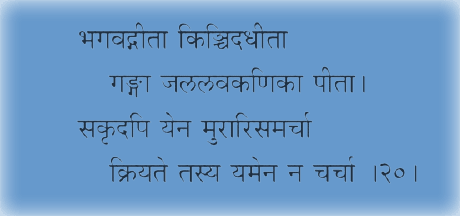
I have no doubt that the Gita has plenty of lessons for us mortals to think about in order to lead a good life.  I remember my great-uncle reciting, as he often did, the following verse:


At the source of that image is a translation of the verse:
One who has studied the Bhagavad Gita just a little,
drunk even a drop of Ganga water,
has worshipped Murari (Krishna) just once,
does not meet with Yama (lord of death).
This atheist cares not about worshiping Murari, is convinced that there won't be any encounter with Yama, and will not dare to drink a drop of the highly polluted Ganga water.  But, yes, I believe that I immensely gained from the Gita that I read, even if I understood nothing, way back during my angst-filled undergraduate years.

Sunday, March 02, 2014

The Hindu defenders react on Twitter!

Without comments ...


Updated:

Blogging about reading Wendy Doniger's "The Hindus": #3

Three years ago, India's Supreme Court noted that India, too, is a land of immigrants and that about 92 percent of the population descended from immigrants from the northwest and the northeast.  India has been at interesting crossroads throughout--people and ideas came in from over the mountains and across the seas. Doniger writes that "India functioned, throughout history, less like Shangri-la than like Heathrow or O'Hare."

She builds on that imagery, and draws a parallel with that icon for immigrants to the US:
The proliferation of polythetic polytheisms may pose problems for the definition of Hinduism, but they are its glory as a cultural phenomenon. Pluralism and diversity are deeply ingrained in polylithic Hinduism, the Ellis Island of religions; the lines between different beliefs and practices and permeable membranes.  Not only can we see the Hindu traditions a divided among themselves on many central issues throughout history, but we can see what the arguments were on each point, often far more than two views on major questions. The texts wrestle with competing truths, rather than offer pat answers.
Not only are new people and new ideas coming in to stir things up, the Hindu traditions are divided amongst themselves with competing truths. Thus, when a new layer is added:.
The Parsis ("Persians"--i.e., Zorastrians) in several communities in India tell a positive story about social hybridity. They say that when the Parsis landed in India, the local Hindu raja sent them a full glass of milk, suggesting that the land was full. The Parsi leader added sugar and returned the glass, indicating that his people could mix among the Arabs and Hindus like sugar in milk, sweetening it but not overrunning it. The metaphor of sugar in milk suggests the extreme ideal of communal integration, in which individuals change the community by melting into it, flavoring it as a whole with their qualities (Zorastrianism, or sweetness).  The Parsis did not in fact dissolve into Islam and Hinduism; they remained Parsis and indeed were often caught in the crossfire during the riots that followed the Partition of India and Pakistan in 1947. This seems to me the more accurate way to view such cultural mixes: as a suspension of discrete particles rather than a melting pot.
Which is all the more why I find it so un-Indian like to protest against Wendy Doniger's book, and to compel the publisher to withdraw all the copies and pulp them.  To borrow from an Indian sport that was accidentally invented in England, this battle cry against a foreigner and her ideas is simply not cricket.

Doniger wraps up the first of the twenty-five chapters with this:
I would therefore argue for the recognition of the simultaneous presence of a number of pairs of opposites, throughout the history of the Hindus, the both/and view of community. The historiographic pendulum of reconciliation, never resting at the swing either to one side or the other, forces us to acknowledge the existence, perhaps even the authenticity, of the two extremes of various ideas, and also their falseness, as well as the fact that there is no pure moment at either end of the swing, and leave it at that
Perhaps such an interpretation reminds one of Amartya Sen's The Argumentative Indian.  I wonder if I picked up on the multiplicity of truths, even without my knowing, right from my young days and, to this day, am hell bent on ticking people off because I rarely ever subscribe to anything as the truth!  The earliest I remember when I felt my views on Hinduism challenged and, thereby, my view of the world itself, was during my preteen years and father had brought home from his magazine club the tabloid Blitz.  In that was an article about the Shiva Lingam being a phallic symbol.  A phallic symbol!  I talked about that with my cousin, who seemed to be aware of that interpretation but was not at all bothered by it.  Doniger does write about that, which is not really news anymore, but can easily upset the true believers who worship the lingam.  I am sure she will have more on these in the later chapters.

The Gudimallam Lingam, aka Lingodhbhava
Source

Blogging about reading Wendy Doniger's "The Hindus": #2

Where does one begin the narrative on the Hindus, right?  Will be quite a challenge.  No wonder the book is as long as it is, and I am yet to move past the introductory chapter!

Meanwhile, a friend informs me that the saga continues:
Another book on Hinduism by American indologist Wendy Doniger has come under attack from the same Delhi-based group which had compelled the publishers of an earlier work by her to withdraw the title. 
Shiksha Bachao Andolan Samiti (SBAS) demanded on Saturday that the Aleph Book Company stop sales and pulp all remaining copies of Doniger's book "On Hinduism", published in 2013. 
Which is why negotiating with terrorists is a bad idea--they get emboldened the moment you yield. 

Anyway, continuing on with "The Hindus" by Wendy #Doniger (the immediately previous post here):
The textbook of legal code (dharma) attributed to Manu (first century CE) does not use the word "Hindu" but does offer a geographical definition of the people to whom his dharma applies (a definition that, it is worth noting, uses animals to define humans):
From the eastern sea to the western sea [the Indian Ocean and the Bay of Bengal], the area in between the two mountains [the Himalayas and the Vindhyas] is what wise men call the Land of the Aryas. Where the black antelope ranges by nature, that should be known as the country fir for sacrifices; and beyond it is the country of the barbarians. The twice-born [the upper classes and particularly the Brahmins] should make every effort to settle in these countries.
At first blush,, it might seem like Manu was the biggest ignoramus that ever lived. But, in jumping into that conclusion, we forget to contextualize his observations.  It was 2,000 years ago, when humans had very little idea of the planet, and its physical and human geography.  It is, therefore, quite an impressive achievement that Manu was familiar with the geography that he describes.  If we laugh at his idiocy now, imagine how generations two centuries from now will find our own idiocy to be a tragic farce!

However, those few sentences also underscore the rising importance of the upper classes, and the Brahmins in particular. A social dynamic that has immensely messed up India forever.

The narratives about India and Hinduism often completely ignore the non-Sanskrit stories. I grew up in a Tamil language environment--the oldest living language with a rich literature past.  A language that is not derived from Sanskrit, and which uses a script that is not god's own, Devanagiri, that Sanskrit uses.  Thus, the world outside rarely has any clue about the Tamil and Dravidian stories--of Hinduism and otherwise.  How did that happen?
Sanskrit is the model for most North Indian languages (and the source of much of their grammar and some of their vocabulary), , as Tamil is for the Dravidian languages of the south (such as Telugu, Kannada, and Malayalam.) ... Not only did southern ideas go north, and vice versa, and not only did Tamil flow into Sanskrit and Sanskrit into Tamil, but Tamil went north and Sanskrit south.
...
The British used texts as a way of disregarding actual Hindu practices and justifying their own imperial project with textual citations. And the Orientalist orientation to texts is the orientation toward Brahmins (and Sanskrit, and writing.) More recently, scholars have begun to pay more attention to ritual, archaeology, art history, epigraphy, the records of foreign visitors, and, in the modern period, ethnography, revealing new aspects of a lived religion that is very differently represented in texts.
There was a great deal of non-Sanskrit, non-Vedic, Hinduism that I was familiar with right from when I was a kid.  At grandmothers' villages, there were village deities that had nothing to do with the Vedic gods.  There was the "maadan"--spirits. The "god" who protected the population from the dreaded smallpox was non-Vedic. The favorite god of many Tamils, "Murugan," is almost exclusively worshipped in the Dravidian south.

The "kodai" festival at Pattamadai was a village celebration in non-Vedic ways. My father's cousin sister has a favorite story about this.  Girls could go to those celebrations up until they hit puberty.  But, rarely were kids--boys and girls--taken to those because of the "strange" practices there.  This aunt of mine nagged her father enough--she was the youngest of four--that he took her to the festival. One strange thing after another. And finally they sit down for the feast. A guy proceeds to cut himself on his elbow and blood gushes out.  He then moves from one plantain-leaf-plate to another and places a drop of his blood on each.  The aunt said she almost fainted.  This was less than fifty years ago!

I have always considered it a tragedy that the old country did not spend time and energy understanding such old faiths, which were also part of Hinduism.  Instead, it all became a Brahminical, Sanskrit, version of a very complex and diverse religion.  I am sure Doniger will get to such discussions as well.

At the temple out in the wilderness where our "family temple" is located

Saturday, March 01, 2014

Blogging about reading Wendy Doniger's "The Hindus": #1

I started reading Wendy Doniger's "The Hindus." As I noted in this earlier post, the trigger was the news about how the Hindutva elements pressured the publisher, Penguin, to withdraw all the copies and pulp them and not sell the book in any form in India.

I am doing this not to merely piss off the Hindutva idiots--that is merely a wonderful bonus. I figured that this whole brouhaha is a neat opportunity to read a scholarly book, about a religion and tradition in which I grew up, though it has been decades since I gave up on any religion--not only Hinduism.

If the first few pages are any indication, then this will be a joy to read. The language is so light and reader-friendly even as she presents some serious materials.  And a great deal of humor too!

I plan to provide quotes from Doniger on a regular basis, and add my own comments as well. Here is the first of what might be a long series.

Hindus may approach their scriptures as a part of their piety or as scholars who study Hinduism as they would study any other human phenomenon, or both simultaneously. ... But there are also advantages in a more academic approach, such as a religious studies approach, to which the religion of the scholar in question is irrelevant. ...Nowadays most non-Hindu scholars of Hinduism strike the familiar religious studies yoga posture of leaning over backward, in their attempt to avoid offense to the people they write about. ...I sympathize with the many American and British Hindus who have been raised in a particular tradition, generally the philosophical neo-Vedantic tradition, and therefore are genuinely shocked to hear, from an American woman, about aspects of their own tradition that are not only entirely new to them but often offensive by virtue of their violence or sexuality. But it is precisely for the sake of such Hindus, and for their children, as well as for non-Hindus who know nothing about Hinduism, that I feel it important to write about the lesser known aspects of the tradition, particularly those aspects that revisionists have purposely erased from contemporary versions of the texts. .... And so I intend to go on celebrating the diversity and pluralism, not to mention the worldly wisdom and sensuality, of the Hindus that I have loved for about fifty years and counting.(excerpted from pages 13-16)
An intellectual, religious studies, approach is about questioning and understanding, and not to simply treat the texts as the words from god.  Of course, that is bound to be upsetting to the true believers--I am reminded of my grandmothers whose typical comeback was "you don't ask why" to questions I had. .  And more so when the analysis and interpretations are being done by a person who grew up in a different faith, in a different country, and who is a woman.  Three strikes and you are out ;)  

I love the way Doniger writes about scholars striking "the familiar religious studies yoga posture of leaning over backward, in their attempt to avoid offense to the people they write about."  That is such a shame.  And all the more heartening and refreshing to note how Doniger goes where the analysis takes her.  

And most of it all, I can certainly relate to her comment about "celebrating the diversity and pluralism, not to mention the worldly wisdom and sensuality, of the Hindus that I have loved for about fifty years and counting."  While in Doniger's case the fifty years and counting was from the time she became intellectually, and emotionally, invested in Sanskrit and India, in my case it has been from birth.  I suppose I will echo her thoughts if I write similar phrases about the United States.

Can't wait to get through the entire book--690 pages of text alone, excluding the notes, bibliography, and index, which makes it a weighty tome at 779 pages!  

Sunday, March 15, 2009

The coming benign authoritarianism in India

Over the last couple of years, every time I visited India somebody or the other commented on how I look like Narendra Modi--the chief minister of Gujarat. Sometimes it was just the beard that triggered such a comparison. They thought it was a compliment, and I always had to smile outside but cringe inside! As a visitor, the last thing that I wanted to do was pick a fight on this.

Why cringe? This is a guy who oversaw the worst communal violence when, as Robert Kaplan writes, "More than 400 women were raped; 2,000 people, overwhelmingly Muslim, murdered; and 200,000 more made homeless throughout the state." All in a matter of hours :-( The US government, at least in this context, has done the right thing by denying Modi visa to visit the US.

But, Modi is a popular guy in India. He is one mix of contradictions. In a land of corrupt politicians, Modi is known for high levels of fiscal integrity. A workaholic's schedule he has. Has created a business-friendly environment in Gujarat. Has a reputation for being an authoritarian leader. And, yes, has a strong anti-Muslim outlook. I was visiting India during his recent re-election. With all the election noise in the background, one television news channel, mimicking the hysterical news shows in the US--more like Hardball--had one of the most bizarre and awful discussions ever. The topic, if I remember correctly, was "All Muslims are not terrorists, but all terrorists are Muslims." Talk about (ir)responsible journalism!

I won't be surprised at all if Modi, or somebody like him, becomes the prime minister really soon. Kaplan echoes the sentiments I have heard all too often in India--both when I was growing up there, and during my recent visits, when he writes:
India’s rise as an economic and naval power has invited frustrating comparisons with China: whereas the authoritarian government in China can make things happen, development happens in India mainly in spite of the government. Hanif Lakdawala told me that, especially because of the nightmarish chaos of Indian cities, “there are some in this country ready to accept a fascist, or at least a very strong dictator.”

Not a fascist, in my opinion, but certainly someone like Modi. As Vimal Ambani, a prominent, liberal-minded Gujarati businessman, told me, “At the end of the day, Modi still offers the best model for governance in India.”

Because, the reality is that most Indians are sick and tired of the lack of governance, and corruption, which they correctly perceive as holding them and the country back from a much more rapid advancement. What good is a right to vote when the choice is between tweedledum and tweedledee and when even water is in shortage, is a typical comment.

I am afraid that the collapse of Pakistan will not only embolden the likes of Modi, but that a larger number of Indians will also prefer that kind of a "stronger" leader. When that happens, Francis Fukuyama can write about why history did not end, and is being re-written!

Photo of Modi: The Atlantic

Thursday, February 05, 2009

Valentines Day in India: what a stupid controversy!

Don't they have better things to do in India, than to come up with some Hindu version of the fashion mullahs?  These nincompoops are carrying out god's tasks?  Bizarre!  Read this:

BANGALORE: After their recent attack on young women at a Mangalore pub, the Sri Ram Sene has now announced an action plan to target couples found dating on February 14, Valentine’s Day.

At a press conference here on Thursday, Sri Ram Sene leader Pramod Muthalik, who is now on bail, said Sene activists across Karnataka would not only hold protests outside colleges, hostels and hotels, where Valentine’s Day celebrations are held, but also forcibly marry off couples found dating in public.

“Our activists will go around with a priest, a turmeric stub and a ‘mangal sutra’ on February 14. If we come across couples being together in public and expressing their love, we will take them to the nearest temple and conduct their marriage,” he said. If the couples resisted the move, the girl would be forced to tie a ‘rakhi’ to the boy.

Mr. Muthalik said his outfit would ensure that Valentine’s Day greeting cards were not sold. Activists would check out stores that sold such cards.