Showing posts with label economy. Show all posts

Friday, May 12, 2017

Never enough?

Years ago, soon after Amazon released the Kindle, my daughter bought me one.  And later, she was surprised that I was not using that gadget.  I tried my best to explain to her that I am not into gadgets just because they are new and fancy.

Now, it does not mean that I am not a consumer.  I am one hell of a consumer.  A wasteful consumer as much as anybody else.
much of the world’s waste is a product of habitual practices we think normal: driving a car, yes, but taking a daily shower, too, or heating our homes or changing our underpants daily (by 1986, 45 percent of German men did compared to the 5 percent who did in 1966). It has almost nothing to do with individual motives or morality.
I think of my own life, and can easily see how rapidly my consumption has increased.  Take, for instance, clothes.  Back when I was a kid, all my clothes could have been packed into a small carry-on.  Come to think of it, back then most of us kids did not even wear underwear.  I say this with confidence because one of the punishments at school was to stand up on the bench.

One of the old jokes related to this punishment is this:
The teacher asks, "where is Kenya?"
The student has no clue.
The teacher tells the student to stand on the bench.
The smartass student then asks, "if I stand up on the bench, will I be able to see Kenya?"

It was a public shaming--the one standing up on the bench did something wrong according to the teacher and now the entire class and anybody who passed by is made aware as well.  We would giggle at being able to see the bat and balls, if you know what I mean, of the one standing adjacent to us.  Chances are that, now, no urban first grader boy in India ever goes to school without underwear on.  A small change in daily life, but that is an example of daily life consumption, right?

Unlike my six-year old self, whose clothes could be packed into one small carry-on, I will now need a few boxes to pack all my clothes.  And then the footwear!  I have three pairs of work shoes, two pairs of sneakers, two pairs of sandals--in contrast to one pair of slippers (flipflops) and a pair of shoes that I wore to school when I was a kid.  What I had as a kid was itself a great deal more than what my father had--he got his first pair of footwear only when he got to the "First Form"--sixth grade, I think it means.  Until he was eleven or twelve, father went about barefoot like almost everybody else.

My point is that my not having a Kindle or an iPad or whatever does not make me any holier.

From a larger perspective, we need to understand this--it is not anything "American":
Trentmann demonstrates that by the twentieth century, states of many kinds—not just the liberal democracies—regarded consumption as indispensable. Countries such as Britain and the United States set the model: there, the link between the citizen and the consumer was forged tightly. At the heart of the New Deal were ideals of freedom and plenty, understood as mutually reinforcing propositions. But Trentmann seeks to extend the point more broadly, to demonstrate that freedom was hardly necessary to a thriving consumer society. Nazi Germany, for instance, sought to deliver the goods or, failing that, to promise their appearance; German factories continued producing toys and cosmetics until the defeat at Stalingrad. With its canny embrace of consumption, the contemporary Chinese state furnishes another good example. Starting in the late 1990s, China created “a nation of property owners” in less than a decade, a feat that outstrips the record of Herbert Hoover and Margaret Thatcher, the Anglo-American “champions of home-owning democracy.”
I consume, therefore I am!  One of the paradoxes of economic transformation from the old agrarian past.

Friday, May 27, 2016

Where do men fit in a feminizing world?

I have blogged for the longest time about shrinkage.  No, not that one, but the shrinking world for men.  I have even tagged plenty of posts with "save the males."  I have blogged and talked in plenty about how the male identity is in crisis.

Most men--old and young--simply do not know what their roles are in a rapidly changing society.  Muscle power is rarely needed anymore to bring home the tofu, er, bacon.  Lesbians don't care for men.  Education and work are all about talking and communication, from which the old-style grunting men run away.

A few years ago, my much older neighbor/friend commented, during one of our many coffee-chats, that television sitcoms portray males as grown up boys who never became real men.  The male characters in popular sitcoms like Everybody Loves Raymond or the King of Queens were only a little better than kids who had been potty-trained.

It is one heck of a crisis, yet fully grown boys seem to worry only about that thing!

In my classes, I have often remarked. to any student who was even half attentive, that the story of economic progress over the last two centuries--like the Great Enrichment that Deirdre McCloskey talks about--is pretty much a story of women.  The role of women, which was tightly circumscribed by men in cultures all across the world, started changing for the first time ever.  It started slowly.  And then it picked up steam.  And now, here we are, with men falling behind.

Thanks to such a worldview for a while now, I was not surprised--not even a tiny bit--to read Tyler Cowen's take that "the contemporary world is not very well built for a large chunk of males."  And it will get worse for even more men. And this is now playing into the fascist's demagoguery:
Trump’s support is overwhelming male, his modes are extremely male, no one talks about the “Bernie sisters,” and male voters also supported the Austrian neo-Nazi party by a clear majority.
Not news to me.

What I found to be interestingly new is where Cowen goes from there:
One response would be to double down on feminizing the men, as arguably some of the Nordic countries have done.  But America may be too big and diverse for that really to stick.  Another option would be to bring back some of the older, more masculine world in a relatively harmless manner, the proverbial sop to Cerberus.  But how to do that?  That world went away for some good reasons.
If this is indeed the problem, our culture is remarkably ill-suited to talking about it.  It is hard for us to admit that “all good things” can be bad for anyone, including brutes.  It is hard to talk about what we might have to do to accommodate brutes, and that more niceness isn’t always a cure.  And it is hard to admit that history might not be so progressive after all.
What percentage of men are brutes anyway?  Let’s hope we don’t find out.
Yes, let's hope that we never, ever have to find out.

Saturday, October 10, 2015

Keep calm ... and toke up!

It was about four in the afternoon when I pulled into the gas station a few days ago.  On the first of this month, if you want me to be precise about the date.  Gawd!  Can I continue with my story now?

So, anyway, I gave my credit card to the gas station attendant.  "Fill up regular, please" I said.  I always, always add that "please" even though filling gas is exactly what the transaction is all about.  He got the pump going and returned the card to me.

"What's with the crowd across the street?" I asked him.

"Oh, it has been there all day long, right from about nine in the morning.  People want their pot" he laughed.

I had forgotten that on October 1st recreational marijuana was becoming legal here in Oregon. But then how does it matter to me when I have never been anywhere near pot and potheads.

"They started lining up well before the store hours" he said with more chuckles.  I suppose he is like me who can be amused very easily.

The amount sold is, ahem, high ;)
Retailers sold more than $11 million of marijuana during Oregon’s first week of legal recreational sales, outpacing the early business done in other states that have legalized pot, according to the Oregon Retailers of Cannabis Association.
Oregon retailers had sales of $3.5 million by the end of opening day, saidCasey Houlihan, executive director of the association, the Statesman Journal in Salem reported. By contrast, Colorado’s first week of sales reached $5 million. In Washington, sales during the first month hit $2 million.
So, what made Oregon's sales so much higher right from the first day?  The same conditions that every other economic activity require:
 One reason Oregon posted stronger early sales was the existing medical marijuana infrastructure. More than 250 medical marijuana dispensaries in Oregon have told the state they will sell to recreational customers. By contrast, Colorado had 24 stores on Day 1. Washington had just four, and a year later still has fewer than Oregon.
Oregon also has a robust supply of marijuana that’s grown to support medical marijuana users and the black market. Companies have invested in massive warehouses in Portland to grow the drug indoors, and Southern Oregon has some of the nation’s best conditions for outdoor cultivation of marijuana.
Growers don’t face strict regulations yet, so the supply can more easily flow into retail stores than it did in Washington and Colorado.
I guess the legalization has begun at the right season--it has started cooling down, the daylight hours are getting shorter, and soon the rains will be here.  All the more convenient, perhaps, to stay indoors and toke up.

Recreational pot is one heck of a job-creation opportunity, argues this lawyer who is also the cho-chair of the legislature's committee overseeing the legalization:
 if we get the new industry right, Oregon could become for marijuana what Napa Valley has become for wine. Our economy would be more robust
Hey, if wine can not only be a huge industry but also spawn wine critics, connoisseurs, and sommeliers, then why not for marijuana, eh.  What a strange world in which we live!

I am so happy with the drug that I live for ;)

Caption at the source:
Co-owner Traci Watson helps a customer at Maritime Cafe in Gladstone
on the first day of legalized recreational pot sales in Oregon, October 1, 2015 in Oregon.

Monday, October 27, 2014

Economy in the time of Ebola: An embargo!

I suppose the uber-religious who see a divine explanation in everything that happens might have a solid rationale for the Ebola nightmare in West Africa.  Or, for that matter, even for slavery.  But, for the rest of us rational people, we are worried that this latest outbreak of Ebola, which could have been easily contained if only the rest of the world had cared at least a tad, will set back economic conditions not only in the three primarily affected countries but in the rest of the continent too.

It will affect the entire continent because to most people in the world Africa is one country.  One big blob.  Ebola in Liberia becomes an "African" disease. An "African" problem. Thus, even as slowly the world is beginning to respond to the crisis, the irrational fear is driving individuals and businesses away from the sub-Saharan economy, in particular.
"Everybody is running away from Ebola, Kaifala Marah [Sierra Leone's finance minister] said at the annual meetings of the International Monetary Fund and World Bank in Washington.
"By default or design, it really is an economic embargo," he said.
An economic embargo.  How terrible!

How were the economic conditions in the three countries a few months ago?
Before the Ebola outbreak intensified, these countries were making remarkable economic progress—particularly Sierra Leone and Liberia, which experienced rapid economic growth in recent years after overcoming decades of civil strife. In 2013, Sierra Leone and Liberia ranked second and sixth among the top 10 countries with the highest GDP growth in the world (albeit their base levels of GDP are very small to begin with). Guinea, while growing more slowly at 2.5 percent in 2013, had high expectations for growth
Just when conditions seemed to be settling down, not only does the Ebola virus hit but also the irrational response from the rest of the world.
In addition to the enormous and tragic loss of human life, the Ebola epidemic is having devastating effects on these West African economies in a variety of essential sectors by halting trade, hurting agriculture and scaring investors.
The long-term destructive effect on the economies coming from the fear:
the largest economic effects of the crisis are not as a result of the direct costs (mortality, morbidity, caregiving, and the associated losses to working days) but rather those resulting from aversion behavior driven by fear of contagion.  This in turn leads to a fear of association with others and reduces labor force participation, closes places of employment, disrupts transportation, and motivates some government and private decision-makers to close sea ports and airports. 
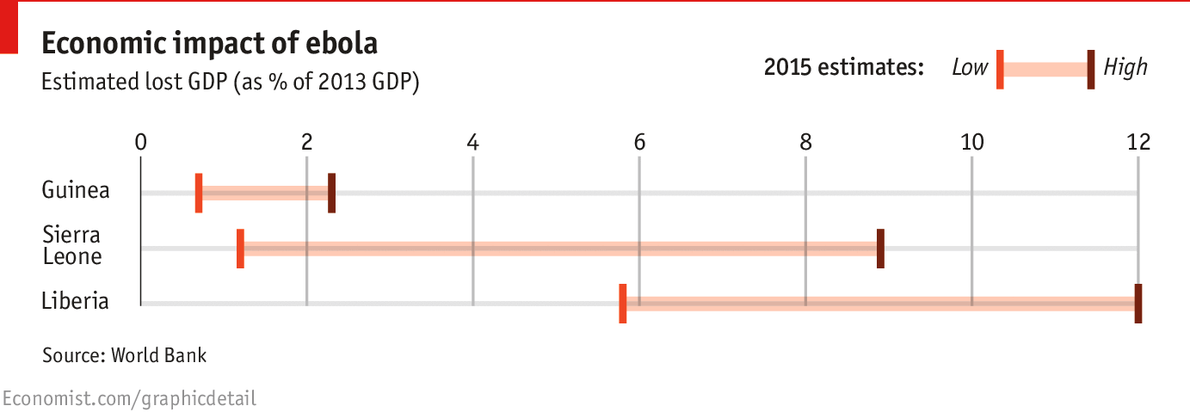
Keep in mind that the following were estimates of impacts developed nearly a month ago:
these estimates rise to $809 million in the three countries alone. In Liberia, the hardest hit country, the High Ebola scenario sees output hit 11.7 percentage points in 2015 (reducing growth from 6.8 percent to -4.9 percent).  
Now, $809 million might not seem to be a high number.  Until you think about the estimated GDP of the those countries.

If instead of words, you prefer a picture, here is one from The Economist:


I suppose that it is only a continuation of history when we rich folks in the rich and poor countries decide that all we want to do is to lift up the drawbridges and keep the poor and the hungry and the ill away and on the other side of the moat, and casually remark that they can eat cakes.  Some fucked up humans we are!

Have you made your donation to help those fight the good fight?  I recommend donating to Doctors Without Borders.


Tuesday, September 16, 2014

Energiewende is the zeitgeist word. No schadenfreude, please

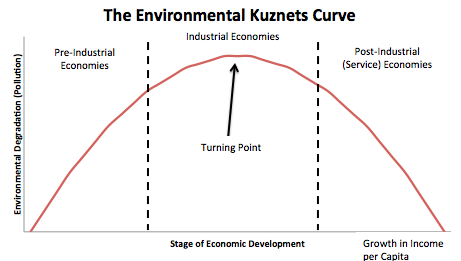
What if globally we are at, or at least close to, that worst point along the environmental Kuznets Curve, and things could only get better from now on?


Of course, I could be--and for all I know--completely wrong.  But then, keep this in mind: Nobody. Knows. Anything.

We try to make order of the chaos that the world is by connecting the dots.  It is, however, to some extent like how we connect the celestial dots--the stars--and give them "shapes."  But, we could connect the stars differently and come up with completely different shapes, right?  Of course, I am using the stars analogy only for illustrative purposes--here on earth, we can confirm with the passing of time whether or not the shape that I create is wrong and whether somebody else's is correct.

I suppose I am connecting a few dots out of my optimism.  A wish that we might be on to a path of screwing up the natural environment a tad less, and make it better.

It all begins with the world's factory--China--where "environmental anxiety is spreading."
This growing anxiety is reflected in the rising frequency of environmental protests. In the past year, people have taken to the streets in cities throughout the country to protest the building of coal-fired power plants, chemical plants, oil refineries, waste incinerators, and the like. According to Chen Jiping, a former leading member of the Communist Party’s political and legislative affairs committee, pollution is now the leading cause of social unrest in China.
Why this budding environmental consciousness now? The answer is simple: 2013 was, by any accounting, one horrific year for the environment. ...
China’s environment is a disaster. But by casting a bright light on the country’s severe pollution problems, the crises of the past year have stirred a greater environmental consciousness in the people. At the same time, they have spurred the country’s leaders to take more aggressive environmental action.
There is hope.

Meanwhile, the big European industrial power, Germany, continues to wage its seemingly lone war against climate change:
Germans will soon be getting 30 percent of their power from renewable energy sources. Many smaller countries are beating that, but Germany is by far the largest industrial power to reach that level in the modern era. It is more than twice the percentage in the United States.
Hence:
The word the Germans use for their plan is starting to make its way into conversations elsewhere: energiewende, the energy transition.
Germany's efforts involve China too:
Germany’s relentless push into renewable energy has implications far beyond its shores. By creating huge demand for wind turbines and especially for solar panels, it has helped lure big Chinese manufacturers into the market, and that combination is driving down costs faster than almost anyone thought possible just a few years ago.
But, it does not mean that all is well.  There is a catch:
Much concern is focused on Germany's reliance on brown coal, which harms the environment more than other types of coal, for a secure and affordable power supply. Last year lignite was the single biggest source of German power, generating 25.8 percent, and it has risen every year since 2010.
Greenpeace says no other country in the world extracts and converts as much brown coal into electricity as Germany.
"Germany is making itself a laughing stock because it hasn't set limits on brown coal," said Greenpeace's Karsten Smid, who wants the government to say when it will phase it out.
These lignite-based power plants (which is why Germans were technical advisers for the industry in the town where I grew up) are needed because, more than anything else, the renewables are intermittent.

I am confident a majority on this planet are in a situation where we can echo this:
“Indeed, the German people are paying significant money,” said Markus Steigenberger, an analyst at Agora, the think tank. “But in Germany, we can afford this — we are a rich country. It’s a gift to the world.”
Germany is not the only rich country, right?  We can all afford to begin to afford to experiment with Energiewende (pronounced in-ur-GEE-vend-uh) and make it a century of carbon in other ways than merely burning it up:


Wednesday, January 30, 2013

So what if cuts in defense spending shrink the economy?

It is one of those news items that might seem like bad news, but is not:
The U.S. economy unexpectedly shrank from October through December, the first quarterly drop since 2009 and a reminder of the economy’s vulnerability as automatic cuts in government spending loom.
I do not mean to suggest that a contraction in the economy is good, when unemployment, especially among the educated youth, is at levels that are way higher than a "normal" rate of unemployment.

It is a good news because of the underlying reasons for the contraction:
The decline in federal spending last quarter was the largest drop since 1973. Spending at all levels of government fell 6.6% in the period.
That drop was the primary culprit for the economy contracting, said Alan Krueger, chairman of the White House's Council of Economic Advisers.
"Several private-sector components of GDP continued to make positive contributions," Mr. Krueger said. "A likely explanation for the sharp decline in Federal defense spending is uncertainty concerning the automatic spending cuts that were scheduled to take effect in January," and are now set for March 1.
I am cheering not because I a rabid libertarian who believes that all government is evil.  But because at least for a short while we have had a drop in military expenditure.  A slight, very slight, tempering of our war infrastructure is something that ought to relieve us.  If only we can continue to go after the military budget, which, if not for the "fiscal cliff," is always treated as a sacred cow that had to be fed more and more. (too many metaphors?)

If we don't spend money on guns, then we will have more money for butter.  The more we can decrease spending on guns, the better off we will be.  Do not allow yourself to be scared into thinking that this drop in defense spending is bad news.
Economists stressed that the key factors that dragged on GDP in the fourth quarter could prove short-lived, even though the economy faces other threats in 2013.
“Frankly, this is the best-looking contraction in U.S. GDP you’ll ever see,” Paul Ashworth, an economist at Capital Economics, said in a research note. “The drag from defense spending and inventories is a one-off. The rest of the report is all encouraging.”
For all of 2012, the economy expanded 2.2 percent, better than 2011’s growth of 1.8 percent.
We might already be witnessing the "more butter" aspects:
consumer spending accelerated and business investment rebounded, suggesting some fundamental strength that should help to support the recovery even as Washington tightens its belt.
"We are not concerned that the economy is slipping back into recession," said John Ryding, chief economist at RDQ Economics in New York.
A second report showed private employers stepped up hiring in January, suggesting an improvement in the labor market. 
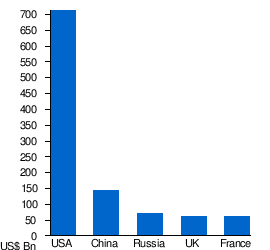
Yep, we don't need a gazillion more bombs and fighter planes and submarines and drones.  Think about the many ways we could constructively spend all that money! (the chart compares the top five military budgets in 2012.)
Source

Wednesday, September 12, 2012

If only all of India can be like Amul!

All through my growing up years, dairy milk was always in short supply.  To make it worse, whatever we did get was of low quality.  Our neighbor in Neyveli, the industrial town where I did all my K-12 schooling, often used a lactometer to test the quality of the milk delivered by Pandurangan, and was always upset by the the readings that indicated dilution with water.

In Sengottai--my grandmother's place--it was worse.  In the summer days that I have spent there, I have gone chasing after the sounds of the milkman on his bicycle worried that it will all be sold out before it was my turn.

It is not that everyone drank a whole lot of milk.  Very little of it was consumed as milk or used in coffee and tea.  Most of it was to make yogurt (curd) from which butter was churned as well.

But then, things changed.  And they changed fast.

In Madras, where we had moved to during my college days, we walked or bicycled a couple of blocks to the milk-vending machine.  In Sengottai, all I had to do was walk a little more than half-a-mile from grandma's home to the dairy cooperative to buy all the milk I ever wanted.  All of a sudden, my parts of India became the land of milk (and, thereby, sweets!)

Now, when I visit India, whether it is Madras (which is now Chennai) or Sengottai, milk is available a lot more than water is.

All thanks to one man: Verghese Kurien.  He died, ninety wonderful years old.

His work in transforming perennial shortage into full and plenty is a classic example of how economic activities are shackled by India's awful dirigisme.  As noted in this piece:
Before Kurien came on the scene, the task of dairy development was being handled by the milk commissioners of the State. The Government milk schemes soon found that it was easy to use cheap imported milk in urban areas. These milk schemes in Delhi, Bombay and Calcutta started with good intentions. To start with, they procured milk at prevailing prices and sold it at market prices. As producer prices rose, consumer prices needed to be raised. It was cheaper to bring in imported milk powder to keep urban prices low. India became dependent on imported milk powder, and the urban market was destroyed for rural milk producers.
The milk commissioners became ones with vested interest in the sector. Kurien then said that there were no milk commissioners in Denmark, the Netherlands and New Zealand, but there was plenty of milk there. His theory was that you could either have milk or milk commissioners.
Kurien was able to get rid of the commissioners and unleashed the abilities of millions of dairy farmers.  It is by no means a stretch to argue that economic progress in India would have been truly astounding without the various shackles that the government uses. 

Kurien carefully cultivated the brand identity as well.  A brand that is recognized in India for quality, with consumers confident that they would be served with nothing but the best.
In the late 1950s, Mr. Kurien decided to market the produce of the cooperative through a brand name, and that led to the creation of one of the most enduring Indian brands — Amul Butter. Amul’s billboard advertisements, which play on current affairs, are a parallel historical record of modern India. So endearing is the brand that even The Times of India, which does not grant any corporation free mileage on its editorial pages and even blurs images of company logos in its editorial photographs, carries images of Amul’s billboards when the brand is in the news. Mr. Kurien’s obituary was, inescapably, accompanied by the images of Amul’s billboards in several newspapers.  
Amul's ads are often playful and I have always wondered how much of that was orchestrated by Kurien.  Will end this with Amul's homage (ht) to the late Dr. Verghese Kurien.


Tuesday, June 05, 2012

If only the jobs news was enjoyable as news about Facebook shares!

If only the news was always as good as this one: Facebook shares are trading at $25.79 as I type this!  Couldn't make my schadenfreude better :)  I am enjoying this because, well, why the heck not!  Even if commentaries like this point out that the schadenfreude is bizarre!

In contrast to the fun with news about FB, I am not thrilled with the latest jobs report that has shocked the markets into a tumble as investors worried about the economic outlook.  Oil is down to $82, which was hard to imagine three months ago.  

This is not good news for any incumbent President.  On the other hand, it appears that the incumbent chief executive of the state of Wisconsin might survive the recall effort, which will add to the President's political woes as the summer campaign begins to heat up.  

Take it away, Jon Stewart, and let us watch that wonderful game-show called "Polish that turd" :)

Thursday, May 31, 2012

India slowly regressing to the old Hindu rate of growth?

My punditry is perhaps no different from advertising in that perhaps half of what I say are correct, but the problem lies in not knowing which half it is!

Thus, it is always more than comforting when I can spot the instances where I have been correct all along, and then it turns out that those are not happy developments either. It is a bloody no-win situation.

For a while now, I have been blogging and writing op-eds on how not everything is going well in India, and that Indians ought to be really, really worried.  Instead, of course, Indians appear to care only for whatever happens in the cricket and movie worlds, while ignoring the phenomenally more urgent issues--like India's s(t)inking economy, about which, it turns out, I have been way more right than wrong.

The Economist reports that India's economic growth has considerably slowed down.  In its characteristic punning style, the magazine newspaper captioned it as "A Bric hits the wall":
perhaps most important—issue raised by lower growth is another kind of stability: social. India, unlike the other BRIC countries, is still desperately poor. One businessman and guru interviewed by your correspondent recently declared that "the next fifteen years will be India's worst since independence" and that there was a one-in-ten chance of a revolution. If India's economic miracle turns out to have been a mirage, it will not be so easy to dismiss that kind of talk as cranky. There is already widespread disgust at corruption. And at least ten million young folk will enter the workforce every year for the next decade or so. They will be coming to the big cities, looking for jobs that won't be created if India expands at a rickshaw rate of growth. Talk of a demographic dividend may turn back into talk of a time bomb.
 The Economist worries about the economic miracle having been a "mirage" while I have referred to it simply as a hype.  But, otherwise, we are referring to the same set of economic conditions.

The Hindu adds:
In tandem with a host of negative factors at home and abroad impacting the macro-economic environment, the country's GDP (gross domestic product) growth slumped to a nine-year low of 5.3 per cent during the fourth quarter (January-March) of 2011-12 as compared to a robust 9.2 per cent expansion in the same quarter of the previous fiscal. ...

The scale-down in growth rate for 2011-12 to 6.5 per cent — the lowest since 2002-03 when the economy grew by four per cent — disappointed both the government and the industry but came as no surprise as indications of a steady slowdown have been there for quite some time.
Disappointed with the dismal GDP figures, Finance Minister Pranab Mukherjee, however, expressed cautious optimism and pointed to some signs of recovery in some select sectors. ...

In a statement, Mr. Mukherjee said: “GDP growth is the lowest in contemporary period. It has been substantially because of the very poor performance of manufacturing sector…The government would take all necessary steps to address imbalance on the fiscal front and on the current account. It would help in checking inflationary expectations and inspire confidence for improved capital inflows as well as recovery in domestic investment growth”.
This is the same finance minister, who, less than a month ago, stated:
 India was growing at over 9 per cent before the global financial crisis of 2008 pulled down the growth rate to 6.7 per cent in 2008-09. India has projected a growth rate of 7.6 per cent in 2012-13, up from 6.9 per cent recorded in the previous fiscal. 
Seriously!  It is a huge difference between 7.6 percent and 6.5 percent within four weeks, don't you think?

The good news: at least it is not 1991!
Bimal Jalan, Former Governor of the RBI showed confidence that the Indian economy has not gone back to the 1991 era yet.

Jalan was of the opinion that both the political and economic situation during the 1991 crisis was very difficult. He said that at present the economy has the strength to grow on the back of the industrial sector. He hoped that India will not be faced with a situation similar to the unprecedented external debt crisis of 1991. 

Well, I suppose the swearing in of the Indian cricket god, Sachin Tendulkar, as a member of the upper house of the parliament will by itself transform the sluggish economy, right?


Sunday, May 27, 2012

As the rupee speeds towards 60 ... hey, retirement age!

India's economic situation and the worsening rupee are beginning to consume my attention, which is not good news!

The Financial Times editorial notes that the situation is quite serious:
Not so long ago there was excited chatter in India about the possibility of the country overhauling China to become the world’s fastest growing large economy. But the Indian tortoise, far from gaining on the Chinese hare, is going backwards. Growth has not edged into double digits. Instead it has sagged back towards 6 per cent. In recent days, three investment banks have downgraded their view of India’s prospects. Morgan Stanley says the slowdown, the result of policy paralysis and a worsening external environment, could be deep and prolonged.
The symbol of India’s fall from grace is the rupee. It has sunk more than 17 per cent against the dollar this year to its lowest level on record. That ought at least to have helped exports. In fact they have shrunk, along with industrial output, which fell 3.5 per cent in March.
 Remember all the time and the effort that went into selecting a symbol for the rupee?  The focus ought to have been on the substance and not merely a symbol.  Well, hey, the new sign is fast losing its shine!
If foreign investors take fright, India’s balance of payments situation could quickly deteriorate. Standard & Poor’s has warned it may downgrade the rating on India’s sovereign debt unless Delhi can get the fiscal deficit under control. India also needs faster growth to help bring hundreds of millions of people out of abject poverty.
Mr Singh, who used to be lauded as the architect of economic reforms, is now routinely derided. More than a prime minister, he is characterised as an errand boy for Sonia Gandhi, the Congress party leader. Indeed, the 79-year-old Mr Singh seems to have lost all ambition, as well as any grip over the administration he might once have had.
Singh has become a punchline--an awful way to be finally remembered in history!

But, forget all the words of the commentators; editorial cartoonists distill them well into a neat image, like this one:


Sometimes, I wonder if Indians are way too intoxicated by their cricket obsession to even notice the deterioration.  An outright ban on cricket might be the best fiscal policy, eh!

Thursday, May 10, 2012

If India is energy-starved, how about Pakistan?

Today is one of those days when I happened to wonder whatever might have happened if India and Pakistan (and, therefore, Bangladesh) hadn't split and, at least, hadn't fought wars and engaged in expensive arms race.  Imagine!  The possibilities are simply limitless.

Instead, the Subcontinent, including Sri Lanka and Nepal, has been a tragicomedy of wasted opportunities and unfulfilled dreams.  Increasingly, the tragicomedy is looking more and more farcical.

Consider this: India and Pakistan blast nuclear devices whenever one feels the urge to demonstrate its testosterone levels when its government is getting battered internally.  Or, they shoot up missiles.  All these, as even a third grader knows well, is awfully expensive.

Meanwhile, as I noted a couple of days ago, there is a lot to worry about India's economy.  How is it across the border in Pakistan?  It seems to want to outdo India in making sure its people will not have enough electricity:
Demand for energy in Pakistan now outstrips its capacity to supply electricity to industry and households by several thousand megawatts. With preliminary census projections of a population of more than 192 million and the share of the urban population rising, the challenge to power Pakistan will only grow more difficult. Already, hours-long interruptions in power have dragged down productivity in key sectors like the textile industry and sparked confrontations between rural and urban political leaders and the transportation, agricultural, and manufacturing sectors for priority access to what energy is produced. 
 Of course, this is not entirely new; I noted here more than a year ago about Pakistan's floating power plant, which the government had leased from Turkey.

But, now the situation is getting even worse because the government is broke and can't pay up:
nine independent power producers -- which collectively produce 8 to 9 percent of Pakistan's energy supply -- now warn that they can no longer continue operations if government payment is not immediately forthcoming. With fresh borrowing plans, the government is likely to negotiate another settlement with these companies. 
How deep is the government in debts, you ask?  
approximately half of this year's federal budget expenditures were devoted to debt repayment, far eclipsing military spending, government salaries, or development investments. 
The Indian economy is sputtering, and the government seems to be hell bent on making sure there are enough and more to choke the windpipes.  As this column notes, it seems like it is three steps backward for each forward step!   Despite the government's best intentions, it is amazing that the economy grows at all, I suppose.

How did the Subcontinent get so messed up?  How much worse could it have been if there had been no partition?


Saturday, May 05, 2012

Worry about India's economy. Worry a lot!

Less than a fortnight into the hundred days in India, the more I observed, the more I wondered whether India's economic "success" story was more hype than real.  That line of thinking morphed into to this column in which I wrote that "the economic health of India is not looking good."

Every day, evidence seemed to pile on to further reinforce the impression that India could run into some serious economic troubles really soon.  I was particularly concerned that the country was not paying enough attention to the long-term requirements of resources, energy, and infrastructure.  

Thus, it was pretty much all "doh!" for me when I read Tyler Cowen's NY Times column where he writes that "We ignore India’s troubling trends at our peril"
 the economy has decelerated from projected rates of more than 8 percent, and negative momentum may bring a further decline. The government reported year-over-year growth in the October-through-December quarter of only 6.1 percent.
What is disturbing is that much of the decline in the growth rate is distributed unevenly, with the greatest burden falling on the poor. If the slower rate continues or worsens, many millions of Indians, for another generation, will fail to rise above extreme penury and want. The problems of the euro zone are a pittance by comparison.
India's growth, or lack of, will affect the smaller neighboring economies, Cowen writes.

India's finance minister, Pranab Mukherjee, who is now canvassing to become the country's next president, offers an upbeat assessment, which I find hard to believe:
 India was growing at over 9 per cent before the global financial crisis of 2008 pulled down the growth rate to 6.7 per cent in 2008-09. India has projected a growth rate of 7.6 per cent in 2012-13, up from 6.9 per cent recorded in the previous fiscal. 
Even if India records that rate of growth, there is inflation to worry about.  Thus, a report like this one appears to be a lot more realistic than the ministerial pontifications.

Meanwhile, when I talked with my parents the other day, they said that electricity rates have gone up, and power cuts continue.  It is a continuation of the power shortage that forced my college-mate to shut down his mill in Coimbatore.  While the upward revision of the rates is a correct policy approach--one that had previously severely under-priced electricity--not much can be created without new sources of electricity, which is needed for rural and urban economic activities alike.

Not lookin' good :(

Wednesday, December 21, 2011

From within, the Indian economy seems even less rosy

If and when students ask me about the prospects for the US, I tell them that my long-term bets are always on my adopted country.

The USSR came and went. The Sun briefly rose in Japan, and then sank really fast.  China is only a powder-keg away from the Communist party unraveling and, in any case, the country is far from ready to deal with the coming demographic implosion. 

The "native" country?

I quote the title of Amartya Sen's book, The Argumentative Indian, and tell students that the virtue of all-talk all the time on any topic will continue to constrain its economic progress. (Though, such a take on the title is not what the book is about.)

Thus, the US wins one of two ways: either it genuinely is creative and gets ahead, or it simply waits for others to fall and then be the last one standing.  Like with the case of the Eurozone now.

A few days into the India trip, and I see no evidence to the contrary.  The data points suggest to me that India's success might have been oversold, too.

There is a huge increase in consumption, yes.  Everything from chocolates and chips to computers and cars.  But, long-term investments that could propel continuous productivity enhancements seem to be severely lacking.  From the physical manifestations in roads and power supply to education and health.

Only a few days, and this is rather depressing.

A number of areas where in the US market and non-profit ventures kick in to meet demand are through the government, here in India.  There is, in fact, an expectation that government ought to do certain things, and that it is not delivering those goods and services.

Government is thought of as the default option. And that is what bothers me.  As much as I am far from being a maniacal Republican, and with enormous sympathies coming from the left of the political center, I find it troublesome when people casually sit back expecting the government to do things.

Government, meanwhile, at the federal and state levels, is severely paralyzed--not any surprise given that the best (worst?) of the "argumentative Indians" go on to politics.  The Economist picks up on this point of paralysis:
Investors and others lament policy paralysis. Ministers shy away from big decisions, fearing accusations of graft—though Mr Singh this week urged them at least to get on with infrastructure spending. Meanwhile an obstructive opposition, the Bharatiya Janata Party (BJP), has caused gridlock in parliament for much of the year, hoping to tap public fury over corruption.
As a result, the current parliament has done the least work of any in a quarter of a century.  
It is a similar story of paralyzed and incompetent governance at the state level--at least in Tamil Nadu, where I currently am.

The piece in the Economist was jarring for another reason: it refers to the government as "rulers."  In a democracy, leaders do not rule but govern.  In the US, we don't think of the President or a governor as a "ruler."  While the usage in the Indian context could have resulted from a lack of editing, perhaps it was intentional: referring to how much the people are "ruled" by state and federal governments.

It is no surprise, therefore, that the economic health of India is not looking good:
Local and foreign investors are already unnerved by a global slowdown. Political intransigence, continuing corruption, high inflation and the possibility that India will miss its fiscal targets all add to the government’s woes.
Another metric of the economic outlook is the exchange rate, where the rupee seems set to fall even further:
International investors are boosting bets that India’s rupee will extend the worst slide since 2008 as an economic slump deepens, suggesting a lack of confidence in the central bank’s steps to curb exchange-rate volatility. ...
The rupee, the worst performer against the dollar among Asian currencies and of the so-called BRIC nations in 2011, plunged to a record low of 54.305 per dollar on Dec. 15, poised for a third straight quarter of declines, data compiled by Bloomberg show.  
All is not well. I am all the more convinced that the US politicos should stop playing the "compete against India" card.

On the other side of the planet, back home in the US, things are picking up.  Yep, my long-term bets are always on the US.

If only Indians were a little less argumentative :(

Saturday, August 21, 2010

China is second largest economy. So, ...?

I play bridge online (for free, through BridgeBase) and rarely are even two of the four hands around the table American.  Once, a few days ago, to my right was a player from Greece.  After a few games, he informed the table that he was leaving, to go for a swim.  A fellow player then chimed in that Greece is so beautiful, to which the Greek replied that it was the most beautiful country in the world and that he knows because he has been to 36 countries.

I chuckled away thinking that in Europe it is quite easy to drive a couple of hundred kilometers and be in another country!  Here in the US, driving north from San Diego, it will take about 800 miles to even get to another state within the same country.  (Ahem, that is about 1300 kilometers!  So, having traveled 36 countries doesn't say any damn thing.
 
China is one bloody huge country--it ought to be viewed as a continent.  And it has the population too to be a continent.  After all, China as one single country has a population that exceeds the combined population of all the European countries together.

So, when the world's press announces with great drama that China has overtaken Japan to become the second largest economy in the world, yes, it is commendable that China has progressed a lot.  But, even for a moment did the media pause to consider, for instance, Japan's population is just about a tenth of China's?   

Why is then that China's economy captures our attention so much?

One is a very simple reason--over the years, China's Communist leaders have preferred to use a good chunk of the generated wealth to loan to America.  And now, China is locked into it, and has no choice but to keep this going.  As Larry Summers described it a long time, this is the Mutually Assured Destruction in the post-Cold War era.

The American interest in the Chinese economic story comes, I think, with this in mind.  For Europeans, it is more about environmental impacts, and human rights (or lack thereof) in China.

India is not far behind--as a continent, similar to China.  But is a lot poorer; when Europe was clawing its way out of its Dark Ages, India might have been way more advanced compared to the rest of the world.  "The twin stories of India and China are the most dramatic in the world economy. In 1820, the two countries contributed to nearly half of the world's income. In 1950, their share was less than a tenth"  Now, it is one poor country, where about every third Indian is poor.  The fact that these two continents countries now have some of the highest economic growth rates doesn't surprise me nor worry me.

What does worry me is the uneasy tension that lies under the surface in the relationship between these two countries.  As the Economist points out,
China and India are in many ways rivals, not Asian brothers, and their relationship is by any standard vexed—as recent quarrelling has made abundantly plain. If you then consider that they are, despite their mutual good wishes, old enemies, bad neighbours and nuclear powers, and have two of the world’s biggest armies—with almost 4m troops between them—this may seem troubling.
One scenario that has always been of concern to me is this: so far, the Communist Party has managed to keep a tight hold on the political aspects, while freeing up a lot on the economic front.  But, what if the pressure builds up to an extent that it threatens the very hold of the party?  The contested territory could then become an ideal relief valve for China--hey, nothing holds a country together and legitimizes a government's power like a foreign war!
The basic problem is twofold. In the undefined northern part of the frontier India claims an area the size of Switzerland, occupied by China, for its region of Ladakh. In the eastern part, China claims an Indian-occupied area three times bigger, including most of Arunachal. This 890km stretch of frontier was settled in 1914 by the governments of Britain and Tibet, which was then in effect independent, and named the McMahon Line after its creator, Sir Henry McMahon, foreign secretary of British-ruled India. For China—which was afforded mere observer status at the negotiations preceding the agreement—the McMahon Line represents a dire humiliation.

China also particularly resents being deprived of Tawang, which—though south of the McMahon Line—was occupied by Indian troops only in 1951, shortly after China’s new Communist rulers dispatched troops to Tibet. This district of almost 40,000 people, scattered over 2,000 square kilometres of valley and high mountains, was the birthplace in the 17th century of the sixth Dalai Lama (the incumbent incarnation is the 14th). Tawang is a centre of Tibet’s Buddhist culture, with one of the biggest Tibetan monasteries outside Lhasa. Traditionally, its ethnic Monpa inhabitants offered fealty to Tibet’s rulers—which those aged peasants around Tawang also remember. “The Tibetans came for money and did nothing for us,” said Mr Nansey, referring to the fur-cloaked Tibetan officials who until the late 1940s went from village to village extracting a share of the harvest.

Making matters worse, the McMahon Line was drawn with a fat nib, establishing a ten-kilometre margin for error, and it has never been demarcated. With more confusion in the central sector, bordering India’s northern state of Uttarakhand, there are in all a dozen stretches of frontier where neither side knows where even the disputed border should be. In these “pockets”, as they are called, Indian and Chinese border guards circle each other endlessly while littering the Himalayan hillsides—as dogs mark lampposts—to make their presence known.
I suppose my grandmother said it best when we were kids and when we complained about somebody else getting a larger portion (we perceived it thus).  Grandma always then directed us to simply focus on our own plates and finish what was served.  Similarly, we will be much better off worrying about our own internal problems--which we have in plenty--than to point to China's or India's economic growth rates.

Tuesday, August 18, 2009

Fleeing California. And Florida. And ????

For the first time in the post WWII era, Florida is apparently experiencing more people exiting the state than entering it. The Miami Herald reports that:
the state lost about 58,000 people from April 2008 to April 2009, according to a new estimate from the University of Florida's Bureau of Economic and Business Research.

``It's such a dramatic shift from what we've seen in the past,'' said Stan Smith, the bureau's director.

``Florida's economy is, in a lot of ways, driven by population growth,'' he said. ``Perhaps more importantly, population growth is a reflection of how the economy is doing both in Florida and in the nation.''

Smith said the decline doesn't look like a trend. Instead, he sees it as a deviation from previous decades of growth upon which Florida's development-based economy relies. He also said the decrease is a ``drop in the bucket'' compared with Florida's 18.3 million population.

Smith said the last time Florida lost population, in 1946, it was because so many soldiers left the state's military bases to go home. This population loss, he said, is solely due to the bad economy.

In Florida's case, it seems to be a response to economic conditions, and nothing else. However, the state of the economy might just be the last straw for many Californians who have endured the chaos in the state for a long time. This LA Times op-ed describes the break-up between the writer and the state:
I've been thinking about this for a very long time, and I've come to the conclusion that we should go our separate ways. I thought I loved you and it would last forever, but I was so very wrong.

I know that our relationship has lasted 50 years and that we should fight to stay together, but you've changed so much that, frankly, I don't know who you are anymore!

When we first met I was young and rather naive, and I loved you unconditionally. I spent years running with abandon across your sandy beaches in the bright sunshine, playing in your beautiful parks and attending your top-rated schools, which were a national model for the other states. For 18 years or so, I can honestly say that I was truly in love with you,
"Exit, Voice, and Loyalty" was how the late Albert Hirschman succinctly described our responses to institutions: We might stay out of loyalty even when we sense that things are going wrong. Later, as the level of discomfort rises, we voice our opinions. And, when nothing works, we exit. We do this to corporations, to municipalities, to states and countries as well.

We better pay attention to the "exit" numbers.

Tuesday, May 19, 2009

Economy has bottomed out

The Onion reports that:

White House budget chief Peter Orszag said that with April consumer prices stable and production declining at a slower rate, the worst of the recession is over. What do you think?

Old Man

Kevin Burke,
Air Quality Tester
"Seriously? But I just learned how to save money."

Young Woman

Barbara Roberts,
Darkroom Worker
"I don't understand economics very well, so could you put the question to me again in analogy form? To help you, my favorite analogies involve old dogs, apples, and fishes on bicycles."

Asian Man

Ian Katz,
Kennel Attendant
"What great news for people whose lives exactly mirror economic data reported by the government."

Tuesday, May 05, 2009

Origins of the financial/economic crises

Economic historians will have some real good time writing about this Great Recession--for many, many years down the road, and will also offer convincing answers to people like my mother who asked me last December, "how come nobody knew?" that such a crisis was round the corner ..... well, here is one explanation of how things soured, from four months ago, by Jeffrey Frankel, who is the James W. Harpel Professor of Capital Formation and Growth at Harvard Kennedy School

Friday, February 13, 2009

Climate change, economics, and journalists

Like many people, I too can't but wonder where the global climate change will take us, and have blogged, and "oped"ed about it too.  
Eric Pooley writes that as much as scientists are in agreement about most aspects of climate change, most economists are also in agreement about one thing: it is cheaper to act than not to act.  He writes:  
First, there is a broad consensus that the cost of climate inaction would greatly exceed the cost of climate action—it's cheaper to act than not to act. Reducing greenhouse gas emissions by moving to alternative energy sources and capturing carbon from coal-fired power plants will cost less in the long run than dealing with the effect of rising sea levels, drought, famine, wildfire, pestilence, and millions of climate refugees. (There are some outliers who disagree with this—Danish statistician Bjorn Lomborgcomes to mind—and some respected economists, like William Nordhaus, who argue that future, richer generations will be able to more easily shoulder the cost burden than we can.) But influential mainstream economists from Paul Volcker to Robert Stavins to Lord Nicholas Stern to Larry Summers all agree that action is cheaper than inaction, even if they disagree on much else (Stavins can't stand Stern's methodology; Summers prefers a carbon tax to cap-and-trade). Stavins, director of Harvard's Environmental Economics Program, phrased it this way in a recent paper: "There is general consensus among economists and policy analysts that a market-based policy instrument targeting CO2emissions ... should be a central element of any domestic climate policy."
The second area of consensus concerns the short-term cost of climate action—the question of how expensive it will be to preserve a climate that is hospitable to humans. The Environmental Defense Fund pointed to this consensus last year when it published a study of five nonpartisan academic and governmental economic forecasts and concluded that "the median projected impact of climate policy on U.S. GDP is less than one-half of one percent for the period 2010-2030, and under three-quarters of one percent through the middle of the century." (That's a lot of money—U.S. GDP in 2007 was $13.8 trillion—but Stavins has estimated the cumulative cost of all U.S. environmental regulation to date at 1 percent of GDP, and it has not been an insupportable burden.) Stavins' climate-cost calculations come in a bit higher than those in the EDF study, ranging from less than 0.5 percent to 1 percent of U.S. GDP; he describes these as "significant but affordable impacts" that are "consistent with findings from other studies." The Stern Review on the Economics of Climate Change, an influential but controversial 2006 report for the British government, concluded that climate action would cost 1 percent of global GDP (though Stern now warns that our failure to act is raising the price tag) and that inaction could reduce global GDP by up to 20 percent.
So, one might then wonder why we don't hear much about the consensus among economists.  Pooley faults journalists for this, and partly the economists themselves.  He notes that even when economists agree on the larger picture, they tend to disagree a lot, which then leads journalists to think that economists are split on this, and they then resort to reporting "both sides" of the story ....

But, all these don't worry me at all.  
I lose sleep thinking that my future and yours are in the hands of bozos, er, politicians in this country and all over the world.  Here is an example (not from climate change discussions, but from the current economic crisis).  Megan McArdle writes:
I sat here in front of my television and laughed at Maxine Waters, because her apparently random ramblings are a true spectacle.  One laughs because one can't cry.  But this woman is sitting on the House Financial Services Committee.  She is supposed to help craft the bills that govern our financial system.  And she clearly doesn't have the first shred of an inkling of a clue of how said financial system works.  Her questions had the air of someone who couldn't quite wrap her mind around the complexities of the E-Z Reader consumer activist pamphlets from which she had presumably cribbed them.

That's not really funny.  This is the crack talent that's supposed to reform the banking system into something more robust? 

Tuesday, December 09, 2008

The Chinese are coming, The Chinese are coming

Unless you are totally into movies, it is most likely that you haven't heard of a movie called 'The Russians are coming, The Russians are coming'. It came at the heights (depths?) of the Cold War--in 1966. A great comedy, and a great picture at the same time--not merely a slapstick one.


According to this LA Times story, it is literal--the Chinese are coming. And apparently they are coming to buy homes, because prices have dropped so much. It is almost like somebody went to China and advertised a huge clearance sale in California and elsewhere :-)

An excerpt from the Times piece:

The Chinese do have a lot of cash to spend. The central government holds the biggest stockpile of foreign reserves in the world, nearly $2 trillion, most of it in dollars. And the Boston Consulting Group estimates that there were more than 391,000 millionaire households in mainland China last year, up from 310,000 reported the previous year.
....
[Home] prices in the U.S. have fallen more sharply than in China, and many Chinese consider the American market highly alluring as a place to invest and live because of the United States' developed economy.

The purchasing tours in the U.S. grew out of similar trips by well-heeled Chinese back home.

Investors from Wenzhou and other entrepreneurial hot spots were known for chartering buses to visit such cities as Shanghai to shop for apartments. Now some of them are signing up with outfits like Soufun.com, the real estate website that is sponsoring the home-buying trip next month from Beijing to California and Nevada."