Showing posts with label Ebola. Show all posts

Wednesday, July 24, 2019

tRump is not the only international emergency!

The first ever reference that I made to Ebola was back in September 2014.  It was in this post.

A week after that, I wrote about the "ice bucket challenge" (remember that?) and how I refused to participate in it:
How would I justify contributing to ALS as a higher priority compared to a contribution to fight any one of those neglected diseases that affect millions and kills millions?
Ebola is back in the news.  And not in a good way.
The deadly Ebola outbreak in Congo is now an international health emergency, the World Health Organization announced Wednesday after a case was confirmed in a city of 2 million people .
An international health emergency.
WHO had been heavily criticized for its sluggish response to the West Africa outbreak, which it repeatedly declined to declare a global emergency until the virus was spreading explosively in three countries and nearly 1,000 people were dead. Internal documents later showed WHO held off partly out of fear a declaration would anger the countries involved and hurt their economies.
A reminder that we live in a political world, in which even declaring a health emergency is not simply based on facts!

Don't expect any sense of empathy from the current American President.  Not only because he is a sociopath with no sense of empathy.  But also because he has tweeted like this in the past:
The sociopath didn't support Obama's decision to send troops to help with the crisis. I wrote an oped applauding it, and quoted a commenter from back then:
A few days after the president's decision, an old high school friend, who has returned to India after a career that took him all over the world, commented on my blog: "The U.S. action of committing troops to fight the disease is probably one of the finest acts of the Obama presidency. Your government didn't have to do it, but it did. That is the best of America on show." The best, indeed!
63 million, including former commenters, elected to power the sociopath, and we can now be assured that the US will only try to insulate itself by building walls, closing flights, ...

This commentary by a former USAID administrator notes how important the American effort was:
when America did lead, the rest of the world followed. The United States rallied technical experts and leaders from governments all over the world to launch a coordinated response to the Ebola crisis in Western Africa. Together, we leveraged American investments to yield new commitments from others and reminded the world that when there’s a moral imperative to act on global health, we will.
And now?
As someone who has helped fight this ugly disease before, my experience compels me to speak out to Republicans, Democrats and anyone who is in a position of influence about the steps we can take to help control this outbreak. Right now, we’re watching a crisis turn into a catastrophe. We have the tools to defeat Ebola. What we’re missing is the political will. The time to start caring about Ebola isn’t when it reaches the shores of the United States or Europe, it’s now.
If only somebody can talk about this to tRump during his golf outings, which have already cost us taxpayers $106 million!

Saturday, December 31, 2016

Dead viruses tell no tales

A "kumbabhishekam" is in the works for a temple in the old country. In grandmother's village.  That temple is dedicated to the god(dess) who, according to the believers, protected them from the dreaded small pox.

Belief and faith continue despite the knowledge that it is not any god or goddess who protects the people or curses them with pox. It is not any god who worked to eliminate small pox; recall this post from a few months ago after reading Dr. D.A. Henderson's obituary?  About how he worked in godawful conditions in India to wipe the virus off the face of the earth?

No, this post is not to beat up on faith.  This being a new year, I want to celebrate. By noting something extraordinary.
It took a major Ebola epidemic that led to more than 11,000 deaths, but we now finally have a successful Ebola vaccine candidate in development. If approved, the vaccine would vastly reduce the likelihood of ever seeing another major Ebola outbreak.
You can imagine my excitement here--given my posts here on the urgency to address the awful disease.  I urged here, and on Facebook, to donate to MSF for their phenomenal service during that epidemic.  Thrilled I am with this news.
[The researchers] decided to try something called "ring vaccination," a public health method used to eradicate smallpox in the 1970s. It involves immunizing the immediate contacts — friends, family, housemates, neighbors — of a person who falls ill with a virus to create a protective ring around them to stop transmission.
As soon as a new Ebola case was diagnosed, the researchers traced all their contacts for a total of 117 clusters (or "rings"), each made up of about 80 people. They then randomized the rings of people to get the vaccine either right after their friend or family member had been diagnosed or after a three-week delay.
Their preliminary results were so positive that the researchers changed the trial design so that everyone got the vaccine immediately, including children.
Yep, the same public health method that was used by Dr. Henderson in his remarkable war against small pox.

It is remarkable how such progress happens despite all the horrible politicians and governments.  One can only imagine how much the world would have been a better place if only we humans had at least a little bit of an understanding of our fleeting existence here and, therefore, our priorities.  Oh well; stupid is as stupid does!

I hope this Ebola vaccine delivers what it promises.  And I wish that the success will energize the search for something like a vaccine that can stop dead another dreaded ailment--malaria.

For now, this news about the Ebola vaccine is good enough for me to wish you all a happy new year!


Thursday, October 08, 2015

I bring you good news. Really.

The older I get, the more I am convinced that we humans manage to get a few things right despite our own efforts to mess up the world.  Imagine then how wonderful the world could be if only we got our act together!

Today's exhibit: Ebola.

Remember how manically I was blogging about Ebola, Facebooking about Ebola, and tweeting about Ebola?  When the crisis unfolded, I was shocked, disappointed, and angry that most of the world--especially the United States--was not worrying about it.  Even when Doctors Without Borders kept issuing those reports, we responded with a only collective yawn.

In case you got worked up about all that, here is an update:
The three West African countries at the heart of an Ebola epidemic recorded their first week with no new cases since the outbreak was declared in March 2014, the World Health Organization (WHO) said on Wednesday.
The U.N. agency said that more than 11,000 people have died in Guinea, Liberia and Sierra Leone in the world's worst known occurrence of Ebola, but there were no new cases in the week to Oct. 4.
First, a sense of relief. Phew!  And then a feeling of "can we celebrate now?"
New cases of Ebola have dwindled sharply this year, but WHO said there was still a risk of resurgence.
"Over 500 contacts remain under follow-up in Guinea, and several high-risk contacts associated with active and recently active chains of transmission in Guinea and Sierra Leone have been lost to follow-up," the report said.
“There remains a near-term risk of further cases,” the report added.
Let us see how we humans deal with "a risk of resurgence."  I am guessing we will screw it up, like we always seem to do.  But, for now, a victory, yes.

The New York Times "had more than a dozen reporters, photographers and videographers inside the Ebola zone in West Africa over the course of the epidemic" and two of them speak about their experiences.  One says:
As reporters, we needed to remain resilient ourselves. The virus was all around us but remained unseen. We were constantly under threat. We would cover our bodies and equipment in protective gear and constantly wash them off with chlorine and disinfectant spray to kill the virus. Each day was an exercise in extreme caution, and each night we would nervously go to sleep hoping we had done everything right.
However, in the midst of all the darkness of these situations is the most powerful story to be told: the human ability to remain resilient. Hope is an infectious power in times of pain. Telling the story of Ebola’s spread helps people on the other side of the world connect with these abstract feelings of suffering. It helps to bring us all together.
Yes, those "abstract feelings of suffering."  To empathize with somebody, in a country somewhere, suffering from a problem that we cannot even imagine, brings us all together.  Imagine how much good we can achieve if we can truly connect with people this way, instead of being the selfish, nasty, brutish, and short humans that we typically tend to be!

There is hope, yes.  Even when we bomb the shit out of Doctors Without Borders operating in yet another crisis.

Friday, August 14, 2015

For a change ... I bring you good news!

A polio-free world is in sight.  Yes, a world without polio!
Since the initiative was launched by the assembly in 1988, the number of polio cases have reduced by 99%. The remaining 1% of cases can be found in the two countries with endemic polio – Pakistan and Afghanistan.
This is one of those rare moments when we humans deserve to stand up and congratulate ourselves.  Go ahead, pat yourself on your back.

Note that AfPak is the problem, in more ways than one!  The other notorious home for polio, Nigeria, is off the list; what an achievement, right?
It has been one full year since polio was detected anywhere in Africa, a significant milestone in global health that has left health experts around the world quietly celebrating.
A quiet celebration because of the recognition that the virus can always stage a comeback.  After three continuous years of no cases, the real celebration will begin.
“This is a big success, but it’s still fragile,” said Dr. Hamid Jafari, the initiative’s World Health Organization director. “There’s always a worry that there could be an undetected case in a population you’re not reaching.”
If you are like me, you then wonder how public health experts go around seeking confirmation.  (Maybe it is a good thing you are not like me, eh!)
How does one go about finding the polio virus across the expanse of an entire country or continent? There are now far fewer polio virus needles in the global haystack, which is fantastic news. But the remaining ones become even more difficult to find. We can’t stamp out a disease if we don’t know where it is. But with polio we do know where it is—and we know thanks to poop.
And now, if you are like me, you are puzzled.  What has poop got to do with polio.  That's how ignorant I am; turns out that all these years I hadn't bothered to find out how polio spreads!
When children get polio, the virus grows in their intestines and is excreted in the stool, and from there it spreads to other children. That’s why it has been so tough to beat polio in areas with poor sanitation. 
No kidding; now I understand why India eliminating polio within the country is such a cause for astonishment.  A country with extremely poor sanitation facilities managed to wipe out polio.  That's phenomenal!
The last case of polio in India was reported in 2011, an achievement once thought impossible. The country once suffered from more polio cases than anywhere else in the world, and the combination of dense populations, poor sanitation, and weak routine immunization programs led experts to suggest it would be the last place on Earth to drive out polio. Today, India’s polio story is one of historic success.
What more evidence does one need that we humans can achieve remarkable success, despite all the hurdles!
Since 1988, more than US$9 billion has been invested into the global polio eradication initiative.
What a wonderful use of nine billion dollars!  Let me put this in perspective:
The Marine Corps, the ascetic tribe of “Devil Dogs” that prides itself on being “the first to fight,” is getting a new weapon, announcing Friday that its version of the F-35 Joint Strike Fighter is, at long last, ready to be unleashed in combat.
The announcement comes after years of testing and development, marking a significant milestone for the sometimes-beleaguered, often-criticized and always controversial $400 billion program, which is years behind its original schedule and billions of dollars over its original budget.
Got that?  400 billion dollars. For fucking fighter planes!  Ok, I shouldn't rant about the military expenditure because I want to bring you only the good news in this post ;)

So, brother, can you spare me a dime. Er, make that a billion dollars. To launch something similar to the war against polio.  Against the Ebola virus:
Last month, the New England Journal of Medicine published a bold proposal by three doctors for an international vaccine fund with an initial capitalization of $2 billion. That is far less than the $8 billion that Liberia, Sierra Leone and Guinea, which had the most Ebola cases, say they need for recovery. Bringing a single new vaccine to market costs between $500 million and $1 billion.
The fund would be a boon to the biotechnology companies and university research centers that are already working on vaccines but don’t have the resources to get drugs approved and manufactured. And it would save lives.
Don't try telling me that we don't have the money for it.  You can never, ever convince me about lack of money.  Will stop here before I take off on a rant on our misplaced priorities! ;)


Thursday, March 19, 2015

Microsoft Ebola

I know, after reading the subject line, you are thinking that I have indeed gone completely insane.  But, there is a method to my madness, if you pardon the atrocious pun here ;)

Recall the names of the dudes who founded Microsoft?

Source

Sure, you know that guy on the right as Bill Gates.  The co-founder?  Ok, ok, you know it is Paul Allen.  (Do you know the names of the two dudes who started Google?  Aha, I got you there!)

So, what about Bill Gates, Paul Allen, and Ebola?  I told you that there is always a method to my madness.

In the NY Times, Gates had authored an op-ed:
The Ebola epidemic in West Africa has killed more than 10,000 people. If anything good can come from this continuing tragedy, it is that Ebola can awaken the world to a sobering fact: We are simply not prepared to deal with a global epidemic.
More than 10,000 dead.  From a disease. Caused by a virus. Yet, we--in the US and the rest of the world as well--pretty much don't care.  Which is all the more why Gates reminds us even if we care not about the 10,000 dead, and the epidemic that continues to infect people, well, perhaps we will at least take notice if we think that we too might get affected by some global epidemic.
Of all the things that could kill more than 10 million people around the world in the coming years, by far the most likely is an epidemic. But it almost certainly won’t be Ebola. As awful as it is, Ebola spreads only through physical contact, and by the time patients can infect other people, they are already showing symptoms of the disease, which makes them relatively easy to identify.
Other diseases — flu, for example — spread through the air, and people can be infectious before they feel sick, which means that one person can infect many strangers just by going to a public place.
Are you listening now?
I believe that we can solve this problem, just as we’ve solved many others — with ingenuity and innovation.
As committed as he is to the cause, it requires more than well-funded nonprofit organizations and foundations.

Meanwhile, the other co-founder, Allen, has been spending on Ebola, according to this piece that the friend passed along to me:
Paul Allen reportedly began tracking the current Ebola outbreak before a lot of governments saw it as a serious threat because of his work on wildlife conservation in Africa. As well, Allen’s philanthropic focus has been shifting and expanding over the last few years to include new issues, which makes sense for a guy who has $17 billion, has signed the Giving Pledge, and isn't getting any younger. So, all in all, it wasn't so bizarre that Allen jumped into the Ebola crisis with a boatload of cash for frontline work to contain epidemic. 
Yep, the same Paul Allen who makes the road-tripping sports maniac all pumped up ;)
By late October, Allen had upped his commitment to $100 million, making it the largest private contribution to combat the Ebola crisis. Allen’s big give was surprising and a bit shocking because his previous philanthropy had never touched humanitarian or global health issues before.
Allen and Gates understand all too well that to fight Ebola means more than merely fighting the virus alone.  So,
Paul Allen is not going to pocket the unspent Ebola money now that people aren't dying anymore and move on to something else. On the contrary, he may dive deeper into the troubled healthcare systems of West Africa, spending even more money. 
Aren't you now happy that these two nerds founded a small little company called Microsoft?

If only the local business billionaire, who has more money than Allen, funded worthwhile causes like this instead of this!


Thursday, November 27, 2014

'Tis Thanksgiving. Remembering the year that was ...

As we sit down for the Thanksgiving meal with friends and family, perhaps all of us can be thankful for one thing—the year with strange and unexpected developments is coming to an end.

Who would have thought that this country would ever end up panic stricken about Ebola? So panicky we became that the photograph of a nurse biking in a small town in Maine caused quite a few, who were thousands of miles from the Pine Tree State, to worry that they, too, caught the dreaded virus infection. We became so involved with the panic over nothing that we even forgot the thousands in West Africa who continue to suffer from the illness.

Ebola came in time for us to worry about the state of the world just when the Israel-Gaza conflict ended. Of course, the end of the bombing campaigns does not mean that peace has descended upon that troubled geography. Not far away, a ruthlessly barbaric outfit that grew out of the ashes of Al Qaeda in Iraq (AQI) has quickly become a force to reckon with. And the number of name changes this outfit has had in a matter of few months—Islamic State of Iraq and the Levant (ISIL), Islamic State of Iraq and Syria (ISIS), Islamic State (IS)—has made the casual observer feel like there are multiple versions similar to the number of Agent Smiths in “The Matrix” movie series.

The big European story is, of course, about how Russia swallowed up the Crimean Peninsula. One day Crimea was a part of Ukraine, and the next day it became a Russian territory. Russia is not done with gobbling up Ukraine’s land, with more military incursions expected.

The perils of Pakistan continue, with the same old formula of a weak and ineffective government that is constantly trying to keep the powerful military away. The story of its life ever since its birth in 1947! Meanwhile, suicide bombers continue to strike, with a recent one near the border with India killing nearly sixty and injuring another estimated hundred. Terrorists have warned that the next incident will be in India.

If you are like me, every once in a while you wonder whatever happened to the more than 300 girls who were kidnapped in Nigeria. Remember all that Facebook and Twitter activism to “bring back our girls”? But then that was such a long time ago and Ebola has completely taken over our panic-stricken collective consciousness.

The global economy continues to be in a state of flux. Economists keep warning about the Euro area on the verge of a recession and, perhaps, deflation as well. An economic contraction while prices keep falling is one awful combination, which will surely be worrisome to the millions of unemployed youth, especially in the southern countries of Spain, Italy, and Greece.

While we in the US might feel sheltered from such an listing—however incomplete it is—of less than pleasant developments around the planet, the Ebola virus was a nasty reminder that we live in an interconnected world and that what happens in a remote part of West Africa will not necessarily stay in West Africa. The military conflicts around the world will force the US to act—a burden that comes with being the sole global superpower. Economic slowdown in Europe will affect us, given the highly interdependent economic web that links us to countries that we might not even be able to identify on a world map.

An old idea that is often mentioned, especially in academia, is that “war is God's way of teaching Americans geography.” We need to update that for the contemporary contexts. Now, any crisis is apparently how we Americans learn geography. Thus, thanks to Boko Haram, we were forced to look up Nigeria on a map. With Ebola in the news, there is a good chance that a few Americans were suddenly thrust with narratives about the historical connection between Liberia and slavery in the US. But then, if history provides any guidance, we perhaps passed on all the chances to learn geography.

Whether or not we learnt anything, not unlike my students, we are thankful that the tumultuous and eventful year is coming to an end. But, of course, just because the calendar year is ending, all those problems won’t simply go away. It will be a long while before the public health professionals declare an end to the current Ebola outbreak. The geopolitical tensions in the Levant, Ukraine, and Pakistan, will continue irrespective of the month and the year. Above all, there is really no respite from one certain scary development—when the calendar flips to 2015, the campaigning for the November 2016 elections will begin!

Tuesday, November 11, 2014

This pacifist, too, thanks the veterans

(The following was my op-ed that was published, with a different title, in the Statesman Journal)

On Veterans Day, my practice has been to call or email a couple of people who are close to me in order to thank them. One is a 93-year-old who lives in Southern California. Jack was a teenager when he was drafted to serve as a bombardier during World War II.

While that old habit will continue this year too, the pacifist in me is immensely thankful to the U.S. military for marching to the orders from the commander-in-chief to fight an invisible enemy far away from the U.S.: the Ebola virus.

In September, President Barack Obama announced that the U.S. military would assist in the fight against the deadly Ebola virus, which since then has claimed even more lives and has infected thousands more. The arrival of the virus in the U.S. also underscores the urgency to fight this enemy in its original home in the severely affected countries of Liberia, Guinea and Sierra Leone.

A few days after the president's decision, an old high school friend, who has returned to India after a career that took him all over the world, commented on my blog: "The U.S. action of committing troops to fight the disease is probably one of the finest acts of the Obama presidency. Your government didn't have to do it, but it did. That is the best of America on show." The best, indeed!

"Operation United Assistance," which is the Department of Defense's name for this assignment, will provide logistical and medical support to various agencies, including the U.S. Agency for International Development (USAID), that are involved in the international effort to battle the virus.

Doctors Without Borders, which was awarded a Nobel Peace Prize in 1999 "in recognition of the organization's pioneering humanitarian work on several continents," welcomed this announcement even though it typically has not favored military involvements in the past. Only the military "has the rapid deployment capability and chain-of-command structure necessary now," said Dr. Joanne Liu, the president of Doctors Without Borders.

Following up on the U.S. military's involvement, China is also sending to Liberia an elite unit of its army, which has plenty of experience fighting another infectious disease from a decade ago: Severe Acute Respiratory Syndrome (SARS).

The U.S. military is best positioned for such an effort, with its vast logistical preparation. Above and beyond that, the military training to follow orders every step along the way will be immensely important, because all it takes is one breach in the protocol for the Ebola virus to infect a person. That level of precision in implementing protocols will not come easily to civilians like me, who even have trouble consistently following the rules of driving.

While the Ebola virus is an invisible and silent enemy, it is perhaps even deadlier than many visible enemies that the military has engaged in past battlefronts. This theater of war in West Africa is as critical to humanity as was the front where Jack served as a bombardier.

My thanks to the valiant troops who are assisting in this just war and fighting the good fight.

Tuesday, November 04, 2014

Ending Ebola begins by ending our ignorance

Anything interesting in the screenshot below?


Yep, two NFL teams, and the Virgin Galactic crash, are more important news stories than is Ebola.  And, ahem, news about Taylor Swift is more important than about Ebola.  When there are no more Ebola cases in America, and when the "rebellious" nurse in Maine has been put in her place, we Americans don't have to worry about Ebola anymore.  We are back to seeking out entertainment.

To which there is only one possible response: boy, are we f*ed up with our priorities!

So, whatever happened to the Ebolapalooza?  Ebola continues to mess up people's lives.  Not in Africa.  But, in those three countries.  The Washington Post provides us with a helpful map of Ebola in Africa:


“The world as a whole doesn’t have the preparedness for epidemics, and we’ve had a few flu scares that got us to do some minor things, but not enough,” he said in an interview at the annual meeting of the American Society of Tropical Medicine and Hygiene here. “If this thing had been twice as transmissive, we’d be in a lot of trouble, and there are agents that have a real chance of coming on in the next several decades that are far more transmissive than this is."
 And that guy is?  
Mr. Gates appeared moved after a 90-minute meeting at which two doctors who survived Ebola spoke. The epidemic is a key moment for global health, he said. “I think there’s a lot of lessons for future epidemics.”
Discussing the foundation’s reasons for getting involved, he said, “This disease, not only does it kill directly, it also shuts down health systems. If this thing had spread throughout West Africa, among other things you could throw out the window is the incredible progress we’ve made on polio.”
Meanwhile, scientists are slowly chipping away at understanding the virus:
What don’t we know about Ebola? In some ways, we’re only aware of how much we don’t understand because of the little that we do.
So, we are finally at Step 1--realizing how much we don't know about this virus, four decades in since the first detection.
This outbreak must not be viewed as an unthreatening “orphan infection,” a rare occurrence without global impact. The current epidemic will not abate quickly, and billions of dollars are needed in the field to limit the spread of the virus. But smart investment in research today will be repaid manifold in saved lives. In the United States, the money for Ebola has largely been a spinoff from the larger bioterrorism effort. Now representatives have awakened to its urgency, and there are calls from both sides of the Congressional aisle to revisit the level of federal research support in November after the midterm elections. Ending Ebola begins by ending our ignorance.
That's asking for too much.  Congress to revisit this after the midterm?  And to allocate money for research?  And for people to be involved, after stuffing themselves with stuffed turkeys?  Ain't gonna happen, unless the NFL is shut down because of Ebola infection!

Monday, October 27, 2014

Economy in the time of Ebola: An embargo!

I suppose the uber-religious who see a divine explanation in everything that happens might have a solid rationale for the Ebola nightmare in West Africa.  Or, for that matter, even for slavery.  But, for the rest of us rational people, we are worried that this latest outbreak of Ebola, which could have been easily contained if only the rest of the world had cared at least a tad, will set back economic conditions not only in the three primarily affected countries but in the rest of the continent too.

It will affect the entire continent because to most people in the world Africa is one country.  One big blob.  Ebola in Liberia becomes an "African" disease. An "African" problem. Thus, even as slowly the world is beginning to respond to the crisis, the irrational fear is driving individuals and businesses away from the sub-Saharan economy, in particular.
"Everybody is running away from Ebola, Kaifala Marah [Sierra Leone's finance minister] said at the annual meetings of the International Monetary Fund and World Bank in Washington.
"By default or design, it really is an economic embargo," he said.
An economic embargo.  How terrible!

How were the economic conditions in the three countries a few months ago?
Before the Ebola outbreak intensified, these countries were making remarkable economic progress—particularly Sierra Leone and Liberia, which experienced rapid economic growth in recent years after overcoming decades of civil strife. In 2013, Sierra Leone and Liberia ranked second and sixth among the top 10 countries with the highest GDP growth in the world (albeit their base levels of GDP are very small to begin with). Guinea, while growing more slowly at 2.5 percent in 2013, had high expectations for growth
Just when conditions seemed to be settling down, not only does the Ebola virus hit but also the irrational response from the rest of the world.
In addition to the enormous and tragic loss of human life, the Ebola epidemic is having devastating effects on these West African economies in a variety of essential sectors by halting trade, hurting agriculture and scaring investors.
The long-term destructive effect on the economies coming from the fear:
the largest economic effects of the crisis are not as a result of the direct costs (mortality, morbidity, caregiving, and the associated losses to working days) but rather those resulting from aversion behavior driven by fear of contagion.  This in turn leads to a fear of association with others and reduces labor force participation, closes places of employment, disrupts transportation, and motivates some government and private decision-makers to close sea ports and airports. 
Keep in mind that the following were estimates of impacts developed nearly a month ago:
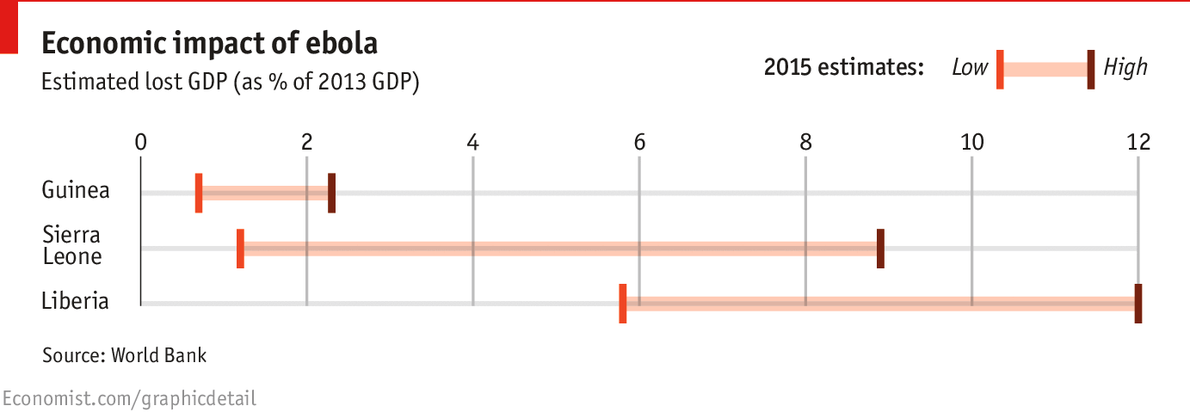
these estimates rise to $809 million in the three countries alone. In Liberia, the hardest hit country, the High Ebola scenario sees output hit 11.7 percentage points in 2015 (reducing growth from 6.8 percent to -4.9 percent).  
Now, $809 million might not seem to be a high number.  Until you think about the estimated GDP of the those countries.

If instead of words, you prefer a picture, here is one from The Economist:


I suppose that it is only a continuation of history when we rich folks in the rich and poor countries decide that all we want to do is to lift up the drawbridges and keep the poor and the hungry and the ill away and on the other side of the moat, and casually remark that they can eat cakes.  Some fucked up humans we are!

Have you made your donation to help those fight the good fight?  I recommend donating to Doctors Without Borders.


Monday, October 13, 2014

Why the Ebola panic in the US? We are certified idiots, that's why!

Consider the following:
In 2010, transport accidents in the U.S. accounted for 38,000 deaths, with more than two-thirds of these fatalities occurring among men.
Not merely in 2010, but every year we could expect more than 30,000 to die from transport accidents.  Every year, we can expect more than 15,000 from homicides.

This ought to make us scared to venture out of our homes, right?  Yet, we carry on with our lives.  We drive, we go to the stores, and merrily go about as if we don't care a damn about the probability that we will die in a road accident.  Or, die from a senseless random bullet.

Ironically, we are also the same people shit scared about Ebola.  About Ebola, here in the United States!!!

James Surowiecki writes in the New Yorker that there is an even worse danger, an evil one, that awaits us this very minute: the flu virus.
No one is asking “What Scares You More: Ebola or the Flu?”
And they should be asking that because:
We know, based on past experience, that the upcoming flu season will kill thousands of Americans and send hundreds of thousands to the hospital. Yet the press seems relatively diffident about raising an alarm about this threat; its flu coverage has none of the high-pitched anxiety that suffuses writing about Ebola
Whatever happened to evidence-based reasoning and thinking skills that we should have picked up even from a basic high school education?
As a myriad of studies have shown, we tend to underestimate the risk of common perils and overestimate the risk of novel events. We fret about dying in a terrorist attack or a plane crash, but don’t spend much time worrying about dying in a car accident. We pay more attention to the danger of Ebola than to the far more relevant danger of flu, or of obesity or heart disease. It’s as if, in certain circumstances, the more frequently something kills, the less anxiety-producing we find it.
We are certified idiots with no "civic scientific literacy."  That is what I can conclude.  There is simply no other explanation.
The real problem is that irrational fears often shape public behavior and public policy. They lead us to over-invest in theatre (such as airport screenings for Ebola) and to neglect simple solutions (such as getting a flu shot).
Irrational fear leading to panic.  Sheer panic.  As Michael Specter notes:
Our response to pandemics—whether SARS, avian influenza, MERS, or Ebola—has become predictable. First, there is the panic. Then, as the pandemic ebbs, we forget. We can’t afford to do either.
We are certified idiots.

It is a shame though we are so afraid of Ebola only because it entered our territory.  As long as it was merely something that killed some people somewhere in Africa, we couldn't care less.  What a shame, what a tragedy!
Rob Carlson, the author of “Biology Is Technology,” who has written widely about genetic engineering and vaccine development, says, “We could have pushed the development of a synthetic Ebola vaccine a decade ago. We had the skills, but we chose not to pursue it. Why? Because we weren’t the people getting sick.”
Yep, we could have made tremendous advances:
Of course, we could all rest easier if there were an anti-Ebloa vaccine. That is something that could protect people far more effectively than any tightening of security at airports or along the border. Dr. Francis Collins, head of the National Institutes of Health said the NIH has been working toward that goal since 2001 and would have gotten there, if not for one thing.
“Frankly, if we had not gone through our 10-year slide in research support, we probably would have had a vaccine in time for this [outbreak] that would’ve gone through clinical trials and would have been ready,” Collins told the Huffington Post.
Why, you may ask, did the NIH not have the money to do the work that, Collins, said, “would have made all the difference?” Easy answer: Republican budget-cutting fanatics in Congress have held down funding for the NIH and the Centers for Disease Control and Prevention for a more than a decade.
Well, now that we are so worried that we could get sick, let us hope that at least this panic will lead us to develop an Ebola vaccine that will eliminate the virus similar to how we got rid of small pox.

Until then, do us all a favor and stop looking at your smartphone when driving.  Get yourself a flu shot.  Walk an hour every day and eat healthily.  Stop watching cable news.

More than anything else, keep calm and carry on.


Sunday, September 21, 2014

Ebola or ALS? Which is an urgent "challenge"?

Four weeks ago, a friend "challenged" me with his ALS "ice bucket" video and I couldn't be bothered with that challenge.  As I wrote then,
How would I justify contributing to ALS as a higher priority compared to a contribution to fight any one of those neglected diseases that affect millions and kills millions?
Since that post, Ebola has become even nastier that an entire country is shutting down:
Sierra Leone is holding a country-wide experiment: For three days, no one is allowed to leave their home.
It's part of the country's strategy for controlling the deadly Ebola virus. While people across Sierra Leone stay at home, teams of workers go door-to-door, educating the public about the disease.
The effort got its shaky start on Friday.
The streets were empty in the heart of Freetown, the capitol. The only sound came from a few street sweepers and a police van blasting a song from an old speaker.
The lyrics: "Ebola is real. It's a terrible disease, and there is no cure."
The United Nations has declared this iteration of the Ebola outbreak to be a "threat to international peace and security":
The council unanimously adopted a resolution calling on states to provide more resources to combat the outbreak.
UN Secretary General Ban Ki-moon warned an emergency meeting of the council that the number of Ebola infections was doubling every three weeks.
More than 2,600 people have now died in the worst Ebola outbreak on record.
One columnist (I have lost track of that source) noted that more people have now died from this Ebola outbreak than from the events of 9/11, and called it Africa's 9/11 that should require global attention as much the collapse of the WTC towers did.

When such is the emergency, have you seen any "challenges" on Facebook regarding ebola, unlike with "the feel-good health story of the summer"?
The contrast between the Ice Bucket Challenge and this summer’s other major health story, the worst Ebola outbreak in recorded history, could not be more striking. While thousands of Americans soak themselves to benefit ALS research, Ebola has become a public-health catastrophe in West Africa, one of the world’s poorest regions. The virus kills up to 90% of its victims by interrupting the blood’s natural ability to clot, causing terrible bleeding and shutting down vital organs. 
While the following interpretation might be harsh, I unhesitatingly agree with it:
Ebola’s main victims – poor, black, African – are part of a demographic that, to put it mildly, is of little interest to mainstream America. Consider, for example, the different perspective on August’s protests in Ferguson, Missouri, which followed the police shooting of a young, unarmed black man. Surveys reveal that 80% of African-Americans thought the issue had raised important questions about race in the United States; only 44% of whites agreed.
So it should not be surprising that the $110 million that the Ice Bucket Challenge has already raised for ALS is almost 50% more than the US government has committed to fighting Ebola, despite public-health leaders’ pleas for funds. Maybe the ALS Association, which sponsored the Ice Bucket Challenge, would consider allocating a proportion of its money to help the effort to end the Ebola epidemic. Such a move would be unprecedented, but desperate times call for desperate measures.
If only all those who proudly showed off their ice-bucket videos will pitch in with making Ebola a priority, and match their contributions to ALS with comparable--or even higher--contributions to fighting Ebola!

Barack Obama announced the largest humanitarian deployment by America’s armed forces to fight an infectious disease. Saying that the epidemic “is not just a threat to regional security—it’s a potential threat to global security if these countries break down”, the president began the process of sending some 3,000 American troops to set up treatment centres with 1,700 beds and to train local health workers.
A little late, yes.  But, as the old saying goes, better late than never.
 In August the World Health Organisation estimated that it would take nine months and cost $490m to contain Ebola. Now it reckons the cost has risen to over $1 billion. The longer the world prevaricates, the harder and costlier it will be to contain this outbreak.
The CDC USAID has linked its page to a list of organizations to which you can donate and help fight this outbreak.  I bypassed that and donated to Doctors Without Borders.


I challenge you to donate.


Sunday, September 14, 2014

Don't know much about geography. Don't know much about, well, everything.

The Onion made fun of bloggers like me:
So, of course, here I am returning to my blog after a break of, gasp, two days!

BTW, if there is nobody to read a blogger's post, then does the blog post make that philosophical noise in the forest? ;)

Anyway, two months ago, I remarked on how much even the attention-paying few realize that yesterday's news becomes quickly forgotten:
We live in a world in which yesterday's news is not merely yesterday's news but feels like something that might have happened back in the Jurassic Age! 
Apparently, I was not the only one to think along those lines, though it does almost always feel that way in my world.  In today's paper, I read this commentary, where the author writes that "even dedicated news junkies are bound to tune things out" because of the sheer volume of events:
A look back at this year shows just how fickle the public’s attention can be. Several stories have peaked in the news, but no two have commanded the same peaks of attention at the same time.
Google Trends tracks how often people search for keywords — including those related to major events — all over the world. Back in March, the conflict in Ukraine grabbed the world’s attention, but it was largely forgotten when Malaysia Airlines Flight 370 disappeared.
It wasn’t that the action in Ukraine or its global importance diminished, as we would see later in the year. Audiences and news organizations simply switched head space and resources to the other story.
Two stories could not claim the same peak of attention at the same time.
Then, in July, the fighting in Gaza ramped up along with its audience. But just as it was heading for a Google Trends peak as high as those of Ukraine and MH370, something else happened: the downing of another Malaysia Airlines jet in Ukraine. With two big stories developing simultaneously — the plane was shot down on the same day Israel launched its ground invasion of Gaza — neither managed the heights of attention of Ukraine and MH370 earlier in the year.
Within weeks, however, attention shifted again. An outbreak of ebola in West Africa wiped almost everything else off the map. In August, there was another change. Ebola dropped well off its peak, as the crisis in Ferguson, Mo., began to capture eyes from around the world.
Then, as the Islamic State has advanced farther across Syria and Iraq and has committed horrific crimes, it has pulled readers and viewers away from ebola and other stories. Of course, none of this has any impact on whether the deaths from ebola are mounting (they are) or concern from public health officials is growing (it is).
Forget the "average" person.  What about the experts?  No, I am not referring to Thomas Friedman.  And, no, by experts I am not pointing to where John McCain drools.  I am referring to real experts like, well, me.  Hahaha!  Ok, seriously, what do the experts think?  Here is Dan Drezner, who has now started moonlighting at the Washington Post, opining that nobody knows anything:
Let me be blunt:  I didn’t expect a lot of this to go down in this fashion. After all, I’ve been relatively upbeat about global economic governance, and I was hopeful that as the developed economies recovered, so would their ability to tamp down geopolitical tensions.  Oops.
It has been one awful year. Just when it seemed like we were all settling into more peaceful and friendly ways, kaboom!

Drezner ends it with an important piece of advice:
when the world seems like an uncertain place and you’re looking for some guru to help explain what the world will look like in 2015, please remember:  Nobody. Knows. Anything.
If that is the case, then is it even worth following the news?

YES, DAMMIT!  Don't ever take your eyes off the world news.  Otherwise, the McCains and the Friedmans of the world will screw us even more than they have.

Ok, I exaggerated.  Ignore the world news.  Ignore the Onion.  READ THIS BLOG! ;)