Showing posts with label budget. Show all posts

Friday, December 08, 2017

Eat, drink, and be merry, for tomorrow we die

When we were kids, my parents meticulously kept accounts of household expenses.  I know it well because even we tiny ones were involved with the accounting.  We helped count up the coins and helped them remember the expenditure items.

Thus, we were all intensely aware that there was no free money lying around. Often, the parents borrowed from the rainy-day-fund.  We became intensely aware that the rainy-day-fund was being depleted.

Those were the hard cold days before credit cards.  So, there was no concept of spending money and then worrying about paying that later.  If we didn't have it, well, we couldn't spend it either.  It was, therefore, no surprise that, for instance, we did not have a fridge at home, nor a "scooter" leave alone a car.

Every once in a rare while, we would be allowed to get "hotel food"--those tasty puri/potato or masala-dosai or, yes, ice cream!  I did not know of a phrase called "eating out."  Well, with mother making awesome foods and snacks and sweets, why would we want to eat out anyway, eh!

It is a different world now.  It seems like everybody eats out.  I simply do not understand how that can be possible.  Do people have unlimited expense accounts?

Turns out that "adults tend to underestimate how much they spend on eating out by more than twice what they’re actually spending."  Yep, they have no idea how much they are wasting, er, spending.  A few years ago, I remarked in class that back in my undergraduate days, we would split a cup of tea from the corner stall--we could not afford even that cheapest tea.  We took for granted that students would have to live on tight budgets.  And, I continued on with the contrast of students walking around with mochas and lattes, which easily add up to quite a few dollars per month.  People blow their budgets on eating and drinking out.
This phenomenon matters because around the world, people are eating out more than at any point in modern human history. According to most estimates, it constitutes as much (or more) than 45 percent of food expenditures in the United States.
More importantly, studies have shown that those earning less tend to spend a greater proportion of their disposable incomes on eating out.
It is insane!

On top of that, I should also note here my grandmother's observation: While mothers and grandmothers prepare healthy foods for their families, the "hotel" people do not care.  One grandmother loved remarking, "and you never know where their hands went before they cooked."

Grandmother was not way off:
while eating out doesn’t necessarily need to be unhealthy, people often aren’t aware what’s in the prepared meals we’re buying from restaurants, markets and cafeterias.
The solution is simple, I think.  Don't eat out often. Live within your budget.  Make your own damn meals and coffee, instead of wasting time on Instagram!  Right?

Nope.  This is America.  Nobody will listen to General Malaise!
The Greek philosopher Plato once said, “The first and best victory is to conquer self.”
But in a culture that implores people to “let loose” and “live a little,” self-control shouldn’t be equated with self-punishment. I like to point to a maxim of celebrated chef Julia Child: “You must have discipline to have fun.”
Apparently all I have is discipline and no fun.  As a cousin once told me, "live a little!" I am left with only one alternative: As an American, I will blame my parents for instilling in me such a fun-killing discipline ;)

Monday, March 06, 2017

Hey, wanna balance the budget?

I have often commented that government budgets are nothing but a reflection of our priorities and, therefore, our moral decisions.  But then, well, nobody cares for my comments anyway!

That kind of a bottom-line on budgets as priorities is easily conveyed through a wonderful "game" that Brookings has put together.  In this game, the player is asked to figure out ways in which the federal debt can be decreased.  For this, the player has to first identify three goals as the targets while working on balancing the budget.  I chose the following: Climate change, social safety net, and investing for the future.  Within each, the game offers specific policy proposals to choose from, the resulting action adding to or decreasing the debt.

Those three reflect my priorities.  It will not be any surprise to anybody who has known me even for a couple of years that I went with a carbon tax; increase in social security payroll tax; and enacting immigration reform.

It is all about the priorities.  Budgeting and economics require us to make clear upfront the question that a graduate school professor talked to us about in his guest lecture: What do you want to maximize?

Answering that question is not the same as answering 2+2 = 5.  What we try to maximize depends on our preferences, which means I am making moral decisions--like how enacting immigration reform is to me not merely a budgetary issue but also a statement on what it means to be human and to respond to the trials and tribulations of the undocumented and their children.

Even after this step, it is not as if economics is a science. Far from it.
Economics provides the illusion of science, the veneer of mathematical certainty.
 It is a big-time guessing game, in which the experts do provide all the ceteris paribus caveats and the degree of confidence that they have.  However, when talking with people in the real world, they simplify the message and let people believe that it is all science.
We economists should be more humble and honest about the reliability and precision of statistical analysis.
Indeed!

So, go ahead, play that budget game.  Think for yourself, instead of outsourcing "thinking" to an economist or--worse--to this president!

Saturday, February 11, 2017

The huge budget deficit because of that damn foreign aid we give!

When discussing alternatives to carbon, students suggested--and correctly--that alternatives are either expensive or cannot serve the huge demand.  The class seemed pretty confident that the way forward is to aggressively pursue clean energy.

But then this is Oregon and these are wonderfully young people who have not been tainted by alternative facts.

One student, from the back, slowly raised his hand.  "Even a ten percent cut in the military budget can pay for a lot of this stuff."

This president and his minions are in serious trouble if more Americans are like the students in that class.  But, here's what is working well for this president and his adopted white supremacists party:
Fortunately for Trump, most voters have no real idea how the government spends its money
Which is why when this president presents his alternative facts about federal workers being a waste, the crowd applauds thinking believing that he will make America great again!
The sociologist Arlie Hochschild, in her recent book “Strangers in Their Own Land,” about working-class Republicans in Louisiana, documented wider misconceptions. Many of the people she talked to believe that the federal government employs forty per cent of American workers; it’s closer to two per cent. “They think that the government is full of waste and freeloaders,” Hochschild told me.
Think about it.  The reality is a number that is close to two percent.  It is not as if the loyal Republican white working class thought the number was four, or five, or even ten percent.  They thought the federal government employs forty percent of American workers.  40 versus 2!

It is the same case with everything that the party beats up on, which the loyal base applauds, and treats as god-given facts.  Which is why they beat up on foreign aid, or NPR, as if these are the reasons why we have deficits.  You ask them about the military budget and they will repeat the party line that the damn Democrats have weakened the military by repeatedly shredding the budget.  And, therefore, the Democrats are traitors!

This president and his falsehood-peddling minions can talk all the shit they want, but they won't be able to balance the budget.  Simple math:
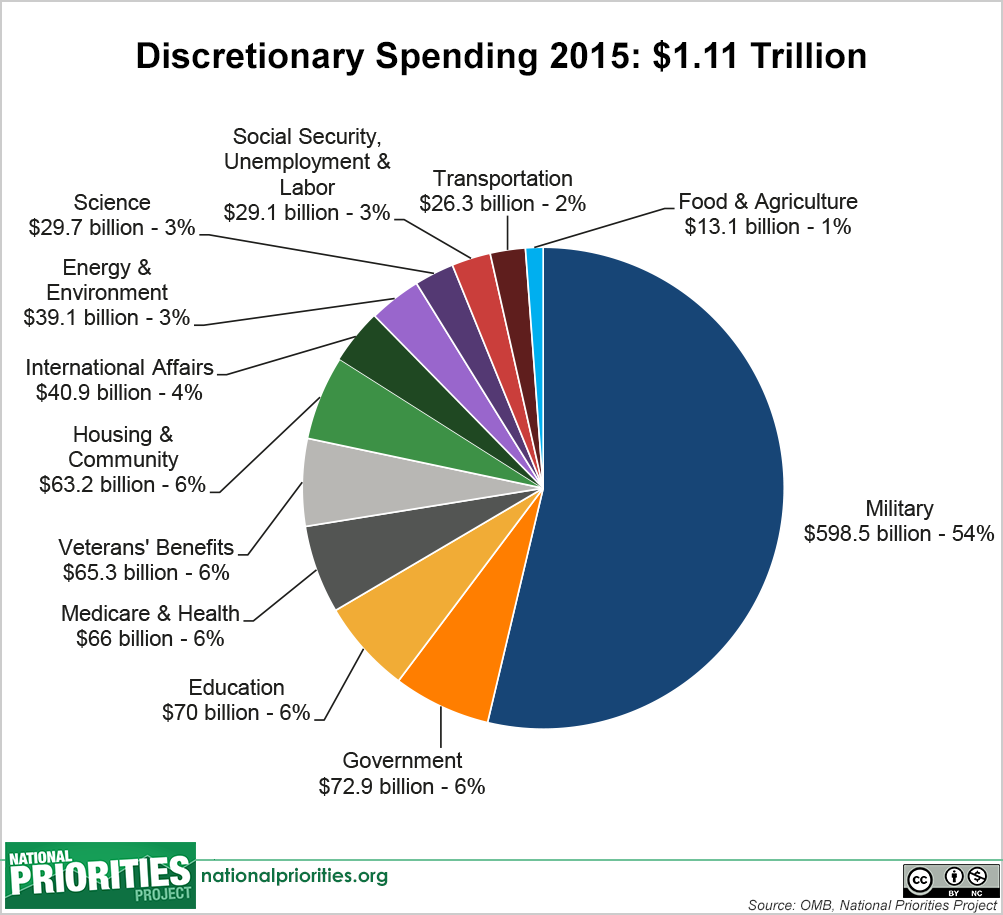
Most federal spending is nondiscretionary, meaning that it goes to entitlements (such as Social Security, Medicare, and unemployment insurance) and to pay the interest on the national debt. Discretionary spending totals just $1.2 trillion a year (out of a budget of almost four trillion), and roughly half of that goes to national defense, which Trump insists that he won’t touch. The federal budget deficit is around six hundred billion dollars a year, and analysis by the Tax Foundation suggests that Trump’s proposed tax cut would reduce federal revenue by another half trillion or so. So it’s simply impossible for Trump to balance the budget while protecting defense and entitlement spending.
The theatre of endless discussions over foreign aid or PBS will entertain the masses, yes, but the budget hole will continue to get bigger and bigger and bigger.

Such insanity--and remember that this is an administration that is only three weeks old--is also why no economist of any decent reputation wants to go anywhere near being an adviser to this president:
Other than Mr Navarro, Mr Trump struggles to find economists who will support him. Perhaps as a result, his cabinet will be wonk-free.
Seriously, 63 million Americans voted for this man?  The Republican Party kowtows to this nincompoop?  There is simply no way that there can be anything good about a Trump voter!  Assholes, all of them!

Source


Monday, October 05, 2015

Never Again Scientific Activities. I.e., NASA!

About two years ago, I blogged here that India was wasting a whole lot of resources on an expedition to Mars when it had plenty of problems, especially the daily realities of open defecation and urban waste management.  And then a year later I celebrated India's success with the Mars expedition, and was delighted with the number of female scientists in the project.

It is not that I am a flip-flopper who is happy to ride along with success.  If it were up to me, I would any day push India towards spending money on the fundamentals like addressing defecation and the atrocious government schools.  The Mars expedition success does not change the reality on the ground.

The United States, on the other hand, has been doing everything possible to dismantle its valued, respected, and universally admired NASA, thanks to Congress crying that there is no money to fund NASA.  Seriously?  My old country and the adopted country are both messed up with their priorities in their own ways!  The richest country that the planet has ever known has no money for NASA?  We waste trillions of dollars on fighting wars for reasons that did not even exist, but no change to spare for NASA.
In the 1960s, NASA’s budget was nearly five percent of our federal budget. The U.S. space program gave us solar panels and MRI scans and inspired two generations of citizens to become fascinated by science and engineering, which is arguably the driving force behind our technological superiority among nations. Today, NASA scrapes by, still doing remarkable things with rovers and probes, on less than half of one percent of the federal budget. How can we help more Americans understand the value NASA has for our advancement?
From five percent of the budget to less than half of one percent?  Shocking.  Disgusting.

Even more shocking to when it is put like this:
NASA's flat budget won't pay for a Mars mission. At the moment NASA can't even get an astronaut to the International Space Station without buying a seat on a Russian rocket.
Seriously?  WTF!
In recent years, the agency has had to build its strategies around flat budgets. "Budget is mission-critical" is a catch phrase at headquarters. NASA retired the space shuttle program in 2011 not because the hardware was old or dysfunctional, but to free up several billion dollars a year to build new rockets and capsules that could go beyond Low Earth Orbit.
Why spend the money, you ask?  Here is Neil deGrasse Tyson:
There’s a lot to do in space.  I want to learn more about the greenhouse effect on Venus, about whether there was life on Mars, about the environment in which Earth and the Sun is immersed, the behavior of the Sun.  We still can’t predict the day-to-day behavior of the Sun.  We have something called space weather now, which monitors particles that stream off from the Sun.  That’s a whole frontier, didn’t exist a few decades ago.  We knew about it but we couldn’t measure it, couldn’t do anything about it.  So I see NASA as our… the extension of our senses into space.  ‘Cause Earth is not an island, Earth is a participant in our cosmic environment.  And the more you think… I only have to look down, the more doom you are because of the environment in which we’re embedded.  You look down, all the asteroids coming behind you and you miss it. 
But, all that cannot happen when we want to cut NASA's budget further down from the less than half of one percent of the federal budget.
What a mess. The majority of Americans love NASA, and it’s incredible that NASA can do such amazing feats like send probes to Pluto and Saturn and protoplanets like Vesta and Ceres at all, let alone given the Keystone Kops feel of the Congresspeople pulling the purse strings. My only hope now is that these folks in Congress get replaced in the 2016 elections.
It’s hard to look to the stars when the people funding you have their heads jammed into pork barrels.

What a mess!

Tuesday, March 11, 2014

Guns v. butter. No, make that shoes v. butter!

Remember this chart from a few days ago?


I am sure you forgot all about it and went your ways. Because you have way too many other things to worry about.  But, you--whether living in the US or in Chennai--cannot "afford" to forget it!

The Economist offers an interesting example for why the military budget is tough to tame.  Before getting into the example itself, these comments from the magazine newspaper:
[Harnessing] austerity to reform the defence budget will be dauntingly hard. Congress will have final say over Mr Hagel’s plans and something about camouflage gear has a strange effect on politicians. Even in this era of cuts, the Pentagon’s budget is vast: America accounts for about four of every ten dollars spent on defence worldwide. The temptation is always there to play at industrial policy or simple favouritism.
The scale and the complexity of Pentagon spending make it hard to assess the real prospects for reform.
You ready for the example?  Consider military boots:
 The plant in Big Rapids is still more unusual: every component used there is American, from leather (a Minnesota tannery provides most hides) to shoelaces, eyelets and the yarn used for linings.
 When we live in a world where the shoes we buy might have been manufactured in Cambodia, and shirts from Bangladesh, interesting to note that even the shoelaces for the military issued boots are red-blooded American. Why so?
 This patriotism is explained not by sentiment, but the law. Military footwear is governed by the Berry amendment, passed by Congress on the eve of war in 1941 to ensure that troops would be given home-grown wool and food. Today the amendment applies to most uniforms, tents, flags and processed food bought with Pentagon funds. These must be entirely American-made or -grown, unless domestic firms simply do not make the product.
Make up your mind: do you want to laugh or cry about that?

So, that was about those tough military footwear. If only the politics stopped with that!
 a bipartisan clutch of senators and members of Congress—notably from states with some domestic shoe production—has spent years prodding the Pentagon to start buying a product that does not exist: all-American military running shoes. Under orders from Congress, defence officials formally asked domestic shoemakers in January to report if they could make “Berry-compliant” athletic shoes. The inquiry was made through gritted teeth. Market forces do a fine job of supplying comfortable, cheap running shoes to recruits. Defence officials argue that costs may rise if trainer choices are limited, and that injuries may even follow. The signals are clear enough: the Pentagon has no desire to get into the sneaker-design business.
Yes, even the Pentagon is opposed to the very proposal from the lawmakers
Again, make up your mind: do you want to cry or laugh?

All that was over shoes. And then there are tanks. Aircraft carriers.  Submarines. Fighter planes. Bombs. Missles. ...

Meanwhile, we fight over scraps to maintain soup kitchens.  USA, USA, USA!!!  As Paul Krugman recently put it:
The total failure to accept that the poor face real physical hardship, that affluent politicians have no business lecturing people having trouble buying food or having trouble paying for health care about dignity, is just stunning.
Awful!

For the final time: do you want to cry or laugh?

Wednesday, January 30, 2013

So what if cuts in defense spending shrink the economy?

It is one of those news items that might seem like bad news, but is not:
The U.S. economy unexpectedly shrank from October through December, the first quarterly drop since 2009 and a reminder of the economy’s vulnerability as automatic cuts in government spending loom.
I do not mean to suggest that a contraction in the economy is good, when unemployment, especially among the educated youth, is at levels that are way higher than a "normal" rate of unemployment.

It is a good news because of the underlying reasons for the contraction:
The decline in federal spending last quarter was the largest drop since 1973. Spending at all levels of government fell 6.6% in the period.
That drop was the primary culprit for the economy contracting, said Alan Krueger, chairman of the White House's Council of Economic Advisers.
"Several private-sector components of GDP continued to make positive contributions," Mr. Krueger said. "A likely explanation for the sharp decline in Federal defense spending is uncertainty concerning the automatic spending cuts that were scheduled to take effect in January," and are now set for March 1.
I am cheering not because I a rabid libertarian who believes that all government is evil.  But because at least for a short while we have had a drop in military expenditure.  A slight, very slight, tempering of our war infrastructure is something that ought to relieve us.  If only we can continue to go after the military budget, which, if not for the "fiscal cliff," is always treated as a sacred cow that had to be fed more and more. (too many metaphors?)

If we don't spend money on guns, then we will have more money for butter.  The more we can decrease spending on guns, the better off we will be.  Do not allow yourself to be scared into thinking that this drop in defense spending is bad news.
Economists stressed that the key factors that dragged on GDP in the fourth quarter could prove short-lived, even though the economy faces other threats in 2013.
“Frankly, this is the best-looking contraction in U.S. GDP you’ll ever see,” Paul Ashworth, an economist at Capital Economics, said in a research note. “The drag from defense spending and inventories is a one-off. The rest of the report is all encouraging.”
For all of 2012, the economy expanded 2.2 percent, better than 2011’s growth of 1.8 percent.
We might already be witnessing the "more butter" aspects:
consumer spending accelerated and business investment rebounded, suggesting some fundamental strength that should help to support the recovery even as Washington tightens its belt.
"We are not concerned that the economy is slipping back into recession," said John Ryding, chief economist at RDQ Economics in New York.
A second report showed private employers stepped up hiring in January, suggesting an improvement in the labor market. 
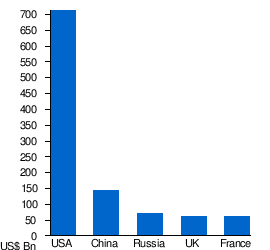
Yep, we don't need a gazillion more bombs and fighter planes and submarines and drones.  Think about the many ways we could constructively spend all that money! (the chart compares the top five military budgets in 2012.)
Source

Saturday, July 09, 2011

Quote of the day: military eating the employment lunch

I am not always a fan of Congressional Representative Barney Frank--he is too ideological for my political tastes.  What he says here is a gem:

Scoffing at the suggestion that “everything is on the table’’ in budget negotiations between the Obama administration and congressional leaders, Frank said, “The military budget is not on the table. The military is at the table, and it is eating everybody else’s lunch.’’

Frank also commented a few days ago that after Obama announced troop withdrawal from Afghanistan, Congress didn't bother to take back the billions originally appropriated for those troops as well.

When it comes to war and defence, there is one one hell of a scary bipartisanship.

We are at war in Iraq, Afghanistan, Libya Yemen, Pakistan.  In the first two, we have "boots on the ground."  In Yemen and Pakistan, we use drones.  And Libya, of course, is not war but "kinetic military action."

Meanwhile, scary employment and economy scenarios back here at home.

These are the kind of situations when I wonder why I even bother to read the news anymore :(

Sunday, September 05, 2010

Oregon's kicker law: I told you so!

A couple of days ago, the media reported a surreal news item: that while Oregon's state government was struggling to deal with the ever widening budget gaps, it also faced the prospect of refunding millions of taxes to corporations--as mandated by the state's kicker law.

It was only a matter of time before editorials, like this one, were written about this.  But, hey, yet again, I have this feeling of I told you so!  The following was my opinion column published in the Register Guard on May 7, 2009. Yes, that was fifteen months ago!!!

The Great Recession is the label that some commentators use to refer to the current global economic slump, and it seems appropriate. Even as we struggle against the downturn, I am relieved that the legislative process has been set in motion to address the “kicker law.”

The kicker law mandates refunds to taxpayers if the tax receipts exceed forecasted biennial revenue by more than 2 percent. One lesson of the Great Recession, which has immense implications for the kicker, is a simple one: Predicting the economic future is nearly impossible, and even more difficult is the task of estimating revenues within a 2 percent margin.

Very few experts foresaw the nasty recession when we were still riding high two years ago. Even the chairman of the Federal Reserve, Ben Bernanke, did not see this coming. In fact, during the early years of the bull market, Bernanke publicly worried that the problem in the world was from a savings glut. He was also among many leading economists who were confident that we had tamed the boom-bust cycles, and that we were in for smooth cruising. If only that were the case!

A clear minority of experts predicted a recession, and even fewer, such as Nouriel Roubini, worried that it would be a nasty global economic pandemic.

Plainly, economic forecasting is not as easy, nor scientific, as we might imagine it to be. Yet, the kicker is predicated upon such economic forecasts. Take, for instance, the state economist’s revenue forecast from March 2008. The report notes that, “The forecast projects a slowing Oregon economy in 2008 with mild growth returning in 2009.” It has been anything but.

However, it does not mean that the state economist was way off. The same report states, correctly, that “Uncertainty surrounds the financial system. … Broadly, we place ‘uncertainty’ under ‘risks,’ and note that the Oregon economy is at a precarious juncture of the business cycle.” A year later, that “uncertainty” has revealed itself in a number of unpleasant ways, including the 12.1 percent unemployment, which could worsen.

The bottom line is that the kicker law is built on “forecasting” that cannot ever be precise and is, therefore, set up to fail. No wonder, then, that rebates have been frequent, rather than rare exceptions.

Looking at it another way, this kicker law, which was approved in 1980, was an Oregon innovation similar to other notables such as the bottle bill or the gas tax. However, unlike the bottle bill, the kicker law was not adopted by any other state in the union. Could it be for a simple reason that the kicker was not considered an idea brilliant enough to be copied?

I fully recognize and support the reason behind the kicker law — as a check against uncontrolled expansion of government, which could otherwise suck away money from private economic activities. However, there is no guarantee that such controls on revenue alone will constrain government expenditures.

All we need for an example is immediately to the south of us. Californians passed the famous Proposition 13 back in 1978, before our own kicker law, to limit property taxes and future tax increases. Three decades later, the libertarian Reason magazine recently noted that even Gov. Arnold Schwarzenegger, who swept into office promising to limit government, has ended up expanding it at rates slightly more than what his predecessor did: “Under Schwarzenegger, spending has increased 6.8 percent annually, compared to a population/inflation rate of just under 5 percent.”

It is therefore up to us voters to be on the alert for necessary and unnecessary government expenditures, and to use existing processes to express our preferences. A constitutional revenue choke-off, which is what the kicker amounts to, cannot by itself limit government, and can only worsen budget crises whenever we enter into a recession.

Furthermore, let us not forget that there will be a recession after we recover from this one — that is the nature of the economic system. This means we ought to prepare ourselves for the economic ups and downs that are not easy to forecast, which is why I fully support the proposals to strengthen the rainy day fund by diverting a portion of the monies that would otherwise become kicker refunds.

The old saying is “once bitten, twice shy” — and Oregonians have been bitten more than once by economic downturns. Let us work on avoiding nasty bites in the future.
Posted to Web: Wednesday, May 6, 2009 05:29PM
Appeared in print: Thursday, May 7, 2009, page A9

Wednesday, May 05, 2010

OMG! Federal budget in 2020

This is from the Congressional Budget Office (CBO)

(A much simpler graphic than the one on PIIGS, and infinitely simpler than that nasty military Powerpoint slide!)

ht

Tuesday, April 20, 2010

How we spend money

In an earlier post (it was an op-ed piece) I referred to a study from the Center on Budget and Public Priorities.  Today, I came across this neat graphic (ht) that tells us the reality of the federal budget--that a whole bunch of discussions on items that take up most of the budget are actually off the table: defense, medicare, social security, ... so, at the end of it all, federal and state budget deliberations are essentially about small slices of the pie :(

Friday, April 09, 2010

Taxes make government services available to all

April 15 is Tax Day, the deadline to file taxes on incomes earned.

Speaking for myself, I can't imagine a better time than now to thank my fellow Oregonians for making possible through these and other taxes, a wide range of services including the university where I teach.

The rationale for government provision of a wide range of services is varied as well. Sometimes the nature of the service requires a collective provision such as policing. One can imagine the complications if we expect people to privately pay for state troopers in order to ensure safety on the highways, and then travelled with their own posse.

In a different category of services like education, one of the goals is to ensure that children and youths are provided opportunities that might otherwise not be accessible to them for sheer lack of money. Of course, public support for higher education has decreased significantly over the last two decades, and this has made college education that much less affordable and accessible.

These, and many other compelling arguments for government, have resulted in a problem that we have come to understand very well over the past few years: a widening gap between what we would like the government to provide versus the funding available for all those services. Hence, the perpetual problem of budget deficit and the need to balance it all over again.

We ought to recognize that the budget deficits will not go away even as we slowly come out of this Great Recession, which we eventually will. According to the Center on Budget and Policy Priorities, "budget pressures have not abated and, in fact, are increasing. Because unemployment rates remain high — and are projected to stay high well into next year — revenues are likely to remain at or near their current depressed levels. This is likely to cause a new round of cuts."

In Oregon, the near-consensus opinion is that we will experience a jobless economic recovery. It is quite possible that unemployment levels, currently at about 10.5 percent, may just about barely dip down into single-digits even by the end of this biennium. We can, therefore, expect the state budget issues to get complicated — even more than they already are. Thus, it is no surprise that the state's economist is projecting a deficit of $2.5 billion in the next biennial budget. All these mean that it will require Oregonians getting together to figure out what our spending priorities ought to be, not only at the state level, but at county and city governments too.

But it was disheartening to read that 37 percent of the 500 voters who were randomly polled recently did not even know that Oregon, like all the states, sends two senators to the Congress. Making tough choices during bad times requires our collective involvement through a basic understanding of, and involvement in, the civic processes of the state and country.

To that effect, here is a suggestion: Maybe "Tax Day" is a good opportunity to brush up on our civics knowledge, starting with a note of thanks to taxpayers.

Published in the Statesman Journal, April 9, 2010

Wednesday, January 27, 2010

On Oregon's vote to increase tax rates

So, Oregonians defied historical trends and voted for a tax increase.  Well, I had made my position clear even before the vote :)

From across the continent, Megan McArdle has the following observations:
  • The fact that Clinton raised taxes, and then the economy recovered, is not proof that raising taxes has no effect on the economy.  Most people thing that there is at least some dampening effect, which is especially problematic in a downturn.
  • Realistically, income tax response gets more elastic as the tax region gets smaller.  Oregon borders two states with attractive migration possibilities.  California's taxes are no bargain--but Oregon's relatively lower tax rates may have attracted wealthy individuals and businesses that will now find it not so attractive.
  • The Tax Foundation says that pre-tax, it was on the top ten list for business tax climate.  That suggests that it has relatively more room to increase taxes than other states.
  • The business tax changes apparently include a gross receipts tax, which is really an awful tax, especially during a downturn.  Companies which are actually losing money may still owe taxes, which could hasten their closure, and the evaporation of any jobs they provide.
  • Trying to close the gap with only taxes on high income makes state revenues very dependent on a very small group of people.  Ask New York and California how that's going.
  • Since state income taxes are deductible from federal taxes, this doesn't entirely raise new tax revenue--much of it will be transferred from the Federal government.
  • There aren't that many attractive revenue-raising measures for state budgets during a downturn, nor is cutting services always optimal, since demand for them rises when the economy tanks.  Ideally, states would run surpluses in the good years.  Practically, it almost never happens.

Friday, November 20, 2009

Oregon's fiscal crisis

Are the revenue raising Measures 66 and 67 doomed to fail because they are scheduled to be voted on in January?

I relocated to Oregon in fall 2002, and soon I was on the metaphorical public policy treadmill in order to figure out what was at stake in the special election the following January.  Measure 28 was on the ballot and it was an attempt to temporarily raise income tax rates. 

On January 28, 2003, Measure 28 was defeated by almost a ten percentage margin, and budget cuts resulted, including at the university where I work.

Before the year ended, there was another measure on the ballot, and again at about the same time of the year.  In February 3, 2004, it was with a convincing 18-percentage margin that Oregonians voted down Measure 30, which was aimed at increasing revenues through income and corporate taxes.

I wonder about the timing for such votes to increase taxes.  Are such revenue-raising attempts self-defeating because the ballots arrive at about the same time that we also receive bills for all the purchases we made over the lengthy holiday season from Thanksgiving until the new year? 

If the “no” votes are more a reflection of voters juggling with their personal finances, and less about a political philosophy of taxes, well, Oregonians seem to be significantly less secure now compared to back in 2003 or 2004—we are currently amidst a deep and broad level of economic contraction and unemployment.

Will we then look past our respective financial insecurities to understand that Measures 66 and 67 will not raise tax rates for most Oregonians?  Measure 66, for instance, will mean higher taxes for roughly about three percent of personal income tax filers, which means that it will not affect the remaining 97 percent.

I suspect that as in 2003 and 2004, the word “tax” could easily grab the attention of a significant number of voters who might almost reflexively reject the idea. 

Should the measures fail, the impacts could be worse than the aftershocks of the rejection of Measures 28 and 30.  In the current recessionary environment, government spending has been able to prevent a more serious depression.  A reduction of public spending could further worsen the state’s economic situation, through direct cuts and their eventual multiplier effects.  In a recent report, the National Governors Association observed that “the biggest impact on states is the one to two years after the recession is over.”  It is, therefore, important to uphold the taxes approved by the legislature. 

However, we also ought to recognize that Measures 66 and 67 are temporary solutions, at best.  We need to look no further than down south at California to realize that increasing the revenue stream alone is not enough.  Thus, irrespective of the results on January 26, 2010, I hope Measures 66 and 67 will catalyze discussions on Oregon’s priorities and commitment to its citizens. 

In the meanwhile, here is to hoping that Oregonians will reverse past trends this coming January. 

Thursday, November 19, 2009

Friday, October 09, 2009

California Failing

It is getting worse in California.  The latest news is that:
State revenue has already fallen more than $1 billion short of assumptions in the budget lawmakers passed less than three months ago, according to a new report from the state controller.
What is a billion anymore, right?  Well, if only it were not on top of a few other billions:
Even before the bad fiscal news, policymakers were bracing for a big budget deficit next year. The Department of Finance anticipates a $7.4-billion deficit in 2010-11. That’s a conservative estimate, because lawsuits have tied up or reversed some planned budget cuts.
The state is in so much of a mess that all the way from Britain, the Guardian asks "Will California become America's first failed state?"
There is a growing movement to call for a constitutional convention that could redraw the way the state is governed. It could change how the state passes budgets and make the political system more open, recreating the lost middle ground. Recently, the powerful mayor of Los Angeles, Antonio Villaraigosa, signed on to the idea. Gerrymandering, too, is set to take a hit. Next year Schwarzenegger will take steps to redraw some districts to make them more competitive, breaking the stranglehold of party politics. He wants district boundaries to be drawn up by impartial judges, not politicians. In previous times that would have been the equivalent of a turkey voting for Christmas. But now the bold move is seen for what it is: a necessary step to change things. And there is no denying that innovation is something that California does well.
Of course, it would be foolish to write-off California.  But, they better clean up the political mess fast if they want to maintain that California mystique.  And I want them to--some day I hope to return to Southern California .... for good.  After all, that is the place whereI was partly raised.

Tuesday, July 21, 2009

Beware the Budget Billions

Exhibit A (from Bloomberg):
[A] spokesman for the White House budget office said postponing the review from mid-July until mid-August isn’t unusual during a president’s first year in office.

“Because of the unique circumstances of a transition year, we are, like President George W. Bush in 2001, releasing the mid-session review a few weeks later than as is usual in non- transition years,” Kenneth Baer, communications director for the Office of Management and Budget, said.

Bush’s first mid-year review was released Aug. 22, 2001, and the one issued in former President Bill Clinton’s first year in office came out on Sept. 1, White House press secretary Robert Gibbs said. ...

A worsening jobs picture compared with February’s forecast and a still-weak economy may make the deficit picture look worse than the $1.84 trillion forecast this year, about four times the previous record of $455 billion. Next year’s deficit was projected to decline to $1.26 trillion.

Gibbs said he expected the review to show “the budget situation is going to be even more challenging” than February’s forecast. He didn’t elaborate.

Exhibit B (Economist's Voice):
Although this year's record deficit has attracted a lot of attention, the real concern is the unsustainability of the federal budget over the next 10 years and longer. The budget situation presents policy makers with a very delicate balancing act between encouraging economic recovery and establishing fiscal sustainability, according to Alan Auerbach of U.C. Berkeley and William Gale of Brookings.
The following sentence in Exhibit B is a mind-boggler:
In 2009, the U.S. federal deficit will be larger than the entire GDP of all but six other countries.
All but six other countries have GDPs less than the US federal government's deficit. What a way to understand how huge our economy is!

Anyway, let us see what the state of the government is when the report comes out, and how that might affect healthcare and other policies that are in competition for lots of resources.

Friday, April 17, 2009

Schwarzenegger: California's wasted years

I was one of the many who could not believe that an actor with no political track record whatsoever could be elected as the governor of the largest economy in the US--California. Has the Governator been any better for California? Read this from Reason:

When Gray Davis, a Democrat, became California’s governor in 1999, the state’s budget was $75 billion. Tempted by dot-com windfalls and beholden to public-sector unions, Davis bumped that number to $104 billion in four short years of boom and bust, after which he was bounced out of office for his fiscal irresponsibility and replaced by a Milton Friedman–quoting action hero who promised to bring “fiscal sanity” back to Sacramento. Five years later, after facing another boom, another bust, and a series of bruising political defeats at the hands of public-sector unions, Schwarzenegger had hiked the budget to an astonishing $145 billion. In 10 years, state spending in nominal terms increased 92 percent.

One good way to measure fiscal stewardship is to see whether state spending growth exceeds the rate of population growth plus inflation. Under Davis, budgets rose an average of 6.7 percent a year, as opposed to a population/California price index growth rate of 4.8 percent. Under Schwarzenegger, spending has increased 6.8 percent annually, compared to a population/inflation rate of just under 5 percent. A governor who was swept into office by damning Davis’ $38 billion budget deficit, vowing not to raise taxes, and mocking his predecessor’s vehicle license fee hikes announced on February 20 that he would address his own $42 billion budget deficit by raising taxes and doubling those same fees.

Sometimes I wonder if politics and politicians here in the US are any better than what I experienced in India. Maybe it goes with the territory?