Showing posts with label carbon. Show all posts

Sunday, June 30, 2019

Armed and dangerous ... and headed into the shit

A few months ago,  I participated in a march to express my worries over climate change and to urge action.

Very few young people were in the march.  We were a bunch of geezers.

The march went past quite a few apartment buildings where young people were partying.  A couple of them waved out to us from a balcony where they were partying.

Here we were, middle aged and older, marching to make the world a better place for young people, but the youth didn't care enough to protest!

Beer, sex, and Instagram beat climate change protests!

If that's how it is here in liberal, progressive, and green Oregon, then should we be surprised that the US has not done any damn thing about climate change?

We witnessed yet another regression in this when the fucked up party skipped town, skipped state, and went into hiding in nearby Idaho all because their elected officials did not want to do anything about climate change and were, therefore, opposed to the cap-and-trade bill that was up for vote.
Having killed the climate crisis bill, the Republican senators said they would return to their jobs on Saturday. “Our mission was to kill cap-and-trade,” said senator Herman Baertschiger “And that’s what we did.”
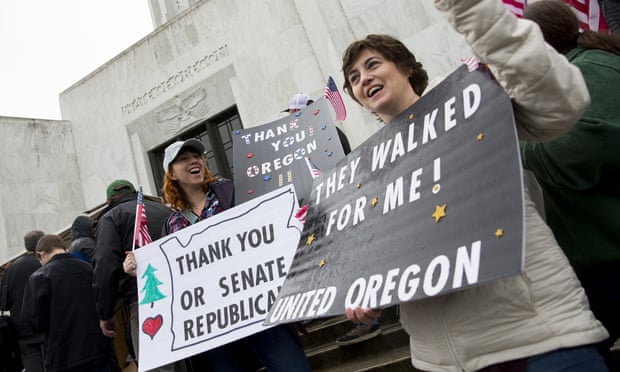
Source

These young people are thanking the Republicans for screwing up their own futures?  How can this be?

When you have guns, everything is possible, it seems.
Joe Lowndes, a political scientist at the University of Oregon who researches rightwing politics, said: “If the Oregon Republican party were a European political party it would be an authoritarian far-right party. It really has that character, that extraordinary truculence,” he said.
During the standoff over climate crisis, Lowndes said, Republicans “were essentially gloating about having an armed wing of the party. That’s when you cut into the structure of constitutional democracy”.
The fucked up party, not only here in Oregon but throughout the country, has become the most powerful far-right country in power anywhere in the democratic world!
the Republican Party lies far from the Conservative Party in Britain and the Christian Democratic Union in Germany — mainstream right-leaning parties — and closer to far-right parties like Alternative for Germany, whose platform contains plainly xenophobic, anti-Muslim statements.
It is frightening to think that this is now the mainstream party!
The difference is that in Europe, far-right populist parties are often an alternative to the mainstream. In the United States, the Republican Party is the mainstream.
“That’s the tragedy of the American two-party system,” Mr. Greven said. In a multiparty government, white working-class populists might have been shunted into a smaller faction, and the Republicans might have continued as a “big tent” conservative party. Instead, the Republican Party has allowed its more extreme elements to dominate. “Nowhere in Europe do you have that phenomenon,” he said.
Will leave it to David Roberts for the last word:
Basically, this is future-of-the-species stuff, getting decided through a spectacle that's barely even able to break into the daily news cycle. And the next time around, there may not even be the pretense of democracy. We are truly headed into the shit. 

Wednesday, August 01, 2018

"If everyone does a little, we’ll only achieve a little"

I drive a gasoline-powered car.
I fly--domestic and international.
I live in a house that is way big for one person.
I eat almonds from California.
These past few days, I have been cranking up the air-conditioning.

And, oh, I don't use plastic drinking straws, and I recycle paper, bottle, and plastic.

Can you tell me again why recycling and staying away from straws makes me an environmentalist, when my carbon footprint in everything else that I do is humongous?

For years, I have been complaining that we are not pursuing the big-impact issues, and are instead doing merely feel-good things. Like banning plastic straws and plastic bags.  I don't mean to suggest that banning these is a bad idea.  They are much needed.  But, it also does a huge disservice by making people think that banning straws and plastic bags is all that is needed.
If we want to educate conscientious environmental consumers, we should be honest about the scale of the problems and the results of our actions.
Exactly!

We should also remind people that this is a large-scale issue, and pointing fingers at individuals is ineffective.
Effectively, we have accepted individual responsibility for a problem we have little control over. We can swim against this plastic stream with all our might and fail to make much headway. At some point we need to address the source.
On top of that, a much bigger problem:
If environmentalism becomes about vilifying so many of life’s small pleasures and conveniences, I fear it will turn off more people than it rallies to its cause.
Like a neighbor who thinks that being environmental means to walk around with a stink--from not taking showers--and to wear dirty rags.

So, what should be done?

For starters, don't be a dick and blame population growth.  That is atrocious!  Our consumption patterns are the problem, not the numbers of humans born every year.

Go after the producers:
the best way to accelerate significant environmental progress might be to worry less about individual consumption and more about the production side of the equation.
Of course, this is increasingly difficult in this trump era; those in power now and the pro-business maniacs think that every shit that any business does is gold, and that those of us who worry about the long-term impacts on the natural environment are nothing but socialist snowflakes!

Elections have consequences, which the Berniacs did not think through when they went on a hate-Hillary campaign!

We are less than 100 days away from the next major election.  Do whatever you can to vote out these irresponsible scumbags who are robbing from the grandchildren.


ps: The title for this post was a quote in the essay that I have referred to.

Sunday, March 11, 2018

Taking a dump in the commons

(I have sent the following to the editor)

Like many, I am disappointed that Oregon’s legislature did not pass a cap and trade bill in its short session that ended on March 3rd. It will be a while, therefore, before we Oregonians figure out how to stop pumping carbon dioxide (CO2) into the atmosphere.

In discussing emissions, politicians often try to sell the laws they propose as jobs, jobs, jobs. Here in Oregon, the cap and trade bill was floated as the “Clean Energy Jobs Bill.” Politicians take this approach for a good reason—public discussion on emissions is incorrectly framed by climate change deniers as job killers. Hence, the constant repackaging of legislation in this arena as an employment generator.

If a significant percentage of the public and their preferred leaders are not receptive to straight talk about the urgency to limit the emission of CO2 because of the role it plays in climate change, then there is another way to repackage it in a form that will appeal to many—as public health infrastructure.

In order to understand limiting CO2 emissions as an “infrastructure bill” we can learn from recent history. When England, and later the US, started industrializing, cities grew rapidly. People rushed to London, New York, and Philadelphia, in search of jobs and fortunes, and the growth of such population centers was unprecedented. The crowding of people and their close contact with each other made it easy for pathogens to wreak havoc, and life in the city became nasty, brutish, and short.

Two hundred years ago, Londoners were not only in close proximity with each other, they also lacked the piped water supply and sewer systems that we now take for granted. In the absence of protected systems, human feces found their way into fresh water supplies, like wells, and illnesses and death followed. A widely discussed example is the cholera epidemic in London in 1854 that was traced back to a single well where a mother had washed her child’s dirty diapers.

When American cities started growing as important economic centers, the population here, too, experienced health issues. Cities recognized the importance of public health and started investing in protected water supply services. As the Harvard economist Ed Glaeser points out, by the end of the 19th century, municipalities in the US were spending as much on water supply systems as the federal government was spending on everything except the military and postal services. It was a massive public infrastructure investment that wins applause from even contemporary anti-government crusaders.

These public investments in clean water supply and sewer systems separated the bad—the feces—from the good—potable water—and did wonders to decrease the incidence of water-borne diseases like cholera, and contributed to sharp increases in life expectancy. Thanks to our public sewer system, we now use the bathrooms at home and at the office, and don’t worry for a nanosecond about what happens after we flush.

This infrastructure is not for free. We pay monthly bills to our wonderful local utilities that collect all our refuse, process them at large sewage treatment plants, and make our cities livable and beautiful.

We do not want people to treat the banks of the Willamette River as their bathrooms—unlike, for instance, how the poor do in India by the side of lakes and rivers. Yet, we are the same people who have been merrily discharging filthy CO2 waste into the air that all of us breathe! We need an infrastructure plan to address this public dumping.

CO2 is a harmful byproduct of our activities that should not be dumped in the commons. Whether it is the smokestacks in factories, or the tailpipe in the car that I drive, the CO2 that comes out is casually and irresponsibly released into the air. All of us—yes, I, too—should be held accountable for this public dumping, and be required to pay for the needed infrastructure.

However, unlike with human feces, it is not easy to capture CO2 from the air and process it, though scientists and technologists are working on that approach. An easier and simpler approach is to limit our use of carbon in the first place. The less carbon we use, the less CO2 we will produce and, therefore, we will dump less in the commons.

Which is why I suggest that attempts to limit the use of carbon, through taxation, should be an important aspect of public health infrastructure investment for the future, similar to how generations past invested for the betterment of our lives. I hope that our elected officials will decisively act on this in 2019.

Monday, August 29, 2016

Ducking climate change

(Have sent a version of this to the editor)

An old high school friend, who is a practicing pathologist in India, visited with me in mid-August, just as the temperature started its sharp climb during the dog days of summer. I joked that she brought with her the Indian conditions. Talk about the weather soon morphed into discussing climate change.

My friend, like many hundreds of millions in India, is intensely familiar with the recent unusual meteorological happenings there. Last December, for instance, the city of Chennai--home to both our parents--received rainfall amounts that vastly exceeded all kinds of records and the city was flooded. (I addressed this in a column that was published on January 6, 2016.)

In late spring, more than a quarter of India’s 1.2 billion population struggled with drought and water shortage. The conditions worsened in the summer, when the country recorded unbearably hot temperatures, and the heatwave turned out to be a killer as much as the heatwave of 2015 was. Then, when the monsoon arrived after all the heat and dust, it poured and flooded. In Kaziranga National Park in India’s northeast, more than twenty rhinos, which had been making quite a recovery after near extinction, were killed in the monsoon floods.

Most scientists and lay people alike in India are in agreement that these extreme weather episodes, year after year, are a result of climatic conditions that are getting weirder and not predictable as they might have been in the past.

Here in the US too, it is not a mere accident that record-setting rain fell in Louisiana, for instance. Only months before, we witnessed Houston deluged by rains. When records are being shattered in places across the world, across different parameters of heat, rain, drought, and cold, then surely these are not isolated events but a part of a larger story.

When it comes to that larger story of global climate change, it is not a case of what happens in Vegas stays in Vegas. Instead, the cumulative effects of Vegas and everywhere else means that all of us anywhere on the planet are feeling the effects. The more extreme the resulting weather events, the more will be the destruction of life and property as well.

My friend and I got to talking about what can be done. “Look at all the lights here” she remarked. Homes were aglow in my neighborhood from the light inside and from the street lamps. Artificial light is so much in abundance in the US that we are worried about light pollution that prevents most Americans from sighting even our own home galaxy—the Milky Way. “Twinkle, twinkle, little star” is an abstract idea for many urban kids who rarely see get to see stars in the sky during their everyday lives.

It is quite a contrast in her country. "In India, a large population doesn’t even have electricity in their homes. Turning the lights off won’t help fight climate change" she said.

Developing countries like India have an immense problem to solve. When 300 million people in India lack basic electric light, leave alone air conditioners and refrigerators, the magnitude of the problem is easy to imagine. Even among those who are connected to the electricity grid, the power consumption per person is barely a fifth of the global average. The fulfillment of the dreams of the people will require a whole lot of energy. However, the use of coal and other carbon sources will further accelerate the climate weirding.

While India’s emissions are very low on a per-capita basis—about a tenth of US per capita emissions—it is already the third largest total emitter of carbon dioxide. As India’s economic engines rev up, if it follows the same fossil-fuel path that was traveled most recently by China, and by the developed countries including the US earlier on, then the explosive growth of carbon use will mean “game over”, and we might as well party like there will be no tomorrow.

Thus, as we move into the future, it is India—more than any other developed or developing country—that will practically determine our collective global fates with its decisions on clean and carbon-free energy sources.

It was an unbearably warm evening the day before my friend left. We walked up to the Willamette River and soaked our feet in the cool waters. About thirty young and old ducks floated and quacked all around us. Climate change could prevent future generations from enjoying such blissful nature. Here is to hoping that the natural world of tomorrow will be as good as, or even better than, the wonderful world that we inherited.


Monday, August 01, 2016

The disposables

One of the ideas that has been most destructive ever to the environment is actually a very short phrase.  "To go", as we say here in the US, or the "take away" in some other parts of the English-speaking world.

When I was a kid, if we wanted to drink tea or coffee, we had no choice but to sit down at the stall or the restaurant and finish the hot drink.  There was no concept of "to go"--unless we took a thermos or a kooja in which we brought home the drink.  The businesses washed (I hope!) the glasses and tumblers, and there was nothing to be disposed.

Snacks we rarely bought and, when we did, they were wrapped up in old newspapers, which also doubled up as oil-soakers thanks to which the snacks were that much less greasy ;)  Of course, banana leaves doubled up as both wrappers as well as plates for pooris and idlis.

Now, seemingly everybody other than me, rushes around with coffee-cups of concoctions that are rarely coffee and mostly liquid desserts.  Automobile manufacturers even proudly list the number of cup-holders in the vehicles!

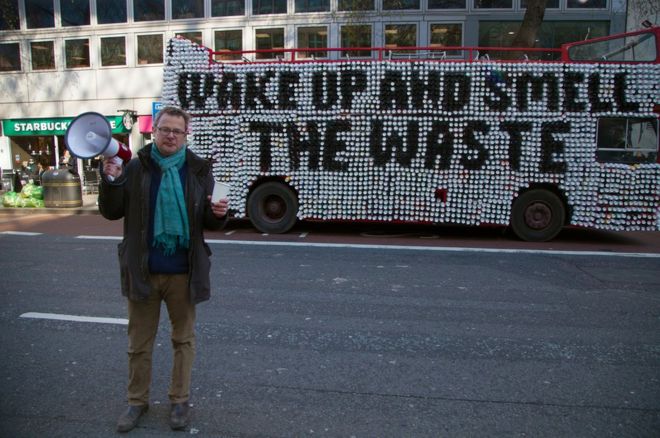
How big are the numbers?  In the UK alone about 2.5 billion paper cups are used each year.  That is merely one country.  Think about other countries and, I bet, you too will find that to be staggering number to imagine.

Source

Coffee, tea (or me ... hehehe) and other drinks, and then the doughnuts and burgers and fries and everything else we get "to go" means there will soon be a whole lot of stuff to be thrown away.  It is elementary, my dear Watson!

The "to go" culture has firmly established itself in the old country too.  To make things worse, the paper and plastic containers and cups are simply thrown away into stinking piles of garbage every few feet.

I am not certain that the solution is for appropriate disposal or recyclable cups and containers.  It is the "to go" attitude that needs a serious adjustment.

Seriously, are people so busy that they cannot brew their own coffee in the morning after they wake up?  Or are they that lazy?  In this part of the world, we have drive-through coffee places where cars snake up in the morning hours.  If they have the time to wait in line for coffee, surely they could have brewed coffee for those same minutes back in their respective homes, right?  I bet many of those customers sitting in their gas-guzzling vehicles are also bleeding-heart environmentalists ;)

A few months ago, when I was in San Francisco for a conference, I went to the nearby Starbucks for a cup of coffee and something to eat.  I ordered a scone and coffee, and told them that I was going to sit there and eat/drink.  She shrugged an ok and then handed me a paper cup of coffee. That's when I thought that the rare occasions I go out for coffee, I should patronize only those coffee shops that serve coffee in mugs that will be washed and re-used.

Hmmm ... all  these have made me drool for a cappuccino.  I will go make myself one, and have it in my coffee mug ;)

Tuesday, October 06, 2015

Reduce, yes. Re-use, yes. Recycle? Hmmm...

Even though the garbage trucks come to our neighborhood every week, I have opted for trash pickup only every other week.  Not because there is a huge cost savings--the rate differential between weekly and biweekly service wouldn't even pay for a latte at the coffee place that seems to serve a blackish liquid that looks like it came from charcoal!  I consume very little, and throw the recyclables into the blue bin.  There is very little of trash for me to worry about.

Over the years, I have been convinced that even the recycling that I do is more for my own feel-good benefits than for anything else.  I blog often, like here, that I am a hypocrite for worrying about the environment.  I have joked often with students, and even noted once in an op-ed, that my annual flights to visit with the people in the old country contributes immensely more to pollution than I could ever pay for through the recycling.  Yet, the world too is way more impressed with my recycling, instead of being concerned that I take too many trips that are fueled by carbon-based energy sources.

All these are why I did not take any offense with this op-ed in the NY Times, in which the author writes:
To offset the greenhouse impact of one passenger’s round-trip flight between New York and London, you’d have to recycle roughly 40,000 plastic bottles, assuming you fly coach. If you sit in business- or first-class, where each passenger takes up more space, it could be more like 100,000.
Even those statistics might be misleading.
For the ease of argument, let us suppose that a round-trip flight between Eugene and Chennai will be about 60,000 plastic bottles.  (Of course, I don't fly business class. Not anymore!)  So, if I recycle about 500 plastic bottles a year (that's a stretch!) I have not achieved anything by recycling, have I?

But then you are thinking, "hey, lots of Americans don't fly that much."  My travel pattern is an outlier, I could claim.  For a regular John Doe, wouldn't recycling help?  And given that the John Doe numbers are far greater than the Srirams, surely recycling helps, right?  Well, it does not:
Despite decades of exhortations and mandates, it’s still typically more expensive for municipalities to recycle household waste than to send it to a landfill. Prices for recyclable materials have plummeted because of lower oil prices and reduced demand for them overseas. The slump has forced some recycling companies to shut plants and cancel plans for new technologies.
Recycling is a huge money loser.  Last week, one of the local trash hauling services announced an increase in the rate for curbside recycling!  The NY Times op-ed suggests that this is not the local company's fault:
The future for recycling looks even worse. As cities move beyond recycling paper and metals, and into glass, food scraps and assorted plastics, the costs rise sharply while the environmental benefits decline and sometimes vanish. “If you believe recycling is good for the planet and that we need to do more of it, then there’s a crisis to confront,” says David P. Steiner, the chief executive officer of Waste Management, the largest recycler of household trash in the United States. “Trying to turn garbage into gold costs a lot more than expected. We need to ask ourselves: What is the goal here?”
In a country like India, recycling can be a profitable venture, which is why the rag-pickers even search through the public trash piles.  But, as societies get more affluent, the relative cost of recycling climbs up rapidly.  
As a business, recycling is on the wrong side of two long-term global economic trends. For centuries, the real cost of labor has been increasing while the real cost of raw materials has been declining. That’s why we can afford to buy so much more stuff than our ancestors could. As a labor-intensive activity, recycling is an increasingly expensive way to produce materials that are less and less valuable.
I am especially drawn to issues like this because we are forced to think through the complications and question our own preferred ideas on how to make this world a better place for tomorrow.  A constant examination, a Socratic questioning, in which there is no sacred cow, so to speak.

But then we have this urge to do something.  Climate change is for real.  We know we have to reduce our carbon footprint.  Can we do anything at all?  We need to travel a different route for that:
It would be much simpler and more effective to impose the equivalent of a carbon tax on garbage, as Thomas C. Kinnaman has proposed after conducting what is probably the most thorough comparison of the social costs of recycling, landfilling and incineration. Dr. Kinnaman, an economist at Bucknell University, considered everything from environmental damage to the pleasure that some people take in recycling (the “warm glow” that makes them willing to pay extra to do it).
He concludes that the social good would be optimized by subsidizing the recycling of some metals, and by imposing a $15 tax on each ton of trash that goes to the landfill. That tax would offset the environmental costs, chiefly the greenhouse impact, and allow each municipality to make a guilt-free choice based on local economics and its citizens’ wishes. The result, Dr. Kinnaman predicts, would be a lot less recycling than there is today.
As you know very well, this is a road that politicians do not, and will not, take.  Whether it is in the context of trash, or the fossil-fuels that we burn, the incorrect price for carbon is the real problem.  Carbon tax, anyone?

Oh, btw, the op-ed's author, John Tierney, was following up on his own lengthy report for the NY Times from twenty years ago.  The title of that report?  Recycling is garbage.

Friday, June 05, 2015

Drill, baby, drill. Who the frack cares!

One event and so many different headlines!


Who you gonna believe?

I wonder if it always was like this, or whether such contentious interpretations day in and day out are a modern phenomenon.  Even for a junkie like me, this is simply head-spinning.  Perhaps all the more why many simply decide to shut themselves off from this cacophony and instead rely on their favorite news sources.  You know, like the Faux News people!

What was the event that triggered all these headlines? In a weighty tome that can put anybody to sleep, the US EPA found "no signs of “widespread, systemic” drinking water pollution from hydraulic fracturing."

But, we are talking about energy and politics.  Not really science.  Which means:
it’s widely believed the Obama administration is deferential to natural gas fracking companies because the industry is more environmentally friendly than Big Coal but also robust enough to help drive much-needed economic growth. That attitude is shared by other members of the president’s part
Fight coal, but then a wink-wink towards natural gas.

Except, even the fighting coal is not really happening, notes the Pulitzer-winning writer at my favorite magazine:


So, where do all these  leave us?  Do the President and his people have any real energy policy at all? Kolbert writes, "the White House’s energy policies remain a muddle."  Great!  Can anything be done?
the Administration is undermining its own best efforts. But such a muddle is probably the best we can expect until and unless American voters demand something more coherent.
Ah! American voters demanding something coherent?  Good luck on that!

All these mean that after November 2016, we will most likely end up with a President and a Congress that will be a lot more fossil-fuel friendly than the friendly environment that currently exists.  Meanwhile, there is a climate conference coming up in December:


Good luck on that, rest of the world!

Thursday, January 15, 2015

It's tough to make predictions, especially about the future

Yes, that was one of the classics from the one and only Yogi Berra.  If only many important aspects of life can be so easily articulated (even if it fails a formal grammar test.)

For years, I have heard enough and more left-leaning people, especially within academia, beat up on oil companies and their profits.  (Meanwhile, I was beating up on the company that makes the computers that the left-leaning people love to use--for the sheer audacity with which it earns gazillions while portraying a saintly image!)  The evil oil corporations, the story went, did everything possible to increase their profits.  Even launched wars, with the government as their proxies.  The bad oil companies did their best to stifle innovation with the development of the electric car, they argued, because the electric cars will not need oil (gasoline.)

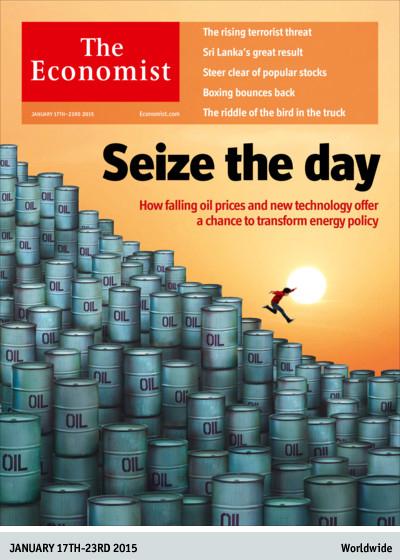
I wonder what they will complain about now, with oil prices tumbling to levels that nobody predicted.  "Peak oil" and the evil corporations together means soon we will be looking at $200 per barrel, they warned us.  The cold, hard, news of today is this:
Brace for $40-a-barrel oil.
So, whatever happened to that framework of the evil oil corporations that want to earn those huge profits?  Why are they now practically giving away gasoline at the pump?

Meanwhile, the company that I love to beat up on is as busy as ever storing its gazillions at tax havens, far away from the taxman and gets a free pass from the left-leaning folks who continue to target the oil companies.  Oh well, a strange world this is!

So, about that oil price.  How come from the experts to the conspiracy nutcases, everybody got it so wrong?  Well, re-read the Yogi Berra quote in the subject line!

Of, if you want an oil-specific quote:
When contemplating the future of oil prices, one should always keep in mind U.S. foreign service officer James Akins’ observation, “Oil experts, economists, and government officials who have attempted in recent years to predict the future demand and the prices of oil have had only marginally better success than those who foretell the advent of earthquakes or the second coming of the Messiah.” Akins wrote that in 1973.
Isn't that a lot more words than the simple Yogism? ;)

Ron Bailey, whose note in Reason is where that quote is from, includes another quote there from a Saudi billionaire who claims that oil will never go back up above $100 a barrel.  Say what?

In a commentary at Project Syndicate, is another interesting question:
should we expect $50 to be the floor or the ceiling of the new trading range for oil?
Say what?  This commentator expects oil prices to go well below $50?  Whatever happened to greedy oil companies and their profits?
economics and history suggest that today’s price should be viewed as a probable ceiling for a much lower trading range, which may stretch all the way down toward $20. 
Are you kidding me?
the marginal cost of US shale oil would become a ceiling for global oil prices, whereas the costs of relatively remote and marginal conventional oilfields in OPEC and Russia would set a floor. As it happens, estimates of shale-oil production costs are mostly around $50, while marginal conventional oilfields generally break even at around $20. Thus, the trading range in the brave new world of competitive oil should be roughly $20 to $50. 
Don't bet your farm on this, as they say.  Why?  I refer you to the Yogi Berra quote in the title.

A couple of years ago, I received a snarky email from a former student.  In the email, she referred to the stepped up production in the US thanks to fracking up the Bakken oil as evidence that I was bullshitting in the class.  (Ok, she didn't use the BS word.)  I wrote back to her that my worry has never been about exhausting the oil supplies or the price, but about the continued and expanded use of carbon as the source of energy and its impacts on global climate.  Even now, though it is awesome to fill up a tank at a remarkably low price, I do worry about the long-term consequences of a delay in energiewende.

Maybe I should not worry about tomorrow and, instead, seek consolation in the Yogism, "It's tough to make predictions, especially about the future."


Tuesday, September 16, 2014

Energiewende is the zeitgeist word. No schadenfreude, please

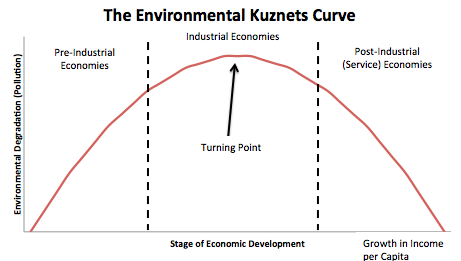
What if globally we are at, or at least close to, that worst point along the environmental Kuznets Curve, and things could only get better from now on?


Of course, I could be--and for all I know--completely wrong.  But then, keep this in mind: Nobody. Knows. Anything.

We try to make order of the chaos that the world is by connecting the dots.  It is, however, to some extent like how we connect the celestial dots--the stars--and give them "shapes."  But, we could connect the stars differently and come up with completely different shapes, right?  Of course, I am using the stars analogy only for illustrative purposes--here on earth, we can confirm with the passing of time whether or not the shape that I create is wrong and whether somebody else's is correct.

I suppose I am connecting a few dots out of my optimism.  A wish that we might be on to a path of screwing up the natural environment a tad less, and make it better.

It all begins with the world's factory--China--where "environmental anxiety is spreading."
This growing anxiety is reflected in the rising frequency of environmental protests. In the past year, people have taken to the streets in cities throughout the country to protest the building of coal-fired power plants, chemical plants, oil refineries, waste incinerators, and the like. According to Chen Jiping, a former leading member of the Communist Party’s political and legislative affairs committee, pollution is now the leading cause of social unrest in China.
Why this budding environmental consciousness now? The answer is simple: 2013 was, by any accounting, one horrific year for the environment. ...
China’s environment is a disaster. But by casting a bright light on the country’s severe pollution problems, the crises of the past year have stirred a greater environmental consciousness in the people. At the same time, they have spurred the country’s leaders to take more aggressive environmental action.
There is hope.

Meanwhile, the big European industrial power, Germany, continues to wage its seemingly lone war against climate change:
Germans will soon be getting 30 percent of their power from renewable energy sources. Many smaller countries are beating that, but Germany is by far the largest industrial power to reach that level in the modern era. It is more than twice the percentage in the United States.
Hence:
The word the Germans use for their plan is starting to make its way into conversations elsewhere: energiewende, the energy transition.
Germany's efforts involve China too:
Germany’s relentless push into renewable energy has implications far beyond its shores. By creating huge demand for wind turbines and especially for solar panels, it has helped lure big Chinese manufacturers into the market, and that combination is driving down costs faster than almost anyone thought possible just a few years ago.
But, it does not mean that all is well.  There is a catch:
Much concern is focused on Germany's reliance on brown coal, which harms the environment more than other types of coal, for a secure and affordable power supply. Last year lignite was the single biggest source of German power, generating 25.8 percent, and it has risen every year since 2010.
Greenpeace says no other country in the world extracts and converts as much brown coal into electricity as Germany.
"Germany is making itself a laughing stock because it hasn't set limits on brown coal," said Greenpeace's Karsten Smid, who wants the government to say when it will phase it out.
These lignite-based power plants (which is why Germans were technical advisers for the industry in the town where I grew up) are needed because, more than anything else, the renewables are intermittent.

I am confident a majority on this planet are in a situation where we can echo this:
“Indeed, the German people are paying significant money,” said Markus Steigenberger, an analyst at Agora, the think tank. “But in Germany, we can afford this — we are a rich country. It’s a gift to the world.”
Germany is not the only rich country, right?  We can all afford to begin to afford to experiment with Energiewende (pronounced in-ur-GEE-vend-uh) and make it a century of carbon in other ways than merely burning it up:


Friday, February 08, 2013

Holy carbon! US exports coal and Europe imports it!!!

A chart that I would never have imagined would be the case:
Wow!
In the United States, natural gas is now frequently less expensive than coal for power, so demand for the hard, black fuel has plummeted. Ships are steaming the coal around the world instead. U.S. coal exports to Europe were up 26 percent in the first nine months of 2012 over the same period in 2011. Exports to China have increased, too.
But, ... but, ... aren't Europeans supposed to be, ahem, greener than thou?  
Green-friendly Europe has a dirty secret: It is burning a lot more coal.  Europe’s use of the fossil fuel spiked last year after a long decline, powered by a surge of cheap U.S. coal on global markets and by the unintended consequences of ambitious climate policies that capped emissions and reduced reliance on nuclear energy.
So, Germany shuttered its nuclear program after the Fukushima incident, and now burns more coal instead.  The truth is always dizzying!

How much have things changed in Germany?  Like so, in a community not far from the Polish border:
Last year, the power plant consumed 88,000 tons of lignite a day and generated more electricity than it had since 1981, according to Vattenfall, the Swedish company that runs it. That record is even more impressive given that in 1981, Communist East German officials didn’t have to contend with labor laws or environmental regulations and could run the mines almost every day of the year.   
The expansion of lignite mining has stunned some people who live in its path. One community under threat is the tiny hamlet of Atter­wasch, a cluster of 250 people on the edge of a proposed expansion of the Jaenschwalde mine. They might have to leave their homes, as well as their church, whose chapel was built in 1294.   
“This church survived the Thirty Years’ War [in the 1600s], two world wars and socialism,” said Mathias Berndt, the senior pastor at the church, which is festooned with anti-coal-mining protest banners. “Now a free country is coming and saying, ‘Good for you, but now you have to move.’ ”
Germans are in love with coal now.  And that too one of the dirtier varieties--lignite.  It was their expertise with lignite that led the West Germany of those old times to provide technical assistance in the town in India where I grew up.

The burning of coal is understandable when poor countries do it--they simply cannot afford to use way more expensive resources, especially when they have to import it.  "Moving away from fossil fuels could be devastating for some of the world's poorest countries."  But, Germany? The Netherlands?

Why is Germany so much anti-nuclear energy, even to the extent of burning more coal?  For that matter, it is a shame that an anti-nuclear energy stance has come to be typical of the liberal left. Why so?  Ashutosh Jogalekar discusses the following five reasons in detail over at the Scientific American:
  1. Ignorance: This simple reason remains remarkably pervasive. I am not trying to sound preachy or elitist here but reading two or three books would greatly benefit people who have a gut reaction against nuclear energy.
  2. Bad psychological connections: There are two bad connections in the minds of many liberals, both of which are rather unjustified and contribute to their dislike of nuclear power. One is the connection between nuclear power and nuclear weapons.  ... Another flawed connection is between environmentalism and the boycott of nuclear power. Unfortunately die-hard environmentalists are mainly responsible for reinforcing this connection. Their decades-long opposition to nuclear energy started with some reasonable premises, but then mainly descended into irrational, uninformed and exaggerated polemic.
  3. Waste: ... Many people think that this is the single greatest threat from nuclear power, that we will all be inhabiting vast atomic wastelands if we allow nuclear power to flourish. ... It’s not a trivial issue, but many of the problems have to do with inefficiency and increased proliferation threats from burying valuable plutonium-containing nuclear waste.
  4. Damn them Republicans: There is actually a third connection- that between nuclear weapons and belligerent right wing political leaders that drives liberals’ disdain for all things nuclear. If the erroneous connection between power and weapons takes hold in your mind, then it is not too difficult to perceive a connection between nuclear energy and right wing excesses.
  5. Fear of the unknown: This is again related to the first point. Fear of the unknown has unfortunately driven negative liberal reactions to many other promising technologies, including vaccines and GMOs. 
An argument in favor of rationally approaching the global energy issue, and the energy needs of the developing countries in particular, is not new to this blog.  Especially when Europe is importing coal like there is no tomorrow!

BTW, the US is flush with coal because fracking has made natural gas available in plenty, and at low prices.  And Europe is grabbing that coal.  Why doesn't Europe also use natural gas then?
One big part of the problem, experts and officials say, is Europe’s cap-and-trade system, which aims to reduce European Union-wide industrial greenhouse gas emissions by 20 percent by 2020. The system is the centerpiece of Europe’s green policies. But the program, which charges industries for permits to emit greenhouse gases, no longer serves as a major disincentive to pollute. Industrial production fell dramatically during the economic crisis, so overall greenhouse gas emissions remain well underneath the cap, and they are still falling. The price per ton of carbon emissions is barely more than a tenth of its 2008 peak. Energy companies, who must plan decades in advance, have shied away from investing in gas-fired power plants because they are not profitable in comparison to coal.
Yep, carbon is way too cheap now!  Burn, baby, burn!

Friday, February 01, 2013

The coal chart that should scare us towards exploring renewable energy

I am not any environmental activist by any means.  I understand that life is about tradeoff and that the natural environment is one of the many factors that we have to consider.

But, I do worry that all is not well with the manner in which the global economy has been pursuing a growth strategy in which many, many, goods--from inexpensive plastic bottles to iPhones--are manufactured in China, at a huge cost.  The cost being environmental.  I suspect that such a global economic approach will depend on how China responds, and the response--or lack thereof--will have implications for internal political stability as well.

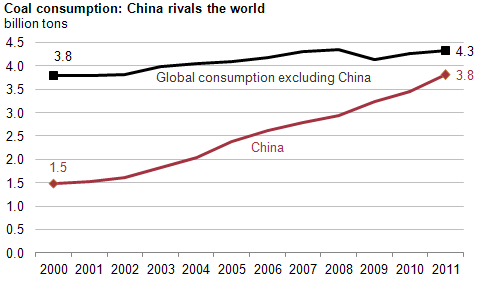
China's economic engine is fueled by coal, the consumption of which is simply astounding, as this chart, which was all over the news and the blogs yesterday, shows:
Source: EIA
As this note in the Scientific American adds:
In fact, according to EIA, the 325-million-ton increase in Chinese coal consumption in 2011 accounted for 87 percent of the entire world's growth for the year, which was estimated at 374 million tons. Since 2000, China has accounted for 82 percent of the world's coal demand growth, with a 2.3-billion-ton surge, the agency said.
A scary, scary, chart, indeed!

But, China consumes so much coal for a very good reason--it is one heck of a cheap source of energy.  Well, cheap because nobody has to explicitly pay for the downside to burning carbon, as is the case when we burn gasoline or natural gas too.

It is coal that has helped the rapid transformation in China--especially in the rural hinterland:
Xu Youwang has been a farmer all his life. The 56-year-old says he can remember a day when all he owned were sheep. He and his neighbours all live in mud-brick houses.
But now he has a washing machine, a TV - and big dreams. "If I had the money I'd buy a car, an apartment, a fridge and a computer," he said.
Farmer Xu expects his life to only get better. And that is the challenge for China's leaders - balancing the aspirations of people like him with more sustainable economic growth
For now, at least, the country's reliance on coal and the pollution that comes with it shows little sign of ending.
Of course, China has been actively exploring alternatives to coal--there are more nuclear power plants planned and under construction there than anywhere else on the planet:
Source: The Economist
Like any other rational person, I too worry about the downsides of nuclear power.  But, hey, that is what I mean as tradeoff!  An environmental activist who opposes coal and nuclear power then has to provide for alternatives, right?

China has been exploring hydropower too as an alternative-but, remember all the environmental controversies over the Three Gorges Dam?  Tradeoff is not easy.  Never easy.

China is pushing for more hydro projects, which will not only have environmental issues, but will also catalyze more geopolitical hand-wringing:
In a major concern for India and Bangladesh, China has approved construction of three new hydropower dams on the Brahmaputra river.

The move comes after a two-year halt amid concerns shown by India and environmental groups about reduced water flow downstream.

The three new dams have been approved by the Chinese State Council Cabinet under a new energy development plan for 2015.
Bloomberg reports that China is pushing for more solar power, too!
China plans to increase its goal for solar-power installations in 2015 by 67 percent to reduce reliance on fossil fuels blamed for greenhouse gases and as smog in Beijing reached record hazardous levels this month.
The world’s biggest emitter of carbon-dioxide plans to raise the solar target to 35 gigawatts by 2015 from 21 gigawatts set last year, boosting demand for manufactures that suffer from slowing sales in Europe, Shi Dinghuan, the counselor of China’s State Council and the president of Chinese Renewable Energy Society, said today by phone.
“We’ve got more pressure to save energy and reduce emissions as smog worsens due to pollution,” he said.
All these make very, very clear that we--the world--cannot have our cake and eat it too: if we, especially in the US and in the rich countries, want cheap stuff that fills up our closets and garages, then we have to accept the carbon usage in China.  If we, especially in the US, refuse to impose a carbon tax on ourselves and, thereby, set an example for the rest of the world, then we have no choice but to accept the carbon usage in China.

We can always fool ourselves by claiming that CO2 emissions in the US have fallen way down to the lowest level since 1994--we have simply exported away the pollution, exactly as Lawrence Summers wanted us to back when he was the Chief Economist at the World Bank :(

Wednesday, January 16, 2013

The world needs Bert from Mary Poppins to ease up global warming

A bloody cold and foggy day it was today.  One of those days when the sun didn't even bother showing up to work--the sun called in sick because of the fog. When I returned home yesterday, it was close to seven in the evening and it was about 39 degrees.  Today, I returned home a good two hours before that--it was a couple of minutes past five--and it was only 33!

Global warming is a hoax, it seems like!

Scientists have apparently found something new about global warming.  And, no, it is not because of the fog here.  Turns out that good ol' soot is more a factor than was previously thought.  First it was a brief blurb at Slate:
New research shows that soot, AKA black carbon, is one of the top two contributors to climate change, greater than methane and second only to carbon dioxide. 
Bloody soot!

So, I had to read up more to get some details.

Friday, March 25, 2011

The sea floor was "a graveyeard." Revisiting the BP spill

We are fast zooming in on the first anniversary of the catastrophic explosion and oil spill in the Gulf of Mexico,  The incident began on April 20th of last year, and the final sealing of the leak itself was completed on September 19th.  I haven't forgotten how transfixed and depressed I was while obsessively following that story.

Claudia Dreifus, whose reputation as the NY Times science writer has now been eclipsed by the fame and notoriety as a result of the book on higher education that she co-authored with Andrew Hacker, has a neat interview with Dr. Samatha Joyce, whose team of scientists were the first independent trained and qualified observers to investigate and report on the crisis.  In response to Dreifus' question comparing Japan's recent and ongoing nuclear crisis with the BPO spill, Joyce replies:
No one can prevent earthquakes. That’s up to Mother Nature.
However, building nuclear power plants on an island adjacent to an active tectonic zone is inherently dangerous. Likewise, deepwater drilling into gas-overcharged sediments is dangerous. For me, both of these disasters are a very loud plea for green energy.
Yes, indeed.  Every major energy incident over the last forty years ought to have sharpened our attention on how much we are tied down by fossil fuels and nuclear power, and yet here we are in 2011 with carbon and nukes even more dominant in our lives than ever before.  

I wonder why.  Is it because technology to tap into other energy sources has not developed at the rate at which we think it ought to have?  Were/are we naive to think that somehow green energy technology will arise out of whatever levels of science and technology we now have?  If we were to use a comparison, and suppose that an iPhone symbolizes the level of green energy technology.  How much ever something like an iPhone might have fascinated people fifty years ago, well, it would have been impossible at that time given the scientific understanding we had then and the technological capabilities, right?  So, along that line of thinking, how far are we from an "iPhone green energy" technology?

For sure, I would hate for us to continue to burn, smoke, spill, and radiate for another fifty years.

Thursday, March 24, 2011

Why carbon might rule over the 21st century, too

The versatility of carbon, explained in this video:


I wish we had such videos when I was in high school; I would have become even more of a nerd then :)

In my classes now, I routinely bug students about various aspects of carbon.  Often I tell them that perhaps my fascination with it is because I grew up in a town where the entire economy was built around carbon from under the ground--lignite mining.  The lignite then used for power generation.

Anyway, back to carbon in the 21st century.  There has been a lot of talk about carbon nanotubes and graphene.  But, so far it has been only that--a lot of talk.  A little while back, in the context of the Nobel Prize for the graphene scientists, Wired explained some of the potentially transformative applications.

But, I am not sure how many students find any of my stories interesting enough ... oh well, even if neither carbon nor I are a student's best friends, an allotrope of carbon is a best friend to at least one half of the population, right?

Tuesday, November 09, 2010

Dirty coal, clean future

That is the title of a calm and level-headed essay from James Fallows on how coal will dominate for quite a few more decades.  But then when have his essays not been calm and level-headed, right?  Fallows notes the horribly low energy efficiency of coal-fired processes even three centuries after James Watt's pioneering use of steam that is pretty much the symbol of the Industrial Revolution.  But, coal is here and we better deal with it because CO2 keeps piling up above.

Why focus on coal on our way to cleaning up the air?

“I know this is a theological issue for some people,” Julio Friedmann of Lawrence Livermore said. “Solar and wind power are going to be important, but it is really hard to get them beyond 10 percent of total power supply.” He pointed out the huge engineering achievement it has taken to raise the efficiency of solar photovoltaic cells from about 25 percent to about 30 percent; whereas “to make them useful, you would need improvements of two- or threefold in cost,” say from about 18 cents per kilowatt-hour to 6 cents. He recited a skeptic’s line used about the Carter administration’s clean-energy programs—“You’re not going to run a steel plant with solar panels”—and then made a point that summarized the outlook of those who have decided they can best wage the climate fight by working on dirty, destructive coal.
“It is very hard to go around the world and think you can make any difference in carbon-loading the atmosphere without some plan for how people can continue to use coal,” Friedmann said. “It is by far the most prevalent and efficient way to generate electricity. People are going to use it. There is no story of climate progress without a story for coal. In particular, U.S.-China progress on coal.”
living in Oregon means we are lucky to enjoy hydroelectric power (it has a different set of environmental impacts) and we can even forget coal fired plants.  It was a surprise to hear on the news the other day about plans to close down the only coal-fired power plant.  Which left me wondering where it was.  One student in my class knew about this--she grew up in a town that was practically across from this plant.  The things I learn from students everyday, and they have no idea about the free education I am getting from them.  One other student wondered where all those coal fired plants are in the US.  Google gave me the following graphic:
Notice that one dot practically on the Oregon/Washington border?  Apparently that could be closed down as early as 2020.

Monday, July 13, 2009

Expect China and India to drag feet on climate intiatives

Visualize this: The temperature outside is 105 degrees, with about 80 percent relative humidity. There is no electricity, which means no air conditioning.

That was my experience on the third day after arriving in Chennai, India’s fourth largest city with a population of more than 7 million.

I suppose I have been spoiled by the temperate conditions in the paradise that is the Willamette Valley, and am no longer able to bear the weather conditions in which I spent the first 22 years of my life. The power supply was restored after a few hours. After a couple of more days in Chennai, I headed to the cooler temperatures of Mysore to, at least temporarily, escape the heat and humidity.

As I was walking around a little after the sun went down in Mysore, everything turned dark because of load shedding in the electric power grid. With the entire area in darkness, the well-lighted Royal Palace stood out as a fantastic spectacle, while being simultaneously a symbol of India’s paradoxical problem of shortages and consumption.

When I wrote in this paper a few months ago about energy and water problems in India, I had no idea I would experience the shortage within a short time. In addition to the power shortage, there are widespread worries about a water shortage because the monsoon has been delayed, and rainfall is expected to be below normal.

A below-normal monsoon might well be the proverbial last straw to this country of a billion, which has managed to weather the Great Recession without too many problems. Agriculture, which is mostly rain-fed, will have significantly lower productivity as a result.

Electrical generation will drop as well with a decrease in hydropower. As will China, India too will ramp up its consumption of coal to produce electricity in order to try to keep pace with the dizzying growth in demand.

That means a larger volume of carbon dioxide emissions from the power plants. And there will be a lot more of carbon dioxide — from automobiles.

One report suggests that automobile sales in India can be expected to double in the next 15 years. Tata Motors, the manufacturer of the much talked about Nano — the $2,000 car — has enough orders to keep it going for years. It is the same Tata that is also the owner of the upscale Jaguar and Land Rover, which it has introduced into the Indian markets.

Meanwhile, Nepali and Indian scientists have been collecting and analyzing data on glaciers and glacial lakes in the Himalayas. Preliminary reports indicate that the lakes have become larger. That is no cause for celebration, because the lakes’ increased size comes from glaciers that are melting.

All these experiences from this trip thus far are valuable indicators of the intense arguments that are forthcoming when the world gathers later this year in Copenhagen for the United Nations Climate Change Conference.

It is clear that the energy needs of India are immense, and they will continue to grow at dizzying rates that will match China’s. We can expect both these countries to continue to state at the conference that advanced countries are higher polluters on a per-capita basis and that they should therefore share a larger burden than the much poorer nations of India and China, which are low per-capita polluters.

I am confident that Bob Doppelt, who has been writing in these pages about climate change issues, will agree with me that India and China will press hard the case that slowing their economic growth rates will not be viewed as feasible, politically or morally.

In a casual dinner table conversation about Chennai’s pollution levels, my parents asked me whether America, too, polluted a lot. It was a tough question in many ways. For one, I was representing America at the table. And as an academic, I am expected to be “neutral” and stick to the facts.

I gave them examples, from places where I have lived, of how America also polluted its way to economic prosperity — from how even the Willamette River was a convenient dumping ground to how Los Angeles used to be even dirtier than it is now.

I added that the old U.S. model is not sustainable. America has got to change its habits, and other countries need to avoid the unsustainable aspects of the American model.

Well, if my dinner table conversation is an indicator, then maybe the Copenhagen meeting will be successful only if it is attended by a lot more mothers.