Showing posts with label poem. Show all posts

Friday, June 25, 2021

This little light of mine | I'm gonna let it shine


What a lovely and powerful illustration of the deep, deep, depths under the seas, about which we know very little!

That image accompanied this essay by Elizabeth Kolbert, who writes: "We’ve barely explored the darkest realm of the ocean. With rare-metal mining on the rise, we’re already destroying it."

One of those awesome mysteries lies way down where the sun don't shine, as they say:

Only the top layers of the oceans are illuminated. The “sunlight zone” extends down about seven hundred feet, the “twilight zone” down another twenty-six hundred feet. Below that—in the “midnight zone,” the “abyssal zone,” and the “hadal zone”—there’s only blackness, and the light created by life itself.

Hadal zone.  I had never heard about this, until I read the essay.

In this zone, the only light is the light created by life.  Yes, created by life.

Bioluminescent creatures produce light via chemical reaction. They synthesize luciferins, compounds that, in the presence of certain enzymes, known as luciferases, oxidize and give off photons. ... In the case of bioluminescence, different groups of organisms produce very different luciferins, meaning that each has invented its own way to shine.

We have barely understood anything that deep down, but we know enough that there are precious and rare metals.  So, who cares for life in its variety and complexity, eh!  “Even if we found unicorns living on the seafloor, I don’t think that would necessarily stop mining.”

Such is our human behavior!

A later issue of The New Yorker includes a poem titled Bioluminescence.  Why the editors failed to pair it in the same issue that had Kolbert's essay is beyond me.  At least in my post, I can present them together.

Here is the poem Bioluminescence, by Paul Tran:

There’s a dark so deep beneath the sea the creatures beget their own
light. This feat, this fact of adaptation, I could say, is beautiful

though the creatures are hideous. Lanternfish. Hatchetfish. Viperfish.
I, not unlike them, forfeited beauty to glimpse the world hidden

by eternal darkness. I subsisted on falling matter, unaware
from where or why matter fell, and on weaker creatures beguiled

by my luminosity. My hideous face opening, suddenly, to take them
into a darkness darker and more eternal than this underworld

underwater. I swam and swam toward nowhere and nothing.
I, after so much isolation, so much indifference, kept going

even if going meant only waiting, hovering in place. So far below, so far
away from the rest of life, the terrestrial made possible by and thereby

dependent upon light, I did what I had to do. I stalked. I killed.
I wanted to feel in my body my body at work, working to stay

alive. I swam. I kept going. I waited. I found myself without meaning
to, without contriving meaning at the time, in time, in the company

of creatures who, hideous like me, had to be their own illumination.
Their own god. Their own genesis. Often we feuded. Often we fused

like anglerfish. Blood to blood. Desire to desire. We were wild. Bewildered.
Beautiful in our wilderness and wildness. In the most extreme conditions

we proved that life can exist. I exist. I am my life, I thought, approaching
at last the bottom of the sea. It wasn’t the bottom. It wasn’t the sea.

Friday, April 30, 2021

Legacies

Today marks the end of the National Poetry Month.  Of course, we will continue to write and read poetry later too! ;)

Today's poem brings together a couple of different aspects that interest me.  African-American poetry (remember?) and my interest in old stories as in the legacies that I have inherited and are a part of me.

Here is Legacies by Nikki Giovanni:

her grandmother called her from the playground   
       “yes, ma’am”
       “i want chu to learn how to make rolls” said the old   
woman proudly
but the little girl didn’t want
to learn how because she knew
even if she couldn’t say it that
that would mean when the old one died she would be less   
dependent on her spirit so
she said
       “i don’t want to know how to make no rolls”
with her lips poked out
and the old woman wiped her hands on
her apron saying “lord
       these children”
and neither of them ever
said what they meant
and i guess nobody ever does

Monday, April 05, 2021

To strive, to seek, to find, and not to yield

April is poetry month.  Something that even this prosaic blogger remembers and likes to blog about every April.

Poetry speaks to the emotional beings that we are.  I did not realize the emotional appeal of poems until I was well into adulthood, as a working stiff in the US.  I went to a poetry reading.  The poet was a local boy who had made it big on the other coast.  As the middle-aged poet read lines from his poem, it hit me: This is what poetry is about!  Those lines spoke to me, which is what we expect from good poetry.

Since then, I have come to realize that when the right person reads a great poem, oh boy, it is as if the mysteries of the universe are being solved.  One word at a time, and one verse at a time.

We collectively experienced that when we listened to Amanda Gorman reading her poem at President Biden's inauguration.  When her reading ended, we wanted more.  Remember?

As Margaret Renkl writes in the NY Times:

Thank God for our poets, here in the mildness of April and in the winter storms alike, who help us find the words our own tongues feel too swollen to speak. Thank God for the poets who teach our blinkered eyes to see these gifts the world has given us, and what we owe it in return.

Thank god, indeed!

The title of this post is from the final stanza of Lord Tennyson's Ulysses.   Ulysses reaches Calypso’s island, exhausted after a shipwreck.  The goddess Calypso offers herself to Ulysses and also promises him immortality.  Think about this: The most beautiful woman ever and immortality.

Ulysses turns down the offer.

He then heads to the high seas.  An unknown expanse of adventure.

Ulysses wanted to live a life that he would not regret.

Tennyson writes:
Old age hath yet his honour and his toil;
Death closes all: but something ere the end,
Some work of noble note, may yet be done,
Not unbecoming men that strove with Gods.
The lights begin to twinkle from the rocks:
The long day wanes: the slow moon climbs: the deep
Moans round with many voices. Come, my friends,
'T is not too late to seek a newer world.
Push off, and sitting well in order smite
The sounding furrows; for my purpose holds
To sail beyond the sunset, and the baths
Of all the western stars, until I die.
It may be that the gulfs will wash us down:
It may be we shall touch the Happy Isles,
And see the great Achilles, whom we knew.
Tho' much is taken, much abides; and tho'
We are not now that strength which in old days
Moved earth and heaven, that which we are, we are;
One equal temper of heroic hearts,
Made weak by time and fate, but strong in will
To strive, to seek, to find, and not to yield.
I wish us all well with the chances that we take, and may we never have to regret the chances we didn't, and don't, take!

Monday, February 08, 2021

The dreams of young men

I am continuing with opening a random page in the book, and reading a poem on that page or on a page near that.

What prevents me from going sequentially from page 1 on is a question for which I have no answer.  If a text does not require me to read pages in sequence, then almost always I jump around.  When this approach has worked well for me all these years, why would I want to change things now, eh!

When reading the poems by African-Americans, I feel an emotional difference--these issues do not hit me as hard as they used to over the past four years.  "I can't breathe" seemed to be the motif during the dark era between November 8, 2016 and January 6, 2021, even though that phrase itself became a rallying cry only in spring and summer of 2021.

I hope that the urgency of the horror of anti-blackness will not ease up just because we are no longer governed by a sociopath and his toadies.  After all, as Charles Blow notes: "Racism is everywhere — it's just about what kind of racism you can live with."

Blow pays special attention to the role of elders in the community as he discusses how the original Great Migration caused a "loss of generational connectedness as an entire young generation left and the South became more of aged society," adversely affecting both young people and the elders. Here, Blow crafts an homage to the of elders in the Black community — from the great-uncle who babysat him to the importance of the example of elders like the 100 year-old Tim Black of Chicago who mentored a young Barack Obama newly arrived to Chicago.

We need to make big gains and fast before yet another generation grows old and see their bubbles burst in air.

Old Black Men
By Georgia Douglas Johnson

They have dreamed as young men dream
Of glory, love and power;
They have hoped as youth will hope
Of life’s sun-minted hour.

They have seen as other saw
Their bubbles burst in air,
And they have learned to live it down
As though they did not care.

Monday, January 18, 2021

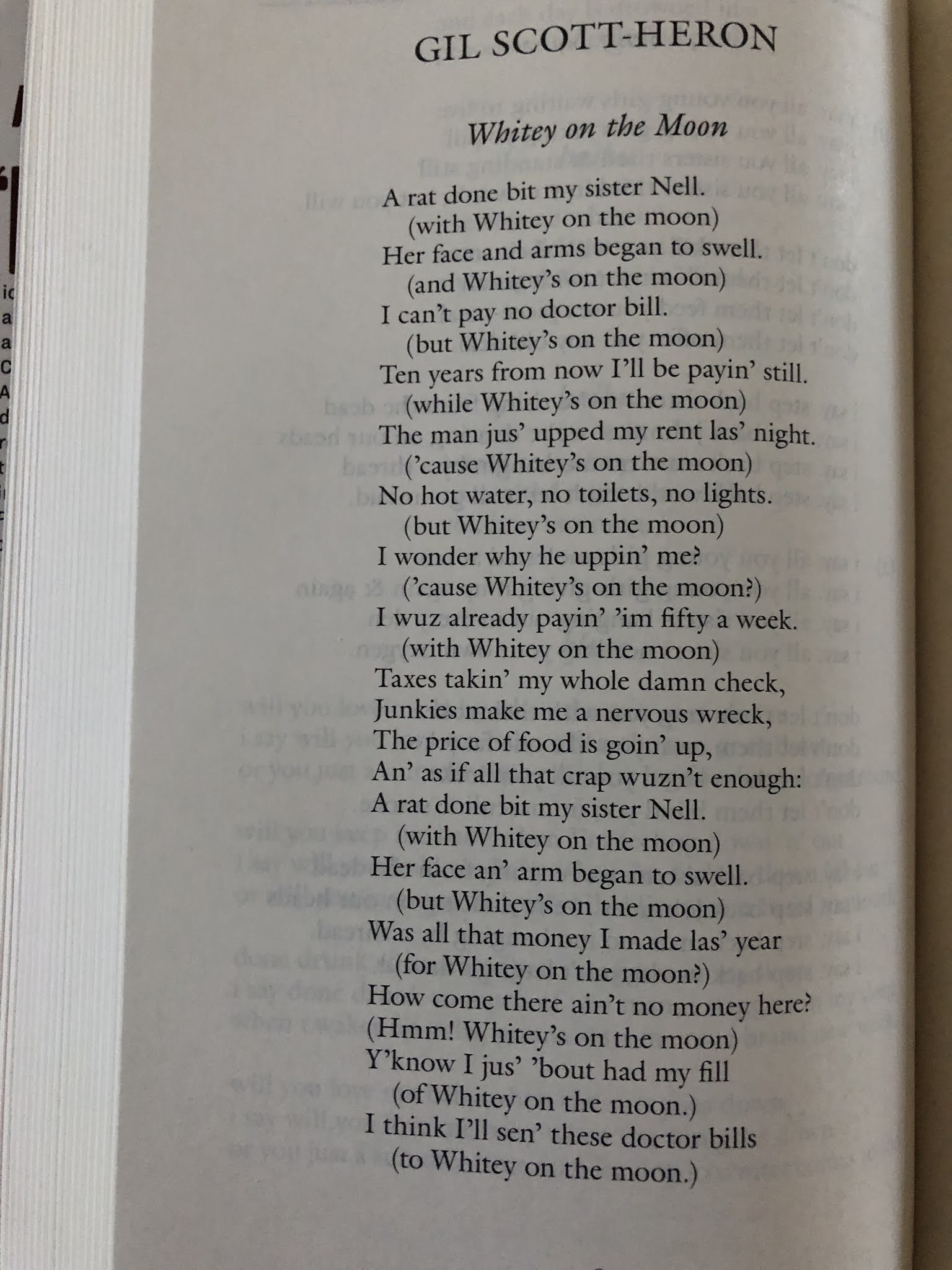
Whitey on the Moon

I read a book review.
An anthology of poems.
By African-Americans
Edited by The New Yorker's poetry editor.

I placed the order.
A pre-publication order.
A delayed gratification
For one who aces a marshmallow test!

The doorbell rang.
I saw the brown uniform walking away.
"Thank you" I yelled out
Even though he didn't hear me.


I opened the book
Somewhere to near the middle.
I was blown away
By the poem on the page.


Such issues have always bothered me
Which is why I quit engineering too
Are science and tech so important
To neglect the real needs of the poor?

I have blogged in plenty
About these awful injustices.
Including this about the protest
In advance of the Apollo 11 launch.

"Around 150 Americans,
Mostly black mothers and their children,
Walking with two mule-drawn wagons
through light mist and rolling thunder.

The contrast was dramatic:
mules and rockets, rambling wagons
and a vast sky to be conquered."
The poor Blacks who marched on Cape Kennedy!

We shall overcome
We shall overcome
We shall overcome ...
... some day


Monday, December 07, 2020

Wait

These are stressful times in many ways.  Not that life in 2019 was hunky-dory, before pandemic became a household word in 2020.  Living has never been without stress, but COVID-19 has taken us all to a whole new level of stress.

Prior to the global pandemic, America had already been dealing with a host of pervasive stressors such as health care access, mass shootings, climate change, rising suicide rates, and an opioid epidemic. Fast forward to the present day, as our country continues to struggle with our new reality amidst the global pandemic, select groups of our country are facing greater stress and poorer outcomes.

A few months ago, in my Twitter feed, I read a comedian's comment that the coronavirus has made us forget mass shootings because we are not gathering in groups anywhere now--not in schools, churches, movie halls, and open-air concerts, which have all been the favored venues for the armed sociopaths.

Re-working another comedian's joke, I wonder how many of us ever thought in 2019 that it was one heck of a good year and that the year that followed--2020--would suck.

We feel acedia.  We feel lots of things.  We are dealing with stress.  

[Many] Americans are taking their anxiety, frustration, anger and stress out on their jaws and teeth. “There’s effectively an epidemic of jaw muscle pain in the country right now because of COVID,” said Dr. Mark Drangsholt, chair of the Department of Oral Medicine at the University of Washington’s School of Dentistry.

I suppose the jaw, not the entire face, is the index of the mind!

Here's one easy way to unclench your jaw, and to put your worries and stress aside.

Listen to Wait, read aloud by Amanda Holmes.

Maria Popova writes that Galway Kinnell's poem addresses the "elemental question of existence with extraordinary compassion and spiritual grace in a poem he wrote for a student of his who was contemplating suicide after the abrupt end of a romance."

The poem works for any kind of disappointment, frustration, stress, anxiety, anger, ...

Sunday, November 22, 2020

When poems carry our burdens

I went looking for interesting reads at The American Scholar.  A long time ago, I got attached to reading it even though it was not the normal channel that made me aware of that publication.  The "normal" is if one gets elected to the Phi Beta Kappa society.  But, as a junkie for all things higher ed, I quickly came to know about PBK and the publication.

The magazine often has absolutely riveting essays.  My all time favorite there is one by a black professor writing about discussing the n-word with a class of white students.  There was another time when I read an essay by a professor recalling the experiences when he and Scooter Libby were school mates--this was when Libby, who was Darth Vader's dick Cheney's aide, was convicted on multiple counts for leaking the identity of a female CIA officer.  I wrote to the author, who replied!

These days, I hit the paywall and end up reading only whatever freebies they offer.  One of the freebies is their poetry section.  

As they note there, poems are to read aloud.  And, they do it wonderfully.  Many poems I have blogged about after listening to the reading there.

This time, the magazine featured a poem by Gulzar.  And there was a photo of Gulzar.  It was nothing like the only Gulzar that I know about.  This was Anand Mohan Zutshi Gulzar Dehlavi.  

Who?

I suppose most of the world is no different from me.  I live my life as is there is nothing more to know.  I then get smacked everyday about how I don't know a damn thing.  No wonder the university president wants to give me the pink-slip!

This Gulzar was a big time poet.  And more.  

I now know.

Gulzar's poem, Messiah, in translation from the Urdu, is short and conveys a lot.  Listen:

Thursday, September 24, 2020

I read a lovely poem. You too should.

In the previous post, I urged you to listen to a poem.

I have always believed that poetry is to be listened to, and not merely read within.  The written word is new in human history, but speaking and listening is how we made sense of this world and our place in it. 

If only there is an audio version of this poem by Maya Angelou.

No, it is not about a caged bird.

The title of the poem is When Great Trees Fall.

Of course, it is not about the trees themselves.

All I can do is imagine in my head Maya Angelou read this poem and me listening to it.

When Great Trees Fall

By Maya Angelou

When great trees fall,
rocks on distant hills shudder,
lions hunker down
in tall grasses,
and even elephants
lumber after safety.

When great trees fall
in forests,
small things recoil into silence,
their senses
eroded beyond fear.

When great souls die,
the air around us becomes
light, rare, sterile.
We breathe, briefly.
Our eyes, briefly,
see with
a hurtful clarity.
Our memory, suddenly sharpened,
examines,
gnaws on kind words
unsaid,
promised walks
never taken.

Great souls die and
our reality, bound to
them, takes leave of us.
Our souls,
dependent upon their
nurture,
now shrink, wizened.
Our minds, formed
and informed by their
radiance,
fall away.
We are not so much maddened
as reduced to the unutterable ignorance
of dark, cold
caves.

And when great souls die,
after a period peace blooms,
slowly and always
irregularly. Spaces fill
with a kind of
soothing electric vibration.
Our senses, restored, never
to be the same, whisper to us.
They existed. They existed.
We can be. Be and be
better. For they existed. 

Friday, August 07, 2020

To set forth toward class

It does not look like the following essay will be published anywhere other than here in my blog :(
**********************************

With the novel coronavirus firmly establishing itself in the country, and with my university’s budget managers contemplating laying off a few faculty, I have been waking up these past summer mornings wondering if I will ever “set forth toward class,” to use the memorable phrase from William Stafford’s charming poem Old Prof.

Early last March was the last time I “set forth toward class.”  During that final face-to-face meeting in the winter quarter, students had questions in plenty, from arrangements for the final exams, to whether they will be able to come back to the dorms.  I suggested to them that they should take all their valuables when they go back to their homes and assume that they would not be back on campus for a very long time.

Their facial expressions and body language broke my heart.  “Keep calm and carry on” was one of the many clichéd words of wisdom that I shared with them.

The spring quarter that followed was completely virtual.  Logging into the learning management  system from my “home office” was all I had to do in order to set forth toward class.

Virtual classes are not new to me—I have been teaching courses online for two decades, starting at  California State University, Bakersfield, when having a DSL line at home was a luxury and when most had only dial-up modems.  However, twenty years of online teaching did not prepare me for a  completely virtual term with students I had never met in the real world, including a section of  true freshman.  It was unsettling.

Like William Stafford’s “old prof,” will I ever “set forth toward class” again after drinking freshly brewed coffee in my office?

It has been five months since I last saw my office, which, I imagine, would be gathering cobwebs but for the custodial staff keeping calm and carrying on.  In my office and in the classroom, will I be able to once again have meaningful interactions with students, especially the likes of Samantha and Nellie?  (Real names withheld.)

At the end of spring, which also marked the end of a lengthy and circuitous road to her degree, Nellie, a mother of three, wrote in a touching email, “The next time I am on campus (and it is open again) I would enjoy stopping by to say hello, if that's okay.”  Will there be a next time when we will be on campus?

Samantha did not want to wait.  She emailed requesting my home address to which she wanted to send a gift and a thank-you note.  A couple of days later, the parcel arrived.  The thank-you note  was a two-page letter!  “You have set me on new paths, and a little bit of you will be pushing me along in every step of the journey ahead,” Samantha wrote at the end of her letter.

I have prominently displayed Samantha’s gift and letter in the dining room, where we used to  entertain friends before the coronavirus arrived.


There is one other, and more important, reason for me to worry whether I will ever “set forth  toward class.”  Like many regional public universities in the United States, my university too is  dealing with a financial crisis.  “Our goal is to retain as many employees as possible,” noted the president in mid-spring, in a three-page, single-spaced memo to the campus about the process of rightsizing the university. Two months later, another three-page memo arrived in early summer, in which the president described how the program curtailment and retrenchment process will be carried out.  The fact that faculty who will be pink-slipped will get a 12 months’ notice was not comforting.

Will I be informed that I will not be needed after a year?  How will I feel if I stayed on, but favorite colleagues are laid off?

The weather outside does not care for the coronavirus nor for dollars and cents.  The glorious  summer in the Willamette Valley here in Oregon is back after the months of overcast and misty  conditions that characterize this part of the Pacific Northwest.  But, instead of the usual celebration that summer is here, there is a constant nagging worry in the background that I might never “set forth toward class” again.

William Stafford has prepared me for such situations too.  In The Way It Is, Stafford wrote:
There’s a thread you follow. It goes among
things that change. But it doesn’t change.
People wonder about what you are pursuing.
You have to explain about the thread.
But it is hard for others to see.
While you hold it you can’t get lost.
Tragedies happen; people get hurt
or die; and you suffer and get old.
Nothing you do can stop time’s unfolding.
You don’t ever let go of the thread.
I will hold on to the thread. Ever so tightly.

Wednesday, July 15, 2020

The thread of life

Unlike in most other countries, American universities are big time landlords, who earn a lot of income from their developed real estate.

Country clubs Dorms, conference rooms, auditoriums, climbing walls, etc.  Some also own huge basketball and football venues for educational purposes entertainment.

All those expensive real estate developments have been idle since last March.  And there is very little chance that significant usage of those facilities will begin even in early 2021.

The landlords universities are in distress, and the Republican Uncle Sam couldn't care less.

My own university also has to reckon with the tightening dollars and cents.  As a result, some of us faculty, too, are bound to lose our jobs before the next academic year ends.

Should that day arrive way earlier than I had planned, I will be thankful that I was/am one of the lucky few on this planet who was able to pursue for quite a length of time what truly interested me.  Thanks to some dumb luck!

In my agitated and angst-filled younger years, I was convinced that somewhere out there were the answers to the big questions.  Somewhere.

Even in the first couple of years of graduate school, I was confident that I was on the way to the answers.

I did find the answer.  It was a non-answer of sorts.  Life is full of wonderful ambiguity.  That's it.  We have to live through it all.

Every once in a while I succumb to the temptation of the answer, but almost always I just want to breathe and drink and eat this ambiguity.  I love those damn wicked problems!

No wonder then that even with the courses I teach, I seem to always force students to think about the possible multiple interpretations. I even tell them sometimes not to expect a definitive answer from me.  I suppose my pedagogical goal, if I were to think about it that way, is that if I can help students understand that life itself is all about dealing with ambiguity, then they will know how to deal with specific instances whatever they might be.

A concern and worry that I have is that despite the high levels of literacy that humanity has achieved, there appears to be a decreasing interest in exploring and understanding and discussing the ambiguity that life is.  Perhaps that is also a reason why 63 million responded with a favorable vote when a demagogue yelled and screamed that he alone had all the answers,

The following poem by Oregon's own William Stafford is how I want to end this note on the delightful pursuit of ambiguity:
The Way It Is
There’s a thread you follow. It goes among
things that change. But it doesn’t change.
People wonder about what you are pursuing.
You have to explain about the thread.
But it is hard for others to see.
While you hold it you can’t get lost.
Tragedies happen; people get hurt
or die; and you suffer and get old.
Nothing you do can stop time’s unfolding.
You don’t ever let go of the thread.

Tuesday, July 07, 2020

Postcard from Kashmir

"Can you explain to me what's going on in Kashmir between India and China?"

I told him what I know.

I could have told him more.

Like the stories from more than three decades ago, of a Kashmiri Muslim sister and brother who, by coming to graduate school, were fleeing their native land.

Compared to the present, those were Kashmir's good days!

I am confident that those siblings have read Agha Shahid Ali's "Postcard from Kashmir." I can easily imagine that they relate to every word in it.

Postcard from Kashmir
By Agha Shahid Ali

Kashmir shrinks into my mailbox,
my home a neat four by six inches.

I always loved neatness. Now I hold
the half-inch Himalayas in my hand.

This is home. And this the closest
I'll ever be to home. When I return,
the colors won't be so brilliant,
the Jhelum's waters so clean,
so ultramarine. My love
so overexposed.

And my memory will be a little
out of focus, it in
a giant negative, black
and white, still undeveloped.

Wednesday, November 20, 2019

Blame the goat?

I came across a poem. 

But, the essay in which I came across that poem is not really about the poem. Nor about the poet.

You need to read the essay. I highly recommend it.  Especially if you are an academic who has an inflated opinion of your writings ;)

Here's the poem by Shel Silverstein:

Blame
I wrote such a beautiful book for you
About rainbows and sunshine and dreams that come true
But the goat went and ate it—you knew that he would—
So I wrote you another one as fast as I could
But of course it could never be nearly as great
As that beautiful book that the silly goat ate
So if you don’t like this new book I just wrote
Blame the Goat.

Friday, November 15, 2019

Of splendour in the grass, of glory in the flower

Watching the movie, in which the angst- and love-ridden and sexually-repressed teenage girl reads a verse from Wordsworth's poem, Ode on Intimations of Immortality from Recollections of Early Childhood, was yet another reminder that a couple of lines of a poem can say a lot more to and about the emotions than can two pages of prose.

There have been many movie scenes where just a couple of lines do the trick.  Even in charming ones like that awesome situation in The Roman Holiday, remember?  Or like Frasier reciting Tennyson's poem as the series comes to an end?  Or this Longfellow poem at the card table scene?

Here's a Wordsworth poem that says a lot about life, childhood, and the jaded people that we become when we grow older.


Wednesday, November 13, 2019

"I lose sight of my true being"

Every once in a while I look for poems at my usual sources.  There is something in a few lines of poetry that cannot be captured in prose. 

Those few lines appeal to my emotions.
They calm me.
Reassure me. 
Even as they make me mellow.

Today, I chanced upon one of those.  From my old country.  Well, the poem is from the old country.  But, packaged up wonderfully at The American Scholar.

I listened to it.
Twice.
And I tweeted that:
The poet-philosopher knew what he was doing by titling the poem "Dungeon."  I, a much lesser mortal I am, would prefer "I lose sight of my true being."  Those are the words that speak to me.  "I lose sight of my true being."

Often in our lives, we lose sight of our true being.  When we realize what we have become, we wonder and worry.  By then, it is almost too late.  Way too late.  If only we weren't busily building walls all around and taking pride in them!

Here's Rabindranath Tagore's Dungeon.
(You ought to listen to it being read here.  You really, really should.)

Dungeon

He whom I enclose with my name is weeping in this dungeon.
I am ever busy building this wall all around; and as this wall goes up into
the sky day by day I lose sight of my true being in its dark shadow.

I take pride in this great wall, and I plaster it with dust and sand
lest a least hole should be left in this name;
and for all the care I take I lose sight of my true being.

Thursday, September 05, 2019

Did I ask to be born?

Prose I can easily understand, even if I don't always get all the subtexts.  But, poetry is different. Right from the old school days, I have been puzzled that the poem's words say one thing and then the interpretation is always something very different.  Which has then led to wonder why poets don't say what they mean in a straightforward way.  No wonder then that women, with their complicated conversations of hidden meanings, love poems and poets ;)

The poem here, from The New Yorker, seems straightforward enough.  I think I get it.  But, I bet that I don't have a clue what the poem is all about; thankfully, unlike the old days, there is no quarterly exam ;)

We don't ask to be born.  As a comedian (from Brazil was he?) put it, we were once nothing but a sperm, with a dick and an asshole as neighbors!

Our creators--father and mother--perhaps got together for her looks and his money, or for his looks and her money, or for whatever reason.  Maybe they wanted a boy and they kept trying.  An aunt of mine is supposed to have exclaimed "girl again?" after the third child also turning out to be a girl!  the cosmos being a comedian, well, that girl also ended up having a daughter ;)

We don't ask to be born a boy or a girl.  There are people struggling with their inner boy trapped in a girl's body, or vice versa.  They didn't ask that either.

Once we are born, we struggle to make sense of it all. We rush from pillar to post, move from place to place, read and listen to the great minds, in search of the meaning of life.

The poet says, "I want to say that love is the meaning, but I think that love may be the means, what we ask with."

All you need is love!

I Cannot Say I Did Not


I cannot say I did not ask
to be born. I asked with my mother’s beauty,
and her money. I asked with my father’s desire
for his orgasms and for my mother’s money.
I asked with the cradle my sister had grown out of.
I asked with my mother’s longing for a son,
I asked with patriarchy. I asked
with the milk that would well in her breasts, needing to be
drained by a little, living pump.
I asked with my sister’s hand-me-downs, lying
folded. I asked with geometry, with
origami, with swimming, with sewing, with
what my mind would thirst to learn.
Before I existed, I asked, with the love of my
children, to exist, and with the love of their children.
Did I ask with my tiny flat lungs
for a long portion of breaths? Did I ask
with the space in the ground, like a portion of breath,
where my body will rest, when it is motionless,
when its elements move back into the earth?
I asked, with everything I did not
have, to be born. And nowhere in any
of it was there meaning, there was only the asking
for being, and then the being, the turn
taken. I want to say that love
is the meaning, but I think that love may be
the means, what we ask with.

Sunday, July 28, 2019

Something there is that doesn’t love a wall

tRump and his toadies are obsessed with the wall.  That is not news to you or me.  What surprised me was the intensity with with some of his toadies in my neighborhood brought that "wall" to the very fences that mark our community.

Wrote one in an email to the 'hood:
"Have you looked at some of the fences ... lately? What is the point ... when ANYONE ... can WALK into a backyard area, through a broken fence. It’s embarrassing; it’s ugly; and it does not show respect for the other neighbors living here."
A wall or a fence is a statement about ourselves as much as it is about the others.  This is what Robert Frost wanted us to think about in the layers of human complexity that he presents in Mending Wall.  He writes there:
Before I build a wall I’d ask to know / What I was walling in or walling out, / And to whom I was like to give offense.
Neither tRump nor his toadies care to think about "what I was walling in or walling out / and to whom I was like to give offense."

I would like to email Frost's poem to my neighbors.  And for all of us to bring to a neighborhood meeting our understanding of the lessons that we learnt from the poem.

But then I need to remind myself that I am a brown-skinned immigrant with a funny accent, and who looks like an Arab.  For all I know, the toadies might rally outside my home and chant "send him back!"

So, instead, I will end this post with Robert Frost's Mending Wall.

Something there is that doesn't love a wall,
That sends the frozen-ground-swell under it,
And spills the upper boulders in the sun;
And makes gaps even two can pass abreast.
The work of hunters is another thing:
I have come after them and made repair
Where they have left not one stone on a stone,
But they would have the rabbit out of hiding,
To please the yelping dogs. The gaps I mean,
No one has seen them made or heard them made,
But at spring mending-time we find them there.
I let my neighbor know beyond the hill;
And on a day we meet to walk the line
And set the wall between us once again.
We keep the wall between us as we go.
To each the boulders that have fallen to each.
And some are loaves and some so nearly balls
We have to use a spell to make them balance:
'Stay where you are until our backs are turned!'
We wear our fingers rough with handling them.
Oh, just another kind of outdoor game,
One on a side. It comes to little more:
There where it is we do not need the wall:
He is all pine and I am apple orchard.
My apple trees will never get across
And eat the cones under his pines, I tell him.
He only says, 'Good fences make good neighbors.'
Spring is the mischief in me, and I wonder
If I could put a notion in his head:
'Why do they make good neighbors? Isn't it
Where there are cows? But here there are no cows.
Before I built a wall I'd ask to know
What I was walling in or walling out,
And to whom I was like to give offense.
Something there is that doesn't love a wall,
That wants it down. 'I could say 'Elves' to him,
But it's not elves exactly, and I'd rather
He said it for himself. I see him there
Bringing a stone grasped firmly by the top
In each hand, like an old-stone savage armed.
He moves in darkness as it seems to me,
Not of woods only and the shade of trees.
He will not go behind his father's saying,
And he likes having thought of it so well
He says again, 'Good fences make good neighbors.'

Friday, April 05, 2019

Tasting the nectar of life

I read an opinion essay about the hardship that Vladimir Nabokov--and his wife, Vera Slonim--went through--from the communist revolution to Hitler, which finally brought them to America.  He was a refugee and an immigrant more than once in his life.  And, yet, he prospered, leaving his mark on humanity in ways most of us are incapable of.

Nabokov was also an expert on butterflies.  A lepidopterist.

In biology, when we studied about the metamorphosis of a caterpillar into a butterfly, I had a tough time believing and imagining a wriggly worm becoming a colorful butterfly.  How magical, I thought.

These days, urban life means that kids and adults rarely ever encounter butterflies.  Such is life that we call progress!

The Indian poet-mystic Rabindranath Tagore had a simple and yet profound poem in which he referred to the butterfly, in his Poems on Time.  Well, it is not really about the butterfly itself, as you can tell:
The butterfly counts not months but moments,
and has time enough.

Time is a wealth of change,
but the clock in its parody makes it mere change and no wealth.

Let your life lightly dance on the edges of Time
like dew on the tip of a leaf.
May you, too, have enough wealthy moments in your life!

Sunday, November 25, 2018

Into each life some rain must fall

One has to be an Oregonian in order to appreciate the cartoon that rain, er, ran, in our paper:

Source

We had some showers after a long dry spell, with weather stats reminding us that rainfall has been barely a fifth of the normal.

I like the rains.  I often remark, "no rain, no green."  And without the green and the river, well, this will be southern California!

As I kept thinking about the rain, I remembered that way back in high school we studied a poem called "The Comforters."  As my daughter remarked more than once with annoyance, the nerd in me remembers such stuff that we studied decades ago.  Hey, that's the only skill I have--I don't know how to grow crops or change a car tire or even pound a nail!

Hopefully, too much rain is not falling in your life.  If there is something, may this poem ease your mind, in case you live in a place where there is no rain and wind to comfort you, and may you also find comfort in Ella Fitzgerald's song.


The Comforters
By Dora Sigerson Shorter

When I crept over the hill, broken with tears.
When I crouched down on the grass, dumb in despair,
I heard the soft croon of the wind bend to my ears,
I felt the light kiss of the wind touching my hair.

When I stood lone on the height my sorrow did speak,
As I went down the hill, I cried and I cried,
The soft little hands of the rain stroking my cheek,
The kind little feet of the rain ran by my side.

When I went to thy grave, broken with tears,
When I crouched down in the grass, dumb in despair,
I heard the sweet croon of the wind soft in my ears,
I felt the kind lips of the wind touching my hair.

When I stood lone by thy cross, sorrow did speak.
When I went down the long hill, I cried and I cried.
The soft little hands of the rain stroked my pale cheek,
The kind little feet of the rain ran by my side.   


Saturday, February 24, 2018

Poem for the day!

For a long time, I have noted here a goal of mine.

Today, I find out that there is even a poem about that number, expressing that very sentiment.  I tell ya, I am always the last one to know, the last one to arrive at the party ;)


Thursday, January 18, 2018

Orange swirling flame of days

When you read "orange swirling flame," perhaps you thought this would be a post about trump.

It might as well be; that line is from a poem that is titled, "Burning the old year," which might as well refer to trump's full year in the White House!

The poem was published in 1952.  Well before anybody could have ever imagined a nightmare scenario of a trump ruining America.

But, it comes in handy now, to burn the old year, and to look forward to a better year.


Source