Showing posts with label peace. Show all posts

Monday, October 19, 2020

War and Peace

Back in January 2019, I wrote this about David Shulman:

I am stumped at everything that Shulman offers.  A guy who was born in Waterloo, Iowa, who immigrated to Israel, seems to know more about Tamil than all but a handful of the 80 million Tamil-speakers put together!

A polyglot Shulman is.  In addition to English and Hebrew, "he has mastered Sanskrit, Hindi, Tamil and Telugu, and reads Greek, Russian, French, German, Persian, Arabic and Malayalam."

Which is why Shulman comfortably writes that one of the most powerful interpretations of the Mahabharata was written in Malayalam: "By far the most powerful such interpretation that I have read, Wandering the Mahabharata, was written in the South Indian language Malayalam by a maverick scholar, Kuttikrishna Marar"

We are all better off thanks to scholars like Shulman who interpret history and old texts for the vast multitude of us who are barely literate in one language.

Shulman's essay is about a recent book on the Mahabharata.  The first paragraph alone blows my mind on how fluent he is with various aspects of life in the Subcontinent, in addition to his mastery of the epic itself:

The Mahabharata, the great Sanskrit epic, is a fiery, dangerous book. One is not supposed to keep a copy in the house, lest it burn down. And it is dangerous, perhaps fatal, to read it from beginning to end, in linear sequence. Similarly, translating it from Sanskrit into another language, beginning at the beginning, is not recommended. The classical Telugu version from South India has three authors; two died during its composition.

More than a year ago, when I helped my parents move, and when my parents were donating and getting rid of many of their possessions, my father complained that nobody will want his copy of a scholar's interpretation of the Mahabharata--for the very reason that Shulman notes.

Shulman weaves his phenomenal understanding of the Subcontinent when reviewing Until the Lions: Echoes from the Mahabharata.  After listing works that interpreted the epic in innovative and powerful ways--I have no clue about any of those!--he writes:

But surely the most lyrical of all such attempts to see the Mahabharata through the eyes of its characters is the remarkable dramatic poem Until the Lions by the Kerala-born, Paris-based poet, dance producer, and librettist Karthika Naïr.

She has given her book an appropriate subtitle: “Echoes from the Mahabharata.” The thirty haunting, heartrending chapters, in a wide range of forms and styles, resonate powerfully with one another; together they offer a text clearly meant for live performance, in oral recitation—or rather incantation—and in dance. ...

The poems of Until the Lions are graphically typeset on the page so that they seem to be dancing, a celebration of visible sound. Karthika plays with metrical modes—canzone, rima dissoluta, the Panjabi Sufi acrostic form known as Si Harfi, and the Tamil andadi, in which each new verse begins with the final syllables of the previous one.

Read the entire essay.  If you are like me, after reading it, you too will immediately place an order for the book from your favored retailer.

I will end with this nugget from Shulman on the continued relevance of the Mahabharata:

[This] two-thousand-year-old book is, in a way, a template for Indian civilization; it remains as vital and relevant today as it ever was, and not only for South Asia. The apocalypse it describes is something all too human, driven by greed, egotism, spite, and the usual phoney fixation on the glories of dying in war. 

Sunday, January 05, 2020

Bomb,bomb, bomb | Bomb, bomb Iran

Ever since tRump started campaigning, I have been blogging here and telling anybody who wanted to listen to me that he merely crudely distills the same message that most of the Republicans have always expressed more euphemistically.  Every once in a while, even those "statesmen" let their guard down and adopted a tell-it-as-it-is, which is tRump's winning electoral approach.  One of those was about Iran.

Unlike President Obama and the Democrats who wanted to to work a way out of the hostilities, most Republicans were hell bent on bombing Iran back into the stone age.  It was such a sentiment that then candidate Senator John McCain expressed when he sang about bombing Iran.  Recall that campaign moment?

tRump is making that Beach Boys cover song come true!

As a wimp, a wuss, a pacifist, war is never on my mind.

Of course, as most young boys are, I too was once fascinated by wars and battles.  Back in grandma's village, I eagerly listened to what later turned out to be exaggerated accounts of an extended family elder's service in the military during the Indo-Pak war that birthed Bangladesh.  As a teenager, I read books and watched movies that were set in the context of WW II.

And then I grew up.

It started with the excerpt from All Quiet on the Western Front that was required reading in school.  Suddenly, war began to make no sense.  Mohandas Gandhi's pacifism appealed a lot more to me.  But, it was not any immediate Damascene Conversion to pacifism.  I continued to oscillate back and forth through my late teens and early twenties.

By the time of the Iraq War during the first Bush presidency, I was a committed anti-war nutcase.  And have been since.

Reading Ernest Hemingway and re-reading Joseph Heller and others cemented my pacifism.  War is hell. So much so that even movies that featured violence appealed less and less to me.

But, wars continue. Wars are good for business and politics.  There are now new chants for yet another war against yet another country in the Middle East that has been in the Republican radar for a long time.  That context compels me to blog about war and peace.  There are others who tweet about their direct experiences, like this lengthy thread (and the comments there that I urge you to read.)

Sunday, April 21, 2019

Om Shanti Shanti Shantihi

We need a new way entirely to think about what it means to be a human being and what the purpose of our lives is.
Yep.

That excerpt is from this Kristof column, in which he continues the series on conversations with the religious.

To me--born into a traditional Hindu Brahmin family, and an atheist by choice--the question "what it means to be a human being" has nothing to do with any religion.  It is an existential one that all of us have to think about, given the certainty of death.  I sometimes think that I spend time thinking about all these more than most religious do!

I have blogged in plenty about this topic.  A few years ago, a neighbor, who had known me well over the years, commented that I was more of a Christian than many of the people who went to their church.  Coming from born-again Christians, it was high praise.

I am far from confident that religions--old and new--have succeeded in making people think about what it means to be a human being.  It is clear that millions of born-again Christians here in the US have a strange interpretation of what it means to be human.  Elsewhere, there are even Buddhist monks who systematically advocate for violence against others.  Hindus seem to be increasingly jingoistic about their faith in ways that lead to oppressing others.

Kristof's interviewee notes:
The structures of religion as we know it have come up bankrupt and are collapsing. What will emerge? That is for our children and our children’s children to envision and build.
It is irresponsible of us to collectively place such a burden on future generations.  Hopefully, they will do better than us.

Saturday, November 10, 2018

War is hell

Back in high school, one of the essays that we read was an excerpt from Erich Maria Remarque's All Quiet on the Western Front.  It made an impression on me--enough that I am blogging about it forty years later!  The horrors of World War I and the anti-war sentiments in that essay appealed to the pacifist in me.

Much later in life, I read Hemingway's A Farewell to Arms.  This too was set in the context of World War I.  And, a lot more emotional and moving anti-war statement it was, as I have blogged here.

Tomorrow--the 11th--will be the 100th anniversary of the 11th hour on the 11th day of the 11th month when fighting ended with an armistice.  The world has witnessed a lot more wars since that war to end all wars.

Hemingway channeled through his characters about the insanity of wars:
"There is nothing as bad as war. ... When people realize how bad it is they cannot do anything to stop it because they go crazy.  There are some people who never realize. There are people who are afraid of their officers. It is with them the war is made"
"I know it is bad but we must finish it."
"It doesn't finish.  There is no finish to a war."
"Yes there is."
Passini shook his head.
"War is not won by victory. ... We think. We read. We are not peasants.  We are mechanics.  But even the peasants know better than to believe in a war.  Everybody hates this war."
"There is a class that controls a country that is stupid and does not realize anything and never can. That is why we have this war."
"Also they make money out of it."
Catch 22 was another anti-war work, though it was set during a war that happened a half-century later, in a completely different geographic and political context.
... Outside the hospital the war was still going on.  Men went mad and were rewarded with medals.  All over the world, boys on very side of the bomb line were laying down their lives for what they had been told was their country, and no one seemed to mind, least of all he boys who were laying down their young lives.  There was no end in sight. The only end in sight was Yossarian's own ...
Here's to hoping that peace will soon prevail--well before the proverbial eleventh hour--in places like Yemen and Syria where wars have been ongoing for a few years now.


Tuesday, October 02, 2018

To “feel the pain of others, help those who are in misery”

On the occasion of Gandhi's birthday, I am re-posting here a column
****************************************

The United Nations marks Oct. 2 as the “International Day of Nonviolence” for a very good reason — it is the birthday of Mohandas Karamchand Gandhi, popularly known as Mahatma Gandhi.

Gandhi, who was born in 1869, led the independence movement that, in 1947, resulted in the creation of two new countries of India and Pakistan and, with that, the end of the British Raj. The struggle for freedom, in which Gandhi passionately urged his followers to observe non-violence even against the colonizer’s brutal force, inspired many others, including Martin Luther King Jr.
Life is full of tragic ironies — Gandhi and King, the champions of peace and nonviolence, fell to bullets aimed at them. Unlike Gandhi, who was assassinated in 1948, King had not lived long enough to live in the promised land of freedom.

Albert Einstein summed it up best for all of us when he wrote about Gandhi that “generations to come, it may well be, will scarce believe that such a man as this one ever in flesh and blood walked upon this Earth.” On Gandhi’s birthday, it certainly will help us all to be reminded, as the U.N. puts it, of the human desire for “a culture of peace, tolerance, understanding and non-violence.”

In the contemporary United States, any talk in the public space about peace and nonviolence is rare. Politicians of all stripes want to prove how much tougher they are than the other, out of a fear of being labeled a wimp. This has been especially the case since the fateful events on Sept. 11, 2001. At the national level, the “tough” ones smell blood when an opponent does not talk of war. At this rate, even those running for the office of dogcatcher will have to prove their toughness.

Of course, violence is more than merely engaging in war. The political rhetoric during the past year seems to have been anything but peaceful and nonviolent. A new day begins with attacks on yet another person or group of people, based on whatever cultural trait is deemed to be the “wrong” one for the moment. Even I, as insignificant as one can be in the political landscape, have been a target for those who are seemingly at ease with offensive words and rhetoric.

While words, unlike sticks and stones, do not break bones, the violence conveyed through words causes plenty of harm. In the noise and confusion of the violent rhetoric that surrounds us in the real and cyber worlds, we seem to have lost a fundamental understanding of what it means to be human.

One of Gandhi’s favorite prayers says it all about being human: It is to “feel the pain of others, help those who are in misery.” Unfortunately, the rhetoric and practice these days is far from that interpretation of humanity.

When it comes to the terrible humanitarian crises, like the situation in Aleppo, Syria, it is depressing and shocking to see how quickly we closed ourselves off from the “pain of others” and how easily we refuse to “help those who are in misery.” We have refused to budge even when the screens all around us flashed the images of Aylan Kurdi — the toddler who was found dead, face down, on a beach — or the five-year-old Omran Daqneesh, whose dust- and blood-covered face looked dazed and confused.

Meanwhile, all around the world, the number of people displaced from their homes continues to increase. The United Nations estimates that by the end of 2015, the number of people who have been forcibly displaced from their homes reached 65.3 million. The U.N. High Commissioner for Refugees, Filippo Grandi, noted that “at sea, a frightening number of refugees and migrants are dying each year; on land, people fleeing war are finding their way blocked by closed borders. Closing borders does not solve the problem.”

As I write, peace and nonviolence seem to be evaporating even in Gandhi’s old lands of India and Pakistan. Tension between the two countries is at such high levels that commentators wonder, and worry, whether the neighbors are getting ready for yet another war. As often is the case with these sibling countries, this time, too, the fight is over Kashmir, but with plenty of nuclear bombs on both sides of the border.

We shall certainly overcome, in the long run. In the meanwhile, on the International Day of Nonviolence, like the stereotypical beauty pageant contestant, I, too, wish for world peace.


Wednesday, November 15, 2017

Does the Dalai Lama tweet?

I have no idea which god is out there applauding trump in the Oval Office, nor do I have any idea about the god that his 63 million voters pray to.  These religious people I can never understand!

Other religious people have tried to talk sense to trump.  Like the Pope himself.  Remember this one?
When the President met the Pope at the Vatican, last week, it was as if they were members of different species, so far apart in values and style that the actual content of what separated them proved elusive. Francis slyly presented Trump with a gift, though, that—as of yesterday—defines their opposition as absolute. The gift was a copy of his encyclical on climate change, “Laudato Si’.” Trump politely promised to read it. Sure.
If you believe that trump read even one page of that book, hey you are one of the 63 million voters!
[The] dangerously degraded planet, for Francis, is a manifestation of a deeper problem, for “we cannot presume to heal our relationship with nature and the environment without healing all fundamental human relationships.” Though the Pope would not say so, Trump is an embodiment of the moral pollution that generates atmospheric pollution, a sign that something has gone gravely wrong in the way we humans relate to one another.
How awesome that the Pope reasons that our moral pollution is the cause of atmospheric pollution.

Another religious/spiritual leader has stepped in with his anti-trumpism.  The Dalai Lama writes "America First" is deeply flawed:
There are no national boundaries for climate protection or the global economy. No religious boundaries, either. The time has come to understand that we are the same human beings on this planet. Whether we want to or not, we must coexist.
I am sure trump immediately understands this.  His 63 million voters, many of whom include deeply religious Catholics--now denounce him.  Of course I am being cynical!

The Dalai Lama continues:
We must learn that humanity is one big family. We are all brothers and sisters: physically, mentally and emotionally. But we are still focusing far too much on our differences instead of our commonalities. After all, every one of us is born the same way and dies the same way.
I wonder if the pussy-grabber really knows that he too is going to die some day, like every one of us.  Maybe not.  Maybe he thinks that he will merely step into a golden plane and be off to much greener golf courses!

So, what does Tenzin Gyatso--aka, the Dalai Lama--suggest that we do?
The young generations have a great responsibility to ensure that the world becomes a more peaceful place for all. But this can become reality only if we educate, not just the brain, but also the heart. The educational systems of the future should place greater emphasis on strengthening human abilities, such as warm-heartedness, a sense of oneness, humanity and love.
Humanity.
Empathy.
Love.
Heart.
Peace.
Words that trump does not even seem to know.  And 63 million voters elected him!  Shame on them!

Monday, October 02, 2017

Peace seems a lot more distant in the rear-view mirror :(

When talking with my mother, with my usual sense of awful humor, I asked her if she made sweets to celebrate Gandhi's birthday.  And then on a serious note, I told her that Einstein said after Gandhi's passing that future generations might not even believe that there really was a man called Gandhi who did all those awesome things.

I was later reminded that a year ago, the local newspaper published my column that I had timed with Gandhi's birthday, in which I talked about the awful trump and his demagoguery without naming him.

All my worries--way more than this--have come true with the election of the fascist thug, thanks to the 63 million, including a couple of past commentators here.  Violence.  Every day, the fascist attacks somebody or the other, and his minions rejoice.  He even openly threatens nuclear war with North Korea!  And then the events like the one at Charlottesville.  The fascist and his followers are clear evidence that neither Gandhi nor Jesus matter to the maniacs.

I am re-posting here that column from a year ago.
****************************************

The United Nations marks Oct. 2 as the “International Day of Nonviolence” for a very good reason — it is the birthday of Mohandas Karamchand Gandhi, popularly known as Mahatma Gandhi.

Gandhi, who was born in 1869, led the independence movement that, in 1947, resulted in the creation of two new countries of India and Pakistan and, with that, the end of the British Raj. The struggle for freedom, in which Gandhi passionately urged his followers to observe non-violence even against the colonizer’s brutal force, inspired many others, including Martin Luther King Jr.
Life is full of tragic ironies — Gandhi and King, the champions of peace and nonviolence, fell to bullets aimed at them. Unlike Gandhi, who was assassinated in 1948, King had not lived long enough to live in the promised land of freedom.

Albert Einstein summed it up best for all of us when he wrote about Gandhi that “generations to come, it may well be, will scarce believe that such a man as this one ever in flesh and blood walked upon this Earth.” On Gandhi’s birthday, it certainly will help us all to be reminded, as the U.N. puts it, of the human desire for “a culture of peace, tolerance, understanding and non-violence.”

In the contemporary United States, any talk in the public space about peace and nonviolence is rare. Politicians of all stripes want to prove how much tougher they are than the other, out of a fear of being labeled a wimp. This has been especially the case since the fateful events on Sept. 11, 2001. At the national level, the “tough” ones smell blood when an opponent does not talk of war. At this rate, even those running for the office of dogcatcher will have to prove their toughness.

Of course, violence is more than merely engaging in war. The political rhetoric during the past year seems to have been anything but peaceful and nonviolent. A new day begins with attacks on yet another person or group of people, based on whatever cultural trait is deemed to be the “wrong” one for the moment. Even I, as insignificant as one can be in the political landscape, have been a target for those who are seemingly at ease with offensive words and rhetoric.

While words, unlike sticks and stones, do not break bones, the violence conveyed through words causes plenty of harm. In the noise and confusion of the violent rhetoric that surrounds us in the real and cyber worlds, we seem to have lost a fundamental understanding of what it means to be human.

One of Gandhi’s favorite prayers says it all about being human: It is to “feel the pain of others, help those who are in misery.” Unfortunately, the rhetoric and practice these days is far from that interpretation of humanity.

When it comes to the terrible humanitarian crises, like the situation in Aleppo, Syria, it is depressing and shocking to see how quickly we closed ourselves off from the “pain of others” and how easily we refuse to “help those who are in misery.” We have refused to budge even when the screens all around us flashed the images of Aylan Kurdi — the toddler who was found dead, face down, on a beach — or the five-year-old Omran Daqneesh, whose dust- and blood-covered face looked dazed and confused.

Meanwhile, all around the world, the number of people displaced from their homes continues to increase. The United Nations estimates that by the end of 2015, the number of people who have been forcibly displaced from their homes reached 65.3 million. The U.N. High Commissioner for Refugees, Filippo Grandi, noted that “at sea, a frightening number of refugees and migrants are dying each year; on land, people fleeing war are finding their way blocked by closed borders. Closing borders does not solve the problem.”

As I write, peace and nonviolence seem to be evaporating even in Gandhi’s old lands of India and Pakistan. Tension between the two countries is at such high levels that commentators wonder, and worry, whether the neighbors are getting ready for yet another war. As often is the case with these sibling countries, this time, too, the fight is over Kashmir, but with plenty of nuclear bombs on both sides of the border.


We shall certainly overcome, in the long run. In the meanwhile, on the International Day of Nonviolence, like the stereotypical beauty pageant contestant, I, too, wish for world peace.


Saturday, August 05, 2017

Our own moral awakening

More than a year ago, I received a letter from a then 96-year old woman--"a member of the WWII generation."  She wrote in the letter, which was in response to my op-ed on homelessness in America:
You and no one living in the USA at this moment would be where he or she is if my generation had not made it possible.  That includes the dropping of the bomb.
This pacifist hates wars. Hates conflicts. The older I get, the less I am able to tolerate fights and destruction even in movies.  Therefore, it is always jarring to me when people defend the destruction to civilian life and property from the bombs that were dropped in Hiroshima--on August 6th--and three days later on Nagasaki.

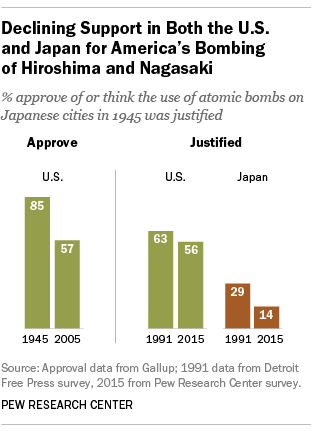
The interpretations of the historical happenings are conflicted.  I am biased; I believe that the war could have, would have, been brought to an end without America flexing its nuclear muscles. My preferences for peace are why I find it discouraging that there is a majority in America that agrees with the letter writer regarding the bomb:

Source

A year ago, Obama visited Hiroshima, ahead of the anniversary of the tragic event.  In all these years since 1945, Obama was the first sitting president to visit the Hiroshima Peace Memorial.  In a moving speech, Obama noted how the world changed since "death fell from the sky" on that cloudless August morning in Japan:
Those who died, they are like us. Ordinary people understand this, I think. They do not want more war. They would rather that the wonders of science be focused on improving life and not eliminating it. When the choices made by nations, when the choices made by leaders, reflect this simple wisdom, then the lesson of Hiroshima is done.
The world was forever changed here, but today the children of this city will go through their day in peace. What a precious thing that is. It is worth protecting, and then extending to every child. That is a future we can choose, a future in which Hiroshima and Nagasaki are known not as the dawn of atomic warfare but as the start of our own moral awakening.
These are dark times.  But, one has to be hopeful; what other choice do we have.  Here is to hoping that despite the effects of the fateful elections this past November, we will get on to the path of our own moral awakening--sooner than later.


Saturday, September 24, 2016

May Peace Be With You

I have sent this across to the editor

The United Nations marks October 2nd as the “International Day of Non-Violence” for a very good reason--it is the birthday of Mohandas Karamchand Gandhi, popularly known as Mahatma Gandhi.

Gandhi, who was born in 1869, led the independence movement that, in 1947, resulted in the creation of two new countries of India and Pakistan and, with that the end of the British Raj as well. The struggle for freedom, in which Gandhi passionately urged his followers to observe non-violence even against the colonizer’s brutal force, inspired many others, including Martin Luther King, Jr.

Life is full of tragic ironies--Gandhi and King, the champions of peace and nonviolence, fell to bullets that were aimed at them. Unlike Gandhi, who was assassinated in 1948, King had not lived long enough to live in the promised land of freedom.

Albert Einstein summed it up best for all of us when he wrote about Gandhi that “generations to come, it may well be, will scarce believe that such a man as this one ever in flesh and blood walked upon this Earth.” On Gandhi’s birthday, it certainly will help us all to be reminded of, as the UN puts it, the human desire for "a culture of peace, tolerance, understanding and non-violence."

In the contemporary United States, any talk in the public space about peace and nonviolence is rare anymore. Politicians of all stripes want to prove how much they are tougher than the other, out of a fear of being labeled a wimp otherwise. This has been especially the case since the fateful events on September 11, 2001. At the national level, the “tough” ones smell blood when an opponent does not talk war. At this rate, even those running for the office of a local dog catcher will have to prove their toughness.

Of course, violence is more than merely about engaging in war. The political rhetoric over the past year seems to have been anything but peaceful and nonviolent. A new day begins with attacks on yet another person or group of people, based on whatever cultural trait is deemed to be the “wrong” one for the moment. So much so that even I, as insignificant as one can be in the political landscape, have been a target for those who are seemingly at ease with offensive words and rhetoric!

While words, unlike sticks and stones, do not break bones, the violence conveyed through words causes plenty of harm. In the noise and confusion of the violent rhetoric that surrounds us in the real and cyber worlds, we seem to have lost a fundamental understanding of what it means to be human,. One of Gandhi’s favorite prayers says it all about being human--it is to “feel the pain of others, help those who are in misery.” However, and unfortunately, the overall rhetoric and practice these days is far from that interpretation of humanity.

When it comes to the terrible humanitarian crises, like the situation in Aleppo, in Syria, it is depressingly shocking how quickly we closed ourselves from the “pain of others” and how easily we refuse to “help those who are in misery.” We have refused to budge even when the screens all around us flashed the images of Aylan Kurdi--the toddler who was dead, face down, on a beach--or the five-year old Omran Daqneesh, whose dust and blood covered face looked dazed and confused.

Meanwhile, all around the world, the number of people displaced from their homes continues to increase. The United Nations estimates that by the end of 2015, the number of people who have been forcibly displaced from their homes numbered 65.3 million. The UN High Commissioner for Refugees, Filippo Grandi, noted that “at sea, a frightening number of refugees and migrants are dying each year; on land, people fleeing war are finding their way blocked by closed borders. Closing borders does not solve the problem.”

As I write this column, peace and nonviolence seem to be evaporating even in Gandhi’s old lands of India and Pakistan. Tension between the two countries is at such high levels that international media and commentators wonder, and worry, whether the neighbors are getting ready for yet another war. As often is the case with these sibling countries, this time too the fight is over Kashmir, but with plenty of nuclear bombs on both sides of the border.

We shall certainly overcome, in the long run. In the meanwhile, on the “International Day of Non-Violence,” like the stereotypical beauty pageant contestant, I too will wish for world peace.

Sunday, August 14, 2016

Ninety years of (In)Fidel

The two major party presidential contenders are no spring chicken.  Senators who ought to have retired long ago continue to run and, even more bizarre is how they get re-elected; there are 25 current senators in DC who are at least 70 years old!  A quarter of the Senate!  I hope this guy, who has become highly unprincipled, is booted out even now--well before he becomes the next Strom Thurmond!

And then there is that one guy chomping away at his cigar:
Fidel Castro used the occasion of his 90th birthday to lash out once more against President Obama.
Wait a second.  Shouldn't he thank Obama for normalizing US relations with Cuba?  And how come thugs like Castro and Mugabe live such long lives?

What was Castro's gripe anyway?
"I believe that the United States' president's speech lacked stature when he visited Japan,” Castro wrote, “and it lacked an apology for the killing of hundreds of thousands of people in Hiroshima, in spite of the fact that they knew the effects of the bomb. The attack on Nagasaki was equally criminal, a city that the powerful chose at random. It's for that reason that I must hammer on the necessity of preserving peace, and that no power has the right to kill millions of human beings."
Wait a second.  How many people were killed by Castro and his people?  I tell ya, we live in a world in which the likes of Castro and Putin and Trump can say anything that pleases them.  As my grandmother used to say, "கேக்கறத்துக்கு ஆள் இல்லை" (roughly translating to "nobody to question")

Meanwhile, the post-modernist extraordinaire marked the occasion:
Castro received a congratulatory call from Russian President Vladimir Putin on his birthday, according to the Russian leader's office.
Of course!

So, is it senility, or ideological rigidity, that made Castro rant against Obama?  A Cuba specialist, Ted , thinks it is a lot more basic than those:
To Henken, Castro's aversion to Obama is transparent. "He doesn't like Obama because Obama has stolen his charismatic thunder," he said.
Obama has certainly stolen the charismatic thunder from quite a few people around the world.  I am going to miss him, even though I have had plenty of problems with many of his political decisions--especially about war and peace.
 
Source

Thursday, February 04, 2016

Remember a country far away ... called Afghanistan?

Blogging about the warmongers led me to think about Afghanistan.  How much have we--the US--sunk in there?

Of course, the war spending is a staggering amount.  In case you forgot that amount, you might want to sit down first and hold on to a firm table or pillar.  The wars in Afghanistan and Iraq cost the US.taxpayers $1.6 trillion, according to the Congressional Research Service.  But, that is an underestimate:
A truer measure of the wars’ total costs pegs them at between $4 trillion and $6 trillion. This fuller accounting includes “long-term medical care and disability compensation for service members, veterans and families, military replenishment and social and economic costs,” Harvard economist Linda Bilmes calculated in 2013.
The Pentagon and its civilian overseers don’t like to talk about war costs, either before or after the shooting. That’s because a high price tag beforehand acts as an economic brake, making war—assuming that’s the goal—less likely.
After all that spending ...

Anyway, that was for the wars that supposedly ended.  Since then, we have also been investing in Afghanistan for its reconstruction.  How much has that been?  Even after adjusting for inflation, our spending there has exceeded the amount that we spent in Europe via the celebrated Marshall Plan.  I wonder who really benefited from all those hundreds of billions of dollars--certainly not the students in my classes who work anything between 15 and 40 hours every week in order to make sure they will not have huge debts when graduating.

So, after all that spending ...
Wasil was waiting Monday at a fruit stand in Tirin Kot, the capital of southern Afghanistan’s Uruzgan province, when he was shot dead by two gunmen. His uncle said he was 12 years old.
What was special about Wasil?
Wasil Ahmad learned to fire a gun at age 9, after his father was killed by Taliban militants.
Before long, his uncle said, the boy had become a celebrated Taliban killer, credited with gunning down six insurgents during a battle last summer.
And,
Local officials in Uruzgan and others hailed Wasil as a hero, but some said his story offered yet another example of the price paid by Afghan youth in the more than 14-year conflict.
In the first six months of 2015, the U.N. Mission in Afghanistan documented 1,270 casualties among children — 320 deaths and 950 injuries — a 13% increase over the prior year.
Yep, that is the Afghanistan today, after all that spending ...
Forgotten by the West, Afghanistan is facing a multidimensional civil war with the Afghan Taliban, which is being aided now by a plethora of groups such as al-Qaeda, the Islamic Movement of Uzbekistan, Chechens, and Pakistan’s Lashkar-e-Tayyaba.
Oh, hey, aren't you glad that we were wonderfully distracted and entertained by the likes of Trump and Palin and more?
In at least two provinces bordering Pakistan (Nangarhar and Zabul) the Taliban are also fighting ISIS, which is trying to recruit among dissatisfied Taliban members. Not until the end of January were US Special Forces in Afghanistan given authorization to go after ISIS fighters in the country—one reflection of how lackadaisically the Pentagon is responding to the crisis there. US forces can now pursue ISIS fighters, who have been declared a threat to the US. One may well ask, What about the threat that the Afghan government has already faced from ISIS all these months as the group has built up its base areas?
Ah, do the blabbering bellicose buffoons who want to lead the Republican Party care about such details before they go to all corners of the world to kick ass and bomb people to oblivion?

Caption at the source:
12-year-old Wasil Ahmad, who was killed by gunmen in southern Afghanistan on Monday, Feb. 1, 2016

Sunday, January 10, 2016

Peace is War. Slavery is Freedom. Strength is Ignorance.

The Nobel Peace Prize has never been without controversies.  Take the case of Mohandas "Mahatma" Gandhi, for instance:
Gandhi was nominated in 1937, 1938, 1939, 1947 and, finally, a few days before he was murdered in January 1948.
Gandhi was not recognized for the phenomenally peaceful methods he preached and practiced.
Up to 1960, the Nobel Peace Prize was awarded almost exclusively to Europeans and Americans. In retrospect, the horizon of the Norwegian Nobel Committee may seem too narrow.
"In retrospect" the Committee ought to feel awful about handing the prize to Barack Obama too, as I have often blogged about!


A few months ago, I blogged about another Nobel Peace Prize recipient behaving in ways that were anything but about peace.  "What a shame!" I commented about Aung San Suu Kyi's silence over the systematic campaign against the country's Rohingya.  She intentionally even shut off the strong advice from two other Peace Prize honorees: the Dalai Lama and Desmond Tutu.

In his column, Nicholas Kristof writes about the wily politician that Aung San Suu Kyi is:
She is now a politician, and oppressing a minority like the Rohingya is popular with mostly Buddhist voters.
Oh, wow, what a surprise!  How awful a politician is she?
Aung San Suu Kyi avoids even saying “Rohingya.”
Kristof writes:
Aung San Suu Kyi is also inheriting the worst ethnic cleansing you’ve never heard of, Myanmar’s destruction of a Muslim minority called the Rohingya.
A recent Yale study suggested that the abuse of the more than one million Rohingya may amount to genocide; at the least, a confidential United Nations report to the Security Council says it may constitute “crimes against humanity under international criminal law.”
Yet Aung San Suu Kyi seems to plan to continue this Myanmar version of apartheid.
Of course, I agree with Kristof when he concludes:
Defenders of Myanmar and of Aung San Suu Kyi note that the country has many problems; they see the Rohingya as one misfortune in a nation with a vast swath of misfortunes. The priorities, as they see them, are economic development, democracy and an end to the country’s many local conflicts, and they protest that it’s myopic to focus on the problems of one ethnic group in a nation so full of challenges.
Yet to me, there is something particularly horrifying about a government deliberately targeting an ethnic group for destruction, locking its members in concentration camps and denying them livelihood, education and health care. When kids are dying in concentration camps, after being confined there because of their ethnicity, that’s not just one more problem of global poverty. It’s a crime against humanity, and addressing it is the responsibility of all humanity.
Strip her of the Nobel, I say.

Saturday, October 24, 2015

This day ... three years ago (2)

(Re-posting from 2012)

It is ok for Obama to kill people because he is not Bush?

This graphic ((ht) says a lot, right, about how we have escalated the killing campaigns?:


As if the old stories on the kill list (have my colleagues nominated my name to be in the list?) were not enough to make us worry about due process and the constitution, the Washington Post reports:
Over the past two years, the Obama administration has been secretly developing a new blueprint for pursuing terrorists, a next-generation targeting list called the “disposition matrix.”
The matrix contains the names of terrorism suspects arrayed against an accounting of the resources being marshaled to track them down, including sealed indictments and clandestine operations. U.S. officials said the database is designed to go beyond existing kill lists, mapping plans for the “disposition” of suspects beyond the reach of American drones.
WTF!

I thought "kill list" was enough of a new and unwanted phrase in our dictionaries.  "Disposition matrix"???

As I expected, Glenn Greenwald is furious about this, and he is way smarter and informed than I ever can be:
The Post's Miller recognizes the watershed moment this represents: "The creation of the matrix and the institutionalization of kill/capture lists reflect a shift that is as psychological as it is strategic." As he explains, extra-judicial assassination was once deemed so extremist that very extensive deliberations were required before Bill Clinton could target even Osama bin Laden for death by lobbing cruise missiles in East Africa. But:
Targeted killing is now so routine that the Obama administration has spent much of the past year codifying and streamlining the processes that sustain it.
To understand the Obama legacy, please re-read that sentence. As Murtaza Hussain put it when reacting to the Post story: "The US agonized over the targeted killing Bin Laden at Tarnak Farms in 1998; now it kills people it barely suspects of anything on a regular basis."
Oh my freaking lord!

To hell with Obama and Romney!

More Greenwald:
It is literally impossible to imagine a more violent repudiation of the basic blueprint of the republic than the development of a secretive, totally unaccountable executive branch agency that simultaneously collects information about all citizens and then applies a "disposition matrix" to determine what punishment should be meted out. This is classic political dystopia brought to reality (despite how compelled such a conclusion is by these indisputable facts, many Americans will view such a claim as an exaggeration, paranoia, or worse because of this psychological dynamic I described here which leads many good passive westerners to believe that true oppression, by definition, is something that happens only elsewhere).
Need I remind you that Obama was awarded the Nobel Peace Prize . What a wonderful living illustration of George Orwell's 1984 scenario ofwar is peace :(


Saturday, August 08, 2015

We have all become Death, the destroyer of worlds?

About this time in August, every year I have posted about nuclear weapons since re-starting this blog.  Why?  Simply put, I find the world's continuing fascination with nuclear weapons despite the horrors of Hiroshima and Nagasaki to be shocking, awful, pathetic, and tragic.

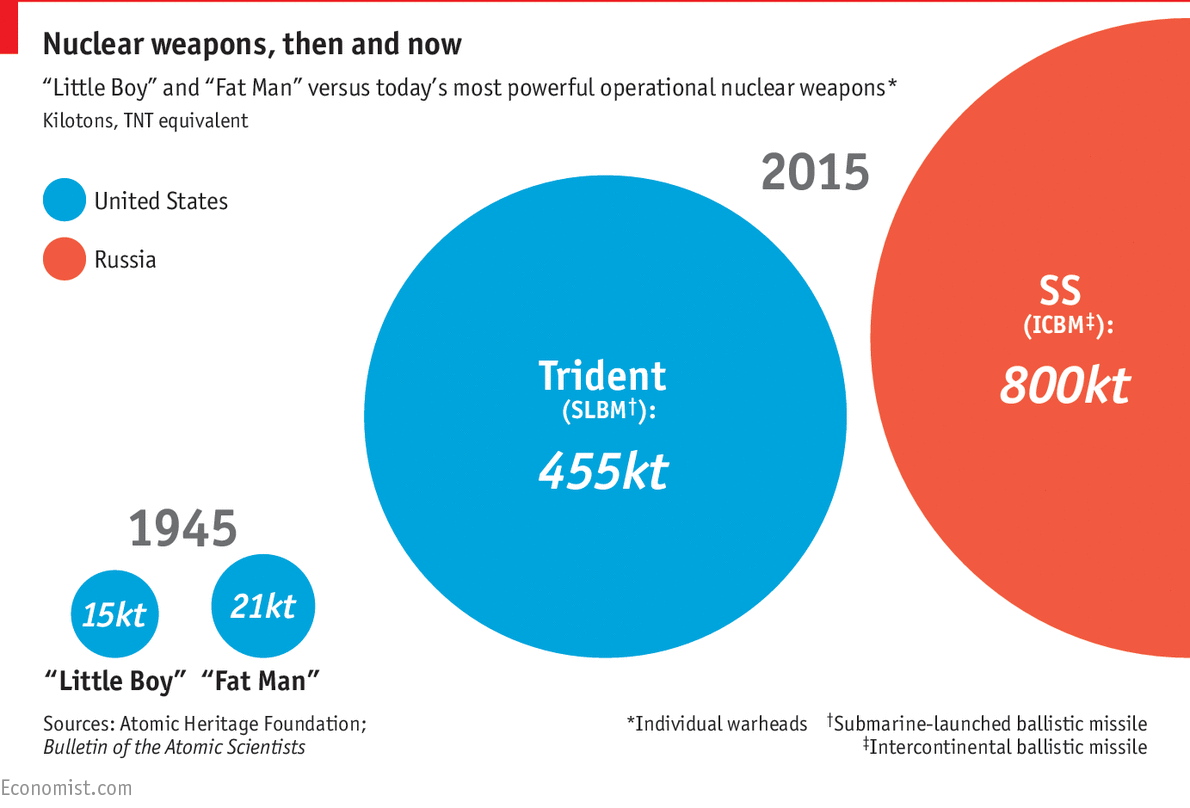
Take a look at the following data:
Source

Every one of those is way more powerful than the relatively tiny bombs ("Little Boy" and "Fat Man") that the US dropped in Hiroshima and Nagasaki, and the world has almost 16,000 of them!


Seriously, how many of those weapons do we need?


The bombing of Nagasaki; image source

In this op-ed titled "Nagasaki, the Forgotten City," the author writes:
About 74,000 people in Nagasaki died instantaneously or within five months of the bombing. Only 150 were military personnel. Another 75,000 people were injured, and these numbers do not count those who fell ill and died from radiation-related conditions in the decades to come.
Initially, purple spots appeared on their bodies, their hair fell out, and they developed high fevers, infections, and swollen and bleeding gums. Later, cancer rates surged. The survivors, known as hibakusha, lived in constant fear of illness and death.
Only 150 of the 74,000 were military personnel!  It is one thing if an earthquake or a typhoon caused utter destruction to property and life.  It is another when we humans manufacture such destruction.  So many of the horrors in history were results of human decisions.  What a tragedy!
To counter growing criticism of the bombings, American leaders established a narrative that the bombings had ended the war and saved up to 1 million American lives by preventing an invasion of Japan. (These postwar casualty estimates were far higher than pre-bomb calculations.) Most Americans accepted this narrative.
Of course, a patriot never, ever questions the government's narrative, as the war-criminal, scoundrel, Dick Cheney always reminded us!

In a related op-ed, the same author writes:
Immediately after the bombings, high-level U.S. officials publicly — and adamantly — rebuffed news reports about the bombs' horrific aftereffects. Gen. Leslie Groves, director of the Manhattan Project, which developed the atomic bombs, dismissed these reports as propaganda, even as he sent teams to measure radiation levels to ensure the safety of U.S. troops about to enter both cities. Later that year, Groves testified before the U.S. Senate that death from high-dose radiation exposure is "without undue suffering" and "a very pleasant way to die."
A"very pleasant way to die."  Read that again. And again.  The horror of that sentence seems worse than the deaths themselves!  

I will end this post with the famous words uttered by Robert Oppenheimer:
We knew the world would not be the same. A few people laughed, a few people cried, most people were silent. I remembered the line from the Hindu scripture, the Bhagavad-Gita. Vishnu is trying to persuade the Prince that he should do his duty and to impress him takes on his multi-armed form and says, "Now, I am become Death, the destroyer of worlds." I suppose we all thought that one way or another.

Wednesday, August 05, 2015

"Bomb bomb bomb, bomb bomb Iran"

The politics of the Iran deal discussions interest me so much that I even follow the administration's Twitter feed on that, which has a Twitter ID that says exactly what it is about, unlike my Twitter ID.

It bothers me a great deal when the Obama administration and the opponents alike convey to the American people--and to the rest of the world--that Iran is like a cancerous blob out there and that the entire region and the world is in jeopardy if we don't act now.  It bothers me because to the average person listening to all that, or reading about it, Iran all the more becomes a distant and abstract entity, instead of the nearly 80 million people living there. A population that is almost twenty times Oregon's but we have plenty who laugh with--and not at--the crazies like "bomb bomb bomb, bomb bomb Iran."

Does it not matter anymore that a country's government is different from its people?  Shouldn't we be respectful of the nearly 80 million people in that country, and those of Iranian descent who live in the US and in other countries?  Imagine me bashing the billion Indians just because I disagree with Modi's politics.  Or, lumping together the billion Chinese into one blob because I hate the Communist Party and its politics.  It depresses me that we are completely dehumanizing the nearly 80 million people of Iran and making demons out of them.

That kind of an atrocious representation of Iran always makes me think of a friend. An old friend, who died a few years ago. Cancer got him :(

Shahab was from Iran, and was one of the many who were forced to exit the country after the theocratic revolution in 1979.  His exit was a story of struggling his way through sympathetic Eastern European countries, then to Western Europe, and finally to the US.

We had quite a few lunches together, and occasional dinners too.  I learnt a lot about Iran and some of the cultural aspects there.  Through Shahab, I even came to know about a religion called "Mithraism," which apparently was a serious competitor to Christianity back in Rome. It was fascinating to find out how much Mithraism, Hinduism, and the Zorastrian faith have/had in common, and how Christianity itself has a lot of common ground with Mithraism.

Shahab's parents--his mother, in particular--were big fans of Indian movies, even from their years in Tehran. He said something along the lines of: "my mother could not understand a word uttered in the movies.  But, she laughed when the heroine laughed and cried when the heroine cried, and enjoyed the songs."  Of course, the older Hindi songs were unlike the contemporary ones--the older songs in Hindi often reflected the Persian cultural heritage that the Mughals brought with them.  His parents were also rice eaters and Shahab joked that if there was no rice served at parties that his parents went to, well, after they returned home they would eat a little bit of rice :)   


Shahab was more a creative arts person than the architect/planner that he was in his day job.  I suspect that he enjoyed the arts infinitely more.  I remember going to the exhibition that he had of his photographs, in the library at Beverly Hills.  The guy was in his elements, and significantly different from his persona at work, and more like the person he was at the lunches and coffees we had.  One of the sites still has links to some of his works, along with an email address to contact him. (That is from where I grabbed the photo.)  I suppose you never cease to exist in the internet.

The next time you hear somebody bashing Iran, ask yourself whether "all options are on the table" appeals to you anymore and, if it does, then find out whether the 80 million there do not matter to you.  Think about Shahab.  Picture him in your mind.

Thursday, April 30, 2015

Goodbye to the cruellest month. So, ... shanti, shanti, shantihi

I have often mentioned in this blog about how the high school curriculum in the old country didn't give me a real taste for poetry.  Of course, when the English teacher slapped me around for no fault of mine, the last thing I wanted to do was to pay attention even to the little bit of poetry that we had.  And thus a prosaic life it has been.

I could read poems on my own, yes.  After all, we live in the modern world where practically every poem that is worth reading is only a mouse-click away.

But, there are two hassles with this approach.  One, I have come to believe that poems are for the ear than for the eye.  I recall attending Frank Bidart's poetry reading a few years ago and sitting there transfixed listening him. The same poem on paper was not even half impressive.

Second, poets write one thing and mean something else that I am supposed to decipher.  Poems, that way, are like women where we men are left smashing our heads into concrete walls yelling, "why couldn't you have said that in the first place?" ;)

Take the much quoted T.S. Eliot line, "April is the cruellest month."  In order to understand this line, I will then have to read the whole damn long coded stuff the guy wrote decades ago.  At least if a poet read that out, I can pay attention and enjoy the rhyme and the reason. On my own, everything is without rhyme or reason!

And when I tried reading that once, it was a Ulysses experience--as in I barely got started and I shut it off and went to play a round of bridge!  But, as I scanned through, I came across the Sanskrit word of shanti.  I wonder what the whole damn thing is about.  I will never know; I blame it all on the big fat slapper.

Whether or not April is the cruellest month, it is coming to an end in this part of the world.  In the old country, it has already ended and the real cruelty will begin, with the heat and dust of the Indian summer.  So, as a bridge between the old and the new country, with the segue provided by shanti via Eliot, perhaps I can close out this poetry month with a couplet from the old country.

The rhythmic and mellifluous chant of this couplet is a sheer joy to listen to in a real world setting:
puranam adah, purnam idam, purnat purnam udacyate
purnasya purnam adaya purnam evavasisyate.
which translates to:
That is infinite, this is infinite;
From That infinite this infinite comes.
From That infinite, this infinite removed or added;
Infinite remains infinite
Of course, the infinite that is referred to here is way more than mathematical concept, and if often interpreted through hours and hour of lectures that are devoted to each and every word in the couplet.  But, hey, it is poetry where words mean way more than what we think they are!

May peace be with you!

Wednesday, August 13, 2014

There is no finish to a war

I know of only one way to fight, whether at workplace or in geopolitics--civil disobedience.  Thanks to Gandhi, of course.  And the older I get, the more I turn away from violence.  

Thus, these days, this news junkie finds very little to be enthused about.

We are far from Gandhi's pacifism.  What a horrible spring and summer it has been in this year alone.  It is almost as if we humans decided that we will not rest until we completely nuke away the "peace dividend" that we thought was possible when the Soviet empire collapsed and the Cold War ended.

It appears that we have forgotten that, as Hemingway put it, war is hell.  He wrote in A Farewell to Arms:
"There is nothing as bad as war. ... When people realize how bad it is they cannot do anything to stop it because they go crazy.  There are some people who never realize. There are people who are afraid of their officers. It is with them the war is made"
"I know it is bad but we must finish it."
"It doesn't finish.  There is no finish to a war."
"Yes there is."
Passini shook his head.
"War is not won by victory. ...
Yet, we continue with wars. There certainly seems no finish.

The following, which Einstein said in the context of nuclear weapons, is applicable to the non-nuclear kind too:
We cannot desist from warning, and warning again, we cannot and should not slacken in our efforts to make the nations of the world, and especially their governments, aware of the unspeakable disaster they are certain to provoke unless they change their attitude toward each other and toward the task of shaping the future.
Even Japan, a country that renounced war, in favor of peace, right in its constitution, has eased up on that and now encourages exports of weapons.  We humans are, perhaps, doomed to live as the most violent animals until we cause our own extinction.

This piece at the New Yorker discusses, via a Hirohima survivor, a public-health hypothesis that
suggests that untended wartime trauma can move vertically and horizontally through individuals and families, morphing across years, decades, or even centuries.
All the more to worry that there is no finish to a war, right?
Sixty-nine years ago last week, a slender woman named Tomiko Shoji was struck and sent aloft by a bright white light. She’d just arrived at her secretarial job, at a tobacco factory, and was standing by the door when the flash occurred; the light’s source had a nickname, Little Boy, but it meant nothing to her at the time. She flew backward under the crushing force of the office door, passed out, and awoke with shards of glass in her head and an expanse of bodies around her—some dead, some alive but dazed, and many more, she soon found, floating “like charcoal” in nearby rivers. The nineteen-year-old climbed up and out of the shell of her younger self; she had survived the U.S. atomic bombing of Hiroshima. Nearly seven decades later, Keni Sabath, Shoji’s youngest granddaughter, started to wonder: Had the bombing’s aftermath reshaped not just the psyche of her bachan (grandmother) but also, in ways both culturally and historically particular, her own?
The horrors of war!
In recent years, a growing body of scholarship has sought to better understand accounts like Shoji’s and Sabath’s through the framework of “trans-generational trauma,” which traces experiences of catastrophic loss across the span of a family or a community. A wide range of studies have examined evidence of “secondary trauma” in the children of Holocaust survivors, the wives of Vietnam veterans, and, more informally, in the families of U.S. veterans who’ve faced P.T.S.D. after deployments to Iraq and Afghanistan. In 2007, a study on the wives of fifty-six traumatized war veterans in Croatia found that more than a third of the veterans’ wives met the criteria for secondary traumatic stress; often, this meant symptoms “similar to those present in directly traumatized persons: nightmares about the person who was directly traumatized, insomnia, loss of interest, irritability, chronic fatigue, and changes in self-perception, perception of one’s own life, and of other people.” More recently, speaking to Mac McClelland for an article on trauma in the families of Iraq and Afghanistan war veterans, the clinical psychologist Robert Motta said, “Trauma is really not something that happens to an individual.” Instead, he proposed, “Trauma is a contagious disease; it affects everyone that has close contact with a traumatized person.”
Wishing for peace is something we have been doing for thousands of years.  Perhaps every time we think we are getting close to achieving it, we humans decide to return to our old ways of killing.  I will leave it to Hemingway to explain why this happens:
"There is a class that controls a country that is stupid and does not realize anything and never can. That is why we have this war."
"Also they make money out of it."
I am guessing that the typical war-monger has never read Hemingway :(

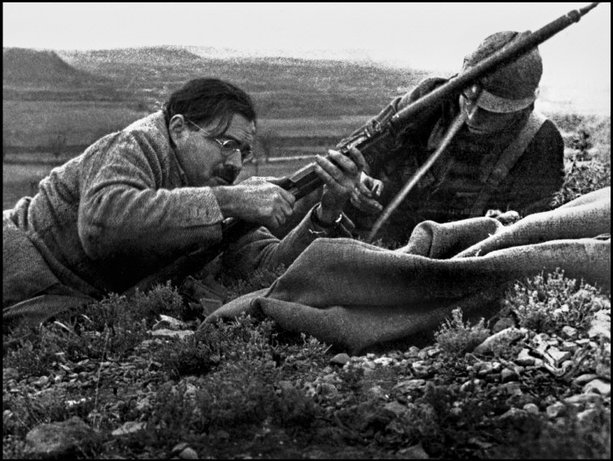
Caption at the source:
MORA DE EBRO, Spain—Hemingway on the front lines with members of Gen. Enrique Lister’s Loyalist 5th Regiment
who were holding out against Gen. Franco's offensive, Nov. 5, 1937.
Update at 22:45 on Aug 14th:
Marine Cpl. Robert Richards, a medically retired combat veteran who was badly wounded in Afghanistan and later appeared in a controversial video urinating on dead Taliban insurgents, was found dead Wednesday night in his home in North Carolina. He was 28.
...
a sniper team led by Richards recorded a video on July 27, 2011, of him and other Marines urinating on the remains of Taliban fighters they had killed. It was never intended to be seen by the public, but Richards later said that the Marine who owned the camera stepped on an IED a couple weeks afterward, and it ended up in the hands of another Marine in the unit. It was posted online, causing an international uproar that led to eight Marines facing discipline.
...
In an exclusive 90-minute interview with this reporter for Marine Corps Times in September 2013, Richards acknowledged intense struggles with post-traumatic stress and night terrors afterward, and taking a variety of medications to deal with it. In one ugly night in Florida, he said he was caught off-guard by a celebration involving replica cannons being fired, and fired a pistol in his hotel room while his wife, Raechel, was present. He thought he was under attack, he said.
There is no finish to a war :(

Thursday, July 24, 2014

I have no idea for a title here! It is on India, Israel, and Palestine.

As a young reader of The Hindu, I was tremendously impressed with Moshe Dayan.  Dayan was Israel's foreign minister as I was getting into my teens and he was in the news a lot thanks to the Israel-Egypt peace negotiations.  It was not the prospect of peace that drew my attention to Dayan--it was his eye-patch!  The guy looked like he had had quite some past and that he meant business.  If I had known then the power of the word "awesome" I definitely would have used that ;)  It does not take much to impress a budding teenager!

Israel was in the news quite a bit those days.  Even though nobody I knew had a passport at that time, it intrigued me that the Indian government did not allow its nationals to travel to Israel.  Indian politics, which was dominated by Indira Gandhi's Congress Party, the various flavors of communist parties, and a few regional ones, was overwhelmingly against Israel and pro-Palestine.  That approach had been in place ever since the days of Jawaharlal Nehru, who " was an outspoken partisan of the Palestinians."

As a teenager, I felt torn between an admiration for Israel's achievements and enormous sympathies for the Palestinians.  "If only India could be well organized and focused as the Israelis are" was a thought that often crossed my mind.  But, simultaneously, I was drawn to the Palestinian cause, and the PLO, as well and simply could not understand why there was this bitter conflict.  There is a good chance that many thinking people in my demographic group had similar experiences.

As I transitioned out of the teens, and was a tad more informed about the world, the admiration for Israel lessened, and the sympathies for the PLO significantly diminished.  There was nothing but violence from both sides, which did not appeal to my pacifist sensibilities.  Dayan and his eye-patch rapidly faded away.

Over the years, India's politics has also dramatically changed.  The fall of the Soviet Union and the changing global order also coincided with India's near-bankruptcy that triggered economic reforms.  A relatively liberal India began to look at the world differently.
Congress Party Prime Minister P.V. Narasimha Rao ended India's Cold War hostility toward Israel by establishing full diplomatic relations in 1992
By then I was  easing into a life in the adopted country where politics was almost overwhelmingly pro-Israel while academe was (and is) predominantly in support of the Palestinians.  In one of the graduate school classes, Professor Lowdon Wingo even brought into the discussions the intifada.  Wingo walked a fine line expressing neither support nor criticisms for either side.  A wonderfully committed academic he was.

Since then, India has rapidly expanded its economic and military relations.
In terms of military cooperation, few countries have backed New Delhi as Israel did by supplying artillery shells during the 1999 Kargil conflict with Pakistan. Since then, Israel has emerged as India's second biggest arms supplier after Russia. 
It is a different India now.  Especially with the Hindu nationalist BJP in power, and with a government led by Narendra Modi.  The old political calculations of empty rhetoric favoring the Palestinians as a way to appeal to the Muslim vote has been replaced by ache din aane wale hain.  So much has the political atmosphere changed that:
The NDA government came under sharp attack in parliament for refusing to allow a resolution condemning Israel for the strikes on Gaza even as the death toll crossed 500 on Monday. In particular focus is the BJP’s top leaderships’ close ties with Israel, given that Prime Minister Modi had travelled as Gujarat Chief Minister to Israel in 2006, promising to return if he became Prime Minister. As Home Minister, L.K. Advani was the first senior Minister to visit Israel in 2000, and External affairs Minister Sushma Swaraj once chaired the India-Israel parliamentary friendship group and led a delegation there. 
That same essay notes this about India's radically different stance on the Israel-Palestinian issue:
Former diplomat and UN official Chinmaya Gharekhan, who was Prime Minister Manmohan Singh’s special envoy to West Asia and the Middle East Peace Process, told The Hindu, “There is no doubt that India’s position on the Israel-Palestine conflict has moderated gradually over a period of time, from its once categorical support for the Palestinian cause.” Mr. Gharekhan says the game-changer in this regard was Israel’s assistance to India during the Kargil war, when it supplied much needed artillery shells at short notice. “It was gratitude for this act and our growing defence relationship with Israel that made the difference in later years. Even at the UN, while we still support statements in favour of Palestine, we no longer co-sponsor such resolutions.”
 In the old country, it is not uncommon for seasoned commentators and intellectuals to look at what the "father of the nation" opined on this geopolitical struggle:
Writing in the Harijan newspaper, which he edited, in November 1938 on the vexed Palestine issue, Mahatma Gandhi declared that "my sympathies are all with the Jews... but my sympathy does not blind me to the requirements of justice." World War II was a year away and the world was yet to become aware of the scale of the persecution that befell the Jews and the enormity of the Holocaust and the Gandhi view merits recall.
In the same article, he continued: "Palestine belongs to the Arabs in the same sense that England belongs to the English or France to the French. It is wrong and inhuman to impose the Jews on the Arabs."
Much water and blood has flown since 1938 and the Jewish state is a reality, in much the same manner that Pakistan is - even though Gandhi was opposed to the idea. 
Hopefully, within my lifetime, everlasting peace will descend upon the troubled Israel-Palestine area, between India and Pakistan, and all around.  If nothing works, I will wear metaphorical patches over both my eyes and pretend that everything is well and good with the world.