But, ... wait, it is the same

:)
 . As in the novel, Pondicherry features a lot in the movie. (Now the city is known as Puducherry)
Of course, life in Pondicherry is changing a lot, and not always for the better--like this one.The movie was shot in several places across the town including the Botanical gardens, Holy Rosary Church, Petit Seminaire and Calve College schools and several canals.Mr. Lee said that almost one-third of the screen time will be occupied by shots from Puducherry.
विषमां हि दशां प्राप्य दैवं गर्हयते नरः ।
आत्मनः कर्मदोषांस्तु नैव जानात्यपण्डितः ॥- हितोपदेश, सन्धि
When a fool is in trouble, he will start blaming fate. A fool will never understand that his present state is the result of his past actions.
- Hitopadesha
Obama now speaks in strings of sentences like these: “The stock market has come roaring back. Corporate profits are up. The economy is growing again.” The stock market, it would seem, plus corporate profits equals the economy: an odd equation to hear from a Democrat. Bill Clinton in 1995 is Obama’s only precursor on this terrain, but even Clinton would quickly have added that corporate profits are not the measure of all good. By contrast, Obama is now convinced that there is no advantage in putting in qualifications except as a formality.It does seem like Obama is firming up his chances on getting re-elected, and has given up on Congress, and wouldn't care if it went Republican.
A main inference from the State of the Union is that in 2011 and 2012, the president will not initiate. He will broker. Every policy recommendation will be supported and, so far as possible, clinched by the testimony of a panel of experts.... The idea is to overwhelm us with expertise. In this way, a president may lighten the burden of decision and control by easing the job of persuasion into other hands. Obama seems to believe that the result of being seen in that attitude will do nothing but good for his stature.Yes, his stature.
Today no one can easily say who Barack Obama is or what he stands for; and the coming year is unlikely to offer many clues, since all the thoughts of Obama in 2011 appear to concern Obama in 2012.Meanwhile, there is a good possibility that 2011 will turn out to be the year of the geopolitical game-changers that I have been blogging about. Obama has been strangely missing in the picture.
Obama did surprisingly little to fulfill the hopes and dreams he unleashed worldwide during the election of 2008. Moreover, he deliberately magnified them in the Arab world with his 2009 Cairo speech. But coupled with his continuation of America's cynical policies to prop up tyrannical Arab regimes, and particularly his spectacular failure to rein in the illegal Israeli settlements in the so-called Arab-Israeli Peace Process in 2010, Mr. Obama may have inadvertently exacerbated the explosive combination of frustrated expectations and business-as-usual that pressurized the current eruption of resentment, anger, and alienation among the Arab people in 2011.Kai Bird makes a similar point at Slate:
But now the moment has come when President Obama must demonstrate that his words were not just words. One way or the other, hard consequences will follow. The end of the Mubarak era will also spell an end to Egypt's cold peace with Israel. No post-Mubarak government, and certainly not one populated with Muslim Brotherhood members, will tolerate the continued blockade of their Hamas cousins in Gaza. Israel will thus be faced with additional strategic incentives to end its occupation of the West Bank, dismantle its settlements and quickly recognize a Palestinian state based largely on its 1967 borders. But as the recent leak of Palestinian-Israeli negotiating transcripts demonstrates, the detailed contours of a final settlement are all in place.But, Obama seems to be even more cautious than ever :( And, even worse, don't merely sit on that metaphorical fence. Stanford's Middle East historian, Joel Beinin, writes:
Change is coming to the Arab world. It can no longer be held back. So the pragmatist and not just the idealist in Obama would be wise to make it clear that he really is on the side of the protesters in the streets of Cairo. It is time to stop hedging our bets.
our president has remained silent about the demonstrators’ goal: a democratic Egypt. In his June 2009 Cairo speech, when nothing was immediately at stake, President Obama uttered eloquent words of support for democracy. If he spoke out forcefully in support of the Egyptian people, as he did for the Tunisian people in his State of the Union address, he could tip events in a direction that would earn America the gratitude of the Egyptian people.And, here is what Mohamed ElBaradei says, Mr. President. I hope you are listening:
This would go far to undoing the damage to America’s standing in the Arab and Muslim world created by the catastrophically wrong-headed foreign policies of the George W. Bush era. It would also do more to undermine al-Qaeda’s international campaign of hatred and terrorism than has been achieved by two wars and over a trillion dollars in military spending.
The whole world is watching. If the tanks of Tiananmen Square roll into Cairo’s Tahrir Square, the people of the Middle East will know who to blame. Tell them "No," Mr. President.
"It is better for President Obama not to appear that he is the last one to say to President Mubarak, 'It's time for you to go," he told CNN.
ElBaradei, a possible candidate in Egypt's presidential election this year, dismissed U.S. calls for Mubarak to enact sweeping democratic and economic reforms in response to the protests.
"The American government cannot ask the Egyptian people to believe that a dictator who has been in power for 30 years would be the one to implement democracy. This is a farce," he told the CBS program "Face the Nation."
"This first thing which will calm the situation is for Mubarak to leave, and leave with some dignity. Otherwise I fear that things will get bloody. And you (the United States) have to stop the life support to the dictator and root for the people."


What I want is to know what happened to my father. If he is alive, I wish to speak with him and see him. If he has broken the law, he ought to be tried and given a chance to defend himself. And if he is dead, then I want to know how, where and when it happened. I want a date, a detailed account and the location of his body.And those awful people still run these countries--Gaddafi in Libya and Mubarak, who "inherited" the power thanks to Sadat's assassination. It is awful that we have tolerated dictators like Mubarak and Gaddafi and so many others for this long. Matar's observations on Gaddafi could apply to many other dictators too:
Gaddafi is unique among dictators in that he has few constant beliefs. A position which has afforded him an extraordinary instinct for survival.
living without one's country is a kind of daily death, that exile is, in essence, an endless mourning.Here is to hoping for a quick end to the millions of such daily death.
Asked if he would characterize Mubarak as a dictator Biden responded: “Mubarak has been an ally of ours in a number of things. And he’s been very responsible on, relative to geopolitical interest in the region, the Middle East peace efforts; the actions Egypt has taken relative to normalizing relationship with – with Israel. … I would not refer to him as a dictator.”Really? What then are the markings of a dictator?
US speaks again, but no one seems to be listeningThe Daily Show does a fantastic job of examining the American commitment to democracy:
| The Daily Show With Jon Stewart | Mon - Thurs 11p / 10c | |||
| The Rule of the Nile | ||||
| ||||
More ordinary citizens are now defying the police. A young demonstrator told me that, when running from the police on Tuesday, he entered a building and rang an apartment bell at random. It was 4am. A 60-year-old man opened the door, fear obvious on his face. The demonstrator asked the man to hide him from the police. The man asked to see his identity card and invited him in, waking one of his three daughters to prepare some food for the young man. They ate and drank tea together and chatted like lifelong friends.Could the sudden overthrow of such regimes be the geopolitical game-changer that I have been waiting for? Certainly these were not on the horizon at all ...
In the morning, when the danger of arrest had receded, the man accompanied the young protester into the street, stopped a taxi for him and offered him some money. The young man refused and thanked them. As they embraced the older man said: "It is I who should be thanking you for defending me, my daughters and all Egyptians."
| The Daily Show With Jon Stewart | Mon - Thurs 11p / 10c | |||
| State of the Union 2011 - Correspondent Rebuttal | ||||
| ||||
| The Daily Show With Jon Stewart | Mon - Thurs 11p / 10c | |||
| Moment of Zen - National Debt Clock | ||||
| ||||
China’s Li Na could ascend to the final while charming everyone in Melbourne with a hilarious postmatch interview in which she blamed her snoring husband for her lack of sleep, among other humorous anecdotes. That spawned the idea that Li could be the crossover star in tennis that Yao Ming was in basketball, but Greg Couch writes on Fanhouse.com that he doesn’t believe she can capture enough attention in the United States. She will get attention in China, however, where tennis was once so obscure Li had to explain the sport to her mother when she decided to play it.
In the past, I have engaged in calm discourse with people from the creationist side, but the biggest problem for me is that ignorance is almost a staple in Christian beliefs. Everything relies on faith. To most Christians my age, being confronted with what philosophers call 'The Problem of Evil' should, in my opinion, make people question the true nature of their God. However, in my experience all dissent, reason and logic is viewed as a test of faith. The problem with faith is that reason can never be trumped by reason if people continue to have faith.
To me, this is not a big deal. I believe that there is a considerable amount of people who either can not, or refuse to think for themselves. It is especially hard when those values have been instilled since childhood. And it certainly is easier being able to get a one hour lesson every week on what is right or what is wrong. Or to be able to watch Fox News and know who you should vote for, or what the opposition is trying to do to destroy your familial values. That, to me, is my biggest qualm with the Christian establishment.
Not being religious, I think our government should be secular as it was written. However, the religious establishment refuses to allow this. Regardless of what a president actually believes, none have been elected without a proclamation of religion. If an atheist or agnostic ran for office, there is no way they would succeed in today's political climate. For example, the governor of Alabama recently proclaimed that non-Christians 'weren't his brothers or sisters.' He ended up apologizing for his remarks, but his apology didn't seem to extend to people who were not religious just those of 'all faiths.' To me, it makes me wonder how that is not a violation of the separation of church and state? It sent the message that regardless of if you pay taxes, vote, participate in our democracy, lacking Christian ideals puts you a step below those who do.
This separation to me alludes to the possibility of a tyranny of a majority. A religious establishment under the guise of a secular one. Were the founding fathers wrong when they wrote our Constitution? Minorities only seem to gain protection after great social upheaval. It took a war for slavery. Since then, women have had to protest on a national stage, then African-Americans, and currently homosexuals. In the 1850s it was a legitimate argument to say that people owned slaves in the bible, so it wasn't wrong. Since then, behind every minority group suppressed there was a religious argument, something I don't understand. In a court of law, if evidence is obtained illegally, it can't be used. Why are religious arguments allowed to be used in social matters, when religion is specifically excluded from the state?


in recent years the dramatic game changers in global history have been quite regular, about a decade apart:2011?
1968: the Tet Offensive
1979: annus horribilis
1989: The Berlin Wall tumbles down
2001: 9/11
Take the case of General Electric, whose chief executive, Jeffrey Immelt, has just been appointed to head that renamed advisory board. I have nothing against either G.E. or Mr. Immelt. But with fewer than half its workers based in the United States and less than half its revenues coming from U.S. operations, G.E.’s fortunes have very little to do with U.S. prosperity.When Krugman writes like this with facts and logic, it is a sheer pleasure to read his columns, as against the rare ones where he gets a tad shrill.
By the way, some have praised Mr. Immelt’s appointment on the grounds that at least he represents a company that actually makes things, rather than being yet another financial wheeler-dealer. Sorry to burst this bubble, but these days G.E. derives more revenue from its financial operations than it does from manufacturing — indeed, GE Capital, which received a government guarantee for its debt, was a major beneficiary of the Wall Street bailout.
Mr. Obama himself may do all right: his approval rating is up, the economy is showing signs of life, and his chances of re-election look pretty good. But the ideology that brought economic disaster in 2008 is back on top — and seems likely to stay there until it brings disaster again.Doesn't sound all too good.
The main impression I got from both Mr Blair's evidence to the inquiry last year and his autobiography was his extraordinary ignorance of Iraq.Thus writes Patrick Cockburn in the Independent (ht) ... And Cockburn adds:
Interesting to note, BTW, how the Wall Street Journal viewed Tony Blair dealing with questions from the Chilcot Commission .... "The prosecution of Tony Blair" .... muahahahaha .... Can Faux Noose beat WSJ's headline? (Update: in light of the comment--below--I now wish all the more for the prosecution of these war criminals. But, we will have to start with KissingerMr Blair's enthusiasm for a confrontation with Iran stems partly from the fact that he never seems to have understood what went wrong for him in Iraq. It was not so much the war against Saddam Hussein that doomed the venture as the occupation which followed. He and President George Bush might have got away with overthrowing Saddam Hussein and his regime if they had swiftly withdrawn and handed over real power to an interim Iraqi government.They did the exact opposite. Instead of withdrawing, the Americans and British occupied the whole country and showed every sign of wanting to remain in control. The occupation was, as Hoshyar Zebari, the Iraqi Foreign Minister and one of the more pro-Western of Iraqi leaders, said, "the mother of all mistakes".
 for his Vietnam and Chile decisions.)
Awesome colors :)Dimasa girls in their traditional dress taking part in the first International Jatinga Festival in Jatinga. On a moonless night, when the mist and fog bearing south-westerly winds blow over the Jatinga valley, different species of local migratory birds get attracted to strong light sources or “bird trap lights.” Photo: Ritu Raj Konwar
The book is startling and depressing evidence of what has happened to American academic Marxism, at least its sociological variant, over the last thirty years. It has become turgid, vapid, and self-referential.Jacoby's concluding comments?l:
In a memoir elsewhere, Wright comments that every September since kindergarten in 1952 he has been in school. It might be time for him to take a break.
That he did not label this book Volume One and promise Volumes Two through Ten shows restraint.
To call this book dull as dish water maligns dish water.
[Only] sociologists force-fed as graduate students will not choke on this book. That many of them have come to adore this stuff is only striking proof of the discipline’s collapse.
C.Wright Mills, who despised sociological jargon, has been succeeded by Erik Olin Wright, once given the C.Wright Mills Distinguished Professor Award at Wisconsin, who cranks out sociological cant. With Wright as elected president of the sociological profession, the conservative nightmare of radicals taking over the university has in part come to pass. But if this book exemplifies academic Marxism, conservatives can rest easy. We should all fear, however, what it suggests about the contemporary university and its scholarship.And in another book review, again thanks to A&L Daily, are these concluding comments, which fit into this discussion really well:
[When] it comes to the state of contemporary higher education, there are no quick fixes. That is why, today, Herbert London continues to cast his vote against liberal academia—but from the outside: “I realize, like G.K. Chesterton, that the problem with pragmatism is that it doesn’t work.”
| The Colbert Report | Mon - Thurs 11:30pm / 10:30c | |||
| Rush Limbaugh Speaks Chinese | ||||
| ||||
| The Daily Show With Jon Stewart | Mon - Thurs 11p / 10c | |||
| Word Warcraft | ||||
| ||||
| The Colbert Report | Mon - Thurs 11:30pm / 10:30c | |||
| 50th Anniversary of JFK's Inaugural Address | ||||
| ||||
I never imagined that one day microcredit would give rise to its own breed of loan sharks.I am surprised that Yunus didn't know his fellow South Asians any better :(
There were reports of suicides, allegedly due to extreme harassment by loan recovery officials from MFIs. A family mourns one such death reported from Rolakal village, Nalgonda, Andhra Pradesh last October. Photo: Singam Venkata RamanaOnce again, it is a screw-the-poor, which is a tragic irony in a culture that talks a lot about helping the poor. More on this in my earlier postings in the context of "Peepli Live"
The kind of empathy that had once been shown toward borrowers when the lenders were nonprofits disappeared. The people whom microcredit was supposed to help were being harmed. In India, borrowers came to believe lenders were taking advantage of them, and stopped repaying their loans.
Commercialization has been a terrible wrong turn for microfinance, and it indicates a worrying “mission drift” in the motivation of those lending to the poor. Poverty should be eradicated, not seen as a money-making opportunity.
Credit is not an ordinary product. It is weighed down by millennia of baggage, for the good reason that it can do real harm. It is like a drug in that it is potentially healthy in small doses, but also potentially addictive. So it stands to reason that sellers of this product must take unusual steps to counteract its special problems of reputation and risk.Things have taken quite a nasty turn, and Yunus is being compelled to defend those ideas and himself:
The strange story of Yunus doesn't end there; he was hauled before the court, but not for any wrongdoings related to Grameen:[In] his native Bangladesh Mr Yunus’s reputation is under attack. His supporters fear that the government plans to remove him from Grameen Bank, the microlender he founded, and take it over. In late December Mr Yunus had to issue a statement denying claims by some in the Bangladeshi government that he had resigned from his post as the managing director of Grameen. ...
Mr Yunus denies all the charges against him but has made powerful enemies among Bangladesh’s politicians. During a period of rule by a military-backed caretaker government a few years ago, he announced the formation of a political party, a project he soon dropped. Some reckon Sheikh Hasina is miffed that Mr Yunus and Grameen got the Nobel prize. It remains unclear how far the government, which already has three seats on Grameen Bank’s board, will go. Some fear that if the government succeeds in taking Grameen over it could turn its sights on other successful outfits, like BRAC. Bangladeshi microlenders can no longer consider themselves safe from the country’s messy politics.
The current defamation charges against Yunus stem from comments he made in an interview with French news agency AFP four years ago, in which he reportedly criticized politicians and said they were only in "power to make money." The remarks came shortly after a military-backed interim government took over amid deadly political violence in Bangladesh.That is right--all because Yunus aired in public the truth that is well known that politicians are corrupt and greedy! How dare he, eh!
A leftist politician in Mymensingh filed the defamation case on January 21, 2007, with a local magistrate court after Yunus' interview was published in local media.
The court last month asked Yunus to appear after a judicial probe found enough evidence to support the allegations, court inspector Md. Shahid Sukrana told CNN.
Nazrul Islam Chunnu, who filed the case, is a politician and district joint general secretary of the socialist party JSD. He charged that Yunus branded politicians as "corrupt and greedy" and said the politicians were "devoid of ideologies."
If Yunus is convicted of the charges, he faces a maximum two years in prison and/or a fine, said a court official.
The emphasis here is on individual neighborhoods rather than cities, lessening transportation issues since people don't have to travel as far. Robotic cars have completely taken over from mass transit.
Megacities on the move - Communi-city from Forum for the Future on Vimeo.
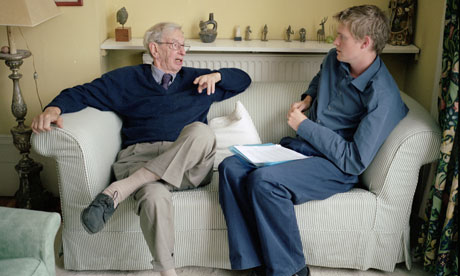
I wish I were this alive even now, while I am only half his age!Eric himself has changed. He suffered a nasty fall over Christmas and can no longer escape the physical constraints of his 93 years. But the humour and the hospitality of himself and his wife, Marlene, as well as the intellect, political incisiveness and breadth of vision, remain wonderfully undimmed. With a well-thumbed copy of the Financial Times on the coffee table, Eric moved seamlessly from the outgoing President Lula of Brazil's poll ratings to the ideological difficulties faced by the Communist party in West Bengal to the convulsions in Indonesia following the 1857 global crash. The global sensibility and lack of parochialism, always such a strength of his work, continue to shape his politics and history.
What I'm saying now is that the basic problems of the 21st century would require solutions that neither the pure market, nor pure liberal democracy can adequately deal with. And to that extent, a different combination, a different mix of public and private, of state action and control and freedom would have to be worked out.I wish that in the US we would get rid of the rigid political/ideological bottom-line that the partisans spout, and begin to explore a 21st century approach. Which is why I hope the LibCons would be daring enough ...
What you will call that, I don't know. But it may well no longer be capitalism, certainly not in the sense in which we have known it in this country and the United States.
For corporate America, the Great Recession is over. For the American work force, it’s not.No, this is not a quote from Robert Reich, who has consistently been trying to get policymakers to focus on the horrendous joblessness of the economic recovery.
The unemployment rate is higher in this country than in Britain or Russia and much higher than in Germany or Japan, according to a study of worldwide job markets that Gallup will release on Wednesday. The American jobless rate is also higher than China’s, Gallup found. The European countries with worse unemployment than the United States tend to be those still mired in crisis, like Greece, Ireland and Spain.Leonhardt notes that employees having a lot more power in Western Europe or Canada, compared to here in the US, where employers reign supreme, might be a significant factor. Whatever the reasons might be, I agree with him that:
Economists are now engaged in a spirited debate, much of it conducted on popular blogs like Marginal Revolution, about the causes of the American jobs slump. Lawrence Katz, a Harvard labor economist, calls the full picture “genuinely puzzling.”
The jobs slump has become too severe to disappear anytime soon. It will be part of the American economy and American politics for years to come. But there is no reason to treat it as a problem that’s immune from solutions. For starters, it would be worth figuring out what other countries are doing right.Meanwhile, here in Oregon, unemployment rates don't want to budge:
Oregon lost 1,800 payroll jobs in December as the unemployment rate held flat at 10.6 percent, essentially unchanged for more than a year.Just awful. A leading economics blogger, and a fellow Oregonian, Mark Thoma, has a timely column on the urgency to reinforce America's social safety net
Forty-five percent of students made no gains on the CLA during their first two years in college. Thirty-six percent made no gains over the entire four years. They learned nothing. On average, students improved by less than half a standard deviation in four years. "American higher education," the researchers found, "is characterized by limited or no learning for a large proportion of students."Apparently the worst culprits include some of the fastest growing majors across the US--"business"
Students majoring in business, education, and social work did not. Our future teachers aren't learning much in college, apparently, which goes a long way toward explaining why students arrive in college unprepared in the first place.Makes sense, give that it is the world of business that taught us about Ponzi schemes :)
Students saddled with thousands of dollars in debt and no valuable skills, certainly. Even worse, workers who never went to college in the first place, languishing in their careers for lack of a college credential. To them, the higher-education system must seem like a gigantic confidence game, with students and colleges conspiring to produce hollow degrees that nonetheless define the boundaries of opportunity.Terrible. Any way out?
Federal and state lawmakers should stop providing hundreds of billions of dollars in annual subsidies based purely on enrollment, and should start holding colleges accountable for learning. Lawmakers also need to shore up crumbling budgets, restrain college prices, and mitigate higher education's growing dependence on debt.I like his polite phrasing--"conspiracy of convenience" .... Ponzi scheme is straightforward ;)
Deep down, everyone knows that learning has long been neglected. But they don't want to know. Policy makers who have poured gigantic sums of money into financial-aid programs designed to get people into college don't want to know that many of the graduates, leaving with degrees in hand, didn't learn anything. College presidents don't want to know, because fixing the problem means arguing with faculty. Faculty don't want to know, because it would expose the weakness of their teaching and take time from research. Students don't want to know, because they'd have to work harder, and it would undermine the value of their credentials.
It has been a conspiracy of convenience. This study should bring the "trust us" era of American higher education to a close.
A dog, 'Leao', sits for a second consecutive day, next to the grave of her owner, Cristina Maria Cesario Santana, who died in the week's catastrophic landslides in Brazil, at the cemetery in Teresopolis, near Rio de Janiero, on January 15, 2011. By Vanderlei Almeida/AFP/Getty.
To grasp the difference between today’s plutocrats and the hereditary elite, who (to use John Stuart Mill’s memorable phrase) “grow rich in their sleep,” one need merely glance at the events that now fill high-end social calendars. The debutante balls and hunts and regattas of yesteryear may not be quite obsolete, but they are headed in that direction. The real community life of the 21st-century plutocracy occurs on the international conference circuit.What happens in in the international conference circuit?
it has the intense, earnest atmosphere of a gathering of college summa cum laudes. This is not a group that plays hooky: the conference room is full from 9 a.m. to 6 p.m., and during coffee breaks the lawns are crowded with executives checking their BlackBerrys and iPads. ... Though the china is Sèvres and the paintings are museum quality (Marie-Josée is, after all, president of the Museum of Modern Art’s board), the dinner-table conversation would not be out of place in a graduate seminar.And then, of course, even the latest gazillionaires like Facebook's Zuckerberg soon becomes a philanthrocapitalist:
What is notable about today’s plutocrats is that they tend to bestow their fortunes in much the same way they made them: entrepreneurially. Rather than merely donate to worthy charities or endow existing institutions (though they of course do this as well), they are using their wealth to test new ways to solve big problems. The journalists Matthew Bishop and Michael Green have dubbed the approach “philanthrocapitalism” in their book of the same name. “There is a connection between their ways of thinking as businesspeople and their ways of giving,” Bishop told me. “They are used to operating on a grand scale, and so they operate on a grand scale in their philanthropy as well. And they are doing it at a much earlier age.”So, ... ?
America really does need many of its plutocrats. We benefit from the goods they produce and the jobs they create. And even if a growing portion of those jobs are overseas, it is better to be the home of these innovators—native and immigrant alike—than not. In today’s hypercompetitive global environment, we need a creative, dynamic super-elite more than ever.
There is also the simple fact that someone will have to pay for the improved public education and social safety net the American middle class will need in order to navigate the wrenching transformations of the global economy. (That’s not to mention the small matter of the budget deficit.) Inevitably, a lot of that money will have to come from the wealthy—after all, as the bank robbers say, that’s where the money is.
It is not much of a surprise that the plutocrats themselves oppose such analysis and consider themselves singled out, unfairly maligned, or even punished for their success. Self-interest, after all, is the mother of rationalization, and—as we have seen—many of the plutocracy’s rationalizations have more than a bit of truth to them: as a class, they are generally more hardworking and meritocratic than their forebears; their philanthropic efforts are innovative and important; and the recent losses of the American middle class have in many cases entailed gains for the rest of the world.
But if the plutocrats’ opposition to increases in their taxes and tighter regulation of their economic activities is understandable, it is also a mistake. The real threat facing the super-elite, at home and abroad, isn’t modestly higher taxes, but rather the possibility that inchoate public rage could cohere into a more concrete populist agenda
More than 130 tenured professors at Texas' two flagship universities have accepted buyouts that are expected to save their financially constrained departments nearly $18-million a year.I would hypothesize that faculty in the sciences stick around way less than those in the social sciences and humanities. The logic here being that the nature of inquiry in the sciences requires a great deal of constant updating of one's technological skills and bringing in research money, which is not necessarily the case in the humanities and the social sciences. In the non-science fields, the situation is analogous to owning a car that you have fully paid up--every single day that you can get from using it, without going in for any major repair work, is a wonderful return on the investment :)
The offers, which included up to two years of pay for some liberal-arts professors, have provided a needed cushion for faculty members who were ready to retire, a bonus for some who wanted to move to other jobs, and new leases on life for a few lecturers who were due to be terminated. But they also created end-of-semester headaches for department chairs who had to quickly reshuffle their teaching rosters.
The retirement incentives are the latest responses by the University of Texas at Austin and Texas A&M University at College Station to continued state budget cuts. State universities absorbed a 5-percent cut during the 2010-11 biennium and have been asked to plan for an additional 2.5-percent cut this fiscal year and a possible 10-percent reduction over the next two-year budget period, which starts this coming fall.
The funeral of his victim was sparsely attended: a couple of thousand mourners at most. A frightened President Zardari and numerous other politicians didn’t show up. A group of mullahs had declared that anyone attending the funeral would be regarded as guilty of blasphemy. No mullah (that includes those on the state payroll) was prepared to lead the funeral prayers. The federal minister for the interior, Rehman Malik, a creature of Zardari’s, has declared that anyone trying to tamper with or amend the blasphemy laws will be dealt with severely. In the New York Times version he said he would shoot any blasphemer himself.Tariq Ali, while reminiscing fond memories of Taseer, warns about the increasingly loud chants within Pakistan that clamor for a military coup, yet again. Everything is going the wrong way for this country, which seems to have been cursed at birth. The decade-long US presence in Afghanistan is further precipitating the internal crisis:
Take the Af-Pak war. Few now would dispute that its escalation has further destabilised Pakistan, increasing the flow of recruits to suicide bomber command. The CIA’s New Year message to Pakistan consisted of three drone attacks in North Waziristan, killing 19 people. There were 116 drone strikes in 2010, double the number ordered in the first year of the Obama presidency. Serious Pakistani newspapers, Dawn and the News, claim that 98 per cent of those killed in the strikes over the last five years – the number of deaths is estimated to be between two and three thousand – were civilians, a percentage endorsed by David Kilcullen, a former senior adviser to General Petraeus. The Brookings Institution gives a grim ratio of one militant killed for every ten civilians. The drones are operated by the CIA, which isn’t subject to military rules of engagementWhat a mess! I wonder how this story will end--will the lunatics win, or will we be able to take control?