Showing posts with label constitution. Show all posts

Wednesday, October 30, 2019

Hamilton ... before he became a musical

Thanks to tRump and his toadies, we are all being compelled to learn civics and government all over again.  One of the tweets in my feed referred to Hamilton and the Federalist Papers, which then reminded me of one of my many commentaries that never got published ... here it is, from ten years ago.
******************************

Aware that I would be without internet access during my stay in the southern highlands of Tanzania, I took with me the book that I have always wanted to read but kept postponing—The Federalist Papers.

The Federalist Papers is a collection of essays that analyze, defend and, in a way, sell, the American Constitution.  The essays were intended to be along those lines because the principal author, Alexander Hamilton, was deeply worried that the Constitution might not get the backing of enough votes, which would have then brought the revolutionary democratic experiment to a premature end. 

So, in fall1787, soon after the conclusion of the Constitutional Convention in Philadelphia, Hamilton, with considerable contributions from James Madison and John Jay, authored a series of essays advocating the ratification of the Constitution.  Looking at it from 2010, when we continue to operate with that original constitution and with only 27 amendments to it over the more than 200 years since, it does sound strange that Hamilton was so concerned.  But, I suppose this is yet another evidence of the thorough job the founders did and left no stone unturned.

Perhaps it was meant to be that I delayed reading this classic treatise all these years until I was in Tanzania.  For one, it meant reading it under conditions that were not far removed from Hamilton’s times.  After sunset, electricity was available at the Tanzanian village only through a local generator, and that too for a restricted three hours between 7 until 10.  Therefore, most of the reading that I did was while sitting up inside a mosquito net and with a LED headlamp on—instead of candles or oil lamps that Hamilton might have used after sundown.

From a political perspective, of course, Tanzania has been one of the fortunate countries in Africa with a relatively high degree of stability.  In contrast, half the sub-Saharan African countries are authoritarian regimes, according to The Economist magazine’s report on democracy, which classifies countries into full democracies, flawed democracies, hybrid regimes, and authoritarian regimes.  Thus, reading this classic while in Africa, in a continent where democratic governance cannot be taken for granted even in the year 2010, was quite a reminder of how much the 18th century thinking of the framers of the Constitution continues to be way ahead of a great part of the contemporary world. 

Yet, as much as they were blazing a new political trail, the authors of the Federalist Papers were no dreamy idealists.  For instance, Madison notes that “if men were angels, no government would be necessary.” He then masterfully reminds us that government is a reflection of human nature, which then logically underscores the need and structure for checks and balances. Unchecked governments, which seem to be in plenty around the world, certainly do prove that they are no angels.

Lest anybody mistakenly conclude that the Constitution is the perfect model without blemishes and where no ideal was compromised, Hamilton observes in the final—85th—Federalist paper, “I never expect to see a perfect work from imperfect man.”  Yes, we need this reminder in the 21st century America, too, as we continue to renegotiate the social contracts at the federal and state levels in order to correct the old imperfections and to mitigate the new ones we introduce.

The fact that the cogent arguments that are offered in the Federalist Papers are as applicable now as they were back in the 18th century is more than a testament to the clear vision of the founders and their belief in the virtues of democracy.  I now have that much more of an appreciation of my good fortune in having spent all my life in democratic societies, one-half in America and the other, earlier, half in India. 

Finally, reading the Federalist Papers was highly encouraging for a personal reason—these were published as a series of essays in the newspapers in New York.  In other words, discussing policy issues with fellow citizens through the pages of the newspapers is an American tradition that predates even Washington’s presidency.

Which is why I now have a simple explanation for writing these opinion columns—it is an absolutely American thing to do!  Thank you, Alexander Hamilton.

Women carrying water from a common hand-pump, in Pommern (Tanzania)

Friday, January 25, 2019

Checks and Balances

Many years ago, I read a column by George Will, in which he used lots of big words, like he always does, and convinced me about the core of his argument, which was this: The Constitution does not create anything like an imperial presidency, and that Congress--especially the House--is as powerful as the president is. 

Will argued that if the president has become powerful over the years it is because Congress was not doing its job, and was yielding its powers to the president.

I am sure there are enough constitutional scholars and presidential historians who can argue this until the proverbial cows come home.  I have always understood that Congress was powerful; maybe because when I came to the country, Tip O'Neill was a powerful Speaker and everything Reagan wanted to do seemed to need the Speaker's blessings too.

The Speaker became powerful, again, during Obama's tenure, only because the uber-patriotic Republicans did not like to see in the Oval Office a black Muslim who was born in Kenya!  And after they managed to clean up the White House by electing the brave soldier who exposed the Kenyan Muslim's birth certificate, the House and the Senate controlled by his party became the President's toy poodles!

I don't always get to read George Will these days.  Whether or not he agrees with the "Wall" or with Nancy Pelosi (he made sure to let everyone know what he thinks about trump and the GOP) I wonder if he is now happy with how the Speaker is functioning as the President's equal.

The NY Times reports on how trump has been checkmated by the Speaker--and a woman at that!
For a president who prides himself on being a master negotiator, Ms. Pelosi is a different kind of opponent, and one who so far has flummoxed him.
Pelosi "is her own boss" and "under the Constitution, she is a leader of a branch of government that is equal to the chief executive."

She is!

And in the standoff against Madam Speaker, trump has lost, and cannot seem to find a way out of the shitdown mess that he created, and for which he loudly, openly, and gladly claimed the mantle!

Maybe I should look for Will's recent columns to see if he has written about this aspect during this shitdown.

Ah, yes, tomorrow I will return to Jill Lepore's book.

Friday, January 18, 2019

We the people ... which people?

In 1863, Abraham Lincoln issued his famous presidential proclamation, freeing slaves.  He was the 16th President.  Why didn't any of the previous fifteen issue such a proclamation?  For that matter, why didn't the first president, Washington, issue one?

Jill Lepore writes:
What would have happened if he had decided, before taking that oath of office, to emancipate his slaves? ...
[Yet] he would not, could not, do it.  Few of Washington's decisions would have such lasting and terrible consequences as this one failure to act.
Lepore doesn't sugarcoat her interpretation of history.  Good for her!

Of course, Washington was acutely aware of the deal that was struck--the three-fifths clause--for the Constitution.  He knew how the slave-owning southern delegates felt about slavery, slaves, and blacks. Like William Loughton Smith of South Carolina, who opposed emancipation "by insisting that if blacks were free they would marry whites, "the white race would be extinct, and the American people would be all of the mulatto breed."

Such bigotry exists today, even nearly 230 years later.  Iowa's long-term representative, steve king, has been saying such crap for years before trump jumped on that hatred and made it a winner!  When trump boasted to king about how much money he had raised for him, king's reply was telling: “But I market-tested your immigration policy for fourteen years, and that ought to be worth something.”

Washington set a precedent: In politics, leaders will compromise on morals and basic human decency for the sake of money and power.  It should not surprise us then that the GOP and 63 million voters prostrated before trump! 

During Washington's time, and later too, slaves were, after all, "property" and, therefore, wealth.  The leaders treated their fellow humans as less-than-human even though they fully knew otherwise.  And they compromised.

They all knew well what they were doing.  Which is why the framers of the Constitution "tried to hide it. Nowhere do the words "slave" or "slavery" appear in the final document."  They tried to hide it.  But, they knew that the truth will reveal itself sooner than later.

Tuesday, July 10, 2018

The rule of the fucking law!

Consider the following sentences:
I do not believe that the meaning of the Constitution was forever “fixed” at the Philadelphia Convention. Nor do I find the wisdom, foresight, and sense of justice exhibited by the Framers particularly profound. To the contrary, the government they devised was defective from the start, requiring several amendments, a civil war, and momentous social transformation to attain the system of constitutional government, and its respect for the individual freedoms and human rights, we hold as fundamental today. 
That was from a speech in 1987.

That paragraph could also serve as some kind of a Rorschach test, I suppose, on how we think about the Constitution and the rule of law. How do you feel about that paragraph?

That excerpted paragraph is from a speech that Thurgood Marshall gave when he was serving as one of the nine in the US Supreme Court.  It was in the context of the bicentennial celebrations of the US Constitution.

Marshall refused to participate in those events.
 The focus of this celebration invites a complacent belief that the vision of those who debated and compromised in Philadelphia yielded the “more perfect Union” it is said we now enjoy.
A sitting member of the Supreme Court openly critiquing the Constitution.  And I had no idea about that all these years!

Marshall pulls no punches. Not even a bit.
What is striking is the role legal principles have played throughout America’s history in determining the condition of Negroes. They were enslaved by law, emancipated by law, disenfranchised and segregated by law; and, finally, they have begun to win equality by law. Along the way, new constitutional principles have emerged to meet the challenges of a changing society. The progress has been dramatic, and it will continue.
The men who gathered in Philadelphia in 1787 could not have envisioned these changes. They could not have imagined, nor would they have accepted, that the document they were drafting would one day be construed by a Supreme Court to which had been appointed a woman and the descendant of an African slave. "We the People” no longer enslave, but the credit does not belong to the Framers.
It continues to boggle my mind that Marshall's vacancy was filled by Clarence Thomas!  And even more mind-boggling that we have justices who believe that the Constitution's "original" intent ought to be interpreted, despite all the moral fatal flaws from which the laws been birthed.
We will see that the true miracle was not the birth of the Constitution, but its life, a life nurtured through two turbulent centuries of our own making, and a life embodying much good fortune that was not.
Of course, very little of such substance will be discussed and debated over the coming weeks of the Senate's consideration of the President's nominee for the Supreme Court.  As has become the standard practice, the nominee will pretty much refuse to answer any question.  The uber-conservative judge will be confirmed, and will help solidify the "originalist" interpretation of the Constitution.

Tell me again why the "rule of law" is so crucial?  Whose law, and whose rule?


Monday, December 07, 2015

It depends upon what the meaning of the word 'is' is

Often, I wonder why venture into reading something that I have no business reading about.  It happened, yet again, today.  And this time it is about a lawsuit that will be settled by the US Supreme Court.  I am no constitutional lawyer, neither am I neck deep in political theory or philosophy, but I was drawn to reports on the lawsuit like a drug addict is ... oh wait, I have no idea what a drug addict feels; I better stay away from bullshitting about that then! ;)

The case is scheduled to be heard tomorrow, Tuesday the eighth of December.  Mother Jones, which is no friend of the GOP, puts it this way:
On Tuesday, the Supreme Court will examine the bedrock principle of "one person, one vote" in a major case that could yield the Republican Party a critical advantage in future elections.
So, what's going on, you ask?
Texas residents Sue Evenwel and Ed Pfenninger want the court to create a uniform national standard for drawing legislative districts based on the total number of eligible voters in them, as opposed to the total number of people, which is the standard that Texas and many other states use now.
Mother Jones lets us know what it thinks about the plaintiffs:
The plaintiffs behind this high-stakes legal challenge are an unusual pair. One is a Texas tea party activist who has promoted a conspiratorial film suggesting President Barack Obama's real father was Frank Marshall Davis, a supposed propagandist for the Communist Party. The other is a security guard and religious fundamentalist who believes the Earth doesn't revolve around the sun and that unicorns were real.
Wait, what?

Can somebody closer to the center, from the other side, explain this, please?
on December 8th the Supreme Court will consider a fundamental question it has elided in previous rulings: When states draw electoral districts, who should they consider to be the population that is being represented? Is it the eligible voters who count—a category that excludes non-citizens, children and felons, among others? Or is the total population—including people who are not eligible to vote—the right metric?
The parties’ briefs in Evenwel v Abbott give the impression that the question may be best addressed in a university seminar room. The dispute in those pages has the air of a dry academic exercise, with few glimpses into the political issues involved. But to pick up the many amicus (friend-of-the-court) briefs on both sides is to see the centrality of the case to the real-world jockeying of America’s political parties. The stakes of Evenwel are potentially huge, and it appears that Democrats have the most to lose.
Wait, what?  When even the Economist notes that "Democrats have the most to lose," isn't it time for people like me to run to the jungle and stay holed up in a cabin?  Any other take?
The change would produce a political earthquake. Eligible voters as a group are older (no children under 18, to begin with), wealthier, and more Republican—and, even more important in Texas, whiter and more Anglo—than the population at large. Many people in the Southwest—both legal residents and undocumented immigrants—are not citizens. Under the proposed Evenwel rule, only those eligible to vote count.
Crap, that does not help!  Back to the Economist then:
 Nine unelected judges hold in their hands a fundamental question of American democracy that could alter the political terrain for decades to come.
Oh my freaking lord!  When even a junkie like me did not know about this case until now, ... Gimme some hope.  Somebody. Anything to grasp, please.
Victory for the plaintiffs seems unlikely, however. The Court is hearing this case not so much out of choice but because, as a direct appeal from a three-judge court, it can’t just refuse. Whether it heard arguments or not, its decision would set a precedent. And the plaintiffs are on shaky ground. They are in essence asking the Court to open itself up to a decade or more of hell adjudicating its new rule. Consider this soothing phrase from their brief: “This appeal need not resolve every implementation issue.” Indeed. A rule basing districts on “eligible voters” would be a nightmare to administer, with district courts around the country required to find information about eligible voters—information that’s not available anywhere.
As an amicus brief for a group of former directors of the Census explains, “there is no actual count of the number of voting age citizens.” The Census counts the number of people in the country. The only systematic information about citizen population is a sample, like a voter poll in other words, taken by the Census. And that sample is too small to produce a reliable estimate of citizens in a given district, the former officials warn: “Adequate data to support Appellants’ positions simply do not exist.”
Oh well.  The umpire is not really an umpire at all! 

Wednesday, March 04, 2015

One nation under Jesus. Hindus, shut up and get back to where you belong!

I imagine a day when there will be nothing to comment about.  The world is a happy place.  Rainbows and unicorns and pots and pots of gold all over!

When that comes true, there will be nothing to blog about.  Until then, it is party time at this blog ;)

Today's festivities sponsored by a few idiots in the Idaho legislature:
Seven Idaho senators remained outside the state Senate chamber Tuesday morning as guest chaplain Rajan Zed delivered the chamber’s first Hindu invocation, then took their seats immediately after it was done.
Three said their absences were unrelated to the prayer – they were just running late from other meetings. But three said they stayed away on purpose, and a fourth questioned why a Christian prayer wasn’t offered as well.
Wait, here comes a juicy quote from one of them, Sen. Sheryl Nuxoll:
she believes the United States is a Christian nation and that “Hindu is a false faith with false gods.”
I love that. False faith with false gods.  Good thing then that my Pascal's wager is not on one of those false gods!

How about her colleagues?
Sen. Lori Den Hartog, R-Meridian, said she didn’t feel comfortable personally taking part in a prayer of a religion different from her own.
Oh, of course, not comfortable.  Is that better or worse than her colleague,
Senator Steve Vick, who walked out of the Senate chamber before Mr. Zed’s invocation said that Hindu prayers should not be allowed because the U.S. was “built on the Judeo-Christian, not only religion, but work ethic, and I don’t want to see that undermined”, the Statesman reported. Hindus “have a caste system,” he added. “They worship cows.”
They worship cows and Senator Vick eats them. So, there, we are all even!

What a bunch of morons who get elected to govern!

BTW, Al Jazeera adds one more that Senator Nuxoll said:
I think it's great that Hindu people can practice their religion but since we're the Senate, we're setting an example of what we, Idaho, believe.
Yes, the "Hindu people" can practice whatever they want as long as they do it back in "Hindu people country" eh.  Because this sets a bad example of what Idaho is.

Ah, if only those who so fanatically believe in their religions can understand that they are infidels according to the fanatics in other religions.

Source


Why do they even have prayers in the legislature, at city hall meetings, and other government spaces?  And why have chaplains?  Oh well, remember the US Supreme Court ruling a few months ago, in the case where "Two women — one atheist, one Jewish" sued the town of Greece in New York?
the high court held that the council was using prayer for "permissible ceremonial purposes," not as an "unconstitutional establishment of religion."
Yes, that case, too, was a 5-4 vote.  Interestingly (I think this is no coincidence) the Jewish justices dissented.

Oh well ... I will have to wait a long, long time for unicorns and rainbows and pots of gold.  I will simply imagine!


Thursday, September 27, 2012

To hell with them both!

After all the reading, listening to the politicians, and blogging, it will soon be time to make my preferences known on the ballot, which will soon arrive home, thanks to the voting-by-mail here in Oregon.

This will be yet another election where my vote will not be for either of the two major party candidates.  Not for tweedledum, and not for tweedledee either.

A review of my blog posts and tweets will easily reveal that I have been an equal opportunity critic.  I realize that there never will be a perfect candidate, and that all governments lie.  Even within this imperfection that is the reality, I find way too many negatives for me vote for either of them.

It does not mean that I won't vote; I will.  But, this time too, it will be a protest vote at the top of the ticket, across the presidential candidates.  Though, sometimes I am so tempted to make real P.J. O'Rourke's tongue-in-cheek advice: "don't vote: it just encourages the bastards"

I will leave it up to Conor Friedersdorf to sum my feelings too:
To hell with them both.

Sometimes a policy is so reckless or immoral that supporting its backer as "the lesser of two evils" is unacceptable. If enough people start refusing to support any candidate who needlessly terrorizes innocents, perpetrates radical assaults on civil liberties, goes to war without Congress, or persecutes whistleblowers, among other misdeeds, post-9/11 excesses will be reined in.

If not?

So long as voters let the bipartisan consensus on these questions stand, we keep going farther down this road, America having been successfully provoked by Osama bin Laden into abandoning our values.

We tortured.

We started spying without warrants on our own citizens.

We detain indefinitely without trial or public presentation of evidence.

We continue drone strikes knowing they'll kill innocents, and without knowing that they'll make us safer.

Is anyone looking beyond 2012?

The future I hope for, where these actions are deal-breakers in at least one party (I don't care which), requires some beginning, some small number of voters to say, "These things I cannot support." 

Are these issues important enough to justify a stand like that?

I think so.
 Or, as this piece in Slate puts it:
One sees the benefits of being a Democrat given to expand upon the wartime practices of your Republican predecessor. In a race against another Republican, the only critique of your foreign policy will be that you haven’t been belligerent enough.
 Yep, to hell with them both :(

Tuesday, May 01, 2012

A minor point about separation of church and state

The President issued this proclamation, in which he notes the date as:
IN WITNESS WHEREOF, I have hereunto set my hand this first day of May, in the year of our Lord two thousand twelve, and of the Independence of the United States of America the two hundred and thirty-sixth.
Ahem, "our Lord" is not an appropriate usage under a constitutional prohibition against the government favoring one religion over another, right?

Even if this comes out of mere habit and traditions--that this is how proclamations have always been issued--shouldn't the mistake be corrected at some point?

What was the proclamation about, you ask?  It is hilariously tragic and will have you screaming "mayday, mayday!"; read it up here, from where I proceeded to the White House web site.


Thursday, December 08, 2011

Terrorists can kill. Congress and President want to take away your freedom!

So, there I was taking a break from grading, which was a good idea.  The bad?  The Daily Show was also about the pathetic Congressional bipartisanship, and the Executive, on taking away away our freedom, which I had earlier blogged about. 

Hey students, your papers are such a relief compared to the insanity in the world outside :)


Wednesday, December 07, 2011

Wyden and Merkley make us Oregonians proud. Bravo, Senators!

A follow-up to an earlier post, on how the Congress is wonderfully bipartisan when it comes to stripping away our Constitutional rights; as this editorial in the Oregonian points out:
only one state had both of its senators voting no, on the theory that the constitutional right to a trial by jury actually means that a trial should have a jury.

"Somebody might think that the Bill of Rights is a quaint idea," explained Sen. Ron Wyden, D-Ore. "We think it matters."

Or as Sen. Jeff Merkley, D-Ore., pointed out, sounding awfully picky, "The government can sweep you up, and the government decides whether you get to see a lawyer. You are now an enemy combatant under the rules the government sets up and good luck."

Oregon. Things look different here. 
Yes, indeed.

BTW, here is how I can add to another post, which was about how we might already be at war against Iran; here is Glenn Greenwald:
One last point about these we-are-at-War! advocates: The Atlantic‘s Jeffrey Goldberg yesterday compiled establishment news reports documenting the multiple acts of war directed at Iran: explosions, murders of their scientists, cyber warfare, and he asked: Is Iran Already Under Attack by some combination of the U.S. and Israel? I wrote about the same question earlier this week in the context of Roger Cohen’s New York Times column which essentially argued (and celebrated) that the U.S. and Israel are already waging a covert war against Iran (Cohen wrote that it “would take tremendous naïveté to believe these events are not the result of a covert American-Israel” effort). Just consider how amazing that is: so war-obsessed is America’s political and media culture that it seems indisputably clear that the U.S. Government — in total secrecy, without any remote legal basis — is involved to some unknown degree in multiple acts of war against Iran, and nobody seems to notice or care or even want to know what the U.S. Government is doing in this regard. If you feel like you need to attack countries in total secrecy, Mr. Commander-in-Chief, go ahead: no need even to tell us. That is what this we-are-at-War! mindset produces.
Yep, why not suspend the Constitution entirely, so that we can have a government that will do nothing but wage war--including against its own citizens too!

Friday, December 02, 2011

We are a military police state. We will detain citizens. Will wage war forever.

For those of you complaining about how the Senate is all screwed up and they can't get anything done, you might be tempted to applaud the overwhelming bipartisanship in the 93-7 vote in favor of the $662 billion defense authorization bill.

Hold your applause.

It is about the military. It is about the War on Terror. It is about government's powers to haul citizens too, and without having to worry about due constitutional processes. Right in your backyard!

First, from Glenn Greenwald:
the 9/11 attack happened more than a decade ago; Osama bin Laden is dead; the U.S. Government claims it has killed virtually all of Al Qaeda’s leadership and the group is “operationally ineffective” in the Afghan-Pakistan region; and many commentators insisted that these developments would mean that the War on Terror would finally begin to recede. And yet here we have the Congress, on a fully bipartisan basis, acting not only to re-affirm the war but to expand it even further: by formally declaring that the entire world (including the U.S.) is a battlefield and the war will essentially go on forever.
Now, perhaps you are also thinking, "hey, we killed Osama, and isn't it time we started winding up things?"  Ha ha, the joke's on you us.

More from Greenwald, who, as I noted earlier, can easily make one depressed:

One of the nation’s most stalwart war cheerleaders and one of the bill’s most vocal proponents, Sen. Lindsey Graham, made clear what the provision’s intent is: “If you’re an American citizen and you betray your country, you’re not going to be given a lawyer . . . I believe our military should be deeply involved in fighting these guys at home or abroad.” As Graham made chillingly clear, one key effect of the provision is that the U.S. military — rather than domestic law enforcement agencies — will be used to apprehend and imprison accused Terrorists on American soil, including U.S. citizens.
In doing so, Graham and the bill he supports — exactly like all those who supported Obama’s due-process-free assassination of Anwar Awlaki – have apparently decided simply to dispense with Article 3, Section 3 of the Constitution, which provides that nobody can be punished for treason without heightened due process requirements being met. In that regard, compare (a) Graham’s pronouncement (widely shared by those supporting Awlaki’s assassination) that “if you’re an American citizen and you betray your country, you’re not going to be given a lawyer” to (b) the Constitutional requirement in Art. III, Sec. 3 that “No Person shall be convicted of Treason unless on the Testimony of two Witnesses to the same overt Act, or on Confession in open Court.” To deny a citizen the right to a lawyer and go to court on the ground that they’ve “betrayed their country” and thus deserve to be imprisoned without a trial (or, worse, to be assassinated without one) is as violent a betrayal of the U.S. Constitution as one can imagine, literally.
So, what's with this fixation on violating the Constitution?  Take it away, Dahlia Lithwick:
So forget the presumption of innocence. Forget the protections of the Constitution. If you are suspected of terrorism, you may be held indefinitely, maybe even shipped off to Guantanamo. And in this war that will last forever and play out on every square inch of the planet, the chances that these new powers will ever be rolled back are negligible. Even long after the war on terror has waned.
Ok, I am now scared shitless that I can be made to suddenly disappear!  But, why such a bill from the Senate?
The underlying rationale for allowing the military such unprecedented power is the tiresome assertion that all of our current strategies against terrorism have failed. It’s almost as if the bill’s sponsors think that there have been multiple successful terrorist attacks since 9/11; that dozens of terrorists have been freed as a result of the sloppy civilian justice system; and that domestic law enforcement has failed in its efforts to combat terror. None of that is true. Congress appears determined to do away with every tactic that has identified and halted terror attacks in the past 10 years, and to enshrine into the law everything that has failed.
WTF!

Lithwick adds:
The secretary of defense, the director of national intelligence, the director of the FBI, the CIA director, and the head of the Justice Department’s national security division have all said that the indefinite detention provisions in the bill are a bad idea. And the White House continues to say that the president will veto the bill if the detainee provisions are not removed. It sees the proposed language as limiting its flexibility.
WTF!

I remembered this from my own blog entry from two years ago:


Friday, October 07, 2011

Quote of the day: on the party of NO

At a Senate Judiciary Committee hearing:

[Lindsey] Graham asked them how many votes they received at their confirmations.
"Ninety-eight," Scalia said.
"Eighty-seven," Breyer followed.
With that, Graham had made his point to his colleagues.

Interesting, right?  Justice Scalia who gets on most Democrats' nerves every single time was practically unanimously confirmed.  Then later during Clinton's tenure, when obstructionism seriously began, Breyer's confirmation generated a lot more no votes.  And now, we are pathetically down to party-line voting, to oppose for the sake of opposing.

The context for Graham to ask that question was this:

One of the sole Republicans to have voted in favor of both Sotomayor and Kagan, Graham looked directly into C-Span's cameras on Wednesday to tell those watching that nominations are a "political decision" and, accordingly, the Senate should accept the consequences of elections and vote for competent judges even if their philosophies don't line up with those of the senator's political party.
 
Good luck with getting that idea across to the Grand Obstructionists Party.

Dahlia Lithwick writes that the joint appearance by Breyer and Scalia is all the more the evidence that the US Supreme Court proceedings ought to be televised:

the two justices killed before the Judiciary Committee, raising the question anew: Why don’t they do this every week? Why are they hiding this great light under a marble bushel? A new Gallup poll shows that the Supreme Court’s approval rating is at a nearly historic low—only 46 percent of respondents approve of the high court, while 40 percent disapprove. That’s a 15-point drop from the recent high of 61 percent in 2009. Politico notes that the lowest approval recorded by Gallup was in 2005, at 42 percent.
On the one hand, the justices of the court shouldn’t care what the polls say. On the other, they really do. And Wednesday’s outing—proving that even ideologically opposed justices can riff about the Constitution, agree about more than they disagree, and call each other “Nino” and “Steve”—can only reassure the American public that there is nothing fearsome, elitist, or threatening about the courts.

I, for one, would love to watch it on C-Span :)

Saturday, June 18, 2011

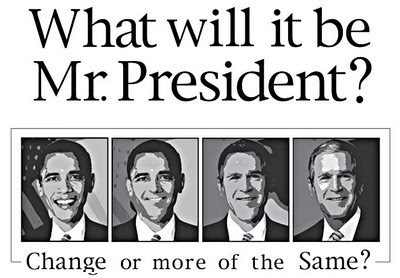
King Obama makes King Bush feel proud of his war legacy: "change?" ha!

I hope Congress has some serious cojones to challenge the imperial presidencies we have been subject to since 2000

More here on this from the NY Times:
President Obama rejected the views of top lawyers at the Pentagon and the Justice Department when he decided that he had the legal authority to continue American military participation in the air war in Libya without Congressional authorization, according to officials familiar with internal administration deliberations. ...
The administration has also emphasized that there are no troops on the ground, that Libyan forces are unable to fire at them meaningfully 
I was sure that my go-to commentator on such constitutional issues, Glenn Greenwald, would have gone ballistic about this, and hypothesized that he would draw the Bush parallels with evidence; he didn't disappoint me:
That George Bush would knowingly order an eavesdropping program to continue which his own top lawyers were telling him was illegal was, of course, a major controversy, at least in many progressive circles.  Now we have Barack Obama not merely eavesdropping in a way that his own top lawyers are telling him is illegal, but waging war in that manner
Greenwald takes this one step more:
what is undeniable is that Obama could have easily obtained Congressional approval for this war -- just as Bush could have for his warrantless eavesdropping program -- but consciously chose not to, even to the point of acting contrary to his own lawyers' conclusions about what is illegal. 
Other than the same hubris -- and a desire to establish his power to act without constraints -- it's very hard to see what motivated this behavior.  Whatever the motives are, it's clear that he's waging an illegal war, as his own Attorney General, OLC Chief and DoD General Counsel have told him.
Why do we keep electing warmongering candidates to the presidency in the first place?  Why do we think that any talk about peace and limiting our military interventions is somehow only being wimpy?  Awful!

I suppose Professor Obama dismissed all the legal advice and went with his own interpretation of the text.  But, wait, what is that old saying about an attorney being his own lawyer?  Oh yeah, has a fool for a client!

Thursday, May 26, 2011

We threw out the Constitution through the Patriot Act :(

Outsourced to Reason:
The reauthorized USA PATRIOT Act has passed the Senate 72-23 and the House 250-153. It heads now to the desk of Barack Obama, who will veto it, in accord with his rhetoric as a senator sign it before the midnight deadline.
So the bastards won, as we always knew they would in the end.
Yes, the bastards won.  We get closer and closer to 1984.  Awful bastards we have as elected representatives from both the parties.

Glenn Greenwald is, as one can imagine, well ... here he is:
Harry "Rove" Reid now joins Dianne Feinstein in announcing that any Senators who try to delay extension of the Patriot Act are risking a Terrorist attack.  Here's what the Majority Leader said about Rand Paul's attempts to add reforms:
"If the senator from Kentucky refuses to relent," Reid said earlier Wednesday, "that would increase the risk of a retaliatory terrorist strike against the homeland and hamper our ability to deal a truly fatal blow to al-Qaida."
It's so outrageous how those Rovian Republicans try to exploit the Terrorist threat to extract civil-liberties-abridging legislation they want, isn't it?  In sum, Congress -- with the Democratic leadership and the White House fully on board -- is trying not only to extend the Patriot Act with no reforms, but prevent any debate on whether that should happen.
So, where are all those Democrats who pilloried Karl Rove and Dick Cheney for saying the same things, right?  Bloody bastards in every party out to screw us all.  There are no two parties in America--it is all the same "screw 'em all" party that rules.

Reason also points out how Al "Fourth Amendment" Franken turns around to vote in support of the Patriot Act


Monday, March 21, 2011

So, who is the real Obama? The Libyan answer is ...?

Salon's War Room is up in arms (yes, a bad pun!) against the military action in Libya, and there is very little there with which I disagree.  Particularly informative were this piece, this, and this.

One that was simply fantastic, and very depressing, contrasted Candidate Obama on presidential war powers versus President Obama exercising those very overreaching powers.  Glenn Greenwald points out the harsh contrast:
consider what candidate Barack Obama said about this matter when -- during the campaign -- he responded in writing to a series of questions regarding executive power from Charlie Savage, then of The Boston Globe:
Q. In what circumstances, if any, would the president have constitutional authority to bomb Iran without seeking a use-of-force authorization from Congress? (Specifically, what about the strategic bombing of suspected nuclear sites -- a situation that does not involve stopping an IMMINENT threat?)
OBAMA:  The President does not have power under the Constitution to unilaterally authorize a military attack in a situation that does not involve stopping an actual or imminent threat to the nation.
As Commander-in-Chief, the President does have a duty to protect and defend the United States. In instances of self-defense, the President would be within his constitutional authority to act before advising Congress or seeking its consent.
Obama's answer seems dispositive to me on the Libya question:  "The President does not have power under the Constitution to unilaterally authorize a military attack in a situation that does not involve stopping an actual or imminent threat to the nation."  And he went on to say that the President could constitutionally deploy the military only "in instances of self-defense." Nobody is arguing -- nor can one rationally argue -- that the situation in Libya constitutes either an act of "self-defense" or the "stopping of an actual or imminent threat to the nation."  How, then, can Obama's campaign position possibly be reconciled with his ordering military action in Libya without Congressional approval
Awful, right?

Ralph Nader comes out of the shadows:
Former presidential candidate Ralph Nader recently rattled off a list of U.S. military and intelligence directives -- apparently including action in Libya -- that he views as egregious violations of international law and grounds for impeachment:
Why don't we say what's on the minds of many legal experts; that the Obama administration is committing war crimes and if Bush should have been impeached, Obama should be impeached.
Hey, Nader, thanks for making me aware many, many years ago that the two parties have rigged the system so much that they are nothing but tweedledum and tweedledee.

Friday, February 04, 2011

Religion in American politics: Happy Yom Chechecheche!

A couple of weeks ago, the governor of Alabama, Robert Bentley, who is a Republican, said the following loudly and boldly (in his Martin Luther King Day message):
anybody here today who has not accepted Jesus Christ as their savior, I'm telling you, you're not my brother and you're not my sister, and I want to be your brother.
That puts to rest any thought that discussions on the separation of church and state ended with the defeat of Christine O'Donnell, who famously raised the question "Where in the constitution is the separation of church and state?"

Let us check in with Texas to see what they think about non-Christians:

The Daily Show With Jon StewartMon - Thurs 11p / 10c
Jewish Speaker of Texas State House
www.thedailyshow.com
Daily Show Full EpisodesPolitical Humor & Satire Blog</a>The Daily Show on Facebook

Wednesday, January 26, 2011

"Guest" post: Why religious arguments in political matters?

One of the sheer joys of being in the profession that I am is this: every once in a while a student decides to engage me in discussions and debates that are not necessarily within the topic areas of the courses I teach.  I cannot think of even one term where I haven't had such an experience.  (A complete contrast to faculty colleagues, who have decided that I am not worth listening to! hahaha!!!)

What follows here is a part of ongoing discussions between me and a student "T" on the topic of science in American political discourse, especially about the problems that Creationists have with science and religion in the public space.  So, with thanks to "T" who has already made this term worth all the time and effort:
In the past, I have engaged in calm discourse with people from the creationist side, but the biggest problem for me is that ignorance is almost a staple in Christian beliefs. Everything relies on faith. To most Christians my age, being confronted with what philosophers call 'The Problem of Evil' should, in my opinion, make people question the true nature of their God. However, in my experience all dissent, reason and logic is viewed as a test of faith. The problem with faith is that reason can never be trumped by reason if people continue to have faith.

To me, this is not a big deal. I believe that there is a considerable amount of people who either can not, or refuse to think for themselves. It is especially hard when those values have been instilled since childhood. And it certainly is easier being able to get a one hour lesson every week on what is right or what is wrong. Or to be able to watch Fox News and know who you should vote for, or what the opposition is trying to do to destroy your familial values. That, to me, is my biggest qualm with the Christian establishment.

Not being religious, I think our government should be secular as it was written. However, the religious establishment refuses to allow this. Regardless of what a president actually believes, none have been elected without a proclamation of religion. If an atheist or agnostic ran for office, there is no way they would succeed in today's political climate. For example, the governor of Alabama recently proclaimed that non-Christians 'weren't his brothers or sisters.' He ended up apologizing for his remarks, but his apology didn't seem to extend to people who were not religious just those of 'all faiths.' To me, it makes me wonder how that is not a violation of the separation of church and state? It sent the message that regardless of if you pay taxes, vote, participate in our democracy, lacking Christian ideals puts you a step below those who do.

This separation to me alludes to the possibility of a tyranny of a majority. A religious establishment under the guise of a secular one. Were the founding fathers wrong when they wrote our Constitution? Minorities only seem to gain protection after great social upheaval. It took a war for slavery. Since then, women have had to protest on a national stage, then African-Americans, and currently homosexuals. In the 1850s it was a legitimate argument to say that people owned slaves in the bible, so it wasn't wrong. Since then, behind every minority group suppressed there was a religious argument, something I don't understand. In a court of law, if evidence is obtained illegally, it can't be used. Why are religious arguments allowed to be used in social matters, when religion is specifically excluded from the state?

Tuesday, October 12, 2010

President Barack O'Bush and civil liberties

ACLU's Executive Director Anthony Romero's blunt talk on why he is disillusioned with Obama's presidency to the point of being "disgusted":
"It’s 18 months and, if not now, when? ... Guantanamo is still not closed. Military commissions are still a mess. The administration still uses state secrets to shield themselves from litigation. There's no prosecution for criminal acts of the Bush administration. Surveillance powers put in place under the Patriot Act have been renewed. If there has been change in the civil liberties context, I frankly don't see it."
Yep. I have blogged many times, quoting the ACLU and Greenwald on how the Obama administration continues with Bush's policies and practices--most, if not all, of which were severely criticized by Obama as the candidate.  Simply atrocious.

Well, renew your ACLU membership, or become a member. (ht)

Update: I just read this wonderful piece by Greenwald, in which towards the end he writes:

Civil liberties and a belief in the need to check government power is something many people care about only when the other party is in control.  They seem to believe that there are two kinds of leaders -- Good ones (their party) and Bad ones (the other party) -- and it's only when the latter wield power that safeguards and checks are necessary.  Good leaders, by definition, are entitled to trust and faith that they will wield power appropriately and for Good ends, thus rendering unnecessary things like accountability, transparency, oversight and even due process.  Of course, the core premise of our government from the start was that political power will be inevitably abused if it is exercised without constraints, that nothing is more irrational or destructive than placing blind faith in political leaders to exercise unchecked power magnanimously.  But the temptation to want to follow Leaders blindly -- to believe in their core Goodness and to thus vest them with unverified trust -- is almost as compelling a part of human nature as the abuse of power when exercised without checks and in the dark.
That's why self-anointed defenders of the Constitution are instantly transformed into authoritarians and back again every time there is a change of party control:  many people don't believe in these principles generally, but only when political leaders they dislike are in power.  The problem, though, is that endorsing civil liberties abuses because one's own Party is in power virtually ensures that those abuses will become permanent, available to future leaders from the other Party as well.  That was the argument which fell on deaf ears when made to cheering Bush supporters, and it's barely more effective now.

Friday, September 17, 2010

Thank the Constitution!

Today it Constitution Day--to recognize the ratification of the US Constitution, and those who have become US citizens.  As a naturalized citizen, I doubly appreciate this day.  A wonderful home this country has been, with all its warts, to quote Shakespeare, "And yet, by heaven, I think my love as rare      As any she belied with false compare."

To mark the occasion, here is a repeat of an earlier post:

Aware that I would be without internet access during my stay in the southern highlands of Tanzania, I took with me the book that I have always wanted to read but kept postponing—The Federalist Papers.

The Federalist Papers is a collection of essays that analyze, defend and, in a way, sell, the American Constitution.  The essays were intended to be along those lines because the principal author, Alexander Hamilton, was deeply worried that the Constitution might not get the backing of enough votes, which would have then brought the revolutionary democratic experiment to a premature end. 

So, in fall1787, soon after the conclusion of the Constitutional Convention in Philadelphia, Hamilton, with considerable contributions from James Madison and John Jay, authored a series of essays advocating the ratification of the Constitution.  Looking at it from 2010, when we continue to operate with that original constitution and with only 27 amendments to it over the more than 200 years since, it does sound strange that Hamilton was so concerned.  But, I suppose this is yet another evidence of the thorough job the founders did and left no stone unturned.

Perhaps it was meant to be that I delayed reading this classic treatise all these years until I was in Tanzania.  For one, it meant reading it under conditions that were not far removed from Hamilton’s times.  After sunset, electricity was available at the Tanzanian village only through a local generator, and that too for a restricted three hours between 7 until 10.  Therefore, most of the reading that I did was while sitting up inside a mosquito net and with a LED headlamp on—instead of candles or oil lamps that Hamilton might have used after sundown.

From a political perspective, of course, Tanzania has been one of the fortunate countries in Africa with a relatively high degree of stability.  In contrast, half the sub-Saharan African countries are authoritarian regimes, according to The Economist magazine’s report on democracy, which classifies countries into full democracies, flawed democracies, hybrid regimes, and authoritarian regimes.  Thus, reading this classic while in Africa, in a continent where democratic governance cannot be taken for granted even in the year 2010, was quite a reminder of how much the 18th century thinking of the framers of the Constitution continues to be way ahead of a great part of the contemporary world. 

Yet, as much as they were blazing a new political trail, the authors of the Federalist Papers were no dreamy idealists.  For instance, Madison notes that “if men were angels, no government would be necessary.” He then masterfully reminds us that government is a reflection of human nature, which then logically underscores the need and structure for checks and balances. Unchecked governments, which seem to be in plenty around the world, certainly do prove that they are no angels.

Lest anybody mistakenly conclude that the Constitution is the perfect model without blemishes and where no ideal was compromised, Hamilton observes in the final—85th—Federalist paper, “I never expect to see a perfect work from imperfect man.”  Yes, we need this reminder in the 21st century America, too, as we continue to renegotiate the social contracts at the federal and state levels in order to correct the old imperfections and to mitigate the new ones we introduce.

The fact that the cogent arguments that are offered in the Federalist Papers are as applicable now as they were back in the 18th century is more than a testament to the clear vision of the founders and their belief in the virtues of democracy.  I now have that much more of an appreciation of my good fortune in having spent all my life in democratic societies, one-half in America and the other, earlier, half in India. 

Finally, reading the Federalist Papers was highly encouraging for a personal reason—these were published as a series of essays in the newspapers in New York.  In other words, discussing policy issues with fellow citizens through the pages of the newspapers is an American tradition that pre-dates even Washington’s presidency.

Which is why I now have a simple explanation for writing opinion columns—it is an absolutely American thing to do!  Thank you, Alexander Hamilton.

Saturday, August 14, 2010