Showing posts with label evolution. Show all posts

Wednesday, September 02, 2020

Are you a man ... or a fish?

Our ears were once gills!

I was blown away when I first came across that idea.  (R)Evolutionary!

The gills that our ancestral fish used to breathe became, over time--as in millions of years--the middle ear and the eardrum and everything else that makes hearing possible.

A few hundred years ago, anybody even thinking along these lines would have been put away in a mental institution because the idea seems so far-fetched.  Yet, this fact is another example of evolution.

Of course, the incremental building up from our evolutionary ancestors makes the the ear and the hearing mechanism so darn convoluted.  And to then think that this entire anatomy exists only to collect information that is processed by the brain that we then recognize as sounds, from cacophony to melody.  The complex human brain deals with the information collected and even fills in the blanks without us knowing.

From a fish gill!

And then to think that there is a matter of personal preference about the sounds that we hear.  Music to one can be noise to another.

I still recall the elders referring to the popular film songs of my teenage years literally as noise (சத்தம்.)  An old friend in India a long time ago referred to Billy Joel's music as heavy metal.  Imagine that!  Years ago, I was playing an opera CD at home when a friend came by. She requested me to shut the music off because she couldn't stand sopranos! Wonderful music to one can easily be horrible noise to another.

While there is a biological explanation for the evolution of gills to ears, and for how we hear, music that we listen to is not a biological necessity.  Why do we have music?

It stems from a creative urge to find patterns in the sounds, in the noise.
It’s an act of rhythm, in tune with the body’s beating heart. From the earliest days on the savanna, humans scream, they shout, they hiss. They clap their hands, they stomp feet. They create noises to chase away adversaries—threatening intruders and imaginary spirits alike.
In the savanna, with various sounds all around, I imagine that there was a survival-urge to make sense of the surrounding noise.  That and our ability to imagine created music.

Music has those primal roots.
Ultimately, music challenges us to face ambiguity, seek solutions and, in the absence of resolution, turn confusion into a positive emotion by reveling in its ambiguity and vagueness. Looking back, noise has been integral to music as long as music has existed, incorporating imitations of birdcalls, animal sounds, and the cries of street vendors. It sounds ironic to say that indulging in noise is how we manage it. But apparently that is how humans shake, rattle, and roll. The visceral, disorienting response of sound’s interaction with the body is what—quite literally—moves us.
All from fish gills!


Thursday, February 21, 2019

Faster, faster ... and even faster!

One of the ideas that I try to get through to students (and in social conversations too) is this: Science and technology are developing faster and faster at speeds that are beyond our human abilities to understand, adapt, and--more importantly--look into the future.  In my intro classes, I routinely tell students that the world as they experience 25 years from now will be wilder than their wildest imaginations.

One of my favorite ways of conveying this to them is for them to imagine a middle-aged human from 10th century being transported into the 15th century.  Not much of a change in the way society works. 

I then ask them to imagine transporting a middle-aged human from a hundred years ago to today.  Students begin to see where I am going; after all, when even their grandparents can't keep up with this world the grandparent of the grandparent will be metaphorical (and literal too?) roadkill in a nanosecond.

If only people listened to me!

If needed--so far nobody has ever asked me to defend my theses--I can easily direct them to this essay by an evolutionary biologist.  He provides a thought experiment that is along the ones that I suggest to students:
Imagine this thought experiment. An infant born on the Pleistocene savannah is switched at birth with another born in 21st-century America. Each would undoubtedly grow up to be a functional member of her society: hunting mastodons or gathering roots and berries in one case, and perhaps running a hedge fund or piloting jet aircraft in the other. Now, delay a few decades and switch these two individuals as adults; the results would be disastrous for both. The biological nature of these individuals will be comparable whereas cultural evolution will have produced qualitatively different circumstances in the two cases, such that individuals carrying only their shared biology into each situation would find themselves woefully unable to function in the other’s cultural milieu.
Yep. Woefully unable.

Our biological inability to keep up with the changes is also a reason why we have a problem even understanding the fact that in a mere 200 years we have heated up the atmosphere and oceans like never before.  It is almost as if our biology is still in the late 19th century, while the science and technology of day is rapidly leading us in a hyper speed into the future.
Insofar as the combustion of fossil fuels generates millions of tons of carbon dioxide, which, via the greenhouse effect, absorbs heat from the sun while preventing much of it from being radiated back into space, our technological hare has set the pace. This phenomenon is largely due to the industrial revolution, barely more than two centuries old, during which time our biological evolution has essentially remained unchanged. Rapid cultural evolution has bequeathed us 50 percent of the problem: the physical and chemical half. At the same time, slow moving biological evolution has left us both reluctant to acknowledge the problem and—even when that psychological roadblock is surmounted—often disinclined to do very much about it.
What's the connection with our biology?
Our biologically evolved selves are quite good at perceiving events that are prompt and threatening; those that are slow-moving, although equally threatening, not so much. A fire in a building and people run outside. A slow moving fire in the Earth’s thermal budget and people hardly notice. For nearly all of our evolutionary past, it was not adaptive to detect such slow-motion changes, and so our ability to do so is limited. 
As the author comments: "An enemy with an upraised club was one thing; a raised ambient temperature—no matter what its cause—would have been quite another."

No wonder the evolutionarily lagging trump and his toadies immediately react to the sight of a brown-skinned immigrant at the border, and point at snow as negation of global warming.  By the time the 63 million evolve to where the rest of us are, well, ...

Oh,  I forgot; most of the 63 million deny evolution too ;)

Tuesday, July 03, 2018

Let's play ball!

I remind students that there is a really easy way to realize that we don't know a damn thing.  All we have to do is step outside and look at the living and non-living things around us and ask questions.  It is always humbling.

Or, without going outside, to read something.  Like this one.  

Now, before I get into that article, lemme ask you a question.  If you have seen elephants, there is a good chance you have seen an elephant's penis. Right?  Have you seen an elephants balls?  Its testicles?

Have you?

Think about it.  Picture a male elephant in your mind.  Go beyond the tusks and the ears. Look under its big fat belly.  Do you see its balls?

Until I read that essay, I had never paid attention to elephant testicles.  Not that I walk around looking at testicles.  But, yeah, of course, a dog's balls are hanging--unless we owners neuter them.  

Humans have dangling balls.  Elephants are mammals.  What about their balls? "elephants have their testicles nestled deep within their bodies, all the way up near their kidneys"
That’s unusual: In most other mammals, testicles form during embryonic development near the kidneys and then descend, either to the lower abdomen or an external scrotum, by the time of a male’s birth.
So, we have seen an elephant's penis but not its testicles because there is no scrotal sack where the balls hang!

I did not know that!
Biologists have wondered about this discrepancy for decades. Did the earliest mammals retain their testicles, like elephants, or did they let their family jewels drop?
Studying the DNA of 71 mammals, a German team concluded that testicular descent is an ancestral trait that was later lost in so-called afrotherians, a ragtag group that includes elephants, manatees and several insect-eaters that live in or originated from Africa.
Seriously,  how do people ever walk around with an arrogant sense of I-know-it-all?  

Which then led me to wonder ... we men have at some time or another, accidentally--like a ball crashing into our balls--or because of another person hitting us, felt an unimaginable pain when the testicles were punched.  Isn't it evolutionarily stupid to let such an important reproductive member exposed to danger?  Why aren't we humans protective of our balls like elephants are?

I leave that for the interested reader, along with this boner, er, bonus piece.

Thursday, September 29, 2016

Jumbo shrimp is not an oxymoron?

"I am on a sea food diet" offers a wonderful pun on sea and see.  It was funny the first time I heard it years ago, and I still find it funny.

For billions of people, other than a few like Ramesh and me, sea food is not any punch line at all; they love sea food.  The only thing that usually keeps them away from the sea food?  The cost of it.

But, as people get more affluent, they then begin to consume more sea food. Where will all those marine critters come from?

Before you think about that, consider chicken or beef.  Wasn't it the same story?  As people got richer, they started eating more beef and chicken.  Or pigs and mutton.  Whatever. The point is that the demand for animal protein picks up with affluence, right?

How did we manage to meet the demand for chicken? Big time factory production and processing, yes?  Similarly, large pig farms.  So, what is good for the chicken and the pigs is good for lobsters and shrimp?

It looks like that is already underway, "to build the largest shrimp farm in the developed world" but with an interesting twist:
Project Sea Dragon’s viability rests on creating in a laboratory in a few years what centuries of natural evolution hasn’t achieved. Scientists are attempting to unlock the genome of the Black Tiger prawn to make a super invertebrate that will grow faster, fight disease more effectively and taste better than its free-roaming brethren.
“It’s super-charging natural selection,” said Dean Jerry, the professor at James Cook University in Townsville, north Queensland, who leads a team working on the project with funds from Seafarms and the Australian government. “What we’re really trying to breed for ultimately is a prawn which grows as fast as it can.”
Evolution on steroids?
A female Black Tiger prawn produces as many as 400,000 offspring in a single spawn, giving picky scientists a wide range of candidates to advance to the next generation. ... [Seafarms director Chris] Mitchell's goal is to breed such hardy and tasty prawns that the project will never have to catch wild ones again.
Frankly, eating cockroaches of the sea creeps me out.  I find it funny that most of the same people who love to eat bugs from the salty waters are aghast at the idea of eating bugs from land!  Oh well, humans don't always have to be rational, eh!
The first offspring from the project could be ready for sale at the end of 2018, and the site is targeting full output of 162,000 tons of prawns a year. That’s more than four times Australia’s current annual prawn consumption.
The prawns will grow on a 10,000 hectare (25,000 acre) slice of the Legune cattle ranch, near the border of the Northern Territory and Western Australia. There’s also a hatchery near Darwin, and more than 2,000 kilometers to the west, a quarantine station for the founding families.
Now, before you go ballistic and start criticizing such industrial, factory, production of food, ahem, you may want to check with this op-ed on "Why Industrial Farms Are Good for the Environment."  Blame it all on our affluence, if you prefer--because, the richer we are, we apparently demand more and better food.

As the author notes:
There are no easy answers, but innovation, entrepreneurship and technology have important roles to play.
 There is another option: Eat like how people ate 200 hundred years ago! ;)

Wednesday, December 16, 2015

Face it, this post is hairy!

“You cannot grow a beard in a moment of passion” wrote G.K. Chesterton.   Of course.

Or, as a late great-uncle--a bearded man himself--put it, "I don't grow a beard.  I simply stopped shaving."

As a bearded male, I have more than a passing intellectual interest in beards.  If only I could recall that exact moment in graduate school when I decided that I would grow one--a beard, that is.  But, those are the moments that I seem to have forgotten.  Just like I don't really remember when it was that the first hair on my chest showed up.  Or on the legs?   For that matter, when did the first pubic hair appear?  I wish somebody had told me to remember those historic events in my own life; instead, I remember trivial events of world history!

Intellectually, scientists have long been puzzled by the facial hair--on men, to be clear.  As I noted earlier in the context of many young men sporting beards these days,
The answer, according to The University of Western Australia researchers, is because men are feeling under pressure from other men and are attempting to look aggressive by being more flamboyant with their whiskers.
Published in the journal Evolution and Human Behaviour, Dr Cyril Grueter and colleagues were investigating the idea that in big societies, male primates have developed increasingly ostentatious "badges" which may enhance male sexual attractiveness to females and give them the edge over other males.   
But, there is more to the scientific curiosity about male facial hair.  A lot more.  Especially because it is so unique:
It is tempting to think that beards are a holdover from our much hairier progenitors, that for whatever reason, this trait survived as we developed into the naked ape. Yet bonobos, our closest relative in the animal kingdom, lack hair around their mouths—precisely where the human beard grows. It would seem that, if anything, human beings have added hair to their faces, even as they lost it most other places. Even if our ape ancestors had had hairy faces, a question would remain: Why did women lose this hair while men retained it? As it is, a hairy chin and upper lip are virtually unique to the human male.
No, do not slip into thinking that we were made in god's image; most Indian male gods are clean-shaven, which would make me a satan then!

What if the beard is nothing but an evolutionary accident?  You know, that old theory--shit happens!
But most scientists have been reluctant to let it rest there. For one thing, insignificance is an unprovable supposition. It is impossible to say for certain that beards are simply along for the ride, at least not until all the functions of all the human genome are discovered. Scientists seek reasons for things, after all, and it is far more interesting to suppose that beards serve a purpose, obscure though it may be.
In other words, scientists always want to know why that shit happens.  Or, here, why the male facial hair?
A second possible solution builds on Darwin’s idea that beards are ornaments that charmed prehistoric women and can presumably still charm women today. Adherents of this line of thought have worked to replace Darwin’s reliance on vague notions of taste with more concrete psychological and biological explanations for women’s preferences. A third theory takes the opposite approach, arguing that hair is a threat device useful in intimidating rival males and establishing dominance. Women, then, have been attracted, not to the beard as such, but rather to the social dominance that impressively bearded men achieve over other men.
My beard serves a practical purpose too--stroking the beard makes it seem like I am a thoughtful and thinking professor in the classroom.  It works, as long as students do not find out that the beard is a mere prop in the awesome stage that the world is, especially in the fifth part (age):
And then the justice,
In fair round belly with good capon lined,
With eyes severe and beard of formal cut,
Full of wise saws and modern instances;
And so he plays his part.

Saturday, February 28, 2015

Curvy women with long eyelashes ... break wind?

A couple of years ago, I went to an ophthalmologist to get rid of the irritation in my eye.  She looked into my eye.

As she got ready to tell me what the problem was, I felt so compelled to ask her, "doc, will I be able to play the violin?"  You know, the old joke?  The doctor replies, "of course you will be able to."  The patient then says, "wow, how about that!"  And then adds, " because I don't know how to play the violin."

But, I did not.  For once, I was "normal."

She put her gear down.  "You have two eyelashes curving inward and they are poking your eye.  I will pluck those two and you will be fine."

Imagine that!  I could have gone to a beauty salon and gotten this taken care of for less than a tenth of the cost :(

After hearing this, a friend joked, "that's what you get for having long eyelashes."  So, now I was the joke, instead of me kidding around.

Why do we have eyelashes anyway?
Surprisingly, the real reason eyelashes evolved has remained unknown. Research shows that those who lack lashes, which some people do, suffer higher than average rates of eye infection. That suggests they have some sort of protective function. But exactly what this is and how it works has been a mystery. Some people hypothesise that lashes protect eyes from falling dust. Others think that they act rather like an animal's whiskers—detecting foreign bodies before they can do harm, and triggering a protective blink.
I can add one more--to poke me in my eye!

Oh well.  So, anything new from the world of science?
David Hu of the Georgia Institute of Technology and his colleagues think they have cracked the problem. Eyelashes do not protect eyes directly, they believe. Rather, they change the flow of air around the eye in ways that stop dust and other irritants getting in, and moisture getting out.
How does Hu know what? (yes, a lame joke!)
no matter what species of mammal he examined (and he studied 22 of them), the length of its lashes was on average a third of the width of its eye.
So?
Nature has, it turns out, arrived at the optimum eyelash length to keep the cornea moist and dust-free. By reducing air flow over the cornea, eyelashes create a boundary layer of slow-moving air. That stops dust getting through, and also promotes water retention, since moisture is not blown away. Up to a point, the boundary layer grows thicker as the lashes grow longer. But long lashes also act as a funnel, channelling moving air into the eye and disrupting the protective layer. 
No kidding!
Eyelashes have, like many other bodily features, acquired a second function as a signal. But their main job, if Dr Hu is right, is to be a wind break.
So, the next time a pretty young thing flashes her long eyelashes at me, I should decode that as she is breaking wind! muahahaha ;)

Speaking of women, what's up with the curves anyway?  Why so different from men's bodies?
The simple answer, suggests Mr Bainbridge, a British reproductive biologist and veterinary anatomist, is that those curvy bums and boobs, the straight “enviable pins” that newspapers salivate over, ensure the future of humankind.
 Ah, yes, only the Economist will report about "curvy bums and boobs" when reviewing Bainbridge's book!
the book’s ultimate question, what does it mean to be a woman and to balance the “ancient conflicting demands of food, shape and success in a modern, unnatural world”, is one worth asking, even if Mr Bainbridge does not quite answer it.
Now, does the title of this post make sense? ;)

Of course, from there!

Monday, February 23, 2015

The tyranny of tiny tasks that screws up what it means to be human

Readers of this blog--yes, there is more than an audience of me alone--know well that I have a love-hate relationship with technology.  While I appreciate, and am thankful for, the ways in which technological advancements have made my everyday life immensely easy than it would otherwise be, I always worry about the downsides--not unusual, given that I worry even when good things happen to me!

Another interesting nuance here is easy technologies versus demanding technologies.
The choice between demanding and easy technologies may be crucial to what we have called technological evolution. We are, as I argued in my most recent piece in this series, self-evolving. We make ourselves into what we, as a species, will become, mainly through our choices as consumers. If you accept these premises, our choice of technological tools becomes all-important; by the logic of biological atrophy, our unused skills and capacities tend to melt away, like the tail of an ape. It may sound overly dramatic, but the use of demanding technologies may actually be important to the future of the human race.
Indeed, I worry about technology because I am not entirely at ease with how technologies seems to determine what it means to be human.  I want humans to consciously think about this ongoing redefinition.  Whether it is in what we eat, how we meet up with people, how we have sex, I worry a lot, perhaps unnecessarily, that we humans are not thinking through enough.
The problem is that, as every individual task becomes easier, we demand much more of both ourselves and others. Instead of fewer difficult tasks (writing several long letters) we are left with a larger volume of small tasks (writing hundreds of e-mails). We have become plagued by a tyranny of tiny tasks, individually simple but collectively oppressive. And, when every task in life is easy, there remains just one profession left: multitasking. 
What then is a demanding technology?
Three elements are defining: it is technology that takes time to master, whose usage is highly occupying, and whose operation includes some real risk of failure. By this measure, a piano is a demanding technology, as is a frying pan, a programming language, or a paintbrush. So-called convenience technologies, in contrast—like instant mashed potatoes or automatic transmissions—usually require little concentrated effort and yield predictable results.
I like automatic transmissions.  I have heard from people about how they hate automatic transmission because it makes us passive. It makes us, well, idiots, according to the passionate ones.  I hate instant mashed potatoes, and make them from raw potatoes.  But, I do thank the technology that has made possible growing potatoes in plenty and bringing them to the store right by my home.

source, via

The advantage with demanding technologies is that "they constantly require new learning."
The brain is stimulated and forced to change. Conversely, when things are too easy, as a species we may become like unchallenged schoolchildren, sullen and perpetually dissatisfied.
Why is all this discussion important?
we must take seriously our biological need to be challenged, or face the danger of evolving into creatures whose lives are more productive but also less satisfying.
All those excerpts are from the series of essays that Tim Wu--a law professor at Columbia--has at the New Yorker.  In one of those, he writes:
If we’re not careful, our technological evolution will take us toward not a singularity but a sofalarity. That’s a future defined not by an evolution toward superintelligence but by the absence of discomforts.
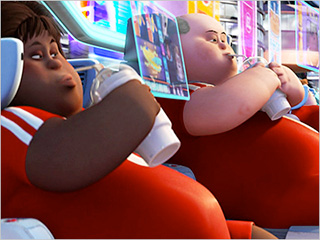
The sofalarity (pictured memorably in the film “Wall-E”) is not inevitable either. But the prospect of it makes clear that, as a species, we need mechanisms to keep humanity on track. The technology industry, which does so much to define us, has a duty to cater to our more complete selves rather than just our narrow interests. It has both the opportunity and the means to reach for something higher. And, as consumers, we should remember that our collective demands drive our destiny as a species, and define the posthuman condition. 
Which is why I am glad there are people growing flowers and vegetables in their yards.  Which is why I spend time putting together my own meals, even if only from step 8.  Which is why some prefer to buy handmade carpets.  We are all, in our own ways, "trying to work out the future of what it means to be human, and, along the way, trying to find out how to make that existence worthwhile."


Monday, December 01, 2014

If only the Tea Party activists ate rice every single day!

Margaret Thatcher famously commented that there is no such thing as society, in her articulation of a political economic thinking that promoted the individual and individual's rights.  Thatcher and Reagan set the world onto reexamining the role of the individual and the individual's contract with others.  As we look around, it is hard not to notice that we are yet to arrive at any definitive version of the contract--in fact, our disagreements appear to be getting more and more intense on the issue of individuals and society (think Obamacare, for instance.)

An anthropology professor notes in the NY Times forum, "The Stone":
modern evolutionary research, anthropology, cognitive psychology and neuroscience have come down on the side of the philosophers who have argued that the basic unit of human social life is not and never has been the selfish, self-serving individual. Contrary to libertarian and Tea Party rhetoric, evolution has made us a powerfully social species, so much so that the essential precondition of human survival is and always has been the individual plus his or her relationships with others.
"Plus" is the operative word there.
The sanctification of the rights of individuals and their liberties today by libertarians and Tea Party conservatives is contrary to our evolved human nature as social animals. There was never a time in history before civil society when we were each totally free to do whatever we elected to do. We have always been social and caring creatures. The thought that it is both rational and natural for each of us to care only for ourselves, our own preservation, and our own achievements is a treacherous fabrication. This is not how we got to be the kind of species we are today.
I don't imagine the patron saint of the Tea Party, Sarah Palin, reading that essay and thinking about the ideas discussed there.  It is a shame that from the intellectual weights of a Jefferson and Franklin and more we have now arrived at the likes of Palin as powerful leaders.  This surely cannot be evolution! ;)

So, why the rice, you ask?  There is a reason, dear reader.  Keep in mind that this blogger does not simply rant like how Palin does!

Here is what a report in the Scientific American notes:
research from the U.S. and China indicates that northern Chinese may have a mind-set closer to individualistic Americans than their southern compatriots. And the reason is rice.
Got your interest there?
Farmers north of the Yangtze predominantly grow wheat, and those to the south grow rice. Cultivating rice is very labor- and water-intensive, and it therefore requires sharing resources. Communities have to cooperate to plant and irrigate. Growing wheat requires half the labor and depends more on rainfall patterns, so it can be managed with much less reliance on one's neighbors.
Sets up well for the question, which is:
[University of Virginia doctoral candidate Thomas Talhelm] wondered if agricultural practices could help explain the more individualistic, or Western, mind-set he found in the north compared with the more holistic, or Eastern, way of thinking in the south.
Aren't you dying to know what Talhelm found?
As expected, the researchers found that holistic thought and loyalty were higher in provinces with rice cultivation and that individualism was more common in wheat-farming areas. To see if the rice theory applied beyond students, the researchers also looked at provincial divorce rates, another indicator of individualism. “Wheat regions had a 50 percent higher divorce rate than rice regions,” Talhelm says.
Aha!  There is more:
The rice theory jibes with other cultural research into how agriculture influences thinking, explains Richard Nisbett, a professor of psychology at the University of Michigan, who was not involved in the study. For example, Nisbett found that in Turkey, farmers (an interdependent occupation) were much more holistic than herders (an independent occupation).
If only Sarah Palin and the Tea Party nutcases would do some serious reading and thinking before they opened their mouths, and if only people across the political spectrum engaged in reading and thinking!

Yep, from the New Yorker ;)

Saturday, June 07, 2014

He that troubleth his own house shall inherit the wind

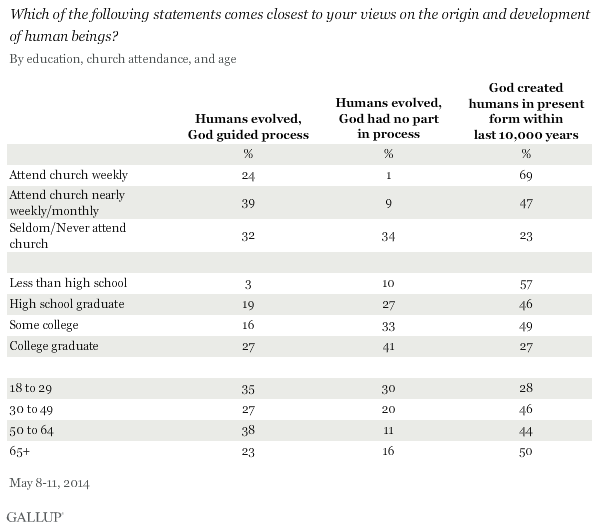
One phenomenally good news about my fellow Americans is this: 19 percent do not think that god was involved in how we came about.

Yes, 19 percent and that is good news.
Because it is an all-time high, and has doubled in thirty years.
Yes, doubled.
And, yes, in thirty years.

Now for the bad news: 73 percent think that either god created humans or guided the process of evolution from other life forms.
73 percent!


Why is this issue so difficult for my fellow Americans?

In order to think through that, well, this is where the subject of this post comes in.  "He that troubleth his own house shall inherit the wind: and the fool shall be servant to the wise of heart" is a proverb from the Bible.  "Inherit the wind," which is a part of that, was a play that I watched with two friends last night at one of the oldest community theatres in the country.

The play
is a fictionalized account of the 1925 Scopes “Monkey” Trial, which resulted in John T. Scopes’s conviction for teaching Charles Darwin’s theory of evolution to a high school science class, contrary to a Tennessee state law. Although the play is not meant to be a historical account, the characters of Matthew Harrison Brady, Henry Drummond, Bertram Cates and E. K. Hornbeck correspond to the historical figures of William Jennings Bryan, Clarence Darrow, John Scopes, and H. L. Mencken, respectively. The trial makes for one of the outstanding dramas of our time—and a subject that still resonates today!
A 1955 play based on the real life events of 1925, and which was made into a movie in 1960.  Despite all the Hollywood gizmos since then, it has been difficult to shake loose this bible-thumping creationist belief, apparently.

Why do I relate the 73 percenters to Bible-thumping?  Because, that too was addressed in the survey:


As the Gallup poll notes:
These Americans tend to be highly religious, underscoring the degree to which many Americans view the world around them through the lens of their religious beliefs. Those who adopt the creationist view also tend to have lower education levels, but given the strong influence of religious beliefs, it is not clear to what degree having more education or different types of education might affect their views.
Oh well!


With our continued anti-science, anti-evolution, outlook, we certainly are destined to inherit nothing but the wind!

Saturday, October 26, 2013

Happiness is what it is. So is unhappiness.

Whenever the context of poverty comes up in my classes, I almost always feel compelled to remind students that poverty and affluence are not the respective synonyms for unhappiness and happiness.  One can expect poor to be unhappy and the rich too can be unhappy. Similarly, one can find happiness among the poor and rich alike.

Extreme, abject, poverty is not what I refer to--a situation in which one is starving, suffering, from a sheer lack of food. That is a terrible condition, indeed.  But, otherwise, happiness is what we make of it.  Despite the best attempts by our brain to dwell on the factors that make us unhappy:
According to Dr. Rick Hanson, a neuropsychologist, a member of U.C. Berkeley's Greater Good Science Center's advisory board, and author of the book Hardwiring Happiness: The New Brain Science of Contentment, Calm, and Confidence, our brains are naturally wired to focus on the negative, which can make us feel stressed and unhappy even though there are a lot of positive things in our lives. True, life can be hard, and legitimately terrible sometimes. Hanson’s book (a sort of self-help manual grounded in research on learning and brain structure) doesn’t suggest that we avoid dwelling on negative experiences altogether—that would be impossible. Instead, he advocates training our brains to appreciate positive experiences when we do have them, by taking the time to focus on them and install them in the brain.
Hmmm ...
The simple idea is that we we all want to have good things inside ourselves: happiness, resilience, love, confidence, and so forth. The question is, how do we actually grow those, in terms of the brain?
Isn't that the tough challenge!  To find the good things, including happiness, within us.

Calvin explains why it is one heck of a challenge:


So, why does the brain focus on the negative?  Evolutionary training at play here:
As our ancestors evolved, they needed to pass on their genes. And day-to-day threats like predators or natural hazards had more urgency and impact for survival. On the other hand, positive experiences like food, shelter, or mating opportunities, those are good, but if you fail to have one of those good experiences today, as an animal, you would have a chance at one tomorrow. But if that animal or early human failed to avoid that predator today, they could literally die as a result.
Too much to think about?  Well, simply live a good life without messing up with others, and enjoy it. Don't overthink--it is what it is! ;)


Tuesday, February 19, 2013

Nostalgia ain't what it used to be

During my graduate school days, I worked as an intern at a transportation planning agency in Los Angeles.  One day, during a conversation on some planning issue, my supervisor, Debra, commented that I seemed to enjoy being a contrarian.  I tried explaining to her that I wasn't contradicting her for the sake of arguing, but that those were serious issues we had to think about.

I knew what she meant though.  In a planning agency, one is expected to follow a certain bottom-line set of ideas.  I, with my free-thinking, either didn't always go along with them or sometimes even explicitly questioned them.  Such a trait has been a constant in my life, perhaps working against my professional advancements, but the free-thinking has been one immensely rewarding intellectual life.  And enriching in my personal life too.

Thus, even now, when I opine in favor of nuclear energy or genetically modified rice, or criticize higher education, but at the same time champion a whole lot of left-of-center values, I am more easily tagged a contrarian than otherwise. Even worse is the contrarian label if I happened to change my mind on issues after years of reflecting on them, even though revising our thesis based on compelling evidence is what the scientific method is all about!

The "contrarian" streak is very much alive when it comes to food and diet.  When academics praise organic foods and advocate for them, I point out that almost always the poorest of poor in the villages of Asia and Africa eat nothing but organic food.  And that organic food hasn't gotten them very far.  Not that I want strange chemicals in my food, but I want to be realistic about "organic."

When people talk about going on diets, I keep quiet mostly because as a thinly built fellow my contrarian comments can be misconstrued in many ways.  But, I would always want to tell them that a diet by itself is not the problem or the solution. Especially when they fondly talk about the food and diet of the old days; because, I then have the urge to remind them that in the old days not only was there not enough food, but even the available food was not good enough.  Under-nourishment was more the norm than otherwise.  I would never want to go back in time. Ever. Because, going back in time means that I have to re-live all those problems our ancestors had to deal with.

In a wonderfully informative and an engaging essay on our "Misguided Nostalgia for Our Paleo Past," Professor Marlene Zuk writes:
It's common for people to talk about how we were "meant" to be, in areas ranging from diet to exercise to sex and family. Yet these notions are often flawed, making us unnecessarily wary of new foods and, in the long run, new ideas.
Yes, it makes us wary of new ideas.  And that is one awful downside.  As I often remark in my classes, what I teach is merely an example of how much humans have progressed from the African Savannah thanks to new ideas.  If we had had nothing but nostalgia for those good old days, then, hello, I wouldn't be blogging this and you wouldn't be reading it either.
Some of our nostalgia for a simpler past is just the same old amnesia that every generation has about the good old days. The ancient Romans fretted about the young and their callous disregard for the hard-won wisdom of their elders. Several 16th- and 17th-century writers and philosophers famously idealized the Noble Savage, a being who lived in harmony with nature and did not destroy his surroundings. Now we worry about our kids as "digital natives," who grow up surrounded by electronics and can't settle their brains sufficiently to concentrate on walking the dog without simultaneously texting and listening to their iPods. ...
Given this whiplash-inducing rate of recent change, it's reasonable to conclude that we aren't suited to our modern lives, and that our health, our family lives, and perhaps our sanity would all be improved if we could live the way early humans did. Our bodies and minds evolved under a particular set of circumstances, the reasoning goes, and in changing those circumstances without allowing our bodies time to evolve in response, we have wreaked the havoc that is modern life.
In short, we have what the anthropologist Leslie Aiello, president of the renowned Wenner-Gren Foundation for Anthropological Research, called "paleofantasies."
 Damn, these people write so well!  I love that phrase "paleofantasies" :)
[In] a larger sense, we all sometimes feel like fish out of water, out of sync with the environment we were meant to live in. If gnawing on that rib or jogging barefoot through the mud is therapeutic, enjoy. But know that should you wish to join us, the scientific evidence will gladly welcome you to the 21st century, in all its inevitable anxious uncertainty.
Perhaps this nostalgia, the paleofantasies, are their defensive approaches to deal with the uncertainties that envelop life.  But, hey, life has never, ever, been for certain.  More importantly, the good old days were not all good old days.

Friday, October 26, 2012

Women's votes ... and the anus, and Penis Worm?

The oversimplification of the "women's votes" in the presidential election has been driving me insane.  The sales pitch as if "women" are some kind of a lobbying group like the Sierra Club or the Chamber of Commerce.  If there is no talk of the "men's votes" then by the same token would it not mean that there is no "women's votes" either?  If men can have various political attributes that can disperse them all over the political spectrum, why treat women as if they are all the same?

Ah, I forget that there is no point arguing with fools!

Samantha Bee does an awesome job on this point. 

So, that led me to the "organ" that Samantha Bee satirically meant when she says that men use to think and act. 

No, not really.

It was a Scientific American tweet that got my attention.  About a "penis worm." Yes, you read that correctly. Now, say that with me: "Penis worm."

Apparently, some new insight from this penis worm could shake the evolutionary tree.  I thought it was something about the penis and the tree of knowledge that got us into trouble in the first place :)
Members of this branch — the protostomes — have historically been defined by the order in which they develop a mouth and an anus as embryos. But gene-expression data suggest that this definition is incorrect
Ok, stop the presses. If any species can't figure out the difference between a mouth and an anus, well, that is serious trouble right there!  Or, wait, this confusion between mouth and anus explains Donald Trump's craziness.

Jokes aside, I had no idea that life forms were also classified in biology based on these two openings:
a major step in evolution occurred when an embryonic ball of cells formed two indentations as opposed to one, giving way to a separate mouth and an anus rather than the single opening that creatures such as jellyfish and sea anemones have. In 1908, animals with a mouth and anus were divided into two groups. In the protostomes (from the Greek for ‘mouth first’), the mouth formed first, and the anus second. In the other, the deuterostomes (‘mouth second’), the mouth formed after the anus.
So, do you now have the same question that I had?  Are humans protostomes or deuterostomes?  I.e., did our mouths form first or was it the anus that formed first?  I am afraid you might not like the answer :)

Friday, September 21, 2012

From Africa's savanna we have become fatsos with feedbags :(

We have come a long way since those early years on the open savanna, and I have my own story to tell.  A familiar topic, yes, and yet I was so taken by the following sentences in this piece in Scientific American (sub. reqd.)
Like our bodies, our brains and behaviors, sculpted in our distant hunter-gatherer past, must also accommodate a very different present.  We can live thousands of miles away from where we were born.  We can kill someone without ever seeing his face.  We encounter more people standing on line for Space Mountain at Disneyland than out ancestors encountered in a lifetime. My god, we can even look at a picture of someone and feel lust despite not knowing what that person smells like--how weird is that for a mammal?
We are one heck of a different species.

Some super-mammal brain we have managed to create over the tens of thousands of years.

We humans will be so much unrecognizable to those savanna inhabitants, but we carry within ourselves many of those traits from a long time ago.
[The] selective demands of food scarcities sculpted our distant forebearers into having a bod that was extremely thrifty and good at storing calories.  Now, having inherited that same metabolism, we hunt and gather Big Macs as diabetes becomes a worldwide scourge.
Back in India, when I was a kid, they used to refer to diabetes as a rich person's disease.  I wonder how much of that was conventional wisdom merely correlating affluence with rich food and diabetes, and how much of that was because of diffusion of scientific knowledge.

This mismatch between our biological drive to get as much calories as possible and the contemporary availability of inexpensive processed simple carbohydrates is becoming a disaster of epic proportions.  Yes, epic proportions here in the US:
The number of obese adults, along with related disease rates and health care costs, are on course to increase dramatically in every state in the country over the next 20 years, according to F as in Fat: How Obesity Threatens America's Future 2012, a report released by Trust for America's Health (TFAH) and the Robert Wood Johnson Foundation (RWJF).
For the first time, the annual report includes an analysis that forecasts 2030 adult obesity rates in each state

(click on the map for the interactive version)
The report projects that by 2030--merely eighteen years from now--almost 60 percent of adult Texans will be obese, unless we change our behaviors.

Wall-E made it easy for us to imagine where we are headed; remember this?
I suppose we watched those scenes while gorging on nachos and super-sized drinks!

Maybe the Onion was onto something a few years ago:
Seriously, this kind of consumption in every possible way is what we want to do after all these years of evolution and migration?  What a disgrace, eh!

Saturday, July 07, 2012

So, why haven't bald men gone extinct?

Years ago, back in California, I asked a colleague--a biologist--why we don't have a greater variety of colors when it comes to hair on our bodies.  The thought was triggered by the daily sights of students, almost always women, with so many colors on their heads, thanks to the dyes humans have developed.

Her reply didn't satisfy my curiosity.  Or, perhaps, I was too stupid to understand her answer?

A few months after that thought, I was shocked at a more personal revelation--I was beginning to develop the typical male bald patches.

A course that I taught had students in the same classroom and students at another off-campus site. The class was held at a television studio-classroom, and images and sounds from the studio were sent in real time to the off campus, and the video and audio from there were beamed back as well.  The off-campus room had only one camera, while the classroom where I was had a camera turned towards the instructor (me) and another from behind me to capture the students.

There was a monitor in my view where I could see the images from the cameras.  And that is when I caught the image from the camera that was behind my back--it showed the back of my head with the (then) thinning hair where the scalp was beginning to shine through.

It was so much a shock that I remember commenting right there something along the lines of "wow, I am going bald!"

Since then, the hairline in front has receded a lot.  The back has become a lot smoother.  When raindrops fall, as they do for nine months of the year here in Oregon, there is very little hair on top to act as shock-absorbers, and I can feel every drop falling like a pebble.

Over the years, the question about hair, in terms of colors, has, therefore, and understandably so, morphed into why there is baldness at all.  Does it serve any evolutionary purpose?  If it does not, and if baldness is a disadvantage, then can we expect bald people to become extinct?

Robb Dunn comments on the question of "why haven't bald men gone extinct?" in the New Scientist.
The hair on our heads may protect us from the noonday sun, maintain body heat when it is cold, and even attract a mate. If so, men who lose their hair are at a disadvantage, and you would expect natural and sexual selection to have weeded them out. So why haven't bald men like me, or at least our versions of genes, gone extinct?
Turns out that it is a teaser essay, without any real explanations; the mystery continues :(

It seems like the rate at which I am balding is far from steady but increases every single day. 

A couple of weeks ago, I wondered how I might look like if (when?) I become fully bald.  So, in a typically scientific approach, I headed (pun intended!) to the barbershop, and came out looking like this:


A few more steps to satisfy my curiosity, and I became:


I don't know about all the bald people, but I am well on my way to extinction :)

Friday, June 24, 2011

Can we ever understand our queer universe?

Richard Dawkins asks:
If the universe is queerer than we can suppose, is it just because we've been naturally selected to suppose only what we needed to suppose in order to survive in the Pleistocene of Africa? Or are our brains so versatile and expandable that we can train ourselves to break out of the box of our evolution? Or, finally, are there some things in the universe so queer that no philosophy of beings, however godlike, could dream them?
What a tragedy if it turns out that we cannot ever figure this out! The latest issue of the Scientific American raises a question on its cover: "Can we get any smarter?"  I really, really, hope we do, though the article itself argues that we may be limited by the physics of the brain.  Even if there are such severe limitations related to mass, miniaturization within the brain, and energy, I hope the collective intelligence of humans will one day crack the mystery of it all.  When after my life ends might this happen? A few hundred years?  A geologic era?


BTW, the "queer" in Dawkins' talk has nothing to do with homosexuality.  Dawkins is working off a JBS Haldane quote:
[My] own suspicion is that the universe is not only queerer than we suppose, but queerer than we can suppose. I suspect that there are more things in heaven and earth than are dreamed of, or can be dreamed of, in any philosophy.

Monday, April 18, 2011

We are one of the great apes. Bananas please!

When I was driving back from Seattle, for a while I listened to the conversation with Richard Leakey in Ira Flatow's program. 

It was such a delight to be able to listen to a casual, and yet informative and educational, conversation.  I tracked down from the transcript the following exchange:
FLATOW: You know, a lot of people who are creationists and do not believe in human evolution, they like to say that no human has descended from a monkey or an ape or a chimpanzee. And that's exactly correct, isn't it? It's not that we were descendants from them, but there's a common ancestry somewhere.
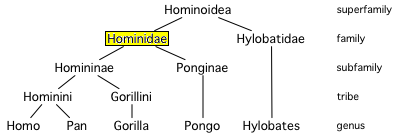
Dr. LEAKEY: Well, indeed. And I think if we were very fair, which humans aren't, and one did - had the classification of primates done by a non-primate, there would be six great apes, not five, because we are just an ape. We just happened to have been a more intelligent one who did the classification ourselves.
I am not sure which one will be a tougher sell with the anti-evolution crowd: that we descended from an ape, or that we are also apes!
 I'm quite sure had Charles Darwin not suggested that we, too, had evolved, evolution would have been perfectly acceptable to everybody. But it wasn't thus and all the evidence today, and there's abundant evidence and very clear evidence, is that we have evolved. And if you go back far enough, our ancestors don't look anything like we do today.
I wasn't sure if Leakey meant it in all seriousness, or was making a political point of sorts that we--the surviving homo sapiens--ought to be recognized as a separate ape.  I am ok with knowing that I am on the planet of the apes :)

Leakey then went on to add this:
people didn't like the idea that the world wasn't the center of the universe. People didn't like the idea that the world wasn't flat. Given time and evidence, people learn to accept these things if they're true. And I think there's no question of the truth of human evolution. None at all.
But, it is quite a challenge:
Dr. LEAKEY: I personally believe that if we could accept human evolution and evolution, science would be much more acceptable. And I think the only way out of the mess this species that's in today is for science to get greater currency value in the world. And I think a lot of biological natural science has been discounted because of the fear of evolution.
Evolution is nothing to be afraid of. And if we could get a lot of money and a lot of attention and look at the last 100,000 years - which I think we can do now - I think we can clear this up once and for all. And it's late, but there is still time.
FLATOW: Are you saying it's a worldwide fear of evolution, or is it mostly in the United States?
Dr. LEAKEY: I think it's growing. I think it's - it is worldwide. I think it's much more of a case in areas where Christianity is - and Islam have a lot of influence. And I think the fundamentalist approach to religion that you're seeing both in those two great religions is making this worse. But you find it in Europe. You find it in England. You find it in Africa. In fact, there are very few African leaders who believe in human evolution and science.
FLATOW: Is that right?
Dr. LEAKEY: And it's very, very worrying, because Africa's problems will only be resolved by African scientists working on those problems. And if we don't teach science from early on, we're not going to get out of this hole, because nobody is going to pull us out of the hole, because they're in one themselves.
FLATOW: Does it make it hard to excavate in these African countries if they don't believe?
Dr. LEAKEY: Funny enough, it doesn't. Because if they don't believe we're looking for human ancestors, they don't care what you're doing.

Sunday, April 10, 2011

Creationism. Only in America. But, not being proud here :(

I told my class the other day that I have pretty much stopped watching television anymore because there is rarely anything interesting.  What I didn't tell them, because of my antiquated notions of keeping politics out of the classroom, was this: American politics is the best sitcom that money can buy, and I am one serious fan of this sitcom.  And, BTW, dammit we spend a lot of money on this hilarious show.

The theatrical production that caught my interest today (ht) was this: Creationism gains ground in Tennessee. 
Tennessee House Bill 368, the creationist friendly legislation that we have previously covered on FrumForum, has passed through of the Tennessee House on a vote of 70-23. The Senate is expected to take up the bill for a vote on April 20th.
I suppose the vote will be in time for Earth Day celebrations in Tennessee, when the politicians will describe how god created the earth that is the center of this universe.

Oh, with one person who didn't vote with his Republican colleagues:
One Republican did vote against the bill however, Representative Bob Ramsey. According to his website, Ramsey also holds a B.S. in Biology.
Anyway, that is not the end of the sitcom--read the following quotes from the honorable members of Tennessee's legislature:
Williamson County Representative Glen Casada says science proponents are intolerant of dissent.
“But there’s now the new religion of evolution. And they in turn are now trying to suppress questioning and free thought.”
Representative Richard Floyd, R-Chattanooga, called the bill a return to common sense.
“And ever since the late ’50s and early ’60s, when we let the intellectual bullies hijack our education system, we’ve been on a slippery slope.”
Dr. Joey Hensley, a Republican from Hohenwald, says a scientific theory is…well, more theory than science.
“Every theory is… just that, it’s a theory. And many scientific theories that we’ve heard from, that people claim, every scientist believes a certain theory, that’s certainly not true.”

Representative Tony Shipley, R-Kingsport, says that as a teacher he worried that he would be criticized for some of the things he taught.
“One of the things that really bothered me, I was told I couldn’t pray with my football players. So I did it anyway. Not only did I do it, I did it in the middle of the football field, on the 50 yard line. So sometimes, it’s important to just do it.”
Representative Sheila Butt, Republican from Columbia, says things she was taught in high school turned out to be untrue.
“I remember so many of us, when we were seniors in high school, we gave up Aquanet hairspray. Do you remember why we did that? Because it was causing global warming. That that aerosol in those cans was causing global warming.
Since then scientists have said that maybe we shouldn’t have given up that aerosol can, because that aerosol was actually absorbing the earth’s rays, and was keeping us from global warming.”
Who knew it would all come down to deeply-buried teenage angst over banning aerosol in hairspray!

Yes, we have our share of nutcases in these United States of America!

And, yes, Tennessee also gave us the famous "Scopes Trial"

At least, it got music :)

Monday, February 21, 2011

The attributes of an intellectual scholar? Really?

Am not so sure about this old saying:

अत्यंतमतिमेधावी त्रयाणां एकमश्नुते ।
अल्पायुर्वा दरिद्रो वा ह्यनपत्यो न संशयः ॥

A very highly intellectual scholar will have at least one of the below three misfortunes - short life, or poverty, or childless.
Fate some how ensures that his wisdom is not carried forward to future generations.

I suppose we could posit that wisdom is not something that is necessarily genetically carried forward. After all, if that were to be the case, then the world would have been flooded by Da Vincis and Einsteins, instead of blokes like me!

Without wisdom being passed down genetically, well, Hollywood has already covered that scenario--Idiocracy :)

Sunday, January 30, 2011

Do you believe in evolution? monkeys-r-us

Wouldn't this be a lovely question to ask every presidential candidate: "do you believe in evolution?"

This question should be featured at every primary--Republican and Democrat. I mean, imagine a Jim Lehrer posing such a question.  I will pay to watch the Republican primaries then :)

And, if the answer is "no" or with a great deal of hemming and hawing, why not follow it up with, as is the case in this video, a question related to antibiotics?  Watch the twisted and ill-informed response from a Republican representative from Georgia. ht

Oh, BTW, the woman threading the antibiotics argument there is the former Canadian prime minister, Kim Campbell--their first, and only, female prime minister.

Friday, January 22, 2010

Destroying "Intelligent Design" into single-cells :)

I wish I had more time to read up on science articles that are not too complicated for me.  I am glad with this recommendation that Ron Bailey had.  This article, in the Journal of Eukaryotic Microbiology that offers a lit-review of the evidence that punctures the argument of the Intelligent Design folks.  And the evidence is all from the single-celled world! 

While it is true that I will not be able to comprehend the finer details of the terms used, I was blown away by this paragraph in that article:
When one considers the tremendous diversity of protistan forms (see Adl et al. 2005), the array of body plans among the Cambrian metazoa pales in comparison. In terms of biological diversity it can be argued that no group approaches that of the protists, especially if one considers that all the plants, fungi, and animals, including the famously diverse Coleoptera, are merely sub-groups of the protistan clades Archaeplastida and Opisthokonta (Adl et al. 2005). Even with the exclusion of the multicellular ‘‘higher’’ eukaryotes, the morphological and physiological diversity among protists is staggering. The major clades of protists contain everything from photosynthetic autotrophs to amitochondriate flagellates and are found in virtually every habitat on Earth (Foissner 2008). The extant diversity of the protists should therefore be seen as the ‘‘background radiation’’ of the eukaryotic Big Bang, with the Cambrian radiation of the metazoa being a subsequent event within a specific group.
I had no idea that there was such a tremendous diversity of those tiny single-celled critters.  The metaphor of the "background radiation" before the biological big bang also really, really appeals to me
And when I read the following paragraph, I thought how cool it will be if the DNA had some kind of a time-stamp on it!!!  I mean, that time-stamp alone can come in handy in everything from crime-scene-investigations to solving the puzzle of when life originated.  Hey, maybe it is encoded somewhere and we are yet to figure it out :-)
As readers of this journal know, DNA sequences are not like birth certificates, stamping an organism with the time and place of its origin. Ancestries inferred from DNA-based methods are founded on comparison of sequence or genomic data, evidence-based modeling of how DNA changes over time, and calculations of the most credible relationship between genetic sequences or patterns. This is just as true for variable number of tandem repeats (VNTR, or so-called ‘‘DNA fingerprint’’) analysis, which is broadly accepted in courts of law, as it is for deep phylogenetic analyses encompassing hundreds of millions of years of evolutionary history. For that matter, acceptance of ‘‘written geneaological records’ requires confidence that the records are not false or misread. Therefore, all methods for determining the history of an organism (except for the direct observation described in the previous section) require theory and well-grounded inference, just as stratigraphic analysis does; they stand or fall together.