Showing posts with label capitalism. Show all posts

Saturday, May 11, 2019

I am not a socialist, but ...

Some of my colleagues think that I am against their left-leaning (in some cases way out left) politics just because I am not in their dues-paying organization.  If only they read even a couple of posts here at this blog!  Or, better yet, if only they had discussed intellectual ideas with me instead of sending me to exile!

The old commie-teenager in me has never really died, as much as the young man with a whole lot of hair has not disappeared from my idea of who I am.  I continue to rail against terrible money-grabbing practices as I have always done.

What increasingly pisses me off is this: The digital economy roars on for those who have money.  For the rest, it is a crawl at best.

Seven years ago, almost to the very date, I ranted against Facebook's IPO.  I quoted from a Forbes column:
Microsoft when public in 1986, its market value was $780 million. Microsoft’s market value would rise more than 700 times in the next 13 years. Bill Gates made millionaires of thousands of ordinary public investors. When Google went public in 2004 at a $23 billion valuation, it left less on the table for you and me. Still, if you had invested in Google then and held your stock, you would be sitting atop a 9x return. Zuckerberg and his Facebook friends took it all.
Money-making in the contemporary digital economy is less and less democratic.

The latest in this is Uber.  (Full disclosure: I have never had an Uber account, but have been in Uber's services a couple of times.)
A successful I.P.O. for Uber will validate and perpetuate the mega-venture capital model, and all the distortions that it entails.
The author--incidentally, an Indian-American--lays out a case, that is less about Uber itself and more about the big venture capital funders:
The largest of Uber’s major shareholders is SB Cayman 2 Ltd., which holds more than 16 percent of Uber shares. That investment represents the SoftBank Vision Fund, a $100 billion mega-venture capital fund that has fundamentally changed the venture financing world. The fund, whose biggest investors are the crown prince of Saudi Arabia and the founder of Japan’s leading internet company, has been writing enormous checks — ranging from $500 million to $5 billion — to start-ups including WeWork, Lemonade, Wirecard and DoorDash. SoftBank’s presence has inflated deal sizes in the venture capital world, where rounds of financing are typically well below $100 million.
These big money funds are taking us all for an uber-ride!

And, of course, Uber is out to screw its employees, er, drivers.  How?  Remember that bottom-line from the Forbes column seven years ago? "The insider pig pile of PE firms and celebrity Silicon Valley angels took it all."  Here too it is the same:
Uber is unprofitable. In fact, they have not really clearly articulated how they're going to become profitable. They have indicated that they intend to clamp down on worker bonuses and incentives, which they acknowledge will upset drivers. At the same time, it's hard to grow, have more drivers, and replace those who turn over and quit, if you're not competitive. And so now we're in a situation of low unemployment. Wages are rising in other industries, but they're not in ride-share driving. So I think they're caught; they're in a price war with Lyft and others. It's hard to see how they're going to be able to accomplish growth, recruiting enough drivers, and become profitable.
So what this IPO is doing is it's giving the Uber investors the potential to cash out. So they may not have to worry about whether Uber ever becomes profitable if they can convince enough people to just buy the stock.
You want an example ?
Mr. McMullen, 33, is part of an exclusive club: the semiretired tech millennial who left California after getting rich. Like many in this group, he is a newly minted multimillionaire who became wealthy by working for high-profile San Francisco start-ups like Uber and Lyft, which are now about to go or have just gone public. Once their wealth was assured, these tech workers quit the companies and fled California, which has the nation’s highest state income tax, at more than 13 percent, to reside in lower-tax states like Texas and Florida, where there is no personal state income tax.
Screw the drivers!
Uber wants to shift the risk, it wants to shift the cost, onto the driver. The end result is that drivers are denied access to worker compensation in an industry that is very dangerous. They have no unemployment insurance, and they obviously get no health or pension benefits. And they're not subject to the wage and hour laws, or laws overseeing race and gender discrimination. So the algorithms that Uber develops are the bosses.
But then, what do I know; after all, according to many of my colleagues, I am nothing but bourgeois trash!

Thursday, September 13, 2018

Because of our traditions, we've kept our balance for many, many years

Manahatta was one of the plays that we watched in Ashland this past June.  It was not in the top-tier of plays that I have enjoyed there over the years.  It certainly had an innovative storytelling by showing the past and the present in parallel.

One of the themes explored in that play was about language and traditions.  The smart daughter gets to a Wall Street firm while her family continues to struggle.  The struggle is not only financial, but also about the language and traditions and everything else that adds up to the identity of the Lenape people.

These struggles are not unique to the US, but are universal.  Canada's First Nations. The indigenous peoples in Australia and New Zealand. In South America. In... everywhere.

In many cases, the language and the traditions were even systematically wiped out by oppressors, who were almost always the invading whites.  Some, like Canadians, have sincerely apologized, and reconciled with the horrible past.

And then there is contemporary India.
Purnima, whose born name is Pukutti, comes from a hamlet deep in the forests of Niyamgiri, where her tribe has lived for centuries, rarely venturing beyond the market towns at the foot of the range. As a small child, she helped her mother sow the dongar, the shifting hillside plots from which the Dongria take their name. They grew millet, bananas, and beans, and at night the children watched for animals—wild dogs, bison, sloth bears, and sometimes tigers. For the Dongria people, “the mountain is God’s abode,” Purnima told me recently. “For many generations, we’ve worshipped these hills, streams, and trees.”
So far, all seems good, right?
There was no school near the family’s home, and Purnima, like many Dongria children, at first received no formal education. The year she turned seven, an official of the Dongria Kondh Development Agency arrived to enroll tribal children in an Ashram, a new government-run residential institution down in the plains. Purnima’s parents did not want her to leave, and they refused to let her go, until the official promised them rations of rice from the local council.
The parallels with Manahatta, and the Canadian First Nations immediately blips in the radar.  The sister, Kuni, who stayed in the forests, and who is illiterate, was one of the many tribal women who were in the forefront of the struggle against a a U.K.-based mining firm that wanted to mine bauxite from the hills and manufacture aluminum.
One night in early May last year, Kuni was asleep in the home of her new in-laws when members of India’s Central Reserve Police Force crept up to their village, Gorata, to arrest her. Kuni says she awoke to the sound of a girl crying, “The police are here!” Then armed men were in the house, hustling her family into the night. Kuni was seized by women constables, who forced her down the trail leading out of the village, to where a convoy of trucks and S.U.V.s were idling.
The authors reporting the tale of these two sisters write:
To close observers of the struggle, Kuni’s arrest is a signal that Vedanta, emboldened by the corporate-friendly national government of Narendra Modi, is setting up a new play for the bauxite in Niyamgiri. To Kuni herself, however, and to others in her tribe, the threat is not that they will be driven off their land but that they will be drawn off of it, like Purnima was, one child at a time.
“Our people are alert to the cause of our land. If the situation demands, we will rise up again,” Kuni told me, and later added, “Our fear is that so-called education will uproot our people. The companies know that ‘educated’ people want to leave. They want jobs elsewhere. That’s why they take our children so far away.”
And how is the residential school system that the other sister is in?
In September of last year, the anthropologist Felix Padel visited an Ashram school in Chatikona, south of Niyamgiri. What he found was, he said, “quite shocking: the girls aren’t allowed to wear their jewelry, and their hair is cut short on arrival, supposedly to get rid of lice.” Teachers seemed well-intentioned, he said, but spoke “in terms exactly reminiscent of colonial-era missionary schools, as if it’s a huge effort to pull these girls out of their traditional culture. Why should that be wished for?”
Is there a different approach that can be attempted?  Kuni suggests that there is:
“Dongria girls need an education, so they can fight for their rights and their land,” she said. “We do need schools, but over here, so they accommodate our knowledge system—what we learn from the Earth and from our community.” Absent that, the transplantation of children seems to her a harbinger of the eventual physical displacement of the Dongrias altogether. “When Vedanta leaves,” Kuni said, “then we will all go to school.”
It is a tragedy that the lands where indigenous people have lived for centuries are also the lands that are rich in resources that salivates the profit-seekers.  Another resource curse!

Caption at the Source:

A woman in traditional Dongria dress.
Of course, the title is from this wonderful song.

Wednesday, May 16, 2018

A skeleton without flesh

Consider this statement:
Global health programs can increase life expectancy or decrease child mortality, but ultimately, people want a higher standard of living.
Re-read that.

And now think about that age old wisdom in "health is wealth."

The guy who flatly declared that it is all about economics? Stephen Moore, who was trump's economic policy adviser during the campaign.  He  wants to gut foreign aid to nothing.  As a nutcase Republican, Moore had the formula to prescribe for development:
All these countries have to do is cut taxes, provide private property rights and get involved in global markets  
Yep, cut taxes, provide property rights, engage in international trade, and within a generation even the Central African Republic can become a Singapore!

What a piece of shithead!

I could never understand the right-of-center's worship of economic growth.  Thus, their endless worship of the economic "successes" like China, for instance.

trump now presiding over such a worship means that we in the US too are doing everything to behave like how China does.  trump's people are hell bent on removing regulations that give priority for the natural environment or labor over economics.  Bizarre and awful.

In this essay about capitalism, the author quotes the profound political thinker Karl Polanyi:
fascism strips democratic politics away from human society so that “only economic life remains,” a skeleton without flesh.
Protecting the flesh, and keeping it healthy, means discussing the very idea that the likes of Stephen Moore, paul ryan, and the way right-of-center maniacs hate: The safety net.
we’d be better off with redistributive programs that are universal—parental leave, national health care—rather than targeted. Benefits available to everyone help people without making them feel like charity cases. Kuttner reports great things from Scandinavia, where governments support workers directly—through wage subsidies, retraining sabbaticals, and temporary public jobs—rather than by constraining employers’ power to fire people. “We won’t protect jobs,” Sweden’s labor minister recently told the Times. “But we will protect workers.” Income inequality in Scandinavia is lower than here, and a larger proportion of citizens work. Maybe a government can insure higher pay for its workers by treating them as if they were, in and of themselves, valuable. True, Denmark’s spending on its labor policies has at times risen to as high as 4.5 per cent of its G.D.P., more than the share America spends on defense, and studies show that diverse countries such as ours find it harder to muster social altruism than more racially and culturally homogenous ones do. Nonetheless, programs like Social Security and Medicare, instituted when a communitarian ethic was still strong in American politics, remain popular. Why not try for more?
Unfortunately, the maniacs are dead set against this.  They would rather govern with a fascist in the Oval office, as long as they can carry out their political agenda.  And they actively sell such a "development" model across the world too! :(

Wednesday, March 28, 2018

Some are more equal than others!

Recall those series of posts here in which I had quoted the Nobel Laureate Svetlana Alexievich?  Those followed my summer reading in 2016.  Among other things,, Alexievich made possible for me to understand why putin continued to be in power in Russia.

Alexievich commented in an interview:
 “In the West, people demonize Putin,” Ms. Alexievich, who turns 68 later this month, said in a recent interview here, speaking Russian through a translator after a conference on her work at the University of Gothenburg. “They do not understand that there is a collective Putin, consisting of some millions of people who do not want to be humiliated by the West, ” she added. “There is a little piece of Putin in everyone.”
The "humiliation."  The emotion that putin has tapped into, in order to Make Russia Great Again!

Source
After having read Alexievich, it does not surprise me that millions of Russians and Eastern Europeans believe that they were better off under communism.
As governments dismantled social safety nets and poverty spread throughout the region, ordinary citizens grew increasingly less critical of their state socialist pasts.
A 2009 poll in eight east European countries asked if the economic situation for ordinary people was ‘better, worse or about the same as it was under communism’. The results stunned observers: 72 per cent of Hungarians, and 62 per cent of both Ukrainians and Bulgarians believed that most people were worse off after 1989. In no country did more than 47 per cent of those surveyed agree that their lives improved after the advent of free markets. Subsequent polls and qualitative research across Russia and eastern Europe confirm the persistence of these sentiments as popular discontent with the failed promises of free-market prosperity has grown, especially among older people.
The surprise, if at all, is that we are surprised when, for instance, the Hungarian Prime Minister, viktor orban, systematically assaults the country's democratic institutions.

Alexievich remarked about that right in the introductory pages of her book:
I recently saw some young men in T-shirts with hammers and sickles and portraits of Lenin on them.  Do they know what communism is?
It is doubtful that a great majority of the people there are rooting for communism's return:
Ethnographic research on the persistence of red nostalgia shows that it has less to do with a wistfulness for lost youth than with a deep disillusionment with free markets. Communism looks better today because, for many, capitalism looks worse
The political economic system--loosely referred to as capitalism--in the US and the UK was not noble by any means.
The US, a country based on a free-market capitalist ideology, has done many horrible things: the enslavement of millions of Africans, the genocidal eradication of the Native Americans, the brutal military actions taken to support pro-Western dictatorships, just to name a few. The British Empire likewise had a great deal of blood on its hands: we might merely mention the internment camps during the second Boer War and the Bengal famine.
So, where do we go from here?
We should all embrace Geertz’s idea of an anti-anti-communism in hopes that critical engagement with the lessons of the 20th century might help us to find a new path that navigates between, or rises above, the many crimes of both communism and capitalism.
Easier said than done in these days of the scumbag, er, president of the US, tweeting hate!


Friday, December 22, 2017

In support of peaceism

In my classes, when students pepper their responses with any "ism"--capitalism, in particular--I tell them to avoid those usages.  At least in my classes, even if they continue with that practice elsewhere.  I tell them that while we think that we know what any "ism" means, and while we believe that everybody else agrees with that understanding, the reality is very different.

Most of us will find it difficult to define and explain any "ism."  Ask a devout Hindu what Hinduism is and you will stump them.  They will give you some rambling answers.  Even if their answer seems brief, chances of other Hindus agreeing with that brief definition are as rare as a snowfall in Chennai.

Capitalism seems like a word that we are all familiar with, and yet most of us will be hard pressed to articulate a clear and succinct understanding of it.  Even worse is when students beat up on capitalism because their professors did.  I would rather that students developed an understanding of issues and ideas, instead of merely mouthing about "isms."

One of my favorite political economic philosopher writes about capitalism that further reinforces our need to understand what we are talking about:
That we insist on ruminating on something called "capital" does not prove that its accumulation was in fact unique to modernity. And it is not. Romans and Chinese and human beings back to the caves have always accumulated capital, abstaining from consumption to get it.
Accumulating and owning capital is not anything new, right?

But, didn't "capitalism" make us rich?
What made us rich were new ideas for investing it, not the investments themselves, necessary though they were.
Which is what I tell students over and over again: The story of the last two hundred years is a story of ideas.  And, for that matter, it is through new ideas that we have gotten to where we are from the time we figured out permanent agriculture.

Even the capital, or investment capital if we want to be clear, alone does not work. Without new ideas, any amount of capital is mere crap; "financing is merely a necessary condition, not a sufficient one."

Back when I was a bullshitting teenager, I was convinced that it was a lack of money that was holding India back.  I freely and strongly opined that if people did not waste their money by buying gold, then there would be plenty of money for other things.  I forgot to ask myself: "What other things?"  Those other things are the new ideas that have transformed our lives.

So, financing is a necessary condition.  Like many other necessary conditions.
Necessary conditions are endless, and mostly not pertinent—"having liquid water at the usual temperatures" and "the absence of an active civil war" are necessary too, but nobody wants to call it waterism or peaceism.
If only we can make peaceism the dominant ideology!

So, if ideas are what transformed the world, and will continue to transform the world, then where do those new ideas come from?

Now, that is a completely different question from merely beating up on, or praising, capitalism, right?  Like I remind students, understanding the world requires us to ask the right questions.

I also tell them that I rarely ever have the answers.  My job is only to ask questions! ;)

Wednesday, October 05, 2016

Empathy and the social contract

First, read the following excerpt:
It is impossible to imagine Bill Gates’s wealth without Bill Gates’s ingenuity and effort. But it is far easier to imagine Bill Gates’s wealth being produced by someone other than Bill Gates within the institutions of modern American economic society than it is to imagine Bill Gates generating Bill Gates’s wealth in a different time and place – in France in the 1700s, or in the Central African Republic today – in which society was or is less tolerant of entrepreneurial capitalism and the accumulation of personal billions, and where the community of engineers that gave rise to and became America’s tech sector is absent. Indeed, at some point in Microsoft’s history it was Microsoft the information-processing organism that was more critical to Bill Gates’s wealth accumulation than Bill Gates himself. People, essentially, do not create their own fortunes. They inherit them, come to them through the occupation of some state-protected niche, or, if they are very brilliant and very lucky, through infusing a particular group of men and women with the germ of an idea, which, in time and with just the right environment, allows that group to evolve into an organism suited to the creation of economic value, a very large chunk of which the founder can then capture for himself.
That paragraph can easily be used as some kind of an ideological  Rorschach test.  Upon reading that, one can get pissed off and defend Gates's gazillions, or one might applaud in agreement that Gates has been unfairly hogging it all, or ... whatever.

To me, what makes that paragraph standout is this: The author, Ryan Avent, is senior editor and economics columnist at The Economist.  You might remember him from one of my earlier posts?  One of the many reasons why I have been a long-time reader of the Economist is this: It is not an ideological outfit.  It is not like the Nation or the Wall Street Journal.  There is a sensibility that reflects a much broader understanding, which Avent also displays in his essay.

In the essay from which I had excerpted that paragraph, Avent makes an argument that will certainly make one sit up:
The wealth of humans is societal. But the distribution of that wealth doesn’t rest on markets or on social perceptions of who deserves what but on the ability of the powerful to use their power to retain whatever of the value society generates that they can.
His follow-up sentence?  "That is not a radical statement."

After quoting Adam Smith and the wonderful advantages of trade and specialization, Avent writes:
Secure in the knowledge that societal growth would not reduce redistribution (and could indeed increase the value available for redistribution by increasing global output) the incentive to draw the borders of society tightly would be curtailed. The challenge, of course, is to create the broad social interest in an encompassing redistribution. How to do that?
Isn't that the challenge that I have been struggling with all my adult life!  How do we create the broad social interest in redistribution that is needed along with the open borders, trade, and specialization?  How do we develop a social contract that will include redistribution, which the ideologues from the right hate, while also allowing for free trade that the ideologues from the left hate?

Avent writes that Adam Smith the philosopher wrote about that too.  "The force of human empathy can be made to serve either openness or societal mercantilism."  Here again the problem is that we are far more empathetic to people like us, but not towards people completely unlike us.  We conveniently forget that deep down we are all humans, but only view each other through nationalistic or religious or ethnic, or whatever divisive lens we want to use.
There is a better answer available: that to be ‘like us’ is to be human. That to be human is to earn the right to share in the wealth generated by the productive social institutions that have evolved and the knowledge that has been generated, to which someone born in a slum in Dhaka is every bit the rightful heir as someone born to great wealth in Palo Alto or Belgravia. ...
Rich societies can find ways to justify their great wealth relative to others: their members can tell themselves stories about the great things they did that others could not have done that made them wealthy beyond imagination. Alternatively, they could recognize the wild contingency of their wealth, cultivate human empathy, and do what they can to extend the wealth of humans to everyone.
If only we had more empathy.  If only we spent at least as much time thinking about what it means to be human as we spend on entertaining ourselves.  If only ...

Monday, August 24, 2015

Breast milk for the brain

There is a reason why I don't summarily dismiss the concerns that people--typically the sincerely religious--have about issues like contraception, abortion, blood transfusion, organ donation, and more and, hence, their opposition to them.  I understand their worries that all those--and more--further diminish our existence to a mere composite of materials.  An assembly of components that then dilute, or even wipe away, the meaning of our existence and the answer to fundamental questions about life and the universe.  After all, like them, I too often find myself questioning what this is all about, even through my secular and atheistic progressive lenses.

Inquiring into our existence means that I am left wondering about a whole bunch of things, every single day.  To such an extent that sometimes I wonder if I will be better off if I stopped thinking.  I watch a movie and I think.  I listen to a song and I think. I read something and I think.  I think about what I think.  Of course, all the thinking is for naught when I am but a wannabe.  But, I think about that too--on how much I am a wannabe, a fake! ;)

In trying to make meaning of this existence, I have a hard time understanding many of the "developments" like the market for breast milk.  We live in strange times of sperm donors, egg banks, breast pumps, and now even frozen breast milk. It appears that an overwhelming majority are accepting of these new material constructs our existence, while I--an atheist--am with a minority, who are usually uber-religious, thinking and worrying if all these are, ahem, kosher.

So, yes, in this scientific and technological world of ours where capitalism governs our lives, a market for human breast milk has been created.
What are the sources of supply to meet this demand? One source is donations that happen though the 19 locations of the Human Milk Banking Association of North America, as well as other donor organizations. But there are also for-profit companies emerging like Prolacta Bioscience and International Milk Bank which buy breast-milk, screen and test it, sometimes add additional nutrients, and then sells it to hospitals. There are also websites that facilitate buying and selling breast-milk.

This market is one where prices are fairly clear: the for-profit companies typically offer moms $1.50- $2 per ounce for breast milk, and end up selling it to hospitals for roughly $4 per ounce. Quantities are less clear, although for a rough sense, the nonprofit Human Milk Banking Association of North America dispensed 3.1 million ounces of breast milk in 2013, while a single for-profit firm, Prolacta, plans to process 3.4 million ounces this year.
Seriously, you don't think this is one strange world that we have created, and will be passing it along to future generations?  We spend a lot of our time on all things trivial, but we don't pause to think about what it means to the meaning of our existence if there is a market for breast milk?  Either I am messed up, or we are all messed up ;)

Consider the following from that same source:
Earlier this year in Detroit,  a company called Medolac announced a plan to purchase breast milk. It received a hostile open letter with a number of signatories, starting with the head of the Black Mothers' Breastfeeding Association. The letter read, in part:
[W]e are writing to you in the spirit of open dialogue about your company’s recent attempts to recruit African-American and low-income women in Detroit to sell their breast milk to your company, Medolac Laboratories. We are troubled by your targeting of African-American mothers, and your focus on Detroit in particular. We are concerned that this initiative has neither thoroughly factored in the historical context of milk sharing nor the complex social and economic challenges facing Detroit families. ... Around the country, African-American women face unique economic hardships, and this is no less true in our city. In addition, African American women have been impacted traumatically by historical commodification of our bodies. Given the economic incentives, we are deeply concerned that women will be coerced into diverting milk that they would otherwise feed their own babies.
The breast milk market is then ripe for "outsourcing"?  Similar to how there are wombs for rent in India, will the market then establish a breast milk supply chain?  

I worry that most fellow-humans do not seem to want to think about such trends that are overwhelming us.  Perhaps because most people do not want to think about why we exist?  They don't care about all these?  It is not that I have answers to most (all?) of the questions that pop up in my head.  I have no answers at all.  None.

Hmmmm ... wait a second.  Maybe I am messed up because of the breast milk that nourished me.  Which means, we know who is to be blamed for my thinking about all these--the same one who is to be blamed for my fascination with coffee, with cooking, with cleaning, ... ;)

Source
 

Sunday, August 23, 2015

Neither god nor capitalism works in mysterious ways!

The hippie, er, Pope, is on a tear talking up the environment and criticizing capitalism, which will certainly make the right-wing Catholics wonder if Francis is some kind of a Manchurian Candidate ;)  One of the problems I have with the faith-based people, which includes not only the religious but also those who make religions of their favorite causes, is that they often tend to obfuscate facts or even try to hide them.  Ricardo Hausman goes after the Pope with facts.  But, first, what was the Holy See's problem with capitalism?
Pope Francis said in a recent speech in Bolivia: “This system is by now intolerable: farm workers find it intolerable, laborers find it intolerable, communities find it intolerable, peoples find it intolerable. The earth itself – our sister, Mother Earth, as Saint Francis would say – also finds it intolerable.”
Typically, this is what happens when preaching to the choir--there is no dissent. The audience, in fact, leaves even more strengthened in their "faith," which in this case is that all the problems of this world can be attributed to capitalism.

Except for an inconvenient truth--our lives have become way more tolerable than conditions have ever been only thanks to capitalism.  If the Industrial Revolution marks as an easy to reference starting point for the economic system that we now practice, all one has to do is think about life as it was prior to that time period.  How many among us would want to live in the conditions that existed, say, 300 years ago?  (The Pope would, I am sure, because the Vatican was immensely more powerful and influential back then!)

Hausman writes:
In poverty-stricken Bolivia, Francis criticized “the mentality of profit at any price, with no concern for social exclusion or the destruction of nature,” along with “a crude and naive trust in the goodness of those wielding economic power and in the sacralized workings of the prevailing economic system.”...
Francis is right to focus attention on the plight of the world’s poorest. Their misery, however, is not the consequence of unbridled capitalism, but of a capitalism that has been bridled in just the wrong way. 
I am no rah-rah fan of capitalism, as the regular readers know all too well.  But then there is no way I will engage in a rhetorical wholesale condemnation either.  Because, there are far too many nuances to think about.  Consider one of the many sweeping accusations of "profit at any price."  Of course, there are atrocious practices like pollution or ill-treatment of the workers, primarily thanks to how those with money are able to rope the government in and get away with such crimes.  But, there is also the other side of the same system that encourages investments even when they do not generate big time profits at all.

You are perhaps thinking that it is so un-capitalistic for the system to voluntarily support when we think it is always "profit at any price."  James Surowiecki writes about " two common but ultimately questionable assumptions":
 The first is that corporate decision-makers care only about the short term. The second is that it’s the stock market that makes them think this way.
Quick. Can you think about capitalistic behavior that has resulted in strong support for companies that don't seem to generate profits?  Stumped?
Of course, there’s no shortage of investors who are myopic. But the market, for the most part, isn’t. That’s why companies like Amazon and Tesla and Netflix, whose profits in the present have typically been a tiny fraction of their market caps, have been able to command colossal valuations. It’s why there’s a steady flow of I.P.O.s for companies with small revenues and nonexistent earnings. And it’s why the biotech industry is now valued at more than a trillion dollars, even though many of the firms have yet to bring a single drug to market. None of these things are what you’d expect from a market dominated by short-term considerations.
Back when the Pope ruled the world, freedom was not known to most of the world, except for a tiny few who were the rich and the powerful.  It was a world of slavery and diseases and tortures and short-lives and poverty and starvation.  We have a lot more to do in order to address diseases and poverty and starvation and many more human sufferings.  But, no soaring rhetoric condemning capitalism will deliver any miracles, even if the faithful blindly believe in the power of miracles.

Source

Sunday, August 16, 2015

Why do "intellectuals" hate capitalism?

Note upfront that it is "intellectuals" in the title and not intellectuals.  Because of the presumption that there cannot be any intellectual on the right side of the political center.  To "intellectuals," a "leftist intellectual" is tautological because, ahem, intellectuals by definition are leftist!

I like to think of myself as an intellectual (haha, the joke is on me and I don't even know it!) but throughout my professional life I seem to be only pissing off the "intellectuals."  Ever since my graduate school days, when I started to systematically inquire about different ways in which we humans organize and govern ourselves, which is also when I started developing my own flavor of a libertarian-left approach, I have been puzzled at how much the "intellectuals" oppose, dislike, and hate capitalism, even as they benefit from it.

Source

One of my earliest introductions into understanding this came from reading Robert Nozick's "Why Do Intellectuals Oppose Capitalism?"  Nozick noted there:
By intellectuals, I do not mean all people of intelligence or of a certain level of education, but those who, in their vocation, deal with ideas as expressed in words, shaping the word flow others receive. These wordsmiths include poets, novelists, literary critics, newspaper and magazine journalists, and many professors. It does not include those who primarily produce and transmit quantitatively or mathematically formulated information (the numbersmiths) or those working in visual media, painters, sculptors, cameramen. Unlike the wordsmiths, people in these occupations do not disproportionately oppose capitalism. The wordsmiths are concentrated in certain occupational sites: academia, the media, government bureaucracy.
Do you feel yourself agreeing with that definition of "intellectuals" and nodding yes?  Read up that complete essay then and find out Nozick's explanation for why "intellectuals" oppose capitalism! ;)

Of course, I have done my share of complaining and protesting.  A favorite example is from way back when WalMart was aggressively expanding.  I hated it but not because of the profits the corporation made.  I couldn't care about its profits.  But, my distaste for WalMart has always been with respect to how it dramatically alters the urban layout.  The huge store is typically located far away from downtown and away from populated areas, and almost overnight shutters the downtown stores.  The town loses its charm.  The kind of charm that attracts me to towns when I travel.  I couldn't care who made the money, but worried that the urban space was becoming less attractive.  To me, the quality of the place matters--immensely.

Thus, as I keep marching to my own libertarian-left music, I continue to fine-tune my understanding of how we humans govern ourselves.  While never a rah-rah cheerleader for capitalism, I am impressed by how much the profit motive makes people do things that they might not otherwise do.  While people talk big about "do the right thing," they rarely seem to actually do the right thing.  But then provide them with the dollar incentive to do the right thing and they seem a lot more eager to do it.

Over the years, I have also been struck by the contradictions that "intellectuals" display--and have often blogged about it too.  My favorite example these days is Apple.  "Intellectuals" seem to love, love Apple and its products.  Their scathing essays that are highly critical of capitalism are almost always composed on expensive Apple products.  While protesting against capitalism, they tweet using their iPhones.  They seem oblivious to the fact that Apple generates humongous profits.  Profits that are larger than the oil companies that the "intellectuals" protest against.  Profits that make Walmart seem insignificant.  My "socialist" colleagues, who proudly chant their union solidarity songs use expensive Apple laptops while I, who have never been a member of any union, am stuck with a cheap PC!  

It is one crazy world out there.  Perhaps it is the craziness that also makes it all the more exciting for the dull and boring wannabe intellectuals like me!

Monday, August 03, 2015

Steinbeck is not the Saint of Sardines?

Only a few pages into the final one in my deep reads for this summer and I am left wondering why I hadn't read The log from the Sea of Cortez before and why it had to be in the final third of my life.  I suppose there is always a time for everything!

Keep in mind that the book first came out in 1941 when you read the following lines:
In time of peace in the modern world, if one is thoughtful and careful, it is rather more difficult to be killed or maimed in the outland places of the globe than it is in the streets of our great cities ...
It was just before World War II snagged the US also.  Since then, as Steve Pinker has documented, life has never been so peaceful.  The number who die in the US every year from gunshots and automobile accidents is vastly greater than the number who died on that fateful 9/11. One would, therefore, think that people will worry about the death and violence in their own backyards, so to speak.   Yet, we don't worry about our streets and our homes!  In a post a couple of days ago, I, yet again, expressed my disappointment that people do not seem to be want to spend time and effort on more pressing questions and complained about the supremacy of entertainment in our lives.  But then this human behavior is not anything new.  Steinbeck writes in the context of fishing and fishermen:
Hitler marched into Denmark and into Norway, France had fallen, the Maginot Line was lost--we didn't know it, but we knew the daily catch of every boat within four hundred miles.  It was simply a directional thing; a man has only so much. ...
This was not a matter of ignorance on their part, but of intensity.  All the directionalism of thought and emotion that man was capable of went into sardine-fishing; there wasn't room for anything else.
There is only so much that we can be bothered about.  As many students have often commented, while they fully understand that the issues and ideas that I bring to their attention are urgent and important, well, they are maxed out.  It is not that they are ignorant nor are they apathetic; according to them, there isn't room for anything else in their lives.

Of course, if everybody went about doing their own thing, then the world could be a better place.  However, the question is whether all our thought and emotion that we are capable of is dharma.  Or, as Spike Lee put it, "do the right thing."  But, we don't always do the right thing.

All the energy and emotion into fishing led to the collapse of the fishing industry in Stenibeck's own backyard.  That intensity and emotion hit even harder, resulting in this a few months ago, in early spring:
Federal regulators on Wednesday approved an early closure of commercial sardine fishing off Oregon, Washington and California to prevent overfishing.
The decision was aimed at saving the West Coast sardine fishery from the kind of collapse that led to the demise of Cannery Row, made famous by John Steinbeck’s novel of the same name set in Monterey, Calif.

Source
Of course, what happens to sardines is not restricted to sardines alone:
“We have been seeing the impacts of a collapsing sardine population on sea lions and seabirds for years now,” said Ben Enticknap, Pacific campaign manager and senior scientist with Oceana.“Sardine are also prey for recreationally and commercially important species like Chinook salmon and albacore tuna, so the effects of a lack of sardine could have much wider impacts.”
The virtue of selfishness and self-interest, which is the cornerstone in an economic system that has a global appeal, comes with its downside as well because doing the right thing is not about self-interest.  Dharma requires us to make room in our lives for more than the singular directionalism to which we direct all our energy and emotion. Not even the Saint of Sardines can convince a few more people and a few more students about all these, right?

Saturday, July 18, 2015

A not so sorry sari story

Attending a wedding in India, which I did this past December, was awesome for many reasons one of which was this: not only older women but most of the younger women too were wrapped in saris.
Silk saris.
In a mind-blowing array of colors of designs.
No two saris looked the same.
And every woman seemed to delight in the sari that she was wearing.

Right from a young age, I was impressed with the beauty of the sari.  I had no idea about the differences that the elders talked about: Kanchipuram silk versus Benares silk, for instance.  All I knew was that saris were gorgeous and that I liked some more than others.  It was exciting when I was asked for my opinions on the saris and I was always willing to jump in with my comments on the color scheme, the pattern, the "border," and whether it will look good for that particular woman.  I think it is a surprise that I never had even the faintest interest in wrapping myself in one! Thankfully ;)

Of course, there was no equivalent for the males, whose traditional outfits at weddings was nothing but a white veshti and an angavastram.

No Angavastram though! ;)
Thus, it is no surprise that I could sympathize with Sashi Tharoor's lament that women were ditching the traditional saris.   Of course, the intellectual me also felt right away that it was atrocious for Tharoor to complain about the loss of traditions after his own life far, far away from the traditions.  But, I suppose people like us will always talk and write about the rapid changes that lead to the tossing overboard of traditional practices--even saris.  Why, even the half-saris! ;)

As women ditch the traditional saris, the industry that once employed hundreds of thousands has been rapidly changing as well.  In the place of human hands weaving those silk threads into colorful patterns that the silk saris become, machines have taken over.  The artisan and artistic craft is dying.  While Kanchipuram silk continues to flourish for various reasons, Benares silk is long past its glory days.  It is now being sustained in ways that makes this sari-fan jump with joy:
The jobs of the Varanasi weavers, once estimated at a half million men, may have been fading out back then, but on a trip in late 2013 I discovered that efforts were underway by two companies — the socially conscious New York fashion label Maiyet and the Mumbai chain Taj Hotels Resorts and Palaces — to reinvigorate the ancient skill by employing the weavers and inviting tourists to visit them as they work. About 700 people have taken Maiyet’s tour; more than 650 have gone on Taj’s.
Hurrah for capitalism and the profit motive!
The fashion line’s work in Varanasi got the attention of David Adjaye, a star British architect whose international works include the design of the Smithsonian National Museum of African-American History and Culture in Washington. Mr. Adjaye is now designing Maiyet’s building for the weavers, which is to be completed in 2016.
Meanwhile, Taj had started resurrecting the desolate village of Sarai Mohana, five miles from Varanasi, which has a large concentration of weavers. Taj’s plan was to have the weavers make saris for its employees and guests. Since then, the village has been turned into something of a tourist attraction.
How awesome!  
For centuries Varanasi was a hub for the silk trade. The gossamer fabric, woven by hand on long wooden looms, is recognizable to aficionados by its refined feel, substantial weight and audible rustle. ...
Weaving in India dates to 500 B.C. and flourished during the Mughal period from the early 16th to mid-18th centuries. Since Islam traditionally forbids the images of people and animals, weavers created floral brocades for saris and scarves, much like the gold flower pattern on mine.
Weavers, nearly all men, pass down their skills to their sons or male relatives. But their trade has been shaken over the last few decades as power looms offer a cheaper and faster way to produce the same goods, six to 12 meters of material a day, depending on the design; it can take a weaver weeks to create the same amount. This technology left many of the artisans facing starvation and selling the wood from their looms for firewood.
Yes, it is that old tale of technology condemning artisans to starvation. The Luddites found out years ago as the Industrial Revolution unfolded in England that fighting the change is hopeless. Adapt or die.  It was literally the death of one weaver that, ironically, led the hotel chain to employ some:
It was this plight that in 2005 caught the attention of Ratna Krishnakumar, the wife of R.K. Krishnakumar, who was at the time the vice chairman of Indian Hotels Company Limited, of which Taj is a part.
“I had heard about how bad the situation was for these weavers, but the final clinching point came when I was watching the evening news and heard about a weaver in his 30s who had died from overselling his blood to feed his family,” she said in a telephone interview from her Mumbai home.
Mrs. Krishnakumar, 66, came up with the idea of tapping the men to make the saris for Taj’s female front-office staff. The weavers now make saris for 550 women who work at 11 of Taj’s 114 hotels in India.
Mrs. Krishnakumar deserves high praise,don't you think so too?
The project started in 2008 with a dozen weavers but now has more than 40. Mr. Ramrakhiani said that they have woven more than 1,000 saris for the hotel employees. Another group of 12 to 15 master weavers creates saris that are sold at 15 of the hotel’s gift boutiques, including at its properties in New Delhi and London.
Like Mrs. Krishnakumar of Taj, Maiyet’s co-founder and chief executive, Paul van Zyl, was aware of weavers’ problems.
“We naturally hit on Varanasi when we were looking for skilled weavers,” said Mr. van Zyl, 44, the former executive secretary of the Truth and Reconciliation Commission of South Africa, which was set up to deal with aftereffects of apartheid. The high-end line that he started is now available at 50 retailers worldwide, including Barneys New York.
If only the business world can always look a little beyond it's narrow and short-term interests--we will all then be collectively much better off.


Wednesday, June 03, 2015

How does sex work get priced?

A while ago, the Economist published a story with this warning up front:
We rarely feel the need to alert readers to explicit content. But our discussion of the online sex trade requires frank language, and some may find the topic distasteful.
Yes, the Economist!

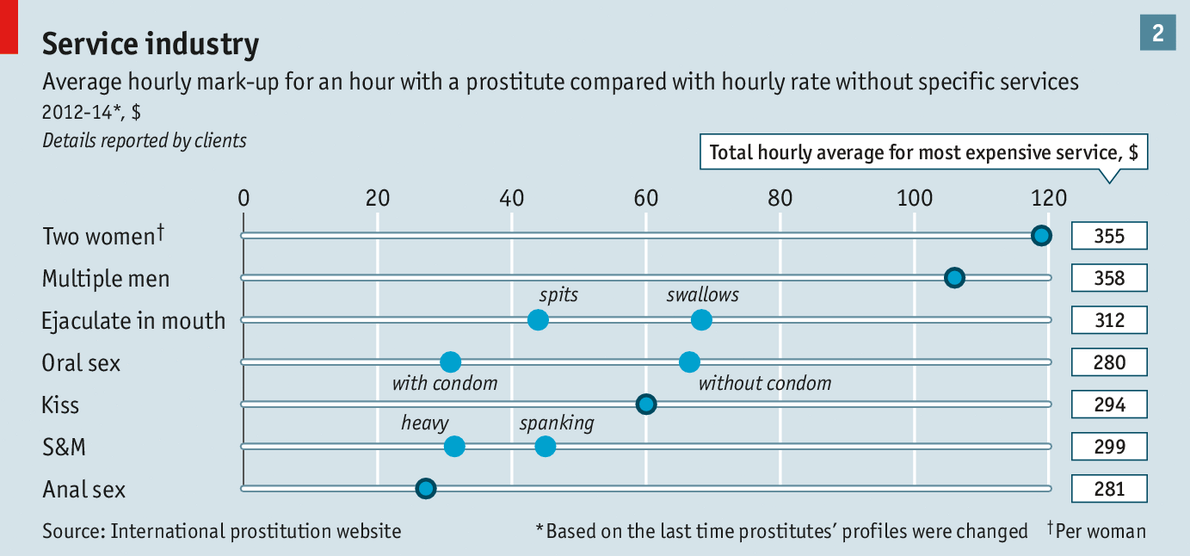
The warning was in place for a good reason; it had charts like the one below and words that can be challenging when a kid is around:


While the vast majority of us are clueless about this industry, we know well that sex is traded as much as various illegal drugs are.  If you are like me, you wonder how they decide to price things?  From a supplier perspective, how do they know what to charge?  What if they are underpricing their services?  What if they can raise their prices, have fewer customers, and still generate higher incomes?  From a demand perspective, how do the Johns know what is a good deal?  Do they comparison shop and, if they do, where are those prices listed?

You see how fascinating the world is?  Every single day is about asking new questions, and finding out that I have no clue whatsoever!

The magazine noted,
Women who are considering entering the industry often seek advice online from those already in it before making up their minds.
Today, I read in another British publication, The New Statesman, which historically has been way left of the Economist, in which a porn actor. Stoya, writes about the need for transparency in how actors are paid.
one thing we rarely talk about openly is pay. Which makes us a lot like many other workers.
Are you thinking about what I am thinking?  How do they even find out about the job openings in the first place?  The magic of the "invisible hand," I suppose!
A well-known performer who had her heyday in the late 2000s once told me that her rate for a double penetration scene was $12,000. I’d just started performing and was under exclusive contract with a single studio – a situation much more like being a direct employee than an independent ­contractor – and had no experience with agencies or booking my own freelance gigs to check this figure against.
Her rate seemed plausible, though – ­being penetrated by two male-bodied people at the same time, one in the anus and one in the vagina, certainly seemed to carry a higher risk of mechanical trauma. Double penetration scenes were rare, as were performers willing to be the receptive partner in them, and rarity tends to add value in any market.
So, when I decided that I wanted to perform in a double penetration scene and the owners of the studio I was with asked how much I wanted to be paid for it, I told them I wanted $12,000. We settled in the middle. Years later it turned out that the performer who had set my expectations so exorbitantly high was actually paid 12 – or possibly 14 – hundred dollars for those sorts of scenes.
Studio contract? Independent contractor?  Freelance gigs? WTF is doubly appropriate here ;)

She writes that "the lack of transparency around rates and my belief in an outrageous lie worked in my favour."  How does the market put a price on a sex act?  This is way too bizarre!
Capitalism, near as I can tell, involves a lot of companies trying to get as much out of a worker as they can for as little pay as possible. In these relationships, the worker should aim for the most pay they can get for the least work. There’s a very important emphasis on “can get”, though, because a luxuriously high rate does absolutely no good if no one is able or willing to pay it.
Stoya articulates one of the toughest issues in market economics--pricing.  That mystery of the marketplace is also why Google hired away an authority on pricing as its Chief Economist.  Yes, the World Bank and the IMF have Chief Economists, and so does Google!
Why does Google even need a chief economist? The simplest reason is that the company is an economy unto itself. The ad auction, marinated in that special sauce, is a seething laboratory of fiduciary forensics, with customers ranging from giant multinationals to dorm-room entrepreneurs, all billed by the world's largest micropayment system.
Google depends on economic principles to hone what has become the search engine of choice for more than 60 percent of all Internet surfers, and the company uses auction theory to grease the skids of its own operations. All these calculations require an army of math geeks, algorithms of Ramanujanian complexity
I don't suppose Google and Varian will want to help out Stoya ;)

Source

Sunday, May 10, 2015

An unholy alliance of the left and the right screws the world's poor!

The last few days I came across one too many commentaries about income and wealth inequality. Inequality within the US, and across the world.  Robert Samuelson's column is in the context of an anniversary.
In 1975, the Brookings Institution — perhaps Washington’s best known think tank — published an elegant essay by Arthur Okun, who had been one of the leading economists of the Johnson administration. The essay was called “Equality and Efficiency: The Big Tradeoff.” Its premise, as the title suggests, was that government faced a choice in fashioning its economic and social policies. A bias toward more equality might weaken economic growth by dulling the incentives to work, save and invest; on the other hand, leaving matters to the market could worsen inequality by widening income and wealth gaps. We could balance equality and efficiency. Once stated, the logic seems impeccable.
Inequality is now worse than it was forty years ago!
How did this happen? How did we end up with degraded efficiency and equality? Why did Okun’s sensible-sounding scheme not survive contact with the real world?
But, that is within the US.  If we, however, looked at the entire seven-billion-plus that we are on this planet, global inequality has reduced.  So much so that the managing editor of the Journal of Economic Perspectives concludes his blog-post with:
the 21st century would be a time of rising equality across the global income distribution.
Data do show that globally inequality is decreasing even as within-country inequality is rising in many countries.  And that is Kenneth Rogoff's point of departure:
Wouldn’t a true progressive support equal opportunity for all people on the planet, rather than just for those of us lucky enough to have been born and raised in rich countries?
He explains:
If current concerns about inequality were cast entirely in political terms, this inward-looking focus would be understandable; after all, citizens of poor countries cannot vote in rich ones. But the rhetoric of the inequality debate in rich countries betrays a moral certitude that conveniently ignores the billions of people elsewhere who are far worse off.
Whenever I ask students in my classes whether we should worry about the increasing inequality in the US, or about the welfare of the economically disadvantaged billions outside the US, after they look at the data, not a student whimpers about the grossness of the inequality in America.  Rogoff reminds us about some of that data:
the middle class in rich countries remains an upper class from a global perspective. Only about 15% of the world’s population lives in developed economies. Yet advanced countries still account for more than 40% of global consumption and resource depletion.
People in America complain because the "ovarian lottery" seems to have lost its value:
global inequality has been reduced significantly over the past three decades, implying that capitalism has succeeded spectacularly. Capitalism has perhaps eroded rents that workers in advanced countries enjoy by virtue of where they were born. But it has done even more to help the world’s true middle-income workers in Asia and emerging markets.
Keep in mind that despite all that economic progress (I won't worry about the non-economic issues for now, because I do that in many other posts) in China and India and Vietnam and wherever, the average American is immensely richer than the average person in many countries around the world.

There is one more way in which all those people in other countries can be given a fair shot at improving their economic conditions:
Allowing freer flows of people across borders would equalize opportunities even faster than trade, but resistance is fierce.
When I bring up this point in my classes, students suddenly become a tad defensive.  I ease them by noting that it is a hot political issue, yes, and even progressives line up against immigration.  

Rogoff doesn't mince words:
Unfortunately, most of the debate in rich countries today, on both the left and the right, centers on how to keep other people out. That may be practical, but it certainly is not morally defensible.
And for a good measure, he reminds us about this too:
Europe’s long history of exploitative colonialism makes it hard to guess how Asian and African institutions would have evolved in a parallel universe where Europeans came only to trade, not to conquer.
Add to that America's slave trade.  And there are more to the list.

We lack definitive answers only when we frame the inequality problem a certain way.  It is just that we don't want to work towards those answers.  We choose to avoid them.  We are being cunningly political.

Monday, April 20, 2015

Meditate on this: birdie num num

Every time I watch The Party I am reminded of Deepak Chopra.

Yes, that movie.  Not politically correct anymore to even mention those kinds of movies in which white people darkened their faces in order to play the roles of dark-skinned characters whose actions were the triggers for slapstick comedy.  But, hey, at the end of it all, it is that character who gets the girl!

Ah, I digress.  So, what's new! ;)

Yes, Peter Sellers:
source

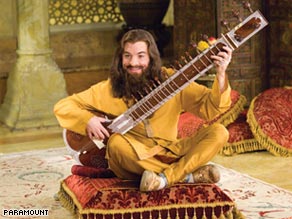
Am not sure if Deepak Chopra plays the sitar.

Source

Oops, sorry, that was Mike Myers ;)

Ok, kidding aside, whenever I come across a reference to Chopra, it is Sellers' Hrundi Bakshi that I immediately think about.  Which is what happened even as I started reading the opening paragraph in this New Yorker piece:
Last month, on CNBC’s “Squawk Box,” Deepak Chopra described the usefulness of meditation for people on Wall Street. Speaking about a friend who manages a hedge fund, he said, “His entire staff meditates. I know many others now on Wall Street that we teach, actually. It makes them much more productive, because they’re centered, they’re not distracted.” Chopra was appearing on TV to promote a free twenty-one-day online meditation course that he offers with Oprah. Its theme is “Manifesting True Success.”
Chopra is a living example to prove PT Barnum's wise words that there is a sucker born every minute.  And Chopra knows how to get all the money that sucker has got!

Chopra is a lot more damaging caricature of Indians than was Bakshi.  This charlatan peddles crap and there are people ready to pay him top dollars for it.  Meditation as a way to make money?  Meditation was for anything but material benefits, and this television evangelist warps the idea.  I imagine that Chopra's next stop will be at the Pentagon in order to sell meditation as the path towards a lot more effective killing and destruction!

But, the New Yorker offers more, which is why I pay my damn money and have subscribed to it for years.
American capitalism has had a long and durable romance with Eastern spirituality, and the latter has hardly undermined the former. For well over a century, business-minded Americans have been transforming Hindu and Buddhist contemplative practices into an unlikely prosperity gospel.
The essay is not about Chopra but about how American capitalism has played on the PT Barnum approach for the longest time.  Chopra is merely one of the latest additions.  My favorite example from there is the following:
Consider the work of Yogi Ramacharaka, whose popular and influential books included “The Hindu-Yogi Science of Breath” (1903) and “Fourteen Lessons in Yogi Philosophy and Oriental Occultism” (1904). Writing in Advanced Thought, a New Thought magazine, Ramacharaka emphasized that his ideas coincided with those of its editor, William Walter Atkinson. “The editor of this magazine has frequently told you that the Touchstone of any teaching is this: ‘Does this make me Stronger, Better and More Efficient?’ I cheerfully support him in this statement, for the same truth is given (in other words) in the best Hindu teachings—in fact, as he, himself, would freely admit, he obtained the idea from such sources.”
And then comes the punchline:
Its not surprising that Atkinson and Ramacharaka claimed the same Hindu sources, because they were, in fact, the same person. Ramacharaka was one of Atkinson’s several noms de plume, and, as the historian Carl T. Jackson points out, Atkinson was “by no means the only New Thought writer to masquerade as an Oriental teacher or to offer an ‘authentic’ course in Eastern wisdom.”
 Suckers after suckers born every minute.
“With business meditation, we have a practice that is extrapolated from Buddhism and secularized so that all of the theological underpinnings are swept away,” Catherine Albanese, the author of “A Republic of Mind and Spirit: A Cultural History of American Metaphysical Religion,” says. “So we have Buddhism stood on its head. Mindfulness meditation has been brought into the service of a totally different perspective and world view.” By now, that’s part of a venerable American tradition.
I am the real sucker, in the American sense.  Instead of living a hermit life in my ashram by the river, I ought to be monetizing my half-baked understandings.  Hey Hrundi, any suggestions for me?


Sunday, August 25, 2013

Doing nothing versus ... doing Bullshit Jobs?

Sometimes, I joke in my classes that the worst invention ever was one that goes back nearly 12,000 years--settled agriculture.  Until then, we humans were no different from other mammals in that we hunted and gathered to feed ourselves, and over the rest of the hours of the day, we played, fought, mated, and scratched ourselves.  And we slept. A lot!

Some stupid humans proposed that we simply stay put, raise some animals, grow some crops, and our problems began.  From that moment on, we were destined to reach the point where we are now.  Growing crops and raising animals meant that we could no longer simply hunt and gather when we felt the hunger pangs, but now had to start planning towards the next meal.  We had to start worrying about the crop going bad, or the animals dying on us.  It was only a matter of time before we played less, mated even less, and slept a whole lot less!

I tell ya, the invention of settled agriculture was the original sin!

Of course, it is all tongue-in-cheek.  I am mighty happy that we have a far better understanding of who we are and where we are in this universe.  Ignorance is no bliss for me.

The process that began 12,000 years ago has led us to the world today in which we do not hunt and gather our food--well, with a few exceptions, that life is impossible for us anymore.  Instead, we work in order to get paid, which we then use to buy the food and more.  The question then is how much do we want to work.  Not much work is needed for mere survival, and a lot more is needed if we want to lead a materially prosperous life.

Quo vadis?

In answering that question, we begin to interpret the options very differently.

David Graeber, a professor of anthropology at the London School of Economics, writes that we are no way near the utopia of a "15-hour work week" because:
Given the choice between less hours and more toys and pleasures, we’ve collectively chosen the latter. This presents a nice morality tale, but even a moment’s reflection shows it can’t really be true. Yes, we have witnessed the creation of an endless variety of new jobs and industries since the ‘20s, but very few have anything to do with the production and distribution of sushi, iPhones, or fancy sneakers.
So what are these new jobs, precisely? A recent report comparing employment in the US between 1910 and 2000 gives us a clear picture (and I note, one pretty much exactly echoed in the UK). Over the course of the last century, the number of workers employed as domestic servants, in industry, and in the farm sector has collapsed dramatically. At the same time, “professional, managerial, clerical, sales, and service workers” tripled, growing “from one-quarter to three-quarters of total employment.” In other words, productive jobs have, just as predicted, been largely automated away (even if you count industrial workers globally, including the toiling masses in India and China, such workers are still not nearly so large a percentage of the world population as they used to be).
But rather than allowing a massive reduction of working hours to free the world’s population to pursue their own projects, pleasures, visions, and ideas, we have seen the ballooning not even so much of the “service” sector as of the administrative sector, up to and including the creation of whole new industries like financial services or telemarketing, or the unprecedented expansion of sectors like corporate law, academic and health administration, human resources, and public relations. And these numbers do not even reflect on all those people whose job is to provide administrative, technical, or security support for these industries, or for that matter the whole host of ancillary industries (dog-washers, all-night pizza deliverymen) that only exist because everyone else is spending so much of their time working in all the other ones.
These are what I propose to call “bullshit jobs.”
A progression from hunting/gathering to settled agriculture to "bullshit jobs."

While I like the way Graeber phrases it as "bullshit jobs," I don't really agree with his explanation that this is all some capitalist conspiracy:
There’s a lot of questions one could ask here, starting with, what does it say about our society that it seems to generate an extremely limited demand for talented poet-musicians, but an apparently infinite demand for specialists in corporate law? (Answer: if 1% of the population controls most of the disposable wealth, what we call “the market” reflects what they think is useful or important, not anybody else.) But even more, it shows that most people in these jobs are ultimately aware of it. In fact, I’m not sure I’ve ever met a corporate lawyer who didn’t think their job was bullshit. The same goes for almost all the new industries outlined above. There is a whole class of salaried professionals that, should you meet them at parties and admit that you do something that might be considered interesting (an anthropologist, for example), will want to avoid even discussing their line of work entirely. Give them a few drinks, and they will launch into tirades about how pointless and stupid their job really is.
...
If someone had designed a work regime perfectly suited to maintaining the power of finance capital, it’s hard to see how they could have done a better job. Real, productive workers are relentlessly squeezed and exploited. The remainder are divided between a terrorised stratum of the, universally reviled, unemployed and a larger stratum who are basically paid to do nothing, in positions designed to make them identify with the perspectives and sensibilities of the ruling class (managers, administrators, etc) – and particularly its financial avatars – but, at the same time, foster a simmering resentment against anyone whose work has clear and undeniable social value. Clearly, the system was never consciously designed. It emerged from almost a century of trial and error. But it is the only explanation for why, despite our technological capacities, we are not all working 3-4 hour days.
Ryan Avent at the Economist counters with this as the point of departure:
 The place to start is to recognise that, romance aside, many of the industrial jobs that have been automated away were incredibly tedious and unpleasant for those doing them.
Indeed!  Can you imagine a job day after day of doing the same thing, like tightening the nuts and bolts of a part, day after day, year after year?  Isn't it better to liberate humans from that kind of awful work?

Avent continues:
One question is why today's workers aren't rewarded with high wages for their suffering. And one possible answer is that, well, they are. Real wages for today's clerical workers are far higher than they were for manufacturing workers a century ago, and the work, for all its tedium, probably isn't nearly as unpleasant. Administrative workers get to sit down in climate-controlled offices, tweeting and playing fantasy football on their desktop when time allows. If firms had to pay more to get a body in the deskchair, they would.
Technology continues to improve, however. Just as robots became ever better at various manual tasks over the past century—and were therefore able to replace human labour in a growing array of jobs, beginning with the most routine—computer control systems are able to handle ever more of the work done by human administrative workers. Jobs from truck driver to legal aid to medical diagnostician to customer service technician will soon be threatened by machines. Starting with the most routine tasks. Human labour will not be eliminated entirely from these sectors. Jobs that require a particularly high level of task flexibility, or creativity, or empathy may continue to employ people (for a while). Yet most office jobs will eventually go the way of the dodo.
And at that point advanced economies may find it necessary to address what is really the central complaint in Mr Graeber's essay. The issue is not that jobs used to have meaning and now they don't; most jobs in most periods have undoubtedly been staffed by people who would prefer to be doing something else. The issue is that too little of the recent gains from technological advance and economic growth have gone toward giving people the time and resources to enjoy their lives outside work. 
I like the way Avent ends his argument:
there is a decent chance that "bullshit" administrative jobs are merely a halfway house between "bullshit" industrial jobs and no jobs at all. Not because of the conniving of rich interests, but because machines inevitably outmatch humans at handling bullshit without complaining
So, there is hope, yet, that a future of not doing anything but to merely watch the day go by is not that far away.

But, wait, what if we end up in a Wall-E world? ;)

Friday, July 19, 2013

"My dream last night was sponsored by Facebook"

I bet there are plenty of people in this world who love sleeping long hours. They talk about how they didn't get out of bed until well into the day.

I am not one of them.

I might waste time, and I do plenty of that, yes.  In fact, I would even make a case that we don't do enough of wasting time. Just idling. Doodling around. Instead, we commit ourselves to way too many activities. Worse, we even bring up kids that way anymore--we wake them up early in the morning, shove down breakfast into their sleepy bodies, pack them off to school, schedule after-school activities, and leave no time at all for simply doodling around.  For kids to then say "I'm bored!"

I get bored a lot. Am so happy that I have enough waking hours and non-working hours to get bored. As a kid, too, I was bored a lot.  My grandmother has commented quite a few times in her life, in response to our whining about being bored, in a highly annoyed tone, "என்ன இது எப்ப பாத்தாலுà®®்?" (what is this all the time?)

Now, boredom has never meant that I should sleep more.  I wake up just to get bored, it seems like.  Boredom and ennui are highly under-appreciated and under-rated, more so in this 24x7 culture that we have created for ourselves.  As Joseph Brodsky noted a few years ago:
When hit by boredom , let yourself be crushed by it; submerge, hit bottom. In general, with things unpleasant, the rule is: The sooner you hit bottom, the faster you surface. The idea here is to exact a full look at the worst. The reason boredom deserves such scrutiny is that it represents pure, undiluted time in all its repetitive, redundant, monotonous splendor.
Boredom is your window on the properties of time that one tends to ignore to the likely peril of one’s mental equilibrium. It is your window on time’s infinity. Once this window opens, don’t try to shut it; on the contrary, throw it wide open.
The mirror image of this--to be constantly doing something--whether it is work or (at the risk of annoying Ramesh, again!) entertainment, is what capitalism seems to prefer.  So much so that the system tries hard to interrupt even that pleasure of sleeping that people might otherwise enjoy:
Sleep, indeed, is a standing affront to capitalism. That is the argument of Jonathan Crary’s provocative and fascinating essay, which takes “24/7” as a spectral umbrella term for round-the-clock consumption and production in today’s world. The human power nap is a macho response to what Crary notes is the alarming shrinkage of sleep in modernity. “The average North American adult now sleeps approximately six and a half hours a night,” he observes, which is “an erosion from eight hours a generation ago” and “ten hours in the early 20th century”.
I sleep for about six hours a night--way less than the average, yes.  But, that is not because I am working hard to make more money, and nor am I being entertained by the money-making entertainers.  I could easily spend time being bored, and I do!
You can’t get more “eyeballs” if the people to whose brains the eyeballs are physically connected are asleep. Hence the interest – currently military; before long surely commercial, too – in removing our need for sleep with drugs or other modifications. Then we would be more like efficient machines, able to “interact” with (or labour among) electronic media all day and all night. (It is strange, once you think about it, that the phrase “He’s a machine” is now supposed to be a compliment in the sporting arena and the workplace.)
If only people would spend time thinking about their lives and what they want to make of it.  How would they want to be remembered after their death?  That they had machine-like work abilities and that they watched a lot television?  Imagine reading that kind of an obituary!
After finishing this book, I had a dystopian nightmare. One day, through clever magnetic stimulation of the brain, it might be possible to insert adverts into our dreams. You could even volunteer to have them interpolated into your sleeping life in exchange for money. (“My dream last night was sponsored by Facebook and Walkers Crisps.”) If that day ever comes, we won’t be safe anywhere
I bet the book-reviewer has now provided the likes of Facebook with a research agenda to insert advertisements in our sleep.

I guess that will be ok as long as the ads in my dreams feature a whole lot of Liril girls ;)