Showing posts with label soccer. Show all posts

Wednesday, June 26, 2019

Oh, say can you see

I use Twitter in ways that it serves me and nobody else. 

If users reply to my tweets, I won't know about those replies unless they are from accounts that I recognize.  If I am curious, I have to go looking for the replies.  Which is what I did about this tweet of mine, which went viral.

It went viral because of a soccer player. A woman. Whose name I had hashtagged: #MeganRapinoe.

One of the replies is this:
The "MAGA" patrol is on the prowl!  Calling a woman a "bitch" is par for the course for them, given how their Dear Leader boasts about grabbing pussies :(

Or, consider this reply:
"saynotoliberal" is the ID.

Meanwhile, their Dear Leader took to his favorite mass broadcast medium and let loose against the soccer star.  Does he not have way more important issues to be concerned about?  Like the trade wars? Or the prospect of real wars?  If course he does not care about those--he knows how to constantly stoke his base, and there are few issues that get his base more excited than when he beats up on women.

Why are the "maga" maniacs so angry at a soccer player, who is integral to the team winning the World Cup

Because ... "she declines to sing “The Star-Spangled Banner” with her teammates."
After Colin Kaepernick began his kneeling protest three years ago, Rapinoe became the first prominent white or female athlete to do the same before a Seattle Reign match in September 2016. In response to her protest, the National Women’s Soccer League and U.S. Soccer Federation have spelled out their policies and tried to curtail Rapinoe’s acts. But she has continued to express herself in various forms. Standing tight-lipped during the anthem is essentially a compromise, but the image continues to look rebellious.
And you know how much the Dear Leader makes literal the adage that patriotism is the last refuge of a scoundrel.
Her stances don’t make her different from her teammates and a detriment to this great soccer program. They verify that she is a product of a revolutionary tradition.
I would never have imagined an American revolution being born in the soccer field!  That kind of a revolutionary spirit is how we will truly make America great again, after the Dear Leader is thrown out of the White House.

Caption at the source:
Megan Rapinoe celebrates one of her two goals against Spain in the Women’s World Cup round of 16 on Monday. 

Wednesday, June 12, 2019

Separate and unequal

As I grew older, I stopped being a sports spectator. Investing time, money, and emotions on people playing does not appeal to me anymore.  Yet, I follow the news about major sporting events because, well, it is news after all.

When I read in the news that a losing semi-finalist at the French Open cried, I couldn't but laugh.  Crying over losing in a sport?  A sport?  At least the Tom Hanks character was dealing with a player crying in a bygone era; but in 2019 a professional cries about losing in a sport?

There is also the soccer World Cup going on.  It is not much talked about though, even by soccer fans, because, well, it is the women competing.  A sport really matters only when men play. That's why the women playing in team America get paid only 38 cents on the dollar compared to the men's team.  Does it matter that the men's team has never won the championship but the women have?  Three times the World Cup champions American women soccer teams have been.

But, nobody cares, and they get 38 cents on every dollar the loser men get!

During the last World Cup, the men's team did not even qualify for the tournament!

And, oh, the women's team has practically ruled at the Olympics ever since it became an official sport there.

You can see why the news interests me.  What women do and accomplish matters very little:
this summer marks the 20th anniversary of the legendary 1999 World Cup final in which the U.S. women’s national team defeated China on penalty kicks before 90,000 fans at the Rose Bowl in Pasadena, California. The '99ers remain American sports icons, but they also epitomize U.S. Soccer’s neglect. The team returned victorious from that World Cup as national heroes poised for huge commercial success. An outline of Brandi Chastain on her knees in exultation after her winning goal could have become a logo as ageless and commercially valuable as Michael Jordan’s Jumpman.
Such is the state of the world!  The high ranking for the team does not translate into prestige and money:
Serena Williams, asked by reporters to comment on the women’s soccer team’s lawsuit after a second-round victory at the BNP Paribas Open in Indian Wells, Calif., called the pay discrepancy “ludicrous,” adding, “I think at some point, in every sport, you have to have those pioneers, and maybe it’s the time for soccer.”
A rational person would think so!  But, the soccer-loving men simply don't want the women's tournament to be shoved down their throats!

Oh well ... What do I know anyway! ;)


Friday, July 03, 2015

Sports has meaning. We render it meaningless!

As a kid, I loved playing indoor and outdoor games alike.  I sucked at cricket, football (soccer,) table tennis, badminton, and (field) hockey; yet, I loved playing them all at school and with the neighborhood kids.

Even the fights that resulted whenever my brother and I played never prevented us from playing again the next day.  I think--or, at least, I like to think that passionate competition, even fist fight, was something I came to expect.  But, right from my young days, I didn't like rough and unsportsman-like attitudes that were driven by a goal to win at any cost.  Winning mattered, yes, but the road to the win was way more important.  One of my favorite memories in cricket is of GR Viswanath recalling the opposing side's batsman after the umpire had ruled him out.  No wonder then that I even wrote an op-ed, seven years ago, dealing with that issue of sportsmanship.

Fair play has always been important to me and that carries over to every aspect of my life--whether it is at work or with family and friends.  To such an extent that I walk away from people--colleagues and family alike--when they sharply deviate from fair play.

These days, I spend even less time than I ever had on watching sports or playing games.  (Well, bridge aside, that is!)  As a news junkie, I scan the latest in the sporting world too, which is how I came to know about England getting booted out of the World Cup:
It was a soccer player’s worst nightmare. With seconds left in a World Cup semifinal on Wednesday, Laura Bassett of England lunged for the ball and accidentally kicked it into her own net.
Seconds later, the whistle blew. Japan had won, 2-1, and Bassett and many other England players were left in tears.
Even during the days that I followed sports with emotions, I could never enjoy winning because I always felt awful for the ones who lost and for their fans.  As I get older, I seem to love the losers even more.  Thus, when I read about this soccer disaster, I was reminded of the Colombian player's fate--he was shot dead for the goal that he ended up kicking for the opponent while defending the ball.  Thankfully, Bassett is being treated well, though one might wonder if some old gender stereotypes are being reinforced in the process:
“Crying is a human emotional response,” Cooky said. “Because sports is so highly masculinized, it’s O.K. for men to cry. When a female athlete cries, it gets read much differently.”
And longstanding differences like those are hard to shake.
“We see male athletes as athletes first,” Cooky said. “We see female athletes as women first.”
Anyway, why do we value sports so much?

An academic philosopher has blogged about this very issue, and he quotes from "the scurrilous Sri Lankan cricket novel Chinaman by Shena Karunatilaka":
"I have been told by members of my own family that there is no use or value in sports. I only agree with the first part. I may be drunk but I am not stupid. Of course there is little point to sports. But, at the risk of depressing you, let me add two more cents. THERE IS LITTLE POINT TO ANYTHING. In a thousand years, grass will have grown over all our cities."
Makes for an interesting point: if there is little point to anything, then why not value sports, right?
Maybe physical skills are less important than purity of character or artistic creativity. The more basic point is that they are valuable in just the same way as other things. Someone who devotes their life to high-jumping or baseball is no less serious a person than someone who devotes it to the ballet, say, or to making money. There is nothing intrinsically dilettante about sports compared with other walks of life.
Certainly.  But, even with those examples, I am left wondering why ballet is vastly undervalued compared to baseball.  
Pride in physical performance is a deep-seated feature of human nature. Humans hone their physical abilities and take delight in exercising them. Perhaps this originally had its roots in the practical needs of hunting, fishing and fighting, but we have come to value physical performance as an end in itself.
Aha, I think that is where my problems with sports lie: "we have come to value physical performance as an end in itself."  We have vaulted sports to such high a pedestal--as if our entire existence is about such things!


Sunday, December 04, 2011

Socrates dead!

The Brazilian soccer star, thanks to whom even a football nincompoop like me stayed up late in the night to watch the World Cup, has died:
He had been in a critical condition with an intestinal infection since being admitted to intensive care on Friday at a hospital in Sao Paulo.
Socrates, who was widely regarded as one of the greatest ever midfielders, was moved onto a life support machine on Saturday.
He played in two World Cups, won 60 caps for his country between 1979 and 1986 and scored 22 goals.
The following is what I had blogged a year-plus ago:
All I remember from that World Cup was one name: Socrates.  It was a simply awesome tournament ... TV was just about being introduced then in the part of India where I lived, and it was the good ol' newspaper and radio that we had to work with.  I wonder if that made it all the more exciting, come to think of it ...

Guess what happened to Socrates?
Sócrates is a doctor of medicine, a rare achievement for a professional footballer (he is a graduate of the Faculdade de Medicina de Ribeirão Preto). Even rarer is the fact that he earned the degree while concurrently playing professional football. There are persistent rumours that Sócrates turned out for the University College Dublin. However, the player himself has denied this saying that he has never even been to Dublin[citation needed].
He is also noted for being an intellectual (he holds a doctorate degree in philosophy), a heavy drinker and smoker, and for his height (193 cm, 6 ft 4 in).

Dev Anand and Socrates on the same day :(

Thursday, January 27, 2011

Tennis: A new China? Cool!

From the Australian Open:
China’s Li Na could ascend to the final while charming everyone in Melbourne with a hilarious postmatch interview in which she blamed her snoring husband for her lack of sleep, among other humorous anecdotes. That spawned the idea that Li could be the crossover star in tennis that Yao Ming was in basketball, but Greg Couch writes on Fanhouse.com that he doesn’t believe she can capture enough attention in the United States. She will get attention in China, however, where tennis was once so obscure Li had to explain the sport to her mother when she decided to play it.


Tennis is, of course, like gymnastics and diving, an individual sport.  Here is a column I wrote on how China doesn't seem to make it in team sports though.

Monday, January 24, 2011

Football: offside versus ineligible receiver :)

It seems like every game has its own quirky rules.  American football has plenty of those.  Cricket is nothing but one quirky rule after another.  Which is why Calvin developing his own rules for playing baseball with Hobbes was all the more hilarious.

Here is John Cleese explaining football's soccer's offside rule:

Ineligible receiver downfield? click here

Tuesday, July 13, 2010

"A modest proposal" to improve soccer :)

P.J. O'Rourke, as always, has quite a few hysterical lines, such as "As an American I remain convinced that English, if spoken loudly enough, can be understood by anyone" ...
before concluding thus:
Soccer matches should be something special, something people eagerly look forward to, something that brightens life. You're almost there. Just use your hands, introduce some full-body blocking, expand the goal area, break up the game a little so that people have time to go to the bathroom between plays and maybe change the shape of the ball slightly so it's easier to carry. Now you've got a sport.

Monday, June 28, 2010

What if Argentina wins it all?:)

A dream final will feature Brazil and Argentina.

But if Argentina wins, and if Maradona fulfils his promise, then we will all have to bear witness to him running naked in central Buenos Aires .... aaaaahhhh :)

Meanwhile, the NY Post sums up the US' loss to Ghana .... ah, the tabloid headlines .... (ht)

Wednesday, June 23, 2010

How to fake it .... learn from soccer

This Ivory Coast player bumps his side into a Brazilian player ... but he goes down holding his nose :)
ht

Come to think of it, this is what most faculty also do at meetings: pretend hurt and anger, when in reality all they do is promote their own interests, hoping that nobody will notice it.
(editor: ahem, aren't you a faculty member, too? Yes, but I skip out of most meetings!)

Sunday, June 13, 2010

How Soccer Explains the World

While India and China seem to be in the news all the time when it comes to economic matters, their noticeable absence from the World Cup tournament in South Africa might be obvious even to those who are not sports junkies.

With a combined population of about 2.5 billion, China and India account for almost two-fifths of the humans on the planet, and yet their teams did not make it to South Africa.  This is not merely the result of the preliminary rounds that determine the qualifiers for the tournament, but might be a reflection of the respective sociopolitical ethos as well.

When the Olympics were held in Beijing last summer, it was clear that China had morphed into a sports power.  Chinese athletes earned the most gold medals—51—but, the United States beat China in the aggregate medal count by ten.  This rapid rise in Olympics was triggered by the Chinese government’s extensive investment in facilities and athletes themselves.

It also turns out that political decisions to invest in sports mean that there is a lot more attention paid to individual performances—such as gymnastics or diving.  Team sports require a lot more planning and coordination at various levels, and are not amenable to delivering quick results.  Further, a football—er, soccer—team, for instance, is simply more than a mere collection of eleven players on the field, and is a wonderful illustration of the philosophical notion that the whole is more than the sum of its parts.  The net result is that China did not get past the third round of the qualifiers for this World Cup. 

The US offers quite a contrast to the Chinese approach in that there is no formal government investment in sports, including football, and expenses are met primarily through sponsorships and endorsements.  The extensive network of youth soccer programs has been slowly and steadily developing quality players and the US soccer teams are no longer taken for granted.

India has neither the Chinese approach to sports, nor does it have an American style bottom-up grassroots structure.  But, it is not because the Indian population or government is indifferent to sports.  For instance, later this year, in October, India will be hosting the Commonwealth Games in New Delhi, and the government spending for it has generated immense controversy. 

Whether it is the Olympics or football, India does not suffer a shortage of television viewership either.  Millions, like my high school friend who lives in Chennai, even re-arrange their schedules in order to keep up with the telecasts from abroad.  But, this passion is not reflected in the results on the field—at the Beijing Olympics, India won one gold and two bronzes for a grand total of three medals. 

Such a situation is not a result of the attention on that other great game—cricket.  After all, teams from countries with significantly lesser population, like Australia or Sri Lanka, often humble the Indian cricket team.  And in field hockey, which is another popular sport in the Subcontinent, teams from the tiny Netherlands routinely rout the Indians.  In soccer, India’s team lost to Lebanon in the first round of the qualifiers.  It turns out that a billion people do not make a sports powerhouse!

A reason that is offered more often than not—even during my childhood years—is that the Indian culture advocates contentment.  Hence, the lack of a “killer instinct” that is needed to push oneself to be a winner in sports. 

As much as it is tempting to buy into this explanation, Sweden offers quite a comparison.  The Swedish folks, after all, have their own word for moderation—“lagom”.  “Lagom” is a way of life that emphasizes individual and social attributes such as enough, sameness, and average.  However, this has not precluded the Swedes from excelling in individual or collective activities. 

A sport is, thus, more than merely about the game itself.  It presents yet another opportunity to begin to understand the peoples of the world, and their cultures and politics.  Yet, if the game of soccer does not grab one’s attention, I suggest the following books as summer readings—“Soccer and Philosophy” and “How Soccer Explains the World.”

Tuesday, June 01, 2010

Soccer mania: 1982, Brazil, and Socrates

All I remember from that World Cup was one name: Socrates.  It was a simply awesome tournament ... TV was just about being introduced then in the part of India where I lived, and it was the good ol' newspaper and radio that we had to work with.  I wonder if that made it all the more exciting, come to think of it ...
Here is a clip of one of those classic Socrates' goals from that tournament

Guess what happened to Socrates?
Sócrates is a doctor of medicine, a rare achievement for a professional footballer (he is a graduate of the Faculdade de Medicina de Ribeirão Preto). Even rarer is the fact that he earned the degree while concurrently playing professional football. There are persistent rumours that Sócrates turned out for the University College Dublin. However, the player himself has denied this saying that he has never even been to Dublin[citation needed].
He is also noted for being an intellectual (he holds a doctorate degree in philosophy), a heavy drinker and smoker, and for his height (193 cm, 6 ft 4 in).
Well, thinking about soccer, and Socrates reminded me of this Monty Python gem: Germany v. Greece :)

Friday, October 02, 2009

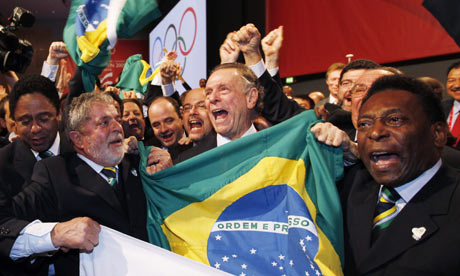
Olympics final score: Pele 1, Obama 0


I mean, did Obama really think there would not be any spin on his trip, particularly when there was a distinct possibility that Rio would be awarded the games?

I think this was the dumbest thing Obama and his advisers have done, yet.  I hope this will be the last one.  There are some issues that even during normal times a President should completely stay away from, and this is one of those.

And, BTW, I am really happy that the US will not host the 2016 Olympics.  It is the most doggone awful waste of money ever.  If the market wants that, well and good. But, to waste tax dollars on it? No way!!!


But, what's up with Pele crying about this?  The soccer magician getting too soft in his older years? :-)

Tuesday, May 05, 2009

Argentina .... I will be there soon .... some day

Even as a kid barely able to hold a newspaper I got to know a little bit about Argentina. It was always in the news--bad economic conditions, dictatorial governments, and later on the Falklands War. And, of course, the news always punctuated with the word "Peronistas". But, there was something about Argentina that captured my imagination--truly my imagination because it was way before the Web, and back in a resource-constrained small town, it was more imagination with the little bit of news than anything else ....
And then there was the sports aspect of Argentina that always made sure it was in the news. In tennis, it was Guillermo Vilas who made sure that I knew where Argentina was. No, I don't play tennis :-) I am just an information junkie! And, of course, football (soccer) and Maradona.

The net result: Argentina has always been on my list of places to go to. Andrew Lloyd Webber's Evita then was the icing on the cake.

As if I did not have enough reasons, the coffee maniac in me then read the following and is now ready to pack my bags :-) (this is an excerpt; read the complete post here.)

The One-Hour Cup of Coffee

henry apr27 coffee.jpg


Buenos Aires is a great coffee city. No, you won't find myriad varieties of beans here, or some great technological advance in the brewing process, but this is a city that knows the art of drinking coffee well, if not the perfect technique to brew it.

In Buenos Aires, you don't get a 20-ounce latte in a to-go cup, in fact there is nearly no coffee to-go in the city, except for a chain of coffee shops called Havanna that offer the amenity. But very few take them up on it (and those that do tend to get strange looks from passers-by).

Instead, coffee here is enjoyed slowly, at a sidewalk cafe, sitting still, in an actual mug, with no plastic lid getting in the way. Throughout the day, locals take their time with it, chatting up friends, admiring the street scenes, or reading the newspaper. Coffee here is a more measured decision, because instead of five minutes you are more likely to spend an hour with your cup.

The coffee is strong, and best enjoyed in smaller quantities--the cortado is my favorite, an espresso with just a spoonful of steamed milk on top (identical to the drink of the same name in Spain). Others prefer the inverse, the lagrima, which is a cup of steamed milk with just a spoonful of espresso (lagrima is Spanish for "teardrop"). There's also cafe con leche, cappuchino, and a wonderful take on hot chocolate called submarino (which I'm saving for a later post).
I want to go there. Please? :-)

Sunday, August 03, 2008

Circket's home shifts from England to India

A few years ago, one book attempted to explain globalization by viewing it through the lens of soccer in How Soccer Explains the World. But, that story did not get into any possible geographic shift in power. Why? Because Europe continues to dominate soccer. While Brazil is a five-time world champion, it lacks the sheer demographic numbers of a China or India.

But, what if either China or India became a big player in a global sport? That is exactly we see happening in cricket. The power shift has happened so quickly and profoundly that “It is no longer correct to speak of the ‘globalisation’ of cricket,” says Gideon Haigh, an Australian writer on the game; “we face the ‘Indianisation’ of cricket, where nothing India resists will occur, and everything it approves of will prevail.” (The Economist)