Showing posts with label children. Show all posts

Monday, July 27, 2020

Do corporations give birth and breastfeed?

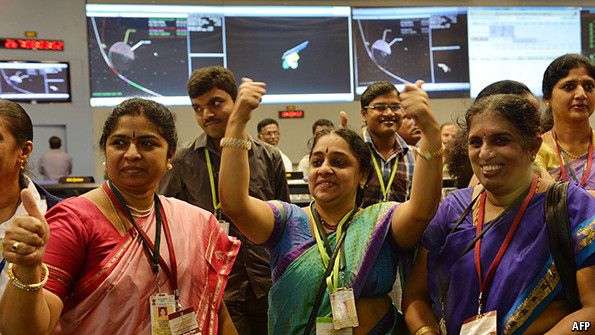
Six years ago, in this post, I wrote about the number of women scientists who were involved in India's success with the Mars orbiter, and included the following image too:


Women rocket scientists.  How awesome, right?

I don't know their back stories.  But, chances are good that if those scientists are also mothers, then child care was never a big worry for them--because, grandparents, almost always grandmothers, took care of the young ones while the parents were off at work.  Nuclear families in which the parents, especially mothers, exclusively take care of their kids is more the exception than the rule in the old country.

Of course, that is not the case here in the United States.

And now the coronavirus has completely upended every aspect of our lives, including schooling and day care centers, which then requires parents to take care of their children 24x7.  In most cases, this huge task falls on mothers, which is a huge challenge when they are also working from home.  It is even more of a challenge if they suddenly became unemployed.
According to research from Syracuse University released last month, more than 80% of adults in the country not working in order to care for children who would be in school or daycare if not for COVID-19 are women. A recent paper published in the academic journal Gender, Work & Organization found that mothers of young children reduced their working hours four to five times more than fathers.
It.Is.A.Nightmare.

Though the following metaphor that Betsey Stevenson uses is not the best one for the context, it conveys the point:
Although young men today are much more likely to profess their belief in gender equality than those of previous generations, they are not significantly more likely to divide most household tasks equitably, from child care to grocery shopping. And COVID-19 does not seem to be changing this dynamic, Stevenson says.
“If the guy is driving toward the cliff of not feeding the children, and the woman is driving toward the cliff of not feeding the children, she pulls off first and she feeds the children,” Stevenson said. “And the problem is that if he knows that she’s going to pull off first, then he wins the game of chicken.”
If that is the situation now, what might be the long-term effects?
Child care is one of those issues where we still really think it’s a personal problem: ‘You made the choice to have those little rugrats. You deal with them.’ Compare that with elder care. We recognized it was a social issue. We built a series of nursing homes and institutional care, and we have societal grants to cover some of that through Medicaid. But with child care, we’ve said this isn’t a social issue. And I think the pandemic has revealed that it is a social issue.
Child care is not a personal issue, it’s not a women’s issue; it’s actually an economic issue. It’s an economic issue because we need to invest in children.
Again, compare with India, where not only child care is a part of an extended family issue, elder care too is part of an extended family issue.

Meanwhile, here in the US, we are leaving parents and their children behind even as we spend gazillions on supporting persons corporations like the airlines.
Come September, I don’t think that the pandemic is enough behind us that every job would be back anyhow. Can we get every job back without child care? Absolutely not. The question is, how much is a lack of child care holding us back, versus how much are people still staying at home because they don’t want to get Covid?
Even if child care is not holding us back in September or October, we are letting the whole child care system erode in such a way that it’s not going to be there for us when we are fully ready to go back.
How so?
Where I really see the child care crisis holding us back is once we are ready to have all the jobs come back and we’re really ready to recover, even though we’ll have opened the schools, opened the child care centers, the workers aren’t going to be there, the slots aren’t going to be there. At the state level, we saw this in the 2008 recession
Very depressing!

Does Professor Betsey Stevenson have a solution?
 The solution has got to be government spending on child care. It’s going to have to be government encouraging and rewarding businesses that provide employees with the flexibility they need in order to balance work and child care. The policymakers debating legislation right now need to realize that caregiving is an essential part of our economy. And it’s an investment that when they make that, they are going to see benefits in terms of economic growth.
The same folks who are happy to cut corporate taxes because they think that’s going to unleash a wave of growth, I want them to realize that if they want to unleash a wave of growth, they need to invest in the next generation so that the current generation can do their work and the next generation is prepared to do it even better.
I am on board with this.

I was/am never a fan of government-subsidies for adults to have children.  But, I have also always believed that subsidies for human issues are far more important than subsidies for corporations to screw our lives.  However, as long as we have a party that is committed to protecting the life of abstract "persons" that corporations are, and with their party faithful committed to defending the "life" of a fetus in a petri dish while not caring about investing in life that is already here alive and suffering, we are doomed.

So ...

Vote accordingly.

Thursday, October 31, 2019

The end of Jammu and Kashmir

Jammu and Kashmir ceases to be state in India.  The mOdi government's fiat takes effect.
India on Thursday formally implemented legislation approved by Parliament in early August that removes Indian-controlled Kashmir’s semi-autonomous status and begins direct federal rule of the disputed area amid a harsh security lockdown and widespread public disenchantment.
The legislation divides the former state of Jammu-Kashmir into two federally governed territories.
As my old country newspaper put it, "The bifurcation of Jammu & Kashmir into two Union Territories came into effect at midnight on October 30."

Three months in and conditions are not looking better.  Especially for kids:
At least 1.5 million Kashmiri students remain out of school. Virtually all private schools are closed, and most government schools are shut — one of the clearest signs of the fear that has gripped Kashmir since the Indian government locked down the disputed territory and separatist militants began carrying out attacks to disrupt its control.
How terrible!
This generation of Kashmiri children has been among the hardest hit. They have known nothing but conflict. For the past 10 years, huge protests and clashes keep erupting. Many young people have seen friends killed, maimed or hauled off by security forces. Their schools are constantly closing, sometimes for months at a time.
What did the kids do to deserve this, right?

What is the rest of the world doing?

Nothing.
The world’s apathy — and the apathy of many Indians — is only perpetuating a climate of fear, silence and repression the region hasn’t witnessed in decades.
And that merely emboldens the fanatical Hindu nationalists.
More of us need to speak up. The world must hear the deafening silence from Kashmir. Looking the other way for strategic relations is not an option. Kashmir and her children are waiting for justice.
But, what can one do?  My government is far more interested in a mafia hit on Ukraine in order to get anything on a political opponent.  And, it was the President who lit the proverbial match with his irresponsible remark (not that he ever makes any responsible remark!)

Back in Kashmir:
The children, meanwhile, are desperate to get out of the house and go back to school. They want to see their friends. They want to learn new things. They know their futures depend on it.
“You should either burn my books and my uniform or send me to school,” Reyan, the fourth grader, grumbled to his father on a recent day as they sat in their house in Baramulla, a town in northern Kashmir.
His father, Pervaiz Ahmad Sofi, a forestry professor, threw open a window and pointed toward a group of soldiers in riot gear, stationed just outside their house, guarding a highway.
“Now tell me, do you still want to go to school?” he said. Reyan looked down and walked away, back to the TV.
This is a fucked up world!


Sunday, October 14, 2018

Kinder Kinder

I want to draw your attention to two meanings in the words that repeat in the title of this post. 

The English language meaning of kinder.  And then kinder as in the German word for children.

Why?

Consider this:


It is a photograph of a child. A five-year old. Her name is Helen.

Here's a question for you.  Would you throw that kid in jail?  Would you separate Helen from her family?  Would you compel Helen to sign on the dotted line and use that piece of paper as a legal document?

You wouldn't.  Because, if you are that kind of a person, you would have stopped visiting this blog a long time ago after you voted for the asshole-in-chief.

Here's the "mug shot" of Helen:


What happened?

63 million racists voted for a guy who lacks even a tiny drop of empathy.  Elections have consequences, like this one.  His administration forced Helen to waive her rights away because she illegally entered this country from Honduras with her family.
According to a long-standing legal precedent known as the Flores settlement, which established guidelines for keeping children in immigration detention, Helen had a right to a bond hearing before a judge; that hearing would have likely hastened her release from government custody and her return to her family. At the time of her apprehension, in fact, Helen checked a box on a line that read, “I do request an immigration judge,” asserting her legal right to have her custody reviewed. But, in early August, an unknown official handed Helen a legal document, a “Request for a Flores Bond Hearing,” which described a set of legal proceedings and rights that would have been difficult for Helen to comprehend. (“In a Flores bond hearing, an immigration judge reviews your case to determine whether you pose a danger to the community,” the document began.) On Helen’s form, which was filled out with assistance from officials, there is a checked box next to a line that says, “I withdraw my previous request for a Flores bond hearing.” Beneath that line, the five-year-old signed her name in wobbly letters.
Re-read this part:
On Helen’s form, which was filled out with assistance from officials, there is a checked box next to a line that says, “I withdraw my previous request for a Flores bond hearing.” Beneath that line, the five-year-old signed her name in wobbly letters.
A five-year old is asked to sign on a legal document, which itself is abhorrent.  And then that signature is used against her!

Read that report on how this current administration is treating Helen--and a number of other kinder--without any kindness.

The Bible-thumping, pro-life, pro-Jesus, Republicans are demonstrating that they don't care a shit about the English and German meanings of kinder. Maybe because it is not their own children, they don't care.  That lack of empathy is a complete annihilation of Jesus' words and actions.  As an atheist, I can claim that I am more Christian in my life than these awful people are! 

Brutus is an honourable man;. So are they all, all honourable men.

Wednesday, June 20, 2018

Do white supremacists eat Mexican food?

There is certainly one thing that makes trump stand out from previous presidents--he keeps his campaign promises.

Remember Obama promising to close Gitmo on day one? Papa  Bush with his "read my lips; no new taxes"?

trump, on the other hand, campaigned as a racist and promised a lot on immigration.  63 million people loved his racism and voted him into the Oval Office.  The guy is coming through with one action after another, fulfilling his promises.

Thus, for instance, we have the crisis of children being separated at the border from their fathers and mothers.  If trump voters are now outraged, well, this is Faustian Bargain, and now the devil is collecting his dues.  Pay up, you fucking bastards!  trump never hid his cruelty!
The policy of shattering families and the cacophony of conservative voices defending it are the fruits of a campaign of dehumanization that began when Trump announced his candidacy for president, declaring that Mexico was sending rapists and drug dealers to migrate illegally to the United States.  ...
Dehumanizing “some” dehumanizes the whole. This has been Trump’s strategy from the beginning. It has been an essential element of the most shameful episodes in American history, a list to which the Trump administration’s policy of detaining children to frighten their parents must now be added.
Yep, it began with the very announcement that he was running for the presidency.  The fucking 63 million voters embraced this cruel and horrible human being!

Dehumanizing the "others" is not new in America.
The Trump administration’s purposeful separation of families has roused the ghosts that haunt America. In the antebellum United States, abolitionists seized on the separation of families by slave traders to indict the institution of slavery itself. Family separation was a key part of Harriet Beecher Stowe’s Uncle Tom’s Cabin, which so affected some readers that, the historian Heather Andrea Williams writes in Help Me to Find My People, they went to slave auctions to bear witness: “Some travelers wanted to see for themselves the scenes that Stowe described in the novel, and they likened the people they saw to her characters.”
For the enslaved, who lived lives of toil and hardship as chattel, the forced division of families was among the most agonizing experiences they ever suffered or witnessed.
If you need to be reminded of that, check out 12 years a slave, which that essay also refers to.
To preserve the political and cultural preeminence of white Americans against a tide of demographic change, to keep America more white and less brown, the Trump administration has settled on a policy of systemic child abuse intended to intimidate prospective immigrants into submission.
It is the white supremacists' power play, all over again.
Trump’s harsh policies are the product of his view that Latin American immigrants will “infest” the U.S., changing the character of the country. It is a racialized view of citizenship, one that perceives white Americans as the nation’s rightful inheritors and the rest of us as interlopers. It is a worldview both antithetical to the American creed and inseparable from its execution.
Jamelle Bouie echoes many of these observations.
President Trump sees all Hispanic immigrants—and not just MS-13—as “animals” threatening the cultural and racial integrity of the United States.
The 63 million voters, including past commenters and some of my neighbors, can claim all they want that they are not racists.  But, racists they undeniably are.

I have been telling friends and family that things will way worsen and that we are yet to hit rock bottom.  Bouie says the same:
This will only get worse as November approaches and the president fights to hold a Republican majority in Congress. To energize its voters, the White House plans a campaign of vicious demagoguery.
Yep, even more vicious than how things are now, if one can imagine such a scenario!
It was always clear Trump would lean on racism to try to win the midterms. What’s now apparent is the shape and scope of that appeal. In 2015, when he kicked off his campaign by calling immigrants “rapists” and drug dealers, Trump also tried to give himself a sheen of plausible deniability: “Some, I assume, are good people.” But in 2018, he intends an unvarnished message of brutality and dehumanization; a white-supremacy campaign for the 21st century.

Monday, June 18, 2018

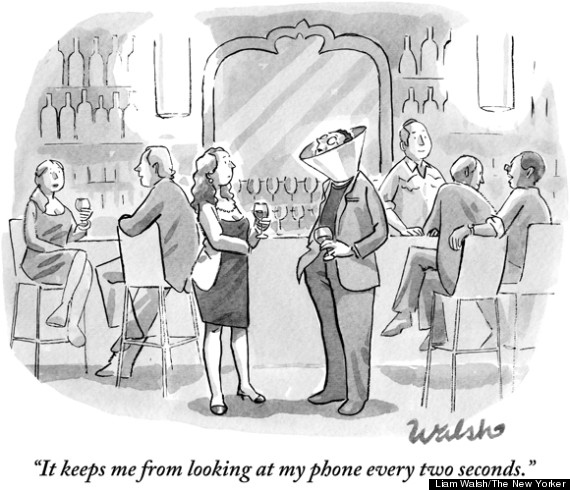
When you are with your child, put down your damned phone

The other day, we saw a three-year-old boy running excitedly on the bike path with a huge grin on his face.  His mother--we assume that was the relationship--was a few steps behind.

Nothing unnatural thus far, right?

Except that the mother was texting on her smartphone as she was walking.  And when she was done, she jogged to catch up with the boy.

If such a scene had been a rare occurrence, then I would not be worried.  But, it is not rare.  This has become the new normal, it seems.  Parents talking not to the kids but to somebody else on their smartphones.  Or texting. Or catching up on Facebook.

I suppose such highly distracted parenting will only worsen, which makes me all the more relieved that fertility rates have fallen to historic lows.  I would rather that people did not have children if they are going to be abandoning kids like this.

We have rapidly transitioned into a new world that runs against our own evolutionary mechanisms:
The new parental-interaction style can interrupt an ancient emotional cueing system, whose hallmark is responsive communication, the basis of most human learning. We’re in uncharted territory.
Unchartered, indeed!  There is decreasing levels of back-and-forth between children and adults.  I don't mean parents alone.  When I was growing up, it was not merely parents.  If they were not around, then I--like pretty much all children anywhere on this planet--was engaged in a back-and-forth with other adults or older children.  All these responsive communication helped all of us grow.
A problem therefore arises when the emotionally resonant adult–child cueing system so essential to early learning is interrupted—by a text, for example, or a quick check-in on Instagram. Anyone who’s been mowed down by a smartphone-impaired stroller operator can attest to the ubiquity of the phenomenon. ... “Toddlers cannot learn when we break the flow of conversations by picking up our cellphones or looking at the text that whizzes by our screens,” Hirsh-Pasek said.
It is all getting messed up!

Of course, parenting has always been associated with distractions.  A few days ago, a friend-couple recalled how when they were doing chores at home, their toddler daughter wandered into the yard--the door was accidentally open--and took a few sips of the lighter fluid.  Every parent has at least one awful story to tell.  But, that occasional distraction is different from the smartphone-distracted parenting of today:
A tuned-out parent may be quicker to anger than an engaged one, assuming that a child is trying to be manipulative when, in reality, she just wants attention. Short, deliberate separations can of course be harmless, even healthy, for parent and child alike (especially as children get older and require more independence). But that sort of separation is different from the inattention that occurs when a parent is with a child but communicating through his or her nonengagement that the child is less valuable than an email. A mother telling kids to go out and play, a father saying he needs to concentrate on a chore for the next half hour—these are entirely reasonable responses to the competing demands of adult life. What’s going on today, however, is the rise of unpredictable care, governed by the beeps and enticements of smartphones. We seem to have stumbled into the worst model of parenting imaginable—always present physically, thereby blocking children’s autonomy, yet only fitfully present emotionally.
All these don't add up well.  A brave new world!

Wednesday, April 11, 2018

Stayin' Alive in The Wall

I have forever blogged about creativity in the time of advanced computing.  Routine tasks can be translated into algorithms--even facial recognition, yes.  But, creativity?

There is no formula for creativity.  After all, if there is one, then that can be written up as an algorithm, right?

Creativity is something that has always intrigued me; I have always felt that formal education the way we offer it simply kills any creativity. Only the fortunate ones survive with their creative skills in tact.

All these add to my frustration with the mantras of STEM and coding. If I could, I would tell educators to "fuck off."  But, alas, in the academic and professional worlds, we cannot ;)

Which is why I fully resonate with the following:
Machines are already superintelligent on many axes, including memory and processing speed. Unfortunately, those are the attributes our education system currently rewards, with an emphasis on learning by rote.
It doesn’t make sense to me. Part of my job as an investor is to attempt to predict the future – I need to make bets on the way we’ll be behaving in the next two, five, ten and 20 years. Computers already store facts faster and better than we do, but struggle to perfect things we learn as toddlers, such as dexterity and walking.
We need to rethink the way we teach our children and the things we teach them. Creativity will be increasingly be the defining human talent. Our education system should emphasise the use of human imagination to spark original ideas and create new meaning. It’s the one thing machines won’t be able to do.
We should aim to teach our kids about the power of creativity in every area.
The system in K-12 and in higher ed increasingly make no sense to me.

As an example, think about how music comes about.  And then think about such remixing:


Of course, there is a lot more to creativity than to music alone.
We need to rethink the way we teach our children and the things we teach them. Creativity will be increasingly be the defining human talent. Our education system should emphasise the use of human imagination to spark original ideas and create new meaning. It’s the one thing machines won’t be able to do.
We should aim to teach our kids about the power of creativity in every area. Science and maths, which are often considered uncreative, have shaped human history with huge creative leaps. It was creativity that allowed Newton to discover gravity while observing a falling apple as he was thinking about the forces of nature.
Tell me something that I have not been yelling about!

Oh well ... nobody cares :(

Here is Sir Ken Robinson, whom I have quoted a lot when it comes to creativity:


Monday, March 26, 2018

The orphan elders

A neighbor recently spent a lot of time and money going back and forth between here and another American city that is 2,000 miles away.  And there were times she even spent more than a couple of weeks there during her visits.

All because her dear friend was dying.  And, that friend did not have children.  Fortunately, the dying person's world of friends, which included people like my neighbor, was there to take care of her.

Single, childless, and old is increasingly a thing.
By 2030, about 16 percent of women 80 to 84 will be childless, compared with about 12 percent in 2010, according to a 2013 report by AARP.
Yet another "problem" that has resulted from the revolutionary past two centuries since the Industrial Revolution.  Decreasing fertility rates and the increasing rights for women have led to this situation where childless and old is no longer a statistical outlier.

Adult children play important roles:
Older single and childless people are at higher risk than those with children for facing medical problems, cognitive decline and premature death ...
Adult children typically help elderly parents negotiate housing, social-service and health care options. 
Life gets complicated, to say the least.

While most elder orphans manage to develop their fallback structures, when we think about the deteriorating quality of life as one gets older, well, this situation that was reported in India will not be any outlier either; An elderly couple "feel it is unfair to compel them to wait to die till they are afflicted by any serious ailment":
A Mumbai-based elderly couple have made a heart-wrenching plea to President Ram Nath Kovind seeking permission for active euthanasia or “assisted suicide” as they feel they are of no use to society or themselves.
Narayan Lavate (88) and his wife Iravati (78), who have no children and say their siblings are also no more, are of the view that keeping them alive against their wishes is a “waste of the country’s scarce resources as well as theirs”.
Longevity could become a curse!

Friday, December 01, 2017

What's good for the president is ...

For various reasons, I chose not to write any op-eds.  It has been months since I sent anything to the editor.  But, ... am thinking that I will send an edited version of this one
**********************************************

We are rightfully preoccupied with the political theatre in Washington, DC, especially with President Donald Trump’s tweets, and the ongoing developments in the investigation by special counsel Robert Mueller into Trump’s Russia connections.

This also means that we are not paying attention to a number of other issues that will affect the country over the long term, and for which we will need to develop constructive public policies.

One of the trend lines that does not make the headlines is the falling fertility rate in the US. If we do not worry about this now, it will become too late to do anything in the future.

The total fertility rate is the average number of children born to women in a society during their childbearing years. Adjusting for various factors, like kids who might not live to become adults or parents, demographers have presented us with an understanding that the fertility rate has to be about 2.1 children per woman in order for the population to be stable.

Fertility rates higher than 2.1 explain population growth that we see in countries like Nigeria. On the other hand, countries like Japan and Italy are on a path of population decrease because the fertility rates there are significantly below 2.1. In Japan it is 1.46 children per woman and, therefore, the population there is projected to shrink by a third in fifty years. If those trends continue, Japan will have less than half of its current population in a hundred years from now.

Here in the United States, we talk so much about “baby boomers” that we have completely overlooked the fact that we are going through a baby bust. Fertility rates in the US have been staying below that magical 2.1 children per woman. The latest data show that fertility rate has dropped to 1.77 children per woman.

This decrease is not really a surprise. After all, most other economically advanced countries have already experienced such a decline in fertility. The surprise is that the US has been a contrast to Europe and Japan for so long, and is only now showing signs of joining them.

There is, of course, an important reason why the US has been different from Europe and Japan in terms of fertility rates. It is related to a huge public policy issue—immigration.

As reported by the Pew Research Center, “were it not for the increase in births to immigrant women, the annual number of U.S. births would have declined since 1970.” While immigrants accounted for only one in seven Americans in 2015, a quarter of all the births in America were to immigrant women. “Births to women from Mexico, China, India, El Salvador, Guatemala, the Philippines, Honduras, Vietnam, Dominican Republic and Puerto Rico accounted for 58% of all births to immigrant mothers in the U.S. in 2014.” Even here in Oregon, births to immigrant mothers have offset what would have otherwise been a decrease in births from 1990 to 2015.

In fact, we need to look no further than the White House for these trends. Of the five children that President Trump has, only one was born to his second wife who is from the US, while the other four are the children of immigrant women he married—Melania and Ivana, who respectively immigrated from Slovenia and the Czech Republic.

The facts are clear: Without immigrants, the US too would exhibit the low fertility rates of Europe or Japan.

It has become fashionable, and a politically winning formula, to beat up on immigrants. However, the nativists might not be aware, or perhaps they refuse to acknowledge, that without immigrants and their children, the US population will not grow, but will decrease. And, like Japan, we too will be trapped with a stagnant economy.

The question, therefore, is “so what?”

The research is also very clear that it is not easy to provide incentives to American women to have more kids. Fertility rates are dropping because women, and men too, are intentionally making those choices. People prefer to invest in education and to lead comfortable lives in leisure. Such preferences mean that they choose to have fewer children.

As any parent knows, having children is expensive. The US Department of Agriculture (USDA) estimates the average cost of raising a child till adulthood to be about $233,610. USDA notes that housing, food, and childcare account for almost two-thirds of those expenses. If we want women to have more children, then it is clear that higher fertility will not happen unless the American people are willing to pay for those expenses. It is highly unlikely that we will subsidize fertility at such high levels.

The answer to “so what?” is, therefore, obvious and staring at us: Encourage immigration for continued growth and prosperity in the United States.

Tuesday, February 21, 2017

Ignorance and the law

A few years ago, when a local organization filed a lawsuit against the federal government and the fossil fuel industry under the public trust doctrine, I didn't think that anything will be accomplished.  But, much to my surprise, the courts are siding with them.  Their claim, on behalf of a few named children plaintiffs, and on behalf of all children, is that the public trust doctrine "requires our government to protect and maintain survival resources for future generations."

The Oregon approach is now not the only one.  I didn't know, until I read this, that February 7th, the court heard "Juliana, et al v. United States of America, et al — a case a group of kids, young adults and environmentalists brought in 2015 against the U.S. government."  It is not the merits of the case that this post is about; there is no way I am going to pretend that I know the law.  I firmly believe in Charles Dickens's description that the law is an ass!

What caught my attention is this:
The lead attorney for U.S. manufacturers and oil and gas companies on a climate change lawsuit didn't know the answer to a measurement fact when asked in court two weeks ago, court papers show.
And what was that measurement fact?
Frank Volpe said he didn't know whether carbon dioxide levels had reached 400 parts per million, a measurement of atmospheric concentration.
A simple measurement fact.  About CO2 in the atmosphere.  The lead attorney defending the industry said he didn't know.

Of course Volpe knows.  Volpe is "representing the American Petroleum Institute, American Fuel & Petrochemical Manufacturers and National Association of Manufacturers in the case."  Of course the industry knows.  They just do not want to admit that they know.

The judge didn't let him off the hook:
Asked by Judge Thomas Coffin whether the groups he represents “acknowledge that the CO2 levels in the atmosphere are currently at 400 ppm,” Volpe did not answer.
“Do you deny that, or do you not know?” Coffin asked, according to a transcript.
“I would say that as we said in our answer, we don't know,” Volpe said.
“You don't know,” Coffin replied. Volpe said that determination would be up to an expert witness.
If we watched such an exchange on Saturday Night Live, we might laugh our asses off.  But, this is for real, in a real courtroom.

The judge tried again.
“So as we sit here today, do you have an expert witness that the intervenors intend to call that you can identify that will opine that the CO2 levels are not 400 ppm, but are something other than that and, if so, what?” he asked.
“I don't know, your honor,” Volpe responded.
How screwed up are the fossil fuel industry and their attorneys!
Neither Volpe nor C. Marie Eckert, another attorney for the trade groups, responded to requests for comment about their clients' views on carbon dioxide concentrations.
Why would they!

You ask scientists the same question, and they will give you the answer even when they are piss-drunk at the unholy 3:00 am when this president starts tweeting.
The National Oceanic and Atmospheric Administration tracks CO2 levels measured at Mauna Loa Observatory, Hawaii. The monthly averages for January this year and last were both greater than 400 ppm, according to the agency.
Reached by phone and asked of the possibility that CO2 levels aren't at 400, a spokesman for the agency laughed.
63 million Americans have voted for a man who denies climate change, and who has appointed to the EPA a man who would rather dismantle the EPA.  How messed up are these 63 million voters?  What a disaster!


Thursday, October 27, 2016

Where does the neighborhood end?

Usually when I call my parents, thanks to life on opposite sides of the world, I end up calling them when they have just about wrapped up a hot breakfast, and when they are contemplating what to prepare for lunch.  Usually.

Not that one day.  Their lunch prep was on hold.

The preparations had to wait because the neighbor had died and they did not want to get the kitchen operations going until the body was taken away.  Whatever be the religious reasons, there is a basic humanitarian reason for such a delay, which you may have already figured out.  Indian cooking releases a gazillion mouth-watering aromas (or, strong odors, if you don't care for them) and such an act while the neighbor's family is sitting with the dead person is simply an awfully discourteous behavior.

In the old days, in my grandmothers' villages, one of the reasons for a quick disposal of the body was to also make sure that the neighbors were not put to a great inconvenience--after all, when tragedy strikes in our life, it is not a tragedy for everybody, right?

Which is what I want to get to in this post.  Where does that neighborhood boundary end?

Tragedies happen every minute of every day all around the world.  But, that does not stop us from cooking delicious meals, traveling, having sex, ... whatever.  While it is a wonderful survival mechanism to make sure that we don't involved with the tragedies all around, my objective in this post is a much simpler one: For us to be reminded that there are real people all around with real problems that are far more compelling than our problems with the overcast skies and crappy cellphone coverage.

One of those tragedies was this image that appeared in my Twitter feed:


The tweet noted:
it's a kid arm holding to his bag after today's bombing
Yet another tragic day in Syria :(

I started following that Twitter feed after reading a Nick Kristof column, in which he had included details about a kid and her mother in Aleppo.  Now, thanks to that, I am reminded every day that life is not normal in Syria.  The image of a kid's severed arm lying on the ground with the fingers wrapped around a school bag is, sadly, only the latest of the horrific images that we have seen over the past couple of years.

Later, news reports provided a complete picture related to that image:
A school compound in a rebel-held part of northern Syria was repeatedly hit by airstrikes on Wednesday in an assault that monitoring groups and rescuers said had left dozens of people dead, including many children.
Unicef, the United Nations Children’s Fund, said the assault in Idlib Province may have been the deadliest on a school since the Syrian war began more than five years ago.
Twenty-two children and six teachers were killed in the strikes, Unicef said. 
Neither my parents nor I stop our lunch and dinner preparations in order to honor and respect the dead in Aleppo. Or in Mosul. Or in wherever.  Because ... they aren't our neighbors?!

Wednesday, September 07, 2016

Racing to a ten

Major Buzzkill tries to do optimism.  But, it is hard.  Deep down, there are worries all the time.  He blames it all on his very optimistic and cheerful grandmother whose night time prayer included a subliminal worry that she might not wake up from her sleep! ;)

Over the years, the Major has made fun of Malthus and the neo-Malthusians.  He has happily pointed out to students that the world human population was less than a billion when Malthus thought we were all going to die soon, while the reality of today is that 7.4 billion people have too much food and obesity is our big worry!  It is all a part of the 200-year transformation, the Major proudly enlightens them.

But, Major Buzzkill, who loves telling students "you're screwed!" does not tell students is that deep, deep, deep down there is always a worry about the future population numbers.

This worry deepens every time he visits India.  Except between late night and early in the morning, it is crowded everywhere, and seems to get more crowded every year.  In contrast, the Major is getting more and more used to the plenty of open space under the big sky here.  It is a struggle within to reconcile the intellectual understanding of population growth and resources with his own personal preferences?

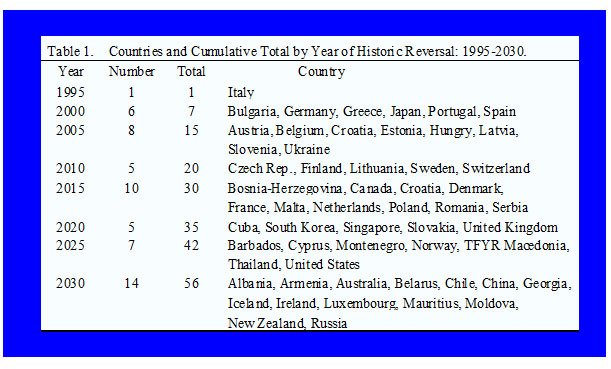
The intellectual Major Buzzkill gleefully points out the historic reversal that is unfolding across the world--the elderly in the country outnumbering the kids there.  As the following chart shows, Italy led the way in 1995,, and now it is a growing list:

Source

Imagine that: 56 countries having more older folks than kids!

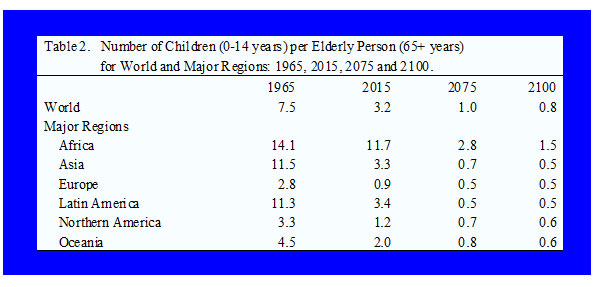
The trend into the future tells quite a story:


Looks incredible, right?  It is almost as if this is from Ripley's Believe it or not.  The future will be the tyranny of the old.  Instead of the parents changing the kids' diapers, it will be middle-aged women (almost always they are the caregivers) or perhaps robots changing the diapers of the elderly.  What a transformation through the 19th, 20th, and 21st centuries!

Major Buzzkill is no Malthusian.  But, deep, deep, deep down he worries that a few countries, like his old country, might struggle to keep up with the total population and the elderly population.

Source

Adding the population of the US to India in another three decades.  Despite his best plans, largely because of his dull and boring highly regimented lifestyle, this might happen within Major Buzzkill's lifetime and he will get to witness it.  I wonder what Major Buzzkill will have to say about this in 2040, if not in 2050.

Thursday, May 05, 2016

Hey, my parents never read books to me!

Life in the adopted country means that I am simultaneously an outsider and one of them.  While some might fret about such an existence, I don't.  It is a fascinating way, a rare opportunity, that people have to understand the world and our existence.

One of the puzzling aspects has always been the hype about reading to the kids.  Especially when the kids are in bed getting ready to sleep.  Movie scenes and sitcoms routinely featured them, and continue to do so.  Academics, too, spend a great deal of time talking about the importance of reading to the kids.  Libraries organize events where books are read to kids with a great deal of theatrics as well.

I gave away what I think about this with the word that I used, right?  Hype ;)

I do not recall my parents or grandparents or anybody ever reading anything to me or any of us kids.  Not when I was sitting down. Not when I was lying down. Not when I was standing either.

But, the older folks did read.  They read the weekly magazines. They read novels. The environment of everybody reading, especially in those dark ages before the internet--heck, even before television--automatically infused in us kids the reading habit.  I can still recall my brother and I fighting over the latest issue of Ananda Vikatan that had arrived and, yes, we tore it up as we both grabbed the magazine to be the first ones to read it.  For which the elders yelled at us.  Yelling is all they did because there was no spanking the kids!

For the most part, kids are like monkeys that do what others do.  If the parents and older folks read, the kids also read.  If the parents and older folks watch television, then that is what kids also do.  Kids, I have always felt, cannot be easily fooled with advice from the older folks when that preaching is not practiced by the elder.

Thus, I had more than a chuckle when I read (get it? I read!) yet another article on the difference that reading to a child makes!
British researcher Don Holdaway was the first to point out the benefits of shared reading. He noted that children found these moments to be some of their happiest. He also found that children developed positive and strong associations with spoken language and the physical book itself, during these moments.
Since then a number of studies have been conducted showing the value of shared reading in children’s language development, especially in vocabulary and concept development.
You, with a sharp and critical mind, are thinking, "but, hey, haven't we moved past books now, in this digital age?"  Yes.  Which is why the research also spews bullshit like this:
While shared reading is often associated with print books, shared reading can be extended to digital texts such as blogs, podcasts, text messages, video and other complex combinations of print, image, sound, animation and so on.
Good video games, for example, incorporate many learning principles, such as interaction, problem-solving and risk-taking, among others.
Yes, now the kid and the parent can play "good video games" together ;)

I suppose the more "advanced" we get, the more easily we forget the simple, basic, aspects of life, such as if you want kids to do something, well, first make sure you do that yourself.  Practice what you damn preach!

Friday, November 13, 2015

I am beginning to hate the zero-tolerance approach

There aren't enough minutes left in my life to list all the mistakes that I have committed.  Small and huge that affected other people.  I vividly recall many of them, and I bet there are more that I don't remember but which the affected parties recall all too well.  Some in elementary school, a few more in high school, and more in college.  These do not even include the works of the devilish idle mind when in the home environment--at my parents' or at grandmother's or ...

There is a fair chance that in most of those situations, the teachers and the elders knew that I was in the wrong, even more than I knew that I was in the wrong.  I bet they gave me a pass because, well, kids screw up all the time.  Some kids screw up more than other kids do.  I would have presented them with a problem if I were not learning from my screw-ups and, instead, were getting on the road to hell.  As long as I was not a repeat-offender, so to say, and as long as the errors were not way off the chart, what I did mattered not much to them.  It was not zero tolerance.

School kids are way more restricted now, it seems.  It is awful.  Even universities seem to be even more protective and less tolerant here in the US than how colleges were back then in India.

I thought I had seen and heard it all, until this flashed in my newsfeed:
9-Year-old Boy Who Passed Love Notes to Girls Threatened with Sexual Harassment Charges
Are you f*ing kidding me?  If a nine-year old boy cannot pass love notes to a fellow classmate .. That's the preciousness of a little romance!

Let's check in with his mother; what exactly did the love notes contain?  Can we have an example?
"How she wears the same uniform and how her eyes sparkled like diamonds," his mother said
Seriously?  If only I had known as a fourteen-year old to compare her eyes to sparkling diamonds!  He is nine years old!
But soon, she says other students started teasing her son about wanting to see the little girl naked.
"That's when the principal proceeded to tell me that it wasn't appropriate that he was writing the note and that if he writes another note, they are going to file sexual harassment charges on my 9-year-old," the mom said.
Hillsborough school district said the boy wrote more than one note and that the notes were unwanted, so that borders on harassment.
Of course the other students would say such things--kids act out in many ways.  Adults then correct them ... but threaten with sexual harassment charges?  They are a bunch of nine year olds, dammit!

The boy--and his classmates--need to be educated on not bothering other kids of any gender.  I wish I had been taught that when I was nine years old--heck, even when I was twenty years old.  That kind of important behavior-correcting education is different from the threat of sexual harassment.
Mild-mannered love notes sent by nine-year-olds do not constitute sexual harassment, and the principal who thought otherwise needs his safety-paranoia meter recalibrated.
Exactly.

We adults do not seem to be discussing important matters like these and are, instead, happily entertaining ourselves to death when not working ourselves to death!  Or, at best, we are scaring ourselves :(
Parents are told almost daily that their children’s health, welfare and safety are at risk, not just from strangers lurking in the park but from adults they know and thought they could trust, including family members, teachers, doctors and volunteers – and the apparently ever-growing menace of online grooming and abuse. Given this state of affairs, how could parents not end up being fearful and paranoid?
How should we, as adults collectively, think about how best to protect and care for children while at the same time challenging and testing them in creative ways? Why do we find it so hard to agree on a ‘commonsense’ approach to child-rearing? ... How might we find ways to develop character, determination and independence of thought and action in future generations?
Now, all I can think is this: thankfully, I am way past the years of youthful follies and, even more thankfully, I am way past the years of raising a child! Phew!!! ;)


Monday, July 06, 2015

Are you a human or a gadget zombie?

Earlier this afternoon, I stepped out to run errands, including getting my hair cut.  I am now uber-conscious about my checklist.  After going through the sequence, I intentionally left my cellphone behind at home and headed out.

I started doing this a while ago, but of course only when I am driving in town.  I leave the cellphone behind fully knowing I might be away from my phone for three hours sometimes.

I was beginning to worry that my mental makeup was getting affected by the tether to this electronic gadget.  A worry that I was becoming the Pavlovian dog responding to the beeps and sounds from the cellphone.  In the old days, when stopped at the traffic light, if I looked at the rear-view or side view mirrors, there was a fair chance that I would see the eyes of the driver behind me.  But, I started noticing that increasingly the drivers' heads were down.  No eye contact anymore.  They were gazing down at their gadgets.


Thus, even though I was a minimal smartphone user when away from home, I decided that I needed to take breaks.  Of course, most of the time when I go for walks I am naked without the phone anyway.   So, driving around in town without the phone was not going to be anything that dramatic. Nonetheless, I decided that I ought to, in order to make sure my brain doesn't get reprogrammed the way the businesses would like to brainwash me.

Even until a few years ago, that's what we did; remember?  The landline is all we had and we went about our lives.  We might have missed calls.  But then we made sure to have an answering machine so that the bill collectors could leave their nasty messages ;)  And remember how some of your annoying friends had some atrocious outgoing messages that made you wait forever for the beep?

Now think about kids and teenagers who are growing up with that tether.  They have no experience whatsoever of being away from gadgets like smartphones.  It should worry you.  It should worry all of us.

Take that one step higher:
Excessive use of computer games among young people in China appears to be taking an alarming turn and may have particular relevance for American parents whose children spend many hours a day focused on electronic screens.
An attachment to books doesn't become something like that.  An attachment to thinking and walking by the river doesn't prevent me from eating and going to the bathroom.
The documentary “Web Junkie,” to be shown next Monday on PBS, highlights the tragic effects on teenagers who become hooked on video games, playing for dozens of hours at a time often without breaks to eat, sleep or even use the bathroom. Many come to view the real world as fake.
Chinese doctors consider this phenomenon a clinical disorder and have established rehabilitation centers where afflicted youngsters are confined for months of sometimes draconian therapy, completely isolated from all media, the effectiveness of which remains to be demonstrated.
Let me repeat one sentence in case you didn't get the full weight of it: "Many come to view the real world as fake."  Worried now?

This is not any uniquely Chinese problem.  Japan has its version.  And the internet of things will mean that sometime soon even Malawi's kids could end up as gadget zombies!
While Internet addiction is not yet considered a clinical diagnosis here, there’s no question that American youths are plugged in and tuned out of “live” action for many more hours of the day than experts consider healthy for normal development. And it starts early, often with preverbal toddlers handed their parents’ cellphones and tablets to entertain themselves when they should be observing the world around them and interacting with their caregivers.
Are you beginning to worry now?  Not yet?  Ok, how about some more excerpts:
“If kids are allowed to play ‘Candy Crush’ on the way to school, the car ride will be quiet, but that’s not what kids need,” Dr. Steiner-Adair said in an interview. “They need time to daydream, deal with anxieties, process their thoughts and share them with parents, who can provide reassurance.”
Technology is a poor substitute for personal interaction.
Aha, you recognize this theme from my other posts, right?  Like even in this road-trip post from a few days ago.

Technology is a poor substitute for personal interaction, indeed.

Maybe, if I have the energy, I will write about the wonderful conversation that I had at the barbershop.  In the meanwhile, for your health, plan on systematic disconnect from that ball and chain that restricts you--no, I am not referring to your spouse, but to your cellphone ;)


Thursday, January 08, 2015

For whom the rainbows dance across the skies

As I neared my seat, I noticed that a kid, about a nine-year old boy, was in the window seat--mine--and his father was digging through his bag while standing at the middle seat, leaving the aisle seat open.  Good for me, I thought.  I love the aisle seat--eases up the little bit of claustrophobia that I have.

Across the aisle were two young girls with their mother in between them.  My hypothesis was that it was a family of mom and dad and their three kids traveling together.  After all, it is very, very rare for a father and a nine-year old to travel.  A mother with the kids is not unusual, and a father traveling alone is quite the norm.  Right?

"If the kid wants the window seat that's fine by me" I said as I stood by the aisle seat.

The father looked up. He then asked his son, "you want the window seat?"

The kid didn't look up from his iPad, but shook his head to mean a no. And then, for a good measure, said "no."

The father made way for me to ease in, and the kid scooted to the middle seat.

As the plane took off on a clear and crisp day, and glided over the Rockies, the window seat afforded me wonderful views of the peaks, many with snow.

I glanced over at the kid.  He was engrossed with an animated movie that he was watching on the iPad.  One seat over, the father was watching a baseball documentary on his iPad.  He removed his headphone and asked his wife something.  Across the aisle, the mother and daughters were watching something on their respective iPads.  Five in the family and five iPads.  Nobody cared about the Rockies, the snow, the clouds.

Life has changed.  Even a few years ago, kids fought with each other for the window seat, and parents requested strangers whether they would swap their window seats so that the kid could enjoy it.  Now, kids don't care?  An iPad for each!

Into the flight, the sky filled up with clouds. It had its own beauty.  Fluffy cotton pieces that seemingly were in wait for somebody to play with.  And then, there it was--a faint but a full rainbow over the clouds.  I took out my iPhone and clicked fully knowing that it will never, ever, capture the beauty that I enjoyed:


I so wanted to grab the kid's hand and show him the rainbow.  I looked over.  He was now playing a video game.  As if that was not enough of a disappointment for this aging old-fashioned guy, the game that the kid was playing was the slot machine.  Yes, a nine-year old playing a game that is all about gambling.

Will the kid ever grow up to appreciate the rainbow?  Are rainbows now too passe for kids who are apparently more impressed with the artificial?  Snow-capped peaks?  Literature and reading?

Sure enough, the kid got bored with the slot machine.  I clicked another photo of the rainbow that traveled along with us.


I felt the kid hitting me, as if to grab my attention. I hurriedly turned towards him.

He was so engrossed in the golf video game, and so excited by it, that he had no idea that he was sharing that excitement with a stranger who happened to be in the adjacent seat.

I suppose rainbows are for us oldies anymore.

Sunday, March 31, 2013

The awful tax we are imposing on the younger generations

So, a couple of days ago I blogged this in which I commented:
here is the real problem: it is not only difficult to draw people's attention to these issues, but even more difficult to make them understand that there are tradeoffs involved in every decision--public and private.  If we want to put every drug user in prison for a few years, well, we will have only pennies to spend on higher education.  If we want Medicare to pay for the 82-year old grandpa's Viagra pills, we will have pennies to spend on the youth.  Spending three trillion dollars on wars mean that we won't have money for a lot of domestic needs.
As my graduate school professor once commented (perhaps in jest, but that is how we often present truth anyway!) it is not what you say but who you are whenever you say anything.  In my case, I am a lonely nutcase in a small town working at a small university.  So, hey, most of the time even you readers don't care about what I have to say, and I don't blame you either ;)

How about if I bring in the big guns?  (See how much the "gun culture" is a part of our vocabulary?)  Simon Jonhson, a MIT professor who was also a chief economist for the IMF, writes:
America can easily afford to do better, of course. Its large budget deficits reflect the impact of tax breaks that favor the wealthy and upper middle class; an unfunded expansion of Medicare coverage to include prescription medicines; two foreign wars; and, most important, a banking system that was allowed to get out of control, inflicting massive disruption on the real economy (and thus on tax revenue).
Today’s children did not play a role in any of these policy mistakes. The preschoolers who are about to lose access to Head Start weren’t even born when they were made.
Imposing austerity on poor children is not just unfair; it is also bad economics
Economic policymaking is not brain surgery.  It is about common sense and critical thinking.  Unfortunately, it is difficult to find either one in the brains of most elected officials.  Nor are we educating the young about the importance of these two, especially critical thinking.

I am surprised that college students are not up in arms and protesting widely, even violently, about how they are being robbed in broad daylight.  Have they become so brainwashed through their K-12 years that they have become what a former colleague in California feared we are producing in education: automatons?  Are teachers not being subversive enough?

Mezels, France (2011)

Monday, June 07, 2010

If I had a vote in this election in China ...

Watch the videos and you too will wish you had a vote.  See how many times you catch yourself smiling, or tearing up ...
This is Part 1 ... you need to watch this first to understand the rest ...