Showing posts with label marriage. Show all posts

Tuesday, December 10, 2019

Going stag

Emma Watson created some brouhaha by declaring herself to be self-partnered.  The rest of us refer to that existence as being single.  Maybe she was serious about that usage, or perhaps she was joking.  But, a brouhaha resulted.  And a few commentaries on her statement, like this one, in whcih the author writes:
The problem with declaring yourself self-partnered is that you’re ceding the argument, agreeing with the precept that some kind of monogamous partnership is a necessary component to a fulfilling life. Self-partnered also makes the same mistake that most depictions of romantic partnership do—assuming that one person can be all things for another. Even a person in a perfect romantic relationship still needs intimate platonic relationships. Self-partnering turns us even more into islands, suggesting that with the right mindset we can all be self-sufficient. A woman’s singleness is not a situation to be corrected, transcended, or rebranded. Be single, Emma, and be proud.
The language issues aside, it is high time that we the people reconsidered privileging the married people through the laws that we have created and the monetary benefits that we bestow on them.  "single people still don’t have access to the legal benefits and protections the government grants to those who get married."  Like what, you ask?
In the US, there are more than 1,100 laws benefiting married couples, and that’s just at the federal level; many states offer perks and protections as well.
Spouses in the US can pass on Medicare, as well as Social Security, disability, veterans and military benefits. They can get health insurance through a spouse’s employer; receive discounted rates for homeowners’, auto and other types of insurance; make medical decisions for each other as well as funeral arrangements; and take family leave to care for an ill spouse, or bereavement leave if a spouse dies.
Now, those are not bad things.  In fact, they are fantastic.  But, why privilege the spouse?  After all, it is not as if single people are mere isolated beings who dropped on earth from outer space, right?  If you prick them, do they not bleed like us?
After all, singles are rarely all alone. They have parents, siblings and other relatives, they have close friends and, often, lovers. Why should they be denied the right to pass on their Social Security benefits to them when they die, instead of having their money absorbed back into the system? Why should they be denied paid time off work to care for them?
Aha, you say now, eh!

I have never understood why a government should subsidize family and marriage.  Especially when we are no longer a "traditional" world in which the man works and the woman stays home barefoot and pregnant.
The law professor Martha Albertson Fineman argues in her book The Autonomy Myth (2004) that the government should stop privileging married couples, and offer the same perks and protections to anyone in a caregiving role. The law professor Vivian E Hamilton makes a similar argument in her paper ‘Mistaking Marriage for Social Policy’ (2004).
Notice that both those authors who are quoted are women?  It is not any accident.  After all, the current framework benefits the man as the primary income earner in a traditional family and they aren't going to be complaining.

Some day, we will wake up to the new reality that has been around us for a while.  But, I know better than to hold my breath for this to happen.

Monday, February 19, 2018

Jane Austen in 2018

It is a truth universally acknowledged, that a single man in possession of a good fortune, must be in want of a wife.
A wonderful opening line from Pride and Prejudice.

Whether or not it is an universal truth, for a while now I have been worried about the changing fortunes of single men--many do not seem to be capable of possessing "a good fortune," which then makes it less likely that they will find a wife.

Tyler Cowen provides me with more to worry about when he asks, "Why are marriage rates rising for educated Americans but falling for the less educated?"

At this point, it is tempting to rewrite Jane Austen's opener as:
It is a truth universally acknowledged, that a single man in possession of a good education, must be in want of a wife.
But, let's not race ahead.

It is not really about the education alone; "more jobs demand good social skills."  Women are more skilled in this than men are.
How about the polarization of marriage rates across the well-educated (almost steady) and the less well-educated (drastically falling)? Well, if you are an educated, high-earning man with a good white-collar job, you will meet more women at work than before. You are facing less competition from other men with comparable workplace status, and so your marriage prospects may be quite attractive. But lower-status men don't have it nearly as good in the marriage market, and many women may prefer to stay single.
I have been saying all these for years!

Why do women prefer to be single?
You don’t want to marry a man who is in all likelihood not economically viable, because it’s not a free lunch.
Ouch!

Like "Olivia Alfano, a 29-year-old single mother living in Evansville, Indiana":
 The money is pretty good, she told me: She drives a BMW and was able to buy a house last year. Alfano now wants to go into management, which she thinks will give her more security in the long run. When I asked her why she hadn’t married, she told me, “I haven’t run into someone I would consider doing that with.”
The times are changing. Many men have yet to even understand the changes, leave alone respond constructively.  The better educated and prepared women population “creates a surplus of men” at the low end who are not going to get married."  And, therefore, "millions of these less well educated men are not going to get the benefits of marriage":
Married men live longer, are less likely to become alcoholic, take drugs, commit suicide, etc.
The less educated men will, also, kill many in mass shootings, beat up foreigners, and vote for trump!

Thus, the modified Jane Austen opener:
It is a truth universally acknowledged, that a single woman in possession of a good fortune, is not in want of a husband.

Monday, September 12, 2016

Leftover women on bare branches

One of the ideas that I get across to students when discussing the two-hundred year transformation is this: We may equally think of the transformation as a history of women.  The past two hundred years has changed, almost overnight, women's roles for the better, and many of the global challenges of today relate to societies (read men!) that are unable to come to terms with this new woman.

Nowhere has the transformation been anywhere as rapid as have been the changes in China.  Not too long ago, we were reading about foot-binding practices in China, and seemingly with a snap of a finger, women have become independent and powerful.  The "traditional" idea of the barefoot and pregnant woman in the kitchen has given way to educated women who are challenging the old ways.  One of the most traditional institutions--marriage--and, therefore, having children, is rapidly falling apart there:
Fewer Chinese people are getting married, a shift with profound implications for China’s economic and social life. The decline in marriages means a decline in the number of babies, and potentially less spending on homes, appliances and other family-related purchases — the kind of spending China needs to drive economic growth.
"Fewer Chinese people are getting married" masks the real story, which should be told as "fewer Chinese women are getting married"
Specialists in economics, demography and sociology say some of those women are delaying marriage to build careers and establish financial footing, resulting in a more empowered female population that no longer views marriage as the only route to security.
“Because they are highly educated, they hold well-paid jobs, they lose the financial incentive to get married,” says Zhang Xiaobo, a professor of economics at Peking University’s National School of Development.
Ever since graduate school, I have understood that education is one heck of a contraceptive.  Typically, the more educated a woman is, the fewer children she has; the fertility story is the same whether it is the First Lady in the White House or women in SmallTown, India.

The higher the percentage of educated women in society, then one of my favorite topics kicks in as well: save the males.  Increasingly men come across as “not mature or irresponsible.”
China still faces yawning gaps in wages and employment between men and women, according to surveys. But women made up more than half of undergraduate students in 2014, compared with about 46 percent a decade earlier, and accounted for nearly half of graduate students, government figures show.
Cheng Guping, a 30-year-old from Hangzhou in eastern China who works at a start-up and is pursuing a doctorate in economics, is one of those women. She cited her professional and educational obligations as the reason she and a recent boyfriend broke up. “I felt that our level of affection wasn’t enough yet,” she said. “I want to see how far I can go on my own.”
Of course, parents who grew up with the older ideas are having a tough time with the new woman; unmarried women referred to as ‘sheng nu’--leftover women.
By government definition, a "leftover woman" refers to any unmarried female above the age of 27.
There is a government definition for this? Yuk!
"Marriage in China is extremely patriarchal and women need to see that being single is something to be celebrated, not to be ashamed of," she says.
"But I believe that this trend of women who choose to be single and independent is going to increase and this is the beginning."
This is the beginning, yes.  The beginnings of the end of men, if they continue to be “not mature or irresponsible."  Good for women, I say!


Thursday, November 19, 2015

Till Death Do Us Part ... or until the contract expires?

A student who graduated more than a year ago knocked on my office door, came in for a chat, and sat down for a whole lot of talk.  Any time any such student comes by, well, it means that I know quite a bit of their stories.  I asked him about his sister and parents, whom I have never met though.  His parents are divorced, he said.

"Are you doing ok?" I asked him and told him about the research on adult children of parents getting divorced finding it more difficult to handle than the young kids who relatively easily adapt to the change.

"Mine was a twenty-year story" I said.  And then told  him about my parents who, if things go well, will celebrate sixty years of married life in slightly more than a year.  In their case, it will be "till death do us part."

But, being married to another till death was an idea that dates back to the times when the average life expectancy at birth was barely thirty-five.  Life, especially the number of years we live, has changed dramatically in a mere two hundred years.  In those old times, if people married at puberty and died in their mid-thirties, well, that is a twenty-year period.  Hmmm.... wait, twenty echoed in my life too!

What if we are operating with a model that is no longer applicable?
Our current contract – ‘until death’ – might have worked when people didn’t live all that long (according to the American sociologist and author Stephanie Coontz, the average marriage in colonial times lasted under 12 years); or when many women died in childbirth, freeing men to marry multiple times (which they did); and when men of means needed women to cook, clean and caretake, and women needed men for financial security.
One grandmother was married to her husband for less than four years--a tragic event killed grandfather.  The other grandmother was married for many more years than four--when grandfather died of a heart attack, they had been married for thirty years.  In both cases, it was "death do us part."  Of course, as traditions mandated, the grandmothers lived as widows for the rest of their lives.  Had the grandmother died after four years of being married, grandfather would have re-married, of course; but, that's a different topic for another day.

At the recent conference, a wonderful, older, colleague sounded a tad agitated over how his son's fairy-tale marriage ended even before the first anniversary--a divorce, not death, parted the couple.  We live in a different world now.
In a recent survey, many Millennials indicated that they’d be open to a ‘beta marriage’, in which couples would commit to each other for a certain number of years – two years seemed to be the ‘right’ amount – after which they could renew, renegotiate or split, as Jessica Bennett wrote in Time magazine last year. While it wasn’t a scientific survey, it points to a willingness to see marriage as something other than ‘until death’, which, in fact, it is not. In 2013, 40 per cent of newlyweds had been married at least once before, according to the US think tank the Pew Research Center. Since 10 per cent of first marriages don’t even make it past five years, a renewable marriage contract makes more sense than ever.
Marriage as a renewable contract makes rational sense.
In 1971, the Maryland legislator Lena King Lee proposed a Marriage-Contractual Renewal Bill so couples could annul or renew their marriage every three years. In 2007, a German legislator proposed a seven-year contract; in 2010, a women’s group in the Philippines proposed a 10-year marital contract; and in 2011, Mexico City legislators suggested a reform to the civil code that would allow couples to decide on the length of their marital commitment, with a minimum of two years.
But, imagine the logistical hassles of contract renewals.  Common property, kids, tangible and intangible investment into making the contract work, ... nightmares for most of us, but pleasant wet-dreams for attorneys who will think of billable hours!

At some point, we might have to admit to the outdated and pointless "till death do us part" notion and work on a major overhaul.

Saturday, April 25, 2015

When women say no ... troubles ahead for India's young males

A couple of years ago, when visiting with the folks, an extended family relative came by to spend some time with my parents.  As is often the case, the elders inquired about her daughter's marriage--whether there were any proposals in the works.

Her reply fascinated me.  Something I would not have imagined.  Her daughter was very particular that she did not want any "boy" who was outside India or had plans to work outside India for a long time.

Such a stand by a young woman, an IT professional herself, would have been next to impossible a few years ago.  For one, not wanting to live abroad for a long time,  For another, and more importantly, a young woman with an education and career holds the trump cards.  Unlike the old days when women were at the mercy of the prospective groom's and his parents' fancies, this young woman clearly laid out the rules for this matrimonial sequence.

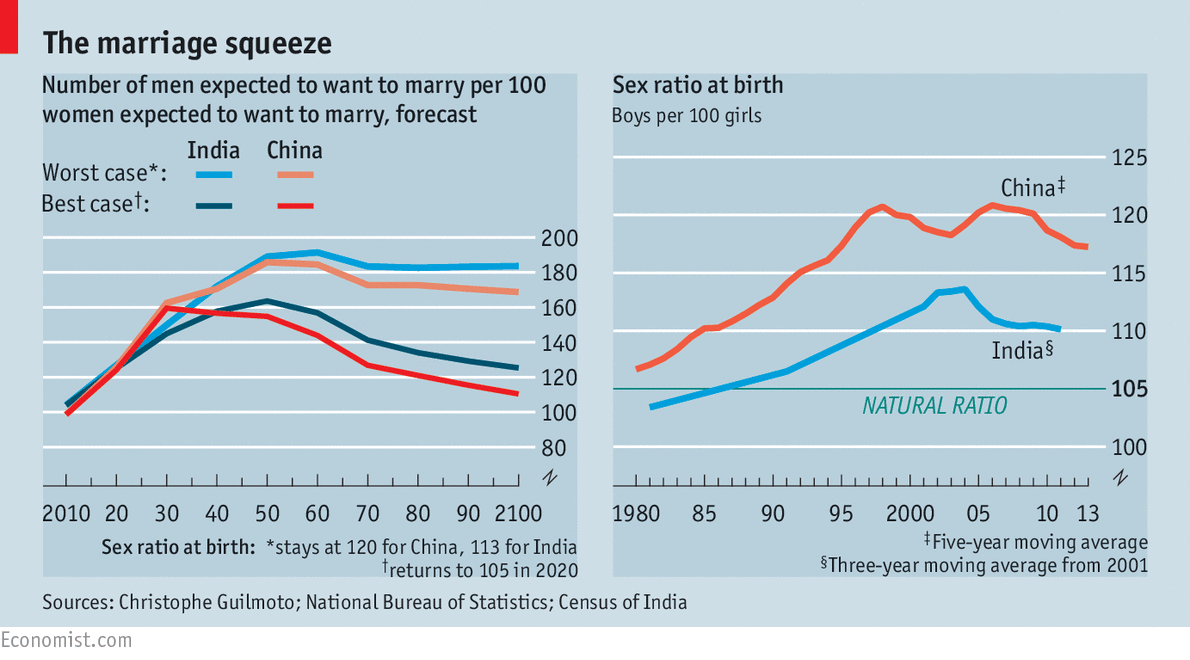
I was reminded of that encounter when I read this in the Economist.  About the marriage squeeze in India (and in China as well.)  Forget the causes for now (those are discussed in the essay); one of the main causes I had recently discussed in this post.

The following chart should interest you:


The chart on the left is a projection of how many men will be around waiting to get married; more men than women.

How much more?
Mr Guilmoto calculates that, in China, for every 100 single women expected to marry in 2050-54 there could be as many as 186 single men (see chart); in India in 2060-64 the peak could be higher: 191 men for each 100 women. This assumes the sex ratio at birth does not change. But even if the ratio were to return to normal in 2020 (which is unlikely), the marriage squeeze would still be severe, peaking at 160 in China in 2030, and at 164 in India 20 years later.
A marriage squeeze of this intensity would be unknown in China and India and extraordinarily rare anywhere in history.
Quite a few bachelors not because it would be their choice to remain unmarried.

The effects will not be felt uniformly across the economic levels, however:
In India and China, women tend to “marry up”—illiterate women marry men with primary education; primary-school women marry men with secondary education; and so on. As a result, men at the bottom of the pyramid, and women at the apex, find it especially hard to find spouses. So the marriage squeeze does not affect everyone equally. It disproportionately hits illiterate men and does not do much to help graduate women
Which also means that the young woman from two years ago, given that she is yet to marry, now inches closer to a risk that she could become too highly qualified and too old for the traditional marriage process, especially because marriages are not arranged when the male is younger than the female.

Interesting complications, yes.


Wednesday, February 25, 2015

When the Best Sex Is Extramarital. Again?

"If I eat meat, I feel like I am cheating" said a colleague who tries to stick to a vegetarian diet.

We make promises all the time.  To our kids. To our neighbors. To fathers, mothers, friends, neighbors.  Yes, even to ourselves.

And, then we cheat.  The colleague ends up eating smoked salmon!

But then there is that mother of all cheating--the sharp deviation from a marriage contract to be faithful.  Remember that joke about Tiger Woods?  That he became a "cheetah"--get the pun? ;)  Speaking of Tiger Woods, boy has his career crashed after that headlines making crash!

I blogged about Murakami's story, but with the title that might have sounded a tad incongruent.  Well, life is incongruent; deal with it! ;)

It merely worked out that way.  I read the story, fell asleep.  After waking up in the morning, when scanning through my news sources, it seemed like a pretty darn coincidence that I had read that short story--yes, there is life issues there related to extramarital sex--and then to read today about extramarital sex in the NY Times. What was the cosmos telling me? Remember, it is always, always about me in this blog! ;)
At our best we learn to refrain from doing things that would make our spouses jealous and insecure, despite our temptations, and when they make us jealous we try to restrain our hostility, despite our hurt.
That is one heck of a difference between cheating to oneself about food habits, versus cheating on a spouse, eh!

It only took ten days after Valentine's Day for the opinionator piece on extramarital sex! ;)
Freud claimed that people often split love and lust. It is not uncommon to have great sex with someone who isn’t lovable, or to have a trustworthy loving relationship with someone with whom the sex is boring. Recent empirical research shows that individuals who exhibit high degrees of narcissism, like Neal, have difficulty integrating love and lust in a single relationship.
Way back when I was an undergraduate student, the fact that there were no girls to distract us in an all-male engineering college did not mean that we didn't talk about our future selves.

I recall that in one of the discussions sitting on the railway tracks, a friend argued that infidelity was not a big deal and he compared it to home-cooked food that we might soon tire of, which is why we go restaurants and have the rich and decadent dishes there.  That never appealed to me--even now, I am very happy to make the same ciabatta sandwich every day for lunch.  Hmmm, I am already drooling thinking about the sandwich ;)


Perhaps you are thinking to yourself, "could there be patterns in who is mostly likely to cheat?"  Oh Yes, there are, says the WSJ:
Have you ever wondered if you’re in danger of being unfaithful? The experts advise you to look at these risk categories. People who engage in infidelity typically fall into more than one.
Yes, gender is a category:
If you are a man, you’re more likely to cheat. ... The gender gap isn’t as big as it used to be
Of course, I know that the gender gap is not as big as it used to be.

So, what are the other categories, you ask?  Don't be lazy--do at least that much reading in your life! ;)

Oh, btw, I did have rich and decadent food at a restaurant and, my god, it was Supercalifragilisticexpialidocious , and the "cheating" colleague stayed faithful to vegetarianism! ;)

Fried Gnudi:
Fried naked ravioli, mushrooms, caramelized fennel, sauce sugo, Romano cheese & chives


Tuesday, April 22, 2014

Racism in our dating and marrying preferences

Even before I reached my teens, I knew that I was against the tradition of arranged marriage.  It did not seem right.  Into my teens and as I passed those years, I was all the more convinced that the arranged marriage was a screwed up system.  Looking back, I am all the happier that I have lived out a life in which there has not been any place for that tradition.

Even if I leave alone the emotions of love and going after what the heart wants, I could not understand how one could restrict the choice of a spouse in that arranged marriage context only to a suitable mate from similar backgrounds.  It was nothing but a rigid institutionalization of us-versus-them.  A Tamil Iyer Brahmin will be set to marry only a Tamil Brahmin Iyer because the others are inferior?  Not worth a look?  Isn't such a narrow-minded approach nothing but racism by another name?

 If we want to systematically associate ourselves only with people who are like us, well, isn't that racism?  Yes, in a way I am returning to the racism topic; you thought I will leave my dear grandmothers in peace, eh!

Back when I was still in graduate school, I once wrote to The Hindu that inter-marriage is the key to harmony in India--harmony among people who are otherwise defined by differences.  Marriages across caste lines. Marriages across religions. Of course, that was one of the many unpublished essays that I have authored.  Blogging has at least taken care of that problem--after all, I am my own publisher ;)

Now, I live in a different country.  Thankfully!  (No offense meant to the readers from the old country ... hehe)  A country in which racism is not anything new either.  A part of life here too, though most people think of themselves, especially here in the white Pacific Northwest, as beyond racism.  In my adopted country, could one ask whether it is "racist to date only people of your own race?"  Reihan Salam raises that very question and the byline gives away the answer: Yes.

First, about Salam.  I have been reading his commentaries for a few years now.  A sharp thinker.  Well informed.  And, of course, I am especially excited that he has made himself a name even when young for one reason--he is a fellow South Asian.  Well, his parents immigrated from Bangladesh.  BTW, is it racist to get excited about some stranger all because he comes from that part of the world?

Anyway, Salam seems to be slowly evolving in his own views.  It appears that he is not as sharply conservative as he once seemed to be.  Or am I imagining it?

So, back to the issue of racism and dating only people of your own race.  Salam writes:
Is a strong same-race preference something one ought to be ashamed of? Or is it enough to say that the heart wants what it wants and to leave it at that? This is a more important question than you might think.
Now, ask yourself this.  Our hearts might like whatever our hearts want, yes.  Perhaps the heart likes slim people. Or fat people. Or short people. Or tall people.  Notice how I have only referred to "people."  But, even before we allow the heart to fall for a person, if the brain is screening out people from "other" races, then, well, isn't that racism?

Salam writes:
To be sure, dating is about more than the sharing of bread, and OkCupid users who express strong racial preferences may well be doing the world a favor by being open and honest about their wants. But I don’t think it’s too much to ask those who do express such preferences, and those who live them in practice, to reflect on them, and on how there might be more to fighting racism than voting “the right way.”
My grandmothers lived long lives for their generation, but not long enough to witness the changes in the lives of some of their grandchildren, when it comes to this spousal issue.  It was well beyond an arranged marriage in my case.  One cousin wed an Oriya. Another is married to a Marathi. Yet another is married to a Christian.  A pretty darn good record, though the number of cousins with arranged marriages to Tamil Brahmin Iyer spouses outnumber those of us who did not care to remain in that box.  A healthy start, nonetheless.  If the rest of the Tamil Brahmin Iyers and entire world begins this practice ... hey, a man can dream, can't he?

Thursday, April 04, 2013

Colleges are good matchmakers. No way can MOOCs do that service ;)

A couple of months ago, I noted here:
When I was relatively new in my Oregon stint, one bright female student, "K," came to talk with me about her law school plans.  I asked her if she was free enough--without any significant other--to go wherever she wanted to.  Her reply was funny then, and is funny now, but is also a reflection of these gender issues.  "K" replied that she hadn't met anybody even her equal, let alone being better than her, and so it was all the more the reason for her to go far away from this part of the world.  I wonder whether she did find her soul-mate in graduate school.
Though on a lighter vein, it was a post on a serious issue that I have been blogging for a long time: how female students are doing wonderfully well, especially when compared with their male peers.  The world of higher education does not resemble in any way, and thankfully so, the bad old days when females were not provided with the opportunities that white males had.  How different are things now?
"A lot has happened since Betty Friedan wrote her book ["The Feminine Mystique"] in 1963," says Claudia Goldin, a Harvard economic historian. "It's amazing." More than 57% of the bachelor's degrees awarded in 2011 went to women,according to the Department of Education. So did 51% of doctorates, 48% of M.D.'s, 47% of law degrees and 45% of master's degrees in business.
It is a phenomenal achievement over a couple of generations.  It is yet another demonstration of what we humans can achieve if we put our minds to it.

This female advancement has also led to drastic changes in male-female relationships.  To quote Hanna Rosin:
Young women in their sexual prime—that is, their 20s and early 30s—are generally better off than young men. They are better educated and earn more money on average. What made this possible is the sexual revolution—the ability to have temporary, intimate relationships that don't derail a career. Or to put it more simply, to have sex without getting married.
This very issue that young women are beginning to be choosy about when to get married, if they want to get married, made an interesting topic of discussion in the online academic world thanks to a mother of two boys, both at Princeton, writing an open letter in the university paper advising the girls to marry!
At your core, you know that there are other things that you need that nobody is addressing. A lifelong friend is one of them. Finding the right man to marry is another.
She set it up well; after all, a Princeton alumna herself.  And then came the blunt advice:
Here’s what nobody is telling you: Find a husband on campus before you graduate.
Why?
Of course, once you graduate, you will meet men who are your intellectual equal — just not that many of them. And, you could choose to marry a man who has other things to recommend him besides a soaring intellect. But ultimately, it will frustrate you to be with a man who just isn’t as smart as you.
What she writes here is a restatement of what that student "K" remarked a few years ago, right?  "K" wanted to improve the odds of finding somebody smarter than her.  This Princeton mom takes that one step further--if not at Princeton, then odds will be against finding a comparable spouse.

To which, a Harvard economist, Edward Glaeser, writes about his own personal experience and suggests:
While I don't feel I can provide advice to young women, I am comfortable, based on both personal experience and the infallible majesty of economic theory, urging young male Princetonians to view your female classmates as prospective long-term friends and spouses (the qualifications for the two roles having much in common), rather than short-term amorous encounters.
I just wish that Glaeser hadn't used such a complicated academic way of writing that sentence ;)

Anyway, he adds this:
The role that colleges can play in forging lifelong friendships, and even marriages, also makes a deeper point. Princeton has nothing to fear from online learning. The face-to-face experience is just too important, not only as a tool for education but for creating the social relationships that are the real stuff of life.
No MOOC can offer this, and residential college-based higher education will be around for a while ;)

Monday, January 23, 2012

Sunday, March 20, 2011

Governors without marriages. It is bi-coastal :)

So, a little over a month ago, I blogged about an irate letter in the local newspaper; the writer was upset that our governor, Kitzhaber, is living with his significant other, instead of being married to her. 
News that the governor has been living what I consider an adulterous life hurts, because voters hoped for a person who would lead Oregon to higher ethics.
History has long proved that nations with low ethics soon collapse, and is showing in our country.
Either the governor and his girlfriend get honorably married or people must recall him from office. Already people are noticing how nature is showing signs of distress by damaging storms. What is real?
God's laws still apply, even to top-level officials. They should look inside those Bibles they put their hands on and put those words into action again.
What I didn't know then, and I know now, was this: the governor of the Empire State, Andrew Cuomo, has been shacking up as well.

Over in New York, it is not the fear of earthquakes as a result of this arrangement that hit the news, but the fact that Cuomo is a practicing Catholic and, therefore, how dare he receive the holy communion!

The strange contrast though:  In Cuomo's case, it is not a letter in a local newspaper.
He has the Vatican upset.
Yes, the Pope apparently doesn't have better things to do.

Heather Mac Donald writes:
An advisor to the Vatican’s highest court had called for the denial of communion to Cuomo on the ground of his “public concubinage”—a perfectly reasonable interpretation of Catholic doctrine.  
The New York hierarchy, however, immediately closed ranks around Cuomo and brushed off this pesky Vatican busy-body.  The leader of the Albany diocese, Bishop Howard Hubbard, assured Cuomo and the world that the Church fathers would not dream of judging Cuomo’s domestic arrangements:
“There are norms for all Catholics about receiving communion and we have to be sensitive pastorally to every person in their [sic] own particular situation,” Bishop Hubbard said. 
"Public concubinage?" OMG! In what medieval century do these people live? A hysterically funny phrase!

Mac Donald adds:
I suppose I should thank Archbishop Dolan for indirectly buttressing the argument behind secular conservatism.  Not only is religious faith not required to justify traditional morality, religious leaders do not even have the backbone any more to stand up for traditional morality in the hard individual case, leavin’ jes’ us secular conservatives to stick our necks out.  If, after centuries of accumulating scientific triumph in understanding the causal mechanisms of our world, we still must have relics, amulets, magical potions, and incantations, the one indisputable benefit that religion could provide would be fearlessness in stigmatizing anti-social behavior.  Instead, we get an Archbishop who calls concern over a Catholic’s carnal sin a “tempest in a teapot” and who thanks God for cooling down said “tempest.” 
Yes, we can have morality without religions.
And that is precisely what Sam Harris argues in The Moral Landscape. 
(BTW, Harris looks like he could be Cuomo's brother!)

I, for one, point out to that rare student who engages me about my atheistic views that while the stereotype that people prefer is that those who are irreligious, or of the wrong religion, live immoral lives, hey, in my case I am an atheist who doesn't smoke, doesn't drink, doesn't do drugs, eats very little of animal products ... and no "public concubinage" either ....

The scientific question then is whether we can make moral, value, judgments in "scientific" ways.  I am not sure.  Most arguments I come across, and perhaps even Harris', tend to be variations of utilitarian thinking.  But, as much as I incorporate utilitarian analysis in the courses I teach, there is always something about utilitarianism that bothers me.  It could be a reflection of the religious and societal contexts in which I was raised.  In any case, to live the life that I now live, religion is unnecessary for moral judgments.

So, leave 'em governors alone!

Thursday, August 12, 2010

Way past time to abolish tenure in academia

There is a parallel of sorts between tenure within academic walls and marriage as an idealized monogamous relationship between a man and a woman.  Yes, there is. Let me explain.

First about the marriage.  As much as I prefer, and practiced, the monogamous marriage, what we are so passionately debating is quite a recent and modern social innovation.  I was reminded of that when I was in Tanzania--a local who worked as a house-help said that she changed her husband after being married to him for about eleven years because she, and her husband, wanted a change.  Larry King going through such fresh re-starts is not anything unusual at all.  The olden days were full of stories of the rich and the powerful, and the hoi polloi too, having relationships outside of marriage.  As Ross Douthat points out in his op-ed,
What we think of as “traditional marriage” is not universal. The default family arrangement in many cultures, modern as well as ancient, has been polygamy, not monogamy. The default mode of child-rearing is often communal, rather than two parents nurturing their biological children.
Nor is lifelong heterosexual monogamy obviously natural in the way that most Americans understand the term. If “natural” is defined to mean “congruent with our biological instincts,” it’s arguably one of the more unnatural arrangements imaginable. In crudely Darwinian terms, it cuts against both the male impulse toward promiscuity and the female interest in mating with the highest-status male available. Hence the historic prevalence of polygamy. And hence many societies’ tolerance for more flexible alternatives, from concubinage and prostitution to temporary arrangements like the “traveler’s marriages” sanctioned in some parts of the Islamic world.
What we have understood as a monogamous marriage is an institution that is a very, very recent creation.  We fight till death to defend this and nuke everything else because ...? 

It is a similar story with tenure in academia.  Yes, I am tenured and thanks to that my faculty and administrative colleagues can't get rid of me, unless I am a horrible teacher (which I am not) or I somehow assault a student or colleague (which will not happen.)  Yet, as much as I enjoy my tenure, I recognize that this is not an institution that has been around forever.

Tenure is a new creation, whose formal practice can be traced back to its origin in 1915.  "The American Association of University Professors first declared the principles of academic freedom and tenure in 1915 and then revised them in 1940."  That is correct--it is not even a hundred years old!  Tenure was needed then in those bad old days, but not anymore in the contemporary world:
The most common pro-tenure argument is that it protects academic freedom. Once a professor gains tenure, the thinking goes, he or she can say anything without fear of being fired. Academia thrives on the circulation of dangerous ideas. The problem is, for every tenured professor who's liberated at age 40 to speak his mind, there are dozens of junior professors terrified to say anything the least bit controversial, lest they lose their one shot at job security for life. Academia relies on young scholars to shake things up. Yet tenure incentivizes them not to. Instead, it rewards students who follow in the footsteps of the elders whose favor they will require when the day of judgment arrives.
Besides, says Taylor, the idea that a tenured professor can finally "speak out" is absurd. "If you don't have the guts to speak out before, you're not gonna have it after." Even tenured professors still have all kinds of incentives to keep their heads down. There's still research to fund, administrators to placate, time off to negotiate.
Just as tenure creates economic inflexibility, it also creates intellectual inflexibility. By hiring someone for life, a school gambles that his or her ideas are going to be just as relevant in 35 years. Tenure can also discourage interdisciplinary studies, since professors are rewarded for plumbing deep into an established subject area rather than connecting two different ones.
One of the horrible downsides to tenure is this: faculty do not have any pressure whatsoever to do anything other than whatever is best for them, without any thought as to what ought to be in the front and center of their attention--students and their futures.  My pet peeve is about how in the university where I teach practically nothing is offered about the Middle East and Islam--not in literature or philosophy or the social sciences.  There is no collective institutional worry about how this shortchanges students either. Unfortunate!

So, where are we headed? Just as a few states have already taken the step towards granting legal recognition to same-sex marriages.
Some universities have already made the leap. Evergreen State College in Washington implemented renewable contracts back in 1971. Florida Gulf Coast University scrapped tenure when it was established in 1991. Boston University now offers salary premiums to professors who decide not to take tenure. Market forces will drive other universities to follow suit, whether they want to or not.

Saturday, September 27, 2008

Love and marriage, in India

India is changing, and rapidly too. Naturally, this is reflected in marriage as well. My marriage to a non-Hindu was a pretty big deal years ago. I don't think such issues matter that much anymore. Since my marriage, here is the listing of a few "non-traditional" ones (out of the eight younger cousins):
  • Male cousin married a non-Tamil/(not Brahmin too?)
  • Female cousin married a non-Tamil (not Brahmin too?)
  • Female cousin divorced--a first in the family
  • Female cousin married a non-Tamil-Christian
Four of the eight--50%--have stepped outside the traditions, even though only one out of these is outside India. The rest live in India, and all are professionals. So, all the more for me a reason for me to think that this writer in The Hindu is on to something:
[Let] us take a look at the “New Indian”, a recently emerging metropolitan creature who is perfectly happy to live in India, warts and all. Even if an overseas work assignment is sought it is more for the experience, the independence away from the family and for enhancing the résumé than for leaving the homeland for good. Apparently, the grass is green enough on this side. Paav baji and masala dosa are as much enjoyed as pizzas and hamburgers; Kumbakonam degree coffee as much as Cappuccino; tender coconut water as much as energy drinks; Shah Rukh Khan as much as George Clooney; the salsa as much as the garba; Art of Living as much as Stephen Covey. In other words, the New Indian does not reject India and Indian. Other things from other parts of the world just get added on. The New Indian’s patriotism is not of the jingoistic, chest-beating variety. Being an Indian is just a fact of life. It’s who s/he is. It doesn’t need to be cried out from the rooftops, nor does it need to be a well-guarded secret.
The New Indian is more pan-Indian in perspective, perhaps on account of leading a more mobile life. Born in Ludhiana, educated in Kolkata, MBA from Lucknow, working in Chennai and married to a Hyderabadi is no longer an exceptional scenario. The New Indian does not make a big deal about language; it is seen as only a tool for communication and no longer defines identity. The New Indian lives life more consciously. As a result, relationships are more emotionally intense and personal experiences more meaningful. However, the New Indian is also impatient, brash and in-your-face. Frustration tolerance is poor. Instant gratification is demanded and the tendency towards impulsive decision-making is high.