Showing posts with label inequality. Show all posts

Thursday, June 03, 2021

Vaccine apartheid

A week ago, I blogged about the insanity of state governments here in the US falling over each other with incentives so that residents in their states will get themselves the Covid vaccine.  Incentives to get a free vaccine that could be the difference between life and death.  How insane is it to offer a million dollar raffle in order to lure the hesitant crowd to the needle!

Many people in many countries around the world would gladly pay to get the vaccine into their deltoids. (Why always into the arm muscle?  Click here to know why.)  Yet, here, we have to offer people pizza, beer, and even million dollar lotteries!

Poor people in poor countries are screwed because they might not get the vaccines until 2023.  Yes, you read that correctly.  2023.  Most covid vaccines going to high- and middle-income countries.

According to Nature, as of mid-March, those countries had secured more than six billion out of 8.6 billion doses. Less than a week later, the Times reported that “86 percent of shots” that went into arms across the globe were “administered in high- and upper-middle-income countries.”

Why should we care? "simple humanity and simple biology."

If left unchecked, the loss of human life for families and societies worldwide will be staggering. Viruses are international travellers, and over time they mutate. Wherever vaccine coverage is patchy, there is selective pressure for the virus to evolve resistance.

If "vaccine apartheid" makes you feel squishy because you are being compelled to think about the awful apartheid regime, then a more palatable phrase "a two track pandemic" might provide you the incentive to think about how "richer countries having access and poorer ones being left behind."

A recent proposal from IMF staff puts forward a plan with clear targets, pragmatic actions, and at a feasible cost. It builds on and supports the ongoing work of WHO, its partners in the Access to COVID-19 Tools (ACT) Accelerator initiative and its global vaccine access programme COVAX, as well as the work of the World Bank Group, the WTO and many others. 

At an estimated $50 billion, it will bring the pandemic to an end faster in the developing world, reduce infections and loss of lives, accelerate the economic recovery, and generate some $9 trillion in additional global output by 2025.  It is a win for all — while around 60 percent of the gains will go to emerging markets and developing economies, the remaining 40 percent will benefit the developed world. And this is without taking into account the inestimable benefits on people’s health and lives.

Hmmm ... $50 billion.  A big number, right?  Let's compare that number against the US annual spending for its military.  President Biden has proposed spending $715 billion on national defense.  $50 billion is practically a rounding off error. 

It is not that we do not have the money.  We clearly lack the will to do the right thing--vaccinate the world. 

Wednesday, March 24, 2021

Throw like a girl?

As kids, my brother and I played cricket in the wide open space between the gate and home.  Three stumps with bails, a cricket bat, and a cricket ball--all kid size, of course.  One bowled while the other batted.  More time was spent searching for the ball and considerably less was the playing time itself.

Often, my sister's friends came visiting.  Sometimes, they wanted to play with us.  Looking back, I am not sure if they played cricket with us for a few minutes because they wanted to humor us or because they really were keen on playing the game.

Back then, in the school or in the public grounds, girls did not play cricket.  (Nor did they play football either.)  I recall my sister playing games like throwball (or was it volleyball?) and whatever the ring tossing game was called.  And, maybe badminton.

It was one hell of a sexist world.

And then one day I read in the newspaper that there was an all-women Indian cricket team.  All women?  I was impressed.  (Thankfully, Wikipedia gives me the particulars.)

It took me a while to shed my sexist skin.  After all, giving up the privileges of being a male isn't easy ;)

I moved to the US, which was only slightly better than India was when it came to gender issues.  I was shocked that "Trojans" referred by default only to the male sports players.  Otherwise, they were the "Women of Troy."

In Bakersfield, when I started writing commentaries, I sent the editor a piece about such gendered usage.  I remember arguing in that essay that "Americans" doesn't mean men by default.  It was one of the many commentaries that never made it past the editor.

Life in Eugene meant that I was bombarded all the time by the athletic activities at the local university. I wrote another commentary, again, on this topic and emailed that to the editor.  He too decided against publishing that.

In the summer of 2019, I blogged about the separate and unequal character of female sports.  Even when a female team is successful, as was the case with women's soccer, it gained neither respect nor the dollars that the losing men's team did.

I don't care for sports.  But, I do care for equal treatment.

The "March Madness" underway has brought the unequal treatment to the foreground, again. "Men’s sports, athletes, coaches and events have always been the association’s priority."

When college women basketball players began to post photos and videos of how they got less food, less accurate COVID-19 testing and less exercise equipment in the NCAA March Madness Tournament bubbles than their male counterparts, a sense of collective outrage ensued.

It is not new, but I am glad it made it to the news.  Let's see if this new outrage produces a different and better outcome.


Monday, March 08, 2021

The poor you will always have with you

 In October 2009--yes, 2009--I wrote in this post:

When I was in India this past summer, as reports of swine flu came to dominate the news and conversations, I sincerely suggested to my parents that they should frequently wash their hands, and time it by humming the “happy birthday” song.

Wash hands and time it by humming the "happy birthday" song.  How familiar is that one now, right?  But, that was the public health advisory 12 years ago too.

In that post, I also wrote how absurd such a suggestion was:

As the words slipped out of my mouth, I knew it was a stupid and incongruous advice because of the water shortage in the city.  Apartment complexes were paying hefty amounts to private operators who supplied water by transporting them in special water-tankers.  When that was the condition for middle-class households, I cannot imagine the less affluent spending their precious money to wash hands in order to battle an invisible enemy.    Clean water is a super-luxury for the poor.

Which is why I suggested back then--yes, 12 years ago:

I do not mean to minimize the risks of a global pandemic, particularly if the swine flu virus were to mutate into a highly virulent form.  But, I do want to point out that the global focus on the swine flu, which we have rightfully managed to accomplish, should remind us that being a good citizen of the world also means that we ought to pay attention to the priorities of the rest of the world—in particular, the sufferings of the poor, who are almost always voiceless in the international arena.

Unfortunately, our track record has not been one that we can proudly hold up when it comes to supporting public health programs for the world’s poor.

We know well how much the 45th President of the US loved supporting the rest of the world, especially its poor.  His America First policy extended to global public health during the pandemic too.  He couldn't care to work with the world's countries on vaccine development and distribution because he hated the World Health Organization.

The Biden administration has been doing things to re-integrate into the world, and to participate in fighting the world's challenges.  The US rejoined WHO on day one of Biden's presidency.

Further, Biden put our money where our mouth is:

In a reversal of his predecessor's U.S.-centric approach to tackling the coronavirus pandemic, President Biden is ramping up pressure on America's wealthiest allies Friday to get COVID-19 vaccine doses into poor and developing countries. Mr. Biden told his fellow G7 leaders during a virtual summit that the U.S. would contribute up to $4 billion to COVAX, the World Health Organization-backed initiative aimed at ensuring equitable access to vaccines around the world.

Virus knows no borders.  And we have a moral responsibility to help out the poorer countries:

So far, richer countries have been able to buy far more Covid jabs than poorer ones.

Covax hopes to deliver more than two billion doses to people in 190 countries in less than a year.

In particular, it wants to ensure 92 poorer countries will receive access to vaccines at the same time as 98 wealthier countries.

Often, people don't care for moral arguments. As a fellow-graduate school student put it once, material incentives beat moral incentives!

Even the dollars-and-sense approach shows that it is in the rich countries' interest to subsidize vaccines for the poorer countries:

[Unequal] vaccine access among countries will likely lead to a “total cost for the world” between $1.8 trillion and $3.8 trillion, with up to half the losses paid for by wealthier nations. In contrast, the cost of vaccinating one-fifth of the world’s vulnerable population, as the World Health Organization’s covax initiative aims to do, would cost less than forty billion dollars, with expenses decreasing over time. 

If only we understood that we are all in this together!

Monday, January 18, 2021

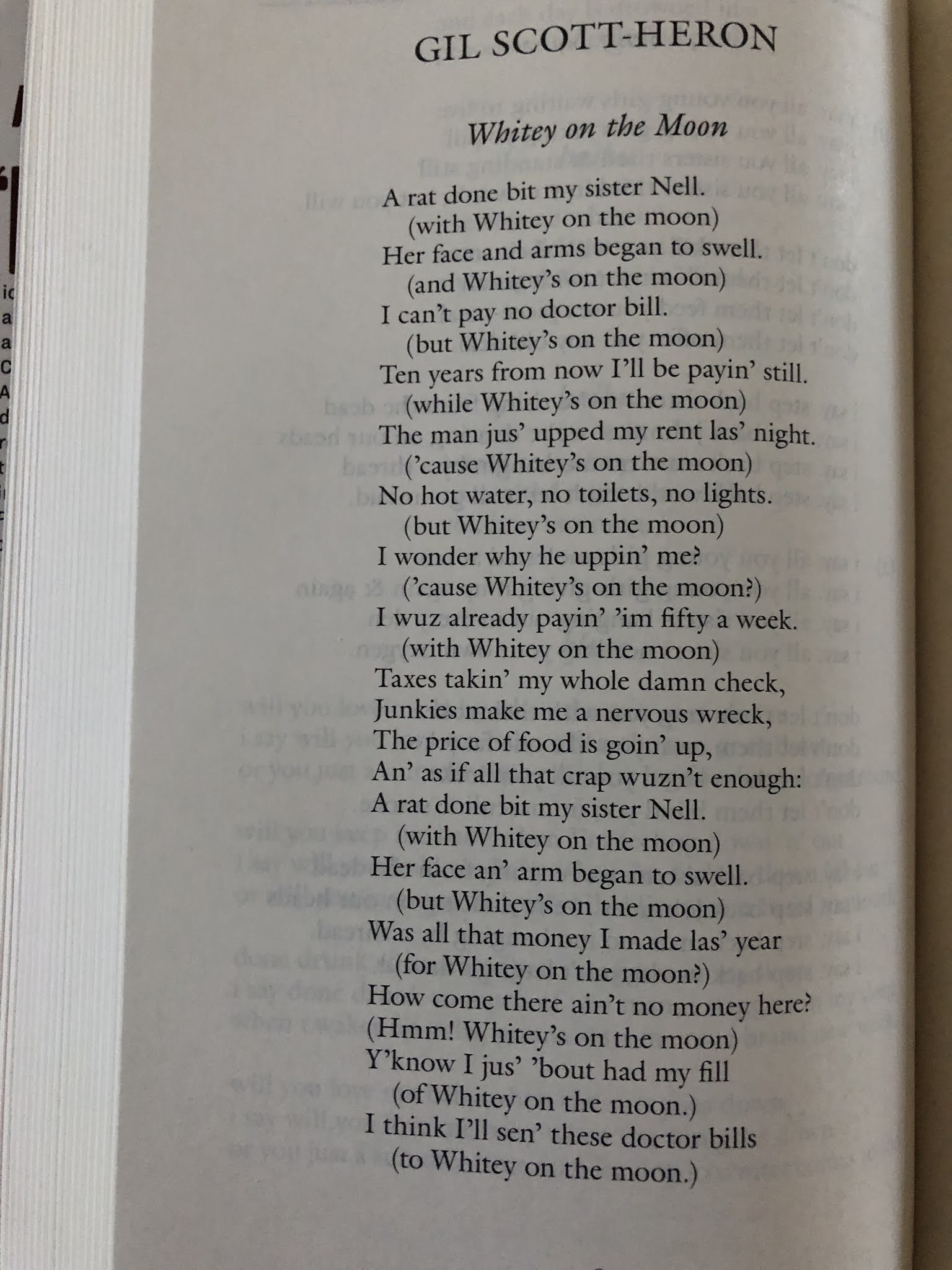
Whitey on the Moon

I read a book review.
An anthology of poems.
By African-Americans
Edited by The New Yorker's poetry editor.

I placed the order.
A pre-publication order.
A delayed gratification
For one who aces a marshmallow test!

The doorbell rang.
I saw the brown uniform walking away.
"Thank you" I yelled out
Even though he didn't hear me.


I opened the book
Somewhere to near the middle.
I was blown away
By the poem on the page.


Such issues have always bothered me
Which is why I quit engineering too
Are science and tech so important
To neglect the real needs of the poor?

I have blogged in plenty
About these awful injustices.
Including this about the protest
In advance of the Apollo 11 launch.

"Around 150 Americans,
Mostly black mothers and their children,
Walking with two mule-drawn wagons
through light mist and rolling thunder.

The contrast was dramatic:
mules and rockets, rambling wagons
and a vast sky to be conquered."
The poor Blacks who marched on Cape Kennedy!

We shall overcome
We shall overcome
We shall overcome ...
... some day


Sunday, January 03, 2021

We fiddle ... while Rome burns :(

Consider this:

If a corporate executive gets a $100,000 bonus for steering a company through a difficult year, while four $25,000-per-year restaurant workers lose their jobs entirely, the net effect on total compensation is zero — even though in human terms a great deal of pain has been incurred.

This is a perfect illustration of why quantitative literacy is important in this modern world.  I wonder what percentage of a literate population, heck even college graduates, will be able to make sense of that simple arithmetic.  I have done my part to educate a few and will perhaps have one final opportunity in the fall term that could even be in the real world, after all the virtual interactions.

It is also a perfect illustration of why we need an economic restructuring, and create a new political economy that will address the human suffering when four workers lose their jobs.

So ... "Even as millions of individuals faced great financial hardship this year, Americans in the aggregate were building savings at a startling rate."

One of the most counter-intuitive outcomes ever, right, when we might have expected differently in what has been awful loss of jobs?

The trend became clear six months into the pandemic.  Professionals and high-income earners didn't seem to lose jobs.  Low-wage workers bore the brunt of the recession.

Back in September, as the university's president and his aides were developing the plans for firing quite a few tenured and adjunct faculty and staff because of the Covid-induced budgetary crisis, I wrote to the president: "It certainly is surprising that Oregon’s current budget won't be significantly affected by COVID-19, and that projections into the future might not be that dark after all."  Always evidence-based in my arguments, I attached the report from the Oregon Office of Economic Analysis.

It has been more than three months since I sent that email; I am yet to hear from the president or his aides.  I suppose I will soon hear from them!

Will there be protection for low-wage workers not only through this pandemic but--and more importantly--even after conditions return to "normal"?

I worry it won't.

Why this pessimism?

For the same reason that I have offered many times.  Like here:

I will once again say the same thing: We work out the solutions politically.  Unlike a challenge of how to get humans to the moon and back, or how to vaccinate people, these are not technical issues.  In a democracy, we are, therefore, at the mercy of voters and politicians.

At the mercy of politicians.  Picture in your mind the likes of mItch mcConnell, tEd cRuz, mArco rUbio, kEvin mcCarthy, ... who will do everything that they can to stop doing anything good for the less-privileged, even as they kiss rich white asses!

Monday, July 22, 2019

Trend lines, headlines, and politics

One of the two brand new courses that I will teach in the coming academic year will be about how much the world has changed--for the better--and yet the news headlines will have us believe otherwise.  (Instead of working on the syllabus, here I am "wasting" away my time!)

Consider one of the many awesome things that we have accomplished--thanks to every government in the world advancing literacy and spending money on education, children from any background can now attend school. (Sadly, there are countries where girls are not educated.)


What a fantastic cause for celebration!.  It is phenomenal an achievement that of all the humans who are 15 years or older, only about 13% is illiterate..  We humans deserve credit for making such a world happen.

However, to look at that kind of progress and to merely engage in self-congratulations is, well, not what I do.  To begin with, that is not my job--I am a critic, by choice and by profession.

But, the change for the better does not mean that we can rest easy; after all, there are a gazillion ways in which we ought to work towards improving the state of the world, for humans and non-humans alike.  In this context, if we were to merely engage in rah-rah about literacy even for the disadvantaged, we begin to overlook the serious troubles there.

Does one imagine, for instance, that a government school in rural Uttar Pradesh is anywhere near the quality of the school that I (and the commenter) went to?  Why are the kids in rural Uttar Pradesh condemned to those godawful schools where teachers might not even come to class, leave alone being horrible teachers in the classroom, while kids in Neyveli get much better education?  Not the kids' fault that they were accidentally born to their parents who live in a certain area, right?

Now, think about how education is merely one out of the gazillion ways in which the accidental birth makes a huge difference in one's life.

Most of us in the political left-of-center always worry ourselves to death that such inequality that arises for no fault ought to be addressed via public policies.  Even while celebrating the fantastic reductions in extreme and absolute poverty, we worry about the uneven competition that exists only because of the accident of birth.

My go-to-expert on these topics, Branko Milanovic, has written in plenty about these issues.  One of his recent empirical analysis showed how "the entire world’s economy is lifted by the open exchange of goods, but this growth is unevenly distributed. The “global upper middle class” — that is, working class individuals in wealthy nations — take it on the chin as less skilled jobs move to poorer nations. Meanwhile, the global middle class and the very wealthy benefit tremendously."

Some of us--yes, I have conveniently inserted myself into an excellent company!--have argued for years that this calls for a new social contract in which we can appropriately compensate the people and communities who lose in this global win.  I yell about this at other places too ;)

"The sensible solution for a wealthy nation is to open its borders to as much trade as possible, but to tax the beneficiaries of free trade to lift up those who lose out."  It is so obvious.  But, apparently obvious only to a few of us who have no political power to make this happen :(


Source


Tuesday, June 25, 2019

Government is for losers. Exactly!

In this post from October 2010, I wrote about a golden rule from India: the "dharma" of a rich person is to create a lot of wealth, and to donate wealth to charity.

The old Indian wisdom recognized that creating wealth is not only ok, but is the duty for some.  But, what comes after that wealth .... something like the "noblesse oblige" in the Western contexts.  Here is one:

संपदो जलतरंगविलोल
   à¤¯ौवनं त्रिचतुराणि दिनानि ।
शारदाभ्रपरिपेलवमायुः
   à¤•िं धनैः परहितानि कुरुध्वम् ॥
- सुभाषितसुधानिधि
Wealth is as temporary as a wave on still water. Youth is just a matter of few years. Our life it self is as uncertain as a cloud of Sharat month (where clouds could get formed and dispersed in a matter of minutes. No rain.) What is the use of all the wealth that you accumulate? Spend them in a way that is helpful to others.
That golden rule is from way back in time, well before the modern concept of countries and governments.  In those bad old days, with wealth and power concentrated with a few, while the overwhelming majority toiled away, charity helped, and helped a lot.  Perhaps charity also helped in the small geographic areas within which the rich and powerful lived.

Now, the rich and the powerful have international reach.  But, our collective problems are way beyond the neighborhood.  Take climate change, for instance.  No amount of philanthropy can tackle that kind of a challenge. Or public health in these times when infectious diseases can easily spread not merely within a country but also across countries.

Philanthropy is no match against the machinery of the government.  However, for the government to address these challenging collective issues, well, the rich and the powerful need to pay up.  And for them to pay their share Republicans need to first acknowledge that our collective challenges, like climate change, are for real and are not some elaborate hoaxes!

If they acknowledged these collective challenges, then they would automatically realize that individuals and charities cannot fight carbon, for instance, and that a well-funded government will be needed for such huge campaigns.

For now, the head in the sand racist party can only keep chanting "tax cuts".

Writing in the NY Times, gazillionaire Eli Broad argues:
I’ve come to realize that no amount of philanthropic commitment will compensate for the deep inequities preventing most Americans — the factory workers and farmers, entrepreneurs and electricians, teachers, nurses and small-business owners — from the basic prosperity we call the American dream.
He continues:
I invite fellow members of the 1 percent to join me in demanding that they engage in a robust discussion of how we can strengthen a post-Trump America by reforming our tax code.
But, the racist party and their Dear Leader that 63 million voted for, which loves to associate with the far-right, will perhaps merely associate Broad, who is Jewish, with their favorite target, who is also a big time philanthropist--George Soros.

Let's see what happens in November 2020.

Tuesday, March 26, 2019

The virtual is for the poor?

It was in 2011 that I first came across a reference to EM Forster's The Machine Stops, and since then I have quoted from that masterpiece many times.  I will quote from that story again in order to get you warmed up for what this post will deal with:
"You talk as if a god had made the Machine," cried the other.  "I believe that you pray to it when you are unhappy. Men made it, do not forget that. Great men, but men. The Machine is much, but it is not everything. I see something like you in this plate, but I do not see you. I hear something like you through this telephone, but I do not hear you. That is why I want you to come. Pay me a visit, so that we can meet face to face, and talk about the hopes that are in my mind." 
She replied that she could scarcely spare the time for a visit.
A century ago thinkers like Forster were worried about the potential for human-human face-to-face interaction to be replaced by human-machine interactions. We are now living that science-fiction!
Life for anyone but the very rich — the physical experience of learning, living and dying — is increasingly mediated by screens.
"For anyone but the very rich."

Consider online classes, for instance.  I have taught online classes from the bad old days when we used dial-up modems.  Even though I teach online classes, I have always argued that students are being shortchanged.  And here's how I often make that argument: Students do not go to Harvard to take online classes there.  So, if Harvard's students, who are, on an average, way more talented and able to learn with very little guidance, go to college for a learning environment that is guided by real humans and in the company of real humans, then how is it that we market online classes only to the less privileged?

Online classes are an example of contemporary life that is "increasingly mediated by screens" for those who are not rich enough. This contrast between the rich and the rest begins from a young age:
In Silicon Valley, time on screens is increasingly seen as unhealthy. Here, the popular elementary school is the local Waldorf School, which promises a back-to-nature, nearly screen-free education.
So as wealthy kids are growing up with less screen time, poor kids are growing up with more.
As it turns out, the wealthy even resort to fraud in order to get their children to colleges where real humans with real intellectual prowess will engage with students.  There is a reason they don't commit fraud in order to get their kids to my online classes!

I particularly like this point that the author makes: "Human contact is becoming a luxury good."

Sad!

Wednesday, October 03, 2018

There goes the neighborhood!

It is very difficult, extremely difficult, to make most of us accept something that we wish we did not have to.  Which is why I have, for instance, stopped even attempting to reason with trump supporters--even if they might have some modicum of decency within them. 

But, just because we don't like a truth, well, that truth does not simply disappear. Instead, it keeps raising its head over and over again, despite our attempts to ignore it or to whack it down the hole. We don't like our views upended and we will do our best to resist the truth.

No, this post is not about trump; though the latest detailed NY Times report might as well be a classic example of what this post is about.

For a long time, I have been blogging that choosing your parents well makes one hell of a difference. (you can now see why that NY Times piece on trump also fits here.)  But, we resist the idea that so much of our future depends on that accident of birth.  Providing evidence that researchers have gathered, I continue to point out this out.

Way back in 2011, for example, I quoted Branko Milanovic (via Catherine Rampell)
an astounding 60 percent of a person’s income is determined merely by where she was born (and an additional 20 percent is dictated by how rich her parents were)
That goes against the idea that we prefer to believe--that individuals can and should pull themselves up by their bootstraps, and they can and will succeed. “I built what I built myself.”

More evidence on this: The American Dream Is Harder To Find In Some Neighborhoods

Note it says neighborhoods.  Now check back with that Milanovic statement.

So, what does the latest piece say?
A new online data tool being made public Monday finds a strong correlation between where people are raised and their chances of achieving the American dream.
Harvard University economist Raj Chetty has been working with a team of researchers on this tool — the first of its kind because it marries U.S. Census Bureau data with data from the Internal Revenue Service. And the findings are changing how researchers think about economic mobility.

Like with climate change, here too we can have researchers do study after study.  Like with climate change, people will dis the studies just because they don't support their preferred view of the world.  The truth doesn't depend on what we prefer though.
Chetty found that if a person moves out of a neighborhood with worse prospects into to a neighborhood with better outlooks, that move increases lifetime earnings for low-income children by an average $200,000. Of course, moving a lot of people is impractical, so researchers are instead trying to help low-performing areas improve.
If Mohammad can't go to the mountain, then we have to explore ways in which the mountain can get to Mohammad.  This is where public policies come in--policies that can address this accident of (mis)fortune.  Policies on  "early childhood development, college and career readiness, family stability and strong social networks, ... segregation, ...pre-K programs and affordable housing."

Those are exactly the kind of issues that trump and the Republicans love to talk about, right?  As in how they can kill such programs and policies!  There is, according to them, a miracle drug that cures all: tax cuts for those who were born in the correct neighborhoods!

I built what I built myself.” My ass!

Thursday, August 02, 2018

Eat more fruits!

I was hungry for a snack earlier this afternoon.  I walked into the kitchen.  I knew exactly what I was going to eat.

I sliced three tomatoes, sprinkled a little bit of salt and a tiny bit of sugar on the slices.  I enjoyed those tomatoes.

It is a contrast to the experience that a former student related to me years ago.  Patrick was a big guy, with roots in California.  He came by my office once in a while just to chat, mostly about San Diego. 

In one of those chats, Patrick recalled the family's poverty when he was young.  His mother, with barely any money to feed her kids, often bought macaroni and cheese packets that were on sale.  The kids ate a lot of them.  Those empty calories made them big--but unhealthy. So, there he was as a young man, but with plenty of health issues.

Increasingly, the paradox is that poorer people tend to be more obese than rich people are.  It is not merely an American experience; The Economist reports about such a situation in the UK:
Poor children have been fatter than rich ones since around the 1980s. But over the past decade the rich have started to slim down, as the poor have got bigger.
A paradox, yes.

It is not difficult to understand some of the reasons, like this:
People have a limited amount of mental capacity to think about their problems, argues Hugo Harper of the Behavioural Insights Team, a part-publicly owned think-tank which co-authored a recent report on the subject with Guy’s and St Thomas’ Charity. Parents concerned about paying rent and keeping the electricity on are thus less likely to think about cooking a healthy dinner.
Yep, that was my student's story as well--his mother was more worried about making sure they did not become homeless, and less concerned about healthy food.

So, what can be done?
But the underlying causes of childhood obesity are fiendishly tricky to fix. As Sir Michael Marmot, head of University College London’s Institute of Health Equity, puts it: “If you want to solve the obesity problem, you have to solve the inequality problem first.”
It might seem strange, but it is true that one can get fast-food that is less expensive than apples and oranges.

All these remind me of the poem that I learnt during the Tanzania trip:

Source

Wednesday, July 11, 2018

Worse since the British Raj!

I usually stay away from blogging about the old country for a simple reason: I have long give up on India.

I know, it pains me to write that, and to say that I have given up on India.  But, the nature of my profession and my personality means that I end up saying and writing unpleasant assessments of life.

But, every once in a while, I read something so egregious that preoccupies me to an extent that only blogging can relieve me of the discomfort about the old country.  Such was the case when I read this about India's crony capitalism.

In the India that I grew up, society was "marked by divisions of caste, race and religion."  Such a stratification was not anything new:
Prior to the country winning independence in 1947, its people were subjugated by imperial British administrators and myriad maharajas, and the feudal regional monarchies over which they presided.
If there were a few good things in India's Nehruvian economic policies, it was that the affluent were held under check.
Even afterwards, India remained a grimly poor country, as its socialist leadership fashioned a notably inefficient state-planned economic model, closed off almost entirely from global trade. Over time, India grew more equal, if only in the limited sense that its elite remained poor by the standards of the industrialised west.
Not anymore. Over the past two decades of liberalization, "India has created a model of development in which the proceeds of growth flow unusually quickly to the very top."  Economic inequality now is worse than what it was even under the bastard Raj!

Even a casual visitor to India will find it hard not to notice the highly unequal society that the country is.  But, "perhaps because Indian society has long been deeply stratified, this dramatic increase in inequality has not received as much global attention as it deserves."  You know, that's how India has always been, so why bother!
There is every reason to believe that on its current course, the country’s the gap between rich and poor will widen, too. Perversely, the closer India comes to its achieving its ambitions of Chinese-style double-digit levels of economic growth, the faster this will happen. On most measures, it should already be ranked alongside South Africa and Brazil as one of the world’s least-equal countries. Even more importantly, poor countries that start off with high levels of inequality often struggle to reverse that trend as they grow richer.
While there are plenty of disagreements on the implications of inequality, I think there will be an universal agreement on this:
India’s greatest curse is inequality of opportunity. People with skills and access to global markets have benefited hugely, while those in rural areas without skills or connectivity have lagged far behind.
If victory can come from pointing to even worse conditions, then India can rejoice that it is not anymore the country with the largest population of extremely poor, who live on less than $2 a day; Nigeria is the new king! But, this is not the World Cup!
For many in India, such talk is sure to provoke sharp debate. Tens of millions of people remain destitute and thousands of farmers commit suicide each year. Nearly 40 percent of Indian children under 5 are short for their age, a sign of chronic undernutrition.
“The claims that India is on the verge of winning the battle against extreme poverty sit uneasily with the current concerns about job creation or rural distress,” said an editorial last week in Mint, a financial newspaper in India.
India is at yet another important crossroad
India is set to grow in economic might throughout this century, as America did during the 19th. By some accounts, it has already overtaken China as the world’s most populous nation; in others, the baton will pass during the next decade or two. Whatever the case, the fate of a large slice of humanity depends on India getting its economic model right. Meanwhile, as democracy falters in the west, so its future in India has never been more critical. To make this transition, India’s billionaire Raj must become a passing phase, not a permanent condition. India’s ambition to lead the second half of the “Asian century” – and the world’s hopes for a fairer and more democratic future – depend on getting this transition right.
But, I am not holding my breath; I gave up on the old country a while ago! :(


Wednesday, May 30, 2018

What kind of society does “America” mean?

I remember John Steinbeck's line somewhere that the poor in America don't consider themselves to be poor--they have been brainwashed into thinking that they are temporarily embarrassed millionaires.  Poverty is a minor setback, and it is only a matter of time before they become another Gatsby.

Except, it is not any minor setback.  And not everybody easily climbs up the ladder to become millionaires and gazillionaires.  Especially if you are not white in America!

But, when the dominant narrative is driven by whites, who shrug their shoulders and ask "Why can’t they get their act together?," to talk about inequality means that the trolls would immediately attack with name-calling. Socialist!

That shoulder-shrugging approach has always been the MO for the whites-only party, aka the GOP:
Republican orthodoxy is that inequality is not necessarily a problem. And if rising tides substantially lifted everybody’s boat, it might matter less that the yachts parked at the North Cove Marina a stone’s throw from Goldman Sachs rode a bigger swell. Tides in America don’t work like that anymore, though.
Most other boats are leaky.  And many don't even have boats!
Your heart doesn’t even have to bleed to care. The United States risks its prosperity by leaving so many Americans behind.
Republicans. Don't. Care. "Republicans just passed another round of tax cuts to offer a helping hand to the upper crust."

I have always wondered why there is simply no rioting on the streets. Why there is no looting. Why aren't the poor jumping into their broken down cars and rushing to ransack the Versailles of the greedy gazillionaires?
As Catherine Rampell noted in The Washington Post, populism — understood as a political movement shaped around giving the working class a “fair shake” — is pretty much dead.
To refer to trump as a populist is a twisted interpretation of what populism means.  He is no populist; he is merely a loud-mouthed racist, misogynist, ...

So, what happens to the poor?  Especially those who are not white?

Let them eat frog legs!

Sunday, May 20, 2018

We are the elite!

Different sets of people.  Different dining table settings and food.  Different conversations.  But, one commonality stands out: We are globalists, and among the economic elite.

We might think of ourselves as "middle class."  But, middle class we ain't. In fact, halfway through one dinner, I proclaimed that we might not think about ourselves as elites but we are.

Of course, me admitting to the world that I am one of the upper-economic-crust is not anything new in this blog.  (Here are two samples: One and Two.)

Any which way we slice the data, well, as long as we don't deal with alternative facts, we cannot escape the reality.  "The families at our end of the spectrum wouldn’t know what to do with a pitchfork."

This elite in the US is mostly white or Asian (yes, including me.)
The Institute for Policy Studies calculated that, setting aside money invested in “durable goods” such as furniture and a family car, the median black family had net wealth of $1,700 in 2013, and the median Latino family had $2,000, compared with $116,800 for the median white family. A 2015 study in Boston found that the wealth of the median white family there was $247,500, while the wealth of the median African American family was $8. That is not a typo. That’s two grande cappuccinos.
Ah, yes, but we are middle class!

The other day, a sales agent told me my credit rating is a "you can buy whatever you want rating."  It is, indeed.  But that rating by itself is a piece of evidence that I ain't middle class, which struggles to keep itself afloat, which is why their credit rating is not one they will be proud about.

We then turn around and tell the real middle class, and the lower class, that they too can do this.  If only!  "In America, the game is half over once you’ve selected your parents."  If you are a regular reader, then you know you have read this before ... and you are right.  It has been one of my favorite ways to summarize the inequality: Choose your parents well!

Recall the old adage that health is wealth?  The two are increasingly tied together:
Obesity, diabetes, heart disease, kidney disease, and liver disease are all two to three times more common in individuals who have a family income of less than $35,000 than in those who have a family income greater than $100,000. Among low-educated, middle-aged whites, the death rate in the United States—alone in the developed world—increased in the first decade and a half of the 21st century. Driving the trend is the rapid growth in what the Princeton economists Anne Case and Angus Deaton call “deaths of despair”—suicides and alcohol- and drug-related deaths.
Yet, despite all such evidence, because of political ideologies, and implicit supremacist views because they know better than to voice them explicitly, many shrug their shoulders and prefer to interpret the other people's relative poverty as vice: "Why can’t they get their act together?"
You see, when educated people with excellent credentials band together to advance their collective interest, it’s all part of serving the public good by ensuring a high quality of service, establishing fair working conditions, and giving merit its due. That’s why we do it through “associations,” and with the assistance of fellow professionals wearing white shoes. When working-class people do it—through unions—it’s a violation of the sacred principles of the free market. It’s thuggish and anti-modern. Imagine if workers hired consultants and “compensation committees,” consisting of their peers at other companies, to recommend how much they should be paid. The result would be—well, we know what it would be, because that’s what CEOs do.
I have no idea how this story will end.  All I know is that this story is not unfolding well.


Wednesday, May 09, 2018

Every breath you take / Every move you make / I'll be watching you!

Take a look at this photo:


Looks like one of those coffee shops where young customers stay for hours while making use of free wifi, right?

Look again.  There is something hanging under his neck.  If somebody had asked me to guess what it is, I would have failed, and failed miserably.

It is a "sociometric badge."

I am with you--I have no idea what it means when somebody says "sociometric badge."  Guess what it is for?  "Combined with digital data, sociometric badge data can help organizations get a holistic view of how work gets done."

Even at this point, you might wonder what that means.  I am with you.  I didn't know about any of these until I read this essay on how digital technology and data on all kinds of things are enabling employers to monitor their employees every second.  It is one of the most depressing essays that I have read recently.  Ignorance is bliss!

That "sociometric badge"?  Ironically, the company that makes that is called Humanyze.  A company that is all about dehumanizing people and their work is called Humanyze!  It is a pioneer in something called "people analytics"--a phrase that I wish I had not heard or read. Referred to in short as PA.   "Worn around the neck and attached to microphones and sensors, the badges record their subjects’ frequency of speaking, tone of voice, facial expressions, and body language."  Note the kinds of data that the badge is collecting!

Very little "escapes the gaze of the sociometric badge and its associated technologies":
“Even when you’re by yourself, you’re generating a lot of interesting data. Looking at your posture is indicative of the kind of work and the kind of conversation you’re having.”
This is fucking insane!

Even scarier is this: Humanyze is not the only game in town.  All these PA firms "rely on combinations of wearables and computer-based technologies to monitor and control workplace behavior."
These companies boast that their systems can find out virtually everything there is to know about employees, both in the workplace and outside it. “Thanks to modern technology,” in the words of Hubstaff, a PA company based in Indianapolis, “companies can monitor almost 100 percent of employee activity and communication.”
Like I said, this is fucking insane!

The owners of these robots gain more wealth and power over labor that increasingly is left behind and becomes voiceless.  The demagogue who foul-mouthed his way to the Oval Office in order to fight for the forgotten men and women couldn't care less.  It was never about the forgotten!

Thursday, April 12, 2018

Me too!

Despite the best efforts of many, the gap between the numbers of rich and poor college graduates continues to grow.
To which all I want to say is this: Duh!

In guarded and polite ways, I have on many occasions asked students over the years: My university awards BA degrees, and so do the flagship university, the university where I earned my PhD, and Harvard.  Are all these BAs the same?  If some BAs mean something more than other BAs do, well, what is the point of awarding those "lesser" BAs?

Of course, not all BAs are created equal; some are more equal than others.  The gap between the more-equal BA graduates and the less-equal BA graduates means that people will seek the more-equal BA, right?  Who are the children who end up at these more-equal colleges?
The wealthy spend tens of thousands each year on private school tuition or property taxes to ensure that their children attend schools that provide a rich, deep college preparatory curriculum. On top of that, many of them spend thousands more on application coaches, test-prep tutors and essay editors. They take their children on elaborate college tours so that their children can “find the right fit” at schools with good names and high graduation rates. Enrollment strategists at these same schools seek applicants from areas where the data they buy confirms that income levels and homeownership are high.
At the end of the day, "the odds against children who come from families earning the median income or less actually graduating from college seem to grow more formidable."
Creating a true meritocracy in higher education would require serious, politically daring changes to our housing policies and the tax code, neither of which seems likely in the current climate. Yet people of means (and I include myself here) are complicit in a system that seems unable to stop itself from extending privileges to the privileged.
Yep, the privileged group includes me too. 

Over the years, I have blogged a lot about these issues, and have even authored op-eds--like this one in 2009.  Yes, 2009.  In that op-ed, I wrote:
[While] it is a wonderful ideal that the sticker price of higher education should not prevent any Oregonian from pursuing knowledge, we ought to recognize that knowledge, like most things in life, has costs associated with it. ...
Thus, it is a no-brainer that when state governments decrease allocations for higher education, universities are then forced to suddenly increase tuition and fees — even if that were not in prior plans and even if it means disastrous public relations.  The lack of state funding has, therefore, resulted in the shifting of the cost burden onto students and families. ...
[If] dramatic reductions in state funding are now making it more expensive for students to attend public universities, what happens then to the original notion to ensure that Oregonians do not walk away from higher education because of lack of money?
In all the op-eds, however, I intentionally never raised the uncomfortable question that I have sometimes asked students: If some BAs mean something more than other BAs do, well, what is the point of awarding those "lesser" BAs?

Friday, February 23, 2018

Let them eat cakes ... the college edition

Conan O'Brien commented that when he was contacted by fundraisers from his alma mater, Harvard, he asked them why Harvard needed more when it already had plenty in the bank. (I am lazy to track down a link; do that yourself, dear lazy reader!)

Harvard's endowment was $37.1 billion back in July.  I assume it has increased in value even more since then.

The university where I teach also has an endowment.  The amount is--sit down before you read this--about $15 million.

Go ahead, and do the math to figure out the ratio of Harvard's endowment to my university's.  You don't have to have a Harvard degree for that simple arithmetic!

Public universities like the one where I teach are rapidly being gutted because of a lack of taxpayer support.  Meanwhile, the uber-rich continue to donate to institutions like Harvard, which is where typically the rich and the powerful pursued their education.
the disproportionate fundraising dominance of the top 20 institutions shows no signs of abating. According to the CAE, these schools—the top three fundraisers were Harvard, Stanford and Cornell—raised 28.1 percent of all 2017 gifts.
Pause for a while to think about it.  Three already phenomenally affluent institutions were the recipients of more than a quarter of all the money that was donated in 2017.
Their success stands in contrast to ongoing divestment in state universities and community colleges, raising recurring concerns about the issue of funding inequality across the higher ed space. And while the discrepancy is rather stark, it should be viewed within a larger context.
The poor students at the lowly public universities and community colleges can go eat cakes!

Meanwhile, the paper that always celebrates competition and the free market applauds the decimation of the small public universities as survival of the fittest in which "U.S. Colleges Are Separating Into Winners and Losers."

Rich people's kids go to good elementary and high schools. They then go to "winning" colleges and universities.  These college graduates go on to make a lot a money, on which they want to pay as little tax as possible.  You know, the taxes that make it possible for poorer students to go to college.  Instead of paying taxes, those wealthy folks would rather donate to their rich colleges and universities.

Like I have always said, choose your parents well! I did--I chose my affluent educated Brahmin parents, thanks to which I lead a comfortable life!  So long, suckers, if you chose to be born to poor and marginalized parents!


Sunday, May 21, 2017

Till death do us part

I walked around observing students talk through and write in response to the task that I had assigned. I stopped at every group's table.  Quick chats with students during these moments are yet another way that I try to connect with them.

"Are you an EMT?" I asked one because of the logo on the work clothes that he was wearing.

Teaching is so much about learning about the students.  They, too, learn about me--from my sense of humor to my intellectual pursuits to, heck, even about my daughter being a neurosurgeon.  It is almost like my classroom is also a blogging space for me, where I talk and listen instead of the writing and reading that I do here.

"A non-emergency guy," he replied.  "But, I know about emergency responses if situations arise."

"If I should have a cardiac arrest in this class, don't do anything.  I have a DNR," I told him.

"You have a DNR?  Why?"

"I have had a good life.  I am done," I replied with what I assumed was a pleasant face, fully knowing that my smiles don't get across.

"But, isn't he required to assist in an emergency? asked his groupmate.

He and I were in agreement--if he did, I could later sue him for bringing me back from the almost-dead.

Later, as I was driving home, I kept thinking about this interaction, and about how I became so embracing of death.

I think I understood death to be a natural process of life even when I was a kid.

My father was in the local hospital for hemorrhoid surgery.  Was I about eleven or ten at that time?  I went there during visiting hours.  The patient in the adjacent room was a boy about two years older than me.  He had blood cancer, and was dying.

I had known of grandfathers and others who were dead.   But, this was my first exposure to one who was dying.  And he was only two years older than me.

About four years later, I witnessed my grandmother's death.

During my train trips to and from the engineering college, I have often wondered what might happen if the train were to derail and I were to die.  I did not worry that I might die.
 
With every passing day, I find that such an approach to life and death is a contrast to how most people, and especially the medical profession, view life and death:
the attitude now towards disease and old age and death is that they are basically technical problems. It is a huge revolution in human thinking. Throughout history, old age and death were always treated as metaphysical problems, as something that the gods decreed, as something fundamental to what defines humans, what defines the human condition and reality.
Death and dying are not really viewed and treated as the human condition.
Maybe we still don't know all the mechanisms and all the remedies, but in principle, people always die due to technical reasons, not metaphysical reasons. In the middle ages, you had an image of how does a person die? Suddenly, the Angel of Death appears, and touches you on the shoulder and says, "Come. Your time has come." And you say, "No, no, no. Give me some more time." And Death said, "No, you have to come." And that's it, that is how you die.
We don't think like that today. People never die because the Angel of Death comes, they die because their heart stops pumping, or because an artery is clogged, or because cancerous cells are spreading in the liver or somewhere. These are all technical problems, and in essence, they should have some technical solution. And this way of thinking is now becoming very dominant in scientific circles, and also among the ultra-rich who have come to understand that, wait a minute, something is happening here. For the first time in history, if I'm rich enough, maybe I don't have to die.
This is a huge change in our attitude towards death.
Death is optional. And if you think about it from the viewpoint of the poor, it looks terrible, because throughout history, death was the great equalizer. The big consolation of the poor throughout history was that okay, these rich people, they have it good, but they're going to die just like me. But think about the world, say, in 50 years, 100 years, where the poor people continue to die, but the rich people, in addition to all the other things they get, also get an exemption from death. That's going to bring a lot of anger.
If everything goes according to plans, I won't be here to witness all that "development."

Wednesday, June 22, 2016

This post is unfair!

Much to the displeasure of Ramesh and Anne, I constantly explore inequality and fairness.  In case they, or you, need a refresher, I will gladly point to the following samples:
Those two posts, among many, always lead to the same bottom-line: The best thing that you can do is to choose your parents well.  Of course, we do not get to choose our parents, which means that ...

It is not merely income inequality that results from this accident of birth in the correct (or incorrect) geography.  It shows up in various attributes of life, like even the lifestyle choices.  Things are different on the other side of the railroad track.

Like with health and life expectancy:


In the old country, the juxtaposition of the rich and the poor is perhaps best symbolized in Antilia.  Being born in the wrong place makes all the difference in one's life.  A luck of the draw, in which we are not even active participants given that it is pretty much determined at birth.

These are the kinds of intellectual and practical issues that led to me graduate school in the first place. Which is also where I got to read John Rawls--in a condensed form, because the book itself was way too big!

This video explains the importance of the Rawlsian argument, and why figuring out fairness is important and is also difficult.


As important as these ideas are, the fact that people prefer instant gratification and entertainment over reading and thinking, and the fact that thinking politicians have been replaced with demagogues, mean that we will never get to addressing the effects of being born in the wrong zip code, or the wrong country, or the wrong skin color, or ... and then we wonder why the world is so unfair!

Friday, December 18, 2015

Flying high ... what about those down below?

We engaged in meaningless chatter which is what family gatherings are essentially about.  The conversation threaded its way to travel and flying.  "So, here's a question for all of you" the professor in me kicked in.  Why not make the family get together also a class discussion, eh!  Hey, they should be thankful that I did not crank up a PowerPoint presentation ;)

"There are more than seven billion people on this planet, right?  What percentage of the people do you think have ever flown?" I asked them.

I am sure the manner in which I asked loaded up the dice.  They figured it had to be way low.  The responses were as low as half-a-percent.  

"Only five percent of the population has been up in a plane" I told them, recalling the data from a post that was less than a month ago.  (And you thought I blog and then forget everything, eh! tsk, tsk, tsk ...)  "In fact, even in the US, a fifth has never been in a plane" I added.

The group seemed to appreciate this.  Damn, I should teach or something.  Oh, wait, that is my day job!

"Given the multiple trips each of us here has made, it means that we all are not only the elite in India, but among the elite on this entire planet.  By this measure alone, we have nothing to complain about.  We ought to be thankful" I continued.

But, complain we all do.

"It seems like the gap between the rich and the poor is rapidly increasing in India" father chipped in.  The professor was happy that the class discussion was being productive.  Students in the non-traditional settings are way more excited about such things than are the traditional students going to college straight out of high school.  The more I teach, the more I seem convinced that college for the vast majority of high school graduates is the wrong choice at the wrong time.  Instead, they need to do something in the real world--learn at the school of hard knocks, as my neighbor often remarks--and should then decide whether they want to attend college.

"Yes, that's what the data also shows" I replied.  "Think about it, do you think that the maid has even been inside a two-tier air-conditioned coach in the trains?"

"I doubt that she has even been in a reserved compartment" replied my sister.

It is so incredibly easy to understand how lucky we are; yet, we conveniently forget that there are hundreds of millions who are relatively way more materially deprived than we are.  We are so quick to resort to "woe is me!"

In an opinion piece on India's wealth inequality, Professor  Asit K. Biswas and Kris Hartley, who is a doctoral candidate, conclude:
India should examine its collective soul to ask whether an economy by and for the obscenely wealthy is just. The inability to establish a political consensus on the extent of redistribution is a convenient excuse for ideological purists to abandon redistributive policies altogether. However, there is a line beyond which inequality is too high, and India is close to – if not already beyond – that line. “Who decides how much inequality is unacceptable?” is no longer an excuse for inaction.
Something is rotten in the country of India.

Monday, May 11, 2015

I should learn to stop worrying and love the bomb

The New Yorker has a lengthy essay that profiles Marc Andresseen and his venture capital firm a16z. It is a piece in the New Yorker, which means it is not some dumb biography, of course.  No, sir. Of the many troubling aspects there, here is one:
Last year, a programmer named Alex Payne wrote an open letter to Andreessen in which he observed, “People are scared of so much wealth and control being in so few hands. Consequently, wherever you and other gatekeepers of capital direct your attention—towards robots, 3D printers, biotech, whatever—you’re going to detect a fearful response as people scramble to determine the impact of your decisions and whims,” which only compound “lingering structural unemployment and an accumulation of capital at the top of the economic pyramid.”
Payne addressed his thoughts to Andreessen because Andreessen represents the Valley—both in its soaring vision and in its tendency to treat people as a fungible mass.
The gazillion dollar issue of our time.

Andresseen is a sharp thinker.  What was his response?
Andreessen waved away the criticisms as the ravings of “a self-hating software engineer.”
Just like that!

This being the New Yorker, the writer is no dummy either:
I told him it seemed paradoxical that some of his other babies, such as Instacart and Lyft, make their profits off blue-collar drivers and pickers who must freelance without a safety net to make ends meet. Unsurprisingly, he strongly disagreed: “Maybe there’s an alternate way of living, a free-form life where you press the button and get work when you want to.”
In many previous posts, I have expressed my angst that the remarkably rapid technological advancements are creating very few jobs anymore and many of those jobs are pretty much variations of the freelance types.  Andresseen doesn't seem to care.
One 2013 paper argues that forty-seven per cent of all American jobs are destined to be automated. Andreessen argues that his firm’s entire portfolio is creating jobs, and that such companies as Udacity (which offers low-cost, online “nanodegrees” in programming) and Honor (which aims to provide better and better-paid in-home care for the elderly) bring us closer to a future in which everyone will either be doing more interesting work or be kicking back and painting sunsets. But when I brought up the raft of data suggesting that intra-country inequality is in fact increasing, even as it decreases when averaged across the globe—America’s wealth gap is the widest it’s been since the government began measuring it—Andreessen rerouted the conversation, saying that such gaps were “a skills problem,” and that as robots ate the old, boring jobs humanity should simply retool. “My response to Larry Summers, when he says that people are like horses, they have only their manual labor to offer”—he threw up his hands. “That is such a dark and dim and dystopian view of humanity I can hardly stand it!”
A lengthy piece at that other favorite magazine of mine, the Economist, is all about the rise of machines and artificial intelligence, which also refers to this 2013 paper and automation:
The worry that AI could do to white-collar jobs what steam power did to blue-collar ones during the Industrial Revolution is therefore worth taking seriously. Examples, such as Narrative Science’s digital financial journalist and Kensho’s quant, abound. Kensho’s system is designed to interpret natural-language search queries such as, “What happens to car firms’ share prices if oil drops by $5 a barrel?” It will then scour financial reports, company filings, historical market data and the like, and return replies, also in natural language, in seconds. The firm plans to offer the software to big banks and sophisticated traders. Yseop, a French firm, uses its natural-language software to interpret queries, chug through data looking for answers, and then write them up in English, Spanish, French or German at 3,000 pages a second. Firms such as L’Oréal and VetOnline.com already use it for customer support on their websites.
Nor is this just a theoretical worry, for some white-collar jobs are already being lost to machines. ... Forecasting how many more jobs might go the same way is much harder—although a paper from the Oxford Martin School, published in 2013, scared plenty of people by concluding that up to half of the job categories tracked by American statisticians might be vulnerable.
Maybe reading these essays on a Monday wasn't a good idea.  Especially when the sun has hid behind the clouds.  But, I suspect reading these on a sunny weekend would not have been uplifting either.
One day, perhaps, something like the sort of broad intelligence that characterises the human brain may be recreated in a machine. But for now, the best advice is to ignore the threat of computers taking over the world—and check that they are not going to take over your job first.
Sure, the machines are not threatening my very professional existence at this moment.  But, they are an immense threat and competition to the jobs that my students will want after graduation.  Given that I don't like to bullshit, I am at a loss anymore when that rare student stops by my office asking for advice.

To wrap up this lengthy post, I wondered whatever happened to Alex Payne, who wrote that open letter to Andresseen.  A Google search led me to this Oregonian news story that Payne has returned "to Portland as tech mentor and vegan restaurateur."  In his blog, Payne writes:
Democratic socialist politics are my politics. I’m a socialist because I want to live in a just society. More than that, I want to live in a survivable society. The form of capitalism we live under does not present a viable future ecologically, economically, or socially. It is a system designed for the creation and preservation of capital, not human life. I’m a socialist because I believe that the wealth of society can best be harnessed through cooperation, not competition.
My problem is this: I agree with Payne and I disagree with Payne. I agree with Andresseen and I disagree with him.  Maybe I am rebelling without a cause after all :(

Source