Showing posts with label babies. Show all posts

Wednesday, July 22, 2020

Will procreation be the COVID-19 recreation?

After the virus crossed over from China, in countries around the world, people have been sheltering in place since March.  People have also been unemployed in huge numbers.  Adding to all these, the lock down has sharply decreased entertainment options.

So, like Khushwant Singh famously joked decades ago about India, will acts of procreation be major recreation in the age of the coronavirus?  Are we looking at a big baby boom towards the end of 2020 and in early 2021?

Nope.

Even back in April, experts said that a baby boom won't happen.
In the short term, as the pandemic wrecks swaths of the economy, the coronavirus will probably give couples even more cause not to have children, experts said.
“I really don’t think they’re saying, ‘Oh, let’s have a baby in the midst of the greatest epidemic that the country has faced in 100 years,’” said Kenneth Johnson, a demographer at the University of New Hampshire.
There may be recreation in the bedroom, but no procreation.

The anxiety over one's economic future in this context itself is a mood dampener, to say the least.  Further, responsible adults might also have intense worries about the future of babies brought into existence when things are chaotic all over.
In contrast, the original baby boom, between 1946 and 1964, took place in an era of postwar euphoria and financial stability for many Americans. Couples married young, could afford homes and had children quickly. And it was not until 1960 that the federal government approved the first birth control pill.
That was in April.  Did the experts change their opinion over time?

Nope.  They doubled down.

Three months into the lock down, experts said that "the COVID-19 episode will likely lead to a large, lasting baby bust."  As a result of the pandemic and the economic recession, "we could see a drop of perhaps 300,000 to 500,000 births in the U.S."

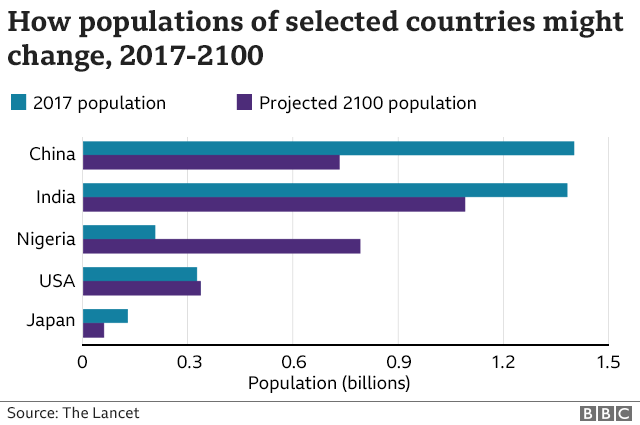
The baby bust will further complicate the demographic crisis that has been slowly unfolding.  Even prior to the corona-recession, the fertility rate - the average number of children a woman gives birth to - had been falling.  As a result, it is only a matter of time before population in many countries started shrinking instead of growing:

Is there a solution?

Yes. But that won't appeal to the uber-nationalistic blood-and-soil tRumpians.  Migration is the answer.  And that too from "shitholes."
Prof Ibrahim Abubakar, University College London (UCL), said: "If these predictions are even half accurate, migration will become a necessity for all nations and not an option. "
To be successful we need a fundamental rethink of global politics.
"The distribution of working-age populations will be crucial to whether humanity prospers or withers."
Of course, the tRumpians can dismiss all these and work with alternative facts that will show that young white women will have lots of babies.

Saturday, November 23, 2019

Teach Your Children "Palate Training"

In yesterday's post on childhood obesity, my formula for addressing that began with "It is about the overall health.  Eat your veggies. ..."

But, what if kids don't want to eat the veggies?

To me, this is impossible to imagine.  As a kid, I ate every vegetable that my mother and all the women in the extended family cooked. There wasn't a vegetable and its prep that I did not like.

I tell ya, if all kids are like how I was as a child, then the mothers of this world won't have a single problem ever ;)

The New Yorker--the magazine that published my short letter, yay!!!--has an informative and thoughtful essay on baby food and kids not taking to veggies.  It is a must-read (though it might be behind a paywall.)

I loved this there:
[Saskia] Sorrosa has a simpler goal. She wants her children to eat the way she ate as a child. “In Ecuador, we had whatever the adults were having—it was just puréed and given to babies,” she said. “I learned to eat spicy young.” On weekends, friends and neighbors would descend on her parents’ farm for buffets of ceviche and sancocho soup (a beef broth with mashed plantains and lime juice), braised goat stew and shrimp in peanut sauce. All of which found its way into Sorrosa’s mouth as she hung from her mother’s hip.
That's how I remember life in India.  Adults would offer just a tad of whatever they were eating.  And, of course, they would also praise the kid for eating it--reinforcing the good behavior.  There was no concept of making something different for children because they didn't like something.  According to grandmothers, our job was to eat what was in our plates and clean it up.  My life in India was no different from Sorrosa's childhood in Ecuador--without the ceviche and sancocho and ... ;)
“Self-weaned” infants, who dispense with purées and just gnaw on their parents’ food, tend to be slimmer and healthier than those raised on baby food. But only if their parents eat healthy meals themselves.
There is your important link to the discussions on childhood obesity too.

The author wraps up the essay by contrasting the American finickiness with how a Congolese immigrant mother in Portland (Maine) was preparing food for her baby.
Rachel’s lenga-lenga was like no baby food I’d ever seen. It was full of onions and garlic and bitter green pepper. It had mashed eggplant and leeks that could give a baby gas. It was salty from the bouillon—the rest of the family would be eating it, too—and far from sweet. By the time it was done cooking, it was a thick green porridge, pungent with smoked fish and sulfurous plants. It made kale look like Christmas candy. And yet, when Rachel brought a bowl of it over to Soraya on the couch, she bounced up and down and clapped her hands.