Showing posts with label kafka. Show all posts

Wednesday, July 03, 2013

Kafka turned 130, reminds Google

When I talked with my father last week, he gave me awesome feedback on a compilation of blog posts that I had sent my parents. Father gave me details on what he and mother really, really liked.  And that included this post of mine.

However old I get--and I am perhaps like most people in this--it is always a special treat when parents or our favorites appreciate us and any small thing we might have done.

Anyway, in that post, I quote one of Franz Kafka's short stories, The Next Village:
My grandfather used to say: "Life is astonishingly short. Now, in my memory, it is so compressed that I can hardly understand, for example, how a young person can decide to ride to the next village without being afraid that--apart from accidents--even the time allotted to a normal, happy life is far too short for such a journey."
If only I could write like that!

Profound!

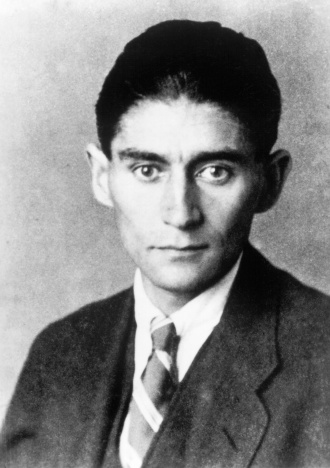
Google's home page reminded me about Kafka with this image there to honor his birthday:


Between Kafka and George Orwell, we have enough and more descriptions of society to make us sit up and think.  And worry.

I even quoted Kafka in my recent annual work report; I will soon find out how well that was received by the powers-that-be ;)

A couple of years ago, the daughter bought me from Prague a book--a collection of some of Kafka's stories--that also included a brief description of his life, along with a few photos too. And a coaster with Kafka's portrait.  One of the best gifts ever.

They just don't make intellectuals like them anymore!


Saturday, April 06, 2013

The economy avoids graduating students as if they are Kafka's bugs!


Students seem to avoid coming to my office in the spring term much more than how they dodge me in fall and winter, because now is when I am even more interested in their answers to my second favorite question, “so, what is your plan for the summer?” My favorite question being “so, what do you plan to do after graduating?”

If experience has taught me anything, then I should have quit asking these questions a long time ago—most students would rather that I don’t trouble them about these issues. Yet, I do.

Almost always, it seems like what students want is to simply get the heck out of the university. Thus, every single instance that I engage in this back‐and‐forth with them, I am reminded of Franz Kafka’s short story, The Departure. It is a short one‐paragraph story that I often share with students:

I ordered my horse to be brought from the stables. The servant did not understand my orders. So I went to the stables myself, saddled my horse, and mounted. In the distance I heard the sound of a trumpet, and I asked the servant what it meant. He knew nothing and had heard nothing. At the gate he stopped me and asked: "Where is the master going?" "I don't know," I said, "just out of here, just out of here. Out of here, nothing else, it's the only way I can reach my goal." "So you know your goal?" he asked. "Yes," I replied, "I've just told you. Out of here‐‐that's my goal."

If at all, I feel a greater urgency to share that Kafka story with students because of the brutal economic conditions that await them even as they express their goal to get “just out of here.” The Great Recession might have ended with an anemic recovery, but is not by any means a healthy economy that awaits the twenty‐somethings. Even internship opportunities, which were in the past guaranteed pathways to careers, seem to have dried up.

Over the past couple of years, in my visits to the stores and during the travels, I have met fresh out of college youth working at the checkout counters of grocery stores, washing cars at rental places, and waiting tables. None of these require a college degree, of course. But, they work at these places because it beats not working at all. One—a recent psychology grad—expressed her worry when she said, “I don’t want to become a lifer here.”

Most students, once past their bubbly freshman years, are well aware of this reality, which is also why they wish that I would not ask them about their plans. The non‐traditional students who are back in school because of the atrocious employment conditions outside always seem to walk around with worried expressions.  One can easily sympathize with students, therefore, for their immediate goal to simply get away from me!

Worry is what we should all do. According to a recent report from the Center for College Affordability and Productivity, about 48 percent of the employed college graduates are in jobs that do not require a four‐year degree. More than a third of those occupations did not even need anything more than a high school diploma. Such a high level of underemployment after a significant amount of time and money invested in a college degree should worry us all.

Just when I thought I had seen everything regarding underemployment of college graduates, I felt horrified to read about a McDonald's in Winchendon, Massachusetts, advertising for a full time cashier position that was restricted to college graduates. Even worse, it required one to two years of prior experience!

My comforting words to students are nearly Polyannaish—“at least you are not in Spain where the youth unemployment is more than fifty percent.” I tell them that even Ivy League graduates are having a tough time, hoping that misery loves privileged company.

The real tragedy is that despite all these trends over the years, we seem to be continuing with college degree as a cure for all, with more determination than ever. Within this collegiate education, it disappoints and depresses me that it is possible for students to have never read anything by Kafka when, ironically, the economy treats new graduates as if they have become the monstrous bugs that Kafka wrote about inThe Metamorphosis.

John Maynard Keynes famously said “When the facts change, I change my mind. What do you do, sir?”  Have we not accumulated enough facts for us to change our minds regarding this expensive approach to getting every kid to college?


A tired, but a much younger me,
by my office door in 2002

Friday, March 08, 2013

I will quote Kafka in my report to the academy!

Soon it will be time for me to submit my annual work report.  I was reminded of that when driving back home last evening, as I was reviewing in my mind the current term that is nearing the end. One more term in the academic year.

Maybe for the annual report I should simply print out Franz Kafka's A Report for an Academy, and leave it to "them" to decide what it means and what I mean by using that story!

Of course, I can't do that!

It is in the professional and social rules of engagement to never engage in calling the others' bluffs.  The emperors are always fully clothed!

So, for now, I am convinced that I will include the following final sentences that Kafka writes to bring the story to an end:
In any case, I don’t want any man’s judgment. I only want to expand knowledge. I simply report. Even to you, esteemed gentlemen of the Academy, I have only made a report.
I can't wait to wrap-up my annual report with those very sentences :)

Over the years, when reading Kafka's writings, or re-reading them, as was the case with with "A report for an academy," Kafka comes across to me more and more of a mystic.  Had he been alive in India, he might have been easily adopted as a guru by many millions, I am convinced.  They don't seem to make intellectuals like him anymore.  Doesn't seem like progress or evolution to me :(

Monday, May 23, 2011

Kafka's "The Departure" is a metaphor for higher education :(

This is the first spring term in a while that I have not shared with my classes Kafka's wonderful short story, "The Departure."  I wonder if it is because I am slowly giving up fighting the screwed-up higher education system.  I hope not.

I was reminded of that short story when a student, "S," came to my office to chat about a few ideas related to her academic work.  In the course of the conversation, "S" tells me that she is completely disillusioned with the whole higher education.  All through high school, she was advised to prepare for college, where, she was told, she would be able to discover herself and her passions by taking a whole bunch of courses.  But, after taking all those courses, "S" now thinks that she could have been doing all that reading by herself, even as she was flipping burgers for a living.

"S" added: "I don't think this self-discovery is worth the $70,000 investment.  If they want us to discover ourselves, then the general education should be free.  Now, I don't care.  All I want is to get the diploma and then move on to find out what I want to do."

I felt horrible listening to "S" because I know her from her freshman year, and she was one highly inquisitive, energetic, sincerely-doing-the-homework, student always with a wonderful smile.  And, through the coursework, it appears that we have simply sucked the life out of her, instead of helping her find her own distinct path towards her future.

Now, all she wants to do is jump through whatever hoops she has to in order to get that diploma and get the hell out of college.

I am willing to put every penny I have (I have only pennies!) to support my view that "S" was articulating what a significant majority of students feel.  Is this what we want to achieve through higher education?  After all the time and money invested in it?

If that is so, then I feel like I am nothing more than the corrupt police constable in India, who might let a car go through only after collecting the bribe.  I am now one of the many constables who force young adults to pay up so that they can move through the lines?  Really?  How awful!

Anyway, we end up in a situation where most students are like "S," who just want to get the hell out of college.  "So, what is your career plan?" I asked "S."  I was not at all surprised when she replied "I don't know. I guess I will figure it out soon."

Which is why I am reminded of Kafka's story, "The Departure."  As you read it, you will see why.  And, you will also see why, in the past years, I have shared this with students in the spring term, as graduation talk fills the air.
The Departure
by Franz Kafka
I ordered my horse to be brought from the stables. The servant did not understand my orders. So I went to the stables myself, saddled my horse, and mounted. In the distance I heard the sound of a trumpet, and I asked the servant what it meant. He knew nothing and had heard nothing. At the gate he stopped me and asked: "Where is the master going?" "I don't know," I said, "just out of here, just out of here. Out of here, nothing else, it's the only way I can reach my goal." "So you know your goal?" he asked. "Yes," I replied, "I've just told you. Out of here--that's my goal."
Hey "S," good luck; I wish you well.  Sorry the system and I let you down.

Monday, June 14, 2010

Kafka and the Gulf of Mexico Oozathon

I have always been drawn to Kafka, and now I can't stop myself from following the BP catastrophe ... It is neat that thanks to one of my favorite websites I came across this fantastic piece that combines Kafka and the great ooze from the bottom of the sea:
Is there any hope in the situation? This is where on our darker days, Kafka is a bleak New Orleans prophet. He was often dark, though never a nihilist. He lived, always, at the edge of faith. Once, his friend Max Brod asked him if there was any such thing as hope in the universe. “Yes,” Kafka replied, “of course there’s hope, plenty of hope—for God. Just none for us.”
I know that punch line sounds grim, but right now it hurts so much it’s funny. In the land of disaster, even a bitter laugh is a start.

Kafka offers wonderful insights through his works.  It is too bad that many universities provide enough and more pathways for students to completely bypass Kafka--they can graduate and earn diplomas without ever even having heard about Kafka.  Unfortunate.  There is one college that has apparently been requiring incoming freshmen to read Kafka and Charles Darwin's works in the summer before they start college, and then the first few weeks of college is nothing but Kafka and Darwin all the time
[We] have asked incoming first-year students to read two texts in the summer before they arrive at Bard---Kafka's The Metamorphosis and the fourth chapter of Darwin's The Origin of Species, "Natural Selection." On some level, students will find something familiar about these summer readings as well as something counterintuitive and obscure. A simplified version of what takes place in Kafka's short story has some presence in popular culture, and at a minimum most students will have heard someone use the word "Kafkaesque." A direct encounter with the writing of this remarkable German-speaking Jew from Prague who was reluctant to have his writings published can be inspiring precisely because of the tension between image, reception, and textual reality that characterizes both The Metamorphosis and Kafka's life.
090206-charles-darwin-02.jpgThe disjunction between image and reality could not be more pronounced than in the case of Charles Darwin. The claims of no other thinker or scientist, with the possible exception of Einstein, have been so mangled and distorted in the popular imagination. Somehow every citizen thinks he or she knows what Darwin thought without actually having read his writings. Direct engagement with Darwin's work not only makes the character and significance of modern biology more apparent, exciting, and vital, but the brilliance and subtlety of Darwin's thought quickly dispel the distortions that dominate scientific journalism in the popular media.
Colleges must counter the experience of conventional high school education in the United States, where learning is little more than a standardized test-driven chore with utilitarian benefits. In college, students should discover that most of the important writings and discoveries they will study were not generated for their benefit, but rather came into being in order to illuminate and improve life. It is precisely the connection between learning and living that justifies the life of the mind and makes study and inquiry a treasured form of human activity and among the most rewarding.
This belief cannot be preached; it can only be experienced. What better mechanism to set this experience in motion than assigning common readings in the summer?

Saturday, June 05, 2010

Day jobs of some who actually produced something ...

I recently commented (ed: to whom? yourself does not count!) that teaching as a profession is way more monetarily rewarding now than it has even been in the past.  While the list in the following graphic (ht) is not one of teachers, well, our profession now owes so much to these, and more, and these people earned less--after adjusting for inflation--than we currently do ... to think of a world without Kafka?

Saturday, September 19, 2009

My 1,000th post in this blog

A thousand posts in this second incarnation this blog, which I re-started in June 2008 after deleting the old stuff--all the way from 2001--in one simple keystroke back in April 2007!

To celebrate, here is one of my favorite short stories by Franz Kafka:
The Departure

I ordered my horse to be brought from the stables. The servant did not understand my orders. So I went to the stables myself, saddled my horse, and mounted. In the distance I heard the sound of a trumpet, and I asked the servant what it meant. He knew nothing and had heard nothing. At the gate he stopped me and asked: "Where is the master going?" "I don't know," I said, "just out of here, just out of here. Out of here, nothing else, it's the only way I can reach my goal." "So you know your goal?" he asked. "Yes," I replied, "I've just told you. Out of here--that's my goal."
And to appropriately mark this occasion, here is a satirical take from JibJab:
Try JibJab Sendables® eCards today!

Tuesday, September 15, 2009

The decline of the English department

I blogged about this a few months ago, and my reasoning was that among other things,
the focus has shifted from helping students comprehend the world and understanding their own individuality and individual place in this world, to some horribly rotten dumbed down version of doctoral topics so that professors can then pretend to be ultra-smart in the eyes of students.
And this is a deep, deep disappointment for me. Because, I have gained so much from reading, and re-reading books. This past summer, I re-read Fathers and Sons after almost 25 years. It was many, many times more profound than it was when I first read it. And then I read Kafka. Simply awesome short stories. And, how can I forget One Hundred Years of Solitude,, which I read again after quite a few years.

Anyway, Professor William Chace has a lengthy essay in the American Scholar, and is disappointed with how English, and the rest of the humanities, is more a liability now than an asset. Chace writes,
at the root is the failure of departments of English across the country to champion, with passion, the books they teach and to make a strong case to undergraduates that the knowledge of those books and the tradition in which they exist is a human good in and of itself. What departments have done instead is dismember the curriculum, drift away from the notion that historical chronology is important, and substitute for the books themselves a scattered array of secondary considerations (identity studies, abstruse theory, sexuality, film and popular culture). In so doing, they have distanced themselves from the young people interested in good books.
Yes, sir!
By the way, where then are the college students headed, if they are bypassing the humanities?
With more than twice the majors of any other course of study, business has become the concentration of more than one in five American undergraduates. Here is how the numbers have changed from 1970/71 to 2003/04 (the last academic year with available figures):

English: from 7.6 percent of the majors to 3.9 percent
Foreign languages and literatures: from 2.5 percent to 1.3 percent
Philosophy and religious studies: from 0.9 percent to 0.7 percent
History: from 18.5 percent to 10.7 percent
Business: from 13.7 percent to 21.9 percent

In one generation, then, the numbers of those majoring in the humanities dropped from a total of 30 percent to a total of less than 16 percent; during that same generation, business majors climbed from 14 percent to 22 percent. Despite last year’s debacle on Wall Street, the humanities have not benefited; students are still wagering that business jobs will be there when the economy recovers.

It is a similar story with geography too. We don't offer the kind of courses that many students would like to take, because we think they are all "old school" and not some cutting edge courses. Ahem, no wonder that our fate is not very different from that of the folks in English.

The two largest majors at our campus? Business and Criminal Justice. Kind of interesting that pair, eh! One set of graduates can throw the other set of graduates in jail. muahahaha!!!

Thursday, March 26, 2009

Kafka Airport, and Dostoevsky Hotel the world's worst!

Again and again I am just amazed at how the people at The Onion continue to generate awesome pieces like this one. I almost spilt the coffee, thanks to a LOL moment, when the "newswoman" reported that guests at the hotel killed another guest.
And throughout the video, the references to "kafkaesque" images and words. Simply awesome.
It would have been a fantastic experience to have been fellow students when these Onion people were in college. Wait, maybe there are this good because they did not go to college? As Twain put it, they did not allow college to stand in the way of their education? :-)

Prague's Franz Kafka International Named World's Most Alienating Airport