People were lining up against their yoga mats and sheets. And then he appeared. Mr. Claus himself.
India is a land of strange juxtapositions. A costumed Santa at the yoga corner of the public park in a major city in India is, well, yet another thing that most locals don't even give a second look. But, I, who for decades have been a foreigner in the old country, watched the spectacle with much curiosity.
Mr. Claus stood where the yoga teacher usually stands. A couple of people walked up to him and took selfies. Middle-aged people--not kids--with Santa.
Mr. Claus then slowly ambled towards the middle of the park.
I wondered whether he would proceed towards the small temple. I prepared myself for the strangest of sights ever--Santa Claus bowing his head while worshiping the idol.
Alas, that did not happen.
Mr. Claus walked towards the gate, and prepared to exit the park. He saw a toddler in the arms of the grandpa. He walked towards them.
The kid screamed and yelled and started crying.
I suppose if I didn't know anything about the world, and if I saw a strangely costumed person walking towards me, I too would scream and yell even at my age.
Mr. Claus was on a mission to bring peace and love to kids. So, he was not ready to give up. And neither was the grandpa. They both tried to get the toddler to look at Santa in the eye. The toddler stiffened up and made sure to look in the other direction while letting out a loud cry.
Mr. Claus walked towards the road and soon disappeared.
I continued on with my walk towards the restaurant to get myself idlis and vadai, wondering if I will be served by Santa Claus ;)
Showing posts with label chennai. Show all posts
Showing posts with label chennai. Show all posts
Saturday, December 21, 2019

Saturday, July 20, 2019
Searching for water on the moon!
By the time I came along, humans walking on the moon had already become a part of school textbooks. During my teenage years, it was all about the space shuttle. I recall telling my grandmother that it might just about be possible that, well into my years, I will be able to travel to outer space and come back to earth. She didn't care for that though!
There was the science and technology aspect that I was fascinated with, yes. But, I was also troubled by the deprivation and injustice that was all around. The rebellious teenager ended up not caring about science and technology, and became increasingly worried about the misplaced priorities of a society that was not addressing the fundamental and basic needs of people.
I continue to worry about the misplaced priorities. More than five years ago, I blogged about the colossal waste that results. In my post, and in most of my complaints about India's awful resource allocation decisions, my question has always been along the lines of why the fundamental issues--like toilets--don't get the priority they deserve.
Or, consider water. Chennai, a "city of nearly 10 million — India's sixth largest — has almost run out of water."
Without water we are doomed.
Piped water has run dry in Chennai, the capital of the southern state of Tamil Nadu, and 21 other Indian cities are also facing the specter of “Day Zero,” when municipal water sources are unable to meet demand.
...
Middle- and upper-middle-class people in Chennai are paying twice as much as before the crisis for water from tankers, and they can afford to drill new wells twice as deep as would have been needed 15 years ago. “We are on war footing,” one of my cousins, who lives there, remarked. As with most environmental crises, the poor are affected disproportionately.
As always, it is the poor who suffer the most.
Yet, it is the same old democratic ways of resource allocation--the government of India is getting ready to launch yet another spacecraft to the moon. Like the previous one, this mission will also search for, among other things, water. What a tragic irony!
The US, too, is no exception to this rule. In the context of the 50th anniversary of the first ever human footprints on the lunar surface, think about the US in the 1960s when JFK launched this mission. Life in the US was brutal for anyone who was not white. By the time NASA was getting ready for the launching of the Apollo 11 rockets, MLK had been assassinated. There was injustice all around. Yet, the government was not investing resources in order to address the injustice. We were a lot more enthusiastic about spending gazillions to go to the moon.
Which is why there was a protest. A symbolic one. But, a protest nonetheless:
They must have been a sight: around 150 Americans, mostly black mothers and their children, walking with two mule-drawn wagons through light mist and rolling thunder. Led by Ralph Abernathy, the caravan arrived at the John F. Kennedy Space Center in advance of the Apollo 11 launch. Unlike many thousands more, however, they hadn’t come in celebration and awe. They came to protest.
The reasons were real. The protesters were no snowflakes!
The contrast was dramatic: mules and rockets, rambling wagons and a vast sky to be conquered. The S.C.L.C. argued that one-fifth of the American population lived in poverty, without adequate food, shelter and health care, and therefore it was indecent for the nation to spend billions on the dream of spaceflight. Abernathy said, “I am here to demonstrate with poor people in a symbolic way against the tragic and inexcusable gulf that exists between America’s technological abilities and our social injustices.”
"They exposed the essential tension at the root of the nation."
America’s ambition persistently stopped short of the equality creed, and yet it seemed to always demand a self-effacing patriotism from even the most vulnerable, including the poor folks who marched with Abernathy on Cape Kennedy.
Back in India, the injustices seems insurmountable. A couple of months ago, during my winter visit with the family, I met a vocal activist. I asked him how he keeps going. "I am a rabid optimist," he replied.
In writing about the water crisis in Chennai, he writes:
Our dominant economic model, with its blind faith in technology, is doomed.
...
Chennai's struggles with water - be it flooding or scarcity - cannot be addressed unless the city re-examines its values, and how it treats its land and water.
Injustices cannot be addressed without examining the values behind our collective decision-making.
Yes, celebrate the anniversary of a phenomenal human achievement of going to the moon and returning. But, let's also pay attention to the injustices all around us. As MLK noted, “injustice anywhere is a threat to justice everywhere."
Sunday, August 19, 2018
God's own country is now underwater!
(I sent this to the editor a week ago; since then the situation in Kerala has worsened. What a tragedy! Click here for information on how to contribute)
Before I left my home by the wonderful Willamette River, I registered my travel plans with the US Department of State. I am always worried that geopolitical issues and extreme weather phenomena mean that I might have to call Uncle Sam to bail me out of trouble when outside the country.
Within a couple of days of arriving in India, I received an email from the Consulate General in Chennai, warning me about the extreme monsoons in the state of Kerala. Noting that the “heavy southwest monsoon rains continue throughout the state of Kerala, triggering landslides and flash floods,” the email suggested that I avoid traveling in Kerala.
The rains in Kerala this monsoon season have been off the charts, and the human impacts have been severe. Floods across vast regions; roads washed away; flights suspended; and, worst of all, a drinking water shortage because of damages to the water supply infrastructure.
Meanwhile, on the other coast of the peninsular tip, it has been hot and humid in the city of Chennai where I am staying with my parents. Day time temperatures have been as high as 96 with 50 percent humidity--equivalent to 108 degrees--and it “cools” down to 81 overnight.!
The reactions in India to the extreme monsoon rains and humid heat always involves the same two words--global warming. India easily and overwhelmingly identifies the extreme weather events with global warming and climate weirding, even before climate scientists are able to attribute the causation.
The reactions in the US to global warming are a contrast to the pulse of the media reports and daily conversations in India. In the US, a significant percentage of the population--that leans Republican--actively denies global warming, leave alone the human cause behind it.
Of course, it is not only India that is worried that extreme weather events might be a result of climate change. Japan and most European countries have had record-setting heat this summer that literally killed people. In the small fishing village of Quriyat located in Oman, the temperature remained above 108.7 degrees for 51 straight hours, making it the highest low temperature observed on Earth's surface. Re-read that: A minimum temperature that was higher than 108 degrees!
Climate scientists offer plenty of evidence for India to worry about; in July, the New York Times reported: “Worldwide, among the 100 most populous cities where summer highs are expected to reach at least 95 degrees Fahrenheit by 2050, according to estimates by the Urban Climate Change Research Network, 24 are in India.”
Humidity will amplify the problems as the climate gets weirder and temperatures increase. As another recent study put it, “Climate change–induced increases in humidity could actually exacerbate the effects of heat to the point of making certain places in the world uninhabitable later this century.”
As humidity increases, not only will it have the potential to dramatically alter the age-old precipitation rhythm and intensity, it will also impede the human body’s ability to cool down through sweating. Unless one is able to get to climate-controlled cooler environments, the possibility of heat exhaustion and even heat stroke is alarming.
The Indian Subcontinent and sub-Saharan Africa, which will be hit hard by the rising temperatures, are also home to a billion people who do not have access to electricity. This means that they have no access to cooling either--no ceiling fans, leave alone air conditioning and refrigeration. I shudder when I think about being unable to cool off on a 100 degree day!
Rasmus Benestad, a Norwegian climate scientist, writes that “we now are observing the first glimpse of a new normal.” Based on the current information and knowledge, the recent heat wave is “a new type of weather patterns we can expect for the future.”
Global warming and disruptions to the once-predictable weather and climate conditions are not hypotheticals anymore. As Somini Sengupta wrote in her recent report in The New York Times, “for many scientists, this is the year they started living climate change rather than just studying it.” Indeed, these trends are visible and can be felt across the Subcontinent.
When I started teaching more than two decades ago, we used the United Nations’ definition of Sustainable Development, which emphasized the need to think about development “without compromising the ability of future generations.” But, many of us are now worried that climate change threatens even our own generation.
Yet, there is very little that we can do unless and until there is a change in the US, which is the only global economic and political power that refuses to acknowledge climate change and, therefore, act with the rest of the world. Thus, it was only fitting that the email from the US Consulate concluded with the following advice: “Have evacuation plans that do not rely on U.S. government assistance.”
Only 1 in 10 voters think Americans should use more coal. More than 80 percent of millennials believe in global warming. Science, a huge majority believes, is not a conspiracy. And yet, this huge majority has been ignored. https://t.co/pfFxyGw6Xb— NYT Opinion (@nytopinion) August 17, 2018
Tuesday, August 29, 2017
Climate change? Bah humbug!
In November-December of 2015, record rain fell in Chennai. After visiting the city during the winter break, I wrote in an op-ed:
Mann continues about the stalling, which has made Harvey pour water from the skies. This stalling is not only with hurricanes and cyclones though:
In another op-ed, after the devastating cyclone that tore through Chennai, I wrote in January 2017:
While scientists are cautious when postulating the cause-and-effect relationship, the role of climate change has not been ruled out. ...
Of course, the natural disaster was amplified by mismanagement of the land and water. Homes and high-rise buildings had been constructed at a frenzied pace in what were previously water-drainage areas, marshlands and lake beds. Thus, the floodwaters speeding along the natural contours of the land ended up in basement garages and ground floor units.
It feels like deja vu all over again, when I follow the horrific updates from Houston.
David Leonhardt writes in the (not failing) NY Times:
Obviously, some extreme weather events are unrelated to climate change. But a growing number appear to be related, including many involving torrential rain, thanks to the warmer seas and air.
“The heaviest rainfall events have become heavier and more frequent, and the amount of rain falling on the heaviest rain days has also increased,” as the National Climate Assessment, a federal report, found. “The mechanism driving these changes,” the report explained, is hotter air stemming from “human-caused warming.”
Leonhardt adds this:
In Houston’s particular case, a lack of zoning laws has led to an explosion of building, which further worsens flooding. The city added 24 percent more pavement between 1996 and 2011, according to Samuel Brody of Texas A&M, and Houston wasn’t exactly light on pavement in 1996. Pavement, unlike soil, fails to absorb water.
Add up the evidence, and it overwhelmingly suggests that human activity has helped create the ferocity of Harvey.
Houston became Chennai on an even larger scale!
The climate scientist, Michael Mann, who helped us understand the famous hockey-stick graph, is emphatic: "climate change made Hurricane Harvey more deadly."
There is a simple thermodynamic relationship known as the Clausius-Clapeyron equation that tells us there is a roughly 3% increase in average atmospheric moisture content for each 0.5C of warming. Sea surface temperatures in the area where Harvey intensified were 0.5-1C warmer than current-day average temperatures, which translates to 1-1.5C warmer than “average” temperatures a few decades ago. That means 3-5% more moisture in the atmosphere.
That large amount of moisture creates the potential for much greater rainfalls and greater flooding. The combination of coastal flooding and heavy rainfall is responsible for the devastating flooding that Houston is experiencing.
More tenuous, but possibly relevant still, is the fact that very persistent, nearly “stationary” summer weather patterns of this sort, where weather anomalies (both high-pressure dry hot regions and low-pressure stormy/rainy regions) stay locked in place for many days at a time, appears to be favoured by human-caused climate change. We recently published a paper in the academic journal Scientific Reports on this phenomenon.Hot days are hotter than ever and stay hot for a lot longer. Wet days are wetter than ever and stay wet for a lot longer.
In another op-ed, after the devastating cyclone that tore through Chennai, I wrote in January 2017:
Such extremes are consistent with climate weirding. ...
Climate scientists warn that we have to prepare for more and more extreme events that result from climate weirding. The Intergovernmental Panel on Climate Change noted that “a changing climate leads to changes in the frequency, intensity, spatial extent, duration and timing of extreme weather and climate events, and can result in unprecedented extreme weather and climate events.”
Of course, it is not merely about the rains. Heat waves, too, for instance, are increasing in both frequency and intensity. Unlike wind and rains, heat waves are not action-made for cameras — heat waves produce no images and videos that go viral. But heat waves kill more people than rains and cold spells do.
In that op-ed, I suggested that we Americans look at ourselves in the mirror:
We in the United States need to stop denying the human cause in the global climatic changes in this industrial era. As a country with an affluence that is the envy of the rest of the world, we need to assume leadership in addressing global weirding.
These will be enormous challenges during a Trump presidency and with a Republican-controlled Congress.
The 63 million who voted for trump and his climate-change-denying minions can now add Houston to the growing list for why they stand accused.
 |
| Source |
Sunday, January 08, 2017
Who cares if poor countries are fucked, eh!
(As you can imagine, an edited version of this is what I have sent the editor!)
A year ago, after visiting India in December 2015, I wrote about the record-setting rains and floods in the city of Chennai, where my parents and sister live. Almost 14 inches of rain fell within a matter of 24 hours, and that was merely one of the rain spells. With all the reservoirs full, authorities had to open up the gates, which then flooded the city.
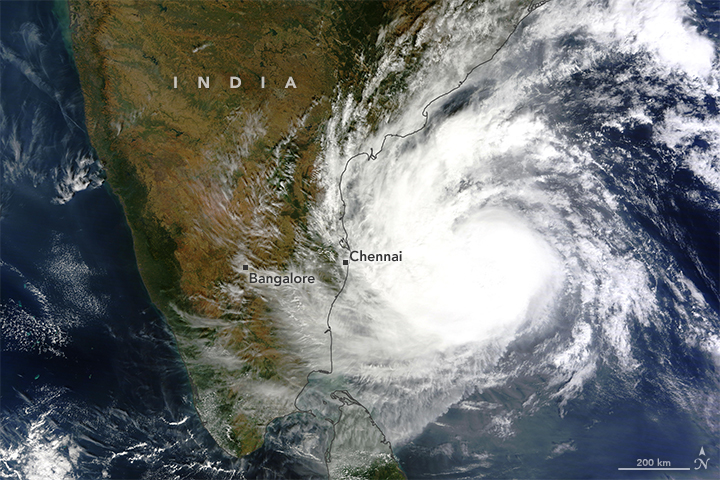
A year later, the same city but another extreme event. A “super cyclone” changed course and aimed straight towards the city. It is an irony that the cyclone was named Vardah, which means red rose. A beauty of a red rose it was not. In a couple of hours, the winds had toppled about a quarter of the trees in the city. Transformers blew up, utility poles cracked and fell, and power and communication systems were knocked out. Some of the more than eight million people in the area were without power and water for more than a week.
Because of the cyclone, the airport was closed. I was already en route, and was held back in Dubai for a day. The night that I landed in Chennai, the city was pitch dark at most places—no electricity. Fallen tree branches—and entire trees too—made the drive home from the airport eerie. Like practically everybody else in the city, my parents were also sitting by the candle light and waving a plastic fan about themselves in order to keep themselves cool and to shoo away the mosquitoes that couldn’t care about the cyclone.
The following morning, I walked about the city. This was as close as I have been to a landscape that can be described as a war zone. Entire trees uprooted. Buildings with facades blown off. Walls destroyed. And a strange silence in contrast to the high noise levels that otherwise typically assault my senses.
The rain and floods of December 2015, and the super-cyclone of December 2016, will now be followed by drought. Yes, water shortage. The state of Tamil Nadu, for which Chennai is the capital, is reeling from a monsoon that failed—the second worst in over 150 years. “The latest spell of rain due to Cyclone Vardah has only brought down the State’s deficit from 66 per cent to 61 per cent, says S. Balachandran, Director in the Meteorological Department.” If not for the moisture that the cyclone brought with it, the city and the state would be in an even worse situation.
Such extremes are consistent with climate weirding. I way prefer the phrase “global weirding” because it helps avoid unnecessary debates with deniers who want to contest global warming. The same deniers also typically point to changes in weather in order to raise pointless questions about global climate changes. Finally, global weirding helps me understand the kinds of extreme weather stories that have become all too common.
Extreme events are beyond the predictability that humans have lived by. The monsoons, for example, have wild swings these days. When it rains, it seems to pour all at once. Or, it rains when it should not. And, like this past season, the rains are deficient. This is especially a disaster for developing countries like India where a significant percentage of the population relies on intensive agriculture. The drought in Tamil Nadu has already resulted in a few farmers worried about their misfortunes committing suicide.
Climate scientists warn that we have to prepare for more and more extreme events that result from climate weirding. The Intergovernmental Panel on Climate Change (IPCC) noted that “a changing climate leads to changes in the frequency, intensity, spatial extent, duration and timing of extreme weather and climate events, and can result in unprecedented extreme weather and climate events.”
Of course, it is not merely about the rains. Heat waves, for instance, are increasing in both frequency and intensity. Unlike wind and rains, heat waves are not action made for cameras. Thus, unlike with a cyclone, for instance, there are no images and videos that go viral when it comes to heat waves. But, heat waves kill more people than rains and cold spells do. It is then not difficult to understand that heat waves during water-deficit situations can become disasters in tropical areas like India.
We in the United States need to stop denying the human cause in the global climatic changes in this industrial era. As a country with an affluence that is the envy of the rest of the world, we need to assume leadership in addressing global weirding. These will be enormous challenges during the demagogue's presidency and with the Grand Old Minions controlling Congress. But, we have overcome challenges in the past; here, too, I hope that we will eventually do the right thing.
A year ago, after visiting India in December 2015, I wrote about the record-setting rains and floods in the city of Chennai, where my parents and sister live. Almost 14 inches of rain fell within a matter of 24 hours, and that was merely one of the rain spells. With all the reservoirs full, authorities had to open up the gates, which then flooded the city.
A year later, the same city but another extreme event. A “super cyclone” changed course and aimed straight towards the city. It is an irony that the cyclone was named Vardah, which means red rose. A beauty of a red rose it was not. In a couple of hours, the winds had toppled about a quarter of the trees in the city. Transformers blew up, utility poles cracked and fell, and power and communication systems were knocked out. Some of the more than eight million people in the area were without power and water for more than a week.
Because of the cyclone, the airport was closed. I was already en route, and was held back in Dubai for a day. The night that I landed in Chennai, the city was pitch dark at most places—no electricity. Fallen tree branches—and entire trees too—made the drive home from the airport eerie. Like practically everybody else in the city, my parents were also sitting by the candle light and waving a plastic fan about themselves in order to keep themselves cool and to shoo away the mosquitoes that couldn’t care about the cyclone.
The following morning, I walked about the city. This was as close as I have been to a landscape that can be described as a war zone. Entire trees uprooted. Buildings with facades blown off. Walls destroyed. And a strange silence in contrast to the high noise levels that otherwise typically assault my senses.
 |
| Source |
The rain and floods of December 2015, and the super-cyclone of December 2016, will now be followed by drought. Yes, water shortage. The state of Tamil Nadu, for which Chennai is the capital, is reeling from a monsoon that failed—the second worst in over 150 years. “The latest spell of rain due to Cyclone Vardah has only brought down the State’s deficit from 66 per cent to 61 per cent, says S. Balachandran, Director in the Meteorological Department.” If not for the moisture that the cyclone brought with it, the city and the state would be in an even worse situation.
Such extremes are consistent with climate weirding. I way prefer the phrase “global weirding” because it helps avoid unnecessary debates with deniers who want to contest global warming. The same deniers also typically point to changes in weather in order to raise pointless questions about global climate changes. Finally, global weirding helps me understand the kinds of extreme weather stories that have become all too common.
Extreme events are beyond the predictability that humans have lived by. The monsoons, for example, have wild swings these days. When it rains, it seems to pour all at once. Or, it rains when it should not. And, like this past season, the rains are deficient. This is especially a disaster for developing countries like India where a significant percentage of the population relies on intensive agriculture. The drought in Tamil Nadu has already resulted in a few farmers worried about their misfortunes committing suicide.
Climate scientists warn that we have to prepare for more and more extreme events that result from climate weirding. The Intergovernmental Panel on Climate Change (IPCC) noted that “a changing climate leads to changes in the frequency, intensity, spatial extent, duration and timing of extreme weather and climate events, and can result in unprecedented extreme weather and climate events.”
Of course, it is not merely about the rains. Heat waves, for instance, are increasing in both frequency and intensity. Unlike wind and rains, heat waves are not action made for cameras. Thus, unlike with a cyclone, for instance, there are no images and videos that go viral when it comes to heat waves. But, heat waves kill more people than rains and cold spells do. It is then not difficult to understand that heat waves during water-deficit situations can become disasters in tropical areas like India.
We in the United States need to stop denying the human cause in the global climatic changes in this industrial era. As a country with an affluence that is the envy of the rest of the world, we need to assume leadership in addressing global weirding. These will be enormous challenges during the demagogue's presidency and with the Grand Old Minions controlling Congress. But, we have overcome challenges in the past; here, too, I hope that we will eventually do the right thing.
Wednesday, December 23, 2015
Into the swing of things ...a year later
My neighbor who joked that I had a job of milking the cows early in the morning--all because I told him I wake up every day well before six--perhaps will be convinced that I am really out milking cows here in the old country because I have been up every morning between 415 and 430. For all I know, even the cows are taking it easy at that hour.
Weekday, weekend, vacation, shmacation, it does not matter to me; I wake up early. Even if it means that soon after coffee I wonder why I had to be up when it is still REM time for most. But, stupid is as stupid does!
As always, after the fresh coffee and a little bit of reading, I headed to the park for a few laps of brisk walking. Every round, as I passed the swings, I wondered whether I should take the chance to swing away blissfully. All these days, I have been avoiding it because of the experience from a summer ago, when I was yelled at--"The swing is for children, and you should not be swinging" a guy scolded me in Tamil. Once bitten, twice shy, they say.
So, there I was today, yet again passing the swings. And drooling for some good old merriment.
Finally, I could not take it.
I stepped off the walking path. I walked up to a swing. I sat there. Across from me on another swing was a young boy, perhaps about ten years old. He smiled at me.
My feet pressed against the ground. And with one strong push, I started swinging.
My feet were now off the ground. I started gaining speed. I became the boy that I was back in Neyveli--the only difference is that I did not stand while swinging.
I was lost to the world. It was heavenly. If Eliza Doolittle thought she could have danced all night, I know I could have swung all day.
And then came the sounds from behind me.
"Stop. This is for children only."
I dragged my feet on the ground in order to slow the swing. I was crawling to a stop when another man--the local security guy with a mustache that could be a typical National Geographic feature--yelled at me. "This is for children less than six years old. You will break it" he said in Tamil.
I got off the swing and started walking away. There was a sense of public humiliation that I had to wash off. But, I simply had to swing today.
As I was walking, the security guy ordered the ten-year old boy also off the swing. I suppose the guy was not going to relax the rule. But then, it is not as if there are swings in the park for ten year olds and teenagers and for middle aged folks, or even for the old who might want to gently swing recalling their years.
Tomorrow I will go to the other park ;)
Tuesday, December 15, 2015
On this painful existence
I did not stir out of my home in California for two days after the fateful events on September 11th, 2001. I even skipped attending the back-to-school events, including the president's address in which he referred to a research project in which I was the lead researcher. I was exhausted from thinking about the families whose loved ones had jumped to death out of the flaming buildings, the ones who were trapped inside, the ones in the planes, the fire and rescue personnel, ... the losses were acutely personal to me, even though I had not known even one of the dead or injured.
It was a replay of similar emotions after the Christmas tsunami. The Fukushima earthquake and the tsunami. The mass shooting in Oregon. The recent rains and floods in Chennai. And a lot more.
I feel for the people at such events. And then I worry that my empathy levels could become unhealthy--or worse, that it already is.
Compared to those events around the world, my troubles seem so trivial. I have to remind myself my daughter's pragmatic suggestion years ago, of which she perhaps has no memory. She matter-of-factly told me that a person's problems were important and huge to that person. Whatever the problems might be. End of story.
The psychotherapy column in the NY Times has that same bottom-line as well: "Got First-World Problems? Don’t Feel Guilty."
Focusing on your hurt feelings because a cousin didn’t invite you to her bridal shower can easily appear shallow if you place it in the context of African genocide or refugees drowning in the Aegean Sea.The therapist advises not to feel guilty that your hurt feelings take priority over those catastrophic global issues.
If we allowed every mass tragedy to affect us deeply, we would soon suffer from empathy overload. Most of us would agree that having empathy for other people is a good thing, a core human capacity that supports morality and civilization. But it’s also possible to have too much of a good thing. Empathy has a downside when it makes you ashamed of what matters to you, or when it distracts you from other important emotions of your own.
If we didn't feel hurt and angry and frustrated in our daily lives that are peaceful and rich, then I suppose we would not be truly human experiencing the emotions that make us human. But, of course, we do not want to live a selfish life that is shut off from all those problems either. A fine balance between empathy and selfishness is what we need.
A similar issue pops up in a column about life after the catastrophic rains and floods in Chennai. The author, a Chennai resident, writes:
There was a family celebration recently, a zero-number birthday, and we went out, had dinner at a nice place. The money I spent, I didn’t feel... guilty about it, exactly. After all, some of my money has found its way to relief organisations. And we can’t stop living, right? Life goes on, right? But when I handed over my credit card, I felt weird. I think I understood — rather, felt — for the first time what Siddhartha must have felt when he stepped out of the palace and saw people who did not have the privileges he did. Again, I’m trying not to make too big a deal about this — but these are big thoughts, big emotions. About, through some freakishly random accident, being born into a certain kind of family, having all kinds of opportunities, having the freedom to chuck a phenomenally well-paying job and pursue a maybe-it’ll-work career in another field, now living in a flat in a high-lying area that floodwaters couldn’t reach — all of which led to this evening where I’m taking a casual look at the bill and handing out my credit card.
There is empathy, yes. But, life goes on. Babies are born. Wedding are celebrated. Funerals are conducted. Parties are held.
All a part of the human condition on this pale blue dot.
Saturday, December 05, 2015
Carry on, love is coming, love is coming to us all
My commitment to cut through the bullshit in any walk of life means that the atrociously unprofessional all-campus emails flying back and forth (which I have only been observing because, after all, it has been years since I was declared persona non grata!) has gotten me all worked up.
All that while I have been trying my best to figure out what was happening on the other side of the planet with the catastrophic rains and floods. Not able to communicate with the family while wondering whether they were alright was stressful, to say the least.
Meanwhile there was the mass-shooting down in Southern California.
These were not helping my highly empathetic personality. I was sure my blood-pressure was through the roof.
I swung by my usual place for the check-up. Well, my doctor will be happy with such a display:

I suppose I chose my parents well--their genes are certainly the reason behind this, or at least they play a significant role.
With immense relief, I got back to my work. I had no idea such a note from a student was waiting for me:
The grading of the finals will soon begin. And then it will be time to board the plane and fly to the old country. I have much to be thankful for, and there is no better (worse?) time than now for me to pay my dues.
All that while I have been trying my best to figure out what was happening on the other side of the planet with the catastrophic rains and floods. Not able to communicate with the family while wondering whether they were alright was stressful, to say the least.
Meanwhile there was the mass-shooting down in Southern California.
These were not helping my highly empathetic personality. I was sure my blood-pressure was through the roof.
I swung by my usual place for the check-up. Well, my doctor will be happy with such a display:

I suppose I chose my parents well--their genes are certainly the reason behind this, or at least they play a significant role.
With immense relief, I got back to my work. I had no idea such a note from a student was waiting for me:
What has helped me comprehend the way the world is and how it works come from the way that you have asked us to think about them, it is you who have helped me develop a better understanding of the world, not necessarily the content of the course. Sure anyone could post news links and academic articles and instruct students to read them but it is what you ask of us that makes the difference. Your views and questions provide the direction that enables us to see and make the connections that are needed to have a better idea of the world.That feedback is worth A LOT in my book. A kind of feedback that money cannot buy.
The grading of the finals will soon begin. And then it will be time to board the plane and fly to the old country. I have much to be thankful for, and there is no better (worse?) time than now for me to pay my dues.
Wednesday, December 02, 2015
On the Chennai floods ...
Will be a while before I get back to blogging ... time and energy spent on the catastrophic rains and floods back in the old country.
A few recent news reports:
From the BBC:
http://www.bbc.com/news/world-asia-india-34981246
From the Indian Express:
http://indianexpress.com/article/india/india-news-india/hit-by-torrential-rain-chennai-submerged-next-2-days-crucial/
The airport has been closed until December 6th (at least?)
It isn't over yet, by any means:
The weather office in Chennai has predicted more rains in Tamil Nadu over the next 24 hours due to presence of a low pressure in Bay of Bengal. “Due to low pressure rainfall will continue in next 24 hours in Tamil Nadu and Puducherry with some places receiving heavy to very heavy rainfall,” said Regional Meteorological Department Director, S.R. Ramanan.This satellite map alone says what is ahead for the next few days:
Wednesday, December 31, 2014
The times they are a-changin'
Once, during the annual summer vacations, from Sengottai we went to Trivandrum, where the highlight for this young kid of then, was the visit to the aerodrome, as it was called. I am sure I had no idea then that I would one day step into a jumbo jet for the first time, and that from then on flying would become a part of life.
In place of the annual summer vacations of a life past to visit the grandparents, I seem to have developed an annual winter vacation routine visiting the folks in the old country. I am now older than my parents' age when I went to the aerodrome, and my parents are older than my grandmothers were.
Years and decades have gone by, as if in a nanosecond.
The old country is less and less like the country that I once knew. Understandable. If I could have changed from a kid who was impressed by the aerodrome to a grey and balding old man, so can the peoples and the natural and built environment in India.
I saw five women walking along the crowded Usman Road. All of them wearing niqabs. Only their eyes were visible. I had never seen women in niqabs when I was a kid.
A woman was ironing clothes on a cart by the roadside. In the past, it was a man's job. Now, it is a woman. Even more interesting was that she was not clad in a sari, but was wearing the churidar combo. As a kid, I would not have imagined a Tamil woman wearing a churidar ironing clothes on a cart by the roadside.
I am always impressed with the rows of Hindi-speaking guys waiting for customers--always women--to offer the henna services. As a kid, all I knew was the simple applying the home-ground henna on fingers and the palms, without any intricate patterns--and that too by Hindi-speaking guys from somewhere.
Seemingly everybody is eating and drinking on the sidewalks, in the tea-stalls, in the cafes, in the "hotels" (as restaurants are referred to here.) As a kid, it was always a special deal to get even a candy from the store--for which we had to beg and annoy the parents.
The three places--Neyveli, Sengottai, Pattamadai--that provided the backdrop for my childhood were all small enough that it seemed like I could not go anywhere without people knowing me. The places were all quiet and peaceful. The kid from those days would never have imagined the noisy, noisy, noisy, life in anonymity in this city that has been home to the folks now for more than the years that I have been away in my adopted land.
The niqab-wearing women, the ironing woman, the henna-workers, all of them would have reasons to be happy and would have their own reasons to be unhappy. I wish them all happiness as this annual vacation comes to an end and as I prepare to leave on a jet plane from an airport.
Happy new year, dear reader!
Saturday, December 27, 2014
The Indianizing Indians
Slowly things are changing in this part of India. It is Indianizing.
A few days ago,
I was shocked to hear languages and dialects that I am sure were not from the Dravidian south, nor were there any Hindi words. I couldn't pick up any Bengali sing-song either. In the heart of traditional Chennai!
Even more shocking was to see people who were clearly not from the Dravidian south, nor from the Hindi Belt. From the northeastern parts. Walking around casually in the heart of traditional Chennai!
Another day, my brother and I were in an autorickshaw when the driver pulled into a fuelling station--an LPG fuelling station. As the driver pushed his vehicle along in the long line, another auto driver attempted to cut in. The station attendant came charging and let out yells--in Hindi! The guy obviously was from another part of India, and was working here in the traditional Chennai, and hadn't learnt the local language to yell in Tamil! Hilarious it was. And one more evidence of the India that is slowly changing and mixing. I call it Indianizing.
People from other parts of India moving to Chennai is easy to understand. It is a combination of demographics and economics: economic growth rates are not enough in areas with high fertility rates, whereas Chennai and the Dravidian south are experiencing economic growth while the fertility rates have fallen well below replacement levels.

My ground-level observations match up with this report:
A few days ago,
before the mysterious fever with aches and pains like I have never had in my life--which miraculously disappeared in 24 hours--and beforeI walked around the uber-congested shopping areas of the infamous Ranganathan Street. In the heart of traditional Chennai.
the horrible experience of traveler's diarrhea--my first in all these years of traveling in the US and different countries, including India,
 |
| Source |
I was shocked to hear languages and dialects that I am sure were not from the Dravidian south, nor were there any Hindi words. I couldn't pick up any Bengali sing-song either. In the heart of traditional Chennai!
Even more shocking was to see people who were clearly not from the Dravidian south, nor from the Hindi Belt. From the northeastern parts. Walking around casually in the heart of traditional Chennai!
Another day, my brother and I were in an autorickshaw when the driver pulled into a fuelling station--an LPG fuelling station. As the driver pushed his vehicle along in the long line, another auto driver attempted to cut in. The station attendant came charging and let out yells--in Hindi! The guy obviously was from another part of India, and was working here in the traditional Chennai, and hadn't learnt the local language to yell in Tamil! Hilarious it was. And one more evidence of the India that is slowly changing and mixing. I call it Indianizing.
People from other parts of India moving to Chennai is easy to understand. It is a combination of demographics and economics: economic growth rates are not enough in areas with high fertility rates, whereas Chennai and the Dravidian south are experiencing economic growth while the fertility rates have fallen well below replacement levels.
My ground-level observations match up with this report:
Internal migrants in India are expected to touch 400 million in the 2011 census, over half the global figure of 740 million and almost twice as many as China's estimated 221 million.A third of the country's population are internal migrants. What a phenomenal change from even two generations ago!
According to the report, internal migrants faced discrimination as 'outsiders', which excluded them from access to legal rights, public services and social protection programmes accorded to residents. This is despite the migrants providing cheap labour and typically doing the most dirty, dangerous and degrading jobs that locals do not want to do. Far from being a burden on society, migrants' cheap labour provides a subsidy and contributes to the national GDP, stated the report. Moreover, remittances from migrants lead to increased expenditure on health and education helping human capital formation.To be viewed, discriminated, as "outsiders" is not an unusual experience for migrants--internal or international. Change from the old is not easy for us humans to handle. But, as this migrant will attest, we migrants are a hardy bunch. I am sure even the Hindi-yelling LPG gas station attendant will survive and prosper--even in the heart of traditional Chennai!
Friday, July 25, 2014
Walk like an Egyptian. Or an American. Or an Indian. Walk!
The summer weather has been unpredictably up and down like a teenage girl's moods ;) Last week, we flirted with triple-digit temperatures but fell short by a degree. And then came a cold front from Alaska, which brought down to the high to the low sixties and dropped some record-breaking rain. Well, the twentieth of an inch was a record for the calendar day.
Today, the weather was just perfect, like that teenage girl in an angelic mood. (I know I will be in trouble with the female readers. hehe!) My neighbors, who I rarely see going for a walk, were there as a lovely couple out on a midday stroll. "What a lovely day" she said. "Awesome" is what I told them.
I love the walk by the five-mile walk by the river. Ok, it is a little more than four-and-a-half, which I round off to five. Try saying "I went for my four-and-a-half mile walk by the river" and then utter "I went for a five-mile walk by the river" and tell me which one is easier for the tongue and the brain!
That five-mile walk, I have always believed, is the most important factor contributing to my health. Ok, there is no other physical activity and that makes it the only factor; happy now? It is not merely the walking. It is the time away from the gadgets. No reading. No talking. Listening to the sounds all around. Watching the goslings. All add up to a relatively healthy body and mind.
And now I have evidence to back me on this: Doctors are prescribing a walk in the park:
One of the best things that the corrupt government in Chennai did was to invest in the dilapidated parks. As my blog posts from my visits to Chennai show, I am not the only one at those parks--if I don't go there early enough, then it gets crowded, which is wonderfully heart-warming to the intellectual in me but the crowd itself is not what I can handle ;)
Surely you don't need Zarr's prescription, right? Then, why are you still reading this? Get up and get going. Go for that four-and-a-half mile walk ;)
Today, the weather was just perfect, like that teenage girl in an angelic mood. (I know I will be in trouble with the female readers. hehe!) My neighbors, who I rarely see going for a walk, were there as a lovely couple out on a midday stroll. "What a lovely day" she said. "Awesome" is what I told them.
I love the walk by the five-mile walk by the river. Ok, it is a little more than four-and-a-half, which I round off to five. Try saying "I went for my four-and-a-half mile walk by the river" and then utter "I went for a five-mile walk by the river" and tell me which one is easier for the tongue and the brain!
That five-mile walk, I have always believed, is the most important factor contributing to my health. Ok, there is no other physical activity and that makes it the only factor; happy now? It is not merely the walking. It is the time away from the gadgets. No reading. No talking. Listening to the sounds all around. Watching the goslings. All add up to a relatively healthy body and mind.
And now I have evidence to back me on this: Doctors are prescribing a walk in the park:
[Dr. Robert Zarr] told me that exhorting patients to “get more exercise” was too vague. Last year, he decided to start trying something different. He stopped asking his patients, “Do you move?” and began asking “Where do you move?” He discovered that many spent very little time outdoors, and he began prescribing time outside for conditions as wide-ranging as ADHD, high blood pressure, asthma, obesity, anxiety, diabetes, and depression.How about that! If only more doctors prescribed walking, right?
The scientific breakthroughs of the 20th century put a premium on treatments that could be tested in a lab. “The half-page advertisements for the Glen Springs Sanitarium gave way to the full-page advertisement for the anti-anxiety drug meprobamate,” Selhub and Logan write. Today, the idea of a doctor telling you to spend time in a pleasant climate seems like something out of Masterpiece Theatre, a quaint tonic from a bygone era available only to those of the leisure class.How terrible!
Intuitively, it probably doesn’t seem surprising that kids who run around in the woods are less fidgety when they do have to pay attention. Or that the smell of a pine forest is so pleasant that it soothes anxiety. But even if the mechanisms aren’t entirely clear, a steadily growing stack of scientific evidence suggests that time in nature is really good for you. Why don’t we embrace this idea of healthy nature more fully? Perhaps popping a pill is less daunting than an overhaul of our daily routines.
Or maybe we don’t think that our environments matter.
So far, Zarr and his team have given out 600 prescriptions for nature. “It’s not a panacea,” he said, “but we’ve touched on something exciting.”
Saturday, July 05, 2014
On this sweet life ...
Many, many decades ago, back in school, there was an attempt, feeble as it was, to start Boy Scouts and Girl Guides. I have no idea what the girls did, but we boys didn't do much though, once, we even went on a day trip--on our bicycles, as I recall.
I was never interested in camping andtieing tying different kinds of knots anyway. But, there was one aspect that impressed me--a Scout maintained a daily list of socially constructive actions, which could include even acts like helping an old person cross the street.
Yesterday, I was a Boy Scout, who helped an old woman on the street.
I was barely out of the compound on the way to buy a jar of honey to go with the jackfruit that awaited me when a woman, who was perhaps in her late 70s and attired in the old traditions of the old country, stopped me. "Do you know where number 7 is?" she asked me in Tamil. Obviously, I had no idea.
But, I did not have the heart to merely tell her that I didn't know. There was a look of desperation in her. It is an awful feeling of being lost--literally and metaphorically. When somebody points out the way or helps along, life becomes a lot more pleasant.
"I am not from here. But, I will try to figure this out" I assured her.
It was amazing how much more relaxed she became in her facial expression.
"I have come to see "S" and his wife, who recently had an operation ..." she started. I bet she would have told me her life story if I had allowed her to.
"They have two numbers here--an old number and a new number. Is "7" an old one or new?" I asked her, fully anticipating that she would not know. Of course, she did not know.
"Can you call "S"" she asked.
"Oh, I don't have a cell phone."
"I have a phone. But, I don't know how to call."
"Do you have the number?"
"It is in the phone."
I cannot understand why corporations cannot manufacture and sell simple cell phones that older folks can use. To make a simple phone call. But, the cell phones and their gizmos end up terrorizing the older folks.
She handed me the phone. Her genuine trust in me humbled me. I live in a world where we are always suspicious of people and their motives.
I located a number for "S" and dialed it. I gave her the phone.
"It is ringing" she updated me. Soon she started talking with "S" and asked him where "7" was.
I walked with her to the street adress "7." "Romba thanks" she said. She was now an assured, calm, smiling face, unlike how she looked when she stopped me.
This boy scout earned his jackfruit with honey. It tasted all the more delicious.

I was never interested in camping and
Yesterday, I was a Boy Scout, who helped an old woman on the street.
I was barely out of the compound on the way to buy a jar of honey to go with the jackfruit that awaited me when a woman, who was perhaps in her late 70s and attired in the old traditions of the old country, stopped me. "Do you know where number 7 is?" she asked me in Tamil. Obviously, I had no idea.
But, I did not have the heart to merely tell her that I didn't know. There was a look of desperation in her. It is an awful feeling of being lost--literally and metaphorically. When somebody points out the way or helps along, life becomes a lot more pleasant.
"I am not from here. But, I will try to figure this out" I assured her.
It was amazing how much more relaxed she became in her facial expression.
"I have come to see "S" and his wife, who recently had an operation ..." she started. I bet she would have told me her life story if I had allowed her to.
"They have two numbers here--an old number and a new number. Is "7" an old one or new?" I asked her, fully anticipating that she would not know. Of course, she did not know.
"Can you call "S"" she asked.
"Oh, I don't have a cell phone."
"I have a phone. But, I don't know how to call."
"Do you have the number?"
"It is in the phone."
I cannot understand why corporations cannot manufacture and sell simple cell phones that older folks can use. To make a simple phone call. But, the cell phones and their gizmos end up terrorizing the older folks.
She handed me the phone. Her genuine trust in me humbled me. I live in a world where we are always suspicious of people and their motives.
I located a number for "S" and dialed it. I gave her the phone.
"It is ringing" she updated me. Soon she started talking with "S" and asked him where "7" was.
I walked with her to the street adress "7." "Romba thanks" she said. She was now an assured, calm, smiling face, unlike how she looked when she stopped me.
This boy scout earned his jackfruit with honey. It tasted all the more delicious.
Friday, July 04, 2014
Pecunia non olet? Not if it is from Yale. From Chennai?
The title of this post should not, by any means, mislead a reader into thinking that I am now a Latin student at Yale. Far from that; they would not allow the likes of me at those Ivies!
A few years ago, when I was in Boston for a conference, I went to Harvard, and walked about. When I was in the law school buildings I decided to use the restroom instead of hunting for one later on. As I like to joke about it, I have contributed a lot to Harvard!
While those kind of contributions stink, we stink, therefore we are human ;) Money, however, apparently has no smell. Remember that earlier post on Pecunia non olet?
It is most appropriate that I continue with that smelly topic from here in Chennai. Not because of the stink in Chennai, about which one could write doorstoppers. But because of Chennai's connection with Yale. With the university's namesake, that is.
First, you plunder.
Then create universities or hospitals or scholarships and launder that money clean.
And get recorded in history as one of the greats.
A few years ago, when I was in Boston for a conference, I went to Harvard, and walked about. When I was in the law school buildings I decided to use the restroom instead of hunting for one later on. As I like to joke about it, I have contributed a lot to Harvard!
 |
| Boston's Charles River, 2008 |
While those kind of contributions stink, we stink, therefore we are human ;) Money, however, apparently has no smell. Remember that earlier post on Pecunia non olet?
It is most appropriate that I continue with that smelly topic from here in Chennai. Not because of the stink in Chennai, about which one could write doorstoppers. But because of Chennai's connection with Yale. With the university's namesake, that is.
Elihu Yale was more a product of the East India Co. than of any place or political jurisdiction. Descended from a Welsh family, he was born in 1649 in Boston but spent most of his childhood in London, where his father, David, sought freedom from the puritanical strictures of New England and a friendly environment for trade. Young Yale enjoyed an education from William Dugard, headmaster of the storied Merchant Taylors' School, before obtaining a job with the East India Co. in 1670. He soon shipped out to Fort St. George, the company's lucrative outpost in southern India, around which had grown the town of Madras, now Chennai, India's sixth largest city. There he remained for the next quarter-century, eventually becoming governor of the settlement. In between, he and his wife, Catherine, would become the first couple married at St. Mary's Church—India's oldest Anglican church—and Elihu would amass a fortune dealing in textiles and precious stones on his own account. After retiring to a grand estate in London, he arranged for a burial at his ancestral home in Wrexham, Wales, beneath a tomb paying homage to his peripatetic life: "Born in America, in Europe bred / In Afric travell'd and in Asia wed / Where long he liv'd and thriv'd; at London dead."From a common puritan to a governor.
Yale had come to India with the entry-level title of a company "writer" and an annual salary of £10—about half a shilling a day at a time when an English cloth suit cost around 15 shillings. Having demonstrated a knack for negotiations with local trade partners, by 1687 he had been named governor.Sounds like there is no reason why his money should smell, right?
His position was precarious: Opportunities for graft were extraordinary, and governors were vulnerable to accusations of improprieties. It didn't help that Yale was widely regarded as a brusque and divisive manager. After the company replaced Yale in 1692, a wide array of allegations regarding his tenure as governor emerged, keeping him on the legal defensive in Madras. But he used the time off the company's payroll in India to focus on growing his vast estate. The precise size of his fortune by the time he left India is unclear, but his assets were numerous enough that their disposal at his death required seven separate auctions.I suppose the formula is simple.
First, you plunder.
Then create universities or hospitals or scholarships and launder that money clean.
And get recorded in history as one of the greats.
Yale had ensured that his name would emerge in the centuries to come as a byword for learned privilege. Always a a shrewd trader, Yale found in his gift to the fledgling New Haven school the best deal he ever made.Oh well ... I have other smelly problems to deal with rather urgently--like how no amount of deodorants can help me in Yale's old robbing grounds ;)
Tuesday, July 01, 2014
Into the swing of things ...
My childhood home was surrounded by trees. Five huge tamarind trees, seven or eight mango trees, a cashewnut tree, two bearing lemons, and a bunch of trees that did not produce any edible fruits.
In one corner of this compound was a lovely swing. A swing with a plank on which two kids could sit or stand. My brother and I have had countless competitions on that swing--two of our favorites were how high one could swing, and how much farther one could jump off that swing. And, of course, many of these ended up in fistfights too!
While the swing at home was an outdoor one, grandmother's home had an indoor swing. A swing that was long and broad enough to serve as a bed. It was in the inner courtyard, which served us kids well because we did not have to deal with the midday sun. We cousins who gathered at grandmother's home during our annual school vacations have played, eaten, and also slept on that swing. And, yes, lots of crying at the swing.
Thus, old as I might be, even now I am always drawn to a swing when I see one.
I was swinging away at the local park when a self-appointed righteous citizen, clad in a dhoti, chastised me for my merriment. "The swing is for children, and you should not be swinging" he scolded me in Tamil as he contorted his facial muscles to produce a contemptuous expression.

Over the past few days, a couple of minutes at the swing has been a part of my early morning routine. It is my reward for the hour-plus of walking in the insanely hot and humid morning. After those couple of minutes, I slowly walk back home.
That local guy, who was perhaps no older than I am, perhaps has never had the pleasure of swinging away life's problems. He perhaps has never experienced the priceless joys of swinging.
There is a pleasure in gentle swinging.
There is a different pleasure in the wild arcs.
Another pleasure with company.
Thrills are different in the morning hours versus in the evenings.
Indoor versus outdoor.
What a joyless world that guy must be in if he has never known such simple pleasures of life!
"It is all ok" is all I replied in Tamil.
That response did not go well with him.
Consistent with the culture of self-appointed righteous citizens, he immediately shared his concerns with two other middle-aged men, who then turned around to look at me swinging. I wanted to wave a hi to them, but I did not. The citizen kept gesticulating at my direction as he continued to talk with them and they too regularly turned their heads towards me. I continued to swing.
I slowly walked back home thinking about the cold, fresh, mango juice in the fridge. I wish I could drink the mango juice while seated on that swing, just like in the old days.
In one corner of this compound was a lovely swing. A swing with a plank on which two kids could sit or stand. My brother and I have had countless competitions on that swing--two of our favorites were how high one could swing, and how much farther one could jump off that swing. And, of course, many of these ended up in fistfights too!
While the swing at home was an outdoor one, grandmother's home had an indoor swing. A swing that was long and broad enough to serve as a bed. It was in the inner courtyard, which served us kids well because we did not have to deal with the midday sun. We cousins who gathered at grandmother's home during our annual school vacations have played, eaten, and also slept on that swing. And, yes, lots of crying at the swing.
Thus, old as I might be, even now I am always drawn to a swing when I see one.
I was swinging away at the local park when a self-appointed righteous citizen, clad in a dhoti, chastised me for my merriment. "The swing is for children, and you should not be swinging" he scolded me in Tamil as he contorted his facial muscles to produce a contemptuous expression.
Over the past few days, a couple of minutes at the swing has been a part of my early morning routine. It is my reward for the hour-plus of walking in the insanely hot and humid morning. After those couple of minutes, I slowly walk back home.
That local guy, who was perhaps no older than I am, perhaps has never had the pleasure of swinging away life's problems. He perhaps has never experienced the priceless joys of swinging.
There is a pleasure in gentle swinging.
There is a different pleasure in the wild arcs.
Another pleasure with company.
Thrills are different in the morning hours versus in the evenings.
Indoor versus outdoor.
What a joyless world that guy must be in if he has never known such simple pleasures of life!
"It is all ok" is all I replied in Tamil.
That response did not go well with him.
Consistent with the culture of self-appointed righteous citizens, he immediately shared his concerns with two other middle-aged men, who then turned around to look at me swinging. I wanted to wave a hi to them, but I did not. The citizen kept gesticulating at my direction as he continued to talk with them and they too regularly turned their heads towards me. I continued to swing.
I slowly walked back home thinking about the cold, fresh, mango juice in the fridge. I wish I could drink the mango juice while seated on that swing, just like in the old days.
Thursday, June 26, 2014
A park. An elderly Muslim. Hindu religious music. Bad mix!
I typically reach the park well before dawn breaks. It is warm even at that hour, with an occasional breeze.

But, I am rarely ever the only person that early at the park. I am even more amazed at the sight of women, walking alone by themselves, that early. At least this part of the old country is far away from the rape news geography.
Slowly they come. In ones and twos, and by the tens as the sunlight begins to stream in. One of those I have seen every morning is an older gentleman who walks slowly with his right hand holding a cane. Always clad in the same outfit--a white lungi, a white shirt, and a white Islamic skullcap.
When I see that older Muslim gent, I become all the more ticked off at the public address system. Why? Let me explain.
This is a public park. A government owned and maintained park. Yet, throughout the more than an hour that I am there, they blast--very loudly--Hindu religious music. Only Hindu religious music. Nothing but Hindu religious music. As if it is not a park but the grounds at a Hindu temple.
The older Muslim's outfit made his religion obvious. There could be, among the walkers, people of faiths other than Hinduism. Perhaps even an atheist or two. (I do not count for I am a citizen no more of this old country.) Why should the government bombard Hindu religious music on people who do not care about Hinduism?
Of course, this is not the first time that I am blogging about this atrocious deluge of religion in a public space. But, it is even more of a sore point given that the sociopolitical environment is now charged/changed with the election of the Hindu nationalist party to power at the federal level.
The attempt to make the public space secular was perhaps a non-winnable fight from the very beginning of an independent India. As India started the process of becoming a republic, Jawaharlal Nehru strongly advocated for Rajaji to transition from the office of Governor General and become the country's first president. Nehru opposed the rival candidate, Rajendra Prasad, who was backed by Vallabhai Patel:
I suppose I am stuck with the loud Hindu religious music every morning at the park. At least it is temporary for me, and I will soon return to my sanctuary--the public space by the river where no government, or private group, blasts any religious music. But, that old Muslim gent has no choice, I guess.
This, too, is India for you.
But, I am rarely ever the only person that early at the park. I am even more amazed at the sight of women, walking alone by themselves, that early. At least this part of the old country is far away from the rape news geography.
Slowly they come. In ones and twos, and by the tens as the sunlight begins to stream in. One of those I have seen every morning is an older gentleman who walks slowly with his right hand holding a cane. Always clad in the same outfit--a white lungi, a white shirt, and a white Islamic skullcap.
When I see that older Muslim gent, I become all the more ticked off at the public address system. Why? Let me explain.
This is a public park. A government owned and maintained park. Yet, throughout the more than an hour that I am there, they blast--very loudly--Hindu religious music. Only Hindu religious music. Nothing but Hindu religious music. As if it is not a park but the grounds at a Hindu temple.
The older Muslim's outfit made his religion obvious. There could be, among the walkers, people of faiths other than Hinduism. Perhaps even an atheist or two. (I do not count for I am a citizen no more of this old country.) Why should the government bombard Hindu religious music on people who do not care about Hinduism?
Of course, this is not the first time that I am blogging about this atrocious deluge of religion in a public space. But, it is even more of a sore point given that the sociopolitical environment is now charged/changed with the election of the Hindu nationalist party to power at the federal level.
The attempt to make the public space secular was perhaps a non-winnable fight from the very beginning of an independent India. As India started the process of becoming a republic, Jawaharlal Nehru strongly advocated for Rajaji to transition from the office of Governor General and become the country's first president. Nehru opposed the rival candidate, Rajendra Prasad, who was backed by Vallabhai Patel:
Mr. Patel’s choice for president was Mr. Prasad, a teacher and lawyer who had just presided over the assembly that drafted India’s constitution. This frustrated Mr. Nehru, who tended to be annoyed by Mr. Prasad’s public religiosity – by, for instance, his stated dedication to renovating the Somnath temple in Gujarat.It was not that Somnath was a Hindu temple, but the temple had a long history of tension between Hindus and Muslims. After the bitter partition along Hindu/Muslim lines, after the tragedy of lives lost and displaced, and property destroyed, Nehru did not want to trigger more communal tension with a Hindu president inaugurating the renovated temple. Nehru lost that fight. I suspect that the fight to keep religion off the public space was also lost; I cannot imagine Rajaji, despite the religious scholar that he was, accepting the invitation to inaugurate the temple.
I suppose I am stuck with the loud Hindu religious music every morning at the park. At least it is temporary for me, and I will soon return to my sanctuary--the public space by the river where no government, or private group, blasts any religious music. But, that old Muslim gent has no choice, I guess.
This, too, is India for you.
Wednesday, June 25, 2014
It is like a sauna in here
Another hot day.
One of Johnny Carson's routines was for him to exclaim in his monologue that it was a hot day in Burbank, when his sidekick, Ed McMahon would serve up a volley with "how hot was it?" for Carson to then deliver the punchline.
So, how hot was it here in Chennai? The punchline was anything but funny--the tiles in the kitchen spontaneously exploded!

If not for mother's cooking, and the parents' delight at having me here, I would have fled town ;)
In a Polyannaish way, I can state that thanks to the free WiFi at home (free for me when parents pay!) I can all the more indulge in reading, tweeting, and blogging. A hot thinking machine I have become. And when overheated, I cool myself down with freshly made mango juice. Father buys mangoes, mother makes the juice, and I drink it. Not bad, eh!
With thoughts of the high temperature always on my mind, it should be no surprise that I tweeted about the global hot streak:
Apparently that tweet ticked somebody off:
That tweeting "Conservative" perhaps does not know that there are Conservatives, and influential ones at that, who know better. Like former Treasury Secretary and Goldman Sachs chief Henry Paulson, who teamed up with others in order to get climate change the attention it deserves, though his worry is merely from an economic standpoint:
Apparently "Risky Business" is more than mere economics; the friend sent a link to this news item:
But, seriously, there can be conditions worse than what I am experiencing now?
One of Johnny Carson's routines was for him to exclaim in his monologue that it was a hot day in Burbank, when his sidekick, Ed McMahon would serve up a volley with "how hot was it?" for Carson to then deliver the punchline.
So, how hot was it here in Chennai? The punchline was anything but funny--the tiles in the kitchen spontaneously exploded!
If not for mother's cooking, and the parents' delight at having me here, I would have fled town ;)
In a Polyannaish way, I can state that thanks to the free WiFi at home (free for me when parents pay!) I can all the more indulge in reading, tweeting, and blogging. A hot thinking machine I have become. And when overheated, I cool myself down with freshly made mango juice. Father buys mangoes, mother makes the juice, and I drink it. Not bad, eh!
With thoughts of the high temperature always on my mind, it should be no surprise that I tweeted about the global hot streak:
For 351 months in a row, or more than 29 years, global temperatures have been warmer than average
http://t.co/cwI4lBigZC #ClimateChange
— sriram khe (@congoboy) June 23, 2014
Apparently that tweet ticked somebody off:
@congoboy seek the truth: http://t.co/gIKCs21Eht
— Conservative Ranting (@iGotSmarts) June 24, 2014
A ranting for sure!That tweeting "Conservative" perhaps does not know that there are Conservatives, and influential ones at that, who know better. Like former Treasury Secretary and Goldman Sachs chief Henry Paulson, who teamed up with others in order to get climate change the attention it deserves, though his worry is merely from an economic standpoint:
Mr. Paulson said the goal is to depoliticize the climate-change debate and instead focus on how it poses an economic risk to U.S. businesses."Risky Business" is the title of the report. Among the business folks who have immediately appreciated this:
The Risky Business effort was applauded by the president of the Reinsurance Association of America, Frank Nutter, who said: "It is crucial that industry factor into account the science of climate change, and changes to national and global weather patterns in risk assessment and pricing."The insurance folks who are in the business of betting apparently know better than to argue that there is no climate change to worry about. I wonder what the likes of the Ranting Conservative will have to say about the insurance folks who have to put their money where their mouth is.
Apparently "Risky Business" is more than mere economics; the friend sent a link to this news item:
"As temperatures rise, toward the end of the century, less than an hour of activity outdoors in the shade could cause a moderately fit individual to suffer heat stroke," said climatologist Robert Kopp of Rutgers University, lead scientific author of the report. "That's something that doesn't exist anywhere in the world today."Again, being Polyannaish, I guess I should be glad I am not dead, yet, and that I won't be alive to experience the terrible conditions.
But, seriously, there can be conditions worse than what I am experiencing now?
Friday, June 20, 2014
An old car for an old man visiting his old country!
"You have not filled out the correct immigration form" the female officer told me with an expression that suggested a combination of irritation and disgust.
I don't blame her; after all, if I am being asked to work at midnight, I too will be cranky as hell. Or, perhaps she was just being a Ramamritham!
"Do you have the form here?"
"No, it is there" she said pointing her fingers to a far away fixture on the wall.
I walked up to that one. Two holders for forms and neither seemed to have any papers.
I walked back to her and reported that there were no forms.
She was even more irritated and disgusted. "It is there in the wooden one."
I went there and fished around inside. Dammit she was right. There was one form. One f*ing form was all that was there in those two bins together. Couldn't these folks at least restock that damn thing?
Having filled it out, I waited for her to finish processing the person at her counter.
Meanwhile, a younger man waiting in line was getting visibly upset that I was making a dash for the counter. "Sir, the line is here" he advised me in a very Indian manner of spoken and body language. I couldn't be bothered. "She asked me to make a correction to the form" I said as I walked up to the counter.
The utterly smile-less officer stamped the passport and I moved on.
Welcome to India, I told myself.
I am sure the Indian visitors get a lot more hassled by the process when they visit the US. But, hey, I can only blog about my own experiences ;)
I paid upfront for a taxi and walked up to the parking lot. A driver led me to his cab. An old black Ambassador with a yellow top. It looked so old and beaten up that I worried it might not be air-conditioned. "Does this have AC?" I asked him. He nodded an affirmative.
It was stifling inside the cab. I removed my shirt and stuffed it into the backpack. Welcome to India, I told myself.
Sunday, June 08, 2014
Ladies' fingers twirl mustaches of men from Madras
Perhaps it was the six years of graduate schooling that has made me pay attention to the paranthetical comments even in the regular publications. Like in The Economist the other night; there I was in bed reading through the lengthy special on Asian businesses when I laughed out aloud, and re-read the following more than twice and laughed every single time:
Not that "the world’s highest incidence of moustaches" is among women--that will be one for the record books! Men, especially the younger ones, in that part of the world sport mustaches. (And older ones too, like this guy!) I, too, was no different, as this photo ID of the FOB me shows ;)

Damn, that is one impressive mustache! ;)
Those aside comments, the footnotes, the words within parentheses, are, sometimes, worth more than the lengthy essays themselves.
It was a similar experience today when I read that:
It was in an essay on, get this, Indian cuisine in America's deep south!
An end-note: I wonder why I suddenly feel hungry now!
Hyundai Motors is becoming as globally minded as Samsung. Near Chennai, a southern Indian city with perhaps the world’s highest incidence of moustaches, it has invested $2 billion over a decade and a half in a factory that builds a car every 68 seconds.A dull and boring editor would have deleted "a southern Indian city with perhaps the world’s highest incidence of moustaches." I am so thankful it was retained.
Not that "the world’s highest incidence of moustaches" is among women--that will be one for the record books! Men, especially the younger ones, in that part of the world sport mustaches. (And older ones too, like this guy!) I, too, was no different, as this photo ID of the FOB me shows ;)
Damn, that is one impressive mustache! ;)
Those aside comments, the footnotes, the words within parentheses, are, sometimes, worth more than the lengthy essays themselves.
It was a similar experience today when I read that:
(Cotton and okra, by the way, come from the same plant family.)Who woulda thunk that!
It was in an essay on, get this, Indian cuisine in America's deep south!
Talking about the cultural linkages between the American South and India is not much of a stretch. At the very least it’s agriculturally defensible. Both were once colonial economies built, in part, on cotton farming. That enterprise expanded rapidly in India during the Civil War, when the Confederate States of America attempted a trade embargo. The C.S.A. believed that Great Britain, dependent on Southern cotton for textile manufacturing, would—when faced with a restricted flow of raw cotton imports—knuckle under economic pressure and support their war effort. The ploy didn’t work. Instead, Great Britain began importing more cotton from India. Decades would pass before country club Southerners began wearing madras fabrics, imported from the Bay of Bengal port city of that name.The essay ends with a link to this video on two cooks--"Atlanta-based chefs Asha Gomez and Steven Satterfield discuss their "two Souths" - Kerala, India, and the Southeastern United States."
Also analogous is a devotion to okra. (Cotton and okra, by the way, come from the same plant family.) Now that I have found my footing in Indian restaurants, I order okra fried, roasted, and stewed, and when I eat it I’m as likely to think of my small-town Georgia upbringing as I am to conjure the last Bollywood extravaganza I saw on the flat screens at Taste of India.
An end-note: I wonder why I suddenly feel hungry now!
Wednesday, May 14, 2014
Let's give 'em something to talk about!
It is summer-like conditions here in the valley. I drove with the air-conditioner on--during the morning drive to campus. The temperature gauge displayed 88 as I drove back home and the air-conditioner seemed to be on strike. It is almost as if I went to sleep in Eugene and woke up in Chennai!
Somebody please send us a piece of that melting Antarctic ice sheet!
Of course, I exaggerate; the heat here is nothing compared to the conditions in Chennai. Even glancing at the weather report for Chennai makes me suffer a severe heat stroke--the unusual high temperature of today is only a tad higher than the low temperature there. Ouch!
Calling up my parents every day does not help either, because the heat there is one of the conversation items.
"It is very, very bright, and very, very hot" father said yesterday. "The humidity is so bad that I am sweating even when doing nothing" he added.
Listening to him, I started sweating here in Eugene. The power of suggestion is for real. But, apparently the power of suggestion does not work when I read about the cold Antarctic ice sheet. I suspect that when I read about it, I end up relaying the heat, causing it to melt even more ;)
Father and son wondered how we dealt with the heat in the old days, when we were both younger. He in his middle age, and I as a teenager. When there was no air conditioning.
"But, no point complaining. It is Agni Natchathiram time" father sighed.
"Exactly. That is how it will be when you are that close to the Equator" I responded, as if there was a subconscious need to make up for the formal geography credentials that I do not have.
A student showed up in my office, which is a shocker anymore. I thought I was successfully driving students away with questions to them--like about their futures, their career plans, and their absences. Darn, some survive it all; some masochists they are!
He complained about the heat, and the sweating from having biked to campus.
"I know all about that feeling, man. Back in India, all through my younger years, I biked all over the place in the heat and the humidity" I replied.
Changes in the weather conditions certainly do give us something to talk about.
Maybe I ought to thank nature--always described in the feminine as if to reflect the unpredictable behavior--for turning up the heat like this; if it were nothing but a pleasant day every single day, perhaps we will even lose the appreciation of the wonders of a pleasant day.
Thanks to the Indian summer today, I can now drool for the cool morning and a pleasant day that is forecast for Friday.
And then complain about the cold and the rain on Sunday. After all, what are we if we do not complain! ;)
Subscribe to:
Posts (Atom)