Showing posts with label immigrants. Show all posts

Tuesday, November 10, 2020

Immigrants and Project Lightspeed

The tRump regime--"administration" doesn't really describe it--loudly and openly beat up on immigrants and Muslims.  Remember how one of the first things he tried to do was a blatant Muslim ban?  He then had to scale it down and pretend it was not really a Muslim ban when it was.

During those dark days, social media--from the anti-tRump side--pointed out how Apple might not have happened if a certain Syrian immigrant had not come to the US.  Steve Jobs' biological father, Abdulfattah Jandali, was an Arab Muslim from Syria, who came to the US to pursue a PhD.

Now, it is another Muslim immigrant to the rescue.  Make that two immigrants.  Not here in the US, but in Germany.  But, it is also an American story.

Scientists have greeted with cautious optimism a press release declaring positive interim results from a coronavirus vaccine phase III trial — the first to report on the final round of human testing.

New York City-based drug company Pfizer made the announcement on 9 November. It offers the first compelling evidence that a vaccine can prevent COVID-19 — and bodes well for other COVID-19 vaccines in development.

Pfizer being a US-based company.  But, the immigrants who provided the scientific breakthrough are not here.  They are in Germany, born to Turkish immigrants.

Dr. [Ugur] Sahin, 55, was born in Iskenderun, Turkey. When he was 4, his family moved to Cologne, Germany, where his parents worked at a Ford factory. He grew up wanting to be a doctor, and became a physician at the University of Cologne. In 1993, he earned a doctorate from the university for his work on immunotherapy in tumor cells.

Early in his career, he met Dr. [Özlem] Türeci. She had early hopes to become a nun and ultimately wound up studying medicine. Dr. Türeci, now 53 and the chief medical officer of BioNTech, was born in Germany, the daughter of a Turkish physician who immigrated from Istanbul.

BioNTech is the firm that the couple founded.

BioNTech began work on the vaccine in January, after Dr. Sahin read an article in the medical journal The Lancet that left him convinced that the coronavirus, at the time spreading quickly in parts of China, would explode into a full-blown pandemic. Scientists at the company, based in Mainz, Germany, canceled vacations and set to work on what they called Project Lightspeed.

They partnered with Pfizer, whose CEO is Greek!

Albert Bourla was born and raised in Thessaloniki, Greece.[2] Born into a Jewish family, he earned his doctorate in the biotechnology of reproduction at Aristotle University of Thessaloniki's Veterinary School.[3] He left Greece with his wife when he was 34 and since then he has lived in seven different cities, in four different countries.

The tRump regime eagerly broadcast the Pfizer success as one that was made possible through its Operation Warp Speed.  Controversies are in plenty on how much Warp Speed really made it possible.  Whatever that might be, did the regime say anything about how it was immigrants who created this success?  Did the regime say anything about the Turkish Muslim backgrounds of the two scientists in Germany?

I am glad that the fucking tRump regime is on its way out, though they will torch everything they possibly can during the exit.  I can only hope that we Americans have inoculated ourselves against that kind of a political virus.

Meanwhile, I hope that the Pfizer vaccine and the others under development will deliver us from the global pandemic in a matter of mere months from now.

Tuesday, August 11, 2020

Dosais for breakfast in the People's House in 2021

I am absolutely delighted that Kamala Harris is Joe Biden's running mate.

A year ago, as the Democratic wannabes were positioning themselves, and when it seemed like Haris was a formidable front runner, The New Yorker profiled this daughter of immigrants--Jamaican father and Indian (Tamil) mother.


Harris' mother was from Chennai.
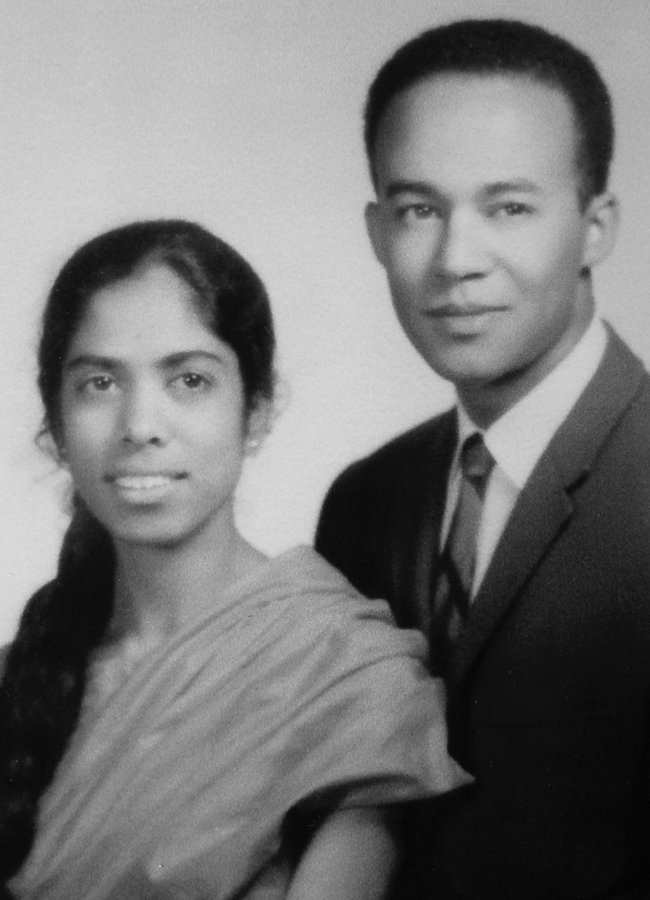
Harris’s mother, Shyamala Gopalan, the Brahman daughter of a diplomat from Chennai, graduated from the University of Delhi at nineteen, and, avoiding an arranged marriage, went to Berkeley to study nutrition and endocrinology. There, she met another graduate student, Donald Harris, from Jamaica, who was pursuing a Ph.D. in economics. The student civil-rights movement, centered on the Berkeley campus, gave the two young immigrants a shared context. “They both identified as people of color and people who were oppressed by a white-male-dominated world,” Meena Harris, Kamala’s niece, told me. “Their fields were science and economics—there were not many Indian women or black men.” They were married while still in graduate school, and Kamala was born in 1964; another daughter, Maya, came two years after that.
A wonderful immigrant story.  Only in America can a brown-skinned woman come to study advanced science, marry another brown-skinned immigrant doing advanced studies in economics, and have a daughter who grows up to be the attorney general of the biggest state, and then its senator, and now a VP candidate.  This itself gives me so much hope for the country that I adopted as mine.

It is awesome that she embraced the Black identity of hers right from when she was young, which is why she chose to study at Howard.
In her late teens, Harris fell in with a group of friends who were bound for historically black colleges. “We all went to private school, we all were educated, we all were very much parented, but we knew kids that weren’t,” Derreck Johnson, a restaurateur in Oakland, told me. He attended the same Catholic school as Maya, before going to Fisk University, and remains close to the family. “The idea of the struggle was embedded in us from our mothers, who told their stories,” he said. Kamala went to Howard and returned to San Francisco for law school. By then, Maya, who had given birth to Meena at seventeen, was in college, so Kamala and her mother often took Meena for overnights and weekends. The matriarchy was intact.
Kamala is not a Tamil word though.  As is the case with most Brahmin names, it is from the Sanskrit, and it means lotus.

This lively, warm, and absolutely human video of Kamala Harris and Mindy Kaling (also with Tamil roots) will remind you of the kind of empathetic and joyful leadership that we used to take for granted.  It is time to make America great again ... and this time with dosai ;)


Saturday, August 17, 2019

Exclusion and cruelty

Almost a year ago, with "The Cruelty is the Point" The Atlantic's Adam Serwer phrased it clearly and succinctly that tRump and his supporters rejoice in the suffering of those they hate and fear.  Such sadism and cruelty is the stuff of dystopian movies, with the difference that this is no movie.  Serwer wrote:
Trump’s only true skill is the con; his only fundamental belief is that the United States is the birthright of straight, white, Christian men, and his only real, authentic pleasure is in cruelty. It is that cruelty, and the delight it brings them, that binds his most ardent supporters to him, in shared scorn for those they hate and fear: immigrants, black voters, feminists, and treasonous white men who empathize with any of those who would steal their birthright. The president’s ability to execute that cruelty through word and deed makes them euphoric. It makes them feel good, it makes them feel proud, it makes them feel happy, it makes them feel united. And as long as he makes them feel that way, they will let him get away with anything, no matter what it costs them.
That was back in October 2018.

Since then, tRump has only amplified his cruelty, and his loyal officials are eager and energetic to implement cruelty.  If they can't, well, either he fires them via tweets or they quit.

In many ways, the cruelty is all about the core question of who gets to be an American.  To him and his base, non-whites don't pass the test.  The brief 50-year easing of the racist immigration laws is being rewritten, rapidly.

I often remark to white anti-tRump Americans, if we get into such conversations, that at least they have only country to worry about.  I follow the events in the old country, too, and get doubly depressed.

Back in India, mOdi and his toadies, who constitute a much more overwhelming percentage of the population than tRump and his base do, are charging full-steam ahead with their efforts to classify who is a real Indian.

No, this is not about Kashmir.

In about two weeks, "as many as 4 million people may soon be excluded from Indian citizenship."  Four million.  Almost the population of Oregon!

Why?
This all stems from the “National Register of Citizens" (NRC), a log that is supposed to contain the names of all Indian citizens in Assam. The list, based on the 1951 census, was created to determine who were Indian citizens and who were migrants from neighboring East Pakistan (now Bangladesh). The government is now seeking to update it, deciding that all those who can prove they were Indian residents before midnight on March 24, 1971 — just before Bangladesh declared independence from Pakistan — will be considered citizens, as will their descendants. Those who cannot are to be excluded from the register, detained and, if unable to prove citizenship before a “foreigners tribunal,” subject to deportation.
The cruelty!
It comes hard on the heels of a surge of virulent nationalism, including the use of the term “termites” in reference to immigrants from Bangladesh, leading to concerns that it will be used as a tool for persecution.

The situation is worsening:
Devastating stories are already emerging of those entangled in the process, including reports of suicides due to exclusion from the list. Men, women and children are already in detention centers, with little hope of emerging unscathed from this legal maze. They face the prospect of indefinite detention and could even end up stateless, with no place to be deported to, given Bangladesh’s position that this is an internal Indian matter.
What's happening in Assam could be extended to the rest of the country too:
After Assam, the BJP has promised a citizenship test for all of India’s 1.3 billion residents – part of a plan to make India a Hindu rashtra, nation. The number of Indian Muslims is almost equal the population of Brazil, the sixth most populous country in the world. A nationwide citizenship test would be an unimaginable tragedy, and would plunge India into chaos.
Why all this cruelty?
  
Caption at the source:
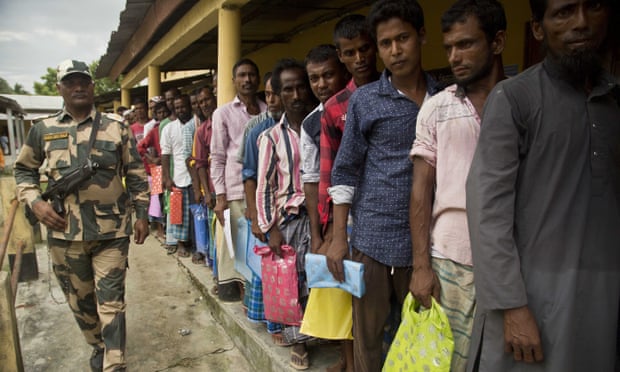
The BJP has promised a citizenship test for all of India’s 1.3 billion residents – a part of the plan to make India a Hindu nation’ Muslim men queuing to check the National Register of Citizens in 2018.

Friday, August 09, 2019

What makes America great?

Back in February, I blogged about writing to Jill Lepore asking her if she had written such an essay somewhere on what makes America great.  Lepore replied: "I think my answer to that question is in my next book, which is called "This America: The Case for the Nation."

I read her op-ed in the NY Times.  I liked what she was arguing for:
I suppose I could have made the book a part of my summer reading.  But, this is the first summer when I have taken off from any serious work.  After years of M suggesting that I get out of my head, I implemented it.  It feels like I have put down a huge weight that I had been carrying on all these years.  I have no idea how people like Lepore keep going!

But then even when I don't read books, I do read plenty of book reviews.  This essay reviews Lepore's "This America: The Case for the Nation."  Well, it is a twofer that also reviews "This Land Is Our Land: An Immigrant’s Manifesto," whose author is an Indian-American--Suketu Mehta.

I haven't read Mehta's book either; but, I have read his op-ed and have heard him articulate his argument.
So, the review essay is not about books that will be unfamiliar terrain.
Nationalism is currently thriving, she believes, because the discourse of American liberalism is deficient. First, that discourse undervalues the radicality and relevance of the country’s founding ideals; second, the preoccupation with the rights of subgroups is essential, certainly, but politically inadequate; third, and here I put the matter much more crudely than Lepore would, liberals must in some sense do battle for possession of the Stars and Stripes. However gauche or complicit it may seem, they must understand and unapologetically frame their values—which currently have a niche, somewhat subversive emphasis—as our core national values:
This America is a community of belonging and commitment, held together by the strength of our ideas and by the force of our disagreements. A nation founded on universal ideas will never stop fighting over the meaning of its past and the direction of the future…. The nation, as ever, is the fight.
I am struck by the reviewer's blunt statement that "liberals must in some sense do battle for possession of the Stars and Stripes."

"The nation, as ever, is the fight."

Right on, Professor Lepore!

"I claim the right to the United States, for myself and my children and my uncles and cousins, by manifest destiny.”

That was not me, but it is from Mehta.
This land is your land, this land is our land, it belongs to you and me. We’re here, we’re not going back, we’re raising our kids here. It’s our country now…. We’re not letting the bastards take it back.
It’s our America now.
We certainly are not letting the bastards take it back.  No way, Jose!

But, for us liberals and immigrants, the challenge is huge when it comes to fighting for the nation. Fighting for our nation.
If Lepore is right and the nation is indeed the fight, liberals must understand what a fight involves. That is, you can’t fight performatively when the other side is fighting to win: that kind of fight simply won’t go on for very long. You have no option but to fight to win, too. You want to win because you are right and they are wrong; because you have a moral right to power and they don’t; because you are real Americans and they’re not.
Fight on!

Wednesday, August 07, 2019

Immigrants gave England their favorite foods. Yet, Brexit?

Way back, a long time ago, when Tony Blair was Britain's Prime Minister, his foreign secretary, Robin Cook, made a comment that was heard around the world.  Cook noted that the chicken tikka masala had become Britain's favorite food that qualified it as the national dish.  He added that it epitomized Britain's involvement with the world and how it adapts to global influences.

The colonial origins of the chicken tikka masala aside, it indeed is remarkable that Britain has been bowled over by curry.  It is a global story to which even the insular Japan is no exception.

The chicken tikka masala displaced fish-and-chips as the national dish.  Was fish and chips truly a "national" dish?

Chips are from potatoes.  Ahem, potatoes did not get to the island, which is becoming increasingly irrelevant, until very recently, well after the white man's not-so-friendly first visits to South America.

So, the chicken tikka masala is recent.  Chips are only a tad older in the English cuisine (yes, an oxymoron!)  How about the fried fish itself?

It turns out that even the fried fish is not particularly English!

Whaaaaat?  Don't tell me that the Pope is not Catholic! ;)

Apparently this fried fish concoction is from the Sephardic cuisine that Jews brought with them after they were expelled from the Iberian peninsula.
As religious violence worsened, many fled Portugal and resettled in England, bringing with them culinary treasures founded in Sephardic cuisine—including fish.
Peshkado frito (in Andalusian dialect, pescaíto frito) was one of them. The dish of white fish, typically cod or haddock, fried in a thin coat of flour, was a favorite particularly among Sephardic Jews, who fried it on Friday nights to prepare for the Sabbath, as the Mosaic laws prohibited cooking. Allegedly, the batter preserved the fish so it could be eaten cold, and without sacrificing too much flavor, the following day.
What a fascinating and complex story about a relatively simple food!

Once it was introduced, well, the rest was history.
It was a hit. Fish prepared “in the Jewish manner” was sold on the streets of London on any given day. And at the end of the week, eating fish on Friday was a part of religious observance for Jews and Catholics alike—as “fish fasting” to avoid consuming warm-blooded animals has been a part of the Catholic tradition for centuries.* Though both groups were religious minorities at the time, fried fish became a popular secular dish, too.
Here's another interesting twist to this globalization story: The writer who provides us the fish-and-chips story is Simon Majumdar.  That last name is a dead give away about the Bengali origin.  Wikipedia offers the details:
Majumdar was brought up in Rotherham near Sheffield, South Yorkshire, England[3] by his Welsh mother and Indian father, a middle child out of four children.[4] His father Pratip "Pat" Majumdar was born in Kolkata
Even the guy who explains the globalization story of fish-and-chips literally owes his life to globalization!  Oh, he is now an American citizen!

If only the narrow-minded, racist, xenophobic people around the world paused to think and appreciate it all!


Monday, July 29, 2019

Real Americans, and real Indians

A few days, in responding to the fascist's atrocious "go back" tweet and more, I shared with the world my own experiences with that kind of a response from a largely anonymous public, with the exception of one woman who sent me a typewritten two-page letter.

To which, an old classmate, who was also a lifer like me in that wonderful school we attended in that magical industrial town, responded with his usual sarcastic humor:
We brown people, who cherish the freedom to express ourselves, are increasingly considered to be "fake" citizens of our countries!

In the old country, the fascist is on an overdrive to make India a Hindu nation.
The rot may have set in decades ago, but it has taken Modi only five years to dismantle the idea of India as democratic and secular.
As if that were not enough, "Modi’s latest assault is on truth itself."

A few weeks prior to the elections, I had an emailed another classmate, who, is Muslim.  In that lengthy email, I wrote this: "I hope you are not feeling jolted, threatened, and anxious, in this current socio-political climate in which loud Hindu nationalist voices yell against Muslims."  It has been months now, and no reply!

And here in my adopted country, the ship of democracy "may be about to hit the iceberg."  But, we browns, in particular, aren't anywhere close to abandoning the ship even though the fascist and his toadies want to toss us overboard:
This land is your land, this land is our land, it belongs to you and me. We’re here, we’re not going back, we’re raising our kids here. It’s our country now…. We’re not letting the bastards take it back.
It’s our America now. 
It is my America, too!

It is clear that we liberals, long been caricatured as wimps, need to fight this good fight.
[You] can’t fight performatively when the other side is fighting to win: that kind of fight simply won’t go on for very long. You have no option but to fight to win, too. You want to win because you are right and they are wrong; because you have a moral right to power and they don’t; because you are real Americans and they’re not.
To which I will add this: When they go low, do not go high.  Instead, kick them even harder!

Friday, June 14, 2019

The existential ambivalence that haunts immigrants

I have often wondered, in this blog too, on what home means in such a modern world where moving around is not unheard of.  Though we relocate and make our lives in completely alien settings, we more often than not forget that this is a new practice in human history.  Through her first forty-plus years, my father's mother barely got around to even forty miles away from her birth place.  Forty miles!  And her parents knew a world that was even smaller.  And here I am ten thousand miles away from all those settings.

The two book reviews that I did recently completed were also about the lives of people making a home for themselves in places far away from the Subcontinent.  One book was about home here in the US, and the other was about the Caribbean.

Life is not always easy when we are far, far away from our original homes.  There are moments, yes, when it hits me hard that I am an immigrant. The reminders coming through remembrances of things past, of places and people and foods and music and everything else.  As the author of this essay notes:
Still, no matter how settled, a queasy unsettledness, an existential ambivalence, haunts the immigrant.
An existential ambivalence.  How wonderfully she has articulated that emotion. Damn these writers who can write so well!

The author is no novelist. She, Ruth Behar, is an academic. An anthropology professor at the University of Michigan.  A daughter of Cuban immigrants, Behar writes:
I have surprised myself by ending up becoming more of a rooted creature than I ever imagined I’d be. I have held on to the same job, the same house, the same address, the same husband (I, who never expected to marry). I gave my son, my only child, who is now the age I was when I thought I was never going to settle down, the gift of an immense stability – firm and steady ground on which to stand.
But when I travel and a stranger asks if I’m from Michigan, I immediately reply: ‘I live there, but I’m not from there.’ I feel compelled to tell everyone about my immigrant past: ‘I was born in Cuba, my ancestors were Jews who spoke Yiddish and Judeo-Espanyol, and I grew up in New York. I live in Michigan because it’s where I work.’
I suppose I fear that people might get a mistaken impression of me if they think I am from Michigan. It’s a desire to tell the truth of who I am, to assert I am a person of many diasporas, I come from somewhere else, I don’t have a firm allegiance to any single place. I am passing through, grateful for a place to rest my wings.
This existential ambivalence might not understandable at all to those who have not moved around a whole lot.  But, it is real.  It is an everyday struggle even if one has merely moved from "home" in one part of the country to another.

When I lived in California, an acquaintance missed her home so much that she quit her job and returned home to Chicago.  She missed the "home" that Chicago was, even though it was merely a couple of hours of flight away.

The existential ambivalence can haunt one in other ways too, like with the "descendants of enslaved people in the Americas."  The author of that essay writes about her sense of belonging after taking "a heritage-focused trip" to Nigeria and Ghana.
There are many ways to nurture a healthy cultural identity, but a journey “home” — to a place that makes you feel that you truly belong — is an especially effective one. 
We are people of many diasporas struggling in our ways to deal with the existential ambivalence.

Tuesday, February 26, 2019

Separate ... and unequal

I hated my undergraduate college for a number of reasons.  At the top of the heap was the air of intellectual apathy.  Nobody cared!

There were a few good things that also came about from that miserable experience.  Topping the list was the fact that for the first time I was interacting with my peers fully cognizant of our respective religions and castes.

All the way through high school, while there was no ignorance of the religious and caste differences that existed, the college experience was new.  We were adults and seeing each other for who they were in the highly stratified Indian society.  It was a quick immersion learning experience for me.  And I learnt a lot.

At the first major semester break as all of us prepared to head home, one of my peers said he was staying back in the hostel (dorm.)  Out of a genuine interest, I asked him why he was not going home.  His reply was not one that I would have ever imagined in a million years.

He explained that back in his village, even the kids of upper-caste folks would call his father by name and order his father around.  Therefore, he didn't want to go home and deal with those issues.

I was stunned.

As kids from an industrial town, whenever we went to grandmas' villages, we could never bring ourselves to calling any of the domestic workers by name.  If we wanted them to do anything, we would simply walk up to them and tell them whatever it was.  The discomfort of childhood had now grown into a serious issue in adulthood.

As some of my cousins and I in the extended family started getting away from the traditionally arranged marriages, and instead found our respective spouses, I began to understand that there also existed various levels of tolerance and intolerance.  An Iyer/Iyengar marriage was not the most blessed event but was acceptable.  A spouse who was a brahmin from another language/culture was, well, ok.  Then began an exponential decrease towards intolerance and hostility.  At the rock bottom of non-acceptance and potential excommunication was marriage to a Muslim or a Dalit.

Caste and religion continue to wreak havoc in the old country.

I had always hypothesized that most immigrants to the US bring along with them oversize baggage of religion and caste.  Maybe people have written about them and I have missed their work.  This multi-part series from PRI's The World and WGBH promises to look into it.  "Dalit activists and respondents to a 2018 survey say that — when surrounded by others of Indian descent — caste bias follows them to the land of the free."  The four-part series, will "explore this stigmatizing effects of India's caste system that immigrants have imported to the United States"

Tuesday, September 25, 2018

The brown-skin exclusion act of November 2016

The current administration in DC has come up with yet another scheme to restrict immigration by providing yet another phony story:
The Department of Homeland Security announced a proposed rule on Friday that would penalize immigrants seeking permanent status who use public benefit programs such as food assistance and housing vouchers. Under the new policy, those who seek financial help could risk losing their chance at a green card.
It is not about any evidence to back this up, obviously.  It is to merely feed into the false narrative that brown-skinned immigrants are lazy bums who are collecting welfare money paid for by hardworking (white) taxpayers.

Just for the heck of it, what are the facts on the ground?
[Research] shows that immigrants are far less likely to burden the federal government than native-born Americans; if anything, they bolster it.
Yep.  There is evidence that we normal people use, and then there are alternative facts that the current administration uses!

Keep in mind that this is the same administration that said it wanted to encourage immigration from Norway and not from shithole countries.  One doesn't need to be a rocket scientist to figure out that it is all about restricting the browns from coming to America.

White nationalists and supremacists are having a glorious time thanks to this administration mainstreaming their views that have been unwelcome in the public space for a couple of decades.  Here's what the son of a big time white nationalist has to say about it:
unfortunately, I think we don't have to look very hard for examples of this kind of rhetoric now in our politics. You know, when you have someone in a primary position of power saying that we should be prioritizing European immigration, saying we need to build the wall - which is an idea that David Duke and the Klan spent a lot of time investing energy in in the late 1970s. When we have somebody in a huge position of power who's saying we don't want people from [expletive] countries - when you have somebody in a huge position of power who is constantly referring to his own genetics, which is a huge white nationalist talking point. They love to talk about eugenics and the false science of race. And so when you have somebody who's saying, I'm a credit to my great, tremendous, really wonderful genes - which, it turns out, some people might think maybe weren't so tremendous - that's furthering white nationalist talking points.
Source

Listen to that entire interview with Derek Black, the son of a grand wizard of the Ku Klux Klan.  The son has renounced the white nationalism that he was raised on, and is now an activist on the good side.  While the President might find it impossible, there is only one good side in this.  There are no good people on the other side.

The tightening of the immigration screws on non-Christian browns has had terrible effects already.  I suppose this is what 63 million "real" Americans voted for!

Friday, June 22, 2018

The diminished expectations of good ol' Americans

As trump and his party go all out in their racist war against immigrants, one of these days even his own minions will begin to understand that it is not white supremacy that made America great, but that only immigrants can make America great again.

Take the case of two comedians with origins in India: Aziz Ansari and Hari Kondabolu.  Both their fathers are medical professionals who immigrated from India, thanks to the changes in the legal framework in 1965. In Kondabolu's case, his mother too is a medical professional.

These two guys are not surgeons or lawyers, but they ventured into comedy--despite their stellar academic credentials and not because they could not make it.

Ansari and Kondabolu typify the American way of life, which the US army has crafted well into its recruitment campaign: Be all that you can be!  If all that you can be means not being a doctor or a lawyer or an engineer, that is ok too.

The parents, the immigrants, work hard so that their children and and grandchildren can do what makes them happy in life.  This is not a new American concept, however.  John Adams wrote in one of his letters to his wife, Abigail:
I must study Politicks and War that my sons may have liberty to study Mathematicks and Philosophy. My sons ought to study Mathematicks and Philosophy, Geography, natural History and Naval Architecture, navigation, Commerce and Agriculture, in order to give their Children a right to study Painting, Poetry, Musick, Architecture, Statuary, Tapestry and Porcelaine.
John Adams wished that his grandchildren ought to be able to pursue painting and poetry if that is what they wanted to do.  That is the American dream!

Such a wishful dream for his children is what this op-ed author--a highly successful son of immigrant parents from Asia--writes about:
I’m temperamentally unable to mimic my father’s succeed-at-all-costs immigrant mind-set, an instinct I share with most of my generation. And maybe that marks our immigrant parents’ ultimate triumph: We have become American. As part of the American parenting mainstream, I aim to raise children who are happy, confident and kind — and not necessarily as driven, dutiful and successful as the model Asian child. If that means the next generation will have fewer virtuoso violinists and neurosurgeons, well, I still embrace the decline.
Imagine an America that is walled off against immigrants.  In addition to a real decline in population--immigration and their fertility rates help the US not become a Spain or Russia--we will also have fewer people who are driven to succeed in medicine, or high tech, or ...

The author writes:
When I became a parent, I felt the wonder and uncertainty that accompany the awesome responsibility of fatherhood. But I was absolutely sure of one thing: The childhood I devise for my two young daughters will look nothing like mine. They will feel valued and supported. They will know home as a place of joy and fun. They will never wonder whether their father’s love is conditioned on an unblemished report card.
I’ve assumed this means my daughters might someday bring home grades or make life choices that my father would have regarded as failures. If so, I embrace the decline.
May our diminished expectations lead to happy lives!

Source

Friday, March 09, 2018

Rewriting history in the land of immigrants

Nope. The title of this post should not lead you to think that this is about trump and the United States of America.  Though, yes, that could work too.

It is about another land of immigrants. One of the oldest ever.

I quoted that country's Supreme Court back in 2011:
While North America (USA and Canada) has new immigrants who came mainly from Europe over the last four or five centuries, India is a country of old immigrants in which people have been coming in over the last ten thousand years or so. Probably about 92 per cent of the people living in India today are descendants of immigrants, who came mainly from the North-West, and to a lesser extent from the North-East.
Yep, this post is about the fascist and his party in the old country. 

modi, the fascist, was elected a couple of years after that remark by the Supreme Court.  And, boy have things changed in a hurry in India. The overwhelmingly majority Hindu population seems to have gladly signed on to the fascist politics!

After coming to power, they quickly started rewriting India's history itself, very much consistent with George Orwell's warning in 1984, in which he wrote: "Who controls the past,' ran the Party slogan, 'controls the future: who controls the present controls the past." 

Rewriting history, in which Winston Smith was employed, has always been a favorite of those fascist thugs.  And that is exactly what is unfolding in India now.
During the first week of January last year, a group of Indian scholars gathered in a white bungalow on a leafy boulevard in central New Delhi. The focus of their discussion: how to rewrite the history of the nation.
The government of Hindu nationalist Prime Minister Narendra Modi had quietly appointed the committee of scholars about six months earlier. Details of its existence are reported here for the first time.
Instead of the fictional Winston Smith, you have numerous modi's toadies working on this grand project. 

Where do non-Hindus fit into this history that is being rewritten?
For India’s Muslims, who have pointed to incidents of religious violence and discrimination since Modi took office in 2014, the development is ominous.
The head of Muslim party All India Majlis-e-Ittehadul Muslimeen, Asaduddin Owaisi, said his people had “never felt so marginalised in the independent history of India.” “The government,” he said, “wants Muslims to live in India as second-class citizens.”
Yep, who controls the present controls the past, and who controls the past controls the future.


Saturday, February 24, 2018

I lift my lamp beside the golden door!

The President of the United States is expected to be the cheerleader who says all the right things in order to inspire people.  We remember and quote, for instance JFK's "ask not what your country can do for you, ask what you can do for your country."  Even those who didn't care much for Reagan, recall his "Mr. Gorbachev, tear down this wall!"  Or, more recently, with Obama even leading the singing of Amazing Grace.

And then there is trump.

When I read news items that referred to trump reading a poem that compared immigrants to snakes that kill, I thought that perhaps the reports were exaggerating whatever happened at the gathering of conservatives.

So, like I tell students all the time, I went out to verify.

Verify I did.

I have been in distress since then.

Perhaps you, too, read the news item.  And perhaps you chose not to watch the video of him reading it.  But, you need to.  This is no regular American.  This is no president of some caricatured banana republic. This is the President of the United States, in front of a huge audience, with his video telecast live and streamed online to the entire world.

Watch him deliver the verse.


I will remind you, again, that the one who you watched is the President of the United States.

And did the high decibel volume of the cheerful response register in your mind?  They are only a small part of the 63 million who elected him President!

As Vox notes:
Time and again, when Trump is in front of friendly audiences — whether it’s a group of police officers on Long Island or a group of conservative activists at CPAC — he gives speeches about how immigrants are subhuman and violent, and that America needs sufficiently ruthless and violent law enforcement officers to fight against them effectively.
"subhuman."  We are snakes?  We will kill the people who are already here?

I wonder where all this will end up.


Friday, December 15, 2017

No immigrants please, we're Republicans

Remember this post from a few days ago, in which I quoted from an op-ed by a highly qualified Hong Kong native who was forced to exit the US because she couldn't get the work visa?  She wrote there:
America is losing many very skilled workers because of its anti-immigrant sentiment, and while this is a disappointing blow to me and my classmates, it will also be a blow to the United States’ competitiveness in the global economy.
Like all that really matters to the 63 million voters, right?  They are willing to cut their proverbial noses in order to spite all our faces!

More and more stories every day, which will gladden the 63 million voters:
Uncertainty in the United States has been a boon to Canada, which since the election has seen a surge in immigration and interest from tech workers and entrepreneurs.
What a wonderful approach to making Canada great again!
The number of tech workers from around the world migrating to Canada is on track to beat 2016’s total by 18%, according to data from Immigration, Refugees and Citizenship Canada.
Ouch!
The Canadian government has also laid the groundwork to make the region more tech-friendly, Tam said. There are tax incentives for companies that invest in research and development. Students who study at public Canadian universities are offered a path to permanent residency. And a new, fast-tracked worker’s visa established this summer allows companies to bring foreign talent to the country without having to go through the rigmarole of a lottery.
Seriously, have the 63 million voters thought through their approach to keep the immigrants out?  Do they really believe that keeping immigrants away will automatically making the country great?

Meanwhile, the market does what the market does.  It even figures out a backdoor and inhumane approach like the "Optional Practical Training, which allows foreign students earning degrees from American institutions to work in their field for a year after graduation":
The flexibility of the OPT program is one reason why its numbers increased 39 percent between 2014 and 2016, and why nearly two times more OPTs were approved than H-1Bs last year. With more than 300,000 OPTs currently working in the United States, according to the federal government, the program has become a key part of the tech industry’s efforts to recruit globally.
This is not always a good deal for the students--it is "white-collar indentured servitude" for many:
For every graduate who lands a job at Amazon, Intel, or Microsoft, many more end up laboring at small companies known as “body shops” that specialize in contracting tech workers for IT and software development roles at larger firms, usually for short-term projects.
Keep in mind that such abuse of labor in servitude that lingers in the shadows is what happened in the ag industry, hotel/restaurant industry.  Right?
Of the million or so foreigners studying at American universities, 16 percent come from India. At last count, there were more than 90,000 Indian OPTs in the United States—more than double the number in 2010.
The work visas become more difficult, while more go the route of OPT.  Works well for businesses and their shareholders, but a disaster for the worker bees.  But then, as the tax bill clearly shows, making America great again has really become making America's rich richer again!  So, the OPT abuse fits right in with this approach.
Yet for all the debate raging over H-1Bs, the OPT program—which has no enrollment cap—has flown under the radar to become the surer, bigger path for Indians to temporarily work in the United States. Recently, Pravin Rao, the chief operating officer of outsourcing firm Infosys, told India’s Economic Times that his company (which has secured thousands of H-1Bs over the years) was now “looking at hiring from more colleges in the US.” Instead of facing the scrutiny that goes with importing midlevel workers from India, it could use the OPT program to take advantage of resources already in the United States.
I am sure that 63 million voters are delighted with all these.

Monday, June 12, 2017

On immigrants and refugees in trumpistan

Soon it will be the longest day of the year in the northern hemisphere.  But then, every day has seemed long like the longest day ever since the disastrous November election.

The president campaigned on various hateful themes, including putting an end to Muslim refugees and to undocumented immigrants. Those themes, and more, won him the few votes that made all the difference in states like Pennsylvania where Hillary Clinton got 2,926,441 votes versus 2,970,733 for trump.  A difference of 44,292 votes.  Clinton's share was 47,46% of the votes cast, and trump's was 48.18%  The winner-take-all electoral votes went to trump.

How are things in trumpistan?
Immigration law is being enforced more aggressively. Out in rural Pennsylvania, in a county Donald Trump carried with 66% of the vote, this is already having a devastating effect on the economy and culture.
That is from an uber-left publication?  Nope; it is an op-ed in the Wall Street Journal!
Beautiful as it is, York Springs is the sort of place people leave after they finish high school. When I moved here in 2012, real estate was cheap and abandoned houses dotted the back roads. The town was aging and dying, though Mexican newcomers were already bringing green shoots. Over the past five years I’ve seen a steady renewal. Townspeople have fixed up many old houses and are raising families.
There has been a little tension, but York Springs in recent years has developed a vibrant, intersectional culture, insofar as that’s possible in such a sparsely populated place.
And then the elections happened.
This stringent enforcement of immigration law is destroying a rich, new rural culture. It’s likely to destroy the economy, too. The orchards generate over $500 million a year, and, one way or another, most of the jobs. But the local growers, many of whom have been operating the family orchards for generations, worry they won’t have enough manpower this fall to harvest the crop.
Sure, a lot of the white folk out here voted for Mr. Trump. Even then, many of them had reservations specifically about his immigration stance. I heard them expressed by Trump supporters in line to vote at the Latimore Township building. Now as we spiral into a local depression that is personal, cultural and economic, a lot of them are going to regret voting for him anyway.
An hour away from York Springs is Lancaster, deep in the Amish country.  This area too was won by trump.  What I didn't know until today is this, which I came across in my Twitter feed:
The ever doubting me did a quick Google search.  It is true.  Like in this news report from a couple of months ago:
Here in Lancaster County, a politically conservative area well known for its Amish community, traditional Christian values run deep. Since the Church World Service opened a Lancaster office 30 years ago, it has been a favored destination for resettling refugees because churches here easily assemble welcome teams whose members see it as a godly duty to care for those in need.
In the last fiscal year, Lancaster County resettled more than 400 refugees from all over the world, with the largest numbers coming from the Congo and Syria.
For once, I hope that the white supremacist British bastard, aka Churchill, was correct when he said that Americans will do the right thing after they exhaust all other possibilities.  After electing trump, there is nothing worse that we can do.  Here is to hoping that better days are ahead.

But, of course, hope alone won't change the world.  So, I did the next best thing that I could: I donated.


Saturday, April 15, 2017

Follow the immigrants

This, which I have sent to the editor, builds on a previous blog-post
************************************************************

“Follow the immigrants.” 

That is an easy guideline to understanding the economic geography dynamics in the contemporary United States.

Consider the affluent neighbor that is immediately south of us. The prosperity in California correlates well with the percentage of foreign-born to whom the Golden State is now home. More than a quarter—about 27 percent—of its population was born outside the country. It is no wonder that the Silicon Valley looks more and more like the United Nations.

Consider a contrast to California. West Virginia is an economic laggard, where how one talks about coal—not silicon—is the way elections are won and lost. Here, too, there is a correlation between the economy and the percentage of foreign-born. Barely 1.4 percent of the population in West Virginia was born outside the US. To put it simply, immigrants do not flock to West Virginia.

It is more than a mere correlation, of course. The foreign-born population cannot afford to be jobless and poor, whether they are here legally or illegally, and whether or not they are skilled or unskilled. Hence, immigrants are almost always headed to states where there is potential for work and wages. California offers that promise, and not West Virginia.

In this broad framework, Abigail Cooke, an assistant professor of geography at the University at Buffalo, and Thomas Kemeny, a UB research assistant professor and at the University of Southampton in England, write about their research that was recently published in the journal “Economic Geography.” There is "a strong relationship between greater immigrant diversity and higher productivity—in this case, wages.”

Jobs and incomes are urban-based. "What we found was remarkable. In cities that are unwelcoming to immigrants, as diversity rises, people's wages either don't change, or they go up by only a small amount. In cities that are welcoming to immigrants, as diversity goes up, people's wages go up, and by a lot,” Cooke notes.

It is an interesting feedback cycle. Cities and states where the economies are growing attract immigrants. This influx strengthens the human capital that in turn creates more economic growth and development.

Such dynamics are not merely a contrast between California and West Virginia. In Oregon, the foreign-born account for about 9.8 percent of the population. Even within the state, we can observe differences between, for example, the metropolitan Portland where the economy is based on modern economic activities, versus Coos Bay whose economy was based on natural resources. 

An economy based on resources that were prized in the past—like timber—lags behind one that is driven by the likes of Intel and Nike. This means we will also notice a corresponding significant difference in the percentage of the foreign-born in the Portland area versus in coastal communities.  A diverse immigrant population is naturally attracted to regions for obvious economic reasons--even farming grains, fruits, and flowers, with considerable export potential, will attract immigrants.

However, this unequal economic growth and development across the geography of the country, and within the regions of a state, have had serious implications. 

Richard Florida—an academic and a public intellectual based in Toronto, who has always been enthusiastic about cities, is now worried about a new urban crisis.  Florida writes in a recent essay about the winner-take-all-urbanism “in which the talented and the advantaged cluster and colonize a small, select group of superstar cities, leaving everybody and everywhere else behind. Much more than a crisis of cities, the New Urban Crisis is the central crisis of our time.”

The story is deceptively simple, but a complex one. Modern economic activities are urban-based, and immigrants flock to those urban areas with the greatest economic potential. The reinforcing feedback cycle makes some cities and regions more prosperous than others, and soon we have regions that are seemingly left behind. These left-behind regions, like West Virginia, are also home to less-diverse population.

It has also been clear for a long time that economic advancement does not seem to reach the corners of West Virginia or a Coos Bay here in Oregon. We the people need to try to understand such complexities in a rapidly evolving global economic geography. And, more importantly, we will need political leaders who can articulate constructive policy responses that will not dampen the pace of economic development even while assisting the under-performing regions. 

Or, we can simplistically decide, for instance, that immigrants in a heterogeneous California are the reasons for the lack of economic opportunities in a significantly homogeneous West Virginia.

I would rather that we attracted the immigrants, instead of chasing them away.

Monday, April 10, 2017

Diversity and economic well-being

Whether it is the US or the UK or France or ... aren't the political events related to this confluence of diversity and economic well-being?

Think about California's Silicon Valley.  A whole bunch of people from all over the world, right?  That is to be expected; after all, the Golden State demographics is heavily tilted towards foreign-born:
With 27 percent of California’s total population foreign-born — or not quite 10.5 million people — the state has more immigrants numerically than any other state and the greatest proportion of its total residents who are immigrants.
Now think about West Virginia.  Guess what?
West Virginia has the lowest portion of foreign-born people at 1.4 percent of the state’s total 1.8 million residents
Hmmm ... Silicon versus coal.  It is not mere coincidence, is it?

It is not any coincidence at all.  Modern economic activities are urban-based.  So, if some states and cities are drawing more foreign-born .... then? There is "a strong relationship between greater immigrant diversity and higher productivity—in this case, wages."
Diverse immigrant populations do more than enrich a city's cultural fabric. According to geographers from the University at Buffalo and Southampton University, they also boost wages. "What we found was remarkable. In cities that are unwelcoming to immigrants, as diversity rises, people's wages either don't change, or they go up by only a small amount. In cities that are welcoming to immigrants, as diversity goes up, people's wages go up, and by a lot," said Abigail Cooke, an assistant professor of geography in UB's College of Arts and Sciences. Cooke wrote the paper with Thomas Kemeny, a UB research assistant professor and a lecturer at the University of Southampton in England. The findings were published online ahead of print in the journal Economic Geography. "It's been shown empirically that as you have more immigrants and greater diversity of immigrants in a city, people's wages also increase, which is certainly not the narrative that is often told about immigrants in our society. But this is a pretty robust finding, especially in the U.S." 
This connection has been clear for a while.  In fact, Richard Florida was pretty much able to write his ticket based on these economic geography aspects.  The "creative class" of immigrants were no different from the native creative class:
The knowledge workers, techies, and artists and other cultural creatives who made up the creative class were locating in places that had lots of high-paying jobs—or a thick labor market. They also had what I called a thick mating market—other people to meet and date—and a vibrant quality of place, with great restaurants and cafés, a music scene, and an abundance of things to do.
They were not going to West Virginia.

Florida writes:
It became increasingly clear to me that the same clustering of talent and economic assets generates a lopsided, unequal urbanism in which a relative handful of superstar cities, and a few elite neighborhoods within them, benefit while many other places stagnate or fall behind. Ultimately, the very same force that drives the growth of our cities and economy broadly also generates the divides that separate us and the contradictions that hold us back.
Which is also why trump became president:
These political cleavages ultimately stem from the far deeper economic and geographic structures of the New Urban Crisis. They are the product of our new age of winner-take-all urbanism, in which the talented and the advantaged cluster and colonize a small, select group of superstar cities, leaving everybody and everywhere else behind. Much more than a crisis of cities, the New Urban Crisis is the central crisis of our time.
The diversity of immigration promotes economic advancement ... but that advancement does not seem to reach the corners of West Virginia or Pennsylvania.  Voters could then either try to understand the complexities of the rapidly evolving global technological economy.  Or, they could simplistically find that the immigrants are at fault.  And cheer on, and vote for, a fuhrer who would point to anybody who is not white as the reason why they were falling behind in West Virginia.  They voted for that despicable human being who cared not for the logic and evidence, and who cared not for serious policies for long-term solutions to these issues.

Caption at the source:
 Donald Trump supporters pose with a Confederate flag at a campaign rally in Jacksonville, Florida

Thursday, March 09, 2017

Twice-born, triple-selected

I am always excited about the classmates of mine who have become famous in ways that I am not capable of.  There is Srikumar (Kumar) who is now a go-to-expert on all things Roma in Europe; so much so that a few days ago, a student rushed in to my office to show me a book that he was reading for a class in which Kumar was quoted!  There is Vijay, who has been recognized for his contributions as a journalist and a poet; there is even a Wikipedia page on him!

This post is not about those two who are from the old days in the old country.  It is about another guy, though I did not know him all that well.  Sanjoy was also a doctoral student at USC.  We did not even have a single class together though--he was two years ahead of me.  Our paths have not crossed since he graduated and moved on to the east coast for a faculty position.

One of the tweets in my feed (see, Twitter is an awesome information portal) was from Foreign Policy.  It was about "Indian immigrants in the time of Trump."  The tweet referred to the authors of The other one percent.  I am familiar with  that book, and with one of those authors--Sanjoy.  So, of course, I had to read that piece.
They use data and research to show how the Indians who come to America are “triple selected” through India’s socioeconomic hierarchy, highly competitive education system, and the U.S. immigration system. If the one percent of the U.S. population that is Indian has done particularly well, the authors argue, it is perhaps because selection factors were such that the Indian-born population is over three times more educated than the population of the United States.
The book was published shortly after U.S. President Donald Trump’s election, and written before changes to the visa system and increased violence against Indians in America. 
 Yes, triple-selected.  The first of which was not our own doing though--the accident of birth into a favorable socioeconomic condition.  If my parents were from a lower caste, then chances are pretty darn good that I would not be doing what I am now doing.  That favorable condition also made possible the education that I received.  After that, the third piece--immigration to the US--was not a big deal.

Sanjoy also talks about it in that interview:
We really wrote the book for an Indian audience, because there are many myths in Indians about themselves, and we needed to address that. The way we put it, we call it triple selection. Indians call it hierarchy. The caste system, the complete inequality with access to education formed over the past 150 years, and in that group you have this ultra-competitive exam system — and most people coming over here have come through that ultra-competitive system. And then the U.S. lets in certain people. The people who are here are extremely fortunate not to be here — they’ve been fortunate their entire lives. Of course they’re going to do well. America is really getting a lot of talent for relatively little money. This group is pretty innovative, all of them are rising to the tops of their professions. There’s a lot of talent here. And that talent is in service of America. But these people were bloody lucky. They’re lucky there, and they’re lucky here. And for us it was important to say that.
Yes, I have been bloody lucky throughout my life.  Which is also one of the sources of my guilt--the lucky accident of birth into a upper-caste affluent family versus the ill-luck that doomed many other babies that were born the very day that I was born, but to lower-caste, poor families.

But, this asshole president has made sure that Indians of all castes and religions will think twice or thrice before applying for that visa. A great equalizer he has become.  Even his buddy, the proto-trump, is now worried and keeps his mouth shut!

PS: What is the deal with the "twice-born" in the title?  Click here.

Friday, April 08, 2016

Dotbusters, Dothead, ...

As a fresh off the boat newbie graduate student, I had a great time spending hours in the libraries at the university.  I couldn't believe there were multiple libraries on campus.  Of course, this was also before the dawn of the internet age and, therefore, it was in the libraries that I could read the newspapers from around the country and the world.

One of the news stories from those newbie days was about the "Dotbusters" in New Jersey.  I tracked down a New York Times report on that, from October 12, 1987:
For years, Indians living in blue-collar enclaves here have been taunted with ethnic epithets by white, black and Hispanic youths, according to the city's Indian leadership and many other people here.
But in recent weeks, Indians here say, the violence has taken on a new and uglier cast. One Jersey City Indian was beaten to death in Hoboken. Another remains in a coma after being discovered beaten unconscious on a busy street corner here earlier this month. And in a crudely handwritten letter, partially printed in The Jersey Journal, someone wrote, ''We will go to any extreme to get Indians to move out of Jersey City.'' The note was signed ''The Dotbusters.''         
I remember many of us Indian students talking about the "Dotbusters" and how the Los Angeles area, where I was, seemed more welcoming.  But, it shocked us that the violence was not in some remote part of the US, or in the Deep South, but in New Jersey!
  A 40-year-old Indian shop owner looked out on to Central Avenue and wondered aloud.
''Why do they want to hurt the Indian?'' she said, apologizing for her broken English. ''We want to make America beautiful. We don't want to spoil it.
''America is a land of chances,'' she said, too fearful to have her name published. ''That's why everybody is here.''
Yes, that's why everybody is here and would love to come here.  Like why I am here and not back in India, nor was I interested to go anywhere else.

An Indian-American was on NPR yesterday, and stirred the stories lodged in my memories from nearly three decades ago.  Amit Majmudar is yet another Indian-American who makes me feel like I am nothing but a blabbering idiot who does nothing.  Majmudar is a radiologist, novelist, poet, and writes commentaries.  And, yes, he is a family man.  Seriously, isn't that supposed to be four different people?  And, oh, he is yet to turn forty! I hate such people who make a good-for-nothing out of me!!! ;)

Majmudar was featured in the NPR segment because he has been appointed "Ohio's first ever poet laureate."  How about that!  Does Ohio's governor, John Kasich, know about this? ;)

Majmudar's "new collection of poems, has as its title an ethnic slur, "Dothead.""  Why?
Well, if you look at racial slurs like this, there is a way to retake it, the N-word, for example. Rappers have taken that word back. And it's still off-limits to those outside of the sort of circle. But internally, it's something that they call each other. And in this way, you kind of take it back from the people who use it against you. And "Dothead" actually relates to something very beautiful and eloquent related to Hindu symbolism. And for me, the dot on the head is something that I associate with my mom. My wife wears one every once in a while when we go to, you know, an Indian wedding or something like that. And above all, it has this religious meaning for me. And so I wanted to take it back, and I wanted to make a poem out of it.
April being poetry month, here's Majmudar's poem:

"Dothead"

by Amit Majmudar
Well yes, I said, my mother wears a dot.
I know they said "third eye" in class, but it's not
an eye eye, not like that. It's not some freak
third eye that opens on your forehead like
on some Chernobyl baby. What it means
is, what it's showing is, there's this unseen
eye, on the inside. And she's marking it.
It's how the X that says where treasure's at
is not the treasure, but as good as treasure.—
All right. What I said wasn't half so measured.
In fact, I didn't say a thing. Their laughter
had made my mouth go dry. Lunch was after
World History; that week was India—myths,
caste system, suttee, all the Greatest Hits.
The white kids I was sitting with were friends,
at least as I defined a friend back then.
So wait, said Nick, does your mom wear a dot?
I nodded, and I caught a smirk on Todd—
She wear it to the shower? And to bed?—
while Jesse sucked his chocolate milk and Brad
was getting ready for another stab.
I said, Hand me that ketchup packet there.
And Nick said, What? I snatched it, twitched the tear,
and squeezed a dollop on my thumb and worked
circles till the red planet entered the house of war
and on my forehead for the world to see
my third eye burned those schoolboys in their seats,
their flesh in little puddles underneath,
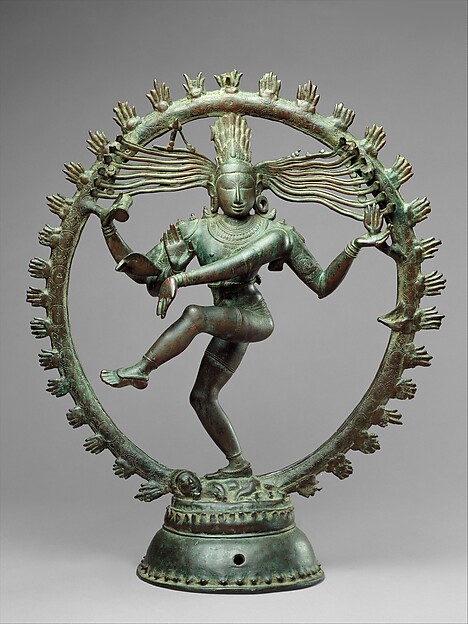
pale pools where Nataraja cooled his feet.

From Dothead by Amit Majmudar. Copyright 2016 by Amit Majmudar. Excerpted by permission of Alfred A. Knopf.

Nataraja (ca 11th century) at the Met

Sunday, April 20, 2014

Where are the mile high Indians?

Not that mile high!  What a dirty mind you have, dear reader!

In all my flights within the US--either entirely domestic or the domestic segments of international flights--I have never, ever, been in a plane with a flight attendant--male or female--who looked Indian-American.  In the international flights--even on Lufthansa--there have been quite a few Indian personnel, yes.  But, for that matter, even when waiting at US airports, which I have done a lot, I have not seen Indian-American flight attendants rushing around.  Ground-staff I have seen in plenty, yes.  But not the flying kind Indian-American staff.

Of course, there could be a huge sampling error at play.  But, within this sample, when I have seen flight attendants who are Chinese-American, Korean-American, Japanese-American, Filipino-American, well, how come no Indian-American?

It could be that Indian-Americans are chasing other occupational opportunities:
Indian Americans lead all other groups by a significant margin in their levels of income and education. Seven-in-ten Indian-American adults ages 25 and older have a college degree, compared with about half of Americans of Korean, Chinese, Filipino and Japanese ancestry, and about a quarter of Vietnamese Americans.
Seven-in-ten!  No wonder that my friend is impressed that every Indian-American I know seems to have at least one graduate degree!

The American story is full of one kind of "group" having its glorious moment.  In a country that was long dominated by the WASP elites, then came different groups with economic success.  Five decades ago:
In 1960, second-generation Greek-Americans reportedly had the second-highest income of any census-tracked group. 
A couple of generations later, the "group" is no longer statistically different from the mainstream averages.  Perhaps it is the Indian turn now.

The picture of the Indian-American is certainly not narrow anymore to being a motel owner (Patel motel) or being in a science/engineering occupation.  The recent Pulitzer Prize in Poetry is perhaps the most recent piece of evidence:
Bangalore-born Vijay Seshadri’s volume of verse, “3 Sections,” won the Pulitzer prize for poetry on Monday.
Mr. Seshadri lives in Brooklyn and teaches writing at New York’s Sarah Lawrence College. When he was five, he moved with his family from India to the United States.
It is a huge achievement--an Indian-American stating to his parents about his wish to be a poet, when the "norm" is to enter the more traditionally high-income occupations.  Of course, Seshadri is not the first of such off-beat success:
Mr. Seshadri is the first Indian-American to win in the poetry category. He joins a growing list of Indian-American writers to have won the prestigious Pulitzer. In 2000, Indian-American author Jhumpa Lahiri won the Pulitzer Prize for her first novel “Interpreter of Maladies” in the fiction category. Then in 2011, cancer physician and researcher Siddhartha Mukherjee’s “The Emperor of All Maladies: A Biography of Cancer” won in the general non-fiction category.
We have had Indian-American motel owners, 7-11 caricatures, physician and engineer stereotypes.  On to literature also.

But, how about the Indian-American plumbers and electricians? Flight attendants?  Are there any?  Surely not all Indian-American kids have the abilities or the interests to be surgeons and programmers and poets.  Where are those Indian-Americans?  What lives do they lead?  I would love to read a profile of a flight attendant who was born in the US to parents who immigrated from India.  Wouldn't you too?

Sunday, September 09, 2012

First world desi problems :)

I suppose every immigrant group has its own inside jokes.  It is one of the many wonderful aspects of living in the US.When you superimpose the 140 character limit of Twitter, then humor becomes quite a creative exercise as well.

Some of the tweets with the tag #Desiproblems are simply awesome, like the ones here :)


Good ol' US of A!

My first immigrant humor experience was Yakov Smirnoff's.  Once, when I played a clip of his in class, during a discussion of immigration, one student said that I probably like him all the more because I look like him. Really?


And I could relate a lot to Russell Peters' jokes, of course


Aziz Ansari perhaps represents the next step in this assimilation story.  His comedy routines do not seem to have ethnic humor as a center-piece.  Occasionally he might throw one in.  I suppose one more generation, and "DesiProblems will belong to history.  Cool!