Showing posts with label economic geography. Show all posts

Thursday, November 12, 2020

What do people vote for?

Back when I was an electrical engineering undergraduate student and thoroughly unhappy in that collegiate setting, I am not sure if I would have immediately jumped on "economic geography," even if somebody had expressed that to me like in the "plastics" scene in The Graduate.

The reality is that I had always been thinking about economic geography without ever knowing that there was a field of study called economic geography.  I couldn't care about how electrons traveled and about silicon chips.  I was sincerely worried about the poverty and illiteracy and open defecation and more that was all around.  A silicon chip was not going to do a damn thing about those human problems.

Graduate school took me to an intellectual world that was unknown to me all through my formal years of education in the old country.  Books and journals and talks and ... 

Decades later, as I noted here, when people ask me what economic geography is about, one of the examples I give them is what I refer to as a big-picture question.  "Why are some countries rich and some poor?"  It is, after all, one of the pressing questions to which, as a teenager, I was struggling to find an answer. 

People always get excited about this example.  Their response is typically along the lines of "wow, I had no idea that geography includes such topics.  I would love to take your classes."

In a huge country like the United States, that question can also be scaled down to "why are some regions rich and some poor?"

That economic geography question easily translates into the political world.  Hillary Clinton spoke the truth to struggling workers in the coal belt, when she told them coal wasn't coming back, and that her government would invest in job-training programs to help them find alternative jobs.  tRump, on the other hand, blatantly lied to them that if elected he will bring even more high paying coal jobs to the region.

The liar won.

But, the liar cannot remake economic geography.  The poorer regions are getting relatively poorer, but they continue to vote for liars!

2000: Gore won 659 counties accounting for 54% of the US economy.

2016: Clinton won 472 counties accounting for 64% of the US economy.

2020: Biden won 477 counties accounting for 70% of the US economy.

Notice both the trends: A decreasing number of counties won by Democrats but representing increasing percentages of the national economic output.


Though I detest tRump, and have no patience for those who voted for him, I worry about this trend.  It does not bode well for the country, for democracy, and--more importantly--for the people who voted for tRump in the lagging regions.

Blue and red America reflect two very different economies: one oriented to diverse, often college-educated workers in professional and digital services occupations, and the other whiter, less-educated, and more dependent on “traditional” industries.

There are reasons why immigrants are going only to some places.  The reasons have a lot to do with economic geography.

Therefore,

If this pattern continues—with one party aiming to confront the challenges at top of mind for a majority of Americans, and the other continuing to stoke the hostility and indignation held by a significant minority—it will be a recipe not only for more gridlock and ineffective governance, but also for economic harm to nearly all people and places.

The challenges are in plenty.  Starting with how to make people understand the basics of economic geography in their own lives.  How do we convince people about the importance of truth?

I hope that Joe Biden and his team will be able to do these.  If they fail, we all will fail.

Tuesday, June 23, 2020

Working from home ... in Chennai and Chengdu

For more than three months, many of the employed have been working from home (WFH.)  Is this working out well?

To answer that, let's check in with the wealthiest people in whose direct or indirect employ are people working from home.  If WFH has not affected productivity, then those wealthy people would have benefited, right?

Guess what?  Those gazillionaires have handsomely profited: "U.S. billionaire wealth surges to $584 Billion, or 20 percent, since the beginning of the pandemic."
Overall, between March 18—the rough start date of the pandemic shutdown, when most federal and state economic restrictions were in place—and June 17, the total net worth of the 640-plus U.S. billionaires jumped from $2.948 trillion to $3.531 trillion, based on the two groups’ analysis of Forbes data. Since March 18, the date Forbes released its annual report on billionaires’ wealth, the U.S. added 29 more billionaires, increasing from 614 to 643. During the same three months, over 45.5 million people filed for unemployment, according to the Department of Labor.
The top five billionaires—Jeff Bezos, Bill Gates, Mark Zuckerberg, Warren Buffett and Larry Ellison—saw their wealth grow by a total of $101.7 billion, or 26%.
Incredible, right?

It is no wonder that tech companies are looking at making permanent a great deal of WFH.  Think-tanks like Brookings immediately sensed an opportunity for those tech workers to get away from the expensive real estate like the Silicon Valley and move to the remarkably affordable interior of the country. 
Suddenly, it looks as if the COVID-19 pandemic could allow not just localized telework, but a more fundamental dispersal of America’s highest-value employment away from large “superstar” metro areas and into the lower-priced American heartland.
Not so fast.

If WFH has not affected company bottom-line, then why should the geographic dispersal be restricted only to within the US?  Companies might as well hire employees in, say, India, and have them work from their homes there instead of bringing them here to the US.  We could easily see a footloose economy on steroids!

A responsible policymaker might then look at these developments and begin to worry that big tech, which has brought wealth and power to the US, could easily start creating a whole bunch of satellite offices around the world.  Well, tRump is no responsible guy--he has proudly stated that he takes no responsibility.  So, it is no surprise that he announced a freeze until the end of the year on work visas for foreign labor.

So, let's recap.  WFH is doing well as a practice.  WFH has not affected productivity, and the big tech employers are reaping huge profits.  Many of the tech employees are foreign born.  tRump wants to prevent them from coming here.  Connect the dots yourself.

Or, read Shikha Dalmia's commentary:
high-skilled foreign workers that blue states like California, Washington, and New York depend on are out of luck. What is likely to happen in these states? Will they rush to hire Americans with big bucks in hand? Not really.
For starters, there just aren't enough high-skilled Americans sitting around to be hired. The unemployment rate last month—the peak of the pandemic—for computer jobs was 2.5 percent compared to the overall rate of 13.3 percent for all jobs, according to an analysis by the National Foundation for American Policy.
So as high-tech companies are choked off from hiring foreign workers, they'll start outsourcing more operations abroad.
If you prefer a "sound bite," Dalmia offers this:
The more Trump tries to turn America into a fortress, the louder will be the sucking sound of jobs fleeing overseas, to use the immortal words of failed presidential candidate Ross Perot.
As I wrote in this essay in Professional Geographer, in 2018, even the President of the United States cannot create an alternative facts of economic geography.

Monday, April 16, 2018

We don't know shit!

When people ask me what economic geography is about, one of the examples I give them is what I refer to as a big-picture question.  And that is: Why are some countries rich and some poor?

People always get excited about this example.  Their response is typically along the lines of "wow, I had no idea that geography includes such topics.  I would love to take your classes."

What I don't tell them is this: Don't ask me for the answer on why some countries are rich and some are poor because, well, nobody knows!

We can fairly easily explain why a country is poor.  That is not what I mean.  But, how to place a country on a path of sustained economic and social growth?  This continues to be a mystery, as it was to me when I began graduate school more than three decades ago.

The Economist addresses this metaphorical elephant in the room:
Economists have precious few hard facts about growth. They know that sustained growth in GDP per person only started in the 18th century. They know that countries can become rich only by growing steadily over long periods. They know that in some fundamental way growth is about using new technologies to become more productive and to uncover new ideas. Beyond that, almost everything is contested.
That's what I don't tell people when they ask me about economic geography.  We don't know shit!

But, this is too important a question for us to ignore. The fact that we don't know shit does not mean that we give up.  Why?
A clearer understanding of how growth happens, and why growth-boosting institutions sometimes wither or fail to take root, could raise the living standards of billions of people. The economics of growth should therefore be central to the discipline, even though the questions it poses are objectively hard, and the answers rest more in history and politics than in elegant mathematics.
Note that dig about "elegant mathematics"?  One of the reasons that I chose to go far away from from the economics folks is because of their worship of the math and statistical models, which really don't give any credible answer.  Yet, that is how the academics play their game.

The Economist wraps it up with a valuable advice:
Until they can give better answers in this area, economists should speak with greater humility about how this structural reform or that tax change might affect long-term growth. They have not earned the right to confidence.
Like I said, we need to admit that we don't know shit.

But then, Que sais-je?!

Thursday, August 31, 2017

Something fishy about robots!

In my classes, I use plenty of contemporary examples in order to highlight the rapidly changing economic geography that makes our lives so fascinating.  Of course, not all students like my approach.  In her review of my teaching, one student wrote in the university's evaluation process that the "class is completely worthless and Sriram Khe should not be allowed to teach the way he does."  "Sriram and his shitty teaching style" made it hard for her to learn, she wrote.

Different strokes for different folks, eh!

I am sure that I will use during this academic year the example of the sushi robot; too bad if a student will not understand and appreciate its significance.

Sushi, which I have never even tasted, has been one of my favorite examples when discussing the geographic diffusion of culture.  Now, keep in mind that food is not merely cultural but has market value too.  Sushi can now be found in practically every grocery store in the US.  In the store next to mine, there is a sushi table where two chefs can be found rolling the sushi.

Sushi is not "native" to this land; it came from elsewhere.  Like how the chicken tikka masala is not native to the UK.  We live in an exciting world of awesome food possibilities.  Sushi, when first introduced in the US, was not a hit.  American consumers gasped at the very idea of raw fish.  And then Breakfast Club happened.  The rest, as they say, is history.

The making of sushi, too, has been automated.
Suzumo Machinery Co.’s robots are used by about 70,000 customers around the world, ranging from sushi chains to factories, and account for about 70 percent of the market for the equipment at restaurants, according to Suzumo’s estimates. Kaiten sushi, also known as conveyor-belt sushi, has become a $6 billion industry in Japan alone, partly thanks to Suzuki’s invention.
Cheap sushi “couldn’t have happened without our machines,” says Ikuya Oneda, who succeeded Suzuki as Suzumo president in 2004, a year before the founder died, and took over his life’s work. “You can certainly say that.”
So much of what we eat these days is a result of machines doing the work.  A while ago, I watched a video in which a creative Indian had mechanized most of the vadai making.  I am not sure if that became a hit in India.  But, it is only a matter of time before vadais become products of full automation, after which a few restaurants will advertise "traditional, hand-made" vadais.

Of course, sushi robots were met with resistance in Japan.
In 1976, sushi was still largely a food for special occasions. It was mostly sold through a legion of small restaurants, where artisan chefs dispensed morsels with no price tags and charged how they saw fit.
Not surprisingly, those chefs were up in arms when they heard about Suzumo’s plan. In their view, it took 10 years to train someone to make sushi. No machine could possibly do the job.
We humans hate change.  We are wired to be conservatives.   That is how we survived in the wild.  But then we humans are also quick to adapt to changes--once we see the benefits of change.
Suzumo stuck with the task, and two years later the sushi chefs finally said the machine was usable. In 1981, the company completed its first robot, which formed sushi rice into balls called nigiri. These days, it offers 28 different sushi machines.
“What they’ve done is allow kaiten restaurants to democratize and make good Japanese food affordable and accessible,” says Robin Rowland, chairman and chief executive officer of Yo!, a U.K. sushi chain with almost 100 restaurants globally.
And, thus, the conveyer-belt  sushi that we have seen, where people point to which box they want.  Further, in a market system, customers know what they want, especially if the price is right:
Already, about three-quarters of Japanese people say that when they eat sushi, it’s from a conveyor belt, according to a survey published by fishery company Maruha Nichiro Corp. in March. Almost half of them choose which restaurant based on price.
I tell ya, whether students find all these to be awesome or shitty, I have a great time understanding this fascinating world through my preferred framework.


Friday, July 14, 2017

Rights and wrongs

Way back, when I was a kid who had barely gotten on to the bicycling phase, I complained to my father that our home was far away from where my friends lived.  He said that the industrial township was intentionally designed that way--with lots of open space and trees--in order to make sure that the health impacts from the open-pit (strip) mining would be minimal.

Fast forward a few decades.  We had a thirtieth high school reunion.  After the excitement died down, we middle-aged classmates even talked about our health issues, and our parents' health.  One classmate was convinced that his father's neurological disease was from the daily exposure to toxic chemicals at the fertilizer factory.  His father's health conditions were nightmarish, of an active brain trapped in an immobile body.

My slightly asthmatic hassles were what I brought to the discussion.  I added that my parents and siblings too had--and have--allergy issues that then complicate the nose, throat, lungs functioning.  A friend quickly jumped in at that point, with a forceful comment that most of us who lived there have those very issues and that, yes, the industrial air was the cause.

Of course, establishing the cause-and-effect is not easy, especially when it comes to geographic clusters of ill-health.  But, think about it: Extensive mining, where the topsoil and the layers underneath are stripped generating whatever into the atmosphere.  Then there are the byproducts of the factories.  There is enough and more to hypothesize, right?  I suppose I should be happy that the township was at least well spread out.

It is a strange "development" model that we have put into place over the past two hundred years.  We destroy the natural environment in order to do everything from making smartphones and tshirts and whatever.

The right to pursue happiness is one thing, but don't we have a more fundamental right to clean air, clean water, a clean environment?
The idea of environmental human rights is receiving growing attention worldwide, driven by our global ecological crisis.
I worry that this is coming a tad too late.  A couple of years ago, I went to India's IT capital to meet with a few friends, including this guy.  I was shocked at how warm and dry and brown it was, in contrast to my trip there when I was wrapping up high school.  My father routinely updates me that wells in my grandmother's village have gone dry.  Every visit, I am shocked by how polluted the city is.

I wish we talked more and often about environmental human rights:
The idea of environmental human rights dates back to the environmental movement of the 1960s and 1970s. It follows other, more established conceptions of human rights, such as civil and political rights and economic, social and cultural rights, and often is classified as part of a so-called third generation of “newer” human rights.
Few international agreements explicitly refer to environmental human rights. At the national level, however, more than 100 countries around the world have constitutions that enshrine environmental rights to some degree, including Brazil and Kenya.
Only a handful of U.S. states, including Pennsylvania and Hawaii, have constitutions that explicitly incorporate environmental rights. What is more, these provisions were largely established decades ago and have had uneven success in their enforcement.
With this president and his secretaries for the natural environments (EPA and Interior) we are well on our way to making things even worse.


Wednesday, July 12, 2017

The dirty truth that does not have to be mined

If only more people understood the importance of economic geography in their own lives.  I often tell students in my intro class that if they carried with them the economic geography way of looking at the world, ... but, of course, rare is a student who pays any attention to me.

Most of this current president's campaign lies were on issues that are absolutely economic geography.  China's competition with the US? Yes. Immigration from Mexico and elsewhere?  Yep. Coal? Of course, yes, dammit!

I read two essays on the coal country in eastern Kentucky and West Virginia.  I am guessing this a region that this president won by a huge margin over Hillary Clinton, who spoke the truth about coal jobs not coming back.

Click here to zoom into the map
You know the economics of the region is in shit streets when even Walmart closes down a store.
Rural areas like McDowell County, where Walmart focused its expansion plans in the 1990s, are experiencing accelerating depopulation that is putting a strain on the firm’s boundless ambitions.
Hit hard by the longterm decline in coal mining that is the mainstay of the area, McDowell County has seen a devastating and sustained erosion of its people, from almost 100,000 in 1950 when coal was king, to about 18,000 today.
This president can bullshit all he wants, and 63 million people can vote for him, yes.  But, then there is the real world.

This wasn't even a regular Walmart store, which can seem huge to visitors from most other parts of the world.  This was a supercenter!
“It’s all about jobs,” says Melissa Nester, publisher of the local newspaper, The Welch News, which sells 4,500 copies three times a week and doggedly refuses to have a website. “Dollar stores have picked up some of the trade left by Walmart, but they haven’t created many jobs.”
At its peak, Walmart employed 300 people in the McDowell County supercenter. That was down to about 140 by the end, but it still made it the largest employer in the area.
 The reality of life in a corner of the US that is being rapidly left behind.  These are the "forgotten" people that this president bullshitted to.
After jobs, taxes are the next things to go. The town of Kimball in which the supercenter is located used to receive $145,000 a year in taxes from Walmart, and when that went it had to cut back its workforce and put all remaining staff on a four-day week.
The county government also lost $68,000 in taxes, most of which went to schools, and all its staff were given a 10% pay cut.
It does not take much for economic conditions to quickly spiral down.  Rome was not built in a day, but it did not take long for the decline and fall, right?

Linda McKinney ... "mourns the communal aspect of the supercenter, its quality as a “social hub”."
McKinney rattles off a list of all the community facilities that disappeared from the region in recent years as the population declined and the culture of mega-chains like Walmart took root.
There used to be 28 churches of her United Methodist denomination in the county, now there are six; there were seven bars in Welch, all but one have closed; there were three cinemas, now it’s down to one; there are no community centers left; many of the corner shops have gone. “There’s nothing here,” McKinney says.
A complementing essay at a different publication looks at another aspect of this economic geography: What can a community college do to help people?
As manufacturers shed workers and businesses gravitate to urban areas, they often leave economic devastation in their wake. Thousands of people reliant on a dominant industry, in this case coal, are thrown out of work and their options are few. In the hills and hollows of Eastern Kentucky, communities must also contend with low levels of education, high rates of poverty, weak infrastructure, and an opioid epidemic.
If you are like me, you are thinking this: A community college cannot do much to address such complicated issues.  True,  But, they try their best.
Meanwhile, state and regional leaders wrestle with a pressing challenge: Can they bring decent jobs to an area that lacks the infrastructure, education levels, and geography to support large manufacturers and skilled jobs? In 2014 the average annual wage for a coal miner in Kentucky was $72,000. Nothing has come along since to replace that.
Nothing will come along to replace that $72,000 job.  Of course, that is not the truth that this president and his minions talked about, right?

Keep in mind that there are other jobs.  It is just that those other jobs barely pay minimum wages.
"A lot of what you see in terms of opioid abuse, a decrease in life expectancy, a lot of that is being driven by the hopelessness of seeing jobs, but not good jobs," says Nate Anderson, who spends a lot of time in Kentucky as a senior director at Jobs for the Future, a nonprofit organization that promotes skills training and job opportunities for low-income people. "No one wants to spend their entire life in retail earning next to nothing. They want opportunity and that’s gone."
So, what can be done?

Anything that can be done will have to start at step number one, which will never ever happen.  That first step is this: Political leaders need to start talking the truth to people.  Because that will not happen, and because even partial-truth will only make losers out of candidates, well, ... we are where we are now!

The second best thing to do: Take courses in economic geography and save yourself a whole lot of trouble!

Saturday, April 15, 2017

Follow the immigrants

This, which I have sent to the editor, builds on a previous blog-post
************************************************************

“Follow the immigrants.” 

That is an easy guideline to understanding the economic geography dynamics in the contemporary United States.

Consider the affluent neighbor that is immediately south of us. The prosperity in California correlates well with the percentage of foreign-born to whom the Golden State is now home. More than a quarter—about 27 percent—of its population was born outside the country. It is no wonder that the Silicon Valley looks more and more like the United Nations.

Consider a contrast to California. West Virginia is an economic laggard, where how one talks about coal—not silicon—is the way elections are won and lost. Here, too, there is a correlation between the economy and the percentage of foreign-born. Barely 1.4 percent of the population in West Virginia was born outside the US. To put it simply, immigrants do not flock to West Virginia.

It is more than a mere correlation, of course. The foreign-born population cannot afford to be jobless and poor, whether they are here legally or illegally, and whether or not they are skilled or unskilled. Hence, immigrants are almost always headed to states where there is potential for work and wages. California offers that promise, and not West Virginia.

In this broad framework, Abigail Cooke, an assistant professor of geography at the University at Buffalo, and Thomas Kemeny, a UB research assistant professor and at the University of Southampton in England, write about their research that was recently published in the journal “Economic Geography.” There is "a strong relationship between greater immigrant diversity and higher productivity—in this case, wages.”

Jobs and incomes are urban-based. "What we found was remarkable. In cities that are unwelcoming to immigrants, as diversity rises, people's wages either don't change, or they go up by only a small amount. In cities that are welcoming to immigrants, as diversity goes up, people's wages go up, and by a lot,” Cooke notes.

It is an interesting feedback cycle. Cities and states where the economies are growing attract immigrants. This influx strengthens the human capital that in turn creates more economic growth and development.

Such dynamics are not merely a contrast between California and West Virginia. In Oregon, the foreign-born account for about 9.8 percent of the population. Even within the state, we can observe differences between, for example, the metropolitan Portland where the economy is based on modern economic activities, versus Coos Bay whose economy was based on natural resources. 

An economy based on resources that were prized in the past—like timber—lags behind one that is driven by the likes of Intel and Nike. This means we will also notice a corresponding significant difference in the percentage of the foreign-born in the Portland area versus in coastal communities.  A diverse immigrant population is naturally attracted to regions for obvious economic reasons--even farming grains, fruits, and flowers, with considerable export potential, will attract immigrants.

However, this unequal economic growth and development across the geography of the country, and within the regions of a state, have had serious implications. 

Richard Florida—an academic and a public intellectual based in Toronto, who has always been enthusiastic about cities, is now worried about a new urban crisis.  Florida writes in a recent essay about the winner-take-all-urbanism “in which the talented and the advantaged cluster and colonize a small, select group of superstar cities, leaving everybody and everywhere else behind. Much more than a crisis of cities, the New Urban Crisis is the central crisis of our time.”

The story is deceptively simple, but a complex one. Modern economic activities are urban-based, and immigrants flock to those urban areas with the greatest economic potential. The reinforcing feedback cycle makes some cities and regions more prosperous than others, and soon we have regions that are seemingly left behind. These left-behind regions, like West Virginia, are also home to less-diverse population.

It has also been clear for a long time that economic advancement does not seem to reach the corners of West Virginia or a Coos Bay here in Oregon. We the people need to try to understand such complexities in a rapidly evolving global economic geography. And, more importantly, we will need political leaders who can articulate constructive policy responses that will not dampen the pace of economic development even while assisting the under-performing regions. 

Or, we can simplistically decide, for instance, that immigrants in a heterogeneous California are the reasons for the lack of economic opportunities in a significantly homogeneous West Virginia.

I would rather that we attracted the immigrants, instead of chasing them away.

Monday, April 10, 2017

Diversity and economic well-being

Whether it is the US or the UK or France or ... aren't the political events related to this confluence of diversity and economic well-being?

Think about California's Silicon Valley.  A whole bunch of people from all over the world, right?  That is to be expected; after all, the Golden State demographics is heavily tilted towards foreign-born:
With 27 percent of California’s total population foreign-born — or not quite 10.5 million people — the state has more immigrants numerically than any other state and the greatest proportion of its total residents who are immigrants.
Now think about West Virginia.  Guess what?
West Virginia has the lowest portion of foreign-born people at 1.4 percent of the state’s total 1.8 million residents
Hmmm ... Silicon versus coal.  It is not mere coincidence, is it?

It is not any coincidence at all.  Modern economic activities are urban-based.  So, if some states and cities are drawing more foreign-born .... then? There is "a strong relationship between greater immigrant diversity and higher productivity—in this case, wages."
Diverse immigrant populations do more than enrich a city's cultural fabric. According to geographers from the University at Buffalo and Southampton University, they also boost wages. "What we found was remarkable. In cities that are unwelcoming to immigrants, as diversity rises, people's wages either don't change, or they go up by only a small amount. In cities that are welcoming to immigrants, as diversity goes up, people's wages go up, and by a lot," said Abigail Cooke, an assistant professor of geography in UB's College of Arts and Sciences. Cooke wrote the paper with Thomas Kemeny, a UB research assistant professor and a lecturer at the University of Southampton in England. The findings were published online ahead of print in the journal Economic Geography. "It's been shown empirically that as you have more immigrants and greater diversity of immigrants in a city, people's wages also increase, which is certainly not the narrative that is often told about immigrants in our society. But this is a pretty robust finding, especially in the U.S." 
This connection has been clear for a while.  In fact, Richard Florida was pretty much able to write his ticket based on these economic geography aspects.  The "creative class" of immigrants were no different from the native creative class:
The knowledge workers, techies, and artists and other cultural creatives who made up the creative class were locating in places that had lots of high-paying jobs—or a thick labor market. They also had what I called a thick mating market—other people to meet and date—and a vibrant quality of place, with great restaurants and cafés, a music scene, and an abundance of things to do.
They were not going to West Virginia.

Florida writes:
It became increasingly clear to me that the same clustering of talent and economic assets generates a lopsided, unequal urbanism in which a relative handful of superstar cities, and a few elite neighborhoods within them, benefit while many other places stagnate or fall behind. Ultimately, the very same force that drives the growth of our cities and economy broadly also generates the divides that separate us and the contradictions that hold us back.
Which is also why trump became president:
These political cleavages ultimately stem from the far deeper economic and geographic structures of the New Urban Crisis. They are the product of our new age of winner-take-all urbanism, in which the talented and the advantaged cluster and colonize a small, select group of superstar cities, leaving everybody and everywhere else behind. Much more than a crisis of cities, the New Urban Crisis is the central crisis of our time.
The diversity of immigration promotes economic advancement ... but that advancement does not seem to reach the corners of West Virginia or Pennsylvania.  Voters could then either try to understand the complexities of the rapidly evolving global technological economy.  Or, they could simplistically find that the immigrants are at fault.  And cheer on, and vote for, a fuhrer who would point to anybody who is not white as the reason why they were falling behind in West Virginia.  They voted for that despicable human being who cared not for the logic and evidence, and who cared not for serious policies for long-term solutions to these issues.

Caption at the source:
 Donald Trump supporters pose with a Confederate flag at a campaign rally in Jacksonville, Florida

Saturday, July 23, 2016

How rooted are you in this footloose world?

Switching over from electrical engineering to graduate school in an alien field meant that every single day I was encountering ideas and arguments that I had never ever come across in my life in India.  I suppose to some, this is the worst approach because the more one keeps going after new ideas, the less one specializes.  Well, unless one is talented and able like this person, for instance, and I ain't! ;)

"Footloose" was one of those new ideas that made an impression on me.  No, not that footloose. All these years later, it turns out that neither Donald Trump nor Bernie Sanders has had that concept explained to them!  If they looked it up on Wiki, they would have understood this about footloose industries: "an industry that can be placed and located at any location without effect from factors such as resources or transport."

Note the key idea there--located anywhere.

That "anywhere" was China, for most manufactured goods.  Honest academics have known about this footloose nature for a long time.  But, we academics are mere buzzkills and we have no idea how to energize people like how demagogues can.  One of these days I should assume the name of Major Buzzkill, which describes me really well ;)

So, we now have a strange spectacle of Trumpeters from the right and Berniacs from the left yelling and screaming about China.  Meanwhile, China is also beginning to understand footloose:
In today’s China, however, workers face a more troubled outlook than Mr. Trump suggests. They are losing their jobs because of a slowing domestic economy, rising costs and stiffer foreign competition — including from the United States.
Presidential candidates “are screaming about yesterday’s problems,” said Jim McGregor, chairman of the consulting firm APCO Worldwide’s Greater China operations. “Manufacturing for export is getting harder and harder” in China.
Yep, they “are screaming about yesterday’s problems.”  But, you think you can explain these things to Trump and his maniacal supporters?
 Labor costs in China are now significantly higher than in many other emerging economies. Factory workers in Vietnam earn less than half the salary of a Chinese worker, while those in Bangladesh get paid under a quarter as much.
Gooooooooood Morning, Vietnam!  Or, even India, like in this case:
Taiwan’s Foxconn, best known for making Apple iPhones in Chinese factories, is planning to build as many as 12 new assembly plants in India, creating around one million new jobs there. A pilot operation in the western Indian state of Maharashtra will start churning out mobile phones later this year.
Now, it does not mean that the industry will always move only to lower labor cost countries.  My favorite way to explain this to students is this: If it were truly about the cost of labor alone, then every manufacturer would be based in countries like Ethiopia or Tanzania.  But then students, too, do not listen to me.  I write op-eds about the footloose economy and, well, nobody cares.  Story of my life! ;)

Anyway, back to China:
Rising costs have also significantly altered China’s competitive position compared with the United States.
In a 2015 study, the Boston Consulting Group said the costs of manufacturing in China’s major export-producing zone were now almost the same as in the United States, after taking into account wages, worker productivity, energy costs and other factors.
Oh, but don't jump up and celebrate thinking that this will bring in a gazillion jobs to the US.  Most manufacturing is and will be highly automated--machines can be awesomely cheap workers, if the technology is there.

BTW, you can now see why economic geography is such a fascinating intellectual field.  The intersection of economics and geography when viewed through how it affects the human condition, and what the policy implications can be is not only brain fodder but with immense real world implications.  If only our "leaders" had taken an introductory course in economic geography!    

Friday, February 26, 2016

What's the secret number for success in life?

Every once in a while, people seem to wake up and realize that geography matters. And then they make a big deal out of it, while some of us--especially those who teach and think economic geography--wonder, ahem, if only you would listen to us!

I have blogged many times, like here, that the best thing one can do for a high probability of economic success is to choose the parents well.  But, of course, that is not a choice that is in our control.  It is not the parents as in the genes within us, but in terms of where we are born and raised.  A good chunk of one's life trajectory is decided right there.

Today, the media reports on yet another research that the geography matters, when it comes to economic success and failures.  In this case, it was about "the geography of economic well-being and distress" after the Great Recession:
We found some really startling results. First and foremost, we're looking at the recovery years here. This dataset starts in 2010 - so after the recession is over. And what we find is that not only does the recovery not lift distressed communities, it actually bypasses them altogether
What does that look like?
You see double-digit loss in employment. You see significant loss in business establishments - again, double digits. This just does not mirror what's happening in the rest of the country. So those that were most vulnerable before the recession are worse off after those early years of the peak recovery.
And if one compares the elite zip codes and the distressed ones?
If you look at the topmost prosperous and the bottommost distressed, it really is like looking at two different countries. In the most-prosperous ZIP codes, you're unlikely to run into somebody who hasn't graduated from high school. You're unlikely to see a vacant home. Your're unlikely to run into somebody who lives below the poverty rate. All of those factors are inverted in the bottom decile, where you have the vast majority of adults out of work. You have establishments eroding very quickly.
Ok, what about when we look at the communities in between the two extremes?
Communities between these two extremes have managed only to tread water in recent years, the study found. Employment in communities in the median ZIP codes increased only slightly and the number of businesses did not grow at all.
The really, really awful part is this:
once a downward spiral begins, it is very difficult for residents or local political leaders to reverse the slide. “When businesses close and there is no investment, the tax base erodes,” Mr. Lettieri said. “Local governments can’t invest their way out.”
Many students in my classes know this all too well from their personal experiences.

So, can you give us a bottom-line?
Where you start has an enormous impact on where you end up in life.
Aha!  Yet another piece of research about the same conclusion. One can then easily imagine the implications for "equality of opportunity" for kids born in the "wrong" zip codes, right?

I will stay away from discussing this with the students in my economic geography class.  I provide them with enough depressing news already!

Monday, July 28, 2014

Corporations are people, my friend!

Way, way, back, when I was in graduate school, I made a wonderful mistake of reading something by Ralph Nader, and even listening to him.  One of his favorites, which continues to dog me enough to even blog about it, questioned the idea of corporations as people.

Much later, another progressive, Robert Reich, articulated it well:
I’ll believe corporations are people when Texas executes one.
For all I know, Riech's thinking was influenced by Shakespeare, whose Shylock exclaims in The Merchant of Venice:
If you prick us, do we not bleed?
if you tickle us, do we not laugh?
if you poison us, do we not die?
We people bleed, laugh, die, but corporations do not.  We people have emotions. We are tied to geography.  We identify with cultures, via the languages we speak, the foods we eat, the music we like, the sports we follow, the places we call home, and the countries that we fondly cherish as our lands.  We are people who need people.

A corporation is anything but all those.  It is an imaginary concept to which we have ascribed human qualities.  A corporation does not have any family, no friends, and no cultural identity.

Thus, a "corporation" can be here one day and vanish the next day.   This imaginary entity can easily be packed up and sent across, whereas we real people are, for the most part tied down by geography.  And now, we are increasingly held hostage by the threat of these artificial people moving to a different geography--another state or another country--if we do not give them what they demand, which is typically a regime of low taxes and regulations.  These imaginary people called corporations behave like kidnappers demanding ransom.

You can, therefore, see why I am not pleased with this leader in the Economist:
Economic refugees have traditionally lined up to get into America. Lately, they have been lining up to leave. In the past few months, half a dozen biggish companies have announced plans to merge with foreign partners and in the process move their corporate homes abroad. The motive is simple: corporate taxes are lower in Ireland, Britain and, for that matter, almost everywhere else than they are in America.
In Washington, DC, policymakers have reacted with indignation. Jack Lew, the treasury secretary, has questioned the companies’ patriotism and called on Congress to outlaw such transactions. His fellow Democrats are eager to oblige, and some Republicans are willing to listen.
The proposals are misguided. Tightening the rules on corporate “inversions”, as these moves are called, does nothing to deal with the reason why so many firms want to leave: America has the rich world’s most dysfunctional corporate-tax system.
The piece begins with "economic refugees," by which you picture in your mind images of real people who move because conditions are horrible in their homelands and they are looking for something better.

Source

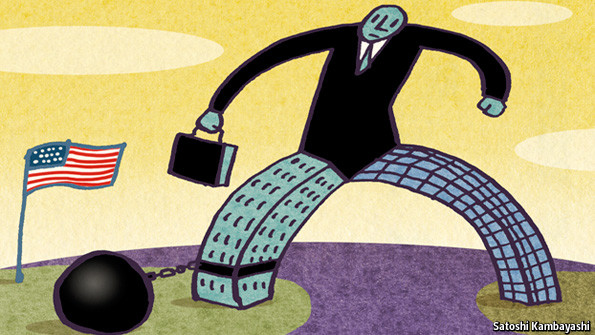
The magazine even provides the readers with an image of the artificial people with a "human face" so that you may then equate those emotional images with the imaginary people called corporations who are tied down by a ball and chain and want to flee from tyranny.  What bullshit!


The problem has been exacerbated by countries that have bought into this idea that by slashing taxation rates they can then attract the imaginary people and real money to their respective geographies:
Twenty years ago inversions were rare. But as other countries chopped their rates and America’s stayed the same, the incentive to flee grew.
The inversions--the movement of the imaginary paper people--were rare back then is an important fact.
Mr Obama insists that corporate-tax reform must also raise more money to spend on things like public infrastructure, which the Republicans oppose
I suppose only we real humans who bleed, laugh, and die use public infrastructure and, therefore, the imaginary people do not need to be taxed at all!

I second the notion that "I’ll believe corporations are people when Texas executes one."

Monday, January 23, 2012

There are places I remember ... or, stairway to heaven?

A standard argument in urban economics/geography is that residential use of land is a residual use--only if commercial use of it is not viable.  Similarly, if money is to be made, then homes in an area can be bought, demolished, and the land will be converted to commercial uses.

My parents lived through this textbook explanation of urban land use.

For twenty-five years, they made themselves home and it looked like this before they moved out:


And that stairway to home has become the stairway to a store :)


The coconut trees are long gone.  No retailer wants coconuts to drop on customer's heads or cars!

Am mighty glad, however, that the trees by the road, which have grown even more, have not been cut down, but have been only pruned.

But, I don't seem to have any particular emotions attached to this old house.

It was Madras when I was a visitor from Coimbatore, and it was Madras when I was a visitor from the US.  It has been years since the city became Chennai.  Having always been a visitor to Chennai, I feel a lot more nostalgic about Neyveli and Sengottai, which stir a lot more memories of "home," than I do about the city where my parents and sister live.

Home is what we individually make of the spaces where we live, and where we create memories.

Which is why we do not talk about homes in economic geography.  They are only houses.  It is only the housing market. 

For now, as I type this post, home is far, far away, in Eugene.

Sunday, February 06, 2011

Mythbuster: The decline, demise, and death of manufacturing in America

So, it seems like every other product has a "Made in China" sticker, right?  Manufacturing in America is dead, right?

Are you sure?  Is that your final answer?

Jeff Jacoby notes that (ht):
There’s just one problem with all the gloom and doom about American manufacturing. It’s wrong.
Americans make more “stuff’’ than any other nation on earth, and by a wide margin. According to the United Nations’ comprehensive database of international economic data, America’s manufacturing output in 2009 (expressed in constant 2005 dollars) was $2.15 trillion. That surpassed China’s output of $1.48 trillion by nearly 46 percent. China’s industries may be booming, but the United States still accounted for 20 percent of the world’s manufacturing output in 2009 — only a hair below its 1990 share of 21 percent.
Our perception of the death of manufacturing in the US is based on: (a) the prevalence of low-price goods from China and other countries, and (b) a declining share of employment in manufacturing.  But, when one looks at it in dollar value, it is an entirely different story:
“America still makes a ton of stuff, and we make more of it now than ever before in history.’’ In fact, Americans manufactured more goods in 2009 than the Japanese, Germans, British, and Italians — combined.
American manufacturing output hits a new high almost every year. US industries are powerhouses of production: Measured in constant dollars, America’s manufacturing output today is more than double what it was in the early 1970s.
I talk about this in my introductory class when we talk about lower-order and higher-order goods, and how America increasingly specializes in higher-order goods.  But, whoever goes to classes and, more importantly, listens to cranks like me in the classroom, right?

Sunday, December 05, 2010

200-year economic history of 200 countries in 4 minutes

I have used many of Hans Rosling's videos in my classes, ever since I watched the first TED talk of his.  While most of the students are, well, students who are indifferent to anything (even my awful puns!) there are always a few who are blown away by his explanations.
I am sure I will use the following next term (and after too?) ... ht

Wednesday, August 11, 2010

It is the new economic geography, stupid. Or not?

Looks like Paul Krugman has started throwing punches in every street battle.  Krugman is now doing an Obama of trying to be everywhere.  Chill it, Prof!

First it was his rather shrill attack on Paul Ryan, by using metaphors to describe the person.  Whatever happened to the academic in Krugman to focus on the arguments and not on the person?   Maybe Krugman has been listening too much to the master manipulator of metaphors whose office is just down the hall from his? :)  Megan McArdle has articulated well what I have in mind:
there are legitimate concerns about whether the roadmap would actually reduce the deficit.  Of course there are legitimate concerns; I share them.  (For that matter, I have legitimate concerns about pretty much every policy proposal ever invented.)  But I am not the person who titled his column "The Flim-Flam Man" and turned the raising of legitimate concerns into the side-show of an all-out attack on Paul Ryan's credibility and ethics, while treating an estimate from the Tax Policy Center as a fact rather than one possible model. 

If you think that this is all rather beside the point, then bring it up with Krugman, who not only did multiple follow-up posts on Ryan's alleged dishonest campaign to prevent his tax program from getting scored, but also seems to have been so tickled by his column title that he threw in a bonus Diana Krall video**.

Nor, in my experience, do such attacks help get one's legitimate concerns addressed.  Rather the opposite, in fact; they tend to entrench the opposition, who for some reason often fear that they will not get a fair hearing.
And now, Krugman is ticked off at a FT opinion piece that opens with a direct hit at Krugman:
China’s exchange rate continues to be blamed for global economic imbalances, with the economist Paul Krugman one of Beijing’s staunchest critics. Even after China announced a change in its currency policy in June, Mr Krugman argued that it did not “address the real issue, which is that China has been promoting its exports at the rest of the world’s expense”. Yet, arguably, it is the Nobel Prize-winning ideas that Mr Krugman developed three decades ago, not currency manipulation, that have led to China’s unparalleled growth.
At least this time Krugman is not resorting to name calling--no "flimflam man" :) and points out that:
surpluses, and the currency manipulation, are neither intimately related to Chinese growth nor necessary for that growth to continue.

Wednesday, July 28, 2010

Stop and smell the roses

The caption for this photo reads:
"A Maridadi employee takes a moment to appreciate the flowers."
It is from an essay in Slate about Kenya's growing flower exports.

While blogging about the economics of flowers is not new here, this photo is new--the Kenyan employee appreciating and admiring the flower.
Sweet!

Thursday, April 01, 2010

NCAA Basketball, geography, and ESPN

When the Green Bay Packers started winning a few years ago, I recall chatting with a few people who were all pumped up about the team and their quarterback, but had no idea about the location of Green Bay itself.  It simply did not matter to them.  This indifference to location, even while fanatical about the economic and recreational activity related to that location, fascinated me.  Since then, every once in a while I have quizzed students on the locational aspects of winning sports teams--football, baseball, and basketball.  The results were always the same: even the most interested and serious sports fan was geographically-challenged about the very team he (almost always a "he") was rooting for.

A couple of years ago, I wrote in an essay that:
It appears that only real estate agents and geographers understand the importance of location, location, and location. Otherwise, I suppose both within and outside academia, there are not many who develop a spatial understanding even of the issues that interest them or the cities where they live.

I wonder if we geographers might be partly at fault because we tend to equate maps with the “old school geography” that impressed upon people an (incorrect) idea of geography that it is only about memorizing facts about places. But in getting away from that atrocious caricature of geography, we might have gone to the other extreme where we, too, might be reinforcing the notion that it is not important to understand the actual location of a place, and its relationship with its surroundings.

Students in my introductory class were not completely off the hook though. Given the notoriety of the New England Patriots, I asked them at the final meeting of the term, as a way of wrapping up the course, where New England is and the name of the city where the Patriots play. I had hoped that at least five out of the forty students would know the correct answer.  Only one knew that the team’s home is in Foxborough, though four others had a good enough answer of Boston.  I suppose I did get that five out of forty I was shooting for.☺

Thus, you can then understand why I am excited about the online geography quiz that ESPN has about the NCAA men's basketball tournament teams.
So, hey you sports nuts out there, who filled out the brackets (including the President!) take that quiz and see how well you know the locations of those universities...

BTW, speaking of the President and his bracket, here is the Daily Show commenting on it towards the end of this hilarious segment :)
The Daily Show With Jon StewartMon - Thurs 11p / 10c
Tenacious O
www.thedailyshow.com
Daily Show Full EpisodesPolitical HumorHealth Care Reform

Monday, March 29, 2010

Krugman, economic geography, and the AAG

Earlier I blogged about Paul Krugman in the AAG Annual Meeting schedule.  Looking forward to his comments on economic geography. 

From Krugman's blog:

DESCRIPTION
Aha. I have to give a talk in a couple of weeks at the American Association of Geographers, and found myself thinking of a sign one sees while driving into New York. I was researching the history of the North New Jersey embroidery industry, and discovered that someone has a Flickr picture.
It’s an interesting history of individual initiative and cumulative causation — the same kind of story now being played out all across the world, especially in China. I still love economic geography.

Tuesday, March 09, 2010

Yemen, women, and ... students in my class?

So, a couple of weeks ago, when we were discussing demographics in my intro class, I remarked that countries like Yemen have high fertility rates, and high fertility rates--at levels way higher than a 2 or 3--are typically in societies, like Yemen, where women don't have rights, or have limited rights.

Naturally, I asked them if they knew where Yemen was and, slowly, through a little bit of critical thinking a couple of students figured out that it was in the Middle East, in the Arabian peninsula.

Coincidentally, this came at the same time that Jon Stewart had fun with the underwear bomber and how we come to know about a country only when somebody from there attacks us.  Yes, of course, I played his video in the classroom :)

Now we are in the final instructional week, and a student "S" was excited about something she came across about Yemen, women, and women's rights .... in the People magazine.  She gave me the piece that she had torn out before rushing to class--that is the scanned image on the left.

It was a coincidence that "S" brought this to class on March 8th, which is International Women's Day!  I wonder if People had also featured this story as a part of the Women's Day issue--you think?

Click on the scanned image or here to purchase the book from Amazon.

Nicholas Kristof wrote about this remarkable Yemeni girl and her ordeal:

For Nujood, the nightmare began at age 10 when her family told her that she would be marrying a deliveryman in his 30s. Although Nujood’s mother was unhappy, she did not protest. “In our country it’s the men who give the orders, and the women who follow them,” Nujood writes in a powerful new autobiography just published in the United States this week, “I Am Nujood, Age 10 and Divorced.”
Her new husband forced her to drop out of school (she was in the second grade) because a married woman shouldn’t be a student. At her wedding, Nujood sat in the corner, her face swollen from crying.
Nujood’s father asked the husband not to touch her until a year after she had had her first menstrual period. But as soon as they were married, she writes, her husband forced himself on her.
He soon began to beat her as well, the memoir says, and her new mother-in-law offered no sympathy. “Hit her even harder,” the mother-in-law would tell her son.
Nujood had heard that judges could grant divorces, so one day she sneaked away, jumped into a taxi and asked to go to the courthouse.
Speaking of Kristof, click here for a video from him on the "Congo workout plan"--the hard physical work that women do, while men sit around and drink beer.  Kristof then attempts to carry that load and gives up!  As I noted once before, at least, we men--sometimes--are good for nothing and only create hassles for women :(  It is simply awful that such conditions exist in the world today. 
More than anything, this being the second time a student has linked something in the world outside to the discussions we had inside the classroom, I am ready to call this term a success.  Was worth all the trouble of preparing the syllabus, lecturing and leading discussions, waking up students in the class (!), grading and grading and grading .... a good term all in all ...

Tuesday, February 23, 2010

Paul Krugman will be at the AAG annual meeting

A neat essay in the New Yorker on how Paul Krugman the economist found politics as well ...
I am all the more looking forward to his talk at the upcoming annual meeting of the AAG, on April 16th.  I would assume that it will be an overcrowded hall for this event :)

Given that I deal mostly with economic geography, I was waiting for that dimension of Krugman's to unfold in the essay, and it is pretty neat:

Later on, Krugman became interested in economic geography, in the related question of why there were regional specialties—why, in the United States, for instance, were cars produced in Detroit, carpets in Dalton, Georgia, jewelry in Providence, and chips in Silicon Valley? Again, the answer turned out to be history and accident. Once an industry started up in one place, for whatever reason (the carpet industry in Dalton appears to have its origin in a local teen-ager who in 1895 made a tufted bedspread as a wedding present), local workers became trained in its methods, skilled workers from elsewhere moved there, and related businesses sprang up close by. Then, as more skilled labor became available, the industry could grow and benefit from economies of scale. Soon, as long as it didn’t cost too much to transport the industry’s products, the advantages of the place would be such that it would be impractical for someone to open up a similar business anywhere else. Many economists found the idea that economic geography could be so arbitrary “deeply disturbing and troubling,” Krugman wrote, but he found it exciting.
Again, as in his trade theory, it was not so much his idea that was significant as the translation of the idea into mathematical language. “I explained this basic idea”—of economic geography—“to a non-economist friend,” Krugman wrote, “who replied in some dismay, ‘Isn’t that pretty obvious?’ And of course it is.” Yet, because it had not been well modelled, the idea had been disregarded by economists for years. Krugman began to realize that in the previous few decades economic knowledge that had not been translated into models had been effectively lost, because economists didn’t know what to do with it.

At the AAG meetings last year, they devoted a session to Krugman receiving the Nobel Prize and what this meant for economic geography.  But, they made quite a mess of it. 

Of course, as one who still enjoys a little bit of freedom of expression, despite the best (worst?) efforts of some of my faculty colleagues to silence me, I did share my feelings with the session's organizer :)  Even though this posting is already too long, here is that email I sent in March 2009:
I was delighted when I noticed in the program a session devoted to Paul Krugman's Nobel Prize for his work in economic geography. 

As a member of the geography department in a teaching university, one of the reasons I look forward to the AAG is for the continuing education benefits from attending sessions.  Particularly when the demands of teaching require me to spread my intellectual interests across a range of courses.  However, for the most part, the session on Paul Krugman did not advance the discussion more than how the Economist summarized it in 1999--almost exactly to the day of the session, ten years ago. 

After my comments, I have copied/pasted the article from the Economist, and the word "geographers" is highlighted throughout because of the keyword search I had employed.  I remembered that piece because (a) it came at a time that Krugman was rapidly transitioning into a public role, and (b) I have used that many times over the ten years, including in a book review in Professional Geographer.

I found it equally puzzling that the geographer mentioned in that article, Professor Ron Martin, was not one of the panelists.  Well, there could have been any number of logistical reasons behind it.  But, puzzling nonetheless.  Anyway, my thanks to Professor Martin for his observations towards the end of the session when it was opened up to comments from the floor.

Well, even if I did not find the session at a level I initially expected, my thanks to you for organizing this session.  I hope that this session will be the beginning of a series of conversations on forging a truly new economic geography that marries the best ideas and methods of economists and geographers.

************
"Knowing your place"
Economist; 03/13/99, Vol. 350 Issue 8110, p92-92, 1p
Economists say they have rediscovered geography. Geographers are interested to hear it. They didn't know they had been away
THE leading light of the "new economic geography" is Paul Krugman, professor of economics at MIT. These days he is widely known for his popular books and magazine columns, where his speciality is to explain economics in straightforward terms while pouring scorn on rival experts such as Lester Thurow and Robert Reich. Mr Krugman is a brilliant writer of economics for non-specialists. Annoyingly, he is at least as good at the real thing. The "new economic geography" has lately been a chief interest, developing as it does from his earlier research in "new trade theory".
It is too soon to say whether this new area of work, like its predecessor, will become a major field of research in its own right. But it is not too early for geographers to be very annoyed that economists are roaming blithely across their land.
In a new paper, Ron Martin, from the geography department at the University of Cambridge, surveys the "new economic geography" with the critical eye of an actual geographer-and makes some interesting points. As will become clear, much of what he has to say applies not just to new economic geography but also to much else of what economic theorists spend their time on these days.
Mr Martin explains that the two main branches of new economic geography-one of them concerned with clusters of activity, the other with regional growth disparities-raise questions that are entirely familiar to geographers.
On clusters, economists start with the idea that centripetal and centrifugal forces are in opposition when firms choose where to locate. The agglomerating forces are "externalities" such as the ability to tap into an established local market for appropriate labour and intermediate goods. The dispersing forces are the costs of congestion, and the bidding-up of prices for land and labour. In models of clustering, transport costs and labour mobility usually have a central role: if transport is cheap and labour is mobile, agglomeration will tend to outweigh dispersal (and the converse).
According to Mr Martin, these and other models "generate a dull sense of deja vu . . . Geographers were busy analysing industrial location in these terms back in the 1960s and 1970s."
Much the same goes for the other sort of models-the kind concerned with convergence (or lack of it) in regional incomes. Again, according to Mr Martin, the economists arrived late for the meeting. Their starting point was the comparatively recent finding that incomes among regions converge more slowly than the standard neoclassical model of growth would predict. (This model embodies diminishing returns, meaning that as you invest more, you get a smaller return-so poor regions should catch up.) New economic geographers are examining the reasons for this slow convergence. Again, Mr Martin observes that their work "merely revives" ideas proposed more than 30 years ago in proper geography.
He goes further. The geographers have not only been there and done that, they have given it up as a fruitless enterprise and moved on. The real problem with new economic geography, they believe, is its obsession with mathematical modelling. The economists sometimes argue that geography came to a halt way back because the mathematical tools of the day were not up to the job. Imperfect competiton features prominently, for instance, and clever maths is needed to deal with it. Now those tools are available-their use in economics pioneered by specialists in industrial organisation and trade-so economists can breathe new vigour back into the lifeless body of geography.
No, not quite, says Mr Martin. It wasn't mathematical backwardness that led geographers away from this approach but the conviction that to rely too heavily on maths was a dead end. Geographers realised that "formal mathematical models impose severe limits on our understanding. Geographers became more interested in real economic landscapes, with all their complex histories and local contexts and particularities . . ."
A specific complaint is that an economist may be happy to use the same model to explain clusters at completely different scales-at the international level, at the scale of core versus periphery within a single economy, among urban concentrations and even within city neighbourhoods. (Yes, that is just like an economist.) Geographers insist that profoundly different processes are at work at different scales. So modern geography is interested in a more "discursive" approach, piling on detail and colour, in "close explication of locally specific and contingent factors", in building models from the bottom up, not from the top down.
Mr Krugman's response is robust. The geographers are often simply anti-model, anti-quantitative, anti-clarity, he has written. The geographical literature uses terms likes post-Fordism-even Derrida gets a look in-and Mr Krugman finds that very off-putting. (So does this column, it must be said.) Mr Krugman's general defence of maths in economics, and his strictures on using it properly, seem right: economic statements are based on models, he has argued, whether you acknowledge their existence or not. Better to know the model you are using, if only to understand its limitations, than to kid yourself you have moved to a deeper, model-free plane. Quite so.
Yet who can deny, as the geographers complain, that at the frontier of research, abstract economic modelling and the real world have moved dispiritingly far apart? A meeting of minds ought to be possible: a middle ground between bottom-up and top-down. One day, maybe, but tempers will have to cool first.
The article by Mr Martin is "The New `Geographical' Turn in Economics", Cambridge Journal of Economics, January 1999. Among Mr Krugman's many writings on the subject are "Development, Geography and Economic Theory" (MIT Press, 1995).