Showing posts with label culture. Show all posts

Friday, June 18, 2021

Will Americans adopt namaste?

As the meeting ended, I asked the doctor what the health protocols are now about handshakes.  "No more handshakes, and only elbow bumps?"

He didn't even pause to consider the question.  "I don't think I will ever shake hands again.  For 15 months, I haven't even had a cold.  It is because I am not in contact with people."

People have their own preferences.  While I honor his, I am not in agreement.

Social distancing in order to avoid a deathly virus is not the same as social distancing in order to avoid a common cold.  If we take this approach to its logical conclusion, then we can continue with social distancing, work from home, and tele-medicine forever, and such a bubble existence will help us avoid any contagious disease however minor or deadly it is, right?

As much a gregarious hermit I am, the bubble doesn't appeal to me.  It completely redefines what it means to be human.

I hope that in this case, too, public memory will be short.  After a few months, or a couple of years, we will return to handshakes and hugs like we used to before the pandemic upended our ways of life.

Now, it is not that I am a huge fan of hugs.  I have learnt to accept them as a part of life, as much as my balding head is something I need to live with ;)

I grew up in a culture in which there seemed to be lots of emphasis on not touching the other person.  A culture in which there were no handshakes or hugs, particularly across the genders. In the culture in which I grew up, relationships were non-contact sports.  As kids, we might have clung on to grandmothers or uncles, but as grown ups we maintained our distances.  A handshake between men was the most we ever got to in terms of bodily contact to express anything.

I often joked, after a few years of living in the US, that it was because we lived in hot and humid conditions and that the last thing we wanted was the other person's stinky sweat!  Even as a kid, I always sweated more than the rest.  My grandmother often commented that I was like a உப்பு சட்டி (salt container) that was always a tad moist.  (The finely powdered "table salt" was not around during my formative years.  Chunks of sea salt were stored in ceramic containers on which condensation was not unusual.) 

After the pandemic ends, or at least eases, I will pay a visit to the old country, and meet face to face with my relatives and friends.  The older folk won't hug.  We will sit apart, and inquire about each others lives.  It will be a touching visit.

Wednesday, June 09, 2021

Names and indentities

"Like in our traditional practice, he is named after his grandfather," my father commented.

The first born is named after the paternal grandparent.  How about the second child?  It depends.  If the second child is the same sex, then the name is the maternal grandparent's name.  A different sex means that the first two kids have the names of the paternal grandparents.  The mother's lineage is for leftovers!

In that tradition, I would have usually been given the name Ramaswamy--my paternal grandfather's name.  But, I wasn't.  The social norms were rapidly changing in the urban and industrial parts of India, and Ramaswamy was old fashioned a name.  Capturing the "Ram" in Ramaswamy, my father came up with Sriram.

I was also given an alias that was used in the formal, Hindu religious and ritualistic contexts: Venkataramasubramanian.  Boy am I glad that this multi-syllable name is not in the official records!

Traditional names are part of the cultural landscapes. Every cultural landscape has its own tradition.  The Icelandic last names are different from the Slavic ones, which are different from Nigerian.  You get the point.  Even within the cultures, traditions are being challenged. Like the Czechs questioning the gendering of last names.

But, even more challenging is when people with names from one culture move to lands with completely different cultures.  

I first got a taste of this as a graduate student when I was surrounded by students from China and South Korea.  "Strange" names with unusual spellings.  But, it was not a huge problem to overcome.  Mungjin and Rongsheng became familiar sounds. 

What I could not understand was a few students taking on Western, Christian names in order to make it easy for the natives.  Why they preferred to lose their identities was simply beyond my imagination and understanding, despite engaging with them about this issue.

I couldn't imagine walking around as "Sam" just because a few natives couldn't pronounce my name.  Sam I am not.  Nor am I a Sri.  I am Sriram, as I have always been.

A cardiologist, who is about my age, writes about her name--Xiaoyan Huang--in the Washington Post:

When I first came to the United States in the late 1980s, for college, I immediately realized that Americans had a hard time pronouncing my name. (Roughly, it’s see-ow yen.) Some people mocked the name; for others, mastering it was a genuine struggle. Meanwhile, among Asian students, I soon learned, my name put me on the lowest rung of the social ladder on campus. The kids who were born in America, or who immigrated with their parents at a young age, often had American names.

Of course, "Xiaoyan" stumps me when I read that string of letters.  It is new.  Just like Quixote was new to me.  Just like I had to learn to pronounce Foucault too!

How did she get that name?

Because Chinese civilization is built upon our profoundly metaphorical language, the words chosen for a baby’s given name are perceived as being critically important in the identity of that person. When I was born in Beijing, my parents carefully selected my given name using the traditional methods. But on his way to the district office to file my birth certificate — or so my parents told me — my father, in his usual romantic and impulsive way, decided unilaterally to change the name. He settled on “Xiao Yan.” “Yan” is a key component of my mother’s name, referencing Yan’an, her birth place — also a center of the Chinese Communist revolution — while “Xiao” means “small.” The name expresses his love for both of us.

I am glad that her professor in Oregon advised her to ditch adopting a Christian name: “Your name is your identity — stick with it”.

Yes!

Sunday, February 02, 2020

Empathy Through Enchiladas

The NY Times had an interesting report on the predictive power of food:
Voters who had been to Europe, Australia, Canada or Mexico or had eaten at an Indian restaurant were less likely to choose Mr. Trump by 10 to 12 percentage points beyond the differences explained by other factors like the ones mentioned above.
...
Of course, it’s not that eating Indian food leads a person to support one Democratic candidate over another — that’s silly. (And there are voters for whom Indian food is the taste of home.) But a voter’s orientation toward the world is related to candidate choice, and it turns out that eating in restaurants that celebrate less familiar cultures is one way to measure where people think they are more connected: to those around them locally or to people farther afield.
Indeed.  Food is a portal to understanding the world around us.

There's something remarkable about breaking bread together--even if that breaking bread happens at an "alien" restaurant.  That magic is powerful when we share food at home, as I quickly realized when I came to the US.

Siddiqqi, who was from Pakistan, or the Taiwanese girl whose name I have long forgotten, came over to my apartment to eat with me.  And then there were more. Greeks. Nigerians. Or my meals with Palestinians. A Guyanese-American with roots in India.  And, of course, white Americans too.

It was never really about the food.  What is it about then?
According to anthropologists and psychologists who have studied food in recent years, cuisines from international cultures can take us out of ourselves and help us better understand distinct people and cultures. The secret ingredient is empathy. And the process begins with stirring our emotions.
Food and emotions, and that wonderfully important ingredient to being human--empathy.

Empathy, about which I have blogged a lot because of the importance that I attach to it, means that we are placing ourselves in somebody else's shoes and understand their feelings.  When the others are from cultures that are alien to us, food is a phenomenal portal through which that "other" slowly becomes "us."
A culture may seem unfamiliar to a person, but after that person discovers the way people from an unfamiliar culture “prepare their food, the way they eat, somehow they understand it. There’s link between you and them, and that gives you insight.”
But, we need to keep in mind that it is not merely about food.  I have always stayed away from the international food fairs at college campuses because it seems to perpetuate the mistaken notion that it is all about food.  I want people to begin to understand the "other" through food.
Food alone, though, is often not enough to complete the trip to another culture. The journey needs other people.
Which is why white Americans eating Mexican and Indian foods can also be racists and xenophobes!  The "others" serving food is what the supremacists think is the norm--the equivalent of "shut up and dribble."  As if we are here only to keep the masters happy!

"Without the ingredient of human empathy, food from another land can only have a bland effect."  As I noted in this post a few months ago, I wish people would think about this:
“Have you or your family ever invited a person or a family of another race to your home for dinner?” ... When is the last time you or your family had dinner in your home with a person or family of another race?
Breaking bread at my home is about empathy and understanding. I have no place in my life for people who lack empathy.

Saturday, November 23, 2019

Teach Your Children "Palate Training"

In yesterday's post on childhood obesity, my formula for addressing that began with "It is about the overall health.  Eat your veggies. ..."

But, what if kids don't want to eat the veggies?

To me, this is impossible to imagine.  As a kid, I ate every vegetable that my mother and all the women in the extended family cooked. There wasn't a vegetable and its prep that I did not like.

I tell ya, if all kids are like how I was as a child, then the mothers of this world won't have a single problem ever ;)

The New Yorker--the magazine that published my short letter, yay!!!--has an informative and thoughtful essay on baby food and kids not taking to veggies.  It is a must-read (though it might be behind a paywall.)

I loved this there:
[Saskia] Sorrosa has a simpler goal. She wants her children to eat the way she ate as a child. “In Ecuador, we had whatever the adults were having—it was just puréed and given to babies,” she said. “I learned to eat spicy young.” On weekends, friends and neighbors would descend on her parents’ farm for buffets of ceviche and sancocho soup (a beef broth with mashed plantains and lime juice), braised goat stew and shrimp in peanut sauce. All of which found its way into Sorrosa’s mouth as she hung from her mother’s hip.
That's how I remember life in India.  Adults would offer just a tad of whatever they were eating.  And, of course, they would also praise the kid for eating it--reinforcing the good behavior.  There was no concept of making something different for children because they didn't like something.  According to grandmothers, our job was to eat what was in our plates and clean it up.  My life in India was no different from Sorrosa's childhood in Ecuador--without the ceviche and sancocho and ... ;)
“Self-weaned” infants, who dispense with purées and just gnaw on their parents’ food, tend to be slimmer and healthier than those raised on baby food. But only if their parents eat healthy meals themselves.
There is your important link to the discussions on childhood obesity too.

The author wraps up the essay by contrasting the American finickiness with how a Congolese immigrant mother in Portland (Maine) was preparing food for her baby.
Rachel’s lenga-lenga was like no baby food I’d ever seen. It was full of onions and garlic and bitter green pepper. It had mashed eggplant and leeks that could give a baby gas. It was salty from the bouillon—the rest of the family would be eating it, too—and far from sweet. By the time it was done cooking, it was a thick green porridge, pungent with smoked fish and sulfurous plants. It made kale look like Christmas candy. And yet, when Rachel brought a bowl of it over to Soraya on the couch, she bounced up and down and clapped her hands.


Sunday, July 21, 2019

நன்றிகெட்ட நாயே

Perhaps most visitors to this blog post will be stumped by the indecipherable title.

It is a Tamil expression that perhaps is not used that much anymore compared to years past--in my trips to the old country, I haven't heard anybody yell out even in the streets.

நன்றிகெட்ட நாயே (nanrikketta nāāye) means "a gratitude-lacking (or ungrateful) dog."

A language that has such a wonderful phrase that packs a ton of emotion in it, well, it lacks an easy way to say "thanks."  Which is why often we end up saying the English word instead.  It is like how there is no equivalent for "I love you." 

But then, there might be some deeper reasons behind why Tamil, which clearly values gratitude, does not offer simple ways to express thanks:
[In] societies, like the Tamil one, that are based on reciprocity as a fundamental social principle, morality and etiquette are inextricably linked. In the modern West, by contrast, etiquette and morality are distinct domains, and although gratitude might be a moral question, thanking someone is frequently just a matter of good manners. Apparently similar kinds of awkwardness might therefore conceal dramatically different moral assumptions about the appropriate currency for the giving of thanks.  
Etiquette and morality as distinct domains versus them inextricably linked.  That explanation easily convinces me.

No, this is not yet another post on Tamil related to something authored by David Shulman.  Though I cannot pass up the opportunity to quote from Tiruvalluvar, who had plenty to say about gratitude too, including this:
      நன்றி மறப்பது நன்றன்று நன்றல்லது அன்றே மறப்பது நன்று.
Which I would loosely translate to: It is not good to forget the good things; but, it is good to immediately forget the bad (thoughts and deeds.)  While I am all in favor of the first half of the couplet, I disagree with the second half--I don't care about forgive and forget!

This post is about how cultural differences shape your gratitude.  "Americans say thanks a lot, but other cultures may have a deeper understanding of gratitude."

It was through that article that I ended up reading the essay from 1985, by Arjun Appadurai, from which I excerpted the comment about etiquette and morality.  That article notes:
What’s clear is that gratitude deeply intersects with a culture’s attitude about the self and its relation to others. Are we individuals forging our own paths, or members of a larger whole? 
And then makes this point:
Gratitude is, after all, ultimately a skill that strengthens our relationships—and it arises when we pay more attention to our relationships and all the gifts they bring us. “At a time when the society seems to be more about me me me, we really need to get people thinking about connections”
I like this notion of gratitude being about relationships, about connections.  It is not merely about mouthing a "thank you."  As Appadurai wrote in that 1985 essay, it is not a mere etiquette,  but one that it inextricably linked with morality. It makes sense to, therefore, think of gratitude as "a moral virtue: a repayment and paying it forward of kindness that are part of being a good human being."
 
நன்றி!

Thursday, February 21, 2019

Faster, faster ... and even faster!

One of the ideas that I try to get through to students (and in social conversations too) is this: Science and technology are developing faster and faster at speeds that are beyond our human abilities to understand, adapt, and--more importantly--look into the future.  In my intro classes, I routinely tell students that the world as they experience 25 years from now will be wilder than their wildest imaginations.

One of my favorite ways of conveying this to them is for them to imagine a middle-aged human from 10th century being transported into the 15th century.  Not much of a change in the way society works. 

I then ask them to imagine transporting a middle-aged human from a hundred years ago to today.  Students begin to see where I am going; after all, when even their grandparents can't keep up with this world the grandparent of the grandparent will be metaphorical (and literal too?) roadkill in a nanosecond.

If only people listened to me!

If needed--so far nobody has ever asked me to defend my theses--I can easily direct them to this essay by an evolutionary biologist.  He provides a thought experiment that is along the ones that I suggest to students:
Imagine this thought experiment. An infant born on the Pleistocene savannah is switched at birth with another born in 21st-century America. Each would undoubtedly grow up to be a functional member of her society: hunting mastodons or gathering roots and berries in one case, and perhaps running a hedge fund or piloting jet aircraft in the other. Now, delay a few decades and switch these two individuals as adults; the results would be disastrous for both. The biological nature of these individuals will be comparable whereas cultural evolution will have produced qualitatively different circumstances in the two cases, such that individuals carrying only their shared biology into each situation would find themselves woefully unable to function in the other’s cultural milieu.
Yep. Woefully unable.

Our biological inability to keep up with the changes is also a reason why we have a problem even understanding the fact that in a mere 200 years we have heated up the atmosphere and oceans like never before.  It is almost as if our biology is still in the late 19th century, while the science and technology of day is rapidly leading us in a hyper speed into the future.
Insofar as the combustion of fossil fuels generates millions of tons of carbon dioxide, which, via the greenhouse effect, absorbs heat from the sun while preventing much of it from being radiated back into space, our technological hare has set the pace. This phenomenon is largely due to the industrial revolution, barely more than two centuries old, during which time our biological evolution has essentially remained unchanged. Rapid cultural evolution has bequeathed us 50 percent of the problem: the physical and chemical half. At the same time, slow moving biological evolution has left us both reluctant to acknowledge the problem and—even when that psychological roadblock is surmounted—often disinclined to do very much about it.
What's the connection with our biology?
Our biologically evolved selves are quite good at perceiving events that are prompt and threatening; those that are slow-moving, although equally threatening, not so much. A fire in a building and people run outside. A slow moving fire in the Earth’s thermal budget and people hardly notice. For nearly all of our evolutionary past, it was not adaptive to detect such slow-motion changes, and so our ability to do so is limited. 
As the author comments: "An enemy with an upraised club was one thing; a raised ambient temperature—no matter what its cause—would have been quite another."

No wonder the evolutionarily lagging trump and his toadies immediately react to the sight of a brown-skinned immigrant at the border, and point at snow as negation of global warming.  By the time the 63 million evolve to where the rest of us are, well, ...

Oh,  I forgot; most of the 63 million deny evolution too ;)

Thursday, November 08, 2018

‘Je suis excité’ ... Non!

A visiting Pole was unusual in one way.  The same way that a visiting Czech was a while ago.  And a visiting Ukrainian too.

What was unusual about them?

They were quite extroverted.  And did not hide their excitement.  They even laughed loudly.

A contrast to the melancholic poker-face that I have come to expect from the population there.

I know, I know.  I am a guy whose smile does not get across to people.  But, this post is not about me, dammit! ;)

The Pole talked about his friend who immigrated to Australia, became a citizen there, and decided to return to Poland.  Why?  Because Australians were always too happy for him!

Americans are also way too upbeat all the time, he said.

I agreed with him.  But, chose to keep my critiques within.

And then later shared my dissenting views with M. "I would think that only white Americans will come across as upbeat all the time.  Similarly in Australia.  You think the indigenous people in Australia or Native Americans here will be that way?"

Once you take away from the discussion the white American and Australian population, I would think that the Americanisms of "Awesome!" and "I am so excited" rarely show up in other cultures, including the one in which I was raised.  Heck, even in France and in the French language.
“I think it's safe to say I express excitement often and outwardly,” said bilingual Australian Dr Gemma King, who teaches French language and cinema at the Australian National University in Canberra, noting that when she speaks French, it is another story entirely. “My students and I often joke that our cooler, calmer, more reticent sides come out when we're speaking French,” she said.
When speaking and thinking in French, even the Aussie excitement dies down ;)
“[The French] don't appreciate in conversation a kind of positive, sunny exuberance that's really typical of Americans and that we really value,” Barlow explained. “Verbally, ‘I'm so excited’ is sort of a smile in words. French people prefer to come across as kind of negative, by reflex.
My French husband agrees.
“If you’re too happy in French, we’re kind of wondering what’s wrong with you,” he said. “But in English, that’s not true.”
You see, I am the normal one when I come across as an unsmiling person!

So, is there a philosophy of life that all these distill to?
“You Americans,” he said, “live in the faire [to do]. The avoir [to have]. In France, we live in the être [to be].”
Oui!

Wednesday, October 31, 2018

Conservative in the morning. Liberal the rest of the day.

When we were kids, the typical breakfast at home was idli or dosai.  Freshly made.  By mother, of course.

One day, my brother, who was perhaps seven or eight at that time, stuck a hand-written note on the kitchen wall to voice his protest.  The note read: "இட்லி தோசை ஒழிக" (No more idli, dosai.)

Every time we get together, the family has a good laugh recalling that.  He vehemently argues that it was my father who put the thought in his head and that as a good kid he carried it out.  We laugh about that too.  Interestingly enough, he is now a dosai expert, and his kids love, love, love his dosais!

Idli and dosai were all what most of the kids in that part of the old country ate back then.  Or, uppuma.  That was the culture.

Bland, salty, savory is the tradition, not only in the old country culture but in old cultures practically anywhere on the planet:
“The idea that children should have bland, sweet food is a very industrial presumption,” says Krishnendu Ray, a professor of food studies at New York University who grew up in India. “In many parts of the world, breakfast is tepid, sour, fermented and savory.”
Years ago, I told my grandmother that in her cultural context, idli every morning with yogurt is the healthiest way to start the day, and no wonder the old cultural belief is that idli plus yogurt is the best food even for the sickest patient.
Children begin to acquire a taste for pickled egg or fermented lentils early — in the womb, even. Compounds from the foods a pregnant woman eats travel through the amniotic fluid to her baby. After birth, babies prefer the foods they were exposed to in utero, a phenomenon scientists call “prenatal flavor learning.”
What an easy excuse then for chocaholics: "hey, it was my mother's fault that she ate all that chocolate when she was pregnant with me!" ;)

Actually, chocaholics don't need to blame their mothers at all:
Sugar is the notable exception to “food neophobia,” as researchers call that early innate fear. In utero, a 13-week-old fetus will gulp amniotic fluid more quickly when it contains sugar. Our native sweet tooth helps explain the global popularity of sugary cereals and chocolate spreads like Nutella: Getting children to eat sugar is easy. Teaching them to eat slimy fermented soybeans, by contrast, requires a more robust and conservative culinary culture, one that resists the candy-coated breakfast buffet.
What we eat, especially when we are kids, is so much culturally determined.  Almost always, that also sets us up for the rest of our lives, unless we consciously make choices about what we eat.  Cultures are conservative when it comes to breakfast.  Whatever one gets used to becomes the daily breakfast routine.  Why?
People are at their most vulnerable first thing; the day has not yet properly begun and breakfast needs to be safe and reassuring. It is the most conservative meal of the day in all cultures, says Kaori O’Connor, an anthropologist who has written a book about the English breakfast. “We have fusion global food. But in all cultures there remains breakfast. It’s a sacrament with which you begin the day. You can go wacko later,” she continues, “but you want to start ‘right’ whatever that may be. You want to gird your loins; you’re emerging from sleep…You want to know that you’re getting a good start.”
We like that re-assuring rote in the morning.

When I am in the old country, I enjoy my favorite breakfast items there: Poori with potatoes, and idli with vadai.  Whoever invented these combinations deserves a bright star named after them!

Daily life in the adopted home is a routine that fits my dull and boring personality.  No idlis or dosais. No packaged cereals, no donuts, no nothing.  It is bland breakfast day in and day out, and I am happy with it.

I don't post any protest signs in my kitchen! ;)


Wednesday, September 20, 2017

The day the music died!

My first full-fledged experience with the American presidential election was when Bill Clinton was the candidate, campaigning as a "new Democrat" against the Republican Bush and the independent Perot.  I did follow the 1988 elections, but I was still new in this country.  By 1992, I was well seasoned in Americana.

One of the coolest things in 1992 was Bill Clinton playing the saxophone while being a guest on Arsenio Hall's show.  It was not his sex, er, sax skills that impressed me.  I didn't care, nor do I even know how to rate such skills.  I was mighty impressed that a candidate to lead the most powerful country was not all stiff. and that there was a lot more color to his personality.

Clinton's presidency also marked my transition from graduate studenthood to life as a real adult, in America.  Like real Americans, I too started watching a lot of TV!!!  Except that mine included quite a few hours of C-Span and public television.

It always fascinated me that music programs were hosted at the White House and also broadcast.  I got to watch pop stars and opera stars alike performing in an intimate setting--right from my living room.

One of my favorites was a rather recent one (recent given my 30 years in America), when musicians performed Paul McCartney's songs in the White House.


Obama leading the crowd with Amazing Grace in a very emotional setting was memorable, yes.  It was also phenomenal leadership during a very tough time.

And now we have an uncultured and uncouth horrible human being, who is seemingly at ease only with everything that lives and breathes in cesspools!  Culture he hasn't shown.  The Economist writes that "The White House has become a cultural wasteland":
IT IS hard to imagine a presidential duty as easy, uncontroversial and plainly enjoyable as hosting the nation’s greatest artists, writers, actors and musicians at the White House. Such events offer a reprieve from politics and partisanship. They bestow glamour on an administration. They are a routine part of the job—a means of recognising and supporting the indispensable role of the arts in a great civilisation.
Yet for Donald Trump even this duty is proving difficult. Artists have snubbed him since the inauguration, when musicians like Elton John, Céline Dion and Garth Brooks refused invitations to perform. “Anything that gives aid and comfort to the adversary is a poor idea,” tweeted Joyce Carol Oates, a novelist, in support. By contrast, Barack Obama’s inauguration in 2009 drew together the very best in American culture—Aretha Franklin, Yo-Yo Ma, Itzhak Perlman, John Williams, Elizabeth Alexander and (for the Obamas’ first dance that night) Beyoncé. 
Of course, I will be labeled an "elitist" by the fuhrer's followers.  But, hey, I am talking about art that survives the test of time.  Puccini's arias and Aretha Franklin's songs will be around for way longer, well after we are all dead.  But, this president knows not such art, and the artists know better than to perform in this madman's presence.
After his comments on Charlottesville, all 16 members of the Presidential Committee on the Arts and the Humanities, established by Ronald Reagan in 1982 to advise on cultural policy, resigned. “We cannot sit idly by, the way that your West Wing advisors have, without speaking out against your words and actions,” they wrote in a letter.
Art--written, sung, spoken, drawn, painted, danced--helps us understand our existence.  We understand ourselves much more and much better thanks to the artists who help us with their creations and renditions.

But, this president does not care about what it means to be human.  He knows not what empathy is, and cares only for one thing--himself!
In the face of concerns like North Korea and neo-Nazis, Mr Trump’s rift with the art world seems insignificant. But it is another indicator of the tenor of his presidency and how drastically it breaks with previous administrations of both parties. Indeed, artists have usually attended White House receptions even when they disagreed with the sitting president. Bill Clinton honoured Charlton Heston, a staunch conservative. George W. Bush hosted Barbra Streisand, an ardent Democrat.
Mr Trump’s stance toward the artists who criticise him suggests he would rather take after, say, the Kremlin if he could: last week, Russian authorities placed Kirill Serebrennikov, one of the country’s leading theatre directors, under house arrest. In America artists still roam free. Will their resistance matter? 
I hope the resistance matters a lot.  Else, we are doomed!


Saturday, July 15, 2017

The man who knew too little

Quite a few years ago, a well-known geographer, Neil Smith, came to campus, and I went to the talk/soirée.

There was a bar, where this teetotaler went to get a soda.  Or, pop, if you prefer.

The bartender was a student, who was of legal age and with the license to serve alcohol.  Of course I had to chit-chat with her.  It amuses me that I am not surprised that I have not forgotten that exchange.

She talked about her interest in Chinese opera.  It was one of the many moments in life when I was made to understand that I knew nothing.  I hadn't ever watched anything from Chinese opera.  Ever. And this young white woman was talking about it with some serious insight.  Even as I type this, I admit that I have not watched, nor listened to, Chinese opera.  Not even for a minute.

I am culture-challenged.

I have admitted to that all along.  I say that sincerely.  I have always said that.  But, people are quick to correct me.  Like the humanities professor back in California.  In our conversation about cinema, when I admitted to not knowing much, she immediately replied that I am a man of culture.  I am?

Over the years, I have come to understand this much then: Even my fleeting familiarity with a few aspects of literature, music, drama, and cinema, apparently make me culturally competent.  But, what about the ocean out there about which I know nothing, right?

Nobody knows it all.

After having truly understood that, the older I get, the more easily I admit to not knowing.  Especially when it comes to aspects of culture.  I am more and more at ease with responses like, "nope, I have not read that; what movie are you talking about?  who is he, or who was he, or is that a she?"

What remains is the primary experience of culture:
The problem was that in falling for New York’s endless cultural possibilities, I had — and still have — much less time for reading than I assumed would be my lot. In exchange for depth I got breadth. I relish, even when only half understanding, the paintings of Artemisia Gentileschi, the photography of Diane Arbus, the architecture of Henry Hobson Richardson, the operas of Giuseppe Verdi, the films of Kenji Mizoguchi, the theater of Peter Brook. On the other hand, I haven’t come close to reading the major works of William James or Toni Morrison or hundreds of other major writers whose oeuvres I once fondly imagined would be at my fingertips. I’m reminded of a story about the librarian/fabulist Jorge Luis Borges, who was once asked in an interview to venture an opinion about Gustav Mahler. As ever, the most stupendously erudite man of his time was ready with a trenchant reply: “Who’s Mahler?” How inspiring!
I experience culture for this: "its beauty, its reach, its strangeness, its ability to transform an ordinary life like mine."  Even though I have never watched Chinese opera, and even when I have no immediate plans whatsoever to watch one.


Monday, May 08, 2017

Chinese Gooseberries and Alligator Pears

In my early years in California, a colleague gave me three or four huge avocados.  They were from her father's farm in Lindsay, which was only a few minutes of a drive away.

I was new to this fruit--until I came to graduate school in Los Angeles, I had't even heard of avocados.  I was just about getting used to eating chips with store-bought guacamole, and now three huge avocados were staring at me on the kitchen counter.

All I knew was that they were not ripe.  They felt rock solid.  

I let a couple of days go by.  They didn't seem to get any less solid.  

After another couple of days, I lost my patience.  I was now beginning to behave like one of those characters in "Three men in a boat."  

I knifed one of those avocados.  They were solid, and raw, and now I was stuck with a wasted fruit.

Undeterred, I decided to chop them down to pieces in the Cuisinart.  And then added salt to taste.

I threw the whole thing into the trash can.

Over time, I learnt how to make good use of avocados.  A few years later, when I started teaching at the local university, Juan, who was a Mexican-American student, shared with me his family recipe to make guacamole.  The first couple of times, I faithfully followed the recipe.  And then I started freewheeling like I always do in the kitchen.

If only I had known avocados back when I was a kid in India--maybe like some of the southeast Asians, I too would have had avocado milkshakes ;)

Eating something alien to us is not easy.  Consider even the name avocado; in most of the US, avocados were not even how they were referred to.
While avocados were popular in California, that wasn’t true for the rest of the country. In the beginning of the 20th-century, they were called “alligator pears.” Their bumpy, olive skin connected them to those denizens of the swamp, and it’s shape resembled, well, a pear.  They had a marketing problem.
I am not sure if I would have eagerly sought out alligator pears.  We might quote "what's in a name"; but, the reality is that the name makes a huge difference.  Names can be misleading too--like how when I was new in the country, I thought that Chinese Gooseberries were the gooseberries back in the old country!

And then the alligator pears went through an intense marketing and branding makeover.  The rest, as they say, is history.
At the end of the day, avocados have a place on today’s table thanks in part to a tireless campaign to redefine and redraft their identity. Some of it was misguided, some of it was weird and some of it was good. That is the nature of advertising.

Saturday, December 31, 2016

Not fifty, but a thousand shades of gray

"Can you explain to me this gay thing?" she asked.

"It is complicated," I replied.

In the first place, I am not sure if I have enough expertise to talk about this. On top of that, the usual complaint is that my responses are always way longer than what the questioner had in mind.  I suppose I don't like to merely give the bottom-line, consistent with my philosophical approach to life that it is never merely about the destination but also about the journey itself.

So, without any expertise I launched into a lengthy explanation.

"It is not as if things are black-and-white when it comes to being gay.  Most researchers now talk in terms of sexual fluidity" I started.

I keenly watched out for any glazed expression. Or the eyeball disappearing after having been rolled way up. No signs.  There was an attentive posture.  I got encouraged.

"The this-or-that approach is modern.  In olden times, it seems like people might have been way less rigid about this than we are now."  I went on and on and on.  Interestingly enough, there were even questions posed and it became an interactive session!

A few days later, I read this awesome essay by Siddhartha Mukherjee, on sex, gender, and gender identity.  Yes, the same Mukherjee whose book on cancer won him a Pulitzer.  This essay is an excerpt from another book of his: The Gene: an Intimate History.

Mukherjee writes:
The distinction between the three words is relevant to this discussion. By sex, I mean the anatomic and physiological aspects of male versus female bodies. By gender, I am referring to a more complex idea: the psychic, social, and cultural roles that an individual assumes. By gender identity, I mean an individual’s sense of self (as female versus male, as neither, or as something in between).
Across the world, as we begin to move away from the old collective arrangements that denied an individual's sense of self, we are beginning to see even the supposedly conservative societies having to face the complexity of sex, gender, and gender identity.

Strictly from a genetic perspective:
Sex, one of the most complex of human traits, is unlikely to be encoded by multiple genes. Rather, a single gene, buried rather precariously in the Y chromosome, must be the master regulator of maleness. Male readers of that last paragraph should take notice: We barely made it.
If you are a long-time reader of this blog, you know about the geographic migratory path of my maleness that came from the African Savannah.

Anyway, even from a genotype/phenotype perspective--without the cultural/socialization aspects--the story is complex:
In 1955, Gerald Swyer, an English endocrinologist investigating female infertility, had discovered a rare syndrome that made humans biologically female but chromosomally male. “Women” born with “Swyer syndrome” were anatomically and physiologically female throughout childhood, but did not achieve female sexual maturity in early adulthood. When their cells were examined, geneticists discovered that these “women” had XY chromosomes in all their cells. Every cell was chromosomally male—yet the person built from these cells was anatomically, physiologically, and psychologically female. A “woman” with Swyer syndrome had been born with the male chromosomal pattern (i.e., XY chromosomes) in all of her cells, but had somehow failed to signal “maleness” to her body.
Imagine that!  What a complication, right?  In the extended family, we have had at least two cases of girls who were biologically girls but who never reached that sexual maturity in their teens.  I wonder if they too could have been chromosomally male?

But do not jump to conclusions about this chromosomal aspects:
Women with Swyer syndrome are not “women trapped in men’s bodies.” They are women trapped in women’s bodies that are chromosomally male (except for just one gene).
Pause for a second and think about this: "women trapped in women’s bodies that are chromosomally male (except for just one gene)" Head-spinning, right?
How can we reconcile this idea—of a single genetic switch that dominates one of the most profound dichotomies in human identity—with the fact that human gender identity in the real world appears in a continuous spectrum? Virtually every culture has recognized that gender does not exist in discrete half-moons of black and white, but in a thousand shades of gray.
Every single fucked up homophobe, condemning people to hell-on-earth based on some fucked up religious interpretation, should be locked up in a room until they read and understand all these complex issues.
At the top of the cascade, nature works forcefully and unilaterally. Up top, gender is quite simple—just one master gene flicking on and off. If we learned to toggle that switch—by genetic means or with a drug—we could control the production of men or women, and they would emerge with male versus female identity (and even large parts of anatomy) quite intact. At the bottom of the network, in contrast, a purely genetic view fails to perform; it does not provide a particularly sophisticated understanding of gender or its identity. Here, in the estuarine plains of crisscrossing information, history, society, and culture collide and intersect with genetics, like tides. Some waves cancel each other, while others reinforce each other. No force is particularly strong—but their combined effect produces the unique and rippled landscape that we call an individual’s identity.
Like I said, it is complicated.

Source

Tuesday, October 25, 2016

Dust thou art, and unto dust shalt thou return

A few years ago, in an academic exchange, somebody remarked that the line in the burial scenes in movies--ashes to ashes, and dust to dust--is not literally there in the bible, but is a paraphrase of the idea.  I tell ya, academics are very particular about the words used.  I remember two colleagues arguing about the meaning of the word "intrinsic."  Whatever floats one's boat, right?

Anyway, about the burial scenes in movies.  A few days ago, my father was recalling old stories and about a death in the extended family.  He said only a couple of people went to the burial ground.  I suppose I forgot I was talking with my father, and as if I was in a classroom I asked him, "when it is cremation that is done, why the usage of 'burial ground'"?  He thinks it might have been from the British days, which is how English words became a part of the vocabulary.  Because the Christian British referred to the burial ground, well, even cremation grounds became "burial grounds."  Methinks I should stop asking questions! ;)

The atheist that I am, even if it were not for my Hindu upbringing, I favor cremation.  After all, death renders the person as nothing but "the body."  When alive, I am sriram, but after I die, the question will not be "what are you going to do with sriram?"  Nope.  The question will be "what about the body?"

As Neil deGrasse Tyson wonderfully put it in this talk, our body is nothing but cosmic dust.  The periodic table elements in us matches the elements in the universe.  The universe is within us, and we are the universe.  It is one heck of a spiritual way to appreciate our place in this universe.  So, after death, cremating and converting me to ashes sounds logical.  Return me to dust.

Of course, to many believers, in the Judeo-Christian faith, cremation is not, ahem, kosher.  Which means that new doctrinal interpretations have to be developed by those who can read the mind of god.  The Roman Catholic institution is now caught up in the, ahem, dust:
On Tuesday, the Vatican responded to what it called an “unstoppable increase” in cremation and set down new guidelines barring the scattering of ashes “in the air, on land, at sea or in some other way.”
When new guidelines are issued, I would think that those we quickly refer to as fundamentalists go berserk.  Either something was the instruction from god, or it was not.  So, what happens to the old instruction that the dead body should not be cremated because of the belief "in the resurrection of the body"?  Not my hassle--it is for the believers to sort out the new software update, so to speak.
Burial prevents the forgetting of the loved one, as well as “unfitting or superstitious practices,” the document states.
For that reason, the Vatican said that cremation urns should not be kept at home, save for “grave and exceptional cases dependent on cultural conditions of a localized nature.”
My conversations with my father are evidence that cremation does not mean we have forgotten the people who went before us.  We share plenty of stories about those whose bodies were cremated; a marker in the graveyard  is not needed by any means to remember and respect the dead.

But then, maybe I am being a cantankerous academic ;)


Friday, April 08, 2016

Dotbusters, Dothead, ...

As a fresh off the boat newbie graduate student, I had a great time spending hours in the libraries at the university.  I couldn't believe there were multiple libraries on campus.  Of course, this was also before the dawn of the internet age and, therefore, it was in the libraries that I could read the newspapers from around the country and the world.

One of the news stories from those newbie days was about the "Dotbusters" in New Jersey.  I tracked down a New York Times report on that, from October 12, 1987:
For years, Indians living in blue-collar enclaves here have been taunted with ethnic epithets by white, black and Hispanic youths, according to the city's Indian leadership and many other people here.
But in recent weeks, Indians here say, the violence has taken on a new and uglier cast. One Jersey City Indian was beaten to death in Hoboken. Another remains in a coma after being discovered beaten unconscious on a busy street corner here earlier this month. And in a crudely handwritten letter, partially printed in The Jersey Journal, someone wrote, ''We will go to any extreme to get Indians to move out of Jersey City.'' The note was signed ''The Dotbusters.''         
I remember many of us Indian students talking about the "Dotbusters" and how the Los Angeles area, where I was, seemed more welcoming.  But, it shocked us that the violence was not in some remote part of the US, or in the Deep South, but in New Jersey!
  A 40-year-old Indian shop owner looked out on to Central Avenue and wondered aloud.
''Why do they want to hurt the Indian?'' she said, apologizing for her broken English. ''We want to make America beautiful. We don't want to spoil it.
''America is a land of chances,'' she said, too fearful to have her name published. ''That's why everybody is here.''
Yes, that's why everybody is here and would love to come here.  Like why I am here and not back in India, nor was I interested to go anywhere else.

An Indian-American was on NPR yesterday, and stirred the stories lodged in my memories from nearly three decades ago.  Amit Majmudar is yet another Indian-American who makes me feel like I am nothing but a blabbering idiot who does nothing.  Majmudar is a radiologist, novelist, poet, and writes commentaries.  And, yes, he is a family man.  Seriously, isn't that supposed to be four different people?  And, oh, he is yet to turn forty! I hate such people who make a good-for-nothing out of me!!! ;)

Majmudar was featured in the NPR segment because he has been appointed "Ohio's first ever poet laureate."  How about that!  Does Ohio's governor, John Kasich, know about this? ;)

Majmudar's "new collection of poems, has as its title an ethnic slur, "Dothead.""  Why?
Well, if you look at racial slurs like this, there is a way to retake it, the N-word, for example. Rappers have taken that word back. And it's still off-limits to those outside of the sort of circle. But internally, it's something that they call each other. And in this way, you kind of take it back from the people who use it against you. And "Dothead" actually relates to something very beautiful and eloquent related to Hindu symbolism. And for me, the dot on the head is something that I associate with my mom. My wife wears one every once in a while when we go to, you know, an Indian wedding or something like that. And above all, it has this religious meaning for me. And so I wanted to take it back, and I wanted to make a poem out of it.
April being poetry month, here's Majmudar's poem:

"Dothead"

by Amit Majmudar
Well yes, I said, my mother wears a dot.
I know they said "third eye" in class, but it's not
an eye eye, not like that. It's not some freak
third eye that opens on your forehead like
on some Chernobyl baby. What it means
is, what it's showing is, there's this unseen
eye, on the inside. And she's marking it.
It's how the X that says where treasure's at
is not the treasure, but as good as treasure.—
All right. What I said wasn't half so measured.
In fact, I didn't say a thing. Their laughter
had made my mouth go dry. Lunch was after
World History; that week was India—myths,
caste system, suttee, all the Greatest Hits.
The white kids I was sitting with were friends,
at least as I defined a friend back then.
So wait, said Nick, does your mom wear a dot?
I nodded, and I caught a smirk on Todd—
She wear it to the shower? And to bed?—
while Jesse sucked his chocolate milk and Brad
was getting ready for another stab.
I said, Hand me that ketchup packet there.
And Nick said, What? I snatched it, twitched the tear,
and squeezed a dollop on my thumb and worked
circles till the red planet entered the house of war
and on my forehead for the world to see
my third eye burned those schoolboys in their seats,
their flesh in little puddles underneath,
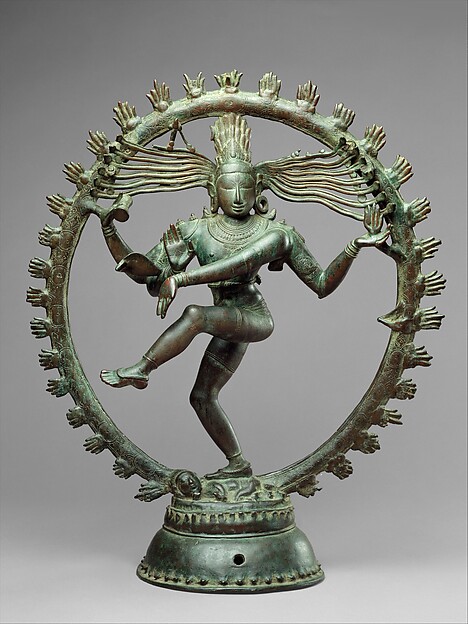
pale pools where Nataraja cooled his feet.

From Dothead by Amit Majmudar. Copyright 2016 by Amit Majmudar. Excerpted by permission of Alfred A. Knopf.

Nataraja (ca 11th century) at the Met

Saturday, February 13, 2016

When a man sees a woman ...

As I look back at my angst-filled teenage years from the comfortable distance of my middle age, I can see that sex was one of the greatest sources of angst.  Sex seemed to be everywhere, and yet there were structures in place to make sure that there would be no outlet for those basic instincts.  I would think that even in contemporary India a typical young male (I can only speak for my heterosexual kind) can relate to all that, and even to this essay on "The Sexual Misery of the Arab World":
Today sex is a great paradox in many countries of the Arab world: One acts as though it doesn’t exist, and yet it determines everything that’s unspoken. Denied, it weighs on the mind by its very concealment.
That paradox generates a great deal of tensions, within the body and out in society.  The following that the writer has to say about the Arab World could easily describe India too:
Desire has no outlet, no outcome; the couple is no longer a space of intimacy, but a concern of the whole group. The sexual misery that results can descend into absurdity and hysteria. Here, too, one hopes to experience love, but the mechanisms of love — encounters, seduction, flirting — are prevented
A few years ago, when visiting Chennai, I was shocked to read news reports about the police arresting young people holding hands and attempting to kiss at one of the public parks.  Seriously, the cops had nothing better to do?

A white woman friend and her white husband (I am intentionally stressing on the "white") from this town are big time Indophiles and, over the years, have visited India seven or eight times, spending three to four months during each visit.  The woman is more than a decade older than me.  She once joked that in India, the young men hit on her too.  Well, there is a reason.

In trying to understand the reason, consider what happened in Cologne, Germany on New Year's Eve:
That night, gangs of young men, mainly asylum-seekers, formed rings around women outside Cologne station and then robbed and sexually assaulted them. More than 600 women reported to the police that they had been victimised.
Young men, from the Arab world.
Migrants are no more likely to commit crimes than natives. But it would be otherworldly to pretend that there is no tension between the attitudes of some and their hosts. European women cherish their rights to wear what they like, go where they like and have sex or not have sex with whom they please. No one should be allowed to infringe these freedoms.
Cologne did not simply happen, nor was the local white woman friend accidentally hit on.  How do we begin to explain that?
with the latest influx of migrants from the Middle East and Africa, the pathological relationship that some Arab countries have with women is bursting onto the scene in Europe.
A pathological relationship with the female kind!

I have a difficult time in a class on diversity that I teach every year--I have to make sure that students think about issues from multiple perspectives without giving away my own opinions on such matters.  Thus, of course, in the class my task is only to force them to think about how they would begin to understand the differences across the culture--even when I know well that I believe it is not kosher to treat women as property, which is the case in the traditional societies be they Islamic or Hindu.  Unless that pathological issue is addressed,"The path to orgasm runs through death, not love."


Tuesday, September 09, 2014

A man does it standing up, a woman sitting down, and a dog on three legs

It was only after the event, when I analyzed within, that I was reminded of how much some practices that I systematically learnt have now simply become a part of who I am and my instinctive and reflexive behavior.

At the friend's place, another (female) friend was leaving and I automatically walked ahead and held the gate open.  A simple act, but one that provides me with enough and more to ponder about the world.

As I continued along this self-analysis (note to myself: stop analyzing!) I was reminded of my recent visit to India.  After a lunch meeting with high school friends, as we were exiting the building, I waited for the (female) friends to exit before I followed suit.  "Oh, a gentleman" one remarked with a smile.

Of course, like you and everybody else, I was not born with instructions such as holding the door open coded into my brain.  I learnt this behavior.  But not in the old country.  There, all I had observed during my growing up years was that women "followed" the men.  It was a less than equal treatment of women, which always made me highly uncomfortable and angry on many occasions.

Exiting the old country was not to lead a life of an Indian in a new setting.  Nor was it to ditch the old country and adopt a new persona.  It has, instead, been a glorious experiment to try to combine the best of the two worlds, and to avoid the worst in both. (Though, of course, some result in humorously awkward situations too, like this one.)  How I relate to women is, thus, a product of this cultural fusion.  The old country's traditions certainly did not teach me to hold the door for women.   

A couple of days ago, I was at a gathering with the friend.  We were sitting around the dining table.  A much older couple were leaving and as the woman neared me, I stood up to say bye to her.  "You don't have to stand" she said with a smile.

In the old country, I didn't know about the standing up either.  After all, back then women did not even sit and eat together with the males.  This is one of those that I picked up with living here and from the travels.

But, America is a strange place, too, with uber-casual interactions.  
My mother is big on politeness. Recently, before a long trip with my girlfriend’s family, she wrote me a letter outlining the things I should remember to do: stand up straight, hold open doors, and rise when ladies approach the table. “I could go on and on,” she wrote, wrapping things up. “Just please reread the etiquette book I got for you in highschool.”
I did not reread the etiquette book. I trust my own sense of decorum, particularly while on vacation; I’m good at vacations. I’m also a thirty-one year old financially independent human who has lived several time zones away from my mother for over a decade. But a short time after returning from that trip, my girlfriend and I moved from the city where we’d met and spent our entire professional, semi-adult lives, to a different one, across the county, and I wished I had reread it. I’ve come to realize that the thing about moving to a new city and meeting lots of strangers who might, eventually, become my friends—or people I have only interacted with on the internet but are kind of friends there—is that no one knows how to greet anyone anymore.
This is a uniquely American problem.
It certainly is uniquely American.

BTW, in all my life in the old country, I certainly did not know about what I am alluding to in the title of this post.  The title is nothing but a funny way in which I was once taught about etiquette.  The humor in that comes from when you ask somebody, "what does a man do standing up, a woman when sitting down, while a dog does when on three of its legs?"  Almost immediately we might smile thinking about peeing.  But, of course, that is only a trap--it is about shaking hands: a man stands up to shake hands but a woman does not have to.  And, of course, a dog extends its paw with its other legs on the ground.

Another day in my autoethnographic rumination! ;)

Tuesday, February 26, 2013

To all that controversy about horse meat: Bah, horse shit!

So, traces of horse meat were detected in IKEA's consumer favorite meatballs.  And this adds to other horse meat news.

This is not scandalous by any means.  Go home and rest easy.

I agree with the New York Times' food writer, Mark Bittman, that in our age of industrial food, when we don't have a clue what is in a burger nor in the hummus, hey, are you sure you know what exactly you are eating unless you are cooking it yourself?

Now, people might complain that they should be informed first, and then they can decide for themselves if they want to buy meatballs with or without horse meat.  Well, maybe.  I suspect it became a big issue only because of the initial story of horse meat:
The scandal first erupted last month after Irish authorities tested suspiciously cheap frozen beef patties and discovered they contained horse DNA.
That's right: suspicion because the patties were cheap.  If they had sold it at a higher price, it might have never triggered any suspicions?

But, money fraud or not, people are more upset, I would think, because it is horse meat.

Think about it for an additional second: this is not a vegetarian complaining.

Saturday, January 05, 2013

Every time we say goodbye ...

Many decades ago, when I was in middle school, I guess, I read a short story in the Tamil weekly, Ananda Vikatan.

It was about a father visiting with his son in the city and then the son accompanying the father to the railway station.  The father boards the train that will take him back to his village and sits by the window while the son stands on the platform by that same window.  During the conversation, which itself was not a freely-flowing one and rather awkward, the son places his arm on the window and it accidentally grazes the father's hand. The son feels goosebumps all over and he realizes that it has been years since his childhood days when he even touched his father.

A simple story that said a lot about the culture in which I grew.  A culture in which there were no handshakes or hugs, particularly across the genders.  I often joked that it was because we lived in hot and humid conditions and that the last thing we wanted was the other person's sweat!  

Of course, life in the US has changed my own practices, perhaps slowly, with respect to men and women alike.  Hugs, too, have found a way into my relationship vocabulary--awkwardly, at first, and a lot more comfortably as years have progressed.

A couple of weeks ago, my brother (who lives in Australia with his family) and I were on the train to visit with my aunts, who lived in the south of India.  It was three-tier coach. At the single-seats facing each other were a woman and a man--they seemed like husband and wife--and a young girl perhaps about five years old.  The adults looked like they were in their late twenties or early thirties.

Two other males, about the couple's age, stood in the aisle and kept talking with them.  As it got closer to the departure time, these two males got off the train after saying bye.  They re-appeared on the platform outside the window.

The couple barely spoke to each other.  In fact, at one point, the husband even took out his Blackberry and texted, and the wife engaged the kid with some small talk.

The train gently shook, indicating that we were all set to start moving.

The husband jumped from his seat and exited the train.

That was it.  No saying bye.  No hugging the wife or the kid.  No peck on the cheek or lips.

He, too, re-appeared on the station platform and waved goodbye as the train pulled out of the station.

This scene was quite a contrast to the typical American goodbyes!  Different cultures and different practices. It is a wonderful world, indeed!

Friday, February 24, 2012

To hug or not to hug is the question. A damn tough question :)

All my life in India, until I left for the US, this question never, ever, came up.  Because, in the culture in which I grew up, relationships were non-contact sports.  As kids, we might have clung on to grandmothers or uncles, but as grown ups we maintained our distances.  A shake-hand was the most we ever got to in terms of bodily contact to express anything.

A magazine, I am sure it was Ananda Vikatan, once even featured a short story that was built on this idea of no physical touching of any sort.  In that story, a father visits with his grown up adult son, and is returning home.  The young man accompanies his father to the train station.  The father boards the train, sits by the window while the son stands on the platform.  During the conversation, which itself was not a freely-flowing one and rather awkward, the son places his arm on the window and it accidentally grazes the father's hand.  The son realizes then that it has been years since he even touched his father ....

I don't recall how the story ends, but it effectively captured the non-contact nature of relationships even within the nuclear family.

And then I left for the US, where it is a completely different world when it comes to expressions.  As Elvis put it, a whole lot of shakin' goin' on :)

Every hug became an awkward moment for me.  How do I approach them--from the left or from the right?  And, what if they lean to kiss me on the cheek?  Aah, the endless frustrations!

It took me years to get used to hugs from females of all ages.

And then the hug from men.  Oh boy, that was yet another learning experience all by itself. 

Finally, I reached a stage where it no longer mattered to me if people wanted to hug me, or expected me to hug them.  Life became stress-free.  Contact or no contact did not bother me.

But that was with life in America.

Confusion started all over again every time I visited India. 

Especially as an academic who understands the need for cultural sensitivity, every trip to India becomes all the more a struggle to control myself from the parting goodbye hugs.  Particularly with women--friends and cousins alike.

During this extended trip here, during the first few days, I suppose I was continuing way more with my acquired American habit.  Slowly, as I consciously settled into the Indian way of doing things, the more I re-learnt the non-contact hellos and goodbyes. 

But, sometimes, I find that only a hug really says that I will miss them after we part.  So, I have now worked out a compromise: with my arm over the other person's shoulder, my shoulder squeezes their shoulder that abuts, if you get the picture.  A win-win, it is, at least the way I look at it!

Perhaps I am over-thinking life.  But, stupid is as stupid does :)

Saturday, December 03, 2011

"Dinner at 6:00" and cultural differences

As a kid, I always got fidgety if the newspaper was delivered later than usual.  Once, a great-uncle who was visiting with us asked me what my problem was and, more pointedly remarked: "as if the world waits for your statement on the day's news!"

If he were alive, he might chuckle about how I am making statements everyday in response to news and comments I read and watch--isn't that what blogging is mostly about?

The newspaper I grew up reading has a magazine feature on entertaining guests.  The author writes:
guests who come at eight — if that was when they were invited — deserve congratulations. If everyone's here by 9 o'clock I'm happy. Because the whole idea is to chat and catch up, you don't want to serve dinner the moment they're all there. But when some people come late, others, who thought they could come on time and wind up early, have to wait.
This alone reveals a completely different culture, a world vastly different, from the one that I have gotten comfortable with halfway around from India.

Dinner invitations are typically for six or half-past that hour at the latest.  Which means that an hour into the chat, we sit down for dinner.  Rarely is a guest anything more than five or ten minutes late.

A Swedish student who stayed with us for a fortnight remarked about their punctuality this way: "if dinner is at 6:00, and if we reach the host's place by 5:58, then we kind of wait for those two minutes outside the home, and then ring the doorbell at 6:00"

What a huge difference then between the culture in which I grew up, and the one in which I now live!

I can't even recall the last time I sat down for a meal at nine in the night!  By nine here, my system has digested the food, and I am typically getting ready to snack on a few nuts or a fruit.

There is more; the author of that piece in the newspaper writes:
The first is the one who looks at your table and says “the muffins are burnt”/ “the cake (which I've painstakingly baked, layered and iced) is crooked”.
The second kind takes a bite of something and says “Whoa! Uff! I can't eat that, it's too spicy”. I run to her with a bowl of cold dahi and she waves me away, and he who says, surveying the table, “I'm allergic to glutens. Isn't there any rice?”
My father noted after his visit to the US that people here are complimentary.  "It is wonderful" is a phrase that made a deep impression on him--that is the kind of response from dinner guests, or gift recipients, even f the food is lousy or the gift is sub-par. 

Sure, some of those compliments might be superficial, but that is infinitely better than guests casually and mercilessly critiquing a host about the food that he or she slaved over, right?

The great-uncle was one of those critics.  Well, he went around criticizing the food, and everything else.  There was no topic that was off-limits to him.  He brought many to tears.  A number of women in the extended family were practically traumatized by his scathing remarks on dishes.

These days when I visit India, I follow my schedules and protocols.  My breakfast and dinner hours are an hour or two before the norm in that context. The academic in me worries that I am being culturally insensitive.  But, ...

I am delighted if anybody cooks and invites me over.  The last time I was there, I was so thankful for the help from my parents' neighbors.  So thankful that I sent them thank-you cards after returning to the US. 

Those thank-you cards, which is not a part of the Indian culture, apparently was the talk of the apartment complex for a few days.  The neighbors repeatedly mentioned to my parents how much they liked the thanks I sent all the way from the US (and, of course, on what a wonderful son they have!)