Showing posts with label diversity. Show all posts

Wednesday, June 09, 2021

Names and indentities

"Like in our traditional practice, he is named after his grandfather," my father commented.

The first born is named after the paternal grandparent.  How about the second child?  It depends.  If the second child is the same sex, then the name is the maternal grandparent's name.  A different sex means that the first two kids have the names of the paternal grandparents.  The mother's lineage is for leftovers!

In that tradition, I would have usually been given the name Ramaswamy--my paternal grandfather's name.  But, I wasn't.  The social norms were rapidly changing in the urban and industrial parts of India, and Ramaswamy was old fashioned a name.  Capturing the "Ram" in Ramaswamy, my father came up with Sriram.

I was also given an alias that was used in the formal, Hindu religious and ritualistic contexts: Venkataramasubramanian.  Boy am I glad that this multi-syllable name is not in the official records!

Traditional names are part of the cultural landscapes. Every cultural landscape has its own tradition.  The Icelandic last names are different from the Slavic ones, which are different from Nigerian.  You get the point.  Even within the cultures, traditions are being challenged. Like the Czechs questioning the gendering of last names.

But, even more challenging is when people with names from one culture move to lands with completely different cultures.  

I first got a taste of this as a graduate student when I was surrounded by students from China and South Korea.  "Strange" names with unusual spellings.  But, it was not a huge problem to overcome.  Mungjin and Rongsheng became familiar sounds. 

What I could not understand was a few students taking on Western, Christian names in order to make it easy for the natives.  Why they preferred to lose their identities was simply beyond my imagination and understanding, despite engaging with them about this issue.

I couldn't imagine walking around as "Sam" just because a few natives couldn't pronounce my name.  Sam I am not.  Nor am I a Sri.  I am Sriram, as I have always been.

A cardiologist, who is about my age, writes about her name--Xiaoyan Huang--in the Washington Post:

When I first came to the United States in the late 1980s, for college, I immediately realized that Americans had a hard time pronouncing my name. (Roughly, it’s see-ow yen.) Some people mocked the name; for others, mastering it was a genuine struggle. Meanwhile, among Asian students, I soon learned, my name put me on the lowest rung of the social ladder on campus. The kids who were born in America, or who immigrated with their parents at a young age, often had American names.

Of course, "Xiaoyan" stumps me when I read that string of letters.  It is new.  Just like Quixote was new to me.  Just like I had to learn to pronounce Foucault too!

How did she get that name?

Because Chinese civilization is built upon our profoundly metaphorical language, the words chosen for a baby’s given name are perceived as being critically important in the identity of that person. When I was born in Beijing, my parents carefully selected my given name using the traditional methods. But on his way to the district office to file my birth certificate — or so my parents told me — my father, in his usual romantic and impulsive way, decided unilaterally to change the name. He settled on “Xiao Yan.” “Yan” is a key component of my mother’s name, referencing Yan’an, her birth place — also a center of the Chinese Communist revolution — while “Xiao” means “small.” The name expresses his love for both of us.

I am glad that her professor in Oregon advised her to ditch adopting a Christian name: “Your name is your identity — stick with it”.

Yes!

Wednesday, December 16, 2020

Running out of luck!

A month ago, I authored a commentary about the coming layoffs at the university where I teach.  I wrote there:

Will I never set forth toward class again and work with students, like how I have been doing since joining WOU in 2002? Only time will tell.

We are now a month away from the final decision.  As the doomsday clock winds down, I thought I would re-visit some of my education-related commentaries.

The following was published in March 2008.
*******************************************

An Honored Ambassador For All of India

When a freshman student in the honors program said, "Dr. Khe, you are the first nonwhite teacher I have ever had," two others immediately jumped in with "mine, too."

Of course, even a kindergartner will easily figure out from my appearance and accent that I am from another country. But until that chance conversation, it had never occurred to me that I would be quite a few college students' first nonwhite instructor ever.

When I left India, I came to the University of Southern California in Los Angeles, where the graduate student population was so multinational that race and ethnicity were nonfactors in my daily life.

After completing graduate school, we lived in Bakersfield, about a hundred miles north of Los Angeles. While not the ethnic salad bowl that Los Angeles is, Bakersfield, too, had a significant nonwhite population. Every once in a while I ran into people who thought I was Latino until my accent gave it away.

It is more than five years since we moved to Oregon. Living here has been a wonderful experience, and all my interactions have been pleasant. If all of a sudden I am the personification of "diversity" to my students, it is because for the first time I am at a university where only about 13 percent of the students are nonwhite.

This percentage reflects the demographic characteristics of Oregon; according to the 2000 census, whites accounted for almost 87 percent of the population. It is therefore quite possible that both white and ethnic students had nothing but white teachers from kindergarten through 12th grade.

My lack of experience with such an educational environment - despite all the discussions of diversity and multiculturalism - meant that I was not quite prepared for the idea that I am the embodiment of "diversity" to many students. Later, when I engaged my upper division students about this topic during the warm-up before class, their responses were similar to those of the freshmen.

James, a nontraditional student who had initially kept quiet, suddenly came alive with a question: "Hey, Dr. Khe, does this mean you feel a huge responsibility now?"

The answer was a no-brainer. "Yes, because I now feel that if I mess up, there is a good chance that students might think all Indians are awful." With such a responsibility, it is no wonder that I have nagging shoulder pain!

I am concerned about making a good impression, particularly because of the saying in the Tamil tradition in which I grew up, which translates to, "You need to sample only one grain to ensure that the rice is cooked." That one small piece tells us whether the entire pot of rice is ready for consumption.

Of course, the rice analogy does not translate well to human experience. Statistically speaking, we ought to have a random sample that can then substitute for the entire population before we can draw a conclusion. However, I would guess that it is not uncommon for people to draw conclusions based on strange events. We are humans - and we err!

Thus, to a large extent, I now have an opportunity that is presented to very few people. To my students, I am now the metaphorical single grain of rice representing a billion-plus Indians. In the months that have passed since that conversation with freshmen in the honors program, I feel a constant reminder that every day in the classroom could easily be a make-or-break situation for the planet's Indians.

While this is a huge, and perhaps unfair, burden, it is an incredible honor and privilege to fill such an ambassadorial role. I am hoping to make the best of this newly discovered honorary position that I never knew I had.

Wish me luck.

**************************

PS: Click here to read about the demographics of the faculty at my university.

Sunday, February 02, 2020

Empathy Through Enchiladas

The NY Times had an interesting report on the predictive power of food:
Voters who had been to Europe, Australia, Canada or Mexico or had eaten at an Indian restaurant were less likely to choose Mr. Trump by 10 to 12 percentage points beyond the differences explained by other factors like the ones mentioned above.
...
Of course, it’s not that eating Indian food leads a person to support one Democratic candidate over another — that’s silly. (And there are voters for whom Indian food is the taste of home.) But a voter’s orientation toward the world is related to candidate choice, and it turns out that eating in restaurants that celebrate less familiar cultures is one way to measure where people think they are more connected: to those around them locally or to people farther afield.
Indeed.  Food is a portal to understanding the world around us.

There's something remarkable about breaking bread together--even if that breaking bread happens at an "alien" restaurant.  That magic is powerful when we share food at home, as I quickly realized when I came to the US.

Siddiqqi, who was from Pakistan, or the Taiwanese girl whose name I have long forgotten, came over to my apartment to eat with me.  And then there were more. Greeks. Nigerians. Or my meals with Palestinians. A Guyanese-American with roots in India.  And, of course, white Americans too.

It was never really about the food.  What is it about then?
According to anthropologists and psychologists who have studied food in recent years, cuisines from international cultures can take us out of ourselves and help us better understand distinct people and cultures. The secret ingredient is empathy. And the process begins with stirring our emotions.
Food and emotions, and that wonderfully important ingredient to being human--empathy.

Empathy, about which I have blogged a lot because of the importance that I attach to it, means that we are placing ourselves in somebody else's shoes and understand their feelings.  When the others are from cultures that are alien to us, food is a phenomenal portal through which that "other" slowly becomes "us."
A culture may seem unfamiliar to a person, but after that person discovers the way people from an unfamiliar culture “prepare their food, the way they eat, somehow they understand it. There’s link between you and them, and that gives you insight.”
But, we need to keep in mind that it is not merely about food.  I have always stayed away from the international food fairs at college campuses because it seems to perpetuate the mistaken notion that it is all about food.  I want people to begin to understand the "other" through food.
Food alone, though, is often not enough to complete the trip to another culture. The journey needs other people.
Which is why white Americans eating Mexican and Indian foods can also be racists and xenophobes!  The "others" serving food is what the supremacists think is the norm--the equivalent of "shut up and dribble."  As if we are here only to keep the masters happy!

"Without the ingredient of human empathy, food from another land can only have a bland effect."  As I noted in this post a few months ago, I wish people would think about this:
“Have you or your family ever invited a person or a family of another race to your home for dinner?” ... When is the last time you or your family had dinner in your home with a person or family of another race?
Breaking bread at my home is about empathy and understanding. I have no place in my life for people who lack empathy.

Friday, April 26, 2019

Learning empathy takes effort

I have blogged in plenty about the need for empathy and, in a number of posts, have also written about a horrible human being seemingly with no sense of empathy being elected by 63 million as the President of the US.

To me, empathy has always been about the others. "Empathy is other-focused, not self-focused."  This is important to understand.  Because, sociopaths like tRump seem to easily zoom into what makes the "others" hurt:
Someone with sociopathic tendencies can ‘read’ other people well and understand their emotions. But a sociopathic person reads others in order to manipulate or take advantage of that person.
Empathy is not about merely understanding the emotions of others.  Empathy "is a tool or skill that provides people with information from which we are then free to take actions, or not. Empathy itself is neutral. What we choose to do with it is up to us."

It is up to us.  And up to us to invest the time and energy to understand the others.
The challenge with empathy is to be open to gaining knowledge about others. We tend to be biased when it comes to empathy. We are better at reading those who are like us than at reading people who are different.
tRump openly expresses his hate for, oh, Muslims and Haitians. But, his heart bleeds if a white person somewhere is attacked by a brown person.  It is not that he is empathetic to the white person in distress--the guy is simply biased. He is bigoted.

The "us-versus-them perception diminishes the ability to empathise. So, what can be done?"  The author distills the full array of empathy into seven behaviors; read them.

I will end this post with the final paragraph from that essay:
If we see ourselves in others, if we walk in their shoes, we have little to fear and can allow empathy to help us decide how to react and behave. It is a challenge to engage in empathy, it is not easy. Some days in some situations, empathy might come easily, other times it won’t. When people are scared, stressed or anxious, it can be difficult for them to step away from their own feelings and tune into those of another person. However, because of mirroring, empathy begets empathy. The more we use it, the more others around us will use it. Everyone wants to be heard and understood. Every group wants to be recognised. It can’t happen without empathy.


Source

Wednesday, April 04, 2018

People, who don't need people?

Two years ago, the university where I work invited interested faculty members to self-nominate themselves to serve on the Strategic Planning Committee.  Given my interests in higher education, and given that the directions that the university sets through this committee will be in place until I retire or am fired, I nominated myself and provided evidence of my track record in thinking above and beyond mere courses and the small little bubbles in which most discussions are trapped.

Of course, I was not selected to be on that committee.  What do know about higher education, right? 

In a brief thank-you email after receiving the notification that also included the list of faculty named to serve on the committee, I added a sentence that I hoped would make them all think about the committee's composition:
BTW, it seems kind of odd that faculty membership does not include any "people of color" as they say ;)
It was not diversity for the sake of diversity that I pointing out, but was instead about the need to think of the demographic reality.  Strategic Planning is about consciously developing specific action items for the future.  The demographic future of the country is in beige, the 2042 that even comedians joke about.  Oregon is notorious for not knowing how to deal with diversity, whether based on the superficial skin or on religion.   Especially Islam.

Everybody is talking and writing about Islam and the Arab world and Muslims.  The more one delves into the news, the more we realize we don't know anything about Islam, the Arab world, and Muslims.   It is bizarre that we are madly against something about which we know nothing!

Edward Said covered all these and more in his Orientalism.  Naturally.  Said had plenty of profound observations on the distorted--and intentional at that--understanding that the "West" has about Islam and the Arabs.
The scholar Edward Said took this point further, writing in his book Orientalism in 1978 that Islam had defined Europe culturally, by showing Europe what it was against. Europe’s very identity, in other words, was built in significant measure on a sense of superiority to the Muslim Arab world on its periphery. Imperialism proved the ultimate expression of this evolution
In a lengthy essay after his book was published, Said wrote--keep in mind that this was in 1980:
 If you were to ask an average literate Westerner to name an Arab or Islamic writer, or a musician, or an intellectual, you might get a name like Kahlil Gibran in response, but nothing else. In other words, whole swatches of Islamic history, culture and society simply do not exist except in the truncated, tightly packaged forms made current by the media. As Herbert Schiller has said, TV’s images tend to present reality in too immediate and fragmentary a form for either historical or human continuity to appear. Islam therefore is equivalent to an undifferentiated mob of scimitar-waving oil suppliers, or it is reduced to the utterances of one or another Islamic leader who at the moment happens to be a convenient foreign scapegoat.        
If that is the case with the average literate Westerner then do we need to even wonder why there are plenty of Americans today who eagerly embrace the anti-Muslim and anti-Arab rhetoric from the likes of trump!

Even at the university, the numbers of students from Saudi Arabia and their families have not been strategically used as opportunities to truly understand "them."  Instead, it seems that my university, like many others, merely continues to treat the foreigners as revenue sources, which is not that different from the "scimitar-waving oil suppliers" caricature that Said was upset about. 


Friday, September 29, 2017

It is all foreign to me ...

One of the many benefits to flying halfway around the world and making myself a home here in the United States is this: Over the years, I have had meaningful interactions with people from all over the world.  There is no doubt whatsoever that this has made me a better person.

Look at some examples that I have even blogged about:  Kugan from Sri Lanka. Siddiqui from Pakistan. Shahab from Iran. It has been a wonderful learning experience.

And there is a lot more to learn.  One life ain't enough.

Consider the Uighurs.  Yes, I have blogged about them too (like here.)  It was wonderful to have an Uighur student in class, who kept in touch with me for a few years even after she graduated.

Something new pops up all the time, even about Uighurs.

First, look at the person in this photo:

Source

She could be French, right? Or Spanish. Or Persian.  Or Turkish. Or even an Indian.  Yes?
"In France, people spoke to me in French, thinking I was French," she says. "In Italy, they spoke Italian to me."
And she is ... Uighur model Parwena Dulkun.

Yep, a Uighur.  Which means that she is Chinese.
The only country where she isn't mistaken for a local is her own.
"In many Chinese cities, people think I'm a foreigner," Dulkun says, giggling.
She uses these moments to educate her countrymen.
"They try to speak English to me, and I answer in Mandarin," she says. "Cab drivers always turn around and ask me what country I'm from."
She says she smiles proudly and concludes her lesson by announcing: "I'm Chinese."
She giggles, while many others might get upset at being mistaken for a foreigner in one's own country.

While politically it has not been good for Uighurs to be under the Party, the world of commerce apparently cannot have enough of them--as models!

Xahriyar Abdukerimabliz, a 19-year-old model from Urumqi, says:
"Not to brag, but we are very good-looking," he says. "Our facial features are naturally attractive. We've got great eyebrows, big, beautiful eyes and double eyelids that weren't created by a surgeon."
Abdukerimabliz blinks, revealing his naturally creased eyelids. More and more Chinese are undergoing surgery to create a crease in their upper eyelids that about half of all East Asians are born without. Abdukerimabliz's "double eyelids" are topped with striking eyebrows, a long nose and expressive eyes that look either Asian or European, depending on his mood — or pose.
The market system, like god, works in mysterious ways! ;)  Which is also something that I learnt in graduate school, after getting rid of my commie colors in the old country. ;)

Monday, April 10, 2017

Diversity and economic well-being

Whether it is the US or the UK or France or ... aren't the political events related to this confluence of diversity and economic well-being?

Think about California's Silicon Valley.  A whole bunch of people from all over the world, right?  That is to be expected; after all, the Golden State demographics is heavily tilted towards foreign-born:
With 27 percent of California’s total population foreign-born — or not quite 10.5 million people — the state has more immigrants numerically than any other state and the greatest proportion of its total residents who are immigrants.
Now think about West Virginia.  Guess what?
West Virginia has the lowest portion of foreign-born people at 1.4 percent of the state’s total 1.8 million residents
Hmmm ... Silicon versus coal.  It is not mere coincidence, is it?

It is not any coincidence at all.  Modern economic activities are urban-based.  So, if some states and cities are drawing more foreign-born .... then? There is "a strong relationship between greater immigrant diversity and higher productivity—in this case, wages."
Diverse immigrant populations do more than enrich a city's cultural fabric. According to geographers from the University at Buffalo and Southampton University, they also boost wages. "What we found was remarkable. In cities that are unwelcoming to immigrants, as diversity rises, people's wages either don't change, or they go up by only a small amount. In cities that are welcoming to immigrants, as diversity goes up, people's wages go up, and by a lot," said Abigail Cooke, an assistant professor of geography in UB's College of Arts and Sciences. Cooke wrote the paper with Thomas Kemeny, a UB research assistant professor and a lecturer at the University of Southampton in England. The findings were published online ahead of print in the journal Economic Geography. "It's been shown empirically that as you have more immigrants and greater diversity of immigrants in a city, people's wages also increase, which is certainly not the narrative that is often told about immigrants in our society. But this is a pretty robust finding, especially in the U.S." 
This connection has been clear for a while.  In fact, Richard Florida was pretty much able to write his ticket based on these economic geography aspects.  The "creative class" of immigrants were no different from the native creative class:
The knowledge workers, techies, and artists and other cultural creatives who made up the creative class were locating in places that had lots of high-paying jobs—or a thick labor market. They also had what I called a thick mating market—other people to meet and date—and a vibrant quality of place, with great restaurants and cafés, a music scene, and an abundance of things to do.
They were not going to West Virginia.

Florida writes:
It became increasingly clear to me that the same clustering of talent and economic assets generates a lopsided, unequal urbanism in which a relative handful of superstar cities, and a few elite neighborhoods within them, benefit while many other places stagnate or fall behind. Ultimately, the very same force that drives the growth of our cities and economy broadly also generates the divides that separate us and the contradictions that hold us back.
Which is also why trump became president:
These political cleavages ultimately stem from the far deeper economic and geographic structures of the New Urban Crisis. They are the product of our new age of winner-take-all urbanism, in which the talented and the advantaged cluster and colonize a small, select group of superstar cities, leaving everybody and everywhere else behind. Much more than a crisis of cities, the New Urban Crisis is the central crisis of our time.
The diversity of immigration promotes economic advancement ... but that advancement does not seem to reach the corners of West Virginia or Pennsylvania.  Voters could then either try to understand the complexities of the rapidly evolving global technological economy.  Or, they could simplistically find that the immigrants are at fault.  And cheer on, and vote for, a fuhrer who would point to anybody who is not white as the reason why they were falling behind in West Virginia.  They voted for that despicable human being who cared not for the logic and evidence, and who cared not for serious policies for long-term solutions to these issues.

Caption at the source:
 Donald Trump supporters pose with a Confederate flag at a campaign rally in Jacksonville, Florida

Monday, January 09, 2017

J'accuse!

Even prior to this post, I have blogged 37 posts that I have tagged with a label that matters to me a lot: Empathy.  In her speech last night, Meryl Streep reminded us about that noble human quality.  By pointing out how empathy-deficient the pussy-grabbing president-elect is:
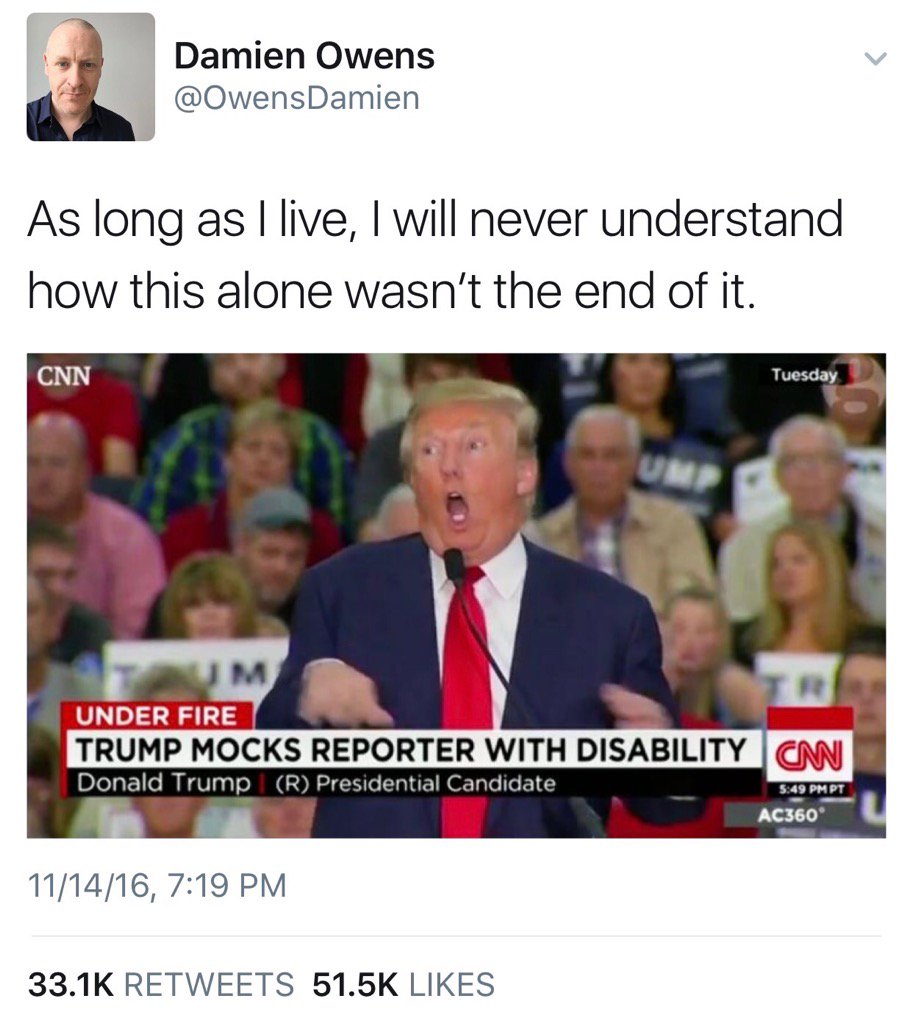
It was that moment when the person asking to sit in the most respected seat in our country imitated a disabled reporter—someone he outranked in privilege, power, and the capacity to fight back. It kind of broke my heart when I saw it, and I still can’t get it out of my head because it wasn’t in a movie; it was real life. And this instinct to humiliate, when it’s modeled by someone in the public platform, by someone powerful, filters down into everybody’s life, because it kind of gives permission for other people to do the same thing.
I still cannot believe he won despite such talk and action.  A horrible human being as the President!

Source

It is even more depressing to think that he won because of such talk and action.

To quote the philosopher Adam Smith--yes, that same Smith who is canonized as the saint of capitalism--"by changing places in fancy with the sufferer, that we come either to conceive or to be affected by what he feels."  We imagine how it would be to be disabled. Or to be terminally ill. Or to live in Aleppo.  Normal human beings, therefore, do not mock the disabled, or the dying, or those being bombed in Aleppo.  Yet, if 63 million voted for that horrible human being to be the president, then I worry more about my fellow citizens than about the pussy-grabber himself!

Which is why right from election night I have been operating with a clear bottom-line: There is no such thing as a good trump voter:
Trump campaigned on state repression of disfavored minorities. He gives every sign that he plans to deliver that repression. This will mean disadvantage, immiseration, and violence for real people, people whose “inner pain and fear” were not reckoned worthy of many-thousand-word magazine feature stories. If you voted for Trump, you voted for this, regardless of what you believe about the groups in question. That you have black friends or Latino colleagues, that you think yourself to be tolerant and decent, doesn’t change the fact that you voted for racist policy that may affect, change, or harm their lives. And on that score, your frustration at being labeled a racist doesn’t justify or mitigate the moral weight of your political choice.
To empathize requires a fundamental starting point of recognizing and respecting the other--who does not look like me. Not with this demagogue and his voters!

Empathy is also what serious art conveys to us.  As Streep said, "An actor’s only job is to enter the lives of people who are different from us, and let you feel what that feels like."  Like even when a eleven-year old boy silently sheds tears because an animated character dies.

Unlike that eleven-year old boy, the demagogue has an utter lack of an ability to "fancy with the sufferer"--a complete and total lack of empathy.  There will be situations during his presidency when he will have to be the comforter-in-chief.  There will be situations when he will have to weigh whether or not to bomb a place or a country.  There will be situations when his policies might have drastic effects on people.  But, when he lacks empathy ... progress will stall.  We might even regress.  The trump voters will stand accused!


Thursday, June 09, 2016

Understanding ‘others’ essential in today’s world

(For The Register-Guard: June 8, 2016)

My childhood classmates came from diverse religious backgrounds. This included Farooq and Yasmeen, among others, who were Muslims. Of the teachers, I still recall Yusuf Ali, who was the machine shop instructor. Thanks to India’s diversity, and to life in an industrial setting, we Hindu kids went to school with Muslims and Christians, and even my highly religious and orthodox grandmothers did not worry about “traditional values.”

As a kid, I did not know that there were Muslims in America. When the name of a boxer, Muhammad Ali, appeared in the newspaper, The Hindu, I assumed he was one of our people who had moved to America.

In the grainy black-and-white news photographs more than four decades back, Ali easily looked like one of us — only immensely more handsome. When my brother and I fought, much to our mother’s displeasure, we sometimes imagined that we were boxing like Ali, though neither one of us knew anything about the sport.

As a fresh-off-the-boat student, I made friends for the first time ever with a student, Siddiqui, who was from India’s arch-enemy — Pakistan. Toward the end of my first year of graduate school, when I was getting introduced to life here in America, I was amused by the sight of my classmate John — a white skateboarding dude — practically worshiping a basketball player named Kareem.

Even while the mullahs of Iran were always in the political crosshairs, the Iranian-­Americans in Southern California went freely out and about — and were seemingly one of the more prosperous groups, too. In those early years of my life in America it seemed as though nothing was said or written in public that was against Islam and Muslims.

After such a healthy head start in my life in the old country and then in this adopted home, it shocks me to no end now when I hear or read virulent anti-Muslim remarks, especially from those seeking or holding elected office. The anti-Muslim rhetoric makes a mockery of the noble idea of freedom to practice religion — a freedom that has been a foundational principle of the United States.

While neither Farooq nor Yasmeen lives in the United States, I think of those old schoolmates when very serious people make yet another anti-Muslim comment. I recall how Siddiqui and I shared the foods that we made as struggling graduate students. When we know people and have developed meaningful relationships with the “other,” it becomes difficult to tolerate sweeping statements that condemn hundreds of millions of Muslims because of a minuscule minority that bombs and kills.

Muhammad Ali’s death provides us with yet another context for learning about Islam, and about Muslims in America.

Islam in America is nothing new. Thomas Jefferson owned a copy of the Quran, which provided him with more than a passing familiarity with the religion and its practices.

Researchers estimate that between 15 percent to 30 percent of slaves were Muslims. One of those was Omar Ibn Said, whose life-story has been well documented. Imagine the double whammy of being a slave who was also a Muslim, after having been raised in what is now the West African country of Senegal!

Islam’s holy month of Ramadan, which began on Sunday, is another opportunity to get to know the religion and its faithful. For a month, most of the world’s 1.6 billion Muslims will fast from sunrise until sunset, to remind themselves about the mortals that we humans are and about the fragility of life without food and water. This fasting alone, which humbles the rich and the poor alike, ought to trigger the curiosity of those who harbor only suspicions about the “other.”

One of the challenges in this rapidly globalizing world is for us to understand the “other.” While in centuries past it might have been easier for people to spend an entire life fully within their own respective tribes, we live in a world in which mixing of people and ideas is the norm, not the exception.

It is also clear that the momentum of globalization will not slow down — it will only pick up more speed. This requires all of us to broaden our horizons. To borrow from the late Indian poet Rabindranath Tagore’s “Where the mind is without fear” — a poem Yasmeen, Farooq and I read in school — we need to create a world of freedom that has not been broken into fragments by narrow domestic walls. It is difficult work to create such a heaven right here on Earth, but is an effort worth pursuing.

Sunday, March 30, 2014

Once upon a time, I was an idiot. An idiot I continue to be.

A few years ago, I was at a social gathering where I was the only non-White.  An elderly gentleman, with whom I shared the table as we had cake and coffee, asked me "if you are from India, how come you are not wearing a turban?"

Whenever I tell such stories of interactions across cultures, and of people asking me questions like that, or "I bet you cook spicy food" only because I am from India, most people think that perhaps I get offended with each and every interaction along those lines.  I do not.

I am not offended when people ask me questions, or make remarks, if those came out of a sheer lack of awareness about the complexity of India, or because of their complete newness to who I am.  After all, we are not born with all the wisdom about this world and we have to consciously work towards learning about our fellow humans and our different ways in which we eat, live, love, die. Unfortunately, we are often too lazy to engage in this--it is way easier to stick to what we knew and how we want to view the world.

When I started graduate school, which was also my first ever exposure to people from the world over, it was humbling to realize that I knew nothing at all and that I was pretty much starting from a blank slate.  I found that most of what I knew--and I thought I was well-informed!!!--were atrocious caricatures.  In 1987, I was still thinking of Chinese women and their feet binding.  When a grad student from Syria was emotionally discussing with me "Zionism is racism" I realized that I had no grasp of the finer points other than the big picture of there are some serious issues out there.  I didn't even have a clue that Nigerians ate spicy foods.  Or that I would love Greek music.  It was quite a realization that it is a huge world out there!

Life since then has been a work in progress.  It is too damn slow a progress for my liking, but I do know for certain that I have progressed a little bit more than where I was, and am hoping that I am inching along in the correct direction.

Which is why I am not at all offended when people ask me questions because of the limited exposure they have had.

I certainly am offended when people who ought to know and behave better do not, and make comments to me or anybody else that piss me off.  Like how in my early years of teaching in Oregon faculty colleagues often chatted with me only on topics about India--they ought to have known better than that, and should have known that just because I am from India it does not mean that I know only all things Indian.  That they can chat with me about "normal" stuff too--about American sports and American politics and American movies and American music.  An American, am I not?  Or about the global topics.  Not talking with me anymore, and excommunicating me from their tribe, has certainly taken care of this problem ;)

A new academic term begins tomorrow.  I will try my best to provide students with opportunities to proceed along in this enterprise of understanding the world in which we coexist.  If experience has taught me anything, it is this: not to expect too much, and take even an itsy bitsy tiny positive change as a huge success.

Here is to looking forward to an itsy bitsy tiny positive change.

BTW, yes, I did find out that Chinese women bind their feet no more.

Monday, September 08, 2008

(Lack of) Diversity in Higher Education in Oregon

Oregon's seven colleges and universities made incremental gains in increasing
their minority student ranks over the past decade, failing to keep pace with
minority increases in the state's general and high school populations.
Minority faculty teaching in the universities increased by 1 percentage
point over the decade to 9 percent in 2007-08, with the number of African
American professors actually declining from 64 to 59.
Members of the State Board of Higher Education meeting at
Portland State University on Friday afternoon expressed concern about the
minimal progress and vowed to make increasing diversity among faculty and
students a higher priority.

Reading that news item reminded me of my opinion piece that was published in the Register Guard on March 10, 2008. Here it is:

An Honored Ambassador For All of India
When a freshman student in the honors program said, "Dr. Khe, you are the first nonwhite teacher I have ever had," two others immediately jumped in with "mine, too."

Of course, even a kindergartner will easily figure out from my appearance and accent that I am from another country. But until that chance conversation, it had never occurred to me that I would be quite a few college students' first nonwhite instructor ever.

When I left India, I came to the University of Southern California in Los Angeles, where the graduate student population was so multinational that race and ethnicity were nonfactors in my daily life.

After completing graduate school, we lived in Bakersfield, about a hundred miles north of Los Angeles. While not the ethnic salad bowl that Los Angeles is, Bakersfield, too, had a significant nonwhite population. Every once in a while I ran into people who thought I was Latino until my accent gave it away.

It is more than five years since we moved to Oregon. Living here has been a wonderful experience, and all my interactions have been pleasant. If all of a sudden I am the personification of "diversity" to my students, it is because for the first time I am at a university where only about 13 percent of the students are nonwhite.

This percentage reflects the demographic characteristics of Oregon; according to the 2000 census, whites accounted for almost 87 percent of the population. It is therefore quite possible that both white and ethnic students had nothing but white teachers from kindergarten through 12th grade.

My lack of experience with such an educational environment - despite all the discussions of diversity and multiculturalism - meant that I was not quite prepared for the idea that I am the embodiment of "diversity" to many students. Later, when I engaged my upper division students about this topic during the warm-up before class, their responses were similar to those of the freshmen.

James, a nontraditional student who had initially kept quiet, suddenly came alive with a question: "Hey, Dr. Khe, does this mean you feel a huge responsibility now?"

The answer was a no-brainer. "Yes, because I now feel that if I mess up, there is a good chance that students might think all Indians are awful." With such a responsibility, it is no wonder that I have nagging shoulder pain!

I am concerned about making a good impression, particularly because of the saying in the Tamil tradition in which I grew up, which translates to, "You need to sample only one grain to ensure that the rice is cooked." That one small piece tells us whether the entire pot of rice is ready for consumption.

Of course, the rice analogy does not translate well to human experience. Statistically speaking, we ought to have a random sample that can then substitute for the entire population before we can draw a conclusion. However, I would guess that it is not uncommon for people to draw conclusions based on strange events. We are humans - and we err!

Thus, to a large extent, I now have an opportunity that is presented to very few people. To my students, I am now the metaphorical single grain of rice representing a billion-plus Indians. In the months that have passed since that conversation with freshmen in the honors program, I feel a constant reminder that every day in the classroom could easily be a make-or-break situation for the planet's Indians.

While this is a huge, and perhaps unfair, burden, it is an incredible honor and privilege to fill such an ambassadorial role. I am hoping to make the best of this newly discovered honorary position that I never knew I had.

Wish me luck.