Showing posts with label dosai. Show all posts

Tuesday, August 11, 2020

Dosais for breakfast in the People's House in 2021

I am absolutely delighted that Kamala Harris is Joe Biden's running mate.

A year ago, as the Democratic wannabes were positioning themselves, and when it seemed like Haris was a formidable front runner, The New Yorker profiled this daughter of immigrants--Jamaican father and Indian (Tamil) mother.
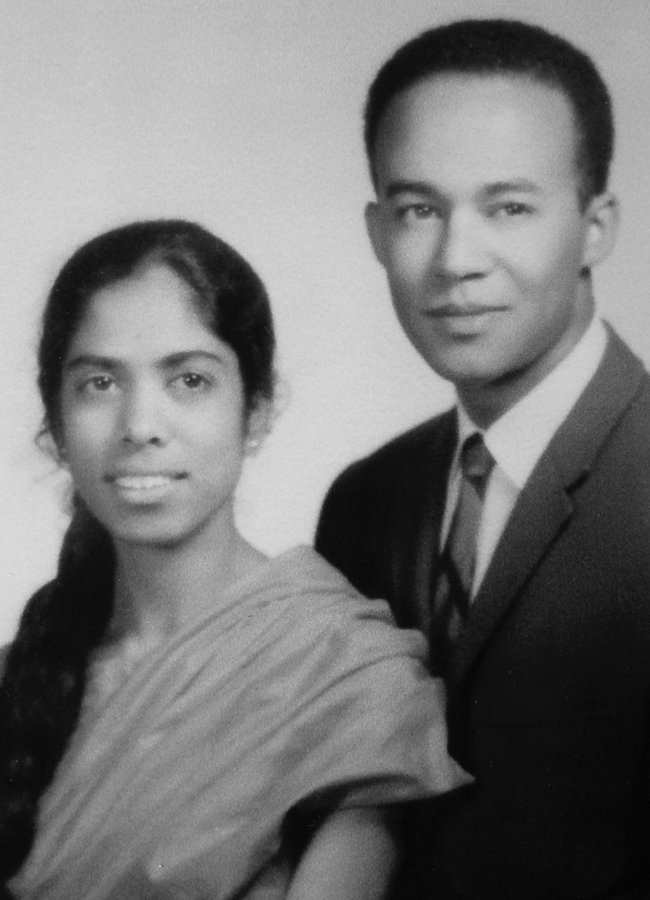

Harris' mother was from Chennai.
Harris’s mother, Shyamala Gopalan, the Brahman daughter of a diplomat from Chennai, graduated from the University of Delhi at nineteen, and, avoiding an arranged marriage, went to Berkeley to study nutrition and endocrinology. There, she met another graduate student, Donald Harris, from Jamaica, who was pursuing a Ph.D. in economics. The student civil-rights movement, centered on the Berkeley campus, gave the two young immigrants a shared context. “They both identified as people of color and people who were oppressed by a white-male-dominated world,” Meena Harris, Kamala’s niece, told me. “Their fields were science and economics—there were not many Indian women or black men.” They were married while still in graduate school, and Kamala was born in 1964; another daughter, Maya, came two years after that.
A wonderful immigrant story.  Only in America can a brown-skinned woman come to study advanced science, marry another brown-skinned immigrant doing advanced studies in economics, and have a daughter who grows up to be the attorney general of the biggest state, and then its senator, and now a VP candidate.  This itself gives me so much hope for the country that I adopted as mine.

It is awesome that she embraced the Black identity of hers right from when she was young, which is why she chose to study at Howard.
In her late teens, Harris fell in with a group of friends who were bound for historically black colleges. “We all went to private school, we all were educated, we all were very much parented, but we knew kids that weren’t,” Derreck Johnson, a restaurateur in Oakland, told me. He attended the same Catholic school as Maya, before going to Fisk University, and remains close to the family. “The idea of the struggle was embedded in us from our mothers, who told their stories,” he said. Kamala went to Howard and returned to San Francisco for law school. By then, Maya, who had given birth to Meena at seventeen, was in college, so Kamala and her mother often took Meena for overnights and weekends. The matriarchy was intact.
Kamala is not a Tamil word though.  As is the case with most Brahmin names, it is from the Sanskrit, and it means lotus.

This lively, warm, and absolutely human video of Kamala Harris and Mindy Kaling (also with Tamil roots) will remind you of the kind of empathetic and joyful leadership that we used to take for granted.  It is time to make America great again ... and this time with dosai ;)


Monday, July 20, 2020

It is never just about the food

Ever since I came to America, I have fighting against the usage "Indian food" and "Indian restaurant."

Because, there is no "Indian" food.

In order to paint a picture of the tremendous diversity in the Subcontinent, I have often countered people who ask me about Indian food by asking them whether they have ever had "European food."  That often does the trick.

We not only do not make such a reference to the white people's food, we even show off our culinary knowledge by talking about food from northern Italy versus the delicacies from southern Italy.

Yet, we talk about Indian food!

Recently a friend invited us over for a socially-distanced dinner.  She would cook her favorite Mexican dinner (her mother was from Mexico,) she said.

I asked her if she does mole.

The first time that I had a mole, which had a little bit of cocoa also in the sauce, I was blown away.  That was at a friend's home back in California.

However, rarely does a "Mexican" restaurant include a mole in the menu, and the few times that I have ordered them, well, they have been disasters!  It has been years since I have a had a mole, leave alone a good mole.  Which is why I asked the friend if she cooks mole.

"No, they didn't make mole in the part of Mexico where my mother was from and, so, we didn't grow up with it," she said.

The stereotypical and cliched idea of Mexican food does not allow for the incredible diversity in the traditional foods even in the country south of the border; how are we then going to imagine that there is nothing called "Indian food" in a land that is on the other side of the planet!

Even as confused as we are about all these, in multi-ethnic societies like the US, we tend to view that some "ethnics" cook and eat only their "ethnic food" and, we thereby render people one-dimensional.  A food-blogger/author/chef in Canada but with Indian heritage writes about this:
It is an unavoidable truth, but the color of my skin is sometimes confused with the scope of my talent. The more I write on the foods of India, the greater the risk I will be limited to that focus in the jobs I am offered, even though Indian food is not my chosen specialty. And even if it were, getting pigeonholed would still be a liability.
We have a long way to go in order to get away from the old ways of thinking.

The author, Tara O'Brady, writes about why it "wasn’t a simple yes" to write about a "food I’ve loved for longer than I can remember to those who don’t know it, to explain the process, and the science of it all."
Writers of color are expected to make a living off of their skin, off our families’ private rituals.
That's a powerful line.
There is less interest for us to exist outside broad stereotypes. Our food is sold on conjured emotion rather than granting these dishes the same deferential study we allow “classical” cuisines of Europe, no matter if our traditions stretch back further.
The food that Tara O'Brady was assigned to write about?

The dosai.  Or "dosa" as it is often referred to outside the Tamil world.

The dosai and its sibling dish--idli--are perfect foods for a simple reason: They include carbs and protein to get one going for the day.  O'Brady highlights this:
Most dosas are naturally gluten-free (excluding the wheat varieties, of course), vegetarian, and vegan-friendly if cooked with oil instead of ghee. As a grain is paired with a legume in the batter, a dosa includes a complete form of protein. In short, they’re a practically perfect food.
Even with dosais, the restaurant versions are often different from the home-made ones.
At restaurants this type of dosa can reach impressive physical proportions, the batter spread thin, then coaxed into rolls that span the width of a table. Those shattering paper-thin dosas are ethereal and almost cracker-like, a vehicle for the main component of the meal—aloo masala (dry-fried potatoes with mustard seeds, turmeric, urad dal and asafoetida) being the most traditional.
Homemade dosas tend to be more diminutive and also sturdier, with distinct circles where the batter is left comparatively thick. The bands go lacy and translucent like restaurant dosas, while the mounded ribs fluff, all spongy and bouncy.
Yep, which is why when I visit India, I never ever order dosais at restaurants; my favorite breakfast at any restaurant when in Tamil Nadu--poori with potatoes, with a side of vadai and sambar ;)

I wonder if dosais will go well with a mole sauce!

Dosais waiting to be eaten
Source

Wednesday, October 31, 2018

Conservative in the morning. Liberal the rest of the day.

When we were kids, the typical breakfast at home was idli or dosai.  Freshly made.  By mother, of course.

One day, my brother, who was perhaps seven or eight at that time, stuck a hand-written note on the kitchen wall to voice his protest.  The note read: "இட்லி தோசை ஒழிக" (No more idli, dosai.)

Every time we get together, the family has a good laugh recalling that.  He vehemently argues that it was my father who put the thought in his head and that as a good kid he carried it out.  We laugh about that too.  Interestingly enough, he is now a dosai expert, and his kids love, love, love his dosais!

Idli and dosai were all what most of the kids in that part of the old country ate back then.  Or, uppuma.  That was the culture.

Bland, salty, savory is the tradition, not only in the old country culture but in old cultures practically anywhere on the planet:
“The idea that children should have bland, sweet food is a very industrial presumption,” says Krishnendu Ray, a professor of food studies at New York University who grew up in India. “In many parts of the world, breakfast is tepid, sour, fermented and savory.”
Years ago, I told my grandmother that in her cultural context, idli every morning with yogurt is the healthiest way to start the day, and no wonder the old cultural belief is that idli plus yogurt is the best food even for the sickest patient.
Children begin to acquire a taste for pickled egg or fermented lentils early — in the womb, even. Compounds from the foods a pregnant woman eats travel through the amniotic fluid to her baby. After birth, babies prefer the foods they were exposed to in utero, a phenomenon scientists call “prenatal flavor learning.”
What an easy excuse then for chocaholics: "hey, it was my mother's fault that she ate all that chocolate when she was pregnant with me!" ;)

Actually, chocaholics don't need to blame their mothers at all:
Sugar is the notable exception to “food neophobia,” as researchers call that early innate fear. In utero, a 13-week-old fetus will gulp amniotic fluid more quickly when it contains sugar. Our native sweet tooth helps explain the global popularity of sugary cereals and chocolate spreads like Nutella: Getting children to eat sugar is easy. Teaching them to eat slimy fermented soybeans, by contrast, requires a more robust and conservative culinary culture, one that resists the candy-coated breakfast buffet.
What we eat, especially when we are kids, is so much culturally determined.  Almost always, that also sets us up for the rest of our lives, unless we consciously make choices about what we eat.  Cultures are conservative when it comes to breakfast.  Whatever one gets used to becomes the daily breakfast routine.  Why?
People are at their most vulnerable first thing; the day has not yet properly begun and breakfast needs to be safe and reassuring. It is the most conservative meal of the day in all cultures, says Kaori O’Connor, an anthropologist who has written a book about the English breakfast. “We have fusion global food. But in all cultures there remains breakfast. It’s a sacrament with which you begin the day. You can go wacko later,” she continues, “but you want to start ‘right’ whatever that may be. You want to gird your loins; you’re emerging from sleep…You want to know that you’re getting a good start.”
We like that re-assuring rote in the morning.

When I am in the old country, I enjoy my favorite breakfast items there: Poori with potatoes, and idli with vadai.  Whoever invented these combinations deserves a bright star named after them!

Daily life in the adopted home is a routine that fits my dull and boring personality.  No idlis or dosais. No packaged cereals, no donuts, no nothing.  It is bland breakfast day in and day out, and I am happy with it.

I don't post any protest signs in my kitchen! ;)