Showing posts with label trump. Show all posts

Friday, June 11, 2021

The future has arrived. But, which future?

In this blog, and with my students (I have only one more term to engage with them!) I have often discussed my concerns about the China model for development and its superficial attractiveness not only to developing countries but even to "thinkers" right here in the US.  In 2013, for instance, I wrote in this post against the backdrop of a federal government shutdown:

It is tempting, in such situations, to look across at Russia and China and note that their governments are more “efficient.”  A few months ago, well before this partial shut down, even the New York Times columnists, Thomas Friedman and Nicholas Kristof, had written about how the Chinese get things done while we squabble here.  When Valdimir Putin effortlessly pushes ahead with his agenda, there are appreciative comments as well.

The Chinese model looks "efficient."  The American model of democracy, on the other hand, has always seemed messy, and the past five years of tRumpian politics has only worsened the standing of American politics and governance.

No wonder then that I was attracted to this essay in The Atlantic, in which the author argues that when Joe Biden worries about China it is not merely about the economic competition.  Nope.  His worry is something much bigger.  "In Biden’s view, the United States and other democracies are in a competition with China and other autocracies."

The old rules-based international order has come apart, and two broad constellations of countries are emerging in its place—one consisting of democracies, the other autocracies. Each side is motivated more by insecurity than by an ambition to transform the world in its image. Xi and his fellow autocrats worry that the free flow of information, the attractiveness of democracy, and economic interdependence would destabilize their regimes. Biden and America’s allies are concerned that Xi’s attempt to make the world safe for the Chinese Communist Party will undermine freedom and democracy, pushing international rules in an illiberal direction and empowering autocrats worldwide.

Sure, there are other interpretations of China in the global stage.  Biden gets my vote on this with his concern that the China model is a serious threat to liberal democracy.

And, yet again consistent with my world view, another essay argues that the fate of democracy in the world depends on the fate of democracy in one country--India, where liberal democracy has been rapidly losing ground to authoritarianism that is favored by mOdi and his toadies.

And the rest of the world doesn't even need a microscope to examine what the tRumpian Republicans have been doing in the states that are governed by them: Democracy is already dying in those states!

As Biden says, we are at an inflection point.  What we do and say have immense implications for the global future of liberal democracy.

Wednesday, December 30, 2020

The American Dream

Most Americans have never heard of settler colonialism, much less used it to describe their country. That’s because Americans prefer to call settler colonialism the American dream.

Those lines have been echoing in my head ever since I read them.

It is also perhaps the first time that I have read the phrase "settler colonialism" outside the academic contexts.  Of course, globally speaking, we are not referring to, say, Black settler colonialism.  In the academic discussions, the US and Australia are classic examples of white settler colonialism, in which the settlers displaced and wiped out the indigenous populations--very different from the colonization of India, for instance.  And, yes, one would add Canada and New Zealand to this list.  A slightly modified version was the case with South Africa and Rhodesia (Zimbabwe.)

But, to read "settler colonialism" in a New York Times commentary is a new experience. 

The author, Viet Thanh Nguyen, is familiar to me, only because we watched a multi-part documentary on Asian-Americans.  In one of the episodes in that series, Nguyen talked about his family coming to the US as refugees after the war in Vietnam.  I recall him getting emotional while sharing some of those experiences.

Nguyen's commentary is about how writers and poets might use their craft after the sociopath leaves the Oval Office. 

Trump was the continuation of the conservative counterattack. Mr. Trump clearly wanted to roll back the American timeline to the 1950s, or maybe even to 1882, the year of the Chinese Exclusion Act.

Will writers become apolitical from 2021?

I hope not.  

In fact, from the kinds of books and essays that I have been reading over the past few years, I am pretty darn confident that writers--especially those who are not white or straight--are going to be increasingly political in their essays and books and poems.  Like Noor Hindi, whom Nguyen quotes.

I followed up on the link in Nguyen's essay and read Hindi's poem, which is also the best way to end this post:

Fuck Your Lecture on Craft, My People Are Dying
By Noor Hindi

Colonizers write about flowers.
I tell you about children throwing rocks at Israeli tanks
seconds before becoming daisies.
I want to be like those poets who care about the moon.
Palestinians don’t see the moon from jail cells and prisons.
It’s so beautiful, the moon.
They’re so beautiful, the flowers.
I pick flowers for my dead father when I’m sad.
He watches Al Jazeera all day.
I wish Jessica would stop texting me Happy Ramadan.
I know I’m American because when I walk into a room something dies.
Metaphors about death are for poets who think ghosts care about sound.
When I die, I promise to haunt you forever.
One day, I’ll write about the flowers like we own them.

Tuesday, November 17, 2020

Burn After Reading!

My favorite contemporary public intellectual has an essay in the recent issue of The New Yorker.  The title of the piece will draw one in: Will tRump burn the evidence?

I will read it after I get the physical copy in the mail.

Corrupt regimes trying to burn the evidence is not anything new.  As always, the bastard raj perfected that too.  I remembered blogging about it, and pulled it up.  The post is from October 6, 2016.

October 6, 2016.  The election was barely a month away. 

It is shocking to now read the comments that two commenters had left.

One commenter wrote there:

Sure, the British did a lot of horrible things during the Raj. They did a little good too. ...

Forget your election. Its not as relevant as you lot think it is. You are just going to have more years of gridlock whoever "wins".

Another commenter wrote:

You seem to discount everything the British did as horrible, discriminatory, racist and evil. There has to be something positive from that time, and the positives should not be ignored completely, no matter how awful the negatives. The positives don't compensate for the negatives necessarily, but they deserve recognition as well.

Shocking!

I stand by my response there:

"Other than that, Mrs. Lincoln ..." applies to the White Supremacist Raj too ;) 

I don't refer to all the British then as white supremacists. But, the Raj was very much built on that notion. One of the "positives" that even people in India refer to as an example is the railway network. But that was not built out of any goodness of the heart--it was merely to make the extraction/plunder easier.

Do not put the history away so fast, my friend. Pause enough to acknowledge it. Denounce clearly the colonization. Shine the light enough on the white supremacy that messed up the lives of millions forever ... 

"Forget your election" is not something that we--you included--can afford to. The xenophobic, misogynistic, maniacal Trump's odds of winning are not good. Yes. But:

1. One can't be lax until it is all really over.

2. The nasty underbelly that Trump has exposed will not go away after his defeat. I am convinced that the nasty white supremacy will be more openly vitriolic.

Oh, yes, the bastard raj destroyed as much evidence as they could.  Read that post.  And read Jill Lepore's essay.

Thursday, November 12, 2020

What do people vote for?

Back when I was an electrical engineering undergraduate student and thoroughly unhappy in that collegiate setting, I am not sure if I would have immediately jumped on "economic geography," even if somebody had expressed that to me like in the "plastics" scene in The Graduate.

The reality is that I had always been thinking about economic geography without ever knowing that there was a field of study called economic geography.  I couldn't care about how electrons traveled and about silicon chips.  I was sincerely worried about the poverty and illiteracy and open defecation and more that was all around.  A silicon chip was not going to do a damn thing about those human problems.

Graduate school took me to an intellectual world that was unknown to me all through my formal years of education in the old country.  Books and journals and talks and ... 

Decades later, as I noted here, when people ask me what economic geography is about, one of the examples I give them is what I refer to as a big-picture question.  "Why are some countries rich and some poor?"  It is, after all, one of the pressing questions to which, as a teenager, I was struggling to find an answer. 

People always get excited about this example.  Their response is typically along the lines of "wow, I had no idea that geography includes such topics.  I would love to take your classes."

In a huge country like the United States, that question can also be scaled down to "why are some regions rich and some poor?"

That economic geography question easily translates into the political world.  Hillary Clinton spoke the truth to struggling workers in the coal belt, when she told them coal wasn't coming back, and that her government would invest in job-training programs to help them find alternative jobs.  tRump, on the other hand, blatantly lied to them that if elected he will bring even more high paying coal jobs to the region.

The liar won.

But, the liar cannot remake economic geography.  The poorer regions are getting relatively poorer, but they continue to vote for liars!

2000: Gore won 659 counties accounting for 54% of the US economy.

2016: Clinton won 472 counties accounting for 64% of the US economy.

2020: Biden won 477 counties accounting for 70% of the US economy.

Notice both the trends: A decreasing number of counties won by Democrats but representing increasing percentages of the national economic output.


Though I detest tRump, and have no patience for those who voted for him, I worry about this trend.  It does not bode well for the country, for democracy, and--more importantly--for the people who voted for tRump in the lagging regions.

Blue and red America reflect two very different economies: one oriented to diverse, often college-educated workers in professional and digital services occupations, and the other whiter, less-educated, and more dependent on “traditional” industries.

There are reasons why immigrants are going only to some places.  The reasons have a lot to do with economic geography.

Therefore,

If this pattern continues—with one party aiming to confront the challenges at top of mind for a majority of Americans, and the other continuing to stoke the hostility and indignation held by a significant minority—it will be a recipe not only for more gridlock and ineffective governance, but also for economic harm to nearly all people and places.

The challenges are in plenty.  Starting with how to make people understand the basics of economic geography in their own lives.  How do we convince people about the importance of truth?

I hope that Joe Biden and his team will be able to do these.  If they fail, we all will fail.

Friday, October 30, 2020

Death is in the air

"You were right about your prediction. About covid."

Small talk is rare at the grocery store.  When it happens, it is not so easy to understand the other with the words coming through our ill-fitting masks.

"What prediction?  What did I say"

I was genuinely curious.  For one, that she had paid attention to what I had told her.  And, I was right?

"When it began, you said this will take a year or more.  And that is what's happening," she said.

Of course I am no epidemiologist.  But, I did read and watch experts, including Bill Gates.  They were pretty darn clear that it would take between a year and two before the world got a firm grip over this.

"Oh ... the science is clear.  We can try to deny it as much as we want to ..." I replied.

The science-denying President, who believes that he is the foremost expert on any topic including the global epidemic, goes to rally after rally yelling in his grating tone that we've turned the corner.

The reality is a complete contrast to his world of alternative facts and truthful hyperbole!

I hope the 63 million who voted for the sociopath are fucking happy with their decision!


Sunday, October 11, 2020

The Flat Earth Presidency

First, it came from The Scientific American.  

What was it?

A first ever for the scientific publication to endorse a candidate in the presidential election.  For the first time in its 175 years!

A couple of days ago, an even bigger splash in the scientific waters when The New England Journal of Medicine made a political statement about the presidential election--for the first time in its 208 year history!

How many of the 63 million who voted for tRump in 2016 care about what the NEJM and SciAm say, right?

Chances are that if they knew that these eggheads had dissed their Dear Leader, then they will double down on him.

The anti-science misinformation coming from this President and his toadies are literally killing us. "This “infodemic” has to stop," screams this SciAm commentary.  "Even after Trump became ill with COVID, he continued to mislead the public about the danger of the illness and the safety and efficacy of the experimental treatments he received."  What can one do then!

tRump is unique in being a public person with an "absolute lack of shame."

Like, an absolute lack of caring about human beings, or telling the truth, or anything like that. When he was up against Hillary Clinton, who tried very hard to play by the rules, and make that part of her shtick, it was just a horrible matchup. 

Yet, 63 million voted for him, and a good chunk of those voters are ready to re-elect him!

Terrible three weeks ahead.  And hoping that the attack on science and common sense will end the night of the election.


Tuesday, October 06, 2020

Patient Zero to Pandemic

This happened yesterday:

More on that thought today:

As he always claimed, he alone knows the truth--including about when he became infected with the virus.

At some time or another, we have all heard or read about one of the most famous superspreaders in history: Typhoid Mary.  More than a hundred years ago, in 1907, "about 3,000 New Yorkers had been infected by Salmonella typhi, and probably Mary was the main reason for the outbreak." 

Like the President, Mary too was not cooperative.  But, she was not the President.  Ultimately, she had no choice but to yield to the law.  "At the end she was forced to give samples. Mary’s stool was positive for Salmonella typhi and thus she was transferred to North Brother Island to Riverside Hospital, where she was quarantined in a cottage."

If only we could quarantine the President until inauguration day in January 2021, and then load him in Marine 1 and send him to his true home--Moscow, Russia!

Covid-19 is a contagious virus, and like many other pathogens that humans have encountered over the centuries, it doesn't seem like it will go away easily or soon.  This virus is smarter than ebola, which too hastily kills its host.  It is also smarter than the Sars virus, which made patients with Sars get very sick

The virus had a staggeringly high fatality rate –almost one in five patients died – but this meant that it was relatively easy to identify those who were infected, and quarantine them. There was no extra spread from people without symptoms, and as a bonus, Sars took a relatively long time to incubate before it became contagious, which gave contact-tracers extra time to find anyone who might be infected before they could pass it on.

For a virus, Covid-19 hits a sweet spot: It stays without provoking symptoms in its host, while the host goes around shedding rapidly increasing viral loads.  And then the host begins to show symptoms.  By then, quite a few others are already infected.  The virus lives on and prospers, much to our discomfort and death.

Is there any chance that Covid-19 will just go away, like a miracle that the President claimed would happen?

 “With Covid-19, the reservoir is now us,” says Perlman. In fact, it’s become so much of a human virus that scientists have begun to wonder if it will spread the other way around – from humans to wildlife, in a kind of “reverse spillover”, if you will. This would make it even harder to stamp out.

Apparently this reverse spillover has already happened!

It didn't take long from Patient Zero in the White House!

So, what is the way forward?

[Sarah Cobey, an epidemiologist at the University of Chicago] "thinks now more than ever we should be focused on whittling down the pool of human pathogens." 

“I hope this is a period in which we can reflect on, you know, what sort of illnesses we want to work toward eradicating,” she says. “There are lots of pathogens out there – most people don't appreciate just how many.”

Yes.  We will start with removing this President from the White House, and then President Biden can spearhead the rest of the effort.

Wednesday, September 30, 2020

What would Aristotle do?

Years ago, it was a young student who made me aware of something called “Nicomachean Ethics.”  Having grown up in India, and having gone to an engineering college, I found (find?) myself often playing catch up in the world of liberal education in which I feel truly at home.

Anyway, she then briefed me about it in the manner that most young people do when they get excited to teach their favorite topic to an older person.   In Nicomachean Ethics, Aristotle lays out how men should live.  (I assume that he literally meant "men" given his time period.)

Across the cultures of the world, philosophers and religious leaders have talked and written in plenty about how one ought to live a good life.  The best life.  I am not sure how much of all that talk and writing have gotten translated into everyday life.

Consider tRump's candidacy that led to his presidency.  And the past nearly four years of his rants and insults from the White House.  And the focus on the one question that he simply waffled at the debate--the one about condemning white supremacy.  He did not condemn it, similar to how he did not want to call out the torch-wielding neo-Nazis who marched in Charlottesville chanting "Jews will not replace us."

tRump has his voters.  His base.  Would you be friends with his voters?

I have dealt with this question directly with people I know who voted for tRump.  I terminated the friendship when they made it clear that they stand by tRump because, as Jamille Bouie wrote, there is no such thing as a good tRump voter.

That you have black friends or Latino colleagues, that you think yourself to be tolerant and decent, doesn’t change the fact that you voted for racist policy that may affect, change, or harm their lives. And on that score, your frustration at being labeled a racist doesn’t justify or mitigate the moral weight of your political choice.

What do the Nicomachean Ethics suggest that I, or anyone, do in such a situation?

That is exactly what Kwame Appiah addresses in his Ethicist column.  He writes in response to a query from a reader who wonders whether she should continue the friendship with a friend who is racist.

Appiah writes:

“Perfect friendship is the friendship of men who are good, and alike in virtue,” Aristotle said in the “Nicomachean Ethics.” That is, and was meant to be, a pretty demanding standard. Given that your friend’s racist views, by contrast to your antiracist views, represent a vice, you are not alike in virtue.

But then nobody's perfect.  So, what do you do?  Tolerate that friend?

Friendship can and should err on the side of tolerance, but big-enough vices — beams rather than motes — can be an obstacle to it. The key point that Aristotle got right is that friendship is a morally freighted relationship; a friend’s character matters to a friendship.

Character matters.  (In choosing the presidential candidates too.)  "Let’s grant that, in Aristotle’s sense, you can’t be the best kind of friend with this woman. Is it worth being any kind of friend at all?" So, what do you do? 

Appiah being a philosopher par excellence, helps us think through and not merely give his bottom-line.  Well, he does give his bottom-line--but only after taking us through the process. He writes:

Still, when it comes to someone who, in this day and age, has remained attached to such views, I am not hopeful. If you withdraw from this friendship, it’s clear you won’t be doing so for a programmatic reason; you’ll be doing so for reasons of the heart. At the same time, what most effectively discourages the expression of backward views isn’t rational argument but social sanction. A loss to you could ultimately be a gain for others.

If my social sanctioning of another discourages people to change their backward views, then terminating friendship is the best thing that I could have done.  I am glad I did that.  But, I don't have any hopes that I am significant enough for them to consider the loss of my friendship as a reason to change their backward views on the human condition.  Further, a scorpion will be a scorpion, as the fable taught us.

It seems like I have done right by the Nicomachean Ethics. Maybe I should contact that former student, who is now a professor, to grade me here! 

Sunday, August 23, 2020

Mind your Ps and Qs ... because ...

During discussions in the classroom, which now seems like something that happened in my previous life and to which we might not return for a few more months, I would often follow up with a student's point with "because ..."

I want students to explain why X leads to Y, and not just assume that X is there or that Y will happen.  After all, the courses that I teach are not faith-based.  Sometimes, I would even tell them that very point--we do not simply believe but provide logical explanations.

If the context is climate change, then I even quote Katherine Hayhoe, who said it well that she does not believe in climate change, because climate change is not about belief, not about faith, but is about cause-effect.

Even though I walk around with a Rodney Dangerfield-like punchline, I know well that there are students who listen to me and think about what we discussed.   Like how a student wrote to me well after a term ended:
Hello Dr. K,
When we were in class last term talking about Climate Change you had mentioned Dr. Hayhoe and the quote she had about belief ...
I was wondering if you could please either send a link to her quote or just the quote itself.
If only a significant number of Americans behaved like that student!

Instead, there is a widespread denial of science that runs deep.  "[So many] of the same people who reject the scientific evidence of anthropogenic climate change also question the evidence related to COVID-19."
Given how common it is, it is remarkable that philosophers have failed to give it a formal name. But I think we can view it as a variety of what sociologists call implicatory denial. I interpret implicatory denial as taking this form: If P, then Q. But I don't like Q! Therefore, P must be wrong. This is the logic (or illogic) that underlies most science rejection.
It is not that this crowd is completely against science.  They cheer, for instance, when the American military pinpoints a location and bombs the shit out of an area full of brown people.  They know well that it was science that helped create the bombs and the precision technology to target an area.  So, to call them science-deniers is perhaps incorrect.  They are against science only when they run into "If P, then Q. But I don't like Q! Therefore, P must be wrong."

I like this framework to understand those who oppose climate change, evolution, ...

But, to reject Q just because it is not what we prefer as an interpretation means that it is only a matter of time before we run into reality.  "When we reject evidence because we do not like what it implies, we put ourselves at risk."
The U.S. could have acted more quickly to contain COVID-19. If we had, we would have saved both lives and jobs. But facts have an inconvenient habit of getting in the way of our desires. Sooner or later, denial crashes on the rocks of reality. The only question is whether it crashes before or after we get out of the way.
We are paying for the inaction due to denial all through February.  I cannot wait for President Joe Biden to throw out the regime of "alternative facts" and get us on to a path of ""If P, then Q" and take care of the Ps and Qs.

Monday, August 17, 2020

The campaign is heating up

In school, back in the old country, when learning about deserts around the world, we came across a name that summed up what awaited one on a miserably hot day in the desert: Death Valley.

There is simply no way that I would have imagined then that I would live in the United States, and for a few years not far from Death Valley itself.

However, visiting Death Valley never happened.  It turned out that visiting Death Valley and staying at the historic inn during the couple of pleasant months required long-term planning and committing to the dates month in advance.

Death Valley is in the news today: It "hit a scorching 130 degrees on Sunday, marking what could be the hottest temperature on Earth since at least 1913."

130!

The World Meteorological Organization tweeted that this "would be the hottest global temperature officially recorded since 1931."

We can't merely shrug this off though, in a world in which we have been experiencing a warming trend.  A year ago, on July 2nd, Shahdad, Iran, registered 127.6 degrees on the thermometer.  Every year, we are told that it was hotter than the previous year.

Bill McKibben writes that we might be looking at a century of crises:
Because humans have fundamentally altered the physical workings of planet Earth, this is going to be a century of crises, many of them more dangerous than what we’re living through now. The main question is whether we’ll be able to hold the rise in temperature to a point where we can, at great expense and suffering, deal with those crises coherently, or whether they will overwhelm the coping abilities of our civilization.
We can't even console ourselves with the Casablanca line, "We'll Always Have Paris."  tRump withdrew from the Paris Agreement, remember?

So, what are we looking at?

McKibben quotes from the book by Matthew Lynas that he reviews in the essay:
If we stay on the current business-as-usual trajectory, we could see two degrees as soon as the early 2030s, three degrees around mid-century, and four degrees by 2075 or so. If we’re unlucky with positive feedbacks…from thawing permafrost in the Arctic or collapsing tropical rainforests, then we could be in for five or even six degrees by century’s end.
Keep in mind that the "degrees" are in Celsius.  One degree in Celsius is about 1.8 degrees difference in the Fahrenheit scale.

tRump does not want to "stay on the current business-as-usual trajectory"--he is bent on accelerating the process with his populist talk about coal (and oil and natural gas too.)   The Arctic is for drilling! So, we don't even need to wait for 2030!
The record-setting heatwaves of 2019 “will be considered an unusually cool summer in the three-degree world”; over a billion people would live in zones of the planet “where it becomes impossible to safely work outside artificially cooled environments, even in the shade.” The Amazon dies back, permafrost collapses. Change feeds on itself: at three degrees the albedo, or reflectivity, of the planet is grossly altered, with white ice that bounces sunshine back out to space replaced by blue ocean or brown land that absorbs those rays, amplifying the process.
And then comes four degrees
You don't want to know what happens!

While there is no vaccine to protect us from the warming and the effects, there are other things that are happening.  Like:
The price per kilowatt hour of solar power has fallen 82 percent since 2010—this spring in the sunny deserts of Dubai the winning bid for what will be the world’s largest solar array came in at not much more than a penny. The price of wind power has fallen nearly as dramatically. Now batteries are whooshing down the same curve.
There is hope.  Possibilities.  "The climate plan announced by the Biden campaign last month is a credible start toward the necessary effort."

Vote tRump out of office.  And unseat all the Republicans who continue to deny the science and reality of global warming and climate change.

Sunday, August 09, 2020

Our polarized and fragmented political worlds

Over the decades, I have gotten used to editors rejecting my commentaries.  The latest is merely that--the latest.  Disappointing, yes.  But, to use the words of the current President, it is what it is!

One of the rejections was about the polarized political environment and television "news" channels catering to their audience.  A first version of this was rejected back during my California years.  A decade into my Oregon years, I wrote again about it in 2012, and yet again it was rejected.

Re-reading the piece, well, I stand by it ;)

I concluded there,"We have no choice but to get used to the reality that most Americans—and the rest of the world, too—will increasingly live in polarized and fragmented political worlds."

That was in 2012.  Well before tRump!  Over the past four years, the fragmentation has become severe.

I have always hated living and thinking in a bubble.  This is why I used to read the WSJ, even if I cursed it most of the time.  I engaged with Republicans and have even shared many meals with them.  But, that was all prior to the summer of 2016.

I terribly miss that pre-2016 world, and I know that it will never come back.  After all, the tRump voters have made it clear, to borrow from Taylor Swift, that they are "gonna hate, hate, hate, hate, hate."

Here it is for you to read my rejected 2012 commentary:
************************

When I was new to this country, C-Span fascinated me for its uniqueness—it provided politics in the raw without filters of any kind, and offered me multiple perspectives that I could not have ever otherwise followed.  It even seemed rather quaint that the channel would list separate phone numbers for Republican and Democratic viewers to call in with their comments and questions.

At C-Span and in the real world, the old days at least held out a possibility of conversations across political or religious lines and about the issues of the day, both profound and trivial. 

Now, as much as the common water cooler has been replaced by individualized water bottles, news sources and discussion forums have also become customized.  Thus, it is now easy to remain within our own narrowly defined identities, whatever they might be and, thereby, shut ourselves from anything that does not correspond to our views of the world.

Professor Cass Sunstein wrote about this rapidly emerging trend back in 2001—eons ago in the modern digital timelines!  Sunstein wrote then that one of the vices of the exponentially expanding modern communications involved “the risk of fragmentation, as the increased power of individual choice allows people to sort themselves into innumerable homogeneous groups, which often results in amplifying their preexisting views.”

Empirical evidence confirms this.  In a research paper, Shanto Iyengar of Stanford and Kyu Hahn of UCLA note that “although an infinite variety of information is available, individuals may well limit their exposure to news or sources that they expect to find agreeable. Over time, this behavior is likely to become habituated so that users turn to their preferred sources automatically no matter what the subject matter.”

Fragmentation in the news media will then be a logical outcome in such an information world.

As a matter of fact, this is already the case in India.  .

In the southern Indian state of Tamil Nadu, the two main political parties are represented through their leaders Jayalalitha and Karunanidhi.  Interestingly enough, they both also own stakes in two television cable channels.  The channel “JayaTV” is aligned with Jayalalitha, while “SunTV” is pro-Karunanidhi.   

These channels offer the usual entertainment staples of dramas and movies.   The political slant of the two channels becomes obvious during the regional news programs.  When Jayalalitha is in power, SunTV is forever critical of the government, and the roles reverse when the political fortunes shift! 

It is equally fascinating that the audience is also fully aware that the news from these two television channels is not unbiased.  Thus, news items that are highly critical or laudatory are then appropriately scaled by the viewers!

It appears that this model is being rapidly adopted by other political leaders and parties across India.  In Gujarat, for instance:
Weeks before Gujarat gets into poll mode, the state BJP is set to launch its own TV channel called ‘Namo Gujarat’, eponymously named after CM Narendra Modi.
Perhaps then all we need is a similar sort of full-disclosure of political affiliations from “news” organizations in America. Those who are upset with Fox News and MSNBC will, I am confident, be ok with them if these and similar media outlets stopped pretending that they offer objective and balanced news and analysis and, instead, came out of the news closet and revealed their true political colors.

As Sunstein argued years ago, such fragmentation might not advance the cause of healthy democratic participation.  Instead of having constructive conversations where differences are articulated, we then end up with “shoutfests” where the objective is not to listen to differing views but to drown out the opposing voices. 

But then, as the old saying goes, the genie is, unfortunately, out of the bottle!  We have no choice but to get used to the reality that most Americans—and the rest of the world, too—will increasingly live in polarized and fragmented political worlds. 

Monday, July 13, 2020

A wall has been built

He promised the adoring crowds, which apparently included former readers of this blog and quite a few of my neighbors too, that Mexico will pay for a beautiful wall at the border.

We needed the wall, he said, because rapists, serial killers, and drugs and diseases were otherwise pouring into the country.


His base applauded.

A huge wall now surrounds the US.  We are all trapped within.


Yes, Cambodia!

Ishaan Tharoor (yes, a son of that Tharoor) recently tweeted:
The US passport is worthless, for the time being:
While coronavirus travel restrictions may vary from country to country, much of the world is united in one aspect of their current response: Travelers from the United States are not welcome.
A U.S. passport, long seen as a golden ticket to visa-free travel in much of the world, has long provided its holders with the ability to trot around the globe with ease. Now, that sense of passport privilege Americans are used to is fading.
The wall has been built by the rest of the world to keep Americans and our diseases out of their countries!

All thanks to 63 million voters!


Wednesday, July 08, 2020

Howdy mOdi + नमस्ते tRump = Screw Indians!

During my trip to India a few weeks after the Houston rally where mOdi toadied up to tRump, people were still talking about it.  Knowing my political perspectives, the extended family did not engage me on those issues.  To  friends who asked me about it, I said India should not trust tRump.  He will screw India at the earliest chance, I warned.

Most of India didn't worry much about tRump because the people who voted for mOdi share something deep and fundamental with tRump and his minions--hatred for Muslims.  That shared Islamophobia made mOdi and his toadies warmly embrace tRump, even if he didn't care a bit about the "shithole" conditions in most of India.

I have been worried about the two politicians selling hatred of the other so openly.  In a post in March 2016--when tRump was doing his warming up act in the primaries--I blogged that the largest democracies have mainstreamed hatred.

mOdi and his adoring Indian-American toadies believed that they could thread the needle through tRump's racism and xenophobia:
“Part of what makes it complicated for Indian-Americans is that they don’t like Trump for the most part and yet they like Modi,” Karthick Ramakrishnan, a professor of public policy at the University of California, Riverside and the director of AAPIData.com, a policy research and data firm that focused on Asians and Pacific Islanders, told Power Up. “They bristle against the kind of nationalism that Trump represents here in America, but then they still support Modi regardless of what he is doing in India. So, there is some ideological inconsistency there, but that is the kind of complicated world that we live in.”
A few months ago--which in the age of the coronavirus seems like an eternity--tRump and his trophy wife went to India, and the mOdi gang put on quite a show.

They forgot the old story from Hindu mythology that a scorpion, however friendly it might seem to be, is a scorpion that will eventually sting you, even to death.

The scorpion did its thing.

The freeze on work visas (H-1) was the first sting.
Nearly half of a million H-1B visas issued between 2004 and 2012 went to Indians. Along with their dependants they accounted for more than a fourth of the Indian-American population, which is currently around 3 million.
And then came the regulations regarding international students.

This headline says it all about the Indian perspective in response:
Trump admn slams door on F-1 visa students whose institutes have moved to online-only mode
So, whatever happened to Howdy mOdi and नमस्ते tRump?

This news report refers to that special "friendship" between mOdi and tRump:
Aam Aadmi Party (AAP) state chief and Sangrur MP Bhagwant Mann on Wednesday appealed to Prime Minister Narendra Modi to leverage his friendship with US President Donald Trump for the benefit of millions of Indian students studying in the US so that they are not made to leave the country.
Do these people know anything about tRump?  Have they not been following various reports on the narcissistic sociopath that he is?

Blinded by their Islamophobia, mOdi and his toadies failed to recognize that their brown skins are not welcomed by tRump.
He hates the brown-skinned.  His party hates the brown-skinned. And a good chunk of his party hates immigration, especially of the brown-skinned.
I.Told.You.So!!!

Friday, July 03, 2020

"To him, your celebration is a sham"

I blogged about Frederick Douglass' "What to the slave is the Fourth of July?" in 2017.

We continue to struggle with the issues that Douglass raised in that powerful and compelling oration.  The descendants of the enslaved people continue to be treated as less than equal, and all we can do is do our part to make sure that Black Lives Matter.

Meanwhile, the original people of this land, who were systematically wiped out by the settler whites, were put through another round of torture when tRump decided to hold a fireworks rally at Mt. Rushmore.  If you need a reminder on why that is painful site:
The insult of Rushmore to some Sioux is at least three-fold:
1. It was built on land the government took from them.
2. The Black Hills in particular are considered sacred ground.
3.The monument celebrates the European settlers who killed so many Native Americans and appropriated their land.
Sure, Washington and Jefferson owned human beings as property.  But, didn't Lincoln free the slaves?
Abraham Lincoln famously emancipated slaves, but he supported eradicating Indian tribes from western lands and approved America’s largest-ever mass execution, the hanging of 38 Dakota in Mankato for their alleged crimes in the 1862 war along the Minnesota River.
Teddy Roosevelt, in his “The Winning of the West,” wrote: “I don’t go so far as to think that the only good Indians are dead Indians, but I believe nine out of every ten are … .”
All these bring me back to the Frederick Douglass speech.

Back in high school, my friend and classmate, Chandru, had a record player, in which he played for a couple of us who had gone over to his home an LP of a music group called ABBA.  And soon after that, I came to know the music of another group, Boney M, especially the one that began with "By the rivers of Babylon ..."  That opening line is from "a biblical Psalm – Psalm 137."

That tidbit is merely the starting point for my ignorance.  This essay begins with:
On the anniversary of America’s independence, the abolitionist leader Frederick Douglass made a biblical Psalm – Psalm 137 – best known for its opening line, “By the Rivers of Babylon,” a centerpiece of his most famous speech, “What to the Slave Is the Fourth of July?”.
Douglass told the audience at Corinthian Hall in Rochester, New York, on July 5, 1852, that for a free black like himself, being expected to celebrate American independence was akin to the Judean captives being mockingly coerced to perform songs in praise of Jerusalem.
Not only did it inspire the famous abolitionist; this 2,500-year-old Hebrew psalm has long served as an uplifting historical analogy for a variety of oppressed and subjugated groups, including African Americans.
I read Douglass' speech. Or, at least most of it.

It is powerful. It is moving. It is a must-read.

It will be a gross injustice to excerpt even a single sentence from that speech.  With all the apologies, and my ignorance as an excuse, I will wrap up this post with the following lines from Frederick Douglass:
What, to the American slave, is your 4th of July? I answer; a day that reveals to him, more than all other days in the year, the gross injustice and cruelty to which he is the constant victim. To him, your celebration is a sham; your boasted liberty, an unholy license; your national greatness, swelling vanity; your sounds of rejoicing are empty and heartless; your denunciation of tyrants, brass fronted impudence; your shouts of liberty and equality, hollow mockery; your prayers and hymns, your sermons and thanksgivings, with all your religious parade and solemnity, are, to Him, mere bombast, fraud, deception, impiety, and hypocrisy -- a thin veil to cover up crimes which would disgrace a nation of savages.There is not a nation on the earth guilty of practices more shocking and bloody than are the people of the United States, at this very hour. 

Tuesday, June 23, 2020

Working from home ... in Chennai and Chengdu

For more than three months, many of the employed have been working from home (WFH.)  Is this working out well?

To answer that, let's check in with the wealthiest people in whose direct or indirect employ are people working from home.  If WFH has not affected productivity, then those wealthy people would have benefited, right?

Guess what?  Those gazillionaires have handsomely profited: "U.S. billionaire wealth surges to $584 Billion, or 20 percent, since the beginning of the pandemic."
Overall, between March 18—the rough start date of the pandemic shutdown, when most federal and state economic restrictions were in place—and June 17, the total net worth of the 640-plus U.S. billionaires jumped from $2.948 trillion to $3.531 trillion, based on the two groups’ analysis of Forbes data. Since March 18, the date Forbes released its annual report on billionaires’ wealth, the U.S. added 29 more billionaires, increasing from 614 to 643. During the same three months, over 45.5 million people filed for unemployment, according to the Department of Labor.
The top five billionaires—Jeff Bezos, Bill Gates, Mark Zuckerberg, Warren Buffett and Larry Ellison—saw their wealth grow by a total of $101.7 billion, or 26%.
Incredible, right?

It is no wonder that tech companies are looking at making permanent a great deal of WFH.  Think-tanks like Brookings immediately sensed an opportunity for those tech workers to get away from the expensive real estate like the Silicon Valley and move to the remarkably affordable interior of the country. 
Suddenly, it looks as if the COVID-19 pandemic could allow not just localized telework, but a more fundamental dispersal of America’s highest-value employment away from large “superstar” metro areas and into the lower-priced American heartland.
Not so fast.

If WFH has not affected company bottom-line, then why should the geographic dispersal be restricted only to within the US?  Companies might as well hire employees in, say, India, and have them work from their homes there instead of bringing them here to the US.  We could easily see a footloose economy on steroids!

A responsible policymaker might then look at these developments and begin to worry that big tech, which has brought wealth and power to the US, could easily start creating a whole bunch of satellite offices around the world.  Well, tRump is no responsible guy--he has proudly stated that he takes no responsibility.  So, it is no surprise that he announced a freeze until the end of the year on work visas for foreign labor.

So, let's recap.  WFH is doing well as a practice.  WFH has not affected productivity, and the big tech employers are reaping huge profits.  Many of the tech employees are foreign born.  tRump wants to prevent them from coming here.  Connect the dots yourself.

Or, read Shikha Dalmia's commentary:
high-skilled foreign workers that blue states like California, Washington, and New York depend on are out of luck. What is likely to happen in these states? Will they rush to hire Americans with big bucks in hand? Not really.
For starters, there just aren't enough high-skilled Americans sitting around to be hired. The unemployment rate last month—the peak of the pandemic—for computer jobs was 2.5 percent compared to the overall rate of 13.3 percent for all jobs, according to an analysis by the National Foundation for American Policy.
So as high-tech companies are choked off from hiring foreign workers, they'll start outsourcing more operations abroad.
If you prefer a "sound bite," Dalmia offers this:
The more Trump tries to turn America into a fortress, the louder will be the sucking sound of jobs fleeing overseas, to use the immortal words of failed presidential candidate Ross Perot.
As I wrote in this essay in Professional Geographer, in 2018, even the President of the United States cannot create an alternative facts of economic geography.

Thursday, June 18, 2020

"As the United States swelled, Mexico shrank."

In today's news:
The Supreme Court ruled Thursday that the Trump administration may not immediately proceed with its plan to end a program protecting about 700,000 young immigrants known as Dreamers from deportation.
I had to read a couple of commentators to make sure that I had correctly understood that tRump could have ended the program had he gone about it systematically.
 "The muddled state of play likely prevents the administration from enacting any plans to begin deportations immediately, but there is little doubt that should Trump be reelected, the second-term president almost certainly would seek to end the program."
Thankfully, the haters went about with haste and created a legal nightmare for themselves and the relief of the rest of us.

The hater-in-chief is not happy about this:
"These horrible & politically charged decisions coming out of the Supreme Court are shotgun blasts into the face of people that are proud to call themselves Republicans or Conservatives," Trump tweeted. "We need more Justices or we will lose our 2nd. Amendment & everything else. Vote Trump 2020!"
"Do you get the impression that the Supreme Court doesn't like me?" he added.

It is always about him.  This attitude is no surprise though; after all, throughout his public life he has made it crystal clear that it always only about himself.

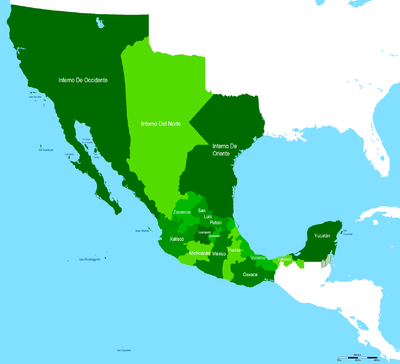
An overwhelming 80%  of the Dreamers were born in Mexico--a country with which the US has had troubled relations practically right from the very beginning.  In These Truths, Jill Lepore wrote about the tangled US/Mexico history and the imperial ambitions of the early presidents.  Texas, which is the largest state by area in the contiguous US, was particularly attractive to the enslavers who wanted to expand their cotton-growing land.  "As the United States swelled, Mexico shrank," Lepore wrote.

The following is a re-post from January 2019.
******************************************

The European settlers continued to displace people.  That's what alien settlers always do.  That is happening even now in contemporary times, like how the indigenous Miskitos are under assault in Nicaragua.

In the young USA, the leaders decided that they ought to displace Mexicans too.

Mexico was as large as the US in land area, and had a larger population:


"As early as 1825, John Quincy Adams had instructed the American minister to Mexico to try to negotiate a new boundary," writes Jill Lepore.  Yep, the new country was not even 50 years old.  trump's attacks on Mexico are merely the latest in this long history.

Why were the European settlers so interested?  The Mexican territories of "Coahuila and Texas, along the Gulf of Mexico, and west of the state of Louisiana, proved particularly attractive to American settlers in search of new lands for planting cotton."

Perhaps you have an immediate question: Working on the cotton fields meant slave labor; so, if somehow acquired by the US, would Texas allow slavery?

The anti-slavery north protested.  Mexico considered Texas its province, though a rebellious one.  The US wanted to annex it, and more.  The US laid a trap for Mexico in order to begin a war.  It was only a matter of time before Mexico fell into that trap.  Almost exactly to this date--on January 25th--back in 1845, "the House passed a resolution in favor of annexation."  And about slavery in Texas?  The resolution included a compromise: "The eastern portion of Texas would enter the Union as a slave state, but not the western portion."

From the 3/5ths compromise, the US has been at such dealmaking in favor of slavery; yet, we have a president in office who loudly wondered why they had never struck a deal in the past in order to avoid the Civil War!  What an ignoramus that 63 million elected only because he appealed to their racism, xenophobia, misogyny, and more!

President James Polk had grand dreams to extend the American empire; "Texas was only the beginning," Lepore writes.  He hoped to get Mexico into an armed confrontation, and it happened.  He asked Congress to declare war.

What would happen if the US won the war and gained territory?  Would Mexicans there now become Americans?  Quite a few leaders were against it.  "Ours is the government of the white man."  Would the new territory then be slave states as well?

As the war with Mexico came to and end in the second half of 1847, Polk "considered trying to acquire all of Mexico" from 26 degrees N all the way to the Pacific.  But, it was finally settled at 36 degrees north.  With a formal end to the war in February 1848, "the top half of Mexico became the bottom third of the United States."

Jill Lepore writes: "As the United States swelled, Mexico shrank."

Saturday, May 09, 2020

And yet it moves.

63 million Americans were fooled by a con man and they don't even know it.  Their Dear Leader is fooled time and again.  If only all of them understood something that is fundamental: "nature cannot be fooled."

Scientists have always worried that nature cannot be fooled, which is why some of them spent a lot of their time, energy, and money worrying about the next global pandemic.  Viruses abound in nature--I read somewhere that there are more than 500 strains of viruses in bats alone!--and they cannot be easily fooled by humans.  They do what they do in order to survive and prosper, just like any other life form does.

But then the 63 million couldn't care about science.  They actively engage in denying the very science that has made their lives also fantastic.

They denied, and continue to deny, the global climatic changes that have happened because of human actions over the past 200 years.

They denied, and continue to deny, the natural selection and evolution, and, therefore, the idea of mutation that makes possible for a virus to jump from bats to humans.

Nature cannot be fooled.

Now, 7.8 billion humans are terrified of a virus that we cannot see.

In this blog, and elsewhere, I have long been worried about the willful ignorance of the ideological crackpots who are adamant deniers of scientific understanding.  Every once in a while, some of those deniers have exhausted me (like here) by trying to debate on this issue--and this was not the kind of time-wasting that I like.

My faith in science is not like the blind faith that the 63 million--including this person--have in their Dear Leader.  My faith in science is based on logic and evidence.  The facts--not the alternative facts that the 63 million believe.

In my case, the faith is tested every day--the scientific method doesn't care for holy cows.
the word faith doesn’t mean “belief without good evidence,” but “confidence derived from scientific tests and repeated, documented experience.” You have faith (i.e., confidence) that the sun will rise tomorrow because it always has, and there’s no evidence that the Earth has stopped rotating or the sun has burnt out. You have faith in your doctor because, presumably, she has treated you and others successfully, and you know that what she prescribes is tested scientifically.
I wouldn't deny the evidence in front of me that the science-denying maniacs are in control of our lives.  But, this is not the first time that science-deniers have held the power.  It used to be way worse.

Thinkers like Galileo learnt from the experiences in the past and understood how important it was for scientists to be political in order to make sure that science trumps denial.
There’s an old belief that truth will always overcome error. Alas, history tells us something different. Without someone to fight for it, to put error on the defensive, truth may languish. It may even be lost, at least for some time. No one understood this better than the renowned Italian scientist Galileo Galilei.
Therefore, the "scientists putting their careers, reputations, and even their health on the line to educate the public can take heart from Galileo, whose courageous resistance led the way."

Those amongst us who have faith in science may have lost a battle or two, but we shall win the war against deniers.

Wednesday, May 06, 2020

Caitlin Flanagan has Stage IV cancer :(

You too would drop everything and read an essay when it has the title, "I Have Cancer and I'm Just Trying to Stay Alive".

And, my god, the subtitle! "My mantra used to be “Stage IV cancer! Could it get any worse?” Then it got worse."

Caitlin Flanagan writes about the long years of her battle against cancer.  It is touching. Moving. At times funny.  And snarky comments about tRump.

Her essay brings together plenty that we can and should think about in terms of what it means to be human.

Is Caitlin Flanagan disposable, in terms of tRump's calculus that the cure for COVID-19 must not be worse than the problem? She writes about that too.

Flanagan ends her essay with this: "Stage IV cancer during a pandemic when Donald Trump is the president!  Could it get any worse? No."

Sad.  Awful. Terrible. Tragic!

I have read many of Flanagan's essays before, and also used them, like in this post from 2015.  I wish her the best.  And, a big thanks for all her thought-provoking essays and commentaries.

The following is slightly edited version of the post from August 7, 2015.
*******************************************************

For a long time, I have been blogging about higher education, especially about:
The entire system treating students as if they are kids at a four-year camp;
The growth of bureaucracy to make sure students are happy and comfortable; and, thus,
Various kinds of "parental" disciplining of students; and, finally
Higher education being run more and more as a ponzi-kind of business scheme.
So, of course I was very happy to read this essay on how today's college students can't seem to take a joke.

The author, Caitlin Flanagan, has a track record of going after the contemporary variations of political correctness in education, and almost always I don't have too many disagreement with her takes.  In this essay, Flanagan reminds us about the context:
Two of the most respected American comedians, Chris Rock and Jerry Seinfeld, have discussed the unique problems that comics face on college campuses. In November, Rock told Frank Rich in an interview for New York magazine that he no longer plays colleges, because they’re “too conservative.” He didn’t necessarily mean that the students were Republican; he meant that they were far too eager “not to offend anybody.” In college gigs, he said, “you can’t even be offensive on your way to being inoffensive.” Then, in June, Seinfeld reopened the debate—and set off a frenzied round of op-eds—when he said in a radio interview that comics warn him not to “go near colleges—they’re so PC.”
Chris Rock and Jerry Seinfeld are no Puritans and their politics are nowhere conservative.  One would think that these two comedians would be an ideal fit for college campuses, right?  But, when these mainstream comedians complain about the PC environment that straitjackets them, well, hey, to the PC crowd they might as well be Fox News anchors, eh! ;)

Perhaps you are thinking, "don't colleges have better things to do with the money than to invite comedians to campuses to entertain students?"  If you ask such a question, then that means you have forgotten that residential colleges are less about education and more about student affairs.

Colleges, big or small, make sure students are sufficiently entertained--should I remind you about football and basketball?  Comedians and music groups are part of the mix.  Why?  Flanagan writes about that too:
it helps to think of college not as an institution of scholarly pursuit but as the all-inclusive resort that it has in recent years become—and then to think of the undergraduate who drops out or transfers as an early checkout. Keeping hold of that kid for all four years has become a central obsession of the higher-ed-industrial complex. How do you do it? In part, by importing enough jesters and bards to keep him from wandering away to someplace more entertaining, taking his Pell grant and his 529 plan and his student loans with him.
Resort is perhaps the best way to describe residential colleges anymore, with the fancy dorms, recreation facilities, fancy foods, and entertainment.  If I were being brutal, I would say that colleges are pimping out, but I would not say that; oops, did I write that? ;)

It seems so quaint that there was once a free speech movement on college campuses that pissed off the establishment.  Now, all those free speech students have all grown up and become the establishment.  And free speech is now harder to find in colleges than back then!

 Comedy is free speech.  If they were alive, George Carlin or Richard Pryor would not be allowed to perform on campuses!
When you talk with college students outside of formal settings, many reveal nuanced opinions on the issues that NACA [National Association for Campus Activities] was so anxious to police. But almost all of them have internalized the code that you don’t laugh at politically incorrect statements; you complain about them. In part, this is because they are the inheritors of three decades of identity politics, which have come to be a central driver of attitudes on college campuses.
 All because the establishment wants to "protect" the "kids." Only in colleges will you hear adults being referred to as kids!
Sarah Silverman has described the laugh that comes with a “mouth full of blood”—the hearty laugh from the person who understands your joke not as a critique of some vile notion but as an endorsement of it. It’s the essential peril of comedy, as performers from Dave Chappelle to, most recently, Amy Schumer understand all too well. But to enroll in college and discover that for almost every aspect of your experience—right down to the stand-up comics who tell jokes in the student union—great care has been taken to expose you to only the narrowest range of approved social and political opinions: that’s the mouth full of blood right there.
Oh well.

Tuesday, May 05, 2020

"Moonface" and "composite nationality"

While most of the country was asleep, my country's war-time President, Agent Orange, apparently went on a lengthy Twitter rant.

The Dear Leader, voted to power by 63 million, which includes a few of my neighbors and former commenters at this blog, was particularly upset at George Conway, who is married to the cheeto's lying aide.

The racist-in-chief knows all the racist usages out there, and he educates the rest of us who don't know that jargon.  The word today, boys and girls, is moonface.  Who knew there were such words that are used to insult!  He knows them all.

Source
Twitter immediately picked up on that, and Conway chimed in too:

Such is the behavior of the President who claims that he has been treated way worse than Abraham Lincoln was!

He and his racist base are trying their best to keep alive the racism and hate that has been a foundational aspect of these United States.  But, their days are numbered.  This is their final, dying, gasp.

What the racists fail to understand and appreciate is how easily immigrants create a “composite nationality" that Frederick Douglass envisioned.
In calling for a composite nationality, Douglass asserted that America’s strength lay in its capacity to welcome newcomers and make them Americans. Speaking at a time of growing hostility to Chinese immigration, he proclaimed that in America, immigrants added their talents, ideas, and energy, but in turn they were incorporated into the nation.
In a post slightly more than a year ago, which was a part of a series when reading Jill Lepore's These Truths, I blogged about Douglass and his open-door to immigration from anywhere.  The following is the unedited post from January 29, 2019:
*********************************

Since 1492, and since Mayflower, and since the Declaration of Independence and then the Constitution, it has been one chaos after another for non-whites.  As we get more into the Jim Crow era in Jill Lepore's narration of the history of the United States, we will remind ourselves about what she is exploring in this book:
The American experiment rests on three political ideas--"these truths," Thomas Jefferson called them--political equality, natural rights, and the sovereignty of the people. ...
Does American history prove these truths, or does it belie them?
And so far the evidence is ... awful!  The original inhabitants nearly wiped out. People from Africa imported, traded, and held as property.  An empire-building America provoked a war with Mexico and gobbled up the upper-third of its territory.  A horrible Civil War was fought in order to abolish slavery. Women were told that they shall not have rights to participate in politics.

Political equality? Natural rights? Sovereignty of people?

It was time to go after yet another group: Chinese immigrants.

Following the gold rush, "Chinese immigrants began arriving in the United States in large numbers during the 1850s."

Given the track record of white supremacy from 1492, it is easy to predict that the Chinese would have been attacked, killed, imprisoned, and their citizenship questioned, right?

It is incredible how when I was in the 8th or 9th grade, when Mr. Venkatesan taught (he was a horrible teacher anyway!) history, we were somehow led to understand that it was a glorious American political experiment, in which the only blemish was slavery, which too was corrected by Lincoln after the Civil War. And it was happily ever after!

So, people immigrated from China.
Chinese workers began settling in Boise in 1865 and only five years later constituted a third of Idaho's settlers and nearly 60 percent of its miners. In 1870, Chinese immigrants and their children made up nearly 9 percent of the population of California, and one-quarter of the state's wage earners.
Imagine white settlers looking across and seeing hardworking Chinese.   Oregon and California tightly restricted the rights of Chinese. 

Frederick Douglass was consistent in his view of human rights:


Again, this is the Douglass about whom the current president knew nothing!

As I noted in this post back in September, the United States passed a law to exclude the Chinese. To strip them of their citizenship. And the US Supreme Court even upheld this law in 1889!

Let's ask ourselves, again:
The American experiment rests on three political ideas--"these truths," Thomas Jefferson called them--political equality, natural rights, and the sovereignty of the people. ...
Does American history prove these truths, or does it belie them?